

Sample Category Title
Soft Signals
Soft US economic data sent incorrect signals over the past year but the mounting strength of survey data is increasingly difficult to disregard. For the second day in a row both the pound was the leader and the loonie was the laggard. Higher than expected employment figures and lower than expected jobless rate from New Zealand gave the kiwi a much-needed respite. The FOMC decision is due on Wednesday. The Dow "divergence" addressed in today's Premium video (below) has grown deeper today, setting up for suitable 2nd-half-of-the-week.
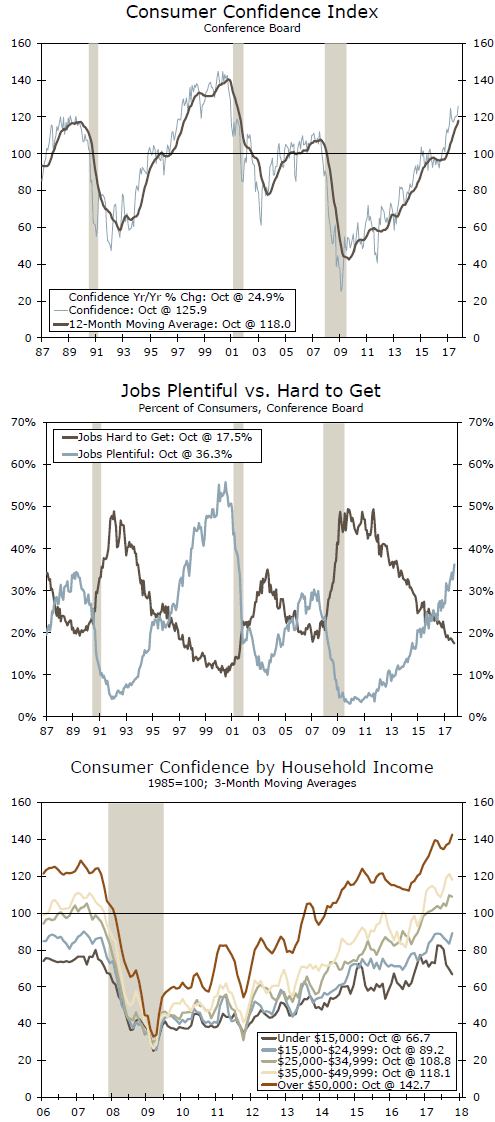
How strong is the US economy? If the consumer confidence survey from The Conference Board is an indication, it's at the best level since December 2000. The index hit 125.9 in October compared to 121.3 expected.
Manufacturing sentiment is also bubbly with the Chicago PMI rising to 66.2 compared to the 61.0 consensus. That's the best since March 2011.
The reports are a continuation of a string of strong data points that are simultaneously turning higher. Combine that with optimism about a tax cut and the US dollar is in a sweet spot.
USD/JPY climbed a half-cent on Tuesday as October came to a close. The pound also continued to benefit from speculation that Carney will hike this week with the possibility of hawkish commentary.
USD/CAD jumped after Canadian GDP contracted 0.1% in August compared to +0.1% expected. Poloz also reiterated that inflation risks are balanced and that the BOC will be cautious going forward. That virtually rules out a December rate hike.
Wednesday's FOMC decision is largely seen as a non-event but we think that's a mistake. The market is pricing in just a 0.8% chance of a hike and while it's still remote, the possibility of a hike is higher than indicated. Yellen may decide she doesn't want to hamstring her successor into only raising rates at meetings with a press conference.
Still, what's most likely is a continued pledge to gradually hike rates with hints of optimism on the economy but caution about the slow rise of inflation. That should be enough to keep a bid in the dollar.
Gold Slips on Solid PMI, Consumer Confidence
Gold has ticked higher in the Monday session. In North American trade, the spot price for an ounce of gold is $1269.13, down 0.56% on the day. On the release front, US indicators were impressive. CB Consumer Confidence jumped to 125.9, well above the forecast of 121.1 points. Chicago PMI improved to 66.2, its highest level since March 2011. Wednesday will be busy. The US will release two key events – ADP Nonfarm Payrolls and ISM Manufacturing PMI. As well, the FOMC will release its monthly rate statement.
The US consumer is optimistic about the economy, and that confidence has translated into stronger spending. CB Consumer Confidence jumped to 125.9 points, and last week's UoM Consumer Sentiment climbed to an all-time high of 100.7 points. Personal spending gained 1.0% in September, its sharpest gain since April 2016. The strong reading comes on the heels of Friday's UoM Consumer Sentiment Report, which hit an all-time record in September. Consumer spending is a key driver of the economy, accounting for two-thirds of economic growth.
The Federal Reserve is also in focus this week, with the release a rate statement on Wednesday. The Fed will almost certainly refrain from a rate hike, so analysts will be combing through the rate statement, looking for clues about future rate moves. The markets have priced in a December rate hike at whopping 96 percent, and the markets are looking for clues with regard to rate policy in 2018. This will depend to a large degree on the new chair of the Fed, who will take over from Janet Yellen in February. The two front-runners, John Taylor and Jerome Powell, have very different stances on monetary policy, which has created some suspense ahead of President Trump's nomination. Trump is expected to choose the new head before departing for Asia at the end of the week. Powell is expected to continue Yellen's incremental approach to raising rates, while Taylor is a proponent of much higher rates, as underscored in his "Taylor Rule", which calls for higher rates when inflation is high or the labor market is at full capacity.
Gold prices move inversely to interest rate hikes, so traders should keep a close eye on the Bank of England, which is widely expected to raise rates for the first time since 2007. Still, there is some dissension in the BoE, as some policymakers are against a rate hike. Both sides can point to economic data to make their case. Inflation is running close to 3 percent, and a rate hike would help curb inflation and bring it closer to the BoE target of 2 percent. Opponents of a hike point to an economy that has softened in recent months and argue that a rate hike would raise the pound, hurting exports. Although a rate hike is price in at 9o percent, the sheer significance of a rate hike could weigh on gold prices.
Pound Rally Continues Ahead of BoE Rate Meeting
The British pound has posted gains in the Tuesday session, continuing the upward movement seen on Monday. In North American trade, GBP/USD is trading at 1.3275, up 0.52% on the day. On the release front, British GfK Consumer Confidence came in at -10, matching the estimate. In the US, key indicators were sharp. CB Consumer Confidence jumped to 125.9, well above the forecast of 121.1 points. Chicago PMI improved to 66.2, its highest level since March 2011. On Wednesday, the UK releases Manufacturing Production. In the US, there are two key events – ADP Nonfarm Payrolls and ISM Manufacturing PMI. As well, the FOMC will release its monthly rate statement.
The pound has started off the week in strong form, gaining 1.4 percent. The currency ignored a weak GfK Consumer Confidence report, as the markets have priced in a 90% likelihood that the Bank of England will raise rates on Thursday, for the first time since 2007. However, BoE policymakers remain divided on a rate hike, and both sides can point to economic data to make their case. Inflation is running close to 3 percent, and a rate hike would help curb inflation and bring it closer to the BoE target of 2%. Opponents of a hike point to an economy that has softened in recent months and argue that a rate hike would raise the pound, hurting exports. At the end of the day, a rate hike of 25 basis points should not have a huge effect on the economy, but the sheer significance of the move could boost the pound against the greenback.
The Federal Reserve is also in focus this week, with the release a rate statement on Wednesday. The Fed is not expected to raise rates, so analysts will be combing through the rate statement, looking for clues about future rate moves. The markets have priced in a December rate hike at whopping 96 percent, and the markets are focusing on what the Fed has planned for 2018. This will depend, of course, on the new head of the Fed, who will take over from Janet Yellen in February. The two front-runners, John Taylor and Jerome Powell, have very different stances on monetary policy, which has created some suspense ahead of President Trump's nomination. Trump is expected to choose the new head before departing for Asia at the end of the week. Powell is expected to continue Yellen's incremental approach to raising rates, while Taylor is a proponent of much higher rates, as underscored in his "Taylor Rule", which calls for higher rates when inflation is high or the labor market is at full capacity.
US: Consumer Confidence Surges in October
Consumers certainly were not spooked in October. Overall consumer confidence jumped 5.3 points to 125.9, which marks the highest level for consumer confidence since December 2000. Gains were broad based.
A Spooky Good Number
Consumer confidence has been on a tear for much of the past year, having taken off immediately after the presidential election and building on those gains throughout the year. The overall index rose 5.3 points in October, with the present situation index climbing 4.2 points to 151.1 and the expectations series jumping 6.1 points to 109.1. Given the timing of the acceleration in consumer confidence, and the coincident upswing in the stock market, the improvement in consumer confidence has been viewed somewhat skeptically, as has the improvement in many other soft economic indicators. The hard data has vindicated the improvement in the soft data, with real GDP climbing at a 3 percent plus pace for the past two quarters and the unemployment rate tumbling to just 4.2 percent. With confidence up further in October, consumers see little to fear in the immediate economic horizon.
While consumer confidence is now at its highest level since December 2000, the run-up in consumer confidence looks more reminiscent of the 1997 period, when consumer confidence surged out ahead of what had been an unusually slow economic recovery and eventually became the longest and one of the strongest expansions on record.
The Consumer Confidence Index measures the breadth of consumer confidence rather than its magnitude. The 24.9-percent rise over the past year means more consumers are feeling optimistic about the economic environment than one year ago. Over this period, consumers' assessment of the present situation index has risen 22.7 percent, while their expectations for economic conditions over the next six months has risen 26.9 percent. The improvement in consumer confidence suggests that the improvement in the economy is broadening and reaching more regions and households.
Most of the improvement in consumer confidence has come from consumers' views on the labor market. The proportion of consumers that believe that jobs are plentiful has surged 43.5 percent over the past year, while the proportion that believe jobs are hard to get has fallen 19.4 percent. The proportion expecting more jobs to be created over the next six months has surged 35.4 percent, while the proportion expecting fewer jobs to be created has tumbled 28.9 percent. Consumers' improved perceptions about the labor market suggest that the run-up in the stock market is playing only a supporting role in boosting consumer confidence. After all, far more consumers have a job than own shares of stock.
Higher stock prices are likely boosting confidence among higher-earning households, a larger proportion of which tend to own stocks. Confidence among the lowest income households has fallen, however, likely reflecting sluggish wage and salary growth.
Yen Edges Lower as Japanese Household Spending Declines
USD/JPY has edged higher in Monday trade. In the North American session, USD/JPY is trading at 113.38, up 0.18% on the day. In Japan, Household Spending declined 0.3%, well of the estimate of +0.7%. Preliminary Industrial Production declined 1.1%, better than the forecast of -1.5%. As expected, the Bank of Japan maintained interest rates at -0.10%. In the US, key indicators were sharp. CB Consumer Confidence jumped to 125.9. well above the forecast of 121.1 points. Chicago PMI improved to 66.2, its highest level since March 2011. On Wednesday, the US releases two key events – ADP Nonfarm Payrolls and ISM Manufacturing PMI. As well, the FOMC will release its monthly rate statement.
It was business as usual from the Bank of Japan, which released its rate statement earlier on Tuesday. The BoJ maintained its commitment to guide interest rates at -0.10% and 10-year bond yields around zero percent. Despite weak inflation and wage growth, there has not been much pressure on the BoJ to change policy, as the Japanese economy has performed well in 2017. GDP expanded at an annualized 2.5 percent in the second quarter, buoyed by solid numbers from the manufacturing and export sectors. Consumer spending has improved, and retail sales in September improved 2.3%, compared to 1.7% a month earlier. Retail sales have risen for 11 consecutive months, as consumers appear more confident in the economy and have opened their purse strings.
The focus is on the Federal Reserve, which releases a rate statement on Wednesday. The Fed is not expected to raise rates, so analysts will be combing through the rate statement, looking for clues about future rate moves. The markets have priced in a December rate hike at whopping 96%, and the markets are focusing on what the Fed has planned for 2018. This will depend, of course, on the new head of the Fed, who will take over from Janet Yellen in February. The two front-runners, John Taylor and Jerome Powell, have very different stances on monetary policy, which has created some suspense ahead of President Trump's nomination. Trump is expected to choose the new head before departing for Asia at the end of the week. Powell is expected to continue Yellen's incremental approach to raising rates, while Taylor is a proponent of much higher rates, as underscored in his "Taylor Rule", which calls for higher rates when inflation is high or the labor market is at full capacity.
Fed to Hold Rates; No Surprises Expected from November FOMC Meeting
Policymakers at the US Federal Reserve begin a two-day monetary policy meeting today with an announcement expected at 18:00 GMT on Wednesday. With no move in rates anticipated at the November meeting and no accompanying press conference, the event is unlikely to receive much reaction in financial markets, especially as there is a bigger focus at the moment and that is who will be replacing Chair Janet Yellen when her term expires in February 2018. President Trump is due to announce his decision on his nominee for the Fed chief the following day on Thursday, November 2.
With a December rate hike now fully priced in by the markets, hawkish language in the FOMC statement will probably not cause much of a stir among investors. After a series of robust indicators on the economy, including stronger-than-forecast GDP growth during the third quarter, FOMC members are expected to strike a more upbeat tone on the economic outlook and signal a rate rise for the next meeting on December 12-13. They will also likely reiterate that they expect the current weak spot in inflation to be temporary.
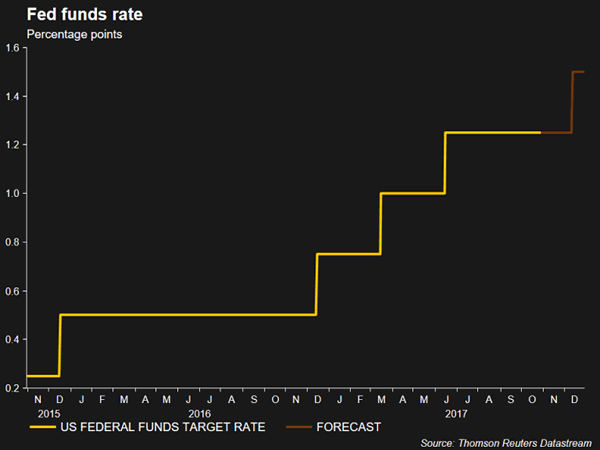
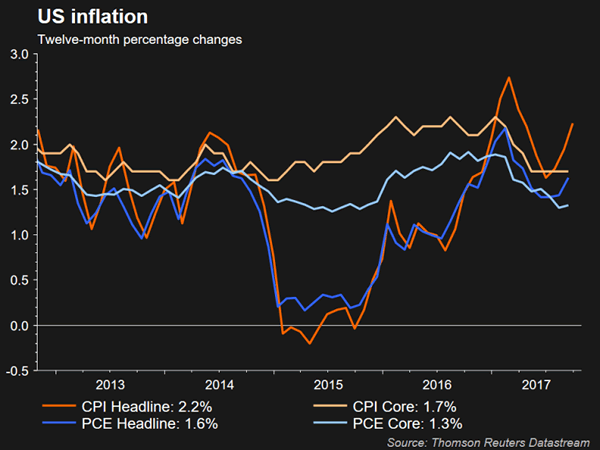
However, given that as the end of the year draws closer and underlying inflation has yet to show signs of a rebound, there may be some hesitancy for further rate hikes. The Fed's preferred measure of inflation, the core PCE price index, was unchanged at 1.3% in September, having retreated from 1.9% at the start of the year. Some committee members may feel uncomfortable about raising rates further until inflation is closer to the Fed's 2% objective. Any shift in the Fed's language on the inflation outlook in the statement to a more cautious one would be perceived as dovish.
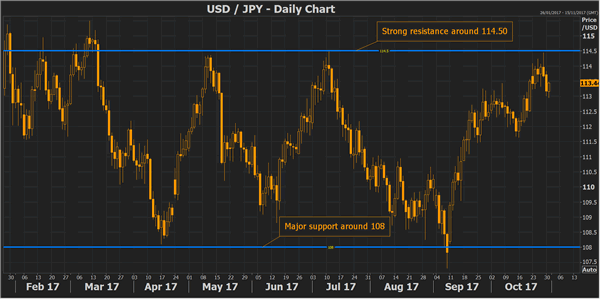
The US dollar could be more volatile to a surprise dovish statement than a very hawkish one. With political uncertainty surrounding Trump's presidency once again being heightened, the risk for a big sell-off seems greater than for a strong upside move. The dollar has already met strong resistance at around the 114.50 area against the yen and a push above that level is unlikely to come without major developments such as the passing of the tax bill and the appointment of a more hawkish Fed chair. If though the Fed surprises with not-so-confident comments about inflation, the dollar may find itself drifting back towards its active support region during 2017 around the 108-yen level.
Elliott Wave Trade Ideas Performance Update
5 positions were entered last week with total profit of 165 points and the positions are listed below.
16 Oct : AUD/USD - Short at 0.7875, exited at 0.7700 ( + 175 points)
24 Oct : EUR/JPY - Long at 133.20, exited at 133.50 (+ 30 points)
24 Oct : GBP/JPY - Long at 149.50, exited at 149.70 (+ 20 points)
26 Oct : GBP/USD - Short at 1.3175, exited at 1.3235 (- 60 points)
31 Oct : GBP/JPY - Short at 150.00,
| AUD EUR/JPY EUR/GBP CAD GBP GBPJPY
Jan - 15 -275 - 35 -120
Feb + 140 -17 - 40 +11
Mar - 20 +115 +132 - 19
Apr + 30 - 40 +120 + 45
May - 55 +100 - 6 -65 -60
Jun + 81 +150 - 10 +185 -120 +205
Jul - 40 - 60
Aug +155 +200 + 100 + 195 -45 - 50
Sep -50 + 165 + 5
Oct + 175 - 30 - 80 - 25 +140 +220
Nov
Dec
Y-T-D + 546 +38 + 87 +798 - 90 +305
Canadian GDP Fell by 0.1% Sending Loonie Lower
Despite positive data published in the Eurozone today, the EUR/USD price was still not able to lift out of the doldrums it's been in recently. The unemployment rate in the Eurozone declined to its lowest level since 2009 reaching 8.9%, which is 0.1% lower than expected. The preliminary report on GDP showed growth in the Eurozone of 0.6% in the third quarter against the 0.5% expected but was still not able to offset the negative sentiment of investors concerning the euro. Meanwhile, the consumer confidence index published by the conference board in the US improved marginally with the index now at 125.9, up from 120.6 in September. Traders are in no hurry to build up positions ahead of the FOMC statement on monetary policy which will be released tomorrow. In case of hawkish rhetoric and the rising possibility of an interest rate hike in December, we are likely to see the fall of the EUR/USD quotes continue.
The USD/JPY is trying to restore previously lost positions. The Japanese yen was under pressure following the statement of the Bank of Japan, according to which the monetary policy settings will remain ultra-soft until inflation reaches 2.0%. This stance by the Japanese regulator may result in continued rising dynamics for the pair, especially if monetary tightening in the US come through as expected.
The Canadian dollar kept falling today and the trigger for another powerful impulse has come from weak GDP data in Canada, according to which the country's economy contracted by 0.1% in August against an expected increase of 0.1%. Markets are likely to remain nervous in the next couple days and we may see sharp moves in different directions.
EUR/USD
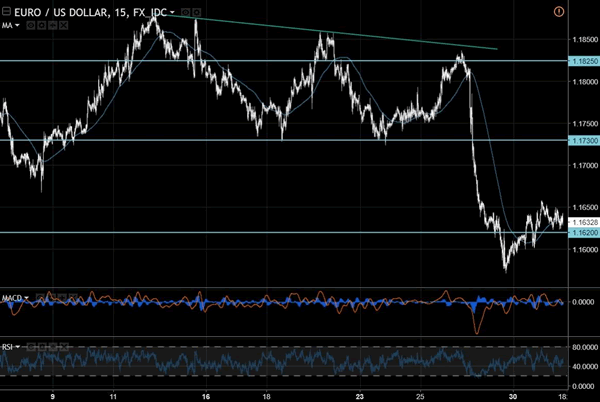
The EUR/USD quotes are consolidating above the important 1.1620 level below which the price could not fix previously. The possible rising movement may be limited by resistance at 1.1700 but it is more likely that we'll see negative dynamics resume with the closest targets at 1.1550 and 1.1500. After the completion of the current consolidation, we are likely to see a growth in volatility.
USD/JPY
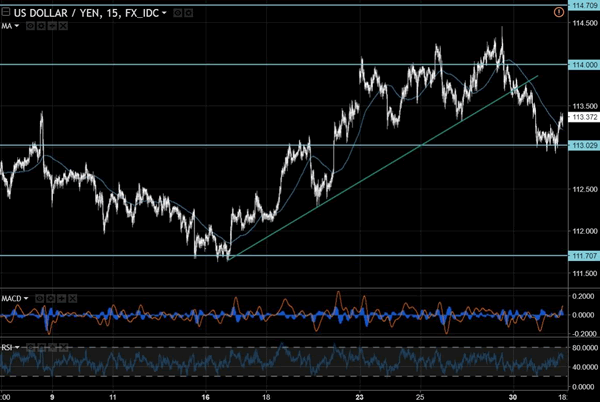
The USD/JPY quotes resumed their positive dynamics after they could not fix below the support at 113.00 and returned to the SMA100 on the 15-minute chart. The immediate objectives, if the current impulse continues, will be at 114.00 and 114.70. On the other hand, confirmation of the signal to sell may come from fixing under the support at 113.00.
USD/CAD
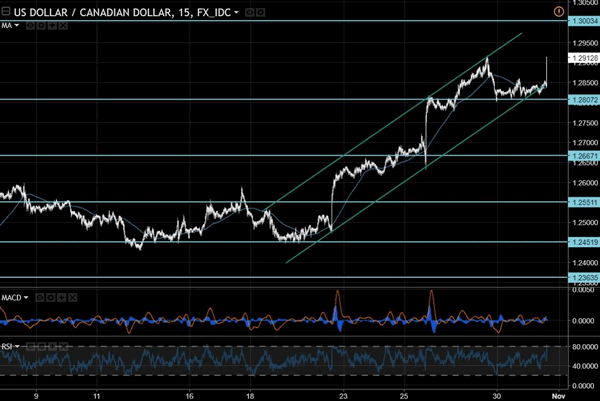
The USD/CAD has grown significantly after a long consolidation above 1.2800. Gaining a foothold above 1.2800 has become a strong basis for a future increase with potential targets at 1.3000 and 1.3200. The RSI on the 15-minute chart is in the overbought zone which indicates the possibility of a price correction. The amplitude of price fluctuations is likely to increase during the next couple sessions.
Loonie Falls Sharply on GDP Miss; Pound Boosted on Barnier; Eurozone Readings Mixed
The Canadian dollar lost ground versus its US counterpart as GDP figures unexpectedly reflected a contraction in the Canadian economy. Eurozone data on inflation, economic growth and unemployment out during today's session gave a mixed picture. The pound moved higher after some comments by Michel Barnier, the EU's chief Brexit negotiator, which suggested that Brexit talks are getting on the right path, while the dollar advanced following upbeat figures on consumer confidence.
The dollar's index against a basket of currencies was trading 0.05% higher on the day at 1458 GMT and was looking set to record its biggest monthly gain since February. On the month, the index is up by 1.6%. This also constitutes the second straight month of advances after retreating in the five months that preceded. Dollar/yen was last 0.2% up at 113.44, recovering from the 11-day low of 112.95 hit earlier in the day. The Fed's two-day meeting on monetary policy will be completed tomorrow. Policymakers are widely expected to hold rates steady and proceed with a 25bps rate hike in December.
Eurozone flash inflation figures for the month of October showed headline and core inflation easing to 1.4% y/y and 1.1% y/y respectively from September's 1.5% and 1.3%. The numbers were also below analysts' projections – headline inflation was expected to rise on an annual basis by 1.5% and core inflation by 1.2%.
Preliminary third quarter GDP estimates showed eurozone economies growing by 0.6% q/q. This was below Q2's upwardly revised 0.7% (from 0.6%) and above expectations of 0.5%. Year-on-year, growth accelerated by 2.5% from Q2's 2.3% and came in above the anticipated 2.4%. The unemployment rate also positively surprised, falling to its lowest since January 2009 as unemployment in the euro area continues to decline. September's unemployment rate stood at 8.9%, below the 9.0% forecasted by analysts. The respective rate in August was revised downwards to 9.0% from 9.1%.
Euro/dollar fell to the day's low of 1.1623 within minutes of the above data going public – all were released at 1000 GMT – with the weaker-than-expected inflation readings apparently carrying more weight (though the reaction in the forex markets upon data release was not significant). Soon after the euro made up for its losses relative to the greenback though. The pair last traded 0.1% lower on the day at 1.1635.
Monthly data on Canadian GDP showed the economy contracting by 0.1% m/m in August, falling short of expectations of growth by 0.1% – the economy stalled in July with the growth rate at 0%. The previous time the economy shrank was in October 2016. The contraction was partially attributed to maintenance shutdowns in the chemical and extractive industries and is consistent with last week's decision by the Bank of Canada to cut its projections for Q3 annualized growth to 1.8% from 2.0%. Figures on September producer prices released at the same time (1230 GMT), showed prices declining by 0.3% m/m, contrasting expectations for a rise by 0.4%. It should be mentioned though that many vehicles are priced in US dollars and thus become cheaper when the Canadian currency rises. In this instance, the strengthening Canadian dollar played a role in falling producer prices as had the dollar/loonie pair remained constant, the producer price index would have instead increased by 0.3% during the month.
Dollar/loonie rose sharply as the above readings went public to eventually rise to the day's high of 1.2914 (within breathing distance of Friday's three-and-a-half-month high of 1.2916). Before the release, the pair traded at 1.2837. Dollar/loonie was last 0.5% up on the day and not far below the 1.29 mark. The Governor of the Bank of Canada, Stephen Poloz, will, alongside Senior Deputy Governor Carolyn Wilkins, appear before the House of Commons Standing Committee on Finance at 1930 GMT.
In US data, the S&P CoreLogic Case-Shiller home price index showed a 6.1% annual increase in August to hit a record high. The gain was above the 5.8% anticipated by analysts while exceeding July's rise by 5.9%. Later in the session, the Conference Board's consumer confidence index outstripped expectations of 121.0 to stand at 125.9 during October, its highest since December 2000. September's reading was upwardly revised to 120.6 from 119.8. The dollar index moved higher following the release.
The British currency was boosted after Michel Barnier indicated that Brexit negotiations are ready to move forward. Pound/dollar was last up by 0.3%, trading not far below 1.3250, a level the pair breached earlier in the day. Euro/pound was 0.4% lower, trading near the one-month low of 0.8775 recorded today.
Kiwi/dollar was last trading 0.6% down on the day at 0.6833 ahead of Q3 employment figures for New Zealand due at 2145 GMT.
In commodities, gold was 0.5% lower, trading at $1,269.31 an ounce. The dollar-denominated metal tends to record losses whenever the greenback strengthens. WTI was lower by 0.2% and Brent crude down on the margin. The two benchmarks traded at $54.02 and $60.89 a barrel respectively. Despite the fall, they were both near their recently recorded multi-month highs. The American Petroleum Institute's (API) weekly data, including on crude stocks, will be released at 2030 GMT.
Candlesticks and Ichimoku Trade Ideas Performance Update
3 positions were entered among all 4 currency pairs with total loss of 65 points and the positions are listed below:
25 Oct : GBP/USD - Short at 1.3185, exited at 1.3220 (- 35 points)
25 Oct : USD/JPY - Long at 113.80, exited at 113.50 (- 30 points)
31 Oct : GBP/USD - Short at 1.3255,
| JPY EUR CHF GBP
Jan + 167 - 85 - 10 + 50
Feb + 200 +150 +93 - 59
Mar -23 -70 -23 - 35
Apr + 65 + 93 + 50 - 40
May - 65 - 35 + 100 -175
Jun -100 -10 - 10 +175
Jul + 85 - 35 - 8
Aug + 35 +210 + 35 +65
Sep +129 +210 +200 - 70
Oct - 35 +2 - 90 - 65
Nov
Dec
Y-T-D + 427 +425 +337 -144