

Sample Category Title
Q3 GDP: Hurricanes Dampen Growth, Sunshine Tomorrow
GDP rose 3 percent in the third quarter as domestic sectors showed some evidence of temporary moderation due to storms, but the economy is expected to sustain solid real growth in the fourth quarter and for 2018.
Domestic Spending: Slower Now, Longer-term Perspective
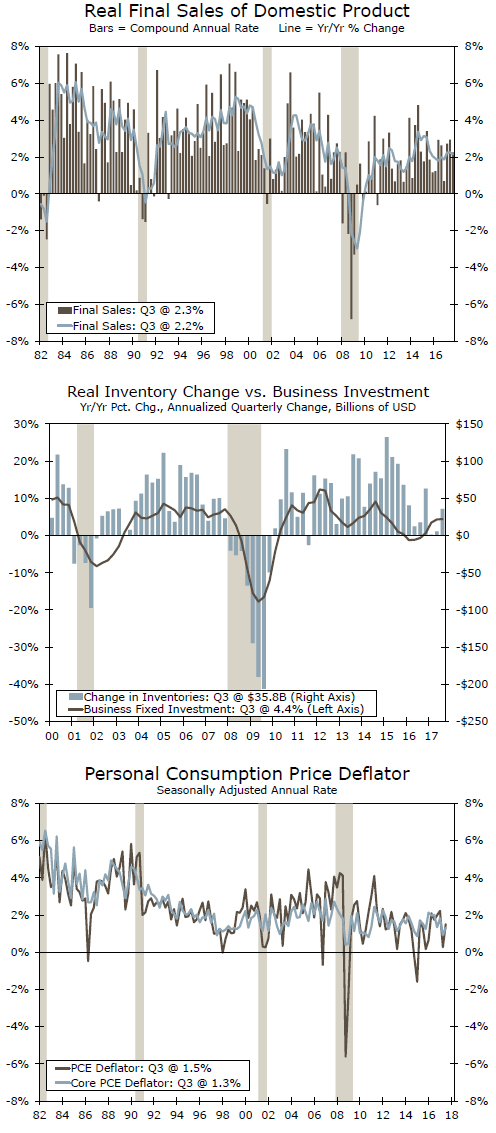
In the third quarter, spending by the consumer and business slowed as real final sales (top graph) came in at 2.3 percent compared to a gain of 2.9 percent in the second quarter and 1.9 percent for 2016. Government was a small drag on growth. In perspective, real GDP growth has averaged 2.7 percent since 1982, although the pace of growth in the current expansion is only 1.7 percent, down from 2.6 percent in the prior expansion. Going forward for real GDP, we expect a gain of 2.6 percent in the fourth quarter and 2.4 percent for 2018.
Consumer spending grew at 2.4 percent in the third quarter (3.3 percent in Q2) with gains in durables but slower in non-durables and services relative to their Q2 pace. This moderation is consistent with the slower pace of real disposable income and a modest hurricane effect. For investment, equipment was solid but structures fell while another real hit came in for residential investment (hurricane impact in TX and FL), which fell for the second quarter in a row. For the government sector, the real story is a second quarter of decline in state & local spending. So far this year, spending by state and local governments has been relatively flat.
Trade and Inventories: A Partial Score
Trade and inventory numbers provide a significant measure of volatility in initial and revised GDP estimates. The initial estimate for trade is that net exports will add 0.4 percent to GDP growth, with exports up 2.3 percent with gains in both merchandise and service exports, while imports fell 0.8 percent.
During Q3 inventories added 0.7 percent and this was a part of our forecast miss. For the second half of 2017, we anticipate a gradual reversion to the average gain in inventories for this expansion, in line with gains in final sales for both farm and non-farm inventories. This outlook is corroborated by the gains in the PMIs indices for inventory building. Inventory investment can be quite volatile over the business cycle (middle graph). In the current cycle inventory investment downshifted sharply in 2016/2017 compared to 2013-2015.
Prices: Sideways - Evidence for Caution in Policy for Investors
Overall GDP prices came in at 2.2 percent in the Q3, with the PCE deflator coming in at 1.5 percent, below the FOMC's 2 percent target.
Inflation, as measured by the PCE deflator, is not mean reverting, in fact, the pace of inflation has trended down since 1982. The PCE deflator has averaged 2.4 percent since 1982, 1.8 percent since 1994 (NAFTA) and 1.5 percent in the current recovery.
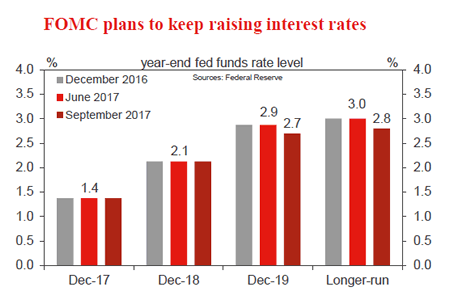
This pace of GDP growth would bring forth an FOMC increase in the fed funds rate in December and again one move in the first half of 2018 as well as a modest rise in the benchmark two and ten year Treasury rates.
Elliott Wave Analysis: USD Index Trading Bullish
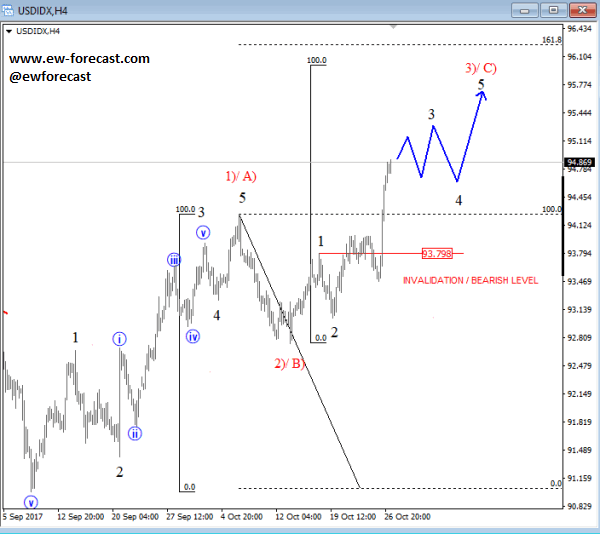
Good day traders! Let's look at USD Index and its 4h view.
USD Index broke to a new high of the month recently, so we have to respect what market is doing and go with the flow. It's a sharp rise from the last 24 hours that acts like a wave three of three so more upside is expect as wave 3)/C) is an impulsive wave, so it must be made by five subwaves. Based on Fibonacci projections there is room for 96.00, while market is above 93.79.
USD Index, 4H
Australia & New Zealand Weekly: Inflation Has Gone AWOL
Week beginning 30 October 2017
- Inflation has gone AWOL.
- Australia: private credit, house prices, trade balance, dwelling approvals, retail trade.
- NZ: residential building consents, business confidence, employment, labour cost index.
- China: official and caixin PMIs.
- Euro Area: GDP, CPI.
- UK: BoE policy decision.
- US: FOMC policy decision, PCE deflator, employment cost index, non-farm payrolls.
- Key economic & financial forecasts.
Information contained in this report was current as at 27 October 2017.
Inflation - Inflation Has Gone AWOL
The September quarter continued the run of softer inflation prints as the competitive margin squeeze remains firmly in place. Dwelling costs have lifted a bit and rising power bills are coming through but rent inflation remains very modest. So even with inflationary expectations drifting back towards the long-run average (we suspect power bills may be responsible for this) the September release is painting a picture that suggests the Australian economy may be in a low inflation (or lowflation) trap.
In the quarter, the CPI rose 0.6% for an annual pace of 1.8%yr while the average of the core measures gained 0.4%qtr/1.9%yr. The September quarter CPI has some significant seasonality with the seasonally adjusted estimate rising just 0.4%qtr which was 0.2ppt lower than the headline estimate.
The core measures, which are seasonally adjusted and exclude extreme moves, rose broadly as we had expected (0.35%qtr vs our 0.29%qtr forecast). In the quarter, the trimmed mean gained 0.37%, while the weighted median lifted 0.33%, highlighting just how modest the broader inflation picture is outside of housing. At 1.9%yr, core inflation was flat on the Q2 print which was just a modest acceleration from the recent low of 1.5%yr in 2016 Q4. More importantly, the six month annualised pace of core inflation has dipped below the RBA target band printing 1.9%yr. With revisions, the six month annualised pace has only broken into the RBA target band once in the last two years with a 2.1%yr print in the June quarter 2017.
For a broader core inflation measure, more in line with some international measures, all groups excluding food & energy rose 0.5%qtr/1.3%yr.
The softer than expected headline increase was due, at least in part, to food prices being softer than expected. Falling 0.9%qtr, this was driven by a larger than expected fall in the very volatile fruit & vegetables (-6.0%, worth -0.1ppt on the headline CPI compared to our forecast). We expect this to be reversed in the December quarter.
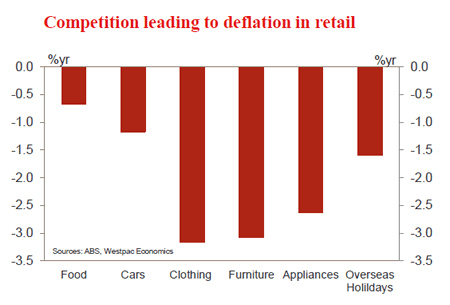
The tobacco excise is reset in the month of September but the 4.1% rise reported by the ABS (worth +0.05ppt compared to our forecast) was a bit stronger than we thought it would be. But more interestingly, the -0.09% fall in clothing & footwear was broadly in line with the trend through the previous three years. More broadly, the intense competition in the retail space has generated a significant deflationary pulse with food prices falling 0.7%% in the year, clothing down 3.2%yr, furniture down 3.1%yr and appliances down 2.6%yr. Even international holidays & travel has seen prices fall 1.6% in the year.
In the September quarter, there was an interesting upside surprise from recreation prices with audio, visual & computing prices jumping 1.2% while holiday travel was also stronger rising 1.9% vs our 0.4% forecast (due to a solid 4.1% lift in international holidays & travel). All up, the gains in recreation prices were worth +0.1ppt compared to our forecasts. We will continue to watch this sector as the rise in September was about double what you would normally expect and may be a sign that, at least in this sector, prices may have now entered a stronger trend.
The more interesting story was in housing costs which rose 1.9% vs our expectation of 2.6%. Dwelling purchases were a little stronger than we thought they would be but the bigger surprise was the softer than expected rise in utilities (6.8% vs 9.8% forecast). Electricity bills rose 8.9% vs our forecast of a 13% rise with Sydney power bills a touch softer than what we had expected. However, the key difference was the lack of price adjustment in Melbourne. If Melbourne electricity prices hold to the usual seasonal pattern, this suggests we should be looking for a meaningful jump in Melbourne power bills in the March quarter of 2018.
This smaller than expected rise in utility costs was worth around 0.2ppt on the headline CPI compared to our estimate. Hence this discrepancy explains a large part of why the headline print was 0.1ppt lower than our 0.7%qtr forecast.
Tradable prices are deflating again falling 0.3% in the September quarter, and breaking it down further, tradable goods fell 0.6%, mostly due to fruit & vegetable & auto fuel, while tradeable services rose 3.9% (mostly due to international holidays & travel). The tradables components represent approximately 35% of the CPI.
Non-tradables do reveal some inflationary pressure with a 1.0% gain in the September quarter. Non-tradable goods are where the strongest gains can be found with a 2.0%qtr increase on the back of rising electricity (8.9%) and tobacco (4.1%) prices. Here we would note two points; firstly it appears that rising electricity prices are having a bigger impact on margins than overall final goods and services prices; and secondly, the impact in the surge in tobacco prices will be moderated from the December quarter by the reweighting of the CPI which will see a reduction in the effective contribution of tobacco to the CPI. Non-tradable services gained 0.5%qtr with a 2.7% rise in motor vehicle services and 2.6% rise in property rates & charges. Non-tradables represent approximately 65% of the CPI.
For now, we are forecasting headline inflation to peak at 2.5%yr in the September quarter of 2018 but it is important to note that this is a bottom up estimate using the current sector weights in the CPI. Our preliminary estimate suggests that the reweighting of the CPI could shave between 0.2ppt and 0.4ppts off the annual rate of inflation by end 2018 (see "Upcoming CPI re-weighting to lower inflation"). And perhaps even more important, given that the run of soft updates point to the Australian economy being in a low inflation trap, it does appear that the risks to the underlying parameters of these forecasts also lie to the downside. We will be updating our inflation forecasts for the November market outlook and we expect that any revisions to our inflation profile will be to the downside.
The Week that Was
This week, the Australian Q3 CPI was the focal point for markets. We also saw key events conclude in China and Europe.
Starting with the CPI, both the headline and core results were below the market's forecast but very close to our own, the headline and core actuals coming in at 0.6%/1.8%yr and 0.35%/1.9%yr. By and large, where there were discrepancies between our forecasts and the ABS figures, the actuals disappointed. For further detail, see the essay above.
On the basis of this report, it is difficult to see Australia breaking out of the current low-inflation 'trap'. Our forecasts currently see annual headline inflation plateauing around 2.5%yr from September 2018. However, that excludes the anticipated negative impact of the December 2017 CPI re-weighting which should knock 0.2-0.4ppts off the pace of annual inflation by the end of 2018. Taking that into consideration, we foresee annual inflation around the bottom of the RBA's target range through 2017 and 2018 - a strong justification for the RBA to remain on hold through 2019.
Turning to China, the 19th National People's Congress drew to a close this week. Highlighting his position of strength, President Xi's "Thought on Socialism with Chinese Characteristics for a New Era" and belt and road initiative were written into the Party's Charter and he was also affirmed as the nation's "core" leader. Further, the structure of the new Politburo Standing Committee left no doubt that Xi Jinping plans to remain China's leader past the end of his second term as President (which runs from now until 2022).
From an economic standpoint, crucial to the outlook is the belt and road initiative and the drive to pursue productivity and efficiency. To make the next stage of China's economic development a reality, there is a need to upskill the population and provide opportunities for them to move into higher paid positions that will not only aid growth in total household income and wealth, but also see it distributed more equitably. Also crucial to the outlook is the broad array of financial and regulatory reforms that are in motion in China. These include, but are not limited to, improving the structural health of the banking and financial system; targeted deleveraging in some sectors; the aligning of foreign investment by Chinese nationals to the nation's objectives; protecting households' wealth and developing greater awareness of the risks associated with investments and debt; as well as the need to deepen capital account convertibility and financial market capacity.
Also on China, it is worth quickly highlighting the latest China property price report. In recent months, we have seen a broadening of price declines across the 70 cities that report. The vast majority of cities are still experiencing price gains, but authorities' actions are clearly being felt more. Arguably, officials are trying and target a period of price stability on average across the nation. That will mean some markets see modest price declines (after a very strong run up) while other less-developed regions continue to experience gains.
For Australia, the more important point to highlight is the clear downtrend in residential investment growth which, if sustained, will weigh on commodity prices and potentially demand. Together with the continuing downtrend in public and private business investment, softer residential investment supports our view that growth in China is set to slow, from 6.8% in 2017 to 6.2% in 2018.
Finally in Europe, the October ECB meeting delivered long-awaited detail on the plan to taper asset purchases in 2018. Broadly the decision was in line with our expectation. €30bn in purchases will occur per month from January to September 2018, down from €60bn per month in 2017. Further, President Draghi was at pains to highlight that the majority of the Council regarded the new program as open ended. To our mind, that speaks to another extension past September 2018, likely only for three months at around €15bn to smoothly phase out purchases. All things considered, it is likely that the ECB will find it much more difficult to justify balance sheet reduction and/or an increase in their policy rate (the refi rate) than in the US. The ECB's inflation forecast of just 1.5%yr in 2019 speaks to the substantial degree of slack that remains in their economy as well as the slow progress being made. We do not foresee any meaningful policy tightening in the Euro area over the forecast period, and would argue that risks to the outlook are skewed to the downside.
Chart of the Week: Major central bank balance sheets
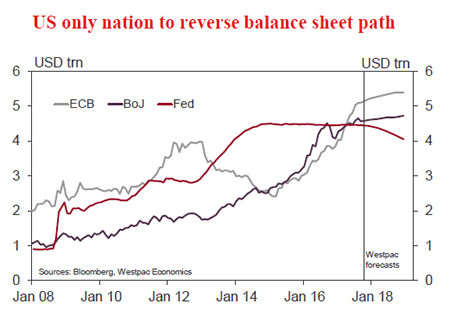
Recently, both the Fed and the ECB have reduced the accommodative support provided by their balance sheets.
After the Fed maintained a period of steady holdings, October marked the beginning of balance sheet normalisation which involves the gradual cessation of reinvesting a set amount of maturing securities.
This week's ECB announcement of a taper of their asset purchases to €30bn per month from €60bn sees the Bank continue on the path towards phasing out the program.
However, with Japan still seeing underlying muted inflation and Abe's election victory, it is likely that the BoJ's Yield Curve Control policy will continue to see them active in the JGB and other financial asset markets.
New Zealand: Week Ahead & Data Wrap
We expect next week's labour market report to show a solid rise in employment over the September quarter, though only slightly outstripping the growth in the working-age population. Strong net immigration flows have bolstered the workforce in recent years, but that pulse is now clearly in decline.
A range of indicators suggest that New Zealand's labour market has continued to strengthen this year, even as the wider economy has entered a period of slower growth. Business surveys report that firms have been hiring at a rapid pace and intend to continue doing so, though skilled workers are becoming increasingly difficult to find. And in our quarterly employment confidence survey, households were optimistic about job opportunities for the first time in nine years.
We are wary that the labour market tends to be a laggard in the economic cycle. For example, unemployment didn't start to fall consistently until several years after the recovery from the financial crisis began, and wage growth has been even slower to respond. So there's good reason to expect a solid set of labour market reports for the September quarter, but there are some clouds on the horizon for the jobs market next year if the current growth slowdown persists.
From the Household Labour Force Survey (HLFS), we expect a solid 1% rise in employment. That follows an unexpected 0.2% fall in the June quarter, which was at odds with a swathe of otherwise strong indicators for that period. We have a suspicion that the revamp of the HLFS in June last year may have altered the seasonal pattern of the employment series (though it will take several more years of data from the new survey to confirm this). If this is the case, we see the risks towards a stronger rise in employment in the September quarter as payback from the previous weak reading.
The drop in employment last quarter was accompanied by a sharp fall in the labour force participation rate, from a record high of 70.6% to 70.0%. We expect some of that drop to be unwound too. But given the potential for unpredictable moves in both of these series, we recommend focusing on the unemployment rate as the more reliable gauge of the jobs market. We expect a modest improvement in the unemployment rate from 4.8% to 4.7%, which would be the lowest rate since December 2008.
The decline in unemployment over the last few years has been a gradual one. Nevertheless, the labour market is moving closer to what could be considered 'tight' territory - that is, an unemployment rate that is associated with rising inflation. There's no agreement as to what constitutes 'tight', but the experience of the last decade provides a useful guide. Wage growth began to tick up in the early 2000s as the unemployment rate fell below 5%, but it really took off once unemployment fell below 4%.
We expect the Labour Cost Index (LCI) to show a mild pickup in underlying wage growth in the September quarter - largely as compensation for inflation, which has picked up from its lows. However, the headline LCI result is likely to be dominated by the impact of the recent equal pay settlement for caregivers in the health sector. This historic agreement will boost the wages of around 55,000 workers over the next few years, with the biggest increase coming into effect in July this year. We also expect to see some spillover to wage rates in associated occupations.
We estimate that this wage increase will add 0.4% to the LCI for the September quarter. Taking out that impact, our forecast implies a modest uptick in annual labour cost growth, from 1.7% to 1.8%. That doesn't sound like a big shift, but the LCI tends to evolve slowly over time - a 1.8% rise would be the strongest annual increase in nearly five years.
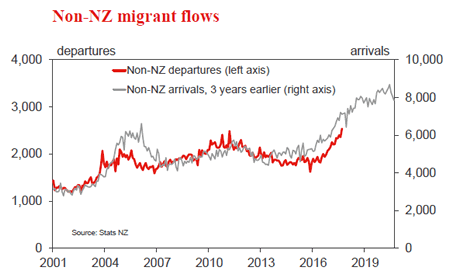
Developments in the labour market are in many ways entwined with the trends in immigration. New Zealand has seen a major shift in migration trends in recent years, with the balance swinging from around zero five years ago to a record net inflow of 72,400 people in the year to July. That has fuelled a strong lift in the working-age population, which is up by 2.4% over the last year.
Immigration has a complex interaction with the labour market. A rise in people numbers adds to both demand and supply within the economy as a whole. But the impact varies across sectors. For instance, an inflow of people is likely to be a net demand factor for the housing market - everyone needs somewhere to live, but only a small fraction of migrants go to work in the homebuilding industry.
It will be equally complex to tease out the implications of a slowdown in net migration, as we're expecting over the next few years. The newly-formed Government's policies are only one factor in this. The Government plans to tighten eligibility for student visas and low-skilled workers, which it estimates will reduce arrivals by 20-30,000 per year.
But this will come on top of a decline in net migration that is already underway. The key change has been a lift in departures of non-New Zealander departures, which have risen more than 20% in the last year. We've been expecting this for some time: a rise in arrivals, particularly those on temporary visas, is typically followed by some proportion of them leaving again, with an average gap of around three years. If that pattern holds, we can expect to see a further rise in departures over the next couple of years.
Even before the election, we were factoring in a drop in net migration to around 33,000 per year by the close of the decade (arrivals down ~20,000, departures up ~18,000). Now, with policy changes likely to put a further brake on arrivals, it's likely that the decline will be even more substantial.
Data Previews
Aus Sep private credit
Oct 31, Last: 0.5%, WBC f/c: 0.5%
Mkt f/c: 0.5%, Range: 0.3% to 0.7%
- Private credit is expected to expand by 0.5% in September, matching the average pace for the September and June quarters. Annual growth will be 5.6%.
- Housing credit is expected to increase by 0.5%, 6.6%yr. There is an emerging gradual slowing after a tightening of lending conditions. The 3 month annualised pace eases to 6.3%, down from 6.8% in March. The total value of housing finance grew by 15% in the year to January, but has stalled since.
- Business credit has emerged from a soft spot to record robust growth of late. We expect a gain of around 0.4%, bringing the 6 month annualised pace to 6.0%, while annual growth will be about 4.8%. Commercial finance has rebounded since February and business investment has turned around from declines to modest gains.
Aus Oct CoreLogic home value index
Nov 1, Last: 0.3%, WBC f/c: flat
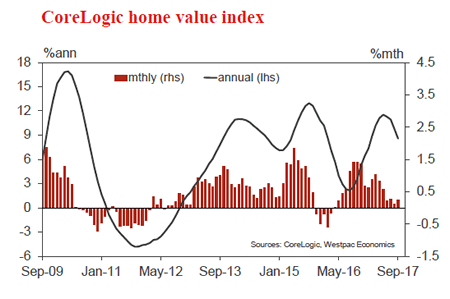
- The overhauled CoreLogic indexes provide a much more reliable guide to price changes and are now a clear 'benchmark' measure. In Sep, the combined capital city index rose 0.3%, annual growth slowing to 8.5%. Annual price growth peaked at 11.4% in May but has slowed materially as macro-prudential measures introduced in late March impacted. The slowdown in price growth has been particularly abrupt in Sydney.
- The daily measure points to a flat result in Oct, which will take the annual pace down to around 7%yr.
Aus Sep dwelling approvals
Nov 2, Last: 0.4%, WBC f/c: -3.0%
Mkt f/c: -1.0%, Range: -13.6% to 3.0%
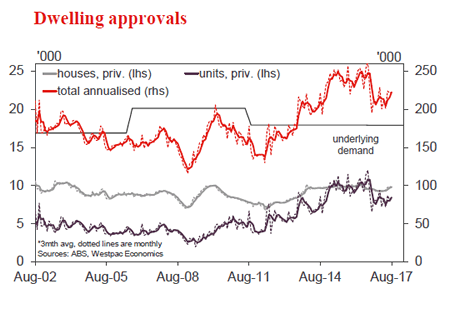
- Dwelling approvals rose 0.4% in Aug, essentially holding steady after an 11% jump back in June. The detail showed high rise approvals continuing to pull back sharply but offset by a strong lift in non-high rise approvals.
- We expect the support from non-high rise segments to drop away this month. After showing solid gains in previous months, construction-related housing finance approvals - a reasonable proxy for non high rise approvals - pulled back sharply in Aug-Sep. While there is invariably some slippage between finance and dwelling approvals, the non-high rise segment is unlikely to see continued strong gains. With high rise still winding down we expect total approvals to fall 3% in the Sep month.
Aus Sep trade balance, AUDbn
Nov 2, Last: 1.0, WBC f/c: 1.40
Mkt f/c: 1.20, Range: 0.45 to 2.00
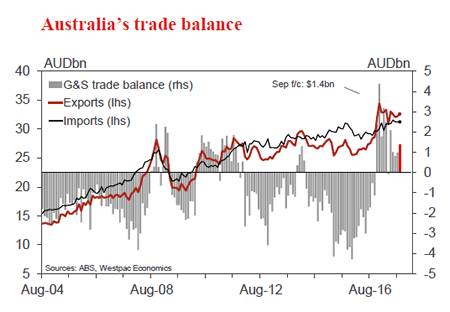
- Australia recorded a $1.0bn trade surplus in August, the 9th surplus in the past 10 months.
- The surplus is expected to widen to $1.4bn in September.
- Export earnings are forecast to increase by 1.2%, $0.4bn. Increased shipments in iron ore and coal outweigh a temporary dip in LNG volumes and a decline in the iron ore price, while gold is expected to rebound, reversing a modest pull-back in August.
- Imports are expected to be unchanged in the month. Note that the dollar was broadly flat in the month, up only 0.1% on a TWI basis and 0.7% higher against the US dollar, rounding up to 79.7¢.
Aus Sep retail trade
Nov 3, Last: -0.6%, WBC f/c: 0.3%
Mkt f/c: 0.4%, Range: 0.2% to 1.2%
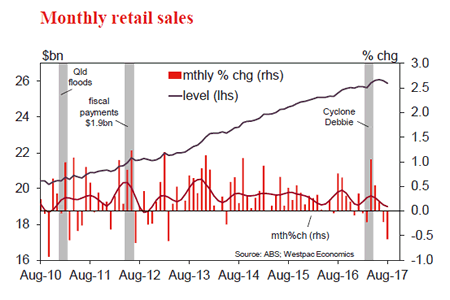
- Retail sales came in well below expectations in Aug recording a 0.6% contraction with Jul's flat result revised down to a 0.2% dip. Annual growth slowed to 2.1%, the weakest pace since June 2013. The 0.8% contraction over Jul-Aug is the largest 2mth decline since October 2010, near the tail-end of the RBA's 2009-10 tightening cycle.
- Consumer sentiment lifted in Sep-Oct, although pressures on family finances remained evident. Some drags, from higher mortgage rates and electricity prices, likely eased a touch and job gains remain strong but weak wages growth and concerns about potential rate increases and slowing housing markets are still clear negatives. Retailers are bearing the brunt of the spending slowdown and engaged in aggressive price discounting at the same time. We expect a better but still weak 0.3% gain for Sep.
Aus Q3 real retail sales
Nov 3, Last: 1.5%, WBC f/c: -0.1%
Mkt f/c: 0.0%, Range: -0.4% to 0.5%
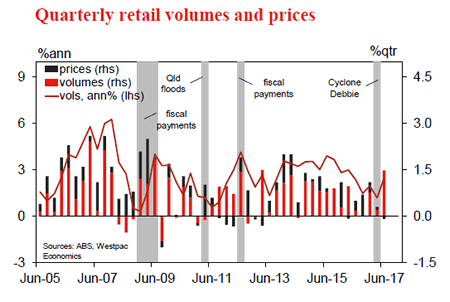
- The last four quarters have been very choppy for real retail sales, a flat Q3 last year, sales followed by a decent 0.8% bounce in Q4, another abrupt slowing as weather conditions impacted in Q1 (+0.2%) and a stronger gain in Q2 (+1.5%). At 2.5%yr, annual growth has slowed overall and is weak by longer term historical standards.
- The Q3 update will show another abrupt slowing with volumes expected to be down slightly in outright terms (-0.1%qtr). Nominal sales are on track to be down 0.2%qtr. The CPI detail suggests about half of this is due to aggressive discounting, food prices alone down 0.9%qtr (this segment accounts for 40% of retail). Note that the retail measure remains an imperfect guide to the broader spending estimates in the national accounts - although the direction for Q3 looks accurate.
NZ Sep residential building consents
Oct 31, Last: 10.2%, WBC f/c: -7.0%
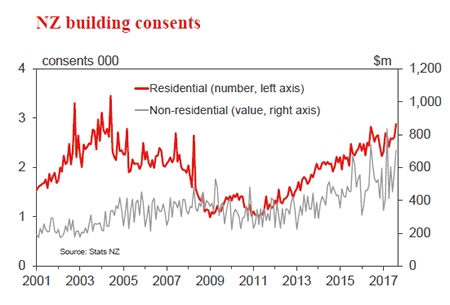
- Residential building consents jumped by 10% in August. The increase was driven entirely by consents for multiples (apartments, townhouses etc) which had their single biggest month in 13 years. This followed a shockingly low number in July.
- Smoothing through the month-to-month volatility, the pace of building in Auckland has flatlined over the last year, at a level well short of what's needed to match population growth. We continue to see moderate increases in most other regions excluding Canterbury.
- We expect the September consent figures to show an 8% drop in issuance as the recent volatility in multiple-consent passes. The underlying trend remains for moderate increase in building as factors such as the slowing housing market weigh on activity.
NZ Oct business confidence
October 31, Last: 0.0
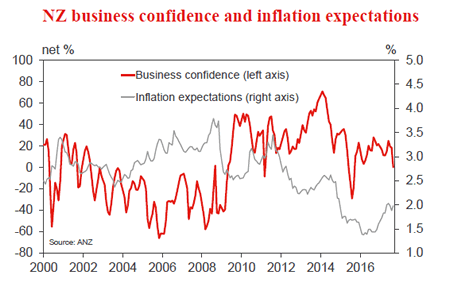
- New Zealand business confidence fell to a two-year low (0.0) in September, following a slightly soft result in August. While September's survey reflected the impact of election uncertainty, October's survey is likely to boast further concerns regarding the ensuing coalition discussions. However, given the timing of the survey the effect of the change in government is unlikely to be captured this month.
- Firms' own activity outlooks eased to 29.6, a low not seen since Q1 2016. Outside of the election, the September survey supports our slightly softer view of the economic outlook. The own activity results supports a GDP forecast of 2.5-3%, with economic growth for the year likely to ebb on the softer side of the range.
- Capacity utilisation fell sharply in the previous survey. Conversely, inflation expectations rose by 10 basis points to 1.98% (August: 1.88%), which is underpinned by the rise in overall pricing intentions and higher fuel prices observed over the month.
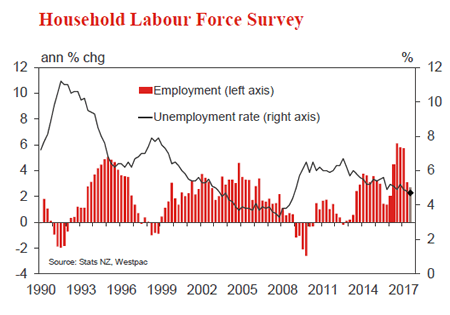
NZ Q3 Household Labour Force Survey
Nov 1, Employment last: -0.2%, WBC f/c: 1.0%, Mkt f/c: 0.8%
Unemployment, last: 4.8%, WBC: 4.7%, Mkt f/c: 4.7%
- A range of indicators suggest that New Zealand's labour market has continued to strengthen this year, even as the wider economy has entered a period of slower growth. We expect the Household Labour Force Survey to show another modest decline in the unemployment rate to 4.7%, which would be the lowest since December 2008.
- Both employment and labour force participation are subject to quarterly volatility. This issue may have been exacerbated by a change to the survey in June 2016, which led to a one-off jump in the level of employment, but in doing so may have disrupted the seasonal pattern of the series. Our forecast of a strong rise in both employment and participation reflects payback for their unexpected declines in the June quarter.
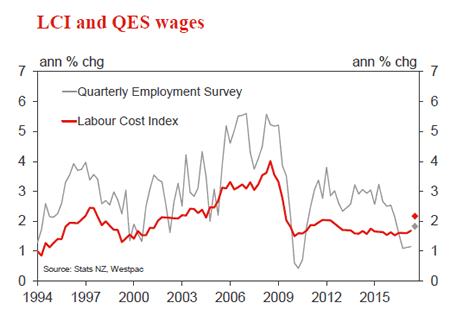
NZ Q3 Labour Cost Index
Nov 1, Private sector last: 0.4%, WBC f/c: 1.0%, Mkt f/c: 0.6%
- With the labour market gradually tightening, and inflation no longer at rock-bottom levels, we expect to see a pickup in wage inflation over the next year or so. The process is likely to be a gradual one, though, as the Labour Cost Index tends to evolve slowly over time.
- However, the September quarter report is likely to see a substantial jump in labour cost inflation, due to the recent equal pay settlement for healthcare workers. (Our understanding is that this will show up in private sector wages, though it's publicly funded.) Excluding this effect, we expect to see a modest uptick in annual labour cost growth, from 1.7% to 1.8%. In the context of this slow-moving series, this would be a five-year high.
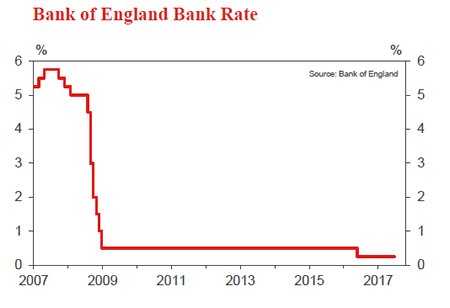
UK Bank of England policy decision
Nov 2, Last: 0.25%, WBC f/c: 0.50% Mkt f/c: 0.50%
- The Bank of England left the Bank Rate on hold at its September meeting. However, the MPC noted that activity had actually been a little stronger than they had expected. In addition, the accompanying minutes noted that if activity proceeds as expected "some withdrawal of monetary stimulus was likely to be appropriate over the coming months."
- While we continue to see the longer-term risk for growth as being skewed to the downside, the potential for a prolonged overshoot of the inflation target is clearly weighing heavily on the BOE. As a result, we expect the BOE to increase the Bank rate by 0.25bps at its November meeting. This will still leave the Bank rate at very accommodative levels. Further ahead, adjustments in the Bank Rate are likely to be very gradual.
US FOMC Nov policy meeting
Nov 1, fed funds rate, last 1.125%, WBC 1.125%
- The November FOMC policy meeting is unlikely to provide any new revelations.
- Chair Yellen and the Committee have very clearly highlighted an intention to continue gradually tightening policy, with the next move to come before year-end (i.e. at the December meeting). The market has since responded, almost fully pricing in a December hike. The November meeting will therefore simply confirm an impending move.
- At this juncture, the focus of markets is instead on who will be the next FOMC Chair. A decision is expected to come from President Trump by the end of next week. If the market rumours are to be believed, then Jerome Powell and John Taylor are in prime position. Both could be seen as more hawkish than Chair Yellen. Hence, on announcement, there may be a shift in market rate expectations for 2018.
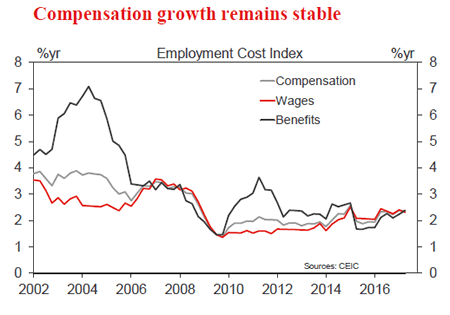
US Oct employment report and ECI
Oct 31, Employment Cost Index, last 0.5%, WBC 0.7%
Nov 3, nonfarm payrolls, last -33k, WBC 260k
Nov 3, unemployment rate, last 4.2%, WBC 4.2%
- The Employment Cost Index is the best gauge of overall wage and total compensation inflation in the US. In Q3, the annual rate is expected to hold around 2.5%.
- In contrast, a strong bounce is anticipated in nonfarm payrolls in October, 260k+, following the hurricane driven -33k print of September. Note that some of the rebound could also come in the form of a revision to September.
- The jump in household employment in September and an unemployment rate of 4.2% from the household survey (which was not affected by the weather) point to continued strength in the labour market which should be with us for some time yet.
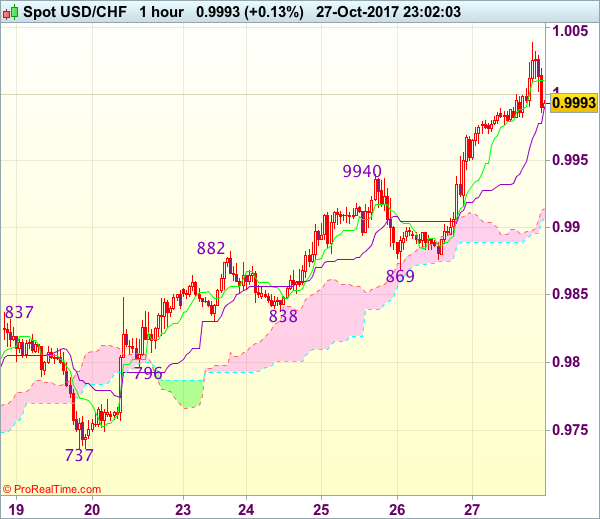
Trade Idea Wrap-up: USD/CHF – Buy at 0.9920
USD/CHF - 1.0000
Most recent candlesticks pattern : N/A
Trend : Up
Tenkan-Sen level : 1.0011
Kijun-Sen level : 0.9991
Ichimoku cloud top : 0.9914
Ichimoku cloud bottom : 0.9907
Original strategy :
Buy at 0.9935, Target: 1.0035, Stop: 0.9900
Position : -
Target : -
Stop : -
New strategy :
Buy at 0.9920, Target: 1.0030, Stop: 0.9885
Position : -
Target : -
Stop : -
As the greenback has retreated after rising to 1.0038, suggesting minor consolidation below this level would be seen and pullback to 0.9960-65 is likely, below would bring correction to previous resistance at 0.9940, however, reckon 0.9920-25 (38.2% Fibonacci retracement of 0.9737-1.0038) would limit downside and bring another rise, above said resistance at 1.0038 would extend recent rise from 0.9421 low to 1.0050-55, having said that, overbought condition should limit upside to 1.0075-80 and price should falter below 1.0100 resistance and bring retreat later.
In view of this, we are looking to buy dollar again on pullback as the upper Kumo (now at 0.9914) should limit downside, bring another rise later. Below 0.9885-90 (50% Fibonacci retracement of 0.9737-1.0038) would defer and suggest top is possibly formed, risk test of support at 0.9869.
Weekly Focus: Packed Week, With Central Banks in Focus
Market Movers ahead
- A host of important data is due out of the US next week, as well as the November FOMC meeting taking place. The meeting is not expected to yield much news.
- We still expect PCE inflation to be subdued, whereas the labour market report for October should come out strong, due largely to the September hurricanes.
- We expect the Bank of England to raise the Bank Rate by 25bp to 0.50%.
- Preliminary Q3 GDP for the euro area is expected to show a continued recovery, albeit with slightly lower growth than in Q2.
- Euro area headline inflation should have ticked down to 1.4% y/y in October (September: 1.5% y/y), due mainly to energy price base effects, leaving core inflation unchanged.
- We expect the Bank of Japan to keep monetary policy ultra-loose.
- Norwegian house prices are likely to attract some attention. We do not expect the recent trend of falling prices to come to an end.
Global macro and market themes
- Central bankers are keen to put the urge for a normalisation of policy on hold for now with the ECB delivering a dovish taper; Scandi central banks are in wait-and-see mode.
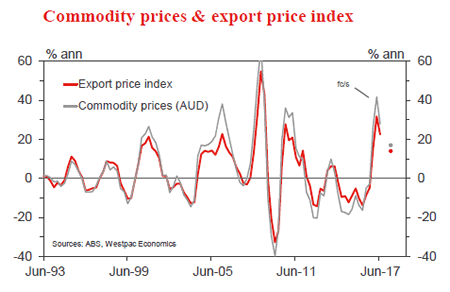
- Commodity prices are on the rise but policy makers need to see 'effective' labour market slack erosion before moving towards an 'exit' from unconventional policies.
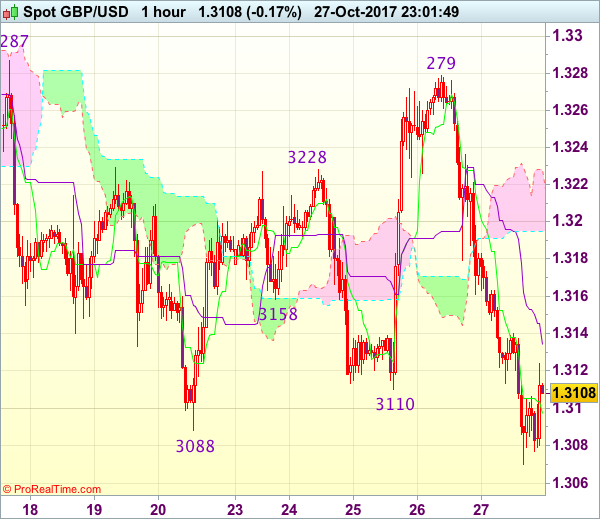
Trade Idea Wrap-up: GBP/USD – Sell at 1.3180
GBP/USD - 1.3114
Most recent candlesticks pattern : N/A
Trend : Near term down
Tenkan-Sen level : 1.3097
Kijun-Sen level : 1.3134
Ichimoku cloud top : 1.3228
Ichimoku cloud bottom : 1.3195
Original strategy :
Sell at 1.3160, Target: 1.3060, Stop: 1.3195
Position : -
Target : -
Stop : -
New strategy :
Sell at 1.3180, Target: 1.3080, Stop: 1.3215
Position : -
Target : -
Stop : -
As cable’s decline from 1.3279 has accelerated and price just broke below indicated support at 1.3088, adding credence to our view that the decline from 1.3338 is still in progress and may extend weakness to 1.3050, then towards recent low at 1.3027, however, break of latter level is needed to retain bearishness and confirm early erratic decline from 1.3658 top has resumed for further fall towards 1.3000 level.
In view of this, we are looking to sell cable on recovery, above the Kijun-Sen (now at 1.3134) would bring corrective bounce to 1.3160 but reckon 1.3180 would limit upside and bring another decline later. Above 1.3195-00 would defer and risk a stronger rebound to 1.3230-35, however, price should falter well below said resistance at 1.3279 and bring another decline later.
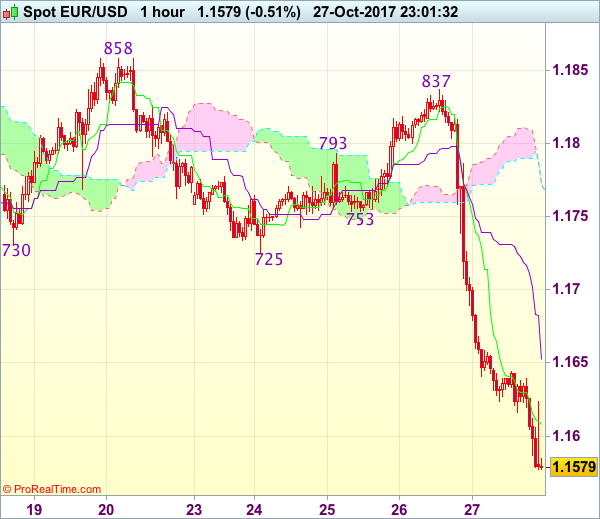
Trade Idea Wrap-up: EUR/USD – Sell at 1.1685
EUR/USD - 1.1583
Most recent candlesticks pattern : N/A
Trend : Down
Tenkan-Sen level : 1.1609
Kijun-Sen level : 1.1652
Ichimoku cloud top : 1.1772
Ichimoku cloud bottom : 1.1772
Original strategy :
Sell at 1.1685, Target: 1.1585, Stop: 1.1720
Position : -
Target : -
Stop : -
New strategy :
Sell at 1.1685, Target: 1.1585, Stop: 1.1720
Position : -
Target : -
Stop : -
Euro’s decline has gathered momentum after breaking below support at 1.1725 yesterday and previous low at 1.1669 was breached as well, adding credence to our view that the fall from 1.2093 top is still in progress and bearishness remains for this move to extend weakness to 1.1570, however, near term oversold condition should limit downside to 1.1550-55 and reckon 1.1520-25 would hold, bring rebound later.
In view of this, we are looking to sell euro on recovery but at a lower level as the Kijun-Sen (now at 1.1652) should limit upside and bring another decline. Only above previous support at 1.1725 (now resistance) would signal an intra-day low is formed, bring retracement of recent decline to 1.1750-55 first.
Dollar Flexes its Muscles on GDP Beat; Euro Headwinds on Catalan Independence
The dollar was standing broadly higher relative to most other major currencies as US quarterly GDP estimates beat expectations. However, the US currency gave up part of its gains later in the session as, according to a report by Bloomberg, US President Donald Trump is leaning towards Federal Reserve Governor Jerome Powell to lead the Federal Reserve after current Fed Chair Janet Yellen's term expires next year. News of Catalonia declaring independence from Spain during the session spurred euro selling on behalf of forex market participants.
Advance estimates of US GDP growth during the third quarter of the year showed the world's largest economy expanding at an annualized rate of 3.0%, surpassing estimates for growth of 2.5% and being just shy of the previous quarter's 3.1%. It was feared that the devastating effects of hurricanes hitting the country during the third quarter would considerably hamper economic activity but a considerable rise in inventory investment, in conjunction with a narrower trade deficit, helped the US economy to expand at an encouraging-given-recent-readings rate. The dollar broadly advanced relative to other majors as the numbers went public.
The dollar index, which gauges the greenback against the currencies of major US trading partners, was up by 0.3% on the day at 1445 GMT, standing at its highest since late July. On a weekly basis, the index was up by a bit less than 1.3%, looking set to record its biggest weekly gain so far this year. Dollar/yen was 0.2% lower on the day though and below the 114 mark after previously touching 114.44, its highest in three-and-a-half months.
Third quarter preliminary estimates for the core PCE price index were released at the same time as GDP numbers. The Fed's preferred inflation measure rose by 1.3% on an annual basis, matching expectations and at a faster pace than the respective figure for the second quarter which stood at 0.9%.
October final figures pertaining to the University of Michigan's Consumer Sentiment index, showed the gauge standing at 100.7, up from September's 95.1 but slightly below expectations for a reading of 100.9. The dollar was retreating as the numbers were released though that was attributed to news of President Trump's likely Fed chief pick rather than having to do with the survey.
The euro was already on the back foot after the ECB's perceived dovishness following the completion of its meeting on monetary policy yesterday. During afternoon trading hours, news on the Catalan parliament declaring independence from Spain after a secret vote added to views that political uncertainty is making a comeback in eurozone countries. Euro/dollar pierced though the 1.16 handle on the way down following the news to record a fresh three-month low of 1.1576. It later partially recovered to last trade 0.4% down on the day, at the 1.16 mark.
Indicative of the dollar's strength: pound/dollar was last down 0.3%, having recorded a near three-week low of 1.3068 earlier in the day. Dollar/loonie was 0.3% up, hitting a three-and-a-half-month high of 1.2916 during today's trading. Aussie/dollar was 0.05% lower, falling as low as 0.7622, a level not experienced since July 11.
Kiwi/dollar posted a notable rebound though, last trading 0.4% higher after earlier hitting 0.6816, a multi-month low.
In commodities, gold was 0.25% higher, trading at $1,270.20 an ounce after recording a three-week low of $1,263.35 earlier in the day. The dollar-denominated precious metal benefitted during later European session trading hours as the dollar was giving up on part of its gains. It yesterday lost 0.8% on the back of dollar strength. WTI was 1.5% higher at $53.41 a barrel and Brent crude was up by 0.9% at $59.90 per barrel. Both benchmarks traded at multi-month highs. The US Baker Hughes oil rig count is due at 1700 GMT.
Leap in US GDP to 3% Supports Greenback
US Gross Domestic Product showed the economy expanded by 3.0% in the third quarter of this year beating expectations of a 2.6% increase. The EUR/USD responded quickly and dropped following the data release as the chances of another round of monetary tightening in the US in December is looking more likely. The pair's decline began yesterday after the publication of the ECB's decision to leave the interest rates at the current level for an extended period and to reduce the amount of the asset purchasing program to 30 billion euro from January 2018. The stimulus program is slated to last until September of next year. The greenback is also supported by the expectation that the next Fed's Chair will have more hawkish views on monetary policy.
The British pound continued falling due to the strengthening of the greenback and belief that the anticipated rate increase by the Bank of England may be delayed. This, along with a lack of confidence on the outcome of trade talks between the UK and European Union, will restrain the bulls from building up long positions.
The USD/JPY price demonstrated positive dynamics due to the strength of the US dollar and rising interest in risky assets. The Japanese yen is traditionally considered a safe haven asset, the demand for which rises as investors' risk appetite wanes due to turmoil on the financial markets. Traders mostly ignored the inflation report in Japan as the core consumer price index remained at 0.7%.
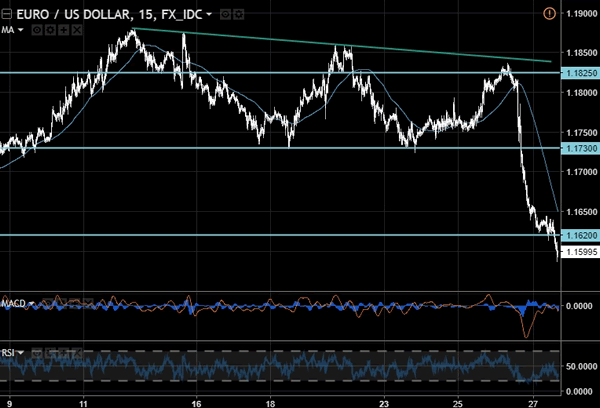
EUR/USD
The single currency was able to break through the strong support level at 1.1730, which has become a stimulus for further price drops to immediate targets at 1.1620 and 1.1550. At the same time, we do not exclude the price to rebound due to profit taking ahead of the weekend. In this case quotes may return to the 1.1700-1.1730 range, but this scenario is less likely.
GBP/USD
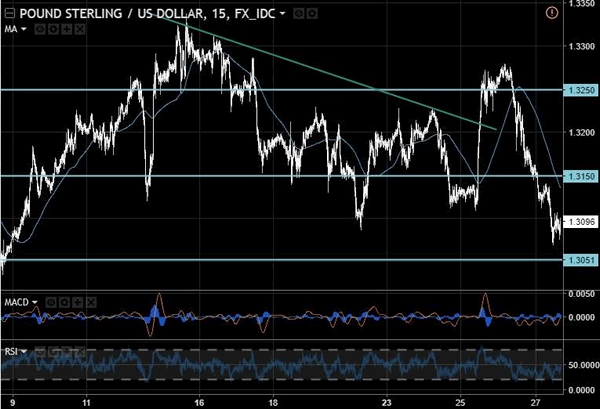
The British pound price keeps falling within the limits of the descending trend and breaking of the 1.3050 may become a strong stimulus for the price to decline to 1.3000 and 1.2900. The MACD signal line of the 15-minute chart approached the zero level and its crossing indicates the possibility of an upward price correction to the 1.3120-1.3150 range.
USD/JPY
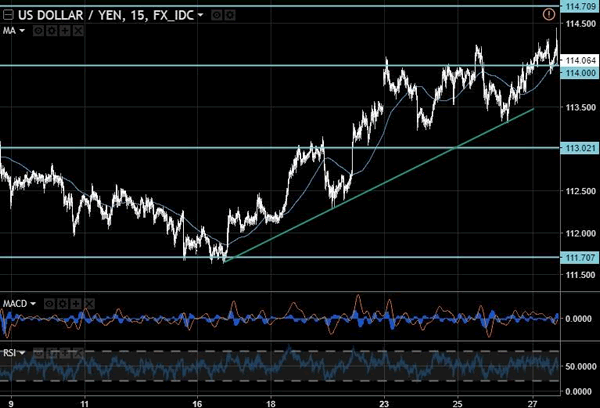
The USD/JPY is trying to gain a foothold above the strong resistance line at 114.00. In case of success, we are likely to see a continuation of the positive dynamics with the closest targets at 114.70, 115.50 and above. A descending movement within the correction is likely to be restrained by the rising trend line and SMA100 on the 15 minute chart.
Trade Idea Wrap-up: USD/JPY – Stand aside
USD/JPY - 113.82
Most recent candlesticks pattern : N/A
Trend : Near term up
Tenkan-Sen level : 114.08
Kijun-Sen level : 114.08
Ichimoku cloud top : 113.79
Ichimoku cloud bottom : 113.69
New strategy :
Stand aside
Position : -
Target : -
Stop : -
As dollar has retreated after intra-day brief rise to 114.45, suggesting consolidation below this level would be seen and pullback to the lower Kumo (now at 113.69) cannot be ruled out, however, reckon downside would be limited to 113.50 and support at 113.34 (yesterday’s low) should remain intact, bring another rise later.
In view of this, would not chase this rise here and would be prudent to stand aside for now. Above 114.45 would extend recent rise from 107.32 low for further gain to 114.75-80 (61.8% projection of 111.65-114.10 measuring from 113.24), however, overbought condition should limit upside to 115.00 and risk from there is seen for a retreat later.
