

Sample Category Title
Brent Oil Another Retest Expected
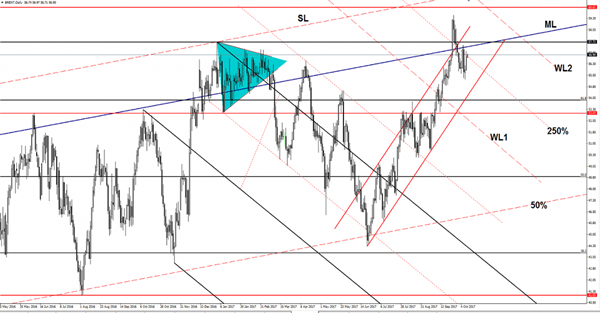
Brent increased in the yesterday's session and climbed above the 250% Fibonacci line (descending dotted line), but failed to close above it. Now is trading in the green and tries to climb towards the median line (ML) of the major ascending pitchfork where he may find resistance again. Technically, it should drop sharply as long as is trading below the ML, only a breakout above this dynamic obstacle and above the 57.72 level will announce an increase at least till will reach the 59.50 previous high.
USD/CAD Still In The Buyers Territory
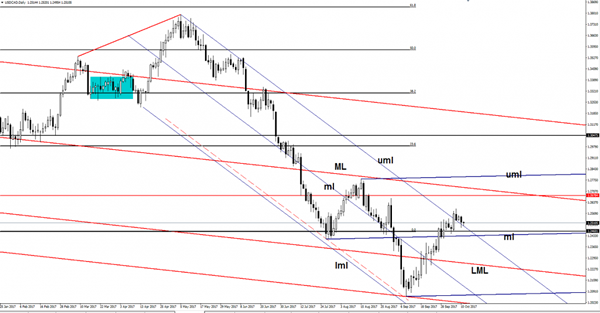
The USD/CAD decreased little today and stays much above the 1.2483 yesterday’s low. Price has come down to retest a broken resistance level and now is somehow expected to climb much higher on the short term. However, the rate could drop much deeper to test and retest some important support levels before will start another upside momentum.
Right now is very important to see what will happen on the USDX, which is located right above a critical support, a drop somewhere below the 93.30 level will signal a further drop and a USD depreciation.
Technically, the price should increase again, but unfortunately, the fundamental factors will take the lead and will drive the price. We may have a high volatility tonight after the FOMC Minutes will be released, a disappointment will demolish the USD.
USD/CAD retested the upper median line (uml) of the minor descending pitchfork and now should increase again. It could still drop along the upper median line (uml) till will reach and retest the 1.2460 static support and the median line (ml) of the blue ascending pitchfork. The next upside targets are at the median line (ML) of the major descending pitchfork and at the 1.2678 horizontal resistance.
Only a drop within the descending pitchfork’s body will signal a broader drop in the upcoming period, this scenario will take shape if the traders will be disappointed by a dovish FED.
GBP/JPY Daily Outlook
Daily Pivots: (S1) 147.96; (P) 148.23; (R1) 148.74; More
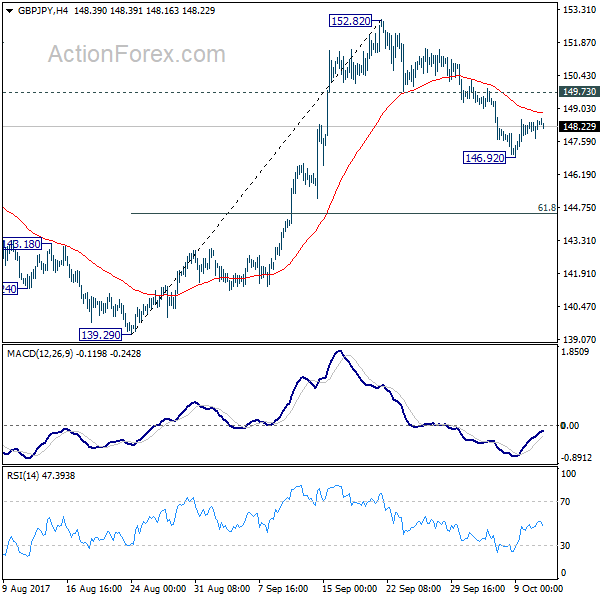
Intraday bias in GBP/JPY remains neutral for consolidation above 146.92 temporary low. Another decline is expected with 149.73 intact. Below 146.92 will target 61.8% retracement of 139.29 to 152.82 at 144.45. Such decline is seen as a correction and we'd look for strong support from 144.45 to bring rebound. On the upside, break of 149.73 support turned resistance will argue that the pull back is completed and turn bias back to the upside for retesting 152.82 high. However, sustained break of 144.45 will put 139.29 key support in focus.
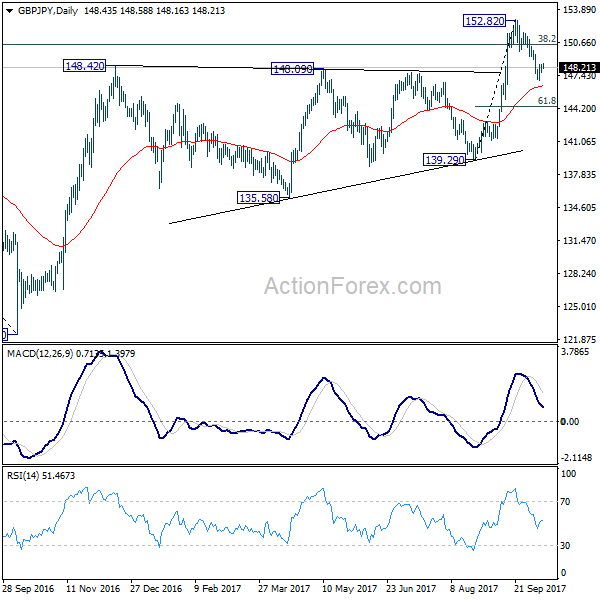
In the bigger picture, medium term rebound from 122.36 is still expected to resume after corrective pull back from 152.82 completes. Firm break of 38.2% retracement of 196.85 to 122.36 at 150.43 will carry long term bullish implications. In that case, GBP/JPY could target 61.8% retracement at 167.78. However, break of 139.29 will indicate rejection from 150.43 key fibonacci level. And the three wave corrective structure of rebound from 122.36 will argue that larger down trend is resuming for a new low below 122.26.
EUR/JPY Daily Outlook
Daily Pivots: (S1) 132.37; (P) 132.62; (R1) 133.02; More...
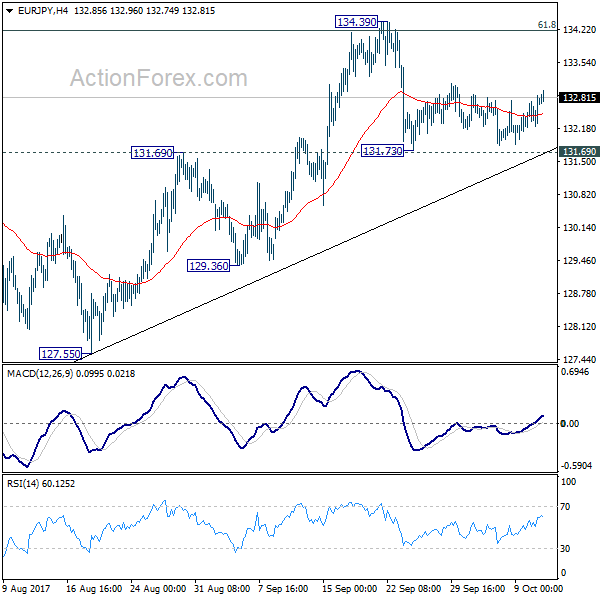
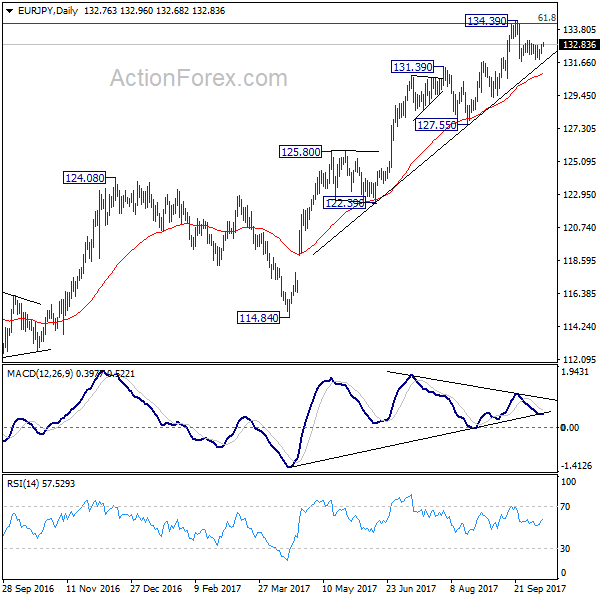
EUR/JPY is staying in consolidation in range of 131.73/134.39 and intraday bias remains neutral first. Near term outlook remains bullish as long as 131.69 holds. Sustained break of 134.20 fibonacci level will extend larger up trend to 141.04 resistance next. However, break of 131.69 will be an early sign of medium term reversal and will target 127.55 key support level instead.
In the bigger picture, medium term rise from 109.03 (2016 low) is seen as at the same degree as the down trend from 149.76 (2014 high) to 109.03 (2016 low). 61.8% retracement of 149.76 to 109.03 at 134.20 is already met. Sustained break there will pave the way to key long term resistance zone at 141.04/149.76. However, break of 127.55 support will argue that the medium term trend has reversal and will turn outlook bearish for deeper fall.
EUR/AUD Daily Outlook
Daily Pivots: (S1) 1.5132; (P) 1.5159; (R1) 1.5210; More....
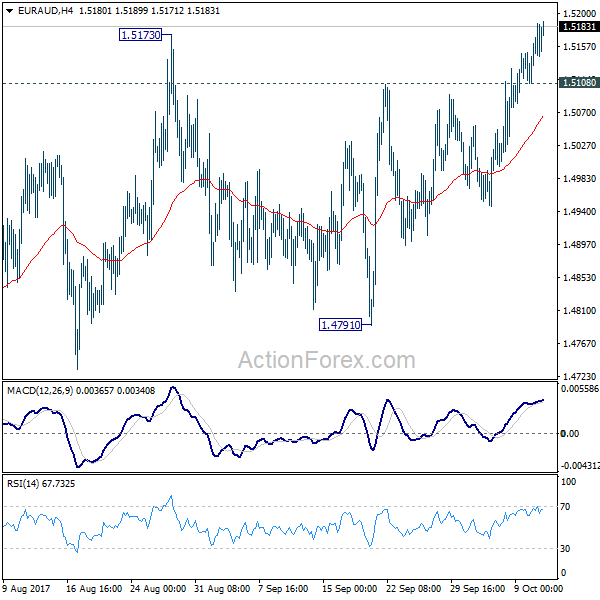
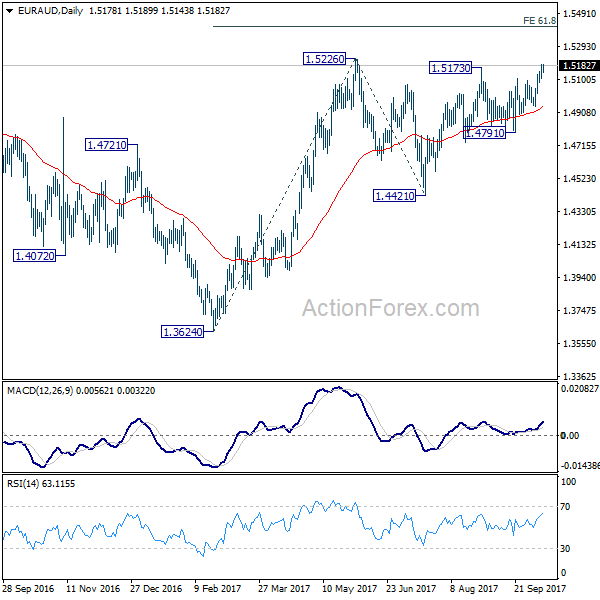
The break of 1.5173 resistance suggests that EUR/AUD's rise from 1.4421 is finally resuming. Intraday bias is back on the upside for 1.5226 key resistance next. Break there will also resuming the medium term rally from 1.3624. In that case, EUR/AUD should target 61.8% projection of 1.3624 to 1.5226 from 1.4421 at 1.5411 first. Break will target 100% projection at 1.6023 next. On the downside, below 1.5108 minor support will mix up the outlook and turn intraday bias neutral first.
In the bigger picture, we're holding on to the view that corrective decline from 1.6587 medium term top has completed at 1.3624. Rise from 1.3624 is expected to extend to retest 1.6587. The corrective structure of the price actions from 1.5226 is affirming this view. Above 1.5226 will target a test on 1.6587 key resistance. However, break of 1.4421 support will dampen our view and would drag EUR/AUD lower to retest key support zone around 1.3624.
Forex: Politics Influence Markets
With fears abating surrounding the threat of Catalan independence, the EUR moved higher overnight. Catalan President Puigdemont stated that, although the October 1st referendum had given him the mandate to pursue independence, he would 'suspend' the result for a period of a few weeks whilst he has discussions with Spain's Prime Minister Rajoy's administration. He commented that the greater European Union should be involved in any discussions as he tries to reassure many Catalan based companies that are threatening to leave the region.
UK Prime Minister Theresa May appears to have 'won back' several of her recent critics of her leadership. Many so-called 'Brexit Hardliners' in her own Cabinet have supported her recent comments on her contingency plans for leaving the European Union without a 'deal'. GBP recovered from its recent losses, but will be sensitive to any further political 'unrest' in the UK.
In the US, President Trump has dismissed the recent 'war of words' he had with Senator Corker over his, and his administration's, ability to govern. Trump has failed miserably during his tenure to get any of his policies approved and needs support, especially from within his own Republican Party, in order to get his Tax Reform policy through the US Senate. The recent 'spat' between Trump and Corker put the Tax Reform 'front and center' and resulted in a slight USD sell off, again those fears appear to be abated, but the markets will be closely watching for any more 'Trumpisms' that could bring his leadership into question.
Finally, the IMF raised its global growth rate targets for 2017 up to 3.6% from the previous 3.5% July estimate. For the US, growth is expected at 2.2% (prev. 2.1%), China expected at 6.8% (prev. 6.7%), Eurozone expected at 2.1% (prev. 1.9%) and Japan expected at 1.5% (prev. 1.3%). However, the IMF downgraded the UK's growth target to 1.7% (prev. 1.9%).
EURUSD is up slightly overnight and currently trading around 1.1819.
USDJPY is little changed overnight, currently trading around 112.38.
GBPUSD is lower by 0.1% in early Wednesday trading. Currently, GBPUSD is trading around 1.3198.
Gold is slightly higher in early trading at around $1,289.
WTI is 0.5% higher overnight, following news that Saudi Arabia will cut its Oil exports by 560K barrels a day in November. Currently, WTI is trading around $51.40.
Major data releases for today:
At 19:00 BST, The US Federal Reserve will release the minutes from their recent Federal Open Market Committee meeting (FOMC) held in September. Currently, the CME FedWatch tool is indicating an 89% probability of a rate hike in December. The majority of the FOMC members support the move, but there are some members who want to wait until US inflation moves higher.
EUR/GBP Daily Outlook
Daily Pivots: (S1) 0.8927; (P) 0.8941; (R1) 0.8956; More...
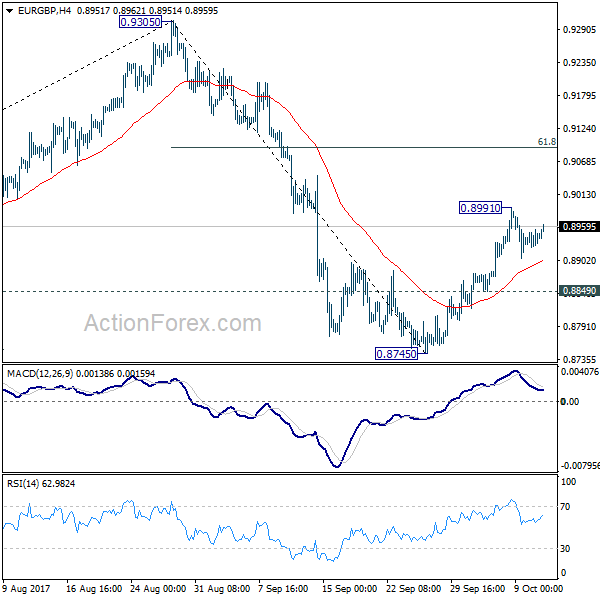
Intraday bias in EUR/GBP remains neutral for the moment. Another rise will be mildly in favor as long as 0.8849 minor support holds. Above 0.8991 will target 61.8% retracement of 0.9305 to 0.8745 at 0.9091. Break there will target a retest on 0.9305 high. However, break of 0.8849 will suggests that rebound form 0.8745 has completed. And, intraday bias will be flipped back to the downside to extend the fall fro 0.9305.
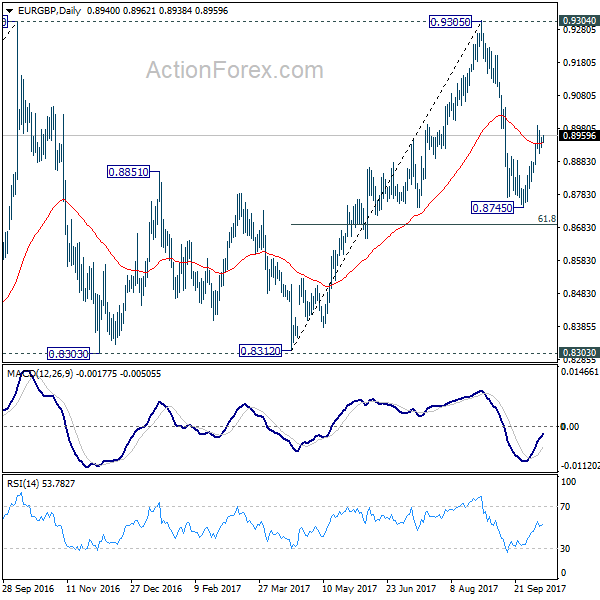
In the bigger picture, there are various ways to interpret price actions from 0.9304 high. But after all, firm break of 0.9304/5 is needed to confirm up trend resumption. Otherwise, range trading will continue with risk of another fall. And in that case, EUR/GBP could have a retest on 0.9303 low. But we'd expect strong support from 0.8116 cluster support (50% retracement of 0.6935 to 0.9304 at 0.8120) to contain downside.
EUR/CHF Daily Outlook
Daily Pivots: (S1) 1.1497; (P) 1.1511; (R1) 1.1526; More....
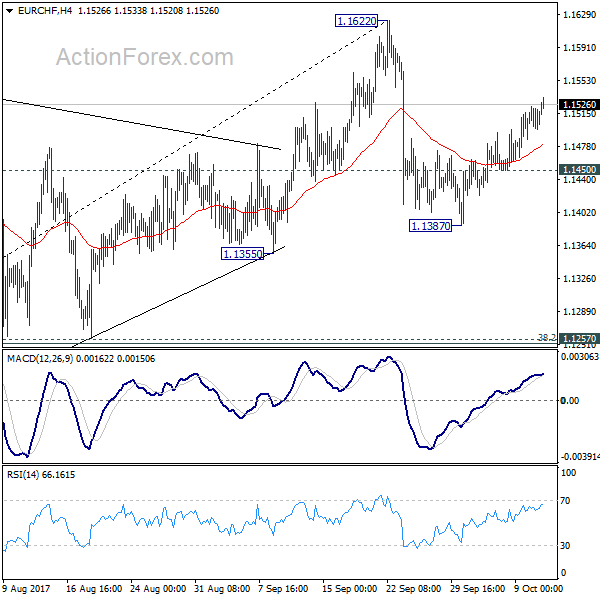
Intraday bias in EUR/CHF remains on the upside as rebound from 1.1387 extends. Further rally could be seen. But break of 1.1622 is needed to confirm up trend resumption. Otherwise, the consolidation from should continue with risk of at least another fall. Below 1.1450 will turn bias to the downside for 1.1387 and below. Strong support in expect at 1.1257 cluster support (38.2% retracement of 1.0652 to 1.1622 at 1.1251) to contain downside and bring rebound.
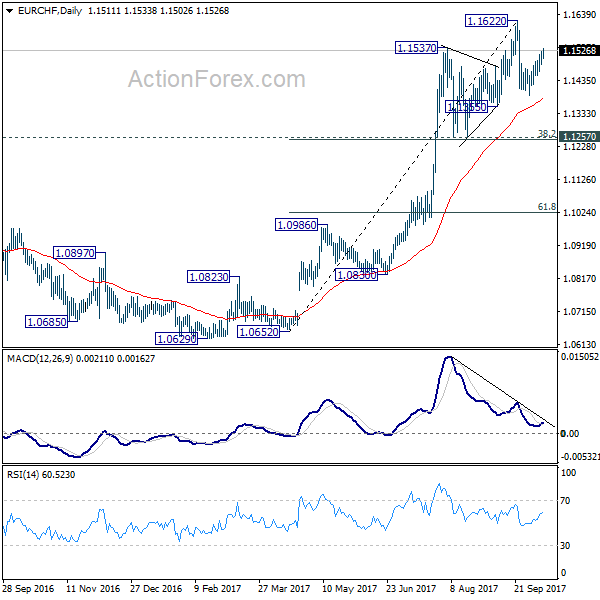
In the bigger picture, long term rise from SNB spike low back in 2015 is still in progress. EUR/CHF should now be heading back to prior SNB imposed floor at 1.2000. For now, this will be the favored case as long as 1.1198 resistance turned support holds.
Currencies: EUR/USD Profits Slightly From ‘Catalan Solution’
Sunrise Market Commentary
- Rates: Catalan issue not resolved yet, cautiousness remains warranted
Focus of today's trading session will be on Spanish-Catalan issue. Uncertainty remains high at this stage and continues to warrant some cautiousness vis-à-vis Spanish assets, while it might even support some safe haven flows in the Bund especially if we get a strong verbal response from Madrid. FOMC Minutes and a speech by ECB Praet (!) are wildcards. - Currencies: EUR/USD profits slightly from 'Catalan solution'
The dollar traded with a soft bias yesterday. EUR/USD finally regained 1.18 after Catalonia kept the door open for negotiations. The eco calendar offers no clues for FX trading today. The minutes of the September Fed meeting and a speech of ECB's Praet might be slightly USD supportive and/or euro negative.
The Sunrise Headlines
- US stock markets ended 0.1% to 0.3% higher after returning from the long weekend. Risk sentiment remains positive overnight with man indices clocking gains of around 0.5%
- Catalan leader Puigdemont stepped back from making a formal declaration of the region's independence as he called for more dialogue with Spain following last week's referendum.
- Theresa May risked upsetting both sides of the Brexit debate when she refused to say how she would vote in another Brexit referendum and appeared to suggest EU citizens' future rights in the UK were in doubt.
- The EC will present today a list of measures it plans to put forward by next spring on reducing bad loans held by European banks, a draft document said, a move that could slow similar moves by the ECB.
- Germany may need to wait until next year for a new government as the three blocs trying to form an alliance are so far apart they will need a deeply detailed coalition deal, a senior Bavarian ally of Chancellor Merkel has told Reuters.
- The leader of the small nationalist party that will decide New Zealand's next government said that "huge" progress had been made in coalition talks, but he has dropped a self-imposed deadline of Oct. 12 to announce a government.
- Today's eco calendar remains rather thin with only Minutes of the previous Fed meeting. Spain's cabinet holds an emergency session on Catalonia. Germany, the Netherlands and the US tap the market while several central bankers speak.
Currencies: EUR/USD Profits Slightly From 'Catalan Solution'
USD confined to tight ranges. Euro gains slightly
Yesterday, the dollar traded soft in Asia and this bias persisted in Europe early in the US. Later, the euro received a better bid as Catalonia leader Puidgemont applied some kind of a 'forward start' for the start of the independence after the referendum. EUR/USD closed the session at 1.1808. USD/JPY dropped to the 112.00 area early in US dealings, but finally still closed the session in well-knowterritory in the mid 112 area, propelled by new intraday highs on WS.
Overnight, Asian equities continue their uptrend with several indices nearing multi-year or even all-time record levels (Kospi). The dollar stabilizes after recent setback, but without an indication of a real comeback. Political bickering within the Trump administration raises questions on the ability to execute the tax reform plans. EUR/USD trades in the 1.1815 area. USD/JPY is little changed at 112.50. The Aussie dollar initially profited from a record bond auction and strong consumer confidence, but the gains evaporated. AUD/USD trades at 0.7780.
The eco calendar is again very thin. In the US, only US JOLTS labour market report is scheduled for release. It is interesting from an economic point of view, as it gives a richer pictures of developments inside the labour market, but it lags the payrolls. The FOMC Minutes are interesting. However, after the September meeting, the Fed eco and rate projections were published and Yellen elaborated during a press conference on the decisions and the outlook. Nevertheless, the debate on too low inflation may give us some interesting insights. ECB's Praet speaks after European trading in NY about the European exit strategies. Praet preaches slowness in changing the current ultra-easy policy stance. He might support the “lower (amount of monthly purchases), but for longer (in time)” tactic for the APP. In this way, the ECB may fight market expectations of higher official rates.
Yesterday the dollar traded soft for most of the day. The euro profited slightly from the news from Catalonia. This process might still go a bit further this morning, but we don't expect big euro gains. The stalemate in Catalonia isn't solved and it doesn't look the Spanish government is prepared to start negotiations. The Fed minutes should support the scenario of a December rate hike. The comments from Praet might be soft. In this context, we expect any EUR/USD rebound to run into resistance soon. It won't be easy for EUR/USD to regain the 1.1823/33 area in a sustainable way.
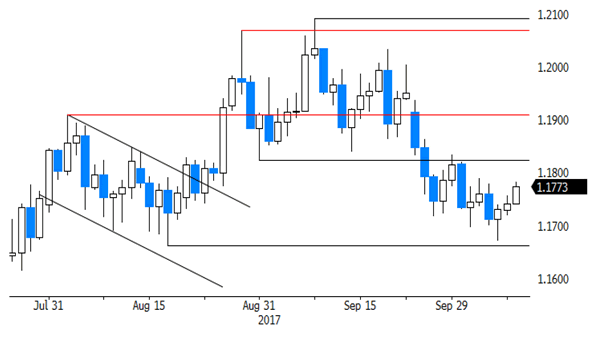
EUR/USD: EUR/USD returns to 1.1823/33 intermediate resistance
EUR/GBP
Sterling awaiting directional news
Moves in sterling were modest yesterday , even as there were plenty UK data. Those data painted a diffuse picture. UK (manufacturing) production rose at a fairly healthy pace in August (0.4% M/M) and Y/Y figures jumped higher due to revisions of earlier data. At the same time, the August UK trade deficit printed at a record as imports rose much more than exports. This set of conflicting data had no noticeable impact on sterling. EUR/GBP closed an uneventful session at 0.8943. Cable succeeded some modest further gains on overall USD softness. The pair closed the session at 1.3203.
There are no important eco data in the UK today. UK PM May will answer questions of the UK Parliament. She probably won't be able to bring any high profile news/progress on Brexit. We don't see a trigger for a clear directional move in EUR/GBP. The pair might continue to drift sideways in the 0.89 big figure, awaiting new eco or other news.
EUR/GBP staged a strong uptrend since April to set a top at 0.9307 late August. UK price data amended the dynamics and hawkish BoE comments reinforced a sterling rebound. Medium term, we maintain a EUR/GBP buy-on-dips approach as we expect the mix of euro strength and sterling softness to persist. The prospect of (limited) withdrawal of BOE stimulus triggered a good sterling countermove, but this rebound has run its course. EUR/GBP supports at 0.8743 and 0.8652 are difficult to break. We look to buy EUR/GBP on dips. Last week's rebound above the 0.89 area improved the ST technical picture of EUR/GBP. EUR/GBP 0.9026 is the 50% retracement of the recent countermove.
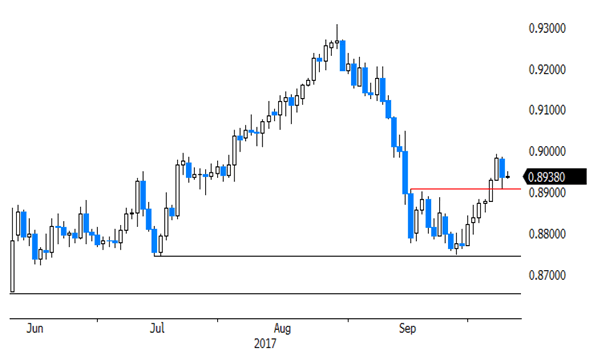
EUR/GBP rebound slows, but holds north of 0.89
EURUSD: Barely Moved During And After Puigdement’s Speech Last Night
Market movers today
FOMC minutes tonight are likely to confirm that the Fed is on track for a December hike, although with the market pricing this in with around a 70% chance, it may not change expect ations much. However, the minutes may reveal more about how the Fed's balance between a stronger economy and still too low inflation is viewed. Previous minutes have shown diverging views with one camp (majority) trusting the Philips curve (lower unemployment leads to wage pressure eventually) while another camp is in favour of await ing clearer signs that inflation is actually moving towards the Fed's target of 2%.
Today, we will also have Fed speeches by Evans (voter, dovish) and Williams (non-voter, neut ral).
The ECB's Peter Praet is due to speak tonight in New York. It seems that market consensus is moving in the direction of a ‘lower for longer' QE extension , i.e. EUR20 or EUR30bn for nine months due partly to recent signals from Praet .
In Scandi, Sweden is due to release Prospera inflation expectations.
Selected market news
Catalonian President Carles Puigdement last night refrained from making a formal declaration of independence. Addressing the regional parliament in Barcelona, Puigdement called for more dialogue with Spain while maintaining that the result of the referendum on 1 October had given his government a mandate to pursue independence but that he would hold off for ‘a few weeks' while negotiations take place. Focus now turns to the response from Madrid as Prime Minister Mariano Rajoy meets with his cabinet today.
EUR/USD barely moved during and after Puigdement's speech last night . The Bund future sold off slightly after the speech and while uncertainty prevails, the move suggests that on the margin it could be positive for Spanish government bonds on the opening today.
The IMF has lifted its global growth forecast for 2017 to 3.6% from 3.5% and for 2018 global growth is lifted 0.1 percentage points to 3.7%, the highest since 2010. Moreover, the US forecast is raised 0.2 percentage points to 2.3%, euro growth raised to 2.1% from 1.9% and China growth lifted from 6.7% to 6.8%. The global GDP forecast is broadly in line with our own project ions – we forecast 3.6% for both 2017 and 2018.
US President Trump last night said that he plans to make changes to his tax plan within the next few weeks without specifying which kind of changes he expects to make.