Sample Category Title
Canada’s Long GDP Growth Streak (Finally) Came to an End in July
Highlights:
- Canadian GDP held steady in July, failing to increase for the first time in 9 months.
- Goods-producing industries fell 0.5% - led by a pull-back in non-conventional oil extraction. Services output increased 0.2%.
- The strong run of earlier increases left GDP still up 3.8% from a year ago in July, reflecting broadly based increases across goods & services sectors of the economy.
Our Take:
Canada's 8-month long streak of monthly GDP growth finally came to an end in July with GDP holding steady at June's level. Most of the July weakness was in goods production with non-conventional oil production pulling back for a second straight month after a surge in output in May and manufacturing output inching lower. Services output rose another 0.2% in July despite a 0.6% drop in finance and insurance output that Statistics Canada noted may have been impacted by the timing of U.S. and Canadian holidays in July. The (unusually) long streak of increases over the prior year means that GDP was still up a solid 3.8% year-over-year in July, reflecting broadly-based gains across goods & services sectors.
More broadly, the slowing in GDP growth in July is consistent with our - and the Bank of Canada's - view that the recent outsized pace of growth over the last year won't be sustained going forward. That said, there is also a lot of room for growth to slow from the 3.7% average increase over the last four quarters and still be at an 'above-potential' pace. The July GDP increase was slightly below what we were expecting but at this point not enough to change our call that GDP will increase another solid 2.5% in Q3. Worries about the stronger dollar, the potential outcome of ongoing NAFTA renegotiations, and still below-target inflation readings will likely keep monetary policymakers cautious. We expect, though, the economy will continue to grow at a pace that will warrant further gradual rate hikes from the Bank of Canada.
Trade Idea Update: USD/CHF – Stand aside
USD/CHF - 0.9702
New strategy :
Stand aside
Position : -
Target : -
Stop : -
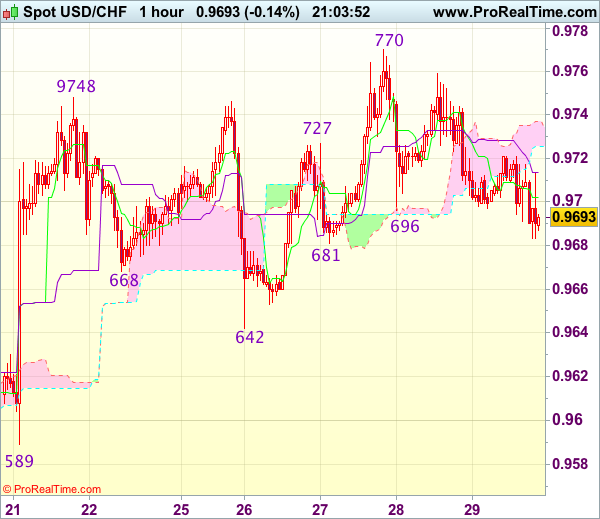
The greenback has remained confined within recent established range and further consolidation would take place, although the retreat from 0.9770 may bring test of 0.9681 support, break there is needed to suggest a temporary top has possibly been formed, bring subsequent weakness to 0.9660 but support at 0.9642 (this week’s low) should remain intact.
On the upside, whilst recovery to 0.9740-45 cannot be ruled out, said this week’s high at 0.9770 should remain intact and bring further consolidation later. Only break of indicated resistance at 0.9770-73 would signal recent upmove has resumed and the move from 0.9421 low would extend gain to 0.9800-10 and later towards 0.9840-50. As near term outlook is mixed, would be prudent to stand aside for now.
Trade Idea Update: GBP/USD – Hold long entered at 1.3375
GBP/USD - 1.3375
Original strategy :
Bought at 1.3375, Target: 1.3475, Stop: 1.3340
Position : - Long at 1.3375
Target : - 1.3475
Stop : - 1.3340
New strategy :
Hold long entered at 1.3375, Target: 1.3475, Stop: 1.3340
Position : - Long at 1.3375
Target : - 1.3475
Stop : - 1.3340
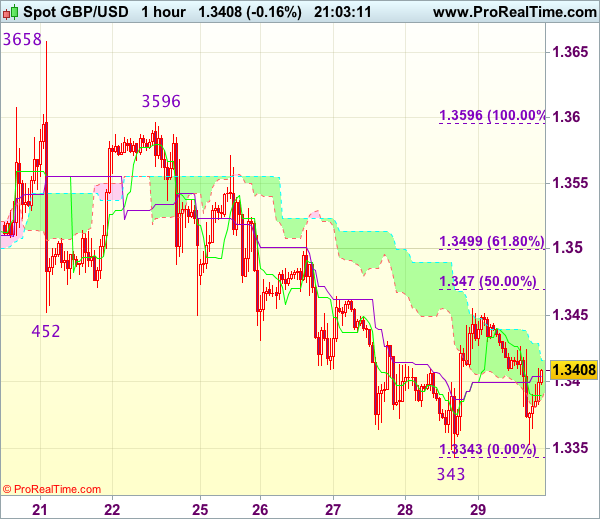
Although cable retreated after meeting resistance at 1.3455 and initial downside risk is seen, as long as support at 1.3343 holds, mild upside bias remains for another rebound, above said resistance would extend the rebound from 1.3343 to 1.3470 (50% Fibonacci retracement of 1.3596-1.3345), however, reckon resistance at 1.3514 would limit upside and price should falter well below resistance at 1.3571, bring another decline later.
In view of this, we are holding on to our long position entered at 1.3375. Only below said support at 1.3343 would abort and signal the selloff from 1.3658 top has resumed and extend weakness to previous resistance at 1.3329, then towards 1.3300.
Trade Idea Update: EUR/USD – Sell at 1.1855
EUR/USD - 1.1821
Original strategy :
Sell at 1.1855, Target: 1.1735, Stop: 1.1890
Position : -
Target : -
Stop : -
New strategy :
Sell at 1.1855, Target: 1.1735, Stop: 1.1890
Position : -
Target : -
Stop : -
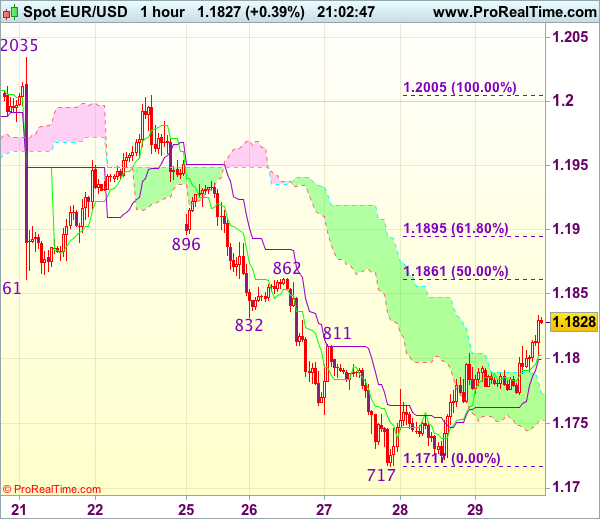
Euro’s rebound after holding above support at 1.1717 has retained our view that consolidation above this level would be seen and marginal gain from here cannot be ruled out, however, reckon upside would be limited to 1.1850 and renewed selling interest would emerge below 1.1861-62 (50% Fibonacci retracement of 1.2005-1.1717 and previous resistance), bring another decline later, below 1.1770-75 would bring weakness to 1.1740-45, break there would bring retest of said support at 1.1717, below there would signal the decline from 1.2093 top has resumed and extend weakness to 1.1700 but loss of downward momentum should prevent sharp fall below previous support at 1.1662 and reckon 1.1625-30 would hold.
In view of this, we are looking to sell euro on recovery as 1.1850-55 should limit upside and bring another decline. A firm break above previous support at 1.1832-38 (now resistance) should hold and bring another decline later. Above resistance at 1.1862 would abort and signal low is formed instead, bring a stronger rebound to 1.1896 (another previous support).
Autos and Oil Led to a July Pause in Canadian GDP
After notching up eight straight months of gains, the Canadian economy took a pause in July, as GDP was effectively unchanged on a month-on-month basis.
Unsurprisingly, only 11 of the 20 major industry groups saw output expand in July, representing roughly 52% of output - the smallest share since October of last year.
The goods producing sector held things back, pulling back 0.5% after four consecutive monthly expansions. Weakness was relatively widespread, as mining and quarrying contracted 1.2%, due largely to weakness in ¬oil and gas extraction. Construction activity fell 0.5% on weakness in the residential sector, while manufacturing output was down 0.4% on the back of motor vehicle manufacturing. As was noted in the manufacturing sales report earlier this month, this pullback appears to be the result of more significant than normal retooling activity at major auto plants in July.
Services remained the 'Steady Eddie' of the Canadian economy, expanding 0.2% in their 16th straight month of growth. Wholesale trade led the way, up 2.0% on broad-based strength. It was a more mixed story across the other major service sectors.
Key Implications
Well that isn't terribly encouraging. A softer report was to be expected given the impact of auto sector retooling, but in the event, July GDP still disappointed as the pullback in the oil and gas sector added to a generally weak month of activity for goods producing industries. The decline was big enough to outweigh growth in the service sector - which saw its 16th month of growth - its longest run since 2006.
With some of the weakness down to one-off factors, a resumption of growth in August appears to be a reasonable assumption. However, with growth tracking 2.2%, effectively in line with our Quarterly Economic Forecast for the third quarter, it appears that the red-hot growth seen in the first half of the year is likely behind us.
Like the other July economic data, today's report only partially reflects the impact of Bank of Canada tightening, and so is likely to be discounted by policymakers. But, when taken together with Poloz's more cautious tone this week, the case for additional monetary tightening in the very near-term does look somewhat weaker.
GBPUSD Tests Support on GDP Revision
The British pound has moved below the 1.3400 level against the U.S dollar during the European trading session, hitting 1.3353, after the United Kingdom's second quarter annual gross domestic product figure was revised lower to just 1.3 percent.
Intraday trading sentiment surrounding the GBPUSD pair is currently bearish, with the pair risking further losses while price-action remains beneath the 1.3400 level.
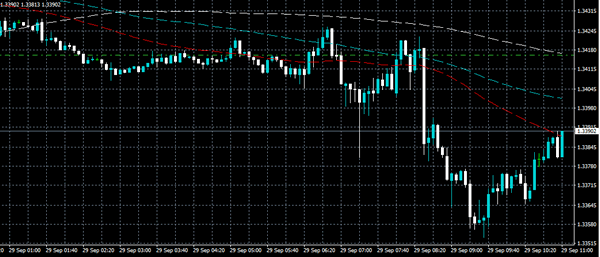
Despite the GBPUSD pairs sharp decline after today's negative economic news, solid buying interest from lower levels is still present, with price-action starting to recover bullish momentum.
Furthermore, the GBPUSD pair has so far created a bullish higher daily price low, with buyers coming in just above yesterday's weekly low, at 1.3443.
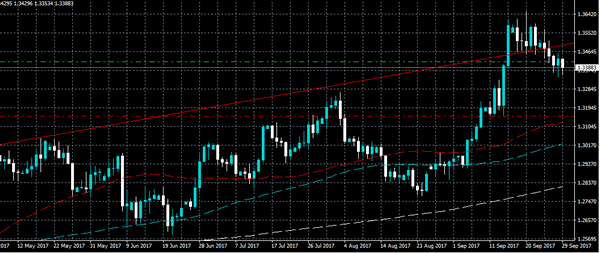
Key intraday technical resistance is now found at 1.3400 and the daily pivot point, at 1.3413. Above the 1.3413 level, the pair may find a buying surge towards 1.3443 and 1.3504.
To the downside, a higher time-frame price-close beneath the pairs 200-week moving average, at 1.3363 should trigger further intraday losses towards 1.3343 and 1.3300.
USDJPY Intraday Bearish Below 112.71
The U.S dollar has moved lower against the Japanese Yen, as the greenback retraces to key support, and investors seek further details from the Trump administrations proposed tax reforms.
Today's intraday trading sentiment surrounding the USDJPY is currently bearish, as buying momentum wanes, and the pair fails to trade back above the former weekly price-high, located at the 112.71 level.
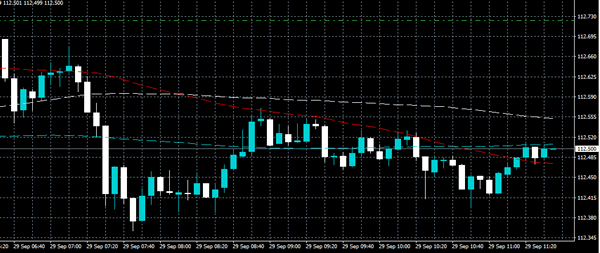
With a lack of economic data on the U.S docket, the focus during the U.S session will turn to end of month price-flows and the weekly price close on the USDJPY pair.
Last week the USDJPY closed price above its 200-week moving average, at 111.69, for the first time in 8-weeks. Traders will pay close attention to a bullish, second consecutive weekly price closes above the pairs 200-week MA.
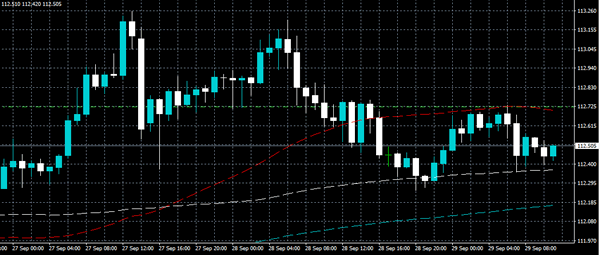
To the downside, key intraday technical resistance is found at the current daily price-low, at 112.27 and the pairs weekly pivot point, at 111.90. Below 111.90, the pair fast approached its 200-week and 200-day moving averages, at 111.69 and 111.46.
Intraday resistance is clearly defined for the USDJPY pair, at 112.71, once above the former weekly high, further bullishness may be seen towards 113.00 and 113.25.
Trade Idea Update: USD/JPY – Stand aside
USD/JPY - 112.32
New strategy :
Stand aside
Position : -
Target : -
Stop : -
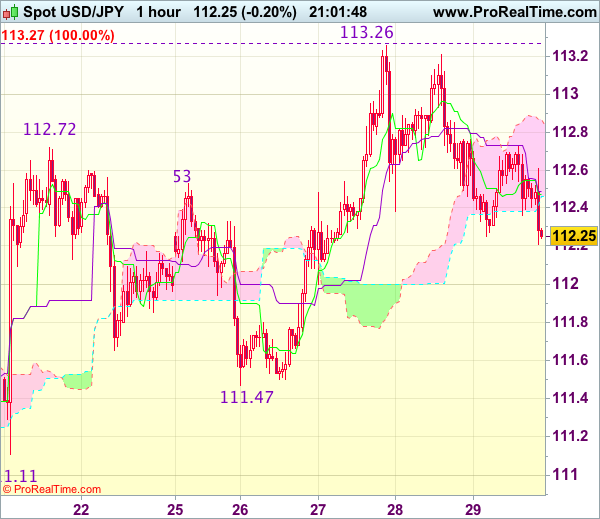
Despite falling to 112.38 yesterday, lack of follow through selling suggests further consolidation would take place and recovery to 112.75-80 cannot be ruled out, however, price should falter below indicated resistance at 113.26, bring another retreat later, below 112.20 would signal top has been formed at 113.26, bring retracement of recent rise to 112.00, then 111.75-80 but previous support at 111.47 should remain intact.
On the upside, whilst recovery to 112.75-80 cannot be ruled out, reckon said resistance at 113.26 would hold and bring further consolidation. Only a break of said this week’s high at 113.26 would revive bullishness and signal recent upmove has resumed, then further gain to previous resistance at 113.58 would follow but loss of upward momentum should prevent sharp move beyond 113.75-80 and reckon 114.00-10 would remain intact. As near term outlook is mixed, would be prudent to stand aside for now.
EUR/USD Mid-Day Outlook
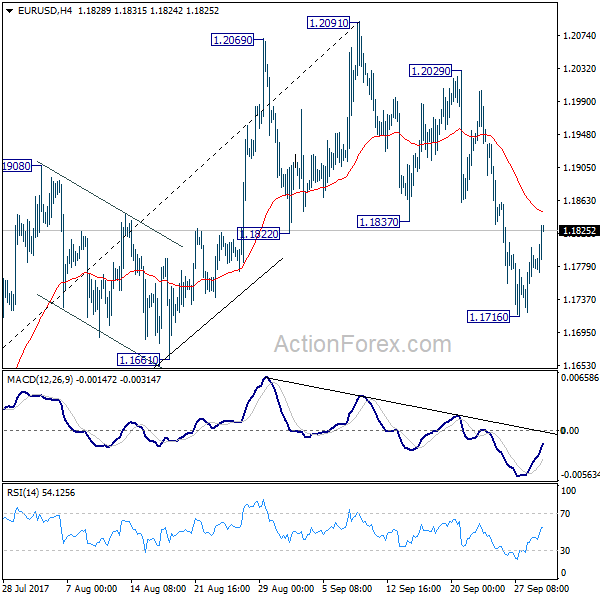
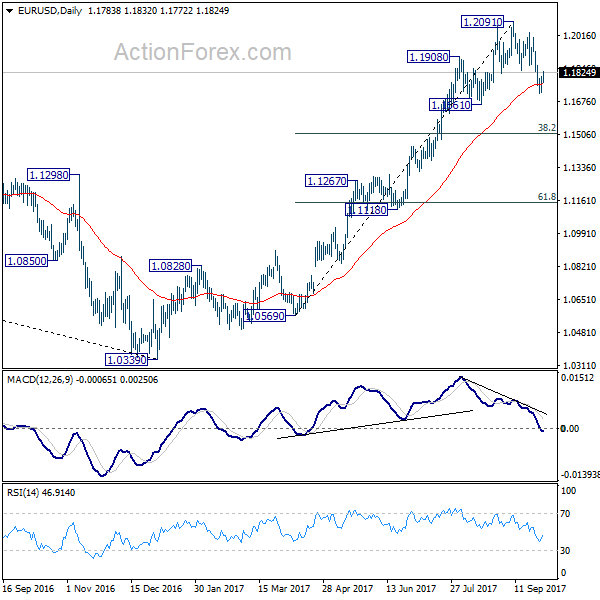
Daily Pivots: (S1) 1.1736; (P) 1.1770 (R1) 1.1820; More...
Intraday bias in EUR/USD remains neutral for the moment and some sideway trading could be seen above 1.1716 temporary low. Deeper fall is expected as long as 1.2029 resistance holds. Decline from 1.2091 is seen as correcting whole rise from 1.0569. Below 1.1716 will target 1.1661 support and then 38.2% retracement of 1.0569 to 1.2091 at 1.1510, where we're expecting support to bring rebound.
In the bigger picture, rise from medium term bottom at 1.0339 is still in progress for 38.2% retracement of 1.6039 (2008 high) to 1.0339 (2017 low) at 1.2516. However, it should be noted that there is no confirmation of trend reversal yet. That is, such rebound from 1.0399 could be a correction. And the long term fall from 1.6039 (2008 high) could resume. Hence, we'd be cautious on strong resistance from 1.2516 to limit upside. But after all, break of 1.1661 is needed to indicate medium term topping. Otherwise, outlook will remain bullish in case of pull back.
GBP/USD Mid-Day Outlook
Daily Pivots: (S1) 1.3370; (P) 1.3413; (R1) 1.3483; More....
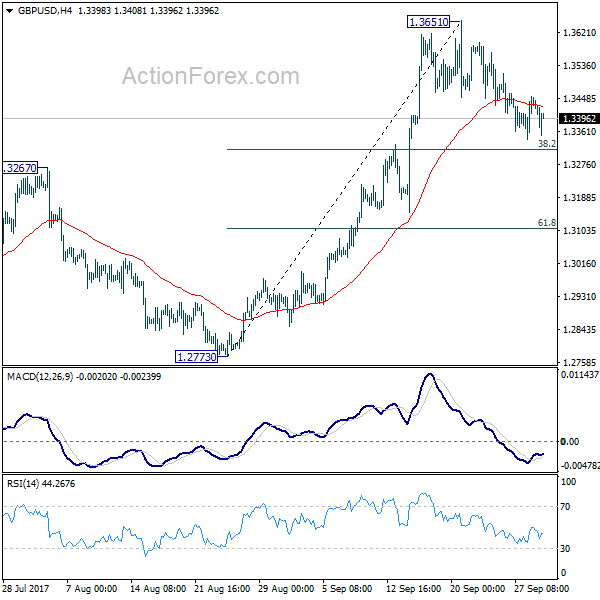
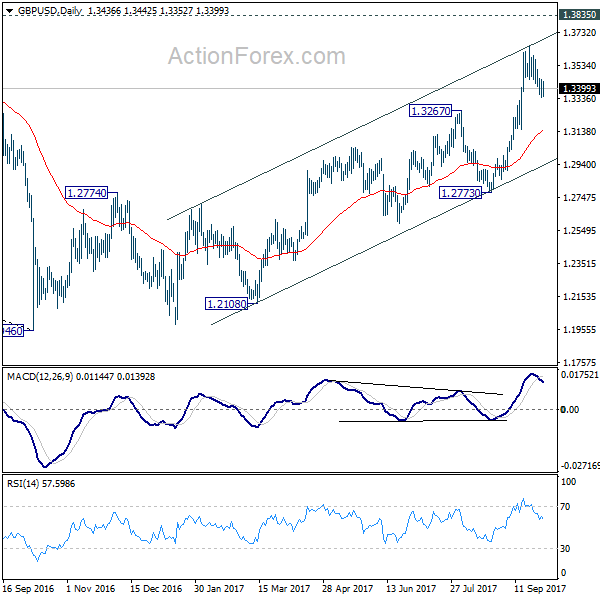
No change in GBP/USD's outlook. Correction from 1.3651 could extend. But we'd continue to expect strong support from 38.2% retracement of 1.2773 to 1.3651 at 1.3316 to contain downside and bring rally resumption. Break of 1.3651 will turn bias back to the upside for 1.3835 support turned resistance next. Break there will target 55 month EMA (now at 1.4405).
In the bigger picture, current development argues that the long term trend in GBP/USD has reversed. That is, a key bottom was formed back in 1.1946 on bullish convergence condition in monthly MACD. Current rise from 1.1946 will target 38.2% retracement of 2.1161 (2007 high) to 1.1946 (2016 low) at 1.5466 next. In any case, medium term outlook will now stay bull