

Sample Category Title
Relief Rally Underway After North Korea Celebrations
- Traders welcome no fresh provocation over the weekend;
- Gold safe haven moves see some unwinding;
- Focus on UK this week but US inflation also eyed.
It's been a bright start to trading in Asia and Europe on Monday and the US is currently on course to follow suit, with all three major indices seen opening more than half a percentage point higher.
Investors understandably adopted a far more cautious approach last week, with tension having already been ramped up by North Korea's hydrogen bomb test the weekend before and speculation that another test could follow on Saturday, the anniversary of its founding day. Fortunately, this never materialized, with Kim Jong Un instead using the celebration to recognise the previous weekend's achievements, allowing investors the opportunity to unwind some of the safe haven trades from the days before.
Indices, which have been in consolidation over the last month or so, are now expected to enjoy a mini relief rally although we should get interesting insight into just how much investors perceive the threat of an escalation to have subsided. The S&P 500 is still expected to open around 20 points or so from its highs and should it overcome them in the coming days, it would suggest optimism is returning.
Of course this is aided by other events having either played out better than expected or not deteriorated further. With Hurricane Irma now downgraded to category one, there is hope that the devastation that has already been caused will not end up as bad as feared, potentially bringing down the eventual bill. The debt ceiling can being kicked down the road a few months is also providing temporary relief but as always with this kind of thing, the problem has only been delayed rather than resolved. All these issues have also taken the spotlight off Donald Trump, following what was a rough couple of weeks for the President and a period that was a concern for investors.
All of this has seen safe haven assets come off their highs, with Gold having previously rallied to a level not seen since August last year. While the yellow metal did actually end lower on Friday after having rallied well earlier in the session and has opened lower today, it remains at elevated levels which is perhaps representative of the lingering unease and expectation that confidence could evaporate quite quickly once again.
While Monday is looking quiet as far as scheduled economic events is concerned, there is a scattering of notable economic data throughout the week, with particular focus on the UK as we get inflation and jobs numbers as well as the Bank of England monetary policy decision. We'll also get August inflation data for the US on Thursday, which comes as Federal Reserve policy makers become increasingly concerned about its lack of movement towards target.
DAX Jumps At Start To Week As Risk Appetite Rises
The DAX index has posted strong gains in the Monday session. Currently, the DAX is trading at 12,439.50, up 1.09% on the day. There are no German or Eurozone events on the schedule.
Global markets sighed in relief on the weekend, as the Korean peninsula remained quiet. With North Korea celebrating its 69th anniversary of independence, there were concerns that Pyongyang would use the occasion to flex some muscle and test a nuclear bomb or missile. North Korea marked last year’s anniversary by exploding its fifth nuclear test. This occasion passed without incident, although the US, along with its allies Japan and South Korea, remain on alert for further provocations from the north. European stock markets have continued the upward trend seen in Asia, as the DAX is up more than 1 percent. Earlier in the Monday session, the DAX hit its highest level since July 21. Monday’s gains have been felt in most of the DAX’s 30 companies, particularly in banking stocks – Deutsche Bank is up 2.51% and Commerzbank has gained 2.85%.
The ECB policy meeting on Thursday appeared to send mixed signals about the bank’s quantitative easing (QE) program, which ends in December. Currently, the bank is purchasing EUR 60 billion/month and the markets were hoping for some guidance about the ECB’s monetary policy plans. The rate announcement was surprisingly dovish, as policymakers said that QE would not be tapered before December, and left the door open to further stimulus in 2018, if necessary. However, Mario Draghi presented a more hawkish stance in his follow-up press conference, saying that the ECB would make a decision on how to scale back stimulus in October. In his remarks, Draghi made direct reference to the exchange rate, noting that “the recent volatility in the exchange rate represents a source of uncertainty which requires monitoring”. Draghi & Co. are clearly concerned by the euro’s appreciation, as the EUR/USD has soared 14 percent in 2017. The stronger euro has made imports less expensive, thus reducing inflation and hampering the ECB’s efforts to raise inflation levels with zero interest rates and the ultra-accommodative QE scheme. Despite an improved eurozone economy, the ECB has now cut its inflation forecast to 1.2 percent in 2018 and 1.5 percent in 2019, well short of its target of just below 2 percent. It is unclear what the ECB has planned when QE runs out, and the markets will be listening closely for any hints from policymakers.
Safe Havens Tumble As North Korea Doesn’t Conduct Missile Test
Markets opened in a risk-on mood today, as North Korea did not conduct any missile tests to celebrate the 69th anniversary of its foundation. Investors may have anticipated something like that, considering last week's media reports that North Korea was set to launch a missile for the anniversary, as it has done in recent years. As a result, safe haven assets such as gold, JPY and CHF, opened with negative gaps, while Asian stock indices are mostly in the green at the time of writing.
Today, the UN will vote on fresh sanctions against the regime. The updated measures are expected to include sanctions on oil and gas, as well as a ban on textiles. In our view, the risks surrounding the situation moving forward are two-sided. On the one hand, the UN hopes that another round of sanctions could motivate North Korea to come to the negotiating table. Any such signs could cause the latest price action to continue.
However, there is the risk that the North Korean regime interprets such measures as an act of aggression, and may therefore respond with another show of force, like a missile launch. In that case, safe havens could quickly come back under demand. Either way, the next few hours could prove critical to how the situation develops, and to what the market anticipates.
Gold opened with a negative gap on Monday, to hit support slightly above the 1333 (S1) line. Given that the price structure on the 4-hour chart remains higher peaks and higher troughs above the uptrend line taken from the low of the 10th of July, we believe that the short-term outlook is still positive. However, for now we see the case for the latest retreat to continue for a while. This is supported by both our short-term momentum indicators. The RSI slid and fell below 50, while the MACD, although positive, has topped and fallen below its trigger line. What's more there is negative divergence between both these indicators and the price action. A dip below 1333 (S1) may confirm the case for further setback and is possible to aim for our next support of 1325 (S2).
Loonie pulls back a little after underwhelming jobs data
The Canadian dollar gave back some of its BoC-related gains on Friday, following the nation's employment data for August. At first glance the report appeared decent, as the unemployment rate ticked down, while the net change in employment came in higher than expected. However, a closer look revealed that these were mainly due to many full-time jobs being substituted by part-time ones, which is a relatively downbeat development. Having said that though, Canada's labor market remains pretty strong, as do most of the nation's economic data, particularly GDP growth. In addition, market expectations for yet another BoC rate hike this year continue to heighten, with the implied probability for such an action currently standing at around 72%. As such, despite the minor pullback on Friday, we maintain our view that the Loonie's broader outlook remains positive.
USD/CAD traded higher on Friday, following the not-so-encouraging employment data for August from Canada. The rate rebounded after it hit support at 1.2060 (S1) and the recovery stopped at 1.2165 (R1). In our view, given that the price structure on the 4-hour chart remains lower peaks and lower troughs below the prior upside support line taken from the low of the 26th of July, the short-term picture remains negative. Even if USD/CAD rebounds a bit more, we expect the bears to take charge again soon and aim for another test near the 1.2060 (S1) support. A dip below that level may pave the way for the psychological zone of 1.2000 (S2).
Today's highlights:
Norway's CPI data for August are already out. Both the headline and the core rates declined, confounding expectations of rising. NOK tumbled as a result. We also have a speaker on the agenda: ECB Executive Board member Benoit Coeure.
As for the rest of the week:
On Tuesday, we get CPI data for August from both the UK and Sweden. On Wednesday, the UK employment data for July are due out. On Thursday, market participants will turn their eyes to the BoE and SNB policy decisions. Both Banks are expected to remain on hold. We think that the BoE could maintain a balanced tone and continue to signal little urgency for near-term rate hikes, amid underwhelming economic developments. As for the economic data, we get Australia's jobs figures, China's retail sales, industrial production and fixed asset investment, as well as US CPI figures, all for August. Finally on Friday, the US retail sales for August will be in focus.
Gold
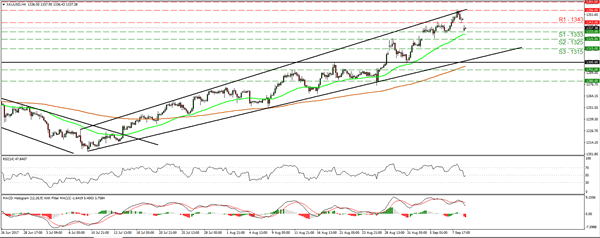
Support: 1333 (S1), 1325 (S2), 1315 (S3)
Resistance: 1343 (R1), 1356 (R2), 1365 (R3)
USD/CAD
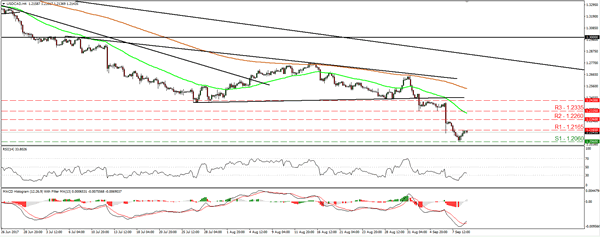
Support: 1.2060 (S1),1.2000 (S2), 1.1920 (S3)
Resistance: 1.2165 (R1), 1.2260 (R2), 1.2335 (R3)
Technical Outlook: Spot Gold – Correction Could Extend To $1323 After Gap-Lower Opening On Monday On Easing Tensions Over...
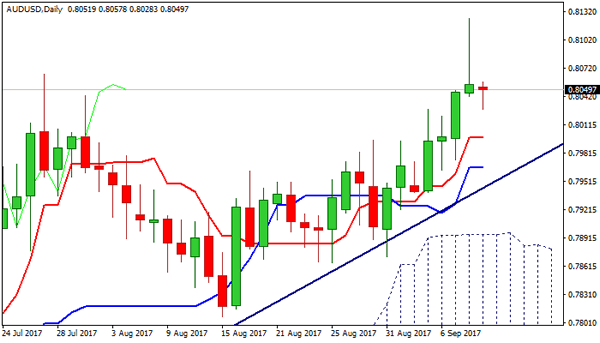
Spot Gold is standing on Monday some $20 lower from fresh one-year high at $1357, posted last Friday, as tension over North Korea eased, inflating the US dollar and reducing demand for safe-haven precious metal.
Monday's opening with $12 gap lower was negative signal for Gold price which could extend pullback towards rising daily Tenkan-sen ($1327) and $1323 (Fibo38.2% of $1267/$1357 upleg).
The notion is supported by reversal of daily RSI / slow stochastic from overbought zone which is bearish signal.
Also, estimates for economic damage look lower than expected that could weigh on gold's price, with extended correction expected to ideally stay above $1323 to keep broader bulls intact.
Increased downside risk could be expected on bearish extension below rising 20SMA at $1309.
Res: 1340, 1347, 1350, 1357
Sup: 1332, 1327, 1323, 1316
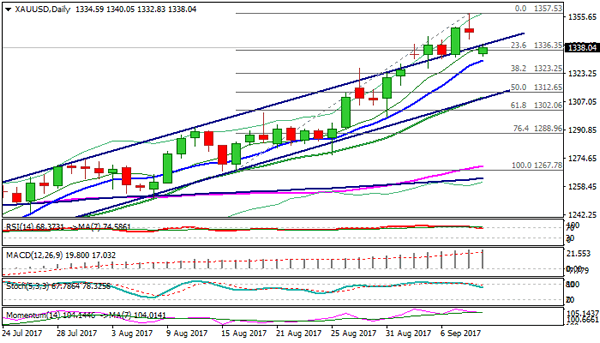
Technical Outlook: AUDUSD – Break Below 0.8000 Would Trigger Stronger Correction
The Aussie dollar stands at the back foot in early Monday on greenback's modest recovery, but dips so far hold well above psychological 0.8000 support (also daily Tenkan-sen) which marks the first pivot. Risk of deeper pullback exists on formation of Shooting star reversal pattern on daily chart and south-heading slow stochastic which reversed from overbought territory. However, limited downside action could be expected while the price holds above 0.8000 handle, as the Aussie is supported by fresh AUDJPY buying on reduced safe-haven demand. Daily Tenkan-sen and Kijun-sen lines (0.8000/0.7966 respectively) should contain extended dips before bulls resume towards target at 0.8164 (50% retracement of 0.9503/0.6825 descend). Conversely, close below daily Kijun-sen would increase risk of deeper pullback.
Res: 0.8065, 0.8100, 0.8124, 0.8164
Sup: 0.8028, 0.8000, 0.7966, 0.7929
Technical Outlook: USDJPY – Limited Correction Before Bears Resume, Weekly Cloud Weighs
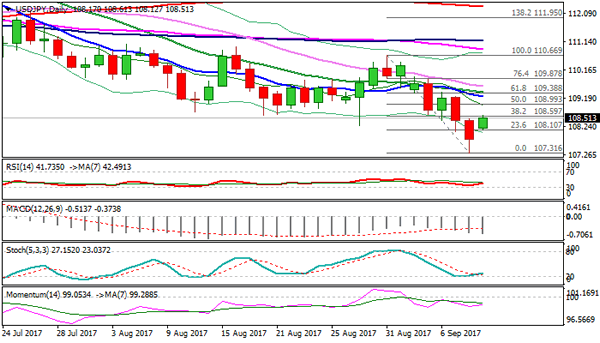
The pair opened with gap higher on Monday as pressure on dollar eases. Recovery met pivotal barrier at 108.60 (Fibo 38.2% of 108.66/107.31 downleg/hourly cloud top) which so far limited rally, guarding key barrier at 108.83 (weekly cloud base).
Last week's strong acceleration lower that left long red weekly candle and closed well below weekly cloud base was strong bearish signal for further extension of broader bears.
We expect limited corrective action, with weekly cloud continuing to weigh and expected to ideally cap.
However, stronger upticks towards 109.00/15 (daily Tenkan-sen/Kijun-sen in bearish setup) could be anticipated before bears re-assert). Alternatively, sustained break above 109.39 (Fibo 61.8% of 110.66/107.31 downleg/20SMA) would sideline bears for stronger correction.
Res: 108.60, 108.83, 109.00, 109.15
Sup: 108.12, 107.78, 107.31, 107.00
Technical Outlook: Sterling Eyes UK CPI And BoE For Fresh Signals
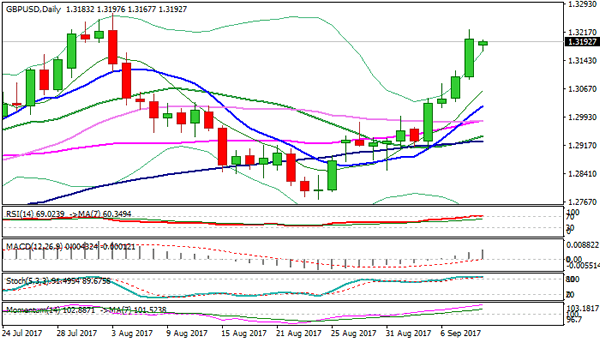
Cable remains supported at the beginning of the week and consolidating under fresh recovery high at 1.3224 in early Monday.
Strong rally last week formed long weekly bullish candle which underpins for further upside and eventual retest of key short-term barrier at 1.3268 (03 Aug high), however, overbought daily studies warn of rally's stall but without stronger signals so far.
Key releases from UK, due this week are in focus and could have stronger impact on pound.
UK inflation numbers for August will be released on Tuesday, with forecasts higher than previous month's figures (2.8% y/y vs 2.6% in July and 0.5% m/m vs -0.1% in July) could be supportive on release at/above consensus.
UK jobs data are due on Wednesday, with Average earnings expected to rise in July 2.3% vs 2.1% in June) but UK Jobless claims are forecasted higher (0.6K in Aug vs -4.2K in July) while Unemployment rate is expected to stay unchanged at 4.4% in July.
BOE MPC is meeting on Thursday to decide about the monetary policy. Interest rates are expected to stay unchanged at 0.25%, as well as QE (435billion pounds) but focus will be on MPC's vote for rate hike, with expectations for 7-2 configuration this time.
Monday's action found footstep at 1.3167 (broken upper 20-d Bollinger band and bounced above cracked hourly Tenkan-sen/Kijun-sen lines which remain in bullish setup and supportive for fresh upside.
Conversely, break below 1.3167 would risk dip towards strong supports at 1.3092 (Friday's low),1.3082 (Fibo 38.2% of 1.2852/1.3224 upleg) and 1.3075 (daily cloud top).
Res: 1.3224, 1.3268, 1.3300, 1.3346
Sup: 1.3167, 1.3136, 1.3082, 1.3075
Technical Outlook: The Euro Stands At The Back Foot On Monday, Deeper Correction On Break Below Hourly Cloud Base
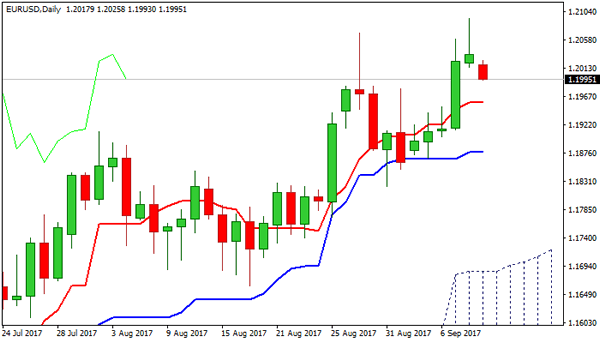
The dollar bears are taking a breather in early Monday's trading after North Korea stayed on hold this weekend, despite wide expectations of another provocation on their National Day and markets being cautious over the economic impact of Hurricane Irma which hit the coast of Florida. The EURUSD recent rally showed strong upside rejection just under 1.2100 barrier on Friday, which left daily candle with long upper shadow and fresh weakness on Monday threatens of competing reversal patter which could signal stronger correction. Near-term bears are so far holding above strong support zone between 1.2000/1.1990 (hourly cloud base/Fibo 23.6% of 1.1662/1.2092 upleg) but near-term risk remains shifted lower and acceleration towards next key supports at 1.1957 (daily Tenkan-sen) and 1.1940 (10SMA) could be expected on break below 1.2000/1.1990 pivot. Extended dips should ideally find support here before fresh push higher as overall structure is bullish and favors further upside after repeated close above psychological 1.2000 barrier. Key release for the Euro this week will be EU's Industrial production which is forecasted higher in Q2 and may inflate the Euro on positive readings.
Res: 1.2025, 1.2070, 1.2092, 1.2164
Sup: 1.1990, 1.1957, 1.1940, 1.1928
Euro Ticks Lower, Markets Looking For Cues
The euro has started the week almost unchanged, as the currency remains above the 1.20 line in the Monday session. Currently, the pair is trading at 1.2024, down 0.09% on the day. On the release front, the sole Eurozone indicator was Italian Industrial Production, which posted a gain of 0.1%, above the estimate of -0.5%. There are no US events on the schedule. On Tuesday, the US releases JOLTS Job Openings, which is expected to slow to 5.96 million.
The markets have become spoiled, expecting the robust German economy to continue producing sharp readings. However, German data disappointed last week, as manufacturing numbers and the trade surplus disappointed. The week started with Factory Orders declined 0.7%, well off the forecast of a 0.2% gain. This marked a 3-month low. German Industrial Production followed suit, as the reading of 0.0% missed the estimate of 0.5%. On Friday, Germany’s trade surplus dropped to EUR 19.5 billion, marking the smallest surplus since January. Why the downturn? Global demand, which had been very strong in the first half of 2017, is showing signs of softening, and this had a negative impact on the manufacturing sectors in Germany and throughout the eurozone. This has also has taken at toll on the export sector, which was reflected in the Germany’s smaller surplus in July. We could be in for some more soft German numbers on Tuesday – Final CPI is expected to slow to 0.1% in August, compared to a 0.4% gain in July.
Last week’s highly anticipated ECB policy meeting last week didn’t shake up the markets, but policymakers appeared to send mixed signals about the bank’s quantitative easing (QE) program, which ends in December. Currently, the bank is purchasing EUR 60 billion/month and the markets were hoping for some guidance about the ECB’s monetary policy plans. The rate announcement was surprisingly dovish, as policymakers said that QE would not be tapered before December, and left the door open to further stimulus in 2018, if necessary. However, Mario Draghi presented a more hawkish stance in his follow-up press conference, saying that the ECB would make a decision on how to scale back stimulus in October. In his remarks, Draghi made direct reference to the exchange rate, noting that “the recent volatility in the exchange rate represents a source of uncertainty which requires monitoring”. Draghi & Co. are clearly concerned by the euro’s appreciation, as the EUR/USD has soared 14 percent in 2017. The stronger euro has made imports less expensive, thus reducing inflation and hampering the ECB’s efforts to raise inflation levels with zero interest rates and the ultra-accommodative QE scheme. Despite an improved eurozone economy, the ECB has now cut its inflation forecast to 1.2 percent in 2018 and 1.5 percent in 2019, well short of its target of just below 2 percent. It is unclear what the ECB has planned when QE runs out, and the markets will be listening closely for any hints from policymakers.
US Futures Reacting To A Relief Rally | Gold Lower & Dollar Higher | UK To Focus On Brexit...
Damages caused by Hurricane Irma are still colossal
The dollar index has bounced back up from its two years lows
Oil traders are also paying attention to the comment of the Saudi oil minister
The US Futures and European markets are enjoying the relief rally. Investors are feeling somewhat relieved today, after the most dire predictions in terms of the disaster caused by Hurricane Irma have evaporated. The damage caused by Hurricane Irma is still colossal as streets have been turned into rivers and nearly 3 million people are without any power. However, thankfully, the overall impact of Irma is falling short of predictions. It is important to keep in mind that the full damage picture will still be colossal. The dollar index has bounced back up from its two years lows purely because the estimates of economic damage are far less than anticipated. The US inflation data will be the talk of the week when it comes to the dollar index from here onwards and a number better than the expectations could satisfy the bulls.
The black gold is recovering its losses as the gulf coast refinery process has seen its production come back online and the effects of Hurricane Harvey are dissipating. Hurricane Irma has paralyzed the tanker traffic and caused nearly 6000 gas stations to close, therefore, the path towards the 50 for crude oil is still looking challenging. Oil traders are also paying attention to the comment of the Saudi oil minister, in which he said that there is a possibility that the current production cut by the cartel could easily roll over to March 2018.
North Korea thankfully didn’t ranch up the tension over the weekend as it was widely expected that the country may surprise the world with more missile test. Nonetheless, the US is going to push the UN for the strongest form of sanction on North Korea in their meeting today. The profit taking in the safe haven market dragged the price of yellow metal lower. Holdings of the SPDR gold trust which is the world’s largest gold exchange traded fund has seen its holding dropping by nearly 0.3%. The near term support is at 1320 and the upside is capped by the resistance of 1360.
Back in the UK, the parliament is set to vote on the Brexit Repeal Bill. The Brexit secretary has given a clear indication that a vote against the bill will not be short of a disaster for the country. It would trigger a chaos in terms of Britain’s exit from the European Union. The repeal bill provides that there will be no dramatic changes to British laws for businesses and individuals. This bill is nothing but the carbon copy under which the same EU laws are implemented in the British law. Moreover, this is going to be a big week for the Sterling as the UK inflation data is due on Tuesday. The number is expected to rise to 2.8% y/y in August. Regardless of the outcome, we do not think that the BOE will be changing its monetary policy stance anytime soon.