Sample Category Title
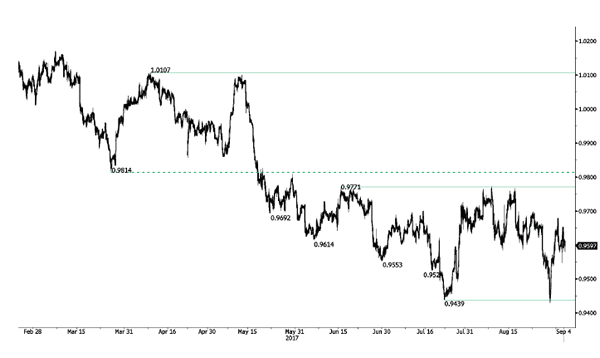
USD/CHF Bouncing
USD/CHF is trading mixed with strong volatility. Strong resistance is given at 0.9771 (15/06/2017 high). The pair is likely to head further lower below 0.9500. Expected to show renewed bearish pressures.
In the long-term, the pair is still trading in range since 2011 despite some turmoil when the SNB unpegged the CHF. Key support can be found 0.8986 (30/01/2015 low). The technical structure favours nonetheless a long term bullish bias since the unpeg in January 2015.
USD/JPY Preparing To Challange Support
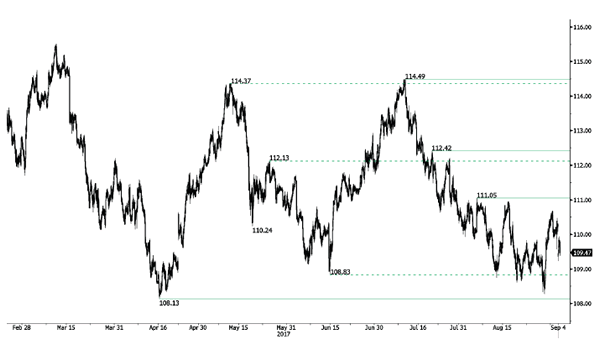
USD/JPY further declined today confirming increasing selling pressures. The pair has failed to test resistance at 111.05 (04/08/2017 high). Support is located at 108.13 (14/06/2017 low). Expected to show further downside pressures.
We favor a long-term bearish bias. Support is now given at 99.02 (10/08/2013 low). A gradual rise towards the major resistance at 125.86 (05/06/2015 high) seems unlikely. Expected to decline further support at 93.79 (13/06/2013 low).
GBP/USD Grinding Higher
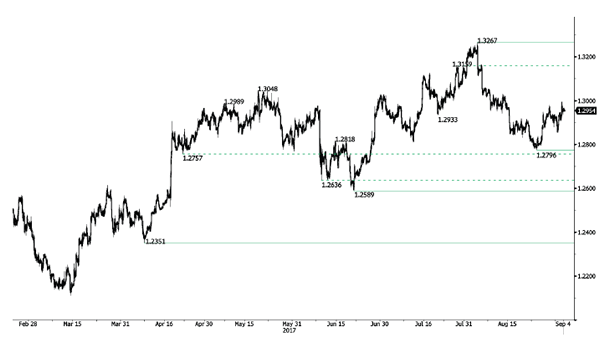
GBP/USD is recovering after its recent massive sell-off. Monitor the test of resistance at 1.2995 (01/09/2017). Hourly support is given at 1.2774 (24/08/2017 high) while hourly resistance is given at 1.2979 (29/08/2017 high). Expected to show short-term bearish pressures.
The long-term technical pattern is even more negative since the Brexit vote has paved the way for further decline. Long-term support can be found at 1.1841 (07/10/2017 low). Long-term resistance is given around 1.35 and would indicate a long-term reversal in the negative trend. Yet, it is very unlikely at the moment.
EUR/USD Consolidation
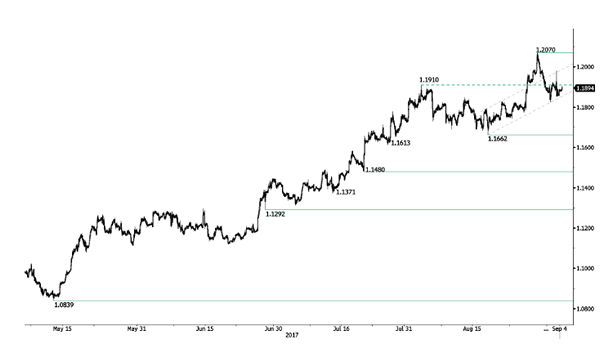
EURUSD is consolidating after massive bullish rally. Hourly resistance can be found at 1.2070 (29/08/2017 high) while hourly support lies at 1.1820 (31/08/2017 low). Stronger support is given at a distance at 1.1662 (17/08/2017 low). Expected to show renewed bullish pressures.
In the longer term, the momentum is now turning largely positive. We favour a continued bullish bias. Key resistance is holding at 1.2252 (25/12/2014 high) while strong support lies at 1.0341 (03/01/2017 low).
Technical Outlook: WTI Oil – Break Above Fibo Barrier At $47.42 May Trigger Extension Towards $47.99
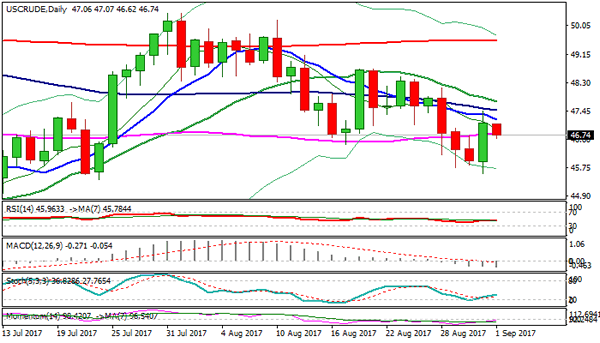
WTI Oil cracked strong resistance at $47.42 (Fibo 38.2% of $50.41/$45.57 descend) on Monday but without clear break higher for now.
Extension of strong two-day rally on Thu/Fri which broke above daily cloud (cloud twists today) may rise to $47.99 (daily Kijun-sen) on firm break above $47.42 pivot.
The oil prices regained traction on production outages after Hurricane Harwey, however, rising geopolitical tensions over North Korea may trigger stronger sell-off, as oil is seen as risky asset.
Near-term outlook is positive but firm break above Fibo barrier at $47.42 (reinforced by falling 100SMA) is needed to confirm bullish continuation.
Otherwise, the downside would remain vulnerable, with pullback below daily Tenkan-sen ($47.02) and 55SMA ($46.85) to weaken near-term tone and risk further easing.
Narrow ranges are seen as likely scenario today, due to US Labor Day holiday.
Res: 47.42, 47.66, 47.99, 48.56
Sup: 47.15, 46.85, 46.55, 46.30
Sea Of Red Across Global Markets | Currency Markets Volatile | Gold Sharply Up
Euro Traders Focused on the German Election and the ECB Meeting
Brexit Bill Stalls Negotiations
Fed Members To Create More Volatility
Sea of Red Across Global Markets | Currency Markets Volatile | Gold Sharply Up
There is a sea of red across global markets. European futures are trading sharply lower and picking up the momentum from Asia. North Korea has further escalated the geopolitical tensions over the weekend and the US has called for an emergency meeting of the U.N council. For investors, this does not present a stable environment for investing. Hence, the risk off trade would become more prominent until the dust settles.
The US is looking for more sanctions and President Trump is making clear over and over again that talks only are not going to help. He has called North Korea's action as "hostile and dangerous". The Chinese and the Russians have also shown their strong response to North Korea's reaction. Other safe haven currencies such as the Japanese Yen and the Swiss franc would also find strength due to this situation.
The risk of immediate military action on North Korea by the US is still somewhat remote as the president hasn't provided any clear direction when he would adopt a more dangerous route. So far more economic pressure would be used in the form of strong sanctions.
Euro Traders Focused on the German Election and the ECB Meeting
Over in Germany, it is all about the upcoming election which is not only going to shape the future of the biggest economy of the euro zone but it would also have an enormous impact on the euro if an unfavourable result becomes a reality. The refugee crisis is at the heart of this election, and the recent TV debate between Angela Merkel and Martin Schultz was very much focused on this issue.
Currency traders are going to stay on the edge and remain anxious ahead of the most important event of this week. The European central bank's meeting is on Thursday and policy makers could be announcing their next policy move. The pressure on the policy makers is sizeable due to the improving euro zone's economy. After the latest announcement by the ECB during which they said that the tapering process could be pushed towards the end of this year, currency traders have largely priced in no move in the ECB's policy (due this week).Of course, anything which is not in line with the ECB's communication would be worrisome for the markets.
Brexit Bill Stalls Negotiations
As for Brexit and sterling, it is more about the Brexit bill for the time being. It has blocked all further communications and the entire process is in gridlock as it was expected. The Brexit secretary has called the £50 billion divorce bill as non-sense. But we all know that without paying their bills, there will be no trade talks and this would take more toll on the UK's economy.
Fed Members To Create More Volatility
For the dollar index, the underwhelming jobs data and catastrophe caused by Hurricane Harvey are going to keep the stellar Q2 GDP in the shadow. A large number of Fed officials are slated to make their speeches this week and the contrasting views of the voting committee members would only make the ground more infertile for the dollar bulls.
ECB Headlines Ruin EUR/USD Bull Fiesta
On Friday, the US employment report for August disappointed in all fronts. NFP rose a mere 156k, missing estimates of 180k, while prints for June and July were revised down. The unemployment rate ticked up and average hourly earnings slowed by more than expected in monthly terms.
EUR/USD spiked higher as soon as the report was out, breaking above the resistance hurdle of 1.1920 (R1). Nevertheless, the rate was stopped around 20 pips below the psychological barrier of 1.2000 (R2) and a few minutes later it tumbled to give back all its NFP-related gains. The tumble came after Bloomberg reports, citing sources familiar with ECB discussion, noted that the Bank is highly unlikely to take any decision at Thursday's meeting, add added that policymakers may not be ready to finalize their decision on QE until December. The pair continued to trade lower in the aftermath of these reports but hit support slightly above the key line of 1.1830 (S1) and then, it rebounded somewhat.
In our view, given that the rate remains above the important barrier of 1.1830 (S1) and also above the uptrend line taken from the low of the 17th of April, the medium-term path remains positive. A break back above 1.1920 (R1) may confirm that the slide towards 1.1830 (S1) was just a corrective wave, and may open the way for the round figure of 1.2000 (R1).
Focus for EUR/USD traders now turns to the ECB policy meeting on Thursday. Following Reuters and Bloomberg reports last week, we believe that in case the Bank maintains its QE easing bias, any declines in the rate are likely to be modest, as the pair has already responded to the aforementioned reports.
The surprise would be a removal of the bias. Something like that could cause EUR/USD to surge.
Risk-off prevails following North Korea's nuclear test
Today, Asian stocks opened with negative gaps, while safe havens, like the yen and gold, gapped up as North Korea reported on Sunday that it has successfully tested a nuclear weapon. Specifically, a hydrogen bomb, a device many times more powerful than an atomic bomb. This negative sentiment may roll over into the European and US equity markets.
The incident drew international condemnation, while US President Trump responded by saying that the US is considering, in addition to other options, stopping all trade with any country doing business with North Korea. Also, when asked, the President refused to rule out military action. What's more, South Korea has conducted a missile drill in response to North Korea's action, according to media reports. The UN Security Council is set to meet today in order to discuss fresh sanctions against the isolated nation.
The situation seems to be escalating, but the magnitude of the market response suggests that investors are not anticipating a prolonged turmoil yet. We believe that the reaction would be much larger if this was the case. Actually, the yen pared some gains following today's opening. Having said that though, future developments that heighten concerns over a military conflict are likely lead to more risk-off market activity.
Gold opened with a positive gap today following North Korea's nuclear test over the weekend. The gap brought the price above the resistance (now turned into support) territory of 1325 (S1), a move that confirms a forthcoming higher high on the 4-hour chart and thereby, keeps the short-term outlook positive. Even if we experience a minor pullback given that the latest rally appears overextended, we expect the bulls to remain in charge and aim for a test near 1340 (R1). A decisive break above that level is possible to pave the way towards our next resistance of 1352 (R2), marked by the peaks of the 6th and 7th of September 2016.
As for today's events:
The only noteworthy indicator we get is the UK construction PMI for August. Markets will remain closed in US and Canada in celebration of the Labor Day.
As for the rest of the week:
On Tuesday, the RBA will announce its policy decision. We don't expect any action at this meeting, neither a hawkish shift in language. We will dig into the statement for clues with regards to how much officials are concerned with the current levels Aussie is trading. On Wednesday, the central bank torch will be passed to the BoC. Although another rate hike this year is more-than-fully priced in, we don't expect it to come this week. We expect however officials to maintain their hawkish bias. On Thursday, as we already noted we have the all-important ECB meeting. A few hours ahead of the ECB, the Riksbank publishes its own interest rate decision. Finally on Friday, we get China's trade data for August and Canada's employment report for the same month.
EUR/USD
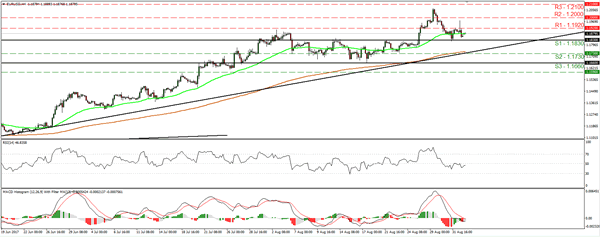
Support: 1.1830 (S1), 1.1730 (S2), 1.1660 (S3)
Resistance: 1.1920 (R1), 1.2000 (R2), 1.2100 (R3)
EUR/USD
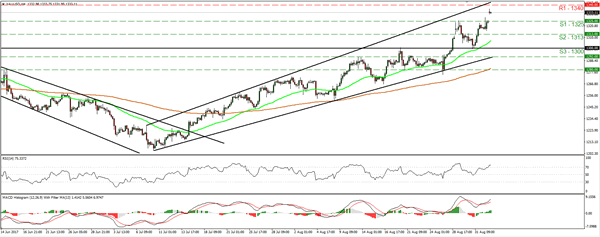
Support: 1325 (S1),1313 (S2), 1300 (S3)
Resistance: 1340 (R1), 1352 (R2), 1365 (R3)
North Korea Escalates Crisis Further – But War Still Unlikely
What happened?
North Korea escalated the crisis with the US, Japan and South Korea over the weekend with another nuclear test. It supposedly had a yield of 100 kilotons, 10 times the power of the nuclear test done a year ago. Ahead of the explosion, North Korea launched a video showing Kim Jong-un around what was stated to be a nuclear warhead capable of being mounted on an Intercontinental Ballistic Missile (ICBM). North Korea tested two ICBMs in July that were deemed capable of reaching the US.
A nuclear test has been one of the ‘red lines' that the US has mentioned would trigger action. See our piece earlier this year, Research: The rising risk from North Korea – and what it means for markets, 27 April 2017
US President Donald Trump and his administration reacted strongly, indicating still that a military option is on the table and looking for North Korea to be isolated from trade. One option mentioned by the administration was to not trade with any country that has trade with North Korea.
The market impact was relatively muted overnight: Asian bourses are mostly lower by close to 1% but the Chinese onshore market is up slightly. The market does not seem to expect the crisis to escalate into war and previous escalations have only had shortlived market effects.
Our quick view
While the nuclear test is a further escalation, we still see war as a low probability outcome as the effects would be detrimental. The US Defence Secretary James Mattis said earlier this month that a war with North Korea would be catastrophic.
However, whenever brinkmanship is in play there is always a risk that some error will occur and things get out of hand with a tit-for-tat pattern. However, none of the parties in the conflict has an interest in war. North Korea is likely to be feeling threatened by the US and South Korea given the rhetoric of ‘all options on the table' and military games going on between them. Hence, Kim Jong-un's response has been to show the US that North Korea would meet any military strike with a significant response and indicate that it has the capability of reaching the US as well with a nuclear warhead.
On the other hand, the US and South Korea aim to show North Korea that any misstep from the latter could lead to total annihilation of the regime. James Mattis said on Sunday that the US was not planning for the ‘total annihilation' of the rogue regime even though it has ‘many options to do so'.
What's next?
It is of course hard to predict and we are by no means military analysts. However, our view is still that we will see a continuation of regular escalations but with a low probability of war.
The US is likely to aim to isolate North Korea and cut it off from trade completely. They may not get full backing for this from China and Russia and we could see increasing tensions between the US on the one hand and China and Russia on the other. The risk of US trade sanctions on China is increasing. This would have a negative impact on both the US as well as the Chinese economy, and thus the global economy.
We do not expect North Korea to back down from its nuclear ambition. It simply sees the nuclear deterrence as the only guarantee of the regime's survival from a US attack. Sanctions are not likely, in our view, to stop North Korea. At the same time, there is no easy solution for Trump to stop North Korea. The crisis is likely to continue for some time. While Trump said last week that ‘talking is not the answer', it is hard to see how North Korea can be stopped militarily and through sanctions. For now though, Trump aims to show that his military threat is credible – even if it is not.
EUR/USD Analysis: Forms Symmetrical Triangle
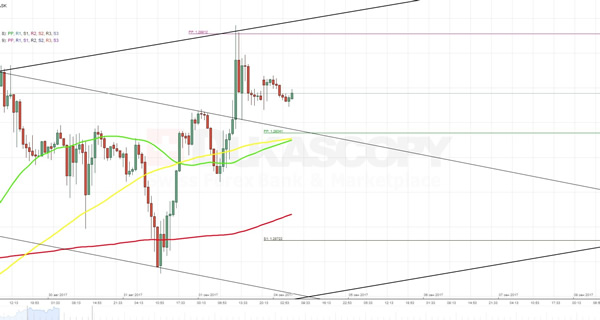
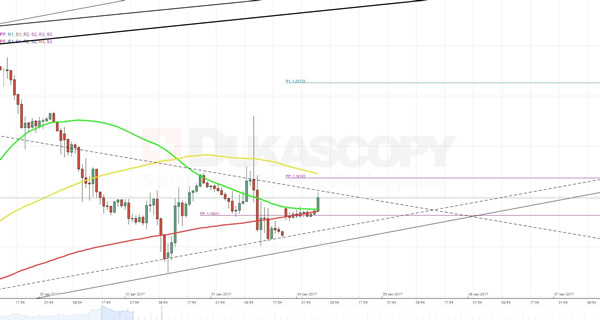
Despite that all three American employment indicators that were released on Friday did not justify experts' forecasts, the Greenback continued to appreciate against the Euro and even managed to break through the bottom trend-line of a medium-term ascending channel. Fortunately for the latter, the downside moment was not strong enough to incite the buck to try to break also through the lower boundary of the dominant ascending channel. For this reason, the pair started new trading week precisely at the monthly PP at 1.1881 that is located in the middle of the junior symmetrical triangle. Even though the northern path is protected by a combination of the weekly PP at 1.1918 and the 100-hour SMA, the southern side still consists of a more rugged support level.
GBP/USD Analysis: Moves In A Limbo
In result of release of data on the UK Manufacturing PMI, the Pound gained a short upside moment that helped it to leave a short-term descending channel to the top. However, a subsequent publication of information on the US labour market neutralized the surge and forced the pair to move horizontally. As a result, today it is squeezed between two barriers. The upper side protected by a the monthly PP at 1.2991 and the upper boundary of a dominant ascending channel, while the southern side is secured by a combination of the updated weekly PP 1.2934 and the 55- and 100-hour SMAs. Both of them represent too strong obstacles to be easily crossed. So, today the pair is expected to continue to fluctuate between them.