

Sample Category Title
USD/JPY Mid-Day Outlook
Daily Pivots: (S1) 108.66; (P) 109.13; (R1) 109.65; More...
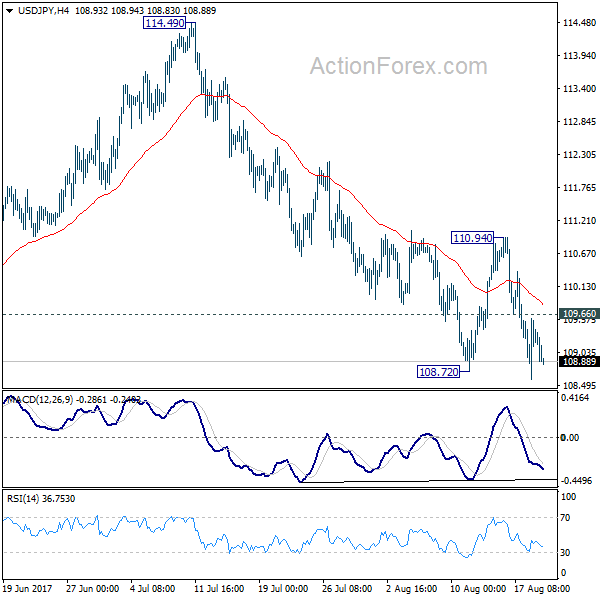
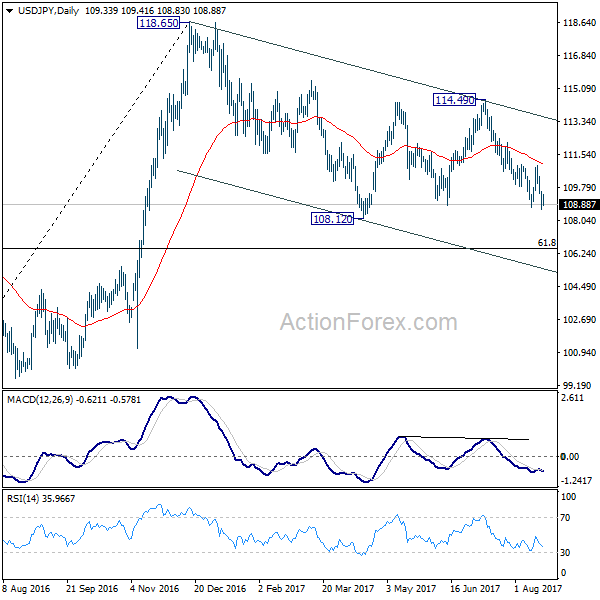
Intraday bias in USD/JPY remains mildly on the downside for the moment as fall from 114.49 is resuming. Such decline would target a test on 108.12 low. Whole corrective decline from 118.65 is possibly resuming and break of 108.12 will target 61.8% retracement of 98.97 to 118.65 at 106.48. On the upside, above 109.66 minor resistance will turn intraday bias neutral first. But break of 110.94 is needed to indicate short term bottoming. Otherwise, outlook remains bearish in case of recovery.
In the bigger picture, the corrective structure of the fall from 118.65 suggests that rise from 98.97 is not completed yet. Break of 118.65 will target a test on 125.85 high. At this point, it's uncertain whether rise from 98.97 is resuming the long term up trend from 75.56, or it's a leg in the consolidation from 125.85. Hence, we'll be cautious on topping as it approaches 125.85. If fall from 118.65 extends lower, downside should be contained by 61.8% retracement of 98.97 to 118.65 at 106.48 and bring rebound.
EUR/USD Mid-Day Outlook
Daily Pivots: (S1) 1.1719; (P) 1.1746 (R1) 1.1786; More...
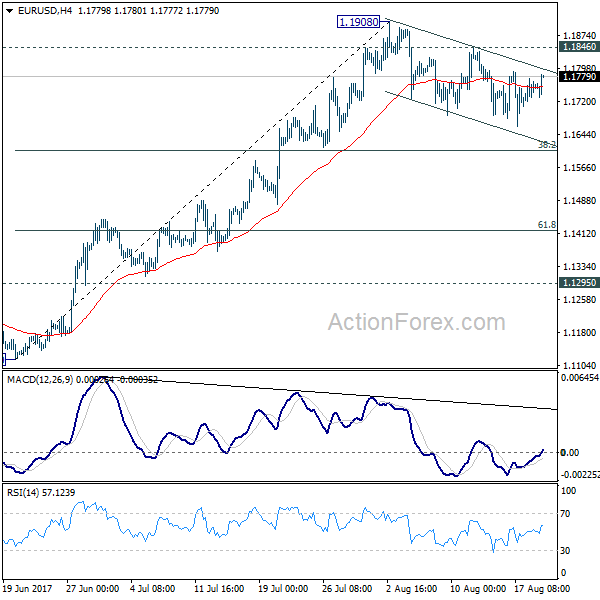
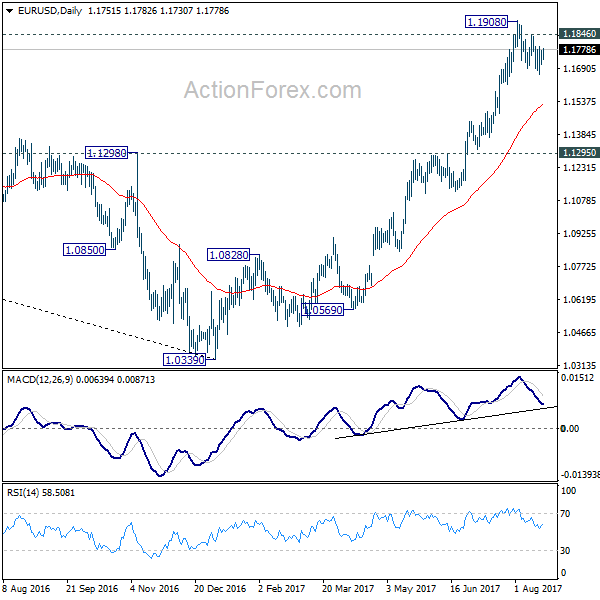
EUR/USD recovers mildly today but stays below 1.1846 minor resistance. Intraday bias in EUR/USD remains neutral as consolidative pattern from 1.1908 might extend. In case of another fall, downside should be contained by 38.2% retracement of 1.1119 to 1.1908 at 1.1606 to bring up trend resumption. Break f 1.1846 minor resistance will argue that larger rise from 1.0339 is resuming for 1.2042 long term support turned resistance next.
In the bigger picture, an important bottom was formed at 1.0339 on bullish convergence condition in weekly MACD. Sustained trading above 55 month EMA (now at 1.1768) will pave the way to key fibonacci level at 38.2% retracement of 1.6039 (2008 high) to 1.0339 (2017 low) at 1.2516. While rise from 1.0339 is strong, there is no confirmation that it's developing into a long term up trend yet. Hence, we'll be cautious on strong resistance from 1.2516 to limit upside. But for now, medium term outlook will remain bullish as long as 1.1295 support holds, in case of pull back.
Euro’s Rally Attempt Limited by Cautiousness ahead of Jackson Hole
Euro is trying to reverse from initial dip today but buying is so far limited. Traders are getting cautious ahead of ECB President Mario Draghi's speech in the Jackson Hole symposium. There were media reports last week that Draghi won't delivery anything outside of the topic of the symposium, that is, "Fostering a Dynamic Global Economy". And it's also clear that ECB will wait for more economic data, especially on inflation, and discuss policy change in the September meeting. Hence, some analysts argue that Euro could indeed be lifted if Draghi meets this expectation by saying nothing. But of course, what Fed chair Janet Yellen delivers is another big factor for both Dollar and Euro. Markets are generally not convinced that Fed is going to hike again in December. The greenback could be given a lift instead and drag the Euro down if Yellen shows no concern over recent tame inflation reading.
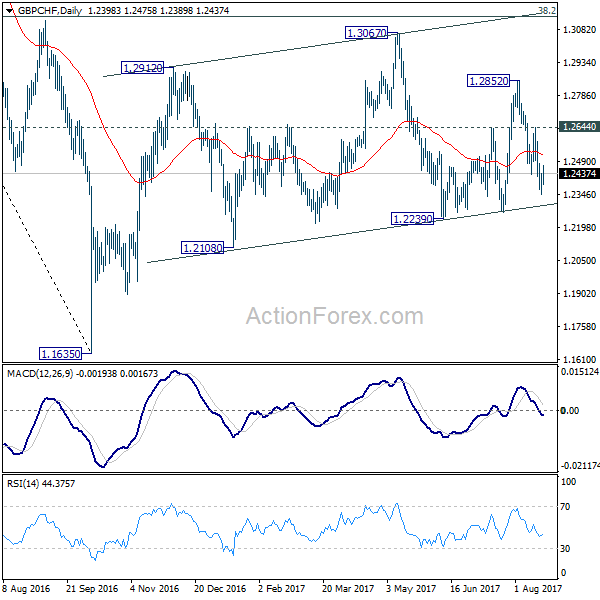
In the global stock markets, European indices are trading lower with both DAX and CAC down more than -0.3%. FTSE is hovering around break even. US futures also point to flat open. Risk aversion in a dominant theme this month, on White House turmoil, Korea tension, terrorist attacks. Yen and Swiss Franc are the main beneficiaries while Sterling suffers most. GBP/CHF's sharp fall from this month's high from 1.2852 to as low as 1.2346 is a clear example. Risk will stay on the downside as long as 1.2644 resistance holds, with focus on 1.2339. As price actions from 1.1635 are clearly corrective looking, break of 1.2239 will very likely bring deeper fall to retest last year's low at 1.1635.
UK's Unrealistic Customs Proposal Might Delay Brexit Negotiations.
Talking about weakness in Sterling, the upcoming round of Brexit negotiation with EU on August 29 will be a focus to watch later. Last week, the UK government, facing criticisms of its lacking preparation, released the policy papers on future customs arrangements, and Northern Ireland and the border with Ireland. The UK's positions, in particular the customs arrangements, triggered criticisms and are expected to delay the completion of the first phase negotiation, limiting the time for the second phase (trade issues). British pound has remained under pressure recently, with GBPUSD hovering around a one-month low and EURGBP firming around the highest levels in 10 months. More in UK's Unrealistic Customs Proposal Might Delay Brexit Negotiations.
Economists expected Cohn as front-runner to replace Yellen
In US, there are some findings from a survey by the National Association for Business Economics, polled 184 economists from July 18 to August 2. Only 17% expected Fed Chair Janet Yellen would be offered a second term when the current four-year term ends next February. 67% expected that Yellen will be replaced while 16% don't know. Among the contenders, 49% expect White House economic adviser Gary Cohn would be picked for the top Fed job. That's a wide margin from former Fed Governor Kevin Warsh's 9% as second. However, it should be noted that the survey was done way before US President Donald Trump's controversial remarks on the Charlottesville clash between Neo Nazi and counter protestors. Cohn was rumored to quite White House last week but denied.
The same survey showed that the respondents are "quite pessimistic about prospects for 'meaningful, revenue-neutral tax reform' in the near term." The survey showed only 10% chance of such legislation this year and 15% chance in 2018. Meanwhile, over 50% said Trump's tax reform will eventually add less than 1% to real GDP growth over the next decade. A third said that impact would be between 1-2%.
Regarding Fed's unwinding of balance sheet, 41% expect 10 year yield to rise by just 0.5% or less. 25% expect the jump in yield to be 0.75%-1.00%. NABE President Stuart Mackintosh noted that "the overall view of the panel is that the likely interest-rate impact of the Federal Reserve's balance sheet normalization is fairly benign."
On the data front
Canada wholesale sales dropped -0.5% mom in June versus expectation of -0.2% mom. UK Rightmove house price index dropped -0.9% mom in August. Japan all industry activity index rose 0.4% mom in June, in line with expectations.
EUR/USD Mid-Day Outlook
Daily Pivots: (S1) 1.1719; (P) 1.1746 (R1) 1.1786; More...
EUR/USD recovers mildly today but stays below 1.1846 minor resistance. Intraday bias in EUR/USD remains neutral as consolidative pattern from 1.1908 might extend. In case of another fall, downside should be contained by 38.2% retracement of 1.1119 to 1.1908 at 1.1606 to bring up trend resumption. Break f 1.1846 minor resistance will argue that larger rise from 1.0339 is resuming for 1.2042 long term support turned resistance next.
In the bigger picture, an important bottom was formed at 1.0339 on bullish convergence condition in weekly MACD. Sustained trading above 55 month EMA (now at 1.1768) will pave the way to key fibonacci level at 38.2% retracement of 1.6039 (2008 high) to 1.0339 (2017 low) at 1.2516. While rise from 1.0339 is strong, there is no confirmation that it's developing into a long term up trend yet. Hence, we'll be cautious on strong resistance from 1.2516 to limit upside. But for now, medium term outlook will remain bullish as long as 1.1295 support holds, in case of pull back.
Economic Indicators Update
| GMT | Ccy | Events | Actual | Forecast | Previous | Revised |
|---|---|---|---|---|---|---|
| 23:01 | GBP | Rightmove House Prices M/M Aug | -0.90% | 0.10% | ||
| 4:30 | JPY | All Industry Activity Index M/M Jun | 0.40% | 0.40% | -0.90% | -0.80% |
| 12:30 | CAD | Wholesale Sales M/M Jun | -0.50% | -0.20% | 0.90% | 1.00% |
Trade Idea: EUR/GBP – Buy at 0.9000
EUR/GBP - 0.9136
Original strategy :
Buy at 0.9000, Target: 0.9130, Stop: 0.8960
Position : -
Target : -
Stop : -
New strategy :
Buy at 0.9000, Target: 0.9130, Stop: 0.8960
Position : -
Target : -
Stop : -
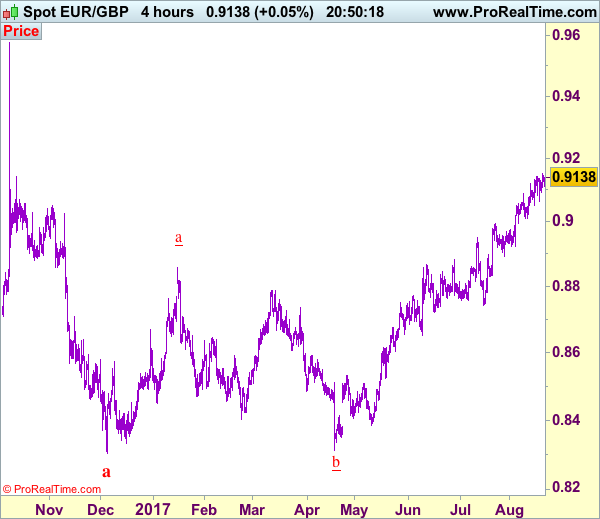
Although the single currency has maintained a firm undertone and bullishness remains for recent upmove to extend further gain to 0.9160, weakening of near term upward momentum should prevent sharp move beyond 0.9180-85 and price should falter below 0.9200, risk from there has increased for a retreat to take place later.
In view of this, would not chase this rise here and would be prudent to buy euro on subsequent pullback as 0.9000-05 would limit downside. Below 0.8960-70 would defer and suggest a temporary top is possibly formed, bring correction to 0.8922 support which is likely to hold from here.
Our preferred count is that, after forming a major top at 0.9805 (wave V), (A)-(B)-(C) correction is unfolding with (A) leg ended at 0.8400 (A: 0.8637, B: 0.9491 and 5-waver C ended at 0.8400. Wave (B) has ended at 0.9413 and impulsive wave (C) has either ended at 0.8067 or may extend one more fall to 0.8000 before prospect of another rally. Current breach of indicated resistance at 0.9043 confirms our view that the (C) leg has ended and bring stronger rebound towards 0.9150/54, then towards 0.9240/50.
Trade Idea: USD/CAD – Hold short entered at 1.2690
USD/CAD - 1.2582
Original strategy :
Sold at 1.2690, Target: 1.2490, Stop: 1.2700
Position: - Short at 1.2690
Target: - 1.2490
Stop: - 1.2700
New strategy :
Hold short entered at 1.2690, Target: 1.2490, Stop: 1.2700
Position: - Short at 1.2690
Target: - 1.2490
Stop:- 1.2700
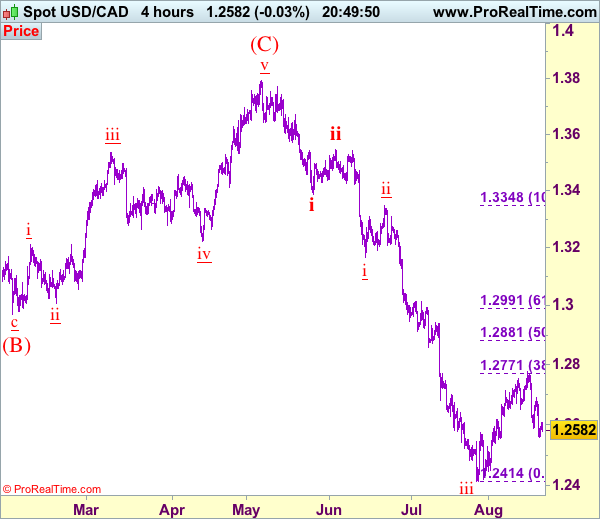
As the greenback has dropped again after meeting renewed selling interest at 1.2691 on Friday, retaining our bearish view that the decline from 1.2778 top is still in progress for weakness to 1.2540-50, however, a sustained breach below there is needed to signal the wave iv correction from 1.2414 (wave iii trough) has ended at 1.2778, bring further fall to 1.2490-00 but support at 1.2451 should hold on first testing. We are keeping our count that wave v as well as wave (C) ended at 1.3794 and impulsive wave (i ii, i ii) is now unfolding with minor wave iii possibly ended at 1.2414, hence wave iv correction is underway.
In view of this, we are holding on to our short position entered at 1.2690. Above 1.2700 would risk a stronger rebound to 1.2740-50, however, said resistance at 1.2778 should hold. Only break of said resistance at 1.2778 would abort and signal the rebound from 1.2414 is still in progress for retracement of recent decline to 1.2825-30 but still reckon upside would be limited to 1.2880-85 (50% Fibonacci retracement of wave iii) and price should falter well below 1.2990-95 (61.8% Fibonacci retracement), bring retreat later.
To recap, wave B from 1.3066 is unfolding as an a-b-c and is sub-divided as a: 1.2192, b: 1.2716 and wave c is a 5-waver with i: 1.1983, ii: 1.2506, extended wave iii with minor iii at 1.0206, wave iv ended at 1.0781 and wave v as well as wave iii has ended at 0.9931, hence the subsequent choppy trading is the wave iv which is unfolding as (a)-(b)-(c) with (a) leg of iv ended at 1.0854, followed by (b) leg at 1.0108 and (c) leg as well as the wave iv ended at 1.0674. The wave v is sub-divided by minor wave (i): 0.9980, (ii): 1.0374, (iii): 0.9446, (iv): 0.9913 and (v) as well as v has possibly ended at 0.9407, therefore, consolidation with upside bias is seen for major correction, indicated target at 1.3700 and 1.4000 had been met and further gain to 1.4700 would be seen later.
Trade Idea Update: USD/CHF – Stand aside
USD/CHF - 0.9649
New strategy :
Stand aside
Position : -
Target : -
Stop : -
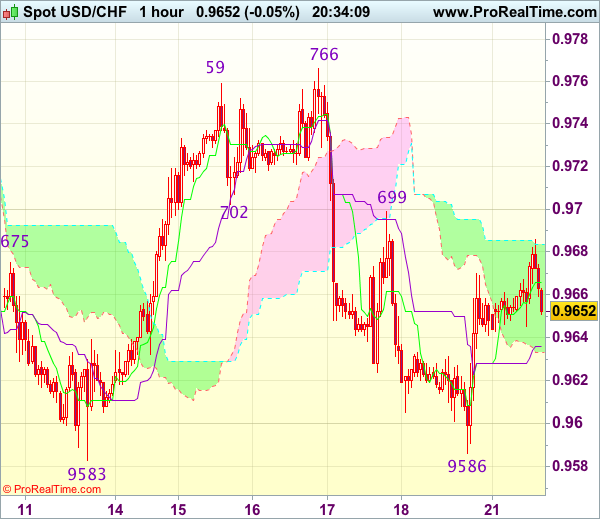
As the greenback rebounded after holding above indicated previous support at 0.9583, retaining our view that further consolidation would take place and another bounce to 0.9699 resistance cannot be ruled out, however, reckon upside would be limited to 0.9730-35 and price should falter below resistance at 0.9766-73 resistance area, bring retreat later.
As near term outlook is still mixed, would be prudent to stand aside for now. Below the Kijun-Sen (now at 0.9628) would bring test of said support at 0.9583, however, break there is needed to revive bearishness and signal another leg of decline from 0.9773 is underway and extend subsequent fall to 0.9550, then 0.9515-20 which is likely to hold on first testing.
Trade Idea Update: GBP/USD – Sell at 1.2935
GBP/USD - 1.2888
Original strategy :
Sell at 1.2935, Target: 1.2835, Stop: 1.2970
Position : -
Target : -
Stop : -
New strategy :
Sell at 1.2935, Target: 1.2835, Stop: 1.2970
Position : -
Target : -
Stop : -
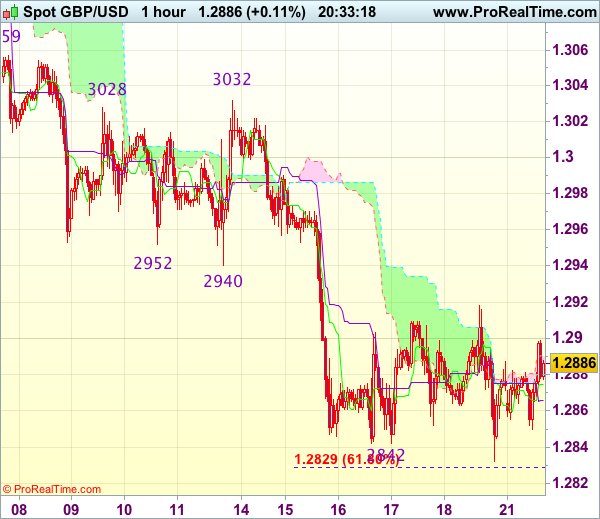
Although cable fell briefly to 1.2832, lack of follow through selling suggests consolidation would be seen and another corrective bounce to 1.2900 and possibly 1.2920 cannot be ruled out, however, reckon previous support at 1.2933-40 would turn into resistance and limit upside, bring another decline later, below said support at 1.2832 would extend recent selloff to 1.2800, having said that, oversold condition should limit downside to 1.2770 and reckon 1.2750 would hold from here, bring rebound later.
In view of this, would not chase this fall here and would be prudent to sell sterling on recovery as said previous support at 1.2933 should cap cable’s upside, bring another decline. Above 1.2950 would defer and risk a stronger rebound to 1.2990-00 before another decline.
Trade Idea Update: EUR/USD – Hold long entered at 1.1720
EUR/USD - 1.1772
Original strategy :
Bought at 1.1715, Target: 1.1815, Stop: 1.1705
Position : - Long at 1.1715
Target : - 1.1815
Stop : - 1.1705
New strategy :
Hold long entered at 1.1715, Target: 1.1815, Stop: 1.1720
Position : - Long at 1.1715
Target : - 1.1815
Stop : - 1.1720
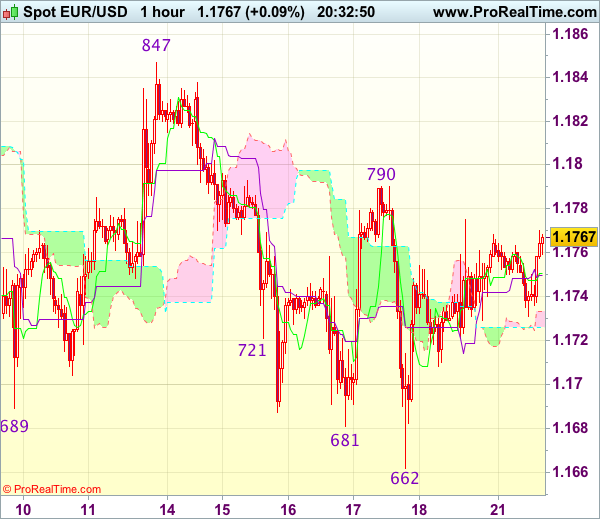
As the single currency found good support at 1.1662 last week and staged a rebound from there, suggesting a temporary low is possibly formed there and consolidation with mild upside bias remains for another test of indicated resistance at 1.1790, however, break there is needed to add credence to this view, bring further gain to 1.1820 but resistance at 1.1847 should hold from here.
In view of this, we are holding on to our long position entered at 1.1715. Below 1.1680-85 would risk retest of 1.1662, break there would extend the erratic decline from 1.1910 top to 1.1640-50 (50% Fibonacci retracement of 1.1370-1.1910 and previous support) but reckon 1.1600 would hold from here.
Trade Idea Update: USD/JPY – Stand aside
USD/JPY - 109.01
New strategy :
Stand aside
Position : -
Target : -
Stop : -
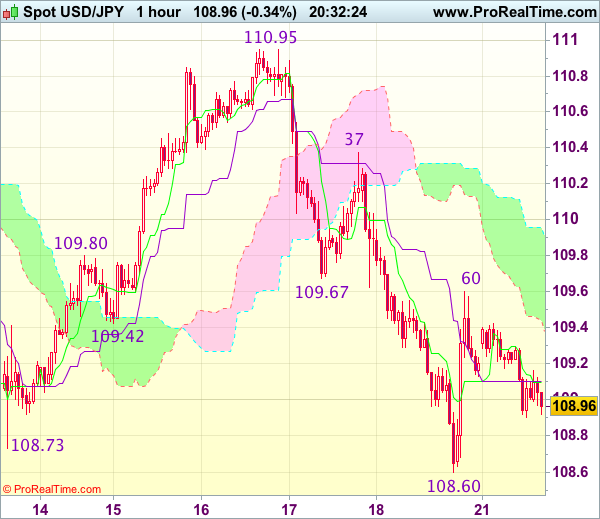
Despite falling briefly to 108.60, lack of follow through selling on break of 108.73 support and the subsequent rebound suggest consolidation above 108.60 would take place and test of 109.60-67 resistance cannot be ruled out, however, break there is needed to signal low is formed, bring further gain to 110.00 and possibly towards 110.37 resistance but price should falter well below last week’s high at 110.95.
On the downside, below said support at 108.60 would signal recent decline is still in progress and may extend further weakness to 108.40, then towards 108.20-25, however, near term oversold condition should prevent sharp fall below latter level and reckon 108.00 would hold from here, bring rebound later. As near term outlook is mixed, would be prudent to stand aside in the meantime.
Traders Eye Jackson Hole Event This Week
- Clarity sought on Fed's interest rate plans;
- Will Draghi risk opening up on tapering?
- Geopolitics and US politics to remain in focus.
It's been a very quiet start to trading on Monday in what is expected to be a slow couple of days, with traders eyeing up the Jackson Hole event later in the week.
With both Mario Draghi and Janet Yellen scheduled to appear on Friday, traders are keen to get more insight into the plans of the two central banks, both of which are now pursuing less accommodative monetary policy. The Fed began its tightening cycle almost two years ago now and next month they're expected to announce plans to start winding down its balance sheet which currently stands at close to $4.5 trillion.
Markets have been largely unresponsive to the prospect of balance sheet reduction, which may come as a surprise given how the opposite was true when the quantitative easing programmes were launched. Still, it seems traders are more interested in what the Fed's plans are for interest rates rather than its balance sheet, with expectations for another this year still below 50%. The only thing keeping them elevated even this much has been hawkish comments from William Dudley - typically a dove and close ally of Yellen - who claimed he supports another hike this year if the economy evolves as expected.
The ECB on the other hand is still in the process of ending its QE program, with purchases currently at €60 billion per month - down from €80 billion earlier this year - and likely to be reduced further from the end of this year. That announcement is expected to come in September and people will be looking for clues from Draghi's speech on whether this will happen or whether it could simply be extended in its current form. While inflation has eased off recently, core inflation is on the rise and while it continues to fall well below target, the trajectory may be enough to convince policy makers that another taper is warranted.
The rest of the week is looking a little quieter though, barring any political and geopolitical events that have kept markets on edge over the last couple of weeks. Scheduled military drills in South Korea - conducted with the US - could heighten the feeling of unrest in the region, despite the drills having been planned long before the recent public war of words. Still, with North Korea having already condemned them as pouring gasoline on fire, there is a risk that a similar show of strength is displayed in response which could trigger further risk aversion.
The political situation at home is providing another distraction for Donald Trump, who will be wanting to put the events of the last week behind him. There had been a lot of speculation that Trump was about to lose Gary Cohn in the aftermath of the events in Charlottesville and his response to them. Instead it was Steve Bannon that departed, a move that some have touted as being a positive for the President's agenda. Whether he will be the final casualty for now is yet to be seen but as ever, Trump will remain very much in the spotlight.