Sample Category Title
What is an AB=CD Pattern?
Developed by Scott Carney and Larry Pesavento, after being originally discovered by H. M. Gartley, the AB=CD pattern has become an effective technique to have in one's toolbox. After months of research, back testing and also live trading, we feel comfortable presenting this setup to our readers. Just to be clear, the following is not the holy grail. We've simply took what Carney and Pesavento taught and traded it in our own way, and so far, it's worked nicely.
To avoid over complicating things, let's take it from the top...

Our way of identifying this formation starts with labelling the four legs: A, B, C, D. The AB=CD pattern means that the CD leg should be at least equal to the length of the AB leg. As can be seen from the diagram above, this is the framework. A rising AB=CD pattern is considered bearish, whereas a descending AB=CD pattern is bullish.
Some traders choose to count how many candles it takes to form the AB leg and then look for a corresponding quantity to be created on the CD leg. Not that there's anything wrong with this, we just choose not to follow this approach.
Below are two bullish AB=CD configurations on the EUR/USD H4 chart that worked out beautifully:

Mr. Fibonacci!
We know of some traders who simply trade the above formation and do very nicely. They are not concerned with Fibonacci drawings. Nevertheless, we find these calculations helpful...
In essence, we look for the BC leg to record a 61.8% Fibonacci retracement. To do this, draw the Fib tool from the A point up to where B completes. Price cannot register a close beyond the 61.8% level - ideally price is to respect this level, give or take a few pips. Carney, on the other hand, states that 'the C point must retrace to either a 0.618 or 0.786'.
The reversal zone (the D-leg completion), is where we look for either a 127.2% or 161.8% Fibonacci extension to converge. Carney called this the 'alternate AB=CD' pattern.
Quite a mouthful, we know! Hopefully the diagram below will help clarify this...

Here's a live chart showing both a bullish and bearish setup with the Fibonacci drawings attached:
Long setup:
As can be seen from the chart, the pattern held firm at the top edge of the 161.8/127.2% reversal zone and rallied a respectable distance!

Short setup:
This sell trade, while the area was respected, was unable to surpass minor structure formed from the high circled in green.
Why we choose to adopt the noted Fibonacci calculations is simple. As the two live examples show, using both the 127.2/161.8% Fibonacci extensions help define a reversal zone (see the green areas). The reason for strictly adopting the 61.8% Fibonacci retracement value at the BC-leg completion is due to this giving better results in our back test, nothing more than this. We found that if price drove too far beyond the 61.8% value, the setup was not as successful.

Further considerations:
- We have found the pattern works far better when the (D) completion point fuses with some kind of structure to the left. What we mean by structure is supply and demand, support and resistance, psychological levels etc.
- In our view, trading the AB=CD as a trend continuation pattern is the better route to take. Although they also work countertrend, trading with the trend tends to be more reliable.
- What timeframe is best? The pattern can be seen on the M1 right up to the monthly timeframe. It is said that the higher timeframes are more consistent, but we've had success using this pattern on the M15, M30 and H1 charts. We've yet to test the validity of the M1 and M5 so it's difficult to judge.
In closing...
Take your time learning this setup. A lot of professional traders use this pattern either as a setup in and of itself or as a way of further confirming another setup.
Weak Dollar Supports EUR/USD
The EUR/USD is consolidating after strong growth and currently the quotes are above the important level of 1.1800. Some pressure on the common currency came from the release of the flash manufacturing PMI for the Eurozone that declined by 0.2 to 56.6 in July against the expected 56.8. Traders took the report on GDP in stride as it showed growth by 0.6% which met forecasts. The US dollar is still under pressure thanks to political tensions and growing disappointment in the Trump administrations ability to implement stimulus measures in the US. Further pressure for the USD came from today's report on personal incomes in the US which showed zero growth against a forecasted increase of 0.4%.
The pound received support from news on the better than expected manufacturing PMI which came in at 55.1 for July against the 54.4 predicted. The weakness of the greenback is the major factor for the growth of the sterling but investors still fear the outcome of negotiations on the terms of Brexit.
The Australian dollar fell today after the Reserve Bank of Australia commented on worsening trading conditions and the negative impact of a stronger national currency on the pace of economic expansion in the country. On the other hand, commodity markets showed price increases for oil, iron ore, copper, gold etc. which will cheer the bulls to push the price of the aussie higher. Among the medium term risks noted by the RBA includes the high debt level in China who is a major buyer of Australian export goods.
EUR/USD
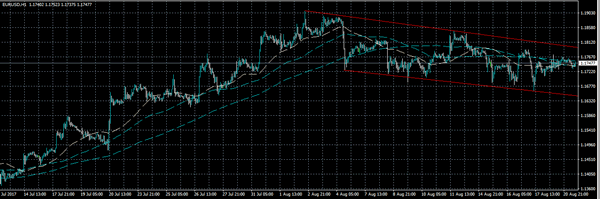
The single currency has shown consolidation within the rising trend and after its end we may see growth resume with potential target at 1.2000. Stimulus for such a move may come from the news of the fall in construction spending in the US by 1.3% in June. The closest support in case of a descending correction will be at 1.1700 and its breaking may become a signal for the trend reversal.

GBP/USD
The British pound is moving along the inclined resistance line and the closest objective is located at 1.3250. The signal for the bears to pull the quotes down will be breaking through the local support at 1.3200. In this case, the immediate goals will be at 1.3125 and 1.3050. Volatility is likely to increase after the recent decline in the amplitude of price fluctuations.

AUD/USD
The aussie price declined today, but was unable to break the lower limit of the rising channel. After the RSI on the 15-minute chart touches the oversold zone, we may see the price rebound with potential of growth up to 0.8000-0.8050 range. Switching the trend to negative will be possible after the breaking of support at 0.7890. And the target levels within the drop may be at 0.7800 and 0.7740.

WTI
The price of the light sweet crude oil benchmark demonstrated a confident decline after OPEC published a report according to which the production levels in the cartel increased to 33 million barrels per day. We should note that the statement about export cuts in Saudi Arabia in August and weaker drilling activity in the US has led to a strong rally during recent weeks. In case of breaking the support at 49.00, we may see the price continue to fall to 47.75 and 46.00.

ISM: Manufacturing Sector Continues to Move Forward
Purchasing managers signaled continued gains in the manufacturing sector. Production, new orders and employment registered expansion. Meanwhile, input cost pressures appear to have increased.
Manufacturing Signals for Continued Strength
The ISM manufacturing index moderated to 56.3 in July from 57.8 in June and thereby remains in expansion mode (top chart). This is a positive sign for industrial production and was the eleventh consecutive month in which the index has been above breakeven. Our outlook is for about 2.5 percent growth for industrial production in the second half of this year.
The production subcomponent dropped to 60.6 from 62.4 in June. Fourteen industries reported growth (including wood products, chemicals and machinery) in production, while only textile mills indicated that production declined last month. For both production and employment, the gains were broad-based.
Employment fell to 55.2 in July from 57.2 in June. Eleven of 18 sectors reported gains in employment including paper, food & beverage, plastics and chemicals.
New Orders—Signal of Growth Ahead
Forward-looking indicators also were strong, suggesting that manufacturing production should continue to expand in coming months. New orders remained at a high level at 60.4 and have been in growth mode for 11 straight months (middle chart). Fourteen of 18 industries showed growth in orders, including plastics, electrical equipment, appliances and chemicals. The gains in new orders are solid and very broad-based.
Foreign sources of demand contributed to the overall strength in orders as the new export orders subcomponent came in at 57.5 in July after an index of 59.5 in June. Eleven industries reported growth in new export orders. The "backlog of orders" subcomponent came in at 55.0 in July, the seventh straight month of expansion. Rising backlogs are another forward indication that manufacturing production will continue ahead.
Cost Pressures Appear to Have Increased
Rising commodity prices earlier this year had led to some cost pressures in the nation's factory sector. This is confirmed by the increase of 7 points to 62 for July's prices paid index (bottom chart). Fourteen of the 18 industries surveyed indicated paying increased prices for their inputs. Paper, furniture, primary metals and food & beverage were among the industries paying higher prices.
Commodities up in price included aluminum (for the ninth straight month), corrugated boxes (five straight months) and electric components. The rise in the ISM prices index does intimate upward pressure on core finished goods in the PPI index. Our outlook is for rising inflation that will prompt the FOMC to start to shrink its balance sheet in the fall and raise the federal funds rate as early as December.

Eurozone Mid-Year Economic Outlook
Executive Summary
Real GDP accelerated in the Eurozone in Q2, as the year-ago pace of economic growth crossed the 2 percent threshold for the first time since Q1-2011. Economic growth has become increasingly broad based in recent quarters amid steady employment gains and improving business sentiment. Looking forward, we expect that the increasingly self-sustaining economic expansion will remain intact. Our current forecast looks for real GDP in the Eurozone to grow 2.1 percent in 2017 which, if realized, would be the strongest annual average growth rate since 2007.
Like several other advanced nations, Eurozone monetary policymakers face a challenging conundrum; the unemployment rate has reached an eight-year low, but core inflation has been listless around 1 percent for the past two years. As such, policymakers at the European Central Bank (ECB) will likely proceed with caution in coming months as they seek to move away from the highly unconventional monetary policy they adopted in recent years while still keeping the economic momentum going. We look for the ECB to maintain its policy rates for the time being and announce a reduction in its monthly bond purchases at the September 7 meeting, although we acknowledge that policymakers could conceivably wait until the October 26 meeting to make the announcement.
Sustainable Expansion Underway in the Eurozone
Data released today showed that real GDP in the Eurozone grew 0.6 percent (2.3 percent annualized) on a sequential basis in Q2-2017 (Figure 1). On a year-over-year basis, real GDP grew 2.1 percent. The outturn marks the 17th consecutive quarter in which real GDP has risen on a sequential basis. Real GDP in the overall euro area is up 7.0 percent since the mild 2011-13 recession ended, and it currently stands 3.7 percent above it previous peak set in Q1-2008.

A detailed breakdown of the Q2 GDP data into its underlying demand components is not yet available, but growth in recent quarters has been broad based, which makes the ongoing economic expansion more sustainable. For example, the 1.9 percent year-over-year GDP growth rate that was registered in the first quarter was supported by a 1.6 percent rise in real personal consumption expenditures and by a 3.5 percent increase in real investment spending. Looking at available monthly data from the second quarter, real retail sales were up 0.7 percent (not annualized) in the first two months of Q2-2017 relative to Q1. This growth in real retail spending in conjunction with the uptrend in car registrations (Figure 2) indicates that growth in real personal consumption expenditures remained solid in Q2-2017. Production of capital goods in the first two months of Q2 rose 1.0 percent relative to Q1, suggesting that investment spending likely was solid as well.

The economic expansion that has been underway in the euro area since 2013 has led to firmer conditions in the labor market. In early 2013, the unemployment rate in the Eurozone exceeded 12 percent (Figure 3). Today, the rate stands at an eight-year low of 9.1 percent. However, despite the solid rate of real GDP growth and the tightening in labor market conditions, inflation remains benign. Although the overall rate of CPI inflation has risen this year, the core rate of inflation, which excludes food and energy prices and which is more reflective of underlying inflationary pressures than the overall rate, has been more or less trendless around 1 percent for the past two years (Figure 4).


As summarized above, real GDP growth has been broadly balanced across spending categories recently, and it appears that the expansion is becoming increasingly self-sustaining. Looking forward, we expect that the economic expansion will remain intact. Strong growth in employment, which is up 1.5 percent on a year-ago basis, should translate into solid growth in consumer spending, and high levels of business confidence in conjunction with accommodative financial conditions should bolster investment spending. Continued economic growth in the rest of the world should help to support export growth in the euro area. Our current forecast looks for real GDP in the Eurozone to grow 2.1 percent in 2017 which, if realized, would be the strongest annual average growth rate since 2007. We look for 2 percent real GDP growth in 2018.
Policy "Normalization" to Get Underway at the ECB
The European Central Bank (ECB) has the single mandate of "price stability," which it interprets as an overall CPI inflation rate of "below, but close to, 2 percent." In that regard, CPI inflation has been below target for more than four years. Consequently, the ECB Governing Council has turned to "unconventional" monetary policy measures in an attempt to boost inflation back towards its target. Not only has the ECB cut its deposit rate into negative territory (Figure 5), but it has also been engaging in a quantitative easing (QE) program over the past two years.1 Between March 2015 and March 2016, the ECB bought €60 billion worth of government bonds per month, but it ramped up its monthly purchase rate to €80 billion in April 2016. It subsequently dialed back its monthly purchases to €60 billion in April 2017. The ECB QE program has swelled the size of its balance sheet from about €2 trillion in early 2015 to more than €4 trillion today (Figure 6).


ECB policymakers envision that the €60 billion/month pace will last "until the end of December 2017, or beyond, if necessary, and in any case until the Governing Council sees a sustained adjustment in the path of inflation consistent with its inflation aim." Given the improvement in economic fundamentals, which should eventually lead to higher inflation, we look for the ECB to announce another reduction in its monthly bond purchases. In our view, this announcement will be made at the September 7 policy meeting, although we acknowledge that the Governing Council could conceivably wait until the October 26 meeting to make the announcement. We believe that the next stepdown in the monthly pace of purchases will take effect in December, and we look for the ECB to cease buying bonds altogether by the end of Q2-2018, at the latest.
The Federal Reserve ended its QE program (October 2014) before it hiked rates (December 2015). Likewise, we believe that the ECB will not hike rates until it has completely wound down its QE program. And just like the Fed, we anticipate that the ECB will wait a number of months until hiking policy rates. In our view, it is likely that the Governing Council will first hike its deposit rate while leaving its two-week refinancing rate and the rate on its marginal lending facility unchanged (see Figure 5). Hiking the deposit rate, which currently stands at -0.40 percent and which sets the lower bound for the overnight interbank rate, will push short-term interbank rates up from negative territory back toward zero percent. Taking the deposit rate into negative territory was an "extraordinary" policy measure, and it seems that the Governing Council would want to first phase out its "extraordinary" measures as it begins the process of "normalizing" monetary policy.
Assuming there are no disruptions in financial markets from the initial hike in the deposit rate, we think the Governing Council will, after a few months, then hike its two-week refinancing rate and the rate on its marginal lending facility. We currently look for the initial hike in the deposit rate in late summer/early fall 2018, with subsequent increases in the refinancing and marginal lending facility rates in Q4-2018. That said, the timing of these rate hikes is highly uncertain and obviously depends on the incoming data flow in coming months. Stay tuned.
Conclusion
Real GDP in the Eurozone rose 0.6 percent in Q2-2017, the 17th consecutive quarter in which economic output in the euro area has grown. The demand-side drivers of real GDP growth appear to be broad based at present, and the economic expansion is becoming increasingly self-sustaining. Although the unemployment rate has receded to an 8-year low, there are few signs yet of a sustained upturn in CPI inflation in the euro area. As a result, we expect the ECB will proceed with caution when shifting from an easing to a tightening policy framework, just like its Federal Reserve counterpart did a few years ago. We look for the ECB to leave its policy rates unchanged for the time being and announce a reduction in its monthly bond purchases at the September 7 meeting, although we acknowledge that policymakers could conceivably wait until the October 26 meeting to make the announcement.
US: Three Hurdles to 3 Percent Growth
Executive Summary
President Trump's official 2018 budget assumes uninterrupted increases in the pace of economic growth during each of the next three years before real GDP growth levels out at 3 percent for every year thereafter. Our own forecast is less sanguine, as are those of the Congressional Budget Office and the Blue Chip consensus (Figure 1). In an interview earlier this year, the president stated, "We're saying 3 (percent) but I say 4 over the next few years. And I say there's no reason we shouldn't be able to get at some point into the future to 5 and above."

The economy's long-run sustainable rate of economic growth is driven by three factors: labor, capital and total factor productivity (TFP). Given current demographic headwinds (boomers are leaving, not entering, today's workforce), and a historically weak stretch for productivity growth, growth of 3 percent is a tall order. In her testimony before Congress earlier this month, Fed Chair Yellen said that 3 percent growth would be "something that would be wonderful if you could accomplish it," but conceded that in reality it "would be quite challenging."3 In our view, 4 percent plus would be nearly impossible. In this special report, we unpack the key drivers used in longrange forecasts and consider the scenarios under which 3 percent growth might be achieved.
In order to achieve sustained 3 percent GDP growth, the economy would need the unlikely occurrence of surging labor force growth like we saw in 1970s/1980s or the capital spending spree/technological innovations seen with the advent of the internet in the 1990s.

Why So Slow? Isn't 3 Percent Just Average?
While it is true that real GDP growth has averaged 3.2 percent per year since 1950, that average is skewed by much higher growth rates in the early part of that period. For more than a generation, 3.0 percent real GDP growth has been much tougher to achieve on a sustained basis. Since 1970, average annual GDP growth has been 2.7 percent. Since 2000, it is just 1.9 percent.
Over the short-run, aggregate spending drives economic growth. It is from the demand-side that economists derived the well-known equation C+I+G+NX=GDP. Although economists measure the economy in this way, over the long run growth is driven by an economy's capacity to produce goods and services. This is a somewhat tricky concept that is best illustrated by an extreme example. If tomorrow all U.S. consumers went out and drained their savings accounts completely, economic growth would surge. However, this surge would do nothing to raise the economy's productive capabilities, and the increase in economic activity would quickly peter out.
As stated in the intro, it is labor force growth and the growth in the productivity of these workers that determines the sustainable growth rate for the economy. The latter half of this duo can further be divided into two drivers: capital (the physical tools utilized by the workers) and total factor productivity (the intangibles that affect output per hour worked, such as education or new innovations). Potential GDP has decelerated as both labor productivity and labor growth have slowed (Figure 3). Those brief periods when the economy was able to crank along at an above average pace were often made possible by one-off surges in one of the inputs (Figure 4).


The red bars in Figure 4 illustrate the surge in the labor force that began in the 1970s as baby boomers and women entered the workforce in greater numbers. The blue and brown bars represent the growth of capital and TFP and show the surge that occurred in the second half of the 1990s as American businesses ramped up info-tech spending and embraced new technologies.
At present, there are no clear signals that these dynamics are likely to be repeated in the near term. In the rest of this report, we explore each of these dynamics in greater detail to determine what it would take to reach a sustainable growth rate of 3 percent.
Battling Demographic Headwinds
To achieve sustained economic growth of 3 percent solely through labor input, potential hours worked would need to expand at about 2.2 percent per year, holding the CBO's capital and total factor productivity forecasts constant (Figure 5). This would be a rare feat in U.S. economic history, requiring potential labor hours growth in the neighborhood of the rates achieved during the period when mass inflows into the labor force occurred from baby boomers and women. The year-over-year percent change in the workforce is plotted in Figure 5 and illustrates the challenge in unmistakable terms.

Such a dramatic rebound in the growth rate of the labor force would not only reverse a trenddecline that has been in place for more than a generation, it would also be at odds with underlying demographic trends and the aging of the population. Since 1997, the 55-and-over crowd has increased as a share of the labor force at the expense of younger workers (Figure 6). Notably, in 2003 the share of these older workers in the labor force surpassed that of 16-24 year-olds. Primeage workers (25-54 year-olds) are still the lifeblood of the labor force, but the graying of the American workforce exhibits a clear upward trend.

The fertility rate in the United States in 2016 was the lowest it has ever been. Even if incentives for boosting fertility were adopted today, there is a roughly 20-year lag before those measures bear fruit in terms of faster labor force growth. A liberalization of immigration policy could boost labor force growth more quickly, but this is likely a non-starter in the current political climate.
Labor Productivity Left to Pick Up the Slack
So, if labor force growth cannot be boosted in the near term, what about measures to boost capital and productivity? To achieve sustained potential GDP growth of 3 percent over the next decade through capital alone, potential capital growth would need to average about 5.5 percent, well above even the fastest historical potential growth rates (Figure 7). Similarly, to achieve potential GDP growth of 3 percent over the next decade through TFP growth alone, potential TFP growth would need to average approximately 2.1 percent, more than four times higher than the pace of actual TFP growth over the past year and much higher than has been achieved for most of the recent past (Figure 8).


As it happens, capital spending in this cycle has been weak, though it is getting stronger. A slowdown in energy-related spending contributed to a run of four consecutive quarterly declines in real equipment spending last year. Prior to this period, we had never witnessed more than two consecutive quarterly declines outside of a recession. Equipment spending turned positive in the fourth quarter of 2016 and has now increased for three straight quarters. Business sentiment has improved in recent months, and core capital goods orders are firming as well, so we expect a modest improvement in capital spending, but not enough to drive the sort of capital growth we would need to hit 3 percent growth.
Total factor productivity has perhaps the most potential to boost growth, as growth in TFP flows through one-for-one to growth in potential GDP. The challenge with total factor productivity growth is that, among the three components, it is the most elusive. Increasing inputs such as capital and labor, while no easy feat, is at least straightforward. Increasing the efficiency with which those inputs create output, however, is a more daunting task. Developing more skilled workers through education is one potential avenue, but college enrollment rates have flat-lined after decades of rising. Fostering the conditions for entrepreneurship and innovation is another important step, but the steps necessary to do so are neither always clear nor easy. Perhaps the widespread use of artificial intelligence or some other major breakthrough is right around the corner, but the timing and extent of its economic impact would be huge question marks, and banking on this occurring is not much of an economic strategy from a policymaking perspective.
Wait Wait Wait: Can't All These Things Improve at Once?
The above examples illustrate the challenge in achieving 3 percent potential growth by improving one input alone. However, at this point some of our more optimistic readers might be asking: what if all three drivers of potential growth increase at once? To illustrate what this might look like, we turn to the last time real potential GDP growth averaged 3 percent over a 10-year period. Figure 9 illustrates the average contributions to potential growth from labor, capital and TFP from 1997-2007, the last time this feat was achieved. This period saw robust total factor productivity and capital growth as businesses and individuals embraced computers and information technology. Over the next decade, potential total factor productivity growth would need to be approximately 68 percent faster than the CBO projects, or roughly 0.6 percentage points, while potential capital growth would need to be about 75 percent faster each year.

Ultimately, the key challenge is that labor and productivity often change at a glacial pace, and the current trend growth rates are historically slow. An optimist might say perhaps this means there is only room to go up from here. However, due to the long lead times needed for a change in these long-term factors influencing growth, such a low base today implies that even solid progress might not be enough to achieve robust growth of 3-4 percent. Furthermore, to achieve 3 percent growth, everything has to improve simultaneously. This is of course possible, but raising the pace of growth in labor, capital and TFP all at once is a tall task. As illustrated in Figure 10, there is little precedent for surging labor force and labor productivity growth occurring simultaneously over a 10-year period (Figure 10).

Conclusion
The economy's long-run sustainable rate of economic growth is driven by three factors: labor, capital and total factor productivity. Our analysis considers what kind of growth it would take in any one of these factors individually or in combination to achieve 3 percent growth on a sustained basis. While we agree with Chair Yellen's assessment that such a growth environment would be wonderful, it would also be very difficult to achieve and maintain.
In our assessment, the world's largest economy can only grow at 3 percent on a sustained basis if one makes unrealistically rosy assumptions about the pace of labor force growth that would match the simultaneous arrival of women in larger numbers and the baby boomers' entry into the workforce seen in the late 1970s/early 1980s. The 3 percent goal would also likely require a pace of capital spending like we witnessed with the capital spending spree of the 1990s.
None of this is to say that the economy could never grow at such a strong pace again, but past cycles have demonstrated that all three of these factors tend to change at a slow pace, which suggests long lead times before new policies could achieve the fleeting objective of 3 percent growth.
Gold Soars Further as USD Continues to Sink
Gold prices rose further last week, boosted by the unrelenting decline in the dollar. Without any major risk events on the horizon, we think that the yellow metal's price could continue to be dictated by the performance of the greenback over the next days. Given the latest turmoil in the White House and the subdued market expectations for another Fed rate hike this year, we think that the US currency could remain under pressure for a while. Something like that could keep the yellow metal supported.

XAU/USD continued edging north last week, but traded in a consolidative manner yesterday between the support of 1265 (S1) and the resistance of 1271 (R1). The price structure on the 4-hour chart remains higher peaks and higher troughs within the upside channel that has been containing the price action since the 10th of July. Hence, we consider the short-term outlook to still be positive. A clear break above 1271 (R1) would confirm a forthcoming higher high and perhaps set the stage for extensions towards our next resistance of 1280 (R2).
Nevertheless, taking a look at our short-term momentum indicators, we stay mindful that a corrective setback may be looming before the next leg north. The RSI turned down after it hit resistance near its 70 line, while the MACD, although positive, has topped and fallen below its trigger line. What's more, there is negative divergence between both these indicators and the price action.

As for the broader outlook, the metal continues to trade in the sideways range that's been in place since the end of January, between the 1200 and 1300 key barriers. The latest short-term uptrend began from near the lower bound of that range. As such, this increases the likelihood for further near-term advances, perhaps for a test near the upper bound of the range, at 1300.
Dollar Weakness Unfolds; Sterling Gains on Manufacturing Rebound
Today's busy schedule of economic data releases kept forex traders active, following significant dollar moves last night. The US currency retraced some of the losses against most of its peers during the early European trading, but those gains were short lived as the greenback's weakness unfolded ahead of the construction spending and PMI data releases.
The European session kicked off with a set of PMIs out of the eurozone and its member countries, followed by the eurozone GDP figures for the second quarter and German unemployment data. In the UK, figures pointing to a manufacturing recovery were of main interest. The eurozone economy accelerated slightly to 0.6% quarter-on-quarter in the three months ending June, in line with analysts' expectations. In the previous quarter, growth was revised down however, from 0.6% to 0.5%. On a 12-month basis, GDP growth edged up from 1.9% to 2.1%, also in line with forecasts and the highest since the final quarter of 2015. Among the released PMI numbers, highly watched figures out of Germany showed that the manufacturing sector there recorded a solid gain last month, though at a slower rate than in June as new orders came in more slowly. The index fell to 58.1 in July's final reading from 59.6 in June, remaining above the 50-expansion mark.
The euro traded above the 1.18 mark against the greenback for most of the day, with the pair last trading at 1.1830, following yesterday's rally on the back of dollar weakness.
Sterling rose to an 11-month high against the greenback, as today's manufacturing data eased concerns of an economic slowdown. The PMI survey for July recovered from a seven-month low as it rose to 55.1 from a downwardly revised 54.2 in June and above expectations of 54.4. The rebound was helped by the biggest influx of new export orders since 2010, which offset tempered growth in manufacturing output. Investors are hoping that the upbeat figures will hearten policymakers at the Bank of England, which will make a policy decision and release its latest quarterly Inflation Report on Thursday. Pound/dollar surged following the survey release to 1.3233 to last trade at about the same level as the US session was under way.
The US morning session was similarly busy with an ample of data releases. Consumer spending barely rose, up 0.1%, in June as personal income stagnated for the first time in seven months due to a decline in dividend payments. Modest growth in consumer spending, which accounts for more than two-thirds of US economic activity, could signal a disappointing third quarter expansion. The personal consumption expenditures (PCE) price index, excluding food and energy, rose 0.1% in June m/m after a similar gain in May. Annually, the PCE index increased 1.5%, mirroring the prior month's gain. The PCE index is the Federal Reserve's preferred inflation measure. Meanwhile, the ISM report showed that US manufacturing expansion cooled in July to 56.3 from a reading of 57.8 the prior month, and narrowly missed expectations of 56.4.
Following all the released US figures, the greenback fell against the yen, last trading just below the 110-mark, while the dollar index hit a 15-month low of 92.77.
Looking at commodities, oil prices pulled back from their two-month high. WTI was last trading at $49.55 a barrel while Brent was at $51.95. Gold gained as demand for the precious metal rose on the back of dollar weakness. Gold was last trading at $1,272.70 an ounce.
U.S. Manufacturing Decelerates in July, But Remains Well in Expansionary Territory
The Institute for Supply Management (ISM) manufacturing index edged down to 56.3 in July, from 57.8 in June. This was a hair below consensus expectations for 56.4.
Most subcomponents were lower on the month, with the exception of inventories which edged up to 50.0 (from 49.0).
In general, most subcomponents indicate healthy growth in activity. Production and new orders both edged down to 60.2 (from 62.4) and 60.4 (from 63.5), respectively. The employment sub-index pulled back 2 points, but at 55.2 remains well in expansionary territory.
Export orders moved down 2 points, while the imports subindex moved up by the same amount. Still, both remain in the 56 to 58 range, indicating healthy growth in international shipments.
Prices paid bucked the downward trend, moving up strongly to 62.0 (from 55.0 in June).
The spread between new orders and inventories pulled back a little, but at 10.6 remains supportive of future growth in the sector. This notion was also corroborated by 15 of the 18 manufacturing industries reporting growth this month, while only petroleum, apparel and textiles reporting contraction.
Key Implications
The U.S. manufacturing sector continues to show healthy growth. The slight deceleration in July is not surprising, following on the heels of June's strong performance.
A rebounding global economy, a relatively steady oil price, and the lower U.S. dollar should continue to support U.S. manufacturing. Assuming a relatively stable political backdrop and little disruption on the trade front, there is little reason not to remain optimistic about manufacturing's prospects. This is corroborated by the forward looking indicators in today's ISM report and relatively optimistic industry views.
The uptick in the price sub-index is a welcome development and should provide some evidence for the Fed that the recent slowdown in inflation will prove transitory.
Spot Gold Accelerated Higher and Hit Fresh Session High
Spot Gold accelerated higher and hit fresh session high (also the highest since 14 June), receiving fresh boost from lower than expected US ISM Manufacturing PMI numbers which pressured the dollar.
Strong uptrend from $1204 (10 July low) approached its next target at $1274 (Fibo 76.4% of $1296/$1204 descend), with $1280 (14 June spike high) also being in focus.
Past three weeks action was shaped in three long bullish weekly candles, with monthly performance being also positive in July (bullish monthly candle with long tail) which is seen as strong bullish signal, along with firm bullish setup of daily technical studies.
Overbought conditions so far did not affect gold's bulls but corrective action should be anticipated in the near term, as daily cloud is twisting later this week and may attract for pullback.
Today's strong downside rejection at $1262, which is the session low, marks initial support, along with broken Fibo 61.8% barrier at $1261, followed by rising 10SMA (1257) and daily Tenkan-sen ($1254) which guard key support at $1249 (weekly cloud top).
US labor data due on Friday will be closely watched for fresh signals.
Res: 1274; 1280; 1288; 1296
Sup: 1262; 1257; 1254; 1249

Can DAX Join A US Stocks “Mania Cycle”?
Good day traders!
German Dax and S&P500 are in negative correction for the last few weeks; with US market trading at all-time high while DAX lost nearly 7% since June 20th high. Technically we see US markets entering into bullish mania phase with DJIA breaking above the upper trendline of an Elliott Wave channel. We may see fifth wave rally to continue up to 24000-25000. Mania cycle is also confirmed by Charles Schwab reports that clients opened the highest number of brokerage accounts in the first half of 2017 since 2000 as highlighted in article by ZeroHedge. Keep in mind that from 2000 peak DJIA lost nearly 40% in two years and S&P500 fell nearly 50%. However, I don't think that top is near yet, as Elliott Wave model appears incomplete; it suggests more upside in coming months.

So if we go back to DAX and US markets correlation, I think that Dax can see more upside and join the mania phase as well while DJIA is trading towards projected levels. In fact Dax came down in three waves to fill the gap around 12000, which can prove out to be a good support area. Break above the upper channel resistance line can be an important evidence that European and US markets are going back into positive correlation. Higher DAX should also impact the EURUSD moves.