Sample Category Title

Will US GDP Provide Bright Spark On An Otherwise Downbeat Day

  • Amazon earnings weigh on sentiment;
  • Obamacare “skinny repeal” fails to get past the Senate, threatening tax reform and spending;
  • US and Canadian GDP releases eyed, as well as Kashkari comments.

Financial markets are set to open on a more downbeat note on Friday, with earnings from Amazon on Thursday being blamed for the initial underperformance along with the US Senate's inability to pass the “skinny repeal” of Obamacare.

While Amazon's results may only be responsible for some short term negativity, with the tech sector as a whole still enjoying a remarkable year, the failure in the Senate could pose further problems for President Donald Trump and his growth agenda. It's generally believed that the repeal of Obamacare will unlock the ability to cut taxes, a key policy of Trump's during the campaign and one that was partly responsible for such a strong post-election rally in equities, the dollar and rates.

Equity markets have been rather resilient to the delayed approval of tax cuts and spending measures that were intended to boost growth in the world's largest economy, from the currently below par levels. This has been aided by healthier earnings, as we've once again seen for the second quarter, despite the occasional blip, as we had with Amazon. Today is looking a little quieter but we will get numbers from Exxon Mobil, Merck and American Airlines, among others.

Friday is also looking a little quieter on the economic data side as well, with US and Canadian second quarter GDP the only notable releases. The US will be of particular interest, with expectations currently for quite a sizeable upward revision to 2.5% which would make the first half of the year not the shambles it first appeared. With inflation and jobs data still to come next week, it could also act as another incentive for the Fed to pursue another rate hike this year – although that's unlikely to come until December – with policy makers comfortable with the path the economy is on.

We'll also hear from Neel Kashkari later on today, a voter on the FOMC and arguably its most dovish member. While his comments will be of interest, being one of the few doves among a committee who's consensus is still to tighten does mean his comments possibly carry less weigh, as far as traders are concerned.

Yen Finds Support As Japanese Consumption And Employment Brighten In June

On early Thursday, the yen partially reversed yesterday's losses after statistics out of Japan showed a surprise improvement in domestic consumption and the labour market. This is said to put the BOJ's recent arguments for maintaining current policy into question and will likely encourage policymakers to scale back their ultra-loose stimulus program in the future.

In June, the unemployment rate in Japan beat forecasts according to the Japan Institute for Labour, falling from 3.1% in May to 2.8%, while analysts anticipated the figure to slip to 3% instead. The availability of jobs which is measured by the jobs to applications ratio rose slightly to 1.51, exceeding the 1.49 observed in the previous month and the 1.50 forecasted. Despite the marginal increase, the ratio climbed for the fourth consecutive month reaching the highest on record in 43 years.

Concerning consumption, household spending continued expanding in June, rising by 1.5% month-on-month, which was more than double the previous reading of 0.7%. The positive figure was a surprise, as based on forecasts, household expenditure was anticipated to decline by 0.1%. On a yearly basis, consumer spending turned positive for the first time in a year, climbing unexpectedly by 2.3%. The reading in May was down by 0.1%, whereas for the month of June, analysts expected a rise of 0.6%.

Separate data showed that retail sales experienced an increase as well, climbing by 0.1 percentage points to 2.1% and missing the forecast of 2.3%.

Looking at prices, national CPI was in line with expectations, remaining steady at 0.4% in June on an annual basis. Note that, CPI has followed an upward path since the beginning of the year. Excluding energy and food products, national core CPI did not change from 0.4% seen in May.

Last week, the BOJ decided to maintain its ultra-easy monetary policy under concerns that inflation will take more time to approach the target of 2%. However, the above data on employment conditions and consumption will likely motivate companies to raise prices sooner than anticipated and therefore increase stubbornly low wage growth. This would give a signal to BOJ policymakers to rethink their recent conclusions as inflation might not delay hitting the desired target after all.

In the forex markets, the data drove the yen higher against the greenback by 0.22%, with dollar/yen falling from 111.22, before the data release, to 110.98.

EUR/JPY Elliott Wave Analysis

EUR/JPY - 130.21


EUR/JPY: Wave v as well as larger degree wave (C) ended at 94.11 and first leg of larger degree wave C upmove has possibly ended at 149.79 and wave 2 correction has possibly ended at 109.49.


The single currency has maintained a firm undertone after surging to 130.77 earlier this month, bullishness remains for medium term upmove from 109.49 low (2016 low) to resume after consolidation, above said resistance at 130.77 would extend this move to 131.00, then 132.00-10, however, near term overbought condition should prevent sharp move beyond 132.90-00 (1.236 times projection of 109.49-124.10 measuring from 114.85) and price should falter well below previous chart resistance at 134.59, risk from there has increased for a retreat to take place later.

The daily chart is labeled as attached, early selloff from 169.97 (July 2008) to 112.08 is wave (A) of B instead of end of entire wave B and then the rebound from there to 139.26 is wave (B), hence, wave (C) has possibly ended at 94.12 with a diagonal triangle as labeled in the daily chart, hence upside bias is seen for further gain. Recent rally above indicated retracement level at 116.69 (50% Fibonacci retracement of the intermediate fall from 139.26-94.12) adds credence to this view and signal major reversal has commenced but first leg of this wave C has possibly ended at 149.79, hence wave 2 has commenced with wave A ended at 126.09, followed by wave B at 141.06, wave C commenced and could have ended at 109.49, above 126.00 would add credence to this view, then headway to 130.00 would follow. 


On the downside, although initial pullback to 129.30-40 cannot be ruled out, reckon 128.85-90 would limit downside and bring another rise to aforesaid upside targets. A daily close below support at 128.49 would bring test of support at 127.44 but break of latter level is needed to suggest a temporary top is possibly formed, bring retracement of recent upmove to 126.45-50 but price should stay above previous resistance at 125.82 (now support) and euro may head north again from there. Only a sustained breach below this level would signal correction of recent upmove has commenced for further fall to 125.15-20 but previous resistance at 124.65 would hold from here. 

Recommendation: Buy at 128.85 for 130.85 with stop below 127.85.


To re-cap the corrective upmove from the record low of 88.93 (18 Oct 2000), the wave A from there is subdivided as: 1:88.93-113.72, 2:99.88 (1 Jun 2001), 3:140.91 (30 May 2003), 4:124.17 (10 Nov 2003) and 5 ended at record high of 169.97 (21 Jul 2008). The brief but sharp selloff to 112.08 is viewed as a-b-c x a-b-c wave (A) of B. The subsequent rebound to 139.26 is (B) of B and (C) of (B) has possibly ended at 94.12 and in any case price should stay well above previous chart support at 88.93, bring rally in larger degree wave C towards 150.00.

USD/CHF Elliott Wave Analysis

USD/CHF –  0.9693

 
USD/CHF – Wave IV ended at 1.1730 and wave V has possibly ended at 0.7068

 
Although the greenback fell to as low as 0.9438 late last week, the subsequent strong rebound suggests a temporary low is possibly formed there and consolidation with mild upside bias is seen for gain to 0.9701 resistance, however, a daily close above there is needed to add credence to this view, bring retracement of recent decline towards resistance at 0.9771 but only a sustained breach above this level would provide confirmation and signal correction of recent selloff has commended, then headway to 0.9808 resistance would follow but upside should be limited to 0.9890-00 and price should falter well below psychological resistance at 1.0000. 

Our preferred count on the daily chart is that early selloff to 0.9630 is an end of the larger degree wave III and major correction is unfolding from there with a leg ended at 1.2298 (Nov 2008 with (a): 1.0625, (b):1.0011 and (c):1.2298), wave b ended at 0.9910 with (a): 1.0370, (b): 1.1967, (c): 0.9910. The rise from there to 1.1730 is the wave c which also marked the end of wave IV and wave V has possibly ended at 0.7068.


On the downside, whilst pullback to 0.9550-60 cannot be ruled out, reckon 0.9490 support would remain intact and bring another rebound to aforesaid upside targets. Only a drop below said recent low at 0.9438 would revive bearishness and signal the erratic decline from 1.0344 top (formed back in late 2016) is still in progress and downside bias remains for this move to extend weakness to 0.9390-00, however, loss of downward momentum should prevent sharp fall below 0.9300-10, risk from there has increased for a rebound to take place probably later.
 
Recommendation: Buy at 0.9550 for 0.9750 with stop below 0.9450

Dollar's long-term downtrend started from 2.9343 (Feb 1995) and it was unfolding as a (A)-(B)-(C) with (A): 1.1100, (B): 1.8310 (26 Oct 2000), then followed by another impulsive wave (C) with wave III ended at 0.9630 (Mar 2008). Under this count, correction in wave IV has possibly ended at 1.1730 and wave V already broke below support at 0.9630 and met indicated downside target at 0.7500 and 0.7400. The reversal from 0.7068 suggests the wave V has possibly ended and the breach of resistance at 0.9595 add credence to this view and indicated upside target at 1.0000 had been met, however, the sharp retreat from 1.0296 to 0.7401 suggests choppy trading would be seen but price should stay above said record low at 0.7068.

Technical Outlook: EURCHF Hits The Highest Levels Since Jan 2015 On Steep Rally In Past Few Days

The Euro surged against Swiss Franc this week, marking gains of over 3% so far in the biggest weekly advance since late Jan 2015. The Swiss Franc hit the lowest level since the SNB unpegged the national currency on Jan 15 2015.

Market participants suspect that the SNB might be behind the move, as central bank's president Jordan warned about significantly overvalued franc.

Strong rally so far doesn't show signs of fatigue, despite strongly overextended daily studies, but some corrective action could be anticipated in the near term.

The pair hit fresh high at 1.1379 on Friday, the highest since 15 Jan 2015 fall, signaling further advance.

Immediate target lies at 1.1418 (Fibo 138.2% projection) and rally may extend towards 1.1554 (Fibo 161.8% projection.

Res: 1.1379, 1.1418, 1.1500, 1.1554
Sup: 1.1300, 1.1260, 1.1180, 1.1105

Euro At 30-Month Highs, US Advance GDP Next

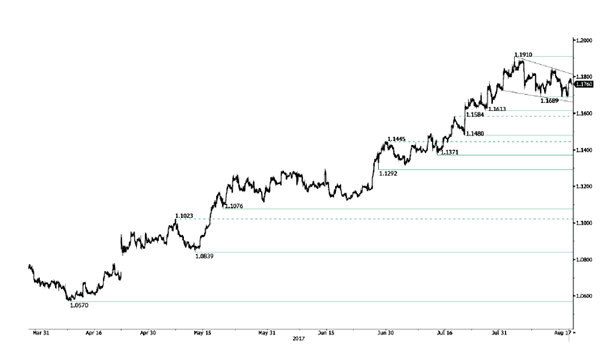
The sparkling euro climbed to 1.1777 on Thursday, its highest level since January 2015. On Friday, EUR/USD has inched higher, as the pair is trading at the 1.17 line, up 0.23% on the day. On the release front, German Preliminary CPI is expected to remain unchanged at 0.2%. Later in the day, the US releases Advance GDP, with the estimate standing at 2.5%. If GDP surprises, we can expect movement from the euro. We’ll also get a look at UoM Consumer Sentiment, with is expected to dip to 93.2 points.

The German consumer remains optimistic about the economy, and economic barometers certainly bear out the positive sentiment. With German exports in high demand, the manufacturing sector is strong. GfK German Consumer Climate strengthened for a fourth straight month, improving to 10.8 in the July report. This edged above the estimate of 10.7 points. Importantly, strong consumer confidence has translated into increased consumer spending, a key driver of economic growth. However, the fly in the ointment remains inflation, which is stuck at low levels. The lack of inflation is a pressing concern for ECB policymakers, and there is little chance that the bank will end its quantitative easing program before December, if inflation levels don’t move upwards.

The Federal Reserve maintained the benchmark rate at 1.25% on Wednesday. The highly-anticipated rate statement was cautiously optimistic in tone, saying that the economy was growing at a moderate pace and that the labor market remained strong. The statement made note of low inflation, but said that the Fed expected the economy to continue to expand. Another key issue on the Fed’s plate is the $4.2 trillion balance sheet. The rate statement said that the Fed plans to taper asset purchases “relatively soon”, which is a likely nod at September as the start date. This would involve the Fed tapering its purchases of Treasury bonds and mortgage securities, with an initial taper likely of $10 billion/month. Although the Fed continues to talk about another rate hike in 2017, investors remain skeptical. The rate statement did not change many minds, as the odds of rate increase in December stand at 47%, according to the CME Group.

Daily Technical Analysis: EURUSD, GBPUSD, USDJPY, USDCHF


EURUSD

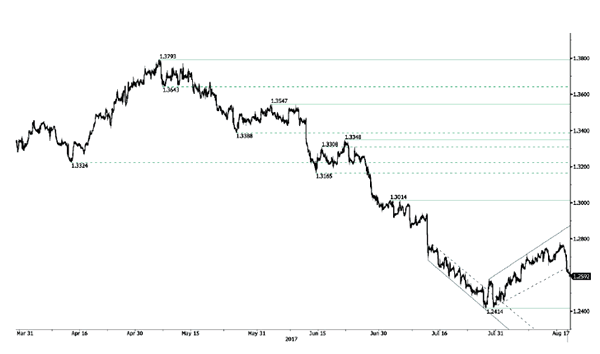
The EURUSD was corrected lower yesterday bottomed at 1.1650. That is a normal corrective movement and overall I remain bullish. The bias is bearish in nearest term testing 1.1640 – 1.1580 support area which is a good place to buy with nearest target seen around 1.1875. Immediate resistance is seen around 1.1712. A clear break above that area could lead price to neutral zone in nearest term retesting 1.1776 region. On the downside, a clear break and daily/weekly close below 1.1580 and the trend line support would signal further bearish correction and activate my neutral mode.

GBPUSD

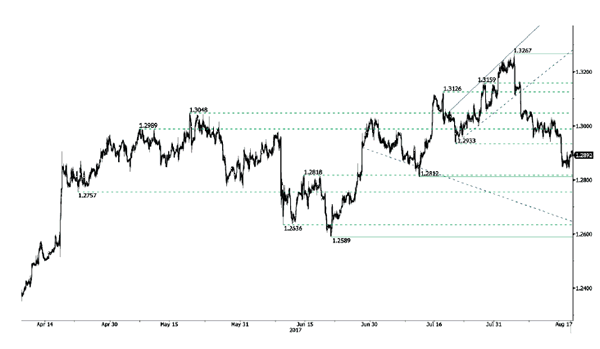
The GBPUSD attempted to push higher yesterday topped at 1.3159 but whipsawed to the downside and closed lower at 1.3062. The bias is bearish in nearest term testing 1.3000 area which is a good place to buy with a tight stop loss. Immediate resistance is seen around 1.3100/25. A clear break above that area could lead price to neutral zone in nearest term but would keep the major bullish bias remain strong retesting 1.3159 or higher. Overall I remain bullish but a clear break and daily/weekly close below 1.3000 would signal further bearish correction next week.

USDJPY

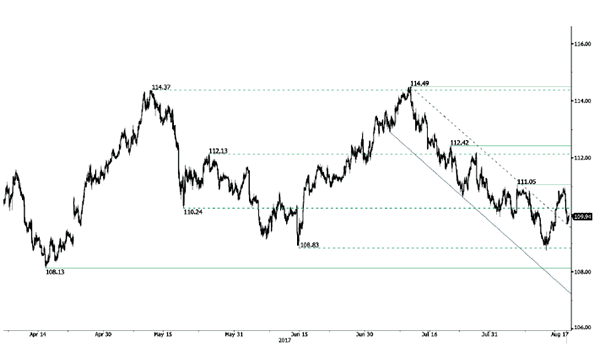
The USDJPY was indecisive yesterday. The bias is neutral in nearest term. Price has been moving sideways without clear direction this week. Immediate support is seen around 110.60. A clear break and daily/weekly close below that area could trigger further bearish pressure testing the trend line support and 109.50/00 support area next week which is a good place to buy. Immediate resistance is seen around 111.50/70 region. A clear break above that area would expose 112.75 region. Overall I remain neutral.

USDCHF

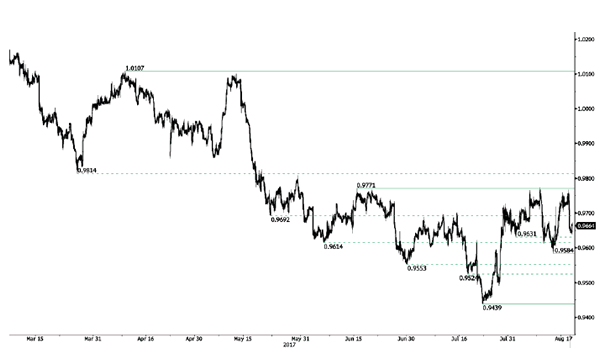
The USDCHF had a strong bullish momentum yesterday topped at 0.9661 and hit 0.9721 earlier today in Asian session. The bias is bullish in nearest term testing 0.9765 – 0.9807 resistance area which is s good place to sell. Immediate support is seen around 0.9650. A clear break below that area could lead price to neutral zone in nearest term testing 0.9595/50 area. Overall I remain bearish but need a clear break at least back below 0.9550 to keep the bearish outlook remain strong.

US Data Prints On The Soft Side, Russia Central Bank To Stay On Hold

US data in focus as USD extends losses

Durable goods orders printed well above median forecast suggesting a solid recovery in June after two months of contraction. The headline gauge increased 6.5%m/m versus 3.9% expected and an upwardly revised figure of -0.1% in May. The upside surprise was essentially due to a sharp bounce in new orders for aircraft, thanks to the Paris Air Show (23-25 June). Excluding the volatile transportation components, core durable goods orders came in below estimates, printing at 0.2%m/m versus 0.4% expected and 0.6% previous reading. Overall, the report suggests that the manufacturing activity continues to expand at a moderate pace, while the anaemic demand for consumer goods such as vehicles and electronic products signals households’ consumption is not ready to take of yet, which is of bad omen for inflation.

Talking about inflation, the core personal expenditure index for the second quarter is due for release later today. The gauge is expected to have increased 0.7% (SAAR), down from a rise of 2% in the first quarter. Although the slowdown in inflation pressures has already been documented through the last months, financial markets are not immune to sharp adjustments should the gauge surprise in either direction.

US Q2 GDP is anticipated to have accelerated to 2.7% (q/q annualised) compared to a reading of 1.4% in the previous quarter, mostly due to heightened expectations for personal consumption - 2.8% (saar) consensus and 1.1% in Q1.

On Friday, EUR/USD stabilised at around 1.17 after printing a multi-year high at 1.1777 on Thursday. The broad-based dollar weakness of the recent months was enhanced by the Fed’s dovish statement released on Wednesday. Investors will have to wait September to get further clarity on both the ECB and Fed thinking, which means the market will become more sensitive to economic data than usual, especially inflation figures.

Russia: Rate decision over sanctions fears

The ruble is trading sideways around 60 ruble and this may not last long as the USDRUB pair is under pressures. While the Russian economic data are improving, there are other geopolitical issues that may have strong consequences on the future of the Russian economy. Indeed, U.S senate has finally approved further strengthening of sanctions which would prevent Donald Trump from lifting them. Now Trump must revise this legislation which sounds contradictory knowing that his relation with Russia during his campaign are under investigation. There may be there a conflict of interest.

Some say that there is now growing risks that Russia, under the US sanctions, could face decades of low growth. Other economic fundamentals such as low oil prices, which remain below $50, are also weighing on the Russian economy. Inflation, even though declining, are still very high and should likely end up to 5% before year-end (4.4% at the moment). We believe that the Central Bank of Russia has some room for normalizing its monetary policy. In addition, the CBR needs to guarantee price stability because of sanctions will which will drive policymakers not tighten rates. As a result, key rate is then set to remain at 9%. We target 58 ruble for one dollar in the medium-term as we consider the ruble is still one good carry trade with, even though existing but limited downside risks.

Bitcoin Consolidating Around $2500

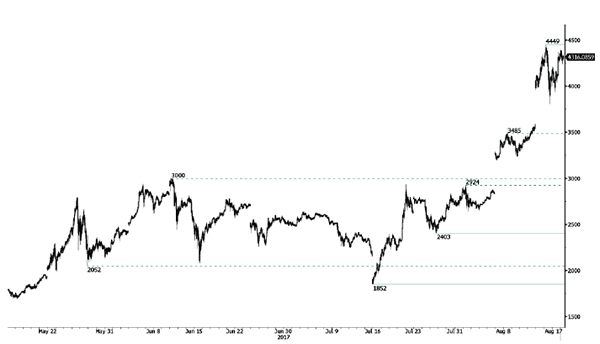
Bitcoin's volatility has declined. Strong resistance can be found at 3000 (12/06/2017 high) and hourly support lies at 2403 (26/07/2017 low). Further retracement are expected.

In the long-term, the digital currency has had an exponential growth. There are decent likelihood that the asset will consolidate above $1500. Long-term support is given at $1464 (04/05/2017 low).
Trade Idea: GBP/JPY – Stand aside

GBP/JPY - 145.25

Recent wave: Medium term low formed at 120.50 and (A)-(B)-(C) major correction has commenced with (A) leg ended at 148.45, hence wave (B) is unfolding for retreat to 131.00-10.

Trend: Near term up

Original strategy:

Sold at 145.90, stopped at 146.50

Position: - Short at 145.90
Target: -
Stop: - 146.50

New strategy :

Stand aside

Position: -
Target:  -
Stop:-

Although sterling moved higher to 146.55 yesterday, lack of follow through buying and the subsequent retreat suggest further consolidation would be seen and weakness to 144.80-85 cannot be ruled out, however, below support at 144.45-50 is needed to signal the rebound from 144.00-05 has ended, bring test of this level, break there would add credence to our view that a temporary top has been formed at 147.75 earlier this month, bring retracement of recent upmove to 143.50, then towards support at 143.30.

On the upside, above said resistance at 146.55 would signal low has been formed at 144.05 and bring a stronger rebound to 146.90-00 and possibly towards 147.30. As near term outlook is still mixed, would be prudent to stand aside in the meantime.

Our preferred count is that larger degree wave V with circle is unfolding from 251.12 with wave (I) 219.34, (II): 241.38 and wave (III) is subdivided into 1: 192.60, 2: 215.89 (23 Jul 2008) and wave 3 ended at 118.87 earlier in 2009. The correction from there to 162.60 is wave 4 which itself is a double three and is labeled as first a-b-c ended at 151.53, followed by wave x at 139.03, 2nd a ended at 162.60, 2nd b at 146.75 and 2nd c leg of wave 4 ended at 163.00. Therefore, the decline from 163.00 to 116.85 is now treated as wave 5 which also marked the end of larger degree wave (III), hence wave (IV) major correction has commenced for retracement of the wave (III) from 241.38 and upside target at 183.95-00 (50% Fibonacci retracement of the wave (II) from 241.38) had been met, a drop below 160.00 would suggest wave (IV) has ended at 195.85, bring decline in wave (V) for initial weakness to 130 (already met) and 120.