

Sample Category Title
Identifying Correlations
Unless you intend on trading one market at a time, it is vital to understand how different instruments markets interact with one another. A correlation, in simple terms, describes how much (or how little) two markets move together over a period of time.
The key thing to remember is that financial markets DO NOT trade in isolation. Currency pairs, for example, deal with TWO economies. You can easily see this by overlaying and comparing different pairs or by simply reading a currency correlation table.
In this article, we'll attempt to cover not only how currency pairs typically interrelate, but also look at what affect commodities, bonds and equities have on the currency markets. With this being a somewhat extensive subject we'll do our best to keep it as concise as possible!
These correlations, however, are not fool proof and do from time-to-time deviate. However, they can help a trader immensely if he/she knows how to correctly use them.
Some correlated currency pairs to keep an eye on
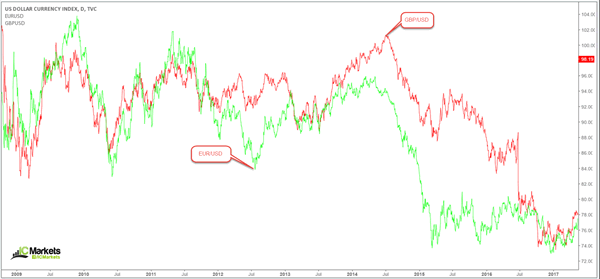
The EUR/USD and GBP/USD usually track each other over 80% of the time. This means that when the EUR/USD puts in a high, you'll typically see a similar scenario over on the GBP/USD.
The AUD/USD and NZD/USD are two other markets with a similar relationship as above. Notice that these two instruments almost mirror each other exactly. In fact, these markets move in tandem over 70% of the time!
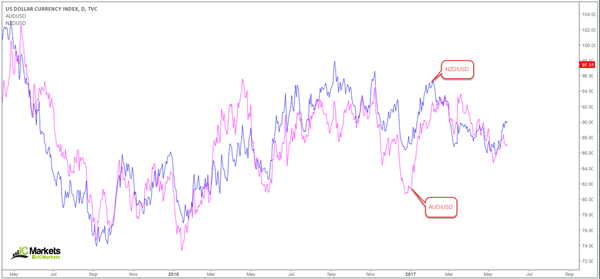
Over the long haul we can expect the above markets to mirror each other's movements, but there will be times when the correlation deviates and this is usually due to political or economic reasons. Why these correlations exist is largely due to the currency pairs having the quote currency priced in US dollars. For example, imagine that the dollar sold off across the board, this would likely send the EUR, GBP, AUD, and NZD higher. Of course, some markets are more hot-blooded than others, so do not expect each unit to have the same range!
A few inversely correlated currency pairs to pay attention to
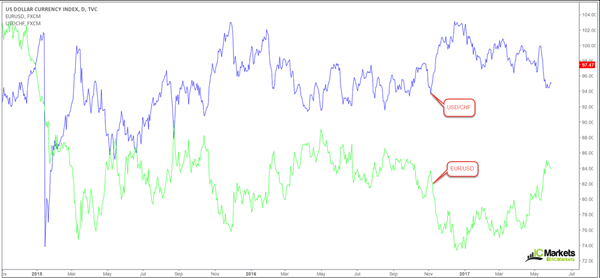
First up is a well-known inverse correlation: the EUR/USD and the USD/CHF. These two pairs tend to trade contrary to one another nearly 90% of the time!
You can see that both pairs have the US dollar in common, one as a quote currency and the other as a base currency. The US dollar is an extremely powerful currency. It is in fact the world's reserve currency. Therefore, when the dollar is bid, this will typically send the USD/CHF higher and the EUR/USD lower. In addition to this, bear in mind that the GBP/USD pair also has a strong inverse correlation to the USD/CHF.
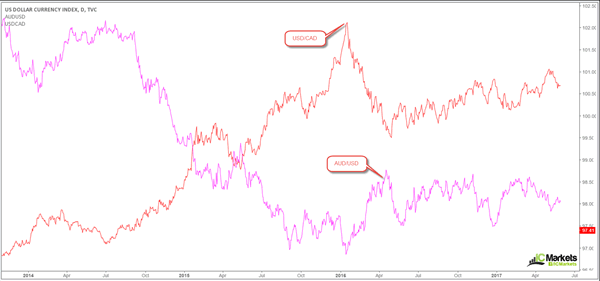
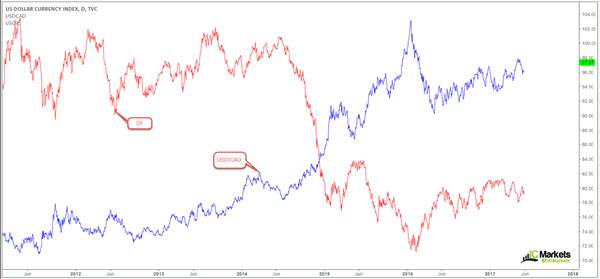
Two other pairs that we also keep a close eye on is the AUD/USD and the USD/CAD. Both pairs generally move opposite to one another around 80% of the time. Both the Aussie and Canadian dollar are considered commodity currencies (we'll touch on this soon), with a specific relationship to gold and oil. Similarly, like the EUR/USD and the USD/CHF, both pairs have the US dollar in common, again one as a quote currency and the other a base currency.
Intermarket correlations
With a brief understanding of how some currency pairs correlate, it would be unwise not to include additional intermarket correlations between the forex market and other financial markets… Grasping an understanding of how stocks, bonds and commodities affect the currency market is, in our humble view, a technical edge by and of itself.
Gold
Let's begin by looking at everyone's favourite yellow metal: gold. Bullion is considered a good hedge against inflation, and is also believed to be a safe-haven asset.
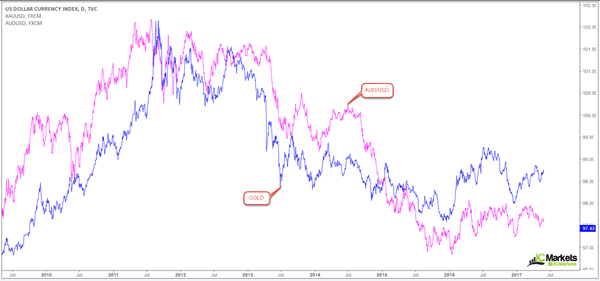
The relationship between gold and the AUD/USD pair is a positive one. Behind China, Australia is the second biggest gold-producing country in the world. So, when the price of gold rallies, the Aussie dollar tends to follow. Therefore, try and avoid buying both the Aussie and gold simultaneously, as you'll be potentially doubling up on risk.
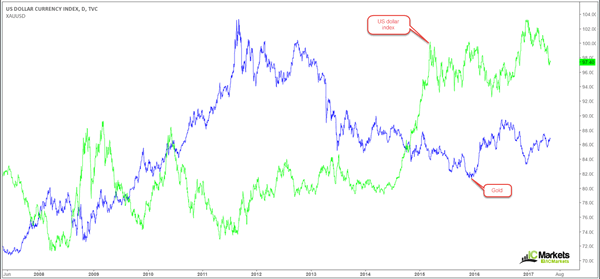
Gold also has an interesting relationship with the US dollar. When the dollar rises in value, it is usually expected to see the price of gold deteriorate. This inverse relationship remains because a falling dollar increases the value of other currencies, and thus increases the demand for gold. When the dollar starts to lose value, investors tend to look for alternative investments, with gold being one of those alternatives. During times of economic unrest, investors also tend to dump the dollar in favour of gold. Unlike other assets, gold maintains its intrinsic value.
Also of interest is the USD/JPY pair and gold. These two instruments continue to trade inversely. This extremely strong correlation shows that gold is, in fact, viewed as a safe-haven asset. So, we can say that gold behaves similarly to the Japanese yen, which is also considered to be a safe-haven currency.
Oil
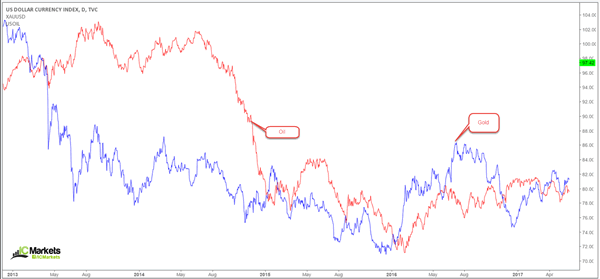
Before we have a look at oil's effect on currencies, there's an important link between oil and gold that needs addressing, and that is inflation. As the price of crude rises, inflation also rises. Gold, as we briefly mentioned above, is known to be a good hedge against inflation. Therefore, the value of gold increases when inflation is rising. Over 60% of the time, gold and oil are said to have a positive relationship.
The price of oil also affects the USD/CAD pair. Canada is one of the top oil producers in the world, exporting over 3 million barrels of oil per day to the US. Due to this large volume, the Canadian dollar is in demand. Therefore, if the demand for oil rises, manufactures need more oil which generally leads to a depreciation in the USD/CAD.
US dollar index
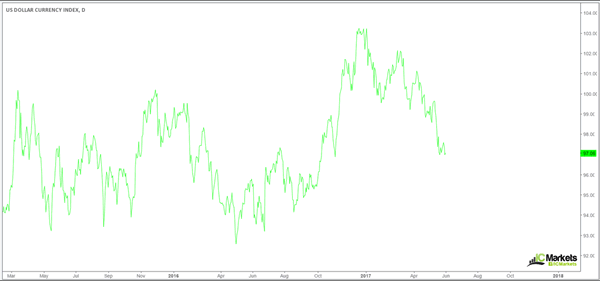
We use this index all of the time as it is beneficial in determining dollar strength. The US dollar index provides investors with a general indication of the value of the US dollar. It does this by averaging the exchange rates between the dollar and six other major currencies (EUR, GBP, JPY, CAD, CHF and SEK). As can be seen from the chart below, the dollar has been struggling since the index topped at highs of 103.0ish. So, with this, we should be seeing a rally in pairs like the EUR/USD, GBP/USD, AUD/USD etc.
Global stock indexes
It might surprise newbie forex traders that there is a relationship present between the global stock markets and currencies. It is certainly something traders/investors should be cognizant of.
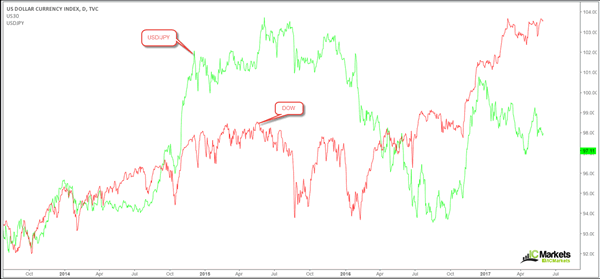
The USD/JPY and the Dow Jones Index generally track each other's movements. Why? Well, from our perspective, it boils down to investor risk appetite. When traders/investors are feeling optimistic about the global economy (the US in particular), they tend to bid both the dollar and stocks. Conversely, when global risks emerge, market participants typically sell equities and the dollar and buy safe-haven assets like gold and the Japanese yen. As you can see, the correlation is not perfect, but it does tend to track each other close to 70% of the time.
Bonds
For the purpose of this article, we'll be talking about the ten-year treasury note. Basically, this instrument is a debt obligation issued by the US government that matures in ten years. It is, in effect, an 'IOU'. So, what does this unit have to do with the currency market?
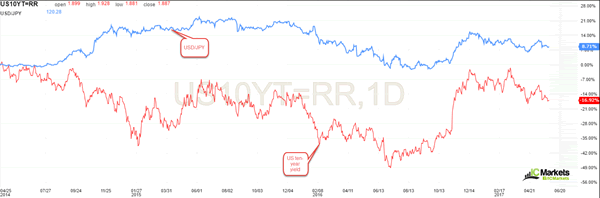
Falling treasury yields tend to be dollar negative, while rising treasury yields typically support the dollar. Bond yield refers to the rate of return, or interest, paid to the bondholder while the bond price is the amount of money the bondholder pays for the bond. Also, do remember that bond prices and bond yields are inversely correlated. Furthermore, government bond yields act as an indicator of the overall direction of the country's interest rates and expectations.
Therefore, when the ten-year yield is on the rise, we can expect the USD/JPY pair to generally follow suit.
How can I use these correlations?
Utilising correlation techniques can help you stay out of positions that could cancel each other out.
For example, let's look at the EUR/USD and the USD/CHF pairs. As we already know, these markets usually trade inverse to one another. So, placing a buy on the EUR/USD and a short on the USD/CHF simultaneously is not a wise move! By the same token, taking a long trade on the EUR/USD and a long on the GBP/USD would, given the close correlation between the two pairs, be similar to doubling your risk!
Having used correlations for years, we like to keep it simple by solely using price action: supply/demand and support/resistance.
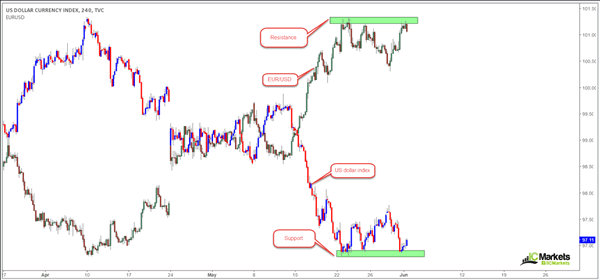
On The chart below, we've plotted the EUR/USD and US dollar index together. Notice how the EUR is currently chiselling in an area of resistance, while the US dollar index is busy forming a support area. What's also notable is the US dollar is showing signs of strength at the moment (look at the current candle), which could imply the EUR/USD will likely see further downside over the next few hours.
Here's another interesting example. Say that you wanted to short this H4 bearish selling wick at the underside of the broken trendline on the Aussie H4 chart, which by the way is a beautiful setup. From here, one could check out what the USD/CAD is up to on the H4 chart.
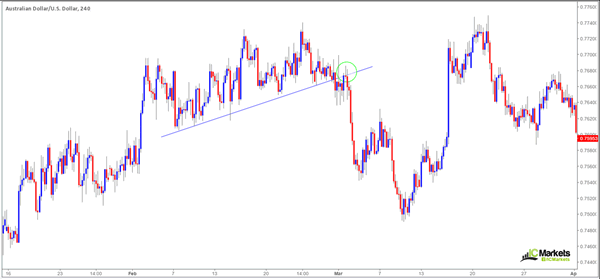
And here's what we would find: price had actually closed above a H4 trendline resistance a few hours PRIOR to the Aussie striking the underside of the trendline resistance! The only grumble we would have had here though was the Quasimodo resistance level that was sighted just above!
Nevertheless, the USD/CAD had given us an early signal (a correlation confirmation if you will) that Aussie bears may look to strengthen. This – coupled with the Aussie H4 bearish selling wick at the underside of a trendline resistance was, in our humble view, worth the risk.

In closing…
Books have been written on the subject of correlations, so we've not even really began to scratch the surface here. As such, we most certainly encourage you to research the world of correlations!
Concentrate on Trades by Overcoming Forex Trading Jitters
At times, the excitement during executions can bring about many emotions. One of these is the feeling of nervousness. Whether new or highly skilled, there will always be moments when traders experience forex trading jitters. In an active and volatile forex market, it is normal to feel anxious about trading activities like entering and closing a trade or planning out the best strategy. Because of this, it is important to properly manage nervous energy to channel more productivity when trading. With enough planning and practice, learn how to easily overcome forex trading jitters for optimal forex trading.
Top benefits of relaxed forex trading
Feeling apprehensive towards a trade can cripple decision making and focus. To keep up with the market, traders need to be able to control emotions like forex trading jitters. Eventually, overcoming nerves can also improve mental health as well as boost trading results. For optimal performance and quality trades, learn the top benefits of relaxed forex trading:
- Promotes a more engaging trading session
- Encourages consistency in strategy and decision making
- Develops a highly focused trading mindset
- Gives extra energy to get into the details of the trade
- Creates a positive and proactive way of thinking
- Diminishes stress and lessens the possibility of energy drain
- Allows consistent execution of calculated plans and strategies
Have a focused and relaxed mindset by managing forex trading jitters.
What you can do to overcome forex trading jitters
Going through forex trading jitters is a common feeling for any forex trader. The most important thing to remember is that nerves should not distract you during vital trading activities. In the long run, this will lead to optimized emotional management and enhancement of overall forex trading performance.
If your trading jitters negatively affect attitude and mindset towards trading, it is time to apply ways to overcome these nerves. To be able to avoid disruptive habits caused by nervousness, be sure to learn the best techniques to properly manage your forex trading jitters:
Trust in your calculated strategy
In order to overcome forex trading jitters, traders need to trust the strategy that they have created. Oftentimes, it is easy to get nervous and question the way trades are executed. Because of this, you will need to efficiently plan and execute a reliable strategy that will lead to desirable trades. Once you gain confidence your strategy, you can easily rely on your system whenever any nerves kick in.
To achieve successful trades, traders must be confident in their strategy. You must also view your trading journey with a proactive and positive mindset. With positivity and an efficient trading plan, you can conquer nerves while improving overall performance. To be able to trust in yourself and your strategy, learn the secrets to achieving a positive mindset.
Refine your strategy with a demo account
Before acquiring a reliable trading strategy, forex traders need to refine the process through trial and error. By starting with a demo account, traders can practice and master skills without risking any real capital. Every execution in a demo account allows you to practice your strategy and also apply forex education. It gives you an idea of market movement and the importance of staying focused during trades. To be able to navigate and understand the forex market, be sure to gain confidence and optimize your system with the help of a demo account.
Practice disciplined decision making
For consistently profitable trades, disciplined decision making is a great skill to use when avoid forex trading jitters. Whether during executions or chart analysis, forex traders need to make calculated decisions on a constant basis. It provides structure and confidence in every trading activity. Disciplined decision making also encourages better planning that ultimately lessens the possibility of trading nerves.
For long term success, make use of disciplined decision making to avoid forex trading jitters. According to Top Ways to Boost Decision Making Skills, here are a few ways to boost excellent decision making for focused trading:
- Simplify processes and mindset through goals or priorities
- Take advantage of available quality forex trading education
- Set a standard system of approach when important decisions need to be made
- Make use of tools to stay updated with forex trade news and activity
Learn to embrace and manage the pressure
In a changeable market, forex trading jitters will always be a part of the journey. Whether for large or small trades, traders will always feel a sense of pressure during executions. To become a successful, you will need to learn how to manage and embrace forex trading jitters. By doing this, you can overcome any anxiety and use nerves to your advantage. Take note of these reminders to help embrace your nerves:
- When feeling nervous, it means you are careful about your trades. Take this as a positive and manage from there.
- Forex trading jitters can minimize impulsive decision making. This will allow you to have a moment to be able to think about your next steps.
- To fully embrace your nerves, be comfortable in its nature when forex trading. You can use this to improve and optimize the scenarios when you feel anxious This will refine your trading character and boost performance.
Emotionally Detach from trades
To gain optimal clarity and focus, master the best ways to emotionally detach from any type of trade. - Ways to Emotionally Detach from a Trade
Forex traders often feel anxiety because of past trades. To avoid disruptive forex trading jitters in the future, it is important to emotionally detach from past trades. Being able to learn from each trade makes way for a relaxed mindset especially during stressful trading scenarios. Forex trading jitters caused by previous attachments can increase the chances of emotional trading. With time and practice, emotional detachment can help traders better overcome forex trading jitters and optimize mental health.
Be mindful of chronic anxiety
To properly manage and prevent forex trading jitters, traders must learn the nature of chronic anxiety. According to Anxiety BC, chronic anxiety describes those with excessive or uncontrollable worry towards daily activities. In reality, everybody experiences nervousness from time to time. When these nerves become uncontrollable, this may lead to chronic anxiety. The best way to beat the possibility of chronic anxiety is by constant exposure and proactive learning.
Forex trading jitters should have a positive effect on both mindset and performance. Through a helpful forex trading journal, traders can input and review past trades to manage forex trading jitters. This will enable you to view your trades constructively and actively avoid the chances of chronic anxiety.
Avoid chronic anxiety to achieve consistently desirable trades and optimal performance.
Take advantage of your strengths
Nerves come from self-doubt or uncertainty of the future. To overcome feeling nervous, be sure to stay positive and be self-assured in your personal strengths. For new traders, forex education is a great time to learn new skills and to get exposed to the latest trading tools or techniques. When there is a sense of anxiety in a demo or live account, one of the best ways to overcome forex trading jitters is to make use of your personal strengths. This will greatly boost your performance without letting your nerves take over. Here are top 3 methods to recognize and take advantage of your strengths:
- Take note of all your innate skill and recent achievements. Build on these to optimize or enhance overall skills.
- If you cannot trust your own judgement, trust your calculated strategy and lessons from previous trades.
- Always pair your inner strengths with commitment and passion. By doing this, you are not only overcoming forex trading jitters but also finding more opportunities in the market.
Create a personal development plan
Creating a personal development plan is the enhancement of skills geared towards a goal. Whether for work or for personal goals, is a great method to reinforce all efforts for a target achievement.
Applying a personal development plan in forex trading provides more structure when optimizing and reaching goals. This includes improving way of thinking or optimizing skills that are affected by forex trading jitters. Through a personal development plan, forex traders can also increase self-awareness. It can identify which areas need more work and which skills require more practice. This way of viewing forex trade encourages traders to train towards target goals. By mastering overall skill and performance, traders can effectively gain confidence in the strategy they have developed while reducing nerves along the way.
Remain confident and focused when trading
In an exciting and fast paced market, it is inevitable to get nervous at times. The most important thing to remember is to never let these nerves control your decision making or affect mental well being. In order to control any anxiety, traders need to learn how to overcome forex trading jitters. If traders do not take action, these jitters may lead to loss of confidence in systems and impulsive decision making. Because of this, it is vital to manage nerves to get a clear and controlled trading mindset. To successfully manage any nerves, you must practice the best techniques according to your strategy and what works for you. Eventually, you can properly overcome forex trading jitters while improving performance.
To encourage discipline and focus, master the ways to control forex trading jitters.
How Long Will it Take Before I Can Expect Consistency?
We understand that this is a perfectly natural question, especially for newer traders. Unfortunately, it is difficult to answer. To a degree, we believe it depends on the person who is doing the asking. With that in mind, let's have a look at some of the key points relating to this subject…
Time
Learning to trade the markets requires a substantial time investment. Do not underestimate this.
One trader may have three hours each day that they're able to devote to the charts, while another may only have an hour. The more time you invest, the quicker you're likely to see results. However, it does not always work out this way. Having a mentor with a proven track record will highly likely help speed up this process.
Using your time effectively is also key. Spending thirty minutes reading about some trader whine and bitch about how trading is not possible is NOT effective time management. Focus on learning methods that have stood the test of time. Of course, this will take some research, but it's time very well spent if you ask us.
Having the right mindset
Having the right mindset for trading takes time to develop. Trading is an incredibly solitary venture, and without the correct psychology you'll find trading terribly frustrating and will likely fail to ever make consistent profits.
Before you invest time in this venture, it's wise to consider whether trading is a good fit, as this business really is unlike any other. Mull over the following questions and try to give yourself honest answers:
- When every bone in your body is telling you not to be, can you demonstrate patience?
- Are you usually a disciplined person? There's constant temptation in the market. So, having the discipline to stick to a trading plan is paramount.
- Can you handle losing money? This may seem a stupid question since let's be honest there are few individuals on the planet who enjoy losing money. Nonetheless, when operating in the markets, losses are a part of the business. Expecting each and every trade to be a winner is NOT something you can do. Well, you can, but it will likely end with you going insane and throwing your monitor out of the window. This is where thinking in probabilities helps a lot!
So much to consider
Everyone is unique and learns at different rates. With this, we believe it is almost impossible to definitively answer how long it'll take for any one person to reach consistency. Anyone who is telling you otherwise is either trying to lure you into buying something, or, quite frankly, doesn't know what they're talking about.
Therefore, the best answer to this question, in our opinion, is quite simply: 'it depends'. 'Depends on what?' We hear you asking. Well, many things… For example, some people are just better wired to deal with the stresses of trading. Being a naturally patient and disciplined individual is going to benefit you in your trading journey. Someone who rushes into things and lacks discipline may find trading a challenging endeavour. That doesn't mean that those who struggle will not become consistently profitable traders, it just means that it might take a little more time.
In closing…
Let's keep in mind that trading, at least in our opinion, has no destination. There is no finish line here! It is actually a continual learning process.
With that in mind, especially in the earlier stages of one's journey, focusing more on the PROCESS of trading, rather than the result is advisable. If the process is correct, the results will undoubtedly follow.
Learning to trade the markets is an incredibly difficult feat to accomplish. Friends of ours who have traded the market for many years reported that, on average, it took them over 7 years to reach a level they were satisfied with. Of course, this doesn't mean that it will take you that long!
Including Fundamental Analysis In Your Trading
Do you remember the first time that you came across the financial markets, or more specifically, forex trading?
Unless you had a keen interest in economics, it's highly likely that you were almost immediately drawn to technical analysis (T.A). Those attractively colourful indicators, pin-point accurate support/resistance lines and rumours of other technical traders trading for a living, is usually enough to lure the majority of newcomers into this category. There is, however, another technique used to analyse the markets: fundamental analysis (F.A).
Both approaches have strengths and weaknesses. Some traders choose solely to adopt one method over the other, whereas other traders elect to use both.
What is fundamental analysis?
When traders elect to follow F.A, what they're really doing is analysing the economic situation of a country, and its potential effects on its currency. Through research of macroeconomic events and geopolitical data, market speculators essentially try to foresee future exchange rates.
Just like T.A, F.A also has a wide-range of indicators on offer, with some attracting more interest from the financial community than others. A country's employment situation, interest rates, housing, balance of trade, growth data and inflation figures are just some of the top-tier indicators fundamental analysts use to gauge a country's well-being.
Economic Indicators that print better-than-expected numbers over consensus is usually deemed good for the country's currency, and imply that the country's central bank may look to take on a hawkish stance. This basically means that interest rates could increase. On the other side of the coin, disappointing numbers could force the country's currency southbound and cause the central bank to step in and take a dovish stance by lowering interest rates.
Apart from the economic indicators that grace the news calendar virtually each business day, F.A goes a lot deeper than this. For example, when the UK voted for 'Brexit' the British pound took an absolute hammering and dropped more than 20% in value against the US dollar. Now, even if there was an economic indicator that chalked in upbeat news for the GBP that day, it would have likely been ignored! The steep downward move on the GBP that day was a direct market reaction in response to the result.
More recently, we had the UK elections. As no party secured an outright majority, Britain is facing a hung parliament. This saw a 250-pip bearish move take shape on the GBP/USD pair in space of a few minutes! This, again, was a direct market reaction in response to the result.
A brief look at the US employment report
As this is one of the most eagerly awaited economic indicators, we thought it'd be an idea to peer into this market-moving report to give you a brief idea of what we look at…
First of all, let's just say that the US employment report is extremely well timed as it's released after the end of the month being reviewed. Timing is important!
It's also a leading indicator of consumer inflation. This is because when businesses pay more for labour, the higher costs can sometimes be passed on to the consumer. The economic statistic that generates the most excitement within this report, though, is the monthly change in non-farm employment. Other figures that warrant close attention are the following:
- The unemployment rate.
- Average hourly earnings.
- Participation rate (commonly known as labour-force participation rate).
US employment news can greatly affect the dollar's value in the currency markets. After a string of better-than-expected months, it can suggest that the Fed may increase interest rates which generally attracts investors. By the same token, weakening employment data may well indicate that the Fed could step in and lower interest rates, which would likely see a dollar selloff.
The US ADP non-farm employment change is another indicator worthy of mention. This data provides an early look at employment growth, and is considered to be a precursor to Friday's BLS (Bureau of Labour Statistics) non-farm employment change as it's released the day before.
Different ways of using fundamental analysis
With the majority of technical traders viewing charts differently, we believe it's also fair to say that not all traders view fundamentals the same way as well.
For market participants who favour T.A, some will occasionally use the economic indicators as a way of knowing when to step away from the market, or reduce risk. For example, say that one has a long trade that's in profit on the EUR/USD pair, and the non-farm employment report (see above) is due to be released within the hour. Does that trader hope that the number favours the current position? Of course, one could do this but it is not something we'd advise! Letting a winning trade turn into a losing trade is NEVER fun! To our way of seeing things, the trader has the following options:
- Close the trade in profit and be satisfied with what the market has already provided you.
- Take partial profits and reduce risk to breakeven.
- Depending on by how much the current position is in profit, move the stop-loss order below/above clear structure. With this you're essentially using market structure to hide your stop from any possible gyrations the non-farm payrolls report may cause.
Another way of utilising fundamentals is by incorporating a fundamental trigger alongside a technical entry. Let's imagine that the Federal Reserve has been talking about raising interest rates for a while now, and you're seeing a considerable amount of dollar buying come into the market. Of course, one could simply buy on the premise that the dollar is the favoured currency at the moment. However, we'd personally prefer to wait for a break above a noteworthy resistance or a trendline resistance followed by a retest as support, as it would, at least in our book of setups, be valid technical confluence for a long entry.
Instead of using the central bank's words as a fundamental trigger, one could, if you're looking to trade intraday, use the top-tier market events scheduled for that day to find a potential trading opportunity. Say the Aussie dollar had been trading beneath resistance over the past couple of days, and housing data recently came in much stronger than expected, forcing the unit above this line. Now that short-term sentiment has cleared this level, should a retest of this base come about and hold successfully as support, then a long from here is certainly worthy of consideration.
If you're a longer-term trader who prefers to ride trends or catch huge reversals, you can, as we briefly highlighted above, also make use of F.A in gauging how economic data can affect central banks' interest-rate decisions and monetary policy actions. Interest rates vary for different economies and central banks are able to raise or lower these in order to maintain price stability and boost economic growth.
In closing…
We agree that there's a plethora of information to take on board regarding the fundamental landscape, so we're not surprised that a great deal of traders coming into the business choose to adopt a technical approach. Still, we feel that completely ignoring the fundamental events is extremely risky. Even knowing when the next few high-impacting events are scheduled for release can save one an unnecessary loss!
For those interested in furthering their understanding, we would advise beginning by learning how to interpret the economic indicators. A noteworthy book: 'The Secrets Of Economic Indicators' by Bernard Baumohl is fantastic, and will really help one understand how economic indicators function.
Apart from economic indicators, traders are also urged to keep abreast with the current economic climate of the market you're trading, such as: upcoming elections, wars, comments from political figures and also speeches from key members representing major central banks.
Get to Know the Positive Aspects of Being a Forex Trader
Life as a forex trader is exhilarating and rewarding. In an exciting market, expert traders have to be goal-oriented, mentally sharp and emotionally intelligent. To reach trading goals, successful forex traders need to acquire optimal knowledge and a focused mindset. On a constant basis, traders have to practice analysis, strategizing and diligence. Eventually, this provides a positive and proactive way of thinking that is beneficial for both personal life and career goals.
Life as a forex trader
There are many fulfilling and exciting aspects of being a forex trader. Aside from having flexibility with working hours and a mobile office, forex traders also get to build character and innate skill. When you open yourself to the world of trading, you enable personal development and the possibility of profit. Here are the best benefits and top advantages of being a forex trader:
You become a disciplined global thinker
Forex traders become global thinkers as they work towards profit from markets around the world. Trading encourages you to learn about the economies you are trading in. Whether applying fundamental analysis or not, traders need to stay updated with global markets for better decision making. Without doing this, you cannot achieve full understanding of the pairs traded. You will need to look at aspects like the country's Gross Domestic Product or its political scene. Forex traders also need to be exposed to current administration as well as where the country is headed in the future. In the process, forex traders become globally aware of world news and economics. With so many pairs to trade, forex traders need to analyze and study which markets to invest in. This allows traders to become more disciplined in taking global news and interpreting it into their strategy.
Forex trading can you open you up to a world full of possibilities.
You are constantly learning
Forex traders are constantly learning from the forex market. Whether you are a veteran or an aspiring trader, there is always something new to learn. After building a strong foundation and mastering basic skills, good forex education should not stop there. Once you have an efficient strategy, forex traders must stay updated with news, innovations or techniques. Well rounded forex traders must also learn how to achieve a balanced forex lifestyle. To become an efficient trader, get to know the top 3 ways to constantly learn from the forex market:
- Continue quality forex education. Getting quality forex education is one of the best ways to become a successful trader. To remain sharp and perform well, traders should continue to gain knowledge from quality sources. After applying everything you've learned, it is important to still take in up-to-date information. Educational blogs or sites are great tools for continued forex education. Create a habit and dedicate efforts towards further knowledge. To Build a Strong Career Through Good Forex Education, expose yourself to information or industry insights for continual self-mastery.
- Become comfortable with a forex lifestyle. Being a forex trader means working at any time of the day. Depending on your strategy, you may need to trade during odd hours. Because of this, forex traders must also learn how to live a forex lifestyle. By being comfortable with common lifestyles of forex traders, you can fully enjoy the rewards of being a forex trader.
- Stay updated and connected. Having access to information or trading activity can allow traders to constantly learn and optimize. Whether through up-to-the-minute news or market analysis, staying updated encourages better decision making.
All quota comes from you
Being forex trader gives you the freedom to strategize output at your own rate. This allows you to plan and execute your systems at a pace that you are comfortable with. With the freedom to set targets and timeframe, forex traders can customize personal development and performance. This way of working can lead to more quality output and can minimize any pressure.
Forex trading also gives you the option on whether to trade with small or volume accounts. With many choices for your trades, the pace of your trading career is really up to you. You may plan your investments according to what works best for your personal goals. You can also take a break from trading without too much restriction.
Forex trading has endless possibilities
Being a forex trader means endless possibilities for profit. Whether you are a part time or full time trader, there is great potential to earn from trading. Depending on the planned strategy, you can profit from forex trading with patience and discipline. Here is how you can take advantage of the possibilities when being a forex trader:
- Grab every possibility of a successful trade with enough caution and confidence. Overconfidence can lead to impulsive trading.
- Remember that success comes from being consistently profitable.
- Every possibility to earn from a trade should be backed up by optimal knowledge of both market and your intended strategy.
- Amidst profit, there will be challenges to face. It is vital to remain proactive and positive.
- Be sure to trade within your limits for capital.
For success and profit, forex traders should become global thinkers that practice a strategic mindset.
Success with a well-balanced lifestyle
Success in forex trading is not just about executing the right strategy. For a growing career, forex traders must also learn how to balance time for work and well being. Profitable traders should practice a disciplined mindset along with a healthy lifestyle. With demands from the forex market, successful trades are achieved through good work-life balance. By gaining optimal mental health, forex traders can succeed in continuously profitable trades without being affected by any negative thinking.
Work-life balance is key for long term success. To learn more about achieving a balanced lifestyle, take pointers from A Forex Trader's A Forex Trader's Survival Guide: The Work-Life Balance.
Being a successful forex trader
Being the business of forex trading is a challenging and exciting endeavor. According to The World Beast, the popularity of forex trading comes from the many opportunities to earn profit. With a market full of these possibilities, being a forex trader is a great career for those who can achieve self-management and discipline. Through the right mindset and a calculated strategy, the possibilities of the market can be achieved through time and practice.
The benefits of being a forex trader go beyond a successful career. Like all career goals, the road to success and continuous profit requires diligence as well as patience. The requirements of the industry can bring about strong work ethics and optimal trading character. In the long run, being a profitable forex traders means having a strong and healthy mental well being. This can offer traders a fulfilling profession as well as many opportunities for profit.
Being a forex trader is a great way to achieve self-mastery and discipline.
Common Forex Trading Mistakes
Mistakes happen. This is a part of life. More importantly, it's how we learn and progress.
Mistakes in the trading business, however, can be costly. In addition to this, it can also discourage newer traders, eventually forcing them to throw in the towel. To help shorten the learning curve, we've come up with a brief list of the most common mistakes we see occur on a regular basis…
Little preparation
Coming into the markets unprepared is financial suicide! You're just asking to lose money. In fact, you'd be better off heading to a casino and ploughing your funds into a slot machine. At least you'll have fun whilst losing your capital.
Learning how to trade will, no matter what your trading guru says, TAKE TIME. Be prepared to accept this, or quite frankly, suffer the consequences.
A prepared trader will have a tried and tested methodology clearly written down. They will know when to pull the trigger and when to remain flat. A strict money management plan will also be something an experienced trader will have in hand.
Without at least these two above said components, you're playing a very dangerous game if you have active money in motion.
Running with losses
A professional trader will have no qualms in closing out a losing position. Let's repeat the last sentence. A professional trader will have no qualms in closing out a losing position. In fact, this should be written in stone and placed on your desks! The ability to take a small loss is critical to your success. Therefore, this is something one should familiarise themselves with, as it will happen a great deal throughout one's trading career.
Holding on to a losing position in the hope that it will eventually recover is a one-way street to account wreckage! Yes, you may have a few trades reverse back in your favour, but the ones that don't WILL ruin you!
Cap your loss early and live to fight another day. Staying in the game is paramount!
Not using stop-loss orders
The stop-loss mechanism is in place for a reason. It's to avoid huge losses to your account! Why traders choose to not implement a stop-loss order is something we'll never comprehend. Markets can move in the blink of an eye, with little to no warning. And without a stop in place, the losses to your account could be catastrophic.
USE a stop-loss order! They're there to help.
Using too much leverage
Leverage basically means having the ability to control a large sum of capital using very little of your own funds and borrowing the rest. While high leverage could potentially net one incredible gains, it can just as easily wipe you out. This sentence alone should highlight the need to correctly manage risk!
Staying in the game is crucial, in our experience risking more than 2% of equity in any one trade is VERY risky business.
Overtrading
Rather than thinking short term, try and think long term. Don't fall victim to the 'I want to be a millionaire next month' camp. Experienced traders typically know that there's little point in trying to be involved in every market turn. Overtrading not only causes stress, it also can deplete your capital in as little as only a few months! This would be difficult to come back from, not only from a financial standpoint, but also from a psychological perspective as well.
In closing…
We have only really scratched the surface here guys. The mistakes noted above, nevertheless, are the most common we see. So, try to avoid these mistakes at all costs as it will have a marked effect on your trading results.
A Brief Look at Trading Psychology
Why is psychology such an important aspect in trading? Well, if you're incapable of controlling your mind/thoughts whilst operating in the market, you stand very little chance of reaching consistency.
Generally, traders, especially those new to the business, focus primarily on learning all they can about the technical side of trading. While we do agree that this is a necessary step for individuals wishing to function successfully by means of technical analysis, one MUST also place an equal amount of emphasis on mastering the psychological side of trading, as well. Unfortunately, the latter is often overlooked by so many!
During the course of this article, we aim to walk you through a number of different aspects relating to trading psychology, which we feel truly separates the winners from the losers.
Having a well-defined trading plan in place
Assuming that one has the discipline to FOLLOW their trading plan, it should help curb emotionally-driven mistakes. We personally think of a trading plan as a road map, guiding us through the market place. Without it, as far as we're concerned, you're essentially driving blind!
Below is a brief outline of what we believe should be covered in a trading plan:
- Risk parameters. This is where you will determine how much risk is to be allocated to each trade. Realistically, it should be an amount that you're comfortable losing without causing panic, which ultimately can result in 'revenge' trading. Revenge trading, for those who do not know, is the act of not observing risk management principles or executing trades beyond the scope of one's trading plan, in the hope of winning back a previous loss (or losses).
- Money management. Remember trading is a business, and should ALWAYS be treated as such. How one handles their account funds is crucial. This section should include, but is certainly not limited to, preparing for the worse-case scenario (how much of your account you're willing to lose before trading is to seize), planning for the long term and setting realistic financial goals.
- Timeframes. Filtering between different timeframes can be overwhelming for some and eventually lead to a poor trading decision. Therefore, it's imperative to have this outlined beforehand.
- Targets/Goals. Some traders set financial goals to achieve a certain amount per week/month and year. We try to remain somewhat flexible here by only having an annual percentage goal. The reason for this is that we firmly believe in being open to accepting whatever the market is willing to give us. Furthermore, if one has weekly or monthly targets that are not met, this can place a trader under pressure. And trading under pressure is not something we'd encourage!
- Markets. Will you stick to just the major currency pairs, delve into the minors or even the exotics? Do equities, commodities or bonds interest you? All of this should be well documented in your trading plan.
- Trading times. Though the market is a 24-hour auction house that operates five days a week, scheduling times to trade can instil some consistency to one's trading day.
- Performance evaluation. Evaluating each trade is crucial to the development of a trader. Remember, we learn by our mistakes!
- Software. Will you purchase specialized charting software or a dedicated news feed?
- Strategy rules. This is the section where one shapes his/her rules of engagement. Don't hold back here! Detail every point needed to confirm an acceptable setup. By doing this, you will avoid emotional decisions.
As you can see, without a trading plan you're likely going to be executing trades from a reactionary state. This is NOT a place you want to be. Compose a trading plan and refrain from trading blind!
Be careful who you follow!
Although there are a number of successful traders out there advertising trade setups for others to shadow, relying on these setups is not an approach that usually ends well for a number of reasons. For one, you have little knowledge of the method's nuances. Two, it's also impossible to know the psychological mindset of that particular trader from one day to the next. Above all else though, do you really want to spend your trading career relying on someone else's decisions? There is an exception to this, of course, and that is if you're using the trade calls to help solidify/complement your OWN trading setups.
Blindly trading other traders' ideas typically pushes one into a vicious psychological cycle. An illustration of such a cycle can be seen on the basic diagram below:
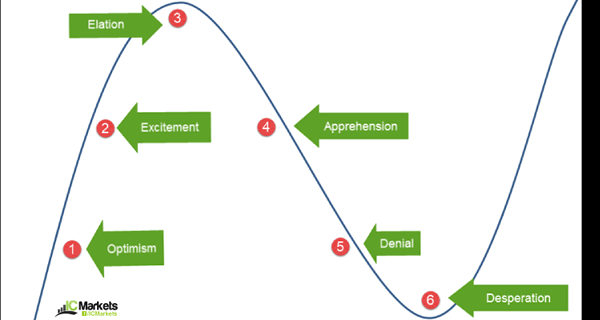
- At point one, you're full of optimism. The trader who provided the call to buy the EUR/USD (for example) has an outstanding record. So you naturally believe that this trade is highly likely to be a winner.
- The pair begins to move in favour and this carries you over into the excitement phase.
- At point three you're elated! The position has moved nearly double the position's risk and you feel on top of the world.
- It is at point four, though, where things begin to turn sour. Price starts consolidating and threatening bearish candles begin to emerge.
- At point five you've entered into a state of denial, as the market is now trading beyond your initial entry point.
- Taking into account that you have no plan in place to prepare for this situation, the next step is usually desperation. At this stage, you're essentially begging the market to get back to your entry level. However, even if price were to move in your favour and eventually lift itself back into the green again, would you, a trader with no plan for this, not just resort back to point one on the diagram above and begin the painful process all over again?
As we mentioned above, using other traders' ideas to complement your own setups is, in our opinion, a viable approach. Trading advertised setups blindly, however, will likely cause you a great deal of unnecessary stress.
Accept the risk
A financial loss is painful for just about anyone. That, we're sure, we can all agree on!
The majority of you reading this piece will genuinely believe that you already accept the risk on each trade you take. But do you really?
We're pretty sure that we've all been there. We place a trade and honestly believe that we are willing to lose the money invested i.e. have accepted the risk. Why then do we find ourselves altering the stop to protect our capital if the market does not act as expected? This, unless it is firmly in your plan to do so, is NOT accepting the risk. A way to overcome this is to begin trading positions that you are at ease with. What we mean by this is if you are feeling disappointed or angry at losing a certain amount of money, you may want to crank your size down considerably and work your way back up from there.
Accepting that your trades are random
What we want you to do now is visualize the perfect setup according to your rules. Now, picture the market steam rolling through your entry level like a knife through hot butter! This happens all the time and often leaves the trader in a state of confusion.
One has to realize that their analysis is NOT the market. The only reason the market responds to a setup is because other traders, often with deep pockets, get involved. Should others believe that the market is better sold at 1.2550 and you're selling at 1.2500, the trade will very likely fail.
Coming to realization that your trade outcomes are random is quite difficult for many. But until this happens, you will continue to have an emotional attachment to each trade you place.
Thinking in probabilities helps a great deal with this. In a nutshell, however, the point of this is to simply highlight and REMIND you that one losing trade means VERY little in the wide scheme of things and you can, even just by winning four times out of ten, still come out ahead. That is, of course, as long as you calculate risk accordingly! Taking colossal losses is a sure-fire way to a depleted account, and all the planning in the world will be of little use to you.
Having a can-do attitude
We believe this goes for just about everything in life! Without a positive attitude, you will likely get discouraged and emotional in this business. Still, we must point out that you mustn't confuse positive thinking with arrogance, as arrogance has absolutely no place in trading, despite what Hollywood films may portray.
In closing…
Let's remember that the main goal of trading the markets is to make a PROFIT. Satisfying the desire to be correct instead of making money is NOT how professional traders operate. The realisation that you can be wrong several times and still accomplish your goals is a difficult concept to accept, but one that is an essential component to a healthy trading mindset.
Typically, we only have our thoughts to work with when trading. Having the discipline to control these thoughts will, in our humble opinion, make or break you as a trader.
Despite covering some important aspects in this article, we have barely scratched the surface. It's compelling to think of how much of an effect psychology actually has on us as traders, and how little it is covered in mainstream teachings. To that end, we hope to dive deeper into this subject in future articles…
What are the Habits of Successful Traders?
What are the habits of successful traders? How can you implement these habits in your own trading to achieve better results? In this article, you can find some tips about trading habits that may help you achieve better results.
The better way to achieve success in trading is by having good trading habits. Find out what these are and how you can implement them.
Self-control
First of all, one of the most important characteristics of a trader is self-control. Once you develop a winning strategy, it's very important to control your actions and emotions when time comes to put it in practice. Some traders are not so successful because they cannot handle their actions when trading. In this sense, although they have a very good strategy, they let their emotions interfere too much, which may be prejudicial. Highly successful traders are often capable of becoming emotionally detached from their profits or losses. This can be very hard to achieve, but it's all about being capable of doing the right thing regardless of the amounts involved. The ultimate goal should be to trade well instead of making money – and the results will eventually come.
Accept Risk
Although trading allows you to make a serious amount of money, it may also lead you to lose a lot. This is a risky activity where high potential losses are involved. This means that, if you want to be a successful trader, you need to accept all the risks involved. You also need to be able of taking losses without it affecting your strategy. It's impossible to win every time so it's important to know what the stakes are from the beginning.
Once you manage to deal with risk, it's time to test your own limits. Some traders are risk lovers and can handle a major drawdown, while others prefer safer bets. Before starting to trade, it's better to know what kind of risk can you handle and develop a strategy from this point on.
Keep Stress at Bay
A successful trader should also be able to withstand a high level of stress. Real money is involved, and it's easy to lose focus once the market starts going against us. During such times, keep your rationale over your emotions. If you can make the right decisions under stress, probably your actions will be the right ones.
Be Patient and Adapt to the Market
The fourth essential habit in trading is to be patient. You don't need to be always trading to make money. The better trades come when you wait for the right time. If you wait for the right market conditions to apply your strategy, there's a higher probability it'll be more successful.
Establishing trading habits through psychology is the best way to apply it to your daily life.
Every day is different and the market may easily change drastically from one day to the other. Successful traders are the ones who can easily adjust to the market conditions and even profit from these changes. The first trader to realize a trend reversion and trade it is going to profit more. What was true yesterday may not be true today, and so it's always important to be prepared to adapt quickly.
Be Confident
You must be confident about your trading. If you did your analysis properly, don't be afraid to enter a position. There are a lot of great analysts that are poor traders because they are not capable of "pulling the trigger". Doing the research and testing a strategy is only half the way. The other half depends on the ability to enter the trade at the right time. Don't delay your actions, otherwise when you finally go in, the market may have already lost its steam.
Accept Losses
When trading, it's essential to be completely open-minded. What was right yesterday may be wrong today and the faster you realize your errors, the better. A lot of traders refuse to accept when they are wrong and always expect a market rebound. However, these traders often end up losing more than if they accepted their loss right from the beginning. It's not easy for the human being to accept he is wrong, but the most successful traders are the ones who can do this.
Recognizing a mistake earlier may lead to smaller losses, which contributes positively to your overall balance.
Establish Goals
Finally, establish your own goals and be perseverant. Sure, there will be times when everything seems to go against you: the prices never go your way, and that makes you go through a series of losses. That happens to all of us, good or bad traders. Just keep in mind that those losses are important for you to develop your skills and strategy, and to have better results in the future. Instead of focusing on the money lost, you focus on learning from what went wrong and try to improve it.
Establishing higher goals as times passes by is a good way to challenge yourself and commit to working harder.
Learn the top tips about trading habits that will help you achieve better results.
Of course, it's essential to have a good strategy and make a good analysis out of the market, but that's not everything in trading. Psychology plays a bigger role that we might think, and establishing trading habits is the best way to develop this in your daily life. The next time you trade, try to implement some of these trading habits and share with us if it helped to improve your results!
Everything You Need to Know about Confluence
To say confluence is powerful would, in our humble opinion, be a huge understatement! We agree that individual pattern recognition is worthy of attention, but without additional confluence it is not something we would entertain as a conceivable setup.
To become a successfully consistent trader you need an edge. This is something we're sure we can all agree on. That edge can involve areas of confluence. Still, truly understanding what confluence is and how to use it effectively is sometimes difficult to grasp. This is especially true in the earlier stages of one's journey, as confluent zones can form in a myriad of different shapes.
By the end of this article, you will have hopefully gained an understanding on how one can approach looking for confluence.
What is trading confluence?
Trading confluence can be defined in a simple sentence:
'An area in the market where two or more structures come together to form a high-probability buy/sell zone.'
As highlighted above, understanding what confluence is and how to use it effectively can be challenging. For instance, some traders solely rely on indicators to develop a trading zone, whereas others prefer to focus on price action and there are also those that favour a combination of the two. No matter which path you choose, having a thorough understanding of each complementing component is vital.
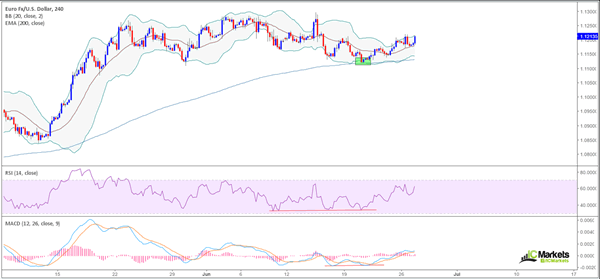
The chart below (H4 EUR/USD) provides a visual example of how traders can use indicators to form confluence. The small green zone marks where a possible reversal can (and in this case, did) take place.
Complementing the zone, the following indicators came together:
- MACD divergence.
- RSI divergence.
- 200 EMA.
- Bollinger band support.
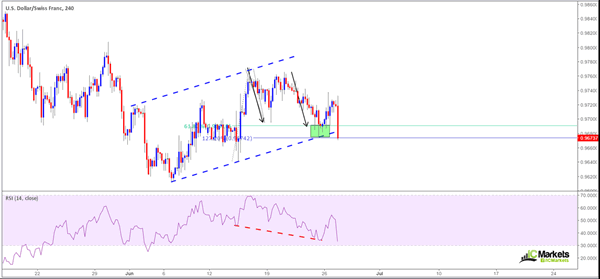
The next chart shows how one can exclusively use price action to establish a trading area. For those who follow our daily reports: IC Markets Market analysis you may recall that this was actually a trade our desk showed a lot of interest in.
Forming this trading zone, we had the following converging structures:
- H4 channel support.
- A H4 AB=CD 127.2% ext. level.
- A H4 61.8% Fibonacci support level.
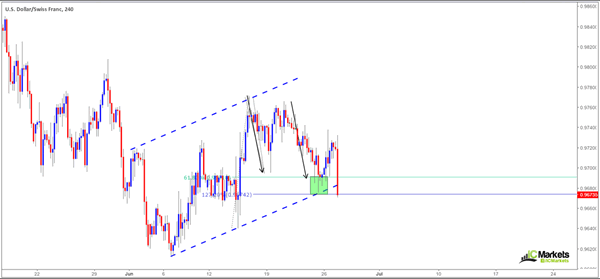
And for traders who prefer to use a combination of price action and indicators, one could have simply added the RSI on the chart above as additional confirmation, which happened to show divergence at the time (see above).
It's important to bear in mind that while trading areas of confluence does provide an edge, it doesn't mean that every single trade will produce a profitable result. Expecting each trade to win will be extremely frustrating because, well quite frankly, it WILL NOT happen!
However, if you take into account the setups that show strong confluence will, on average, produce reasonable results, you can profit in this business. As long as you see that your account is growing over the long term, a losing trade is not a cause for concern.
How much confluence should a trader look for?
This is where we get into the nitty-gritty.
How will a trader know when he/she has enough confluence to trade confidently? Clearly, this will be trader dependent. Some traders may only require two things to come together to form a zone, while another trader may need at least five concepts to merge before taking a trade.
For the purpose of this segment, we'll layout what we consider to be sufficient confluence. Personally, we designate each trade setup as either being: A1, A2 or A3.
An A1 setup is a first-rate trade. This is a setup which although may not be as regular as A2 and A3 setups, it tends to carry far more weight concerning the win/loss ratio. With that in mind, here are the following structures needed to fulfil an A1 formation:
- A credible area of structure. What we mean by this is the trading zone has to converge with either a supply or demand area, or a support or resistance barrier.
- A clear AB=CD formation. Ideally, the waves will have little interference. What we don't want to see is a smooth A-B leg and a distorted C-D leg.
- Trade with the trend. Personally, we only look on the traded timeframe for this. Therefore, if we're trading a H4 setup, we want to see the trend clearly painted on this timeframe.
- A psychological number. Most of us already know the importance of these values. For that reason, either a full round number (1.2300), or a mid-level number (1.2350) needs to be seen clearly around the area.
- Trendline convergence. Plotting the trendline is important here. Typically, we require at least two points, including the starting base, to be seen before drawing in a trendline.
- Either a 61.8% or 38.2% Fibonacci retracement point is required.
- A monthly or yearly opening level. Put simply, these are price points extended into the future from the opening candle of each year and month.
As you can see, there's a considerable amount of structure required here. Once an area forms that shows all of these levels come together, we would, unless there is a high-impacting news event due to be released, expect the zone to at least bounce price. Below is an example of such a setup which turned out to be a monster of a trade:
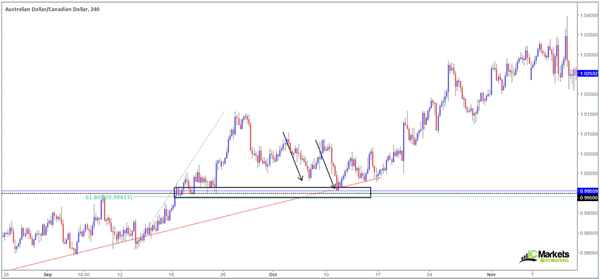
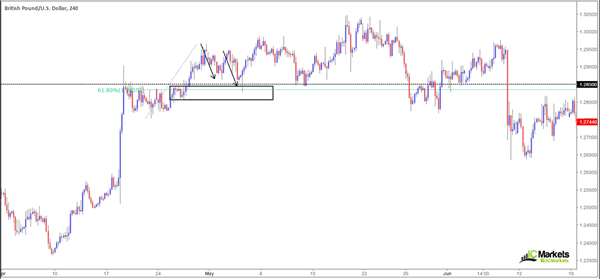
An A2 setup on the other hand, is a watered-down version of an A1 formation. With this, one is not required to have the yearly/monthly opening level, or a trendline. The remaining check points listed above in the A1 section are still needed to fulfil an entry. In addition, both A1 and A2 setups ideally need to show space for price to move on the higher timeframes (you will see this in action when we get to A3). Here's a basic A2 example:
This leaves the A3 setup. Just to be clear, we much prefer trading A1 and A2 patterns. But when there is nothing on the horizon, we will trade A3 setups, albeit using lower risk. Should a level such as a round number give way, with room seen for price to run, we would consider trading any retest of that level seen thereafter.
However, the retest must be accompanied by a bullish/bearish rotation candle (depending on which way you trade). A rotation candle is simply a candle that bounces from the level and forms a full, or very near-full-bodied candle. This, in our humble opinion, suggests buyer or seller intent. Of course, we would much prefer to see these levels bolstered by other structures such as a trendline, since every little helps!
Below is a perfect example of this in action as we recently took this trade. We must clarify though that our team did have additional reasons that bolstered this setup which we will explain shortly…
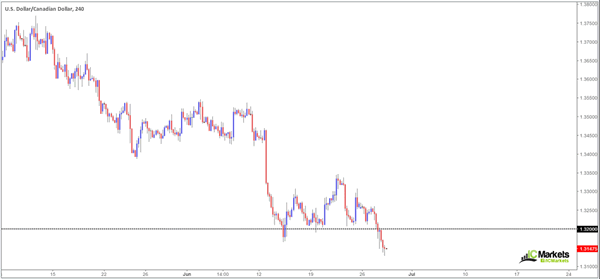
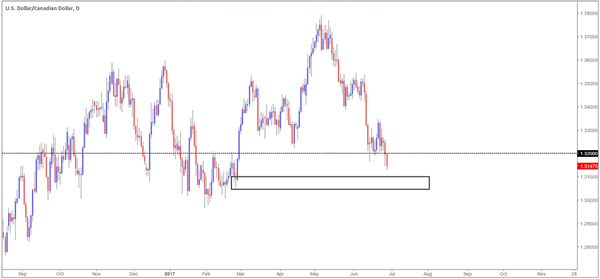
Ultimately, we were looking for a H4 close below the 1.32 handle to signify bearish resumption. Still, before we qualified a short, we needed a retest to take shape that is followed up with a H4 bearish (full-bodied) candle, which, as you can see, did indeed come to fruition. Nevertheless, this trade would not have been valid for us (especially using an A3 setup) if there was higher-timeframe support nearby. Looking to the daily timeframe on the chart below, you can see that there is room for the bears to stretch their legs, thus qualifying this trade:
What timeframe?
Which timeframe a trader selects will ultimately depend on his/her lifestyle. An individual who has a full-time job may only be able to swing trade, which entails one looking at the charts once (maybe twice) a day. Personally, to swing trade, we stick to the H4 timeframes and higher. Any lower, and we feel this is considered intraday.
If one is retired on the other hand, or works a part-time job, trading the market intraday is an option. Intraday simply means that a trade is executed and liquidated in the same day. Anything below the hourly timeframe is, for us, considered an intraday scale. This type of trading can involve sitting at the computer for several hours each day.
On the other side of the spectrum, you could also think about trading long term which involves looking at the charts a few times a week. This is slow and is not suited for everyone. Anything above the daily timeframe is what we deem to be long-term charts.
In closing…
Speaking personally, we feel trading areas of confluence is an incredibly strong edge. Without this, trading the markets successfully is difficult, not impossible mind you, but difficult. However, we must clarify that even with this edge it does not mean that you will succeed. Why? The reason simply comes down to psychology. Having the discipline to act, respect and follow your rules is often much harder than it sounds. In future articles, we hope to touch on the many psychological issues traders face.
Apply the Best Mindsets for Efficient and Enjoyable Trading
An optimal mindset is key to achieving efficient and enjoyable trades. With a volatile forex market, traders need a reliable mindset to manage all trading activities. By obtaining a strong and optimistic mental attitude, you can properly accomplish trades and vital tasks for success. Applying the right mindset allows a focused way of thinking that can minimize anxiety and reduce the chances of emotional trading. To have a healthy outlook towards the forex market, practice the best mindsets for optimal forex trading.
What is a good mindset?
A healthy trading mindset can make way for profitable output and a gratifying forex trading career. In any type of endeavor, a good mindset can inspire constant growth. It positively interprets experiences and drives the right actions to be taken. Because of this, forex traders must consider the best ways to apply a proactive and optimistic way of thinking.
A proper mindset is dictated by personal belief, innate skill and instinctive diligence towards the task at hand. In forex trading, it is also driven by incoming information and education used to make decisions. Even with an unpredictable market, traders are still able to control their mindset to achieve the target goals. Whether during challenging trades or successful executions , a forex trader's way of thinking is key to enhance growth and success.
For positivity and profit, apply the best mindsets for success in forex trading.
Benefits of an optimal mindset
Forex traders need to practice a positive and proactive way of thinking. Through a healthy mindset, you can go through trading activities and market challenges with a relaxed mind and full concentration. Here are the top benefits of having a good mindset while trading:
- Provides a sense of control over skill and progress
- Helps traders emotionally detach from challenging trades
- Allows you to enhance your innate skill and develop others that are necessary for optimal trading
- Encourages traders to further learn and grow from the forex market
- Inspires better corrective planning especially when dealing with any setbacks
"When we embrace a Get Better mindset, we welcome risk and are less afraid of failure, both key to personal development." -Heidi Grant Halvorson on 99U
What are the best mindsets for forex trading?
Mindsets can be cultivated to help you achieve the forex trading career you envision. Over time, these mindsets will encourage development and favorable results. With enough time and practice, a great mindset can be rooted into a trader's psychology. This will result in better forex trading character as well as performance. For success and wellbeing, practice the best mindsets for optimal forex trading:
The Holistic Mindset
- Focuses on the target goal and the overall forex trading journey
- Takes into consideration all the possibilities of the forex market including its setbacks
- Strengthens a way of thinking towards collective growth as well innate potential to succeed
Being holistic means seeing a person or a process as a whole. Having a holistic point of view is beneficial for traders who tend to be precise about every step of the trading process. With many learning stages and expected challenges in forex trading, practicing a holistic mindset can help you view the entirety of your trades. It describes a trader who sees both failure and accomplishment as part of the whole journey towards success.
The Positive Mindset
- Improves long-term mental health by minimizing anxiety
- Inspires confidence in the planned strategy and personal capabilities
- Provides an optimistic point of view when dealing with stress
Successful trades are fueled by calculated strategies and optimistic mindsets. For powerful mental health, traders who practice a positive mindset are able to deal with the challenges of forex trading. Optimism is a valuable state of mind that can make a difference in performance and psychology. To have a lasting career in forex trade, learn as 7 experts share their secrets to achieve a positive mindset.
The Proactive Mindset
- Initiates problem solving especially after trading losses
- Optimizes enhanced performance and strategy
- Boosts eagerness to learn and move on from mistakes or unexpected market turns
Applying a proactive mindset is a powerful way to process the challenges from the forex market. Through a proactive mindset, forex traders can master the ways to deal with losses while always gaining insight from it. According to 2nd Skies Forex, it is vital to use the information obtained from every experience to achieve target goals. Those who apply a proactive way of thinking can take action while learning how to trade more efficiently. With a proactive mindset, you can gain the habit of accepting losses instead of dwelling on it.
The Analytic Mindset
- Improves analytical skill when reading charts or processing incoming news
- Reduces impulsive trading
- Promotes better decision making especially during executions as well as the planning stages
A forex trader with a highly analytical mindset efficiently evaluates information and uses this analysis to improve and optimize. The analysis is applied from all information or updates coming in. While being updated when forex trading, having an analytical mindset also drives better decision in every trading activities. Along with a proactive mindset, forex traders with an analytical way of thinking also ensures the habit to study every experience and taking away lessons from it.
The Business Mindset
- Strengthens management of skills, tasks, as well as time
- Minimizes the risk of losses when steering away from emotional trading
- Allows traders to approach trading
This type of outlook describes a trader who sees forex trading as a business. As much as it is a personal endeavor, forex trading is a business venture. Having a business mindset can allow traders to explore the activities of forex trading with discipline. In the end, this mindset conditions all actions towards more calculated decisions like any businessman would. It prevents emotional trading and initiates constructive processes. Aside from this, applying a business mindset also promotes self-worth with forex trading as a personal investment.
Always look towards success. Use a growth mindset to drive progress and optimal trading.
The Steady Growth Mindset
- Increases the capability to master skills for better performance
- Expedites the learning curve especially for those new to trading
- Stimulates the habit to optimize and grow in every step of the process
There is a great advantage for traders who are naturally adept to trade forex. In a successful trading journey, being knowledgeable or market savvy is just a start-off point. Forex traders must have a growth oriented mindset to optimize systems and deliver consistently profitable trades. In many aspects of work and personal undertakings, a growth mindset is one of the best mindsets to ensure progress. With a growth mindset, traders can build more dedication and the feeling of fulfillment towards trading.
Avoid a fixed mindset!
The forex market evolves by the minute. To keep up with its volatile nature, traders must be open and adaptable. Because of this, it is important for forex traders to avoid a fixed mindset. Whether it is a fixed mindset that believes progress cannot be attained or failure will not happen, traders must always focus on growth. According to Psychlopaedia, a fixed mindset assumes that character, intelligence, and abilities cannot be changed. To grow towards success, forex traders should believe in personal potential and the possibilities of the market.
By avoiding a fixed mindset, you can create a trading career that is always optimizing. Through a strong and resilient mindset, any challenges can be faced with stable and disciplined decision making. At the same time, traders should also be ready to work hard and stay diligent.
Best mindsets for quality trades
A proper mindset can build a thriving career in forex trading. In a market full of possibilities, forex traders should attain a good mindset to succeed. Eventually, the mindset you practice will become as valuable as the strategy you develop. While analysing data or performing an execution, an optimal mindset can steer you through your calculated strategy without additional stress. For successful trades and a healthy well being, be aware of your thought process to achieve powerful forex trading mindsets.
In an exciting market, a forex trader's way of thinking is key to further growth and success.