

Sample Category Title
Central Banks To Trip On Oil
Oil is working its way back into the central banking and economic equation with prices now down 19% since the May 25 OPEC meeting. GBP was the top performer Wednesday while CAD lagged. The RBNZ held rates at 1.75%, as expected. A new NZD Premium trade has been issued in addition to the 7 existing trades.
Especially worrisome about the $1.00 fall in WTI on Wednesday to $42.50 was how it got there. The news was constructive and technical support was in place, yet crude hit the lowest since August.
First, OPEC tried a bit of jawboning. Iran's oil minister Zanganeh said consultations were ongoing about a further production cut. That comment barely had a positive effect on prices. Second, the US inventory report was mildly bullish as oil inventories fell 2451K compared to 1200K expected. Initially, WTI climbed more than 50-cents on the headlines but the spike was erased in an hour and then crude prices stated to swoon.
Finally, WTI easily slid below the intraday lows, yesterday's lows and the important November bottom with barely a sign of buyers. The low on the day was $42.05 compared to $52 on the day of the OPEC meeting.
The combination of those factors made it an even worse day for oil than it seemed. It could also make for some bad days for central bank hawks. The drop in crude is deflationary and will undercut hopes for a return to 2% inflation any time soon. Yes, it's temporary but the optics of hiking rates with 1% headline inflation is a major turn off for all global central bankers.
What's more, is the risk of economic impacts. A prime potential victim is Canada and the timing couldn't be worse for the BOC as they've just shifted to a hawkish stance and declared that energy worries are behind the economy. A reversal in position would send USD/CAD sharply higher.
The US isn't immune either. Another round of layoffs in the shale industry would come at a delicate time and worries about corporate debt could re-emerge.To be sure, those factors aren't yet in play but if oil falls below $40, they will come to the fore.
In early Asia-Pacific trade, the New Zealand dollar jumped after the RBNZ said the growth outlook remained positive. They pledged to continue with accommodative policy and added some anti-NZD jawboning but it wasn't effective as NZD/USD rose 60 pips initially to 0.7260.
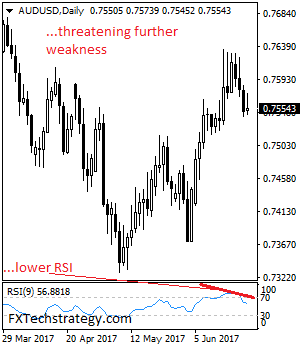
AUDUSD – Weakens, Faces Further Bear Pressure
AUDUSD - The pair continues to hold on to its downside pressure leaving risk lower. On the downside, support resides at the 0.7500 level where a breach will aim at the 0.7450 level. Below that level will set the stage for a run at the 0.7400 level with a cut through here targeting further downside pressure towards the 0.7350 level. On the upside, resistance lies at the 0.7600 level. A cut through here will turn attention to the 0.7650 level and then the 0.7700 level where a violation will set the stage for a retarget of the 0.7750 level. On the whole, AUDUSD remains biased to the downside nearer term.
Opportunistic Price Action
Opportunistic price action
Hawkish central bank rhetoric, the largest first-half slide in oil since 1997 and global political risk have imparted a level of uneasiness in currency markets. The squally trading conditions across most asset classes have traders looking every which way for select opportunities as both risk and uncertainty abound.
There has been little follow through on the USD revival that started the week as in the absence of any actionable US economic data the dollar bulls are erring on the side of caution
But with the with the GOP struggling to push through economic agenda, it's difficult to envision an extended US dollar rally until the US administration gets their ducks in a row.
As for the rest of the street, traders are looking for short term selective opportunities as opposed to perusing any trend in this turbulent market.This environment supports chasing opportunistic price action, and dealers found a sweet spot in both Oils and the Pound
WTI
Oil prices spiked after the EIA weekly crude stock data showed a decline in US inventories. But Bears prowling the oil patch cut that rally short in a heartbeat as WTI plunged to 42.05 before pulling back into the close of NY futures trading.The Oil Bears are steering this tanker as the weekly inventory decline failed to put a dent in the overwhelmingly bearish market sentiment. The currency market spillover saw the Canadian dollar, which correlates to the movements of oil prices, trade lower while equity markets continue trading with a softer bias weighed down by energy sector stocks
The Pound
BoE's Chief Economist Haldane through a spanner in the works when he flew out of the dove's nest right into the Hawks. Coming on the heels of BOE Governor Carney Mansion House dovish tilt, it added another level of confusion to the already muddled UK currency market landscape. The hawkish surprise saw cable gap 65 pips to 1.2700 as the market got caught short again toward the lower end of recent ranges
Japanese Yen
Despite the ripples of risk aversion the USDJPY move towards 111.75 overnight which seemed to coincide with 10:00 AM NY option expiry and cross yen demand after BoE comments. But falling oil prices and weaker equity sentiment carried the day which continues to weigh negatively in early APAC trade.Without a rebound in oil prices, risk sentiment remains extremely fragile, and we could see a push lower
Australian Dollar
The hawkish Fed narrative combined with metal weakness has taken the wind out of AUD mainsail despite an upturn in domestic economic data. While the Aussie remains offered vs. the dollar, it came under further duress on the crosses particularly against the pound after the surprising hawkish tilt from BoE's Chief Economist Haldane
The oil price gusher is not helping commodity sentiment, and with the market still clinging on to some small longs a convincing push below .7550 could trigger stops and a risk for a deeper correction to .7525-15 level. But given the focus remains in the USD narrative, I suspect the Aussie will hold current ranges in the absence of any tier one useful US economic data to support current USD strength.
New Zealand Dollar
The RBNZ left the OCR unchanged as expected at the June OCR review, and the overall policy assessment is also consistent. With very little to glean from the RNBZ assessment, but in the absence of any dovish suggestion, it should prove mildly supportive of the KIWI.The market was poised for dovish expectations as some expected the RBNZ re-instate its concern about currency over-valuation. So .we could see the Kiwi return to favour on any hint USD selling pressure
Chinese Yuan
$CNH seems to be moving on its own accord, and with the realisation, the MSCI inclusion shouldn't have much of a currency effect in the near-to-medium term, it's back to the USD narrative and extremely vulnerable risk narrative.
USD/CAD Canadian Dollar Lower After Oil Drops To 10 Month Low
The Canadian dollar depreciated versus the US dollar on Wednesday as the price of oil continued falling despite a higher than expected drawdown in weekly US crude inventories. U.S. Federal Reserve speakers continue to bolster the possibility of at least one more rate hike in 2017 and the start of its balance sheet reduction program, while the hawkish words of the Bank of Canada (BoC) policy makers are now lost in last week's headlines.
Statistics Canada will release retail sales data on Thursday, June 22 at 8:30 am EDT. Analysts are forecasting a rise of 0.6 percent in the core reading after last month's contraction. Adding the volatile auto sales that grew 3.2 percent in March the overall gain was 0.7 percent as clothing sales and convenience stores offset the gains in the auto sector. Economic indicators have been positive which lead the comments from the BoC about the growing momentum opening the possibility of a rate hike this year.
The USD was mixed against major pairs with most of the gains coming off versus commodity currencies affected by the fall in energy prices. The loonie was the most affect falling 0.42 percent, but followed closely by losses in the AUD and NZD. European pairs moved higher versus the greenback with only the JPY close to flat on Wednesday's trading. The economic calendar does not offer much support for the USD outside of Fed speaker speeches that keep stoking the fire of a third rate raise in 2017.
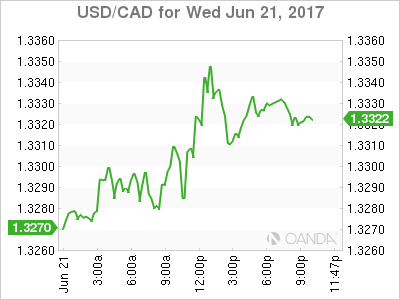
The USD/CAD gained 0.432 in the last 24 hours. The currency pair is trading at 1.3313 with the CAD failing to catch a break this week. Lower than expected inventories were not enough to convince markets oil should be priced higher. The changes in the Saudi hierarchy could spell an escalation of diplomatic and non-diplomatic tension between Iran and Saudi Arabia which could tear the Organization of the Petroleum Exporting Countries (OPEC) apart, specially after the action against Qatar. T
The high correlation with oil has put downward pressure on the loonie and most reports around NAFTA are hardly encouraging as the relationship with Canada's largest trading partner could change if the US follows its America First doctrine. The CAD will have to depend on the retail sales data for direction as Fed speakers continue to prepare markets for an eventual rate hike later this year.
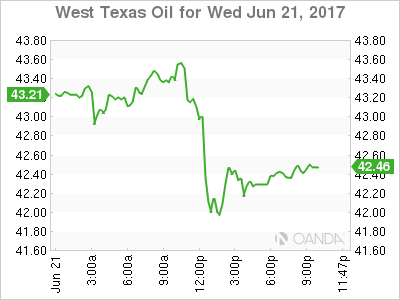
Oil price fell 2.261 percent in the last 24 hours. The price of WTI is trading at $42.29 as the market is full of supply concerns with rising animosity between OPEC partners offsetting the high compliance of the production cut agreement yet with few results to show for it. Iran hinted today that the group could be working on deeper cuts, only for those comments to be dismissed by other oil producers in the group. he Energy Information Administration (EIA) released a deeper than expected drawdown of 2.5 million barrels when 1.2 million were forecasted. Gasoline stocks surprised with a drawdown of 600,000 barrels but not enough to offset the reality of over production specially with Libya and Nigeria resuming their production at full force.
Saudi Arabia's King Salman shook up the kingdom's hierarchy as he put his son Mohammed bin Salman as next in line to succeed him. The 31 year old replaces his cousin and has been a rising star in Saudi politics and economy as he is also in charge of bringing the kingdom out of its dependancy to energy which is easier said than done. His appointment raises the stakes as to when a new confrontation will happen with Iran who sits in the other spectrum of OPEC membership. If the embargo on Qatar by other Arab states is any indication it could escalate rather quickly as Saudi Arabia wishes to have closer ties to the US and Russia.
The showdown between US shale producers and OPEC members continues and with stagnant demand for energy around the globe, prices have been caught in a tight range with only big supply disruptions having an impact, only to be cancelled once they get sorted.
Market events to watch this week:
Thursday, June 22
8:30 am CAD Core Retail Sales m/m
8:30 am USD Unemployment Claims
Friday, June 23
8:30 am CAD CPI m/m
Gold Remains Close to 5-Week Low as Fed Sounding Hawkish
Gold is showing little movement in the Wednesday session. In North American trade, spot gold trading at $1244.59 per ounce. In economic news, Existing Home Sales improved to 5.62 million, beating the estimate of 5.54 million. Crude Oil Inventories posted a sharp drawdown of 2.5 million, larger than the estimate of -1.2 million. On Thursday, the US releases unemployment claims.
The Fed has tightened policy twice this year and has hinted at one more rate hike in the second half of 2017. As for the markets, they have circled the December policy meeting as the most likely date for a rate move. The CME Group has pegged the odds of a September hike at just 13%, compared to 18% a week ago. However, the odds for a December increase are at 49%, and this could increase if Fed policymakers continue to wax positive about the economy. Earlier this week, Federal Reserve of New York President Charles Dudley continued the upbeat message, cautioning the Fed against halting its current tightening cycle. Dudley said that the tight labor market should lead to higher wages, which in turn would push inflation to the Fed's target of 2.0%. The markets like what they are hearing – not just the positive spin on the economy, but also that the Fed has signaled that it plans to reduce the bloated balance sheet of $4.2 trillion.
Although gold prices remain close to 5-week lows, the uncertainty over Brexit has prevented gold from falling even lower. Just a few weeks ago, Prime Minister Theresa May was confidently peddling a hard Brexit, putting Europe on notice that if she didn't like what the Europeans were offering, the UK would leave the European Union without a deal. However, May was humiliated in the UK election, and will be forced to govern with a minority government that is dependent on the support of a small Irish party. May's defiant tone has been replaced by a more conciliatory Philip Hammond, the British finance minister. Hammond has said that he wants a business-friendly and pragmatic Brexit and that no deal would be bad for the UK, although he won't accept an agreement that is aimed at punishing Britain. At the insistence of the Europeans, there are three key issues which will lead off the negotiations: (1) the legal status of EU citizens in the UK; (2) the status of the border between Ireland and Northern Ireland; and (3) the financial obligations of the UK to the EU. This week's formal meeting between the two sides was essentially a photo-op. However, with only two years earmarked for a Brexit agreement to be reached, the talks need to become substantive very soon if an agreement is to be reached.
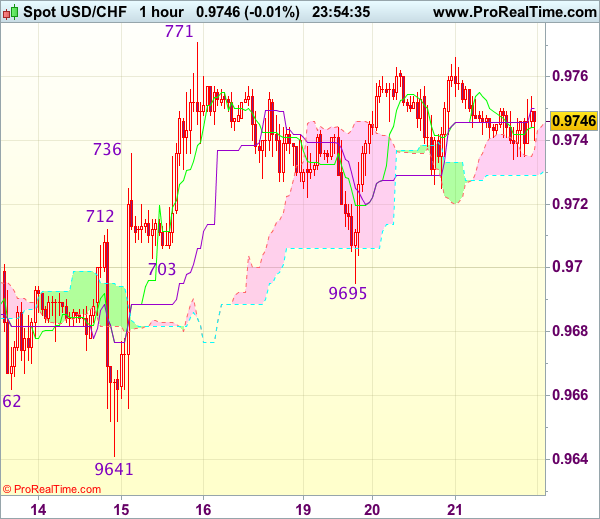
Trade Idea Wrap-up: USD/CHF – Hold long entered at 0.9705
USD/CHF - 0.9745
Most recent candlesticks pattern : N/A
Trend : Near term up
Tenkan-Sen level : 0.9744
Kijun-Sen level : 0.9750
Ichimoku cloud top : 0.9743
Ichimoku cloud bottom : 0.9729
Original strategy :
Bought at 0.9705, Target: 0.9805, Stop: 0.9690
Position : - Long at 0.9705
Target : - 0.9805
Stop : - 0.9690
New strategy :
Hold long entered at 0.9705, Target: 0.9805, Stop: 0.9690
Position : - Long at 0.9705
Target : - 0.9805
Stop : - 0.9690
As the greenback has retreated after faltering below resistance at 0.9771 (last week’s high), suggesting further consolidation below this level would be seen, however, as long as support at 0.9695 holds, bullishness remains for recent upmove to resume after initial sideways trading, break of said resistance at 0.9771 would confirm recent rise from 0.9613 low has resumed for test of resistance at 0.9808 but reckon previous resistance at 0.9825 would hold from here due to near term overbought condition.
In view of this, we are holding on to our long position entered at 0.9705. Below said support at 0.9695 would defer and risk weakness towards said support at 0.9641 but only break there would abort and revive bearishness, this would also suggest the rebound from 0.9613 has ended instead, bring retest of this level later.
Trade Idea Wrap-up: GBP/USD – Hold short entered at 1.2695
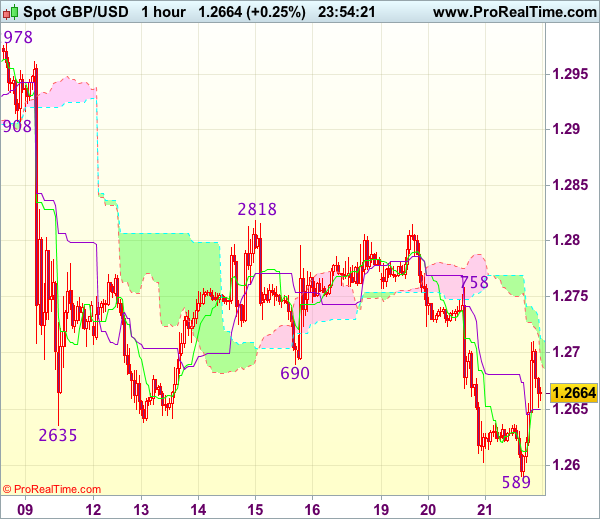
GBP/USD - 1.2667
Most recent candlesticks pattern : N/A
Trend : Near term down
Tenkan-Sen level : 1.2622
Kijun-Sen level : 1.2681
Ichimoku cloud top : 1.2769
Ichimoku cloud bottom : 1.2752
Original strategy :
Sold at 1.2695, Target: 1.2595, Stop: 1.2710
Position : - Short at 1.2695
Target : - 1.2595
Stop : - 1.2710
New strategy :
Hold short entered at 1.2695, Target: 1.2595, Stop: 1.2710
Position : - Short at 1.2695
Target : - 1.2595
Stop : - 1.2710
Although cable has staged a strong rebound after intra-day brief fall to 1.2589, as long as 1.2710 holds, mild downside bias remains for another decline, below 1.2635-40 would bring another fall towards said support but break there is needed to retain bearishness and signal recent decline has resumed for weakness towards 1.2550, however, oversold condition should limit downside to 1.2520-25.
In view of this, we are holding on to our short position entered at 1.2695. Only above 1.2720-25 would abort and suggest low has been formed instead, bring a stronger rebound to 1.2755-60 and possibly 1.2780 but price should falter below indicated strong resistance at 1.2818.
Trade Idea Wrap-up: EUR/USD – Sell at 1.1185
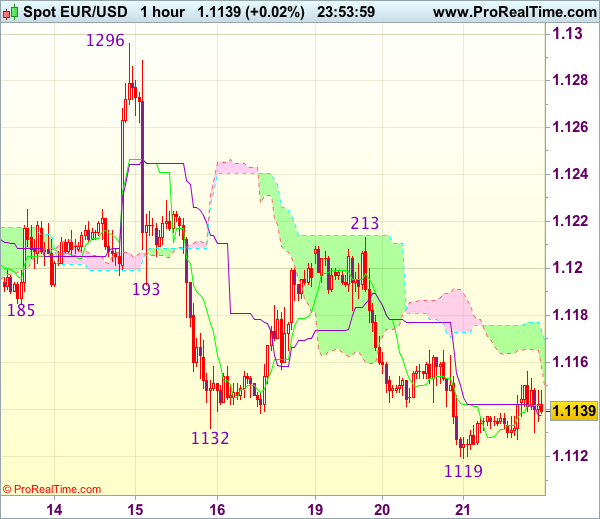
EUR/USD - 1.1143
Most recent candlesticks pattern : N/A
Trend : Near term down
Tenkan-Sen level : 1.1142
Kijun-Sen level : 1.1138
Ichimoku cloud top : 1.1174
Ichimoku cloud bottom : 1.1158
Original strategy :
Sell at 1.1175, Target: 1.1085, Stop: 1.1210
Position : -
Target : -
Stop : -
New strategy :
Sell at 1.1185, Target: 1.1085, Stop: 1.1220
Position : -
Target : -
Stop : -
Yesterday’s breach of previous support at 1.1132 confirms recent decline has resumed and bearishness remains for further weakness to previous support at 1.1109, however, break there is needed to retain our bearish view and extend subsequent selloff to 1.1075-80 but loss of near term downward momentum should prevent sharp fall below 1.1050, risk from there is seen for a rebound later.
In view of this, we are looking to sell euro on recovery as 1.1175-80 should limit upside. Only above 1.1213 resistance would defer and risk a stronger rebound to 1.1230-35 but upside should be limited to 1.1260-70, bring another decline later.
Trade Idea Wrap-up: USD/JPY – Buy at 110.65
USD/JPY - 111.59
Most recent candlesticks pattern : N/A
Trend : Near term up
Tenkan-Sen level : 111.50
Kijun-Sen level : 111.41
Ichimoku cloud top : 111.45
Ichimoku cloud bottom : 111.22
Original strategy :
Buy at 110.65, Target: 111.65, Stop: 110.30
Position : -
Target : -
Stop : -
New strategy :
Buy at 110.65, Target: 111.65, Stop: 110.30
Position : -
Target : -
Stop : -
Although the greenback has rebounded after finding support at 111.07 and test of yesterday’s high at 111.79 is likely, break there is needed to confirm the rise from 108.82 low has resumed and may extend headway to 111.90-95 (50% projection of 108.82-111.42-110.65) but upside should be limited to resistance at 112.13 and 112.25 (61.8% Fibonacci retracement of 114.37-108.82 and 61.8% projection) should hold from here. If said resistance continues to hold, then another retreat to 111.07 cannot be ruled out but 110.65 (previous support as well as 38.2% Fibonacci retracement of 108.82-111.79) would limit downside and bring another rise later.
In view of this, would not chase this rise here and we are looking to buy dollar on pullback as 110.65 support should limit downside. Below 110.30-35 (50% Fibonacci retracement of 108.82-111.79 and previous resistance turned support) would abort and signal a temporary top has been formed instead, risk weakness towards 109.95-00 (61.8% Fibonacci retracement).

Pound Steadies as MPC Member Haldane Says Rate Hike Needed
The British pound has stabilized and posted slight gains in the Wednesday session. In North American trade, GBP/USD is trading at 1.2660. On the release front, the UK deficit narrowed to GBP 6.0 billion, better than the forecast of GBP 7.3 billion. The BoE's chief economist, Andy Haldane, made headlines when he said he supports raising rates later this year. In the US, Existing Home Sales improved to 5.62 million, beating the estimate of 5.54 million. On Thursday, the US releases unemployment claims.
There were more developments out of the BoE, as policymakers continue to make public statements as to whether the BoE should raise interest rates or not. On Wednesday, MPC member Andy Haldane said that the bank might need to raise interest rates soon, in order to ward off inflation. Haldane noted that the British economy continues to grow and the labor market remains strong. Haldane was not one of three MPC members who voted for a rate hike last week. The markets misread the amount of support for a hike, predicting that the vote to hold rates would be 8-1. Haldane said that he had voted with the majority due to concerns over the recent election and weak wage growth.
BoE Governor Carney was unusually blunt in a speech in London on Tuesday, when addressing interest rate policy. Carney poured cold water on raising interest rates, saying that "now is not yet the time to begin that adjustment". The pound reacted sharply to Carney's comments, losing 0.91% in the Tuesday session. With the economy having weathered the Brexit storm quite well, there have been calls for the BoE to raise rates, which hasn't happened in over a decade. The pressure was ratcheted higher last week, when three of nine MPC members voted to raise rates. Clearly, Carney felt the need to act and resist the calls for higher rates. The cautious Carney noted that consumer spending had dropped, and that more time was needed to evaluate how the economy reacted to the "reality of Brexit negotiations". Carney finds himself in a corner, as he is dead set against hiking rates, but the weak pound has pushed inflation to unhealthy levels, as CPI rose 2.9% in May. If Carney holds back on any rate increases, inflation could continue to climb.