Sample Category Title
DAX Edges Upward, Eurozone CPI Softens But Matches Forecast
The DAX index has edged higher in the Friday session, gaining 0.27 percent. The index is currently at 12,729.00 points. On the release front, there were no surprises on the inflation front, as Eurozone Final CPI in May dropped to 1.4%, matching the estimate. Still, this reading marked the weakest Final CPI release in 2017, and was down sharply from the April release of 1.9%.
The ECB continues to hold the course with an ultra-accommodative monetary policy, in order to improve growth and raise inflation levels. ECB President Mario Draghi has acknowledged that economic conditions have improved in the euro-area, but appears in no rush to make any significant changes. However, one major player has long been unhappy with this stance, and the complaints are getting louder. Germany wants to see a tighter policy out of Brussels, arguing that the current low-interest environment is hurting savers and is ill-fitted to Germany’s strong economy. On Tuesday, German finance minister Wolfgang Schaeuble bluntly called on the ECB to change its policy in a 'timely manner'. For its part, the cautious ECB has argued that it must keep its asset-purchase program and low interest rates in place while inflation remains at low levels. However, with Germany facing elections in September, the pressure on the ECB to tighten policy will only increase, especially if key indicators continue to point higher.
There was some positive news for embattled Greece, as eurozone lenders and the International Monetary Fund have agreed to a bailout for the country. Under the terms of the agreement, the eurozone will provide Greece with a total of EUR 8.5 billion – 7.7 billion in early July, and 0.8 billion at a later time. The IMF has also pledged to provide funds, but not before it receives details of Greece’s debt sustainability. The deal comes at a critical time for Greece, which despite severe austerity measures, finds itself again on the verge of default. The Greek government has implemented tax hikes and pension cuts, and is hoping that the battered economy has turned the corner with this injection of funds.
Following weeks of broad hints that a rate hike was coming, the Federal Reserve pressed the rate trigger at this week’s June meeting, marking its second rate hike in 2017. The Fed increased rates by 25 basis points, to a target range of 1.00 percent to 1.25 percent. Fed policymakers sounded upbeat in the rate statement, which that was more hawkish than expected. The statement portrayed an optimistic picture, noting that the economy was growing and the labor market remained strong. Concerns over low inflation were brushed aside, as the statement noted that although inflation remains below the Fed’s target of 2.0%, it expected that target to be reached in the 'medium term'. The Fed projected one more rate hike in 2017, and analysts were quick to circle December meeting as the most likely date. However, the markets don’t appear to share the Fed’s optimism as far as another rate hike this year. The odds for a September increase are at 18%, compared to 23% a week ago, according to the CME Group. As for a December increase, the odds stand at just 38%.
Daily Technical Analysis: EURUSD, GBPUSD, USDJPY, USDCHF
EURUSD
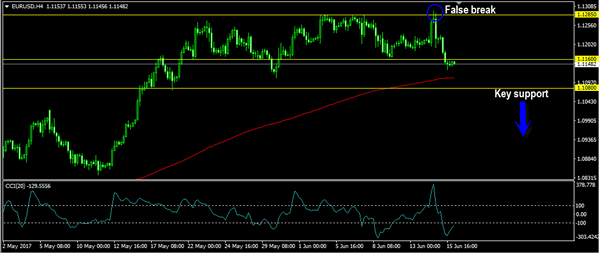
The EURUSD had a bearish momentum yesterday bottomed at 1.1132. The bias is bearish in nearest term. The false breakout above 1.1285 gave us a valid bearish signal targeting 1.1080 which remains a good place to buy with a tight stop loss. Immediate resistance is seen around 1.1200. A clear break back above that area could lead price to neutral zone in nearest term but key resistance remains around 1.1285 which needs to be clearly broken to the upside to continue the bullish scenario testing 1.1350 – 1.1425 region. On the downside, a clear break and daily/weekly close below 1.1080 would nullify the bullish bias.
GBPUSD
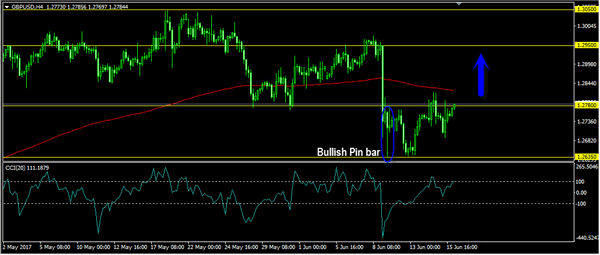
The GBPUSD had another indecisive movement yesterday. The bias remains neutral in nearest term. The bullish pin bar appeared on H4 chart on June 9th remains valid but need a clear break above 1.2780 to confirm the bullish scenario targeting 1.2900 – 1.3000/50 region. Immediate support is seen around 1.2725. A clear break below that area could trigger further bearish pressure but only a clear break below 1.2635 would nullify the bullish pin bar scenario targeting 1.2500 region.
USDJPY
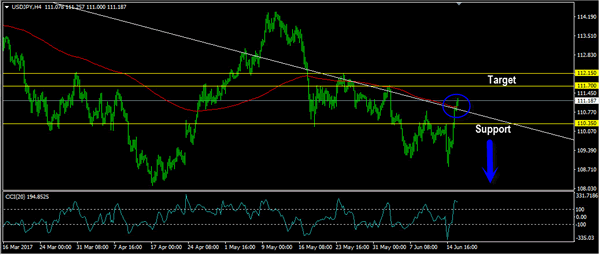
The USDJPY had a strong bullish momentum yesterday topped at 110.97 and hit 111.25 earlier today in Asian session. Price broke above the trend line resistance as you can see on my H4 chart below which nullify the bearish bias. I am not bullish yet, but short-term bias is bullish targeting 111.70 – 112.15 area. Immediate support is seen around 110.80. A clear break below that area could lead price to neutral zone in nearest term but only a clear break back below 110.35 would stop the current short-term bullish bias.
USDCHF
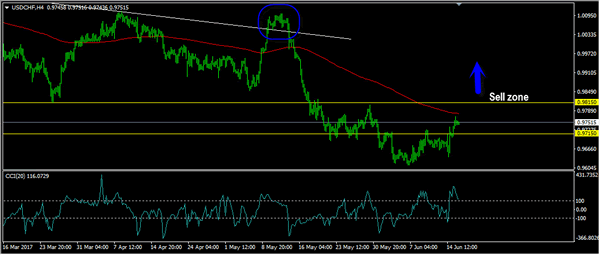
The USDCHF had a bullish momentum yesterday topped at 0.9770. The bias is bullish in nearest term testing 0.9815 key resistance which is a good place to sell with a tight stop loss targeting 0.9600 – 0.9550 area. Immediate support is seen around 0.9715. A clear break below that area could lead price to neutral zone in nearest term testing 0.9680/50 region. On the upside, a clear break and daily/weekly close above 0.9815 would end the bearish outlook testing 0.9900 area or higher.
Will Data Support Fed’s Plans Of Another Hike This Year?
- Equity markets higher but quadruple witching likely playing a role;
- US data in focus later as Fed plans one more hike this year;
- Oil bounces ahead of Baker Hughes oil rig data;
- Sterling edges higher but political uncertainty continues to weigh.
It's been a slow start to trading on Friday, with the lack of major news flow or notable releases meaning traders are left to digest the events of the last couple of days.
It's difficult to read too much into moves in equity markets with today being the expiry of June futures and options – otherwise known as quadruple witching – likely playing a big role. It's been a quiet morning so far in Europe, with the only notable data being the final inflation figures from the eurozone – both of which were unchanged, as expected – which is unlikely to have had much of an impact.
We do have more data to come from the US around the open on Wall Street, with building permits, housing starts, UoM consumer sentiment and inflation expectations figures all being released. The Fed raised interest rates earlier this week and signalled one more this year but traders still appear unconvinced, with another hike by December only around 45% priced in. How the data performs between now and the end of the year should see the gap between the two close in the months ahead and today's figures could offer some interesting insight, particularly the consumer and inflation numbers.
We're seeing a small bounce in oil this morning as we await the Baker Hughes rig data later in the session. Brent and WTI crude have come under significant pressure since oil producers agreed to extend cuts by another nine months in a bid to rebalance the market and bring inventories back to their five year average. Whether US output will offset these cuts, or a significant portion of them, will be seen over the next year or so but as long as we keep seeing the rig count climb, prices could remain under pressure. Brent and WTI may have found some support around their May lows but should this level be breached, it could trigger another wave of selling and put pressure on producers to do more.
Sterling is making minor gains this morning, buoyed by yesterday's vote on interest rates at the Bank of England. Three policy makers surprisingly voted for a hike, with the outgoing Kristin Forbes the only one to have done so recently. While this doesn't necessarily mean we'll see a rate hike any time soon, it clearly indicates that policy makers are more hawkish than markets anticipated. Still, the pound's gains against the dollar were capped around 1.28, reflecting the fact that downside pressure remains on the currency as a result of all the political uncertainty which comes at the worst possible time for the country.
Euro Steady As Eurozone CPI Matches Forecast
The euro has recorded slight gains in the Friday session, as EUR/USD is trading at 1.1170. In economic news, Eurozone Final CPI dropped to 1.4%, matching the estimate. In the US, it's a busy day, with three key indicators – Building Permits, Housing Starts and UoM Consumer Sentiment.
France's election season will wrap up on Sunday, when voters go to the polls in the second round of the parliamentary election. At stake are the 577 seats in the National Assembly. French President Emmanuel Macron is expected to win a landslide majority, with some polls giving Macron's En Marche party a staggering 80% of the vote. Macron has run on a pro-business agenda, which includes overhauling France's labor laws and making the economy more competitive. As well, Macron is a strong supporter of the European Union, and a Macron-Merkel alliance could strengthen the EU at a time when Brexit and nationalistic parties on the continent have undermined European unity. Macron, who is expected to support a hard line against Brexit, met with British Prime Minister Theresa May earlier this week. Macron said that the EU would leave the “door open” in case Britain changed its mind and decided to stay in the club, but May is unlikely to take up the French President's invitation.
Following weeks of broad hints that a rate hike was coming, the Federal Reserve pressed the rate trigger at this week's June meeting, marking its second rate hike in 2017. The Fed increased rates by 25 basis points, to a target range of 1.00 percent to 1.25 percent. Fed policymakers sounded upbeat in the rate statement, which that was more hawkish than expected. The statement portrayed an optimistic picture, noting that the economy was growing and the labor market remained strong. Concerns over low inflation were brushed aside, as the statement noted that although inflation remains below the Fed's target of 2.0%, it expected that target to be reached in the “medium term”. The Fed projected one more rate hike in 2017, and analysts were quick to circle December meeting as the most likely date. However, the markets don't appear to share the Fed's optimism as far as another rate hike this year. The odds for a September increase are at 18%, compared to 23% a week ago, according to the CME Group. As for a December increase, the odds stand at just 38%.
Although the rate hike was widely expected, the Fed still managed to surprise the markets. Earlier in the year, the Fed mentioned its goal of reducing its $4.2 billion balance sheet (comprised of Treasury bonds and mortgage-backed securities). Fed Chair Janet Yellen revisited this issue at her follow-up press conference on Wednesday. Yellen was short on specifics, saying that the goal was to begin the normalization “relatively soon”. The Fed balance sheet ballooned after the financial crisis in 2008, as the Fed implemented a massive quantitative easing program as part of its accommodative monetary policy, together with interest rates of zero. The gradual reduction in the purchase of these assets is significant for the markets, as signifies a vote of confidence in the strength of the US economy.
Daily Technical Analysis: GBP/JPY Further Uptrend Expected As Long As The Price Is Above 141.35
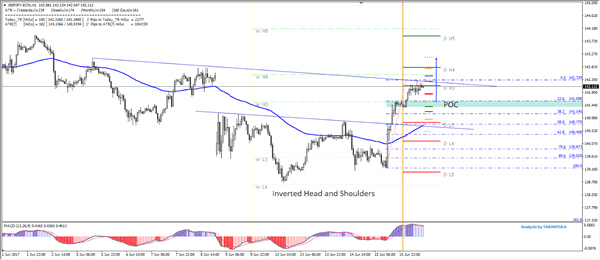
The BOE held the rate at 0.25% as expected, but the statement has been bullish and the GBP/JPY spiked from the support breaking the neckline of inverted head and shoulders pattern. The trend seems to be strong as the price is above both W H3 and D H3. The POC 141.40-60 could spike the price again if the pair drops to the zone (23.6, ATR pivot, W H3). Break of 142.33 aims for a breakout towards 142.77 and 143.15. However, the break of 141.35 to the downside might spur a deeper retracement and interim bullish scenario for this day might be negated.
Market Update – European Session: BOJ Kuroda Gives No Clues In Any Timing To Ending Its QQE
Notes/Observations
BOJ Kuroda press conference dampened any expectations of QE exit plans; noted too early to discuss policy exit given weak inflation
Euro Zone May CPI confirmed remained below the ECB target for the 2nd straight month
Overnight
Asia:
Bank of Japan (BOJ) left Interest Rates unchanged at -0.10% (as expected); maintained 10-year JGB Yield Control (YCC) at 0.00% (no set time) and annual pace of asset purchases at ¥80T
Europe:
Eurogroup's Dijsselbloem: we have achievements on all elements on Greece. Greece will maintain a 3.5% surplus until 2022. Debt relief would be granted after bailout ends with success in 2018
Eurogroup statement noted that Euro Zone Finance Ministers agreed on €8.5B loan to Greece. Ready to implement extensions of the weighted average maturities and further deferral of EFSF interest by between 0-15 years. Debt relief for Greece would be granted after bailout ends with success in 2018
IMF's Lagarde: To propose approval in principle on Greece; to discuss the Greek accord with the IMF in July. Intended to propose a loan for Greece in the range of $2B; to propose to exec board an approval in principle of a standby arrangement for Greece below $2B. Needed to see more details on Greek debt measures in the weeks ahead; currently, as is, Greek debt was not sustainable
Greek Fin Min Tsakalotos: There was a strong growth package, including launch of a state development bank. The point of this whole exercise was to leave the program next year. Issue of accessing the debt markets is a technical issue; Greece's return to the debt market to depend on a judgment call; would receive clearance to access debt markets in due course
UK and EU officials reportedly to begin formal Brexit talks on Monday, June 19th, as expected - PM May: time for a Northern Ireland deal is running out; must come to agreement by June 29th
DUP party said not calling for UK to stay in EU single market or customs union as part deal to support Conservative party in Govt; decreases hopes the agreement could lead to a less extreme form of Brexit
Americas:
Special Counsel Mueller was looking into finances and business dealings of Jared Kushner - China US Treasury holding for April rose to its highest level since Oct ($1.092T vs. $1.088T m/m)
Economic Data
(EU) Euro Zone May CPI M/M: -0.1% v -0.1%e; Y/Y (Final Reading): 1.4% v 1.4%e; CPI Core Y/Y (Final reading): 0.9% v 0.9%e
Fixed Income Issuance:
None seen
SPEAKERS/FIXED INCOME/FX/COMMODITIES/ERRATUM
Equities
Indices [Stoxx50 +0.6% at 3547, FTSE +0.4% at 7449, DAX +0.5% at 12750, CAC-40 +0.9% at 5266, IBEX-35 +0.7% at 10776 FTSE MIB +0.7% at 20999, SMI +0.9% at 8933, S&P 500 Futures +0.2%]
Market Focal Points/Key Themes European Indices trade higher across the board rebounding from yesterday's falls, with macro economic news in focus. as well as triple witching Friday. The French CAC outperforms while the UK FTSE under performs following the BoE rate decision and minutes yesterday. On the corporate front UK Supermarket giant Tesco reported better then expected UK LFL sales, whilst group sales lagged, Nestle shares trade higher after talk of possible sale of US confectionery division. Newly listed ALD Automotive and Indorisa Pharma opened for trade today with Indorsia higher by over 20% after spinning off from Actelion.
Equities
Consumer discretionary [Tesco [TSCO.UK] -0.6% (Q1 update), Nestle [NESN.CH] +1.8% (Reportedly considering strategic options for US confectionery division, including possible sale),SThree [STHR.UK] +3.3% (Earnings)]
Telecom: [Avanti Communication Group [AVN.UK] +47% (Super facility)]
Industrials: [Rolls Royce [RR.UK] +0.9% (Trading update)
Financials: [ Record Plc [REC.UK] +12% (Earnings), SocGen [GLE.FR] +1.4% (ALD Automotive IPO)]
Healthcare: [ Indorsia Pharma [IDIA.CH] +17.5% (Spin off from Actelion)]
Speakers
ECB's Villeroy (France): Must complete Basel III bank capital requirement discussions. Unilateral deregulation would be a 'lose-lose' game with grave consequences
EU's Moscovici noted that the Greece agreement makes progress on debt management
EU's Dombrovskis: Finance Ministers continue to work on Non-performing loans (NPLs)
UK Chancellor of Exchequer Hammond: Govt to take pragmatic approach in Brexit negotiations; to find a solution that works. Have set out a very clear desired outcome in planned EU talks but would not give 'blow-by-blow accounts. Set out to prioritize jobs and growth
Portugal Fin Min Centeno: Govt plan to maintain the cash buffer as it continues to make early repayments of its IMF loan over the next 30 months. To pay €1.0B by end of June as soon as we have the formal authorization from the European institutions
Luxembourg Fin Min Gramegna: Good compromise on Greece from Eurogroup; gives country a bit of buffer with aid payout; Euro Zone gave Greece room to maneuver. Saw good solution for Greece and Europe on debt in coming months
Greece PM Tsipras: Have taken a definitive step to exit crisis
BOJ Gov Kuroda post rate decision press conference reiterated view that to adjust monetary policy as needed to maintain momentum in achieving the 2% price target; still quite a distance to achieve target, only half-way there. Recovery has turned to a moderate expansion. Taking time to end the deflation mindset in Japan. Reiterated that expects prices to rise gradually from here. Rising wages to lead to higher selling and service prices. To conduct bond purchases to achieve yield target; no pre-set idea about the pace of bond buying; amount to be result of yield target. Not appropriate to present specific plan about any exit from stimulus. Hard to give simulations about what will happen to BOJ earnings during exit. Growing talk of a policy exit is due to what's happening with central banks in the US, Europe
China FX regulator SAFE reiterated that forex supply and demand remained balanced in May
Currencies
USD/JPY was higher above the 111.30 level in the session as the BOJ post rate press conference saw Gov Kuroda note that the BoJ was not planning to release simulations regarding a pullback of its easy-money policies. Some in the market had speculated the central bank could start to float the idea of a possible future exit. Kuroda press conference dampened any expectations of QE exit plans. The yen currency softer as a result. Kuroda noted that growing talk of a policy exit was due to what's happening with central banks in the both US, Europe.
The EUR/USD retraced its post FOMC losses but remained below the 1.12 level. Euro Zone May CPI confirmed remained below the ECB target for the 2nd straight month
Fixed Income
Bund futurestrade at 164.28 down 30 ticks after a technical break and now are at the lows for June. Resistance lies near the 164.60 level, followed by 165.52. A break of the 163.89 support level could see lows target 162.05 followed by 160.30.
Gilt futurestrade at 128.71 down 22 ticks after extending its declines from Wednesday's high 130.23. Price fell below 129.14 level and now initial support lies 128.27 level, with key support at the 127.96 support level. An acceleration lower could test the 127.43 region. Resistance lies at the 129.80 level followed by 132.65.
Friday's liquidity report showed Thursday's excess liquidity fell to €1.662T a decrease of €14B from €1.676T prior. Use of the marginal lending facility rose to €226M from €180M prior.
Corporate issuancesaw $3B come to market via 1 issues headlined by Brighthouse Financial Inc. -2-part senior unsecured note offering. This week's issuance is at $14.0B, lower than the analysts' issuance target to come in around $20B. For the week ending Jun 14th Lipper US fund flows reported IG funds net inflows $2.603B bringing YTD inflows to $64.29B, High yield funds reported outflows of $0.2B bringing YTD outflows to $4.70B.
Looking Ahead
06:00 (IE) Ireland Apr Trade Balance: No est v €5.1B prior
06:00 (UK) DMO to sell combined £3.0B in 1-month, 3-month and 6-month bills (£1.5B, £0.5B and £1.0B respectively)
06:30 (RU) Russia Central Bank (CBR) Interest Rate Decision: Majority of analysts expect Russia to cut its Key 1-week Auction Rate by 25bps to 9.00%
06:45 (US) Daily Libor Fixing
07:30 (BR) Brazil Apr Economic Activity (Monthly GDP) M/M: +0.2%e v -0.4% prior; Y/Y: -1.4%e v +1.1% prior
07:30 (IN) India Weekly Forex Reserves
08:00 (IS) Iceland May Unemployment Rate: No est v 2.1% prior
08:00 (BE) Belgium Debt Agency (BDA) announcement of upcoming OLO auction for Mon, Jun 19th
08:15 (UK) Baltic Dry Bulk Index
08:30 (US) May Housing Starts: 1.22Me v 1.172M prior; Building Permits: 1.25Me v 1.2228M prior (revised from 1.229M)
08:30 (CA) Canada Apr Int'l Securities Transactions: No est v C$15.1B prior
10:00 (US) Jun Preliminary University of Michigan Confidence: 97.0e v 97.1 prior
10:00 (US) May Labor Market Conditions Index Change: 3.0e v 3.5 prior
11:00 (EU) Potential sovereign ratings
(PT) Portugal Sovereign Debt to be rated by Fitch
(UK) United Kingdom Sovereign Debt to be rated by DBRS
12:45 (US) Fed's Kaplan speaks in Dallas
13:00 (US) Weekly Baker Hughes Rig Count Data
Will Equity Bulls Make A Friday Appearance?
Equity bulls were missing in action on Thursday after a selloff in technology shares and prospects of higher US interest rates pressured World stocks. Markets have washed away the caution during Friday's trading session as Asian stocks steadied after the Bank of Japan left monetary policy unchanged. European equities found themselves supported by the renewed appetite for risk, and this positive momentum could rollover into Wall Street in the afternoon.
This has been an action-packed week layered with central bank meetings and political developments with investors most likely using the weekend to digest the myriad of news events.
Bank of Japan holds fire
As widely expected the Bank of Japan offered no surprise to markets by keeping monetary policy unchanged in its June board review. The central bank left interest rates unchanged at -0.1% and the 10-year government bond yield around zero while maintaining its mammoth annual holding of bonds at 80 trillion yen. Although Friday's statement did adopt a more upbeat tone with the BoJ upgrading its assessment for private consumption and overseas growth, inflation is still far from the 2% target.
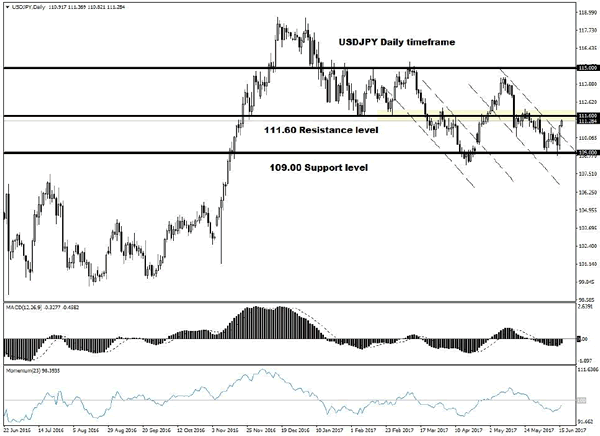
When focusing on the USDJPY, the extreme divergence in monetary policy between the Federal Reserve and Bank of Japan could play a role in where the pair concludes this year. While prices are currently bearish amid risk aversion, the prospects of higher US interest rates could empower USDJPY bulls in the medium to longer term. From a technical standpoint, the current bearish trend is at risk of becoming invalidated if prices breakout and close above 111.60.
WTI Crude struggles below $45
Oil prices descended deeper into the abyss on Thursday as bearish investors exploited the unexpectedly large build in gasoline inventories to instigate renewed rounds of selling. The King Dollar's return weighed heavily on the commodity by making it more expensive for buyers utilizing other currencies. With oil displaying repeated signs of weakness despite OPEC cutting production by 1.8 million barrels a day and US Shale pumping incessantly, there is a threat of price weakness becoming a recurrent theme.
Sentiment remains firmly bearish towards oil with further downside expected as the oversupply fears grant sellers the permission to attack the commodity. From a technical standpoint, WTI Crude is heavily bearish on the daily charts. Traders may utilize the dynamic $45 resistance to send WTI towards $43.
Gold bears conquer $1260
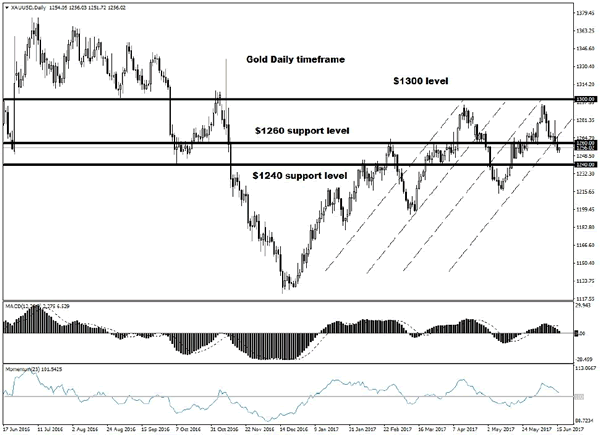
Gold found itself vulnerable to heavy losses on Thursday, building on the selling momentum that started during Wednesday evening after the Federal Reserve dished out an unexpected hawkish surprise. A resurgent Dollar amid the Fed's optimism over US economic growth has contributed to Gold's woes with the metal descending to a fresh week low at $1252 during early trading on Friday.
With the zero-yielding metal visibly dictated by US interest rate hike expectations, there is a risk of further downside if speculations mount over the Federal Reserve raising rates again this year. Although risk aversion from both Brexit developments and political uncertainty in Washington could support prices, short-term bears remain in control below $1260. From a technical standpoint, previous support around $1260 could transform into a dynamic resistance that encourages a decline towards $1240.
Currency spotlight – EURUSD
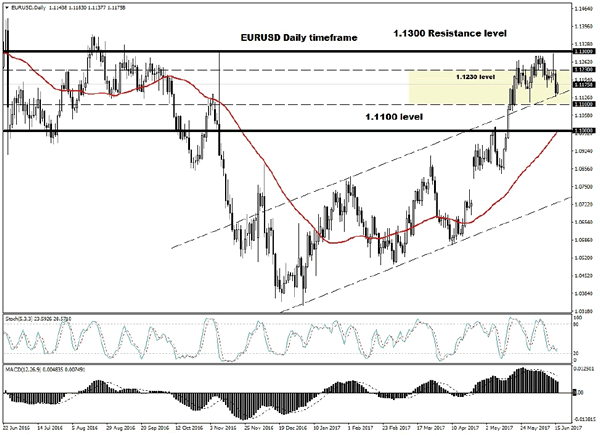
The EURUSD tumbled to a two-week low at 1.1132 on Thursday after the more hawkish tone by the Federal Reserve boosted the US Dollar. Regardless of recent losses, sentiment towards the Euro remains bullish and the currency should remain supported by the encouraging macrofundamentals from the European economy.
Focusing on the technicals, the EURUSD remains bullish on the daily charts and may be in the process of creating a new higher low. A breakout above 1.1230 should encourage a further incline higher towards 1.1300. In an alternative scenario, weakness below 1.1100 opens a path back towards 1.1000.
Technical Outlook: USDJPY – Extended Recovery Eye Targets At 111.58/88, Broken 200SMA Offers Solid Support
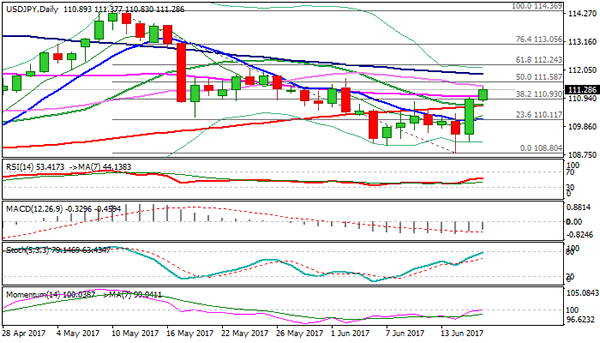
The pair extends recovery above 111.00 barrier on Friday, following strong rally and close above 200 SMA barrier on Thursday.
The dollar remains supported after FOMC and strong US data while yen weakened further after Bank of Japan kept monetary policy and asset purchases unchanged.
Long bullish candle that was left on Thursday underpins fresh bullish action which met target at 111.37 (daily Kijun-sen) and eyes target at 111.58 (50% retracement of 114.36/108.80 descend).
Bulls may extend towards 111.80/88 zone (daily cloud base / 100SMA) but consolidation phase may precede fresh extension higher as slow stochastic is entering overbought territory.
Strong bids lay at 110.69 (converged 20/200SMA’s) where extended corrective dips are expected to find solid support.
The pair is on track for strong bullish weekly close which would support further recovery.
Res: 111.37, 111.58, 111.88, 112.12
Sup: 111.00, 110.83, 110.69, 110.41
Strategy: Fed Heading For The Exit Door
The most anticipated event this week was clearly the FOMC meeting announcement on Wednesday night. A key question was to what extent a so-called data-dependent Fed would factor in a string of weak data, notably on the inflation side and change the stance of its monetary policy. Markets had remained remarkably convinced that a hike was in the making but we were less sure and stood by our call that the data-dependent Fed would keep rates unchanged and instead announce details about their plan for reducing the balance sheet, also called quantitative tightening.
In the end, the Fed both hiked its policy rate by 25 basis points AND laid out its plans for the reduction of its balance sheet. At the same time, the Fed continued to signal another hike this year and three hikes next year. How did Fed governor Yellen sell this rather hawkish twist to monetary policy and what will the market implications be in the near and longer term?
The FED meeting on Wednesday clearly signalled a shift in the Fed's focus. It downplayed the drop in core inflation as temporary (although Yellen did say that they are monitoring inflation developments ‘closely') while attaching greater importance to the fall in unemployment rates, which they expect will reignite wage growth and help push up inflation to the central bank's two percent target. With the US economy expected to grow close to 2% over the next two years, we should see further falls in the unemployment rate.
But we have doubts how fast this will translate into a higher wage growth and thereby inflation. At the press conference, Yellen did acknowledge that the US Phillips curve is rather flat (meaning that the low unemployment rate is not yet translating into higher nominal wage growth) and that the estimate of the unemployment rate below which wages start to rise faster is uncertain. Following the meeting, we are still expecting a hike in December but have become less certain while now only expecting 1-2 hikes next year (down from 3).
Fixed income: long-term yields kept in check
While the more hawkish Fed has certainly put upward pressure on the shorter end of the yield curve, the case for higher longer term yields is more uncertain at least near term. So far the longer-term US yields have declined following the Wednesday meeting. While the balance sheet reduction will soon be started by the Fed, it will still be re-investing sizeable amounts. Furthermore, the relatively weak inflation pressures and expectations also limit the pressure on long-term yields. Furthermore, both Bank of Japan (this morning) and the ECB (last week) signalled no rush to exit their quantitative easing programmes, which will also help keep a lid on global long-term rates. Hence we continue to see the longer-term yields being held in check for most part of 2017.
Equities: sell on rallies near-term
The Fed decisions on Wednesday are not fundamentally changing our view. We still see equities going through a mild downward adjustment following sizeable gains in the spring and stretched valuations. However, if we get a third hike this year as signalled in the dots (our take would be in December), then this could change and we would find ourselves in a situation similar to 2004-05, where US-T sold off, while equities fared fairly well.
FX – further downside to EUR/USD near-term, higher later in 2017
The hawkish twist to the Fed's decision on Wednesday is clearly aiding the USD. This has lent support to our tactically bearish EUR/USD trading recommendation. We continue to see further downside for the cross near-term with the ECB being side-lined in coming months by a sustained deterioration in the inflation outlook and a Fed determined to move on with policy normalisation. Furthermore, the mixture of a BOJ continuing its extraordinary easing programme and the Fed moving towards the exit should also support the USD/JPY, where we see the cross moving to 112 in 1-3M and 116 in 6-12M.
Rising risk of a slowdown in China
It was noteworthy that the Fed removed the monitoring of ‘global economic and financial developments' from its statement on Wednesday, indicating that it is less concerned about the negative impact of global developments on the US economy. This may in our view be a bit premature as we see rising risks of an economic slowdown in China after the withdrawal of stimulus measures and the crackdown on the shadow banking sector. This week we saw a further slowdown in credit supply, falling to the lowest level since October last year, mostly on account of a sharp contraction in shadow banking finance. Adding in a more hawkish Fed, the pressure on Chinese economies markets may grow in the coming months, which risks having repercussions for the global economy.
GOLD Trading Lower Within Uptrend Channel, SILVER Selling Demand, CRUDE OIL Heading To Support At 43.76.
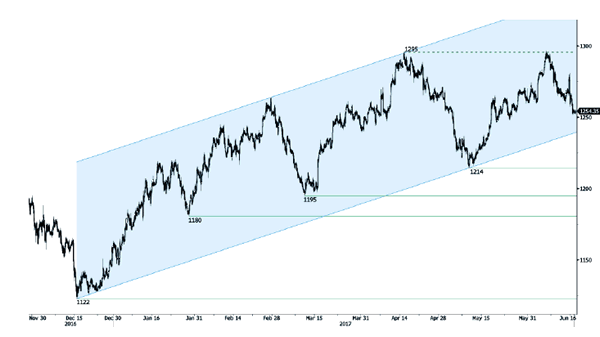
GOLD Trading lower within uptrend channel.
Gold is consolidating within uptrend channel. Hourly support is located at 1246 (18/05/2017 low). Stronger support is given at 1195 (10/03/2017 low). Expected to show renewed upside pressures.
In the long-term, the technical structure suggests that there is a growing upside momentum. A break of 1392 (17/03/2014) is necessary ton confirm it, A major support can be found at 1045 (05/02/2010 low).
SILVER Selling demand.
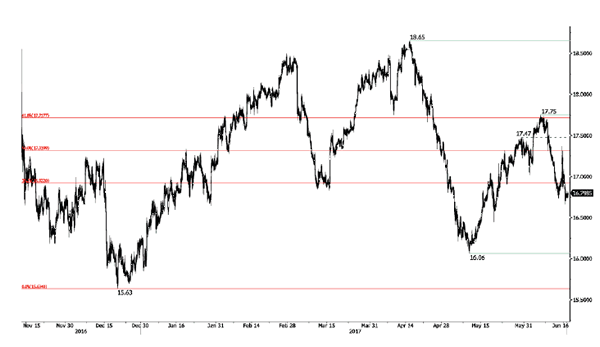
Silver declines. Closest support is given at 16.44 (18/05/2017 low). Strong support is given at 16.06 (09/05/2017 low). Key resistance is given at a distance at 19.00 (09/11/2017 high). The road seems wide open for further decline.
In the long-term, the death cross indicates that further downsides are very likely. Resistance is located at 25.11 (28/08/2013 high). Strong support can be found at 11.75 (20/04/2009).
CRUDE OIL Heading to support at 43.76.
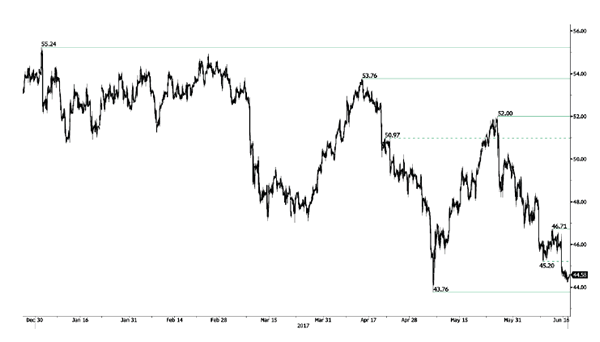
Crude oil is finally continuing its decline since the recent collapse from $52. Support is given at a distance 43.76 (05/05/2017 low). Expected to show further decline.
In the long-term, crude oil has recovered after its sharp decline last year. However, we consider that further weakness are very likely. Strong support lies at 24.82 (13/11/2002) while resistance can now be found at 55.24 (03/01/2017 high).