

Sample Category Title
US Data And Oil Inventories Key On Thursday
- ADP, jobless claims and manufacturing PMIs the key releases on Thursday;
- GBP remains under pressure as election uncertainties weigh;
- Oil stages minor recovery after API report, EIA confirmation could boost it further.
It's been a busy morning on the economic data side, with manufacturing PMIs being released across Europe and that's set to continue as we enter into the US session.
Ahead of tomorrow's jobs report, the ADP release will be the most closely watched, despite its tendency to not provide an accurate indication of the official NFP release. A number in line with expectations would suggest tomorrow's number will be good enough to convince the Federal Reserve that a hike at the meeting in two weeks' time is still a good decision. Given the data we've seen since the start of the year though, a bad report tomorrow may worry some officials and it will be interesting to see what that does to market expectations, with a hike currently 91% priced in, according to the CME Group FedWatch Tool. Other data to come from the US today includes jobless claims and manufacturing PMIs from both Markit and ISM.
Sterling is coming under some pressure once again on Thursday as the election continues to weigh on the currency. Despite staging a recovery on Wednesday when a poll from Panelbase called into doubt one earlier released by YouGov, the pound has once again fallen victim to the uncertainty surrounding the election outcome next week. What once looked like being an easy campaign for Theresa May and a question of just how large the majority could get has been clouded by problems, which doesn't bode well for the Brexit negotiations.
Whether May can stage a recovery over the next week and settle traders nerves is yet to be seen but in the absence of this – and momentum is very much against her – sterling continues to look vulnerable. On the bright side, this is good news for the FTSE which has tended to benefit from the weaker currency due to the global nature of the companies that make it up.
Oil is staging a modest recovery on Thursday after enjoying a small bounce late in yesterday's session. Brent crude has stabilised around $51 today after finding support yesterday around $50, an important psychological level. The bounce was aided by the API report on Wednesday evening which suggested inventories had fallen by 8.67 million last week which was far more than what was expected.
Should EIA confirm this number today – or a number close to it – it would be the largest drawdown since September and could offer further reprieve for oil, which has been sold heavily over the last week since the output cut was extended by another nine months. It would appear the markets were both expecting and demanding more in terms of the size of the cut and were disappointed that participating members took a more cautious approach. It will be interesting to see whether today's inventory number extends the number of weekly drawdowns to eight and perhaps convinces people that the cut is working more than markets would suggest.
GOLD Demand Is Strong, SILVER Short-Term Bullish Momentum Continues, CRUDE OIL Wide-Open For Further Decline.
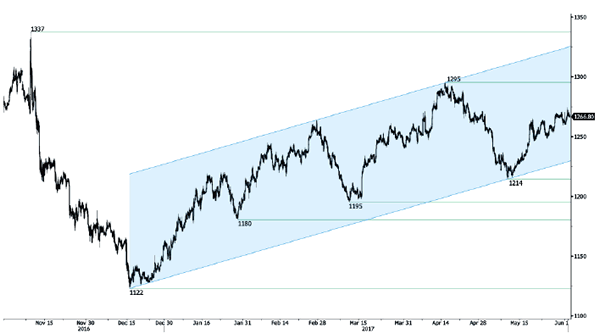
GOLD Demand is strong.
Gold is pushing higher within uptrend channel. Hourly support is located at 1246 (18/05/2017 low). Stronger support is given at 1195 (10/03/2017 low). Expected to show further upside pressures.
In the long-term, the technical structure suggests that there is a growing upside momentum. A break of 1392 (17/03/2014) is necessary ton confirm it, A major support can be found at 1045 (05/02/2010 low).
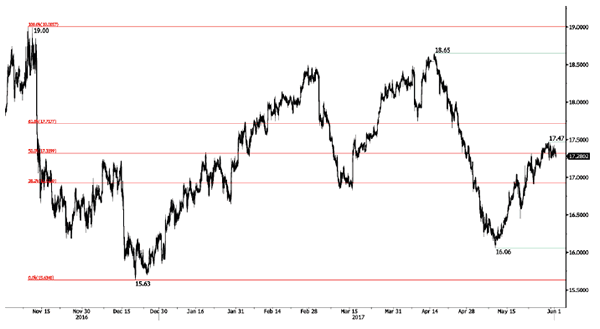
SILVER Short-term bullish momentum continues.
Silver increases. Strong support is given at 15.63 (20/12/2017 low). Closest support is given at 16.20 (04/05/2017 low). Key resistance is given at a distance at 19.00 (09/11/2017 high). Expected to push towards 61.8% Fibonacci retracement around 17.75.
In the long-term, the death cross indicates that further downsides are very likely. Resistance is located at 25.11 (28/08/2013 high). Strong support can be found at 11.75 (20/04/2009).
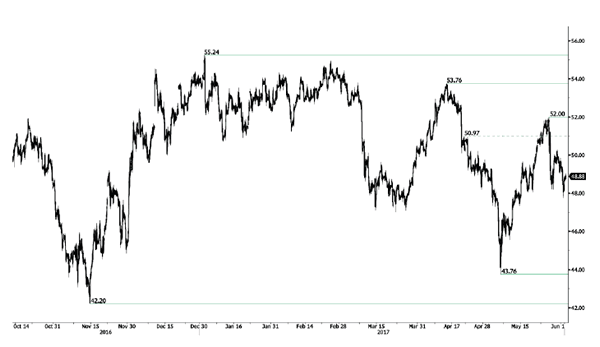
CRUDE OIL Wide-open for further decline.
Crude oil is still collapsed after the bounce following the short-squeeze move towards $52. Support is given at a distance 43.76 (05/05/2017 low). The technical structure suggests further strengthening towards $50.
In the long-term, crude oil has recovered after its sharp decline last year. However, we consider that further weakness are very likely. Strong support lies at 24.82 (13/11/2002) while resistance can now be found at 55.24 (03/01/2017 high).
EUR/JPY Increasing, EUR/GBP Stalling Below Resistance Area, EUR/CHF Declining.
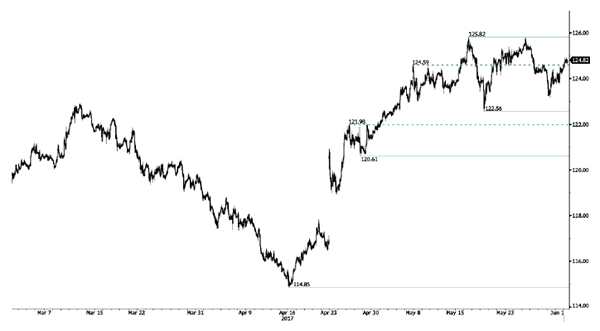
EUR/JPY Increasing.
EUR/JPY is trading higher. Hourly support is given at 122.56 (18/05/2017 low). Hourly resistance can be found at 125.82 (16/05/2017 high). Major support is given at 114.90 (18/04/2017low). Expected to see the pair increasing towards 125.82..
In the longer term, the technical structure validates a medium-term succession of lower highs and lower lows. As a result, the resistance at 149.78 (08/12/2014 high) has likely marked the end of the rise that started in July 2012. Strong support at 94.12 (24/07/2012 low) looks nonetheless far away.
EUR/GBP Stalling below resistance area.
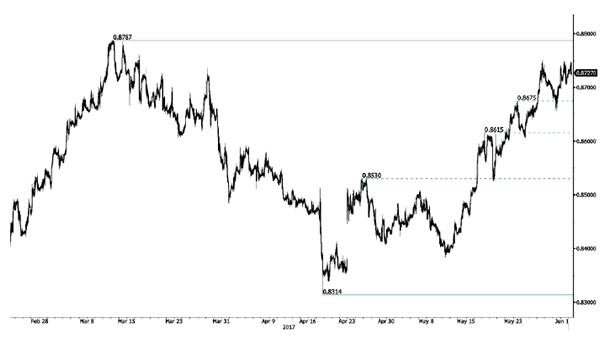
EUR/GBP's bullish momentum is fading. The technical structure had turned positive since the pair has broken resistance at 0.8530 (25/04/2017 low). Strong support can be found at 0.8304 (05/12/2017 low). Expected to see a further bullish breakout towards resistance at 0.8787 (13/03/2017 high).
In the long-term, the pair has largely recovered from recent lows in 2015. The technical structure suggests a growing upside momentum. The pair is trading above from its 200 DMA. Strong resistance can be found at 0.9500 psychological level.
EUR/CHF Declining.
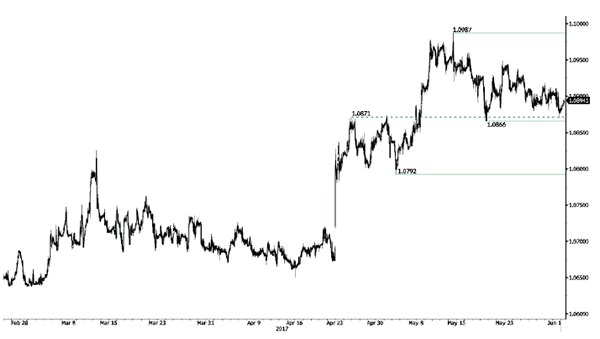
EUR/CHF is trading mixed. We believe that the medium-term pattern suggests us to see continued bearish pressures towards key support that can be found at 1.0623 (24/06/2016 low).
In the longer term, the technical structure is mixed. Resistance can be found at 1.1200 (04/02/2015 high). Yet,the ECB's QE programme is likely to cause persistent selling pressures on the euro, which should weigh on EUR/CHF. Supports can be found at 1.0184 (28/01/2015 low) and 1.0082 (27/01/2015 low).
USD/CHF Bearish Breakout, USD/CAD Growing Short-Term Bullish Momentum, AUD/USD Bearish Pressures Are Strong.
USD/CHF Bearish breakout.
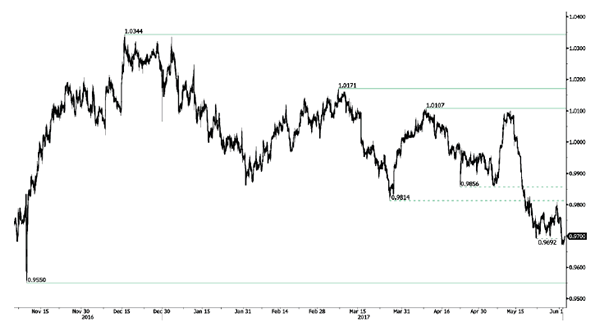
USD/CHF has finally broken support given at 0.9692 (22/05/2017 low). Strong resistance is given at 1.0107 (10/04/2017 high). Expected to show continued weakness towards hourly support at 0.9692.
In the long-term, the pair is still trading in range since 2011 despite some turmoil when the SNB unpegged the CHF. Key support can be found 0.8986 (30/01/2015 low). The technical structure favours nonetheless a long term bullish bias since the unpeg in January 2015.
USD/CAD Growing short-term bullish momentum.
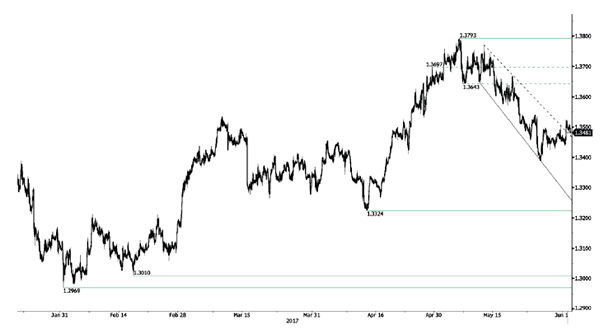
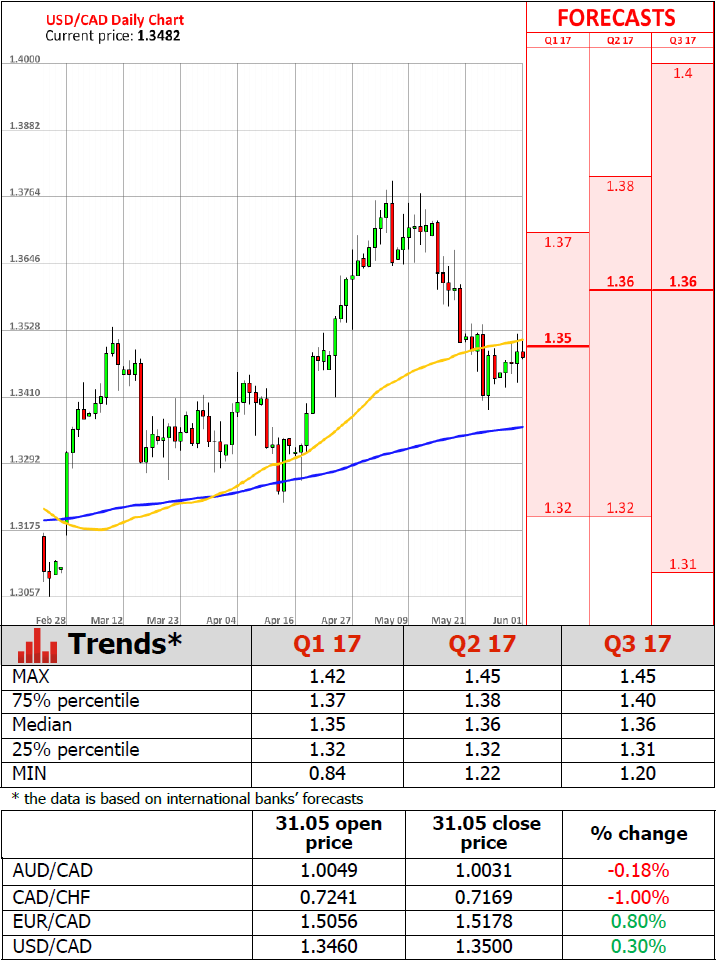
USD/CAD is trading around 1.3500. The pair has exited downtrend channel. Hourly support can be found at 1.3424 (28/05/2017 low) then 1.3388 (25/01/2017 high). Expected to show very short-term bullish pressures,
In the longer term, there is now a death cross with the 50 dma crossing below the 200 dma indicating further downside pressures. Strong resistance is given at 1.4690 (22/01/2016 high). Long-term support can be found at 1.2461 (16/03/2015 low).
AUD/USD Bearish pressures are strong.
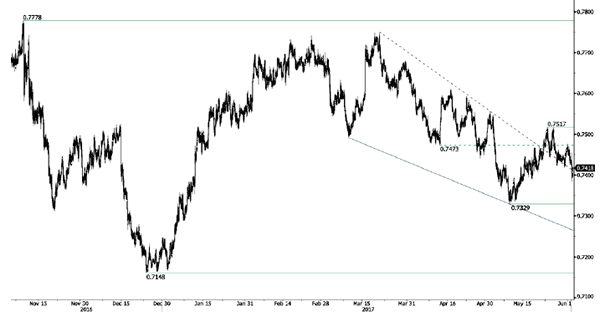
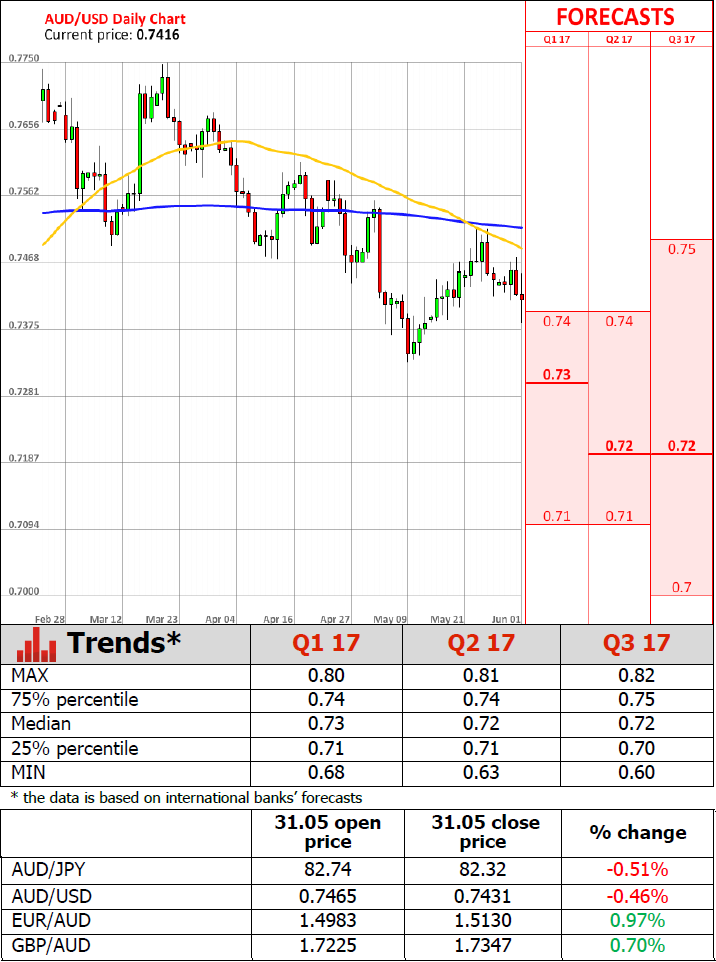
AUD/USD is pushing lower. Hourly support is given at 0.7329 (09/05/2017 low). As long as prices remain below resistance at 0.7608 (17/04/2017 high), there are strong downside risks. Expected to remain below 0.7400.
In the long-term, we are waiting for further signs that the current downtrend is ending. Key supports stand at 0.6009 (31/10/2008 low) . A break of the key resistance at 0.8295 (15/01/2015 high) is needed to invalidate our long-term bearish view.
EUR/USD Moving Higher, GBP/USD Failed To Monitor Support At 1.2757, USD/JPY Continued Weakness.
EUR/USD Moving higher.
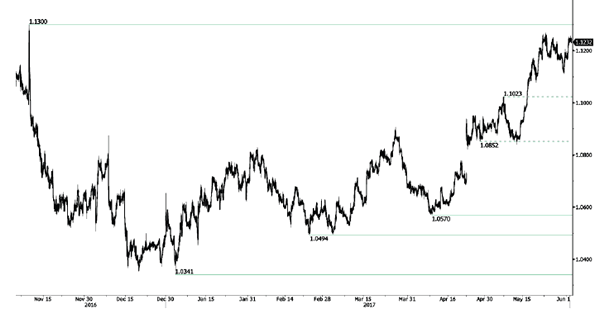
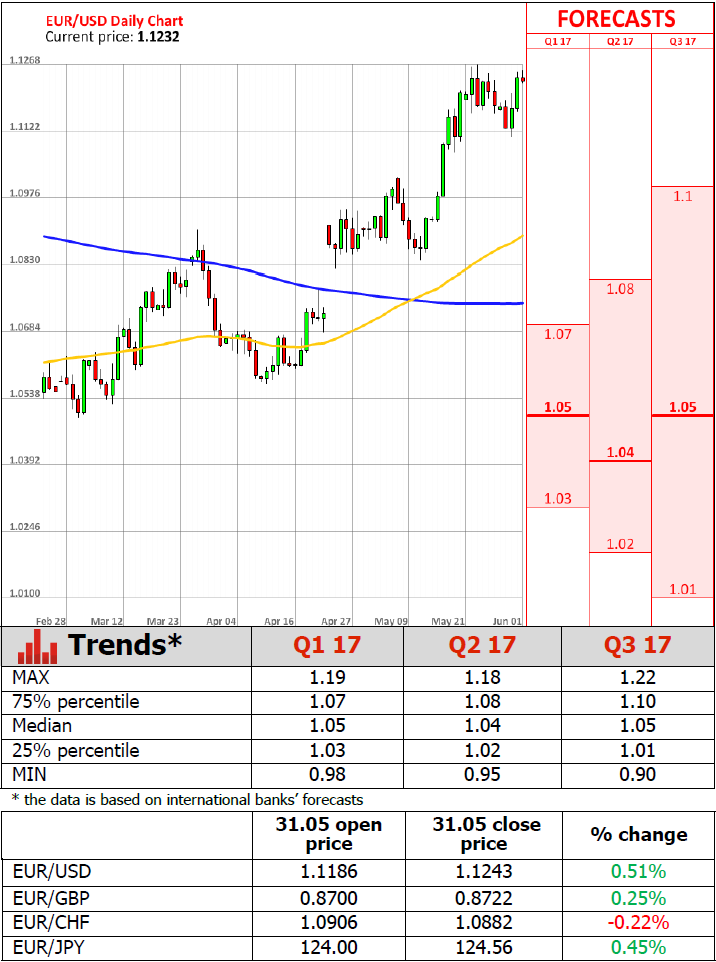
EUR/USD is pushing higher towards strong resistance given at 1.1300 (09/11/2017 high). Hourly support is given at 1.1110 (22/05/2017 low) has been broken. Stronger support lies at 1.0842 11/05/2017 low) and key support is given at 1.0494 (22/02/2017 low). Expected to show continued bullish pressures.
In the longer term, the death cross late October indicated a further bearish bias. The pair has broken key support given at 1.0458 (16/03/2015 low). Key resistance holds at 1.1714 (24/08/2015 high). Expected to head towards parity.
GBP/USD Failed to monitor support at 1.2757.
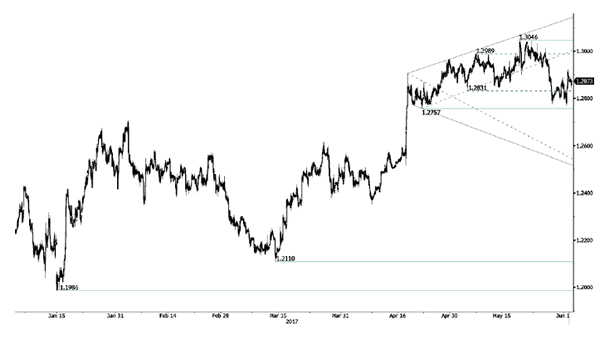
GBP/USD is bouncing around support given at 1.2757 (21/04/2017 low). Hourly resistance lies at 1.3046 (18/05/2017 high). Expected to show renewed bearish pressures.
The long-term technical pattern is even more negative since the Brexit vote has paved the way for further decline. Long-term support given at 1.0520 (01/03/85) represents a decent target. Long-term resistance is given at 1.5018 (24/06/2015) and would indicate a long-term reversal in the negative trend. Yet, it is very unlikely at the moment.
USD/JPY Continued weakness.
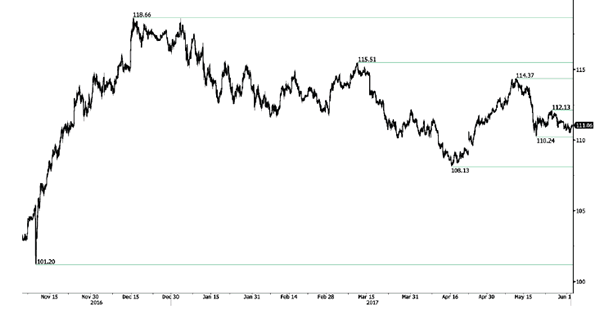
USD/JPY has exited the symmetrical triangle and keeps pushing lower. Hourly support is given at 110.24 (18/05/2017 low). Stronger support is located at 108.13 (17/04/2017 low). Other key supports lie at a distant 106.04 (11/11/2016 low). The road is wide-open for further decline.
We favor a long-term bearish bias. Support is now given at 96.57 (10/08/2013 low). A gradual rise towards the major resistance at 135.15 (01/02/2002 high) seems absolutely unlikely. Expected to decline further support at 93.79 (13/06/2013 low).
Latest Seats Forecasts Weigh On GBP Prospect
Per the latest 'poll of polls' released yesterday May 31, conducted by the Press Association based on a 7-day rolling average of all published polls, approval ratings for the Conservative and Labour Parties are 44% and 35% respectively. The Conservatives' lead is 9% which is higher than the previous shocking low 5% lead.
Currently the breakdown of the 650 seats in the House of Commons are: The Conservative Party has 330 seats, the Labour Party has 229 seats, the SNP has 54 seats, the Liberal Democrats has 9 seats and “other” parties have 28 seats.
Notably, per the latest prediction conducted by YouGov, the Conservative Party will likely win 310 seats, Labour 257, SNP 50 and the Liberal Democrats 10. That said, it is likely that none of the parties will win more than half of the 650 seats, which is at least 326 seats.
The reason behind the snap election decision was to increase the Conservatives' dominance in Parliament. However, now it looks ironic that the Conservatives will likely have 20 seats less than their present 330 after the election, and Labour will likely gain nearly 30 seats.
If the YouGov's prediction is correct Theresa May might face the crisis of stepping down which would likely result in a GBP sell-off. The Conservative Party now must do the final sprint before June 8th to win 16 seats more (326 – 310) for a modest victory.
If none of the parties win more than half of the seats, then it will result in a Hung Parliament. In this situation, the majority party must consider whether to remain as a narrow majority or to unite with other smaller parties. After the 2010 general election, the Conservative Party chose to unite with the Liberal Democrats.
On Wednesday, GBP/USD weakened and tested the significant support line at 1.2800 again, hitting a 5-week low of 1.2768. It was followed by a robust rebound, testing the near term major resistance level at 1.2900, hitting a 3-day high of 1.2920, then corrected by around 80 points. In early trading on Thursday June 1st. GBP/USD is at 1.2875. Be aware that before the election outcome is released increased uncertainty will likely pose downward pressure to GBP.
US Pending home sales (YoY) released yesterday saw a 3.3% drop in April from a 0.8% growth in March, marking the biggest drop since June 2014. After the release of the data, USD weakened across the board.
The dollar index hit a 1-week low of 96.78, marking a 0.35% intra-day fall. USD/JPY hit a 2-week low of 110.47. The weakening of USD pushed gold up, spot gold rallied 0.46%, hitting a 5-week high of 1274. EUR/USD rallied 0.5%, hitting a 1-week high of 1.1255. GBP/USD hit a 3-day high of 1.2920. USD rebounded in US afternoon session. On Thursday in early European session, the dollar index bounces and tests the 97.00 resistance level.
The crucial US ISM manufacturing PMI for May will be released this afternoon at 15:00 BST. It has remained above 50 since October 2016, however, seeing a falling trend over the past three months. Be aware that it will likely cause volatility for USD and USD crosses.
Inflation Growth In Euro Zone Slows In May
'That should allow the ECB to continue to stress that underlying inflation pressure in the euro area remains weak, despite strengthening growth, when it meets next week.' - Cathal Kennedy, RBC Capital Markets
Inflation in the Euro zone decelerated during the fifth month of the year, official figures revealed on Wednesday. Eurostat reported that its Flash Consumer Price Index for the 19-country bloc came in at 1.4% year-over-year in May, following the preceding months gain of 1.9% and missing expectations for an increase of 1.5%. Meanwhile, the so-called core inflation rate climbed 0.9% on an annual basis, compared to April's climb of 1.2%, whereas analysts anticipated a rise of 1.0%. Most of the fall in headline inflation came on account of tumbling energy prices. According to the report, the energy price advanced 4.6% in May after surging 7.6% in the prior month. Analysts suggested that the European Central Bank would likely delay its monetary stimulus reduction amid unstable inflation growth. Earlier in the week, the ECB President Mario Draghi acknowledged improving economic growth but stated that the Bank's stimulus should remain in place. According to economists, the Banks is unlikely to raise interest rates or withdraw some of its stimulus until inflation stabilises around the 2% target level.
Canadian Economy Expands 0.5% In March Vs 0.3% Forecasts
'If we continue to get growth numbers like this, absent trade policy risks, it's going to be tougher for the Bank of Canada to avoid rate hikes at some point in the distance.' - Derek Holt, Scotiabank
The Canadian economy performed better than expected during the March quarter amid strong consumer spending and business investment. Statistics Canada reported on Wednesday that the domestic economy expanded at an annualised pace of 3.7% in the Q2 of 2017, following the preceding quarter's upwardly revised rate of 2.7% but slightly missing expectations for a 3.9% growth pace. Within March, the economy grew 0.5% after holding steady in February, whereas analysts expected the economy to expand at a 0.3% pace during the reported month. Analysts suggested that the economy's stronger-than-expected performance would move the Bank of Canada closer to raising interest rates. According to economists, the Bank is set to remain on hold until 2018. Following the release, some analysts revised up their forecasts for Canadian economic growth. According to them, the economy is expected to grow 2.7% this year. Strong GDP growth was mainly driven by higher business investment, which rose 3.7%, and higher consumer spending, which climbed 1.1% during the reported quarter.
Australian Retail Sales Rebound More Than Expected In April
'It's good to see the bounce-back but we don't expect to see a repeat as underlying consumption growth is still weak.' - Su-Lin Ong, RBC Capital
Australian retail sales rebounded markedly in April, fresh figures showed on Wednesday. The Australian Bureau of Statistics reported that retail sales climbed 1.0% in April on a seasonally adjusted basis, following the preceding month's downwardly revised drop of 0.2% and topping analysts' expectations for a 0.3% gain. April marked the first retail trade rise in the past four months. However, the increase was mainly attributed to temporary factors. The stronger-than-expected data release is set to please the Reserve Bank of Australia, which was concerned about surging real estate prices. The café, restaurants and take away food services sector posted a 1.1% sales increase. A 1.2% sales climb was seen in food retailing, whereas department stores posted a 2.5% sales rise during the reported month. Sales of clothing and footwear advanced 0.3%, whereas sales of household goods increase 0.4%, following two consecutive months of declines. Analysts suggested that April's rebound was the answer to March's cyclone that hit the Queensland State. Sales in Queensland jumped 2.4% in April after five straight months of drops.
RUB Subject To Downside Risk, USD Oversold
Russia: Upside pressures on the currency
In an effort to stabilize the ruble, Russia is looking to expand its Foreign-Exchange reserves (including Gold). Today, Russia will disclose this amount for the period ending 26 of May. Russia’s Central Bank has already made clear that one of its primary objectives is to increase those reserve holdings up to $500 billion as stated by Elvira Nabiullina, head of the central bank.
The reserves currently amount to $405 billion. By the way, Russian gold reserves could officially be above China gold reserves by year end. Regarding the state of the Russian economy, Nabiullina said the economy has been resilient regarding international sanctions. As a result she hinted that interest rates may go even lower. The key rate is standing at 9%.
Data-wise, inflation is collapsing, the last release printed at 4%. We recall that it was at an astonishing 16+% two years ago and the consumer prices growth is now standing at 4%. The unemployment rate is also on its way down and is now reaching 5.2%. However, real disposable income should continue its decline in May after the strong decline in April of -7.6%. We reload our RUB short position against the dollar for some more time and we target 57 ruble for one dollar in the short-term.
USD oversold
The data from the US continues to provide evidence that economic activity is improving from a soft 1Q. The ADP labor report and initial claims (180k and 238k respectively) are expected to indicate that labor markets remain strong and suggests a solid payroll read on Friday. In addition ISM manufacturing and construction spending (54.7 and 0.5% respectively) should indicated that growth is strengthening.
In the mid and long term we remain bearish on USD, however we currently see USD positioning oversold. European / US interest rates differentials have spread excessively wide in our view indicating a probable correction should the economic data force repricing of the Fed interest rate hikes. Today's Final EU PMI is unlikely to provide real insight into the European outlook.
We are constructive on the USD against G10 currencies in the short term. GBP continues to be driven by political uncertainty rather than economic fundamentals. Despite the fact that Theresa May missed a party leaders' debate and select polling results, bookmakers still assign a low probability of Labour ousting the Conservatives from power. Should the Conservatives hold on to power we anticipate a move to 1.30 on the reduction of domestic political concerns.
Brazil GDP expected to grow 1%q/q in the first quarter
Over the last couple of weeks, the Brazilian real has been mostly driven by political jitters rather than economic developments. The panic sell-off that took place after the alleged corruption of President Michel Temer is definitely over as market participants continued to discount an impeachment, in the short-term at least.
The real recovered partially from the sell-off with USD/BRL back below 3.25, compared to more than 3.40 exactly two weeks ago. Implied volatility eased substantially - 1m gauge fell to 14.74%, compared to 23.50% 2-weeks ago - suggesting that investors are confident again holding Brazilian assets.
On the fundamental side, the BCB cut the Selic rate by 1% yesterday. The decision was broadly expected by investors and had no effect on the currency. According to the latest BCB’s week survey, economists expect the Selic rate to reach 8.50% by year-end, while the main inflation gauge should stabilised 50bps below the central bank’s mid-point target of 4.50%.
As long as the political mess doesn’t escalate, we remain constructive on the real as investors mostly seized the opportunity to enter into long BRL positions at a discount. First quarter GDP growth is due for release later today. Growth is expected to have reached 1%q/q during the March quarter. A positive reading should accelerate the BRL recovery.