

Sample Category Title
AUDNZD Looking Ready To Recover Slightly
Key Points:
- The pair has reached a very robust level of support.
- Upsides will be tangible but not as pronounced as last time's reversal.
- Keep an eye on the RBNZ's report, due shortly.
Given the rather sedate prior session resulting from public holidays in both the US and the UK, some of the more exotic crosses are worth investigating a little more closely today. In particular, the AUDNZD has set itself up for what could be a decent rally over the coming week – at least if its technical bias is anything to go by.
As is shown below, the rout that has been gripping the pair over the past few sessions has come to an abrupt end as support kicked in strongly. However, this really shouldn't come as a total surprise given that we have reached the point of intersection of the declining trend line and the lower extreme of the regression trend channel. What's more, the presence of this channel suggests that we might now see some form of recovery as we move forward.
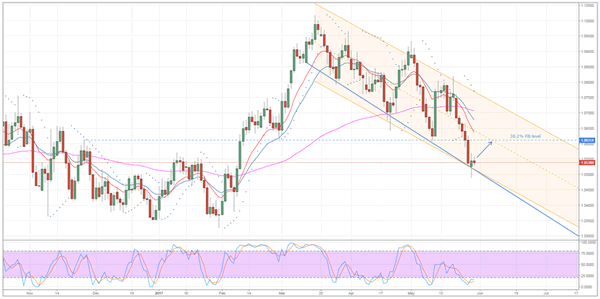
Indeed, we are already beginning to see buying pressure return as the market attempts to relieve the highly oversold stochastic oscillator. If this continues, it could mean that we have a near-term corrective manoeuvre on our hands which is good news for the bulls out there. This being said, we aren't currently expecting to see a huge degree of upside action moving ahead as there is a highly robust zone of resistance in place at around the 1.0611 level.
More precisely, the intersection of the regression channel's basis line and the 38.2% Fibonacci level will likely prove to be a hard cap on gains without some form of fundamental upset. This cap is only reinforced by the parabolic SAR and EMA biases – both of which are bearish. Ultimately, whilst they shouldn't hamstring the bulls altogether, these readings are likely to prevent the kind of kneejerk price spike that we saw only a few weeks ago and this means that we are unlikely to see more than 70 pips netted in a single session this week.
Overall, expect to see some buying pressure coming down the line but don't ignore the presence of that resistance level. Although, keep half an eye on the RBNZ which will be releasing its Financial Stability Report shortly as this could generate some unexpectedly strong bullish sentiment for the pair should the bank have a more dour tone than we have seen recently.
Will June Be The Lift Off Month For The Fed?
Key Points:
- Fed likely to be monitoring the PCE Deflator results closely.
- June rate hike still possible but caution is likely.
- Failure to tighten monetary policy likely to lead to a greenback depreciation.
The past few weeks have probably left many readers questioning just how strong the case for a June rate hike from the U.S. Federal Reserve is. To date, we have seen some significant tightening in labour market conditions, as well as renewed forecasts of economic growth from the Atlanta Fed. However, you would be forgiven for questioning these data points given that the last release of FOMC minutes seemed to take a dovish tone and hint at the need for additional economic strength to be seen. Subsequently, a June rate hike appears to be anything but a done deal and here's why:
Inflationary Pressures
Central banks typically love manageable inflation and the Fed is no different in this regard. However, despite tremendous amounts of QE having been injected into the U.S. economy, and falling unemployment nearing natural levels, we are yet to see much in the way of sustained inflation being reported. In fact, the Fed primarily looks at the Personal Consumption Expenditure (PCE) readings, which coincidently are due out tomorrow, as a gauge to give them a lens to measure inflationary pressures, primarily demand pull, in the domestic economy. However, the latest reading of the PCE showed a worrying downtick that largely matched the relatively lacklustre Q1 GDP results. Subsequently, the central bank will be looking for a relatively strong result before they will consider near term rate hikes.
Wage Inflation
In extension to the PCE, wage inflation is also another measurement that can be applied to provide us some insight into pent up demand within the economy. Unfortunately, hourly earnings have been relatively flat over the past year which shouldn't be surprising given the rise in part time employment. The reality is that without well paying, fulltime jobs, people are typically loathe to spend what money they possess on consumable items.
1st Quarter GDP Growth
The central bank was a little shell shocked when the Q1 GDP was revised downwards and immediately reached into the bucket of excuses to explain why. Chiefly amongst them was the suggestion that this was just a transitory weakness and that they expected the following quarter to drive additional growth to match the Atlanta Fed's GDPNow forecasts. However, this has largely turned into farce with the forecast seemingly changing weekly. Subsequently, some members on the FOMC are now clearly expressing concern that the downward GDP revisions could, in fact, form a trend.
Slowdown in China
China was always going to experience a slow down at some stage given the successive years of a rapidly growing economy. Unfortunately, for the Federal Reserve, the slowdown appears to coincide right when the bank is thinking of normalising their interest rates and winding back their balance sheet. Subsequently, the FOMC is right to be concerned as to the impact on trade and demand as the juggernaut that is/was the Chinese economy starts to slow down.
Ultimately, I suspect that the FOMC's decision is likely to hinge upon the PCE Deflator results due out tomorrow. An abject lack of inflationary pressures in the indicator could very well cause the Fed to remain cautious and hold off on a rate rise to their next FOMC meeting. However, that will surely lead to the USD falling further and the bubble that is the S&P growing ever more present.
Elliott Wave View: GBP/JPY More Downside Expected
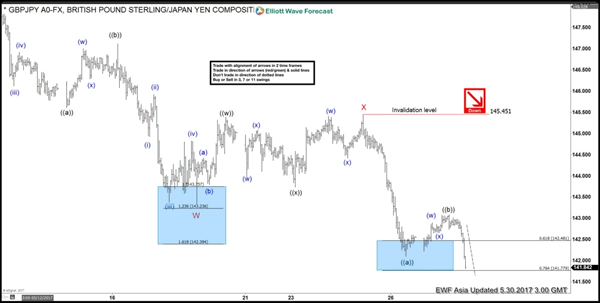
Short Term Elliott Wave view in GBPJPY suggests the decline from 5/10 peak is unfolding as a double three Elliott Wave structure where Minor wave W ended at 143.33 and Minor wave X ended at 145.45. The subdivision of Minor wave W unfolded as a zigzag Elliott Wave structure where Minute wave ((a)) ended at 145.61 and Minute wave ((b)) ended at 147.12. After ending Minor wave X at 145.45, pair has since resumed lower and broken below 143.33. This creates a bearish 5 swing incomplete sequence from 5/10 peak and favors more downside in the near term.
The decline from 145.45 looks to be unfolding as a zigzag Elliott Wave structure where Minute wave ((a)) ended at 142.11 and Minute wave ((b)) ended at 143.08. Pair has also broken below 142.11 which suggests that Minute wave ((c)) lower has already started. Near term, while bounces stay below 143.08 in the first degree, but more importantly below 5/25 high (145.45), expect pair to continue lower towards 139.51 – 140.65 area before cycle from 5/10 peak ends. Buyers should then appear from the aforementioned area for at least a 3 waves bounce at later stage. In case pair breaks above 143.08 now, then the move from 5/26 low can be labelled as a Flat and pair should extend higher to correct cycle down from 5/25 high (145.45) but it still expected to turn lower again afterwards provided that pivot at 145.45 high stays intact.
GBPJPY 1 Hour Elliott Wave Chart
Market Morning Briefing: The Dovish Sentiment Expressed In The ECB Chief Draghi’s Statement
STOCKS
Dow (21080.28, -0.01%) was closed yesterday. As mentioned yesterday, 21200 is an important resistance for the near term. In case it breaks on the upside, the index could rally towards 21400-21600 else a fall back towards 21100 is possible in the coming sessions.
Dax (12628.95, +0.21%) is stable and may continues to remain sideways within 12800-12400 (broad region of trade for at least this week)
Shanghai (3110.06, +0.07%) looks bullish in the near term towards 3170. A small dip to 3070 is also possible before the index starts to rise higher.
Nikkei (19576.19, -0.54%) seems to be confused on which direction to take. Immediate movement within 19500-20000 is possible but only if it breaks on either side, can we confirm on further direction. For now, some sideways consolidation is possible.
Nifty (9604.90, +1%) has been rising in line with our expectation. 9700-9800 is on the cards for medium term.
COMMODITIES
As this moment, the Support at 1248 has held on intra-day basis and Gold (1270) has moved up a bit. Given that the Support at 1248 has held, some more rise towards 1275-80 is possible. For the near term, the market seems to be trading in a 1248-80 range now and the medium term range is now 1220-1280. The big question is whether we will see a rise past 1280-1300 or not in June.
Nothing new to add in Silver (17.43) also as the recent trading range is 17.36-87 and the medium term range is now 16.69-17.87. Both Gold and Silver are entering in a short term overbought zone thus chances of a correction can't be completely ignored.
Copper (2.55) is hovering around it's support area of the short term range of 2.55-2.62 with no directional clarity. Only above 2.62, higher resistances of 2.67-72 can come into consideration. A close below 2.55 levels could open up 2.44-46 levels as well.
Brent (52.20) and WTI (49.84) are hovering around their respective pivots of 52.77 and 49.54 of their short term trading ranges of 51.32-54.60 and 47.50-51.20 respectively. We will be assured of strength of Brent and WTI only when a firm and sustainable closing above 54.60 and 53 are made by both of them. A daily close below the respective supports could open up 49.50 levels for Brent and 47.50 for WTI as well.
FOREX
The dovish sentiment expressed in the ECB chief Draghi's statement about the European bond buying program has kept Euro (1.1128) weak but the proximity of the major support 1.1100-1.1075 and the lack of downside momentum still point towards the possibility of a turnaround this week. In a similar vein, the strength of Dollar Index (97.67) looks suspect even above the interim resistance of 97.55 and the near term upside may be limited to 98.00 at most.
Dollar Yen (110.87) keeps oscillating in the range of 110-112 and may continue that for a few sessions more. The bullish options remain open till 110 holds but the prolonged weakness in EURJPY (123.38), which may 122.80-60 or even 122.00 before bouncing back, raises questions about the upside chances. If a break below 110 is seen, then a resumption of the larger downtrend may be confirmed. Waiting for clarity.
The major support of Pound (1.2818) around 1.2750-00 holds for now and short covering may push the currency higher to 1.2900. The volatility is expected to remain high till the June 8 election with 1.2750-00 being the make or break support level for the near to medium term trend.
Aussie (0.7424) has been trading sideways in the range of 0.74-0.75 as expected and may continue that for the rest of the week.
Dollar Rupee (64.49) remains in a consolidative mode as expected which may continue for another couple of sessions. The immediate range is expected be 64.35-64.70.
INTEREST RATES
The UK 10Yr (1.01%) is testing support near current levels and could bounce back in the near term while the 20Yr (1.57%) and the 5Yr (0.46%) have some more scope on the downside to test medium term supports.
The Japanese yields have risen slightly and could move up in the near term. The US-Japan 10Yr (2.20%) could be headed towards 2.15% in the near term.
The resistances coming from mid-2015 have held well for the German yields and the yields have come off sharply in the last few sessions. The yields look bearish in the near term. The German-Us 10YR (-1.94%) and the German-US 2Yr (-2.04%) have fallen sharply but could face some support just below current levels from where a bounce is possible for the near term.
The 10Yr GOI (6.8125%) may rise towards 6.85% or higher in the near term. Immediate support is visible in the 6.75-6.70% region.
EUR/JPY Daily Outlook
Daily Pivots: (S1) 124.03; (P) 124.33; (R1) 124.48; More...
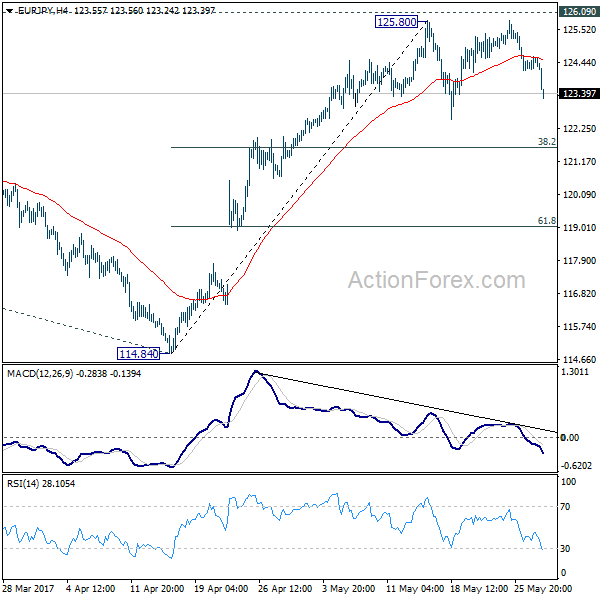
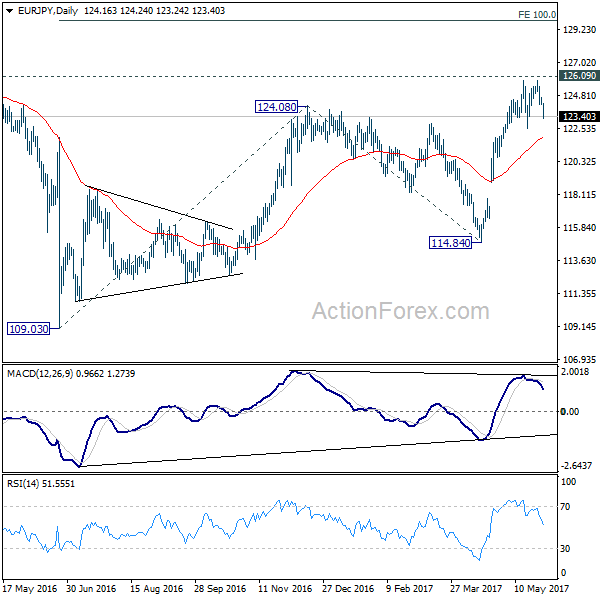
EUR/JPY drops sharply to as low as 123.24 so far and deeper decline might be seen. But after all, it's staying in the consolidation pattern from 125.80. Hence, we'd expect downside to be contained by by 38.2% retracement of 114.84 to 125.80 at 121.61 to bring rise resumption. We're staying mildly bullish in the cross. And, break of 126.09 key resistance will extend the whole rebound from 109.03 to 100% projection of 109.03 to 124.08 from 114.84 at 129.89. Nonetheless, firm break of 121.61 will dampen our bullish view and bring deeper fall to 61.8% retracement at 119.02.
In the bigger picture, focus is back on 126.09 support turned resistance. Decisive break there will confirm completion of the down trend from 149.76. And in such case, rise from 109.20 is at the same degree and should target 141.04 resistance and above. Meanwhile, rejection from 126.09 and break of 114.84 will extend the fall from 149.76 through 109.20 low.
Euro Tumbles on Increasing Chance of Early Italian Election, Outlook Stays Bullish Though
Euro tumbles broadly this week as some traders are betting on an early election in Italy, that creates some political uncertainty again. Leaders of major political parties are going to discuss, in the coming weeks, a new electoral law with a proportional system similar to the German model. And it's believed that an agreement is close between the leaders that could pull ahead the elections original scheduled in early 2018. Former Prime Minister and Democratic Party leader Matteo Renzi, who's desperate to seek a come back after the referendum defeat, is pushing for an early election as soon as in September, at the same time as Germany's own election. But ultimately, the move would also require President Sergio Mattarella's decision to dissolve the government. After all, the markets are starting to price in the development.
Technically, EUR/USD failed to take out key resistance at 1.1298 and retreated. Near term outlook, though, stays bullish as long as 1.1020 support holds. EUR/JPY also lost momentum ahead of 126.09 key resistance. But similarly, near term outlook stays bullish as long 121.61 fibonacci level holds. EUR/GBP also lost momentum ahead of 0.8786 resistance but outlook stays mildly bullish as long as 0.8602 minor support holds. Overall, Euro remains the strongest major currency, next to Kiwi, for the month, as boosted by French election results and positive economic data.
ECB Draghi delivered cautious message to European parliament
ECB President Mario Draghi sounded cautious in the hearing in European parliament yesterday. Draghi said policy makers are "firmly convinced" that extraordinary amount of monetary policy support is "still necessary" for the Eurozone. He pointed out that support is needed for reabsorbing present level of "under-utilized resources" and for brining back inflation to 2% target and "durably stabilize" around there. Meanwhile, Draghi expects new staff economic projections at the June monetary policy meeting. ECB would then be able to reassess the risks to outlook for growth and inflation.
Currently, it's expected that the new June staff projections to provide upward revision to growth and inflation forecast, at least for 2017. ECB policies makers would probably start discussing exit of stimulus but there wouldn't be any decision made. Instead, Draghi might hint at an announcement of some sort in the September meeting, in particular as the current asset purchase program will end in December. So, there are still some food to digest for Euro traders in the June meeting.
May and Corbyn take different Brexit negotiation stance
In UK, the focus in the election to take place on June 8 could be starting to narrow to the parties' Brexit negotiation stance while Conservatives' lead over Labour has been narrowing. Prime Minister Theresa May is clear that she's taking a tough stance with the snap election to secure her mandate. And May reiterated that "no deal is better than a bad deal", and, "we have to be prepared to walk out". On the other hand, Labour leader Jeremy Corbyn set out a totally different approach and emphasized that "there's going to be a deal" and "we will make sure there is a deal".
The negotiation is scheduled to start on June 19. Ahead of that, EU's chief Brexit negotiator Michel Barnier urged the European MPs to be vigilant throughout the negotiation. Barnier wanted that once it leaves EU, UK could be "tempted to distance itself from our standards" like consumer projection or financial stability. And, he urged to ensure that this "inevitable divergence" won't become "unfair competition". And he emphasized "full transparency for these negotiations". He reiterated his stance with EU leaders that "sufficient progress" is needed on the issues of the "divorce bill", citizens right and Ireland border arrangements before the talk of a trade deal.
On the data front...
New Zealand building permits dropped -7.6% mom in April. Australia building approvals rose 4.4% mom in April. Japan unemployment rate was unchanged at 2.8% in April, household spending dropped -1.4% yoy, retail sales rose 3.2% yoy. Eurozone confidence indicators, Germany import price and CPI, France GDP will be featured in European session. Swiss will also release KOF leading indicator. In US, session, US personal income and spending, S&P Case-shiller house price and consumer confidence will be featured. Canada will release current account, IPPI and RMPI.
EUR/JPY Daily Outlook
Daily Pivots: (S1) 124.03; (P) 124.33; (R1) 124.48; More...
EUR/JPY drops sharply to as low as 123.24 so far and deeper decline might be seen. But after all, it's staying in the consolidation pattern from 125.80. Hence, we'd expect downside to be contained by by 38.2% retracement of 114.84 to 125.80 at 121.61 to bring rise resumption. We're staying mildly bullish in the cross. And, break of 126.09 key resistance will extend the whole rebound from 109.03 to 100% projection of 109.03 to 124.08 from 114.84 at 129.89. Nonetheless, firm break of 121.61 will dampen our bullish view and bring deeper fall to 61.8% retracement at 119.02.
In the bigger picture, focus is back on 126.09 support turned resistance. Decisive break there will confirm completion of the down trend from 149.76. And in such case, rise from 109.20 is at the same degree and should target 141.04 resistance and above. Meanwhile, rejection from 126.09 and break of 114.84 will extend the fall from 149.76 through 109.20 low.
Economic Indicators Update
| GMT | Ccy | Events | Actual | Forecast | Previous | Revised |
|---|---|---|---|---|---|---|
| 22:45 | NZD | Building Permits M/M Apr | -7.60% | -1.80% | -1.20% | |
| 23:30 | JPY | Unemployment Rate Apr | 2.80% | 2.80% | 2.80% | |
| 23:30 | JPY | Household Spending Y/Y Apr | -1.40% | -0.70% | -1.30% | |
| 23:50 | JPY | Retail Trade Y/Y Apr | 3.20% | 2.20% | 2.10% | |
| 1:30 | AUD | Building Approvals M/M Apr | 4.40% | 3.00% | -13.40% | -10.30% |
| 6:00 | EUR | German Import Price Index M/M Apr | 0.10% | -0.50% | ||
| 6:45 | EUR | French GDP Q/Q Q1 P | 0.30% | 0.30% | ||
| 7:00 | CHF | KOF Leading Indicator May | 106.2 | 106 | ||
| 9:00 | EUR | Eurozone Business Climate Indicator May | 1.11 | 1.09 | ||
| 9:00 | EUR | Eurozone Economic Confidence May | 110 | 109.6 | ||
| 9:00 | EUR | Eurozone Industrial Confidence May | 3.1 | 2.6 | ||
| 9:00 | EUR | Eurozone Services Confidence May | 14.1 | 14.2 | ||
| 9:00 | EUR | Eurozone Consumer Confidence May F | -3.3 | -3.3 | ||
| 12:00 | EUR | German CPI M/M May P | -0.10% | 0.00% | ||
| 12:00 | EUR | German CPI Y/Y May P | 1.60% | 2.00% | ||
| 12:30 | CAD | Current Account (CAD) Q1 | -11.4B | -10.7B | ||
| 12:30 | CAD | Industrial Product Price M/M Apr | 0.80% | |||
| 12:30 | CAD | Raw Materials Price Index M/M Apr | -1.60% | |||
| 12:30 | USD | Personal Income Apr | 0.40% | 0.20% | ||
| 12:30 | USD | Personal Spending Apr | 0.40% | 0.00% | ||
| 12:30 | USD | PCE Deflator M/M Apr | 0.20% | -0.20% | ||
| 12:30 | USD | PCE Deflator Y/Y Apr | 1.70% | 1.80% | ||
| 12:30 | USD | PCE Core M/M Apr | 0.10% | -0.10% | ||
| 12:30 | USD | PCE Core Y/Y Apr | 1.50% | 1.60% | ||
| 13:00 | USD | S&P/Case-Shiller Composite-20 Y/Y Mar | 5.60% | 5.90% | ||
| 14:00 | USD | Consumer Confidence May | 120 | 120.3 |
Inflation Is The Key
Inflation is the Key
The shortened Memorial day week is chalk full of critical data but Tuesdays PCE and Friday’s Payrolls results will be crucial in shaping the markets near term structural view for the USD. Given the Fed’s concern about realised inflation, dealers will be directed to the Average Hourly Wages Friday as this week’s print can cause massive volatility in Financial Markets given the releases proximity to the anticipated June US interest rate hike
Similarly, Wednesday’s EU inflation data will play a significant role in Euro fortunes. Moreso given the market’s high expectations for a more hawkish change in the ECB’s forwarding guidance, While the markets have been watching ECB speeches more intently, ECB Draghi stuck to the script while addressing a committee of the European Parliament suggesting the ECB’s extraordinary amount of monetary policy support is still required.
While most markets sleep walked through yesterday’s session the same can not be said for the CNH as volumes s were trading well above average.The fallout from last week’s stronger CNY fixing and the latest funding squeeze are taking their toll on newly minted dollar longs and dampening enthusiasm for CNH trade. If this were the objective of the Pboc latest temper tantrum, after the Moody’s downgrade, the job was well done, given the huge carry, investors would likely prefer short USDCNH exposure. If the non-existent funding conditions persist, with T/N trading at 175 at one stage, we may see the USDCNH eventually test the key psychological 6.80 level as this short term carry is too juicy to ignore.
Euro
In early Asia, the EURO toppled from 1.1170 to 1.1130 after a headline surfaced that Greece may opt out of next payment without debt deal ( BILD). With the war of words escalation between the ECB and Greece regarding the inclusion in ECB bond buying program, the uptick in Greece risk premium is weighing on Eurozone sentiment.
The Euro was trading a tad dark as Draghi’s latest comments suggest the EU still needs stimulus, sounding much less hawkish than the market lean. The headline saw fast short term money take advantage of both market positioning and early morning liquidity to drive the Euro to lower with ease Positioning is a bit stretched on the EUR and EUR crosses so there could be some additional follow through on the headlines
Australian Dollar
The Aussie is under the gun in early trade more so from a general view that downside risk to the commodity space abounds rather than any one particular headline. With this dispirited near-term view for iron ore prices and the Feds all but certain to raise interest rates in June, the Aussie appears poised for a significant move lower
Japanese Yen
USDJPY has extended its decline below 111 as EURJPY positioning unwinds on this morning Greece headline But overall risk, in general, is struggling this morning on Greece and the latest UK election poll.
The Pound
But risk, in general, is struggling on the latest UK election poll.The gap between Conservatives and Labour parties is narrowing in the most recent polls in UK elections. The Times cites a Survation poll as showing that Conservatives are at 43% versus 37% for Labour- a lead of 6 points down from 9 points a week earlier.
USD/CAD Canadian Dollar Flat On Thin Holiday Trading
The Canadian dollar is trading close to the 1.3445 price level on a low volume session due to the US memorial Day and UK Bank Holidays. The pair has been moving in a tight trading range ahead of the next four days were a deluge of US data is expected.
The highlight of the week is the release of the U.S. non farm payrolls (NFP) on Friday. The U.S. Federal Reserve is heavily anticipated to hike rates when the Federal Open Market Committee (FOMC) meets in June 13/14. The CME FedWatch tool is showing a probability of 84.2 percent of the benchmark fed funds rate going up to 100 to 125 basis points range.
On the Canadian front the biggest release will be the monthly gross domestic product on Wednesday, May 31 at 8:30 am EDT. The release of the Trade balance on Friday is likely to be overshadowed by the US jobs report in a week where the loonie is on the back foot to US releases. The Canadian stock market was higher after positive earnings reports from banks last week.
Political risk has put the USD under pressure as Russian connections have raised the possibility of the Trump administration collaborating with foreign representatives during the election. The Fed has kept the USD at current levels with the majority of the recent Fed speakers saying that rate hikes are needed sooner rather than later. The words from San Francisco Fed President John Williams that the US economy does not need a fiscal stimulus package was seen as a USD positive as there are a lot of obstacles to tax reform in the US, and some of them put in place by the Trump administration.
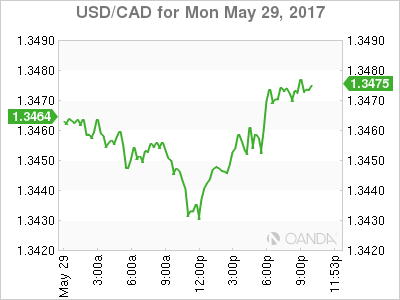
The USD/CAD lost 0.011 percent in the last 24 hours. The currency pair is trading at 1.3445 in a low liquidity trading session. Investors are already looking ahead at the data to be released tomorrow. The US consumer confidence data to be released at 10:00 am EDT and the Reserve Bank of New Zealand (RBNZ) fiscal stability report later in the day at 5:00 pm EDT.
Due to the Memorial Day holiday the ADP private payrolls report and the weekly US crude inventories will be pushed back to Thursday at 8:15 am EDT for the employment report and 11:00 am EDT for the crude stock info.
Market events to watch this week:
Tuesday, May 30
10:00 am USD CB Consumer Confidence
5:00 pm NZD RBNZ Financial Stability Report
Wednesday, May 31
8:30 am CAD GDP m/m
9:30 pm AUD Private Capital Expenditure q/q
9:30 pm AUD Retail Sales m/m
Thursday, Jun 1
4:30 am GBP Manufacturing PMI
8:15 am USD ADP Non-Farm Employment Change
8:30 am USD Unemployment Claims
10:00 am USD ISM Manufacturing PMI
11:00 am USD Crude Oil Inventories
Friday, Jun 2
4:30 am GBP Construction PMI
8:30 am CAD Trade Balance
8:30 am USD Average Hourly Earnings m/m
8:30 am USD Non-Farm Employment Change
8:30 am USD Unemployment Rate
Gold Drifting As US Markets Observe Memorial Day
After posting strong gains on Friday, gold is unchanged in the Monday session. In North American trade, spot gold is trading at $1266.79 an ounce. There are no US events on the schedule, as markets are closed for Memorial Day. On Tuesday, the key event is CB Consumer Spending.
The US economy slowed down in the first quarter, but there revised estimate for growth came in at 1.2%. This was considerably higher than the 0.7% gain which was reported in the first estimate in April. Although the revised figure was welcome news, GDP in Q1 was the lowest in a year, and well off the 2.1% gain in Q4. Business spending remains weak, and although consumer confidence remains at high levels, consumer spending has not kept up, as retail sales was softer than expected in April. The manufacturing sector has hit some turbulence, with Core Durable Goods Orders posting a decline of 0.4% in April, its third decline in four months. After a shaky first quarter for the US economy, there are no indications pointing to a rebound in the second quarter.
Will weaker growth and stubbornly low inflation cause the Fed to rethink a June rate increase? The markets don’t think so, as the odds of a 0.25% rate hike have increased to 84%, according to the CME Group. At the same time, the likelihood of a rate hike in the second half of 2017 are low. The odds for a September rate are just 26%, with the markets unclear on whether the Fed will make further moves this year if inflation remains below the Fed target. Even if soft first quarter data was a blip, the markets are concerned that President Trump, who is facing congressional investigations over his connections with the Russian government, could be seriously weakened and may not be able to pass his pro-business agenda through Congress.
Poll-Watching But Euro Move Looms
It's all about the polls as the UK election winds down and the market flirts with the mother of all comebacks. The pound was the top performer in light holiday trading on Monday as it rebounded from Friday's drubbing. CFTC positioning showed a big move in euro shorts. More on the latest drop in the euro below.
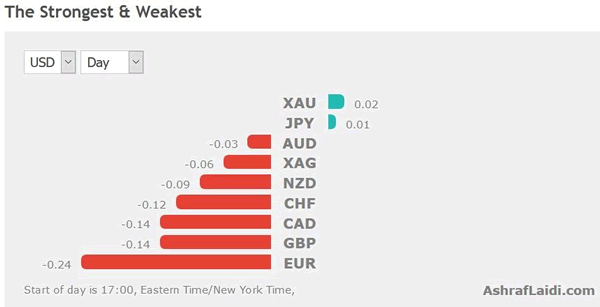
Slippage in the euro ensued in eary Pacific trade on reports that Greece may forego the next bailout tranche in case of disagreement among its creditors if with regards to the latest debt relief program. Draghi's comments that "extraordinary" amount of monetary support was is still needed also is said to weigh on the single currency.
A series of campaign missteps left Theresa May vulnerable and voters began to flirt with the idea of voting for Labour. The Manchester attacked added to anxiety and what looked like a sure thing was suddenly in question as some polls on Friday showed her ahead only 6 points.
Those are the kinds of numbers that put her close enough to the margin of error to remind voters of Brexit polls. On Friday, the pound fell more than 150 pips in a broad rout that ensure polls over the final 10 days of the campaign will be market mover.
On Monday, the news was better for the Prime Minister with an ICM poll putting her ahead 46% to 32% against Labour. In response, cable rebounded 40 pips. The rebound may continue Tuesday as Chinese, US and UK traders return.
At the same time, the week ahead features some major economic data points and it begins with Japanese employment and retail sales then is followed with French GDP, German CPI and a critical US PCE report.
CFTC Commitments of Traders
Speculative net futures trader positions as of the close on Tuesday. Net short denoted by - long by +.
EUR +65K vs +38K prior GBP -24K vs -33K prior JPY -52K vs -60K prior CHF -20K vs -21K prior CAD -99K vs -98K prior AUD +3K vs +6K prior NZD -9K vs -12K prior
The euro gradually had become the darling of the currency market. It's been a rapid shift from a large net short over the past month and the net long is now the most extreme since October 2013. The market loves a central bank that's bottomed out and an economy that's outperforming but we've been here before. Is this recovery for real?
Draghi was certainly optimistic in European Parliament on Monday as he continued to underscore the recovery. The ECB is trying to prepare the market for a taper signal in September while keeping the euro in check; it's a tough balancing act but if the data remains strong, a euro rise is inevitable.