Sample Category Title
EUR/AUD Weekly Outlook
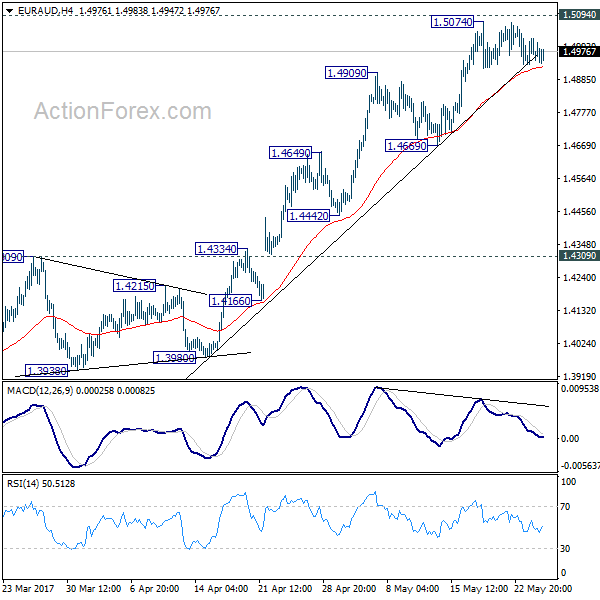
EUR/AUD stayed in range of 1.3872/4309 last week and outlook is unchanged. We continue to favor the case that larger fall from 1.6587 is completed at 1.3624, after defending 1.3671 key support. And the trend is reversing. Hence, another rise is anticipated after the consolidation from 1.4309 completes.

Initial bias in EUR/AUD stays neutral this week first. On the upside, break of 1.4215 minor resistance will turn bias to the upside for 1.4309. Break there will finally resume whole rise from 1.3624 and target 1.4721 key resistance next. On the downside, however, sustained break of 1.3872 will dampen our view of trend reversal. In that case, intraday bias will be turned back to the downside for retesting 1.3624 low, with prospect of extending the larger down trend.

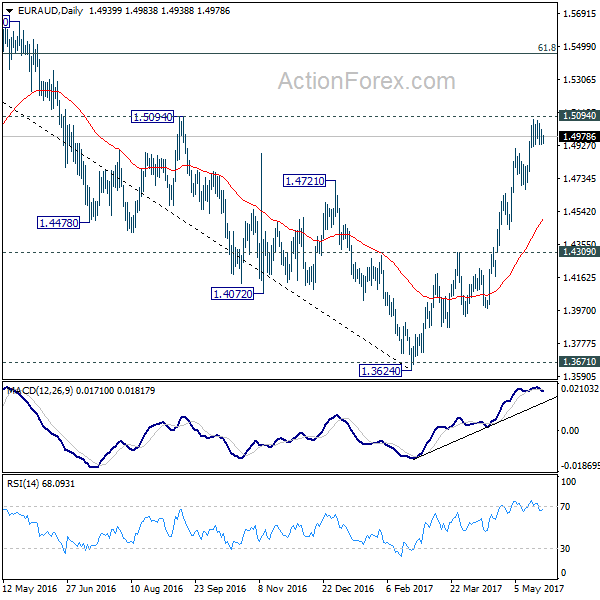
In the bigger picture, price actions from 1.6587 medium term top are viewed as a corrective pattern. Such correction could be completed after testing 1.3671 key support. Break of 1.4721 cluster resistance (38.2% retracement of 1.6587 to 1.3624 at 1.4756) should confirm this case and target 61.8% retracement at 1.5455 and above. Overall, we'd expect the up trend from 1.1602 to resume later. However, sustained break of 1.3671 will invalidate our bullish view and would turn extend the fall from 1.6587 towards 1.1602 long term bottom.

In the longer term picture, the rise from 1.1602 long term bottom isn't over yet. We'll keep monitoring the development but there is prospect of extending the rise to 61.8% retracement of 2.1127 to 1.1602 at 1.7488 and above. However, sustained trading below 1.3671 should confirm trend reversal and target 1.1602 long term bottom again.

EUR/CHF Weekly Outlook
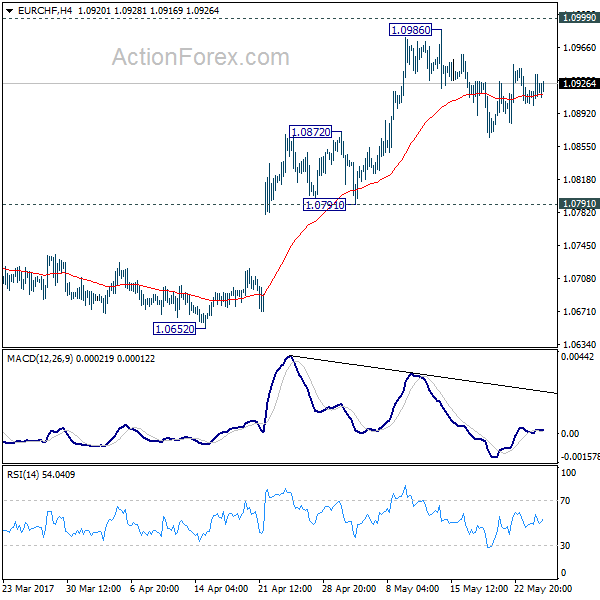
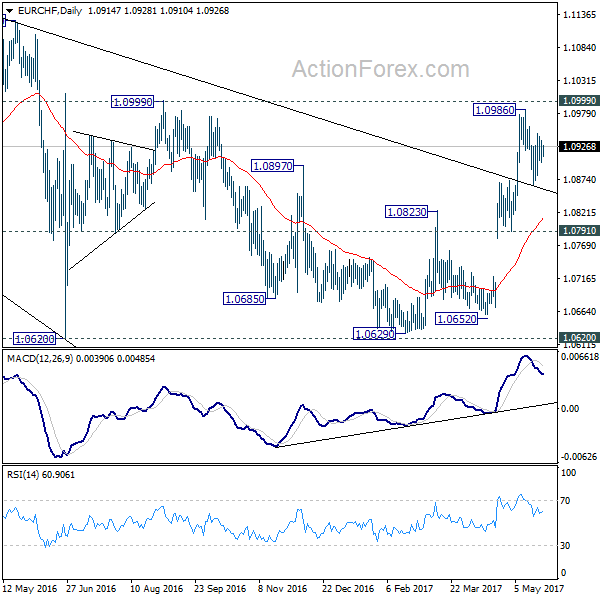
EUR/CHF's fall from 1.0823 extended last week by taking out 1.0668 support and reached as low as 1.0658. The near term bearish outlook remains unchanged. That is, rebound from 1.0629 has completed at 1.0823. And, the larger decline from 1.1198 is likely resuming.

Initial bias in EUR/CHF remains on the downside this week for 1.0620/29 key support zone. Decisive break there will confirm resumption of whole fall from 1.1198. In that case, EUR/CHF should target next long term fibonacci level at 1.0485. On the upside, break of 1.0699 minor resistance will turn intraday bias neutral first. We'll assess the outlook later in that case.

In the bigger picture, the decline from 1.1198 is seen as a corrective move. Current development suggests that it's not completed yet. Sustained trading below 38.2% retracement of 0.9771 to 1.1198 at 1.0653 will target 50% retracement at 1.0485. In any case, break of 1.0823 resistance is needed to be the first indication of reversal. Otherwise, deeper fall is still expected even in case of recovery.


Weekly Economic and Financial Commentary
U.S. Review
The Hard Data Looks a Bit Soft
- Headline retail sales fell in line with expectations in March, while February's already soft print was revised lower. Looking past the headline, however, control group sales are up 4.1 percent on a three-month annualized basis.
- Energy prices weighed on headline inflation data in March, with consumer prices declining for the first time in more than a year. The core index also slipped, with the year-over-year rate falling to 2.0 percent. Import prices and the PPI also edged lower on the month.
- Survey data released this week point to continued tightening in the labor market and suggest that the March slowdown in nonfarm payrolls is likely to be short-lived.
The Hard Data Looks a Bit Soft
Headline retail sales fell in line with expectations in March, declining 0.2 percent. February's already soft print was revised lower, however. Weakness in auto sales continued to weigh on the headline, with auto sales falling in four of the past five months. Control group retail sales, which filter directly into GDP, rose a better-than-expected 0.5 percent on the month. On a threemonth annualized basis, control group sales are up 4.1 percent (top chart). While solid, given the pickup in inflation and softer trend in auto sales, we look for real personal consumption to slow to a 1.1 percent annualized rate in the first quarter.
Survey data released this week point to continued tightening in the labor market and suggest that the March slowdown in nonfarm payrolls is likely to be short-lived. Job openings reportedly remained on course in February, rising to 5.74 million, which marks a seven-month high. Moreover, nearly one-third of small business owners indicated job openings were hard to fill in March (middle chart), according to data from the NFIB small business survey. As a result, more owners reported increasing compensation to attract and retain workers. A net 28 percent of owners stated raising workers' compensation, which marks the second-highest reading since mid-2007. These measures suggest that demand for labor remains solid and support our outlook for a continued decline in the unemployment rate and a gradual pickup in wage growth over the course of the year.
Energy Weighs on Headline Inflation Data
Import prices fell 0.2 percent in March, marking the first drop in four months as the recovery in oil prices took a pause. Expetroleum, however, prices rose 0.2 percent and are up 1.2 percent on a year-over-year basis. The upward momentum in nonfuel prices has largely been driven by strengthening in the business sector as nonfuel industrial supplies and capital goods prices are rebounding. Export prices edged higher in March and are up 3.6 percent over the past year.
The Producer Price Index (PPI) ticked down 0.1 percent in March, ending a six month string of gains. As expected, energy was a drag on the headline, down 2.9 percent. Ex-food, energy and trade services, the PPI rose 0.1 percent, marking the tenth consecutive increase.
Consumer prices fell in March for the first time in more than a year, declining 0.3 percent versus expectations that price levels would remain unchanged. A 6.2 percent decline in gasoline prices was the largest contributor to the headline's drop. Excluding energy, prices also slipped 0.1 percent despite a rebound in food prices. The core index also fell a modest 0.1 percent, the first decline in more than six years. Weakness was reported in both core goods and services. The core index slipped to 2.0 percent year-over-year; however, we do not see this weakness as start of a new trend. Despite this week's mixed readings on price pressures, we believe the Fed will continue to focus on their preferred inflation measure, the core PCE, which continues to drift higher.


U.S. Outlook
Housing Starts • Tuesday
Mild weather in January and February allowed the homebuilding season an earlier start in 2017. Housing starts were up 3.0 percent in February to a 1.29 million unit pace, with all of the increase in single-family starts. Momentum is increasingly shifting toward single-family homes in suburban markets as multifamily continues to cool in urban markets. Steady job and income growth, combined with tight inventory of homes available for sale in many markets, should continue to support homebuilding going forward.
The early start to the spring homebuilding season may bring some volatility to the seasonally adjusted data in coming months. Spring months are unlikely to see the large gains they normally do because they did not fall off as much as they normally do this winter. We expect housing starts to come in at a 1.21 million unit annual pace in March.
Previous: 1.29M Wells Fargo: 1.21M Consensus: 1.25M

Industrial Production • Tuesday
February's flat reading of industrial production was largely the result of warmer weather weighing utilities output for the second straight month. Manufacturing and mining output continued to climb. Factory output rose 0.5 percent in February, continuing its six-month winning streak as manufacturing activity ramps up after two years under the weight of slow global growth, decreased energy exploration and high inventories. Factory data continue to steadily improve as these headwinds fade into the rearview mirror.
Looking to March, we expect continued improvement in manufacturing output. The ISM slipped slightly in March but still pointed to a ramp up in production while factories added more workers in March. Utilities output should reverse course in March, as colder temperatures returned to most of the country. Taken together, we expect the headline to be up 0.9 percent on the month.
Previous: 0.0% Wells Fargo: 0.9% Consensus: 0.5%

Existing Home Sales • Friday
Home sales declined 3.7 percent in February following a 3.3 percent jump in January. February's slowdown was to be expected, given the January decline in pending home sales, which are measured when the contract is signed and tends to lead existing home sales, which are counted at closing. February's pullback in existing home sales did alleviate some pressure on exceptionally tight inventories of homes available for sale, though at a 3.8-month supply, the market remains competitive for homebuyers.
Pending home sales picked back up in February, which bodes well for a faster pace of existing home sales in March. We expect a healthy spring selling season, as stronger job and income growth encourages home purchases. However, the supply of homes available for sale remains exceptionally low, making this a sellers' market.
Previous: 5.48M Wells Fargo: 5.64M Consensus: 5.55M

Global Review
Global Growth Continues to Solidify
- Information on the global economy continues to show growth solidifying. This week's strong import and export numbers from China, up 20.3 percent and 16.4 percent, respectively, year over year, are a clear indication that trade has started to improve. Concerns on further economic weakness in Chinese and global economic growth are giving way to slowly improving and stabilizing economic conditions.
- We are now forecasting a 1.2 percent growth rate for the economy this year rather than the mild recession. Still, we believe that the Mexican economy will be negatively affected by the new policies from the Trump administration but that the effects will be spread over several years.
Global Growth Continues to Solidify
Information on the global economy continues to show growth solidifying. This week's strong import and export numbers from China, up 20.3 percent and 16.4 percent, respectively, year over year, are a clear indication that trade has started to improve and concerns on further economic weakness in Chinese and global economic growth are giving way to slowly improving and stabilizing economic conditions. Last week's third consecutive increase in monthly foreign reserves was a further sign that expectations on the future of the economy have improved somewhat after several years of dwindling reserves.
Meanwhile, in this Hemisphere, we have become a bit more optimistic on the future of the Mexican economy. There has been an important shift in the conversation from the new U.S. administration regarding all-things-Mexico lately. Thus, we are now forecasting a 1.2 percent growth rate for the economy this year rather than the mild recession. Still, we believe that the Mexican economy will be negatively affected by the new policies from the Trump administration but that the effects will be spread over several years. Furthermore, industrial production numbers for February were mixed, with the construction sector leading growth in the month but public utilities and mining output weakening further. Meanwhile, the manufacturing industry remained relatively stable but almost unchanged from the previous month. However, we saw a strong increase in automobile production and automobile exports in March so manufacturing output is probably going to improve in the short run. Also in North America, the Bank of Canada, as expected, decided to keep its benchmark overnight interest rate unchanged at 0.50 percent as the economy has continued to improve and inflation remains contained.
In South America, the Brazilian central bank cut interest rates by 100 bps as inflation continues to decline amid still very weak economic activity. Meanwhile, our expectation for this year's economic performance remained unchanged even as the central bank has become more dovish in terms of inflation and inflationary expectations. We still expect the economy to grow 0.7 percent in 2017. However, we are still concerned with the ongoing investigation into the Car Wash fraud scandal, which has continued to expand and now has even touched Fernando Henrique Cardozo, ex-president of Brazil during the Plan Real in the mid-1990s. But, accusations have also spilled across the border as Peruvian and Mexican officials have also been accused of taking bribe money from Brazilian construction conglomerate Odebrecht.
In Europe, even as the economy continues to improve, markets have started to concentrate on France's approaching elections (April 23), with analysts envisioning a second-round vote (if needed, on May 7) as no candidate is expected to win them during the first round. However, the presidential elections are probably the least of the problems as potential alliances between diverging political parties and movements make compromise even more difficult and policies more difficult to implement.


Global Outlook
China GDP Growth • Monday
The Chinese economy has been decelerating for the past few years. That said, real GDP growth in China has stabilized just below 7 percent in the past few quarters, and most analysts suspect a similar rate of growth was registered in the first quarter. The Chinese government has been able to engineer a "soft landing" via expansionary economic policies.
Chinese authorities do not release timely data on the demand-side components of real GDP, but monthly indicators provide some useful insights into the economy. Data released this week showed that export growth has picked up recently, which is helping to support real GDP growth in China. Next week's data releases on retail spending and industrial production in March will give analysts further insights into the current state of the economy. Looking forward, we expect that GDP growth will slowly downshift as investment spending decelerates further.
Previous: 6.8% (Year-over-Year) Wells Fargo: 6.7% Consensus: 6.8%

Brazil Economic Activity Index • Monday
Real GDP in Brazil has contracted 9 percent since peaking in Q1-2014. The monthly economic activity index, which will print next week, will offer some insights into the state of the Brazilian economy in the first quarter. Although the year-over-year rate of descent of the index is flattening out, there are few signs yet to suggest that economic growth in Latin America's largest economy is turning positive again.
Inflation data for April will also print next week. CPI inflation, which shot up as high as 11 percent in early 2016, has been dropping like a stone in recent months due to economic weakness and exchange rate appreciation. The nosedive in inflation has allowed the central bank to reduce its main policy rate by 300 bps since October (it cut the rate by 100 bps this week). Further disinflation would give the central bank scope to ease policy further in coming months.
Previous: -0.8% (Year-over-Year) Consensus: -2.4%

U.K. Retail Sales • Friday
Following the Brexit referendum last June, there was concern that the uncertainty associated with the negotiation process could cause the British economy to slip into a mild recession. However, economic growth in the United Kingdom has remained positive due, at least in part, to resiliency in consumer spending.
That said, growth in retail spending has slowed recently. If the volume of retail sales edges down 0.2 percent in March relative to February, as the consensus forecast anticipates, then real retail spending will have contracted more than 1 percent on a sequential basis in the first quarter. Although real spending on services likely remained positive in Q1, the modest downturn in real retail sales suggests that overall consumer spending has decelerated. Rising inflation, which reflects the effects of sterling depreciation in the wake of the Brexit referendum, has eroded growth in real disposable income.
Previous: 1.4% (Month-over-Month) Consensus: -0.2%

Point of View
Interest Rate Watch
Perfect Policy Storm?
Three policy initiatives are on a path to challenge investors and policy makers going forward. Each of these initiatives is on a path that has not been explored before and thereby adds to the risk of the implications of the confluence of economic storms.
FOMC: Uncertain Search for Neutral
For the FOMC, the direction of policy intentions, as illustrated by the top graph, is for a rise in the funds rate for the next two years. Yet, while the intended direction for rates is clear, the magnitude of the move remains uncertain, given both the pace of inflation and the debates surrounding the neutral interest rate target. Debate on the real neutral rate (zero, one or two percent) also faces the feedback effects between interest rates, growth and inflation. These feedback effects are highly uncertain, given that policymakers have not gone down this policy path before.
Rising Treasury Debt Issuance
For U.S Treasury and fixed income investors, the expected path of debt finance and the amount of debt held by the public projected by the CBO (middle graph) signal that Treasury finance is moving into unexplored territory.
Again, there is an interaction of a rising path for Treasury finance in an environment of tighter monetary policy (above) as well as changes in sentiment of foreign investors to Treasury debt. There is no linear path here for rates but rather the interaction of forces beyond the bounds of our experience in the amount of debt and the willingness of investors to buy debt in a rising inflation environment.
More Treasury Issuance in the Face of a Less Willing Buyer
Recent commentary by FOMC speakers has highlighted that the FOMC is considering starting the process of shrinking its balance sheet. Again, we are entering unexplored territory. As illustrated in the bottom graph, the maturity schedule of Treasury debt is very front loaded. A triumvirate of influences will take market rates and volatility into a world we have seen before.


Credit Market Insights
Consumers Remain Optimistic
Earlier this week, the New York Fed released its monthly Survey of Consumer Expectations, which provides an outlook of consumers' near- and medium-term expectations for inflation, the labor market and household finances. In March, the decline in inflation expectations over the short- and medium-term was broad-based across different demographics, while household finances and the labor market expectations improved.
Consumers' outlook on the labor market strengthened over the month. The jobfinding- expectations component increased to its highest level since the series' start in mid-2013. Even the disappointing March employment print was not enough to dampen job seekers' outlook on future employment, which is at nearly 60 percent. Moreover, those surveyed believe that wages are going to pick up in the near term.
In addition, more households believe they are moving in the right direction and will be better off next year. Consumers expect their household income to grow and are more confident in their ability to maintain their debt and are satisfied with the level of credit afforded to them. Also, expectations for higher interest rates on saving accounts as well as higher U.S. stock prices rose to series highs.
That said, we think the momentum of the economy and the strength of the consumer will be able to withstand two additional Fed rate hikes that we have forecasted for this year.
Topic of the Week
Balancing Act: Normalizing the Balance Sheet
As the Fed considers what to do with its $4.5 trillion balance sheet and the implications these decisions might have on financial markets, we are reminded of Donald Rumsfeld's observation that "it is easier to get into something than to get out of it."
Prior to the 2008 financial crisis, the Fed's asset holdings were about $900 billion, consisting primarily of Treasuries (top chart). Today, the balance sheet is roughly $4.5 trillion, comprised mostly of Treasuries and mortgage-backed securities (MBS).
Fed guidance on the timing and structure of balance sheet reductions has been fairly tight-lipped until recently. However, based off of the Fed's "Policy Normalization Principles and Plans," the Fed appears set to 1) allow maturing assets to roll off rather than outright sell securities and 2) gradually return its holdings to primarily Treasuries over the long run.
The front-loaded nature of the Fed's Treasury holdings is conducive to a policy that ends reinvestments. As illustrated in the bottom chart, more Treasury securities come due in 2018 than any other year. For MBS, however, there is a less clear path ahead: Prepayment on MBS, due to refinancing, downsizing/upsizing, mobility and other factors, all influence the pace at which these securities will mature.
In our view, the Fed most likely will propose starting the process by allowing maturing securities to roll off by year's end, through a combination of MBS and Treasury reductions. In order to prevent a taper tantrum repeat, the Fed will likely try to signal this well in advance and choose to reinvest a sizable percentage of the maturing assets, smoothing the transition. If all proceeds according to plan and the economy continue to improve, the Fed would then gradually reduce the share of its reinvestments to normalize further.


Eco Data 4/21/17
[php_everywhere] [/php_everywhere]
Eco Data 4/20/17
[php_everywhere] [/php_everywhere]
Eco Data 4/19/17
[php_everywhere] [/php_everywhere]
Eco Data 4/18/17
[php_everywhere] [/php_everywhere]
Eco Data 4/17/17
[php_everywhere] [/php_everywhere]
Summary 4/17 – 4/21
Monday, Apr 17, 2017
[php_everywhere] [/php_everywhere]
Tuesday, Apr 18, 2017
[php_everywhere] [/php_everywhere]
Wednesday, Apr 19, 2017
[php_everywhere] [/php_everywhere]
Thursday, Apr 20, 2017
[php_everywhere] [/php_everywhere]
Friday, Apr 21, 2017
[php_everywhere] [/php_everywhere].
Turkey’s Constitutional Referendum, Key Data in Focus
Next week's market movers
- In Turkey, citizens will head to the polls to decide whether to grant their government additional powers. The outcome could have a notable impact on the Turkish lira.
- In New Zealand, CPI data for Q1 are expected to show inflation returning to the midpoint of the RBNZ's target range, which could greatly diminish the likelihood for any further easing.
- From Australia, we get the minutes from the latest RBA meeting, where the Bank remained on hold and shifted to a somewhat more dovish tone.
- We also get key economic data from Eurozone, the UK, China, and Canada.
Major events begin early next week. On Sunday, Turkish citizens will head to the polls to vote on constitutional changes that could greatly expand the executive powers of President Erdogan. The referendum will ask the question of whether to turn Turkey from a parliamentary to a presidential republic. The government and the President argue that a "yes" vote would reduce political deadlocks, thereby accelerating the pace of future reforms. On the other hand, critics of these changes argue that too much power would be concentrated in the hands of one person, which could increase the risk for an authoritarian government in the future. Opinion polls suggest that this race is too close to call. A "yes" outcome is seen by most polls as being more likely, but marginally so. Importantly, the majority of polls show a high percentage of undecided voters, so surprises are definitely possible.
With regards to the Turkish lira, we see the case for the currency to strengthen under a "yes" outcome, and to weaken if the Turkish public votes against these reforms. Ever since the failed military coup last year, Turkey has remained in a state of emergency, which is still ongoing. Media reports suggest that in a "yes" scenario, the government could lift this state of emergency, which in our view could prove positive for the lira in the short-term, as some political uncertainty dissipates. On the other hand, a "no" vote could heighten political uncertainty even further. The state of emergency could stay in place, and there seems to be no clear plan about what happens next. Some reports suggest that the nation could even go into early elections as soon as this year.
On Monday, markets will remain closed in most G10 nations, in celebration of Easter Monday
Nevertheless, during the Asian morning, we will get China's GDP data for Q1. Expectations are for the Chinese economy to have grown at the same pace as previously. We see the risks surrounding that forecast as tilted somewhat to the downside. Our view is based on the nation's trade data for the quarter, where imports skyrocketed throughout Q1, whereas exports only began to pick up in March. This may have weighed on net exports and thereby, GDP growth. The fact that yearly retail sales have slowed notably in January and February compared to those same months in 2016, enhances this view. We also get the nation's industrial production, fixed asset investment and retail sales, all for March. Retail sales are expected to have accelerated slightly, industrial production is forecast to have risen at the same pace as previously, while fixed asset investment is expected to have slowed somewhat.

On Tuesday, during the Asian day, the RBA will release the minutes from its April policy meeting, where the Bank remained on hold, and shifted to a somewhat more dovish tone. Policymakers indicated that some labor market indicators have softened recently, while they noted that the recently announced supervisory measures with regards to lending could ease financial stability risks. At the time, this suggested to us that once these measures take effect, the Bank would be more flexible to cut rates again if needed, without being concerned that its actions would amplify risks to the economy. We will examine the minutes for any clues on how concerned the Bank was regarding the labor market, and whether the officials would indeed cut rates without much hesitation in case the outlook deteriorates. Having said that though, following the remarkable jobs report for Marc, released after that meeting, we think that the probability for any further RBA easing is pretty low. We think this is also likely to be reflected in the Bank's tone at the next policy meeting.
On Wednesday, we have a relatively quiet day, with no major events or indicators due to be released.
On Thursday, during the Asian morning, we get New Zealand's CPI data for Q1. The forecast is for the CPI rate to have surged to +2.0% yoy from +1.3% yoy in Q4. We think that such an acceleration is likely to be very encouraging for RBNZ policymakers, as it would bring the rate exactly in line with the midpoint of the Bank's target range. At its latest gathering, the Bank kept the door open for further easing, and noted that it expects inflation to return to the midpoint over the "medium-term". As such, we think that a sooner-than-expected return to that point is likely to diminish the likelihood for any further rate cuts by the RBNZ and may even lead policymakers to close the door for any further easing. This view is amplified by the fact that the nation's 2-year inflation expectations have risen recently, and are now almost in line with that midpoint as well.

On Friday, we get the preliminary Markit manufacturing and services PMIs for April from several European nations and the Eurozone as a whole. Most of these indices are expected to tick down, but to remain at very healthy levels. Even though these are likely to be more pleasant news for ECB policymakers, we think that they are unlikely to lead to a material change in the Bank's dovish rhetoric, at least not at the upcoming meeting in late April. The ECB has made it absolutely clear that it is too early to discuss any reduction in stimulus and thus, despite the continued strength in forward-looking indicators such as the PMIs. The case for the Bank to remain dovish for a while is enhanced by the latest pullback in the bloc's core CPI rate, as well as the looming elections in France, which could trigger a surge in the bloc's government bond yields.

In the UK, retail sales data for March are coming out. The forecast is for sales to have fallen somewhat from the previous month. The case for a decline in sales is supported by the nation's consumer sentiment indices for the month. The TR/IPSOS figure declined while the Gfk index remained unchanged within the negative area. What's more, the BRC retail sales monitor for the month declined as well. Moving forward, we think that retail sales are likely to play a key role regarding how BoE policy evolves. The Bank has repeatedly stressed that it expects a slowdown in demand this year, as a consequence of lower real income growth. A considerable slowdown in retail sales over coming months could confirm the Bank's concerns and thereby, eliminate any surviving speculation regarding a tightening move in the foreseeable future.

From Canada, we get CPI data for March. The forecast is for the headline rate to have declined somewhat, while no forecast is available for the core rate. The case for a pullback in the headline rate is supported by the yearly change of oil prices, as well as the latest BoC meeting statement, which indicated that the Bank expects CPI inflation to dip in the months ahead as some temporary factors unwind. As for the core rate, our own view is that it may have remained unchanged. We base this hypothesis on the nation's Markit manufacturing PMI for the month, which indicated that manufacturers raised the prices on final products at the steepest rate for three years. So, although temporary factors may have dragged down the headline rate, the core rate may have held firm, we think.