Sample Category Title
Technical Outlook: USDCAD Fell Sharply after BoC
The pair fell sharply after Bank of Canada left interest rates unchanged at 0.50% as expected, but the greenback came under increased pressure after downbeat US Housing data in April.
Loonie hit fresh one-month high against the greenback at 3.3430, which lies near strong support provided by Fibo 61.8% of 1.3222/1.3793 rally.
Weakening daily studies suggest further downside which requires close below 1.3440 Fibo 61.8% support for bearish signal and may extend towards 1.3345/1.3300 (100 / SMA's respectively).
FOMC minutes are next event that may further impact pair's near-term performance.
Res: 1.3482; 1.3527; 1.3540; 1.3575
Sup: 1.3430; 1.3410; 1.3345; 1.3300

Bank of Canada Poloz Holds the Line with a Neutral Statement
As was universally expected, the Bank of Canada maintained its key policy interest rate at 0.50%. The short statement accompanying the decision struck a neutral tone.
The statement highlighted a number of perceived positives: a global economy that "continues to gain traction" and an expected rebound in U.S. economic growth after a weak first quarter. Domestically, the adjustment to lower oil prices is seen as largely in the rear view, and recent economic data is seen as encouraging, helped by improvements in labour markets that are broadening.
Balancing the positives are subdued wage and price growth, which are viewed as consistent with ongoing excess capacity in the economy. The uncertainties highlighted in the Bank's April Monetary Policy Report remain in place, and export growth remains modest in the face of "ongoing competitiveness pressures". Finally, macroprudential measures are expected to contribute to more sustainable debt profiles, but are not seen to have had any meaningful cooling effect to date.
Key Implications
Canadian growth may be coming in hot, but the Bank of Canada is not. Despite signs of still robust economic growth in Canada, Governor Poloz chose to once again strike a cautious, if balanced, tone.
The short statement accompanying today's decision covered both sides of the ledger, acknowledging the positive tone of recent Canadian data, but also highlighting areas of concern. The risks posed by the housing sector remain tangible given the lagged impacts of macroprudential policies, and crucially, price pressures, whether in terms of wages or inflation, are largely nonexistent at the moment.
Indeed, the Bank's core mandate is to control inflation over the medium term. Healthy economic growth of late has yet to translate into meaningful price pressures with several of the Bank of Canada's preferred measures actually softening in recent months. This should not be surprising, given significant economic setbacks in recent years and the lags between economic growth and inflation. As we move into early 2018, the strong economic growth of recent quarters should begin translating into inflationary pressures, motivating the start of a gradual tightening cycle.
Dollar Stays Off Recent Lows, But No Further Gains
- European equities traded sideways and are currently marginally down, while US equities open marginally higher and are a whisker away from all -time highs.
- U.S. home sales fell more than expected in April, weighed down by a shortage of houses on the market. Existing home sales declined 2.3 percent to a seasonally adjusted annual rate of 5.57 million units. Despite the decline, April's sales pace was the fourth highest over the past 12 months.
- Sweden's central bank is once again ramping up the pressure on the government to do more to address the country's rapidly-rising debt levels, warning that the issue poses "a serious threat to financial and macroeconomic stability
- The reliance of the eurozone's financial system on the policies of its central bank have been laid bare in the European Central Bank's latest financial stability review, which highlights the risks posed by attempts to rein in extraordinary monetary stimulus.
- The Bank of Canada as expected kept its policy rate unchanged at 0.5%. The Bank still sees current monetary stimulus as appropriate. The bank sees recent economic data as encouraging, but the uncertainties flagged in April are still clouding the outlook.
Listless bond trading awaiting FOMC minutes.
In a news-poor session, core bonds traded quietly. US yields are very little changed while German yields are modestly lower. US Treasuries hovered listless in a very tight 4/32 range, awaiting the FOMC Minutes. The Bund opened a little lower, but soon went higher. However, gains were limited and in the afternoon the Bund faded, losing most of the small morning gains. Comments of ECB Praet and Draghi were interesting (see below), but unable to impact markets. At the time of writing, US yields barely moved and yield changes vary from +0.6 bp (2-yr) to -1.4 bp (30-yr). German yields fell between 1.2 and 2.3 bps, flattening the curve.
In EMU bond markets 10-yr yield spreads narrowed about 3 bps across the board with Portugal (+6 bps) and Greece (+20 bps) underperforming. In case of Portugal, it might be due to news that it wants to pay back IMF loans. Markets expect more supply. Greece is still reeling from the absence of an agreement between its creditors.
ECB Praet sounded optimistic on growth as he sees an increasingly solid recovery which is remarkable resilient to external shocks. He wants to see the good surveys translated in hard data. Q1 was already strong, but we think that Praet wants a confirmation from Q2 GDP. He sees the output gap closing in 2019 when price pressures will increase and the ECB objective will be fulfilled. He added that underlying inflation is still low. "It's a debate for the coming weeks, coming months to say to what extent we have confidence in" the projected path of inflation and "to what extent --if you start withdrawing accommodation -- this inflation path is sustained" So, now even the very dovish and influential ECB member is ready to question short term the path the ECB will follow in his policy.
Draghi said "Asset purchases are inevitably more difficult to calibrate, more complex to implement, and more likely to produce side-effects than other instruments, including moderately negative rates" He clearly restates the sequence of the exit policy: First ending QE, later reversing negative rates.
Dollar stays off recent lows, but no further gains
Today, the dollar maintained most of yesterday's late session gains, but there was no news to inspire additional follow-through gains. EUR/USD stabilizes in the high 1.11 area. USD/JPY is changing hands around 111.80. The FOMC minutes to be published later on will probably decide the fate.
Overnight, Asian equities showed a mixed picture. USD/JPY traded in the high 111 area going into the European open. The China rating downgrade put temporary pressure on the Aussie dollar. AUD/USD dropped to the 0.7450 area, but the Asian losses were reversed later in the session. EUR/USD held a tight range in the 1.1180 area after yesterday's setback.
There was hardly any news to guide trading in the major FX cross rates in Europe. European equities held a sideways trading pattern near yesterday's closing levels. The dollar maintained yesterday's gains against the euro and the yen. USD/JPY tried a shy attempt to regain the 112 mark, but failed. ECB Praet's Praet suggested that the ECB might reconsider some elements of its ultra-easy in the near future. However, the euro hardly reacted.
There were also no US data releases. US equities opened marginally higher, near the highs, but the moves in equities, yields and FX remain very limited. EUR/USD trades in the 1.12 area. USD/JPY is seen in the d 111.75/85 area. The FOMC minutes later this evening might decide if there is room for a USD rebound.
EUR/GBP rebound takes a breather
Today, there were no eco data or other events with market moving potential in the UK. Technical considerations and the price moves in the euro and the dollar drove sterling trading. The terror warning had hardly any impact on the UK currency. Early this morning, yesterday's EUR/GBP correction went a bit further, but new buying interest already kicked in just north of the 0.86 big figure. An intraday bottoming out in the EUR/USD also prevented further EUR/GBP losses. The pair is again trading in the 0.8640/50 area. So, the EUR/GBP uptrend isn't broken yet. Cable again tried to regain the 1.30 barrier after yesterday's setback, but the attempt failed again as the dollar was in (slightly) better shape compared to of late. Cable trades again in the 1.2950 area.
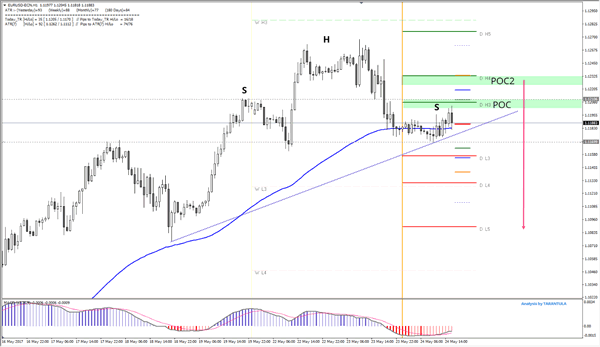
PRE FOMC Coverage: EUR/USD Bearish Head and Shoulders For Possible Drop
On hawkish FOMC, the EUR/USD could drop from POC and POC2. POC 1.1180-1.1200 (D H3, Top of Left Shoulder, ATR Pivot) could reject the price lower towards 1.1150 and 1.1080. In the case of deeper retracement (less hawkish FOMC or dovish FOMC) the POC2 1.1220-30 (D H4, ATR Pivot) could reject the price down IF the price stays below 1.1270. Above 1.1270, 1.1300 should be exposed.
USD/CAD Mid-Day Outlook
Daily Pivots: (S1) 1.3469; (P) 1.3497; (R1) 1.3538; More....
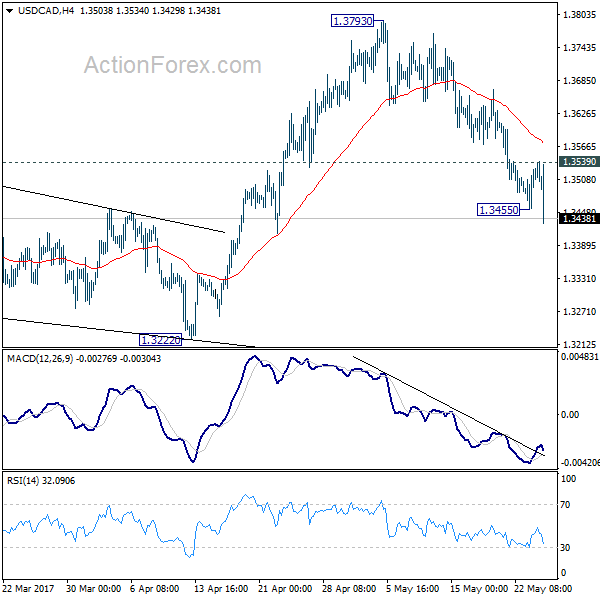
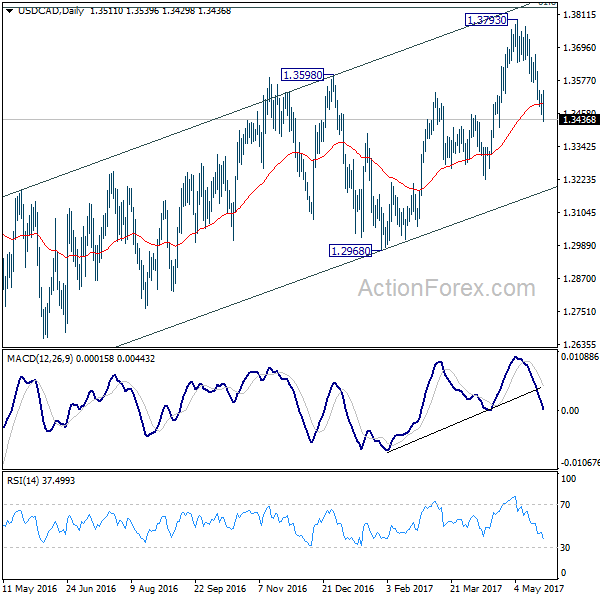
USD/CAD's break of 1.3455 indicates resumption of decline from 1.3793. Intraday bias is turned back to the downside for 1.3222 support next. As noted before, corrective rally from 1.2460 could have finished ahead of 1.3838 fibonacci level. Break of 1.3222 will affirm this case and target 1.2968 key support level for confirmation On the upside, above 1.3539 minor resistance will turn bias neutral and bring another recovery first.
In the bigger picture, price actions from 1.4689 medium term top are seen as a correction pattern. The first leg has completed at 1.2460. Rise from 1.2460 is seen as the second leg and would end at around 61.8% retracement of 1.4689 to 1.2460 at 1.3838. Break of 1.3222 should indicate the start of the third leg while further break of 1.2968 should confirm. Nonetheless, sustained trading above 1.3838 would pave the way to retest 1.4689 high.
Trade Idea Wrap-up: USD/CHF – Hold long entered at 0.9700
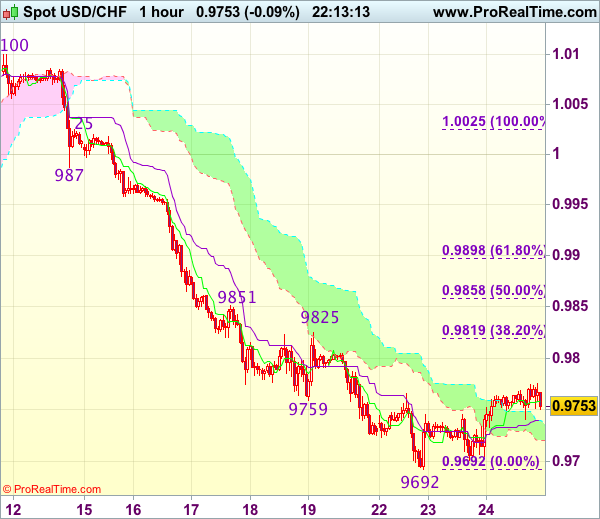
USD/CHF - 0.9757
Most recent candlesticks pattern : N/A
Trend : Near term down
Tenkan-Sen level : 0.9756
Kijun-Sen level : 0.9740
Ichimoku cloud top : 0.9740
Ichimoku cloud bottom : 0.9721
Original strategy :
Bought at 0.9700, Target: 0.9800, Stop: 0.9700
Position : - Long at 0.9700
Target : - 0.9800
Stop : - 0.9700
New strategy :
Hold long entered at 0.9700, Target: 0.9800, Stop: 0.9700
Position : - Long at 0.9700
Target : - 0.9800
Stop : - 0.9700
As the greenback has rebounded after holding above this week’s low at 0.9692, retaining our view that further consolidation above this level would be seen and mild upside bias remains for another rebound to 0.9790-00, however, break of resistance at 0.9825 is needed to low is formed, bring retracement of recent decline to previous resistance at 0.9851 which is likely to hold from here.
In view of this, we are holding on to our long position entered at 0.9700. Below said support at 0.9692 would signal recent decline has resumed and extend weakness to 0.9670-75 but reckon downside would be limited to 0.9650 and 0.9620-25 should hold, bring another rebound later.
Trade Idea Wrap-up: GBP/USD – Stand aside
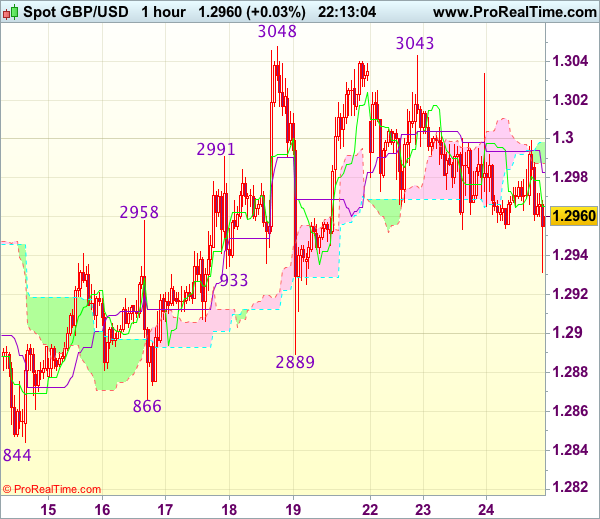
GBP/USD - 1.2957
Most recent candlesticks pattern : N/A
Trend : Near term up
Tenkan-Sen level : 1.2965
Kijun-Sen level : 1.2983
Ichimoku cloud top : 1.2998
Ichimoku cloud bottom : 1.2987
New strategy :
Stand aside
Position : -
Target : -
Stop : -
Cable’s retreat after faltering below indicated resistance at 1.3048 (last week’s high) has retained our view that further choppy trading below this level would be seen and pullback to 1.2930 cannot be ruled out, however, reckon downside would be limited to 1.2900 and said support at 1.2889 should remain intact, bring another rebound later.
On the upside, although recovery to 1.3000-10 cannot be ruled out, reckon said resistance at 1.3048 would hold, bring further consolidation. Only a break of said resistance at 1.3048 would confirm recent upmove has resumed an extend further gain to 1.3075-80 and possibly towards 1.3100-10 later. As near term outlook is mixed, would be prudent to stand aside in the meantime.
Trade Idea Wrap-up: EUR/USD – Stand aside
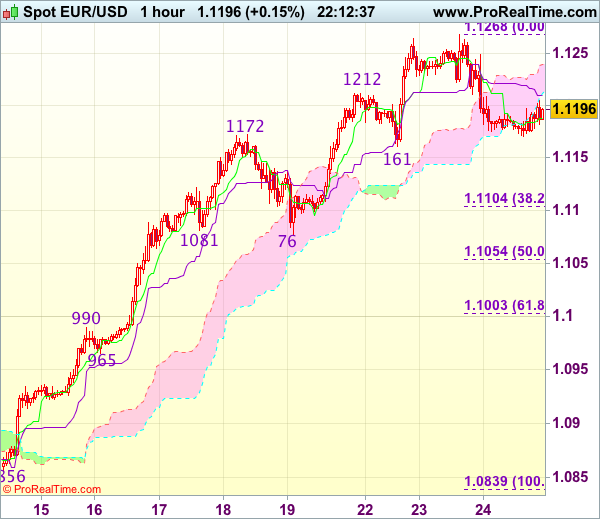
EUR/USD - 1.1197
Most recent candlesticks pattern : N/A
Trend : Up
Tenkan-Sen level : 1.1188
Kijun-Sen level : 1.1210
Ichimoku cloud top : 1.1240
Ichimoku cloud bottom : 1.1212
New strategy :
Stand aside
Position : -
Target : -
Stop : -
Despite yesterday’s marginal rise to 1.1268, the subsequent retreat suggests a temporary top is possibly formed and test of support at 1.1161 cannot be ruled out, however, break there is needed to add credence to this view, bring further fall to 1.1130 but reckon downside would be limited to 1.1100-05 (38.2% Fibonacci retracement of 1.0839-1.1268) and price should stay well above support at 1.1076, bring rebound later.
On the upside, whilst recovery to 1.1200 cannot be ruled out, reckon the Kijun-Sen (now at 1.1220) would limit upside and 1.1250 should hold, bring retreat later. Only break of said resistance at 1.1268 would extend recent upmove to extend further gain to 1.1280-85 (61.8% projection of 1.0839-1.1172 measuring from 1.1076) and possibly towards 1.1300-10.
Yen Drifting as Markets Look for Rate Clues from Fed Minutes
USD/JPY continues to show little movement this week, as the pair drifts in the Wednesday session. In North American trade, the pair is trading at the 112 level. On the release front, US Existing Home Sales dropped sharply to 5.57 million, short of the forecast of 5.65 million. Later on, the Federal Reserve will release the minutes of its May policy meeting. On Thursday, the US releases unemployment claims and Japan will release Tokyo Core CPI, a key inflation indicator.
Is the US housing sector in trouble? On Wednesday, Existing Home Sales fell to 5.57 million in April, compared to 5.71 million in the March estimate. This report comes on the heels of New Home Sales, which dropped to 569 thousand, well short of the forecast of 611 thousand. To be fair, the March readings for both indicators was very high, so the April numbers could just be a blip. However, if upcoming housing reports miss expectations, concerns will grow about the health of the US economy.
Since the Federal Reserve raised rates back in March, there has been plenty of speculation as to the timing of another rate hike. The markets are expecting the Fed to press the rate trigger at the June policy meeting. The odds of a rate hike have increased to 83%, according to the CME Group. Just last week, the likelihood of a rate increase stood at 73%. Despite the market speculation, Fed policymakers are keeping their cards close to their chest, at least in their public appearances. On Tuesday, Philadelphia Fed President Patrick Harker said that a June move was a "distinct possibility", but cautioned that a weak inflation report could delay a rate hike. Earlier in the week, Robert Kaplan, President of the Dallas Fed, stated that three interest increases in 2017 was "appropriate". The Fed minutes are expected to underscore support for a June move, but may not shed much light on what happens after that. Still any clues about the Fed's rate plans could shake up the listless USD/JPY.
With President Trump still overseas on his first presidential trip, the White House presented Trump's 21018 budget proposal to Congress on Tuesday. Trump has promised to slash government spending, and the budget proposes major cuts to the Medicaid health program, disability benefits and food stamps. Trump has outlined an ambitious program to cut government spending by $3.6 trillion in the next 10 years and achieving a balanced budget by 2020. The budget also includes $25 billion for paid leave after childbirth and some $200 billion for infrastructure programs. It's a safe bet that Trump's budget will face tough opposition on Capitol Hill, with both Democrats and Republicans unlikely to go along with such deep cuts to social assistance programs. Still, with the Trump administration beset by Congressional investigations, the White House can point to the budget as a step forward in his agenda to cut government spending.
Trade Idea Wrap-up: USD/JPY – Sell at 112.40 or buy at 111.50
USD/JPY - 111.88
Most recent candlesticks pattern : N/A
Trend : Near term down
Tenkan-Sen level : 111.88
Kijun-Sen level : 111.52
Ichimoku cloud top : 111.27
Ichimoku cloud bottom : 111.14
Original strategy :
Sell at 112.40, Target: 111.00, Stop: 112.75
O.C.O.
Buy at 111.50, Target: 112.50, Stop: 111.15
Position : -
Target : -
Stop : -
New strategy :
Sell at 112.40, Target: 111.00, Stop: 112.75
O.C.O.
Buy at 111.50, Target: 112.50, Stop: 111.15
Position : -
Target : -
Stop : -
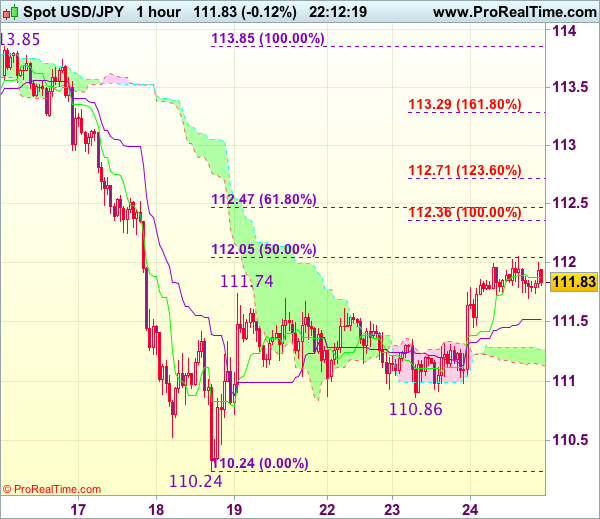
The greenback has rebounded after holding above support at 110.86, suggesting near term upside risk remains for the corrective rise from 110.24 low to extend gain to 112.05 (50% Fibonacci retracement of 113.85-110.24), then 112.36 (100% projection of 110.4-11174 measuring from 110.86) but upside should be limited to 112.45-50 (61.8% Fibonacci retracement) and bring another decline later, below 111.30-35 would bring test of said support at 110.86 but break there is needed to signal the rebound from 110.24 has ended, bring further fall to 110.50 first.
In view of this, whilst we are still looking to sell dollar on further recovery, we would turn long on dips as the Kijun-Sen (now at 111.50) should limit downside and bring another rebound. Above 112.70-75 would abort and signal recent decline has ended, bring further gain to 113.00.