Sample Category Title
AUD/USD Daily Outlook
Daily Pivots: (S1) 0.7695; (P) 0.7721; (R1) 0.7755; More...
AUD/USD edged higher to 0.7747 but lost momentum since then, as seen in 4 hour MACD dragged below signal line. Further rise could be seen with 0.7662 minor support intact, through 0.7777 resistance. But at this point, we'd expect upside to be limited by 0.7849/50 cluster resistance to limit upside and bring reversal. That level represents 61.8% projection of 0.7158 to 0.7740 from 0.7490 at 0.7850 and key long term retracement level at 0.7849. On the downside, below 0.7662 minor support will turn bias to the downside for 0.7490 support first.
In the bigger picture, we're still treating price actions from 0.6826 low as a correction. And, as long as 38.2% retracement of 0.9504 to 0.6826 at 0.7849 holds, long term down trend from 1.1079 is expected to resume sooner or later. Break of 0.6826 low will target 0.6008 key support level. However, firm break of 0.7849 will indicate that rise from 0.6826 is developing into a medium term rebound, rather than a sideway pattern. In such case, stronger rise should be seek to 55 month EMA (now at 0.8169) and above.


Aussie Lost Momentum Despite Strong House Price, after RBA Minutes
Australian dollar's hit a four month high overnight but lost momentum after strong housing data and RBA minutes. RBA highlighted in the meeting minutes the risks from the heat-up housing markets. It noted that "data continued to suggest that there had been a build-up of risks associated with the housing market." And, "growth in household debt had been faster than that in household income."
Regarding the job markets, RBA said that "it was clear that spare capacity remained and there continued to be significant differences in labor market outcomes across the country." Also, "domestic wage pressures remained subdued and household income growth had been low, which, if it were to persist, would have implications for consumption growth and the risks posed by the level of household debt."
Also from Australia, house price index jumped 4.1% qoq in Q4, highest quarterly rise since 2015.
BoE Haldane: Low interest could have hurt productivity
In UK, BoE chief economist Andy Haldane said that low interest rates could have hurt productivity. He pointed out that the "total factor productivity" had its longest stagnation in history since the financial crisis. And low interest rates had kept unproductive "zombie" businesses alive. Meanwhile, he emphasized the importance of free trade and foreign direct investment to UK. He noted that "for a foreign-owned (company), it's twice as productive as domestically run firms. Higher exports, higher productivity - that screams from the data." And he hoped that "both of those features were preserved, ideally enhanced, in a post-Brexit world."
Talking about Brexit, UK Prime Minister Theresa May's spokesman James Slack said that Article 50 on Brexit will be triggered next Wednesday on March 29. And, UK representative to EU Tim Barrow has already informed European Council President Donald Tusk of the plan. Slack also noted that "after we trigger, the 27 will agree their guidelines for negotiations and the Commission's negotiating mandate." And, "President Tusk has said he expects an initial response within 48 hours. We want negotiations to start promptly."
Chicago Fed Evans: It could be three, two, or four hikes this year
In US, Chicago Fed President Charles Evans said Fed is on track for two more rate hike this year. Meanwhile, he maintained that a total of three hikes this year is "entirely possible". And, "as I gain more confidence in the outlook I could support three total this year. If inflation began to pick up, that would certainly solidify (that expectation). It could be three, it could be two, it could be four if things really pick up."
Minneapolis Federal Reserve President Neel Kashkari, the lone dissenter in last week's FOMC meeting when FOMC hiked interest rate, spoke again yesterday. He reiterated that "when the data do call for removing some monetary accommodation, my preference would be that we ... articulate a plan of exactly how and when we're going to roll off the balance sheet." And, "as we move forward, we allow the balance sheet to start running off. Then we can return to fed funds rate hikes when the data call for it." And in short, his preference is "the balance sheet should be the next move."
On the data front...
Elsewhere, UK inflation data will be the main focus in European session. Headline CPI is expected jump to 2.1% yoy in February and core CPI is expected to rise to 1.7% yoy. RPI, PPI, house price index, public sector net borrowing will also be released from UK. Swiss will release trade balance. Later in US session, Canada will release retail sales while US will release Q4 current account.
AUD/USD Daily Outlook
Daily Pivots: (S1) 0.7695; (P) 0.7721; (R1) 0.7755; More...
AUD/USD edged higher to 0.7747 but lost momentum since then, as seen in 4 hour MACD dragged below signal line. Further rise could be seen with 0.7662 minor support intact, through 0.7777 resistance. But at this point, we'd expect upside to be limited by 0.7849/50 cluster resistance to limit upside and bring reversal. That level represents 61.8% projection of 0.7158 to 0.7740 from 0.7490 at 0.7850 and key long term retracement level at 0.7849. On the downside, below 0.7662 minor support will turn bias to the downside for 0.7490 support first.
In the bigger picture, we're still treating price actions from 0.6826 low as a correction. And, as long as 38.2% retracement of 0.9504 to 0.6826 at 0.7849 holds, long term down trend from 1.1079 is expected to resume sooner or later. Break of 0.6826 low will target 0.6008 key support level. However, firm break of 0.7849 will indicate that rise from 0.6826 is developing into a medium term rebound, rather than a sideway pattern. In such case, stronger rise should be seek to 55 month EMA (now at 0.8169) and above.


Economic Indicators Update
| GMT | Ccy | Events | Actual | Forecast | Previous | Revised |
|---|---|---|---|---|---|---|
| 0:30 | AUD | House Price Index Q/Q Q4 | 4.10% | 2.50% | 1.50% | |
| 0:30 | AUD | RBA Minutes | ||||
| 6:45 | CHF | SECO March 2017 Economic Forecasts | ||||
| 7:00 | CHF | Trade Balance (CHF) Feb | 3.85B | 4.73B | ||
| 9:30 | GBP | CPI M/M Feb | 0.50% | -0.50% | ||
| 9:30 | GBP | CPI Y/Y Feb | 2.10% | 1.80% | ||
| 9:30 | GBP | Core CPI Y/Y Feb | 1.70% | 1.60% | ||
| 9:30 | GBP | RPI M/M Feb | 0.80% | -0.60% | ||
| 9:30 | GBP | RPI Y/Y Feb | 2.90% | 2.60% | ||
| 9:30 | GBP | PPI Input M/M Feb | 0.10% | 1.70% | ||
| 9:30 | GBP | PPI Input Y/Y Feb | 20.10% | 20.50% | ||
| 9:30 | GBP | PPI Output M/M Feb | 0.30% | 0.60% | ||
| 9:30 | GBP | PPI Output Y/Y Feb | 3.70% | 3.50% | ||
| 9:30 | GBP | PPI Output Core M/M Feb | 0.20% | 0.50% | ||
| 9:30 | GBP | PPI Output Core Y/Y Feb | 2.50% | 2.40% | ||
| 9:30 | GBP | House Price Index Y/Y Jan | 6.30% | 7.20% | ||
| 9:30 | GBP | Public Sector Net Borrowing (GBP) Feb | 2.9B | -9.8B | ||
| 11:00 | GBP | CBI Trends Total Orders Mar | 5 | 8 | ||
| 12:30 | CAD | Retail Sales M/M Jan | 1.30% | -0.50% | ||
| 12:30 | CAD | Retail Sales Less Autos M/M Jan | 1.30% | -0.30% | ||
| 12:30 | USD | Current Account (USD) Q4 | -129B | 113B |
(RBA) Minutes of the Monetary Policy Meeting of the Reserve Bank Board
Members Present
Philip Lowe (Governor and Chair), Guy Debelle (Deputy Governor), John Akehurst, Kathryn Fagg, John Fraser (Secretary to the Treasury), Ian Harper, Allan Moss AO, Carol Schwartz AM, Catherine Tanna
Others Present
Luci Ellis (Assistant Governor, Economic), Christopher Kent (Assistant Governor, Financial Markets), Alexandra Heath (Head, Economic Analysis Department)
Anthony Dickman (Secretary), Andrea Brischetto (Deputy Secretary)
International Economic Conditions
Members commenced their discussion of international developments by noting that forecasts by private sector analysts for growth in the major economies in 2017 had been revised upwards since mid 2016. Growth in global industrial production and merchandise trade had picked up further and survey measures of business conditions had remained at high levels. Headline inflation in the major advanced economies had increased noticeably in recent months, largely as a result of higher oil prices, to be close to most central banks' targets. However, core inflation had generally remained low.
The Chinese National People's Congress had announced a growth target for the Chinese economy in 2017 of around 6.5 per cent (or higher, if possible), which is only slightly lower than the pace of growth recorded for 2016. This suggested that the authorities would continue to use policy to support near-term growth. However, policymakers had also increased their focus on addressing the risks to longer-term growth. The People's Bank of China had signalled a reduction in monetary stimulus, reflecting concerns about rising financial stability risks, and the target for growth in total social financing had been lowered slightly to 12 per cent. Additional measures had also been put in place to curb rapid housing price growth in some cities. Members noted that there had been a pick-up in the growth of non-bank and off-balance sheet lending.
In the United States, consumption had been the key driver of expenditure growth over 2016, supported by continuing improvements in labour market conditions. Investment intentions had picked up significantly and the number of active oil rigs had increased in response to the higher level of oil prices. Fiscal policy was also expected to be expansionary under the new administration and the US economy was expected to grow above its potential rate in 2017. Members noted that the volume of trade destined for the United States had fallen significantly as a share of total global trade since the late 1990s. Nevertheless, a move to more protectionist policies would still be damaging for the medium-term outlook for both the US and global economies. Above-average growth in unit labour costs, higher oil prices and more expansionary fiscal policy were all expected to contribute to a further rise in core inflation, which had increased since 2015 to be only a little below the Federal Reserve's goal.
The euro area and Japanese economies had grown faster than their potential growth rates over 2016, resulting in further improvements in labour market conditions. The unemployment rate in the euro area had fallen to its lowest level in seven years, while the unemployment rate in Japan had declined to a two-decade low. In both economies, core inflation had remained low, while headline inflation had increased, largely as a result of higher oil prices. In the euro area, headline inflation had increased to be consistent with the European Central Bank's target. Measures of inflation expectations in both economies had been steady or had increased.
Members observed that merchandise exports had picked up for the euro area and Japan towards the end of 2016. A significant increase in merchandise exports had also contributed to growth in East Asia. Members noted that the increase in global trade over the second half of 2016 had been underpinned by an improvement in global economic conditions, both for Australia's major trading partners and other parts of the world that were important sources of external demand for output from East Asia.
Australia's terms of trade had risen by around 15 per cent over the second half of 2016 and were expected to rise again in the March quarter. In February, prices for iron ore, base metals and crude oil had all reached their highest level in more than a year, although the price of coking coal had fallen from its peak in November. Some reversal in the terms of trade was still expected, although the recent improvement in global demand suggested that higher commodity prices could be more persistent than previously anticipated. Members noted that generalised strength in commodity prices tended to indicate an improvement in global demand conditions, but that factors affecting the supply of commodities had also affected prices.
Domestic Economic Conditions
GDP growth in the December quarter of 1.1 per cent had been above expectations. The outcome partly reflected the reversal of some of the temporary factors that had contributed to the fall in output in the September quarter. Most notably, there had been a solid pick-up in export growth in the December quarter; in addition, growth in both consumption and business investment had been higher than expected. Total nominal income had risen strongly, driven by growth in mining sector profits as a result of the higher terms of trade; in contrast, growth in labour incomes had been unusually weak.
The mining sector had contributed to growth in the December quarter, reflecting higher exports and an unexpected increase in investment. Members observed that some resource firms may have been able to increase their exports to take advantage of higher commodity prices by running down inventories. Consistent with previous staff forecasts, the capital expenditure survey of investment intentions continued to indicate that mining investment would fall further over the following year or so, but that the drag on growth would dissipate over this period.
Non-mining business investment had risen in the December quarter, largely as a result of higher non-residential construction, although machinery and equipment investment had also risen. Non-mining business investment had picked up over the previous two years or so and business conditions had been more positive in recent months. In contrast to these more positive signs, non-residential building approvals had declined further and the capital expenditure survey continued to suggest that, in aggregate, firms do not intend to increase their spending on non-mining investment over the following year or so. Members observed, however, that this survey does not cover some important sectors, including education and health, and also does not include investment in intellectual property, which has become an increasingly important share of non-mining business investment in the national accounts measure. Members noted that in most sectors there had been little evidence that non-mining business investment had been held back by lack of access to credit.
Dwelling investment had rebounded in the December quarter; much of the strength had been concentrated in New South Wales. Even though building approvals had fallen significantly in recent months, the substantial amount of building work in the pipeline suggested that dwelling investment would continue to contribute to growth in coming quarters. Conditions in established housing markets had continued to differ significantly across the country. Over recent months, conditions appeared to have strengthened in Sydney and had remained strong in Melbourne; these cities had continued to record brisk growth in housing prices, and auction clearance rates had remained high. Housing loan approvals and credit growth had picked up for investors, primarily in New South Wales and Victoria. In contrast, housing prices and rents had fallen in Perth for two years or so, and apartment prices had declined in Brisbane.
Rural exports had grown strongly in the December quarter, reflecting strong farm production following favourable weather conditions in many areas over the second half of 2016. As a result of this and the higher prices for bulk commodity exports, there had been a trade surplus in the December quarter for the first time in almost three years. The current account deficit had narrowed to less than 1 per cent of GDP, the smallest deficit since 1980; the trade surplus was partly offset by a widening in the net income deficit as some of the increase in mining profits had accrued to foreign owners.
Household consumption growth, which had been relatively subdued in mid 2016, picked up in the December quarter, consistent with retail sales. Liaison with retailers suggested that recent trading conditions had been around average and household perceptions of their personal finances had also been around average.
The pick-up in consumption growth stood in contrast to the ongoing weakness in labour incomes, with the household saving ratio declining in the December quarter. Members noted that over the past two decades movements in the Australian household saving ratio had been much larger than those in other similar economies. One contributing factor was likely to have been that Australia had experienced a much larger terms of trade cycle than other developed economies with significant commodity exports. Differences in the evolution of household saving ratios across the states suggested that the terms of trade had played an important role in households' saving and spending decisions.
Indicators of labour market conditions had remained mixed. Employment growth had picked up in recent months and the unemployment rate had edged down to 5.7 per cent in January. Leading indicators, including job advertisements and firms' employment intentions, suggested that there could be some pick-up in employment growth in the near term. Members noted that although experience had varied across the states, in recent years employment growth had generally been stronger in the capital cities than in regional areas. Employment growth had continued to be concentrated in part-time jobs over the past year and wage growth had remained low, suggesting that the labour market had not been quite as strong as the headline employment and unemployment rate figures had indicated.
The wage price index had increased by 1.9 per cent over 2016, in line with the staff forecasts. Subdued wage growth appeared to have been broad based and was most pronounced in mining-related industries and states. Average earnings per hour in the national accounts had fallen sharply in the December quarter, as had the wage bill as a share of nominal GDP. Although quarterly movements in average earnings per hour are volatile, this measure of wage growth had also been subdued in year-ended terms, continuing to suggest there was very little labour cost pressure in the economy. Members noted that the recent experience of low inflation may also have contributed to lower wage outcomes and that other business costs, such as rents, are often linked to inflation. Members observed that although credit growth was lower than in previous decades, it had been faster than the subdued growth in household incomes.
Financial Markets
Members commenced their discussion by noting that global financial markets had been relatively quiet over the preceding month, with market participants focused on evolving expectations about the upcoming US Federal Reserve meeting, the new US administration's policies and national elections in Europe in coming months. Globally, monetary policy remained very stimulatory and financing remained readily available on favourable terms.
Financial market participants' expectations for an increase in the federal funds rate at the March meeting of the US Federal Open Market Committee (FOMC) had risen to over 90 per cent. This followed continued positive economic news in the United States as well as statements by FOMC members. Members noted the widely held expectations for no change in monetary policy settings in the euro area and Japan, compared with the general view earlier in the previous year that further monetary easing was in prospect in these economies.
In major markets, 10-year government bond yields remained above their lows of mid 2016, reflecting the run of more positive economic news since then, as well as expectations that the new US administration's policies would support US growth. Members observed that, although euro area government bond spreads to German government bonds had increased over recent months in response to political developments, yields remained relatively low by historical standards. Corporate bond yields in developed markets remained very low, with spreads to government bonds having narrowed markedly over the previous year, particularly for non-investment grade bonds. Australian government bond yields had been little changed over the month and the spread to US Treasury yields had also been steady at a low level. As in other markets, Australian corporate bond spreads had narrowed over the preceding year.
Global equity prices had moved higher over the prior month in response to continued positive economic data. In the United States, financial sector share prices had increased strongly following the new administration's orders for a review of financial market regulations. In the euro area, banks' share prices had declined following lower-than-expected earnings, which were largely related to loan-loss provisions. Over the previous year or so, Australian share prices had moved broadly in line with those in the rest of the world excluding the United States, where share prices had risen further. Recent Australian company earnings results had been generally positive, driven by strong profits in the resources sector.
The US dollar had been little changed over the prior month in nominal trade-weighted terms, while the euro had depreciated a little against the US dollar, in part reflecting political uncertainty around the upcoming national elections. The Chinese renminbi had been broadly unchanged over the preceding month against the US dollar and in trade-weighted terms.
Members noted that the People's Bank of China had tightened monetary policy a little and indicated that further tightening was likely in response to rising inflationary pressures and to address leverage, including of financial institutions. The tightening had flowed through to increased corporate bond spreads; recent bond issuance in China had been weak after a sustained period of strength, although yields had remained low. In emerging markets more broadly, financial market conditions had been favourable and flows into emerging market funds had resumed as the global economic outlook had improved since mid 2016.
The Australian dollar had been little changed over the prior month and had remained more than 10 per cent higher against the US dollar and in trade-weighted terms since early 2016, reflecting the significant increase in commodity prices since then.
Members observed that Australian banks' funding costs and average outstanding housing and business lending rates were estimated to have been broadly steady over recent months. Interest rates had increased slightly over prior months for some investor and interest-only housing loans.
Financial market pricing indicated that market participants expected the cash rate to remain unchanged at the March meeting.
Considerations for Monetary Policy
In considering the stance of monetary policy, members noted that recent data had continued to support a more positive outlook for growth of Australia's major trading partners than had been apparent a few quarters earlier. A number of indicators, including growth in global industrial production, global trade volumes and business sentiment, had improved. Recent data had also confirmed the pick-up in global inflation. Financial market data suggested that the probability of the Federal Reserve increasing the federal funds rate at the March meeting had increased markedly and there was no longer an expectation of further monetary easing in other major economies. At the same time, however, there continued to be significant uncertainty about policy in China and the United States and the implications for global growth and trade after 2017.
Domestically, there had been a significant increase in the terms of trade in the second half of 2016 and many commodity prices had risen further in recent months. Although mining companies were expected to increase their dividend payouts following the sharp rise in mining sector profits in the December quarter, a significant proportion of shareholders are non-residents, which would limit the flow-through to an increase in household incomes in Australia. However, the fact that the recent increases in commodity prices had been supported by a pick-up in global demand raised the possibility that commodity prices could be higher than expected, in which case the flow-through to the domestic economy could be larger than currently forecast.
The Australian economy had continued to make its transition following the end of the mining investment boom, supported by the low level of interest rates and the depreciation of the exchange rate since 2013. GDP growth had picked up in the December quarter to be around 2½ per cent over 2016, which was only a little below estimates of the medium-term potential growth rate of the economy. This outcome confirmed that the weakness in the September quarter was temporary. Looking forward, year-ended growth was expected to pick up gradually to be above its potential rate over the forecast period. An appreciating exchange rate would complicate the adjustment of the economy following the end of the mining investment boom.
Momentum in the labour market remained difficult to assess, but it was clear that spare capacity remained and there continued to be significant differences in labour market outcomes across the country. Domestic wage pressures remained subdued and household income growth had been low, which, if it were to persist, would have implications for consumption growth and the risks posed by the level of household debt. Spare capacity was expected to decline slowly as momentum in the economy built; wage growth and underlying inflation were expected to rise, but only gradually.
Recent data continued to suggest that there had been a build-up of risks associated with the housing market. In some markets, conditions had been strong and prices were rising briskly, although in other markets prices were declining. In the eastern capital cities, a considerable additional supply of apartments was scheduled to come on stream over the next few years. Growth in rents had been the slowest for two decades. Borrowing for housing by investors had picked up over recent months and growth in household debt had been faster than that in household income. Supervisory measures had contributed to some strengthening of lending standards.
Given all of these considerations, the Board judged that holding the stance of policy unchanged at this meeting would be consistent with sustainable growth in the economy and achieving the inflation target over time.
The Decision
The Board decided to leave the cash rate unchanged at 1.5 per cent.
G20 Rifts Open, GBP Shorts Hit Record
Headlines from the G20 meetings in Germany showed the new US administration beginning to assert itself and other leaders beginning to push back. The first French Presidential debate gets underway this evening, followed by the RBA minutes. Sterling fell sharply after UK PM May announced the date of Article 50 kickoff to be March 29, shedding all the gains from Thursday's hawkish dissent from BoE's Forbes. A new trade will be issued this evening to Premium clients.
The best way to look at the G20 is a barometer. Little is ever accomplished at the Summits but the topics of discussion and dispute are clues on which way the world is headed.
Baden-Baden was Mnuchin's first entry onto the world stage. In public comments, he was cordial and only offered small hints on what the administration was after. But behind closed doors other leaders hinted at frustration as Trump's team sets its own course.
The Communique removed a reference to resisting protectionism and leaders were unable to find a compromise on the language on trade as most pushed for free and open but Mnuchin insisted on a reference to fair.
After more than 50 days of Trump, we still have little idea on whether he's mostly talk or if his team truly plans to reshape global trade. The G20 may have been a small signal that it's Option #2.
Commitments of Traders Speculative net futures trader positions as of the close on Tuesday. Net short denoted by - long by +.
EUR -41K vs -58K prior JPY -71K vs -54K prior GBP -107K vs -81K prior CHF -9K vs -10K prior AUD +43K vs +51K prior CAD +21vs +29K prior NZD -6K vs -4K prior
The net short in cable is the most extreme since records began in 1992. It's been sold heavily from -60K in the final week of February. It's the clearest sign yet that specs are piling into shorts and looking for a quick profit on Article 50. That's the kind of thing that often blows up in the other direction.

GBPUSD – Bullish, Targeting Further Upside Pressure
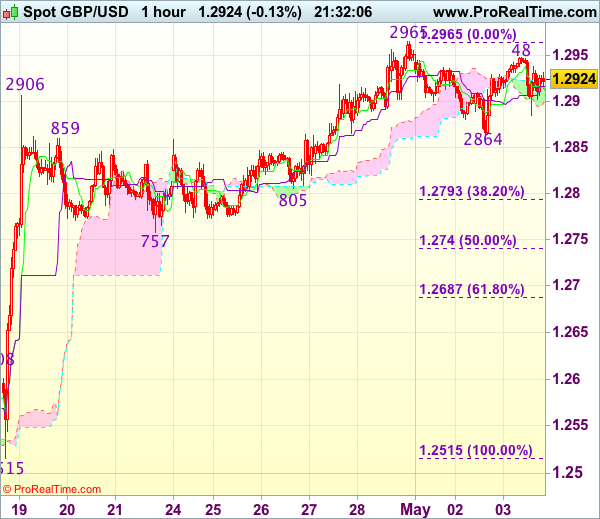
GBPUSD - The pair remains on the offensive leaving risk higher in the days ahead. Support lies at the 1.2350 level where a break will turn attention to the 1.2300 level. Further down, support lies at the 1.2250 level. Below here will set the stage for more weakness towards the 1.2200 level. Conversely, resistance stands at the 1.2450 levels with a turn above here allowing more strength to build up towards the 1.2500 level. Further out, resistance resides at the 1.2550 level followed by the 1.2600 level. On the whole, GBPUSD continues to face upside pressure.

Elliott Wave Trade Ideas Performance Update
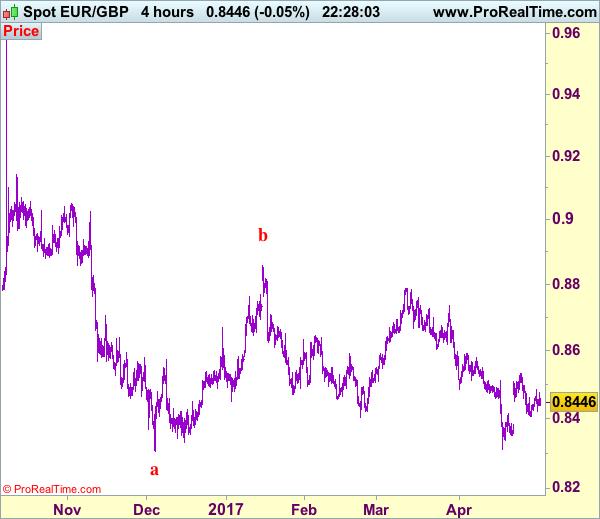
Two long positions were entered in EUR/JPY last week, the first one entered at 121.80 was quickly exited around break-even, we then entered another long position at 121.30 and the position is still holding at the moment.
No position was entered in other currency pairs last week.
In short, 2 positions were entered last week with total profit of 5 points and the positions are listed below.
15 Mar: EUR/JPY - Long at 121.80, exited at 121.85 (+ 5 points)
17 Mar: EUR/JPY - Lobg at 121.30,
| AUD EUR/JPY EUR/GBP CAD
Jan - 15 -275 - 35 -120
Feb + 140 -17 - 40 +11
Mar + 20 +165
Apr
May
Jun
Jul
Aug
Sep
Oct
Nov
Dec
Y-T-D + 145 - 127 - 75 + 57
Ellliott Wave Analysis: Crude Oil Pointing Higher
Crude oil is making nice bounce from our support area at 48.00 where energy might already completed an a-b-c structure. It is a corrective pattern that is pointing higher now, back to 49.58, especially if price will close outside of a downward channel.
Crude OIL, 1H

Candlesticks and Ichimoku Trade Ideas Performance Update
The long positions entered in cable at 1.2215 in the previous week was stopped at 1.2180 and although sterling extended weakness to 1.2109, decent demand emerged there and the British pound finally staged the anticipated rally from there to even above 1.2400 level late last week.
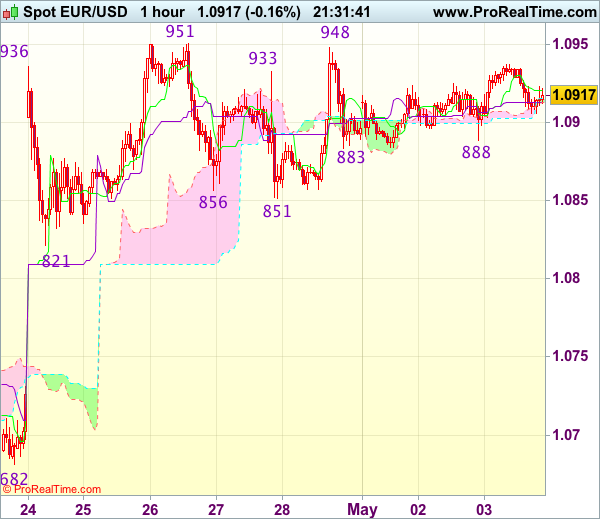
Another long position was entered in EUR/USD at 1.0640, however, the retreat from 1.0713 was just a bit deeper than expected, the position was stopped at 1.0610 before the single currency finding renewed buying interest and rallied as suggested to as high as 1.0782 on Friday.
In short, 2 positions were entered among all 4 currency pairs with total loss of 65 points and the positions are listed below:
13 Mar: GBP/USD - Long at 1.2215, exited at 1.2180 (- 35 points)
14 Mar: EUR/USD - Long at 1.0640, exited at 1.0610 (- 30 points)
| JPY EUR CHF GBP
Jan + 167 - 85 - 10 + 50
Feb + 200 +150 +93 - 59
Mar -8 -35 0 - 35
Apr
May
Jun
Jul
Aug
Sep
Oct
Nov
Dec
Y-T-D + 359 + 25 +83 -44
Trade Idea Wrap-up: USD/CHF – Sell at 1.0020
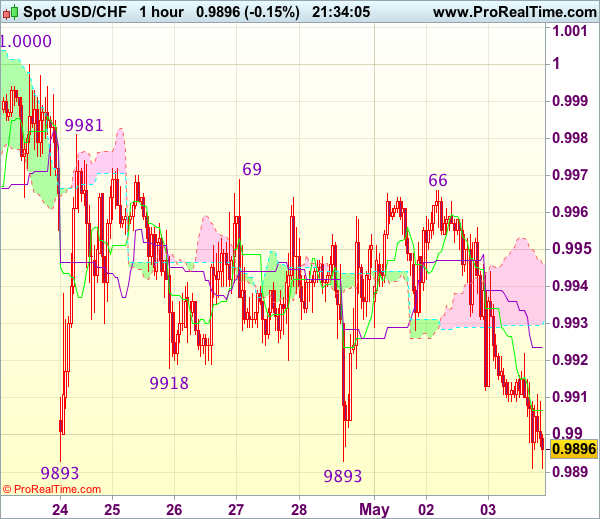
USD/CHF - 0.9963
Most recent candlesticks pattern : N/A
Trend : Near term down
Tenkan-Sen level : 0.9972
Kijun-Sen level : 0.9973
Ichimoku cloud top : 1.0021
Ichimoku cloud bottom : 0.9961
Original strategy :
Sell at 1.0020, Target: 0.9920, Stop: 1.0055
Position : -
Target : -
Stop : -
New strategy :
Sell at 1.0020, Target: 0.9920, Stop: 1.0055
Position : -
Target : -
Stop : -
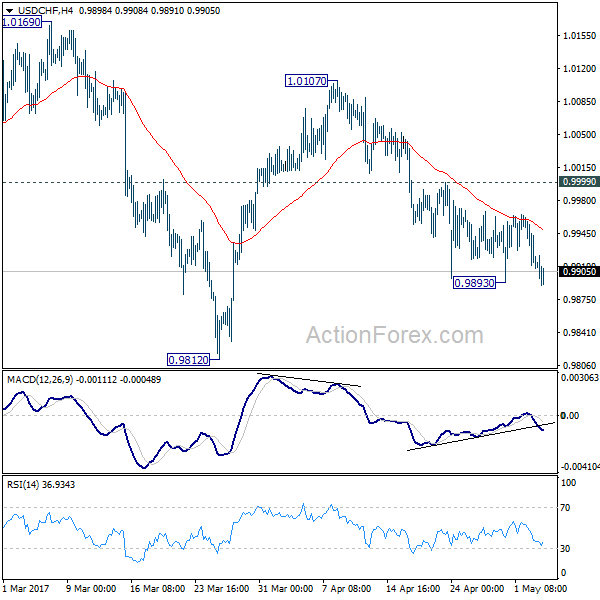
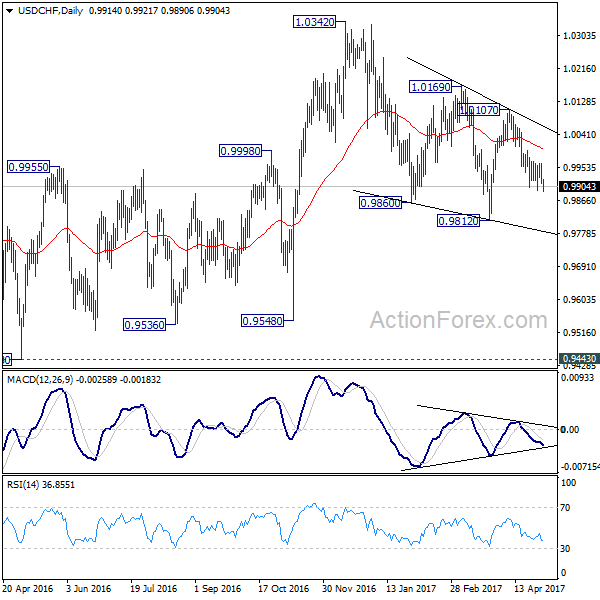
As the greenback has rebounded after finding support at 0.9942 on Friday, suggesting consolidation above this level would be seen and corrective bounce to 1.0005-10 (38.2% Fibonacci retracement of 1.0109-0.9942) cannot be ruled out, however, reckon upside would be limited to 1.0025 (50% Fibonacci retracement) and bring another decline later. Below said support at 0.9942 would extend recent decline from 1.0171 to 0.9920-25 but loss of near term downward momentum should prevent sharp fall below 0.9900 and reckon 0.9870-75 would hold from here.
In view of this, would not chase this fall here and would be prudent to sell dollar on recovery as 1.0021 (current level of the upper Kumo) should limit upside and bring another decline. Only above previous support at 1.0060 (now resistance) would abort and signal low is formed instead, risk rebound to 1.0090-95 first.

Trade Idea Wrap-up: GBP/USD – Buy at 1.2310
GBP/USD - 1.2372
Most recent candlesticks pattern : N/A
Trend : Near term up
Tenkan-Sen level : 1.2401
Kijun-Sen level : 1.2399
Ichimoku cloud top : 1.2362
Ichimoku cloud bottom : 1.2292
Original strategy :
Buy at 1.2310, Target: 1.2435, Stop: 1.2275
Position : -
Target : -
Stop : -
New strategy :
Buy at 1.2310, Target: 1.2435, Stop: 1.2275
Position : -
Target : -
Stop : -
As cable has retreated after intra-day brief rise to 1.2436, suggesting consolidation below this level would be seen and pullback to support at 1.2335 cannot be ruled out, however, reckon downside would be limited to 1.2310 (previous resistance now support) and bring another rise later, above said resistance at 1.2436 would extend recent upmove from 1.2109 (this month’s low) to 1.2450 but loss of near term momentum should prevent sharp move beyond previous resistance at 1.2479, risk from there has increased for a retreat to take place later.
In view of this, would not chase this move from here and we are looking to buy cable on pullback as said previous resistance at 1.2310 should limit downside and bring another rise. Below 1.2270-75 (50% Fibonacci retracement of 1.2109-1.2436) would defer and suggest top is possibly formed, risk correction to 1.2241 support.