

Sample Category Title
Euro-Zone’s Unemployment Rate Remained Steady At Its Lowest Level Since April 2009 In March
For the 24 hours to 23:00 GMT, the EUR rose 0.18% against the USD and closed at 1.0929, after growth in the Euro-zone's manufacturing sector was confirmed at a six-year high level of 56.7 in April. However, the PMI was revised slightly lower from a preliminary print of 56.8. In the previous month, the PMI had registered a level of 56.2. Meanwhile, the region's unemployment rate surprisingly remained steady at an eight-year low level of 9.5% in March, against market expectation for a fall to a level of 9.4%.
Separately, Germany's final Markit manufacturing PMI eased to a level of 58.2 in April, confirming the flash estimates. In the previous month, the PMI had registered a reading of 58.3.
In the Asian session, at GMT0300, the pair is trading at 1.0933, with the EUR trading a tad higher against the USD from yesterday's close.
The pair is expected to find support at 1.0901, and a fall through could take it to the next support level of 1.0868. The pair is expected to find its first resistance at 1.0951, and a rise through could take it to the next resistance level of 1.0968.
Moving ahead, market participants will draw their attention to the Euro-zone's 1Q GDP figures and Germany's unemployment rate data for April, scheduled to release in a few hours. Later today, all eyes would be on the release of the latest Federal Reserve monetary policy meeting, wherein investors would be keen to get hints on the timing of the next interest rate hike. Additionally, in the US, ADP's jobs report, ISM non-manufacturing PMI and final Markit services PMI, all for April, will keep investors on their toes.
The currency pair is trading above its 20 Hr and 50 Hr moving averages.

UK’s Manufacturing Sector Growth At A 3-Year High Level In April
For the 24 hours to 23:00 GMT, the GBP rose 0.3% against the USD and closed at 1.2936, after Britain's manufacturing sector surprised with a robust performance in April.
The Markit manufacturing PMI in UK unexpectedly jumped to a level of 57.3 in April, expanding at its quickest pace in three years, buoyed by strong global demand, thus painting a largely bright picture of the economy and tempering worries about a Brexit-driven economic slowdown. The PMI had registered a reading of 54.2 in the previous month, while market participants had envisaged for a drop to a level of 54.0
In the Asian session, at GMT0300, the pair is trading at 1.2941, with the GBP trading slightly higher against the USD from yesterday's close.
Overnight data indicated that the nation's BRC shop price index fell 0.5% on an annual basis in April, meeting market expectations and following a drop of 0.8% in the prior month.
The pair is expected to find support at 1.2885, and a fall through could take it to the next support level of 1.2829. The pair is expected to find its first resistance at 1.2973, and a rise through could take it to the next resistance level of 1.3005.
Moving ahead, market participants await the release of UK's Markit construction PMI for April, set to release in a few hours.
The currency pair is trading above its 20 Hr and 50 Hr moving averages.

Japanese Yen Trading On A Weaker Footing This Morning
For the 24 hours to 23:00 GMT, the USD rose 0.11% against the JPY and closed at 111.97.
In the Asian session, at GMT0300, the pair is trading at 112.04, with the USD trading 0.06% higher against the JPY from yesterday’s close.
The pair is expected to find support at 111.80, and a fall through could take it to the next support level of 111.56. The pair is expected to find its first resistance at 112.29, and a rise through could take it to the next resistance level of 112.54.
On account of a holiday observed in Japan today, investors will look forward to global events for further direction in Yen.
The currency pair is showing convergence with its 20 Hr moving average and trading above its 50 Hr moving average.

Swiss SVME–PMI Fell More-Than-Expected In April
For the 24 hours to 23:00 GMT, the USD declined 0.42% against the CHF and closed at 0.9913.
On the data front, Switzerland's SVME–purchasing managers' index (PMI) declined more-than-anticipated to a level of 57.4 in April, compared to a level of 58.6 in the previous month, whereas markets anticipated for a fall to a level of 58.2.
In the Asian session, at GMT0300, the pair is trading at 0.9911, with the USD trading slightly lower against the CHF from yesterday's close.
The pair is expected to find support at 0.9891, and a fall through could take it to the next support level of 0.987. The pair is expected to find its first resistance at 0.9947, and a rise through could take it to the next resistance level of 0.9982.
The currency pair is trading below its 20 Hr and 50 Hr moving averages.

Loonie Trading Lower In The Morning Session
For the 24 hours to 23:00 GMT, the USD rose 0.23% against the CAD and closed at 1.3704.
In the Asian session, at GMT0300, the pair is trading at 1.3718, with the USD trading 0.1% higher against the CAD from yesterday’s close.
The pair is expected to find support at 1.3658, and a fall through could take it to the next support level of 1.3597. The pair is expected to find its first resistance at 1.3768, and a rise through could take it to the next resistance level of 1.3817.
With no economic releases in Canada today, investor sentiment would be governed by global macroeconomic news.
The currency pair is trading above its 20 Hr and 50 Hr moving averages.

Daily Technical Analysis: EUR/USD Setups Consolidation Zone Break Aiming For 1.10
Currency pair EUR/USD
The EUR/USD remains in a consolidation pattern which is indicated by the support (blue) and resistance (red) trend lines. A bullish break could indicate a potential uptrend continuation towards the 78.6% Fibonacci level of wave 2 (green) whereas a bearish break could start a reversal and indicate the completion of the ABC zigzag (purple).
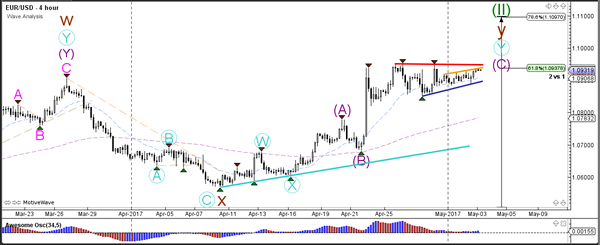
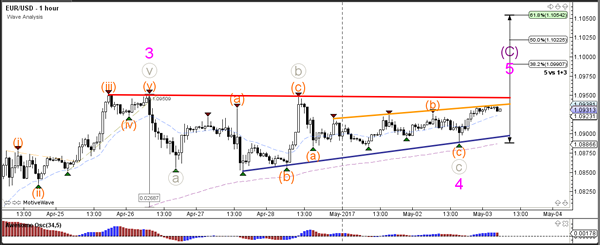
The EUR/USD sideways zone is probably making a wave 4 (pink) correction rather than a reversal. The next targets are the psychological even level at 1.10 and the 61.8% Fib target at 1.1050.
Currency pair GBP/USD
The GBP/USD is continuing with the bullish trend which is indicated by the support trend lines (blue). The 1.30 level could act as resistance too due to the importance of round levels in technical analysis. A break above it could see price extend towards the Fibonacci targets.
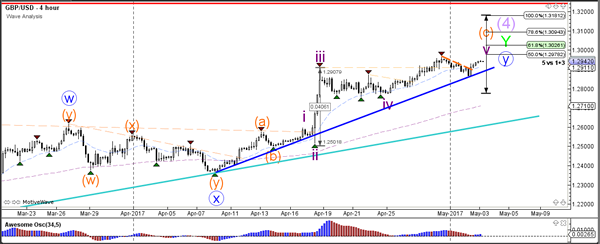
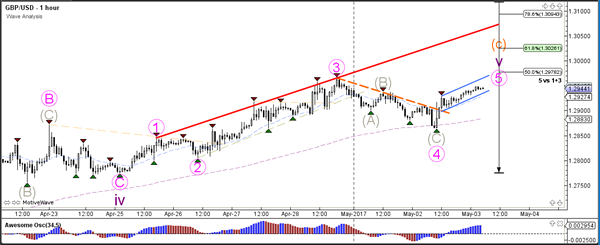
The GBP/USD is building a smaller bullish channel (blue lines) after breaking above the resistance trend line (dotted orange).
Currency pair USD/JPY
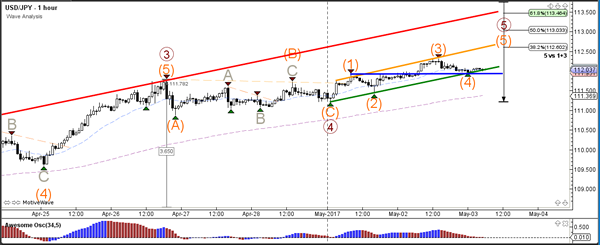
The USD/JPY is in an uptrend channel which is indicated by the trend lines. Price could move up towards the Fibonacci targets of wave 5 (brown). The channel could break bearishly once the 5th wave (brown) is completed.
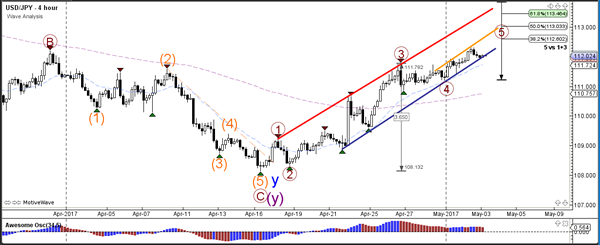
The USD/JPY is probably still in a 5th wave (orange) of a 5th wave (brown) as long as price stays above the support zone (green/blue).
European Open Briefing: Flows Were Light In The Asian Session
Global Markets:
- Asian stock markets: Shanghai Composite down 0.35 %, ASX 200 lost 1.00 %, Nikkei and Hang Seng closed for holiday
- Commodities: Gold at $1257 (+0.05 %), Silver at $16.91 (+0.50 %), WTI Oil at $48.10 (+0.85 %), Brent Oil at $50.95 (+1.00 %)
- Rates: US 10-year yield at 2.29, UK 10-year yield at 1.09, German 10-year yield at 0.32
News & Data
- Australian AIG Services Index Apr: 53.0 (prev 51.7)
- New Zealand Employment Change (QoQ) Q1: 1.2% (exp 0.8%; prev 0.8%; rev prev 0.7%)
- New Zealand (YoY) Q1: 5.7% (exp 5.3%; prev 5.8%)
- New Zealand Unemployment Rate Q1: 4.9% (exp 5.1%; prev 5.2%)
- New Zealand Participation Rate Q1: 70.6% (exp 70.5%; prev 70.5%)
- PBoC Fixes USDCNY Reference Rate At 6.8892 (prev fix 6.8946 prev close 6.8965)
- Asia stocks ride global momentum, dollar up on June Fed rate hike bets – RTRS
- Oil rebounds on U.S. stocks drawdown, declining OPEC compliance weighs – RTRS
Markets Update:
Flows were light in the Asian session, as Japanese and Hong Kong markets were closed. Meanwhile, Chinese and Australian stock markets declined.
In FX, the New Zealand Dollar rose after stronger than expected employment data. The unemployment rate fell from 5.2 % to 4.9 %. NZD/USD rose from 0.6930 to 0.6970. A break above 0.6980 resistance would suggest that the currency pair is likely to recover further. The next notable resistance level then lies at 0.7050.
The Australian Dollar failed to follow the NZD higher. AUD/USD fell from 0.7545 to 0.7505, and some pressure came also from AUD/NZD selling.
The US central bank will decide on interest rates today. No changes are expected, and it is unlikely that there will be a surprise. There will be no press conference for today, but the FOMC will release a statement at 19:00 BST.
Upcoming Events:
- 08:55 BST – German Unemployment Rate
- 08:55 BST – German Unemployment Change
- 09:30 BST – UK Construction PMI
- 10:00 BST – Euro Zone GDP
- 13:15 BST – US ADP Nonfarm Employment Change
- 14:45 BST – US Services PMI
- 15:00 BST – US ISM Non-Manufacturing PMI
- 15:30 BST – US Crude Oil Inventories
- 19:00 BST – Federal Reserve Rate Decision
- 19:00 BST – FOMC Statement
Daily Technical Outlook And Review: EUR/USD, GBP/USD, AUD/USD, USD/JPY, USD/CAD, USD/CHF, DOW 30, GOLD
A note on lower timeframe confirming price action...
Waiting for lower timeframe confirmation is our main tool to confirm strength within higher timeframe zones, and has really been the key to our trading success. It takes a little time to understand the subtle nuances, however, as each trade is never the same, but once you master the rhythm so to speak, you will be saved from countless unnecessary losing trades. The following is a list of what we look for:
- A break/retest of supply or demand dependent on which way you're trading.
- A trendline break/retest.
- Buying/selling tails ... essentially we look for a cluster of very obvious spikes off of lower timeframe support and resistance levels within the higher timeframe zone.
- Candlestick patterns. We tend to only stick with pin bars and engulfing bars as these have proven to be the most effective.
EUR/USD
The EUR/USD, as you can see, remains somewhat muted as the major continues to trade within a H4 consolidation fixed between 1.0816/1.0950. Of particular interest here, however, is the long wick seen formed on the 28th April at 1.0947 (green arrow). This candle's extreme has potentially consumed a large amount of offers within the current range, which could see price approach the upper edge of this box sometime today.
Now, 1.0950 on its own would not be a high-probability location to short from, as momentum has been firmly positioned to the upside since early April. Nevertheless, when coupled with a daily 61.8% Fib resistance at 1.0932 (green line), a nearby daily resistance pegged at 1.0971 and a weekly 127.2% Fib extension at 1.0954 (taken from the lows 1.0340), the technical story shifts in favor of the bears!
Our suggestions: Watch for H4 price to form a reasonably sized bearish candle between 1.0971/1.0950 (preferably a full-bodied candle). Should this come to fruition, then not only is a move back into the H4 consolidation possible, but a trade short on the back of this is as well.
Data points to consider: US ADP non-farm employment change at 1.15pm, ISM non-manufacturing PMI at 3pm and the FOMC's monetary policy decision at 7pm GMT+1.
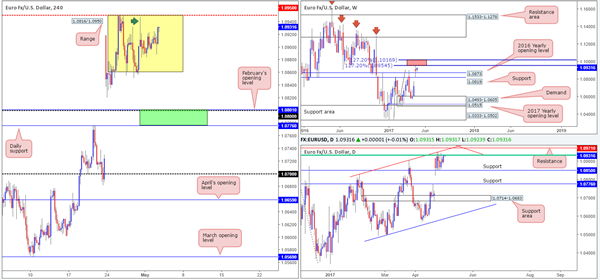
Levels to watch/live orders:
- Buys: Flat (stop loss: N/A).
- Sells: 1.0971/1.0950 ([waiting for a reasonably sized H4 bear candle to form before pulling the trigger is advised] stop loss: ideally beyond the candle's wick).
GBP/USD
Better-than-expected UK manufacturing PMI figures helped provide support around the 1.2883 neighborhood amid London's morning trade yesterday. As a result of this, the market reclaimed the 1.29 handle and popped to a high of 1.2939 by the closing bell. Although this recent advance managed to erase all of Monday's losses as well as print a healthy full-bodied daily bull candle, it's still a challenging pair to buy at the moment. Not only do we have a nearby 161.8% daily Fib extension at 1.2956 (drawn from the low 1.2108) and daily supply carved from 1.3058-1.2979, there's also a weekly supply at 1.3120-1.2957 currently in motion.
Our suggestions: So, if structure suggests shorting, where does one consider selling from? Well, the first level that springs to mind is the most obvious: the H4 mid-level resistance at 1.2950 since it managed to cap upside on Friday. Our next port of call would be the large psychological band seen at 1.30.
Both levels, in our estimation, have equal chance of holding price given higher-timeframe structure. To be on the safe side though, we would not recommend placing pending orders here. Instead, watch how the H4 candles behave once price connects with the said levels. Assuming a reasonably sized H4 bearish candle forms (a full-bodied candle would be attractive), we'd consider selling this market.
Data points to consider: UK construction PMI at 9.30am. US ADP non-farm employment change at 1.15pm, ISM non-manufacturing PMI at 3pm and the FOMC's monetary policy decision at 7pm GMT+1.
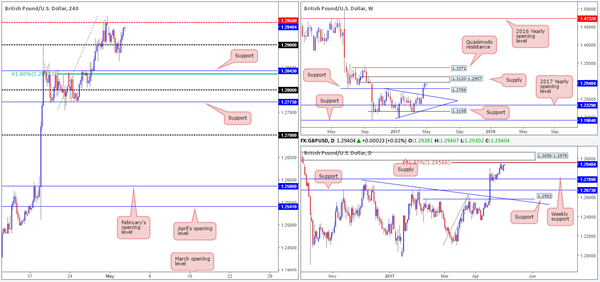
Levels to watch/live orders:
- Buys: Flat (stop loss: N/A).
- Sells: 1.2950 region ([waiting for a reasonably sized H4 bear candle to form before pulling the trigger is advised] stop loss: ideally beyond the candle's wick). 1.30 area ([waiting for a reasonably sized H4 bear candle to form before pulling the trigger is advised] stop loss: ideally beyond the candle's wick).
AUD/USD
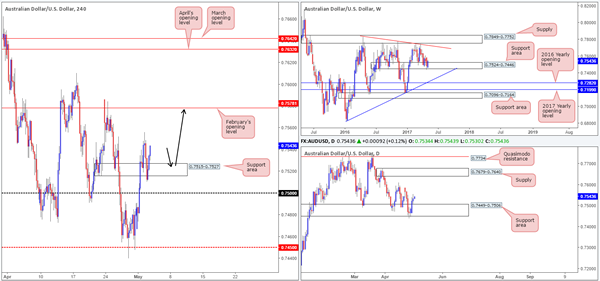
Aussie bulls managed to print their third consecutive daily gain yesterday, reaching highs of 0.7556 on the day. The H4 support area at 0.7515-0.7527 has managed to remain intact, despite suffering a breach going into the US segment. Owing to weekly bulls continuing to defend the support area at 0.7524-0.7446, we still believe that the H4 candles want to test February's opening level at 0.7578. Be that as it may, to take advantage of this move, the only viable setup we see right now is a retest of the said H4 support area (as per the black arrows).
Our suggestions: In the event that a retest of the H4 zone is seen and a reasonably sized H4 bull candle presents itself (a full-bodied candle would be ideal), a long from this region, with a target objective of 0.7578, could be something to consider.
Data points to consider: US ADP non-farm employment change at 1.15pm, ISM non-manufacturing PMI at 3pm and the FOMC's monetary policy decision at 7pm GMT+1.
Levels to watch/live orders:
- Buys: 0.7515-0.7527 ([waiting for a reasonably sized H4 bull candle to form before pulling the trigger is advised] stop loss: ideally beyond the candle's tail).
- Sells: Flat (stop loss: N/A).
USD/JPY
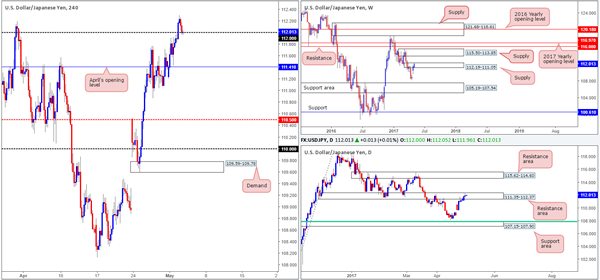
In recent sessions, we can see that the H4 candles cleared the 112 handle during the early hours of London and then went on to retest it as support going into the US afternoon session. While a long from this level could be an option, it might be worth noting the bigger picture. Weekly price is currently seen trading within the upper limits of a supply formed from 112.19-111.05, and daily action has been interacting with a resistance zone coming in at 111.35-112.37 since last Wednesday.
Therefore, instead of looking to buy from 112 today, we are going to be watching for 112 to give way. This could, according to our technicals, open up the path south down to April's opening level at 111.41 and quite possibly the 111 handle.
Our suggestions: A H4 close beyond 112 followed up with a retest and a reasonably sized H4 bearish (preferably full-bodied) candle would, in our humble opinion, be enough evidence to suggest the bears are in control and shorts are now viable.
Data points to consider: US ADP non-farm employment change at 1.15pm, ISM non-manufacturing PMI at 3pm and the FOMC's monetary policy decision at 7pm GMT+1.
Levels to watch/live orders:
- Buys: Flat (stop loss: N/A).
- Sells: Watch for H4 price to close below 112 and then look to trade any retest seen thereafter ([waiting for a reasonably sized H4 bearish candle to form following the retest is advised] stop loss: ideally beyond the candle's wick).
USD/CAD
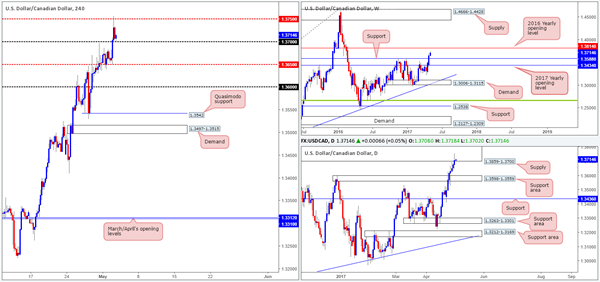
With oil prices softening yesterday, the USD/CAD pair rallied higher. H4 price easily cleared the 1.37 handle and went on to challenge the mid-level resistance 1.3750, which, as you can see, held firm. Although daily buyers printed their eighth consecutive bullish candle yesterday, our team remains somewhat biased to the downside. Our reasoning lies within the higher-timeframe structures. Daily price has recently checked in with a supply zone penciled in at 1.3859-1.3700. And weekly flow looks poised to attack the 2016 yearly opening level at 1.3814, which sits nicely within the upper limits of the said daily supply.
Our suggestions: To our way of seeing things, entering long (medium/long term) is not a viable option at present. Shorts on the other hand, are. However, given our conservative nature, we would not be looking to commit until price has connected with the above noted 2016 yearly opening level (essentially around the 1.38 region). The reason being is that it's firmly positioned within the said daily supply, thus allowing the trader to conservatively place stops above this area.
Data points to consider: US ADP non-farm employment change at 1.15pm, ISM non-manufacturing PMI at 3pm and the FOMC's monetary policy decision at 7pm GMT+1.
Levels to watch/live orders:
- Buys: Flat (stop loss: N/A).
- Sells: 1.3814/1.38 region is an ideal place for shorts since this area requires no additional confirmation (stop loss: conservative at 1.3861).
USD/CHF
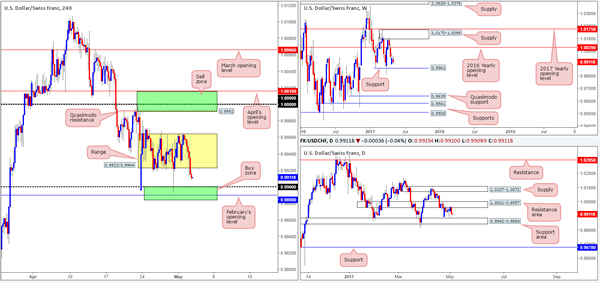
As can be seen from the H4 chart this morning, price breached and eventually closed beyond the lower edge of the consolidation fixed between 0.9923/0.9964. Consequent to this, the H4 buy zone seen marked in green at 0.9884/0.99 is now in view. Comprised of the 0.99 handle, February's opening level at 0.9890 and the top edge of a daily support area at 0.9842-0.9884, this zone could potentially bounce price today as it did last Friday.
Our suggestions: The only grumble we would have if we were to take a long from the said H4 area is the fact that weekly price could potentially push the market lower to shake hands with support at 0.9861. As such, we are advising traders not to trade the above said zone blindly! Wait for additional confirmation either in the form of a H4 candle (preferably a full-bodied candle) or a lower-timeframe buy signal (see the top of this report).
Data points to consider: US ADP non-farm employment change at 1.15pm, ISM non-manufacturing PMI at 3pm and the FOMC's monetary policy decision at 7pm GMT+1.
Levels to watch/live orders:
- Buys: 0.9884/0.99 ([waiting for a reasonably sized H4 bull candle to form before pulling the trigger is advised] stop loss: ideally beyond the candle's tail).
- Sells: Flat (stop loss: N/A).
DOW 30
This market has been as monotonous as watching paint dry since H4 price whipsawed through resistance at 21020. While the market continues to grind lower, albeit as slow as a snail, the next support target on tap from here is not seen in view until March's opening level at 20824.
As highlighted in previous reports, the noted monthly level is positioned above the daily support area at 20714-20821 (the next downside target on that timeframe).With daily price currently trading from a resistance area at 21022-20933, there's a good chance that price may reach the above noted daily support area. However, up on the weekly candles, price still looks poised to continue marching higher!
Our suggestions: Ultimately, our team's bias is long. However, we're finding it difficult to pin down a setup given the only support present is March's opening level seen on the H4 chart. Therefore, unless new H4 structure forms at current price or we see a decline down to 20824, we will continue to remain flat.
Data points to consider: US ADP non-farm employment change at 1.15pm, ISM non-manufacturing PMI at 3pm and the FOMC's monetary policy decision at 7pm GMT+1.
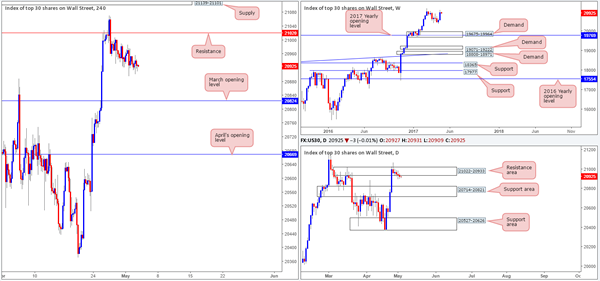
Levels to watch/live orders:
- Buys: 20824 looks an interesting level for longs. However, we would require a H4 bullish candle to present itself here (preferably a full-bodied candle) before committing (stop loss: ideally beyond the candle's tail).
- Sells: Flat (stop loss: N/A).
GOLD
Gold prices are effectively unchanged this morning. The metal continues to loiter around the lower edge of the daily support area seen at 1265.2-1252.1, while weekly bears continue to hold price below support at 1263.7. Although weekly flow suggests further selling could be on the cards, it would be a chancy move to sell seeing where daily price is currently positioned!
Moving across to the H4 candles, the unit remains trading between resistance drawn from 1261.0 and April's opening base line at 1248.0/March's opening base line at 1245.9.
Our suggestions: Should H4 price retest 1261.0 as resistance today and hold, we may, given the technical picture on the weekly chart, think about selling. Of course, the only grumble here is that daily price remains within a support zone (see above). Therefore, we would not consider shorts from 1261.0 UNLESS a reasonably sized H4 bearish candle forms off this line, preferably a full-bodied candle.
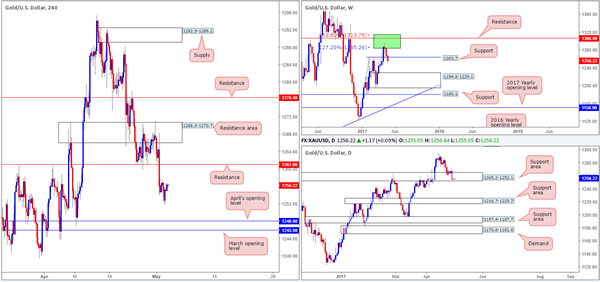
Levels to watch/live orders:
- Buys: Flat (stop loss: N/A).
- Sells: 1261.0 region ([waiting for a reasonably sized H4 bear candle to form before pulling the trigger is advised] stop loss: ideally beyond the candle's wick).
Elliott Wave View: NZDUSD Correction In Progress
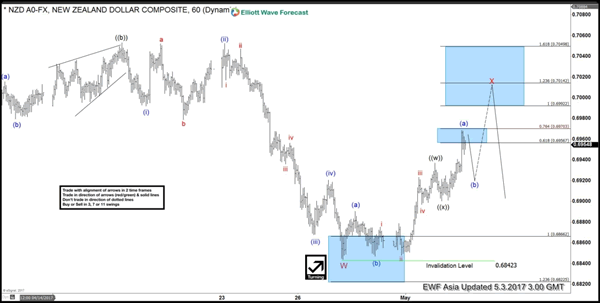
Short term Elliott Wave view in NZDUSD suggests the decline to 0.6844 low ended cycle from 3/21 high in Minor wave W. Pair is currently correcting cycle from 3/21 high in 7 or 11 swing in Minor wave X before the decline resumes. The rally from 4/27 low (0.6844) is unfolding as a double three Elliott Wave structure where Minute wave ((w)) ended at 0.6937 as a Flat Elliott wave structure , and Minute wave ((x)) pullback ended at 0.69. Near term, pair is correcting cycle from 0.69 low within Minutte wave (b) and while dips stay above there, expect pair to resume higher towards 0.699 – 0.7014 area before the decline resumes. We expect Minor wave X rally to find sellers at 0.699 – 0.705 area for an extension lower or at least a 3 waves pullback as far as pivot at 0.709 high remains intact.
NZDUSD 1 hour Elliott Wave Chart
Market Morning Briefing: The Markets Wait For The FOMC Comments Tonight
STOCKS
The Japanese markets are closed today. All other major markets are trading very quietly, mostly waiting for the FOMC comments due tonight and the second round of the French Presidential election on Sunday.
Dow (20949.89, +0.17%) has been stuck in a very narrow range of 20900-21070 for the last 6 sessions but the underlying bullishness can push the index higher towards the resistance of 21400 in the next few days.
Dax (12507.90, +0.56%) has broken into new ground this week as it trades above the 2015 high of 12390. The current rise may extend to 12600-700 before the next bout of profit booking comes.
Shanghai (3140.04, -0.12%) keeps trading in the range of 3100-3180 in line with expectations with 3100 standing firm as a major support. The sideways oscillation may keep the index in this range for the rest of the week and a directional move may be seen next week only.
Nifty (9313.80, +0.10%) has been stalling near the resistance area of 9370-9430 for the last 5 sessions with increasing risk of a correction in the medium term. While 9430 may be tested in the near term, keep any eye for a probable selloff from that area.
COMMODITIES
Muted price action had been seen in Gold (1257) as market is waiting for today's FOMC statement and FED fund rate announcement at 11.30 P.M IST.Immediate support is at 1239. Buyers will take every dip as a further opportunity for buying while it is trading above 1239. A close above 1264 could open up 1285, which could be a level where the price action has to be checked to assess the chances of further bounce to 1305.
Silver (16.78) is Oversold on the near-term charts and trading within the range of 16.50-17.02.The bias will remain bearish while it is trading below 17.50 levels.
Copper (2.61) has shown some strength as it manages to trade above its crucial support at 2.57. Recent trading range could be 2.60-2.69 and upon 2.69, higher resistances of 2.72 -80 can come into consideration.
Brent (51.73) and WTI (48.03) both had moved lower in line with our expectation. They are within their trading ranges of 50 -52. and 46.20 – 48.80 respectively. Brent may consolidate within these levels for few more sessions though the possibility of a corrective bounce towards resistance can’t be ruled out.Today we have U.S Crude inventory at 8.00 P.M IST with an expectation of a decrease of 3.3M barrel, which could be supportive for oil prices. But we will remain bearish while Brent and WTI are trading below 53 and 51 levels respectively.
FOREX
The markets wait for the FOMC comments tonight and the US jobs data on Friday to provide clues for the near term direction of Dollar. Euro and Pound remains the strongest majors with further upside possibilities emerging.
No change in the technical state for either Dollar Index (98.93) or Euro (1.0934) yet as Euro refuses to yield ground even after the initial rejection from the resistance of 1.0950-60. Coupled with the inability of Dollar to rise above the immediate resistance of 99.35-50, the chances of Euro rising past 1.0960 towards 1.10 and higher are increasing instead of the expected correction towards 1.08. In that case, Dollar may retest the major support of 98.50-00.
Dollar-Yen (112.03) has traded in the range of 111-112 for the last 2 sessions as expected but the bulls may be anxious with the proximity of the resistance of 112.30 and 112.90. From any of these resistances, a correction towards 111.00-110.50 can be expected in the next few sessions.
Pound (1.2943) is gathering fresh steam every passing session as it gets closer to our initial target of 1.3000 and now not only 1.3150 comes into consideration, even 1.3350-1.3400 may be not out of question in the coming days.
Aussie (0.7518) has shot above the immediate target of 0.7500 and now needs a break above 0.7560 to extend the rise towards 0.7600-75. Till the break comes, it may consolidate in the range of 0.7450-0.7550.
Dollar-Rupee (64.2125) ended the first session of the month in the range of 63.95-64.35 as expected. The horizontal trading in this range is expected to continue for another couple of sessions as the FOMC meet may not trigger a lot of activity in the markets.
INTEREST RATES
The US yields are range bound before FED rate announcement. The 2Yr (1.26%),5Yr (1.8%), 10YR (2.28%) and the 30YR (2.97%) are all down by 3-4 bps.
The US T Bond 10-5 Yr Short term Yld Spread (0.485) may find resistance at current levels and could come down towards 0.46-0.45 levels.