Sample Category Title
EUR/GBP Weekly Outlook
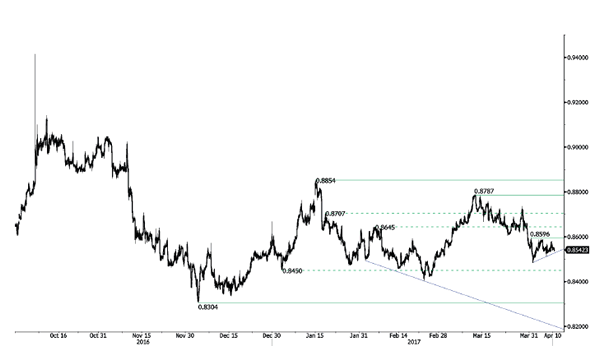
EUR/GBP recovered last week but stayed below 0.8643 minor resistance. Outlook is unchanged and intraday bias remains neutral first. Fall from 0.8851 is seen as the third leg of the corrective pattern from 0.9304. Below 0.8445 will target 0.8303 low first. Break will confirm our view and target 0.8116 key cluster support level. However, on the upside, break of 0.8643 will invalidate our view. In that case, intraday bias will be turned to the upside for 0.8851 to extend the corrective pattern from 0.8303.
In the bigger picture, price actions from 0.9304 are viewed as a medium term corrective pattern. Deeper fall cannot be ruled out yet. But we'd expect strong support from 0.8116 cluster support (50% retracement of 0.6935 to 0.9304 at 0.8120) to contain downside. Overall, the corrective pattern would take some time to complete before long term up trend resumes at a later stage. Break of 0.9304 will pave the way to 0.9799 (2008 high).
In the long term picture, firstly, price action from 0.9799 is seen as a long term corrective pattern and should have completed at 0.6935. Secondly, rise from 0.6935 is likely resuming up trend from 0.5680 (2000 low). Thirdly, this is supported by the impulsive structure of the rise from 0.6935 to 0.9304. Hence, after the consolidation from 0.9304 completes, we'd expect another medium term up trend to target 0.9799 high and above.


Subscribe to our daily and mid-day newsletter to get this report delivered to your mail box
EUR/AUD Weekly Outlook
EUR/AUD dropped to as low as 1.3722 last week before forming a temporary low and recovered. Initial bias is neutral this week first. We're holding on to the view that price actions from 1.6587 are corrective in nature. Thus, we'd expect strong support from 1.3671 key level to contain downside and bring rebound. Decisive break of 1.4025 support turned resistance will indicate near term reversal. In this case, intraday bias will be turned back to the upside for 1.4289 resistance first.
In the bigger picture, price actions from 1.6587 medium term top are viewed as a corrective pattern. We'd expect strong support from 1.3671 key level to contain downside and bring rebound. Up trend from 1.1602 should not be finished and will resume later. Break of 1.4721 resistance will indicate completion of such correction and turn outlook bullish for retesting 1.6587 high. However, sustained break of 1.3671 will invalidate our bullish view and would turn focus back to 1.1602 long term bottom.
In the longer term picture, the rise from 1.1602 long term bottom isn't over yet. We'll keep monitoring the development but there is prospect of extending the rise to 61.8% retracement of 2.1127 to 1.1602 at 1.7488 and above. However, break of 1.3671 should confirm trend reversal and target 1.1602 long term bottom again.


Subscribe to our daily and mid-day newsletter to get this report delivered to your mail box
EUR/CHF Weekly Outlook
EUR/CHF spiraled lower last week but closed inside established range. Outlook is unchanged and initial bias remains neutral this week first. With 1.0706 resistance intact, outlook stays bearish and deeper decline is expected. Firm break of 1.0620 key support level will extend the larger decline from 1.1198 to 1.0485 fibonacci level. However, break of 1.0706 resistance will indicate short term bottoming and turn bias back to the upside. Further break of 1.0749 resistance will raise the chance of medium reversal.
In the bigger picture, the decline from 1.1198 is seen as a corrective move. Such correction is still in progress. Sustained trading below 38.2% retracement of 0.9771 to 1.1198 at 1.0653 will target 50% retracement at 1.0485. On the upside, break of 1.0897 resistance is needed to confirm completion of such fall. Otherwise, outlook will stay bearish.


Subscribe to our daily and mid-day newsletter to get this report delivered to your mail box
Weekly Economic and Financial Commentary
U.S. Review
Yellen on The Hill
- Retail sales grew a stronger than expected 0.4 percent in January, a sign that consumer spending will continue to be a solid support to GDP growth in Q1.
- Inflation measures surprised to the upside in January with both the Consumer Price Index and the Producer Price Index climbing 0.6 percent for the month. Core inflation measures also remained firm for the month.
- Housing starts fell 2.6 percent in January after rising 11.3 percent in December. Single-family starts still posted an increase for the month. The more forward looking permit data indicated that the downshift in starts may be temporary.
Yellen on The Hill
Federal Open Market Committee (FOMC) Chair Yellen went to Capitol Hill for her semiannual testimony. While uneventful for the most part, clear signals were sent that the FOMC intends to hike rates at a slightly faster pace this year. With respect to understanding when the FOMC may decide to halt reinvestments of maturing portfolio holdings, Yellen indicated that in order to consider reducing the size of the Fed's balance sheet, the committee wants to ensure that "the economy is on a solid course and the federal funds rate has reached levels where we have some ability to address weakness by cutting it." She reiterated the Fed's monetary policy normalization principals including the fact that the committee will continue to reinvest principal payments on maturing assets until "normalization of the level of the federal funds rate is well underway."
Retail sales data for January posted an impressive 0.6 percent gain on the back of a one percent rise in December. Control group sales, which feed into the calculation of GDP, rose 0.4 percent to start the year. Some of the gain, however, is likely due to higher inflation boosting the nominally reported sales figures. Headline CPI rose 0.3 percent in January, taking the year-over-year rate of consumer inflation to 2.5 percent. Core consumer inflation edged higher to 2.3 percent on a year-over-year basis. Taken together, we remain comfortable with our call for real consumer spending to expand at a 2.7 percent pace in the first quarter, slightly stronger than the 2.5 percent pace observed in the fourth quarter of 2016.
Housing starts fell 2.6 percent in January to a 1.25 million units pace after posting an impressive 11.3 percent gain in December. The more volatile multi-family starts pulled back for the month while single family starts rose 1.9 percent. The forward-looking housing permits data indicated that the downshift is likely temporary. The NAHB/Wells Fargo Housing Market Index fell in February suggesting that some of the post-election jump in builder sentiment has begun to fade. Looking ahead to the rest of this year, we continue to expect home building activity to remain steady with housing starts climbing to 1.22 million units from 2016's 1.17 million units put in place.
Industrial production fell 0.3 percent in January as a drop in utilities output weighed on the index. The plunge in utilities output due to the warmer weather for the month was the largest declines since January of 2006. Manufacturing output rose 0.2 percent in a sign that the sector was slowly improving. That said, the industrial sector of the economy continues to face headwinds from a strong U.S. Dollar and soft global demand.
Business inventories rose 0.4 percent in December in an early sign that businesses are beginning to feel a bit more optimistic about future growth prospects. Total sales were up 2 percent with gains across the supply chain. Inventories have boosted growth over the last couple of quarters but given that the pace of sales and inventory building appear to be more in line, we expect inventories to have a negligible effect on GDP growth this year.


U.S. Outlook
Existing Home Sales • Wednesday
Following three straight monthly gains, existing home sales slipped 2.8 percent to a 5.49 million-unit annual rate in December. Despite the drop, existing home sales rose solidly in 2016, with total sales increasing 3.8 percent to finish the year at 5.45 million units—the highest level since 2006.
Lean inventories continue to restrain resale activity, however, with homes available for sale down 6.3 percent year over year. The supply of lower-priced homes has been particularly tight, with sales of homes priced under $100,000 accounting for a smaller share of overall sales in recent years. The lack of listings at more affordable price points, coupled with higher borrowing costs, will likely continue to hold back first-time homebuyers.
We look for existing home sales to rise a modest 1.5 percent in January to a 5.57 million-unit annual rate.
Previous: 5.49 Million Wells Fargo: 5.57 Million Consensus: 5.55 Million

New Home Sales • Friday
New home sales ended 2016 on a weak note, falling 10.4 percent in December. Despite the monthly decline, home sales rose a solid 12.4 percent in 2016, increasing to 563,000 homes. Home prices have continued to rise, with the median price of a new home increasing 5.7 percent over the year to $313,200. Homebuilders have struggled to contain housing costs as supply-side issues including labor shortages and lack of buildable lots are driving prices higher.
A spike in mortgage rates likely dampened sales in December. On average, mortgage rates were 43 basis points higher in December relative to the prior month, rising to 4.2 percent. While interest rates remain historically low, we expect home sales to rise modestly in the first half of 2017 as consumers adjust to higher borrowing costs.
Previous: 536,000 Wells Fargo: 566,000 Consensus: 575,000

Consumer Sentiment • Friday
University of Michigan's consumer sentiment index inched up in January to a cycle-high at 98.5. The elevated reading coincides with other survey measures that increased markedly in the wake of the U.S. presidential election, in part, due to heightened prospects for economic growth. The preliminary February release reported a decline in sentiment, however, with the majority of the softness occurring in the expectations component.
The U.S. consumer has been the backbone of the current economic cycle, supported by a relatively strong recovery in employment and some help from real personal income growth. The better-thanexpected retail sales report this week was an encouraging signal of continued consumer strength. We look to next week's sentiment indicator for further clarity on consumers' attitudes about future spending.
Previous: 95.7 Consensus: 96.0

Global Review
Japan Strings Together Four Quarters of Growth in 2016
- Preliminary estimates released this week suggest that the Japanese economy expanded at an annualized rate of 1.0 percent in the fourth quarter.
- While that was a shade lighter that most analysts had forecast, it marks the first time that Japan has had positive GDP growth for all four quarters of the year since 2005.
Japan GDP Expands for Fourth Quarter
Advance estimates for fourth quarter GDP in Japan were released this week and while the figures were generally weaker-thanconsensus expectations, the report affirms that the trade-led recovery in Japan continues. The annualized growth rate of 1.0 percent was a shade softer than the 1.1 percent that had been expected. However, it was the fourth straight quarterly increase— the longest stretch of uninterrupted growth since 2013. In addition, it is the first time the Japanese economy has expanded in all four quarters of a calendar year since 2005.
Net exports have been a steady driver of Japanese growth in recent quarters and that was the case here in the fourth quarter as well. Despite the fact that consumer spending was unchanged, imports increased 1.3 percent. The demand pull came from the business sector as business investment climbed 0.9 percent. Exports, meanwhile, increased 2.6 percent.
It has been more than four years since Prime Minister Shinzo Abe came to power in Japan largely on a platform to lift the Japanese economy through fiscal and monetary expansion and other structural reforms. While the track record of Abenomics has been mixed, this fourth quarterly increase is something of a milestone. Given the important role of trade in the Japanese expansion, it is little wonder that Prime Minister Abe was eager to meet with his newly elected counterpart in the United States last week. After years of diplomacy with the Obama administration to shore up support for the Trans-Pacific Partnership, the dismissal of that trade pact by the new U.S. president is certainly not a positive development for Japan.
The United States and China are roughly tied for the spot of Japan's largest export market, with Korea coming in a very distant third, so some eagerness on Abe's part to work out a bilateral trade deal is understandable.
BoJ Still Supportive
In January, the Bank of Japan (BoJ) increased its forecast for 2017 GDP to 1.4 percent from the 1.0 percent forecast it had previously. The BoJ is not likely to alter its current policy based on this latest GDP report.
The BoJ is still engaged in what it has called "yield curve control," which it maintains through a negative short-term policy rate and by engaging in purchases of 10-year Japanese Government Bonds (JGB) such that the yield on 10-year JGB remains at or near zero. The BoJ's asset purchase program, which is injecting cash into the financial system via bank purchases of a variety of financial instruments, including ETF and REITs, is also still ongoing as are various fund provisioning measures to stimulate bank lending and to provide relief for disaster areas affected by earthquakes. The ¥28 trillion fiscal stimulus is also underway in Japan and should underpin growth through the first quarter. In short, fiscal and monetary policies in Japan are both supportive; continued improvement in global growth and healthy trade could help the Japanese economy stretch its win streak to five quarters.


Global Outlook
Eurozone Manufacturing PMI• Tuesday
After recording the highest level in almost three years, up to 55.2, the Eurozone preliminary manufacturing PMI for February is scheduled to hit the wire next week. The Markit Eurozone manufacturing PMI has been coming up slowly and uninterrupted since August of last year and a new strengthening of this index in February could continue to push expectation of an overdue manufacturing recovery in the region, following a similar pattern at this side of the Hemisphere.
With the weakening of the euro over the last year or so the expansion in manufacturing is probably expected to continue as the global economy continues to improve and manufacturing output from the region regains some lost competitiveness over the previous years.
Previous: 55.2 Consensus: 55.0

Germany Manufacturing PMI • Tuesday
The German Markit/BME manufacturing PMI is also on the docket for Tuesday and similarly with the Eurozone index, the January reading was the highest in almost three years, up to 56.4 from a previous reading of 55.6 in December. It is clear that it is Germany in the driver's seat of the manufacturing recovery in this cycle, something that should not surprise those that follow the German economy and the overall Eurozone economy.
Germany is also going to release its IFO business climate report, economic expectations index, as well as its current economic assessment for February on Wednesday. The first two of these indices were a tad lower on January while the third one was slightly better. We will also see the final reading on Q4 GDP and whole year GDP, which includes all the demand components. Meanwhile, closing the week we will get the Gfk consumer confidence index for March, which hit a high of 10.2 in February.
Previous: 56.4 Consensus: 56.0

Mexico Q4 GDP • Wednesday
Although Mexico released a "flash" GDP result for the last quarter of 2016 and for the whole year, the statistical institute is in the docket to release the more informative supply side GDP sector breakdown on Wednesday as well as the economic activity index for December of 2016. From the economic activity index we will be able to gauge the strength of the Mexican economy during the last month of 2016 while from the broader supply side result we will be able to make some inferences on the demand side of the economy by looking at commerce, construction, utilities, hotels, manufacturing, etc.
It is clear that the slowdown that has hit the productive sector over the last year or so has still to be reflected in domestic demand so this first exercise at inferring demand side components from the supply side could yield some more insights from what we should expect for the Mexican economy in 2017.
Previous: 2.2% Consensus: 2.0%

Point of View
Interest Rate Watch
Highlights from the Hill
If markets were looking for a strong hint that the FOMC would make its next move as soon as the March meeting, they did not get it from Chair Yellen this week. In her semi-annual testimony to Congress, Yellen held a steady line between emphasizing the continued progress in the economy and that only gradual increases in the fed funds rate would be warranted.
Stronger inflation readings from the PPI and CPI this week helped to raise market expectations for a fed funds rate hike in March. On Monday, markets were pricing in a 30 percent chance of a rate hike with the probability rising to 44 percent on Wednesday after the CPI release. However, with Yellen's view of inflation appearing little changed after these reports, market expectations for a March increase have fallen back to the low 30s. We continue to expect the next rate hike to come in June.
Fiscal Policy Only Part of Equation
Much has been made about the potential for faster tightening this year amid plans for more supportive fiscal policy. Yet here too Yellen's outlook seemed little changed from previous comments. With little detail on what fiscal policy may look like, Yellen remains hesitant to alter her outlook at the moment. And while any changes in fiscal policy are more likely than not to be supportive of growth, she also emphasized that U.S. fiscal policy is only one of many factors influencing monetary policy.
No Plans for the Balance Sheet
With markets more convinced that the Fed will raise rates multiple times this year, increased attention has been put on the Fed's balance sheet. In her remarks, Yellen noted that the Fed will continue its policy of reinvesting maturing debt.
When pressed on the timing of such a policy change, Yellen said shrinking the balance sheet would not occur until interest rates were high enough to where they could be meaningfully cut if the economy weakened. In other words, the FOMC remains in no hurry to shrink the balance sheet despite some regional Fed presidents beginning to discuss it more publicly.


Credit Market Insights
Consumer Credit Standards Tighten
Consumer credit standards tightened modestly in the fourth quarter according to the most recent Senior Loan Officer Opinion Survey. A net 3.1 percent of bank respondents reported being more willing to make consumer installment loans, down from 12.5 percent in Q3. The decline coincides with the cyclical trend witnessed over the past several business cycles, which shows banks' willingness to lend picking up early in economic recoveries and falling in the latter stages of the business cycle.
Lending standards for consumer loans tightened modestly across the board in the fourth quarter. A net 8.3 percent of banks reported tightening standards for credit cards, which marks the first quarter of net tightening since 2010. Similarly, standards for auto loans also constricted with a net 11.7 percent of lenders tightening standards, the largest share since 2011. Notably, banks expect to continue to tighten auto lending standards in 2017. On the flip side, the majority of banks expect to ease lending standards for mortgage loans over the year, which should help offset some of the drag from rising interest rates.
Despite the signs of some modest tightening in consumer credit standards, household leverage remains low relative to the bubbly period before the Great Recession. In addition, the tightest labor market in a decade ought to spur a pickup in wage growth in 2017, which should help keep personal consumption growth on solid footing.
Topic of the Week
Populist Push in Europe
Populist and nationalist forces appear to be ascendant in many countries. Three large Eurozone economies, the Netherlands, France and Germany, hold important elections in coming months, elections that may determine the future of the Eurozone. Approaching quickly is the election to the Dutch parliament, which will be held on March 15. The populist Party for Freedom (PVV), an anti-immigration and anti-EU party, is expected to garner the most votes. However, a plurality of votes, rather than a majority, means that the PVV would have to form a coalition government, and most centrist parties have ruled out cooperating with the PVV. That said, a better-than-expected showing by the PVV could induce a negative market reaction.
France's presidential election, which contains two rounds, will occur on April 23 and May 7. Marine Le Pen, the leader of the EU-skeptic National Front, likely would be one of the top two vote-getters if the first round of the French presidential election were held today. However, most polls currently show that either François Fillon, leader of the center-right Republicans and Emmanuel Macron, leader of the independent En Marche! party would handedly beat Le Pen by 60 percent or more of the vote in a second round. However, if political events since last June have taught us anything it is that political polls can be widely off the mark. Could a President Le Pen unilaterally take France out of the European Union? No. EU membership is enshrined in the French constitution, so "Frexit" would require an amendment to the French constitution.
Germany, will hold elections for the Bundestag, the lower house of the German parliament, on Sept. 24. Angela Merkel, who is the leader of the CDU and who has been the German chancellor since November 2005, is in a neck-to-neck race to retain her chancellorship. The probability that an EU-skeptic party comes to power in Germany following the Sept. 24 Bundestag elections is even lower than it is in either the Netherlands or France. The full report can be found on our website.


The Weekly Bottom Line
HIGHLIGHTS OF THE WEEK
United States
- Despite heightened political uncertainty it was another good week in equity markets, with the three U.S. benchmarks reaching peaks mid-week before retracing somewhat ahead of the weekend.
- U.S. data came in well above expectations with survey indicators from the NFIB, as well as the New York and Philly Federal Reserve Banks rising to multi-year highs. The optimism was also prevalent across harder data, with retail sales as well as consumer and producer inflation metrics surprising to the upside.
- Together with the stronger data, Chair Yellen's testimony where she indicated it "unwise" to wait too long to remove accommodation, boosted the odds of a March hike. Nevertheless, we continue to anticipate the Fed will wait until mid-year to raise rates next.
Canada
- It was a busy week for the jet-setting Canadian Prime Minister with stops in Washington D.C. and Europe. In both cases, trade was on the agenda. Canada received some reassurance from the U.S. President on the strength of the relationship between the two countries, but he also noted that NAFTA would be "tweaked."
- With the approval of the free-trade deal between Canada and the European Union by the European Parliament, the agreement has passed another important hurdle. The deal will eliminate tariffs on 99% of trade between the jurisdictions and should help to diversify Canada's trade.
- Canada's housing market is showing some signs of slowing down, especially in terms of home sales. Nonetheless, tight supply in Canada's hottest markets have kept upward pressure on prices, which are up over 20% year-on-year.

UNITED STATES - ANIMAL SPIRITS CONTINUE TO TRUMP ANXIETY
Investors continued to be enamored by the potential for growth-inducing policies of President Trump this Valentine's Day week despite relatively few details. While politics continued to drive headlines, financial markets were more focused on healthy earnings and robust economic data. The three main U.S. equity indices hit record highs on Wednesday, before paring back some gains through this morning. The sell-off in the bond market, which saw the U.S. 10-year Treasury rise near 2.5% by mid-week as Janet Yellen testified to Congress, also reversed course recently, with the benchmark falling to 2.4% by this morning. Oil remained largely range bound, as the support from realized cuts by OPEC were offset by rapidly rising inventories in the U.S. where production has been recovering in recent months.
News across the Atlantic was largely lackluster this week. The economy of the Eurozone area grew by 1.6% in the final quarter of last year, missing expectations for a 2.0% pace of growth. The U.K. economy also exhibited signs of weakness, with retail sales declining in January. The result missed expectations for a rebound from December's large decline, and suggests that Brexit anxiety and rising prices related to the falling pound are beginning to affect U.K. consumers who previously appeared unfazed by the vote results. Greece is also beginning to make headlines as a rift between European officials and the IMF looks to delay the next disbursement of much needed funds, while anxiety about upcoming elections in France is having investors rethinking holding French bonds.
Political uncertainty remained on the back-burner in the U.S. as investors focused on healthy earnings growth with U.S. corporate profits looking to grow by over 6% after three quarters of declines. Moreover, the animal spirits that have been driving stock markets since the election appear to also be showing up in the economic data.
Much of the positive sentiment can be found in survey data. This week, the NFIB's Small Business Optimism index surprised to the upside, rising to the highest level since December 2004, while both the Empire and Philly indices - the earliest indicators of February activity - rallied strongly (Chart 1), with the latter at a more than three-decade high. The positive news was not limited to survey data, however, with retail sales also surprising to the upside in January, rising by 0.4% on the month from an upwardly revised 1.0% gain in January. This performance suggests that the consumer is becoming increasingly confident to spend and should remain a key support for the U.S. economy this year as job gains eat up slack and push wages higher.
The reduction in slack also appears to be manifesting in higher prices. Both the core CPI and PPI measures surpassed expectations, rising by 0.3% and 0.4% in January, respectively, with the headline consumer inflation measure accelerating to 2.5% (see Chart 2). The hotter-than-expected data is adding pressure on the Fed to not fall behind the curve. In her testimony to Congress this week Chair Yellen highlighted that waiting too long to remove accommodation would be "unwise," suggesting that the Fed could raise rates in the near-future. While a March or May hike is not off the table should the data continue to come in above expectations, we remain of the view that the Fed will wait until June to raise rates.


CANADA - MR TRUDEAU GOES TO WASHINGTON (AND EUROPE Too)
It was a busy week for the Canadian Prime Minister. On Monday, Justin Trudeau was in Washington for meetings with the Trump administration and members of Congress. He was there to promote Canada's close economic relationship with the United States and to get some reassurance that the bond will remain strong. President Trump for his part, lent some credence to this view, praising the close relationship with Canada. But, on a direct question about NAFTA, he still noted that the agreement will be tweaked, adding that it would be in ways that would benefit both countries.
Even if there are only minor tweaks made to NAFTA as far as Canada is concerned, other policy changes, particularly to U.S. taxes could still prove disruptive. Of particular concern are proposed changes to corporate income taxes that would include a border adjustment tax that would effectively raise prices of all U.S. imports by as much as 20%. Exchange rates would likely adjust with the Canadian dollar falling against its U.S. counterpart to make up for the change in relative prices. But, despite the exchange rate rebalancing, the measure could still present quite a shock. A recent report by the C.D. Howe argues that the disruption to supply chains could cut Canadian real GDP by as much as 1.0%.
There have been few moves on the tax front in Washington over the last few weeks, with the exception of a statement from the President that he would be announcing details for a "phenomenal" package within the next few weeks. Within Congress, tax reform appears to have taken a back seat to changes to healthcare legislation. In the meantime, there appears to be a growing opposition to the border adjustment tax within the political and business community in the United States that may yet prevent it from moving forward. Still, given the potential size of the shock to Canada and other trading partners, it will remain an important area to watch.
Not long after his trip to the U.S., Trudeau was off once again, this time to Europe to celebrate the approval by the European Parliament of Canada's free trade deal with the European Union. The deal eliminates 99% of the tariffs on goods traded between the two jurisdictions. It also opens up government procurement and reduces non-trade barriers in services by standardizing rules across major sectors. While the trade deal will not reduce the importance of NAFTA, it should help diversify Canada's trade and bring benefits to consumers through lower prices.
On the home front, data on existing home sales showed a continued slowdown in activity, and considerable divergence in price growth across the country. The hottest markets in the country are those around the Greater Toronto Area, where prices are up over 20% over the last year. There is little doubt that the sharp rise in prices has cut into affordability and is unlikely to be sustained. However, one point of caution on an expectation for a major turnaround in prices is that the supply of listings remains very tight. Across the country, new listings fell even more than sales in January, bringing the months' supply of existing homes for sale to its lowest level in years. While downside risks are building, the limited supply suggests that a deceleration in home price growth is more likely than a sharp reversal.


FOMC & RBA February Meeting Minutes, Key Data in Focus
Next week's market movers
- In the US, the Fed will release the minutes of its February meeting. Markets will probably focus on any signals regarding the timing of the next rate hike.
- We get February meeting minutes from the Reserve Bank of Australia as well. We will look for any hints on how much further Aussie appreciation the Bank is willing to tolerate.
- We also get key economic data from Eurozone, Germany, the UK and Canada.
On Monday, we have a quiet day, with no major events or indicators on the economic agenda. Markets will remain closed in the US and Canada in celebration of Presidents' Day and Family Day respectively.
On Tuesday, the RBA will release the minutes from its February policy meeting. The tone of the statement accompanying that decision was surprisingly optimistic in our view, as the officials basically disregarded the latest mixed batch of data out of Australia. They indicated that although GDP growth was negative in Q3, this was due to temporary factors, and a return to reasonable growth is expected in Q4. With regards to the slip in the underlying inflation rate for Q4, the RBA simply indicated that the CPIs were more or less in line with their forecasts, and that even though inflation remains low, it is expected to return to target over time. We will go through the minutes in order to confirm whether the officials are indeed as confident on the domestic economy as the statement led us to believe. What's more, another theme that may attract attention is their view on the AUD. The RBA has repeatedly expressed its desire for a weaker currency and the market has not been paying a lot of attention to that. However, considering our recent experience with the RBNZ's verbal intervention, we will scan the minutes for any clues on how dissatisfied the RBA is with the recent strength of AUD, and whether it may choose to utilize similar tactics to those of the RBNZ in the future.

We also get the preliminary manufacturing and services PMIs for February from several European nations and the Eurozone as a whole. Eurozone's composite PMI report for January was very upbeat on all fronts, indicating strong employment growth, intensifying inflationary pressures, and a relatively robust pace of economic growth. February's forecast is for the index to have remained more or less unchanged, but still at an elevated level, something that would undoubtedly be encouraging news for ECB policymakers. Will that be enough to make the ECB shift to a more neutral stance though? We doubt it. At the latest ECB press conference, Draghi made it clear that the Bank intends to keep its current policy unchanged until there is a convincing upward trend in the core CPI rate, which has been range-bound for two years now. As such, we maintain the view that although forward-looking indicators are improving, the ECB is unlikely to risk shifting to a more upbeat bias anytime soon.
If it does, the resultant surge in the euro that would probably take place as investors begin to speculate "ECB tapering", could lead to a tightening in financial conditions, thereby putting at risk the prospect of a sustained uptrend in inflation.

On Wednesday, the main event will be in the US, where the Fed will release the minutes from its February policy meeting. Considering that this was one of the meetings that was not accompanied by a press conference or updated forecasts, we think that the market may look through the minutes for extra details on the Fed's forward guidance and the timing of the next increase in borrowing costs. This week, in her semi-annual testimony before Congress, Chair Yellen was quite optimistic with regards to a near-term hike, indicating that a hike will likely be appropriate at one of the upcoming meetings if employment and inflation evolve in line with the Fed's expectations. Following her appearances, the probability for a March hike rose somewhat, though it has since reverted back to its prior levels, despite incoming economic data being stronger than expected overall. Nevertheless, we believe that in case we get optimistic signals from the minutes as well, that probability could increase once again. Considering that the data the Committee had access to at that time were solid, since the disappointing wage growth print for January had yet to be released, we could indeed get some hawkish commentary.
Having said that, we maintain our view that the FOMC is unlikely to rush into a March hike amid lackluster wage growth and heightened uncertainty around fiscal policy. Therefore, we still expect the next rate hike to come in June. We would like to see some clarity around fiscal reform, some acceleration in wage growth, as well as an uptick in the core PCE price index rate, before we reconsider this view.

n the UK, the 2nd estimate of Q4 GDP is due out. The 1st estimate showed that economic growth held steady at +0.6% on a quarterly basis, beating the consensus for a slight slowdown. This was another confirmation that the UK economy has not been hit by Brexit uncertainties, at least not yet. With regards to the 2nd revision, we see the case for GDP growth to remain unchanged, with risks skewed to the upside. Industrial production for December, which was released after the 1st estimate of GDP, beat expectations significantly. As such, we conclude that if there is any revision, it is likely to be upwards.

In Germany, the Ifo survey for February is due out. The forecast is for both the expectations and the current conditions indices to have declined marginally, which is also supported by the slides in both the ZEW indices. In any case, we don't expect these results to be particularly worrisome for the ECB. As we noted above, the Bank's main concern for now is the core CPI rate.

On Thursday, we have no major events or indicators due to be released.
On Friday, Canada's CPI data for January are due out. In the absence of any forecast, we see the case for both the headline and the core CPI rates to have risen again. We base our view on the nation's Markit manufacturing PMI for the month, which showed that as a result of higher input costs, manufacturers raised their prices at one of the fastest paces since early 2014. Although we expect both rates to have risen, considering January's yearly change in oil prices, the headline rate is likely to have increased by more than the core, something that has already become evident in the CPI prints of many advanced economies. Coming on top of the remarkably strong employment data for the month, another improvement in the CPI rates is likely to be a welcome development for the BoC, which at its latest policy meeting signaled that a rate cut is still on the table should downside risks materialize. Accelerating CPIs could diminish somewhat the likelihood for the Bank to introduce any further easing, at least in the near term.

Week Ahead Dollar Higher Ahead of Fed Minutes
Notes from Fed to boost Dollar on short US trading week
The U.S. dollar is higher against most major pairs ahead of the Presidents Day long weekend. American economic fundamentals had a strong week, but failed to gain traction given the rise of political risk as Trump's administration continues to send mixed messages to markets. The stock market and safe havens like gold and the Japanese yen finished higher against the dollar in a very political week.
The Federal Open Market Committee (FOMC) meeting in February reenergized the greenback and started the current USD rally. The minutes from that monetary policy meeting will be published on Wednesday, February 22 at 2:00 pm EST (7:00 pm GMT). Fed member comments since then have confirmed the high probability of multiple rate hikes this year, although according to the CME FedWatch tool the market remains unconvinced showing a higher than 80 percent probability of the central bank keeping rates unchanged in March. Fed member Jeffery Lacker said that the market could be caught by surprise. The biggest threat to the dollar has been the political climate. Scandals on the national security front have raised red flags on the inexperience of the Trump administration.
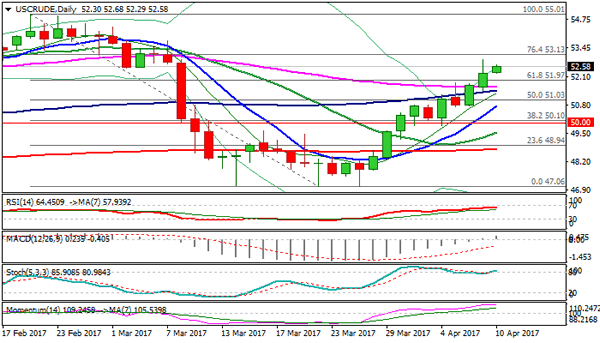
The holiday on Monday will push the release of U.S. crude inventories back a day. The U.S. Energy Information Administration (EIA) will release its weekly statistics on Thursday, February 23 at 10:30 am EST (3:30 pm GMT). The price West Texas has not been able to push above $54 despite the efforts of the Organization of the Petroleum Exporting Countries (OPEC) to communicate the success of their production cut agreement. The main factor keeping crude at current levels is the growth of U.S. production that have kept prices in a tight range for most of 2017 even as the OPEC have hinted at an extension to their six month deal.
The EUR/USD lost 0.518 percent in the last five days. The single pair is trading at 1.0613 which is a surprise given the very strong economic data out of the U.S. this week. Strong inflation, manufacturing and retail sales data along with hawkish words from Fed Chair Janet Yellen on her testimonies before congress should have the USD trading higher. Political scandals have made the French election even more unpredictable weakening the euro, but the so-called Trump rally has been derailed by Trump himself while softening on trade has increased anti-immigrant actions all the while not given enough details on pro-growth policies to boost the USD.
Stock markets have been on a record run boosted by strong fundamentals and commentary from Fed members, but that optimism hasn't extended to the American currency. Chair Yellen provided the most quotable sound bite when she told the Senate banking committee that it would be unwise for the central bank to wait too long before hiking rates. The translation from Fedspeak to English diminishes the hawkish tone as the Fed Chair is only implying the Fed is ready to hike but more data is likely needed before making that decision. If U.S. fundamentals can continue to beat expectations like the latest releases it could be sooner rather than later for the first U.S. interest rate hike of 2017.
Oil is flat in a volatile week that saw the price of crude move in a 1.17 percent range. The price of West Texas is trading at $53.15 as the results of the production cut by OPEC members are being cancelled by rising U.S. shale production. 72 rigs have been added in 2017 as the price of crude remains over $50. There were doubts surrounding the deal between OPEC members and 11 other oil producing nations, but so far there has been compliance. The lack of a massive price surge has OPEC contemplating an extension to the original 6 month duration of the agreement.
The boom in shale oil activity in the U.S. is a direct result of stable prices and a more industry friendly administration. The biggest challenge still facing oil prices is global demand that continues to be weak despite optimistic forecasts from OPEC and the U.S. EIA that show an improvement in energy demand.
Market events to watch this week:
Monday, February 20
- 7:30pm AUD Monetary Policy Meeting Minutes
Tuesday, February 21
- 4:30pm AUD RBA Gov Lowe Speaks
Wednesday, February 22
- 4:30am GBP Second Estimate GDP q/q
- 8:30am CAD Core Retail Sales m/m
- 2:00pm USD FOMC Meeting Minutes
Thursday, February 23
- 8:30am USD Unemployment Claims
- 11:00am USD Crude Oil Inventories
- 5:30pm AUD RBA Gov Lowe Speaks
Friday, February 24
- 8:30am CAD CPI m/m
*All times EST
Weekly Focus: Industrial Cycle Looks Set to Peak
Market Movers ahead
- We look for a rise in the US PMI in February, while the index for Europe is likely to show that the recent upward trend has ended. We expect both indices to show, however, that activity remains solid.
- Minutes from the recent FOMC meeting due for publication next week are unlikely to reveal much new. Instead, the market should turn its focus to speeches from a number of FOMC members for hints on monetary policy.
- In the UK, the House of Lords is set to start debating Article 50 on Monday.
- In Norway, the oil investment survey for Q1 is set to be published next week. We do not expect significant changes compared to the latest survey.
Global macro and market themes
- After a lot of political noise, the Trump administration is finally starting to gear up the economic policy agenda.
- This may reignite the second leg of the 'Trump trade' following a brief pause.
- We recommend positioning for a stronger USD and a leap higher in US equity markets in coming months.
- US yields may also increase but the crux is the Fed's reaction to Trump's fiscal plans.
- A stronger USD and higher US yields, together with a Chinese economic slowdown, are likely to weigh on emerging market currencies over the next few months.
Canadian Dollar Steady as US Employment, Mfg. Data Beat Expectations
USD/CAD continues to have an uneventful week. The pair has edged higher on Friday as it trades at the 1.31 level. It's a quiet end to the week, with just two minor events on the schedule. Canada will release Foreign Securities Purchases, which is forecast to climb to C$11.59 billion. In the US, the CB Leading Index is expected to post a gain of 0.5% for a second straight month.
The US economy continues to perform well, as underscored by sharp economic data on Thursday. Unemployment claims were slightly higher at 239 thousand, but beat the forecast of 245 thousand. On the manufacturing front, the Philly Fed Manufacturing Index soared to 43.3 points, crushing the estimate of 18.5 points. This marked its highest level since 2011. Earlier in the week, the Empire State Manufacturing Index also climbed sharply, with a reading of 18.7, compared to the forecast of 7.2 points. The surprisingly strong data is welcome news from the manufacturing sector, which like other industrialized countries, has been battered by globalization. President Trump has promised to bring manufacturing jobs back to the US and invigorate the struggling sector. There was more good news from the inflation front, as PPI and CPI posted respectable gains of 0.6% in January, above their estimates.
With the US economy firing on all cylinders, Federal Reserve Chair Janet Yellen is in the enviable position of deciding the appropriate timing of a rate hike. Earlier this week, Yellen made her semi-annual appearance before Congress. In her testimony, Yellen sounded upbeat about the US economy. She noted that inflation is moving towards the Fed's two percent target, the labor market remains red-hot and consumer spending is strong. A rate hike appears to be just a question of time, as Yellen warned that "waiting too long to remove accommodation would be unwise". If the US economy stays on track in 2017, analysts expect two or three small rate hikes. At the same time, the Fed needs to take into account the economic stance of the new administration, which remains unclear. President Trump has promised to outline a tax reform plan in a few weeks, but has left the Fed and the markets in the dark regarding economic policy. Barring an unexpected tailspin from the economy, the Fed is likely to raise rates in the first half of 2017.
With relations between Britain and the European Union severely strained over Brexit, Canada is poised to take advantage of the situation. The EU and Canada have finalized a free trade agreement (CETA), which must now be ratified by both sides. On Tuesday, the House of Commons voted on Tuesday to adopt the agreement, as did the European Parliament. The legislation now moves to the Canadian Senate, which is expected to stamp its approval in March. CETA is expected to boost Canada-EU trade by 20 percent, which translates into $12 billion for the Canadian economy. Both sides have high hopes from the agreement. Canada is looking to reduce its dependence on the United States, which is the destination of 80 percent of Canadian exports. President Trump's protectionist stance has sent alarm bells off in Ottawa, with Trump declaring he would rip up NAFTA. Trump has since lowered the rhetoric, saying that while he wants to make significant changes with Mexico, he merely wants to "tweak" the agreement with Canada. Still, given Trump's unpredictability, Canada will be looking to build on CETA and conclude trade agreements with other countries. For the EU, this would mark the first trade agreement with a G-7 member and comes at a time when EU-US free trade talks have been suspended.
EUR/USD Mid-Day Outlook
Daily Pivots: (S1) 1.0616; (P) 1.0647 (R1) 1.0706; More.....
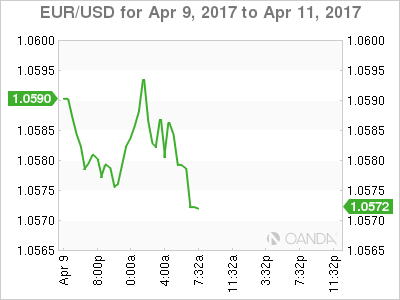
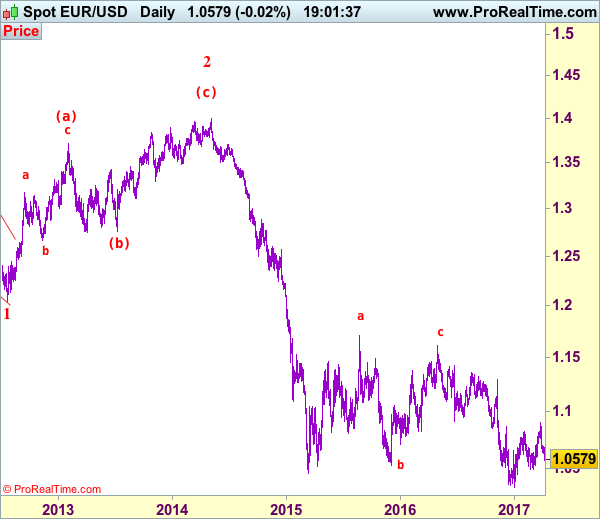
Intraday bias in EUR/USD remains neutral for consolidation above 1.0520 temporary low. As long as 1.0713 minor resistance holds, deeper decline is still expected. We're holding on to the view that fall from 1.0828 is resuming the larger down trend. Below 1.0520 will target a test on 1.0339 low. Decisive break there will confirm our bearish view and target parity. However, above 1.0713 will dampen out view and turn focus back to 1.0828 instead.
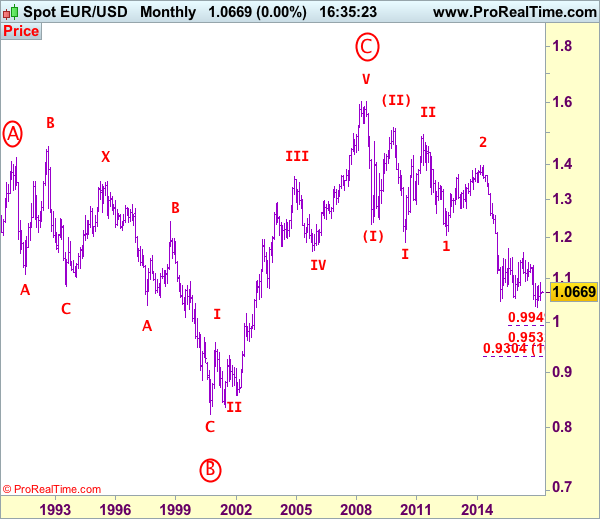
In the bigger picture, whole down trend from 1.6039 (2008 high) is in progress. Such down trend is expected to extend to 61.8% projection of 1.3993 to 1.0461 from 1.1298 at 0.9115. On the upside, break of 1.1298 resistance is needed to confirm medium term bottoming. Otherwise, outlook will stay bearish in case of rebound.


Subscribe to our daily and mid-day newsletter to get this report delivered to your mail box