Sample Category Title
AUD/USD Daily Report
Daily Pivots: (S1) 0.6528; (P) 0.6548; (R1) 0.6568; More...
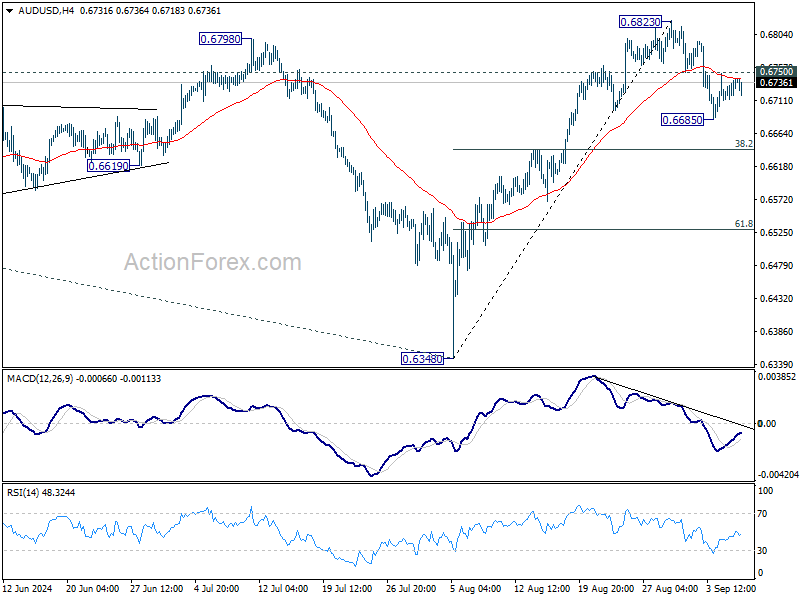
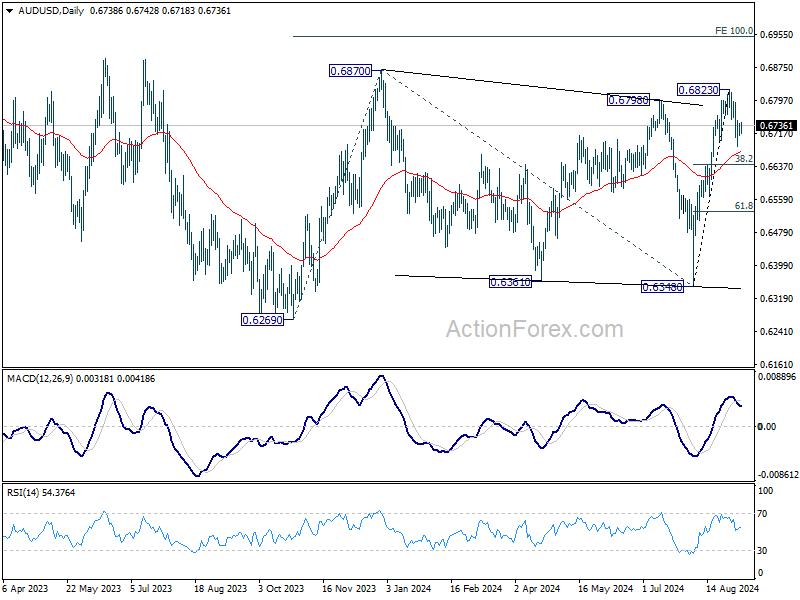
Intraday bias in AUD/USD remains neutral for consolidations above 0.6513 temporary low. Further decline is expected as long as 55 4H EMA (now at 0.6623) holds. On the downside, sustained break of 61.8% retracement of 0.6361 to 0.6798 at 0.6528 will resume the fall from 0.6798 to 0.6361 support next.
In the bigger picture, overall, price actions from 0.6169 (2022 low) are seen as a medium term corrective pattern, with fall from 0.6798 as another falling leg. Deeper fall could be seen to the lower side of the range between 0.6169/6361. But strong support should be seen there to contain downside. For now, risk will stay on the downside as long as 0.6798 resistance holds, in case of rebound.
Asian Equity Markets Kick Off the week in Good Spirits
Markets
Core bonds finished higher last Friday. US Treasury yields were unable to build on Thursday’s Q2 GDP intraday rebound. The release of some economic data including personal income & spending and June PCE deflators wouldn’t call for a net daily yield decline between 3.1 and 5.6 bps but yet that’s exactly what happened. It suggests that going into a busy week and even after a sharp correction already, the downside in yields remained vulnerable. German yields ended the day marginally lower by less than 2 bps across the curve. Stock markets caught a breather. Technical support areas (5400 zone in S&P500, 4840 zone in EuroStoXX50) lived up to the name. Europe and Wall Street easily ended more than 1% higher. The US dollar traded mixed to slightly weaker. EUR/USD as a result finished a bit higher, into the northern 1.08-1.09 half. After an impressive comeback, Japan’s yen traded near the recent highs against the dollar (USD/JPY 153.76) and the euro (166.93). Sterling rebalanced after Thursday’s sharp drop lower. EUR/GBP tested 0.845 but eventually closed virtually unchanged around 0.8437. Cable (GBP/USD) snapped a three-day losing streak, eking out a slight gain to 1.2867. UK yields followed the global example south. The 2-yr yield hit a new YtD low ahead of the Bank of England meeting later this week.
Asian equity markets kick of the week in good spirits, following the US example end last week. Japan outperforms regional peers, rising more than 2%, unbothered by the Gaza war over the weekend escalating. Israel blamed Hezbollah for a rocket explosion in the Israeli-occupied Golan Heights that killed several youngers during a soccer game. Israel retaliated on Sunday but kept the door open for diplomacy. The eco calendar is a meagre one today and its backloaded nature could keep markets on the sidelines of the trading arena. Things get interesting from tomorrow on with European Q2 GDP and national (Germany, Spain, Belgium) inflation numbers due ahead of the European figure on Wednesday. Both the Bank of Japan and the Fed have their policy meeting on Wednesday with the Bank of England’s knife-edge decision due a day later. Friday is centered around US payrolls.
News & Views
Seeking to be better prepared for a potential next term, EU officials are developing a two-step trade strategy to deal with Donald Trump and the Republicans after the November elections. The former president has already floated the idea of a 10% minimum tariff on all imports, which the EU estimates could reduce exports to the US by around €150bn annually. The bloc’s negotiators plan to approach Trump and his team before he takes office and will discuss with US products the EU could buy in larger amounts. If that fails, the EC trade department is drawing up a list of imports on which it could smack 50% or more tariffs. The carrot-and-stick approach follows after Trump in his first presidency oversaw an import levy on €6.4bn of steel and aluminium, which was then countered by the EU by tariffs of a value of less than €3bn.
G20 finance chiefs last Friday concluded a two-day meeting with a joint statement expressing increasing hopes for a soft landing of the global economy. But there are a number of risks, including wars and escalating conflicts, that could endanger this outlook. It called for more global cooperation instead and to resist protectionism as well as stressed the need to reduce economic inequalities. The communique also first the time ever argued for cooperation to effectively tax the world’s largest fortunes though it has not been agreed on how to move further from this. The G20 chiefs assessed economic risks as broadly balanced with more economic cooperation, faster-than-expected disinflation and technological innovation including AI offsetting downside risks coming from the latter, as well as economic fragmentation, climate change, excessive debt and higher-for-longer rates.
Graphs
GE 10y yield
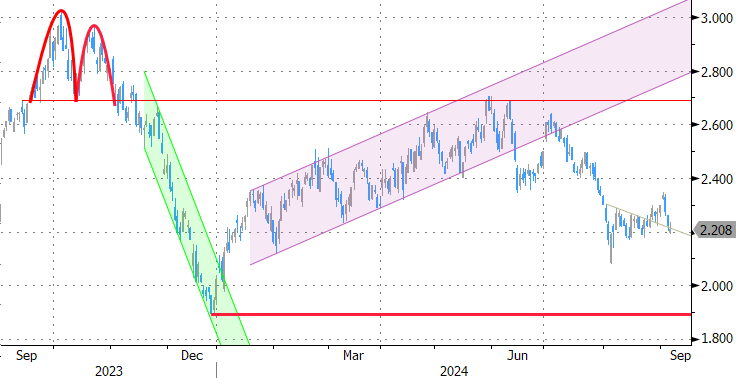
The ECB cut its key policy rates by 25 bps at the June policy meeting. A more bumpy inflation path in H2 2024, the EMU economy gradually regaining traction and the Fed’s higher for longer US strategy make follow-up moves difficult. Markets are coming to terms with that. Disappointing US and unconvincing EMU data, however, for now brings yields back to their post-French snap election low. The 2.34%-2.4% support zone looks solid.
US 10y yield
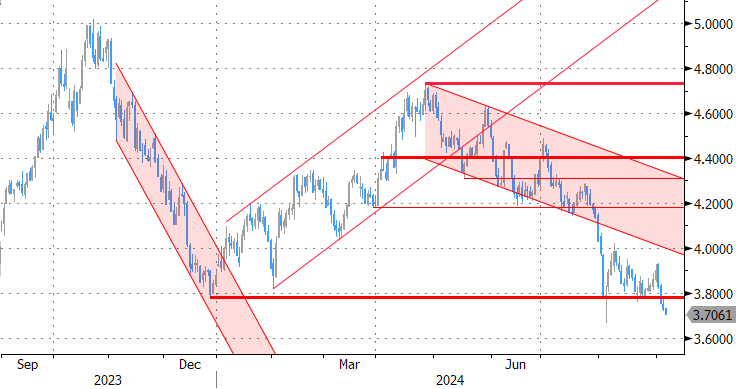
The Fed indicated that it needs more evidence to lower its policy rate. June dots suggested one move in 2024 and four next year. Disappointing ISM and back-to-back downward CPI surprises put the US money market back on more than two rate cuts this year (September/December). The US 10-yr yield tests the recent lows and the downside of the downward trend channel in the 4.2% area.
EUR/USD
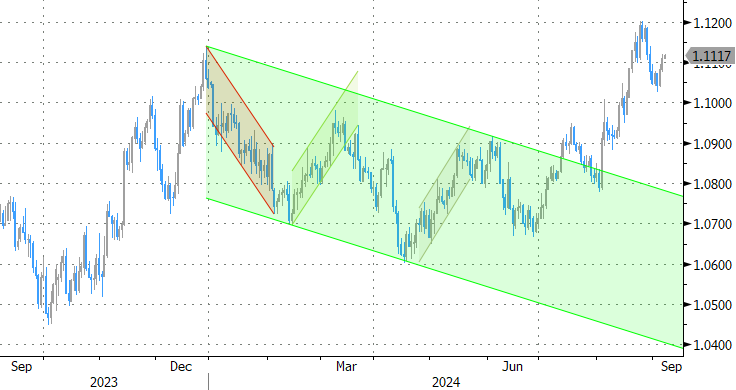
EUR/USD tested the topside of the 1.06-1.09 range as the dollar lost interest rate support at stealth pace. Markets consider a September rate cut a done deal and only need confirmation from high-ranked Fed officials. In the meantime, the euro got rid of the (French) political risk premium. EUR/USD recently evolved back to a more neutral positioning but is holding up rather well despite ongoing poor EMU data.
EUR/GBP
Debate at the BOE is focused at the timing of rate cuts. May headline inflation returned to 2%, but core measures weren’t in line with inflation sustainably returning to target any time soon. Still some BoE members at the June meeting appeared moving closer to a rate cut. Labour has yet to reveal its policy plans after securing a landslide election victory. EUR/GBP 0.84 support is being tested.
A Sense of Hope in the Market This Monday Morning
There is a sense of hope in the market this Monday morning after Friday’s PCE data boosted the expectation that the Federal Reserve (Fed) is getting very close to signaling its first rate cut in September. The core PCE came in slightly higher-than-expected – steady at 2.6% instead of a further easing to 2.5%, but the rest of the data was either in line or lower than expected. Personal income and spending for example showed easing and inflation-adjusted PCE fell to 0.2% on a monthly basis. All in all, the data was read as a green light for the Fed to confirm that September is a good time to start cutting the rates. The US 2-year yield sand below 4.40% after the data and remained under pressure in Asia this morning, the 10-year yield consolidation below 4.20%, activity on Fed funds futures gives a 100% chance for a September rate cut (with increasing pricing for a 50bp cut), and two more rate cuts are expected before the year ends. The Fed will start its two-day policy meeting tomorrow and will announce its policy decision on Wednesday. If all goes according to the plan, a strong signal for a September cut should not make a big difference – as it’s is already priced in. The risk is that we meet a slightly cautious Powell, in which case there could be some correction in dovish Fed bets. Also this week, the US jobs data will be closely watched. Due Friday, the NFP number is expected to show that the US added around 177K new nonfarm jobs in July, for steady wages growth of around 0.3% and an unemployment rate steady near 4.1%.
For now, the US dollar index remains under pressure near its 200-DMA and hovers around a key Fibonacci support – the major 38.5% retracement on this year’s rally – near 104.24. A decline below this level will – in theory – send the US dollar index into a medium term bearish consolidation zone and pave the way for a deeper downside correction. But one major hurdle to a further dollar weakness is the dovishness from the other central banks. A Fed cut will increase the probability of further rate cuts from the major central banks like the European Central Bank (ECB) and the Bank of England (BoE), which could, in return, slow down the weakening of the US dollar. In this context, the BoE could announce a 25bp rate cut when it meets on Thursday, while the ECB rate cut expectations mount on soft economic data and a disappointing earnings season.
In contrast with dovish expectations, the Bank of Japan (BoJ) is expected to announce QT this week and lower its policy rate by 10bp. The yen is in demand against most majors. If all goes according to the plan, the narrowing gap between Japan and the rest of the developed world should give the yen a further positive spin.
Focus on Big Tech
Friday was a better day for the Big Tech stocks in the US. Roundhill’s Magnificent Seven ETF rebounded 1%. But overall, last week saw accelerated rotation flows as capital moved out of Big Tech and into smaller and non-tech sectors of the market, driven by rising Fed cut bets and disappointing earnings from Google and Tesla. Nasdaq 100 slipped more than 2.50% last week and the S&P500 closed last week 0.8% down, while the equal weight index rebounded 0.8% over the week and the Russell 2000 stocks gained almost 3.5%. A dovish Fed and weak economic data could accelerate the rotation trend. As such, the Big Tech can only rely on their earnings to slow and – maybe – reverse the selloff. 4 of Magnificent Seven companies : Microsoft, Meta, Apple and Amazon are due to announce their Q2 earnings this week. Their results should not only meet but also beat the sky-high expectations.
Mounting Mid-East tensions give support to Oil
Crude oil is better bid this morning on mounting geopolitical tensions in the Middle East, after having slipped more than 2% on Friday. OPEC+ will meet this and expectations are mixed. OPEC is supposed to scale back their production restrictions next quarter, but the sluggish Chinese demand, the ample supply from Americas and the easing energy prices increase the odds of a delay of that move. Combined with boiling Mid-East, we could see oil prices in a better shape by the end of the week. Key resistance stands at $80pb.
USD/CAD Daily Outlook
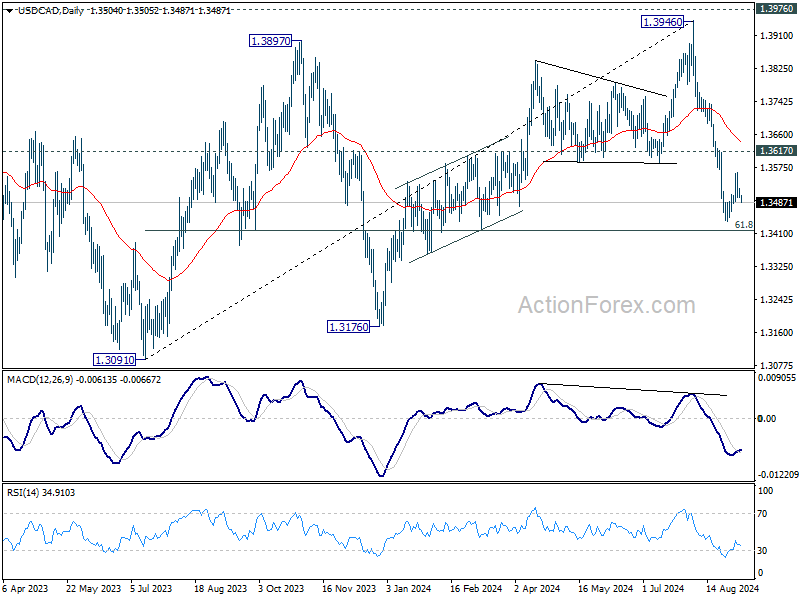
Daily Pivots: (S1) 1.3814; (P) 1.3831; (R1) 1.3856; More...
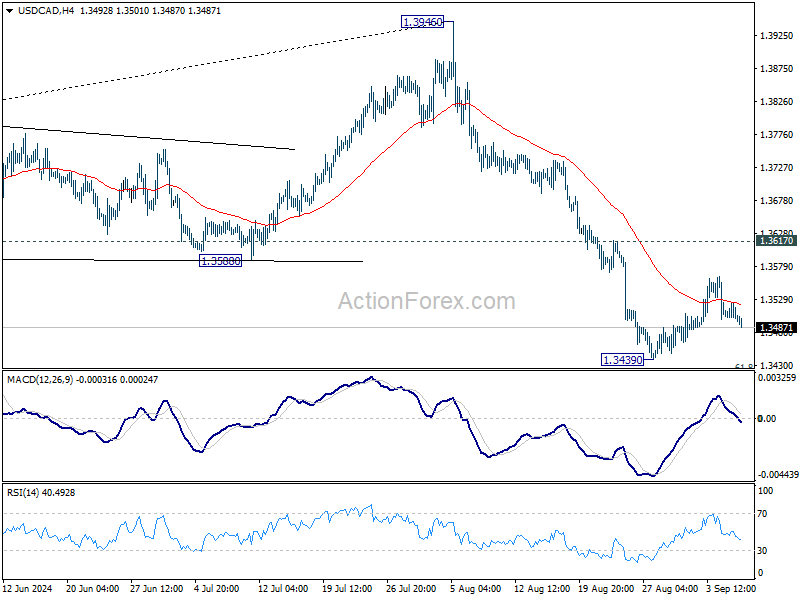
Intraday bias in USD/CAD remains neutral for consolidations below 1.3848 temporary top. Further rally is expected as long as 55 4H EMA (now at 1.3762) holds. Decisive break of 1.3845 will resume whole rally from 1.3176. Next target is 61.8% projection of 1.3176 to 1.3845 from 1.3588 at 1.4025.
In the bigger picture, price actions from 1.3976 (2022 high) are viewed as a corrective pattern, that might have completed at 1.3176 (2023 low) already. Firm break of 1.3976 will confirm resumption of whole up trend from 1.2005 (2021 low). Next target is 61.8% projection of 1.2401 to 1.3976 from 1.3176 at 1.4149. This will be the favored case as long as 1.3588 support holds, in case of pullback.
Quiet Forex Session Precedes Three Central Bank Meetings and High-Impact Data
Trading in the forex markets has been notably subdued during the Asian session today, even as major Asian stock indexes showed strong rebounds. This muted activity in currency trading is not surprising given that it's a typical Monday, coupled with an ultra light economic calendar. However, significant volatility is anticipated later in the week with a series of high-impact events on the horizon.
Three central banks are scheduled to hold meetings that could result in a rate hike, a hold, and a cut. Additionally, important economic data releases are expected, including CPI figures from Eurozone, Switzerland, and Australia, GDP data from Eurozone and Canada, and the highly anticipated non-farm payroll data from the US.
As July draws to a close, Yen remains the top performer among currencies, followed by Sterling and Swiss Franc. New Zealand Dollar is at the bottom, trailed by Australian and Canadian Dollars. Dollar and Euro are positioned in the middle. The overall picture reflects risk-off sentiment that may persist into August.
Technically, Gold is stuck in range without a clear direction for now. Prior support from rising 55 D EMA (now at 2356.89) somehow maintains its near term bullishness. Yet, rebound from 2353.00 is capped by falling 55 4H EMA (now at 2398.51). On the upside, firm break of 2431.84 resistance will suggest that the pull back from 2483.52 has completed, and larger up trend might be ready to resume. However, break of 2353.00 will extend the fall towards 2293.45 support, with risk of starting larger scale correction.
In Asia, at the time of writing, Nikkei is up 2.59%. Hong Kong HSI is up 1.85%. China Shanghai SSE is up 0.10%. Singapore Strait Times is up 0.60%. 10-year JGB yield is down -0.0327 at 1.029.
Bitcoin rises but struggles to break 70k handle
Bitcoin saw a modest rise at the beginning of this week, yet it remains below 70k mark, lacking the momentum to push past this psychological barrier. The cryptocurrency community had high hopes for Republican presidential nominee Donald Trump's keynote speech at the 2024 Bitcoin Conference over the weekend. However, the speech fell short of expectations, as Trump did not pledge to establish an official US bitcoin strategic reserve currency.
Instead, Trump promised to "keep 100% of all the bitcoin the US government currently holds or acquires into the future." He further emphasized the importance of embracing crypto technology, warning, "If we don't embrace crypto and bitcoin technology, China will, other countries will. They'll dominate, and we cannot let China dominate. They are making too much progress as it is."
Technically, Bitcoin's prior bounce from 55 D EMA is keeping the bullish outlook alive. That is, consolidation pattern from 73812 should have completed with three waves down to 53426. Near term outlook will now stay bullish as long as 63421 support holds, for retesting 73812 high first.
Decisive break of 73812 will resume larger up trend. Next target will be 61.8% projection of 24896 to 73812 from 533426 at 83656. Nevertheless, break of 63421 support will delay the bullish case, and extend the corrective pattern with another falling leg.
Fed, BoJ, BoE, and more top-tier events
The coming week promises to be exceptionally busy for financial markets with three central bank meetings and a slew of top-tier economic data on the agenda.
FOMC meeting is a relatively straight forward one. It is widely anticipated that interest rates will remain unchanged at 5.25-5.50%. The spotlight will be on any forward-looking statements, as Fed likely indicate that monetary policy is finally looming near, and pave the way for the first rate cut at next meeting in September.
While fed fund futures suggest a 64% probability of consecutive rate cuts in November and December, Chair Jerome Powell is unlikely to provide explicit hint during this meeting. Instead, Fed may defer to the forthcoming economic projections and dot plots in September for clearer guidance.
BoJ faces a tough decision, with uncertainty around whether to implement a second rate hike at this meeting. While postponing the decision to September or October is seen as feasible, the imminent meeting remains a "close call." It is more certain, however, that BoJ will outline plans to taper its bond purchases, potentially halving them in the coming years, fulfilling a commitment made at the last meeting.
BoE is also under significant scrutiny this week, with some market participants expecting a rate cut from 5.25% to 5.00%. A recent Reuters poll reflects a shift in sentiment, with 49 out of 60 economists surveyed anticipating the rate cut, a decrease in confidence from 97% in a previous June poll, showcasing growing uncertainty among economists.
BoE's history of surprising voting adds an element of unpredictability to this decision. Recent comments from BoE officials didn't suggest any consensus for a cut at this meeting. In addition to the rate decision, BoE will release new economic projections for markets to assess future monetary policy path.
Aside from central bank activities, top-tier economic data from around the globe will also play a crucial role in shaping market dynamics. In the US, consumer confidence, ADP employment, ISM manufacturing, and non-farm payrolls will be particularly influential, with the NFP report crucial for assessing the likelihood of multiple rate cuts by Fed this year. Eurozone GDP and CPI might help conclude the case for ECB to cut interest rate again in September. Likewise, Swiss CPI will also be an important piece of data for SNB to consider whether to cut interest rates again in September.
For Australia, Q2 CPI could be crucial for RBA to decide if another rate hike on August 6 to continue the inflation fight. Any significant upward surprises in CPI figures could compel RBA to act decisively, as failing to do so could impact its credibility. Ideally, RBA is hoping that both headline and underlying inflation are either continuing to decrease, or at least not accelerating. Additionally, Australian Dollar's movements will be influenced by upcoming official PMI data from China and Caixin PMI manufacturing report.
Here are some highlights for the week:
- Monday: UK M4 monthly supply, mortgage approvals;.
- Tuesday: Japan unemployment rate; Australia building approvals; Swiss KOF economic barometer; France GDP; Germany GDP; Eurozone GDP; US house price index, consumer confidence.
- Wednesday: Japan industrial production, retail sales, consumer confidence, BoJ rate decision; New Zealand ANZ business confidence; Australia CPI, retail sales; China official PMIs; Germany import prices, unemployment; Swiss UBC economic expectations; Canada GDP; US ADP employment, employment cost, Chicago PMI, pending home sales, FOMC rate decisions.
- Thursday: Japan PMI manufacturing final; Australia goods trade balance, import prices; China Caixin PMI manufacturing; Eurozone PMI manufacturing final, unemployment rate; UK PMI manufacturing final, BoE rate decision; US jobless claims, non-farm productivity, ISM manufacturing, construction spending; Canada PMI manufacturing.
- Friday: Japan monetary base; Australia PPI; Swiss CPI, PMI manufacturing; France industrial production; US non-farm payrolls, factory orders.
USD/CAD Daily Outlook
Daily Pivots: (S1) 1.3814; (P) 1.3831; (R1) 1.3856; More...
Intraday bias in USD/CAD remains neutral for consolidations below 1.3848 temporary top. Further rally is expected as long as 55 4H EMA (now at 1.3762) holds. Decisive break of 1.3845 will resume whole rally from 1.3176. Next target is 61.8% projection of 1.3176 to 1.3845 from 1.3588 at 1.4025.
In the bigger picture, price actions from 1.3976 (2022 high) are viewed as a corrective pattern, that might have completed at 1.3176 (2023 low) already. Firm break of 1.3976 will confirm resumption of whole up trend from 1.2005 (2021 low). Next target is 61.8% projection of 1.2401 to 1.3976 from 1.3176 at 1.4149. This will be the favored case as long as 1.3588 support holds, in case of pullback.
Economic Indicators Update
| GMT | Ccy | Events | Actual | Forecast | Previous | Revised |
|---|---|---|---|---|---|---|
| 08:30 | GBP | M4 Money Supply M/M Jun | -0.10% | |||
| 08:30 | GBP | Mortgage Approvals Jun | 60K | 60K |
Bitcoin rises but struggles to break 70k handle
Bitcoin saw a modest rise at the beginning of this week, yet it remains below 70k mark, lacking the momentum to push past this psychological barrier. The cryptocurrency community had high hopes for Republican presidential nominee Donald Trump's keynote speech at the 2024 Bitcoin Conference over the weekend. However, the speech fell short of expectations, as Trump did not pledge to establish an official US bitcoin strategic reserve currency.
Instead, Trump promised to "keep 100% of all the bitcoin the US government currently holds or acquires into the future." He further emphasized the importance of embracing crypto technology, warning, "If we don't embrace crypto and bitcoin technology, China will, other countries will. They'll dominate, and we cannot let China dominate. They are making too much progress as it is."
Technically, Bitcoin's prior bounce from 55 D EMA is keeping the bullish outlook alive. That is, consolidation pattern from 73812 should have completed with three waves down to 53426. Near term outlook will now stay bullish as long as 63421 support holds, for retesting 73812 high first.
Decisive break of 73812 will resume larger up trend. Next target will be 61.8% projection of 24896 to 73812 from 533426 at 83656. Nevertheless, break of 63421 support will delay the bullish case, and extend the corrective pattern with another falling leg.
EUR/USD Targets New Gains: Is a Fresh Increase on the Horizon?
Key Highlights
- EUR/USD found support near the 1.0825 zone.
- It cleared a connecting bearish trend line with resistance at 1.0860 on the 4-hour chart.
- Crude oil prices could continue to move down toward $75.00.
- Bitcoin is rising and might soon test the $70,000 resistance.
EUR/USD Technical Analysis
The Euro started a downside correction from the 1.0950 zone against the US Dollar. EUR/USD dipped below 1.0900 before the bulls appeared.
Looking at the 4-hour chart, the pair tested the 1.0825 support zone and remained stable above the 200 simple moving average (green, 4-hour). A low was formed at 1.0825 and the pair is now rising. There was a move above a connecting bearish trend line with resistance at 1.0860.
The pair climbed above the 100 simple moving average (red, 4-hour). It is now testing the 38.2% Fib retracement level of the downward move from the 1.0948 swing high to the 1.0825 low.
On the upside, the pair could face resistance near the 1.0875 level. The next resistance sits at 1.0900 or the 61.8% Fib retracement level of the downward move from the 1.0948 swing high to the 1.0825 low.
The main hurdle sits at 1.0920. A clear move above the 1.0920 resistance might send it toward the 1.0950 level. Any more gains might open the doors for a test of the 1.1000 zone in the coming days.
Immediate support is near the 1.0845 level. The next major support is near the 1.0820 level. A downside break and close below the 1.0820 support zone could open the doors for more losses. In the stated case, EUR/USD might decline toward the 1.0750 level.
Looking at Bitcoin, the bulls came into action and they seem to be aiming for a test of the $70,000 resistance zone.
Economic Releases
- Dallas Fed Manufacturing Business Index for July 2024 – Forecast -15.0, versus -15.1 previous.
Gold Bent But Not Yet Broken
Gold came close to closing lower for the second week in a row, falling to $2372 per troy ounce on Friday morning, $111 below its high on July 17th.
This decline occurred in two impulses, with an intermediate correction in between, and fits within a 61.8% Fibonacci retracement pattern from the initial decline. The extension of the pattern within the classic expansion suggests a downside target near $2320.
On the other hand, gold found buying support on Thursday and early on Friday at the crossover of the 50-day moving average near $2360. This also coincides with the consolidation centre of the repeated pullbacks from April to June. This means that the decline in this area is well within the framework of a correction, and it is not yet possible to claim that the gold rally has broken and that a top has been established for many months and years to come.
Therefore, there are two possible lines of defence for gold in the short term: $2360 and $2320. It is worth keeping a close eye on the price action around these levels. If gold breaks through them with a strong move, we should be prepared for a prolonged decline. If the buyers manage to break the trend near one of these lines, the price may well continue to rise on buyers’ encouragement.
Gold’s ability to avoid a sell-off in June after breaking the 50-day probably helped it make new highs in July. This story could be repeated if the financial markets avoid another deep sell-off and return to growth even without an official correction (a fall of more than 10% from the peak).
Forex and Cryptocurrency Forecast
EUR/USD: Europe is Not Doing Very Well, the US is Not Doing Very Badly
The main events in the currency market will unfold in the upcoming week, with meetings scheduled for Wednesday, 31 July, when the Bank of Japan and the Federal Reserve's FOMC (Federal Open Market Committee) will convene, followed by the Bank of England's meeting on Thursday, 01 August. Even if interest rates and other monetary policy parameters remain unchanged in all three cases, investors will closely listen to the statements made by regulators at the subsequent press conferences, trying to predict their next steps. Therefore, in anticipation of these events, we have focused more on the cryptocurrency market in this review, while still covering Forex.
In early July, one of our review headlines read: "The US is Not Doing Very Well, Europe is Not Doing Very Badly." This time, we have reversed the positions of the US and Europe, prompted by the macroeconomic statistics released last week.
Vladimir Lenin, the leader of the Communists who led the 1917 revolution in Russia, stated in one of his works that "politics is the concentrated expression of economics." In our view, the reverse is also true: not only does politics depend on economics, but economics also depends on politics. This is exemplified by the scales, with the current monetary policy of the Federal Reserve on one side, and the concerning prospects of Donald Trump's return to the White House on the other.
The restrictive tariffs that Trump aims to implement in the trade war with Beijing will create new problems for the Chinese economy, which is already struggling. This, in turn, will negatively impact Europe, particularly Germany, which accounts for half of the EU's exports to China. Within just three months, Germany's business activity indicators have shifted from slowing growth to abandoning optimism about economic prospects. The recent Business Activity Index (PPI) values for Germany, released on Wednesday, 24 July, were all in the red zone, falling below both previous figures and forecasts. Both the manufacturing PPI and the composite PPI are below 50 points, indicating regression. These German indices have dragged down overall European metrics, which have also turned worryingly red. While the US economy is merely slowing down slightly, the recovery of the Eurozone risks being reversed.
The preliminary data on business activity in the United States, released on the same day, 24 July, showed that the PPI in the manufacturing sector decreased from 51.6 to 49.5 points, disappointing the market, which had expected a rise to 51.7. However, the same index in the services sector increased to 56.0, surpassing both the previous value of 55.3 and the forecast of 54.4.
The Composite Purchasing Managers' Index (PMI) rose to its highest level since April 2022. The real surprise, however, came from the US GDP data released on Thursday, 25 July. According to the Bureau of Economic Analysis' initial estimate, the Gross Domestic Product in Q2 2024 grew by 2.8% on an annualised basis. This followed a 1.4% growth in Q1, exceeded the market expectations of 2.0%, and confirmed the belief that the US economy will not fall into recession. Further details in the report showed that the core Personal Consumption Expenditures (PCE) price index increased by 2.9% on a quarterly basis, which was lower than the 3.7% growth recorded in the previous quarter, though slightly above the forecast of 2.7%.
The unrest that began on 17 July in the stock market (detailed in the cryptocurrency review) increased demand for the dollar as a safe-haven currency, strengthening it by more than 100 points. However, for the last three days of the trading week, EUR/USD moved within a narrow range of 1.0825-1.0870 in anticipation of next week's events, with the final note sounding at the 1.0855 mark.
As of the evening of 26 July, analysts' forecasts for the near future are as follows: 40% predict a rise in the pair, while 60% expect a decline. In technical analysis, 65% of trend indicators on the D1 chart remain in favour of the euro, while 35% support the dollar. Among oscillators, there is considerable confusion: 25% are in green, 35% are neutral-grey, and 40% are red, with a quarter of them signalling oversold conditions. The nearest support levels for the pair are at 1.0825, followed by 1.0790-1.0805, 1.0725, 1.0665-1.0680, 1.0600-1.0620, 1.0565, 1.0495-1.0515, and 1.0450, 1.0370. Resistance zones are located at 1.0870, 1.0890-1.0910, 1.0945, 1.0980-1.1010, 1.1050, and 1.1100-1.1140.
The upcoming week, as mentioned, promises to be very eventful, interesting, and volatile. On Monday, 29 July, retail sales volumes will be released, followed by preliminary data on GDP and consumer inflation (CPI) in Germany on 30 July. On the same day, GDP data for the Eurozone as a whole will also be published.
The key day will be Wednesday, 31 July. On this day, consumer inflation (CPI) data for the Eurozone will be released, followed by the FOMC meeting of the Federal Reserve. It is expected that the regulator will again leave the key interest rate unchanged at 5.50%. Therefore, market participants will be particularly interested in the FOMC's Economic Projections Summary and the subsequent press conference of the Fed leadership. The following day, Thursday, 01 August, final data on business activity (PPI) in various sectors of the US economy will be published.
Additionally, throughout the week (30, 31 July, 01 and 02 August), there will be a significant influx of labour market statistics from the United States, including key indicators such as the unemployment rate and the number of new non-farm jobs created (NFP).
USD/JPY: "The Most Intriguing Pair in Forex"
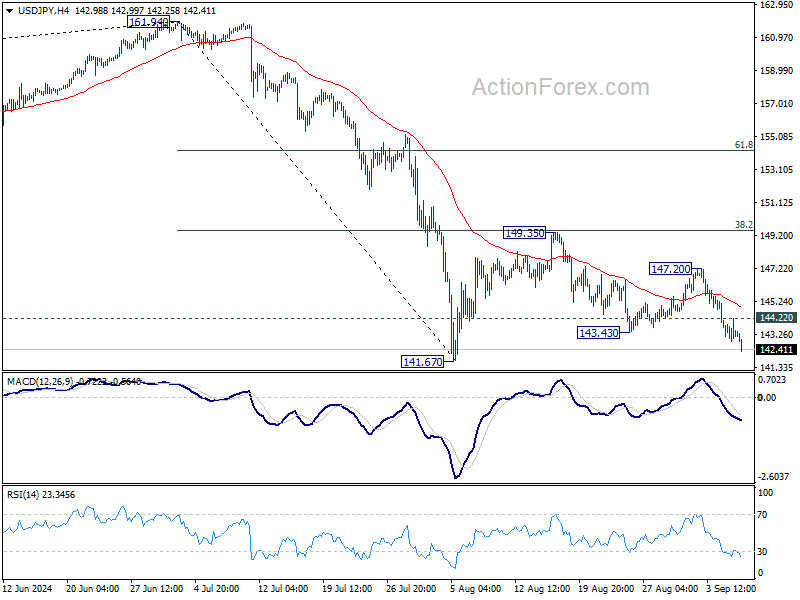
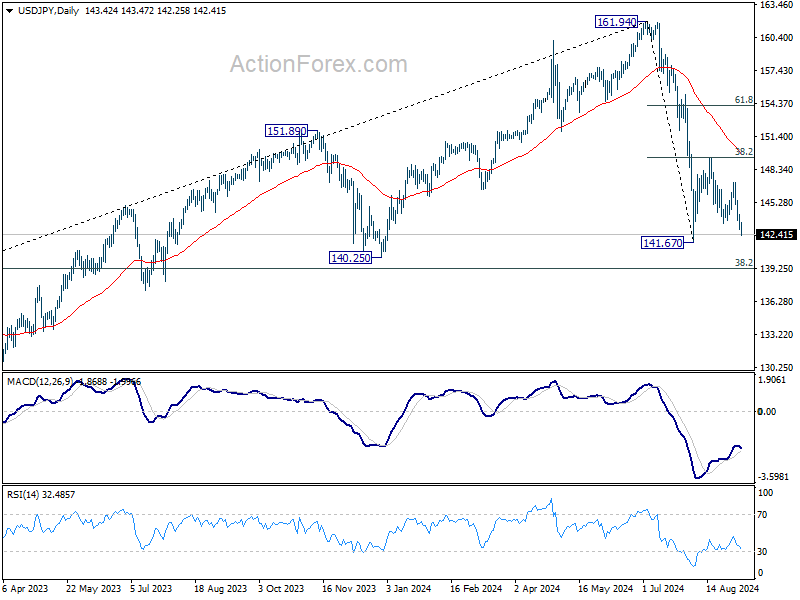
While the dollar has recently been strengthening against the euro and the pound, the situation with the Japanese yen has been quite the opposite. This wasn't just a retreat of the US currency, but rather a panicked flight. On Friday, 19 July, strategists from ING, a major Dutch banking group, described the USD/JPY pair as a "bundle of surprises," retreating to the 155/156 range. A week later, they referred to it as "the most intriguing pair in Forex." This time, the minimum was recorded at 151.93, in the key zone of 151.80-152.00, which coincides with the highs of October 2022 and 2023.
The yen began its resurgence like a Phoenix on 11 and 12 July when the Bank of Japan (BoJ), to support the national currency, purchased an estimated ¥6.0 trillion. On 17 July, USD/JPY came under pressure again due to another currency intervention. Analysts, examining BoJ's accounts, estimated the size of this intervention at approximately ¥3.5 trillion.
Then came a new surge. It is worth noting that on 03 July, USD/JPY reached a high of 161.94, a level not seen in 38 years. Now, in just three weeks, it plummeted by 1,000 (!) points, triggering widespread liquidation of positions across all markets, affecting everything from the yuan to various asset classes, including Japanese stocks, gold, and cryptocurrencies.
On Thursday, 25 July, the yen's exchange rate against the dollar rose to its highest level in over two months. This time, the cause seems to be not the currency interventions of the Japanese central bank but the expectation that the interest rate gap between Japan and the US will narrow on 31 July. Swap markets are currently pricing in a 75% probability of a BoJ rate hike on Wednesday, compared to 44% earlier in the week. Moreover, economists at ING believe the BoJ might raise the rate by an unprecedented 15 basis points (bps) for Japan.
They note that "Tokyo's consumer price data showed that core inflation fell to 2.2% year-on-year in July (from 2.3% in June), but the BoJ's preferred measure, core inflation excluding fresh food, rose to 2.2% in July from 2.1% in June." Based on this, ING suggests a 50% chance that inflationary pressure in the services sector will continue to rise, which could lead the BoJ to increase the rate by 15 bps at the upcoming meeting and simultaneously reduce its bond purchase program.
If something like this occurs, macro strategists at State Street Global Markets believe that the resurgence of the Japanese currency could lead to a significant adjustment in global trading strategies in the foreign exchange market, particularly in carry trades. Carry trades involve borrowing in low-yielding currencies, such as the yen, to invest in higher-yielding currencies.
USD/JPY ended the past trading week at 153.75. According to analysts at State Street Global Markets, "the yen rally may continue ahead of the Bank of Japan meeting next week." As for the median forecast by experts for the near term, it is as follows: 20% expect the pair to move south, further strengthening the yen, 30% predict a rebound north, and the remaining 50% have taken a neutral stance. Among oscillators on the D1 chart, 90% favour the Japanese currency, with 20% indicating the pair is in the oversold zone, and the remaining 10% are neutral. Trend indicators show 85% favouring the strengthening of the yen, while 15% support the dollar. The nearest support level is around 151.80-152.00, followed by 149.20-149.50 and 146.50-147.25. The nearest resistance is located in the 154.70-155.20 range, followed by 157.20-157.40, 158.25, 158.75-159.00, 160.20, 160.85, 161.80-162.00, and 162.50.
Apart from the Bank of Japan meeting on Wednesday, 31 July, no other significant events, including the release of important macroeconomic statistics concerning the state of the Japanese economy, are scheduled for the coming days.
CRYPTOCURRENCIES: Politics Engages with the Digital Market
As early as the mid-19th century, French writer Charles de Montalembert warned, "You may not be interested in politics, but politics is interested in you." This sentiment is vividly illustrated by recent developments in the market for risk assets, including cryptocurrencies.
The past week was disappointing for investors, although the troubles began earlier, on Wednesday, 17 July. On that day, the shares of some of the world's largest semiconductor manufacturers plummeted, causing the stock market to reach its worst condition in several months. This reaction was due to the tensions in US-China trade relations and comments from former (and possibly future) President Donald Trump regarding Taiwan. Shares of several semiconductor companies sharply declined under the weight of geopolitical tension, with some losing over 8% and a giant like Nvidia dropping by 6%. As a result, the S&P 500 Index fell by 1.39%, marking its largest drop since late April, and the tech-heavy Nasdaq fell by 2.77%, its worst performance since the end of 2022.
However, the troubles for the stock market did not end there. Exactly one week later, on Wednesday, 24 July, the US stock market closed with even greater losses. The S&P 500 and Nasdaq indices dropped by 3.6% and 2.3%, respectively, after Tesla's Q2 results revealed a profit decline of more than 40% compared to the previous year. Tesla's shares fell by more than 12% in just one day. Alongside Tesla, shares of Alphabet, Visa, Microsoft, Nvidia, and other technology companies also declined. The seven largest IT giants lost $770 billion in market capitalization in one day. This turmoil occurred amidst ongoing issues with Microsoft's global Windows system outage, which affected many sectors.
Naturally, such market dynamics impacted the riskiest of assets—cryptocurrencies. It's worth noting that the prices of both bitcoin and ethereum appeared quite strong at the start of the past week. However, they eventually succumbed to the pressure and also declined. In addition to global geopolitical factors, cryptocurrencies had their own specific reasons for this downturn.
The market was shocked when US President Joe Biden announced on Sunday, 22 July, that he would not seek re-election. This decision sparked a debate about how it might impact the digital assets market. Many analysts and influencers argue that only a victory by Donald Trump could provide a strong bullish impulse to the industry. This view is shared by experts at JPMorgan. Analyst Josh Gilbert stated, "The longer we see Trump leading in the election odds, the more valuable crypto assets will become after his victory." He further explained, "It's hard to imagine Kamala Harris or another Democratic candidate overthrowing Trump's lead in the polls just three months before the end of this election race.".
Trump's Republican ally, Senator Cynthia Lummis, suggested backing the dollar with bitcoin to improve the country's financial system. A similar approach was proposed by Markus Thielen, founder of 10x Research. He believes that Trump could announce at the upcoming Bitcoin-2024 conference that he plans to make bitcoin a strategic reserve asset for the US government. Currently, the government holds only 212,800 BTC, worth approximately $15 billion, compared to its gold reserves of around $600 billion. If the government were to double its bitcoin holdings, it would have an impact on the price nearly equivalent to the net inflow effect on spot BTC-ETFs since the beginning of the year.
Bloomberg reports that bitcoin miners and crypto companies, previously hindered from going public in the US, could benefit under a second Donald Trump presidency. The agency cites the opinion of Christian Catalini, founder of the Crypto-economics Lab at the Massachusetts Institute of Technology. He believes that "almost everyone in America will benefit if they choose to operate under new rules after they are implemented."
In June, Trump met with miners and expressed his desire for all remaining bitcoin to be "made in the USA." Following Joe Biden's poor performance in debates and an unsuccessful assassination attempt on Trump, the price of bitcoin rose by 10%, while shares of the two largest public miners, Marathon Digital and Riot Platforms, increased by 30%. Cipher Mining's stock prices gained nearly 50%. For the first time since the crypto market crash in 2022, companies in the sector are planning initial public offerings (IPOs). Stablecoin issuer USDC, Circle, filed for an IPO in January with a valuation of $33 billion. Crypto miner Northern Data, which is actively expanding its AI computing division, is considering listing in the US, with a potential valuation of $16 billion. Kraken, the second-largest exchange in the country, is also preparing to go public.
However, all of this is speculative and dependent on future developments. Josh Gilbert, while optimistic about Trump's influence on the cryptocurrency market, cautions that "a lot can happen between now and the election, so nothing is certain." Gary Black, Managing Partner of The Future Fund, echoed this sentiment, warning his 433,000 followers on X that a Trump victory is far from assured. "Those who think Trump/Vance will secure an easy win are getting ahead of themselves," Black wrote.
Arthur Hayes, the former CEO of the crypto exchange BitMEX, also expressed skepticism. He believes that voters who support cryptocurrency may lose influence over politicians once the presidential election is over in November 2024. If a regulatory framework for digital assets is not established before the election, the elected president and their administration may shift their focus to other pressing issues. Geopolitical concerns could overshadow discussions about cryptocurrencies, with the president's attention potentially diverted to international conflicts, particularly involving Iran and Russia. Hayes argues, "The capital needed to support laws promoting cryptocurrency development could be redirected towards addressing more urgent foreign policy issues. Therefore, regulatory clarity should be sought now, before the political landscape changes post-election."
BITCOIN: Bullish Flag or Bearish Den?
Experts at JPMorgan note that the current bitcoin price significantly exceeds its mining cost (~$43,000) and appears overvalued compared to its "fair" price adjusted for volatility (~$53,000). According to JPMorgan, the substantial upward deviation from this fair price "limits the potential for long-term growth." However, they have forecasted positive market dynamics in August, attributed to the diminishing negative impact of the sale of coins confiscated by German authorities and the distribution of coins to clients of Gemini and Mt.Gox.
At the beginning of the year, Nigel Green, CEO of deVere Group, predicted that bitcoin would soon rise to $60,000, and his forecast proved accurate. Now, he believes that the demand for the leading cryptocurrency will continue to grow, potentially reaching $100,000 by the end of the year. "Bitcoin is likely the best asset in terms of growth potential by the end of the year," the financier writes. "Many are expecting it to reach $100,000 by year-end. Is this possible? Quite possibly, because the supply of bitcoin is limited. This means that if demand for BTC increases, so will the price. Bitcoin is not the same as the US dollar, where the Federal Reserve can simply print more."
Green also mentioned that the potential election of Donald Trump as US President could positively impact bitcoin's price.
Analyst and trader known by the nickname RLinda identifies the bullish flag pattern as a key indicator of potential upward movement for BTC. This formation, observed on both daily and weekly charts, is characterized by a sharp upward move followed by a phase of consolidation. RLinda anticipates that a breakout from this consolidation will continue the previous uptrend, potentially targeting around $90,000.
Support and resistance levels play a crucial role in this analysis. Key support levels at $59,300 and $63,800 have shown strong buying interest and stability. The high trading volumes at these levels reinforce the expectation that they will hold during any potential pullbacks. Critical resistance levels are noted at $67,250 and $71,754. Breaking through these resistance points is necessary for BTC to advance towards higher targets. The all-time high (ATH) at $73,743 is particularly significant; a successful breakout above this level could trigger further bullish momentum.
Peter Brandt, the head of Factor LLC, has entered into a debate with RLinda. The legendary trader expresses skepticism that bitcoin will surpass $71,000 and set a new price record. "I try to be as honest as possible in identifying patterns. The current stagnation in the bitcoin market should not be called a flag (it has lasted too long); it represents a descending channel. Anything that lasts longer than 4-6 weeks is not a flag," Brandt wrote.
According to some analysts, the flag pattern observed on the BTC/USD chart suggests an impending bullish rally. However, the descending channel that Brandt refers to indicates a potential decline in the coin's price. This pattern is characterized by lower highs and lows, established after BTC reached its all-time high in March. Based on the chart published by Brandt, he believes that bitcoin's price will not break the resistance line, which lies around $71,000. In this scenario, a bearish trend could begin, with the digital gold potentially dropping to $51,000. The descending channel is slightly widening, suggesting that price volatility may increase over time.
On Thursday, 25 July, the BTC/USD pair dropped to the support zone of $63,200-63,800 and encountered additional support from the 200-day moving average (DMA200). Following this, it reversed direction and started to move upwards. As of the evening of Friday, 26 July, it has nearly recovered its weekly losses and is trading at around $67,500. The total market capitalization of the crypto market has remained relatively stable at $2.42 trillion, compared to $2.43 trillion a week ago. The Bitcoin Fear & Greed Index has risen from 60 to 68 points over the past seven days, remaining in the Greed zone.
ETHEREUM: ETH-ETF – Disappointment Instead of Hope
On 23 July, the long-awaited spot ETFs for Ethereum were launched in the US, providing investors with access to the altcoin through traditional brokerage platforms. On the first day of trading, the turnover reached $1.1 billion, which was 24.4% of the turnover of BTC-ETFs, aligning with optimistic forecasts. However, trading volume isn't the only metric to consider. The net inflow of investments into ETH was significantly lower than that into bitcoin, with $107 million compared to $655 million, respectively, showing a sixfold difference.
The situation worsened as the initial enthusiasm for Ethereum ETFs quickly faded, causing ETH/USD prices to decline sharply, despite the trading volume surpassing $1.0 billion again. The decline was triggered by a significant outflow of funds from a single issuer, Grayscale's Ethereum Trust ETF (ETHE). According to SoSoValue, Grayscale's ETHE lost $484 million on the first trading day and nearly $327 million on the second day, totalling $811 million. In contrast, most other spot ETH-ETFs, including ETHA from BlackRock, ETHW from Bitwise, and FETH from Fidelity, showed growth in inflows. However, these inflows were insufficient to offset the losses from Grayscale's ETHE.
This situation mirrors the experience with Grayscale's GBTC fund in the early weeks following the launch of the bitcoin ETF. Both Grayscale funds were converted from trust to spot ETFs. If the outflow rate from ETHE matches that of GBTC, it could negatively impact all newly established ETH-ETFs.
Moreover, macroeconomic factors contributing to the (hopefully temporary) stock market downturn, the ongoing situation with Mt.Gox, and the lack of staking in ETFs, which deprives the altcoin of the advantage of passive income, also play a role. Additionally, Ethereum's practical applications are increasingly being outperformed by competitors such as Tron and Solana. Experts also remind us of the upcoming US elections, where statements and actions by key political figures could create new opportunities and threats for the market.
Analysts at cryptocurrency market maker Wintermute believe that demand for Ethereum will fall short of expectations, predicting investments in these derivatives will range between $3.2 billion and $4.0 billion in the first 12 months after trading begins. As a result, they expect Ethereum's price to rise to a maximum of $4,300 in 2024.
In contrast, researchers from ASXN offer a more optimistic forecast. They predict that the monthly capital inflow into Ethereum ETFs will range from $800 million to $1.2 billion, implying a total investment of at least $6-7 billion in these funds by the end of the year, significantly exceeding Wintermute's estimate.
Adding to the positive outlook, experts from QCP Capital noted that following the launch of similar BTC-ETFs, bitcoin's price initially fell to $38,000 but then surged to new all-time highs within two months, posting a 90% increase. (However, it is worth noting that the BTC halving may have played a significant role at that time.) The dynamics of Ethereum will become clearer in the near future. Currently, ETH/USD recorded a weekly low of $3,089 and, as of the evening of Friday, 26 July, is trading around $3,200.