

Sample Category Title
EUR/JPY Weekly Outlook
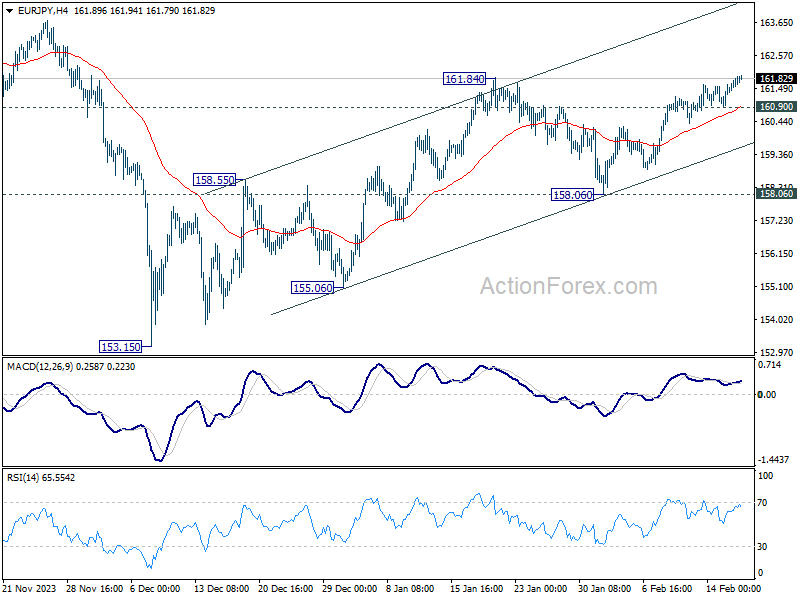
EUR/JPY's rise from 153.15 resumed by breaking 161.84 resistance last week. Initial bias remains on the upside for retesting 164.29 high next. On the downside, however, below 160.90 minor support will turn intraday bias neutral first.
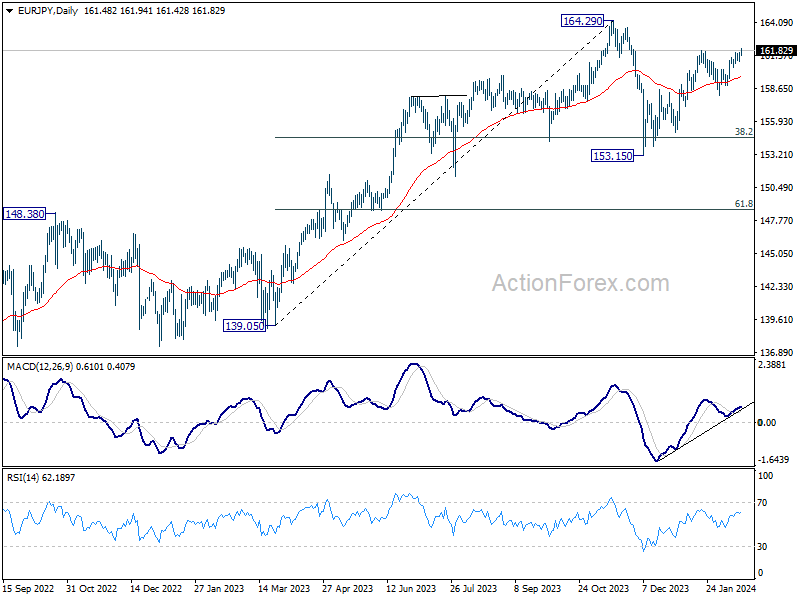
In the bigger picture, price actions from 164.29 medium term top are seen as a correction to rise from 139.05 only. As long as 148.38 resistance turned support holds (2022 high), larger up trend from 114.42 (2020 low) is expected to resume through 164.29 at a later stage. Next target would be 169.96 (2008 high).
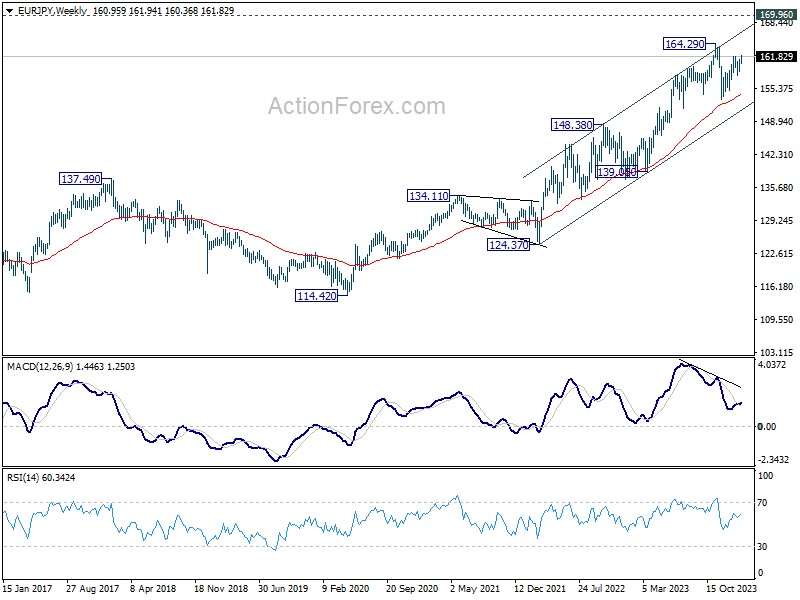
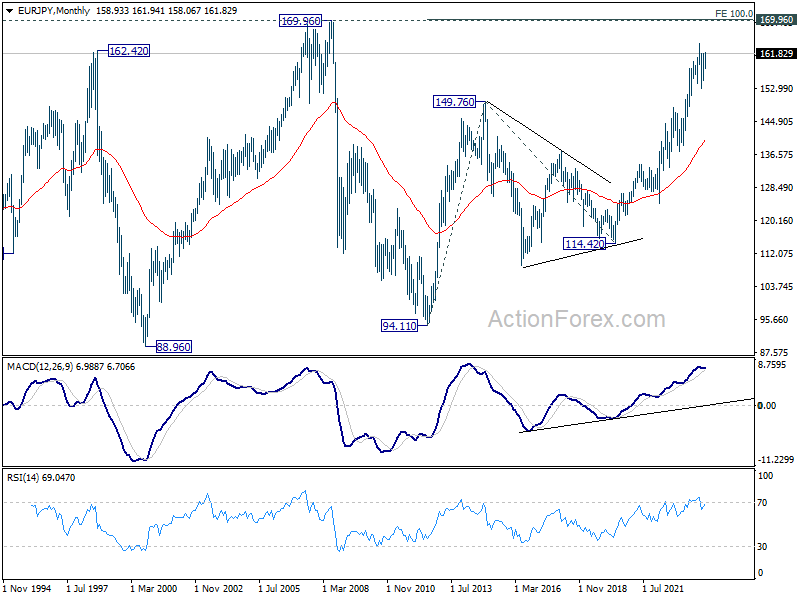
In the long term picture, rise from 114.42 (2020 low) is seen as the third leg of the whole up trend from 94.11 (2012 low). Next target is 100% projection of 94.11 to 149.76 from 114.42 at 170.07 which is close to 169.96 (2008 high). This will remain the favored case as long as 148.38 resistance turned support holds.
EUR/GBP Weekly Outlook
EUR/GBP edged lower to 0.8497 last week but recovered just ahead of 0.8491 support. Yet, upside is capped below 0.8571 resistance. Initial bias remains neutral this week first. On the downside, break of 0.8497 will resume recent fall to 0.8464 projection level. However, considering bullish convergence condition in 4H MACD, sustained break of 0.8571 will confirm short term bottoming, and turn bias back to the upside for stronger rebound.
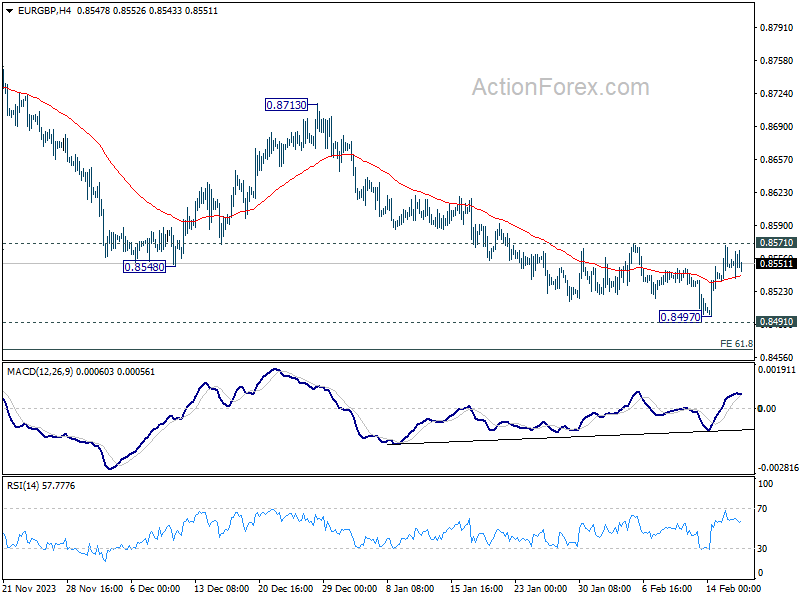
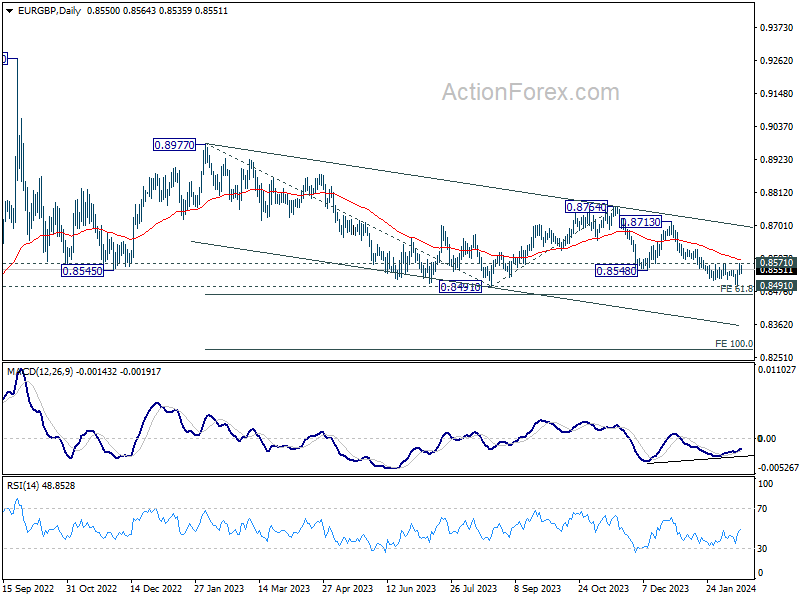
In the bigger picture, fall from 0.8764 is seen as another leg in the whole down trend from 0.9267 (2022 high). Outlook will stay bearish as long as 0.8713 resistance holds. Break of 0.8491 will target 61.8% projection of 0.8977 to 0.8491 from 0.8764 at 0.8464.
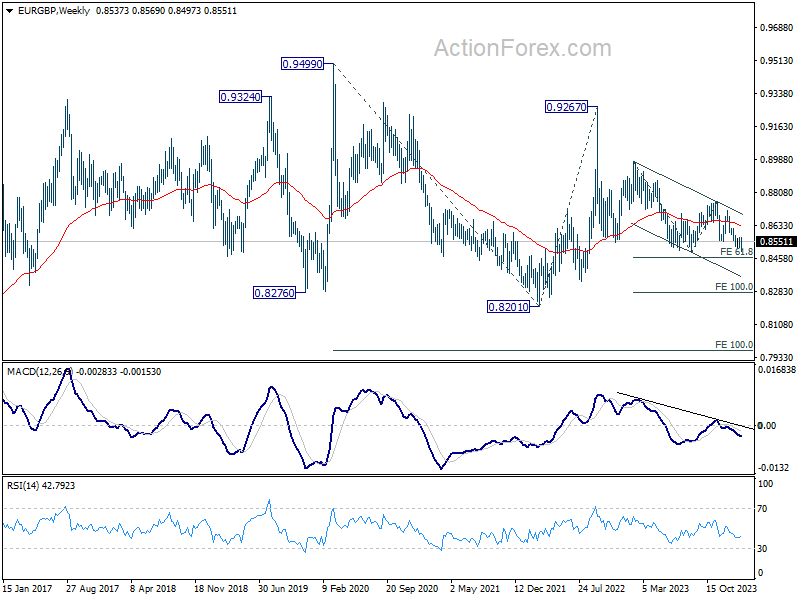
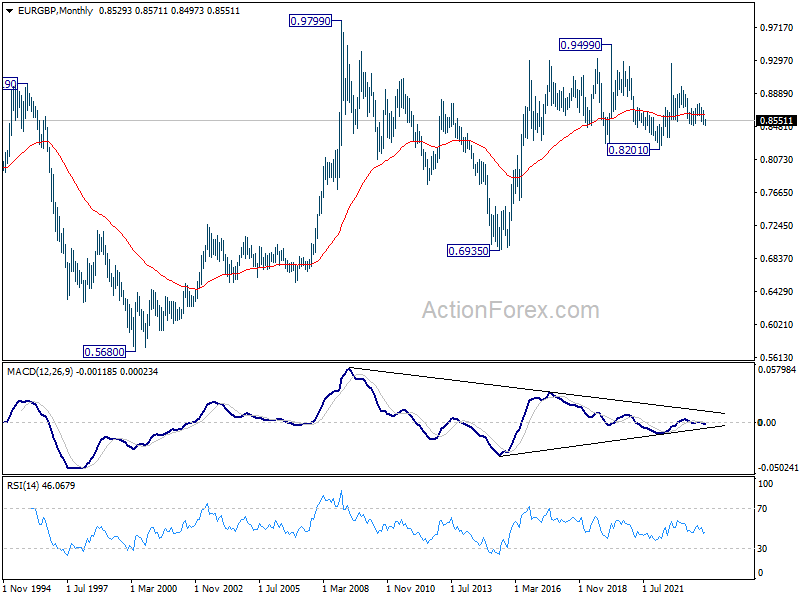
In the long term picture, price action from 0.9499 (2020 high) is seen as part of the long term range pattern from 0.9799 (2008 high). Fall from 0.9267 is the third leg of the pattern from 0.9499. Break of 0.8201 (2022 low) will target 100% projection of 0.9499 to 0.8201 from 0.9267 at 0.7969.
EUR/AUD Weekly Outlook
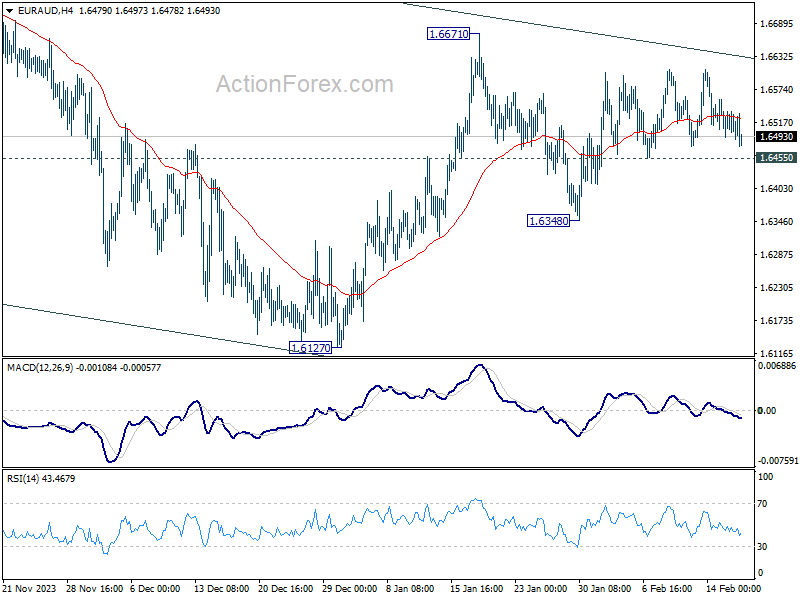
Sideway trading continued in EUR/AUD last week and outlook is unchanged. Initial bias remains neutral this week first. On the upside, decisive break of 1.6671 will revive the case that whole correction from 1.7062 has completed with three waves down to 1.6127. Further rally should then be seen to 1.6844 resistance for confirmation. Nevertheless, below 1.6455 minor support will turn bias to the downside for 1.6348 and possibly below.
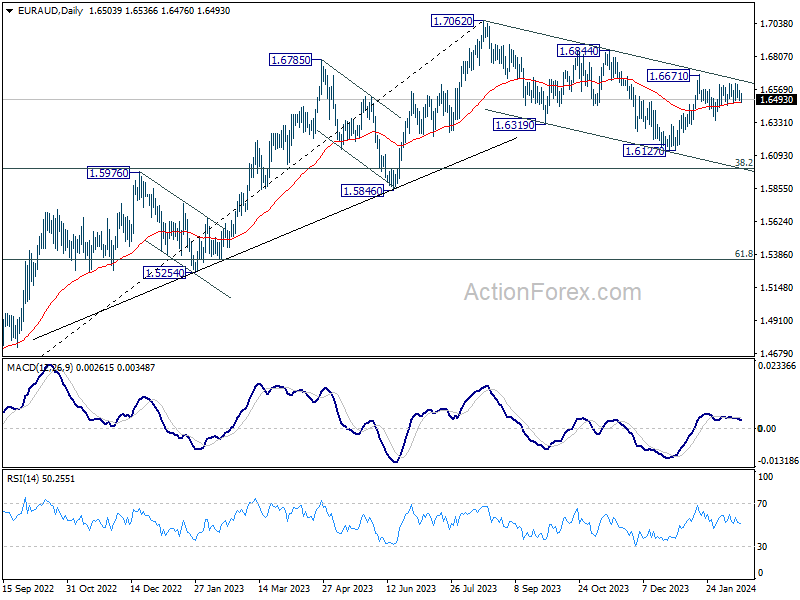
In the bigger picture, fall from 1.7062 medium term top is seen as a correction to the up trend from 1.4281 (2022 low). Break of 1.6844 resistance will argue that this up trend is ready to resume through 1.7062 high. In case of another fall, strong support should be seen around 1.5846 and 38.2% retracement of 1.4281 to 1.7062 at 1.6000 to bring rebound.
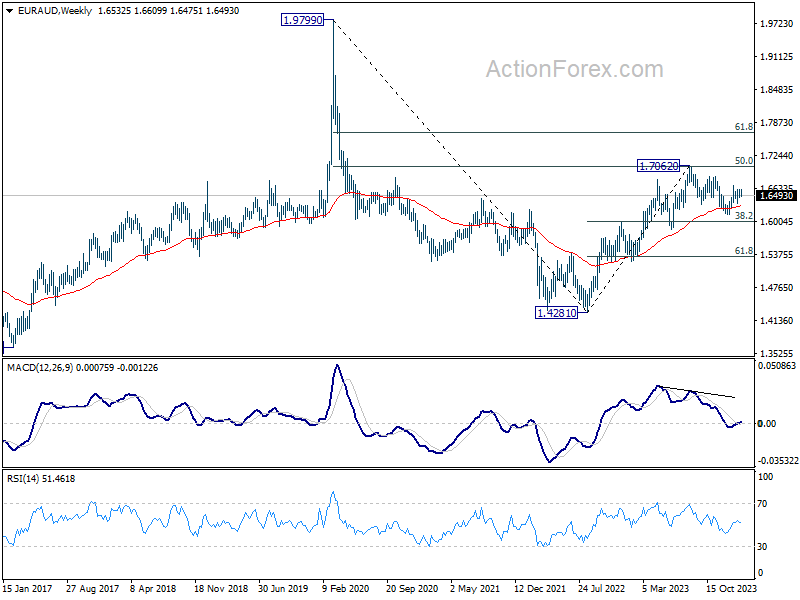
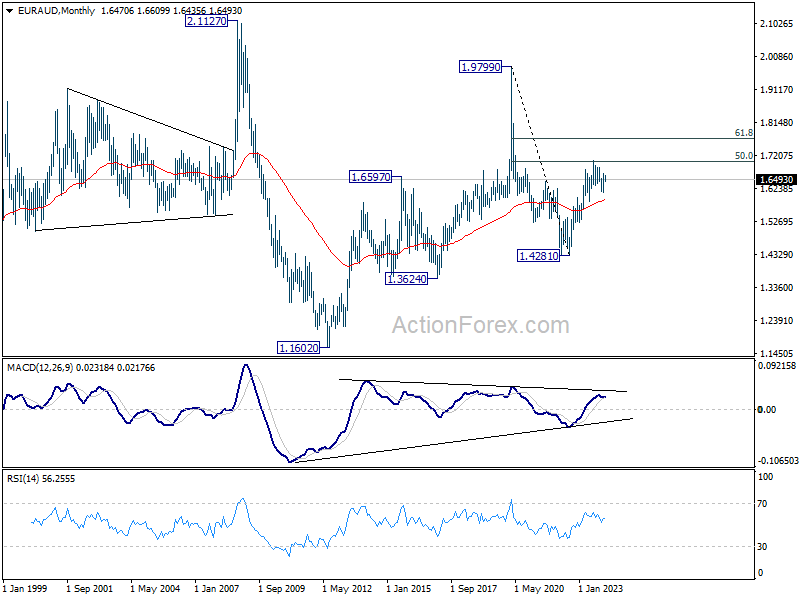
In the longer term picture, price actions from 1.9799 (2020 high) are seen as a long term decline at the same scale as the rise from 1.1602 (2012 low). Rebound from 1.4281 is seen as the second leg. As long as 55 M EMA (now at 1.5902) holds, this second leg could still extend higher. However, sustained trading below 55 M EMA will open up the bearish case for extending the decline through 1.4281 low.
EUR/CHF Weekly Outlook
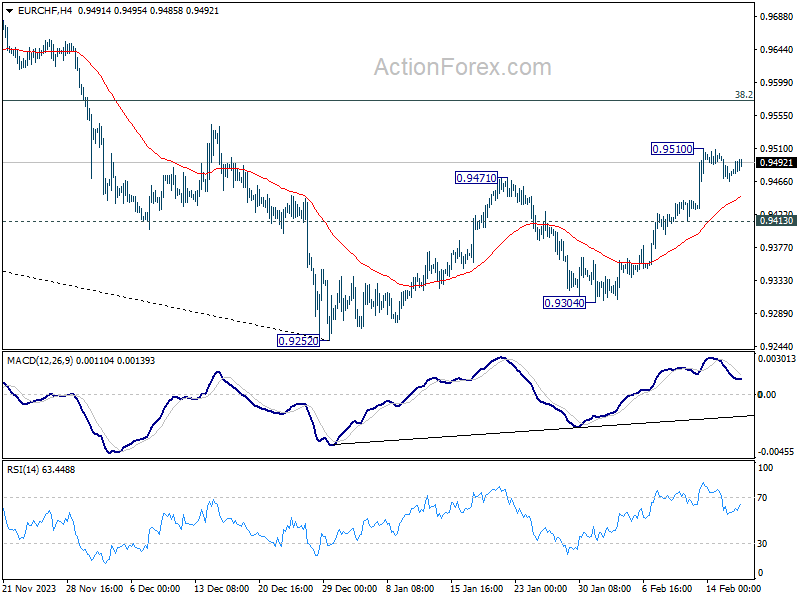
EUR/CHF's rebound from 0.9252 resumed by breaking through 0.9471 resistance last week. But as a temporary top was formed at 0.9510, initial bias remains neutral this week for more consolidations. Downside of retreat should be contained by 0.9413 minor support to bring another rally. On the upside, break of 0.9510 target 0.9574 fibonacci level next.
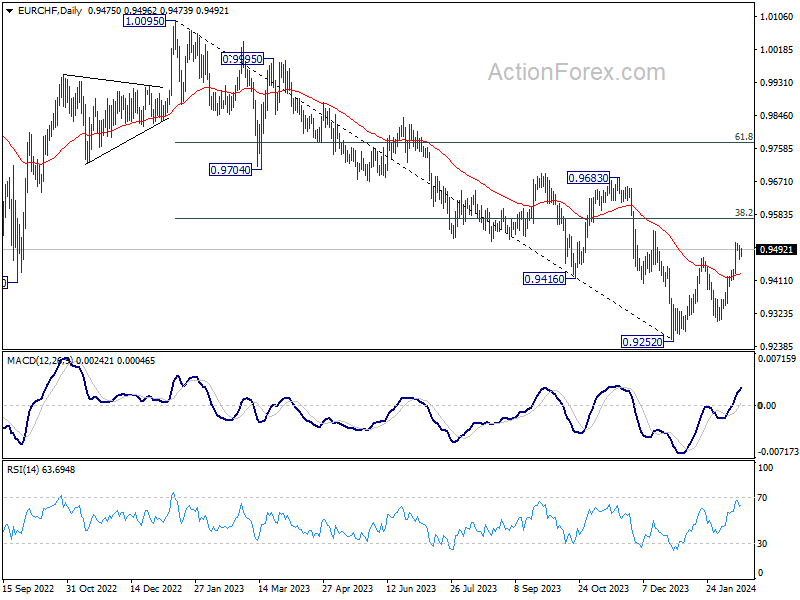
In the bigger picture, price actions from 0.9252 are tentatively seen as a correction to the five-wave down trend from 1.0095 (2023 high). Further rise would be seen to 38.2% retracement of 1.0095 to 0.9252 at 0.9574 and possibly above. But overall medium term outlook will remain bearish as long as 0.9683 resistance holds.
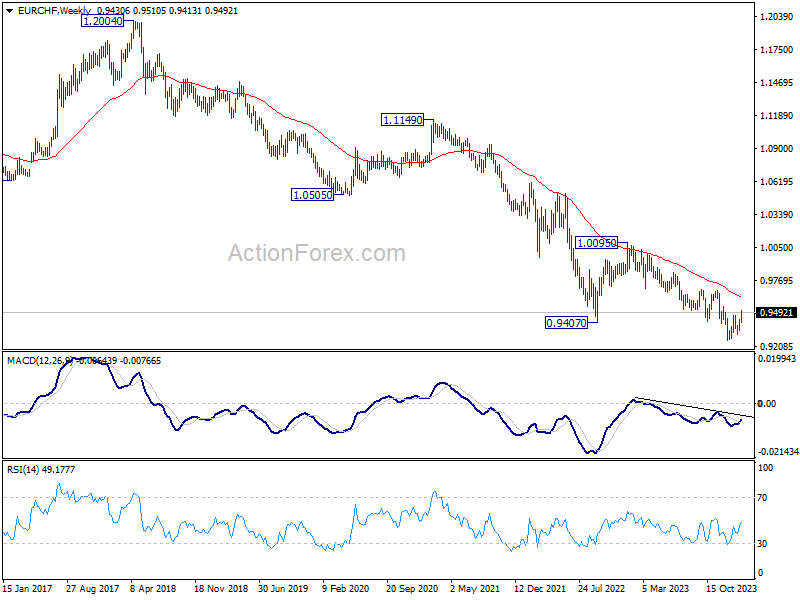
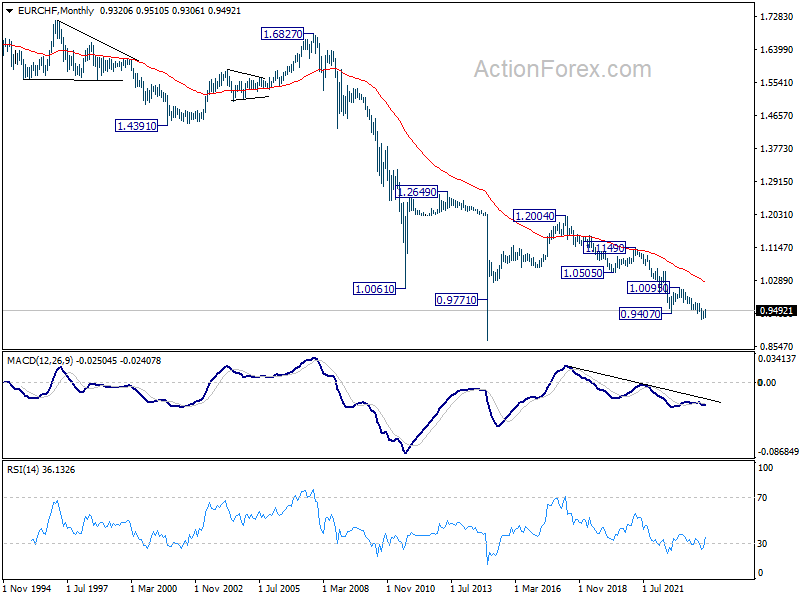
In the long term picture, fall from 1.2004 (2018 high) is part of the multi-decade down trend. Firm break of 1.0095 resistance is needed to be the first sign of long term bottoming. Otherwise, outlook will remain bearish.
Summary 2/19 – 2/23
Monday, Feb 19, 2024
| GMT | Ccy | Events | Consensus | Previous |
|---|---|---|---|---|
| 21:30 | NZD | Business NZ PSI Jan | 48.8 | |
| 23:50 | JPY | Machinery Orders M/M Dec | 2.50% | -4.90% |
| 00:01 | GBP | Rightmove House Price Index M/M Feb | 1.30% | |
| 11:00 | EUR | German Buba Monthly Report | ||
| 13:30 | CAD | Industrial Product Price M/M Jan | 0.10% | -1.50% |
| 13:30 | CAD | Raw Material Price Index Jan | 0.80% | -4.90% |
| GMT | Ccy | Events | |
|---|---|---|---|
| 21:30 | NZD | Business NZ PSI Jan | |
| Forecast: | Previous: 48.8 | ||
| 23:50 | JPY | Machinery Orders M/M Dec | |
| Forecast: 2.50% | Previous: -4.90% | ||
| 00:01 | GBP | Rightmove House Price Index M/M Feb | |
| Forecast: | Previous: 1.30% | ||
| 11:00 | EUR | German Buba Monthly Report | |
| Forecast: | Previous: | ||
| 13:30 | CAD | Industrial Product Price M/M Jan | |
| Forecast: 0.10% | Previous: -1.50% | ||
| 13:30 | CAD | Raw Material Price Index Jan | |
| Forecast: 0.80% | Previous: -4.90% | ||
Tuesday, Feb 20, 2024
| GMT | Ccy | Events | Consensus | Previous |
|---|---|---|---|---|
| 00:30 | AUD | RBA Meeting Minutes | ||
| 01:15 | CNY | PBoC 1Y Loan Prime Rate | 3.45% | 3.45% |
| 01:15 | CNY | PBoC 5Y Loan Prime Rate | 4.10% | 4.20% |
| 07:00 | CHF | Trade Balance (CHF) Jan | 2.35B | 1.25B |
| 09:00 | EUR | Eurozone Current Account (EUR) Dec | 20.3B | 24.6B |
| 13:30 | CAD | CPI M/M Jan | 0.40% | -0.30% |
| 13:30 | CAD | CPI Y/Y Jan | 3.30% | 3.40% |
| 13:30 | CAD | CPI Median Y/Y Jan | 3.60% | 3.60% |
| 13:30 | CAD | CPI Trimmed Y/Y Jan | 3.60% | 3.70% |
| 13:30 | CAD | CPI Common Y/Y Jan | 3.80% | 3.90% |
| 21:45 | NZD | PPI Input Q/Q Q4 | 0.40% | 1.20% |
| 21:45 | NZD | PPI Output Q/Q Q4 | 0.40% | 0.80% |
| 23:50 | JPY | Trade Balance (JPY) Jan | -0.23T | -0.41T |
| GMT | Ccy | Events | |
|---|---|---|---|
| 00:30 | AUD | RBA Meeting Minutes | |
| Forecast: | Previous: | ||
| 01:15 | CNY | PBoC 1Y Loan Prime Rate | |
| Forecast: 3.45% | Previous: 3.45% | ||
| 01:15 | CNY | PBoC 5Y Loan Prime Rate | |
| Forecast: 4.10% | Previous: 4.20% | ||
| 07:00 | CHF | Trade Balance (CHF) Jan | |
| Forecast: 2.35B | Previous: 1.25B | ||
| 09:00 | EUR | Eurozone Current Account (EUR) Dec | |
| Forecast: 20.3B | Previous: 24.6B | ||
| 13:30 | CAD | CPI M/M Jan | |
| Forecast: 0.40% | Previous: -0.30% | ||
| 13:30 | CAD | CPI Y/Y Jan | |
| Forecast: 3.30% | Previous: 3.40% | ||
| 13:30 | CAD | CPI Median Y/Y Jan | |
| Forecast: 3.60% | Previous: 3.60% | ||
| 13:30 | CAD | CPI Trimmed Y/Y Jan | |
| Forecast: 3.60% | Previous: 3.70% | ||
| 13:30 | CAD | CPI Common Y/Y Jan | |
| Forecast: 3.80% | Previous: 3.90% | ||
| 21:45 | NZD | PPI Input Q/Q Q4 | |
| Forecast: 0.40% | Previous: 1.20% | ||
| 21:45 | NZD | PPI Output Q/Q Q4 | |
| Forecast: 0.40% | Previous: 0.80% | ||
| 23:50 | JPY | Trade Balance (JPY) Jan | |
| Forecast: -0.23T | Previous: -0.41T | ||
Wednesday, Feb 21, 2024
| GMT | Ccy | Events | Consensus | Previous |
|---|---|---|---|---|
| 00:00 | AUD | Westpac Leading Index M/M Jan | -0.03% | |
| 00:30 | AUD | Wage Price Index Q/Q Q4 | 0.90% | 1.30% |
| 07:00 | GBP | Public Sector Net Borrowing (GBP) Jan | -18.4B | 6.8B |
| 13:30 | CAD | New Housing Price Index M/M Jan | 0.10% | 0.00% |
| 15:00 | EUR | Eurozone Consumer Confidence Feb P | -16 | -16 |
| 19:00 | USD | FOMC Minutes | ||
| 21:45 | NZD | Trade Balance (NZD) Jan | -200M | -323M |
| 22:00 | AUD | Manufacturing PMI Feb P | 50.1 | |
| 22:00 | AUD | Services PMI Feb P | 49.1 |
| GMT | Ccy | Events | |
|---|---|---|---|
| 00:00 | AUD | Westpac Leading Index M/M Jan | |
| Forecast: | Previous: -0.03% | ||
| 00:30 | AUD | Wage Price Index Q/Q Q4 | |
| Forecast: 0.90% | Previous: 1.30% | ||
| 07:00 | GBP | Public Sector Net Borrowing (GBP) Jan | |
| Forecast: -18.4B | Previous: 6.8B | ||
| 13:30 | CAD | New Housing Price Index M/M Jan | |
| Forecast: 0.10% | Previous: 0.00% | ||
| 15:00 | EUR | Eurozone Consumer Confidence Feb P | |
| Forecast: -16 | Previous: -16 | ||
| 19:00 | USD | FOMC Minutes | |
| Forecast: | Previous: | ||
| 21:45 | NZD | Trade Balance (NZD) Jan | |
| Forecast: -200M | Previous: -323M | ||
| 22:00 | AUD | Manufacturing PMI Feb P | |
| Forecast: | Previous: 50.1 | ||
| 22:00 | AUD | Services PMI Feb P | |
| Forecast: | Previous: 49.1 | ||
Thursday, Feb 22, 2024
| GMT | Ccy | Events | Consensus | Previous |
|---|---|---|---|---|
| 00:30 | JPY | Manufacturing PMI Feb P | 48.2 | 48.0 |
| 00:30 | JPY | Services PMI Feb P | 53.1 | |
| 08:15 | EUR | France Manufacturing PMI Feb P | 44.0 | 43.1 |
| 08:15 | EUR | France Services PMI Feb P | 45.6 | 45.4 |
| 08:30 | EUR | Germany Manufacturing PMI Feb P | 46.1 | 45.5 |
| 08:30 | EUR | Germany Services PMI Feb P | 48.0 | 47.7 |
| 09:00 | EUR | Eurozone Manufacturing PMI Feb P | 47.1 | 46.6 |
| 09:00 | EUR | Eurozone Services PMI Feb P | 48.7 | 48.4 |
| 09:30 | GBP | Manufacturing PMI Feb P | 47.1 | 47 |
| 09:30 | GBP | Services PMI Feb P | 54.4 | 54.3 |
| 10:00 | EUR | Eurozone CPI Y/Y Jan F | 2.80% | 2.80% |
| 10:00 | EUR | Eurozone CPI Core Y/Y Jan F | 3.30% | 3.30% |
| 12:30 | EUR | ECB Meeting Accounts | ||
| 13:30 | CAD | Retail Sales M/M Dec | 0.80% | -0.20% |
| 13:30 | CAD | Retail Sales ex Autos M/M Dec | 0.70% | -0.50% |
| 13:30 | USD | Initial Jobless Claims (Feb 16) | 217K | 212K |
| 14:45 | USD | Manufacturing PMI Feb P | 50.2 | 50.7 |
| 14:45 | USD | Services PMI Feb P | 52.0 | 52.5 |
| 15:00 | USD | Existing Home Sales Jan | 3.95M | 3.78M |
| 15:30 | USD | Natural Gas Storage | -49B | |
| 16:00 | USD | Crude Oil Inventories | 12.0M | |
| 21:45 | NZD | Retail Sales Q/Q Q4 | -0.20% | 0.00% |
| 21:45 | NZD | Retail Sales ex Autos Q/Q Q4 | -0.10% | 1.00% |
| GMT | Ccy | Events | |
|---|---|---|---|
| 00:30 | JPY | Manufacturing PMI Feb P | |
| Forecast: 48.2 | Previous: 48.0 | ||
| 00:30 | JPY | Services PMI Feb P | |
| Forecast: | Previous: 53.1 | ||
| 08:15 | EUR | France Manufacturing PMI Feb P | |
| Forecast: 44.0 | Previous: 43.1 | ||
| 08:15 | EUR | France Services PMI Feb P | |
| Forecast: 45.6 | Previous: 45.4 | ||
| 08:30 | EUR | Germany Manufacturing PMI Feb P | |
| Forecast: 46.1 | Previous: 45.5 | ||
| 08:30 | EUR | Germany Services PMI Feb P | |
| Forecast: 48.0 | Previous: 47.7 | ||
| 09:00 | EUR | Eurozone Manufacturing PMI Feb P | |
| Forecast: 47.1 | Previous: 46.6 | ||
| 09:00 | EUR | Eurozone Services PMI Feb P | |
| Forecast: 48.7 | Previous: 48.4 | ||
| 09:30 | GBP | Manufacturing PMI Feb P | |
| Forecast: 47.1 | Previous: 47 | ||
| 09:30 | GBP | Services PMI Feb P | |
| Forecast: 54.4 | Previous: 54.3 | ||
| 10:00 | EUR | Eurozone CPI Y/Y Jan F | |
| Forecast: 2.80% | Previous: 2.80% | ||
| 10:00 | EUR | Eurozone CPI Core Y/Y Jan F | |
| Forecast: 3.30% | Previous: 3.30% | ||
| 12:30 | EUR | ECB Meeting Accounts | |
| Forecast: | Previous: | ||
| 13:30 | CAD | Retail Sales M/M Dec | |
| Forecast: 0.80% | Previous: -0.20% | ||
| 13:30 | CAD | Retail Sales ex Autos M/M Dec | |
| Forecast: 0.70% | Previous: -0.50% | ||
| 13:30 | USD | Initial Jobless Claims (Feb 16) | |
| Forecast: 217K | Previous: 212K | ||
| 14:45 | USD | Manufacturing PMI Feb P | |
| Forecast: 50.2 | Previous: 50.7 | ||
| 14:45 | USD | Services PMI Feb P | |
| Forecast: 52.0 | Previous: 52.5 | ||
| 15:00 | USD | Existing Home Sales Jan | |
| Forecast: 3.95M | Previous: 3.78M | ||
| 15:30 | USD | Natural Gas Storage | |
| Forecast: | Previous: -49B | ||
| 16:00 | USD | Crude Oil Inventories | |
| Forecast: | Previous: 12.0M | ||
| 21:45 | NZD | Retail Sales Q/Q Q4 | |
| Forecast: -0.20% | Previous: 0.00% | ||
| 21:45 | NZD | Retail Sales ex Autos Q/Q Q4 | |
| Forecast: -0.10% | Previous: 1.00% | ||
Friday, Feb 23, 2024
| GMT | Ccy | Events | Consensus | Previous |
|---|---|---|---|---|
| 00:01 | GBP | GfK Consumer Confidence Feb | -18 | -19 |
| 07:00 | EUR | Germany GDP Q/Q Q4 F | -0.30% | -0.30% |
| 09:00 | EUR | Germany IFO Business Climate Feb | 85.5 | 85.2 |
| 09:00 | EUR | Germany IFO Current Assessment Feb | 87.0 | 87.0 |
| 09:00 | EUR | Germany IFO Expectations Feb | 83.8 | 83.5 |
| GMT | Ccy | Events | |
|---|---|---|---|
| 00:01 | GBP | GfK Consumer Confidence Feb | |
| Forecast: -18 | Previous: -19 | ||
| 07:00 | EUR | Germany GDP Q/Q Q4 F | |
| Forecast: -0.30% | Previous: -0.30% | ||
| 09:00 | EUR | Germany IFO Business Climate Feb | |
| Forecast: 85.5 | Previous: 85.2 | ||
| 09:00 | EUR | Germany IFO Current Assessment Feb | |
| Forecast: 87.0 | Previous: 87.0 | ||
| 09:00 | EUR | Germany IFO Expectations Feb | |
| Forecast: 83.8 | Previous: 83.5 | ||
The Weekly Bottom Line: Inflation Progress Stalls and Spending Falls in January
U.S. Highlights
U.S. inflation rose more than anticipated to start the year, on a Consumer Price Index basis, largely due to greater price pressures within the services sector.
However, retail spending surprised to the downside in January, suggesting that consumer spending may be less vigorous than the stunning pace of last year.
A slowdown in housing starts and less optimistic small businesses also suggest that economic momentum may be cooling.
Canadian Highlights
- Canadian home sales increased for the second straight month in January. However, price growth was soggy, with sellers lowering their price expectations. However, firmer price growth is likely moving forward.
- Homebuilders continue to break ground on new homes at an impressive pace. However, starts still trail fundamental housing requirements flowing from Canada’s sizzling population growth.
- Next week’s inflation report is likely to show little change in overall inflation and sticky core measures, keeping policymakers vigilant on rates.
U.S. – Inflation Progress Stalls and Spending Falls in January
This week saw some key data releases to help gauge the state of the U.S. economy at the start of 2024, and the likely timing of a Fed rate cut. Among them were the CPI inflation and retail sales reports for January. While inflation was higher than expected, retail spending came in notably lower. Markets reacted strongly to the inflation data with stocks falling sharply and treasury yields rising.
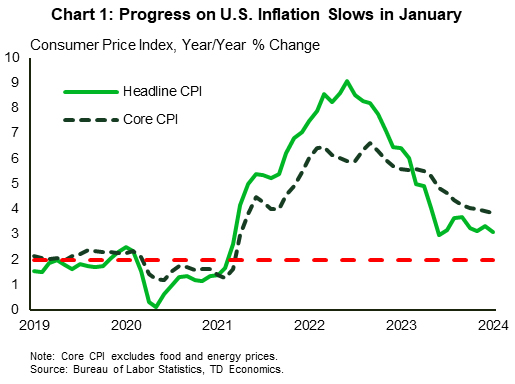
Taking a closer looker at CPI, the headline figure came in at 3.1% year-on-year (Chart 1). While this was lower than December’s 3.4%, it was higher than market expectations for 2.9%. The core measure matched December’s pace at 3.9%, but again was higher than expectations (3.7%). The near-term movements showed that progress on the disinflation front stalled a bit, largely due to services. Both monthly headline and core inflation accelerated relative to December. Also, both the 3-month and 6-month annualized growth for core CPI accelerated, suggesting that the process to tame inflation is likely to progress in uneven spurts. The producer price index corroborated the stalled CPI signal, with the PPI rising by 0.3% m/m in January (markets expected 0.1%) relative to -0.1% in December.
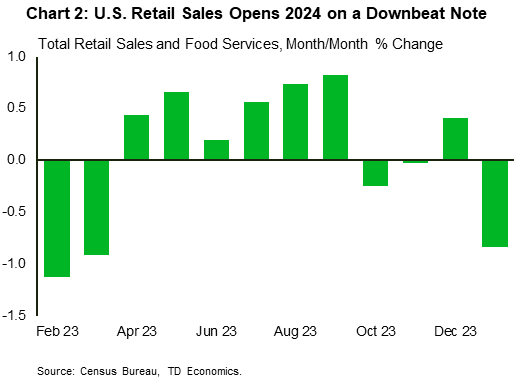
Turning to retail spending, consumers were a lot less jolly coming off the holiday season. Retail sales declined by 0.8% m/m in January (Chart 2). The sizeable decline was much larger than market expectations, however severe winter weather during January likely played a part in keeping consumers on the sidelines. Technical aspects of how the seasonally adjusted data is calculated may also have contributed to the relatively large decline. Nonetheless, the pullback suggests that consumer spending may be less of tailwind to U.S. economic resilience than it was last year.
Signals from the small business sector also suggest that economic activity might be slower in 2024. The NFIB’s small business optimism index declined to 89.9 from 91.1 in December, marking the biggest monthly decline since late-2022. On balance, small firms were generally less upbeat about their economic prospects, with the net percent of firms anticipating a better economy falling by 2 points. Given the higher exposure of small businesses to domestic economic conditions compared to larger firms, their downbeat mood points to headwinds ahead for the economy.
On the housing front, starts also disappointed expectations falling 14.8% to a five-month low (1.33 million) in January. The decline was in both the single and multi-family segments. Permits for future construction also fell on the month, implying that recovery in the housing market will be slow as buyers await lower mortgage rates.
Overall, data for January largely came in below expectations. This has left many market participants wondering what it all means for the timing of rate cuts. FOMC members have repeatedly stated that they need to see steady evidence that inflation is on a consistent path back to 2%. While the CPI and PPI data suggest that progress may be slow going for a bit, the pullback in other indicators point to an economy that is cooling. As such, Fed members may soon have the evidence that they need to begin the cutting cycle – it may just be later than markets desire.
Canada – Housing to Offer Little Shelter from Inflation
Canada's economic calendar was relatively light this week, so markets took their cue from developments south of the border. A hotter-than-expected U.S. inflation report reminded markets that the fight is not over, prompting a re-pricing of rate cut expectations. The prospect of delayed fed rate cuts pushed U.S. yields higher, dragging their Canadian counterparts along with them, while also weighing on the loonie. The Canadian 10-year yield hit 3.67% early in the week – the highest since November, before it retreated into week's end on softer U.S. consumer spending data.
Although the Canadian data slate was light this week, it certainly wasn’t barren. Housing took centre stage, thanks to reports on home sales and prices, alongside the latest data on homebuilding. Home sales increased for the second straight month in January, benefitting from lower borrowing costs in recent months, favourable weather conditions, and ample pent-up demand. The signal from home prices was much softer, with average home prices up only modestly while quality-adjusted benchmark prices declined.
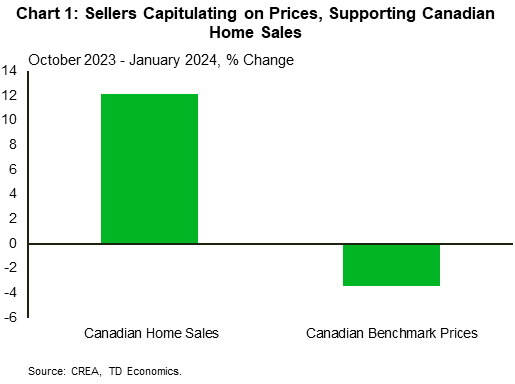
Looking at the big picture, home sales have surged since rates broke meaningfully lower in October, while price growth has lagged (Chart 1). Our view on this dichotomy is that sellers have lowered the price expectations in order to move their homes, especially in Ontario and B.C., where conditions have recently favoured buyers. However, with supply/demand conditions now much more balanced in these markets, weak price performances are likely in the rear view.
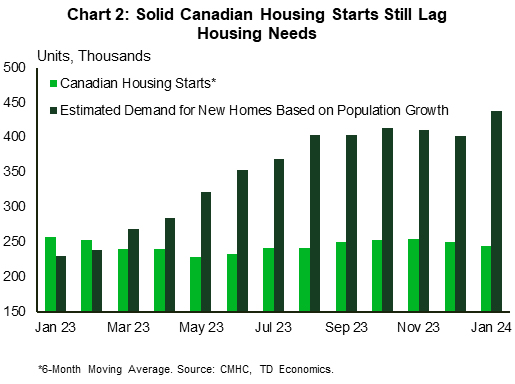
This is not just a story for the short-term, either, as Canadian housing shortages should support higher prices over the longer-term. This week, we received homebuilding data which showed a January decline, but that starts are still elevated on a trend basis. However, the rate at which builders are breaking ground continues to lag fundamental requirements from tremendously strong population growth which has persisted into this year (Chart 2).
Resurgent housing demand, alongside tighter markets, is sure to raise some eyebrows at the Bank of Canada. Rising housing market activity supports GDP growth through a direct boost to residential investment and can stoke consumer spending as well. Meanwhile, home prices feed directly into the CPI through the shelter component, which accounts for nearly 30% of the index. We agree with the Bank of Canada that inflation can hit its 2% target, despite only gradual improvements in the shelter component. However, if the housing market heats up by more than policymakers expect, this could delay rate cuts and/or alter the speed at which they're delivered.
We won't have to wait long to observe the impacts of housing market activity on consumer costs, as the January CPI report is on tap next week. The consensus expectation is that overall inflation was little changed last month, while the Bank's preferred core measures are likely to remain sticky at above 3.5%. The Canadian inflation battle clearly still has legs, which will keep the Bank vigilant on rates.
Week Ahead North America – FOMC Minutes Key, Canadian Inflation in Focus
- Is March a live meeting for the Fed?
- Inflation data in focus as markets eye July BoC rate cut
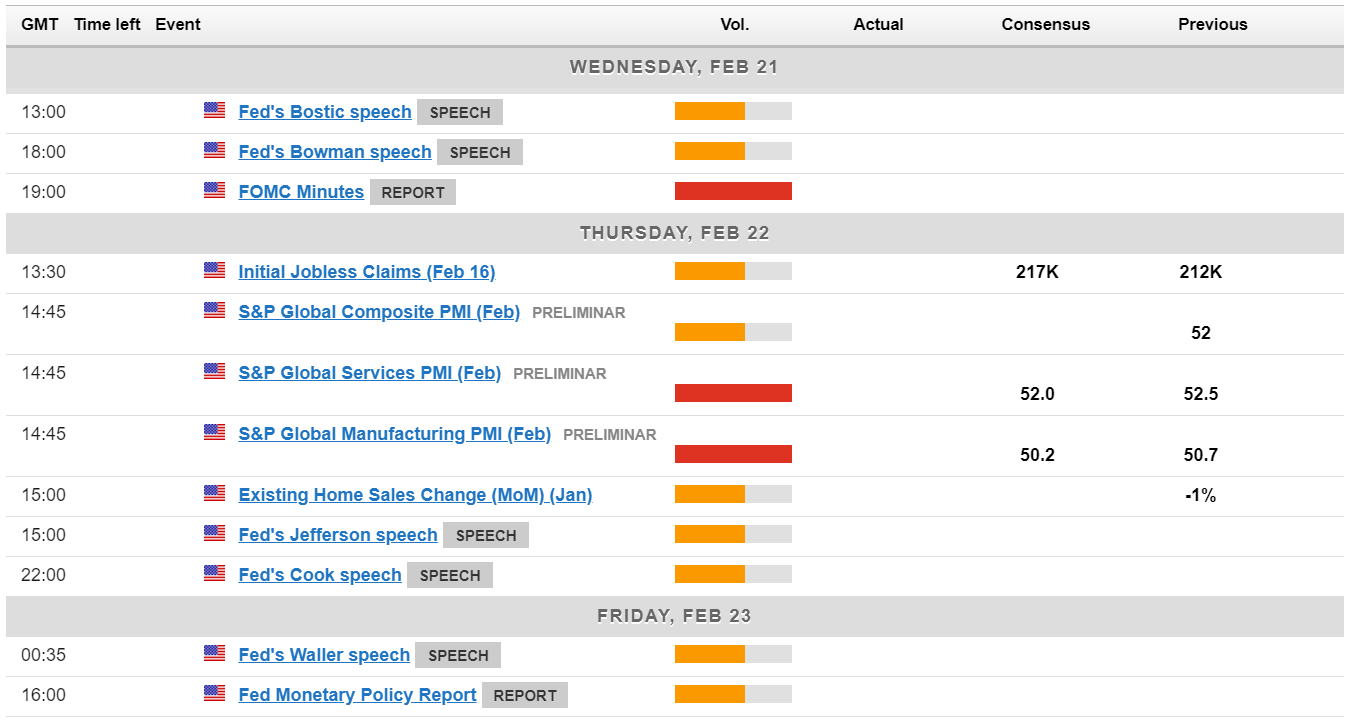
FOMC minutes could tell us how close they are to rate cuts
It’s been a turbulent start to the year, one in which we’ve seen significant shifts in expectations for the economy, interest rates, and the markets.
This past week was evidence of that with inflation exceeding expectations while retail sales dived at the start of the year. That’s not made the Federal Reserve’s job of determining when the correct time to start cutting rates any easier.
The mixed data since the last meeting though makes the FOMC minutes – released on Wednesday – all the more interesting. March appears unlikely for the first cut but the minutes could tell us how close policymakers think they are.
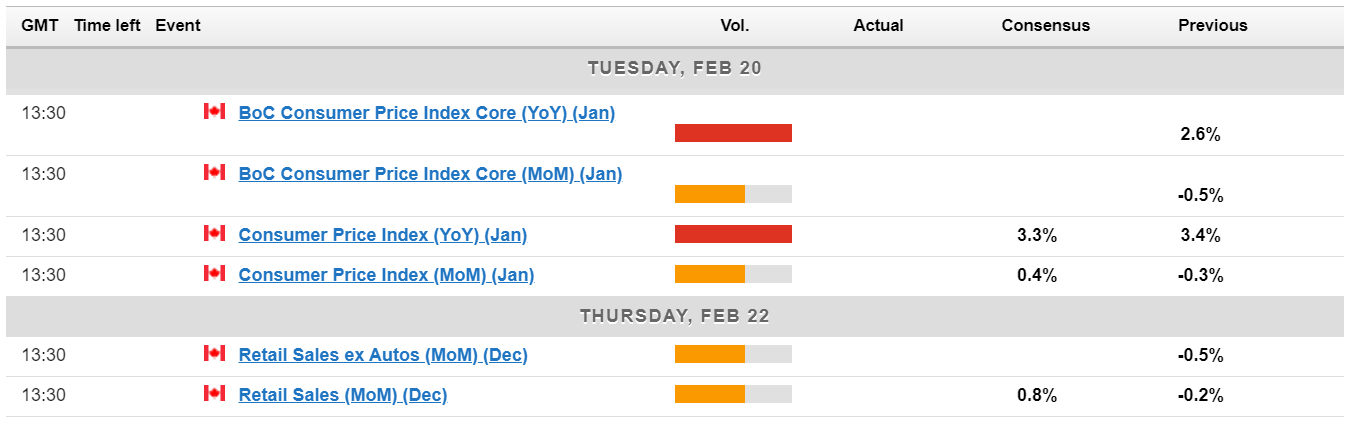
Is inflation set to fall again in Canada?
There’s a lot of economic data being released next week which will be of keen interest to traders, particularly in light of what we’ve seen elsewhere recently.
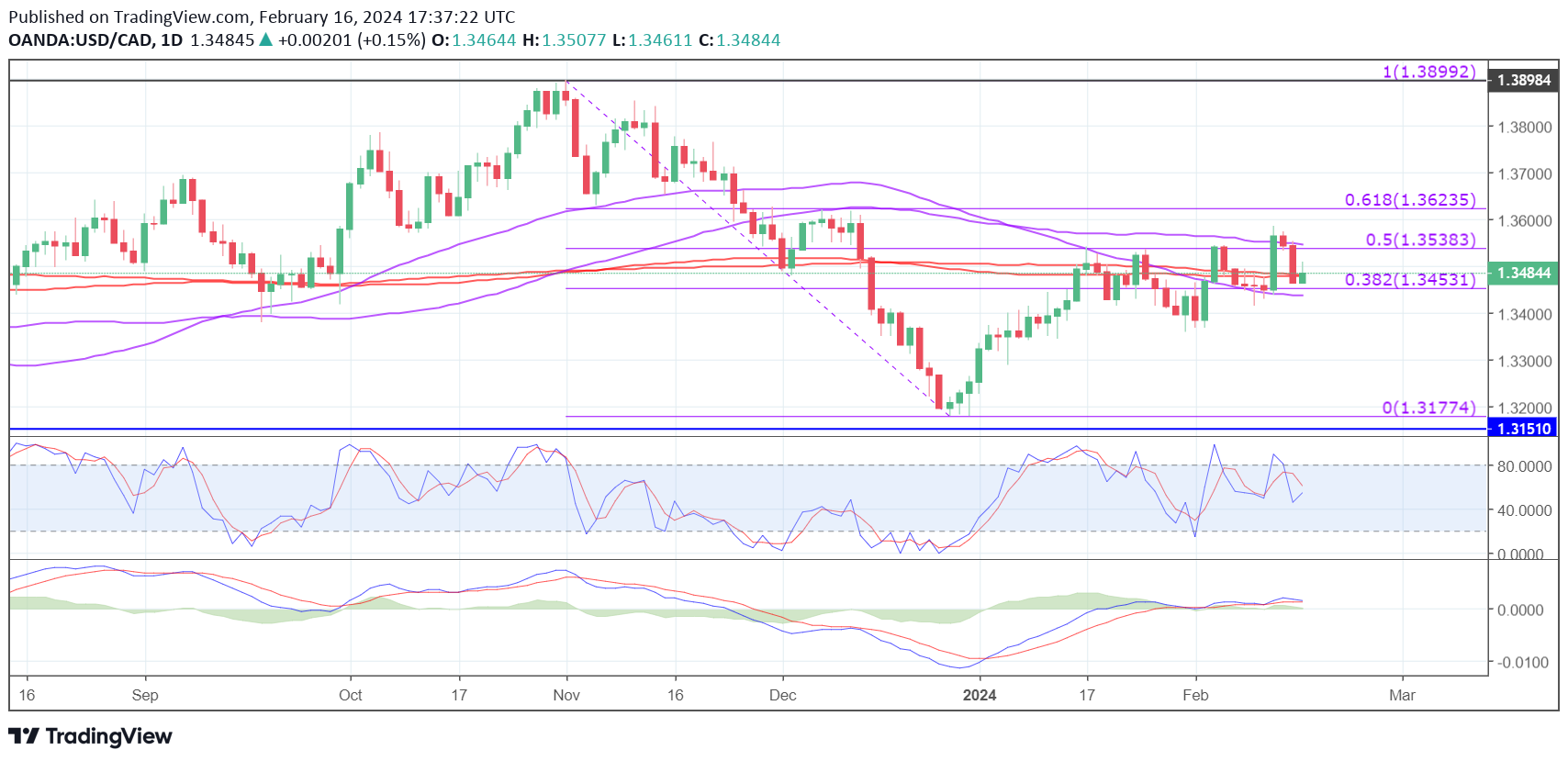
USDCAD Daily
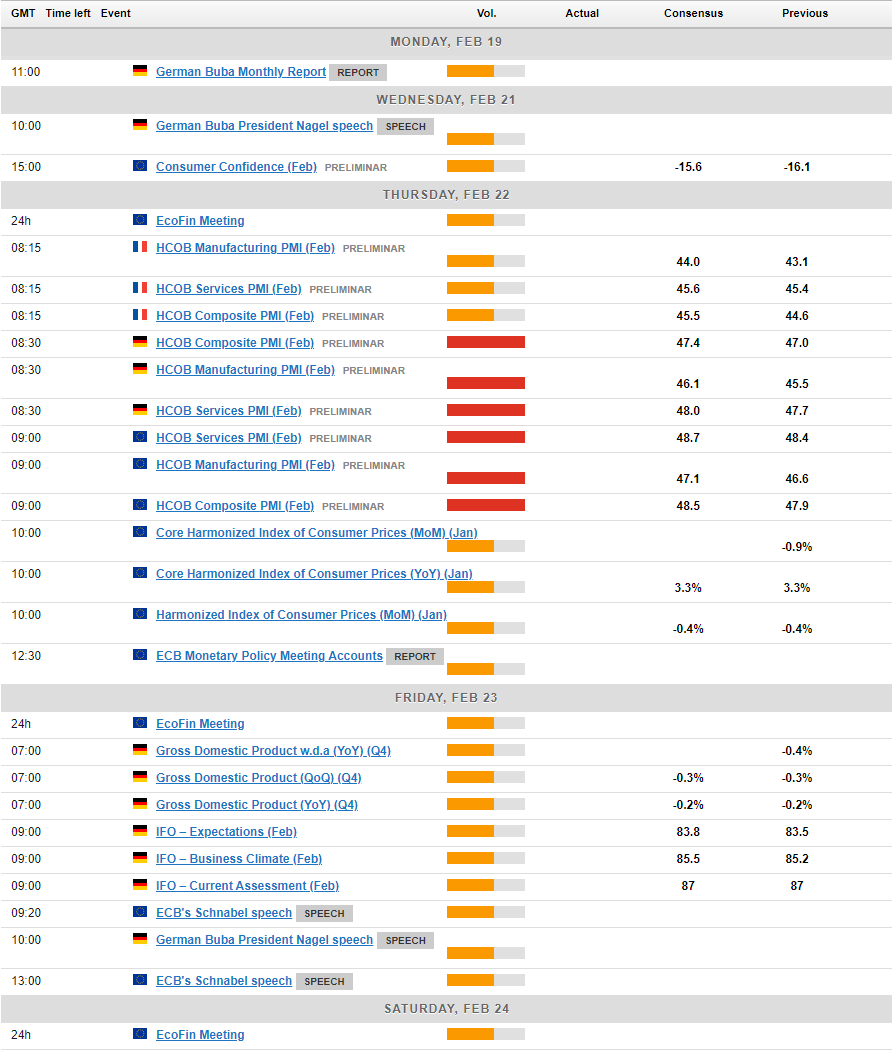
Week Ahead Europe – Eurozone Inflation and PMI Surveys Eyed
- Is a March rate cut from the ECB still possible?
- UK surveys eyed as the economy falls into recession
Could eurozone inflation figures reignite the rate cut debate next month?
March has widely been written off as the likely moment that some major central banks will start cutting interest rates but data next week may change that for one.
The European Central Bank is arguably closer than any other at this point to pulling the trigger on an easing cycle and while the odds of a cut, in the markets, are still low, they could improve if we see a significant revision to the January inflation data on Thursday.
With the bloc flirting with recession, it won’t take much of a downward revision for the ECB to have to consider rate cuts, with the current rate of headline and core CPI within touching distance of the 2% target.
Also on Thursday, we’ll get PMI figures for the eurozone, Germany, and France which could offer an up-to-date view on the economic situation and prospects for the euro area. The surveys are currently deep in negative territory so any improvement, even one that leaves it in contraction territory will be welcome.
EURUSD Daily
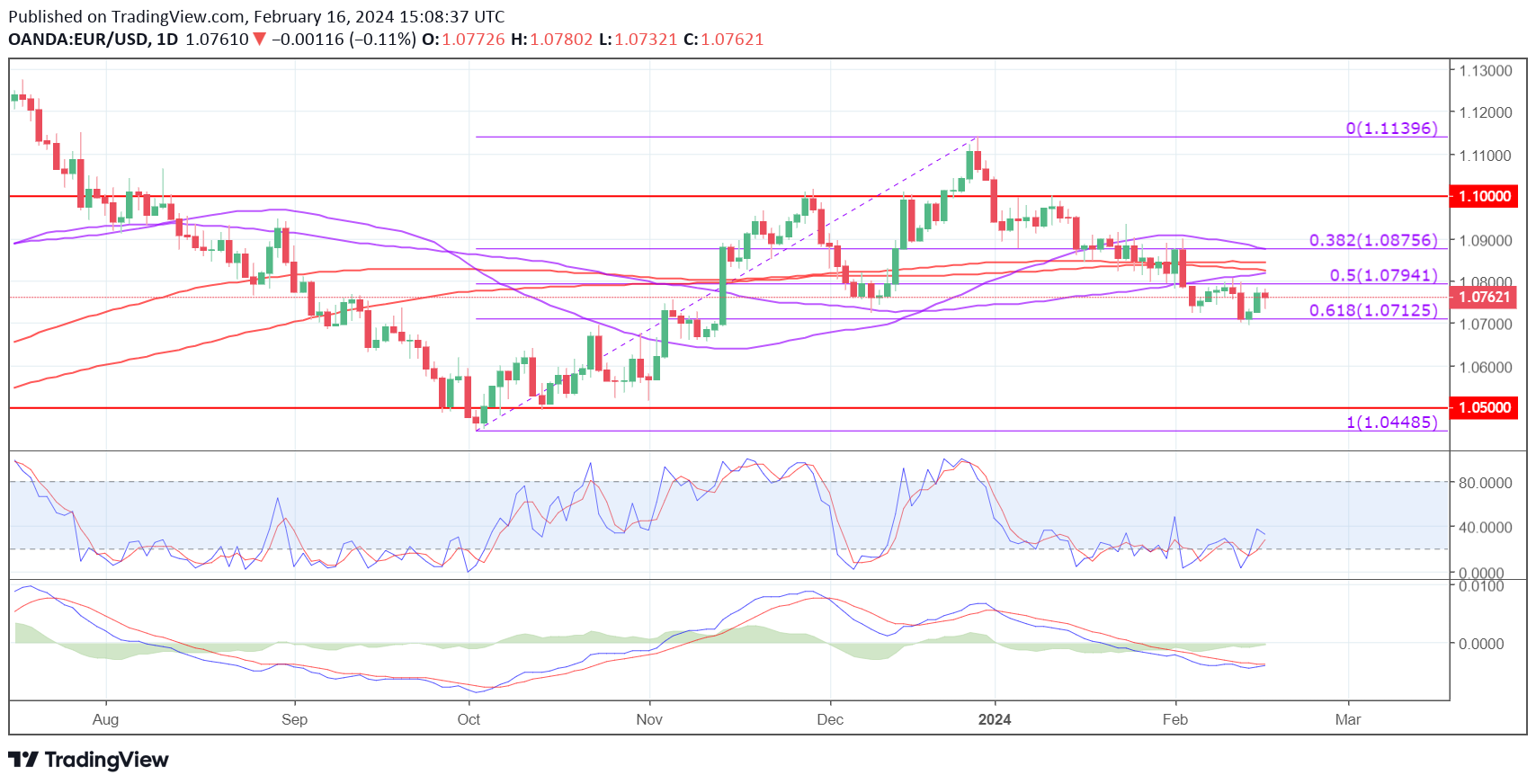
Source – OANDA
EURUSD has continued to trend lower this week but it may be running into some support. The latest rotation off the 61.8% Fibonacci retracement level came amid weaker momentum and a divergence between the price and the MACD.
Perhaps this is a sign of exhaustion in the decline since the turn of the year and that it occurs around a key Fib level may be considered a further bullish indicator.
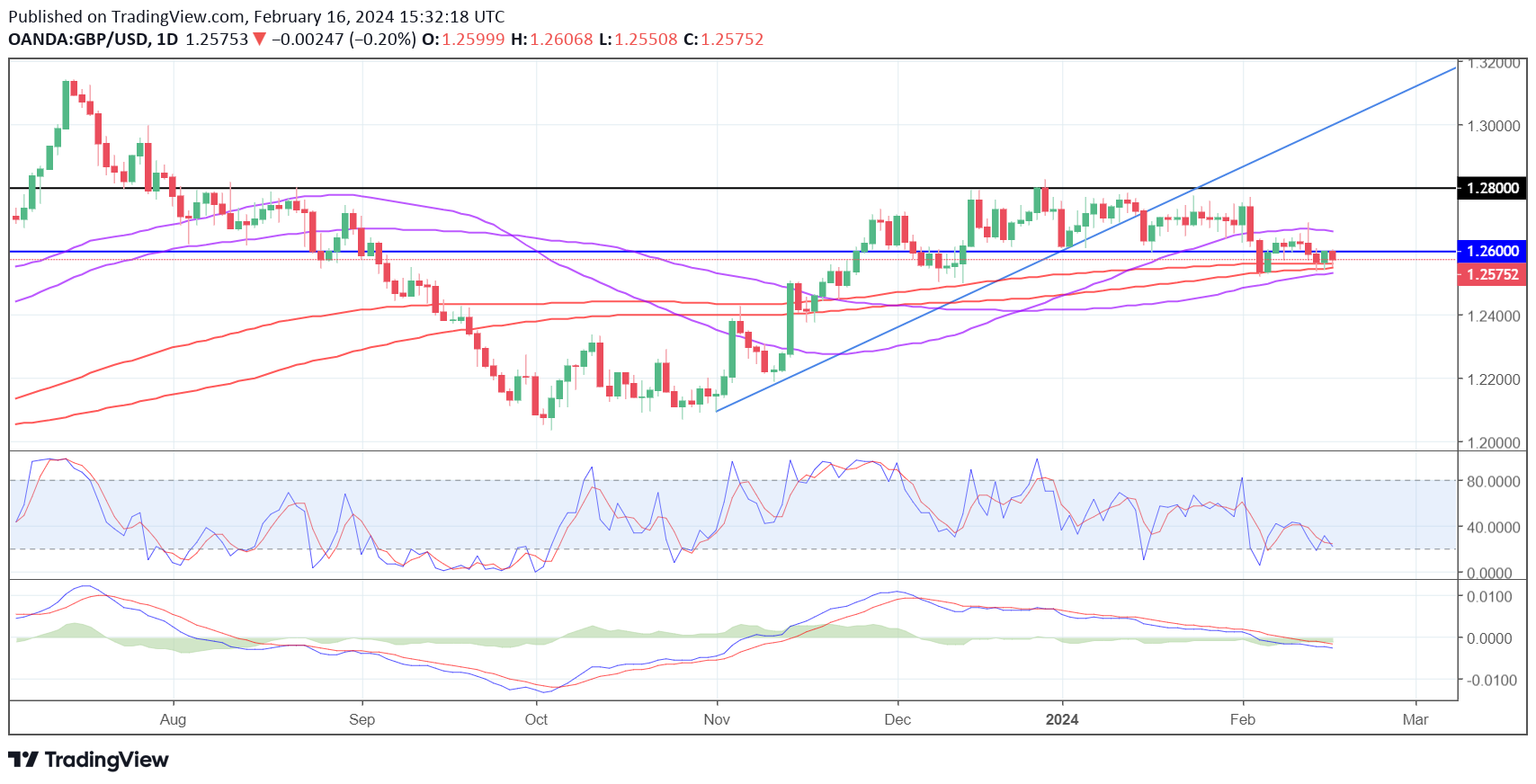
PMIs eyed after the UK fell into recession at the end 2023
We’ve had a lot of data from the UK over the last week which left us with a much better idea of where things stand going into a big election year.
The economy fell into recession at the end of 2023, albeit a very mild one, while inflation didn’t rise last month as it was expected to, and retail sales roared back at the start of the year. While there’s plenty of room for improvement, the UK is in a good position to see rates falling soon and the BoE is confident that the economy will quickly bounce back too.
It’s much quieter next week on the data front, with manufacturing and services PMIs on Thursday the only notable releases. The services component has rebounded strongly over the last couple of months and another good reading could back up the BoE view on the economy this year.
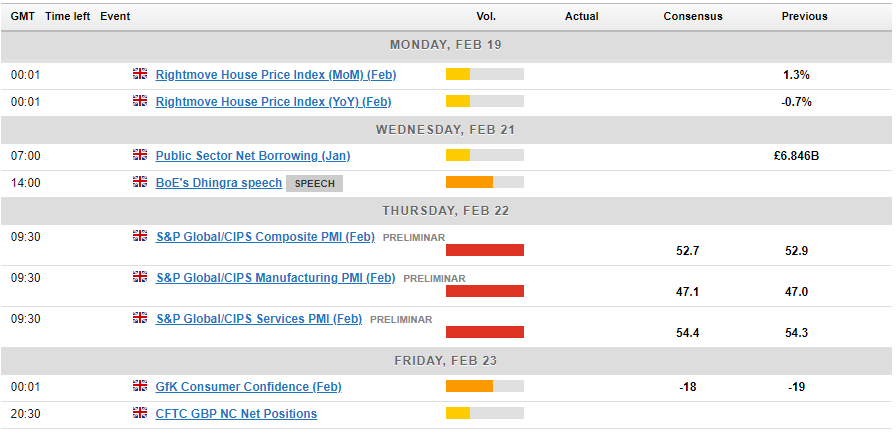
GBPUSD Daily
Source – OANDA
It’s been quite a choppy week for cable after some bearish developments earlier this month. The move below the topping formation neckline, around 1.26, appeared to be quite bearish, as did the following rebound off a key Fib level after rebounding this week, but it’s lost some momentum already before reaching the February lows.
NZD: The Week Ahead
Commerzbank's analysis suggests a brighter outlook for the New Zealand Dollar (NZD) in the coming months despite recent downward pressure. Factors like broader U.S. Dollar strength and domestic issues have kept the NZD below last year's highs. However, robust labor markets in both New Zealand and Australia and an expected stabilization of Chinese economic growth offer reasons for optimism. While economic growth in New Zealand is projected to stabilize slowly, persistent inflation prompts cautious actions from the Reserve Bank of New Zealand (RBNZ). Despite challenges, Commerzbank anticipates a moderate appreciation of the NZD due to the relatively hawkish stance of its central bank compared to other G10 counterparts.
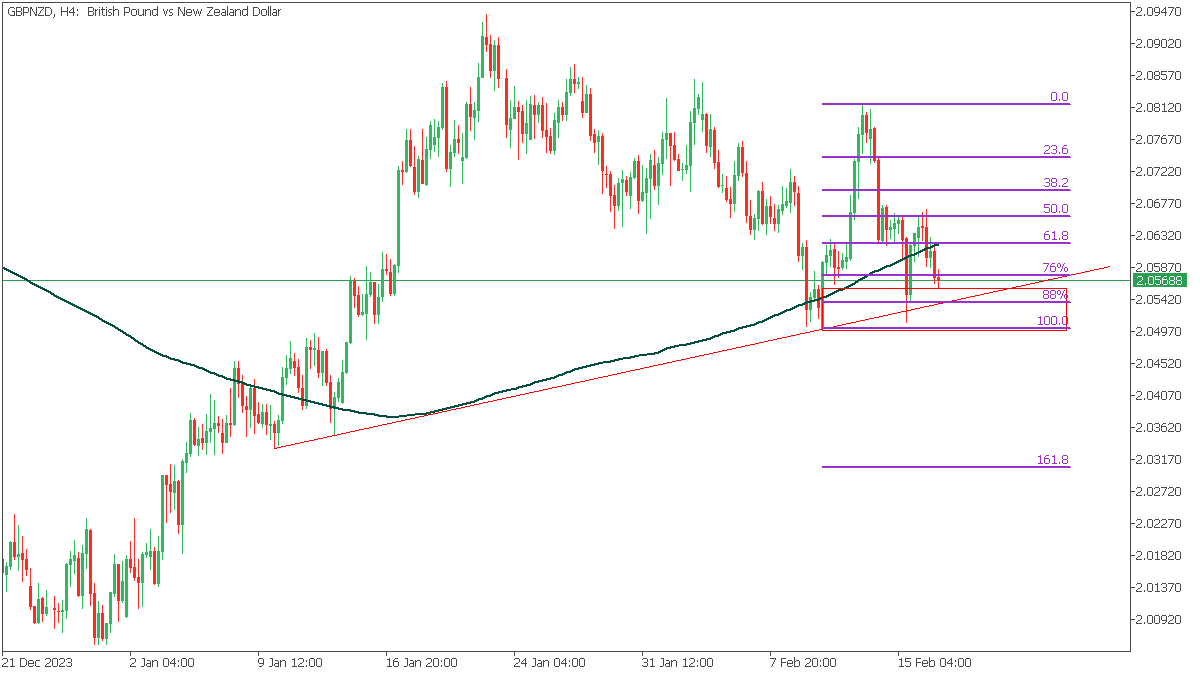
GBPNZD - H4 Timeframe
The 4-hour timeframe chart of GBPNZD as attached above shows price currently retesting the 88% region of the Fibonacci retracement tool. This, combined with the trendline support, and 200-period moving average, indicates the likelihood of price to bounce off the current region to approach the 23% of the Fibonacci retracement as a target level.
Analyst’s Expectations:
- Direction: Bullish
- Target: 2.07402
- Invalidation: 2.04964
NZDUSD - H4 Timeframe
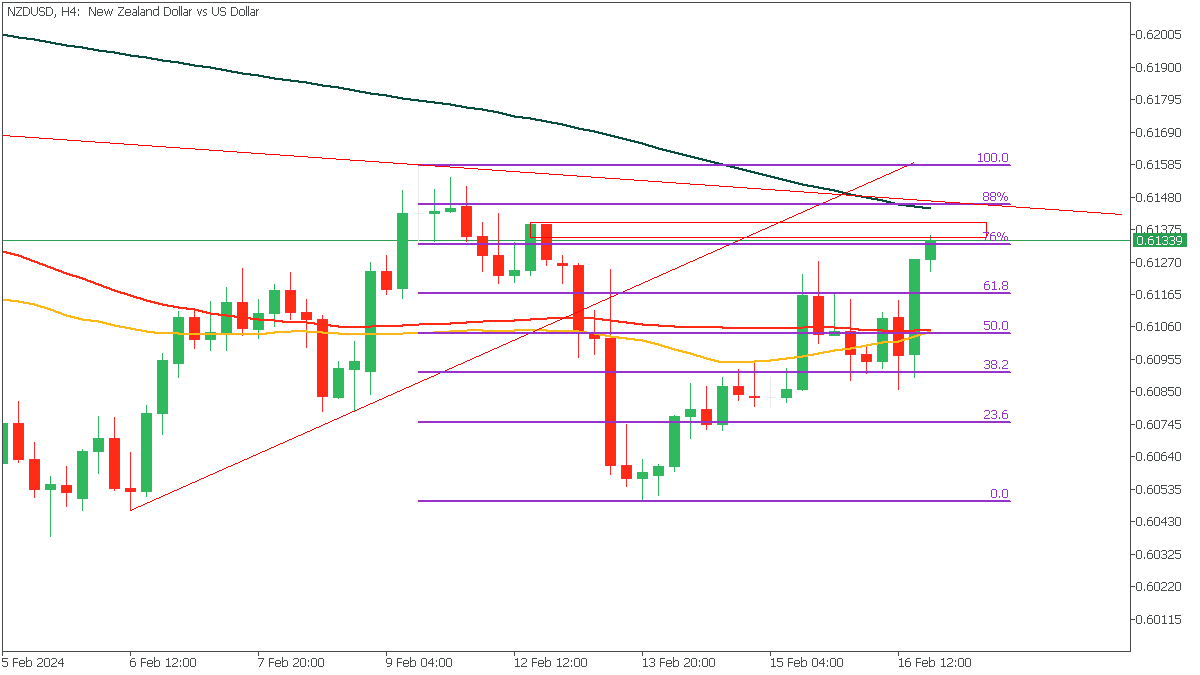
NZDUSD is currently trading between 76% and 88% of the Fibonacci retracement after having broken structure and trendline support. This means that the current price action is likely to reverse once price retests the trendline. Other confirmations include the confluence of two resistance trendlines, the 200-period moving average resistance, the Fibonacci retracement levels, and also, the supply zone.
Analyst’s Expectations:
- Direction: Bearish
- Target: 0.60761
- Invalidation: 0.61595
NZDCHF - D1 Timeframe
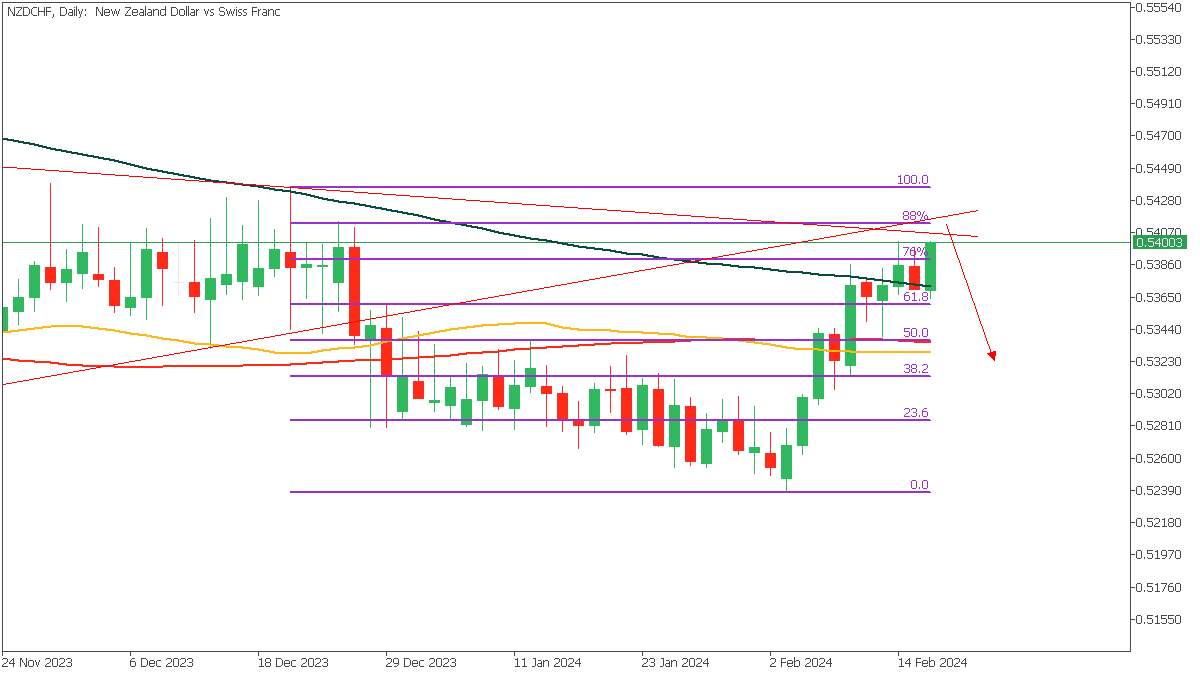
The price action on the daily timeframe of NZDCHF is very akin to what we saw earlier on the 4-hour timeframe of NZDUSD. Here, we see a similar break of structure and trendline support, with price currently making a move to retest these resistance trendlines, as well as the supply zone and the Fibonacci retracement levels. I expect to see a rejection from the supply zone.
Analyst’s Expectations:
- Direction: Bearish
- Target: 0.52863
- Invalidation: 0.54377
CONCLUSION
The trading of CFDs comes at a risk. Thus, to succeed, you have to manage risks properly. To avoid costly mistakes while you look to trade these opportunities, be sure to do your due diligence and manage your risk appropriately.
Weekly Economic & Financial Commentary: Central Banks on Hold for Longer?
Summary
United States: Little Love in January Data
- Economic data were stuck in the doldrums this week, highlighted by a hot January CPI print. The out-of-consensus start to the year for economic data continued with a slip in retail sales and industrial production followed by a startling 14.8% drop in housing starts during January.
- Next week: LEI (Tue.), Existing Home Sales (Thu.)
International: International Data Deliver Downside Surprises
- This week in international data, U.K. Q4 GDP fell 0.3% quarter-over-quarter, and January inflation was slower than forecasted, holding steady at 4.0%. Japan's GDP was also weak, reporting an unexpected decline. Australia's January labor market report was disappointing, with employment virtually unchanged, while the jobless rate rose more than forecast to 4.1%.
- Next week: Canada CPI (Tue.), Eurozone PMIs (Thu.)
Interest Rate Watch: Central Banks on Hold for Longer?
- We explain why we think the FOMC is still on pace to cut rates by 25 bps at its May 1 meeting despite this week's higher-than-expected print on CPI inflation in January. We look for the European Central Bank to reduce its policy rate by 25 bps on April 11. That said, we readily acknowledge that both central banks could wait longer to ease policy than we currently anticipate.
Credit Market Insights: Housing Affordability Update
- The affordability of the U.S. housing market continues to be bifurcated across prospective and existing homeowners as the differential between rates for new mortgages and the average existing mortgage widens. Purchase affordability has reached its lowest level in close to 40 years. Meantime, existing homeowners have yet to directly feel the pinch of higher mortgage rates.
Topic of the Week: Slow to Find Shelter from Inflation
- The strengthening in January's CPI for owners' equivalent rent (OER) stood in contrast to leading measures of shelter inflation and moderation in rent of primary residences (RPR). We expect to see some payback next month, but January's gap between OER and RPR growth hints at a firmer path for OER ahead as the single-family rental market remains tight amid low purchase affordability.