Sample Category Title
Week Ahead – Fed Minutes Headline a Data-Heavy Week
- Dollar shines after inflation surprise, awaits latest Fed minutes
- In Europe, business surveys will be crucial for euro and sterling
- Canadian and Australian data releases also on the agenda
Fired up dollar turns to FOMC minutes
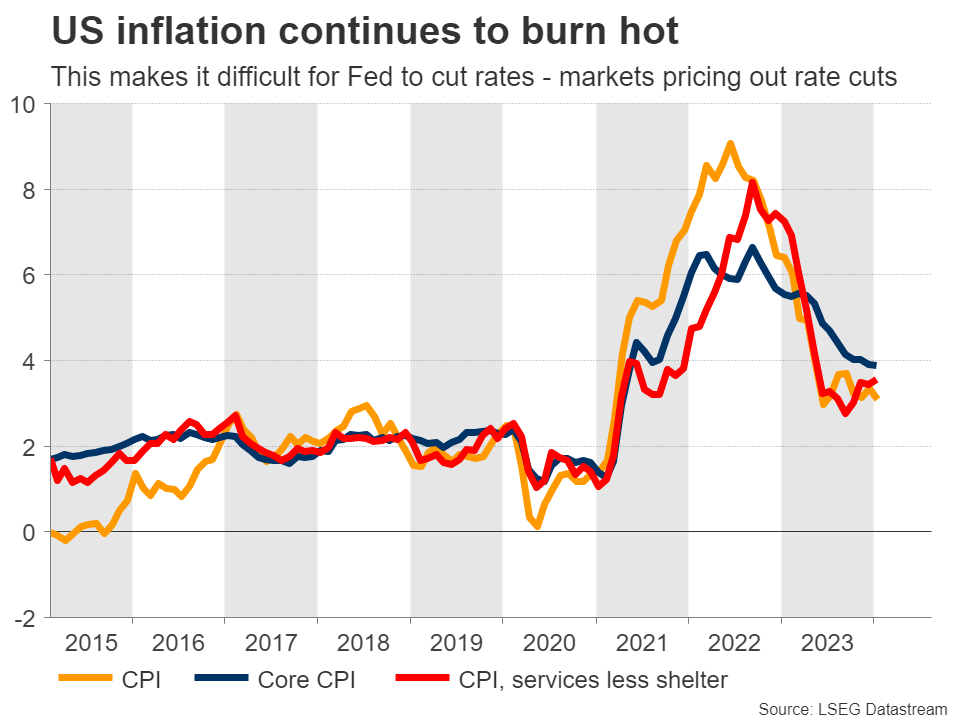
It was a beneficial week for the US dollar, which charged higher after data revealed US inflation is not cooling down as quickly as investors had hoped. Traders were forced to unwind bets of imminent Fed rate cuts in the aftermath, lending the dollar strength through the interest rate channel.
Solid economic growth, a tight labor market, and persistently high inflation are a cocktail that makes it very difficult for the Fed to cut interest rates. Markets have finally gotten the message. The timing of the first rate cut has been pushed out to June, while the market is now pricing in less than four cuts in total for 2024, down from six earlier.
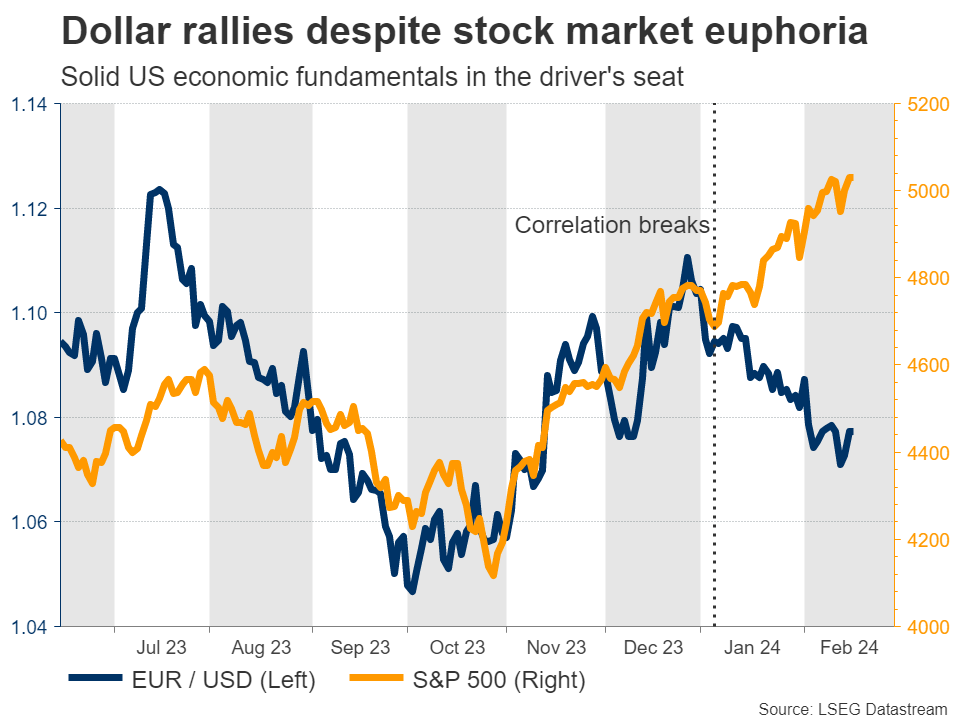
With rate cuts getting priced out, the dollar has started to shine once again, gaining 3% already this year against a basket of currencies. It’s crucial to note that this is happening even despite the euphoria in the stock market. Positive risk sentiment is generally bad news for the dollar, which is considered a safe haven asset.
This makes the dollar’s recent rally even more impressive. The reserve currency has started to realign itself with its robust economic fundamentals, and this process might have scope to continue since the market is still pricing in four rate cuts for this year, whereas the Fed has only signaled three.
Minutes of the latest Fed meeting will be released on Wednesday and will be the next piece in this puzzle. Investors will search for any clues on the potential timing of the first rate cut. We’ve heard from several Fed officials since this meeting, and most have preached patience on rates, warning against premature cuts given the strength of the US economy.
If the minutes echo a similar tone, the dollar could gain more momentum.
Eurozone and UK business surveys on tap
Crossing into Europe, the latest round of PMI business surveys will be released on Thursday in both the Eurozone and the United Kingdom. Both economies have been haunted by stagnant growth for some time now, with the UK even falling into a technical recession late last year.
Investors will dissect these business surveys for signals on whether the situation is improving or worsening in order to gain insights on how quickly these central banks might cut interest rates. Since UK inflation is still very hot, markets think the Bank of England will be among the last central banks to cut in this cycle.
This notion has helped support the British pound, which is currently the second-best performing major currency this year, behind the US dollar. The cheerful tone in global markets played a role too, as the pound is highly correlated with stock market performance, thanks to the UK’s twin deficits.
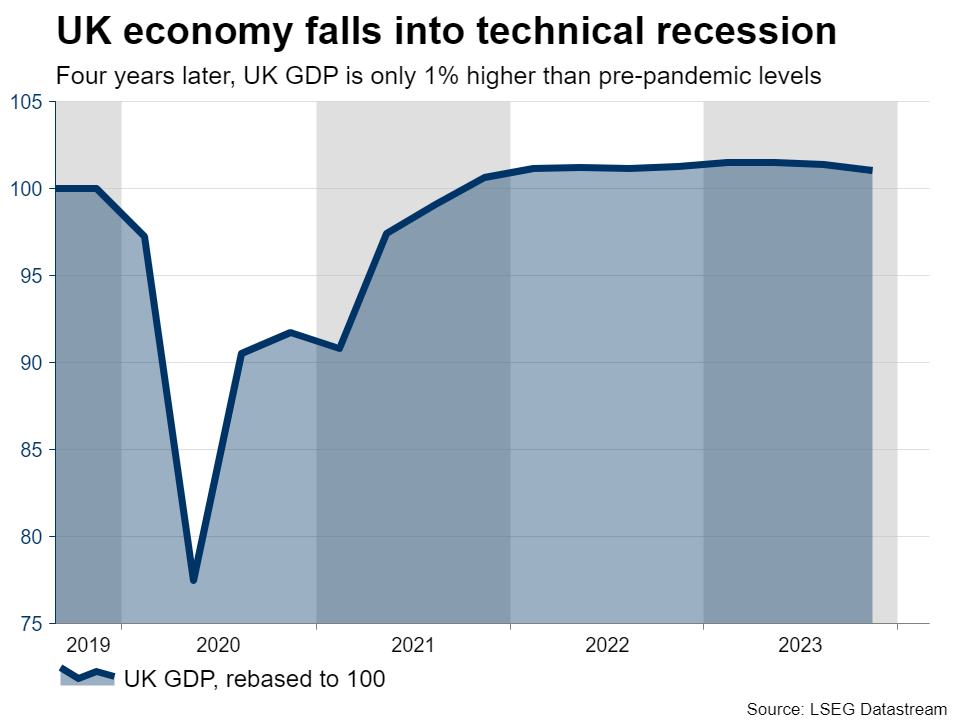
Of course, this is a dynamic that cuts both ways. If stock markets suffer a correction or if UK data continues to deteriorate, the pound would be left vulnerable to a selloff, especially with political uncertainty brewing ahead of a general election.
As for the Eurozone, even though it narrowly dodged a recession, the outlook is equally grim. New business orders have declined for seven months in a row, which is bad news for future growth. If the upcoming surveys show that this trend persists, the euro could receive another blow as traders become more confident the ECB will cut rates in April.
The minutes of the latest ECB meeting will also be published on Thursday, although this release usually does not have a significant market impact.
Canadian and Australian releases
Turning to the commodity-linked currencies, the ball will get rolling on Tuesday with Canada’s inflation stats for January. Inflation has cooled dramatically in recent months, with the core CPI rate falling to just 2.6% in December, leading the Bank of Canada to abandon its tightening bias.
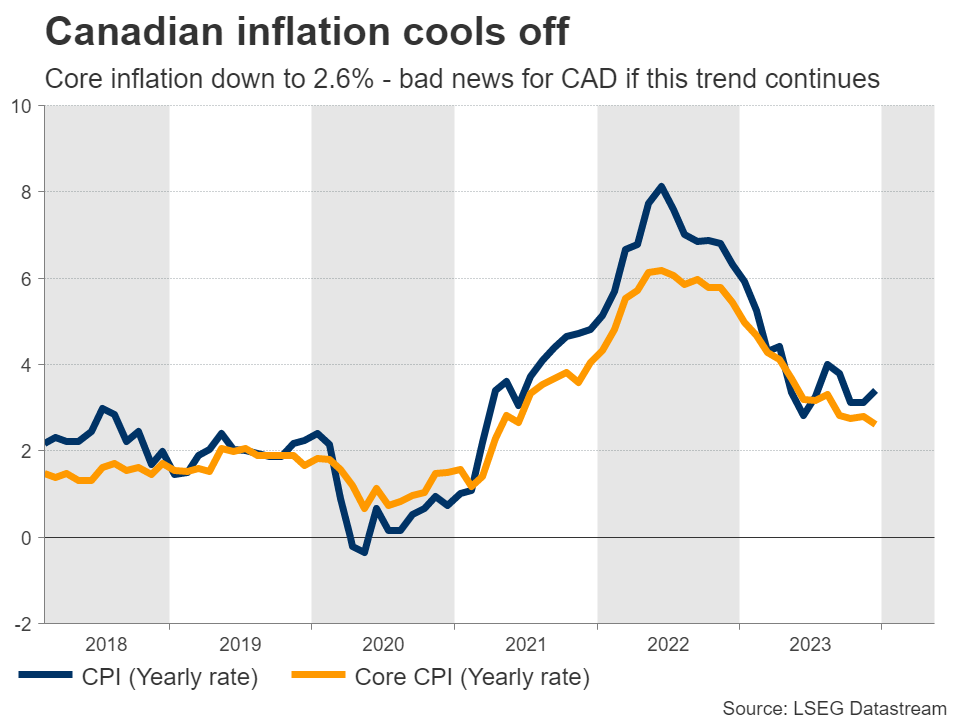
Another cooldown in inflation could raise the likelihood of a rate cut in the spring, keeping the Canadian dollar under pressure. The nation’s retail sales for December will also be released on Thursday.
Finally in Australia, minutes from the latest RBA meeting will see the light on Tuesday, ahead of wage growth data for Q4 on Wednesday.
Canadian Inflation in January Likely Eased as BoC Contemplates Interest Rate Cut Timing
The first Canadian inflation reading of 2024 out next Tuesday should edge lower on falling energy prices and slower food price growth.
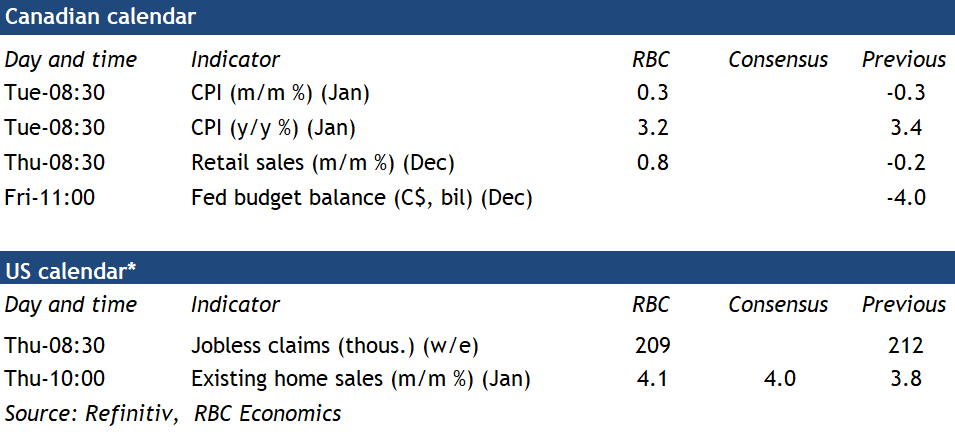
We expect the consumer price index to rise 3.2% year-over-year, lower than 3.4% in December. But the underlying details will be closely watched for signs on whether inflation pressures are continuing to trend— albeit gradually—towards the Bank of Canada’s 2% target. Most of the deceleration we expect in price growth comes from lower energy prices, which the central bank has little to no control over. Gasoline prices were little changed from December to January and residential natural gas prices fell in Alberta. Food price growth also looks likely to ease as a large month-over-month surge in January 2023 (+1.7%) falls outside of the year-over-year growth rate.
Stripping out volatile components like food and energy, we expect price growth to hold at 3.4% year-over-year with the recent months’ mixed underlying drivers continuing. More than a quarter of price growth overall is still coming from higher mortgage interest costs that are a direct result of earlier BoC interest rate increases. If we exclude that component, price growth would already be back within the BoC’s 1% to 3% inflation target range.
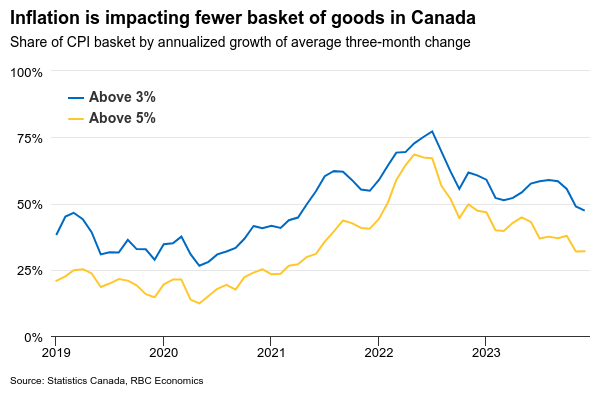
The share of the CPI basket seeing abnormally high inflation has also been declining. Roughly 51% of the consumer basket was growing at more than 3% over the last three months, down from a peak of 77% of the basket in July 2022. But we also look for year-over-year growth in the BoC’s preferred broader trim and median measures of underlying price growth to hold steady at 3.7% and 3.6%, respectively, in December.
Substantially stronger-than-expected January labour market data and a bounce back in home resales have raised fears that the Bank of Canada will need to leave interest rates higher for longer (again) to get inflation sustainably back to target. But, consumer demand has continued to soften on a per-capita basis.
We expect December retail sales data on Thursday to show an increase close to the 0.8% advance estimate from Statistics Canada a month ago, but that likely implies lower spending outside of a monthly jump in vehicle sales and higher gasoline prices. Our tracking of spending in January has been softer.
Weekly Focus – Data Dampens Rate Cut Expectations
The overall theme for markets this week continued to be the scaling back of expectations of rate cuts especially in the US as the economy looks stronger, and inflation higher, than expected. However, the change should not be exaggerated. Inflation expectations are well in line with targets and indicators for banking activity in both the US and Europe confirm that the current stance of monetary policy is having a dampening effect on economies.
The latest significant upside surprise to US data was the January CPI. The core price index rose 0.4% m/m, so clearly more than what is compatible with 2% annual inflation. The increase was driven by a broad-based increase in service prices. The so-called "super core" index of services excluding shelter rose 0.85% m/m. This likely reflected higher than normal January price adjustments to make up for past cost increases in businesses and so is not likely to be repeated to the same extent in coming months, but nevertheless feeds into concerns in the Fed and elsewhere that a tight labour market and high wage growth could make it difficult to get service inflation down far enough.
On the negative side, US retail sales declined 0.8% in January and were revised down for December, and industrial production declined 0.5%. Especially retail sales is a highly volatile data series though, and these numbers do not really change the view on the US economy.
In Europe, the economic news has been slightly more positive this week. Employment growth in the euro area actually accelerated in Q4 to 0.3% q/q. The labour market usually reacts with a lack to the economy, so it is perhaps not surprising that the stagnating European economy has not yet produced a decline in jobs, but accelerating outright growth in employment is harder to explain. Surveys continue to show a large, unmet demand for labour among euro area companies. The strong labour market reduces pressure on the ECB to cut rates and adds to concerns about a potential rebound in inflation from high wage growth. The German ZEW index showed a new increase in business expectations in February consistent with the view of a more positive global situation for manufacturing, although assessment of current conditions actually worsened.
Unlike in the US, UK inflation was lower than expected in January, which helped dampen market worries globally. Core CPI increased just 0.16% m/m seasonally adjusted, and service prices dragged down. On the other hand, wage growth declined less than expected in December and stands at 6.2% y/y, while the unemployment rate declined from 4.0% to 3.8%. With core inflation still as high as 5.1% y/y, we still expect the Bank of England to be cautious in cutting rates.
Next week, on Thursday, we will get February PMI data for most major economies. They could show a renewed strengthening in global manufacturing. Regional PMIs published this week in the US point in that direction, as does indicators from several Asian countries that are normally leading in the manufacturing cycle. However, PMIs might also point to continued weakness in services which at least in the euro area seem to be stagnating or contracting, albeit with rising prices.
Sunset Market Commentary
Markets
This week’s market story was all about US price data which dashed investors hope on a May Fed policy rate cut. January CPI delivered the first and biggest blow on Tuesday by unexpectedly accelerating on a monthly basis and keeping Y/Y-equations more sticky than hoped (3.1% headline & 3.9% core) with a special mention to services and housing related costs. Less important, but again consensus-overtaking import and export prices yesterday neutralized an attempt by US Treasuries to rally on disappointing retail sales. Third time’s usually the charm, though not this time around. January producer prices accelerated by 0.3% M/M (headline) and 0.5% M/M (core) while consensus forecasted only 0.1% for both. The January price update (with only PCE deflators missing; Feb 29 release) highlights the bumpy path ahead, both for markets and for the Fed. The former now even doubt whether the Fed will be able to pull the trigger in June (80% probability)!! The data amplify overnight comments by Atlanta Fed governor Bostic who defended a view consisting of only two rate cuts this year with a first one only in July. US Treasuries sold off in the wake of PPI data with US yields currently rising by 6 bps (30-yr) to 9 bps (2-yr). The US 2-yr yield set a new YTD high at 4.72%. The US 10-yr yield tested the similar reference at 4.33% which also coincides with the 100 day moving average. The dollar profited from the interest rate support, but the move lacked technical relevance. EUR/USD is currently changing hands around 1.0750. ECB comments (see News & Views) failed to impact the pair. We don’t expect any additional follow-up technical action during today US trading session given the upcoming long week. US markets are closed on Monday for President’s day. EUR/GBP trades close to opening levels around 0.8550, with the UK currency failing to profit from strong UK retail sales. Following this week’s economic update, we believe that the EUR/GBP 0.85 support zone is once again stronger.
Next week’s eco calendar is far less enticing that this week’s jam-packed US agenda. On Tuesday, the ECB publishes an in-house, forward-looking, indicator of negotiated wage rates. The day after, the FOMC publishes Minutes of the January policy meeting. On Thursday, it’s the ECB’s turn with global PMI’s on the agenda as well. It’s next week’s main dish with EMU consumer inflation expectations rounding off on Friday.
News & Views
Mario Draghi said central banks should give European sovereigns the space to invest in the green transition and robust supply chains, adding governments need sufficiently low borrowing costs to finance the shift. The former ECB president made the comments in the context of being mandated by the European Commission to seek ways to revitalize the European economy in the face of increased Chinese and US competition. Draghi has never been shy of airing controversial proposals, including during his tenor as head of the ECB. This time around, his call could be seen as a contentious one because it would risk creating the perception of (some form of) monetary financing. The ECB currently keeps policy rates at an elevated level to fight inflation that’s still above target. Draghi said, however, that central banks should focus on keeping inflation expectations anchored and look through “temporary upward price shocks”.
ECB’s Schnabel again warned for caution against calling victory over inflation. Challenging French governor Villeroy’s quote this morning that “the last mile of taming prices is not harder by nature”, the German board member noted that Europe’s sluggish productivity growth may slow the fall in inflation to the 2% target. She explained that "Persistently low, and recently even negative, productivity growth exacerbates the effects that the current strong growth in nominal wages has on unit labour costs for firms" which may eventually get passed on to consumers. Factors behind this underperformance vs the US include lower investment in technology, more red tape and more expensive energy, she noted.
EUR/USD Mid-Day Outlook
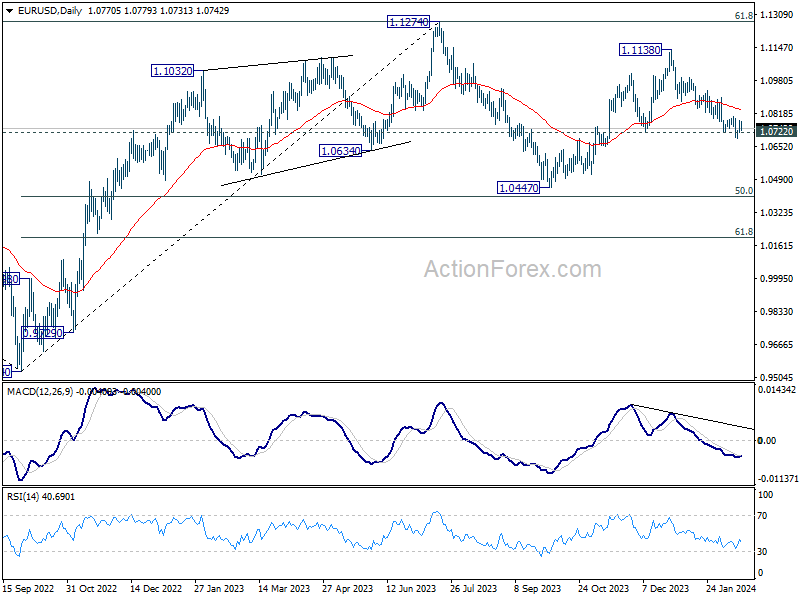
Daily Pivots: (S1) 1.0737; (P) 1.0761; (R1) 1.0797; More...
EUR/USD dips mildly in early US session as consolidation from 1.0694 extends. Intraday bias remains neutral and outlook stays bearish with 1.0804 resistance intact. Below 1.0694 will resume the fall from 1.1138 to retest 1.0447 support. Nevertheless, considering bullish convergence condition in 4H MACD, above 1.0804 will turn bias to the upside for stronger rebound.
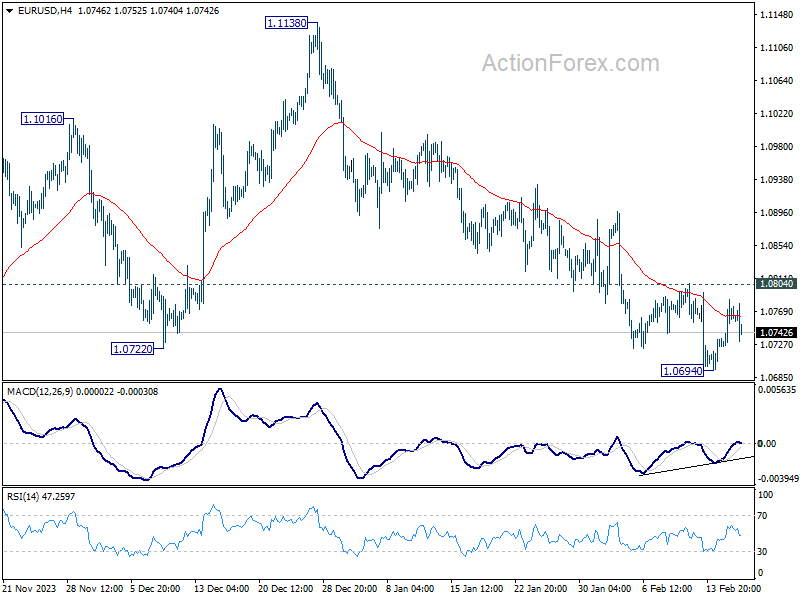
In the bigger picture, price actions from 1.1274 are viewed as a corrective pattern to rise from 0.9534 (2022 low). Rise from 1.0447 is seen as the second leg. While further rally could cannot be ruled out, upside should be limited by 1.1274 to bring the third leg of the pattern. Meanwhile, sustained break of 1.0722 support will argue that the third leg has already started for 1.0447 and possibly below.
GBP/USD Mid-Day Outlook
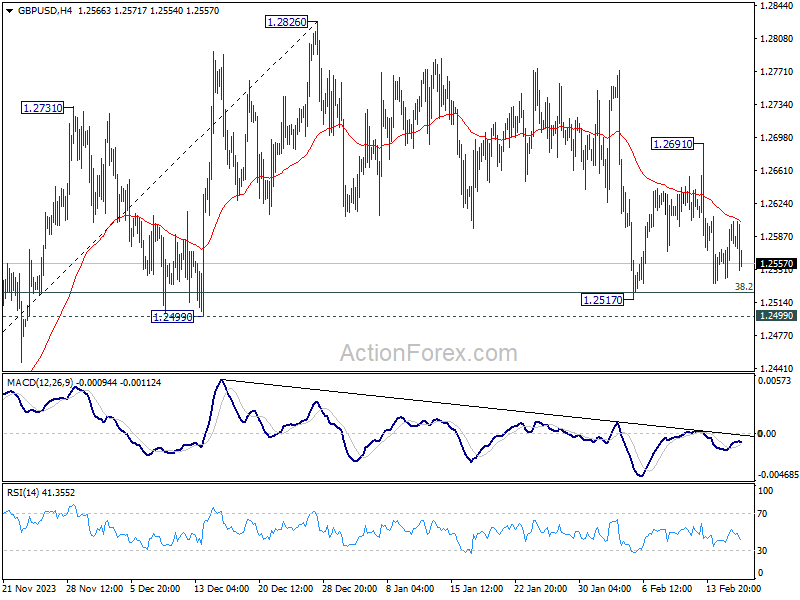
Daily Pivots: (S1) 1.2561; (P) 1.2581; (R1) 1.2621; More...
Range trading continues in GBP/USD and intraday bias stays neutral. On the upside, break of 1.2691 resistance will indicate that correction from 1.2826 has completed. Intraday bias will be back on the upside for retesting 1.2826. Nevertheless, decisive break of 1.2499 will argue that whole rise from 1.2036 has completed and turn near term outlook bearish.
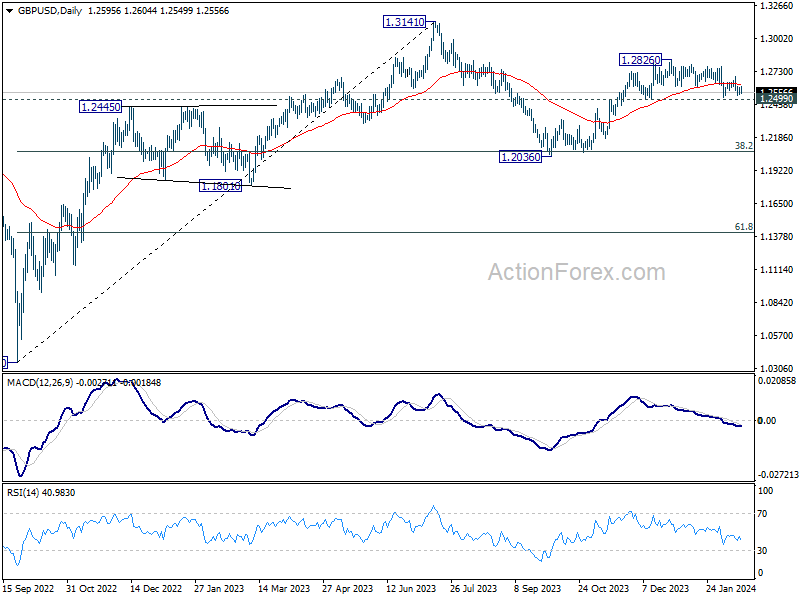
In the bigger picture, price actions from 1.3141 medium term top are seen as a corrective pattern to up trend from 1.0351 (2022 low). Rise from 1.2036 is seen as the second leg, which could be still in progress. But upside should be limited by 1.3141 to bring the third leg of the pattern. Meanwhile, break of 1.2499 support will argue that the third leg has already started for 38.2% retracement of 1.0351 (2022 low) to 1.3141 at 1.2075 again.
USD/CHF Mid-Day Outlook
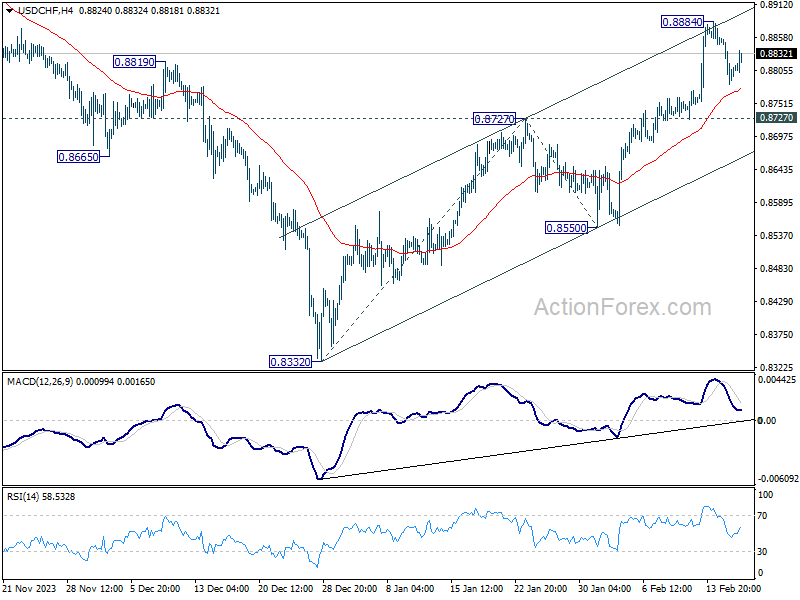
Daily Pivots: (S1) 0.8767; (P) 0.8816; (R1) 0.8850; More....
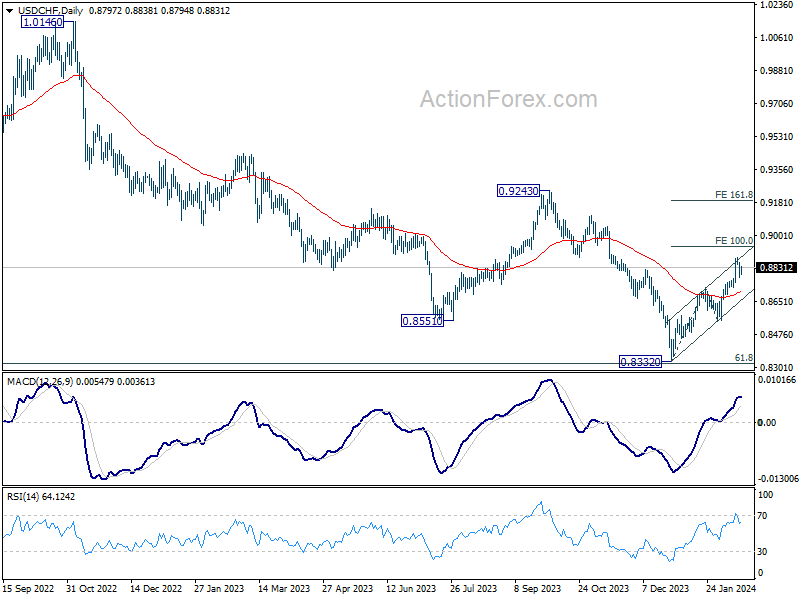
USD/CHF recovers mildly in early US session as consolidation from 0.8885 continues. Intraday bias remains neutral first. Downside of retreat should be contained by 0.8727 resistance turned support to bring another rally. On the upside, above 0.8884 will resume the rise from 0.8332 to 100% projection of 0.8332 to 0.8727 from 0.8550 at 0.8954. Firm break there will pave the way to 161.8% projection at 0.9189. However, sustained break of 0.8727 will dampen this bullish view, and turn bias back to the downside for 0.8550 support instead.
In the bigger picture, a medium term bottom should be formed at 0.8332, on bullish convergence condition in W MACD, just ahead of 0.8317 long term fibonacci support, on bullish convergence condition in W MACD. It's still early to decide if the larger down trend from 1.0146 (2022 high) is reversing. But further rise should be seen to 0.9243 resistance even as a correction.
USD/JPY Mid-Day Outlook
Daily Pivots: (S1) 149.47; (P) 150.02; (R1) 150.50; More...
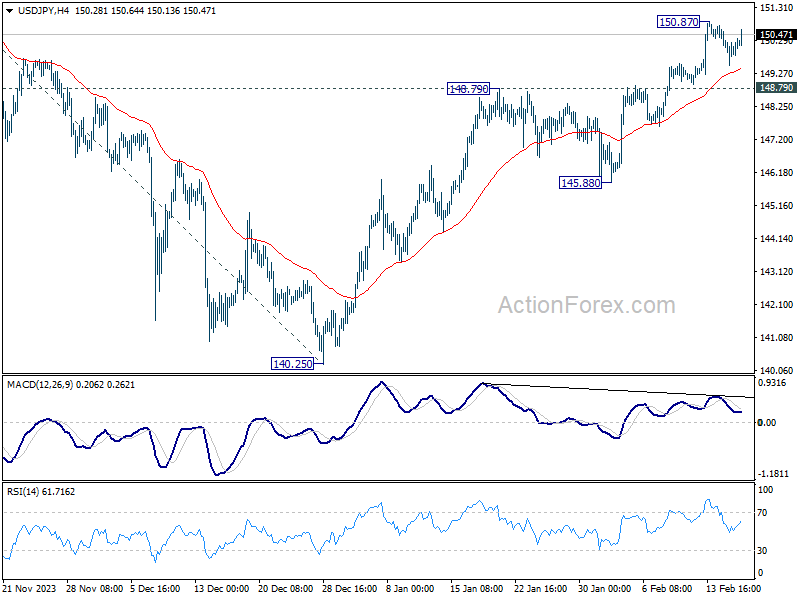
USD/JPY recovers in early US sessions but stays in range below 150.87. Intraday bias remains neutral and more consolidation would be seen. But in case of another retreat, downside should be contained by 148.79 resistance turned support to bring another rally. Above 150.87 will resume the rise from 140.25 to 151.89/93 key resistance zone. Decisive break there will confirm larger up trend resumption of 155.50 projection level next. However, firm break of 148.79 will turn bias to the downside for 145.88 support.
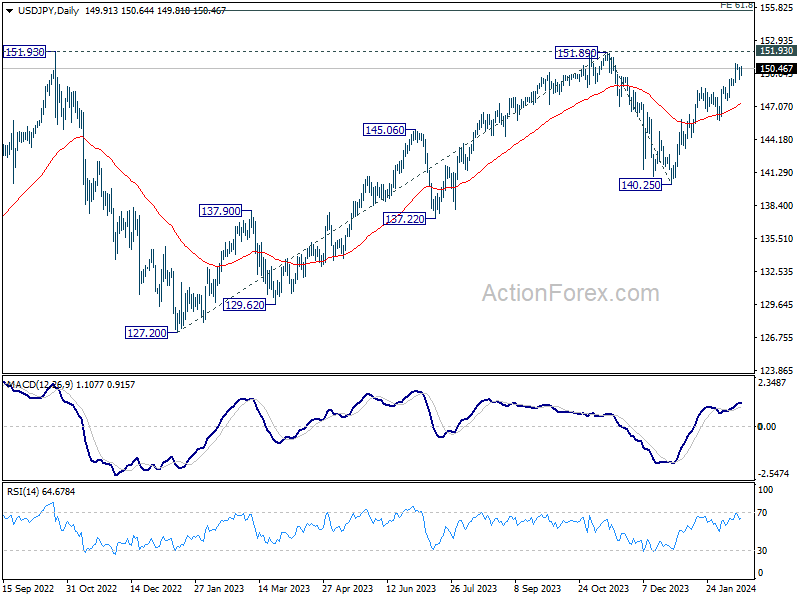
In the bigger picture, fall from 151.89 is seen as a correction to the rally from 127.20, which might have completed at 140.25 already. Firm break of 151.89/93 resistance zone will confirm up trend resumption, and next target will be 61.8% projection of 127.20 to 151.89 from 140.25 at 155.50. This will now remain the favored case as long as 140.25 support holds.
Dollar Finds Footing on Strong PPI Data
Dollar stages a notable recovery in the early US session, buoyed by stronger than expected January PPI figures. The highlight was PPI excluding foods, energy, and trade services, which saw its largest monthly increase in a year, hinting at persistent underlying inflationary pressures upstream. Despite the current rebound rebound, Dollar has yet to surpass the highs against major currencies seen earlier this week. Nevertheless, the current development at least indicates that the selloff triggered by the previous day's retail sales data should have run its course.
Also, Dollar's resurgence should be able to cement its position as the top performer for the week. Canadian and Australian Dollars are trailing behind in strength. Meanwhile, Swiss Franc, Japanese Yen, and New Zealand Dollar languish at the lower end of the performance spectrum, with the Euro and Sterling showing mixed results. The Pound, despite an initial surge from unexpectedly robust retail sales figures earlier today, saw its momentum wane swiftly.
In Europe, at the time of writing, FTSE is up 1.30%. DAX is up 0.46%. CAC is up 0.33%. UK 10-year yield is up 0.0644 at 4.122. Germany 10-year yield is up 0.049 at 2.414. Earlier in Asian, Nikkei rose 0.86%. Hong Kong HSI rose 2.48%. Singapore Strait Times rose 1.42%. Japan 10-year yield fell -0.0001 to 0.730.
US PPI up 0.3% mom, 0.9% yoy in Jan
US PPI rose 0.3% mom in January above expectation of 0.1% mom. PPI goods declined -0.2% mom while PPI services rose 0.6% mom. PPI less foods, energy, and trade services rose 0.6% mom, the largest advance since January 2023.
For the 12-month period, PPI slowed from 1.0% yoy to 0.9% yoy, above expectation of 0.7% yoy. PPI less foods, energy, and trade services was unchanged at 2.6% yoy.
ECB's Schnabel warns of premature policy ease amid wage-driven inflation pressures
In a speech today, ECB Executive Board member Isabel Schnabel noted the role of "persistently low, and recently even negative, productivity growth" in exacerbating the inflationary pressures from the current strong growth in nominal wages.
She pointed out that this scenario increases the likelihood of firms passing higher wage costs onto consumers, thus "delaying inflation returning to our 2% target."
With the backdrop of a prolonged period of high inflation, Schnabel argued for the necessity of maintaining restrictive monetary policy stance until there is clear confidence that inflation will sustainably return to ECB's medium-term objective.
She warned against premature policy adjustments, suggesting that to avoid a "stop-and-go policy" reminiscent of the 1970s, a cautious approach is essential.
"We must be cautious not to adjust our policy stance prematurely," she said.
UK retail sales rises 3.4.% mom in Jan, largest since April 2021
UK retail sales volume rose 3.4% mom in January, well above expectation of 1.5% mom. That was the largest monthly rise since April 2021, reversing the deep decline of -3.3% mom in December.
Sales volumes in all subsectors except clothing stores increased over the month, with food stores such as supermarkets contributing most to the increase.
Sales value rose 3.9% mom, largest rise since January 2021. Sales volume rose 0.7%
RBNZ's Orr stresses continued effort needed to anchor inflation expectations
In a forum today, RBNZ Governor Adrian Orr indicated that the central bank's primary challenge lies in firmly anchoring inflation expectations around the 2% target, a goal that remains elusive despite significant progress.
This "tail end" of the inflation fight, as Orr describes, requires meticulous attention to both "capacity pressures" within the economy and the public's "inflation expectation"s.
"We've got more work to do to have inflation expectations truly anchored at that 2% level, he added.
"We observe headline but we are targeting in a large sense core inflation," Orr stated, emphasizing the importance of these metrics in shaping the central bank's policy decisions.
NZ BNZ manufacturing rises to 47.3, still someway off to expansion
New Zealand BusinessNZ Performance of Manufacturing Index rose from 43.4 to 47.3 in January, hitting the highest level since June last year. Despite this uptick, it's important to note that the manufacturing sector remained in contraction for eleven straight months.
BusinessNZ's Director of Advocacy, Catherine Beard noted that while there are signs of improvement, "the sector is still someway off returning to expansion."
Looking at some details, production rose from 40.5 to 42.1. Employment rose from 47.0 to 51.3. New orders rose from 44.0 to 47.7. Finished stocks rose from 45.9 to 47.3. Deliveries rose from 43.7 to 49.3.
However, the persistence of negative sentiment among businesses cannot be overlooked. The proportion of negative comments in January rose to 63.2%, up from 61% in December and 58.7% in November, reflecting concerns over seasonal factors such as holiday disruptions and a sustained lack of demand or orders.
USD/JPY Mid-Day Outlook
Daily Pivots: (S1) 149.47; (P) 150.02; (R1) 150.50; More...
USD/JPY recovers in early US sessions but stays in range below 150.87. Intraday bias remains neutral and more consolidation would be seen. But in case of another retreat, downside should be contained by 148.79 resistance turned support to bring another rally. Above 150.87 will resume the rise from 140.25 to 151.89/93 key resistance zone. Decisive break there will confirm larger up trend resumption of 155.50 projection level next. However, firm break of 148.79 will turn bias to the downside for 145.88 support.
In the bigger picture, fall from 151.89 is seen as a correction to the rally from 127.20, which might have completed at 140.25 already. Firm break of 151.89/93 resistance zone will confirm up trend resumption, and next target will be 61.8% projection of 127.20 to 151.89 from 140.25 at 155.50. This will now remain the favored case as long as 140.25 support holds.
Economic Indicators Update
| GMT | Ccy | Events | Actual | Forecast | Previous | Revised |
|---|---|---|---|---|---|---|
| 21:30 | NZD | Business NZ PMI Jan | 47.3 | 43.1 | 43.4 | |
| 04:30 | JPY | Tertiary Industry Index M/M Dec | 0.70% | 0.20% | -0.70% | -1.40% |
| 07:00 | GBP | Retail Sales M/M Jan | 3.40% | 1.50% | -3.20% | -3.30% |
| 13:30 | CAD | Wholesale Sales M/M Dec | 0.30% | 0.70% | 0.90% | |
| 13:30 | USD | Building Permits Jan | 1.47M | 1.52M | 1.49M | |
| 13:30 | USD | Housing Starts Jan | 1.33M | 1.47M | 1.46M | |
| 13:30 | USD | PPI M/M Jan | 0.30% | 0.10% | -0.10% | |
| 13:30 | USD | PPI Y/Y Jan | 0.90% | 0.70% | 1.00% | |
| 13:30 | USD | PPI Core M/M Jan | 0.50% | 0.10% | 0.00% | -0.10% |
| 13:30 | USD | PPI Core Y/Y Jan | 2.00% | 1.70% | 1.80% | |
| 15:00 | USD | Michigan Consumer Sentiment Index Feb P | 80 | 79 |
RBNZ’s Orr – Inflation Expectations Still Too High
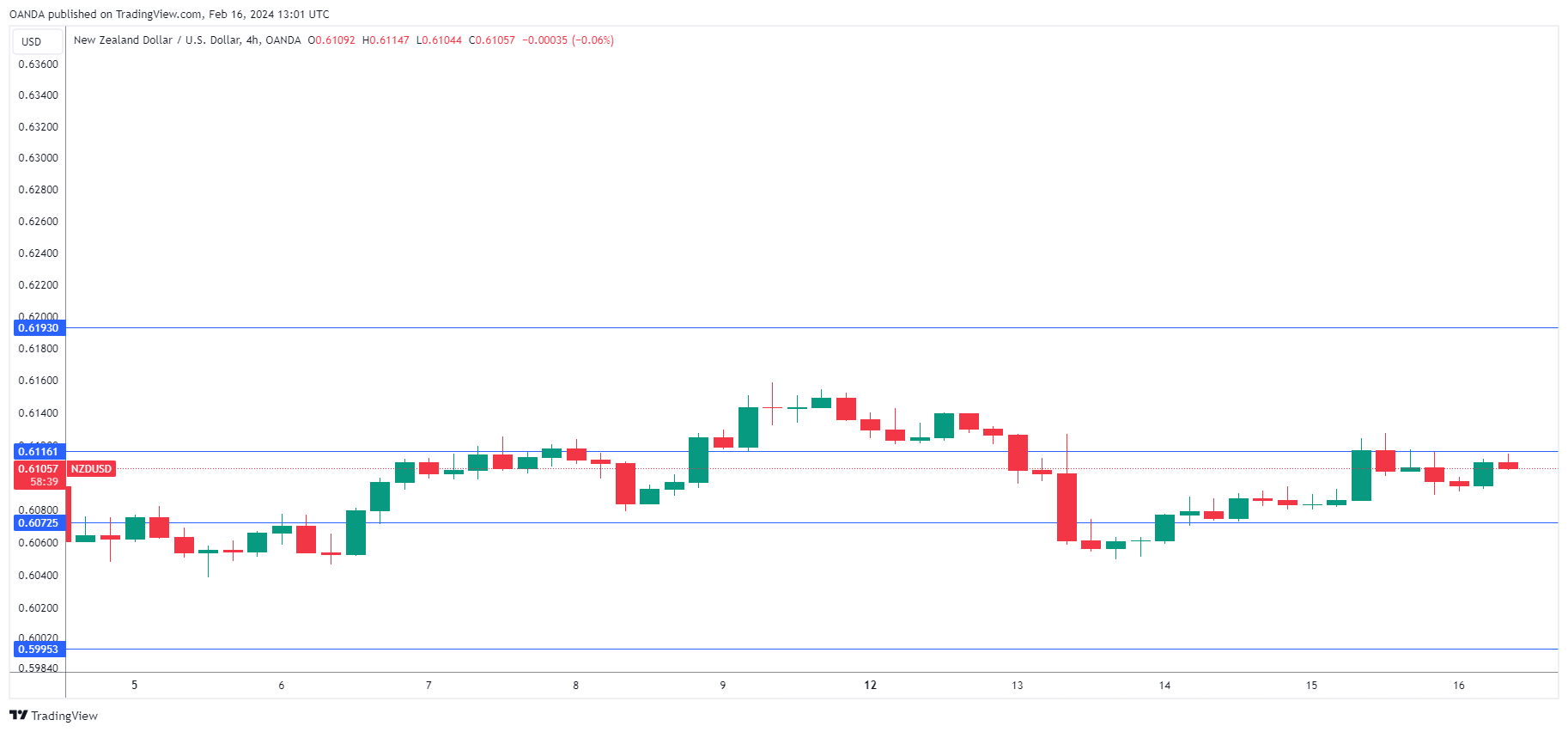
The New Zealand dollar is drifting on Friday. In the European session, NZD/USD is trading at 0.6110, up 0.08%.
Orr pushes back against rate cut expectations
The Reserve Bank of New Zealand has made inflation its top priority and the Bank’s steep rate-hiking cycle has brought inflation lower. Still, at the current clip of 4.7%, inflation is more than double the 2% midpoint of the target band of one to three percent. Earlier this week, New Zealand released inflation expectations, which eased to 2.5% in the first quarter, down from 2.7% in Q4 2023 and lower than the forecast of 2.6%. This was the lowest level since Q3 2021.
If anyone thought that the drop in inflation expectations might prod the RBNZ to be more dovish, they were no doubt disappointed. Governor Adrian Orr responded to the release by saying that inflation is moving in the right direction but there is “more work to do to have inflation expectations truly anchored at that 2% level”. In other words, there has been good progress but the battle with inflation continues.
The RBNZ has paused rates at 5.5% for four straight times and the markets have priced in a rate cut May. The central bank has pushed back against these expectations and Orr’s comments about inflation expectations was the latest instance of the central bank pouring cold water on rate-cut expectations.
At the last meeting in late November, the RBZN said that a rate hike could not be ruled out and projected that there would not be any rate cuts before mid-2025. The RBNZ remains in a hawkish mood and is unlikely to consider rate cuts anytime soon.
NZD/USD Technical
- NZD/USD is putting pressure on resistance at 0.6116. Above, there is resistance at 0.6193
- 0.6072 and 0.5995 are providing support