Sample Category Title
USDCAD Slides But Finds Support at Around 1.3410
- USDCAD retreats but meets support at 1.3410
- Both the daily oscillators paint a mixed picture
- For the picture to brighten, a break above 1.3535 may be needed
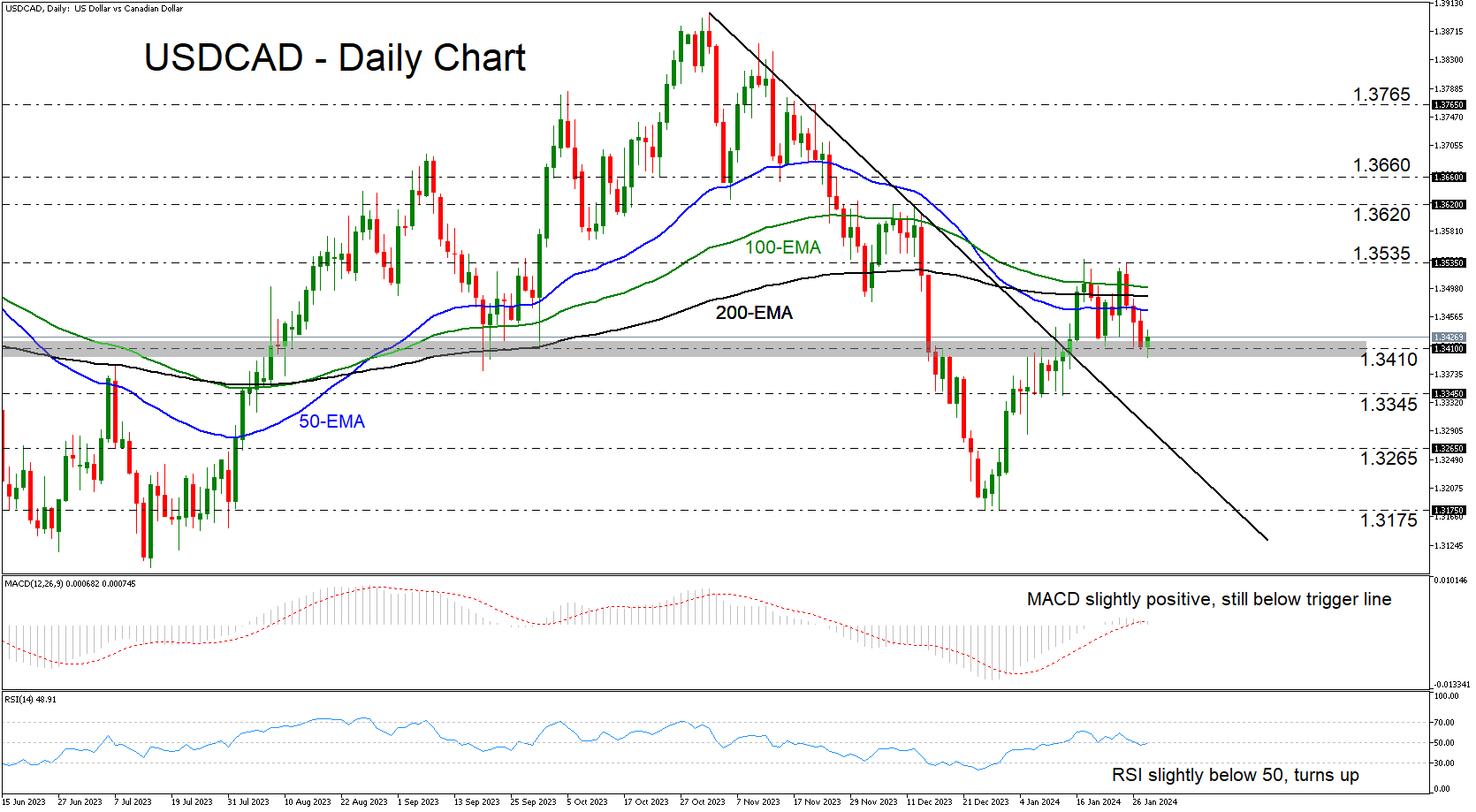
USDCAD slid in the last few days after hitting resistance once again at around 1.3535. That said, the retreat stopped near the 1.3410 barrier, keeping the pair above the prior downtrend line drawn from the high of November 1.
If more bulls are willing to jump into the action from near the 1.3410 barrier, the pair may advance and challenge again the 1.3535 zone, but for the near-term outlook to be considered positive, a break higher may be needed. Such a move would confirm a higher high on the daily chart and may see scope for extensions towards the 1.3620 territory, marked by the high of December 7.
The daily oscillators are sending mixed signals, casting more doubt with regards to where this pair may be headed next. The MACD lies slightly above zero, but still below its trigger line, while the RSI, although slightly below 50, shows signs of turning up again.
On the downside, a break below 1.3410 may encourage more selling, perhaps towards the low of January 12 at 1.3345, the break of which could carry extensions towards the crossroads of the aforementioned downtrend line and the 1.3265 zone.
To recapitulate, USDCAD met some buy orders near the key support level of 1.3410. However, the move signaling an uptrend continuation may be a decisive break above 1.3535.
US consumer confidence hits 2-year high at 114.8, reflecting inflation slowdown and positive employment outlook
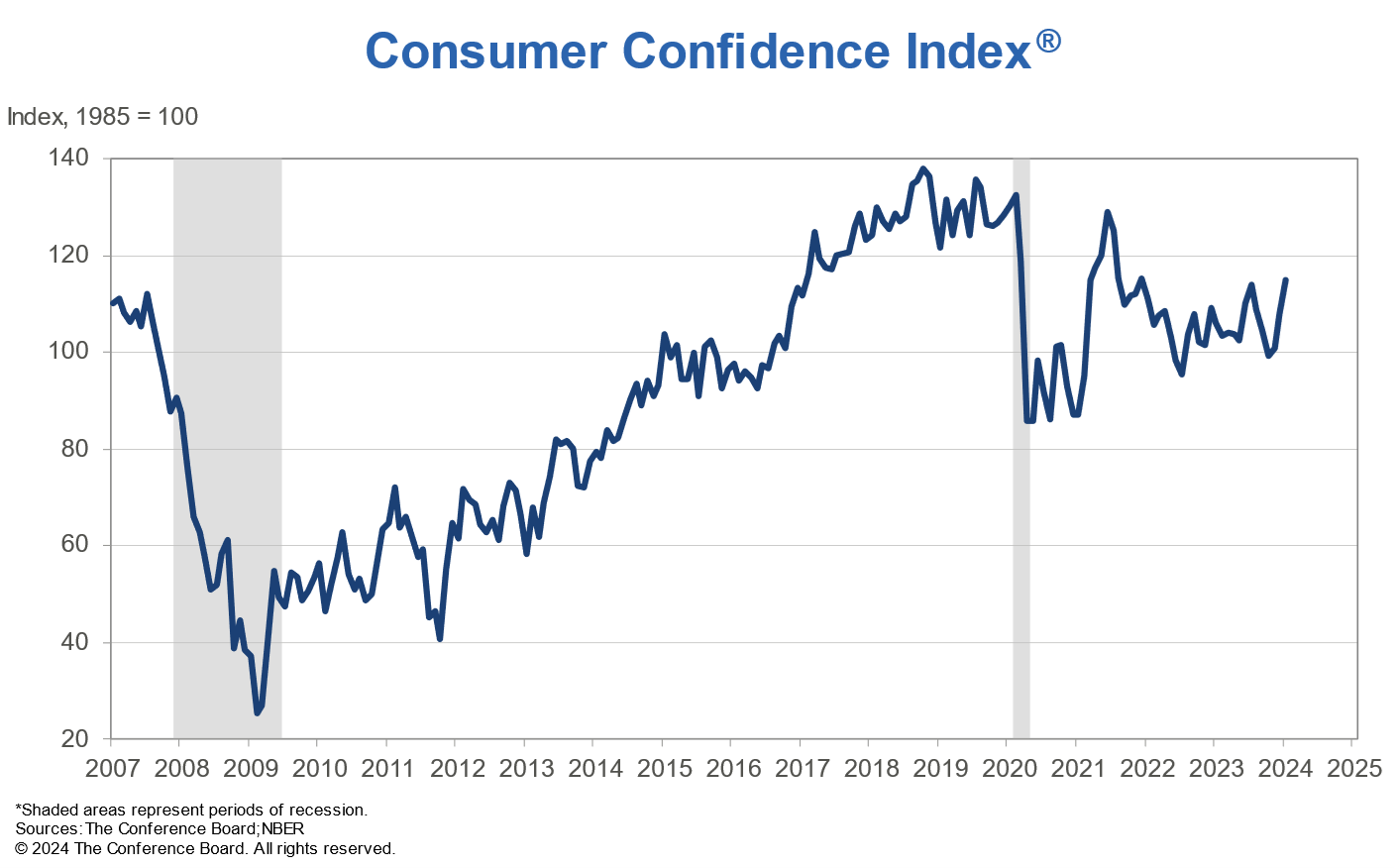
US Conference Board Consumer Confidence rose from 110.7 to 114.8 in January, above expectation of 113.2, and marks the highest level since December 2021. Present Situation Index rose sharply from 147.2 to 161.3. Expectations Index also improved slightly from 81.9 to 83.8.
Dana Peterson, The Conference Board's Chief Economist, attributes this surge in consumer confidence to several key factors, including decelerating inflation, prospects of future interest rate reductions, and the robust employment environment, as companies exhibit a tendency to retain labor.
Furthermore, consumers' perception of the likelihood of a US recession within the upcoming year has continued to diminish, aligning with the Expectations Index's climb above 80.
Sunset Market Commentary
Markets
Economic growth stood in the spotlights today. The IMF in its quarterly World Economic Outlook raised the global forecast from 2.9% to 3.1% this year while keeping the 2025 estimate at 3.2%. The chief economist of the Washington-based institute said “The global economy continues to display remarkable resilience, and we are now in the final descent toward a soft landing with inflation declining steadily and growth holding up”. Global inflation is seen slowing from 6.8% to 4.4% this year, allowing the likes of the Fed, ECB and BoE to start cutting rates but only from 2024H2 on. The US (2.1%), China (4.6%) and Russia (2.6%) saw some of the biggest growth upgrades. The euro area was among the losers (0.9%) thanks to Germany and France. The latter are struggling indeed, according to Q4 GDP numbers released today. A lackluster French (flat) and German (-0.3%) performance was more than made up for by Italy, Spain and Portugal, though. Growing 0.2%, 0.6% and a very solid 0.8% respectively, southern European outperformance helped the European-wide economy narrowly avoid a technical recession in 2023H2. GDP stagnated instead of shrinking by a back-to-back -0.1% that analysts put forward. The first EU member states also published January inflation figures. Belgian CPI (national calculations) accelerated by 0.49% m/m to 1.75% y/y (see below). Spanish HICP fell 0.2% m/m, less than the 0.6% expected, bringing the yearly gauge from 3.3% to 3.5%. After a sharp drop from July 2022 to June 2023, Spanish y/y HICP inflation has fluctuated between above 3.3% and 3.5% since September last year. It’s the paella-loving country that set the tone for European/German bond markets. Bunds opened higher but pared all gains and more after the Spanish data was released. Current changes amount to <2 bps across the curve with the 7 bps drop in the 2-y being a benchmark change. US Treasuries simultaneously left their intraday highs behind but the move there lacked conviction. Yields currently ease 1.6-3.2 bps.
On currency markets, sterling displayed some of the sharpest moves. EUR/GBP rebounded from as low as 0.8517 to 0.8564 before paring some of the gains again to 0.8545 currently. We didn’t see a specific trigger and assume it was mainly a technically driven sprint. Indeed, the pair over the course of January neared the lower bound of a sideways trading range in place since May last year. A break lower was bound to be tricky given the looming Bank of England meeting (inc. new forecasts) on Thursday. Other FX pairs trade muted. EUR/USD sticks around 1.084. JPY hovers near its recent lows. The Hungarian forint is leading Central-European peers. The central bank backtracked on earlier guidance from deputy governor Virag and stuck to a 75 bps cutting pace (to 10%). Virag noted inflation was declining faster than expected, creating room for bigger (100 bps) cuts. Since then, however, the forint fell sharply amid rising tensions between Orban and the EC and concerns about Hungary missing out on billions of EU funding. Financial & forint stability is considered essential by the central bank, so it opted for caution today. The approach brings some relief to the forint with EUR/HUF easing from 390+ to 387.4 currently.
News & Views
Belgian inflation rose by 0.49% M/M in January with the Y/Y-figure accelerating for a third consecutive month, from 1.35% to 1.75%. The most significant price increases in January concerned dairy products, domestic services, bread and cereals, alcoholic beverages and rents. Natural gas, motor fuels, plane tickets, electricity and hotel rooms had a decreasing effect on the index. Food inflation slid for 10th consecutive time from 7.03% Y/Y to 6.58%. Energy inflation is negative for almost a year now at -22.3% Y/Y. Underlying core inflation, correcting for energy products and unprocessed food, decreased for the 8th month in a row from 5.47% Y/Y in December to 4.7%. Service inflation declined from 6.44% Y/Y to 5.15%, but inflation for rents increased from 5.57% Y/Y to 5.91%.
The Saudi government announced a change in investment plans for Saudi Aramco, the Kingdom’s state-owned oil and gas producer. They abandoned a plan to lift output capacity from the current 12 million barrels a day to about 13 mn by 2027. The move is seen as a potential harbinger of a U-turn of global oil demand forecasts by Saudi Arabia (and by OPEC+) especially given that the Kingdom is currently producing ‘only’ 9 million barrels a day given production output cuts. Brent crude prices slide today from around $82.5/b to $81.5/b.
Euro Steady Despite German GDP Decline
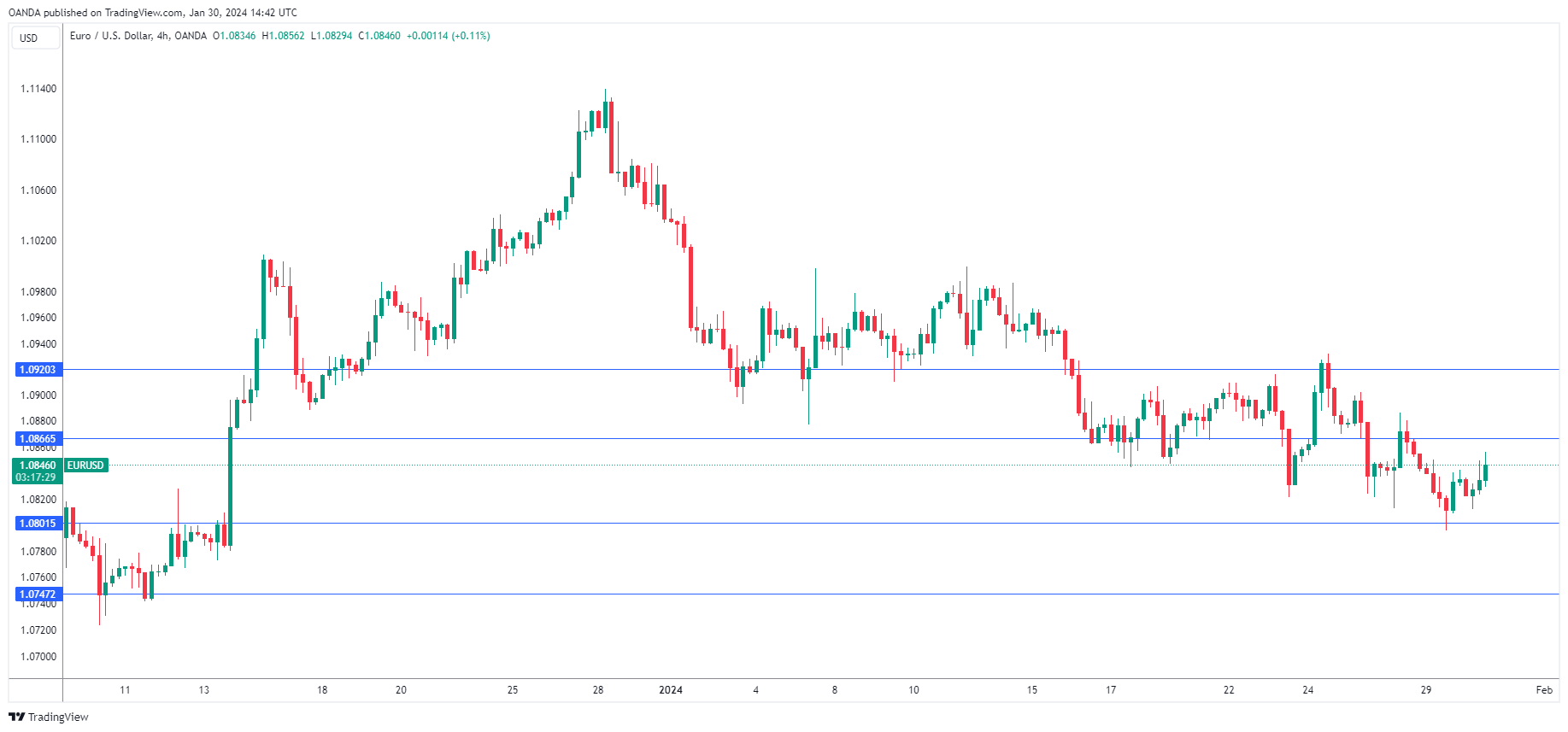
The euro has edged higher on Tuesday. In the European session, EUR/USD is trading at 1.0850, up 0.16%.
German GDP declines by 0.2%
Germany, the largest economy in the eurozone, continues to weigh on the bloc with its weak economy. Germany’s GDP declined by 0.3% q/q in the fourth quarter, matching the consensus estimate. Third-quarter GDP was revised upwards from -0.1% to 0.0%. On an annualized basis, German GDP fell -0.2%, just above an upwardly revised reading in Q3 of -0.3% and matching the consensus estimate of -0.2%. This means the economy entered a technical recession, with two consecutive quarters of negative growth, for the first time in two years.
Eurozone growth remained unimpressive in the fourth quarter. GDP came in at 0%, following a Q3 reading of -0.1% q/q which was also the consensus estimate. On a yearly basis, GDP eked out a 0.1% gain, creeping above the Q3 reading of 0% which was also the market consensus. The eurozone just managed to avoid a recession at the end of 2023, but with weak global demand and the crisis in the Middle East, the outlook for early 2024 does not appear favorable.
The US releases employment and consumer confidence data later in the day, with mixed readings expected. JOLTS Job Openings is expected to drop to 8.75 million, down from 8.79 million, while CB Consumer Confidence is projected to rise to 115 in January, up from 110.7 in December.
The Fed may be on the rate cut bandwagon, but the markets aren’t as feverish about a rate cut in March. Just one month ago, the odds of a March cut were at 73%, but that has plunged to 44%, according to CME’s FedWatch tool. The Fed meets tomorrow and it’s a given that it will hold rates for a fourth straight time. Investors will be on the hunt for clues about rate policy in the upcoming months. Will the rate statement and Jerome Powell’s presser provide some answers?
EUR/USD Technical
- EUR/USD faces resistance at 1.0866 and 1.0920
- There is support at 1.0801 and 1.0747
IMF raises 2024 global growth forecasts, risk of hard landing recedes
In the World Economic Outlook update, IMF upgraded global growth forecast for 2024 by 0.2% to 3.1%. 2025 growth forecast was left unchanged at 3.2%. This upward revision largely stems from stronger-than-expected economic resilience in the US and key emerging markets, along with fiscal support measures in China.
Also, IMF anticipates slowdown in global inflation to 5.8% in 2024 and a further reduction to 4.4% in 2025. With this expected disinflation and steady economic growth, "likelihood of a hard landing has receded", and risks to global growth are now viewed as "broadly balanced".
IMF outlines several potential upside and downside risks to its forecast. Upside risks include faster disinflation potentially leading to looser financial conditions and temporary growth boosts from more expansionary fiscal policies. However, these could pose longer-term challenges. Enhanced structural reforms could also positively impact productivity and have cross-border benefits.
On the downside, IMF cautions against risks like new commodity price increases due to geopolitical tensions, including ongoing conflicts in the Red Sea. Persistent inflation could maintain the need for tight monetary policies. Further, troubles in China's property market or unexpected fiscal tightening in other regions could lead to lower growth than anticipated.
Looking at some details growth forecast:
- US at 2.1% in 2024 (up 0.6% from October estimate), 1.7% in 2025 (down -0.1% from October estimate).
- Eurozone at 0.9% in 2024 (down -0.3%), 1.7% in 2025 (down -0.1%).
- Japan at 0.9% in 2024 (down -0.1%), 0.8% in 2025 (up 0.2%).
- UK at 0.6% in 2024 (unchanged), 1.6% in 2025 (down -0.4%).
- Canada at 1.4% in 2024 (down -0.2%), 2.3% in 2025 (down -0.1%).
- China at 4.6% in 2024 (up 0.4%), 4.1% in 2025 (unchanged).
Silver Recovers But Picture Still Cautiously Negative
- Silver prices bounce back after seven-week decline
- Momentum oscillators around their neutral levels
- Break either above 24.60 or below 21.90 would signal direction
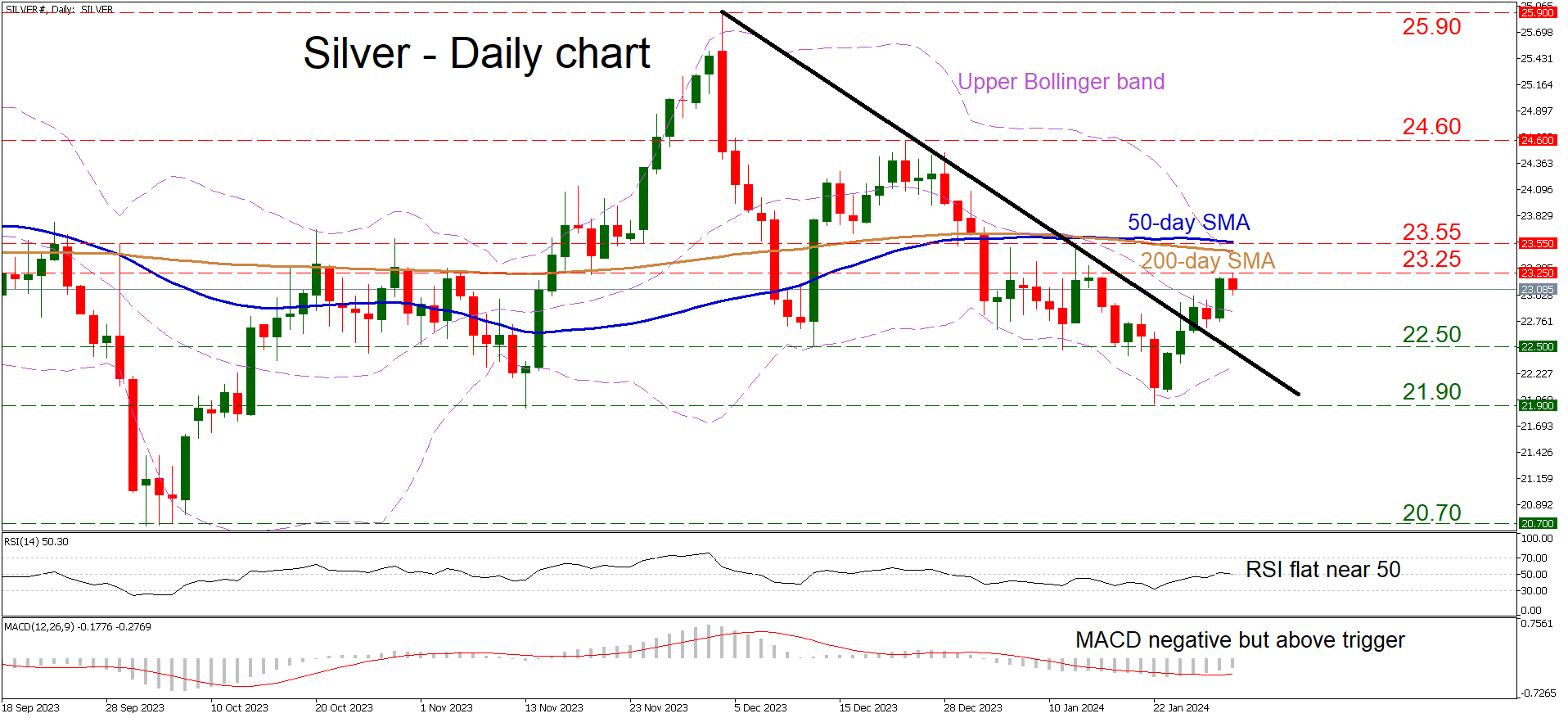
Silver prices have risen over the last week, breaking above a downtrend line to recover a small chunk of the losses from the selloff that started in early December. That said, the structure of lower highs and lower lows is still in force and the market is also trading below its key moving averages, which suggests that the outlook remains cautiously negative.
Momentum oscillators are near their neutral levels, providing no indications about what comes next. The RSI has flattened close to its 50 line, and while the MACD is above its red trigger line, it’s still in negative territory.
If buyers remain in control and pierce above the 23.25 level, an even bigger battle would probably wait for them slightly higher at 23.55, which is roughly where the 50- and 200-day simple moving averages (SMAs) have converged. Another successful break could open the door towards the 24.60 zone, defined by the top in late December.
On the downside, sellers would need to penetrate below the 22.50 region, and even more importantly below the latest low of 21.90, to signal a resumption of the recent downtrend.
All told, the recovery in silver prices is unconvincing so far. A new high above 24.60 could change that, while in contrast, a clean break below 21.90 would signal further losses.
British Pound Edges Lower as Shop Inflation Drops
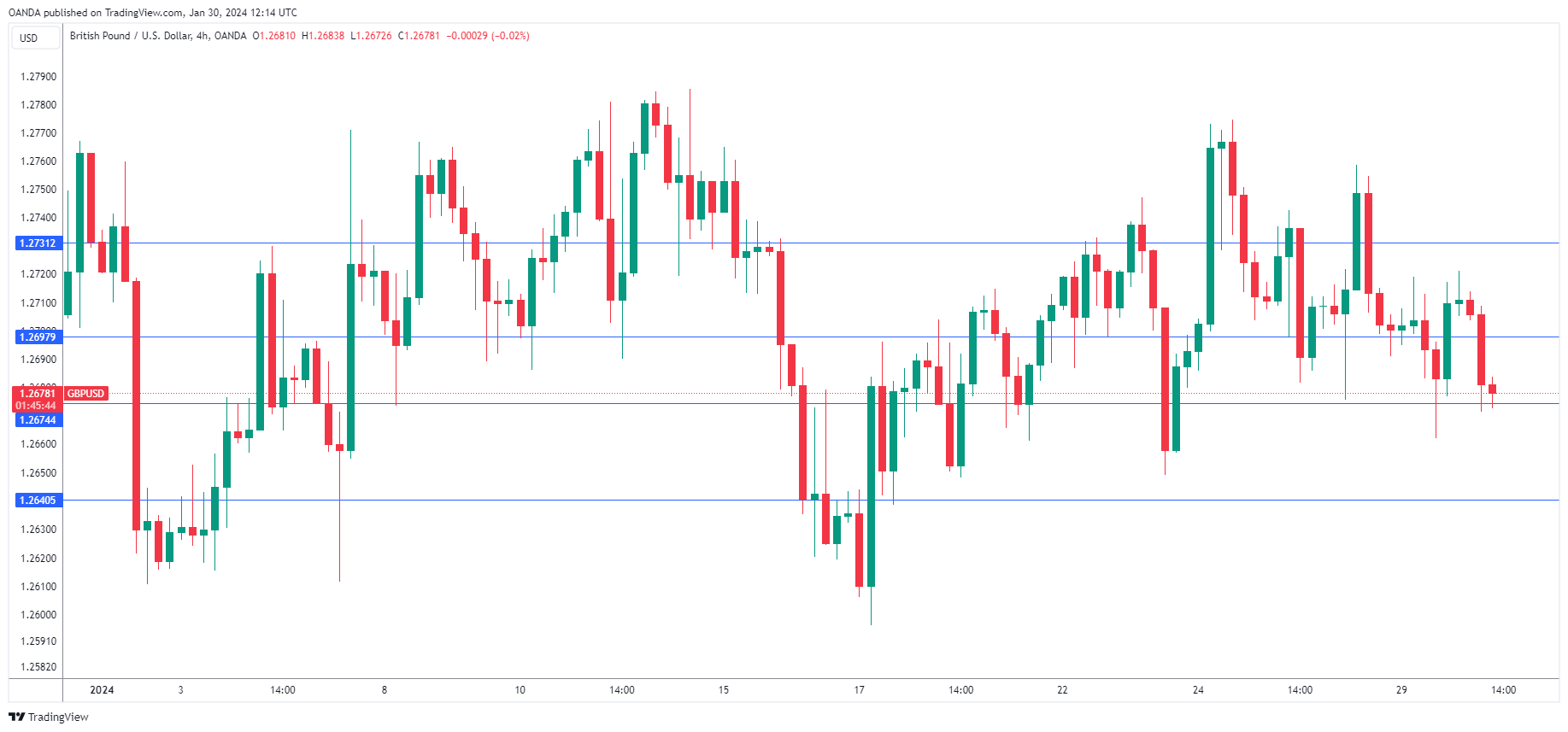
The British pound is lower on Tuesday. In the European session, GBP/USD is trading at 1.2680, down 0.23%.
UK shop inflation decelerates sharply
Inflation in UK shops rose 2.9% y/y in January, compared to 4.3% in December. This was the lowest pace since May 2022. This was an encouraging sign after consumer price inflation surprised by ticking higher to 4.0% in December, up from 3.9% a month earlier. Retailers are enticing shoppers with discounts, which has helped to lower inflation. Still, The Christmas shopping season was weak as consumers are holding back on spending due to the cost-of-living crisis.
The Bank of England meets next on Thursday and is likely to maintain the benchmark rate of 5.25% for a fourth straight time. The rate-hiking cycle is likely over, although the BoE is likely to continue its “higher for longer stance” and keep rates in restrictive territory until inflation falls closer to the 2% target. Services inflation and wage growth are both above 6% and the Bailey & Co. will want to see these numbers drop before cutting rates.
The markets were exuberant in December about rate cuts, pricing in six cuts in 2024, starting in May. The markets have since tempered expectations and have priced in four cuts this year, with the odds of a May cut around 50%, but more likely in August. The central bank hasn’t sent out any signals about rate cuts, but at the Thursday meeting, Governor Bailey might choose to soften the pushback against rate cuts expectations without endorsing rate cuts.
The US will release employment and consumer confidence data later in the day, with mixed readings expected. JOLTS Job Openings is expected to drop to 8.75 million, down from 8.79 million, while CB Consumer Confidence is projected to rise to 115 in January, up from 110.7 in December.
GBP/USD Technical
- GBP/USD is testing resistance at 1.2740. Next, there is resistance at 1.2772
- There is support at 1.2711 and 1.2679
EUR/USD Mid-Day Outlook
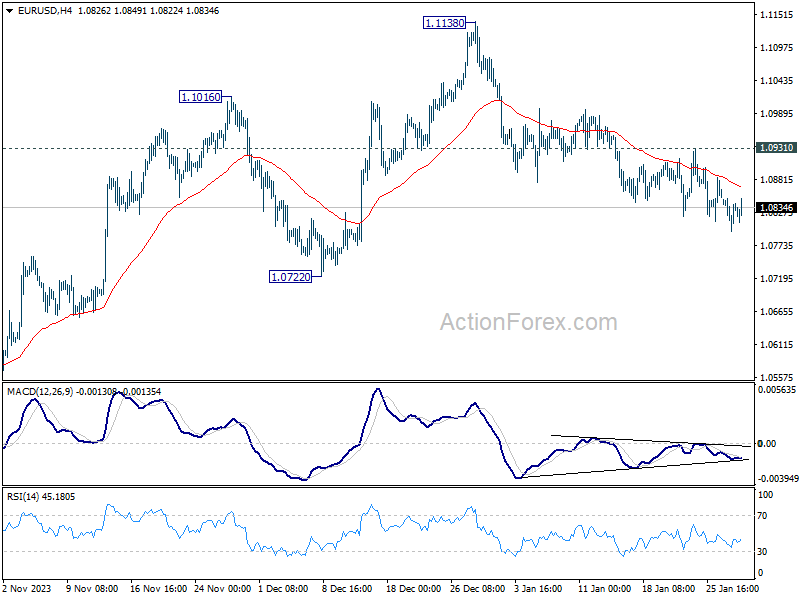
Daily Pivots: (S1) 1.0803; (P) 1.0827; (R1) 1.0858; More...
No change in EUR/USD's outlook. Further decline is expected with 1.0931 resistance intact. Fall from 1.1138 should target 1.0722 support next. Decisive break there will argue that whole rise from 1.0447 has completed, and target this low. However, on the upside, break of 1.0931 will turn bias back to the upside for stronger rebound instead.
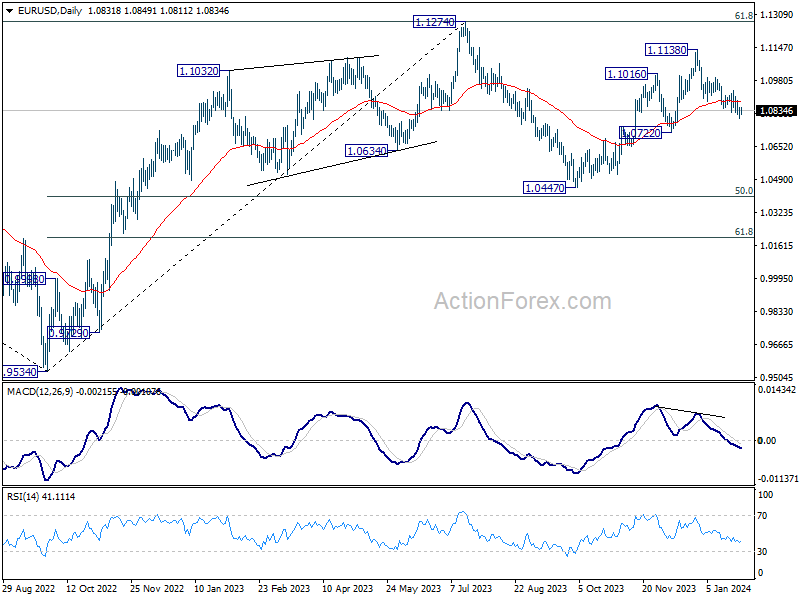
In the bigger picture, price actions from 1.1274 are viewed as a corrective pattern to rise from 0.9534 (2022 low). Rise from 1.0447 is seen as the second leg. While further rally could cannot be ruled out, upside should be limited by 1.1274 to bring the third leg of the pattern. Meanwhile, sustained break of 1.0722 support will argue that the third leg has already started for 1.0447 and below.
GBP/USD Mid-Day Outlook
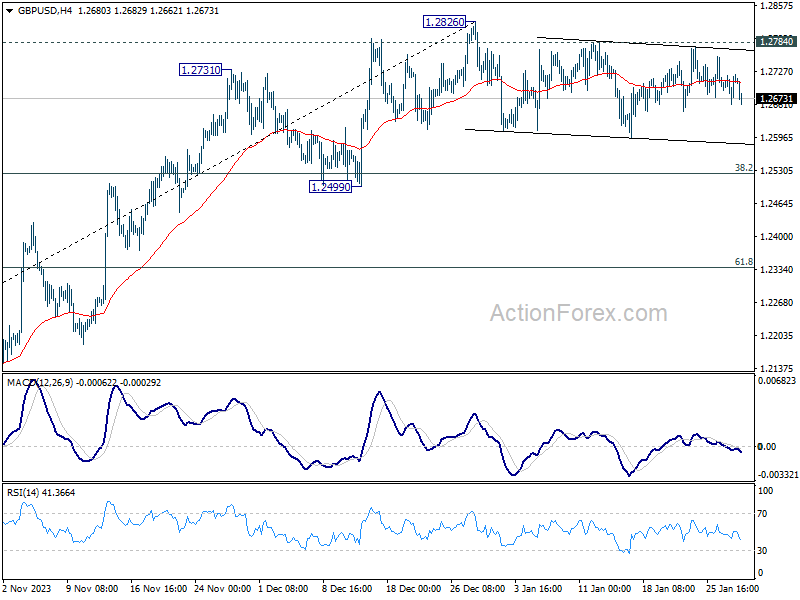
Daily Pivots: (S1) 1.2674; (P) 1.2697; (R1) 1.2731; More...
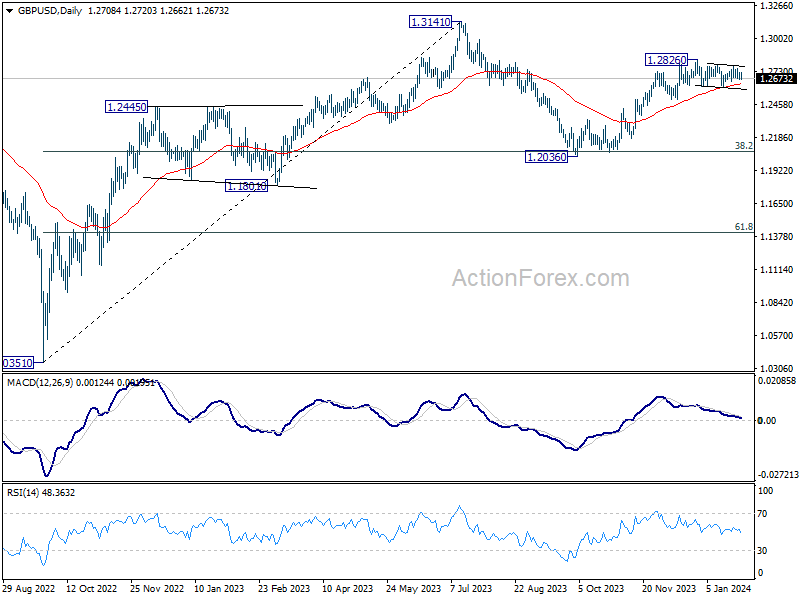
GBP/USD is still bounded in range trading and intraday bias stays neutral at this point. Another fall cannot be ruled out, but downside should be contained above 1.2499 support to bring rebound. On the upside, firm break of 1.2784 resistance will suggest that consolidation pattern has completed. Further rise should be seen through 1.2826 to resume the rally from 1.2036. Next target will be 1.3141 high.
In the bigger picture, price actions from 1.3141 medium term top are seen as a corrective pattern to up trend from 1.0351 (2022 low). Rise from 1.2036 is seen as the second leg that's in progress. Upside should be limited by 1.3141 to bring the third leg of the pattern. Meanwhile, break of 1.2499 support will argue that the third leg has already started for 38.2% retracement of 1.0351 (2022 low) to 1.3141 at 1.2075 again.
USD/CHF Mid-Day Outlook
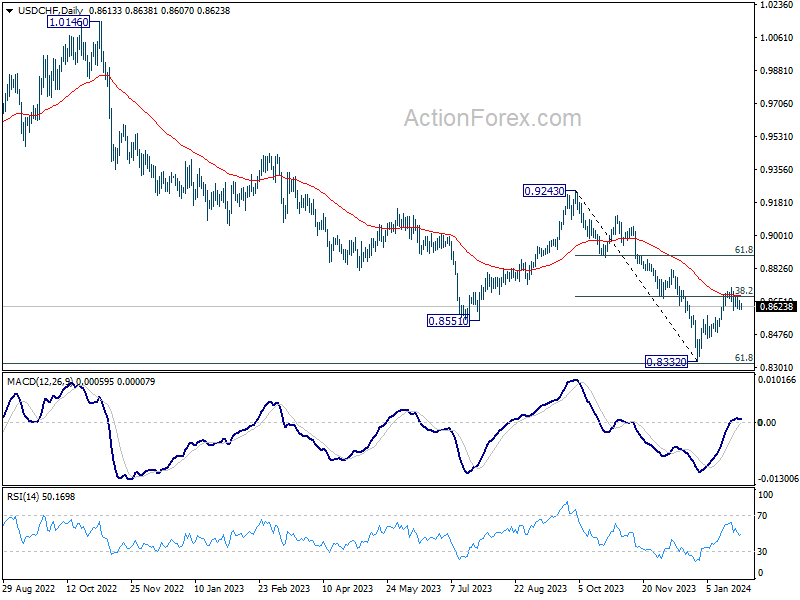
Daily Pivots: (S1) 0.8594; (P) 0.8626; (R1) 0.8645; More....
Outlook in USD/CHF remains unchanged as range trading continues. Intraday bias stays neutral at this point. On the downside, below 0.8605 will resume the pull back from 0.8727 to 0.8487 support. Break there will argue that rebound from 0.8332 has completed, and bring retest of this low. On the upside, firm break of 0.8727 will resume the rebound to 61.8% retracement of 0.9243 to 0.8332 at 0.8995 instead.
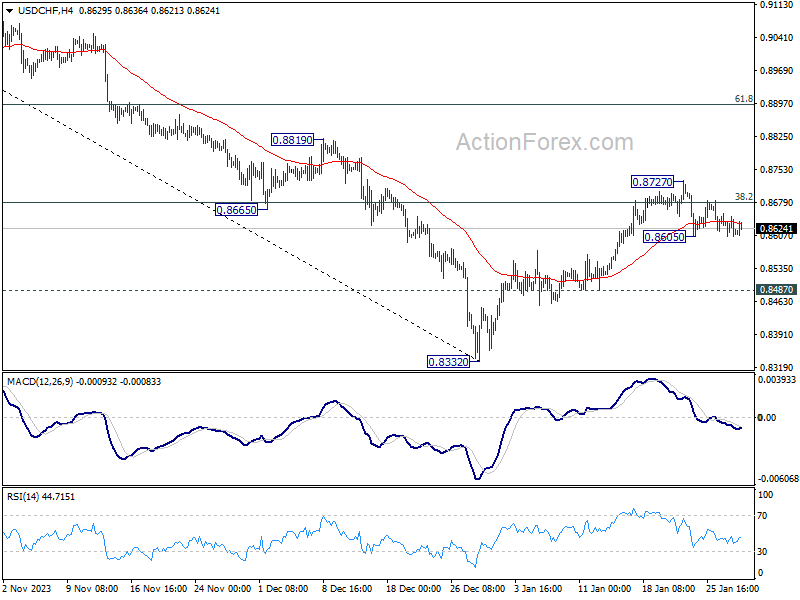
In the bigger picture, while rebound from 0.8332 could be strong, there is no clear sign of medium term bottoming yet. This rebound is tentatively seen as a corrective move for now. Also, outlook will stay bearish as long as 0.9243 resistance holds. Larger down trend from 1.0146 (2022 high) should resume through 0.8332 low at a later stage.