Sample Category Title
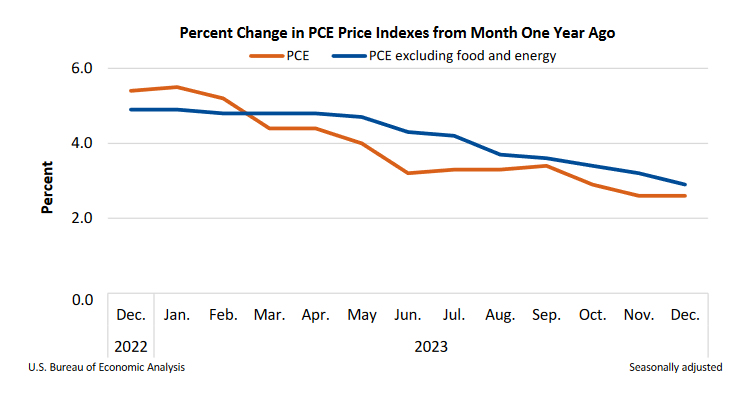
US PCE inflation unchanged at 2.6%, core PCE slows to 2.9%
US personal income rose 0.3% mom or USD 60.0B in December, matched expectations. Personal spending rose 0.7% mom or USD 133.9B, above expectation of 0.4% mom.
PCE price index rose 0.2% mom, matched expectations. Core PCE price index (excluding food and energy) rose 0.2% mom, matched expectations. Goods prices fell -0.2% mom while services prices rose 0.3% mom. Food prices rose 0.1% mom and energy prices rose 0.3% mom.
From the same month a year ago, PCE price index was unchanged at 2.6% yoy, matched expectations. Core PCE price index slowed from 3.2% yoy to 2.9% yoy, below expectation of 3.0% yoy. Goods prices increased less than 0.1% yoy while services prices rose 3.9% yoy. Food prices rose 1.5% yoy while energy prices fell -2.2% yoy.
ECB survey shows lowered inflation expectations and GDP growth forecast
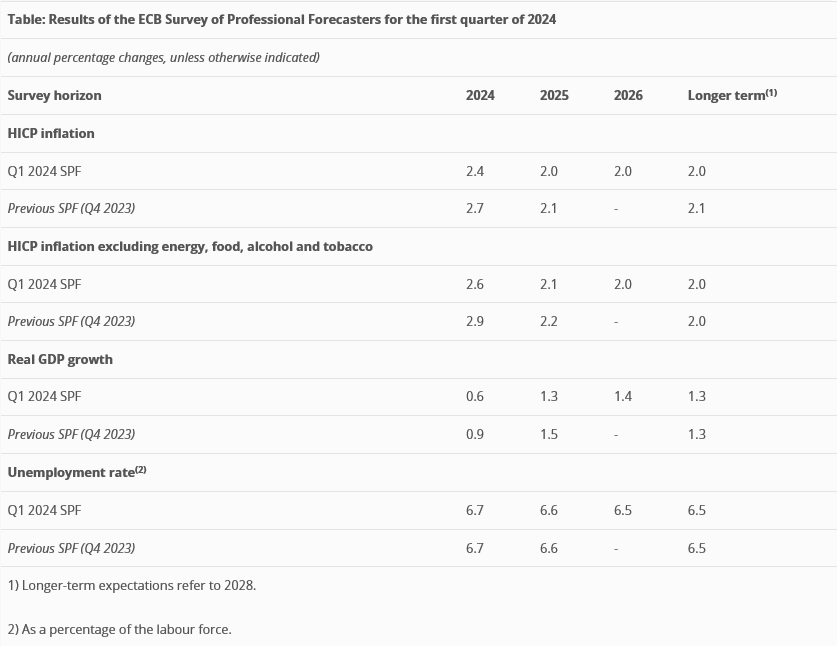
In the latest ECB Survey of Professional Forecasters for Q1 2024, inflation expectations have been revised downwards across all horizons. For the immediate years, headline HICP inflation is projected to decrease from 2.4% in 2024 to 2.0% in 2025 and 2026. These revised figures represent a downward adjustment of 0.3 percentage points for 2024 and a slight 0.1 percentage point decrease for 2025.
Similarly, core HICP inflation, which excludes volatile components like energy and food, has also been revised downward for 2024 to 2.6%, with a further reduction to 2.1% expected in 2025. By 2026, core inflation is projected to align with ECB's target, reaching 2.0%. The revisions for 2024 and 2025, each marked by a 0.3 and 0.1 percentage point decrease respectively, reflect an anticipated easing in the underlying inflationary trends.
On the growth front, expectations for real GDP have been adjusted downward for both 2024 and 2025. The forecasters now anticipate GDP growth of 0.6% in 2024, followed by a modest recovery to 1.3% in 2025 and slightly higher growth of 1.4% in 2026. These projections, revised down by 0.3 and 0.2 percentage points for 2024 and 2025 respectively, indicate a cautious outlook on economic expansion in the near term.
ECB’s Vujcic advocates gradual approach to future rate cuts
ECB Governing Council members Boris Vujcic and Gediminas Simkus have underscored the importance of a cautious approach to future interest rate reductions. In separate interviews occasions, both officials emphasized the need for patience in evaluating economic data before committing to rate cuts.
Boris Vujcic highlighted the necessity of ensuring that inflation is "firmly sustainably on the way" towards ECB's medium-term target. He emphasized a gradual approach, stressing that ECB should wait for sufficient data to validate a downward trajectory in inflation rates.
Vujcic also expressed a preference for rate cuts in increments of 25 basis points, though he did not exclude the possibility of larger steps if warranted by economic data.
Gediminas Simkus, on the other hand, indicated that a rate cut in March is unlikely. He suggested that the likelihood of rate reductions would increase as 2024 progresses, describing this increase as "exponential, not linear." This statement implies a growing possibility of monetary easing later in the year, contingent upon evolving economic indicators.
CAD’s Troubles Could Be Soon Forgotten
The Canadian Dollar faces a confluence of challenges, from the unexpected BoC stance on interest rates to mixed economic data and the traditionally impactful fluctuations in oil prices. As investors grapple with uncertainty regarding future monetary policy directions and the resilience of various economic sectors, the 'Loonie' is navigating a complex landscape. Understanding the interplay of these factors is crucial for anticipating the trajectory of the Canadian Dollar in the coming weeks and months.
GBPCAD - D1 Timeframe
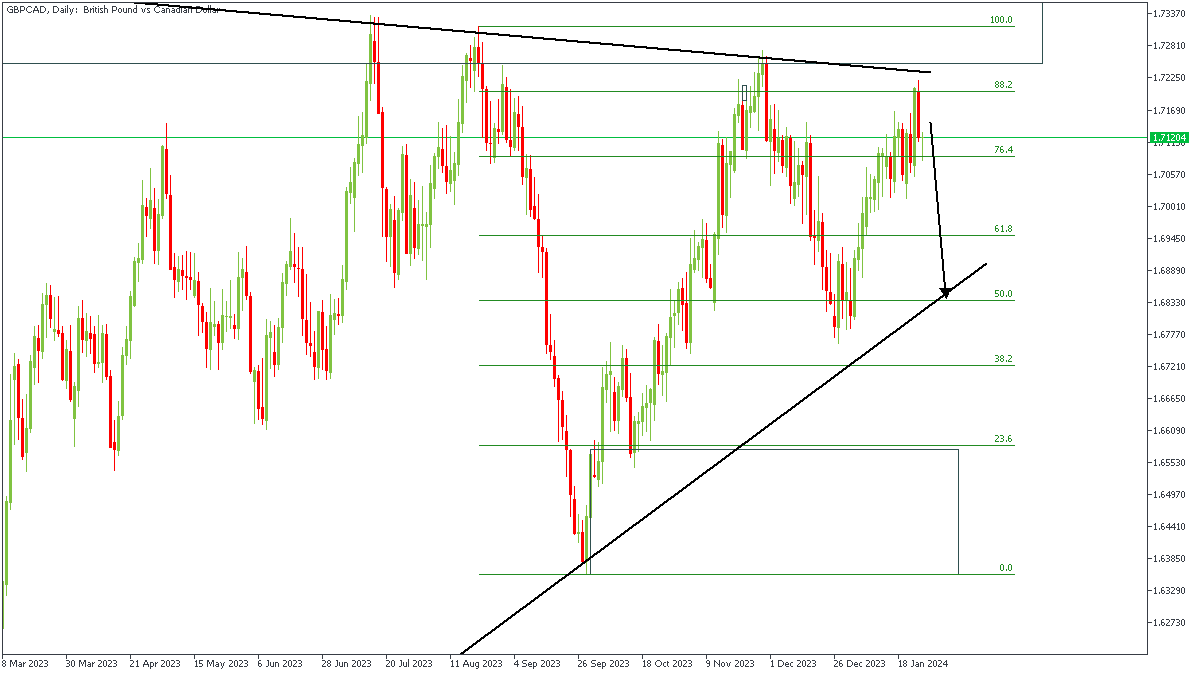
GBPCAD on the daily timeframe seems to have just completed its fourth rejection from the trendline resistance, setting the tone for bearish movement. The confluences for this trade include; the trendline resistance, supply zone, 88% of the Fibonacci, and the previous break of structure being a bearish one. In this case though, my target is quite short so I can wait to see if the trendline support gets broken or not.
Analyst’s Expectations:
- Direction: Bearish
- Target: 1.69257
- Invalidation: 1.72251
USDCAD - H4 Timeframe
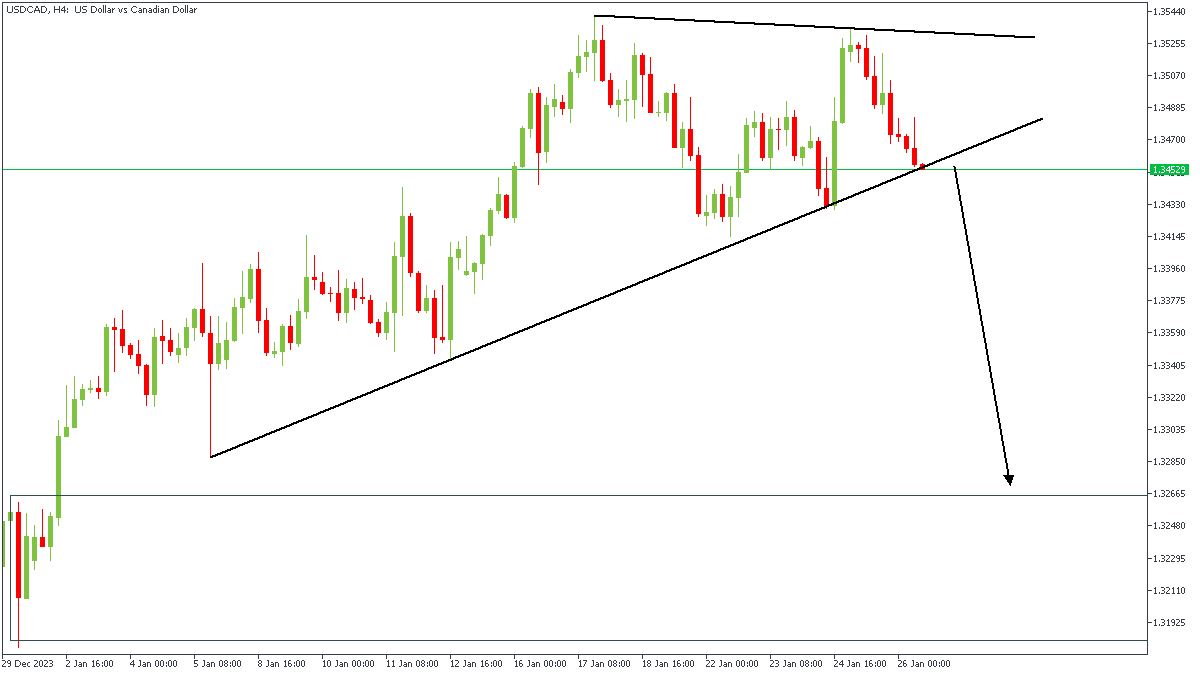
USDCAD is currently resting on the support trendline with a demand zone in sync, even though the higher timeframe suggests a bearish trend. This kind of instance reinforces the need for patience and additional confirmations, which is why despite my overall bearish sentiment, I would rather wait to see a clear break and retest of the trendline before I swing into the trade.
Analyst’s Expectations:
- Direction: Bearish
- Target: 1.32696
- Invalidation:1.35357
CADJPY - H4 Timeframe
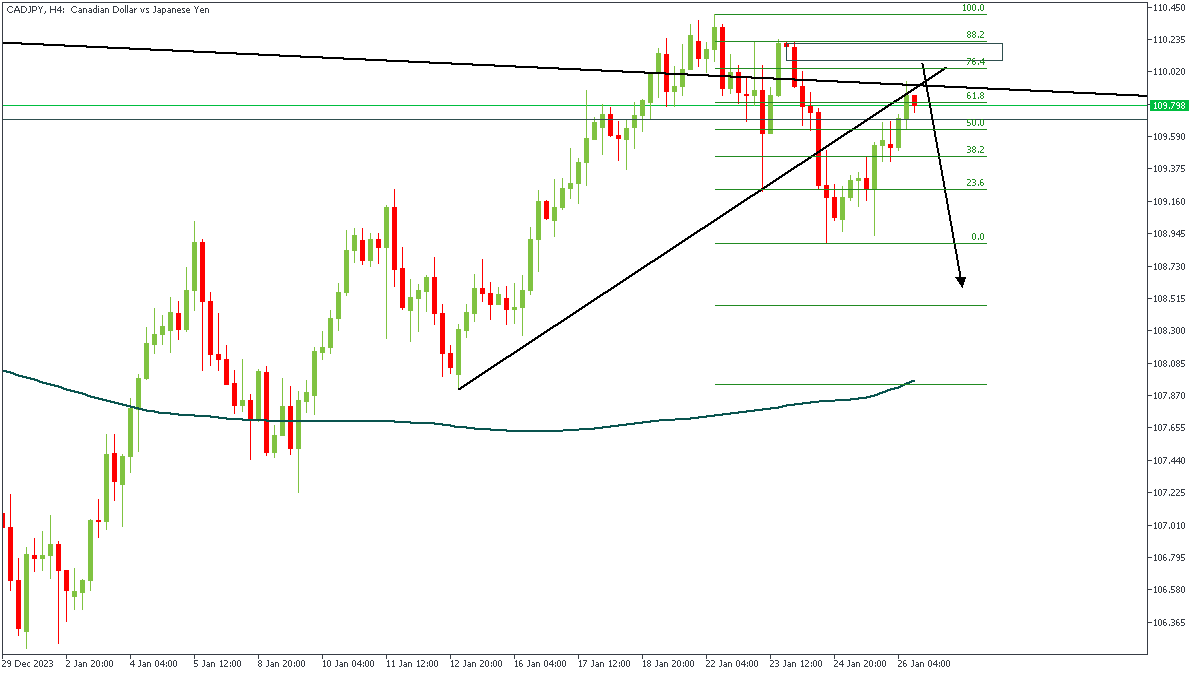
CADJPY as seen has already broken the trendline after being rejected from the overall supply zone. Following this, I have marked out the Fibonacci retracement levels because I was waiting patiently for the retest, which seems to be ready now. The confluence of trendlines, Fibonacci retracement level, supply zone, and the higher timeframe trend are my confirmations for the bearish sentiment.
Analyst’s Expectations:
- Direction: Bearish
- Target: 108.673
- Invalidation: 110.419
CONCLUSION
The trading of CFDs comes at a risk. Thus, to succeed, you have to manage risks properly. To avoid costly mistakes while you look to trade these opportunities, be sure to do your due diligence and manage your risk appropriately.
USD: Likely Outcomes of the PCE
The recent economic data presents a nuanced narrative, showcasing the resilience of the US economy amid uncertainties. As we navigate through the mixed signals of GDP growth, price index fluctuations, and surprising jobless claims, it becomes evident that a comprehensive understanding of these indicators is essential for making informed predictions about the nation's economic trajectory. The upcoming release of the PCE Price Index will serve as a crucial piece in the puzzle, providing a more complete picture of the economic landscape and shaping expectations for the months ahead.
GBPUSD - D1 Timeframe
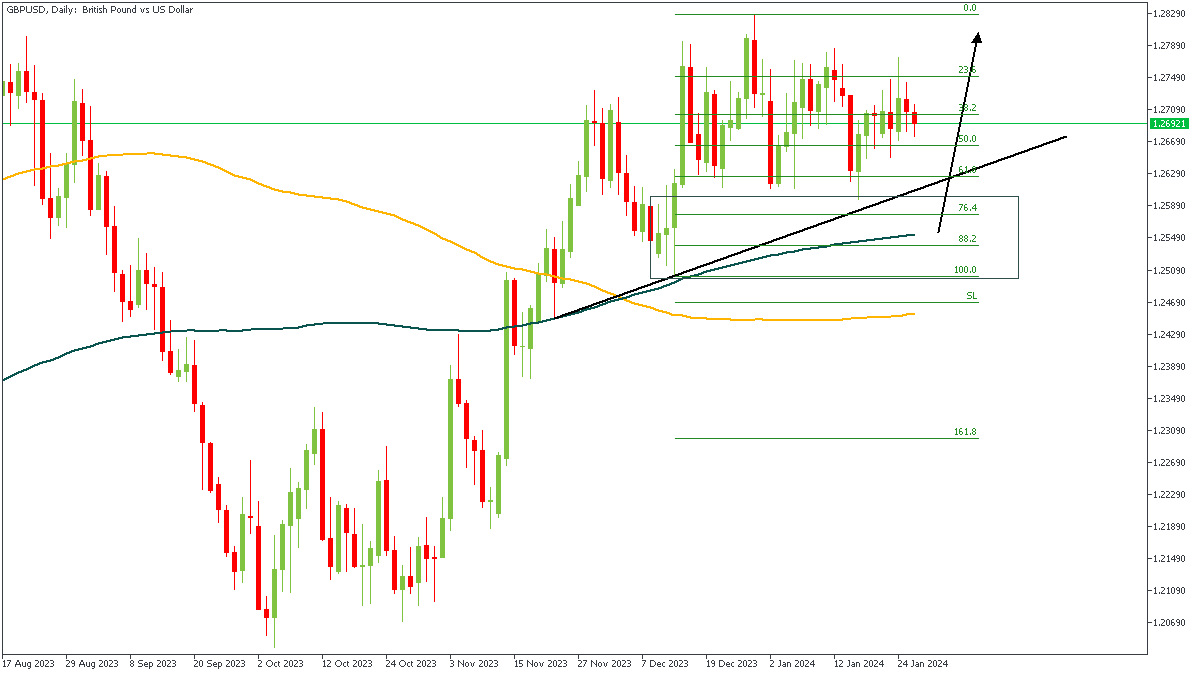
The Daily timeframe of GBPUSD looks quite choppy, but the price action indicates that the last major break-of-structure was a bullish break, hence, I have positioned my entry at the drop-base-rally order block. This order block syncs well with the bullish array of the moving averages, the 100-day moving average support, 76% of the Fibonacci, as well as the trendline support. All these suggest the likelihood of a bullish outcome soon.
Analyst’s Expectations:
- Direction: Bullish
- Target: 1.26988
- Invalidation: 1.24922
EURUSD - D1 Timeframe
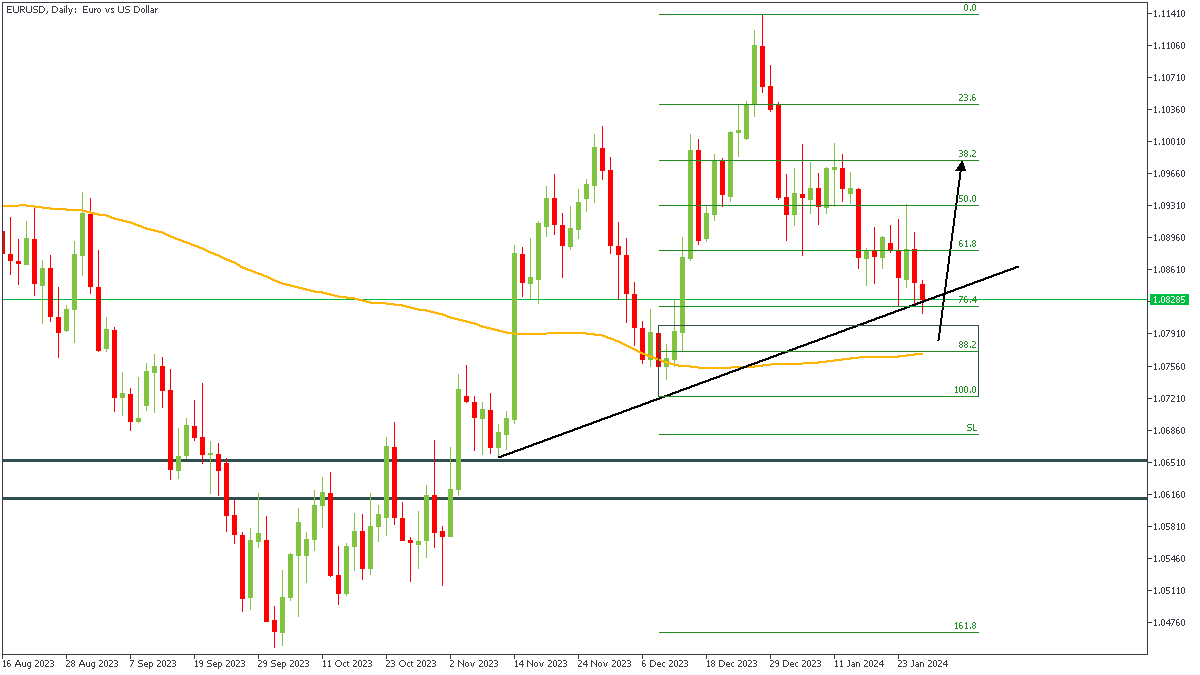
EURUSD is currently resting on the support trendline, and the 76% of the Fibonacci retracement level. The presence of the 200-day moving average as a support, and the 88% of the Fibonacci retracement right on top of the drop-base-rally demand zone concludes my argument in favour of a bullish outcome.
Analyst’s Expectations:
- Direction: Bullish
- Target: 1.09300
- Invalidation:1.07191
AUDUSD - D1 Timeframe
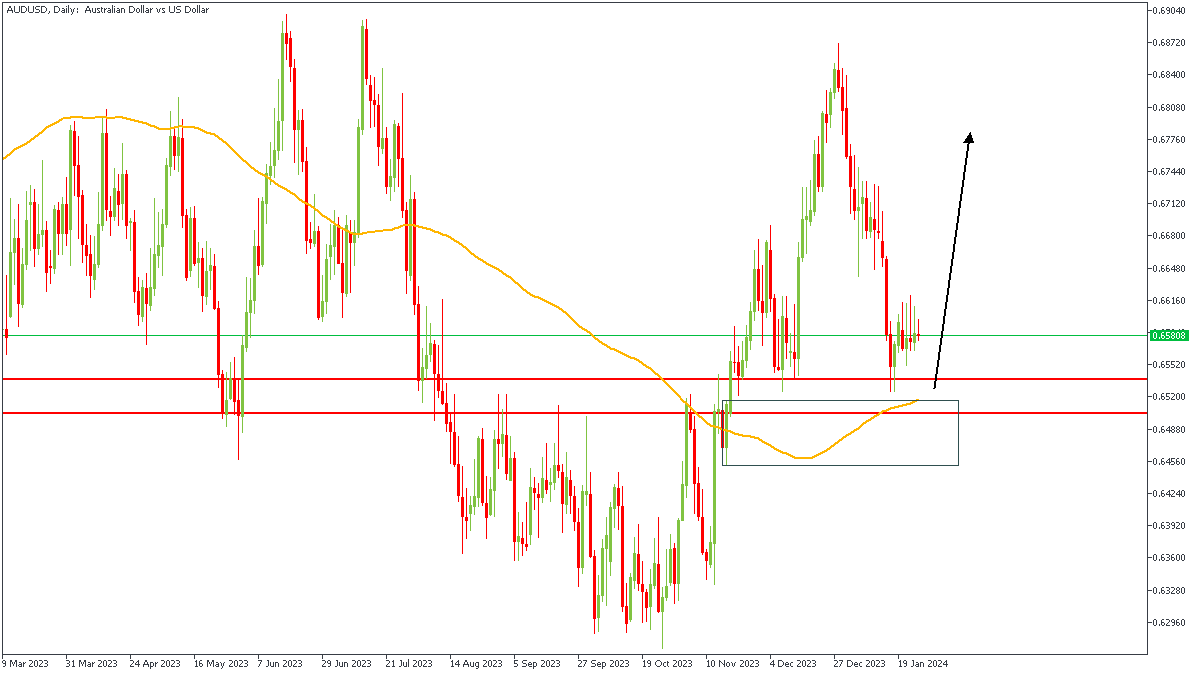
AUDUSD had quite a swift drop for a couple of days and can be seen consolidating at the moment; this price action is often indicative of the weaning off of the bearish impulse, creating room for new buying pressure. Furthermore, the rally-base-rally demand zone, pivot zone, and the 200-day moving average all seem to agree in favour of a bullish reaction from the marked zone.
Analyst’s Expectations:
- Direction: Bullish
- Target: 0.66395
- Invalidation: 0.64453
CONCLUSION
The trading of CFDs comes at a risk. Thus, to succeed, you have to manage risks properly. To avoid costly mistakes while you look to trade these opportunities, be sure to do your due diligence and manage your risk appropriately.
AUDUSD Hovers Around 200-day SMA after Decline Halts
- AUDUSD pauses short-term retreat at December low
- Double bottom pattern triggers a rebound, but 200-SMA holds strong
- Momentum indicators remain heavily tilted to the downside
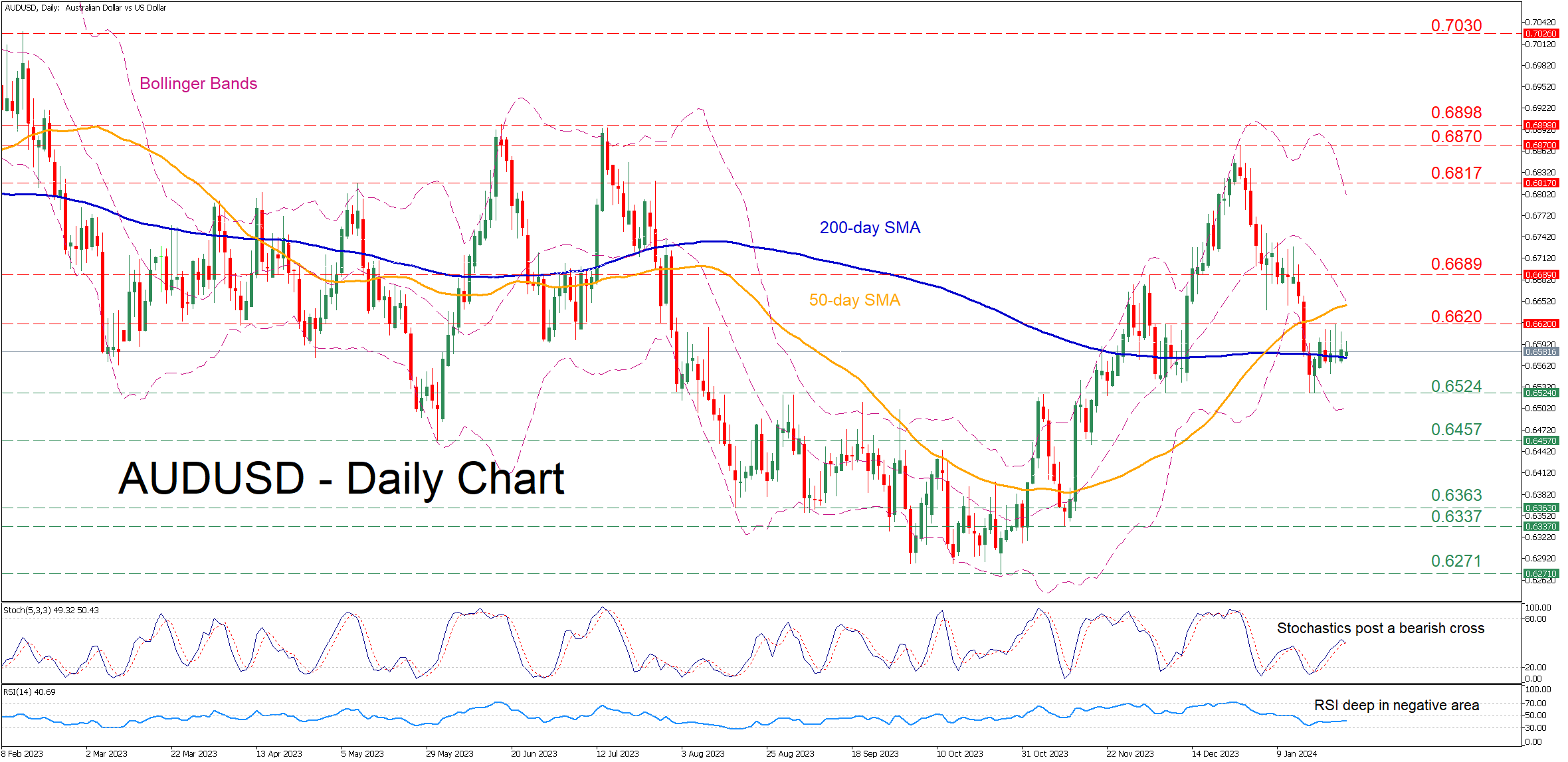
AUDUSD experienced a vast selloff following its December peak of 0.6870, breaking below both its 50- and 200-day simple moving averages (SMAs). Although the pair managed to halt its retreat at the double bottom of 0.6524, its rebound has been repeatedly held down by the 200-day SMA.
Given that both the RSI and stochastics are providing bearish signals, the price could revisit its January bottom of 0.6524. Diving below that zone, the pair might challenge the May low of 0.6457, which also provided support in November. A violation of that region could open the door for the August bottom of 0.6363.
On the flipside, if the pair conquers the 200-day SMA, the recent resistance of 0.6620 could prove to be a strong barricade for the bulls to claim. Further advances could then cease at the December resistance of 0.6689 ahead of the May peak of 0.6817. Should that hurdle also fail, the spotlight could turn to the December high of 0.6870.
Overall, AUDUSD has attempted to recoup some losses in the near term, but the 200-day SMA has been acting as a strong ceiling. A failure to claim the latter could pave the way for the continuation of the short-term selloff.
Ethereum Could End Consolidation With a Dip Towards $2000
Market picture
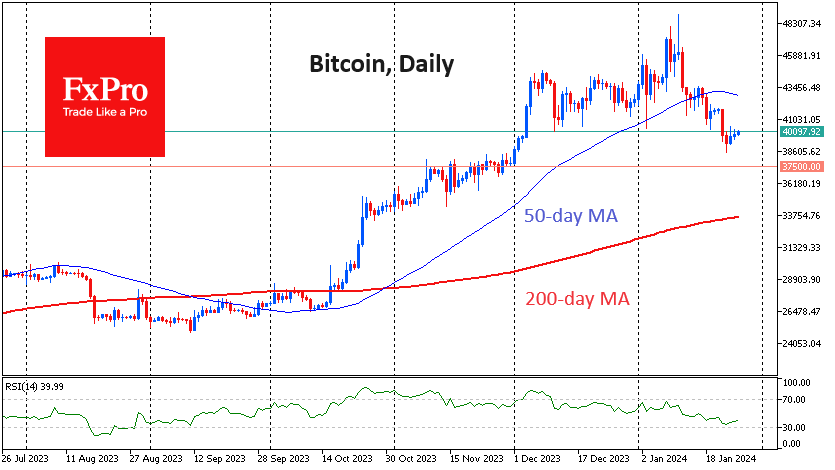
Volatility in the cryptocurrency market remains subdued, keeping the capitalisation near $1.56 trillion for the third day. Meanwhile, Bitcoin remains around $40K, and Ethereum looks pegged to $2200.
The drop in equity indices over the past 24 hours hasn’t been too much of a concern for cryptocurrency investors so far, as it looks more like a series of individual corporate stories rather than a global shift in sentiment.
Bitcoin is benefiting from this consolidation as its share of all cryptocurrencies has once again surpassed 50%.
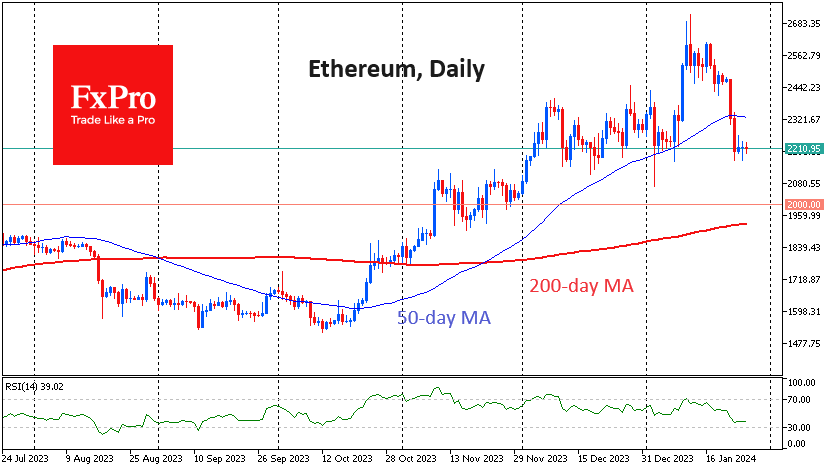
Meanwhile, Ethereum, the second most-capitalised coin, has returned to the lower end of the consolidation it spent most of December in, losing since the start of the day and threatening to fall a notch lower to the $2100 area, which was the upper end of the consolidation in November. A decline here would be as logical a move as a BTCUSD pullback to $37500, which remains the main scenario. At the same time, however, be prepared for a brief dip towards $2000 due to cryptocurrency volatility.
News background
The SEC postponed the decision on BlackRock’s application to launch a spot Ethereum ETF until 10 March. Optimistic experts expect the Ethereum ETF to be approved in May with a 50-70% probability, while sceptics point to regulatory resistance.
The emergence of spot bitcoin ETFs in the US has opened the door for the cryptocurrency to reach a wider audience. Now, for the first time, cryptocurrency could become mainstream, said the head of institutional at exchange Coinbase. New cryptocurrencies will attract a lot of capital, but it won’t happen overnight. It will take “months and even years”.
The G20’s Financial Stability Board in 2024 plans to focus on global regulations for the digital asset industry and the regulation of artificial intelligence.
Reuters confirmed the existence of a thriving underground crypto market in China. Investor interest in digital assets is growing against the backdrop of a troubled economy and a lack of value preservation tools. With Hong Kong’s approval of digital assets in 2023, Hong Kong has become one of the opportunities for Chinese investors to access cryptocurrencies.
AUD/USD and NZD/USD Target Additional Gains
AUD/USD is moving higher and might surge if it clears 0.6610. NZD/USD is also rising and could extend its increase above the 0.6110 resistance zone.
Important Takeaways for AUD USD and NZD USD Analysis Today
- The Aussie Dollar is attempting a fresh increase from the 0.6570 zone against the US Dollar.
- There is a key contracting triangle forming with resistance near 0.6595 on the hourly chart of AUD/USD at FXOpen.
- NZD/USD is showing positive signs above the 0.6100 support.
- There is a major bearish trend line forming with resistance near 0.6110 on the hourly chart of NZD/USD at FXOpen.
AUD/USD Technical Analysis
On the hourly chart of AUD/USD at FXOpen, the pair corrected lower but remained well-bid above the 0.6570 support. The Aussie Dollar is forming a base above 0.6570 and now attempting a fresh increase against the US Dollar, as discussed in the previous analysis.
The bulls pushed the pair above the 50% Fib retracement level of the downward move from the 0.6609 swing high to the 0.6570 low. There was a close above the 0.6590 resistance and the 50-hour simple moving average.
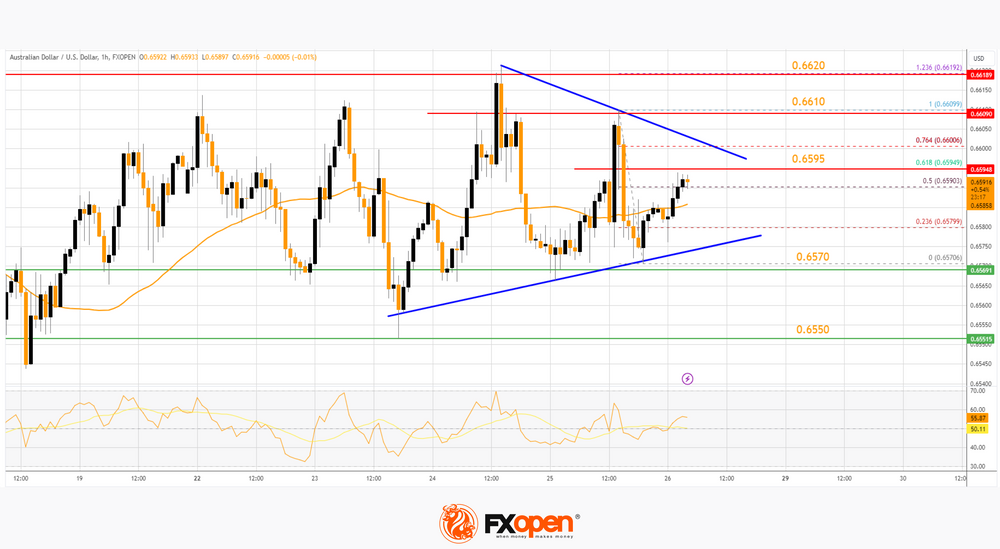
On the upside, the AUD/USD chart indicates that the pair is now facing resistance near a key contracting triangle at 0.6595. It is close to the 61.8% Fib retracement level of the downward move from the 0.6609 swing high to the 0.6570 low.
The first major resistance might be 0.6610. An upside break above the 0.6610 resistance might send the pair further higher. The next major resistance is near the 0.6650 level. Any more gains could clear the path for a move toward the 0.6720 resistance zone.
If not, the pair might correct lower below the 50-hour simple moving average at 0.6585. The next support could be 0.6570. If there is a downside break below the 0.6570 support, the pair could extend its decline toward the 0.6550 zone. Any more losses might signal a move toward 0.6515.
NZD/USD Technical Analysis
On the hourly chart of NZD/USD on FXOpen, the pair corrected lower from the 0.6150 zone. The New Zealand Dollar is now holding the 0.6100 support and eyeing a fresh increase against the US Dollar.
A low has formed near 0.6102 and the pair is consolidating in a range. On the upside, the pair is facing resistance near the 50-hour simple moving average at 0.6610. There is also a major bearish trend line forming with resistance at 0.6110.
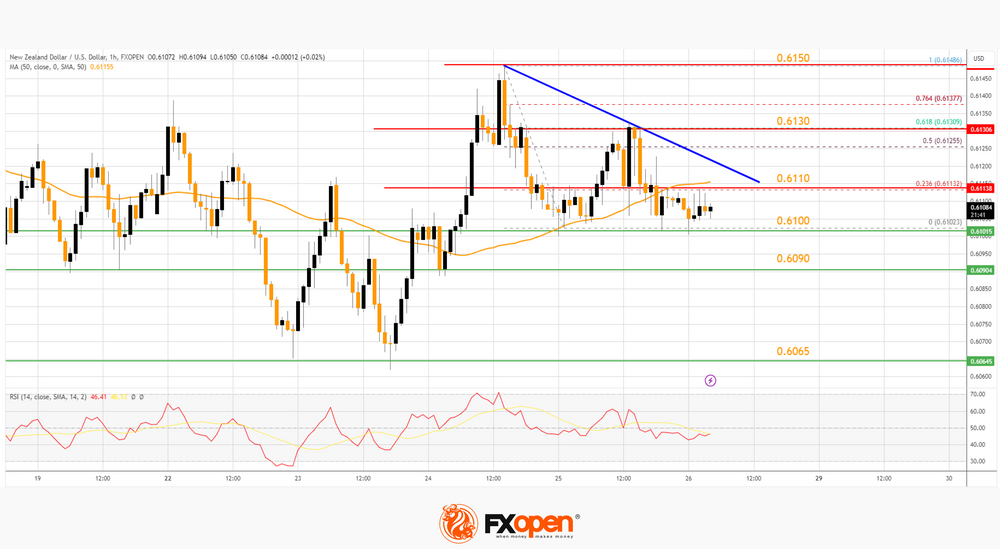
The trend line is close to the 23.6% Fib retracement level of the downward move from the 0.6148 swing high to the 0.6102 low. The NZD/USD chartsuggests that the RSI could move above 50.
The next major resistance is near the 50% Fib retracement level of the downward move from the 0.6148 swing high to the 0.6102 low at 0.6130. A clear move above the 0.6130 level might even push the pair toward the 0.6150 level. Any more gains might clear the path for a move toward the 0.6200 resistance zone in the coming days.
On the downside, there is a support forming near 0.6110. The next major support is 0.6090. If there is a downside break below the 0.6090 support, the pair might slide toward the 0.6040 support. Any more losses could lead NZD/USD in a bearish zone to 0.6000.
This article represents the opinion of the Companies operating under the FXOpen brand only. It is not to be construed as an offer, solicitation, or recommendation with respect to products and services provided by the Companies operating under the FXOpen brand, nor is it to be considered financial advice.
USD/JPY Steady after Tokyo Core CPI Falls Below 2%
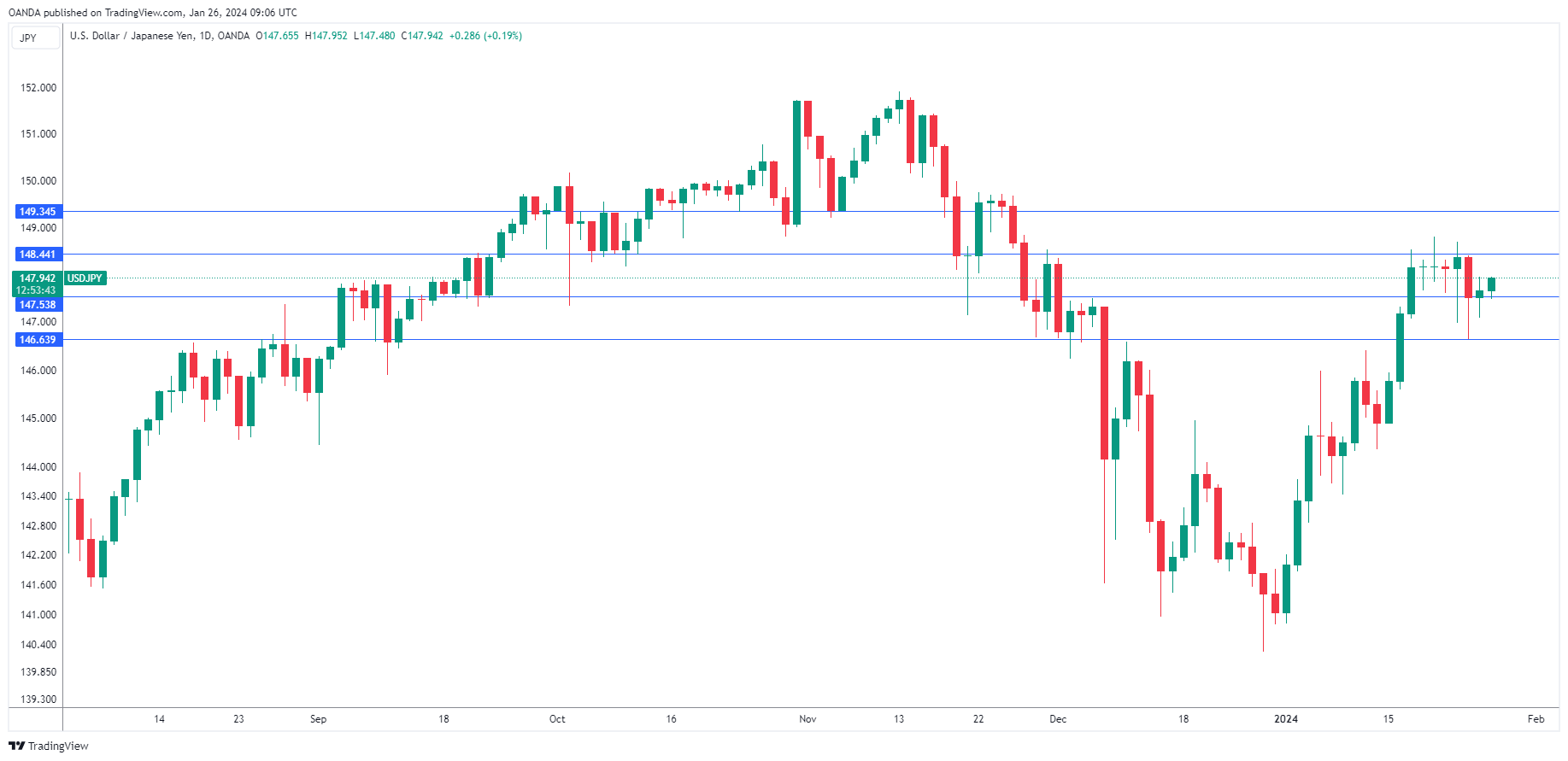
The Japanese yen is drifting on Friday. In the European session, USD/JPY is trading at 147.80, up 0.10%.
Tokyo Core CPI falls to 1.6%
Tokyo Core CPI reached a significant milestone today, falling to 1.6% y/y in January, after a December reading of 2.1%. This was the first time the indicator dropped below the Bank of Japan’s 2% target since May 2022. The main driver of the decline was lower energy prices. Tokyo Core CPI excludes fresh food but includes fuel. The Tokyo core-core index, which excludes fresh food and fuel prices, rose 3.1% y/y in January, down from 3.5% in December.
The drop in inflation reinforces the BoJ’s view that cost pressures are gradually being replaced by rising service prices as the main driver of inflation. This is hugely significant, as it points to inflation being more sustainable, which is a requirement for the BoJ before it tightens its ultra-loose policy. Japan also released corporate service inflation for December which held steady at 2.4%, a nine-year high. That reading underscores that service prices remain high a companies continue to pass on their costs.
BoJ Governor Ueda stated at this week’s policy meeting that progress is being made towards the target of 2% sustainable inflation, and that has the markets speculating that the BoJ could make a major policy shift in April or June. The BoJ wants to see higher wages as evidence that inflation is sustainable and the national wage negotiations in March are expected to provide higher wages for workers.
In the US, the first-estimate GDP for the fourth quarter smashed above expectations, but the US dollar didn’t show much interest. GDP growth rose 3.3% y/y, below the 4.9% gain in the third quarter but well above the consensus estimate of 2.0%. The US economy continues to produce stronger-than-expected data and that has the markets paring expectations for a rate cut in March. The probability of a March cut has fallen to 48%, down sharply from 70% one month ago, according to the CME’s FedWatch tool.
USD/JPY Technical
- USD/JPY tested support earlier at 147.54. Below, there is support at 146.63
- There is resistance at 148.44 and 149.35
USDCAD Looks Ready for Bearish Retracement
- USDCAD battles with 200-day SMA
- Holds above downtrend line
- But momentum indicators show weak signals
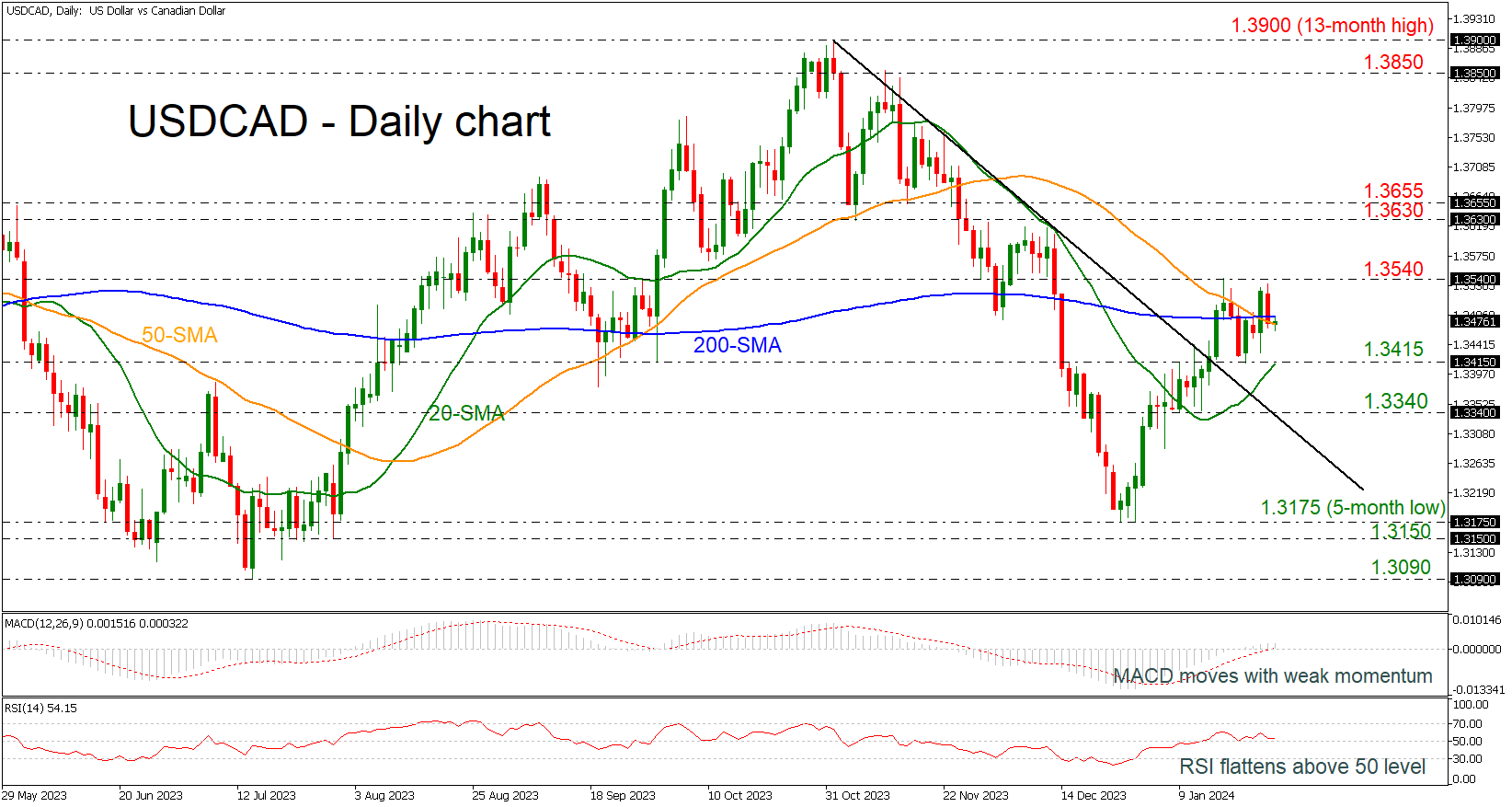
USDCAD is holding above the medium-term ascending trend line and is moving back and forth from the flat 200-day simple moving average (SMA) at 1.3483.
The technical indicators are still located in the bullish area, with the MACD stretching slightly above its red signal line but with weak momentum, and the RSI is pointing marginally up near the 50 level. Yet the latter could also be an indication that the rally is overdone, and hence negative corrections should not be a surprise in coming sessions.
Should the price retreat, the 20-day SMA at 1.3415, which the bears were unable to break this week, could provide immediate support. Moving lower, the focus would shift to the 1.3340 barricade, while lower still, a violation of the downtrend line again would increase speculation that the bullish phase has ended and a downtrend is in progress.
In the alternative scenario, traders would eagerly be looking for a break above the 200-day SMA and more importantly the 1.3540 resistance will increase buying orders towards the 1.3630 resistance. If that’s the case, the rally could last until the 1.3630-1.3655 zone.
The recent bullish move above the descending trend line turned the short-term picture to a more positive one. However, the recent sideways move within 1.3415-1.3540 is raising the likelihood for a potential downside retracement again.