Sample Category Title
Fed Minutes Confirm That Members Believe Rates Are Sufficiently Restrictive
The minutes from the December 12-13, 2023 Federal Open Market Committee (FOMC) meeting reiterated that quelling price pressures remains of paramount importance for the Fed.
On the current economic backdrop, Committee members noted that "after stronger than expected growth of real GDP in the third quarter, recent indicators suggested that growth in economic activity had slowed. While still strong, job gains had moderated since earlier this year, and the unemployment rate had remained low."
When discussing financial conditions, participants noted that "an easing in financial conditions beyond what is appropriate could make it more difficult for the Committee to reach its inflation goal."
On the appropriate policy actions, "all participants judged it appropriate to maintain the target range for the federal funds rate at 5¼ to 5½ percent at this meeting." This was supported by slowing economic momentum and the labor market coming into better balance.
When discussing the future path of policy, Committee members viewed "the policy rate as likely at or near its peak for this tightening cycle, though they noted that the actual policy path will depend on how the economy evolves." Committee members noted the degree of uncertainty surrounding the time that rates will need to remain restrictive.
Key Implications
Financial markets were attentively watching today's minutes looking for any insights into the deliberations surrounding rate cuts. Following Chair Powell's acknowledgement that policy easing had been discussed, financial markets increased their expectations for the number of rate cuts through 2024. The minutes, however, did little in the way of providing additional information on the timing or potential drivers of rate cuts and echoed the recent rhetoric of several FOMC members that have stated that while rate cuts would be appropriate in 2024, they are not imminent.
With inflation trending favorably and the labor market coming into better balance, optimism that the Fed can achieve a soft landing has been growing. Nonetheless, the Fed will proceed cautiously to balance the risks of prematurely easing against the risk of maintaining rates in a restrictive position for too long. We believe that with economic growth set to slow in 2024, the Fed will likely begin cutting its policy rate by the summer.
Risk Rally on Pause, Dollar Rebounds as NFP Report Awaited
- December jobs report not expected to upset markets
- Any slowdown in hiring could reinforce rate cut bets
- But dollar bulls anticipating a different outcome on Friday, 13:30 GMT
Markets vs the Fed
The soft landing narrative completely took hold of the market towards the end of 2023, spurring a risk rally that pushed Treasury yields to multi-month lows and Wall Street to all-time highs. This renewed optimism for the US economic outlook came about from Fed officials flagging the possibility of a policy pivot in the not too distant future.
Not that the economy was in trouble to begin with. Much of the gloom for 2024 had been built on fears that central banks would keep interest rates at high levels for too long. But at the December FOMC meeting, Fed chief Powell signalled that if inflation continues to come down, then rates would need to be lowered accordingly to maintain policy at the same level of restrictiveness.
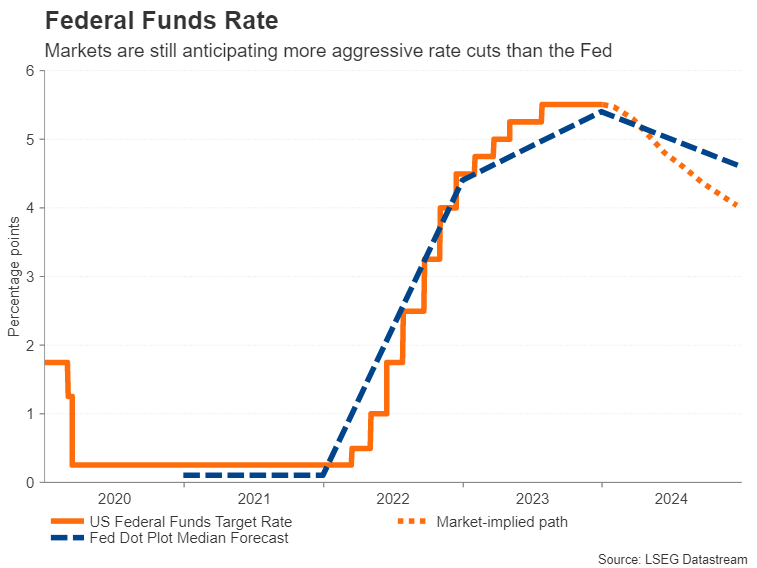
You could argue that this then justifies the exuberance in the markets. Well, only partially. The Fed’s own projection of three 25-bps rate cuts in 2024 sounds reasonable under this assessment. But investors’ view that lower inflation will warrant rate cuts by as much as 150 basis points carries a lot of risk. The main risk being that the US labour market has yet to show any real signs of cracks and could easily heat up by modest rate cuts.
Will there be any surprises in December payrolls?
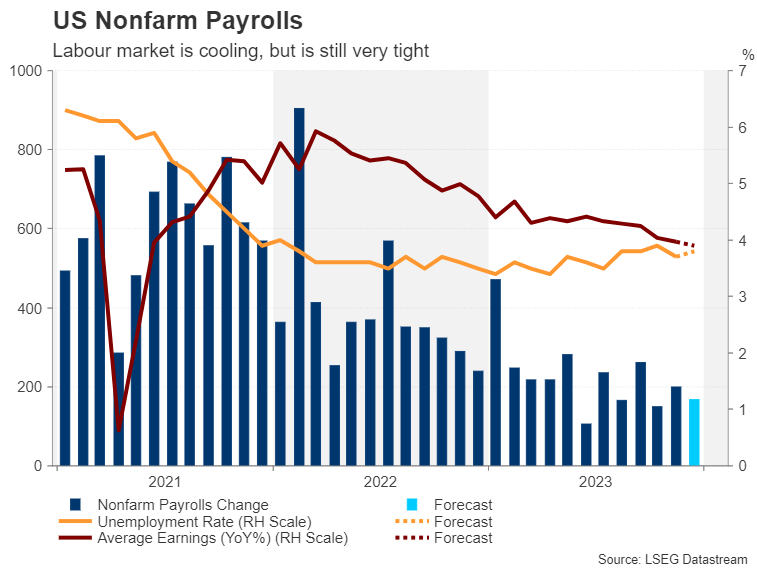
Whilst both hiring and earnings growth have moderated in recent months, businesses are not laying off staff in significant numbers either. This picture likely sums up how the jobs market ended the year but it’s worth noting that the risk of an upside surprise is looking somewhat greater as other indicators suggest hiring remained healthy in December.
Nonfarm payrolls are forecast to have increased by 168k in December, down from November’s 199k print. This slight cooling off is expected to have pushed up the unemployment rate from 3.7% to 3.8%, while average hourly earnings are seen rising 0.3% month-on-month and 3.9% year-on-year, easing marginally from 4.0% in the prior month.
Other data releases on Friday will include the ISM non-manufacturing PMI for December and factory orders for November.
Can the dollar extend its gains?
With rate cuts priced in so heavily by investors, a stronger-than-expected NFP report risks roiling markets at a time when some traders have already started to question their overoptimistic view on the Fed rate path. Stock markets have begun 2024 on a negative footing as rate cut bets are scaled back somewhat, although a flare up in tensions in the Middle East is also contributing to the risk-off mood.
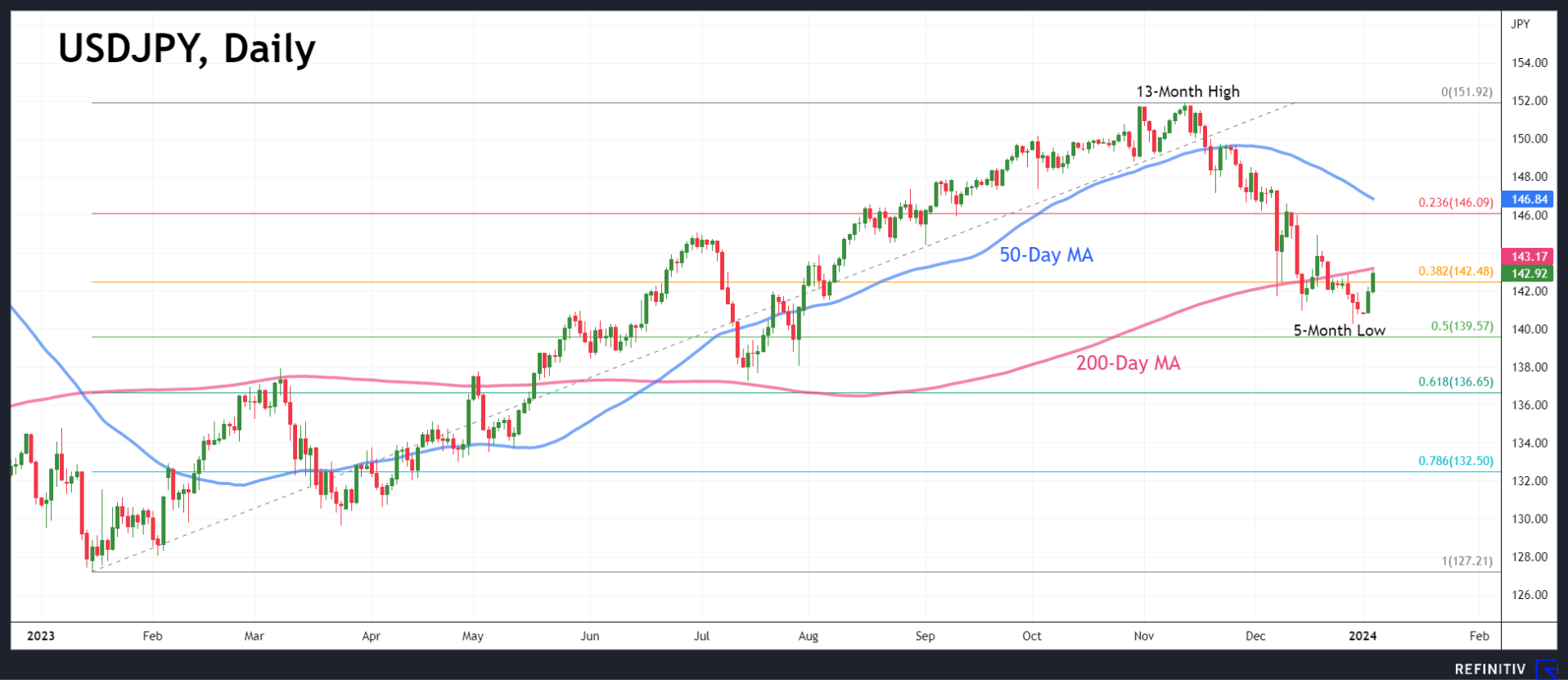
The US dollar, meanwhile, has been recouping some of its year-end losses and could continue to recover if the US economy adds more jobs than anticipated in December. Against the yen, the dollar is fast approaching its 200-day moving average (MA), located slightly above the 143.00 level. A break above 143.00 yen would open the way for the 23.6% Fibonacci retracement of the January-November uptrend at 146.09, while a bit higher is the 50-day MA at 146.84.
Are markets looking to consolidate?
However, the rebound attempt could suffer a setback if the jobs numbers either disappoint or underwhelm. The greenback could revisit the December 28 five-month low of 140.24 yen if the data points to rate cuts coming sooner rather than later. The 50% Fibonacci of 139.57 lies not too far below the December trough, with the 61.8% Fibonacci on standby to halt any further slide at 136.65.
Alternatively, if investors end up with a not too hot, not too cold jobs report, they might decide to remain cautious, at least until a clearer trend starts to emerge as to what direction the economy is headed in. This would of course spoil Wall Street’s chances of benefiting from the January effect, while the dollar could enter a period of consolidation.
Loonie Plunges Ahead of Canadian Jobs Number
- Canada’s economy likely added fewer jobs in December
- Local dollar shows some weakness ahead of Friday’s data due at 13:30 GMT
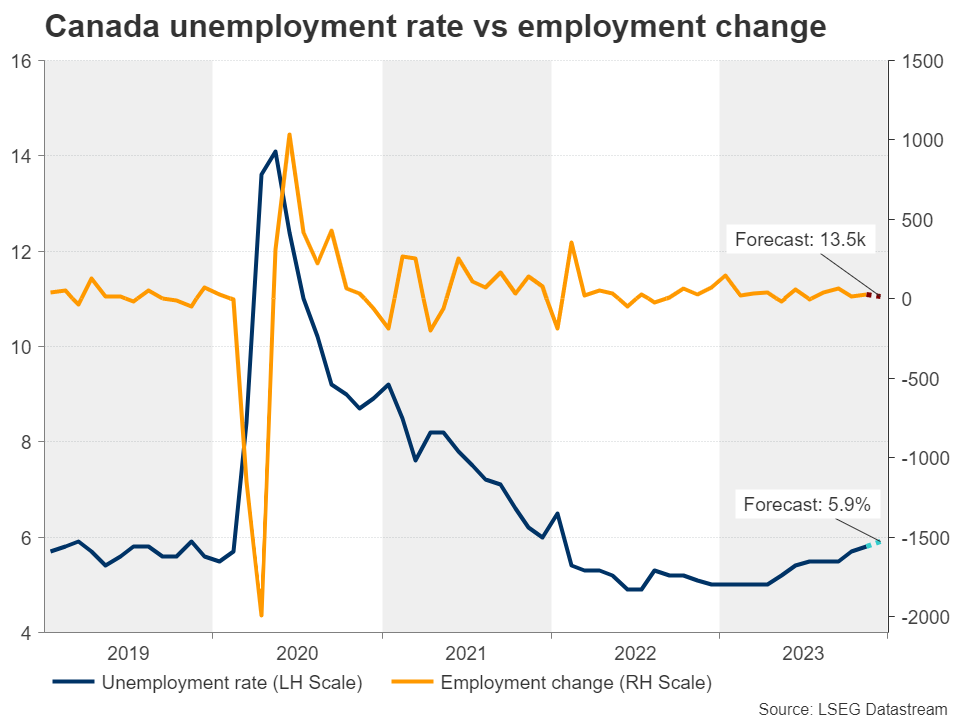
Unemployment rate to rise furhter
According to market forecasts, the unemployment rate in Canada increased to 5.8% in November 2023, higher than the 5.7% figure that was recorded in the previous month. The rate reached its highest point since January 2022, and it increased even further in December, reaching 5.9%. During the month of December, it is anticipated that the economy added only 13.5k new jobs. Despite this, wage growth is still growing at 5%, so investors will be keeping a close eye on that number and the most recent Ivey PMI indicator, which will be released on Friday as well.
Will the BoC raise rates in January?
As anticipated by the market, the Bank of Canada maintained its target for the overnight rate at 5% for the third consecutive meeting in December 2023. Consequently, the cost of borrowing money will remain at a level that was is the highest it has been in 22 years. Policymakers have noted the fact that there are additional indications that monetary policy is reducing price pressures and restraining spending. However, they continue to be concerned about the risks that could affect the outlook for inflation and are prepared to raise the policy rate even further if it becomes necessary. It is the goal of the central bank to see a further and sustainable decrease in core inflation, and it continues to concentrate on the equilibrium between demand and supply in the economy, inflation expectations, wage growth, and the pricing behaviour of corporations. The BoC also announced that it will continue to implement its policy of quantitative tightening.
BoC policy is unlikely to benefit the loonie
As rate cut bets for the Bank of Canada have also been ratcheted up recently, the Canadian dollar will be keeping a close eye on the domestic labor market. Compared to the other commodity-linked currencies, the Canadian dollar is expected to have gained approximately 2.5% against its US counterpart in 2023. This performance is a bit stronger than that of the Australian and New Zealand dollars, which are also commodity-linked currencies.
On the other hand, there is a possibility that the year 2024 will be much more difficult for the loonie if the BoC is forced to begin reducing interest rates due to the stagnation of economic development.
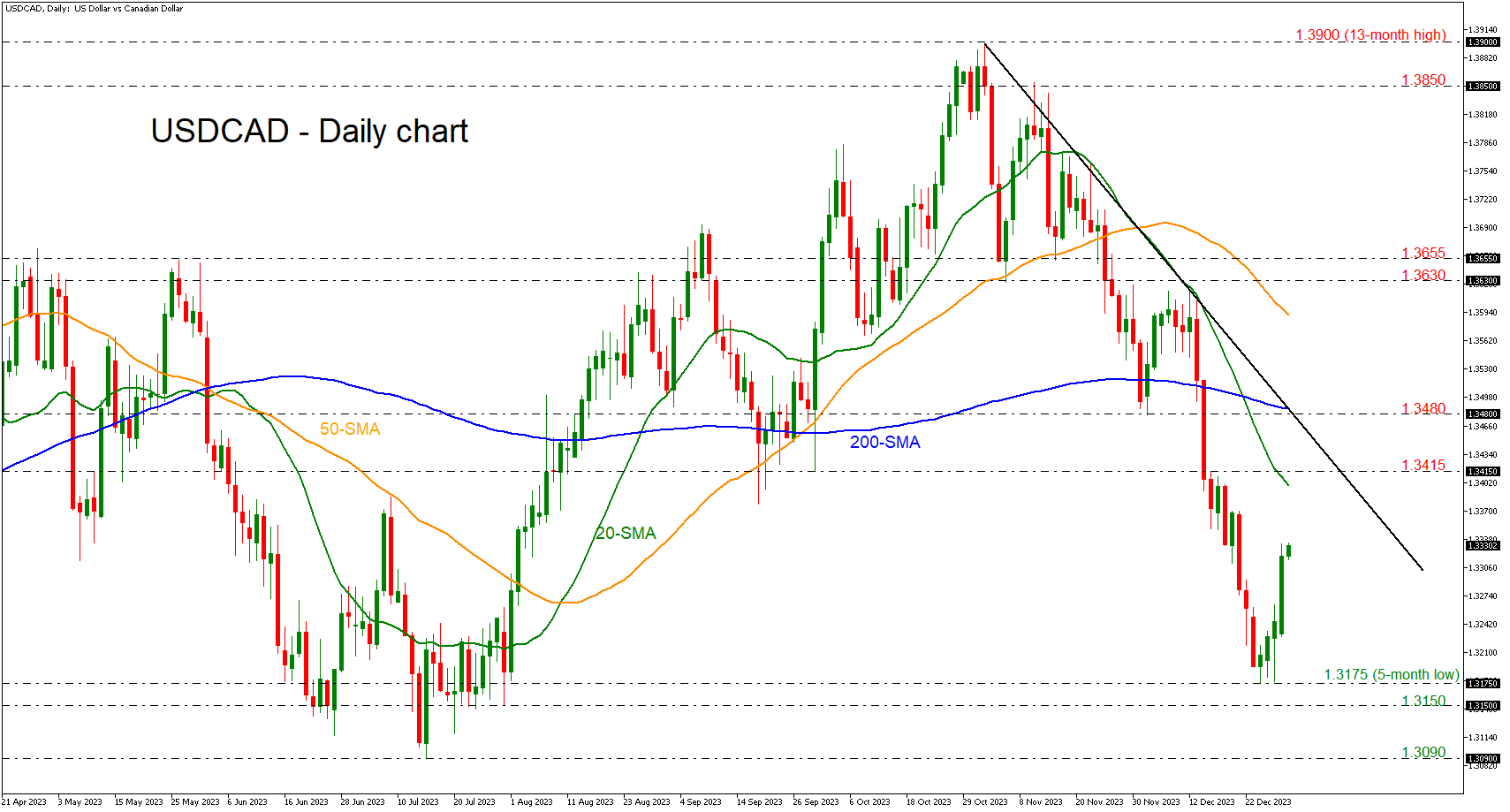
Dollar/loonie is surging after the significant bounce off the five-month low of 1.3175. A fresh move towards the 1.3415 resistance is possible in the near term, reaching the steep descending trend line if the US dollar can extend its bullish streak. However, should the pair reverse back down again, the five-month low of 1.3174 could provide initial support. More downside movements would turn the spotlight on the 1.3150 barrier and the 1.3090 bottom, taken from the low on July 14.
Sunset Market COmmentary
Markets
Interest rate markets tried to build on last week’s ‘U-turn’ after the accelerated decline in yields triggered by the December Fed policy announcement. Corporates and sovereigns are eager to use lower funding costs to frontload at least part of their 2024 financing needs, with new bond issuance taking a solid start. Still, a sustained countermove on the recent bond rally not only needs supply but also an economic narrative. US yields maintain some upside momentum going in the release of the manufacturing ISM and the JOLTS job openings (see below), rising between 4 bps (2-y) and 5.5 bps (30-y). Richmond Fed president Barkin sees a soft landing scenario as ‘increasingly conceivable, but in no way inevitable’. Most Fed officials are expecting rate cuts in 2024, but he stressed the Fed is keeping a close eye both on the economic performance and inflation continuing its decent. With respect to the latter, the recent plunge in yields could stimulate too much demand and keep inflation elevated. He even kept the option for further rate hikes on the table. Understandably, his remarkets were ‘invisible’ on the interest rate charts. German yields in the meantime reversed an early rise to trade marginally lower across the curve. French and German CPI data to be published tomorrow ahead of the flash EMU estimate on Friday are expected to face a less easy comparison base compared to previous months, potentially lifting the Y/Y (headline) measure. However, given recent market momentum, European investors stay cautious to front-run on such an outcome. A more gradual rise/pause in the core yield rebound compared to yesterday doesn’t help risk sentiment. The EuroStoxx 50 is ceding 1.5%, turning its back to the multi-year top reached last week. US equities opened about 0.5% lower (S&P). The dollar extends its comeback. DXY is testing the 102.5 area, compared to a correction low near 100.62 last week. EUR/USD is drifting further south in the 1.09 big figure. First resistance at 1.0875 (38% retracement of the rebound since early October) is coming on the radar. With the BOJ still in wait-and-see modus, USD/JPY revisits the 143 area. Sterling holds ‘strong’ (EUR/GBP 0.865).
At the time of finishing this report US JOLTS job openings eased further from 8852k to 8790k. The headline manufacturing ISM rose slightly more than expected to 47.4 from 46.7, but the prices paid subindex dropped from 49.9 to 45.2 while new orders unexpectedly eased to 47.1. Yields declined a couple of bps after the release.
News & Views
The Swiss manufacturing industry can’t buck the global trend and remains in dire straits. The PMI ticked from 42.1 to 43 in December, but is stuck deep into contraction territory since early 2023. Details showed a new deceleration in output (43.6 from 46.6) with companies running down inventories (45.5 from 49) and hardly having any backlog of orders (39.8 from 38.1). The quantity and stock of purchases slowed at a slower pace though, suggesting that 2024 might see a new start in the inventory cycle. Companies still shed jobs, though at a much smaller pace (49.2 from 46). The data didn’t impact Swiss markets, but a quick look at the FX chart shows that the strong Swiss currency is also one of the factors holding back the manufacturing industry. The November/December global bond rally played in the advantage of the Swiss franc with EUR/CHF touching an all-time low just above 0.9250 around year-end when we exclude volatility around the end of the release of the EUR/CHF 1.20 peg early 2015.
Turkish inflation accelerated to 2.93% M/M in December with the Y/Y-comparison broadly unchanged at 64.77%. Clothing and footwear and transportation were the only two categories reporting a M/M-decline. Underlying core inflation readings also increased by 2.3% to 3% M/M with Y/Y-figures depending on the specific measure around 61% to 70%. Today’s data were close to expectations and in line with the central bank’s outlook. The Turkish government’s end of December decision to hike the minimum wage by 49% this year poses additional upside risks to the Turkish inflation outlook, leaving the Turkish central bank with no options but to stick with its hawkish stance. In an orthodox turn after May’s elections, the CBRT raised its policy rate from 8.5% to 42.5%, but the pace of hiking is slowing (+250 bps in December). A (final) January hike (to 45%?) is still in the cards. The Turkish lira continues its gradual depreciation process facing deep negative real yields. EUR/TRY is close to the all-time high just below 33.
US ISM manufacturing rises to 47.4, 14th month of contraction
US ISM Manufacturing PMI rose from 46.7 to 47.4 in December, above expectation of 47.1. That's still the 14th month of contraction reading.
Looking at some details, new orders, fell from 48.3 to 47.1, the 16th month of contraction. Production rose from 48.5 to 50.3. Employment rose from 45.8 to 48.1. Prices fell sharply from 49.9 to 45.2.
December PMI reading of 47.4 corresponds to an estimated decrease of -0.5% in the real GDP on an annualized basis.

British Pound Starts New Year’s With a Tumble
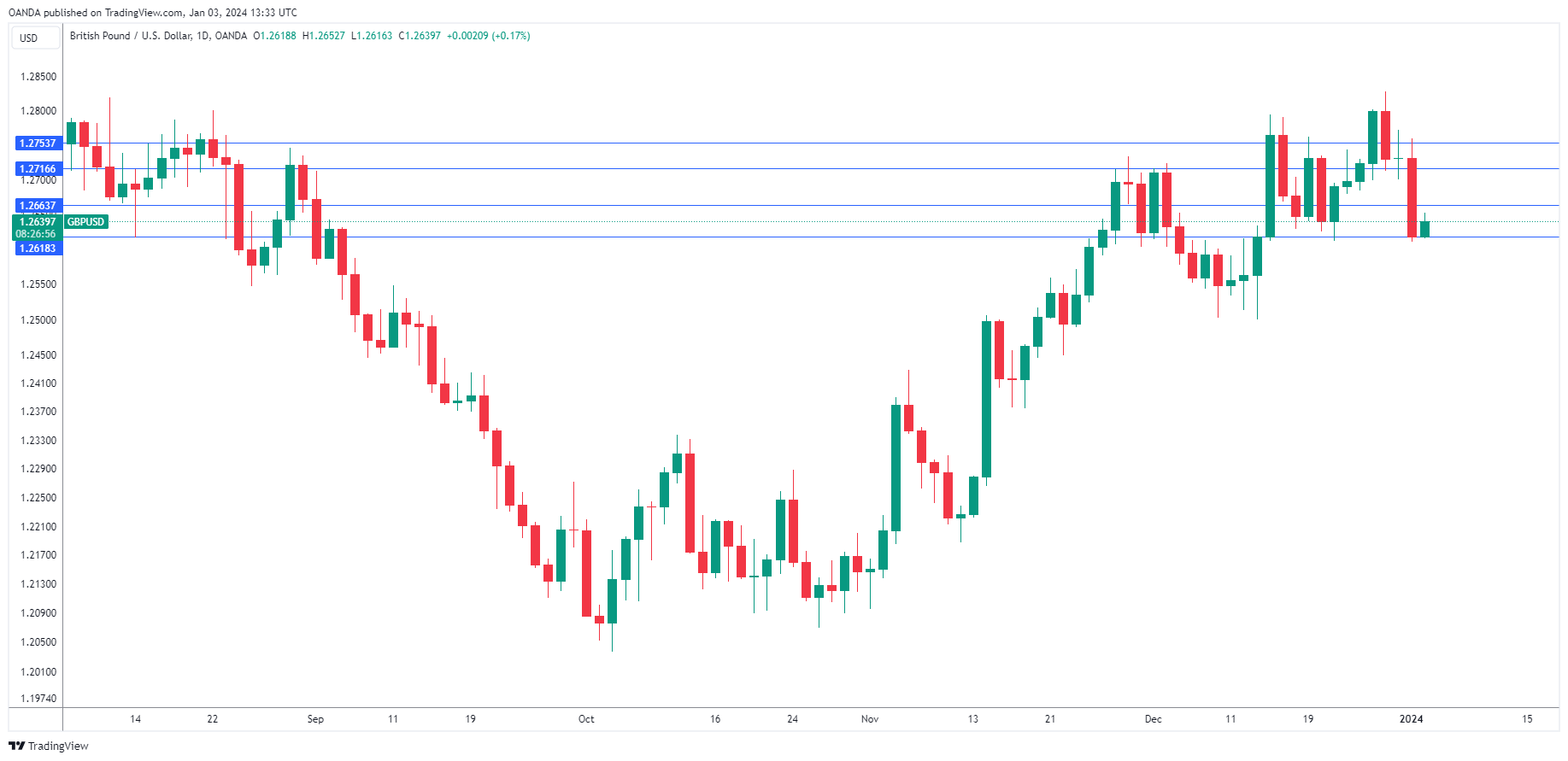
The British pound is steady on Wednesday after sharp losses a day earlier. In the European session, GBP/USD is trading at 1.2632, up 0.11%.
UK Services PMI expected to accelerate
UK Services PMI will be released on Thursday. The services sector, which is responsible for most of the economy’s growth, hit a rough patch late last year and posted three straight declines. The PMI managed to claw back into expansion territory in November with a reading of 50.9. The consensus for December is 52.7, which would indicate modest growth.
The UK manufacturing sector remains mired in a depression. December’s Manufacturing PMI eased to 46.2, below the consensus of 46.4 and shy of the November reading of 47.2, which was a seven-month high. Manufacturing production has now declined for ten straight months. The December decline was driven by weaker demand abroad for UK goods and less optimism from manufacturers about business conditions. The weak UK economy and high borrowing costs continue to dampen manufacturing activity.
The Federal Reserve releases the FOMC meeting of the December meeting later today. The meeting was highly significant as the Fed surprised the markets by failing to push back against rate-cut fever. The Fed signalled that it expected to trim rates three times in 2024, a major pivot from the well-worn script of ‘higher for longer’. Still, some Fed members have cautioned the markets from expecting imminent rate cuts and the timing of any rate cuts is unclear. Investors will be looking to the minutes for further details about the Fed’s surprise pivot. The markets are bubbling with confidence that the Fed will slash rates this year and have priced in six rate cuts starting in March.
GBP/USD Technical
- There is resistance at 1.2753 and 1.2807
- GBP/USD pushed below support lines at 1.2678 and 1.2624 earlier. Below, there is support at 1.2549
Fed’s Barkin: Soft landing within reach, but not assured
Richmond Fed Thomas Barkin, in his prepared remarks for a speech, acknowledged that soft landing is "increasingly conceivable. But he also cautioned that such an outcome is "in no way inevitable."
Barkin outlined four key risks that could potentially derail the US economy from its desired path. Firstly, he expressed concern that the economy might "run out of fuel", implying a slowdown in economic momentum. Secondly, he pointed to the possibility of "unexpected turbulence".
Thirdly, the risk that inflation might stabilize at a level above Fed's 2% target. Finally, Barkin mentioned the risk of a delayed "landing", suggesting that the economy could continue to perform better than expected, which might prolong the process of policy normalization.
Addressing the approach to monetary policy, Barkin emphasized the importance of incoming data in shaping the Fed's decisions. He stated, "Is inflation continuing its descent and is the broader economy continuing to fly smoothly? Conviction on both questions will determine the pace and timing of any changes in rates. There's no autopilot. The data that come in this year will matter."
USD/JPY Mid-Day Outlook
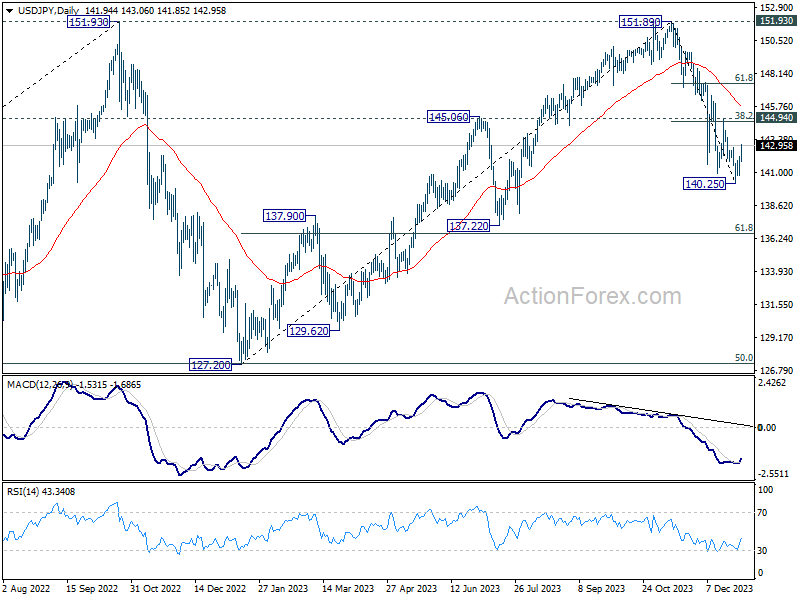
Daily Pivots: (S1) 141.13; (P) 141.67; (R1) 142.54; More...
USD/JPY's break of 142.84 minor resistance indicates short term bottoming at 140.25, on bullish divergence condition in 4H MACD. Intraday bias is back on the upside for stronger rebound to 38.2% retracement of 151.89 to 140.25 at 144.69. On the downside, below 141.85 minor support will bring retest of 140.25 low instead.
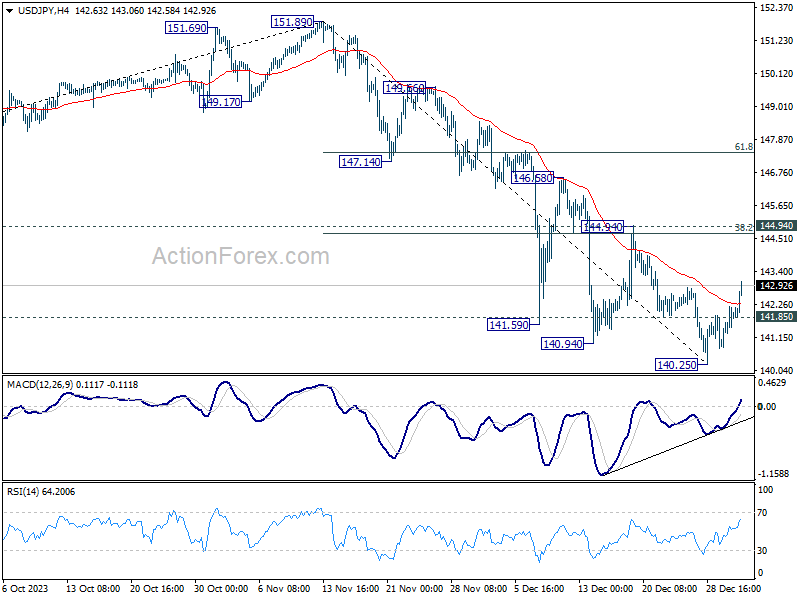
In the bigger picture, fall from 151.89 is seen as the third leg of the corrective pattern from 151.93 (2022 high). Deeper decline would be seen to 61.8% retracement of 127.20 to 151.89 at 136.63, sustained break there will pave the way to 127.20 support (2022 low). This will now remain the favored as long as 144.94 resistance holds.
USD/CHF Mid-Day Outlook
Daily Pivots: (S1) 0.8308; (P) 0.8585; (R1) 0.8779; More....
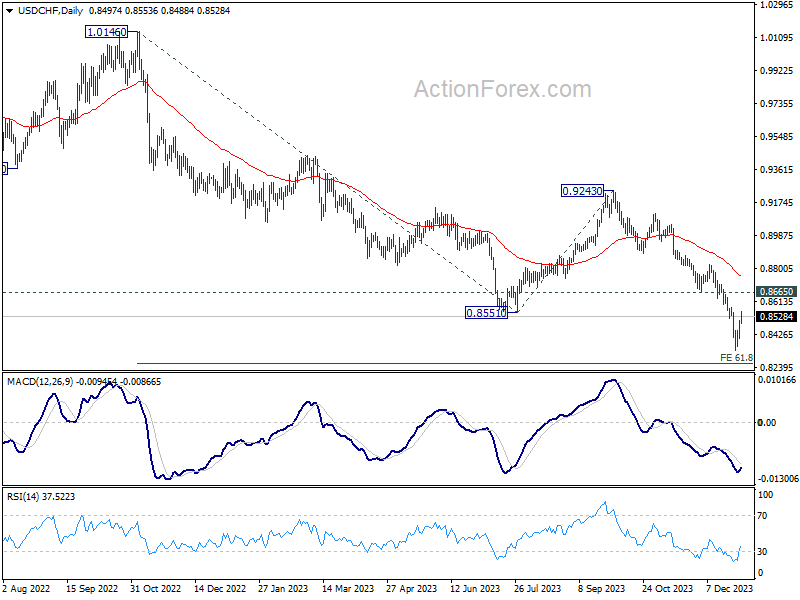
USD/CHF's recovery from 0.8332 is extending. But still, with 0.8665 support turned resistance, current price actions are seen as corrective, and outlook stays bearish. On the downside, break of 0.8332 will resume larger fall from 0.9243 to 0.8257 projection level.
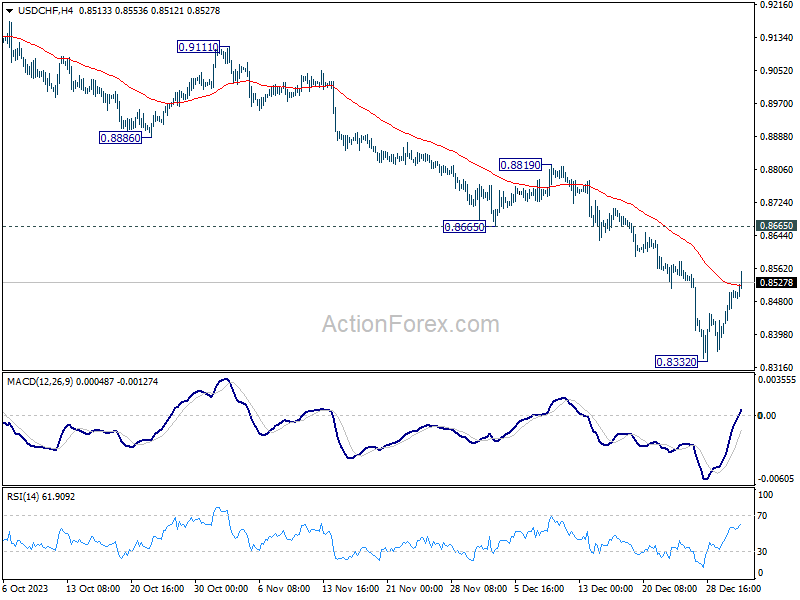
In the bigger picture, break of 0.8551 support indicates resumption of whole decline from 1.0146 (2022 high). Next target is 61.8% retracement of 1.0146 to 0.8551 from 0.9243 at 0.8257. Sustained break there could prompt downside acceleration to 100% projection at 0.7648. This will now remain the favored case as long as 0.8819 resistance holds.