

Sample Category Title
Cautionary Tone on Inflation by Fed Speakers
Market movers today
The main focus this week will be on FOMC minutes Tuesday, Riksbank meeting and Euro PMIs on Thursday and US PMIs, German ifo and Japan CPI on Friday.
Today we start out quiet with no big movers on the agenda.
The 60 second overview
Cautionary tone by Fed speakers. On Friday, some FOMC participants cautioned against declaring victory over inflation despite the recent positive signals. Collins (non-voter) noted that she has seen less progress on non-shelter services inflation and that additional rate hikes cannot yet be taken off the table. Goolsbee (voter) underscored that taming inflation remains the Fed's key focus over growth or the labour market. Daly (non-voter) emphasized that the Fed 'needs patience' as the path to 2% inflation still remains unclear. This week markets will keep an eye out for the FOMC minutes tomorrow evening, although the post-meeting easing in financial conditions could mean that some of the comments are already somewhat outdated. On the data front, November Flash PMIs on Friday will be the most important release; we generally expect to see further signs of cooling economic activity especially on the services sector towards winter.
China keeps lending rates unchanged. China's Loan Prime Rates were held unchanged in line with expectations. They are based on reference rates reported by banks and generally follow the policy rate, Medium Lending Facility rate, which were kept unchanged last week. China seems to prefer quantitative credit measures currently over rate reductions in their monetary tool box in order to protect bank margins and not widen the rate spread further to the US.
Argentina moves to the right. Right-wing libertarian Javier Milei came out as the winner of the Presidency in Argentinian elections on Sunday. Milei won on a campaign against the political elite and high inflation close to 150% and has pledged economic shock therapy.
Equities. Global equities booked a small gain Friday and thereby ended a very solid week on a high note. Focus on yields still overarching, with cyclical growth massively outperforming. The renewed appetite for small caps continued Friday sending US regional banks up almost 10% for the week. The energy sector also flying on Friday as the oil price increase 4% (and continuing higher this morning). VIX has made it all the way down from 22 to just below 14 the last month, telling the story about fear of inflation and central banks fading faster than even we would have expected. US equities Friday: Dow +0.01%, S&P 500 +0.1%, Nasdaq +0.1% and Russell 2000 +1.4%. Asian markets are mostly higher this morning led by some optimism around China. US and European futures close to unchanged.
FI. Global bond yields were mainly moving sideways on Friday. Initially, there was a decent decline in global bond yields, where the yield on a 10Y German government bond had declined some 5-6bp and 10Y Treasuries had declined 3-4bp, but by the afternoon yields had erased most of the gains.
FX. During Friday's session EUR/USD rose firmly above the 1.09 mark followed by a squeeze in US yields. Focus turns to the FOMC minutes out tomorrow evening and November flash PMIs on Friday. Oil prices surged by 4% with Brent trading back above 80 USD/bbl. For SEK, the main event this week is the Riksbank rate decision on Thursday.
Credit. Friday marked another positive day for credit markets as the soft-landing narrative continued to take hold in risk assets. Itrax Main tightened 1.7bp to close at 69.9bp, while Itrax Xover tightened 7.1bp to close at 387.4bp (another post September low for both indices). Primary markets were a bit slower, as is common for Friday, but did exhibit some activity with deals announced earlier in the week being executed.
AUD/USD Daily Report
Daily Pivots: (S1) 0.6473; (P) 0.6495; (R1) 0.6536; More...
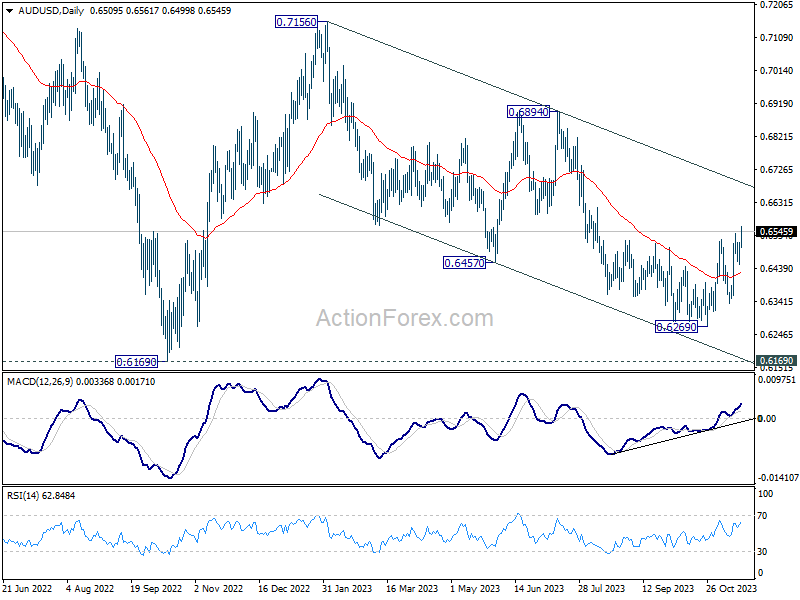
AUD/USD's rise from 0.6269 resumes today by breaking through 0.6541 resistance. Intraday bias is back on the upside. Current development argues that whole decline from 0.7156 has completed with three waves down to 0.6269. Further rally should be seen to falling channel resistance (now at 0.6676) next. Nevertheless, below 0.6451 support will dampen this bullish view and turn intraday bias neutral first.
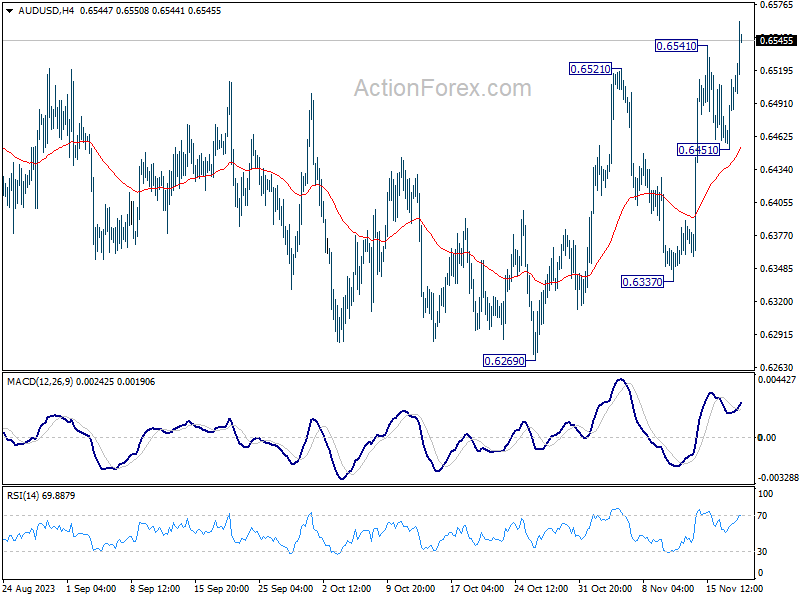
In the bigger picture, there is no confirmation that down trend from 0.8006 (2021 high) has completed. While current rebound from 0.6269 might extend higher, it could be the third leg of the corrective pattern from 0.6169 (2022 low) only. For now, medium term bearishness will remain as long as 0.6894 resistance holds.
USD/CAD Daily Outlook
Daily Pivots: (S1) 1.3698; (P) 1.3734; (R1) 1.3761; More...
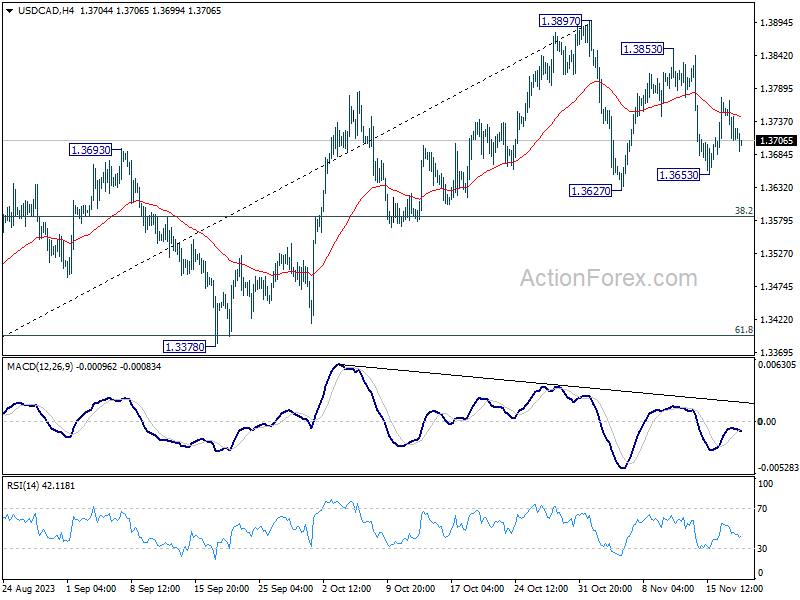
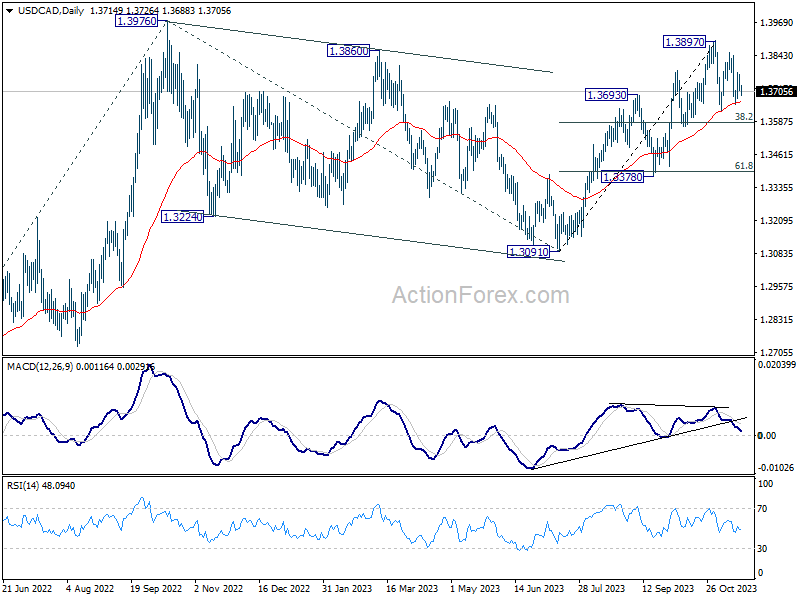
Intraday bias in USD/CAD stays neutral and outlook is unchanged. While another fall cannot be ruled out, downside should be contained by 38.2% retracement of 1.3091 to 1.3897 at 1.3589 to bring rebound. Break of 1.3897 is expected at a later stage to resume larger rally.
In the bigger picture, corrective pattern from 1.3976 (2022 high) should have completed with three waves down to 1.3091. Decisive break of 1.3976 high will confirm resumption of up trend from 1.2005 (2021 low). Next target is 61.8% projection of 1.2401 to 1.3976 from 1.3091 at 1.4064. This will remain the favored case as long as 1.3378 support holds.
EUR/USD Daily Outlook
Daily Pivots: (S1) 1.0855; (P) 1.0884; (R1) 1.0944; More...
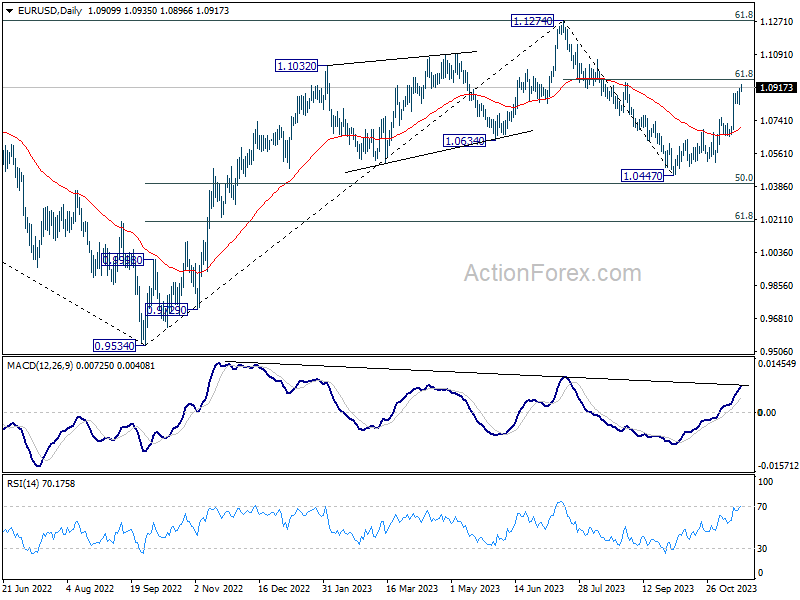
EUR/USD's rally continues today and intraday bias stays on the upside. Current rally from 1.0447 is in progress for 61.8% retracement of 1.1274 to 1.0447 at 1.0958. Sustained break there will pave the way to retest 1.1274 high. On the downside, below 1.0823 minor support will turn intraday bias neutral and bring consolidations first.
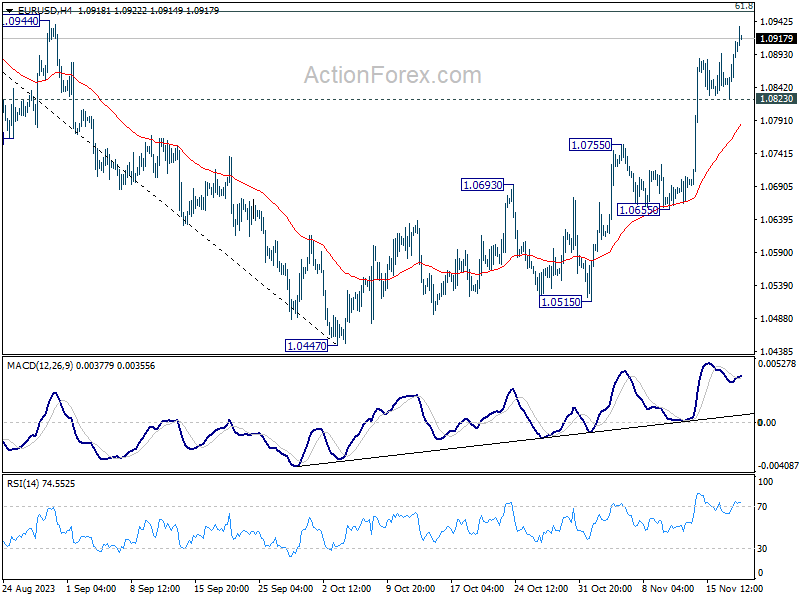
In the bigger picture, price actions from 1.1274 are viewed as a corrective pattern to rise from 0.9534 (2022 low). Rise from 1.0447 is tentatively seen as the second leg. Hence while further rally could be seen, upside should be limited by 1.1274 to bring the third leg of the pattern.
GBP/USD Daily Outlook
Daily Pivots: (S1) 1.2403; (P) 1.2434; (R1) 1.2494; More...
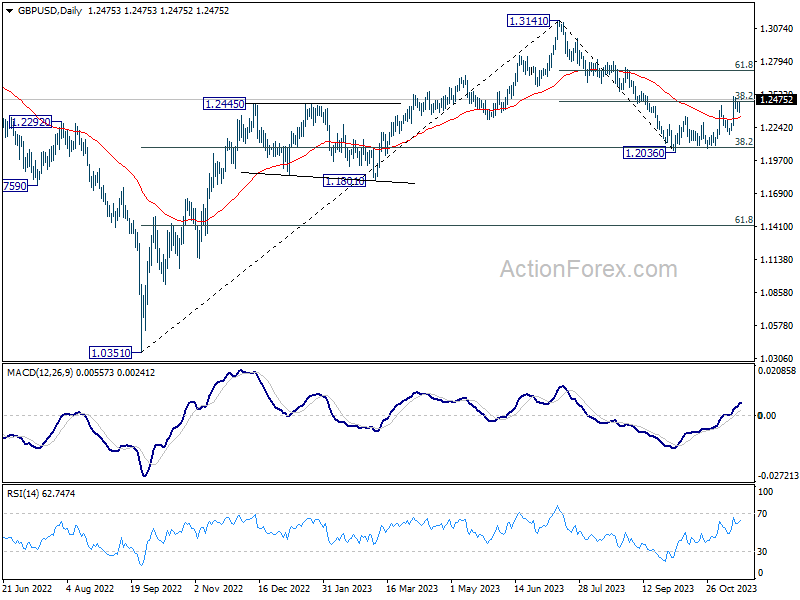
GBP/USD is staying below 1.2504 temporary top despite today's rebound. Intraday bias remains neutral first. In case of another retreat, downside should be contained by 55 4H EMA (now at 1.2359) to bring rebound. On the upside, break of 1.2504 will resume the whole rebound from 1.2036. Sustained trading above 38.2% retracement of 1.3141 to 1.2036 at 1.2458 will pave the way to 61.8% retracement at 1.2716.
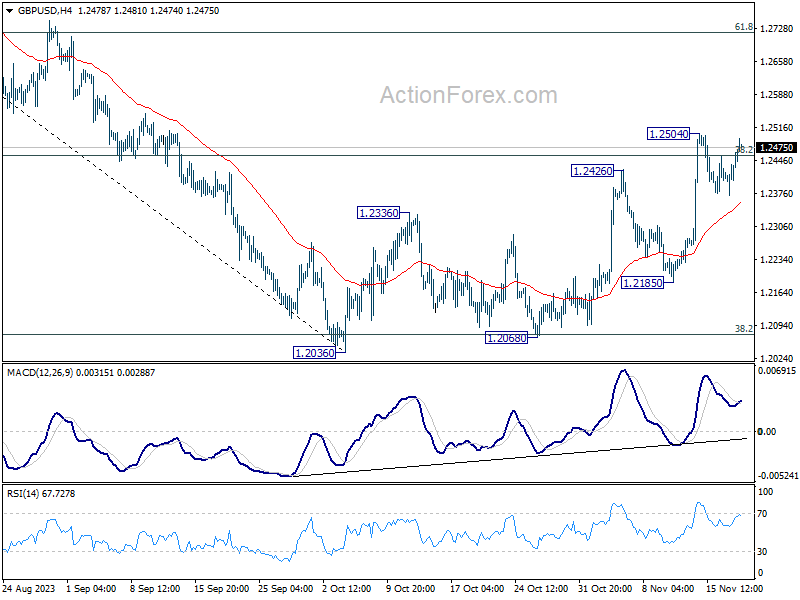
In the bigger picture, price actions from 1.3141 are seen as a corrective pattern to rise from 1.0351 (2022 low). Strong rebound from 38.2% retracement of 1.0351 (2022 low) to 1.3141 at 1.2075 will argue that current rise from 1.2036 is already the second leg. However, while further rally could be seen, upside should be limited by 1.3141 to bring the third leg of the pattern.
USD/CHF Daily Outlook
Daily Pivots: (S1) 0.8837; (P) 0.8933; (R1) 0.8988; More....
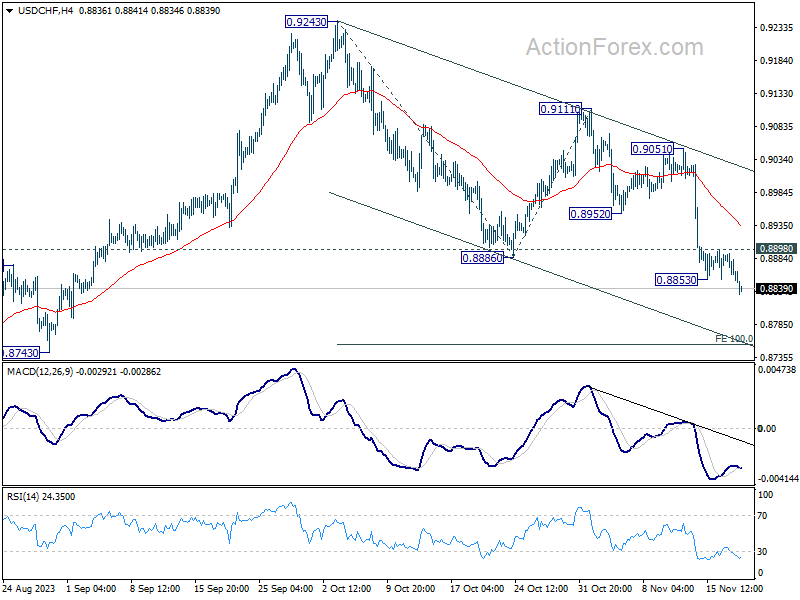
USD/CHF's decline resumed after brief consolidations and intraday bias is back on the downside. Current fall from 0.9243 should target 100% projection of 0.9243 to 0.8886 from 0.9111 at 0.8754 next. On the upside, above 0.8898 minor resistance will turn intraday bias neutral and bring consolidations again. But in case of recovery, outlook will stay bearish as long as 0.8952 support turned resistance holds.
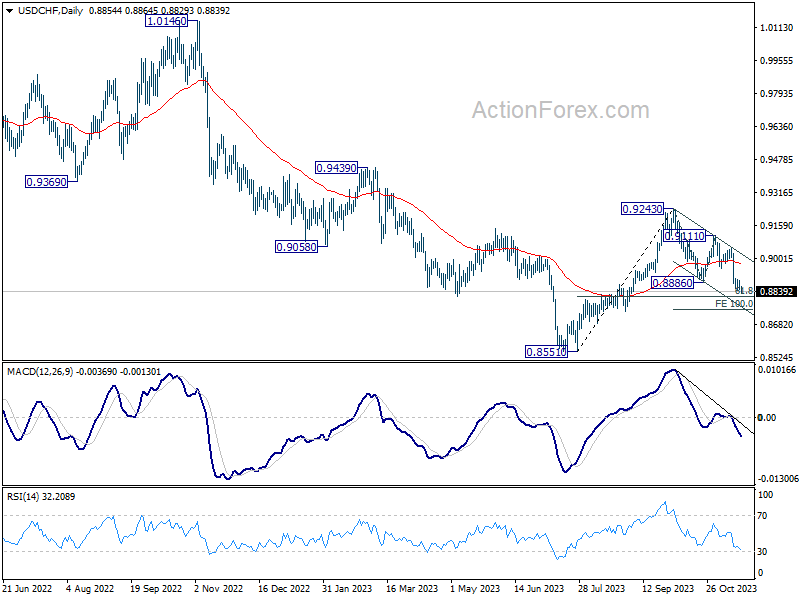
In the bigger picture, price actions from 0.8551 are currently seen as part of a corrective pattern to the decline from 1.0146 (2022 high). Fall from 0.9243 is seen as the second leg for now. Deeper fall would be seen to 61.8% retracement of 0.8551 to 0.9243 at 0.8815. Sustained break there will bring retest of 0.8551 low. For now, this will remain the favored case as long as 0.9111 resistance holds.
USD/JPY: A Potential Medium-Term Bearish Reversal in Progress
- Heightened dovish expectations on US monetary policy have led to US Treasuries-JGBs yield premium shrinkage.
- Bearish momentum factor has taken a foothold as well with USD/JPY’s price action below its 20 and 50-day moving averages.
- Watch the 150.30/70 key medium-term resistance zone.
The relentless medium-term impulsive upside movements of the USD/JPY in place since the 16 January 2022 low of 127.22 are likely to have succumbed to the “law of gravity” triggered by momentum and fundamental factors.
In the past week, the USD/JPY has weakened considerably as its one-month rolling performance as of today, 20 November has slipped to -0.54% at this time of the writing (see Figure 1).
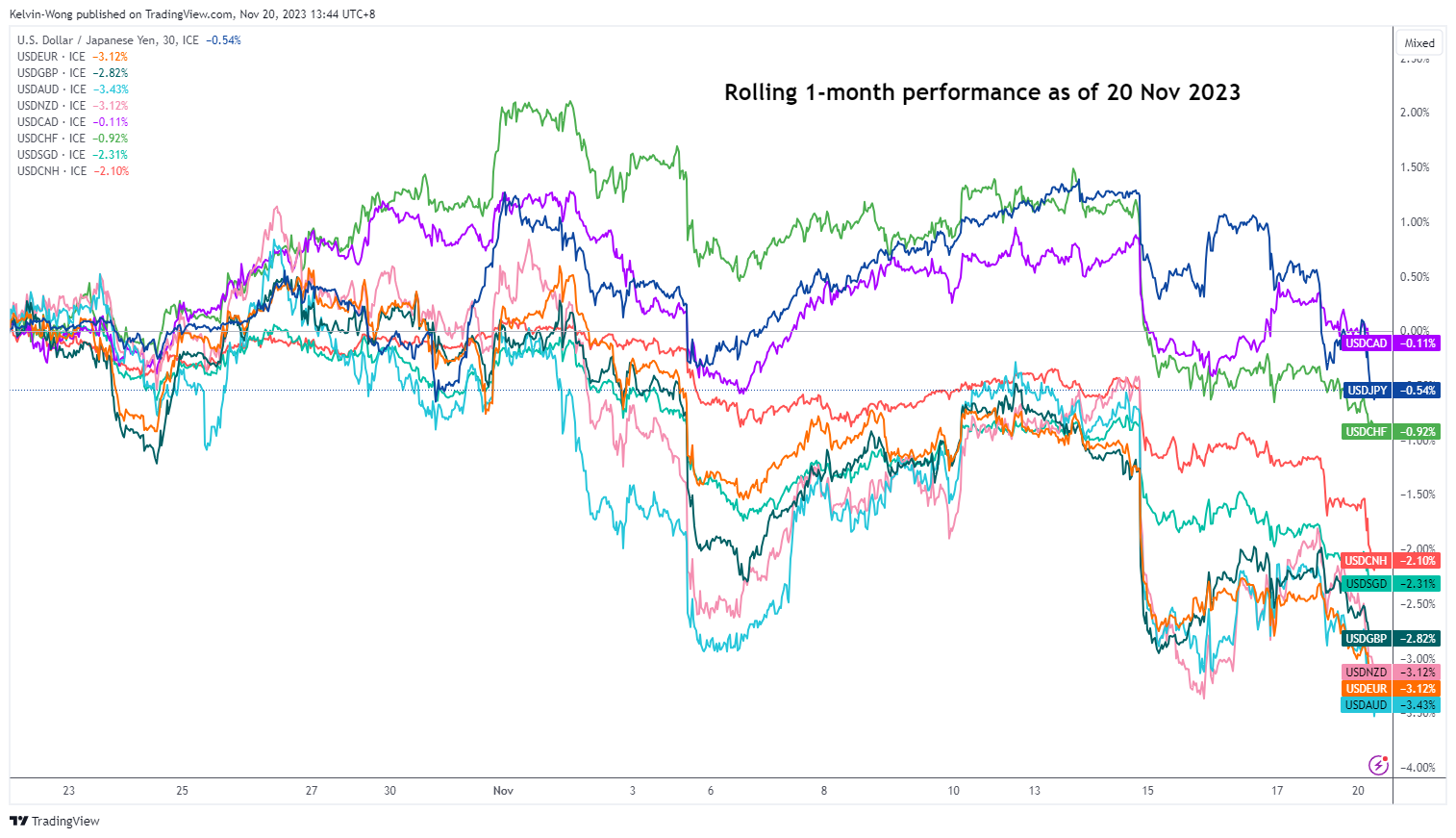
Fig 1: Rolling 1-month performances of major US dollar pairs as of 20 Nov 2023 (Source: TradingView, click to enlarge chart)
External fundamental factors seem to be at play at this juncture rather than Japan’s elevated sticky inflation or the Ministry of Finance’s threat of intervention in the foreign exchange market.
The swing of the pendulum has now shifted abruptly on the expectations of the potential last interest rate hike by the US Federal Reserve to bring its terminal Fed funds rate to 5.50%-5.75% based on the current 2023 “dot-plot” projection of 5.6% as released during the September 2023 FOMC meeting.
Right now, US monetary policy is expected to be less restrictive going forward in the first half of 2024 where the anticipated potential last Fed’s interest rate hike pencilled in the December 2023 and January 2024 FOMC meetings have evaporated into thin air reinforced by the softer US CPI print for October.
Based on the latest data from the CME FedWatch Tool derived from the pricing of the 30-day Fed funds futures, there is now zero chance of any Fed funds interest rate hike next month and for the entire FOMC meetings in 2024. In addition, there is a 30% chance of a first interest rate cut to come as early as March 2024, followed by 64% and 84% chances of a rate cut in May and June 2024 respectively.
US Treasury yield premium has narrowed against JGB
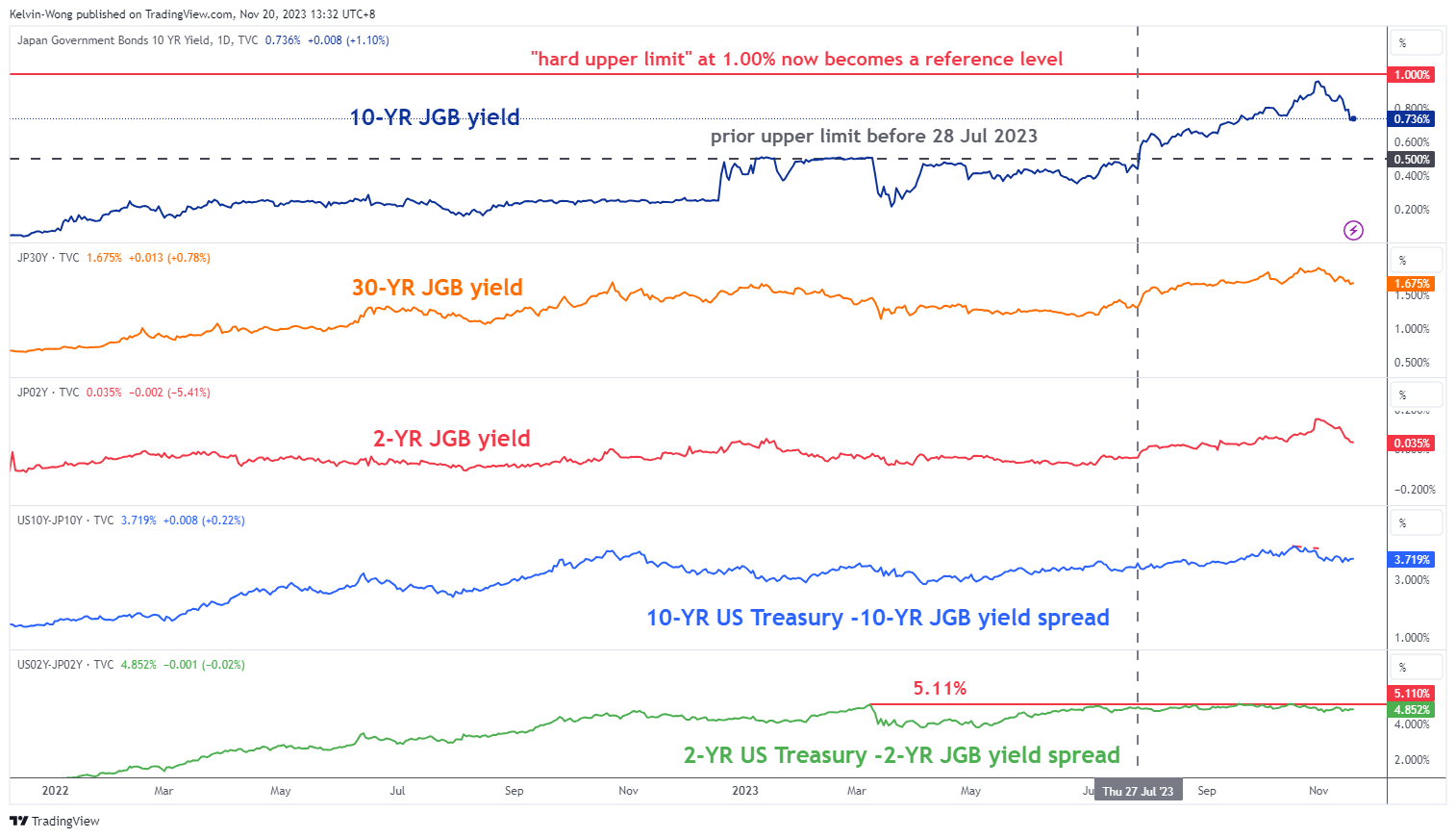
Fig 2: JGB yields with US Treasury-JGB yield spreads as of 20 Nov 2023 (Source: TradingView, click to enlarge chart)
The recent heightened dovish expectations in US monetary policy have led to a bout of softness in US Treasury yields after torrid rallies seen since May 2023.
In the past month, the 10-year yield spread between the US Treasury notes and the Japanese government bonds (JGBs) has narrowed by 55 basis points (bps) from 4.15% to 3.60% printed last Tuesday, 14 November.
The current US Treasury-JGB yield premium shrinkage in the 10-year is the most since the period of March-April 2024. Also, the shorter-term 2-year US Treasury-JGB yield premium has traded sideways below a key resistance of 5.11% since March 2023 (see Figure 2).
All in all, this yield premium shrinkage in US Treasuries has led it to be less attractive for Japanese investors in terms of yield capture which in turn put indirect downside pressure on the USD/JPY foreign exchange rate.
USD/JPY has broken below its 20 and 50-day moving averages
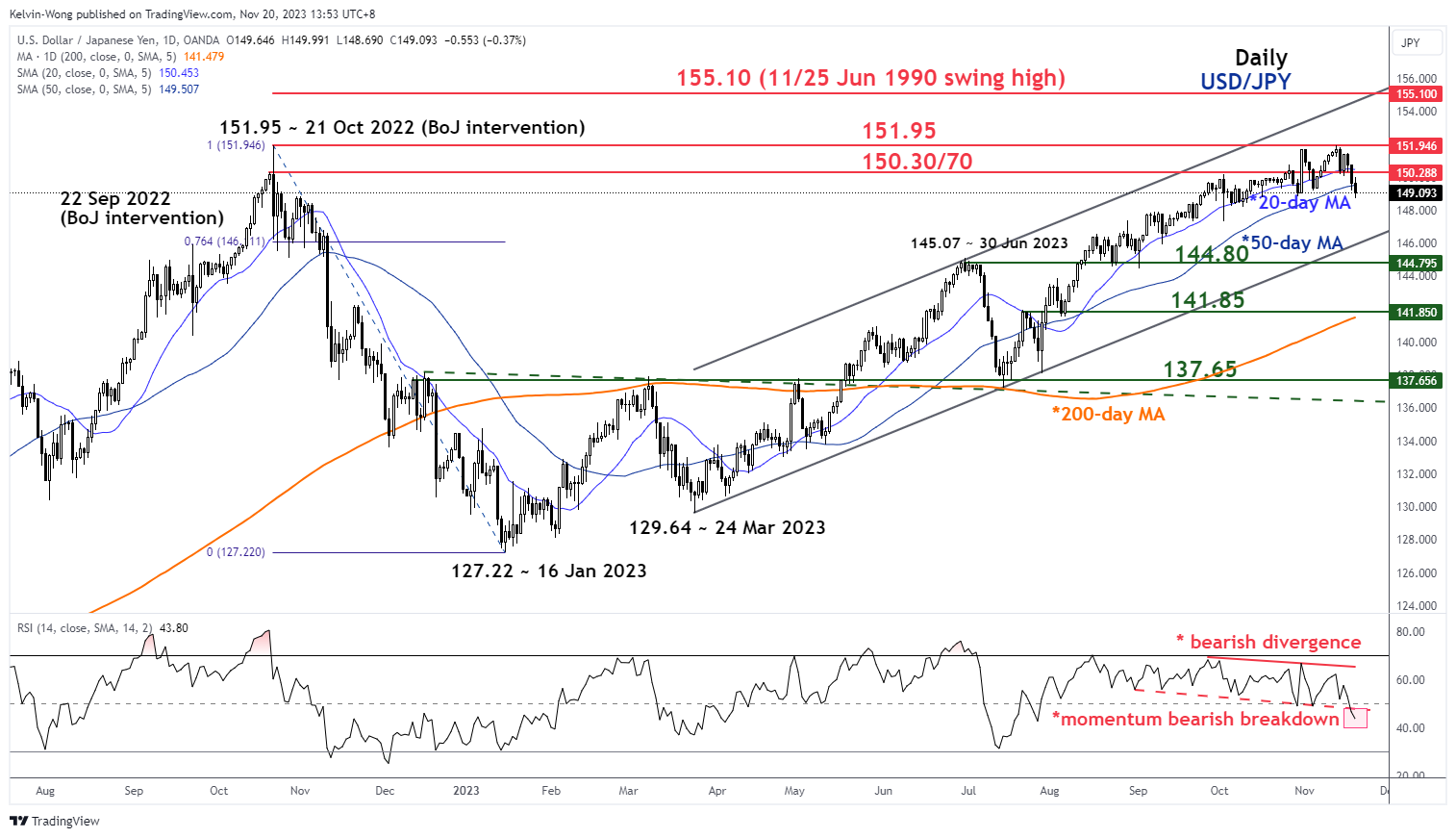
Fig 3: USD/JPY medium-term trend as of 20 Nov 2023 (Source: TradingView, click to enlarge chart)
The current price action of USD/JPY is now trading below its prior upward-sloping 20 and 50-day moving averages after a bearish reaction last Monday, 13 November (printed an intraday high of 151.91) right below the 151.95 major resistance.
In addition, its daily RSI oscillator has just triggered a momentum bearish breakdown below its 50 level after a bearish divergence condition that was flashed out on 31 October 2023 near its overbought region.
These observations suggest that the medium-term uptrend of USD/JPY in place since the 16 January 2023 low of 127.22 is in jeopardy (see Figure 3).
If the key medium-term resistance zone of 150.30/70 is not surpassed to the upside, USD/JPY is likely to stage a potential multi-week impulsive down move sequence towards the 144.80 medium-term support (former swing high area of 30 June 2023 & close to the lower boundary of the ascending channel from 24 March 2023 low) in the first step.
USD/JPY Daily Outlook
Daily Pivots: (S1) 148.91; (P) 149.85; (R1) 150.49; More...
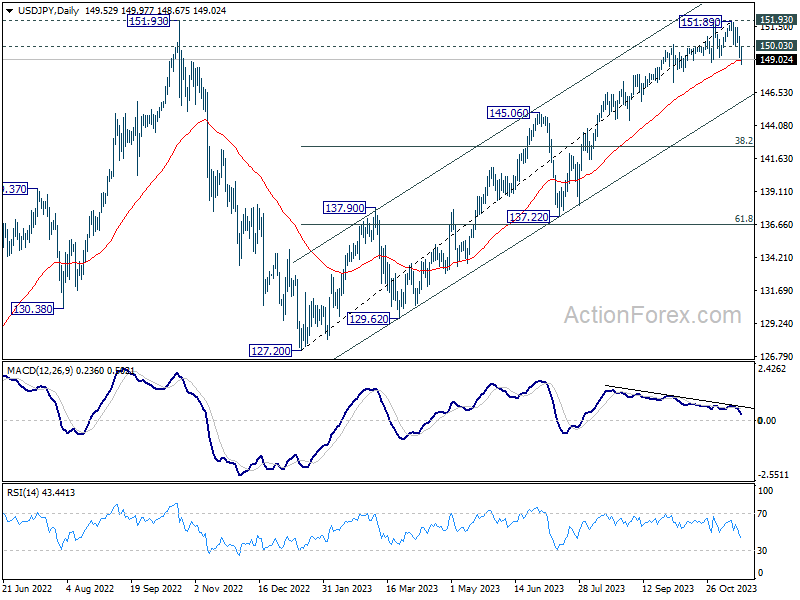
USD/JPY's break of 149.17 support should confirm rejection by 151.93 resistance. Intraday bias is back on the downside for channel support medium term channel support at 145.80. On the downside, though, above 150.03 minor resistance will turn intraday bias neutral first.
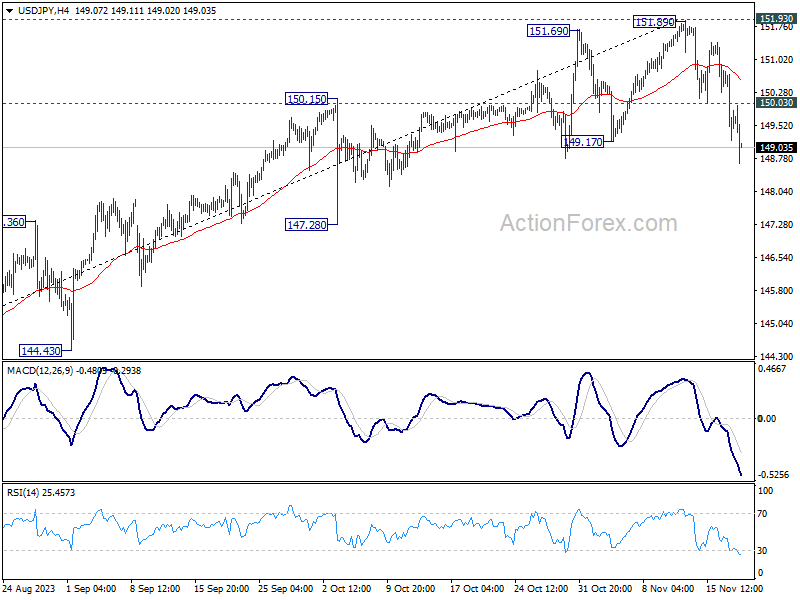
In the bigger picture, focus stays on 151.93 resistance (2022 high). Rejection by 151.93, followed by sustained break of 145.06 resistance turned support will argue that rise from 127.20 has completed, and turn outlook bearish for 137.22 support and below, as the third leg of the long term range pattern from 151.93. However, sustained break of 151.93 will confirm resumption of long term up trend.
Dollar Weakens, Yen Strengthens, and Nikkei’s New Highs
Dollar's selloff intensified in today's Asian session, underpinned by strong risk-on sentiment prevalent in the market. This move was particularly evident in USD/JPY, which saw broke through an important near-term support level around the 149 mark, signaling the prospect for further decline. Yen's strength was mirrored by Chinese Yuan, while the Australian and New Zealand Dollars emerged as the strongest performers in the current environment so far. In contrast, Euro and Canadian Dollar, despite making noticeable gains against Dollar, ranked as the second and third weakest major currencies. Sterling and Swiss Franc, meanwhile, showed mixed performance.
Another notable development is in the Japanese stock market, as Nikkei index briefly reached a new high, not seen in over three decades. This spike in the index represented an attempt to break out from a consolidation phase that has persisted for five months. Despite this bullish signal, the response from cautious investors was somewhat restrained, indicating a level of uncertainty still present in the market.
The rally in Japanese stocks was seen primarily led by financial shares, likely driven by investor expectations of a shift in BoJ longstanding negative rates policy. This sentiment could be further amplified by this week's upcoming CPI data from Japan. If the CPI data reinforces expectations of a policy shift by BoJ, it might trigger another round of buying in Japanese equities and could lend additional strength to Yen too.
This week, the spotlight in financial markets shifts to the minutes from major central banks including Fed, ECB, and RBA, along with BoE's monetary policy report hearing. Additionally, a plethora of economic data releases will be in focus, including CPI figures from Canada and Japan, Germany's Ifo business climate index, and US durable goods orders. PMI data from Australia, Eurozone, UK, Japan will also provide key insights into global economic conditions.
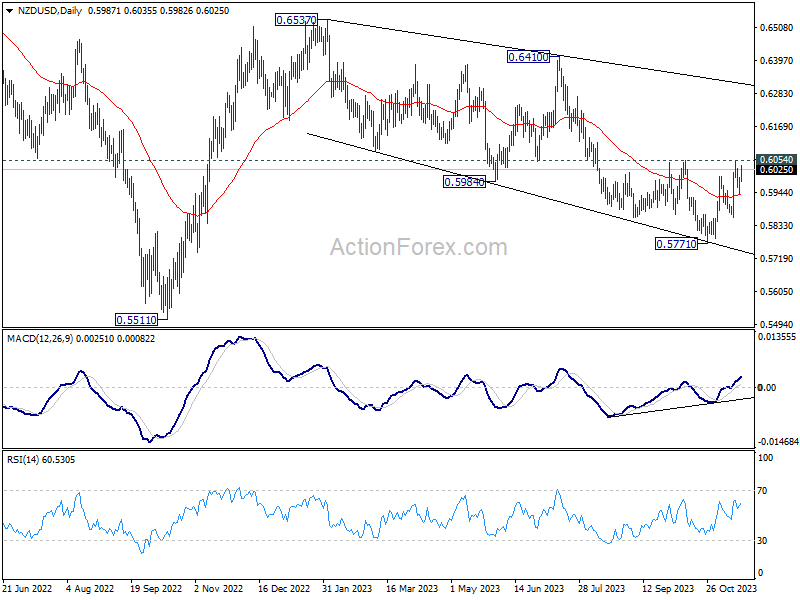
Technically, NZD/USD is ready for a second attempt on breaking 0.6054 resistance, after bouncing from 55 D EMA last week. Decisive break of this resistance will bolster the case that medium term corrective fall from 0.6537 has completed with three waves down to 0.5771. Further rally should then be see towards trendline resistance at around 0.6316 next.
In Asia, Nikkei closed down -0.63% after hitting as high as 33853. Hong Kong HSI is up 1.63%. China Shanghai SSE is up 0.40%. Singapore Strait Times is down -0.73%. Japan 10-year JGB yield is down -0.001 at 0.747.
Yuan extends rebound after China maintains 1-yr and 5-yr LPR
As reported by the National Interbank Funding Center today, China's one-year loan prime rate retains is unchanged 3.45%. Similarly, the over-five-year LPR, a critical determinant of mortgage rates, is also steady at 4.2%.
The LPR, derived from the quotations by various banks with adjustments based on the open-market operation rates, serves as a pivotal indicator for loan pricing. This stability comes in the wake of PBoC's substantial liquidity injection of CNY 1.45 into the market through the medium-term lending facility last week, maintaining an interest rate of 2.5%.
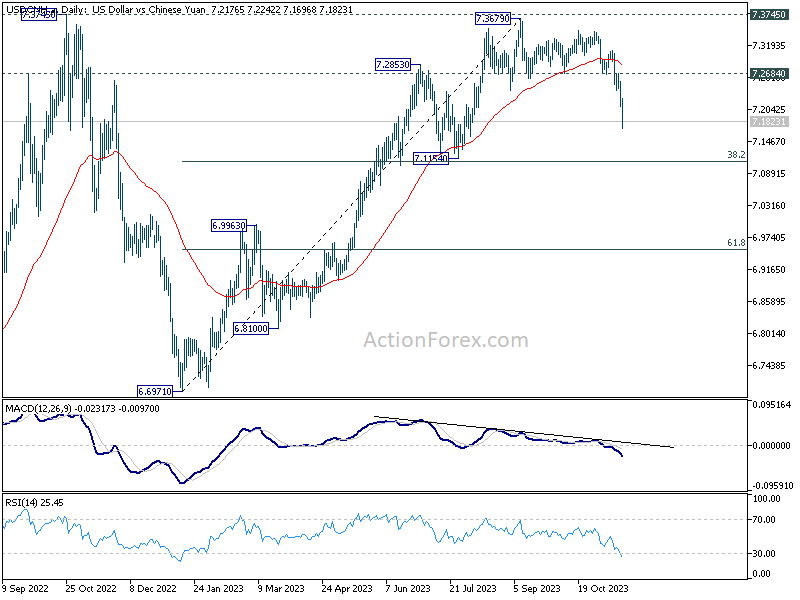
USD/CNH extends the decline from 7.3679 to as low as 7.1696 so far. Technically, near term outlook will now stay bearish as long as 7.2684 resistance holds, next target is 7.1154 cluster support (38.2% retracement of 6.6971 to 7.3679 at 7.1117). Reaction from there will reveal whether USD/CNH is already reversing whole up trend form 6.6971 to 7.3679.
Fed, ECB, and RBA minutes, alongside global PMIs, to define the week's economic agenda
This week in the financial markets, the focus is keenly set on the activities of various major central banks, including minutes of Fed, ECB and RBA. Additionally, BoE's monetary policy report hearing might provide some valuable perspectives.
Fed's minutes from the October 31-November 1 meeting, slated for an unusual Tuesday release, are expected to offer a peek into the internal debate over future rate hikes. Despite a diverse range of opinions likely to be presented, the minutes might not provide significant guidance on Fed's next steps. A critical takeaway, however, is Fed's commitment to maintaining a "sufficiently restrictive" interest rate policy for long enough to tame inflation. The ambiguity surrounding what constitutes "sufficient" and the duration of this stance leaves room for speculation, underscoring the need for December economic projections to shape further decisions.
Turning to ECB, the accounts from its October meeting are not expected to diverge significantly from the current market understanding. ECB officials have consistently communicated that maintaining the current interest rate level should, over time, return inflation to its target. However, like Fed, ECB considers discussions on rate cuts to be premature.
In Australia, RBA's recent 25 basis point rate hike aligns with expectations following robust Q3 and September CPI data. The forthcoming release of the minutes will likely provide deeper insight into RBA's decision-making process. The central bank has expressed a low tolerance for inflation surprises, indicating readiness for further action if necessary. However, any additional rate hikes are not anticipated until after Q4 data is reviewed, which is expected to be available by their February meeting.
For BoE, the upcoming parliamentary hearing will likely focus on Governor Andrew Bailey's interpretation of the recent CPI data, which came in below expectations. Bailey will likely reiterate that the UK is now in a stage of fast disinflation, but it's still soon to declare victory.
Beyond central bank activities, the week is also rich in global economic data releases. CPI figures from Canada and Japan, Germany's Ifo business climate, and US durable goods orders will be closely monitored. However, PMI data from Australia, Eurozone, UK, Japan, and to a lesser extent US, will be particularly telling. These data points are crucial in assessing the slowdown in various global economies and the looming risks of recession.
Here are some highlights for the week:
- Monday: Germany PPI.
- Tuesday: New Zealand trade balance; RBA minutes; Swiss trade balance; Canada CPI; US existing home sales, FOMC minutes.
- Wednesday: US jobless claims, durable goods orders.
- Thursday: Australia PMIs; Eurozone PMIs, ECB meeting accounts; UK PMIs.
- Friday: New Zealand retail sales; Japan CPI, PMI manufacturing; Germany Ifo, GDP final; Canada retail sales; US PMIs.
USD/JPY Daily Outlook
Daily Pivots: (S1) 148.91; (P) 149.85; (R1) 150.49; More...
USD/JPY's break of 149.17 support should confirm rejection by 151.93 resistance. Intraday bias is back on the downside for channel support medium term channel support at 145.80. On the downside, though, above 150.03 minor resistance will turn intraday bias neutral first.
In the bigger picture, focus stays on 151.93 resistance (2022 high). Rejection by 151.93, followed by sustained break of 145.06 resistance turned support will argue that rise from 127.20 has completed, and turn outlook bearish for 137.22 support and below, as the third leg of the long term range pattern from 151.93. However, sustained break of 151.93 will confirm resumption of long term up trend.
Economic Indicators Update
| GMT | Ccy | Events | Actual | Forecast | Previous | Revised |
|---|---|---|---|---|---|---|
| 07:00 | EUR | Germany PPI M/M Oct | -0.10% | -0.20% | ||
| 07:00 | EUR | Germany PPI Y/Y Oct | -11.00% | -14.70% | ||
| 11:00 | EUR | German Buba Monthly Report |
Yuan extends rebound after China maintains 1-yr and 5-yr LPR
As reported by the National Interbank Funding Center today, China's one-year loan prime rate retains is unchanged 3.45%. Similarly, the over-five-year LPR, a critical determinant of mortgage rates, is also steady at 4.2%.
The LPR, derived from the quotations by various banks with adjustments based on the open-market operation rates, serves as a pivotal indicator for loan pricing. This stability comes in the wake of PBoC's substantial liquidity injection of CNY 1.45 into the market through the medium-term lending facility last week, maintaining an interest rate of 2.5%.
USD/CNH extends the decline from 7.3679 to as low as 7.1696 so far. Technically, near term outlook will now stay bearish as long as 7.2684 resistance holds, next target is 7.1154 cluster support (38.2% retracement of 6.6971 to 7.3679 at 7.1117). Reaction from there will reveal whether USD/CNH is already reversing whole up trend form 6.6971 to 7.3679.