

Sample Category Title
US GDP exceeds expectations with 4.9% growth in Q3
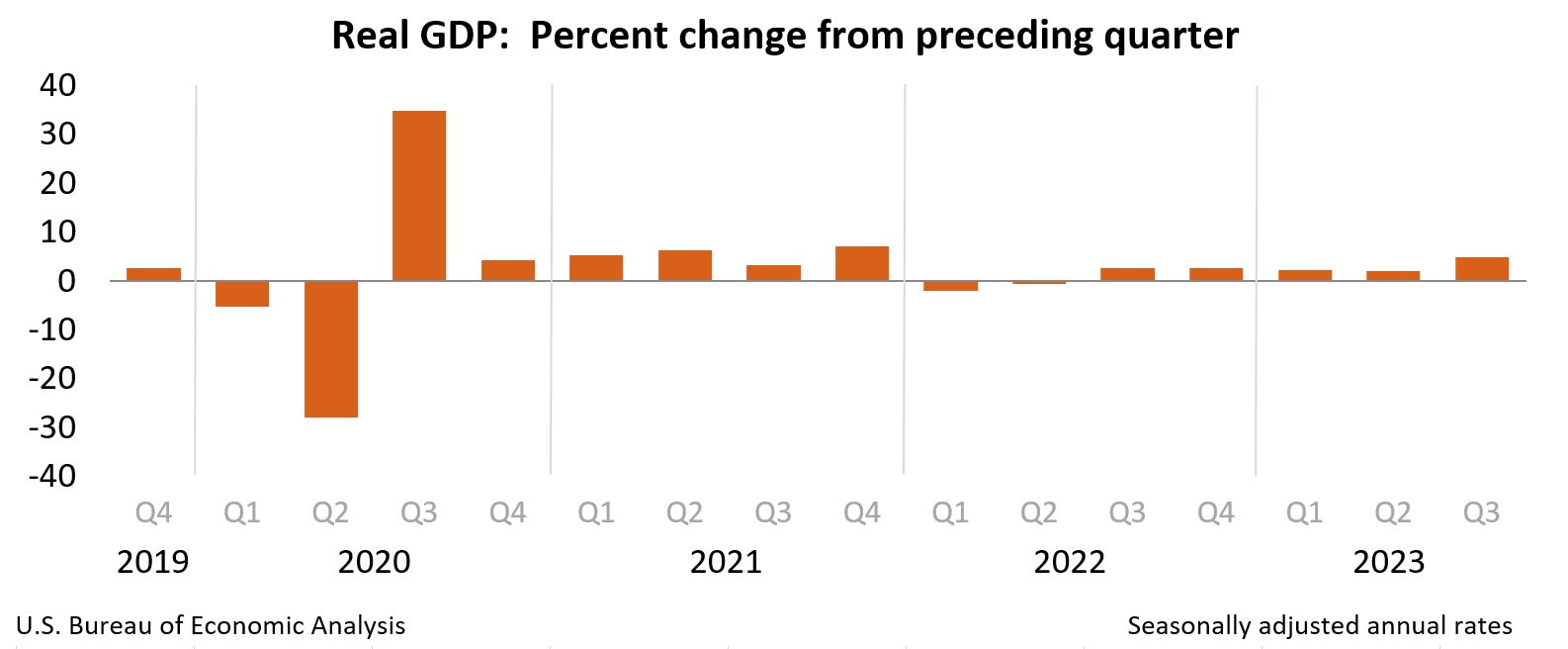
US economy delivered a strong performance in Q3, with GDP growth registering at an annualized rate of 4.9%, surpassing the anticipated 4.3% and showing a marked improvement from the 2.1% seen in Q2.
This robust growth in real GDP was driven by a series of factors. Notably, there were marked increases in areas such as consumer spending, private inventory investment, exports, both state and local government spending, federal government spending, and residential fixed investment.
However, these gains were somewhat tempered by a decline in nonresidential fixed investment. Additionally, it's essential to note that imports, which act as a deduction in GDP calculation, saw an increase during this period.
ECB keeps interest rates unchanged as widely expected
ECB keeps interest rates unchanged as widely expected. The main refinancing, marginal lending and deposit rates are held at 4.50%, 4.75%, and 4.00% respectively.
The central bank maintains that key interest are "at levels that, maintained for a sufficiently long duration, will make a substantial contribution to this goal."
Future decisions will ensure the policy rates are set at sufficiently restrictive levels for "as long as necessary".
Nevertheless, ECB still "stands ready" to adjust all of its instruments.
(ECB) Monetary policy decisions
The Governing Council today decided to keep the three key ECB interest rates unchanged. The incoming information has broadly confirmed its previous assessment of the medium-term inflation outlook. Inflation is still expected to stay too high for too long, and domestic price pressures remain strong. At the same time, inflation dropped markedly in September, including due to strong base effects, and most measures of underlying inflation have continued to ease. The Governing Council's past interest rate increases continue to be transmitted forcefully into financing conditions. This is increasingly dampening demand and thereby helps push down inflation.
The Governing Council is determined to ensure that inflation returns to its 2% medium-term target in a timely manner. Based on its current assessment, the Governing Council considers that the key ECB interest rates are at levels that, maintained for a sufficiently long duration, will make a substantial contribution to this goal. The Governing Council's future decisions will ensure that its policy rates will be set at sufficiently restrictive levels for as long as necessary.
The Governing Council will continue to follow a data-dependent approach to determining the appropriate level and duration of restriction. In particular, the Governing Council's interest rate decisions will be based on its assessment of the inflation outlook in light of the incoming economic and financial data, the dynamics of underlying inflation and the strength of monetary policy transmission.
Key ECB interest rates
The interest rate on the main refinancing operations and the interest rates on the marginal lending facility and the deposit facility will remain unchanged at 4.50%, 4.75% and 4.00% respectively.
Asset purchase programme (APP) and pandemic emergency purchase programme (PEPP)
The APP portfolio is declining at a measured and predictable pace, as the Eurosystem no longer reinvests the principal payments from maturing securities.
As concerns the PEPP, the Governing Council intends to reinvest the principal payments from maturing securities purchased under the programme until at least the end of 2024. In any case, the future roll-off of the PEPP portfolio will be managed to avoid interference with the appropriate monetary policy stance.
The Governing Council will continue applying flexibility in reinvesting redemptions coming due in the PEPP portfolio, with a view to countering risks to the monetary policy transmission mechanism related to the pandemic.
Refinancing operations
As banks are repaying the amounts borrowed under the targeted longer-term refinancing operations, the Governing Council will regularly assess how targeted lending operations and their ongoing repayment are contributing to its monetary policy stance.
***
The Governing Council stands ready to adjust all of its instruments within its mandate to ensure that inflation returns to its 2% target over the medium term and to preserve the smooth functioning of monetary policy transmission. Moreover, the Transmission Protection Instrument is available to counter unwarranted, disorderly market dynamics that pose a serious threat to the transmission of monetary policy across all euro area countries, thus allowing the Governing Council to more effectively deliver on its price stability mandate.
The President of the ECB will comment on the considerations underlying these decisions at a press conference starting at 14:45 CET today.
EUR/JPY Technical: Bulls in Hesitant Mode Again as ECB Looms
The price actions of the EUR/JPY have shaped the expected minor slide toward the highlighted support of 155.90 as mentioned in our previous report. The cross pair printed an intraday low of 154.42 on 3 October 2023 before it reverted to a choppy up move to retest the 159.80 major resistance (31 August 2023 swing high & February/May 2008 congestion area) in the past three weeks.
The bears seem to be lurking around the corner
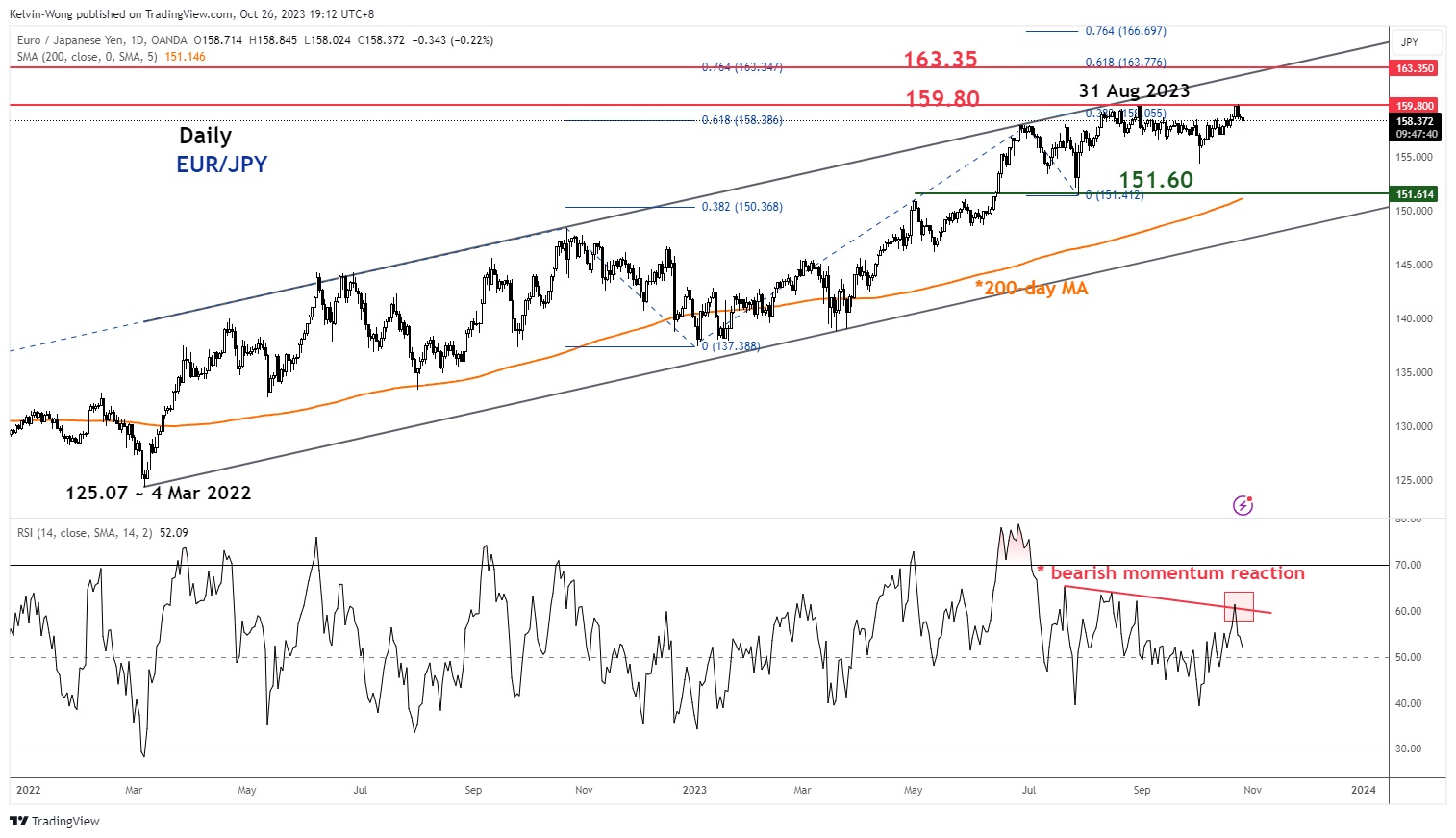
Fig 1: EUR/JPY medium-term trend as of 26 Oct 2023 (Source: TradingView, click to enlarge chart)
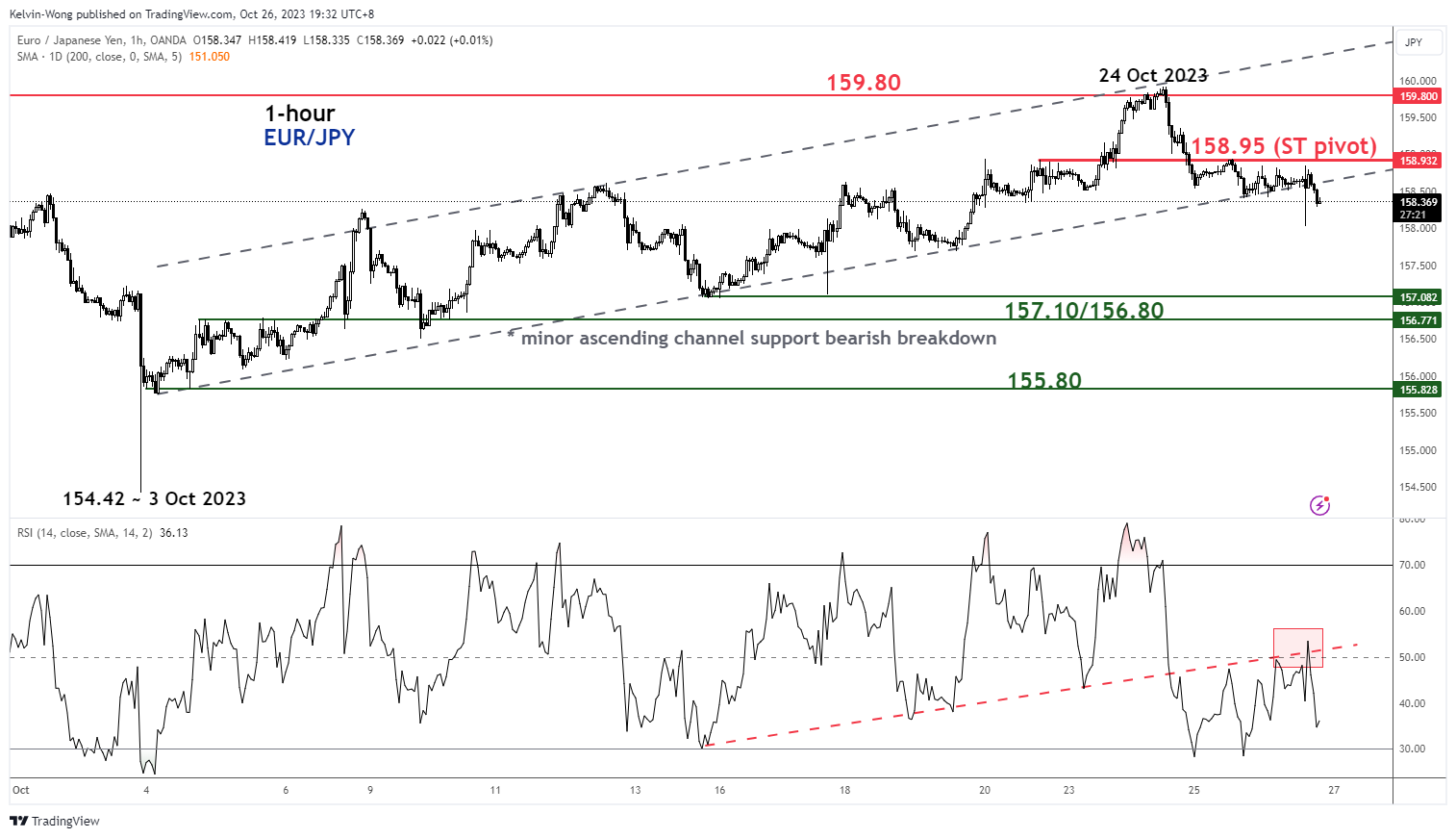
Fig 2: EUR/JPY minor short-term trend as of 26 Oct 2023 (Source: TradingView, click to enlarge chart)
Right now, the current key technical elements are showing potential signs of a bearish momentum resurgence at least in the short-term as ECB monetary policy decision looms.
Firstly, the daily RSI momentum indicator has staged a negative reaction from a parallel resistance at the 60 level on Tuesday, 24 October which suggests a lack of bullish momentum follow-through for the recent up move from the 3 October 2023 low of 154.42 (see figure 1).
Secondly, on the shorter time frame 1-hour chart, the price actions of the EUR/JPY have just staged a bearish breakdown from the minor ascending channel support in place since the 4 October 2023 low coupled with a bearish momentum reading from the 1-hour RSI as it retreated below 50 level and has not hit an extreme oversold level yet (see figure 2).
Watch the 158.95 key short-term pivotal resistance for a potential slide towards the next intermediate support zone at 157.10/156.80 and a break below 156.80 may a revisit of 155.80 next.
On the other hand, a clearance above 158.95 invalidates the bearish move for a probe on the 159.80 major resistance again.
AUD/USD Slips to 12-month Low on Bullock’s Comments
- AUD/USD falls to lowest level since October 2022
- US GDP expected to jump to 4.3%
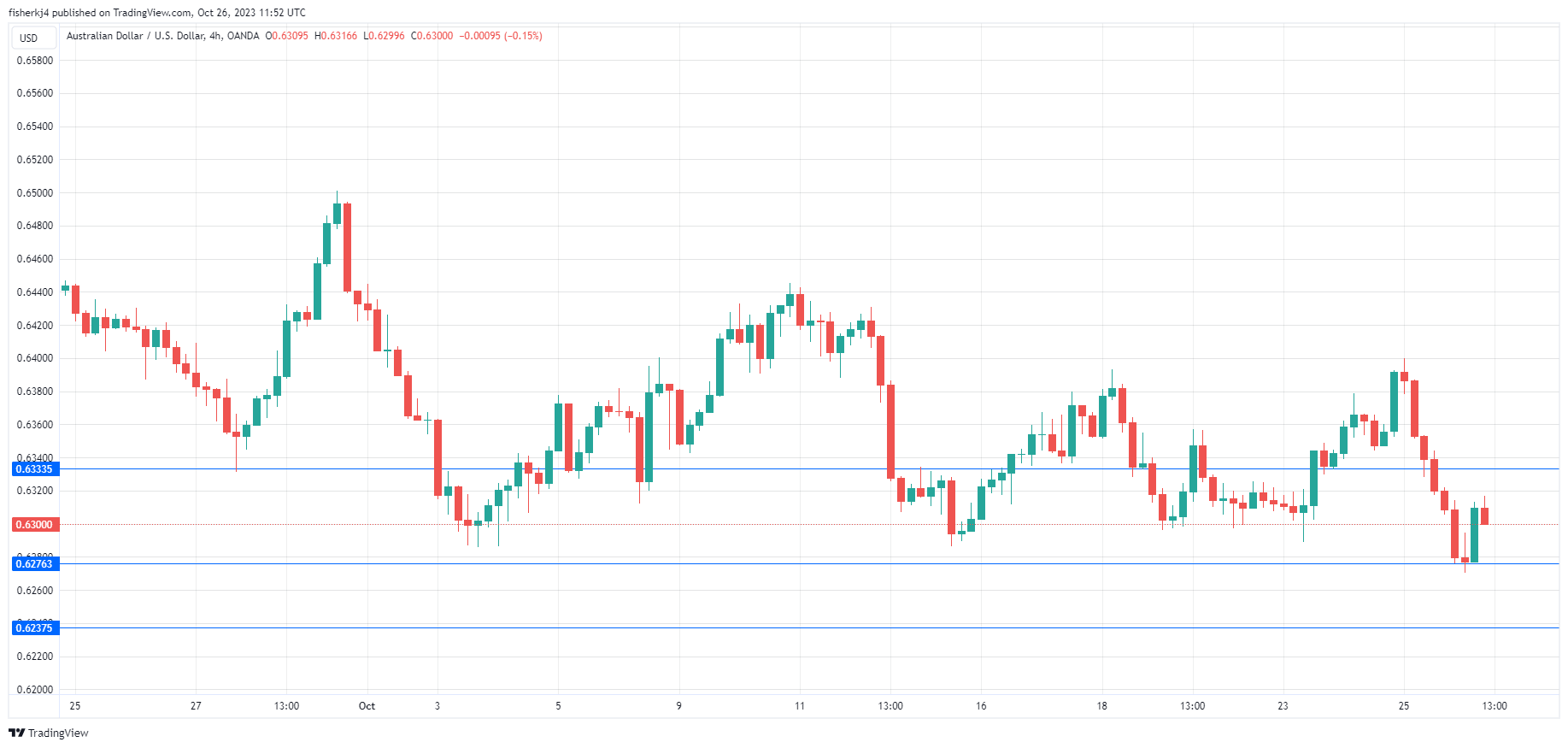
The Australian dollar has pared losses from earlier today. In the European session, AUD/USD is trading at 0.6303, down 0.07%.
Bullock shrugs off hot inflation
Australian inflation was stronger than expected in the third quarter, raising expectations that the Reserve Bank of Australia might respond with a rate hike after four consecutive pauses. The Australian dollar failed to gain ground on the hot inflation report and declined 0.74% on Wednesday. The Aussie’s downtrend continued on Thursday, as Governor Bullock downplayed the rise in inflation, saying it came in pretty much as expected. The comments pushed AUD/USD as low as 0.6270, its lowest level since October 2022. Bullock remained non-committal about a rate hike in her remarks today, saying the board had not decided if rates had peaked or would further tightening be required to curb inflation.
The future markets have been swinging wildly regarding the probability of a rate hike at the November 7th meeting. Just two weeks ago, the odds of a rate hike were a negligible 5%, with a pause a virtual guarantee. That has changed dramatically and the odds of a rate hike rose up to 80% on Wednesday but have dipped to 68% currently. Significantly, all four major banks now expect a hike, up from none prior to the inflation report.
US GDP expected to jump to 4.3%
The US releases third-quarter GDP on Thursday and the markets are expecting a very strong print. The consensus estimate of 4.3%, compared to 2.1% in the second quarter. This would mark the highest level since Q4 2021, when the economy was in recovery mode from the Covid pandemic. Consumer spending has been strong over the past several months and is expected to drive a strong GDP release.
AUD/USD Technical
- AUD/USD has support at 0.6240 and 0.6184
- 0.6343 and 0.6399 are the next resistance lines
Will ECB Support EUR?
Core inflation has improved recently, but the ECB is cautious due to fluctuating oil prices that could rekindle headline inflation. Another ECB interest rate hike is viewed as unlikely at present. Monetary data, economic indicators, and wage growth suggest a more stable underlying inflation trend. In light of this data, it seems prudent for the ECB to pause further rate hikes. Leading experts also propose that current interest rates are sufficiently restrictive. Furthermore, the Commonwealth Bank of Australia and the National Australia Bank, among others, anticipate no interest rate adjustments, consistent with the ECB's stance that rates have significantly contributed to inflation control. While discussions regarding the end of the Pandemic Emergency Purchase Program (PEPP) may arise, a decision in this regard is not expected until early 2024.
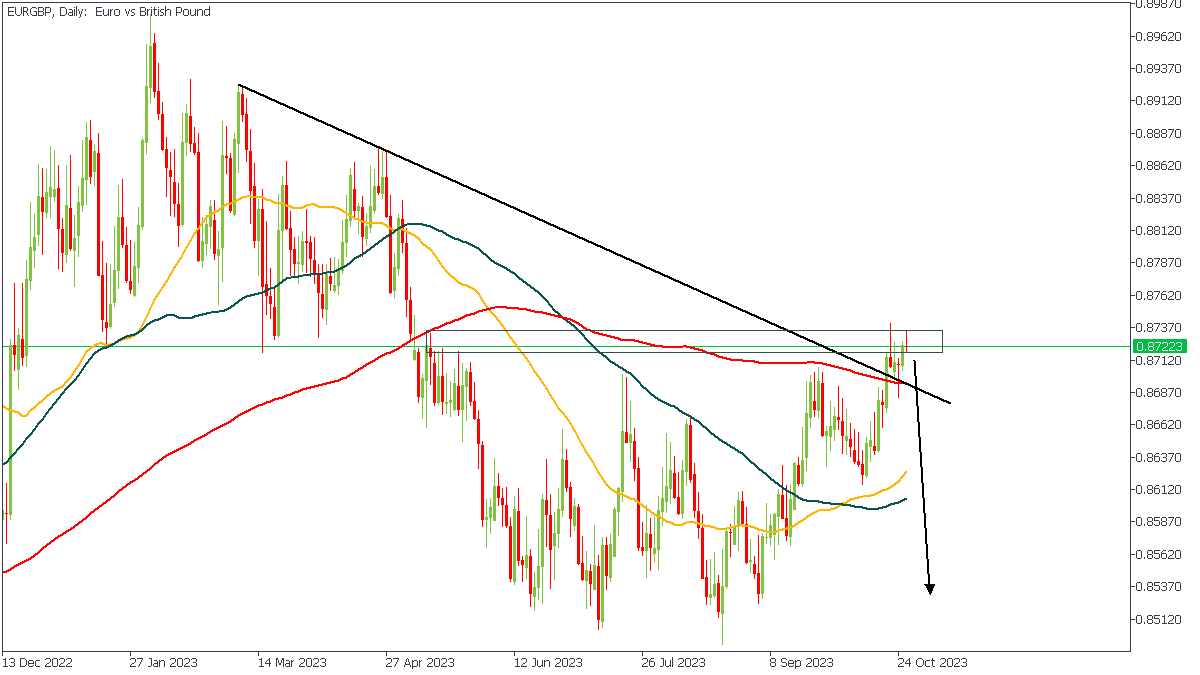
EURGBP - D1 Timeframe
From the chart, we see that price is currently at a supply zone on the daily timeframe of EURGBP. There are also other confluences pointing to the likelihood of a bearish move, including; a trendline, and a moving average resistance.
Analyst’s Expectations:
- Direction: Bearish
- Target: 0.86509
- Invalidation: 0.87444
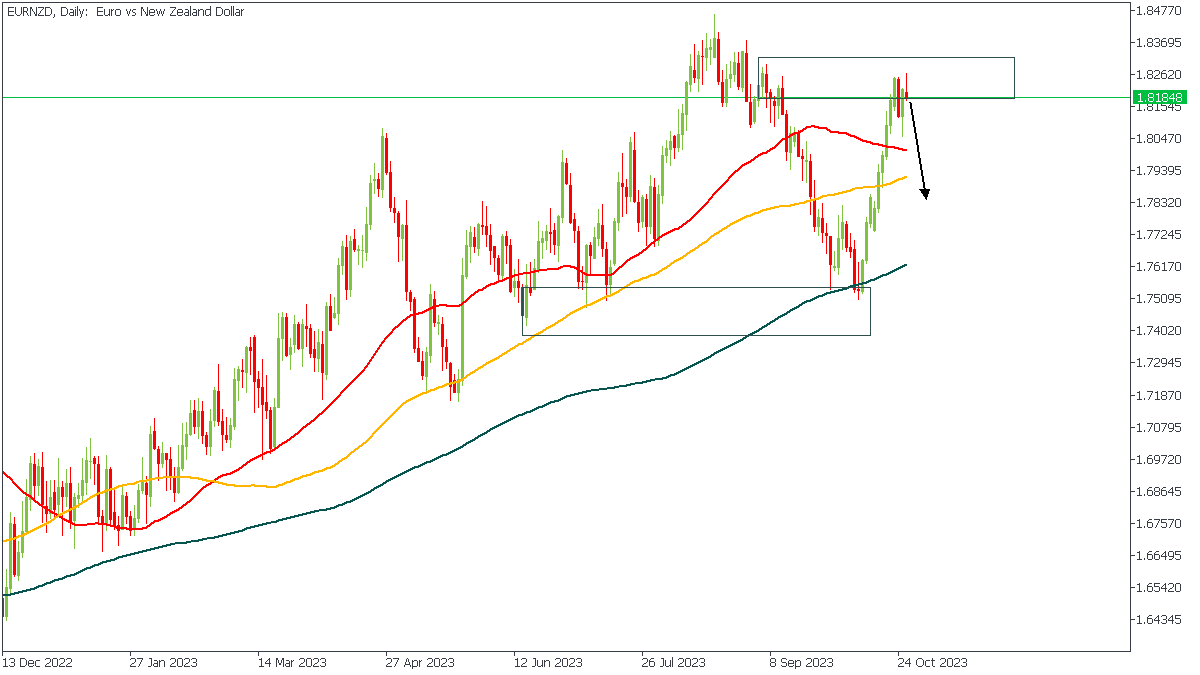
EURNZD - D1 Timeframe
The price action on EURNZD is a bit tricky but the market structure is quite clear - price broke below the previous low before reacting at the trendline support. This means we can now consider the market to be in a bearish trend. The current zone is a supply zone that I believe will provide the final confirmation of the change in market sentiment.
Analyst’s Expectations:
- Direction: Bearish
- Target: 1.78455
- Invalidation: 1.83173
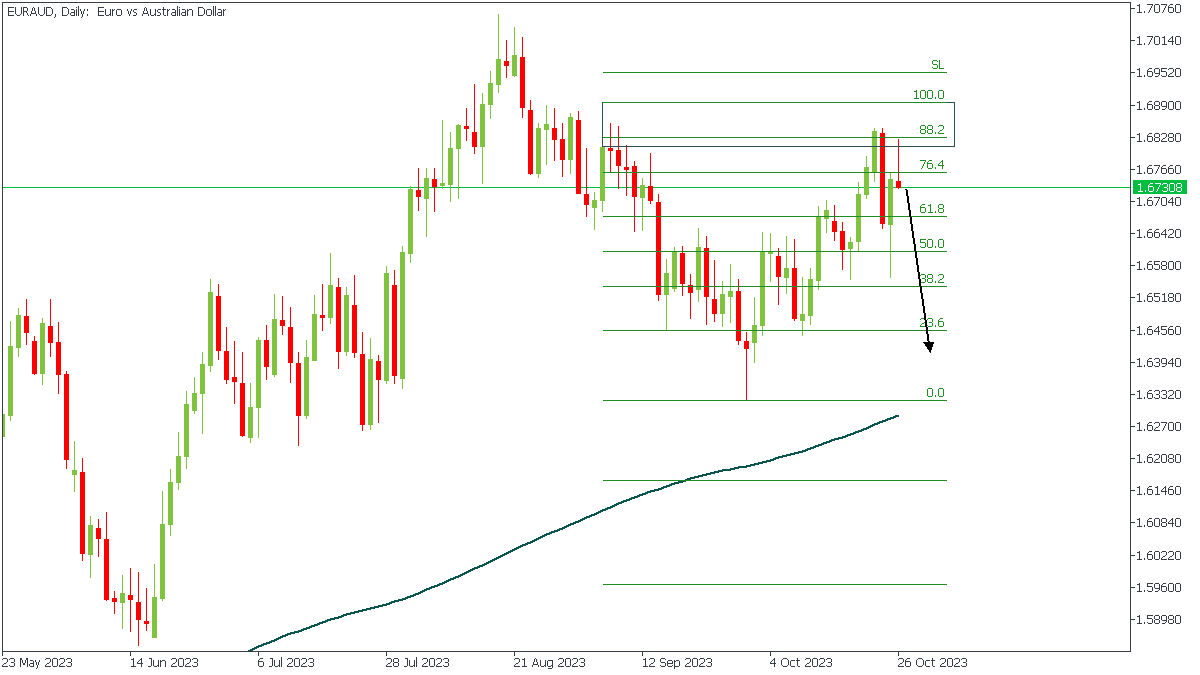
EURAUD - D1 Timeframe
EURAUD on the daily timeframe is currently reacting from the 88% Fibonacci retracement level, and could be heading towards the 200-day moving average as its target. This is not based on speculations, but rather the market structure; we see a bearish break of structure, a Quasimodo pattern, as well as the Fibonacci retracement level.
Analyst’s Expectations:
- Direction: Bearish
- Target: 1.65490
- Invalidation: 1.68700
CONCLUSION
The trading of CFDs comes at a risk. To succeed, you have to manage risks properly. To avoid costly mistakes while you look to trade these opportunities, be sure to do your due diligence and manage your risk appropriately.
NASDAQ Index Officially Enters Correction
The decline to current levels from the peak of the top of the year, set on July 19, exceeded 10%, which is generally considered to be the trigger for the start of the correction. According to statistics, this is the 70th official correction since the index was created in February 1971.
Despite the positive report from Microsoft, the bearish dynamics of the NASDAQ index were determined by the decline in shares of Tesla and Google, as well as the rise in the yield of long-term treasury bonds, which increased the cost of borrowing.
Futures for the NASDAQ index are declining amid falling META shares. How strong can the correction be? According to the Dow Jones Industrial Average for the last 20 corrections:
→ it took Nasdaq an average of 3 months to improve its performance;
→ after 1 year, the index added an average of 14.4%.
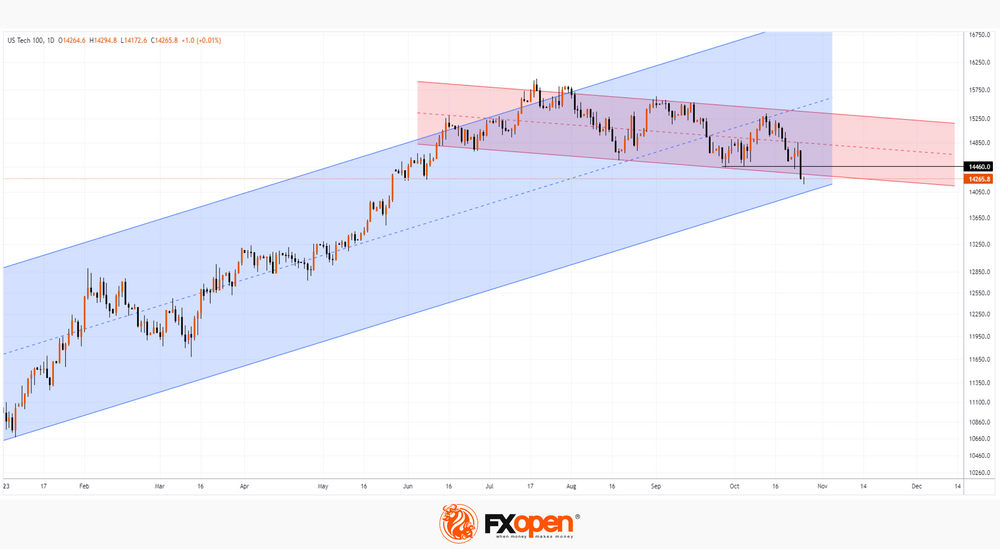
Time will tell how the correction that has begun will fit into the statistics. The chart shows that the median line of the downward channel, shown in red, is already exerting pressure, as can be seen from the price action on October 24th.
So far, the index price is close to the lower boundary of the ascending channel, shown in blue, which describes the prevailing bullish trend; within its framework, the NASDAQ price was able to rise by more than 45% in less than 7 months this year. So the correction looks really appropriate.
In the near future, we may witness the formation of fluctuations caused by the support of the lower border of the blue channel and the current bearish sentiment. Growth may be resisted by the level of 14,460, which acted as support in September.
The AAPL report (expected next week), as well as geopolitical news, will have an important impact.
This article represents the opinion of the Companies operating under the FXOpen brand only. It is not to be construed as an offer, solicitation, or recommendation with respect to products and services provided by the Companies operating under the FXOpen brand, nor is it to be considered financial advice.
Euro Shaky Ahead of ECB Meeting
As far as markets are concerned, the European Central Bank (ECB) is expected to leave rates unchanged in October for the first time in over a year, amid signs of cooling inflation. Over the past few months, price pressures have eased in Europe, with the headline rate falling to 4.3% in September, which was the lowest since October 2021.
ECB officials signalled at their previous September meeting that rates were high enough to bring inflation back towards the 2% target. However, concerns are rising about the worsening economic outlook, along with geopolitical tensions in the Middle East. Indeed, the string of recent disappointing data paints a gloomy picture with recession fears rife as high rates impact households and businesses.
Investors will pay close attention to any fresh clues the ECB has to offer on monetary policy for the rest of 2023 and beyond. Should the ECB communicate that rates will remain higher for longer, this could leave the door open for one final hike in December. As of writing, traders are pricing in only around a 10% probability of an ECB rate hike by December with the odds of a rate cut by April roughly 50%.
Looking at the technical picture, EURUSD remains under pressure on the daily charts. Prices are back within a wide range with support at 1.0450 and resistance at 1.0630. The euro could find itself under fresh pressure if the ECB strikes a cautious tone and hints that no more hikes are expected down the road. This may drag the EURUSD back towards the 1.0450 support level as a result.
Should the central bank strike a hawkish note, this could push EURUSD back towards 1.0630 and beyond as bets increase on a December rate move.
USD/JPY: Rises Above 150 for the First Time in One Year
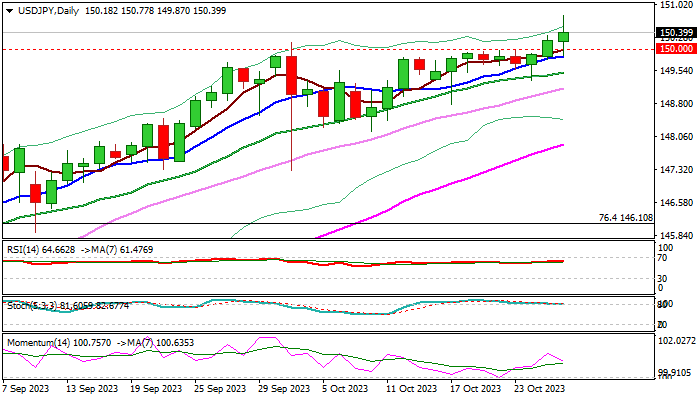
USDJPY is establishing above psychological 150 barrier after registering a first daily close above this level in one year on Tuesday.
Fresh rise of the dollar on growing signals that interest rates would remain elevated for some time, prompted investors out of riskier assets and pushed the pair’s price above 150, after the price was capped here for the most of October, on persisting fears that break higher would trigger intervention of Japan’s authorities.
However, dollar’s strong bullish bias persists on prospects of higher for longer interest rates, causing possibility of intervention to fade, as the action, in current circumstances, likely won’t provide desired results.
Therefore, the pair may extend advance (weekly close above 150 is required to confirm positive signal) and challenge Fibo expansion levels at 150.82 (123.6%), 151.23 (138.2%) and key barrier at 151.94 (Oct 2022 multi-decade peak / near FE 161.8%).
Broken 150 barrier is reinforced by 10DMA and reverted to solid support which should ideally contain and guard lower pivot at 149.00 (daily Kijun-sen), loss of which would put bulls on hold and signal a false break higher.
Res: 150.77; 151.23; 151.56; 151.94.
Sup: 150.00; 149.49; 149.00; 148.77.
Crypto Market Pretends to be a Safe Haven
Market picture
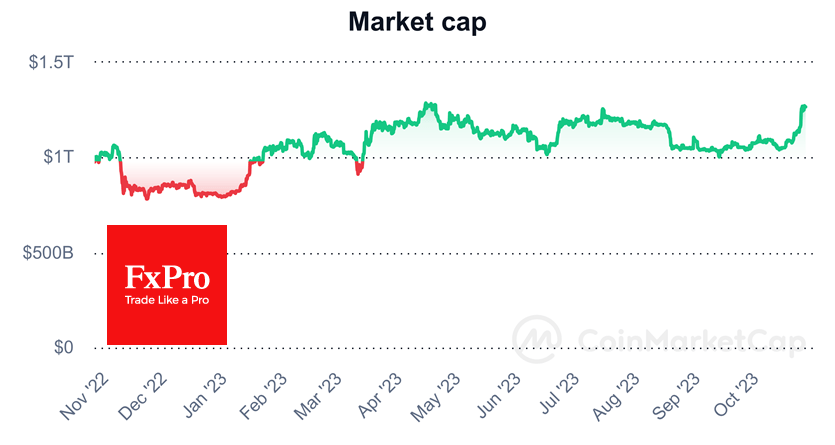
The crypto market is holding its total capitalisation above $1.27 trillion despite a frightening sell-off in equities overnight. Bitcoin and other major altcoins are once again attempting to play the role of safe haven.
There is also possible speculation that market turbulence in the week leading up to the FOMC meeting will force the regulator to soften its tone significantly, which is positive for crypto unaffected by the falling revenues from Google’s cloud business or similar stories.
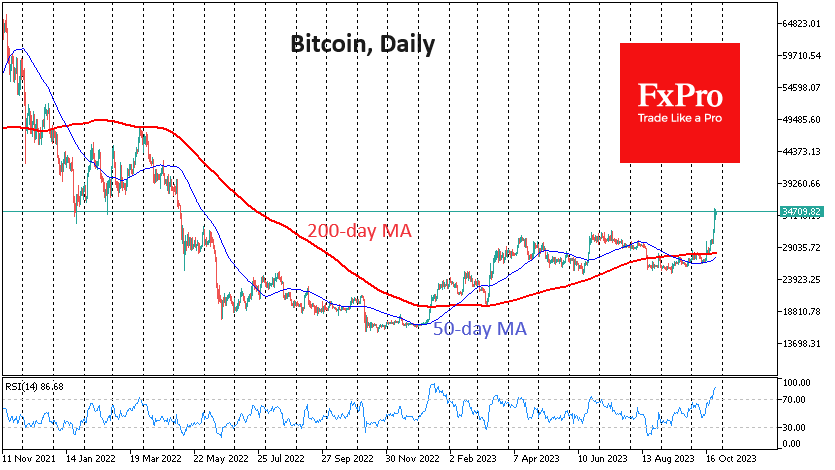
On Wednesday, Bitcoin failed to break above $35K again. Still, we note a series of higher lows that brought the price closer to the upper bound of the consolidation range since Tuesday. We believe that BTCUSD remains in low-density territory, with key resistance levels of $38K or even $48K. However, reaching the upper boundary in the coming weeks won’t be easy.
Background news
The former head of BitMEX, Arthur Hayes, saw prospects for Bitcoin in “wartime”. According to him, if US government bonds do not provide safety for investors, then Bitcoin and gold will rise due to real fears of global inflation in times of war.
Bitcoin has entered a new period of turbulence, but it could end with either a rise or fall, according to Bitfinex. The current rally will last until April 2024, according to AltTab Capital.
Galaxy Digital estimates that within a year of the launch of spot bitcoin ETFs, total inflows into such funds will reach $14.4 billion. This should lead to a 74% increase in the BTC exchange rate to $59,000.
The Binance exchange asked the court to dismiss the US Commodity Futures Trading Commission’s (CFTC) lawsuit, saying the regulator was overstepping its duties and powers. “Congress did not designate the CFTC to be the world’s derivatives police,” Binance said in its appeal.
According to CoinDesk, payments giant Mastercard is considering a partnership with cryptocurrency wallets Ledger and Metamask. A payment card will help cryptocurrency wallet operators increase the number of active users.