

Sample Category Title
AUDNZD Wave Analysis
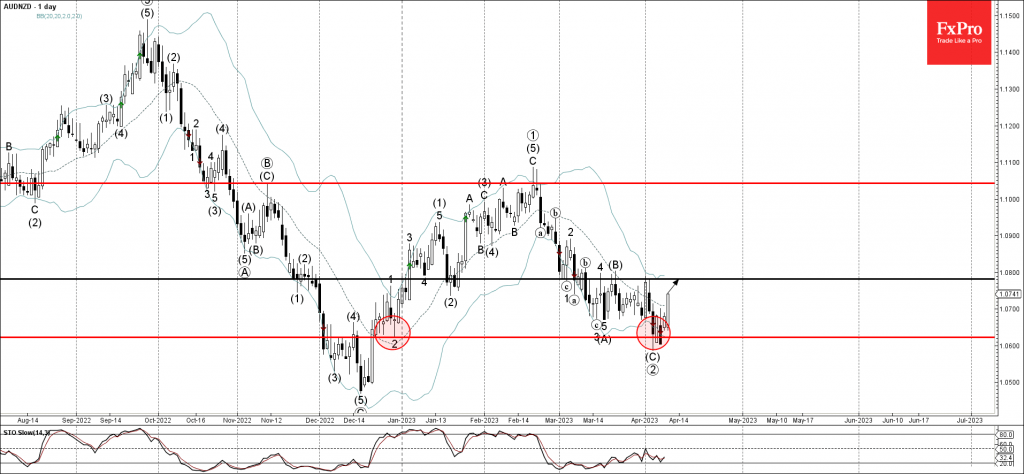
- AUDNZD reversed from support level 1.0625
- Likely to rise to resistance level 1.0780
AUDNZD currency pair recently reversed up from the key support level 1.0625 (which has been reversing the price from last December).
The upward reversal from the support level 1.0625 created the two consecutive upward reversal candlesticks patterns Bullish Engulfing – signalling the strength of this support level.
AUDNZD can then be expected to rise further toward the next resistance level 1.0780 (which stopped the previous waves 4 and (B)).
US CPI Inflation Takes Center Stage as May Policy Decision Looms
The US calendar will be packed this week after the Easter holiday break, but CPI inflation figures will be at the center of attention on Wednesday at 12:30 GMT as monetary policy remains primarily a function of price stability. A pause in monetary tightening came into the Fed’s consideration during its previous policy meeting and the data might be indicative of whether a peak in interest rates will come sooner rather than later. Yet, forecasts suggest that there might be some way to go before we reach a terminal rate. If that proves to be the case, the dollar could stay resilient above its recent lows.
Another rate hike may come soon
Friday’s US nonfarm payrolls report revealed a slightly weaker but still a solid addition of 236k jobs, with the unemployment rate easing closer to previous record lows and the participation rate marking a new three-year high.
Rate expectations for a 25bps rate hike spiked to 70% from 50% previously in the aftermath. Still, the details warranted some caution in hiring as jobs growth came in below the six-month average of 334k, while the retail and construction sectors, which are more sensitive to rate increases, faced job losses. Moreover, the survey was completed a few days after the collapse of the California-based Silicon Valley Bank and New York’s Signature Bank. Hence, the effects from the baking turmoil and the announced layoffs may take some time before they show up in the data.
Meanwhile, the latest spike in weekly jobless claims is already increasing speculation for softer job prints in the coming months, though we can easily argue that the US labor market has been inelastic to the tightening cycle so far. In other words, it has barely weakened in response to continuous rate increases, making the rate cut pricing at the end of this year look premature.
CPI inflation to ease further but not at the target yet
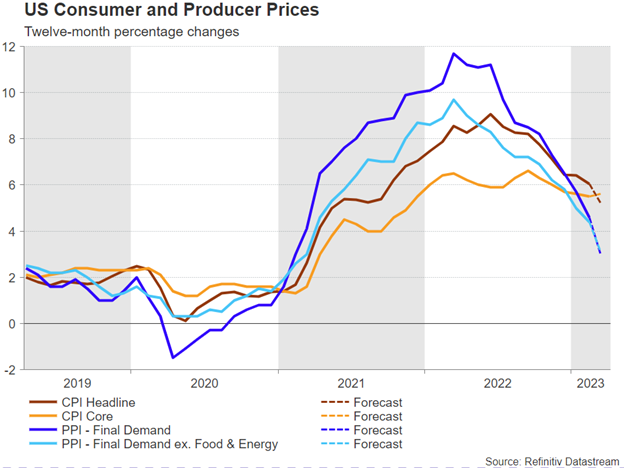
Likewise, CPI inflation data could also play down lower interest rate expectations and hint at additional tightening ahead of May’s policy announcement. Although projections see headline inflation falling for the ninth consecutive month to 5.2% y/y from 6.0% previously, that would still be more than double the Fed’s symmetrical 2.0% average inflation target.
Strikingly, the core CPI measure, which excludes volatile prices such as food and energy, is expected to outstrip the headline measure, arriving marginally higher at 5.6% y/y. The latter could be a warning sign that inflation is becoming entrenched in the domestic price dynamics and interest rates may remain high for longer until price stability is achieved. A similar incident occurred during the 1970-1980 period when the then Federal Reserve chair Paul Volcker held interest rates high for an extended period of time, spurring a recession, though ultimately bringing inflation to the target.
US dollar outlook
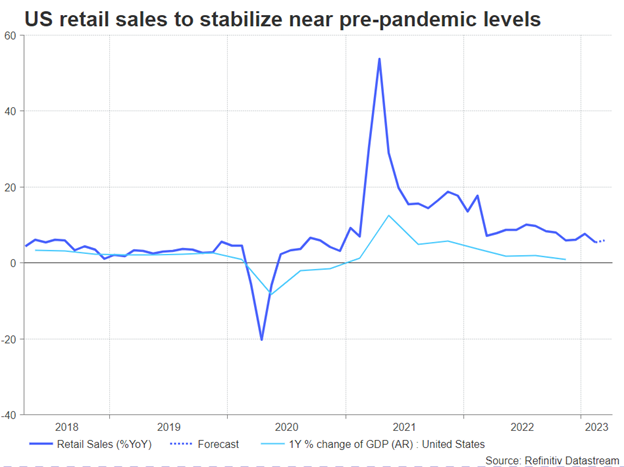
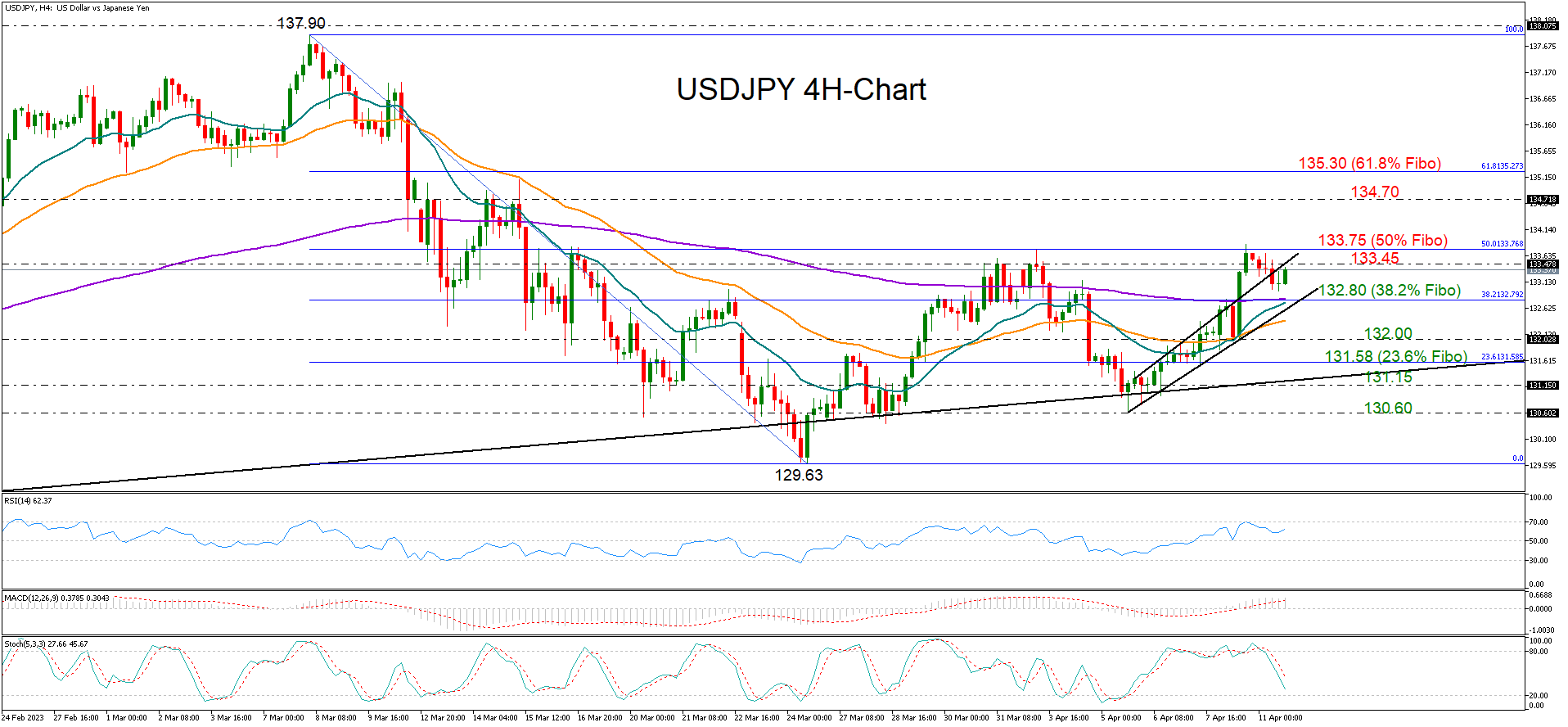
As regards the US dollar, stronger-than-expected inflation readings could bode well for the currency. From a technical perspective, a break above the 133.45-133.75 region is required for dollar/yen to extend its recovery towards the next resistance area seen between 134.70 and 135.30. Monthly retail sales could add more fuel to the rally on Friday too if they beat expectations for a monthly decline of 0.3% and an annual expansion of 5.90%. Otherwise, a rapid downfall in retail sales would reflect fizzling demand, creating new downside pressures in the market at the end of the week, especially if the pair crosses below the 132.80 support region.
All in all, the Fed has not entirely abandoned its hawkish talk despite discussing the potential for a pause during its March gathering. Fed officials, including John Williams and James Bullard, returned to the wires recently to remind investors that the central bank will not abandon its task of getting inflation to the target, while seeing no need to adjust its balance sheet policy anytime soon. That leaves little room for surprises from the FOMC meeting minutes due on Wednesday at 18:00 GMT.
BTCUSD Technical Analysis
Bitcoin continues its bullish momentum from last week, and after touching a low of $27,717 on April 6, we can see a bull run, which managed to push the prices of BTCUSD above the $30,000 handle today in the early European trading session.
The resistance of the channel is broken in the daily timeframe, indicating the strength of the bulls.
We can clearly see a hammer pattern above the $27,717 handle.
Bitcoin continues to move in a range-bound motion between the $29,800 and $30,200 levels, which is indicative of a consolidation phase in the markets.
Both the STOCH and Williams Percent Range indicate overbought levels, which means that in the immediate short term, a decline in the price is expected.
The relative strength index is at 74.02, indicating a strong demand for Bitcoin and the continuation of the buying pressure in the markets.
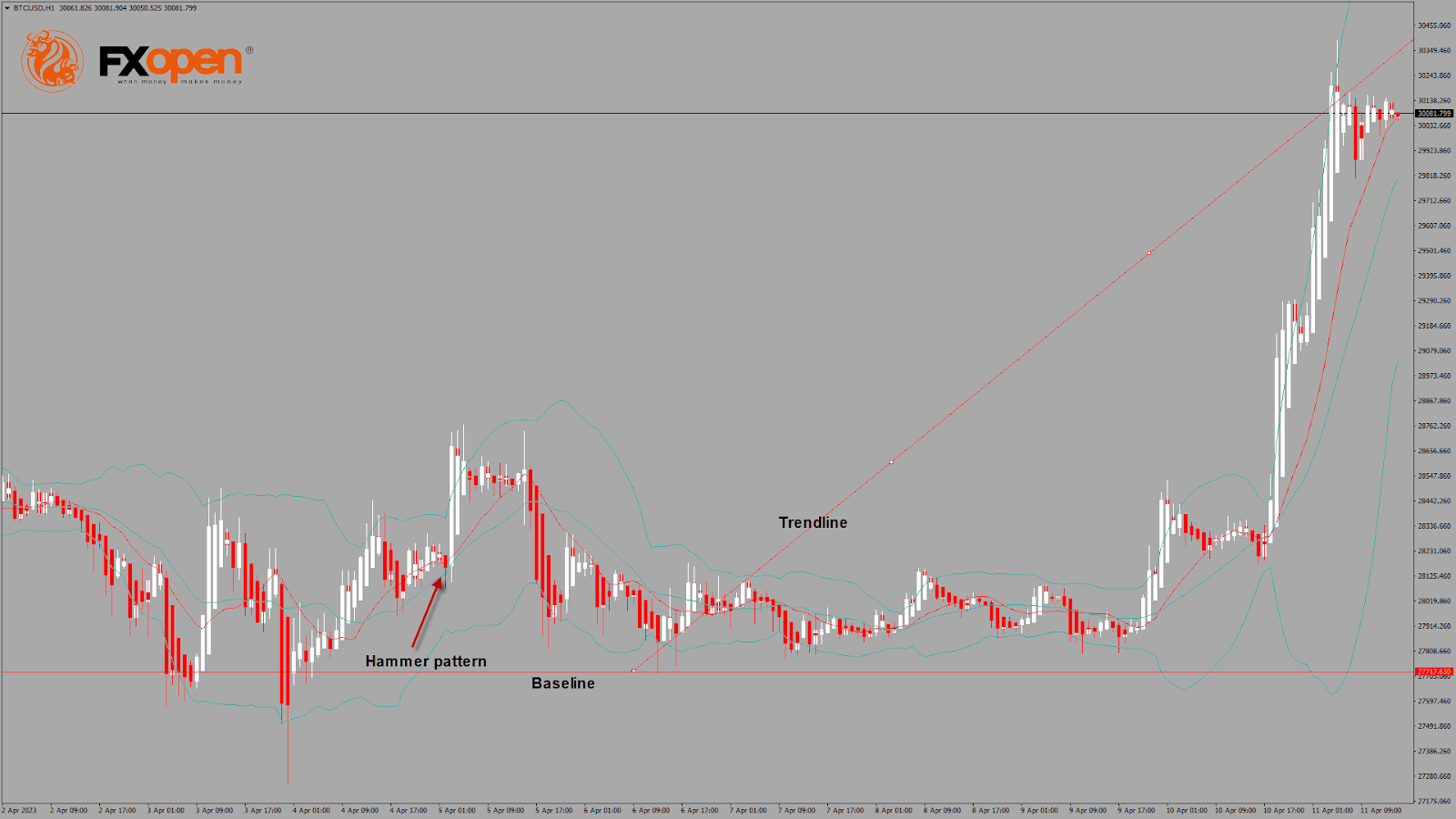
Bitcoin is now moving above its 100-hour simple moving average and above its 200-hour exponential moving average.
Most of the major technical indicators are giving a bullish signal, which means that in the immediate short term, we are expecting targets of $31,000 and $32,500.
The average true range indicates low market volatility with strong bullish momentum.
- Bitcoin bullish continuation is seen above $27,717.
- The RSI remains above 50, indicating a bullish market.
- The price is now trading above its pivot level of $30,088.
- The short-term range is strongly bullish.
- Some major technical indicators signal that the price may move to $30,500 and $31,000 soon.
Bitcoin Bullish Continuation Seen Above $27,717
The price of Bitcoin has been successful in crossing the $30,000 resistance, and now we are looking for fresh upsides in the range of $31,000 and $32,000.
We can see the formation of the bullish harami pattern in the 2-hour timeframe.
The price of Bitcoin indicates the formation of a bullish rally.
A support zone is located at $27,919, where the price crosses the 18-day moving average, and at $28,394, at which the price crosses the 9-day moving average.
BTCUSD is now facing its classic resistance level of $30,168 and Fibonacci resistance level of $30,211, breaking which the price will be able to move to $31,000.
There is an increase of 92.13% in the daily trading volume, which suggests that long-term investors are now coming back into the markets. The short-term outlook for Bitcoin is super bullish, the medium-term outlook has turned bullish, and the long-term outlook remains neutral under present market conditions.
The Week Ahead
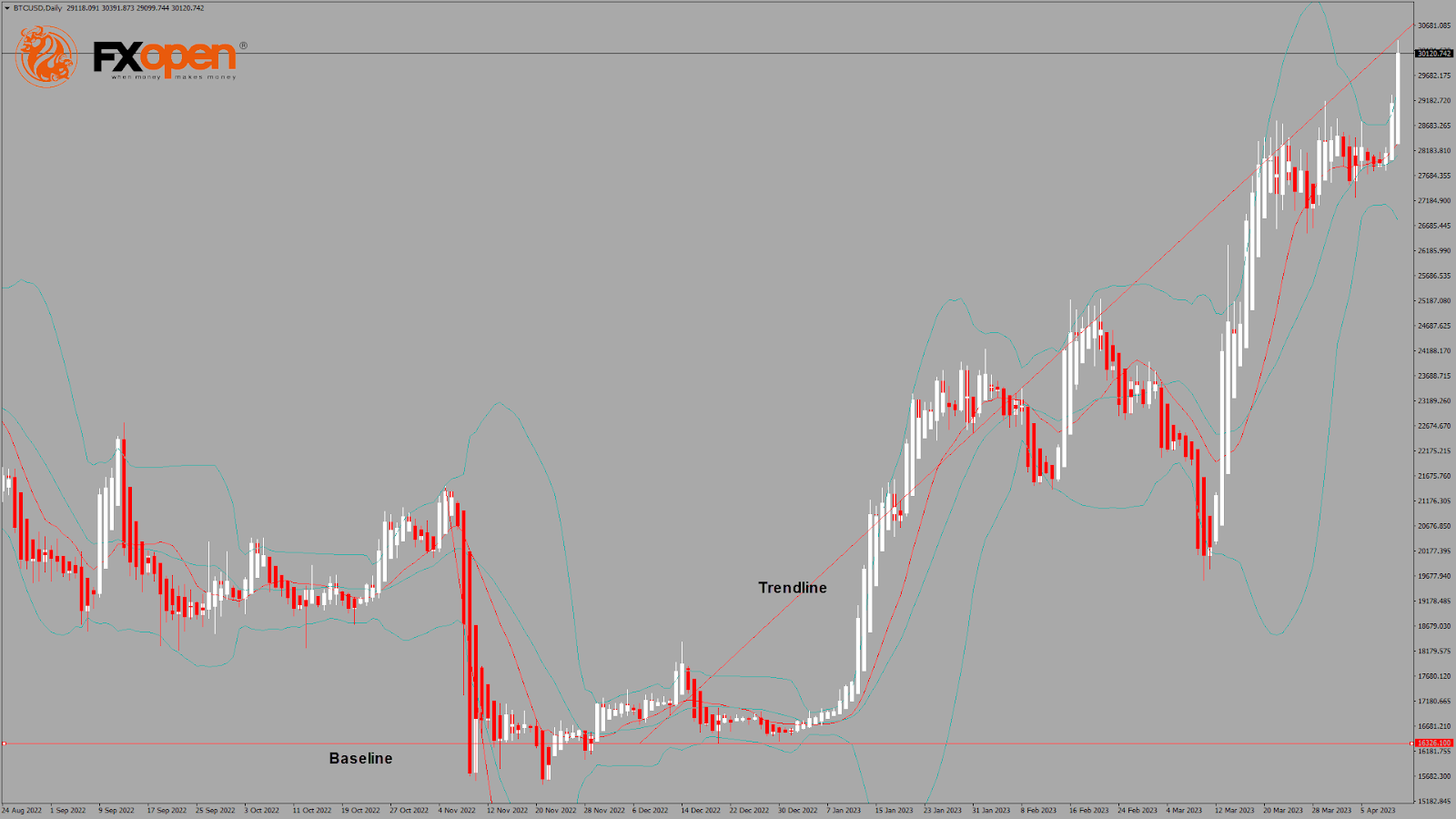
We can see that Bitcoin continues its winning streak against the US Dollar, now trading above the $30,000 handle, with the current support at $26,566, which is a 14-day RSI at 50.
The MACD crosses up its moving average in the daily timeframe, indicating the bullish nature of the market.
We can also see the formation of three white soldiers pattern in the daily timeframe.
The immediate expected target is $32,000, after which we may see some consolidation in the zone of the $31,500 level.
Daily RSI is at 70.79, which indicates the continuation of the bullish trend and the formation of super bullish demand for Bitcoin in the medium-term range.
We can see the formation of a bullish trendline from $27,717 to $30,356.
The BTCUSD is now facing resistance at $31,150, which is a pivot point’ third resistance level, and at $32,468, which corresponds to a 61.8% retracement from the 52-week low.
Stalled European Recovery
Investor confidence and retail sales data released on Tuesday beat average market forecasts but showed no improvement over recent months.
The Sentix investor confidence index rose from -11.1 to -8.7 in April. This is roughly where the index was in February. However, it has been in negative territory for 13 months and has shown no positive trend in the last three months.
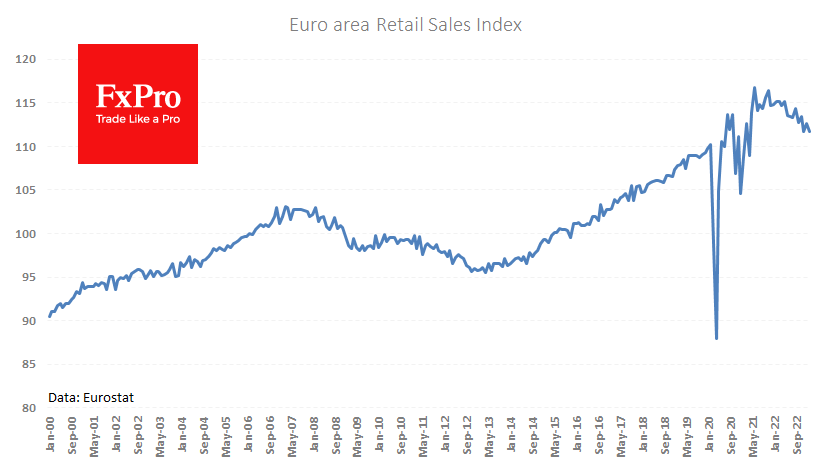
Eurostat reported that retail sales fell by 0.8% in February, after the same increase in the previous month. On a yearly basis, sales are down by 3%. The retail sales index has been downward since November 2021, breaking the long-term upward trend that began around ten years ago.
Melting retail sales and investor pessimism cast doubt on whether the ECB still needs to raise interest rates. However, everything is relative in the currency market, and expectations are now much higher that the Fed will end its hikes sooner and be the first to start easing, supporting the euro’s rise against the dollar.
Japan Recovering, But What About Yen?
After last year’s shock, Japan’s economic indicators are slowly returning to normal. But conditions are still unsuitable for raising interest rates for the Bank of Japan. This is not good news for the Yen. The interest rate differential, which has risen sharply over the past year, creates the conditions for carry trade. The only obstacle to an active interest rate differential play is the uncertainty surrounding monetary policy due to the change in the central bank governor.
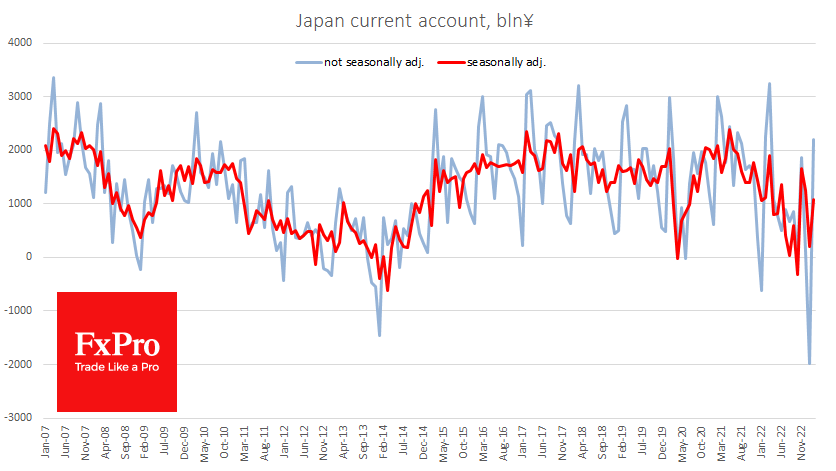
The balance of payments rebounded from last month’s record deficit as the February trade deficit fell to its lowest level in 11 months. The balance of payments appears to have turned around. This is supported by lifting China’s export restrictions and falling container prices, which should boost demand for goods from Japan.
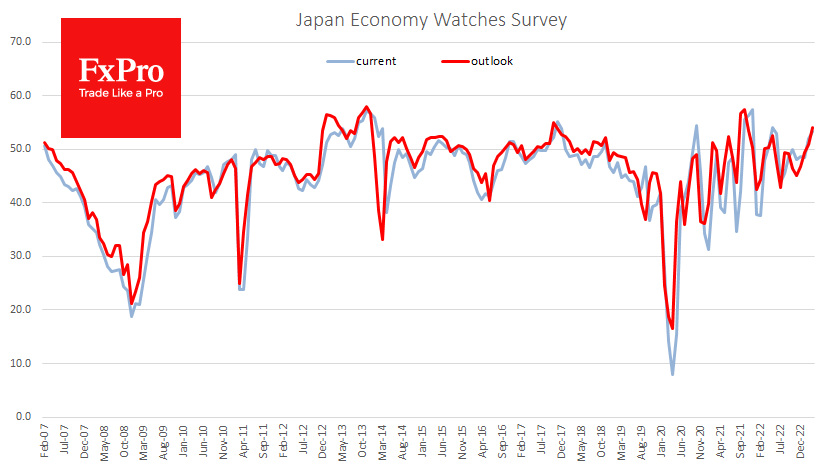
In addition, consumer optimism is on the rise. Household consumer confidence has risen every month since November, from 31.3 to 33.9 in March, the highest level since May last year. The “economy watchers” survey also returned to last year’s highs in current conditions and was at its highest level since October 2021 in terms of forecasts.
A key driver of the Yen’s appreciation in recent months has been speculation about a change in monetary policy. Expectations have grown that Kuroda’s resignation as governor of the Bank of Japan would trigger a tightening of monetary policy. But so far, there has been no real change or even a hint in that direction from the new BoJ governor, who formally took office on 9 April. His latest speech signalled that he would continue to ease policy.
He has not been seen as a proponent of tightening policy, but a confirmation after his inauguration could potentially trigger a new wave of pressure on the Japanese currency. The USDJPY jumped more than 1% on Monday, taking advantage of the dollar’s general bullishness. Today, however, the Yen is in no hurry to regain its losses, as the Pound and Euro are doing. And this may not be the end of the samurai path.
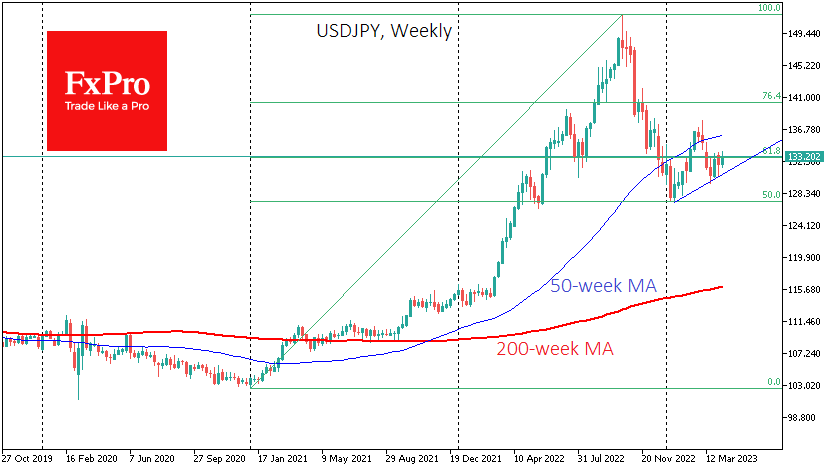
Lower inflation eases the pressure on the BoJ to raise interest rates. The USDJPY’s pullback from 151 to 127 corrected 50% of the rally on the monetary policy change and stopped the pair’s uncontrolled rise. Technically, the path to the upside for the pair is now clear, but it is difficult to identify a clear technical target for this path. The 140 level could be a medium-term target.
Much more helpful is the dynamics of interest rate expectations. The fundamental pressure on the Yen may continue as long as the spread between the Yen’s government bond yields and those of its major rivals widens.
Fed’s Williams suggests one more rate hike as “reasonable starting place”
In a Yahoo Finance interview, New York Fed President John Williams stated that one more rate hike could be a "reasonable starting place," noting that it aligns with the median expectation of his colleagues. However, Williams emphasized the importance of data-driven decisions, saying, "We have to be driven by the data... I will say that one thing that we're paying attention to is credit conditions but also do we really see signs of this underlying inflation coming down?"
Williams highlighted the challenges ahead, stating, "Some of this core services inflation excluding housing hasn't budged yet, so we've got our work cut out for us to get inflation back to 2%." He added that the central question revolves around determining what will be sufficiently restrictive on policy and whether additional measures are needed to achieve their goals, with data and outlook as the key drivers.
Australian Dollar Edges Higher as Consumer Sentiment Soars
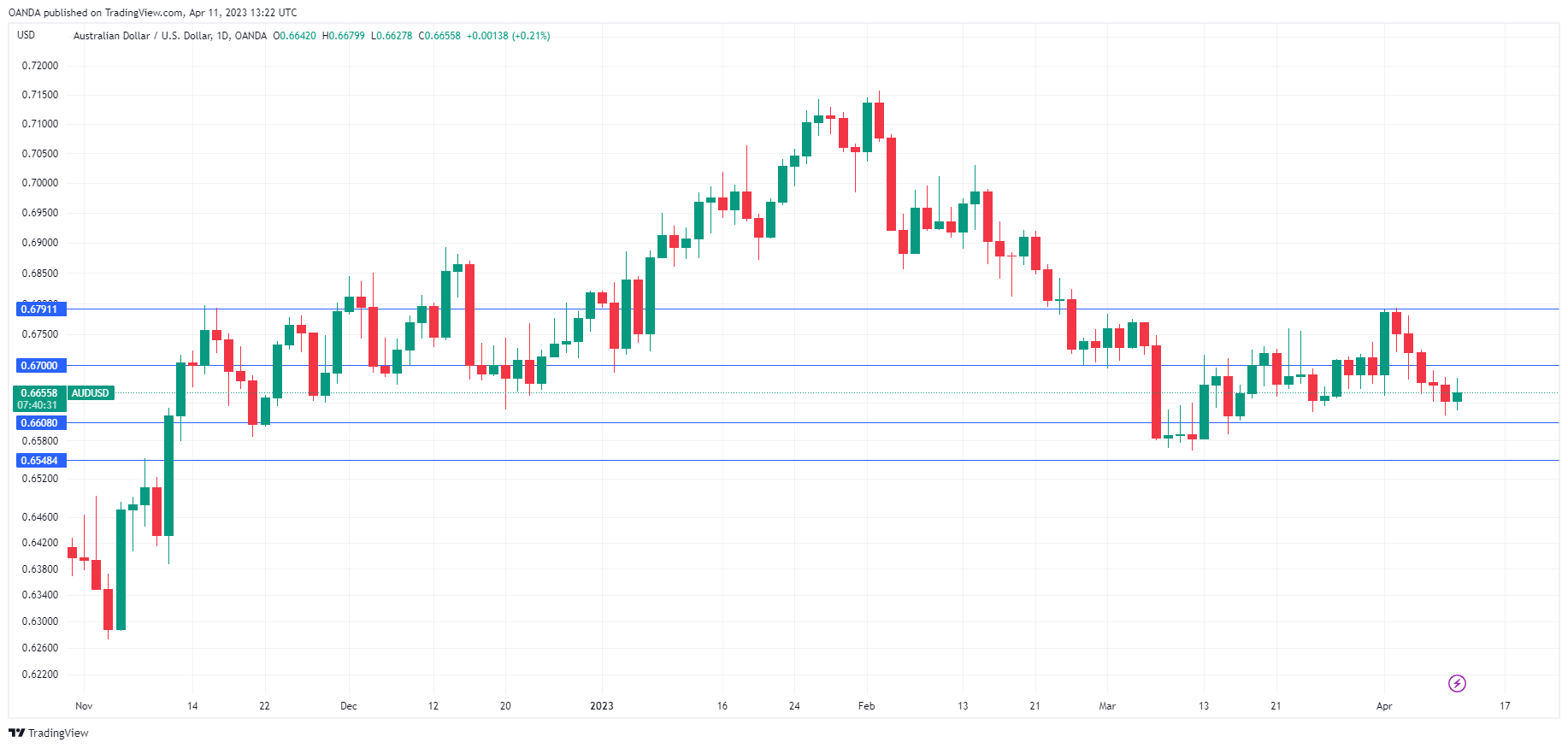
The Australian dollar has posted slight gains today. In the North American session, AUD/USD is trading at 0.6653, up 0.18%.
Australian consumer sentiment jumps
Australia’s Westpac Consumer Sentiment was red-hot in April, climbing 9.4% to 85.8, up from 78.4 a month earlier. This crushed the market consensus of 0.8% and follows a flat reading in March. This marks the highest reading since June 2022. Despite the impressive surge, consumer confidence remains weak, well below the 100-level which separates positive and negative territory.
Business indicators were also positive. The NAB Business Confidence index rose from -1 to -4 in March, close to the estimate of zero. Business Conditions was almost unchanged at 16, just shy of the estimate and the previous reading, both of which were 17 points.
The improvement in the consumer and business confidence data can be largely attributed to the Reserve Bank of Australia’s decision to pause rates at the April meeting, after ten straight rate increases. High interest rates have taken their toll on households and businesses, and the RBA would love nothing more than to extend the pause in rates at the May 2nd meeting. Still, inflation remains the central bank’s number one priority, and the battle promises to be a long one. CPI fell to 6.8% in February, down from 7.4% a month earlier but more than triple the target of 2%. The March inflation report will be released about a week before the RBA decision and will be a key factor as to whether the RBA extends its pause or raises rates by 25 basis points.
There are no tier-1 events on the calendar today, but Wednesday we’ll get a look at the US inflation report for March. The battle to contain inflation is making progress but has gone slower than the Fed had expected. This has meant extending the rate-tightening cycle and a 25-bp is likely at the May meeting. Headline inflation is expected to fall to 5.4% in March, down from 6% in February. The core rate is projected to inch higher to 5.6%, up from 5.5%.
AUD/USD Technical
- The round number of 0.6700 is a weak resistance line. Next, there is resistance at 0.6791
- AUD/USD has support at 0.6608 and 0.6548
Sunset Market Commentary
Markets
European investors had some catching up to do with the US, returning from the long Easter weekend. Last Friday’s US payrolls were the main event. They printed near consensus instead of the feared and positioned-for downward surprise after earlier below-consensus ISM’s, ADP employment and JOLTS. That way, payrolls avoided a break of key support levels in US yields. The US 2-yr yield returned to 4%. The US 10-yr yield bounced off 3.28% to currently trade around 10 bps higher. German Bunds thus underperform US Treasuries today with yields adding 8.8 bps (30-yr) to 14.8 bps (2-yr). US yield are merely flat across the curve. The 10-yr Bund-swap spread drops below 65 bps for the first time since the collapse of Silicon Valley Bank in a sign that market stress levels are receding. In the same vein, the VIX index (expected volatility of S&P 500) since last week trades back near YTD lows. Key European stock indices gain 0.5% to 1% today with the EuroStoxx50 for example testing the YTD top at 4347. Sentiment is dwindling going into the start of US trading though. Positive risk vibes are responsible for EUR/USD’s return above 1.09 as well. EUR/GBP holds within this month’s extremely narrow trading range between roughly 0.8750 and 0.88.
Today’s eco calendar was extremely thin with only outdated and at consensus February eurozone retail sales (-0.8% M/M). The IMF released its world economic outlook, subtitle “a rocky recovery”. It presents the bleakest growth outlook since 1990, as flagged by chief Georgieva last week. The baseline forecast is for growth to fall from 3.4% in 2022 to 2.8% in 2023 (from 2.9% in January), before settling at 3% in 2024 (from 3.1%). Advanced economies are expected to see an especially pronounced growth slowdown, from 2.7% in 2022 to 1.3% in 2023. In a plausible alternative scenario, stressing downside risks to the base case, with further financial sector stress, global growth declines to about 2.5% in 2023 with advanced economy growth falling below 1%. Global headline inflation in the baseline is set to fall from 8.7% in 2022 to 7% in 2023 on the back of lower commodity prices but underlying (core) inflation is likely to decline more slowly. Inflation’s return to target is unlikely before 2025 in most cases. In an earlier released chapter on the natural rate of interest – the real rate that neither stimulates nor contracts the economy – analysis suggests that once the current inflationary episode has passed, interest rates are likely to revert toward pre-pandemic levels in advanced economies.
News & Views
Norwegian headline inflation unexpectedly picked up in pace last month. Rising by 0.8% m/m brought the yearly figure from 6.3% to 6.5%, defying analyst and Norges Bank estimates for a further slowdown to 6.1% and 6% respectively. Core inflation advanced 0.6% m/m, keeping the y/y measure (6.2%) close the series high of 6.4% (January 2023). The increase was driven by durables (furnishings, household equipment), transport and clothing. Given the upward surprise (again), the Norges Bank’s flagged rate hike for May (to 3.25%) is all but cemented. The central bank’s projected a 3.5% terminal rate but kept the option for going higher on the table in case of more stubborn inflation and/or a weaker-than-expected Norwegian krone. The latter isn’t providing much comfort to the NB today. EUR/NOK gets catapulted above recent highs of 11.48 to trade at 11.53 currently – the weakest NOK level since April 2020. Norwegian swap yields are roughly unchanged, moving between -0.4 bps and +0.8 bps.
Minutes from the previous Czech National Bank policy meeting showed broad-based resistance amongst policymakers to cut rates anytime soon, labelling it as “not on the horizon”. The formal guidance instead remains to either keep rates steady at 7% or hike further. The latter option is favoured by only one member, Tomas Holub. He sees “insufficiently tight monetary policy and inflation staying above the target next year as a far greater threat than the risk of excessively tight monetary policy.” Kubelkova said the risk of de-anchoring inflation expectations is growing over time and that it could play a more important role in future decision-making. CNB governor Michl and deputy governor Zamrazilova both repeated their preference for a strong Czech koruna. The currency today however fell prey to some profit-taking after approaching the March 2023/15-year high around 23.30 over the previous days. EUR/CZK currently rises from 23.36 to 23.50.
IMF: Global growth to bottom at 2.8% this year
The IMF released its World Economic Outlook, projecting global growth to slow from 3.4% in 2022 to 2.8% in 2023 and bottom there, and then rise to 3.0% in 2024. Global inflation is expected to decelerate from 8.7% in 2022 to 7% in 2023 and further to 4.9% in 2024.
Pierre-Olivier Gourinchas, Economic Counsellor and Director of Research at IMF, said in a blog post, "The global economy's gradual recovery from both the pandemic and Russia's invasion of Ukraine remains on track. China's reopened economy is rebounding strongly. Supply chain disruptions are unwinding, while dislocations to energy and food markets caused by the war are receding. Simultaneously, the massive and synchronized tightening of monetary policy by most central banks should start to bear fruit, with inflation moving back towards targets."
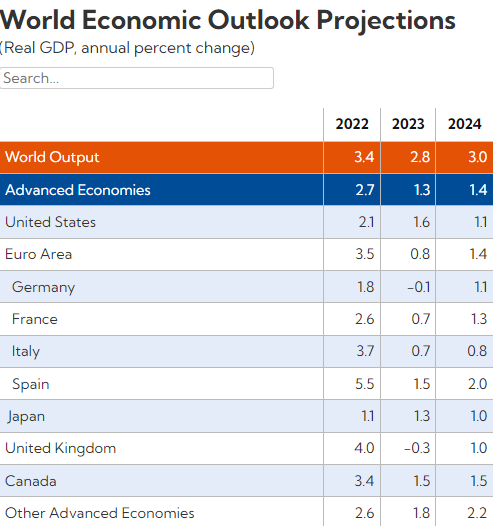
For 2023, global growth projections were reduced by 0.1% compared to January's forecast. US growth was revised up by 0.2% to 1.6%, Eurozone growth by 0.1% to 0.8%, and UK growth by 0.3% to -0.3%. However, Japan's growth projection was revised down sharply by 0.5% to 1.3%. Canada and China's growth forecasts remained unchanged at 1.5% and 5.2%, respectively.
Regarding interest rates, the IMF believes recent increases in real interest rates are likely temporary. Once inflation is under control, advanced economies' central banks are expected to ease monetary policy and bring real interest rates back towards pre-pandemic levels.