Sample Category Title
USD/JPY Mid-Day Outlook
Daily Pivots: (S1) 132.33; (P) 133.10; (R1) 134.37; More...
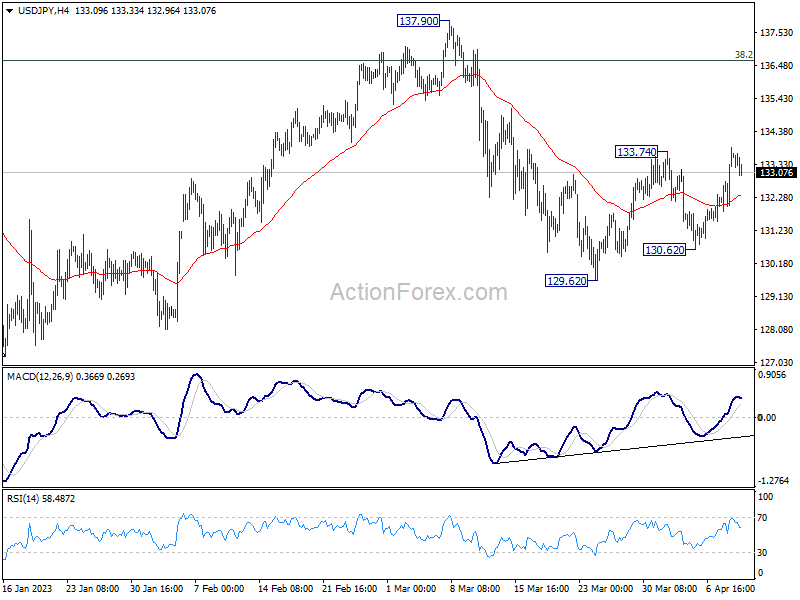
Intraday bias in USD/JPY stays neutral with focus on 133.74 resistance. Firm break there will resume the rebound form 129.62 and target 137.90 resistance again. However, on the downside, below 130.62 will resume the fall from 137.90 through 129.62 to retest 127.20 low.
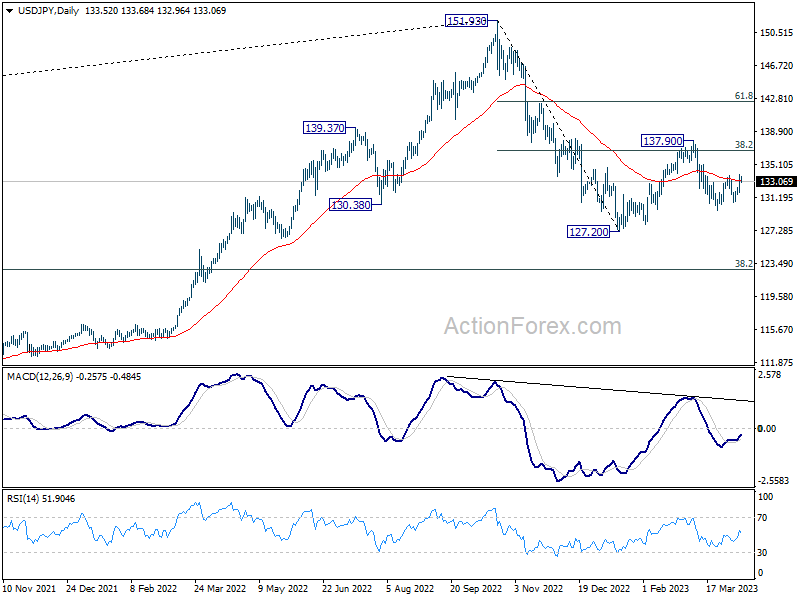
In the bigger picture, corrective pattern from 127.20 might be extending. But after all, down trend from 151.93 is expected to resume at a later stage. Break of 127.20 will resume this down trend and target 61.8% projection of 151.93 to 127.20 from 137.90 at 122.61. This will now be the favored case as long as 137.90 resistance holds.
USD/CHF Mid-Day Outlook
Daily Pivots: (S1) 0.9048; (P) 0.9084; (R1) 0.9131; More...
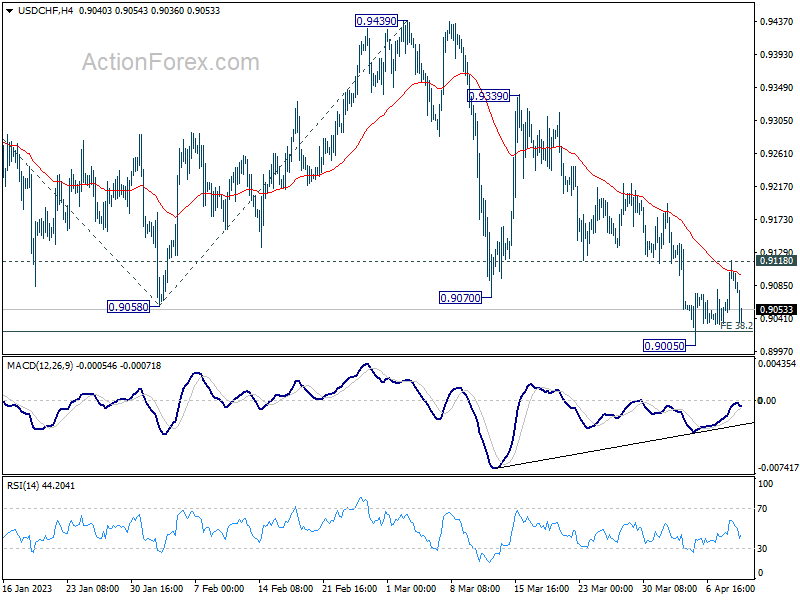
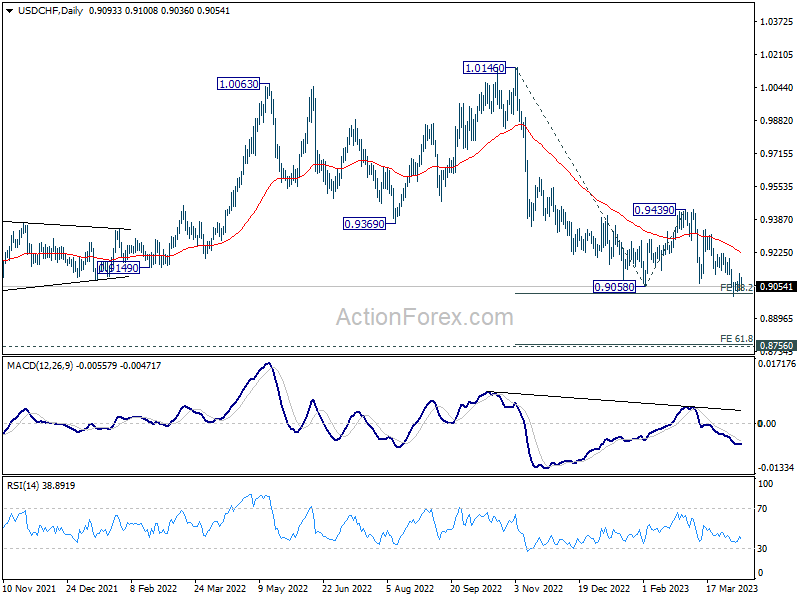
Intraday bias in USD/CHF remains neutral at this point. With 0.9118 resistance intact, further decline is expected. On the downside, break of 0.9005 and sustained trading below 38.2% projection of 1.0146 to 0.9058 from 0.9439 at 0.9023 will extend the down trend from 1.0146 to 61.8% projection at 0.8767. However, firm break of 0.9118 will indicate short term bottoming, and turn bias to the upside for stronger rebound.
In the bigger picture, outlook will stay bearish as long as 0.9439 resistance holds, and fall from 1.1046 (2022 high) is still in progress. Prior rejection by 55 week EMA was a medium term bearish sign. Sustained of 0.9058 will resume such decline towards 0.8756 support (2021 low). But overall, this fall is still as a leg in the long term range pattern from 1.0342 (2016 high). So, downside should be contained by 0.8756 to bring reversal.
GBP/USD Mid-Day Outlook
Daily Pivots: (S1) 1.2338; (P) 1.2390; (R1) 1.2436; More...
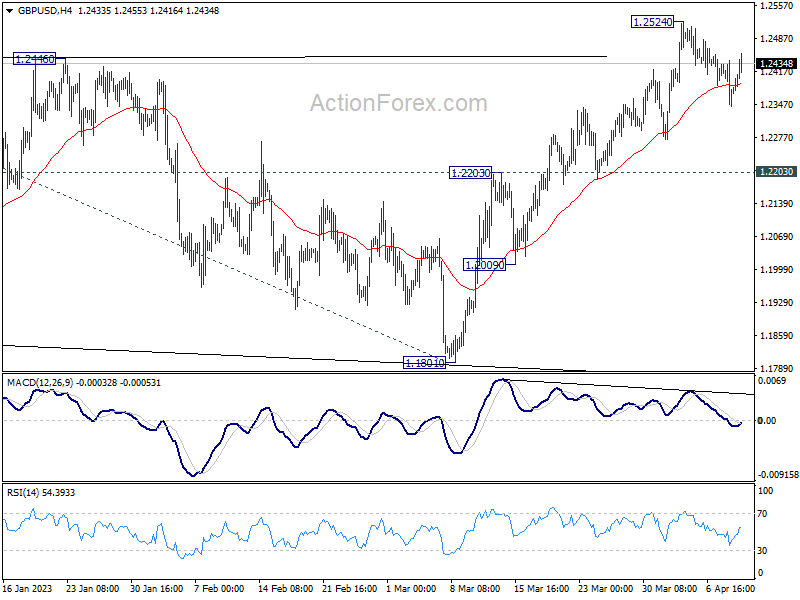
Intraday bias in GBP/USD remains neutral as consolidation pattern from 1.2524 continues. Further rally is expected with 1.2203 resistance turned support intact. On the upside, break of 1.2524 will target 1.2759 fibonacci level first. Firm break there will target 61.8% projection of 1.0351 to 1.2445 from 1.1801 at 1.3095.
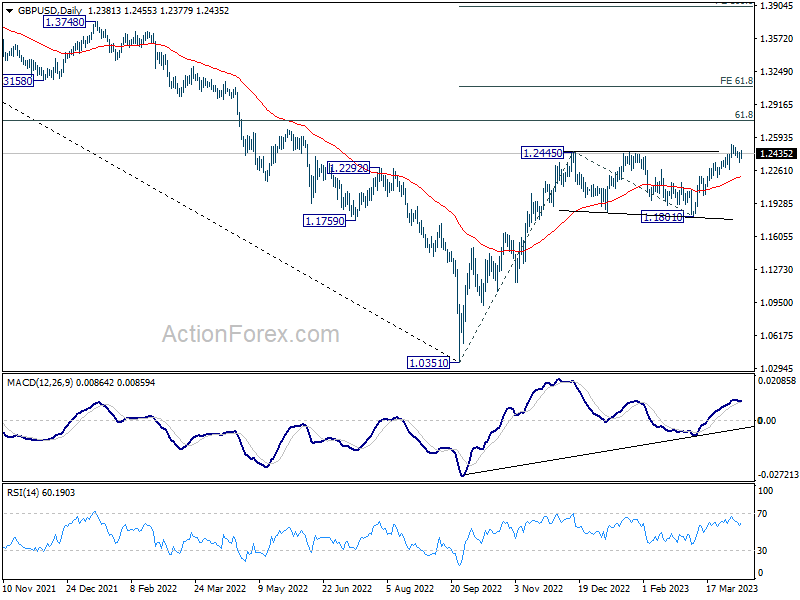
In the bigger picture, the rise from 1.0351 medium term term bottom (2022 low) is in progress for 61.8% retracement of 1.4248 (2021 high) to 1.0351 at 1.2759. Sustained break there will add to the case of long term bullish trend reversal. Further break of 61.8% projection of 1.0351 to 1.2445 from 1.1801 at 1.3095 could prompt upside acceleration to 100% projection at 1.3895. For now, this will remain the favored case as long as 1.1801 support holds, even in case of deep pull back.
EUR/USD Mid-Day Outlook
Daily Pivots: (S1) 1.0823; (P) 1.0870; (R1) 1.0908; More...
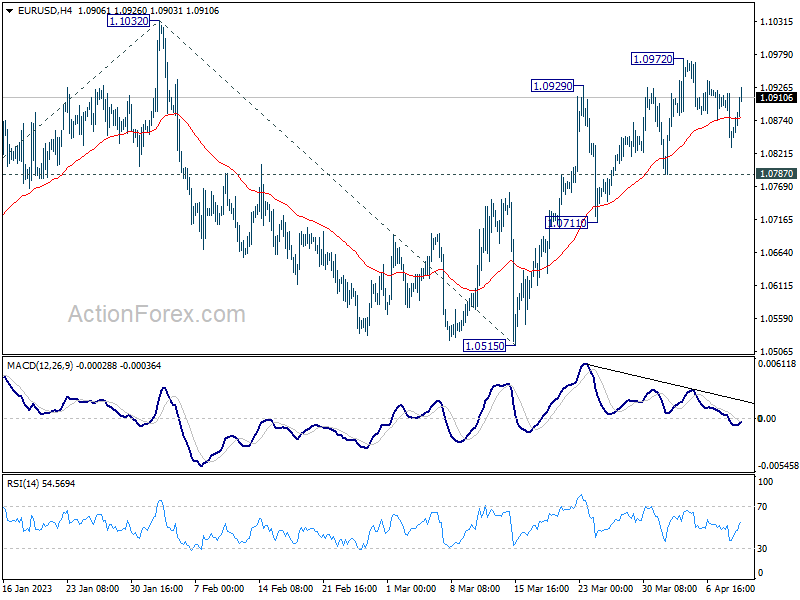
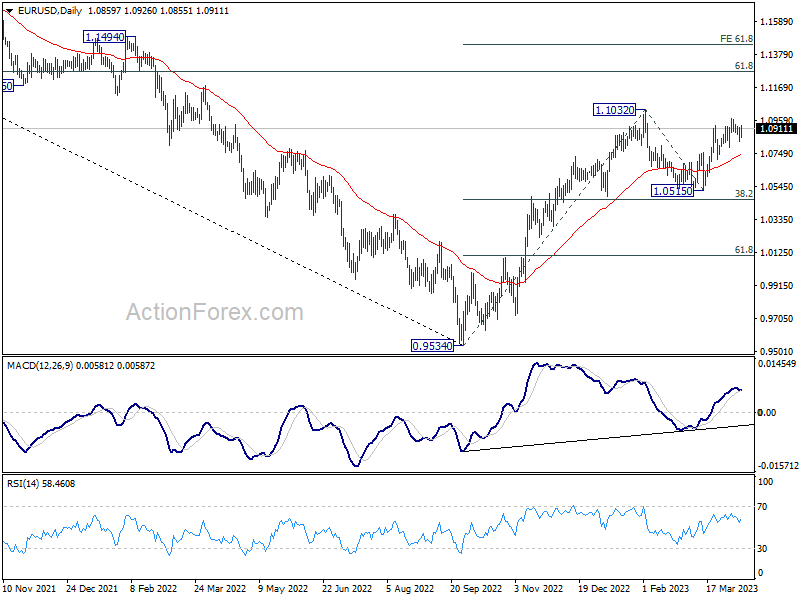
EUR/USD recovers today but stays inside range below 1.0972. Intraday bias remains neutral for the moment. With 1.0787 support intact, further rally is expected. On the upside, above 1.0972 will resume the rally from 1.0515 to retest 01.1032 high. Firm break there will resume larger up trend from 0.9534. However, break of 1.0787 will turn bias back to the downside for 1.0711 support instead.
In the bigger picture, rise from 0.9534 (2022 low) is in progress with 38.2% retracement of 0.9534 to 1.1032 at 1.0460 intact. The strong support from 55 week EMA (now at 1.0625) was also a medium term bullish sign. Next target is 61.8% retracement of 1.2348 (2021 high) to 0.9534 at 1.1273. Sustained break there will solidify the case of bullish trend reversal and target 1.2348 resistance next (2021 high).
European Majors in Spotlight as Eurozone Investor Confidence Improves
European majors are taking center stage today as markets reopen after holidays. Although not spectacular, Eurozone data revealed improvements in investor confidence, which has bolstered overall market sentiment. Major European indexes and benchmark treasury yields are trading slightly higher. In contrast, commodity currencies and Dollar are trading on the softer side, while Yen is mixed for the day but remains the week's worst performer. It's important to note that volatility has been relatively low so far. Traders may remain cautious until tomorrow's US CPI release and Bank of Canada rate decisions.
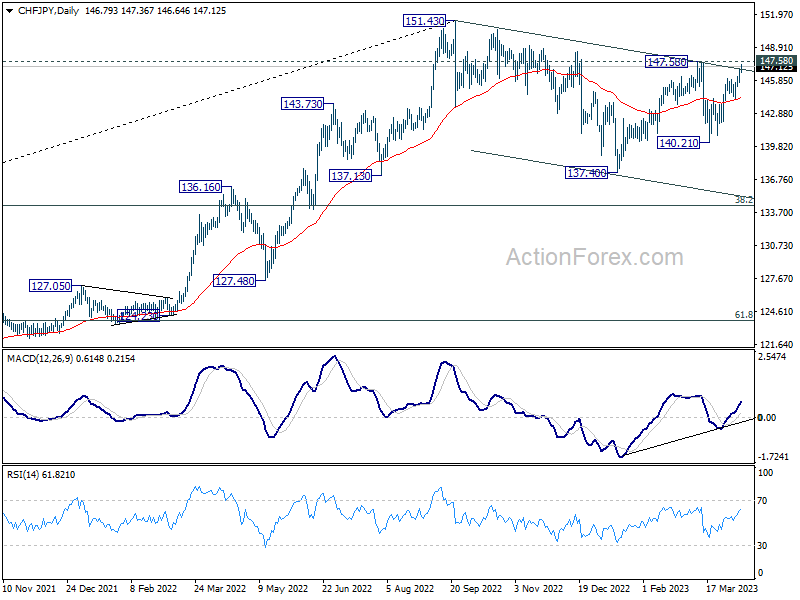
Meanwhile, the development in CHF/JPY is worth mentioning. The cross has entirely reversed the setback from the Credit Suisse turmoil in March, and it now appears ready to resume the rebound from 137.40. Technically, the corrective fall from 151.43 should have already completed at 137.40. A break of 147.68 should prompt a retest of the 151.43 high, a decisive break there would resume the larger uptrend. However, rejection by 151.43 could extend the corrective pattern from 151.43 with another falling leg, before an eventual upside breakout.
In Europe, at the time of writing, FTSE is up 0.24%. DAX is up 0.35%. CAC is up 0.81%. Germany 10-year yield is up 0.089 at 2.275. Earlier in Asia, Nikkei rose 1.05%. Hong Kong HSI rose 0.76%. China Shanghai SSE dropped -0.05%. Singapore Strait Times rose 0.10%. Japan 10-year JGB yield dropped -0.0142 to 0.454.
Bitcoin breaks out surpassing 30k, NASDAQ to follow?
Bitcoin has finally broken through its recent range to the upside, surpassing 30k level for the first time since June 2022. While some observers may attribute the rally since mid-March to safe-haven flows amid banking turmoil, it seems more likely that Bitcoin is moving in tandem with tech stocks, in anticipation of Fed nearing a pause in tightening.
With 100% projection of 15452 to 25242 from 19552 at 29342 now surpassed, the next target is 161.8% projection at 35392. Even if a retreat occurs, outlook will remain bullish as long as 27,808 support holds.
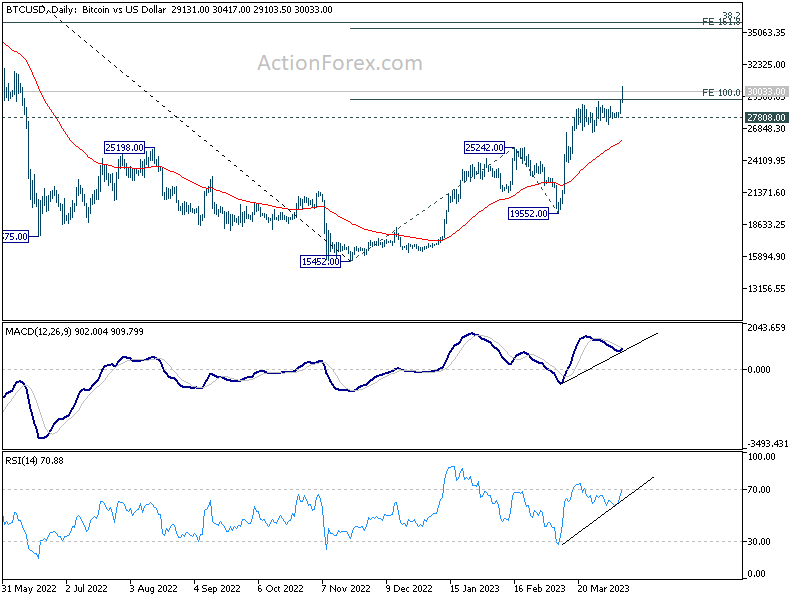
Focus now shifts to the upside momentum of the current move and the reaction to the 35392 projection target. This level is close to the 38.2% projection of 68986 to 15452 at 35901.
Strong upside momentum and a decisive break of the 35k/36k zone would suggest that the rise from 15452 is a of a medium-term impulsive up trend, potentially leading to further gains. Conversely, weak momentum and rejection by the 35k/36k zone would indicate that rebound from 15452 remains just a corrective move.
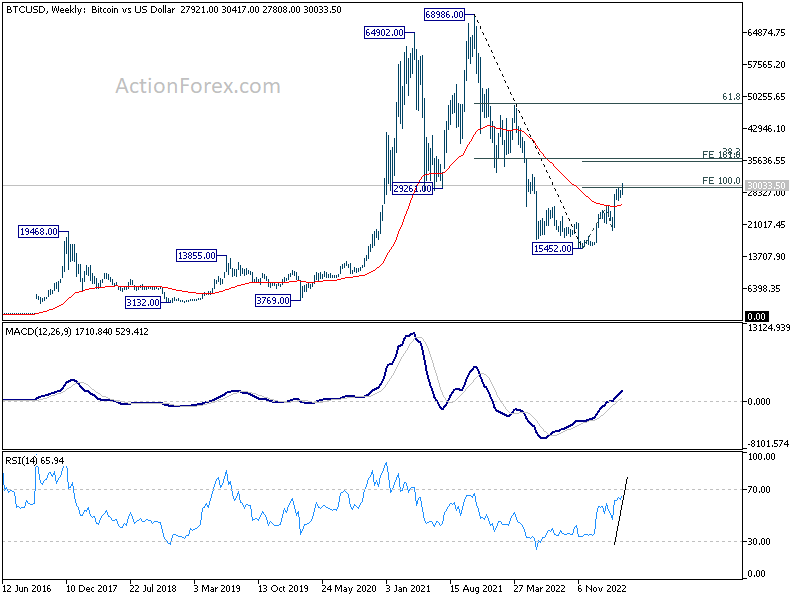
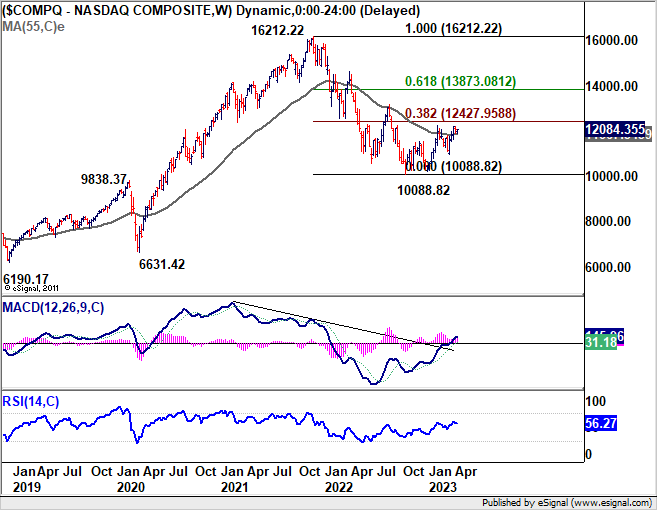
Another question arising is whether NASDAQ can follow suit and decisively break through 38.2% retracement of 16,212.22 to 10,088.82 at 12,427.95, confirming the underlying bullish momentum in tech-related sectors.
Eurozone Sentix Investor Confidence rose to -8.7, negative momentum weakening
Eurozone Sentix Investor Confidence increased from -11.1 to -8.7 in April, surpassing the expected -14.0. The Current Situation index experienced its sixth consecutive rise, moving from -9.3 to -4.3, reaching its highest level since March 2022. The Expectations index, however, remained unchanged at -13.0.
Sentix commented on the data, stating, "There is no doubt that the Eurozone economy has come through the winter months better than many feared in the autumn." However, when considering the future, investors are less optimistic, citing "still considerable uncertainty about the further course of the Ukraine war, concerns about a lasting burden on the energy-intensive industrial sector, and – new – question marks about the state of the US economy."
Despite these concerns, the Sentix Theme Barometer indicates that negative expectations regarding inflation and central bank policy have noticeably decreased. While not an all-clear signal, the negative momentum seems to be weakening.
Eurozone retail sales down -0.8% mom in Feb, EU down -0.9% mom
Eurozone retail sales volume dropped -0.8% mom in February, matched expectations. Volume of retail trade decreased by -1.8% for automotive fuels, by -0.7% for non-food products and by -0.6% for food, drinks and tobacco.
EU retail sales declined -0.9% mom. Among Member States for which data are available, the largest monthly decreases in the total retail trade volume were registered in Slovenia (-10.5%), Hungary and Poland (both -2.0%) and Sweden (-1.6%). The highest increases were observed in Cyprus (+1.6%), Luxembourg (+0.8%) and Belgium (+0.7%).
Australia consumer sentiment jumped 9.4% on RBA pause
Australia Westpac Melbourne Institute Consumer Sentiment Index witnessed a significant 9.4% increase in April, jumping from 78.4 in March to 85.8. This remarkable recovery can be largely attributed to RBA's decision to pause rate hikes during its April meeting, breaking a sequence of ten consecutive meetings with cash rate increases.
However, confidence remains weak, sitting -10.4% lower than April of the previous year, before the tightening cycle began. Respondents continue to exercise caution, with 34.11% still expecting the Standard Variable Rate to rise by more than 1% over the year, although this figure is down from 44.55%.
Regarding the RBA's meeting on May 2, Westpac noted that the central bank would benefit from a clean read on underlying inflation from the March quarter Inflation Report, set to be released on April 26, as well as staff's refreshed economic forecasts. Westpac anticipates that a final 0.25% increase in the cash rate during the May Board meeting would be the best policy approach, rather than waiting for additional information and risking higher rates later in the cycle.
Australian NAB business confidence improved, conditions remain resilient
Australia NAB Business Confidence improved from -4 to -1 in March, while Business Conditions dropped slightly from 17 to 16. Delving into some details, trading conditions rose from 25 to 26, profitability conditions dipped from 14 to 13, and employment conditions fell from 12 to 10.
NAB Chief Economist Alan Oster commented, "Business conditions have been resilient, slowly edging lower over the past few months but remaining well above their long-run average." He added that "trading conditions are particularly elevated, indicating that businesses continue to experience strong demand, and conditions are generally strong across states and sectors."
On the topic of confidence, Oster stated, "Confidence appears to have stabilized, but it remains below average at -1 index point." He noted that confidence was particularly poor in retail and wholesale sectors, likely due to firms being concerned about the sustainability of consumer spending.
In summary, the survey suggests the Australian economy is still holding up, with some easing in inflation. However, Oster emphasized that "there is still a long way to go to bring inflation back down to the RBA's target band and growth could be more volatile from there."
China CPI slows to 18-month low, PPI sees steepest decline since June 2022
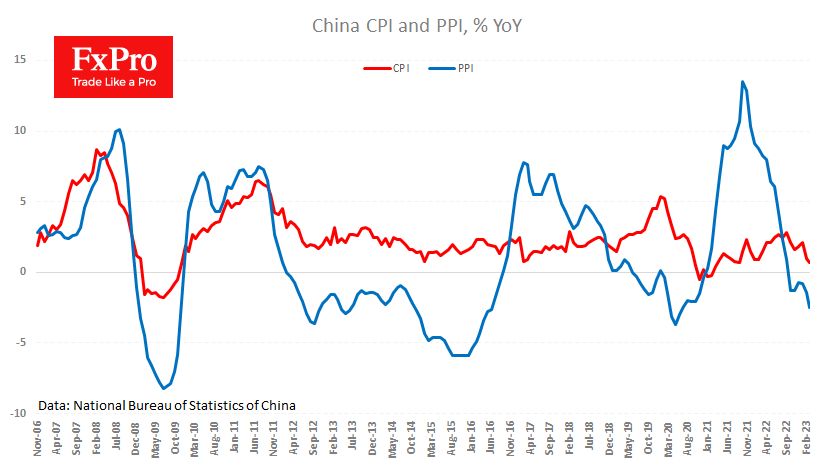
China's CPI slowed from 1.0% yoy to 0.7% yoy in March, falling below the expected 1.0% yoy and marking the lowest level in 18 months since September 2021. Excluding food and energy, CPI increased from 0.6% to 0.7% yoy. Food prices rose by 2.4% yoy compared to a year ago, down from 2.6% yoy in February. Notably, pork prices surged by 9.6% yoy, up from a rise of 3.9% yoy in February.
Dong Lijuan, an NBS statistician, attributed the easing consumer inflation in March to "continued resumption of production and life as well as sufficient market supplies." He also mentioned that the fall in factory-gate prices was affected by a high comparison base in the previous year.
Meanwhile, PPI dropped from -1.4% yoy to -2.5% yoy, matching expectations and marking the steepest decline since June 2022. Dong Lijuan, senior NBS statistician, explained that "production and life continued to recover with sufficient supplies in March."
EUR/USD Mid-Day Outlook
Daily Pivots: (S1) 1.0823; (P) 1.0870; (R1) 1.0908; More...
EUR/USD recovers today but stays inside range below 1.0972. Intraday bias remains neutral for the moment. With 1.0787 support intact, further rally is expected. On the upside, above 1.0972 will resume the rally from 1.0515 to retest 01.1032 high. Firm break there will resume larger up trend from 0.9534. However, break of 1.0787 will turn bias back to the downside for 1.0711 support instead.
In the bigger picture, rise from 0.9534 (2022 low) is in progress with 38.2% retracement of 0.9534 to 1.1032 at 1.0460 intact. The strong support from 55 week EMA (now at 1.0625) was also a medium term bullish sign. Next target is 61.8% retracement of 1.2348 (2021 high) to 0.9534 at 1.1273. Sustained break there will solidify the case of bullish trend reversal and target 1.2348 resistance next (2021 high).
Economic Indicators Update
| GMT | Ccy | Events | Actual | Forecast | Previous | Revised |
|---|---|---|---|---|---|---|
| 00:30 | AUD | Westpac Consumer Confidence Apr | 9.40% | 0.00% | ||
| 01:30 | AUD | NAB Business Conditions Mar | 16 | 17 | ||
| 01:30 | AUD | NAB Business Confidence Mar | -1 | -4 | ||
| 01:30 | CNY | CPI Y/Y Mar | 0.70% | 1.00% | 1.00% | |
| 01:30 | CNY | PPI Y/Y Mar | -2.50% | -2.50% | -1.40% | |
| 06:00 | JPY | Machine Tool Orders Y/Y Mar P | -15.20% | -10.70% | ||
| 08:30 | EUR | Sentix Investor Confidence Apr | -8.7 | -14 | -11.1 | |
| 09:00 | EUR | Eurozone Retail Sales M/M Mar | -0.80% | -0.80% | 0.30% | 0.80% |
| 10:00 | USD | NFIB Business Optimism Index Mar | 90.1 | 89.6 | 90.9 |
Chinese Disinflation
Consumer inflation in China fell to 0.7% YoY in March from 1.0% in the previous month. Last month’s producer price index was 2.5% lower than a year earlier, accelerating its decline from 1.4% in February.
The hypothesis that China’s move away from a 0-covid policy is driving down prices rather than pushing them up, as has been the case in the developed world, remains valid. In this case, we are seeing a normalisation of the economy, which in turn is normalising prices after the spike of previous years.
The stabilisation of supply chains is also evident in the stabilisation of container prices, which have returned to the region of $1,500 (the norm, at least from October 2016 to April 2020) after spiking above $10,000 in the last quarter of 2021.
The normalisation of logistics complements the fall in producer prices, taking inflationary pressure off the developed world. And this is good news for risk demand, as it will allow the world’s biggest central banks to stop tightening policy more quickly.
However, falling producer prices may also signal a sharp contraction in demand in the developed world. Although it signals the end of the interest rate hike cycle in Europe and America, it promises more negativity. In this case, things will get worse before they get better.
EUR/USD – Euro Gains Ground as Investor Confidence Improves
Eurozone Sentix Investor Confidence rises
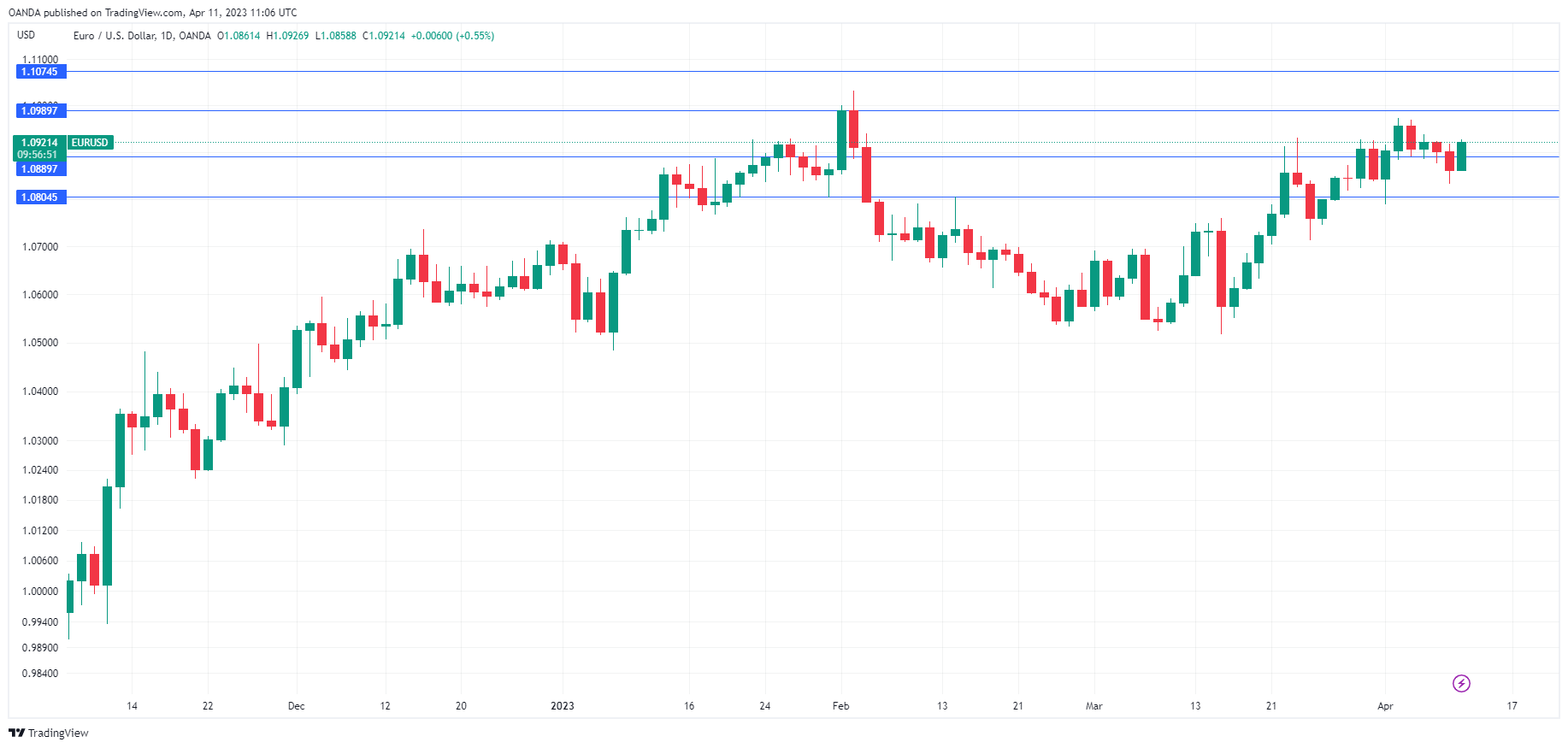
The Eurozone economy continues to recover, but there is plenty of work ahead. The Sentix Investor Confidence index improved to -8.7 in April, above the March read of -11.1 and better than the estimate of -11.7 points. The concerns over an energy crisis in Europe this winter failed to materialize and Germany and the rest of the eurozone came out of the winter better than many had expected, given the weak global economy and the Russia-Ukraine war. Still, the economic outlook remains pessimistic, as Sentix Investor Expectations remain negative in both Germany and the eurozone, at -13 and -11.5, respectively. Still, the markets were pleased with the slight improvement in investor confidence and the euro has responded with gains of around 0.60%.
Eurozone retail sales slipped to -0.8% in February, matching the forecast but contracting after an upwardly revised 0.8% gain in January. Consumers are struggling with high inflation, rising interest rates and uncertain economic conditions and are keeping a tight grip on their wallets and purses.
The ECB meets next on May 4th and all indications are that it will deliver another oversize rate hike. The central bank has been aggressive, raising rates by 50 and 75 basis points in recent months. The ECB was very slow to join the rate-hiking party and the benchmark rate is only 3.50%, compared to 4.25% for the Bank of England and 5.00% for the Federal Reserve. Inflation in the eurozone has proven to be a tougher foe than expected, and core inflation surprised by accelerating in February.
The US releases the March inflation report on Wednesday. Inflation has been falling, albeit at a slower pace than the Fed had expected. This has necessitated additional rate hikes, with a 25-bp increase expected at the May meeting. Headline inflation is expected to fall to 5.4% in March, down from 6% in February. The core rate is projected to inch higher to 5.6%, up from 5.5%.
EUR/USD Technical
- EUR/USD is testing support at 1.0889. Below, there is support at 1.0804
- There is resistance at 1.0989 and 1.1074
USDJPY: Are Bulls Trying to Revive the Long-Term Trend?
The USDJPY yesterday reached its highs of several weeks.
This was facilitated by:
→ a statement by the new head of the Bank of Japan, Kazuo Ueda, who made it clear that there is no need to rush to curtail the stimulus policy;
→ Friday's US employment report, which strengthened expectations of the Fed's interest rate hike in May. Unemployment fell to 3.5%, indicating the strength of the labour market. Trading on Tuesday, futures on the dollar index opened with a bullish gap;
→ US commercial bank deposits rose towards the end of March for the first time in about a month, a sign that the banking crisis is easing and the dollar is regaining confidence.
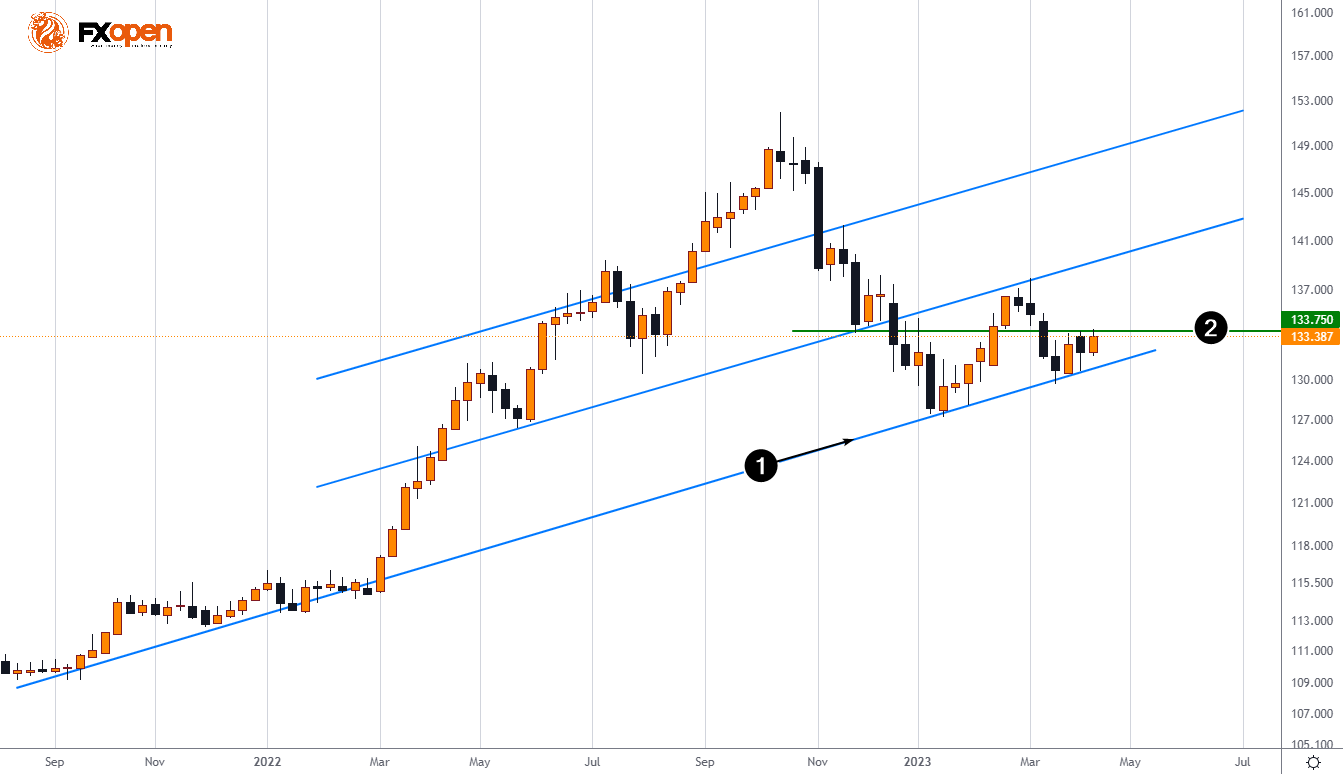
The USDJPY weekly chart may give the idea that the bulls are trying to revive a long-term uptrend from the support line (1). However, for this it is necessary to overcome the resistance (2) around 133.75, the level can serve as an indicator of the real strength of demand.
Dollar Index: Dollar Index Standing at the Back Foot Ahead of US Inflation Report
The dollar index edges lower on Tuesday, following a brief recovery in past few sessions, as markets return to business after Easter break.
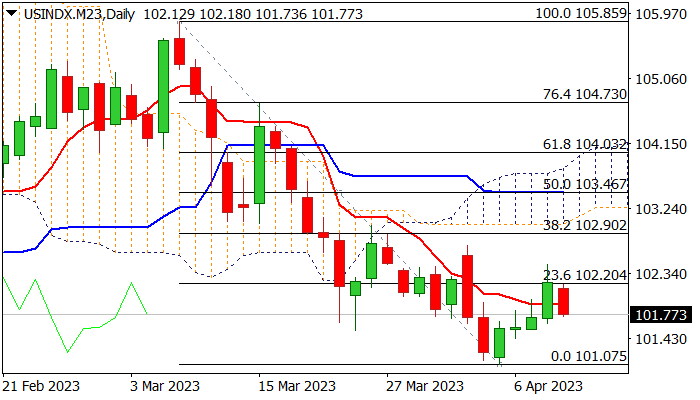
Bounce from new multi-week low at 101.07 (Apr 5) stalled at initial Fibo barrier at 102.20 (23.6% of 105.85/101.07 fall) , with today’s drop generating an initial signal of bull-trap.
Near-term action returned below daily Tenkan-sen (101.90) with daily close below, to increase pressure, as technical studies on daily chart remain in bearish setup (MA’s/negative momentum).
Markets turn focus on the US inflation report (due tomorrow) which will give more clues about Fed’s next steps and subsequently impact dollar’s performance.
Inflation in the US is expected to ease to 5.2% y/y in March from 6.0% in February, but core inflation, which excludes volatile components and is closely watched by the central bank, is forecasted at 5.6% in March vs 5.5% previous month.
Core CPI in line or above expectations would add to concerns that inflation is entrenched and more difficult to be curbed, which will contribute to current about 70% chance of 25 basis points hike on Fed’s May 3 policy meeting and offer fresh support to the greenback.
Conversely, the dollar could weaken if core CPI falls below expectations.
Initial supports lay at 101.50 zone, ahead of 101.07 pivot and more significant 100.66/00 (2023 low/psychological, while 102.20/46 (cracked Fibo 23.6%/Monday’s high) mark pivotal barriers, which guard 102.90/103.14 (Fibo 38.2%/daily Ichimoku cloud base).
Res: 102.20; 102.46; 102.90; 103.14.
Sup: 101.50; 101.00; 100.66; 100.00.
USD/CAD Steady, Bank of Canada Expected to Pause Again
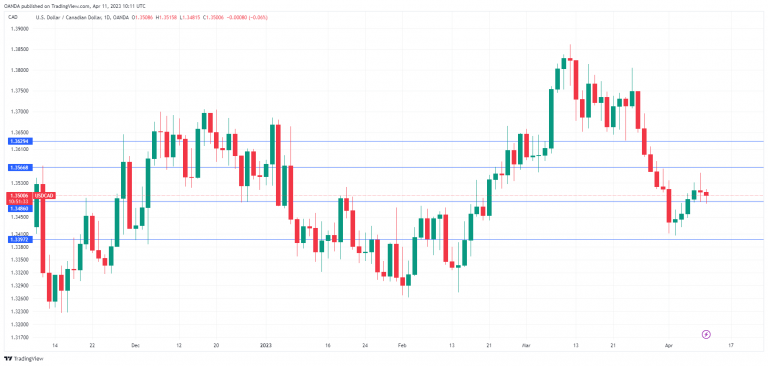
The Canadian dollar is almost unchanged, trading at 1.3501 in Europe. With no Canadian events and no tier-1 releases out of the US, we can expect a quiet day for USD/CAD. The markets will be listening closely as Fed members Goolsbee, Harker and Kashkari will speak. Wednesday should be much busier for the Canadian dollar, with key releases in both Canada and the US. The Bank of Canada will make a rate announcement and the US releases the inflation report for March.
Bank of Canada likely to hold rates
The Bank of Canada meets on Wednesday and is widely expected to pause rates for a second straight time, leaving the cash rate at 4.50%. Governor Macklem announced a “conditional pause” on rates, saying that the central bank would pause if warranted by the data. The key to the Bank’s rate path is inflation, which the central bank is committed to wrestling back to the target of 2%.
The battle against inflation is moving in the right direction, with CPI falling to 5.2% in February, down from 5.9% a month earlier. The employment market remains robust, with the economy adding 34,700 jobs in March, up from 21,800 in February. A rate hike would help cool the labour market but would dampen growth and hurt consumers and businesses which are struggling under the weight of high interest rates. With a pause being the likely decision, the tone of the rate statement could affect the movement of the Canadian dollar on Wednesday.
US inflation
The US releases March inflation on Wednesday. This will be the last CPI release prior to the Fed’s May 3rd meeting and will play a key factor in the Fed’s rate decision. Currently, the markets have priced in a 25-basis point hike at 67%, according to the CME Group, and an unexpected inflation reading will very likely lead to the repricing of rate hike bets. Inflation fell from 6.4% to 6.0% in February and is expected to ease to 5.4% in March.
USD/CAD Technical
- USD/CAD tested support at 1.3486 earlier today. Below, there is support at 1.3397
- 1.3566 and 1.3629 are the next resistance lines