Sample Category Title
Markets Didn’t Respond to the Numbers
Markets
German yields rebounded another 6.5 bps across the curve yesterday. US yields ended over 10 bps higher at the front end (2-3y) with gains at the longer end limited to 1-3 bps (10-30y). The European trading session went without a splash. Early US eco data included unexpectedly strong increases for both the March Richmond Fed Manufacturing index (-5 from -16 vs -10 expected) and consumer confidence (104.2 from 103.4 vs 101 expected). Details from the Richmond survey showed significant improvements in new orders and shipments and a more modest increase in employment. The forward looking part of the report suggests more wage pressure ahead with prices paid & received further mean reverting. The interesting part of the consumer confidence was that the survey date was March 20, in the midst of the regional banking crisis. The stronger number suggests that the strong labour market trumps any worries about potential consequences of the collapse of SVB and some others. On top, especially expectations for the future improved (+2.6). Just like PMI’s last Friday, markets didn’t respond to the numbers. For the moment, their reaction function is asymmetric. They need more convincing to shy away from the idea that central banks are at/very near the end of their policy normalization cycles. We stick to our view that more ground has to be covered. If not, central banks risk running behind the curve in the second half of this year. That suggest that more (hawkish) repositioning will follow if data hold their course. The first reference are EMU inflation numbers on Thursday and on Friday. The US Treasury continued its end-of-month refinancing operation yesterday with a $43bn 5-yr Note sale. The auction stopped through the WI yield with the bid cover in line with recent average (2.45). Overall, the auction thus fared better than Monday’s 2-yr Note auction. The Treasury sells $35bn 7-yr Notes tonight.
Yesterday’s bond sell-off no longer went hand-in-hand with rebounding stock markets. Main indices managed a slightly positive close in Europe and suffered small losses in the US. EUR/USD did extend Monday’s rebound with the pair finishing an inch away from 1.0850 compare to opening levels at 1.08. EUR/GBP closed broadly flat at 0.8790. We expect this week’s trading dynamics to remain at play today given the very thin eco calendar. We must add that the vigor already diminished yesterday compared to Monday and that it could weaken further still today. German/French consumer confidence and US pending home sales are the unattractive highlights. Central bank speeches remain a wildcard.
News & Views
Australian inflation eased from 7.4% to 6.8% in February, representing a bigger-than-expected deceleration. Core inflation retreated from 7.5% to 6.9%. Most components experienced milder yet still-high price increases. Housing (9.9%) and food (8%) showed the steepest inflation, followed by household furnishings (6.6% and) recreation (6.4%). Prices of education, insurance/financial services and alcohol & tobacco even accelerated again in year-on-year terms. The second monthly decline in a row strengthens the RBA’s view that inflation indeed peaked in Q4 last year. Odds for another rate hike diminished significantly in the wake of the recent turmoil on financial markets. With today’s data, markets not only assume a pause in the tightening cycle in April, in their view it is also the end. The RBA lifted rates by 350 bps to 3.6% over the past year. Australian swap yields ease 4.7-8.8 bps across the curve with the long end outperforming. The Aussie dollar holds steady around the 0.67 big figure.
Greek PM Mitsotakis called general elections for May 21. That’s two months earlier as the government suffers from a wave of protests over the country’s deadliest train crash in its history. Support for Mitsotakis’s ruling centre-right party has fallen. But the New Democracy party still has an opinion poll lead over Syriza, the main contender currently. The elections will be the first under the recently introduced system of proportional representation, making it difficult for a single party to form a government. If coalition talks fail, a second ballot under a semi-proportional system is expected to be held by the beginning of July at the latest.
EUR/USD Daily Outlook
Daily Pivots: (S1) 1.0811; (P) 1.0830; (R1) 1.0865; More...
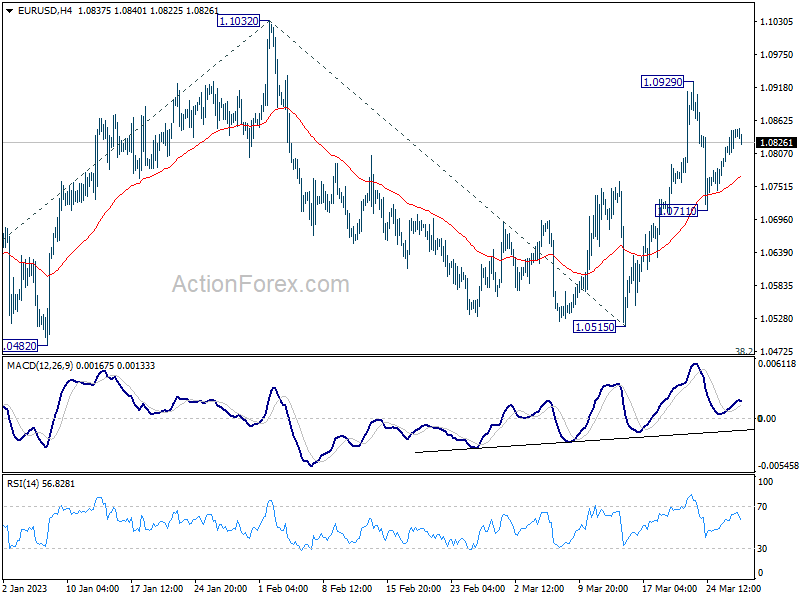
Intraday bias in EUR/USD remains neutral at this point. Further rally is in favor after receiving support from 4 hour 55 EMA (now at 1.1767). Break of 1.0929 will extend the rise from 1.0515 to retest 1.1032 high. Firm break there will resume larger up trend from 0.9534 to 1.1273 fibonacci level next. However, break of 1.0711 will turn bias to the downside to extend the corrective pattern from 1.1032 with another decline.
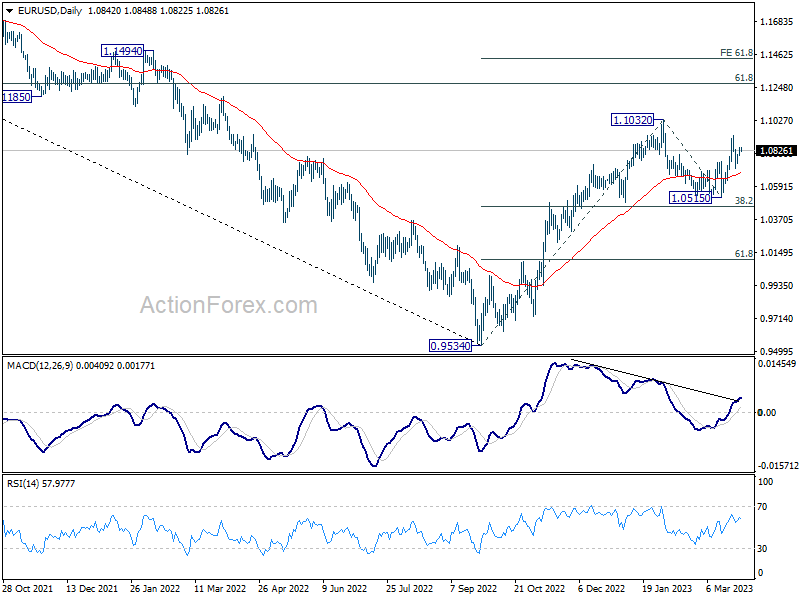
In the bigger picture, rise from 0.9534 (2022 low) is in progress with 38.2% retracement of 0.9534 to 1.1032 at 1.0460 intact. The strong support from 55 week EMA (now at 1.0623) was also a medium term bullish sign. Next target is 61.8% retracement of 1.2348 (2021 high) to 0.9534 at 1.1273. Sustained break there will solidity the case of bullish trend reversal and target 1.2348 resistance next (2021 high).
GBP/USD Daily Outlook
Daily Pivots: (S1) 1.2298; (P) 1.2324; (R1) 1.2366; More...
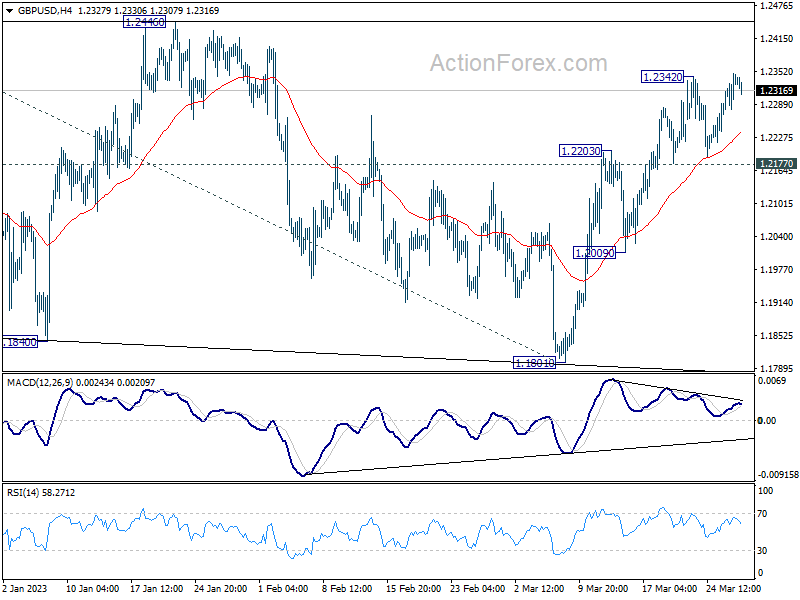
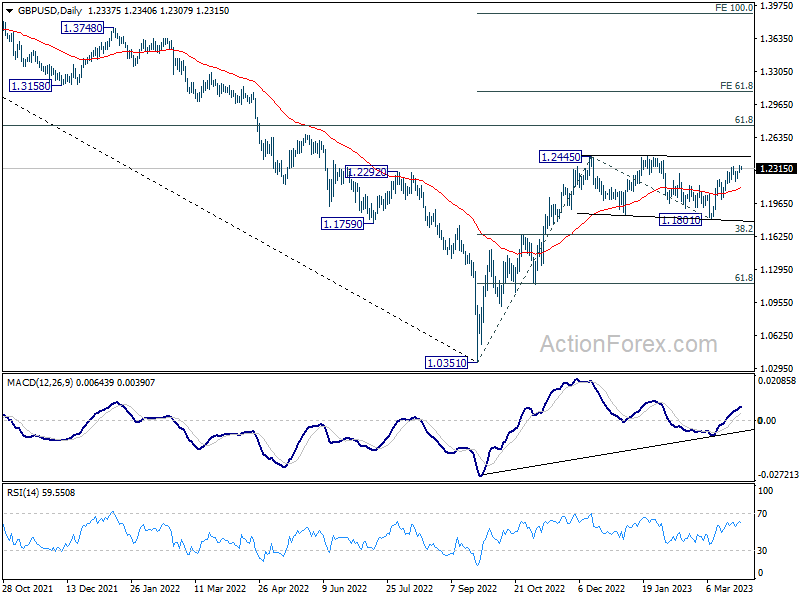
Break of 1.2342 suggests that rise from 1.1801 is resuming. Intraday bias is back on the upside for 1.2445/6 resistance zone. Firm break there will resume larger rally from 1.0351, and target 1.2759 fibonacci level. For now, near term outlook will remain bullish as long as 1.2177 support holds, even in case of another retreat.
In the bigger picture, price action from 1.2445 are seen as a corrective pattern to rise from 1.0351 medium term bottom (2022 low). Resumption of the rally from 1.0351 is expected and break of 1.2446 will target 61.8% retracement of 1.4248 (2021 high) to 1.0351 at 1.2759. This will remain the favored case as long as 38.2% retracement of 1.0351 to 1.2445 at 1.1645 holds.
USD/CHF Daily Outlook
Daily Pivots: (S1) 0.9148; (P) 0.9185; (R1) 0.9234; More...
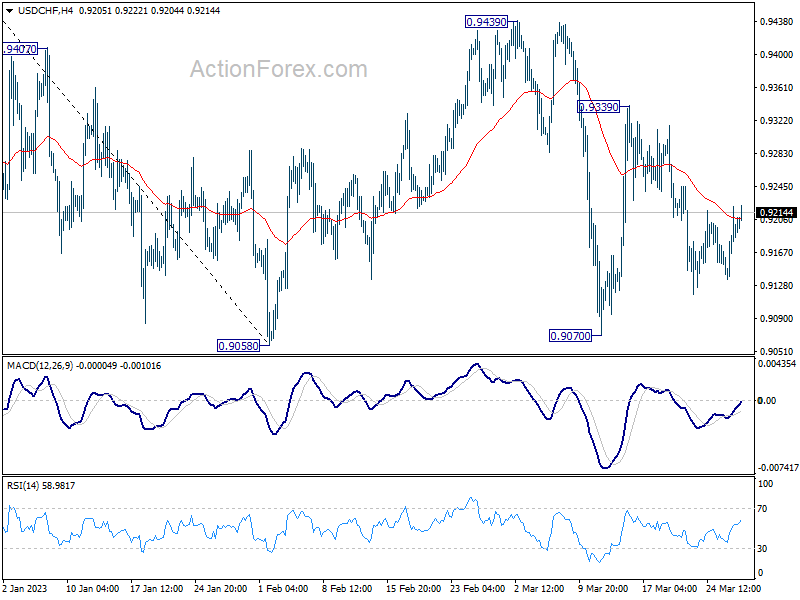
Range trading continues in USD/CHF and intraday bias remains neutral. Corrective pattern from 0.9058 low is extending. Another rise cannot be ruled out, but upside should be limited by 0.9474 fibonacci level. On the downside, firm break of 0.9058 will resume larger down trend from 1.1046.
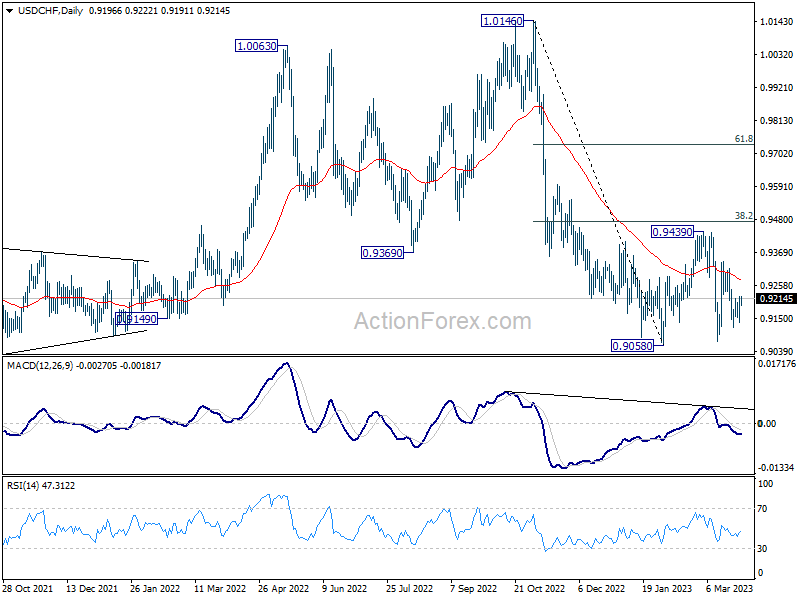
In the bigger picture, fall from 1.1046 (2022 high) should still be in progress with 38.2% retracement of 1.0146 to 0.9058 at 0.9474 intact. Prior rejection by 55 week EMA was a medium term bearish sign. Break of 0.9058 will resume such decline towards 0.8756 support (2021 low). But overall, this fall is still as a leg in the long term range pattern from 1.0342 (2016 high). So, downside should be contained by 0.8756 to bring reversal.
USD/JPY Daily Outlook
Daily Pivots: (S1) 130.34; (P) 130.97; (R1) 131.54; More...
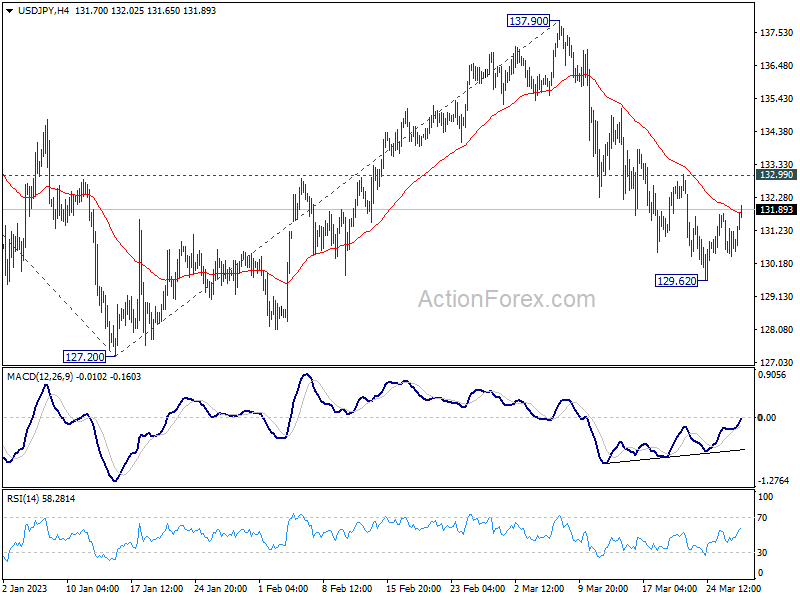
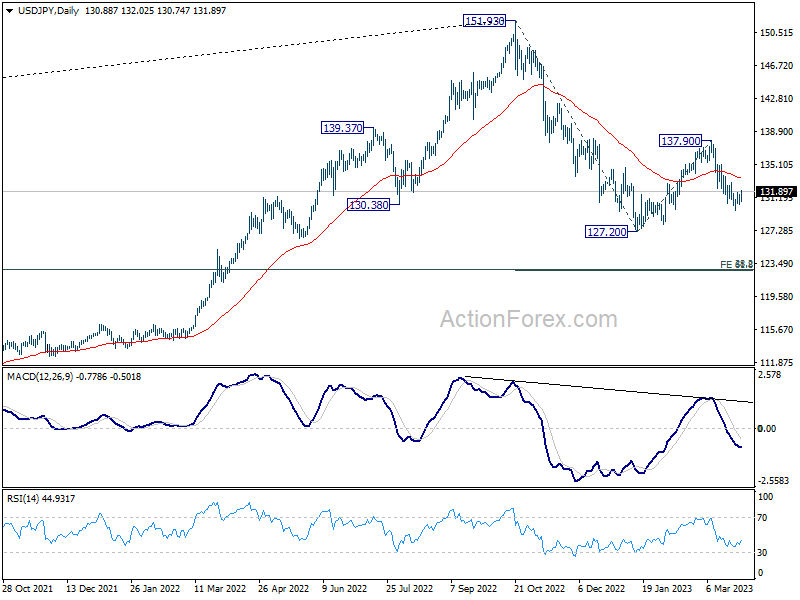
Intraday bias in USD/JPY remains neutral as corrective pattern from 129.62 is in progress. With 132.99 resistance intact, outlook stays bearish. On the downside, break of 129.62 will target a test on 127.20 low. Decisive break there will resume larger decline from 151.93 to 61.8% projection of 151.93 to 127.20 from 137.90 at 122.61.
In the bigger picture, rebound from 127.20 should have completed at 137.90 as a corrective move. The down trend from 151.93 (2022 high) is still in progress. Break of 127.20 will resume this down trend and target 61.8% projection of 151.93 to 127.20 from 137.90 at 122.61. This will now be the favored case as long as 137.90 resistance holds.
AUD/USD Daily Report
Daily Pivots: (S1) 0.6665; (P) 0.6688; (R1) 0.6730; More...
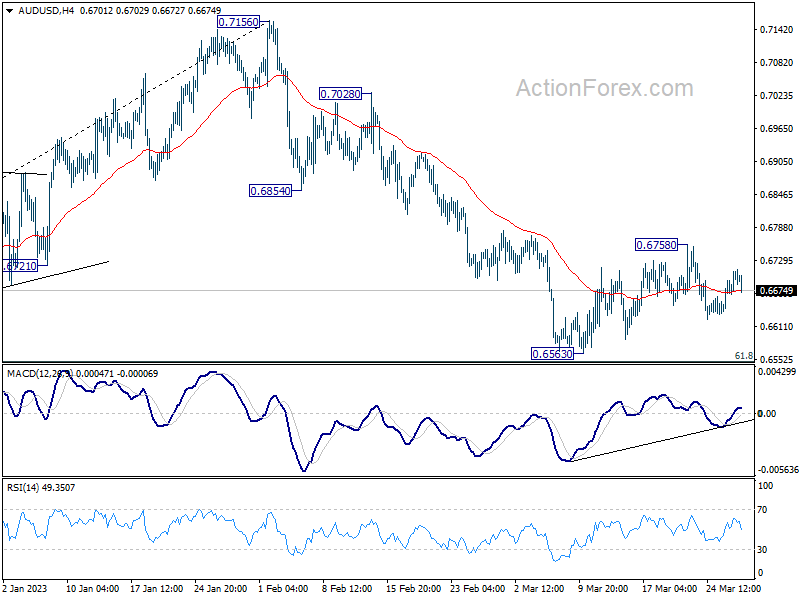
AUD/USD is staying in consolidation from 0.6563 and intraday bias remains neutral first. Deeper decline is in favor as long as 0.6758 resistance holds. On the downside, decisive break of 0.6546 fibonacci level will carry larger bearish implication. On the upside, however, break of 0.6758 resistance will now be a strong signal of bullish reversal and turn bias back to the upside.
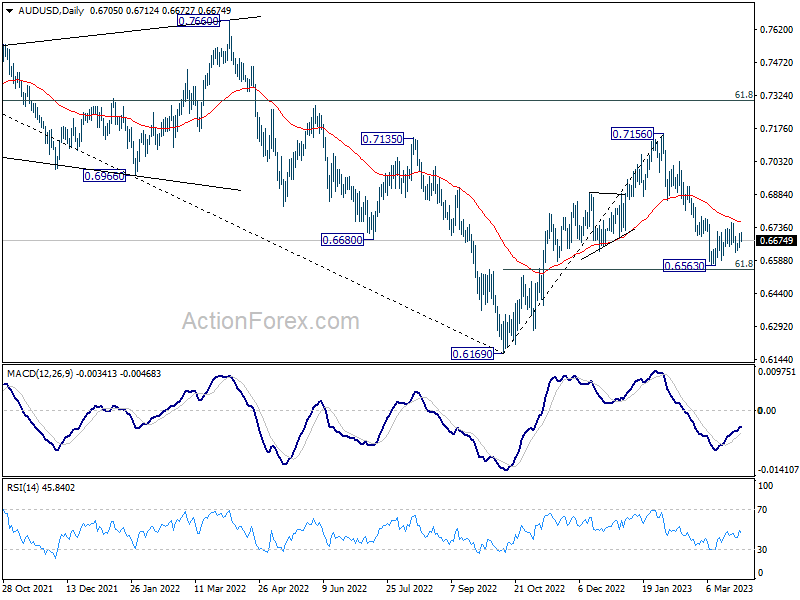
In the bigger picture, as long as 61.8% retracement of 0.6169 to 0.7156 at 0.6546 holds, the decline from 0.7156 is seen as a correction to rally from 0.6169 (2022 low) only. Another rise should still be seen through 0.7156 at a later stage. However, sustained break of 0.6546 will raise the chance of long term down trend resumption through 0.6169 low.
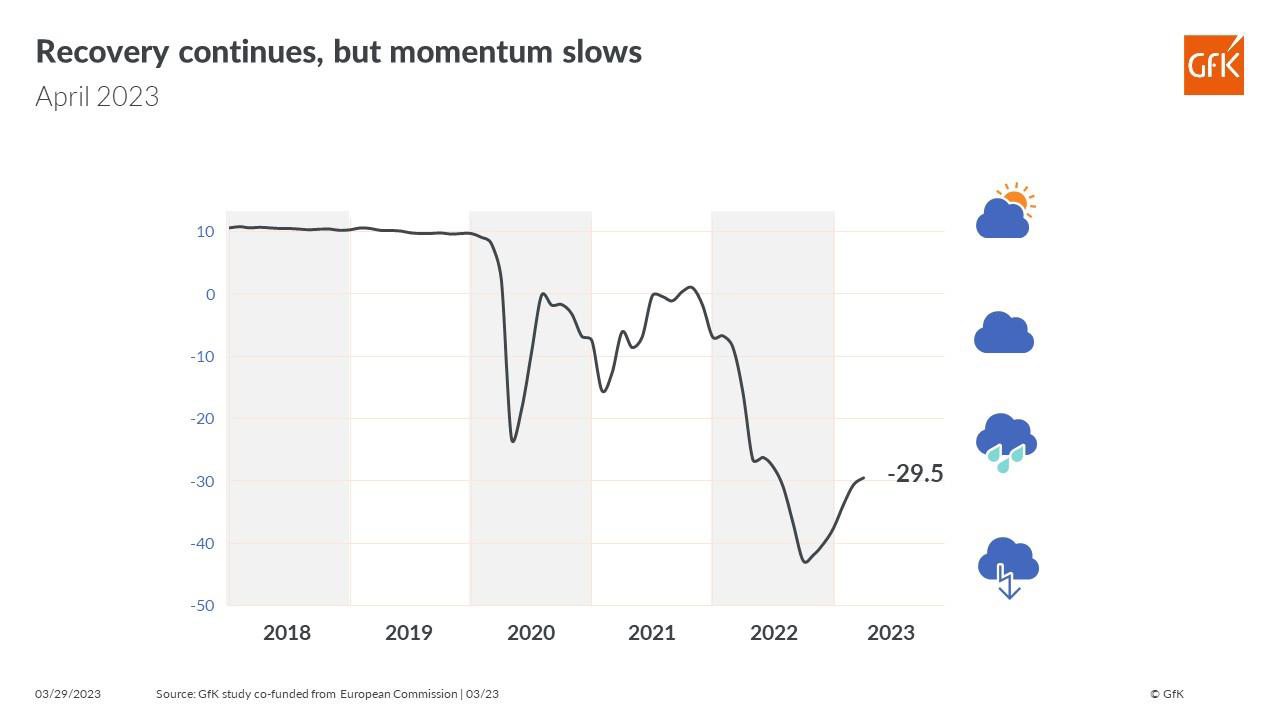
Germany Gfk consumer sentiment ticked up to -29.5, hindered by purchasing power concerns
Germany's GfK consumer sentiment index for April posted a modest improvement for the sixth consecutive month, rising from -30.6 to -29.5, although it fell short of the expected -29.0. In March, economic expectations for dipped from 6.0 to 3.7, while income expectations increased from -27.3 to -24.3. Propensity to buy also saw a slight uptick from -17.3 to -17.0.
GfK consumer expert Rolf Bürkl attributes the improved income expectations to the recent decline in energy prices, particularly for gas and heating oil. However, Bürkl cautions that inflation will remain elevated this year, albeit lower than the 6.9% recorded in 2022.
He explains, "The expected loss of purchasing power is preventing a sustained recovery in domestic demand. Accordingly, private consumption is unlikely to make a positive contribution to economic growth in Germany this year." This outlook is reinforced by the persistently low level of consumer sentiment.
Inflation in Australia Slows More than Expected
Investor sentiment improves as price action in bank stocks point at waning stress.
Treasuries give back gains on the back of weaker risk aversion. The German 2-year yield is back to around 2.60% - after falling to around 2% during the worse of the latest banking stress, while the US 2-year yield settles above the 4% mark.
The S&P500 and Nasdaq come under the pressure of rising yields, which means – if banking stress wanes, the US will go back to fighting inflation, and that could mean another 25bp hike from the Federal Reserve (Fed) in May.
For now, activity on Fed funds futures still point at ‘no hike’ as base-case scenario, with around 60% chance for status quo. But we know that, the pricing could change rapidly in case of a strong US GDP update on Thursday, and a disappointing PCE read on Friday.
End of the beans?
The S&P500 – which benefited from falling yields due to the Silicon Valley Bank (SVB) collapse - is now sitting above the 200-DMA. But a move above the 4000-4200 range will likely be challenging unless the next earnings season comes with a positive surprise. Therefore, we could see gains in the S&P500 rapidly fade if the US yields trend higher with the waning bank stress.
But maybe not today!
Investor mood in Asia was not bad this Wednesday. Alibaba – which jumped more than 14% in New York yesterday, boosted sentiment in Hong Kong. Investors loved the idea that the $220 billion worth Alibaba would be split into 6 little AliBabas which could then be individual units with capacity to raise funds and explore IPOs.
In FX
It could be time for the US dollar to halt selloff and consider a potential rebound, if the US yields recover a part of losses related to bank stress.
The latter could slow the EURUSD’s positive momentum, but the euro is still expected to benefit from the European Central Bank’s (ECB) strong determination to abate inflation despite the bank worries.
From tomorrow, the most recent eurozone inflation figures for March will start coming in. On Friday, the Eurozone’s March preliminary CPI will tell whether the base-effect magic will finally operate. The Eurozone inflation is expected to fall from 8.5% to 7.1% from last March - the first full war month of last year. And soft inflation, if soft enough, could soften the ECB expectations and get some bears to sell the euro. But the medium-term outlook for the EURUSD remains positive.
Elsewhere, inflation in Australia fell more than expected in February, from 7.4% to 6.8%, versus 7.1% expected by analysts. The AUDUSD fell on the back of a broadly stronger US dollar and a softer-than-expected CPI read that fueled dovish Reserve Bank of Australia (RBA) expectations.
In the UK, however, shop prices rose 8.9% this month, a record high going back to 2005 when the data was first collected, and grocery inflation hit a fresh high of 17.5%. Rising UK inflation fuels the Bank of England (BoE) hawks. Sterling bulls have their eyes set on the $1.25 target. But a potential recovery in the US dollar posterior to the bank stress could build a solid wall of resistance at this level.
US Consumer Confidence Surprising Positively
Market movers today
Another day with a thin data calendar. February Retail Sales will be released for Sweden and Norway this morning.
Norwegian retail sales bounced back a bit in January after the sharp fall in December, but the underlying trend is still down, thanks to a combination of reduced purchasing power and the shift towards services after the economy reopened in spring 2022. Figures from BankAxept for card purchases in February suggest that spending dropped back again slightly, so we expect retail sales to fall 0.8% m/m, continuing the underlying downward trend.
In Sweden retail sales figures as well as NIER business and household survey to be published in Sweden. The latest NIER survey from February showed a slight improvement for corporates, with better order inflow and slightly higher hiring plans than during January. Retail sales figures on the other hand reflected a direr picture last month. We expect today's number to confirm the image of increasingly pressed Swedish households and a corporate sector that holds up surprisingly well.
The Czech National Bank is expected to leave rates unchanged in its meeting today.
ECB's Schnabel will be on the wires late in the evening, while the Fed's Barr testifies to the US House financial services committee on bank oversight.
The 60 second overview
Market recap: It has been fairly quiet overnight with most notably Chinese equities performing well following news of a revamp of Alibaba Group Holdings. AUD rates are a little lower as Australian CPI released overnight fell short of market expectations with headline inflation falling from 7.4% Y/Y in January to 6.8% in February. Equity futures are generally trading modestly in green while yields are a little higher. Commodities are little changed.
US economic data surprising positively. Yesterday's release of the Conference Board's consumer confidence index revealed a surprise rise in the main index from 103.4 to 104.2. Following recent market jitters and renewed focus on the risk of a US recession consumer confidence was widely expected to drop considerably. Hence the release was a clear positive surprise likely reflecting how US consumers still enjoy a strong job market situation even if a slightly smaller share of respondents now find "jobs plentiful" compared to one month ago.
CDS trade. Last Friday's trading session was dominated by surging European bank concerns amid a sudden focus on Deutsche Bank. Since Friday market commentators have been looking for reasons why Deutsche Bank suddenly took centre stage without any obvious triggers or headlines hitting markets. Now market consensus seems to settle on a large single trade in the fairly illiquid Deutsche Bank 5Y credit default swap - a derivative offering protection against default - which seemingly sent the price soaring and drove widespread panic and concern in banking stocks, rates and equity markets in general.
Since Friday German and European regulators have underlined an increased focus on risks but also that they believe the banking sector is in a solid shape and much better capitalised than in 2007 and 2008.
Hungary central bank. Yesterday the Hungarian central bank (MNB) kept policy rates unchanged - i.e. benchmark rate of 13.0% and one-day deposit rate of 18.0%. While this was largely expected the HUF still gained strongly as the MNB argued against Primer Minister Orban's urge for rate cuts. The MNB argued that a "trend-like improvement" to the risk assessment is necessary before considering making changes to the current policy setting which at this stage is "not on the agenda" according to Deputy Governor Virag.
Equities: Global equities slightly higher yesterday despite US markets dragging the overall performance lower. Once again it was value driven outperformance and partly defensive as the energy sector was outperforming. Higher yields the natural candidate for growth stocks to struggle. Worth noting, VIX lower again yesterday and now below 20. Implied equity vol is now back around the level before the SVB driven vol spike. The same cannot yet be said about bond vol though it is moving lower as well. In US Dow -0.1%, S&P 500 -0.2%, Nasdaq -0.5% and Russell 2000 -0.1%. Asian markets mostly higher this morning driven by the Chinese stock trade in Hong Kong. US and core European futures in green as well this morning. Credit: Sentiment remains fragile in credit markets and yesterday iTraxx Xover tightened 3.2bp, closing at 486.6bp, while iTraxx Main tightened insignificantly 0.6bp to close at 95.5bp. The primary market continues to be active with several mandates announced throughout the day.
FI: The normalisation in both rates and equities continues with rates rising as the focus returns to the high inflation numbers and the sentiment shift from "risk-off" to "risk-on". 10Y Treasury yields rose 4bp, while 2Y Treasuries rose 13bp.
FX: In a session characterised by further banking-fear relief cyclically sensitive and commodity currencies were generally the big outperformers. HUF was the biggest winner following the MNB rate decision and higher European bank stocks. EUR/USD is back around the 1.0850-levels which is where the cross traded prior to Friday's Deutsche Bank fears.
USD/CAD Daily Outlook
Daily Pivots: (S1) 1.3562; (P) 1.3628; (R1) 1.3665; More....
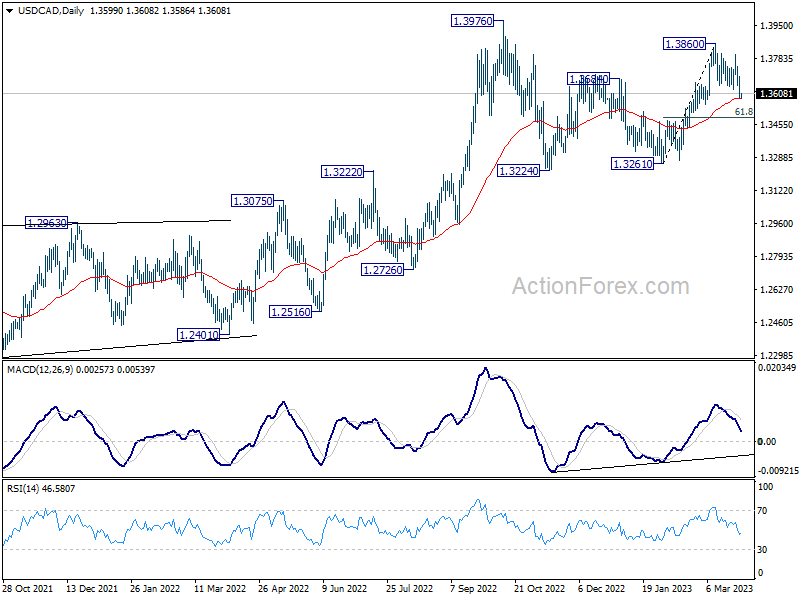
USD/CAD's break of 1.3629 support indicates that deeper pull back in underway. Intraday bias is back and break of 55 day EMA (now at 1.3586) will target 61.8% retracement of 1.3261 to 1.3860 at 1.3490. On the upside, above 1.3694 minor resistance will turn intraday bias neutral first. Overall, the corrective pattern from 1.3976 could be extending with another falling leg from 1.3860.
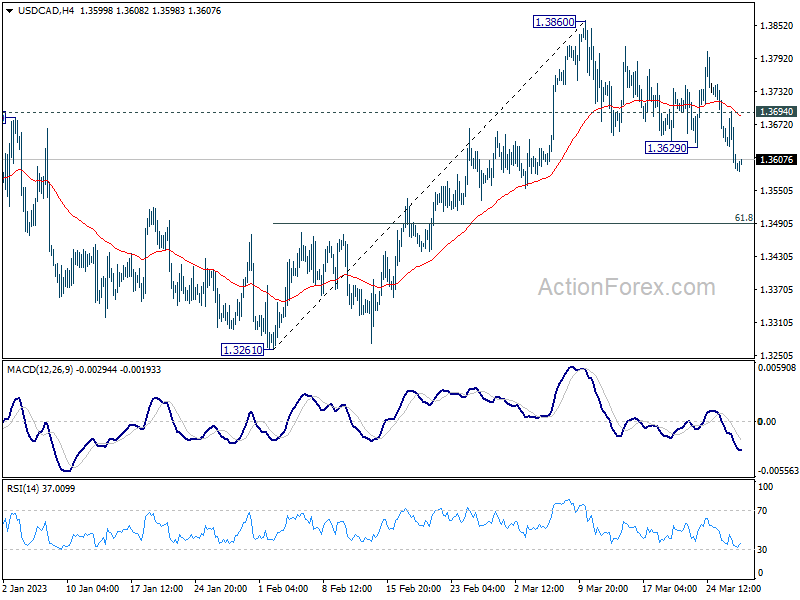
In the bigger picture, the up trend from 1.2005 (2021 low) is still in progress. Break of 1.3976 will confirm resumption and target 61.8% projection of 1.2401 to 1.3976 from 1.3261 at 1.4234. Firm break there will pave the way to long term resistance zone at 1.4667/89 (2016, 2020 highs). On the downside, break of 1.3261 support is needed to confirm medium term topping. Otherwise, outlook will remain bullish even in case of deep pull back.