Sample Category Title
An Upside Inflation Surprise Could Not Come at a Better Time for Yen Bulls
With the rest of the world almost reliving the 2007-08 events, the Japanese developments were mostly under the market radar. This is not atypical, but as we get closer to the Bank of Japan governorship handout the market will start to pay attention to Japanese news. Yen bulls have been enjoying the recent moves, but for the next leg they need concrete economic evidence. Hence, all eyes may be on Friday’s busy calendar with the Tokyo inflation figures being the highlight release.
What has been happening in Japan lately?
As the market got fixated on the banking sector shenanigans that eventually led to the demise of the once-too-big-to-fail Credit Suisse, the Japanese news were treated as non-events. To be fair, the data releases have been on the mixed side and the last BoJ meeting on March 10 proved to be dull. Outgoing governor Kuroda decided to pass the baton to the incoming BoJ chief Ueda without any amendments to the current monetary policy framework or the forward guidance. However, there was very positive news from the Shunto wage negotiations. A number of key firms including Mitsubishi Heavy Industries and Toyota not only fully agreed with the demands of their respective labour unions, but also did so in record time. Honda, for example, completed the negotiations at the fastest time since the 1990s. The end-product up to now has been significant, above inflation, increases in workers’ pay that should be music to the ears of the BoJ members.
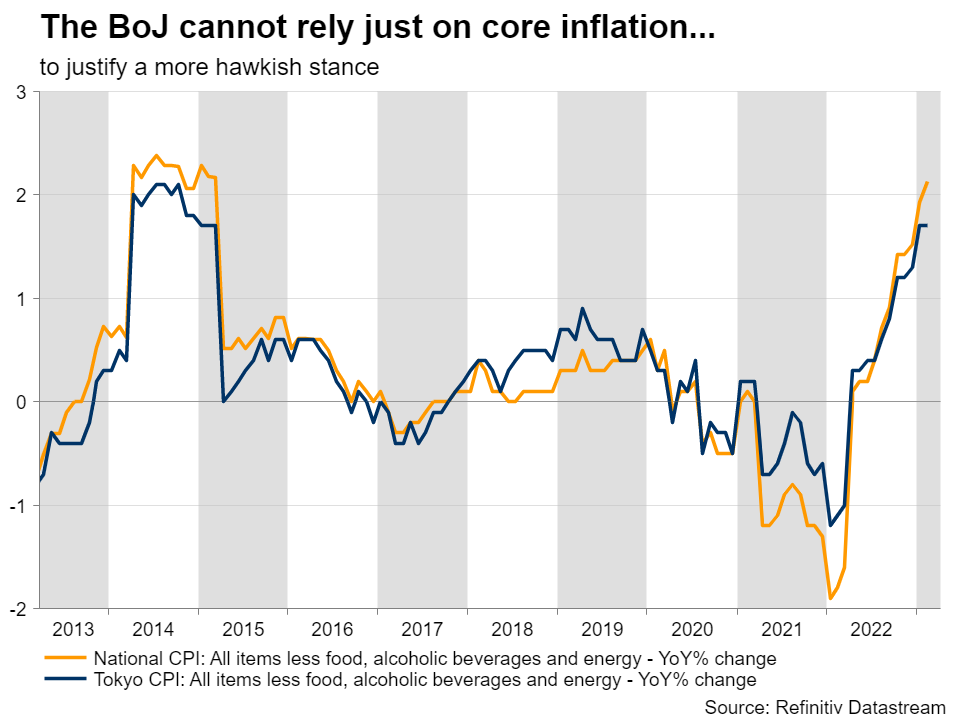
The key point going forward is whether this higher-wages momentum will translate into stronger consumer sentiment. As repeatedly highlighted, Japan has not been plagued by double digit inflation rates seen in other developed countries. However, the headline CPI moved to the highest year-on-year rate since the early 1990s and the core component recorded its strongest yearly increase since early 1980. But apart from the January adjustment at the yield curve control (YCC), the BoJ has not really amended its monetary policy stance, essentially abandoning the yen to foreign market forces.
Tokyo CPI frontrunning the nationwide print
The national CPI print for February showed a full percentage drop in the yearly rate of increase, from 4.3% to 3.3%. While globally we have seen some signs of inflation cooling off, particularly in the US and the euro area, the magnitude of the drop in Japan was clearly not anticipated. Similarly, the core component dropped to a yearly level not seen since September 2022, even though the rest of the world is facing stickier-than-expected-core inflation, and hence complicating the reaction function of the key central banks. On Friday, we get the March Tokyo headline and core CPI figures, an early preview of the current national inflation pressures. The market is looking for further easing in both indicators, which means that inflation is abating. If these forecasts are indeed confirmed, then it would be difficult for the new BoJ leadership to change dramatically the current mixture on monetary policy. The national aggregate inflation print is scheduled for release on April 20, a week before the first BoJ meeting under Ueda.
Decent retail sales growth despite low consumer confidence
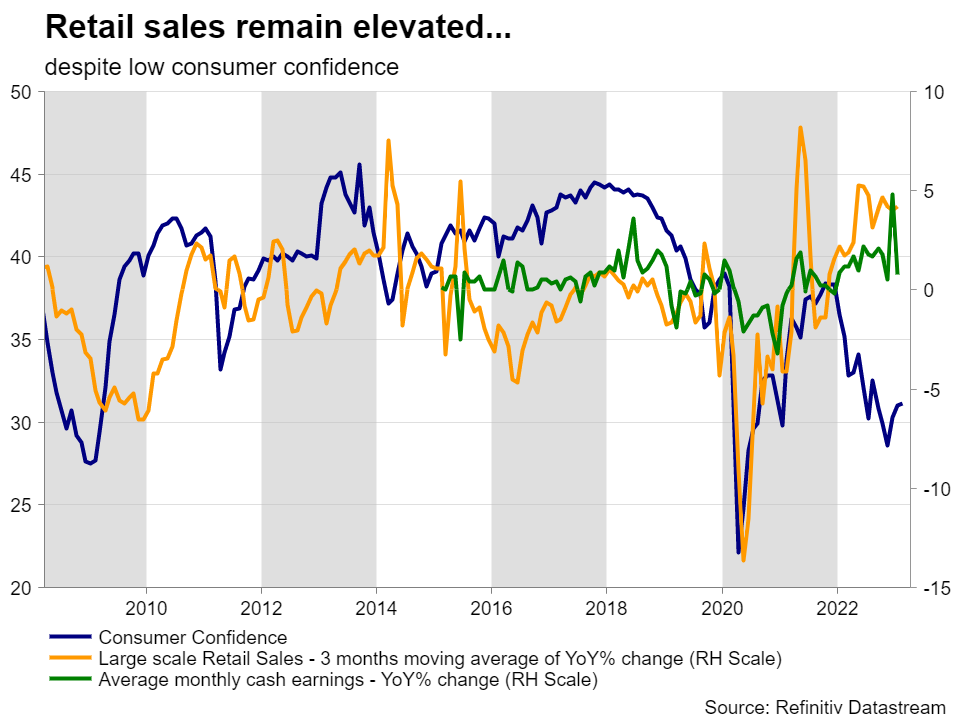
While the rest of the central banks have been almost exclusively focusing on CPI, the BoJ has been all over the consumer spending data. The ongoing disparity between the retail sales figures and consumer confidence remains significant. While the latter has dropped aggressively and hovers around low levels, retail sales growth remains elevated. This gap is even more evident when analyzing the large-scale retail shops data. Putting aside the volatile nature of the sales dataset, history points to a possible correction in retail sales ahead. However, the recent wage increases agreed should support retail sales going forward, and lead to some degree of correction in the consumer appetite. But this tendency is expected to be seen in next month’s figures, thus raising the possibility for a downside surprise on Friday.
Industrial production raises question about GDP growth
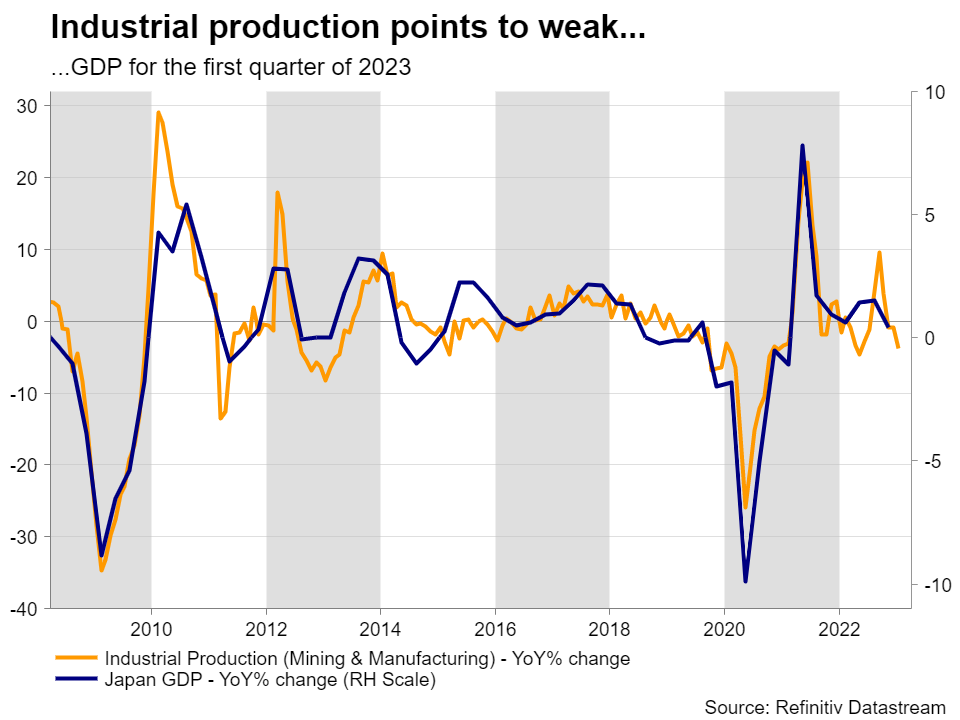
With the final fourth-quarter GDP report disappointing on March 9 and revealing an almost stagnant economy, the market would be looking closely at the preliminary March industrial production data on Friday morning. Up to now, the Q1 figures have been quite disheartening and another negative print means that the market could almost completely write off any hawkish expectations for the next BoJ meetings. In addition, questions will multiply regarding the true extent of the Chinese reopening, and its much-anticipated impact on goods demand and supply lines globally.
Yen’s fate determined by foreign forces
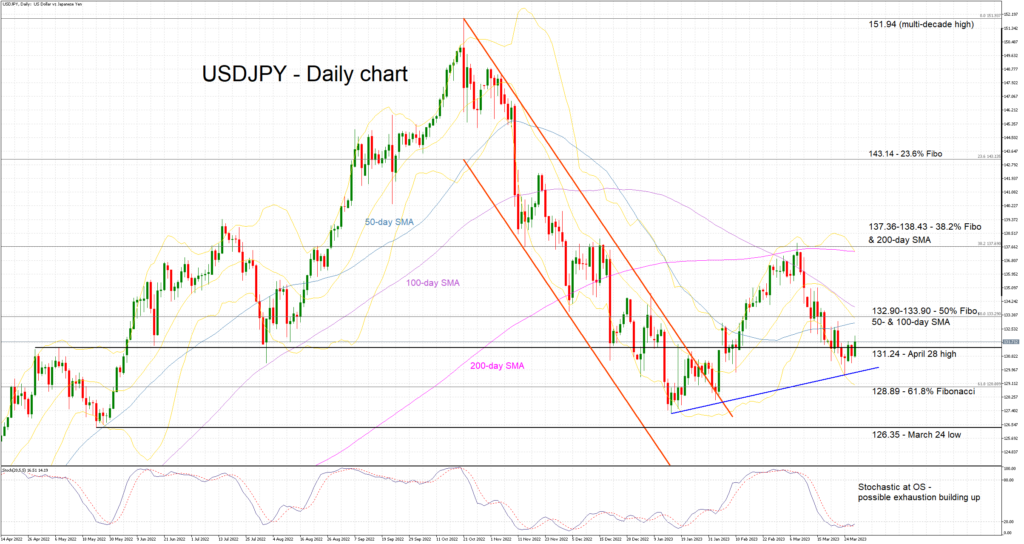
Yen has been one of the beneficiaries of the banking sector woes. Following a negative 3-month spell, the yen managed to record gains against both the euro and US dollar, a typical reaction in the risk-off sentiment seen earlier in March. As we return to more normal conditions and the market refocuses on the economic outlook, the yen underperformance is likely to resume. However, we are currently in a much different world to the early March situation, and hence yen bears should be satisfied with moderate gains in the dollar/yen pair. The overall technical set-up looks favourable for them as the stochastic is preparing for an upward move, signaling the possible start of another rally. The 132.90-133.90 range is a key area for momentum, and if successfully tackled by the yen bears, an aggressive push towards the early March highs could be possible.
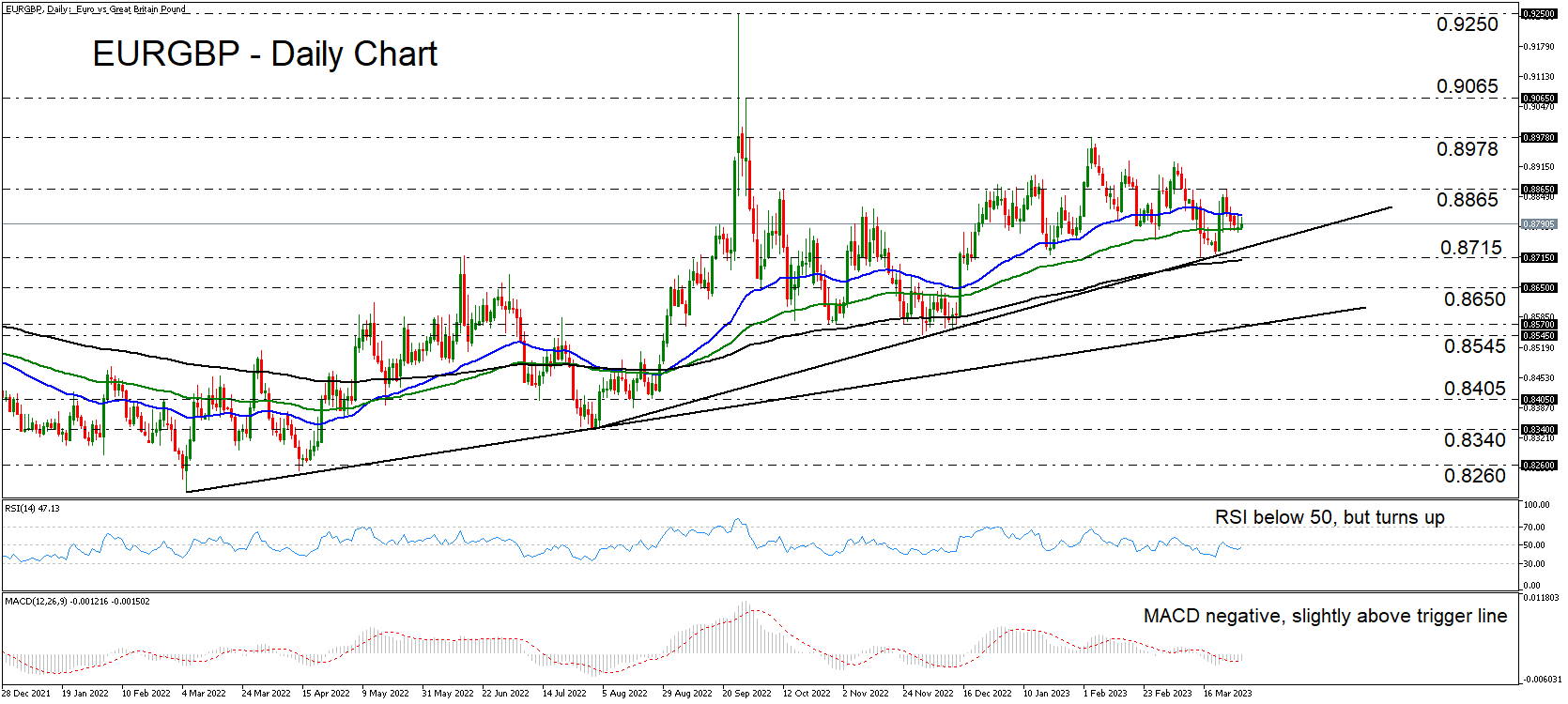
EURGBP Pulls Back But Stays Above Uptrend Line
EURGBP entered a sliding mode last week, but the retreat stopped near the 100-day exponential moving average (EMA) just yesterday. The pair continues to trade above the uptrend line drawn from the low of August 3, which means that the chances for the bulls to take charge again soon are decent.
Both the short-term momentum indicators corroborate that view. The RSI, although marginally negative, has turned up, while the MACD is lying below zero, but above its trigger line, pointing slightly up as well.
A decisive break above the high of March 23 at 0.8865 might confirm that the bulls are back in the driver’s seat and could thereby pave the way towards the peak of February 3 at 0.8978. If they are not willing to stop there, they could then extend their march towards the 0.9065 territory, defined as resistance by the high of September 28.
On the downside, even if the bears manage to push the action below the aforementioned uptrend line, they will still have to face another, longer-term, upward-sloping line drawn from the low of March 7, 2022. Thus, a dip below that line and the 0.8545 area may be needed for the near-term picture to turn overly negative. Should that happen, the sellers may feel confident to aim for the 0.8405 area, marked by the low of August 24.
To wrap up, EURGBP pulled back last week, but the slide was stopped near the 100-day EMA, above the uptrend line drawn from the low of August 3. This likely keeps the bulls in the game, with a break above 0.8865 potentially confirming their ascendancy.
German Consumer Climate Continues to Recover
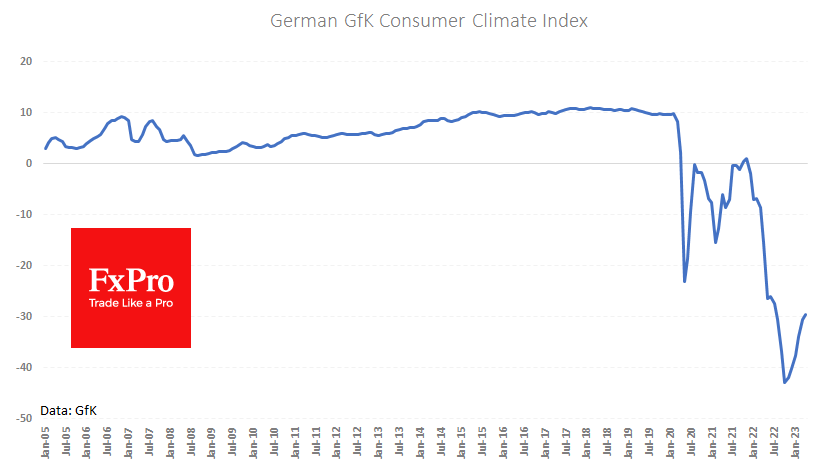
The GfK consumer climate index for Germany rose by 1.1 points to -29.5 in April, a very low level by historical standards and still below the lows of the pandemic in the year 2020. Sentiment has been improving since October, allowing talk of a recovery from the inflation and energy shock in Europe’s largest economy, although the pace of recovery has slowed.
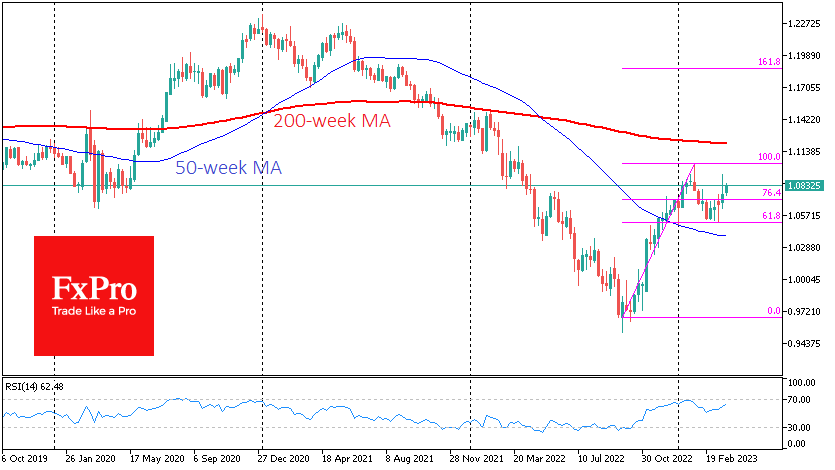
Interestingly, the turnaround in consumer sentiment coincided with a “bottom” in EURUSD. The single currency rallied strongly in the final quarter of last year, briefly topping 1.10 in early February before a technical correction. In the second half of March, the single currency recovered against the dollar, despite selling pressure from Credit Suisse and Deutsche Bank.
We believe this interest in the single currency correlates with rising business and consumer sentiment indices. The economic recovery will allow the ECB to maintain a tighter monetary policy.
Assuming a positive correlation between consumer sentiment and the EURUSD exchange rate, we expect the #1 currency pair to continue its upward trend but with a much more subdued amplitude than at the end of last year. As early as April, the euro could fully emerge from its correction and rise above 1.10, but it is unlikely to exceed 1.12 in the year’s first half.
Dollar Index: Dollar Starts to Gain Traction But Remains Overall Bearish
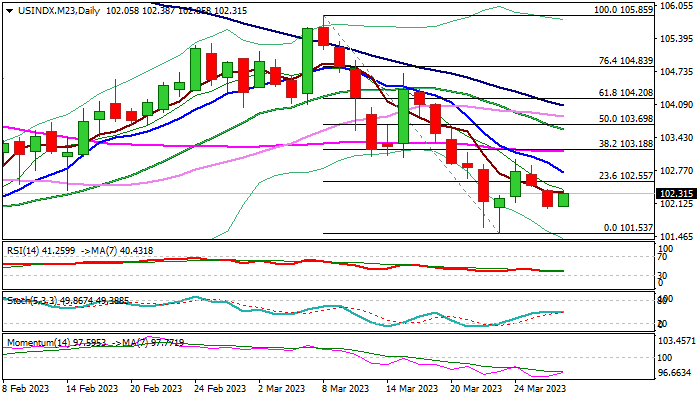
The dollar index regained some ground on Wednesday following strong drop in past two days, on calmer tones over recent turbulence in banking sector and growing hopes that deeper crisis can be averted.
However, investors remain cautious, as recent issues in US banks are expected to continue to strongly influence the dollar, with any signals of further calming of the situation or new cracks in the banking system, to spark stronger movements of the US currency.
Technical picture on daily chart is still bearish, suggesting that limited recovery is likely to precede fresh push lower.
Initial resistance lays at 102.73 (falling 10DMA) guarding upper pivots at 103.15/18 (55DMA/Fibo 38.2% of 105.85/101.53), which should cap upticks to keep bears in play.
Res: 102.55; 102.73; 103.18; 103.70.
Sup: 102.02; 101.88; 101.53; 101.00.
USD/CHF – Swiss Franc Steady after Economic Expectations Slide
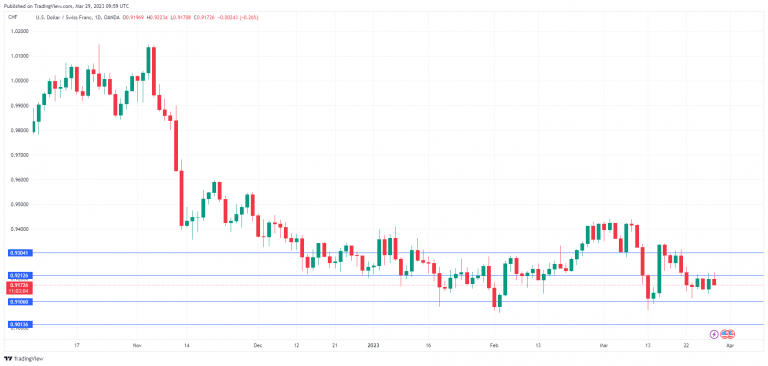
The Swiss franc has edged higher on Wednesday. USD/CHF is trading at 0.9176 in the European session, down 0.23%. The ZEW Economic Expectations index fell sharply to -43.3 points. In the US, CB Consumer Confidence improved to 1o4.2 points.
Banking crisis sends Swiss economic expectations crashing lower
The banking crisis has eased after causing market turmoil across the globe. Switzerland’s banking sector has taken a hit, as Credit Suisse, the country’s second-largest bank, collapsed and had to be rescued by rival UBS, with the Swiss government injecting some $108 billion to ensure that the takeover is completed. The reputation of the Swiss banking system has been badly tarnished and the fallout will likely have a negative impact on the Swiss economy.
Even before the banking crisis, the Swiss economy was sputtering. GDP was flat in Q4 of 2022, as a weak global economy meant less demand for Swiss exports. The economy was expected to grow by 1.1% in 2023, lower than average growth, and that figure could well be revised lower due to the banking crisis. Inflation hit 3.5% in 2022, much lower than in other major economies but high for Switzerland. The Swiss National Bank has tried to curb inflation with higher interest rates and delivered a 50-basis point hike earlier this month.
ZEW Economic Expectations has been mired deep in negative territory for over a year, but showed a significant improvement in January, rising from -40.0 to -12.3 points. The February reading, released today, came in at -41.3, as the January improvement was short-lived. We’ll get another snapshot of the strength of the Swiss economy on Friday, with the release of retail sales and the KOF Economic Barometer.
In the US, consumers have been concerned about their bank deposits and the stability of the banking system. Despite these worries, the Conference Board Consumer Confidence index improved to 104.2 in March, up from an upwardly revised 103.4 prior. Consumer expectations also rose, from 73.0 to 74.0 points. If the banking crisis does not worsen, the strong consumer expectation numbers should translate into increased consumer spending.
USD/CHF Technical
- USD/CHF tested resistance at 0.9212 earlier in the day. The next resistance line is 0.9304
- 0.9106 and 0.9014 are providing support
ECB Lane indicates more hikes needed to tame inflation
ECB Chief Economist Philip Lane, in an interview with German newspaper Die Zeit, emphasized the necessity for further interest rate hikes to ensure that inflation returns to the 2% target. Lane stated, "Under our baseline scenario, in order to make sure inflation comes down to 2%, more hikes will be needed."
He also suggested that even in cases of limited financial stress, interest rates would still need to rise. "If the financial stress we see is non-zero, but turns out to be still fairly limited, interest rates will still need to go up," he said.
Meanwhjile, Lane expressed optimism about moderating price pressures at earlier stages of production, which are expected to eventually impact consumer prices. "If you look at the earlier stages of production, at the farm gate prices, at the prices of the food ingredients, you will recognize: all of these have turned around," he said.
The chief economist also dismissed the notion that a recession is required to bring inflation down, asserting that a soft landing for the economy is possible. Lane believes that the pandemic recovery can continue alongside decreasing inflation, as he noted, "We've lost so much growth momentum in the pandemic that it's possible for the pandemic recovery to continue and for inflation to come down simultaneously."
AUD/USD – Aussie Falls as Inflation Dips
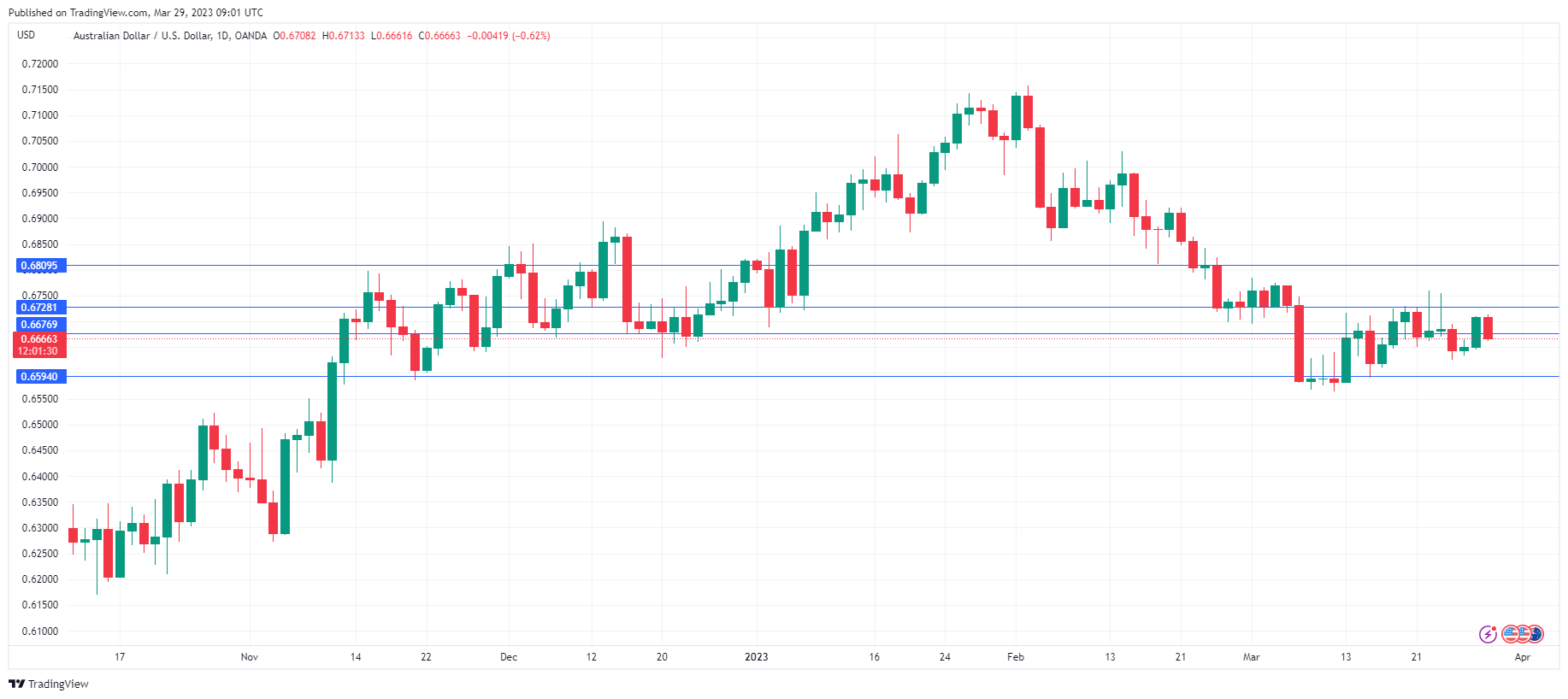
The Australian dollar is trading at 0.6670 in Europe, down 0.57%. Australian inflation was lower than expected, raising speculation that the Reserve Bank of Australia might pause at its April meeting.
RBA keeping eye on retail sales and inflation ahead of rate meeting
Australia’s inflation rate for February eased to 6.7% y/y, down from 7.4% prior and the 7.2% estimate. It may be too early to declare that inflation has peaked, but there’s no question that inflation is heading in the right direction. That is good news for businesses and households, which have been hurt by the double-punch of high inflation and rising interest rates.
The unexpected sharp drop in inflation likely has cemented the RBA pausing at the April 4th meeting, and that is weighing on the Australian dollar today. RBA Governor Lowe had said that this week’s retail sales and inflation releases would be key factors in the rate decision. Retail sales slowed to just 0.2% m/m in February, down from 1.2% prior and shy of the estimate of 0.4%. Weak consumer spending and falling inflation point to the economy slowing, and the RBA will likely respond with a pause, which would be the first since the rate-tightening cycle began in May 2022. The markets have fully priced in a pause at next week’s meeting, with a likelihood of around 90%.
In the US, higher rates have taken a toll on the housing sector. Pending Home Sales has recorded mostly declines over the past year, as potential home buyers are finding it more difficult to afford a new home. The indicator is expected to come in at -2.9% in February, after an unexpected jump of 8.1% in January.
AUD/USD Technical
- AUD/USD is testing resistance at 0.6676. Above, there is resistance at 0.6728.
- There is support at 0.6565 and 0.6402
Gold Battles With 50-SMA as Latest Rebound Falters
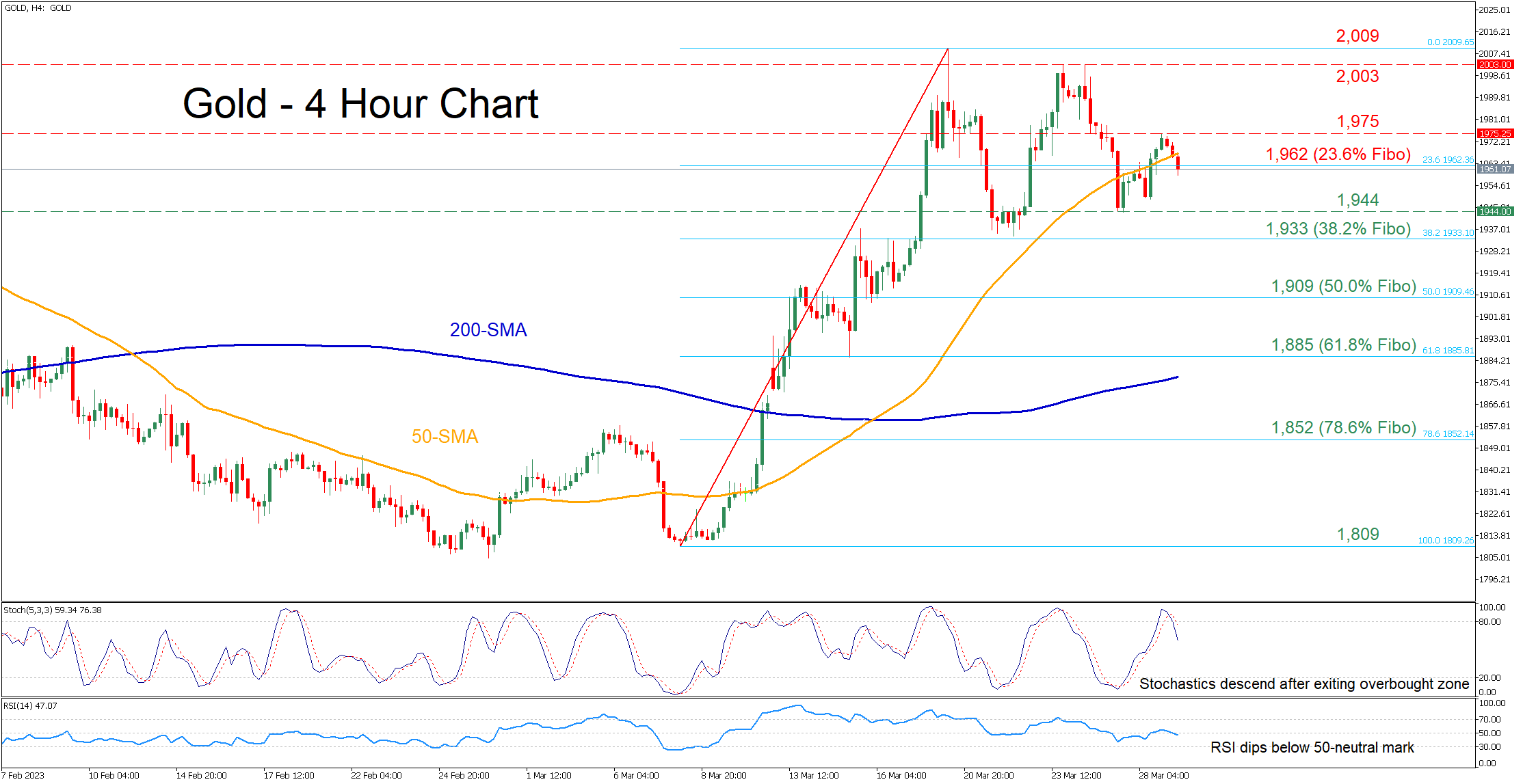
Gold had been edging higher in the four-hour chart, peaking at a fresh one-year high of 2,009 on March 20 before entering a sideways move. In the near term, bullion dropped below its 50-period simple moving average (SMA) after its latest rebound got rejected.
The momentum indicators currently suggest that bearish forces are in control. Specifically, the stochastic oscillator is descending after posting a bearish cross in the overbought zone, while the RSI has crossed below its 50-neutral mark.
Gold has been fluctuating above and below the 1,962 mark in today’s session, which is the 23.6% Fibonacci retracement of the 1,809-2,009 upleg. If the price clearly slides beneath that zone, the recent support of 1,944 could act as the first line of defense. Should that floor collapse, the commodity could then test the 38.2% Fibo of 1,933. Further declines could cease at the 50.0% Fibo of 1,909.
Alternatively, should buyers regain the upper hand, the price might encounter resistance at the recent rejection region of 1,975. Conquering this barricade, the bulls may aim for the 2,003 hurdle, which held strong twice in March. A break above that zone could pave the way for the one-year high of 2,009.
Overall, gold seems to be entering another round of weakness after its latest rebound came to a halt. Therefore, a fresh lower low is needed to signal the extension of the price’s recent downside correction.
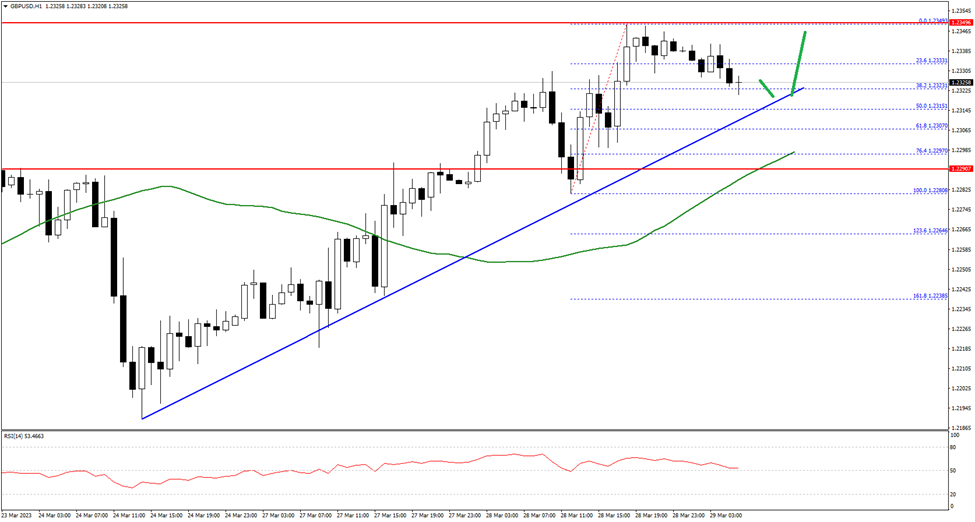
GBP/USD Pair is Now Consolidating Gains from 1.2349
The British Pound started a fresh increase from the 1.2200 zone against the US Dollar. The GBP/USD pair gained pace for a move above the 1.2250 level.
The pair even 1.2300 resistance zone and settled above the 50 hourly simple moving average. A high is formed near 1.2349 and the pair is now consolidating gains. An immediate resistance is near the 1.2340 level.
The first major resistance is near the 1.2350 level. If there is a clear upside break above the 1.2350 resistance, the pair could rise steadily towards the 1.2400 level in the near term. The next major resistance sits near the 1.2450 level.
On the downside, the first major support is near the 1.2320 level. The main support is forming near 1.2295 on FXOpen. A break below the 1.2295 support could push the pair towards the 1.2250 support.
USDJPY Stays Above 130.00; Outlook Still Grim
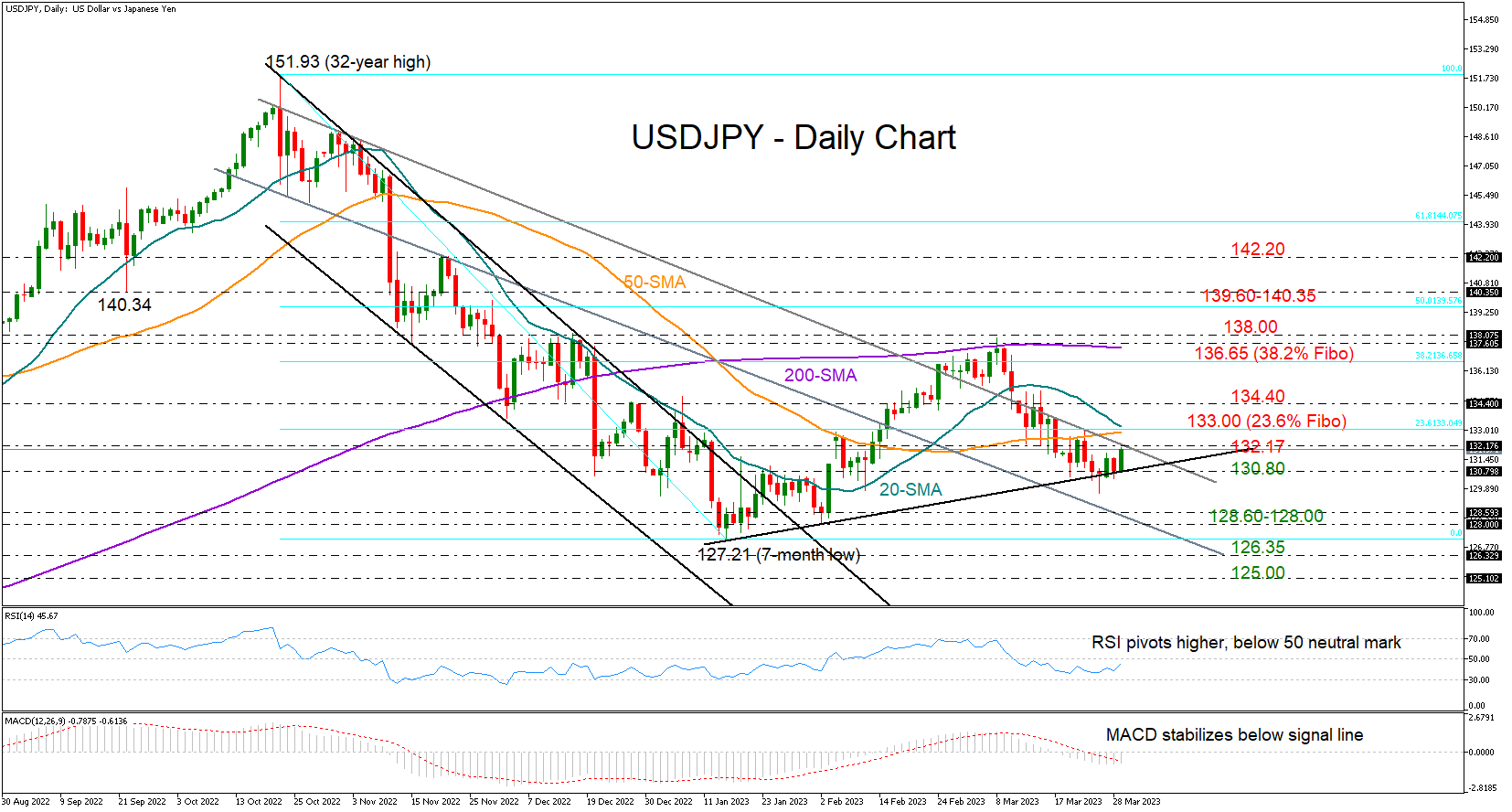
USDJPY resumed its bullish momentum early on Thursday, sustaining a strong foothold within the 130.00 area and around the short-term ascending trendline that has been navigating the market since the start of the year.
The RSI is following the price higher at the moment, though it has not exited the bearish territory yet. Likewise, the MACD has not crawled above its red signal line, both suggesting that the latest rebound is unconvincing.
For the recovery to continue, buyers would need to pierce through the wall of 132.35-133.00. The 20- and 50-day simple moving averages, the 23.6% Fibonacci retracement of the 151.93-127.21 downtrend, and the extension of October’s resistance line are all placed here. Therefore, a clear close higher is required to ease negative risks and lift the price up to 134.40. Should the bulls breach the latter, the price could advance up to the 38.2% Fibonacci level of 136.65 and the flattening 200-day SMA at 137.60. Then, an extension above 138.00 could clear the way towards the 50% Fibonacci mark of 139.60.
In the event the floor around 130.80 collapses, the pair may dive to meet the lower support line within the 128.60-128.00 area. If the October-January downtrend comes back into play below 127.20, the 126.35 region could immediately pause additional declines to 125.00.
Summing up, USDJPY is not out of the woods yet, despite stabilizing its bearish wave around a key support area. A close above 134.40 could boost buying interest, though only a bounce above the 200-day SMA would strengthen the 2023 upleg.