Sample Category Title
AUD/USD – Is RBA Nearing the End?
The Australian dollar continues to lose ground and is sharply lower on Tuesday. In the European session, AUD/USD is trading at 0.6676, down 0.81%. Earlier, the Australian dollar fell as low as 0.6674, its lowest level since December 23rd.
RBA delivers a ‘dovish hike’
There were no surprises from the RBA, which hiked rates by 25 basis points and raised the cash rate to 3.6%. This marked a fifth consecutive increase of 25 bp, as the central bank continues to raise rates in modest increments in a bid to curb inflation without choking economic growth.
This rate decision was noteworthy in the language of the rate statement, which suggested that the RBA could be nearing the end of the current rate cycle. The statement removed a reference in the February statement to needing to raise rates “over the months ahead”, and instead stated that “tightening of monetary policy will be needed to ensure that inflation returns to target. The markets picked up on this change in language as a dovish signal. As well, the statement explicitly said that inflation had peaked, another hint that multiple rate hikes may not be needed. The dovish tone of the statement has sent the Australian dollar considerably lower today.
In the US, Federal Reserve Chair Powell testifies today on the semi-annual monetary policy report. The Fed has been consistently hawkish about the need to continue raising rates and the markets have aligned their expectations closer to the Fed. It was only a few weeks ago that the markets were projecting a pause followed by rate cuts, but this has changed to expectations for three more rate hikes this year.
There is a lot of uncertainty in the air about inflation and interest rates after a host of stronger-than-expected data in January, such as a blowout employment report. These strong numbers may have been a blip, and it will be interesting to see if Powell reiterates a hawkish stance and ignores the January numbers. The markets are widely expecting a 25-basis point hike at the March 22 meeting, but a 50 bp increase cannot be discounted, as the Fed has said that the pace of rate hikes could be ‘higher and longer’.
AUD/USD Technical
- AUD/USD is testing support at 0.6749. Below, there is support at 0.6660
- There is resistance at 0.6862 and 0.7025
Bank of Japan: Will Kuroda Pass the Torch Untouched?
On Friday, Haruhiko Kuroda will sit at the helm of the Bank of Japan for the last time and investors may be eager to find out whether his exit will be accompanied by fireworks, or whether he will prefer to pass the torch to the incoming Governor untouched. With several officials arguing that there is no immediate need to take additional steps, will this decision prove just a stepping stone for the meetings led by the new Governor Kazuo Ueda?
No rush to take more tightening steps
When they last met, BoJ policymakers decided not to further tweak their yield curve control policy, after stunning the financial world in December by widening the target band around the 10-year yield target from ±25 to ±50 basis points around 0%.
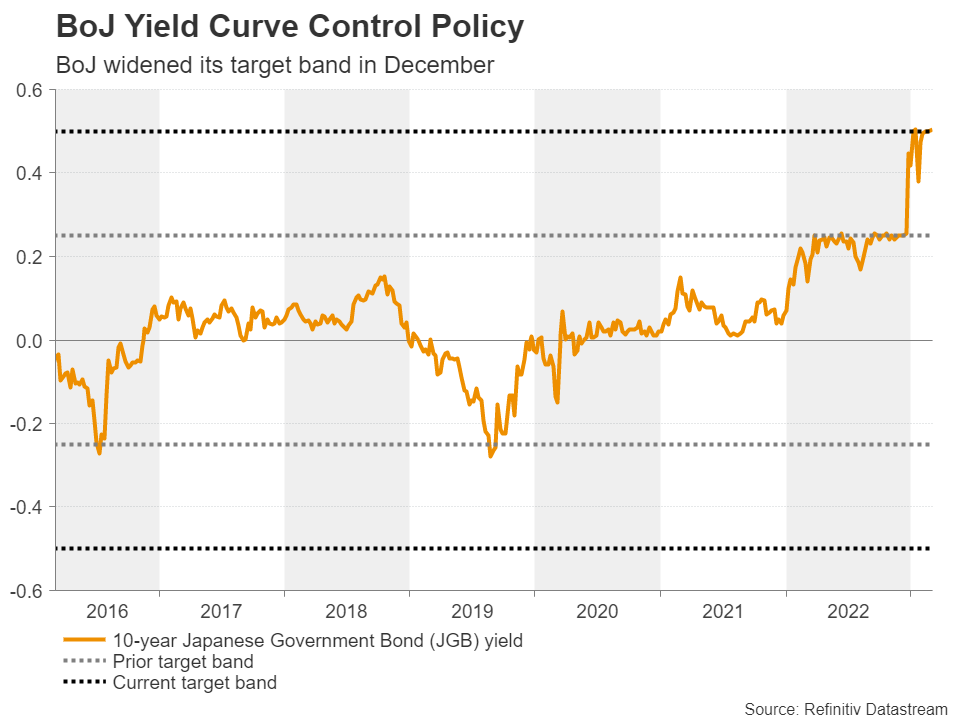
Since then, investors have been trying to figure out whether and when the Bank will decide to further remove accommodation, with the nomination of Kazuo Ueda and subsequent comments of his making the picture blurrier instead of clearing it. While he highlighted last year the difficulty of maintaining yield curve control as inflation bites harder, just after his nomination he seemed in no rush to make another step towards ending years of ultra-loose monetary policy, adding that inflation seems mostly fueled by surging import costs of raw materials rather than strong domestic demand. Apart from Ueda, several other, active policymakers also said they see no immediate need to take additional steps.
Inflation and wages slow
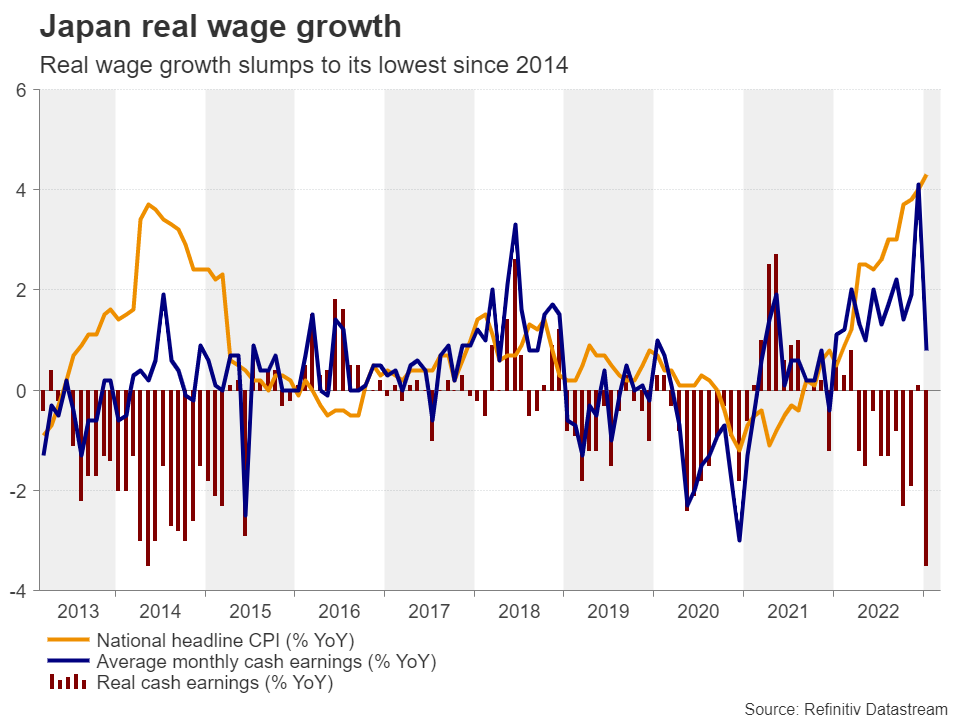
Economic data also support the notion for not taking any action at this week’s gathering. Yes, wage growth surged to above 4% in December, exceeding inflation and thereby resulting in positive real wage growth for the first time since March 2022, but just on Tuesday, data showed that Japan’s cash earnings for January slumped to 0.8% y/y from 4.1%, taking the real growth rate to the lowest since May 2014. What’s more, last week, the more forward-looking Tokyo headline CPI for February slowed by a whole percentage point, while the excluding food and energy rate just ticked up 1.8% y/y from 1.7%, which is still below the BoJ’s 2% objective. What also adds credence to choosing patience for now is the fact that the “shunto” wage negotiations have yet to conclude.
Having said all that though, even if there is ample reason for Kuroda to step down silently, the BoJ’s quarterly survey for the bond market showed that that an index measuring the degree of the market’s functioning slipped to a new record low in February, which means that the widening of the yield band by 0.25bps in December has failed to reduce market distortions. This may have allowed some participants to increase their bets that officials could eventually decide to raise the yield cap at this meeting.
How can the yen react?
Therefore, if the Bank decides to wait for a while longer before taking further steps towards normalization, those expecting action at this gathering will become disappointed and the yen could slip. However, it may be too early to chuck up the sponge on the yen. Despite not being in a rush, officials have repeatedly signaled that they stand ready to adjust policy when deemed necessary, with Ueda saying that he already has ideas on how the central bank could exit its massively stimulative policy. Therefore, it may be a matter of time before policymakers decide to further remove accommodation. For the yen to stay pressured for long, the BoJ may need to maintain a dovish stance beyond April, when other major central banks like the Fed and the ECB continue to raise interest rates to higher-than-previously-estimated levels.
Dollar/yen seems poised to climb higher
From a technical standpoint, dollar/yen has been trading in a consolidative manner since February 27, staying slightly above both the 50- and 200-day exponential moving averages and the key support zone of 134.50. In the bigger picture, the pair is trading well above the prior downtrend line drawn from the high of October 21, as well as above a newly born uptrend line taken from the low of January 16. This keeps the short-term bias positive for now.
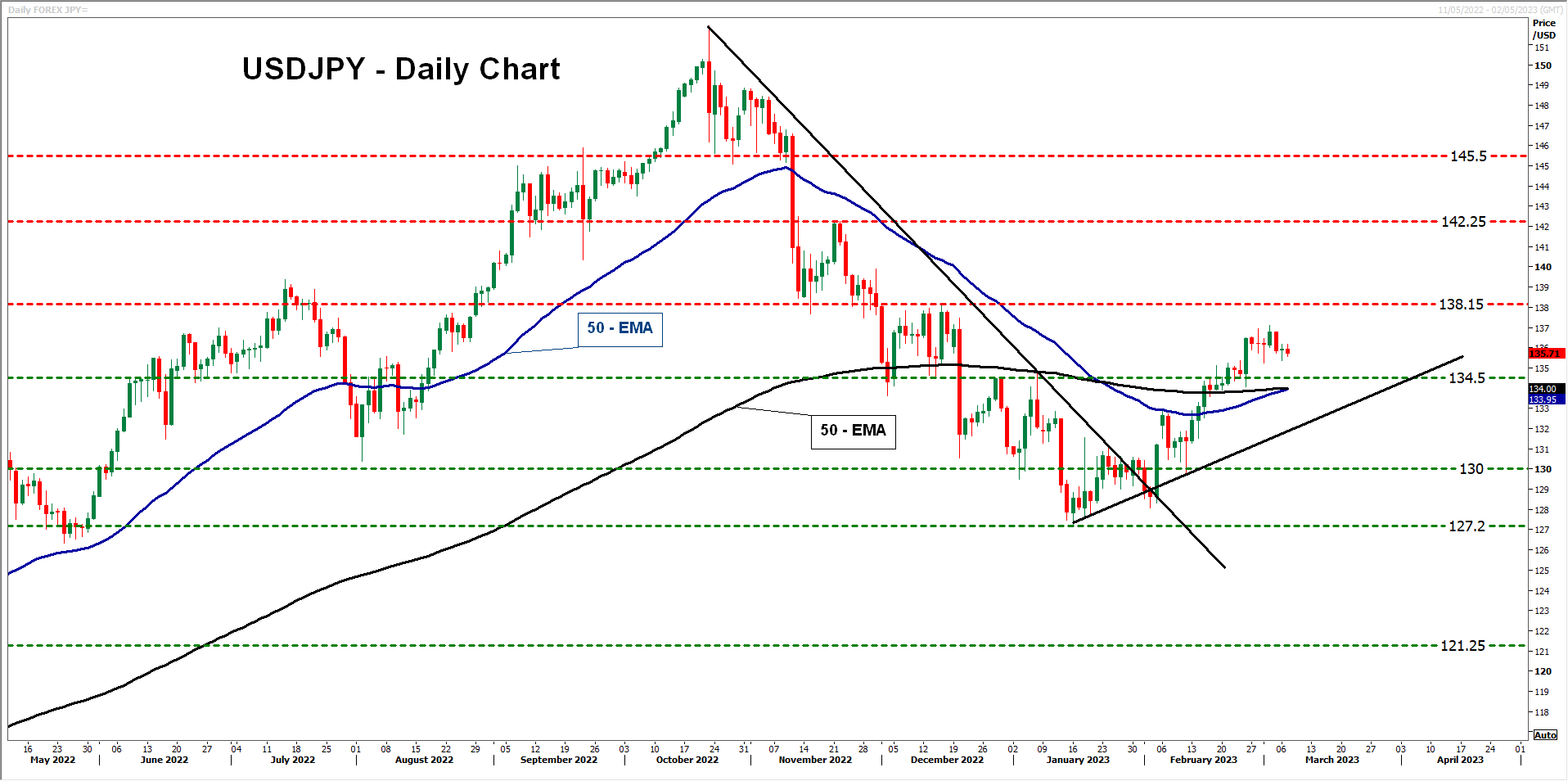
If indeed the BoJ refrains from acting on Friday, dollar/yen could emerge above the 138.15 barrier, marked by the high of December 15, and perhaps travel towards the 142.25 zone, defined as resistance by the highs of November 21 and 22. If the bulls don’t stop there either, they may then climb to the 146.65 territory, which provided support between October 24 and November 8.
On the downside, the move signaling that the bears are staging a comeback may be a dip below the round number of 130.00. Such a move may also confirm the break below the short-term uptrend line and may initially pave the way towards the 127.20 barrier, marked by the low of January 16. Should that territory fail to hold, its break would confirm a lower low on bigger timeframes and perhaps pave the way towards the 121.25 zone, marked by the lows of March 30 and 31, 2022.
UK Data Could Further Ease Recession Fears, But Can It Lift the Pound?
Economic output stats for January will kick off this month’s data releases for the UK on Friday (07:00 GMT), providing investors fresh clues on whether the British economy is still teetering on the edge of a recession. Recent indicators suggest that the outlook has brightened slightly, but the Bank of England nevertheless is undecided about how much further it will have to tighten policy. Subsequently, the pound has been somewhat adrift lately. Can the data provide traders with some direction?
Recession risks are subsiding
The UK economy narrowly avoided recession last year and likely eked out growth of 0.1% month-on-month in January, having shrunk by 0.5% in December. The meagre rebound is expected to have been driven by a 0.3% expansion in the services sector, as industrial production is forecast to have declined by 0.1% over the period. The manufacturing sub-sector is also expected to have contracted by the same amount.
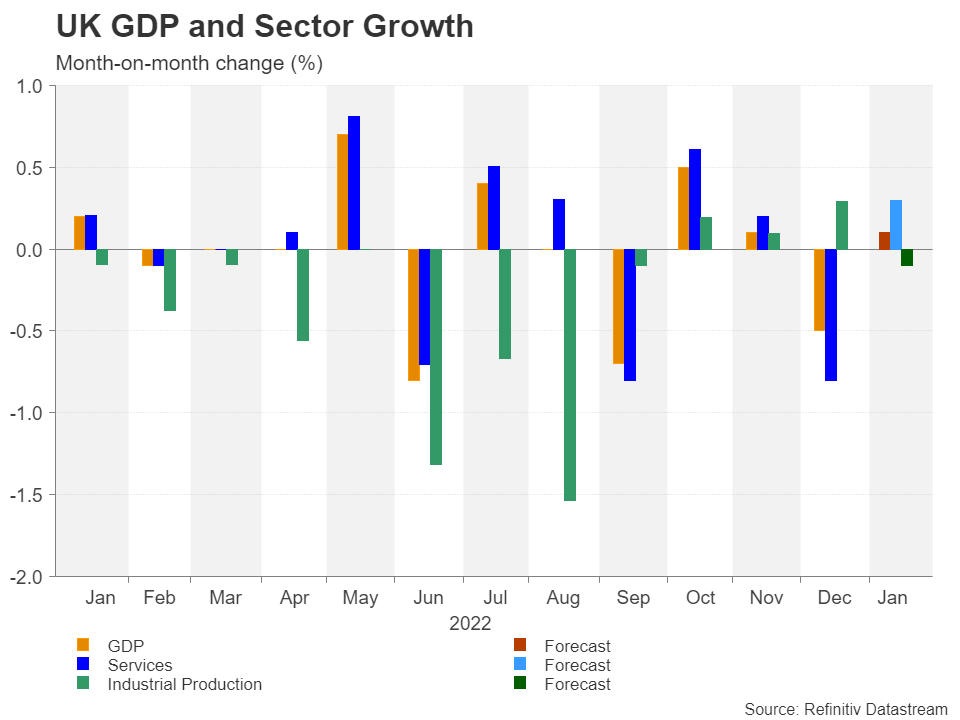
If these estimates turn out to be correct, or even bettered, the timing of any recession would likely get pushed back to late 2023 or early 2024, which is what has been the case for the predictions about the United States and Eurozone economies. This is assuming of course that the growth numbers for 2022 do not get trimmed down at a future point to show two consecutive quarters of contraction, as UK GDP data is notoriously prone to multiple revisions.
BoE still gloomy
For the moment, policymakers at the Bank of England seem to be taking note of the slightly better-than-expected performance of the economy but they are still anticipating a recession in 2023, albeit a shallower one based on their February projections. Hence, should Friday’s GDP readings underscore the improving picture, the January numbers alone probably won’t sway many minds within the Monetary Policy Committee.
However, what could be more of a game changer is strong GDP data combined with hot inflation figures. The February CPI report is due on March 22 and there is great anxiety about how fast inflation is falling in the UK. Having been in double digits for much of the second half of 2022, inflation could finally dip below 10% in February.
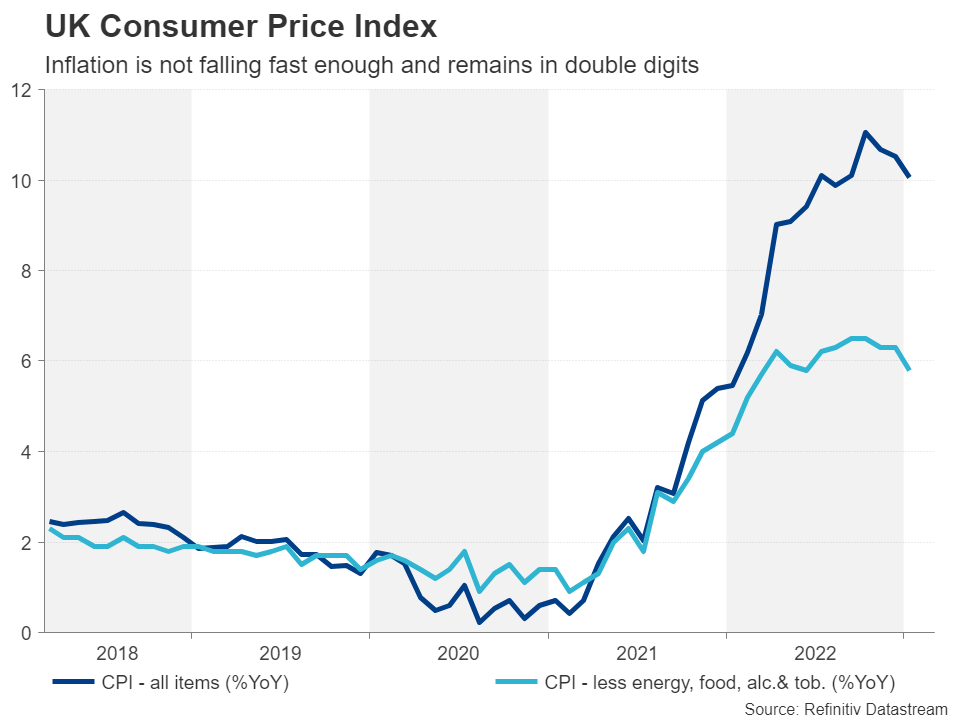
The CPI update will come just in time for the BoE’s policy decision the following day and so it could be a waiting game for sterling until then. The pound has been hovering around the $1.20 mark for the last couple of weeks, confined within its moving averages.
Pound lacking momentum in both directions
There seems to be strong support in the $1.19 region, which came into formation as investors priced out the risk of a steep recession. However, there is a similarly strong barrier to the upside just beneath the $1.2450 level.
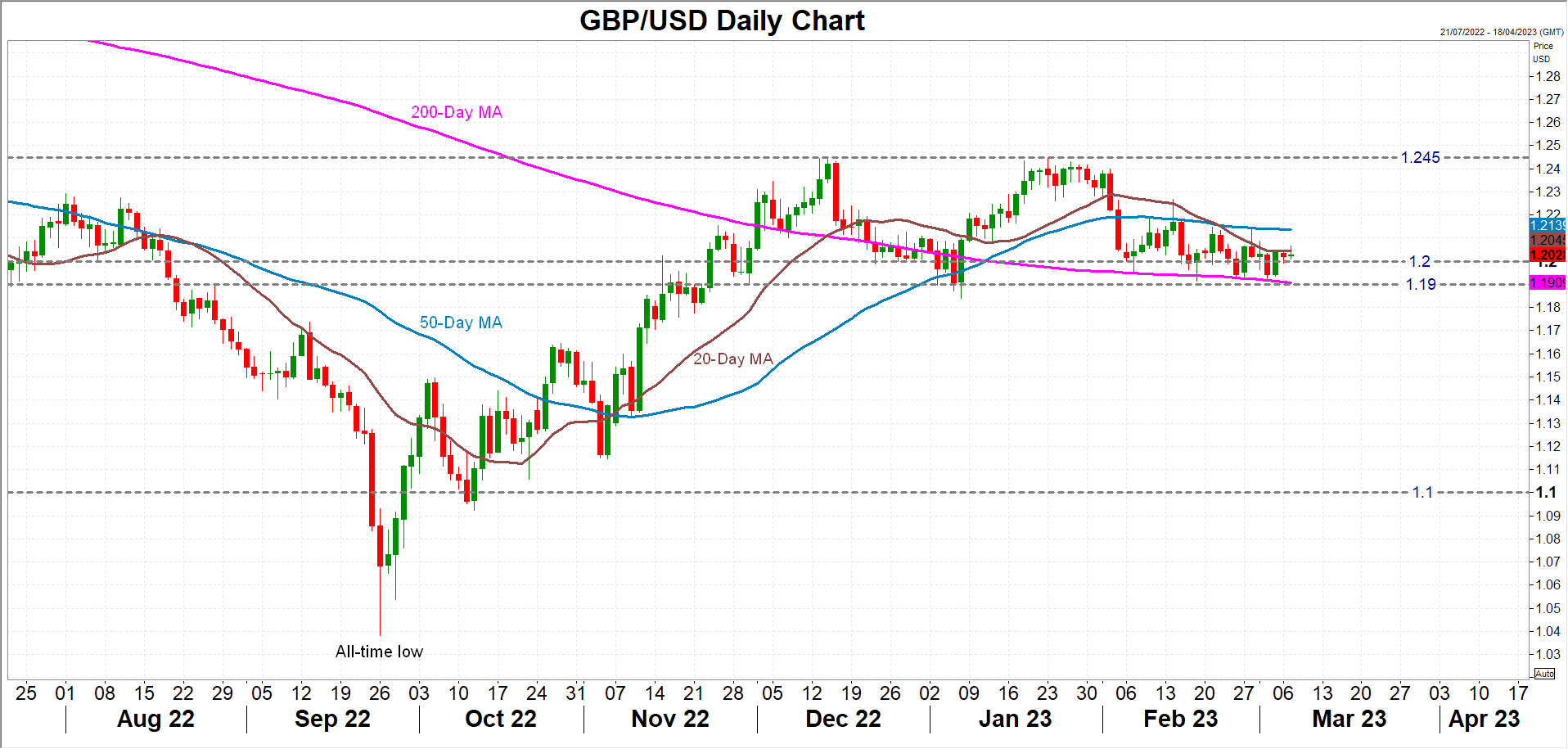
Cable’s trading range is perhaps an accurate illustration of the predicament the UK economy is in right now: the worst case scenario appears to have been averted but it is not completely out of the danger zone. Specifically, the economic outlook being upgraded from recession to stagnation is hardly grounds for a rally in the pound. Unless the US dollar were to fall victim to a Fed-sparked selloff, cable will struggle to resume its stalled uptrend as things stand.
The lack of any precise forward guidance by the Bank of England isn’t helping pound bulls either. At its last meeting, the Bank opened the door to a rate hike pause as early as March. But rather than this being an intentional bias towards a neutral stance, policymakers were merely acknowledging that the data and therefore the policy response could go either way. The BoE is probably right to resist the urge to make promises it can’t keep as other central banks have run into trouble doing this.
Politics matters
But for pound traders, they may have to rely on political headlines to guide them until the economic fog clears up a bit more. There was some boost recently with the announcement of the long-awaited deal between the UK and the EU on fixing the Northern Ireland protocol, the row over which had led to stalemate between Unionists and Republicans in the province’s power-sharing assembly.
The deal is not only positive for the pound because it strengthens ‘the Union’, but it also increases the prospect of deeper post-Brexit ties with the EU. In the more near-term horizon, Chancellor Jeremy Hunt will present his Spring Budget on March 15 and the big question is whether he will extend the energy price guarantee beyond April. UK consumers could be forced to tighten their purse strings again if the government stops subsidizing energy bills.
WTI Oil: Oil Price Rose to Five-Week High on Renewed Supply Concerns
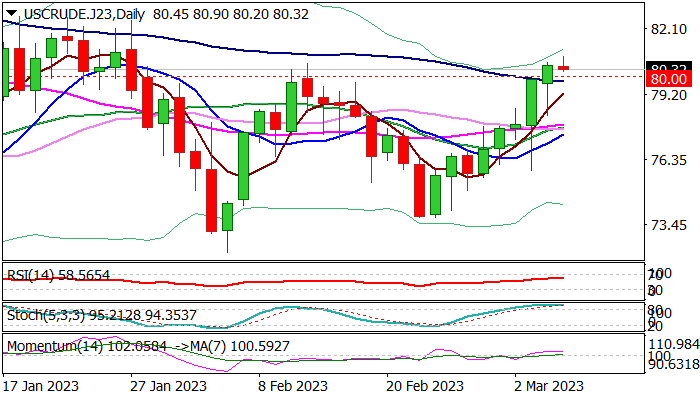
The WTI oil is consolidating under new five-week high ($80.90) in early Tuesday, following strong acceleration higher in past few sessions.
Oil price was lifted by fresh supply concerns, mainly due to growing concerns about the disruption to Russia’s exports of oil and refined products, which partially offset mixed trade data from China.
China’s exports improved significantly in February, boosting hopes that post-Covid recovery is picking up, but import dropped well below expectations and previous month’s level.
Recent rally improved daily technical studies, as momentum indicator broke into positive territory and moving averages (10/20/55) turned to bullish configuration, with fresh positive signal being generated on break above 100DMA ($79.79) and psychological $80 barrier.
However, overbought conditions warn of some profit-taking, which would pause bulls for consolidation / shallow correction.
Dips should find ground above solid supports at $78.00 zone (Fibo 38.2% of $73.77/$80.90 bull-leg / converged 55/20DMA’s) to keep fresh bulls intact for attack at key barriers at $81.91 (50% retracement of $93.72/$70.09 descend / $82.64/61 (January tops, also the ceiling of larger range since mid-December).
Weekly reports from American Petroleum Institute (API), due later today and Energy Information Administration (EIA) due on Wednesday, are eyed for fresh signals.
Res: 80.90; 81.17; 81.91; 82.61.
Sup: 80.00; 79.79; 79.22; 78.18.
China exports and imports continued to contract, but trade with Russia surged
Latest trade data from China showed that both exports and imports continued to declined in the first two months of the year. Trade with the US and the EU contracted, but trade with Russia was having extraordinary growth.
In the January-February period, China's exports contracted -6.8% yoy, better than expectation of -9.4% yoy. Imports contracted -10.2% yoy, much worse than expectation of -5.5% yoy. Trade surplus ballooned to USD 116.9B, much larger than expectation of USD 82.5B
The data also revealed that exports to the US decreased by -21.8% yoy while imports dropped -5% yoy. Exports to the EU were also down -12.2% yoy while imports decreased -5.5% yoy. On the other hand, exports to Russia surged 19.8% yoy while imports also jumped by 31.3% yoy
In related news, Chinese Foreign Minister Qin Gang stated the need to strengthen ties with Russia and suggested using "whatever currency that is efficient, safe and credible."
EURJPY pulls back from 11-week high
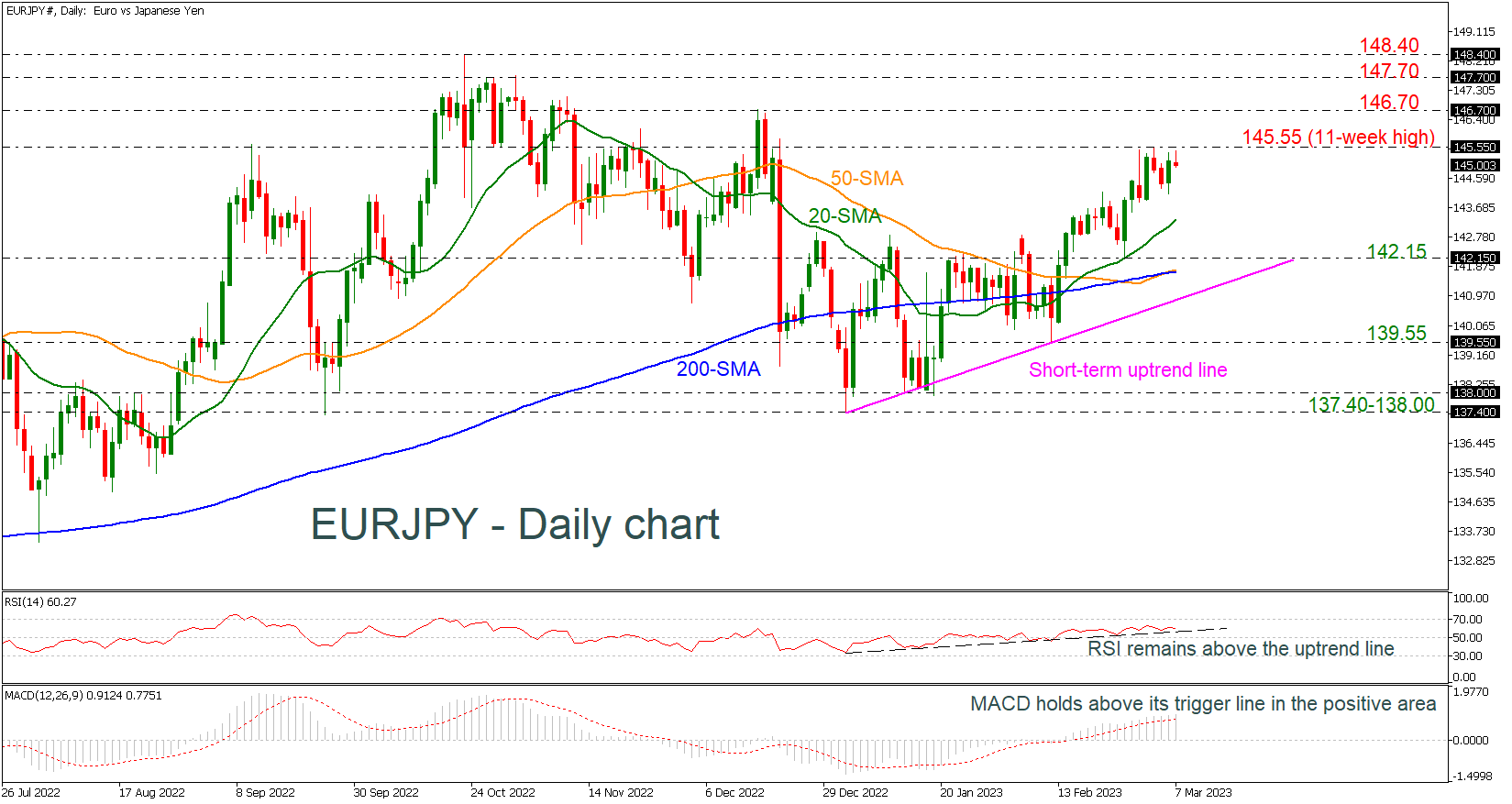
EURJPY has reversed back down again after finding resistance at the 11-week high of 145.55 achieved at the end of December. However, the market is still developing above the short-term uptrend line that has been drawn from the beginning of January.
Technically, the momentum indicators are pointing to a neutral to positive bias in the short term with the RSI just above the uptrend line and the MACD standing above its trigger and zero lines.
Any losses should see the 20-day simple moving average (SMA) at 143.30 acting as a major support ahead of the 142.15 line. Marginally lower, the 50- and the 200-day SMAs at 141.75 would reinforce the bearish structure if the price breaks it and drops beneath the uptrend line at 141.00 as well.
In the event of an upside reversal, the 145.55 mark could act as a barrier before being able to re-challenge the 146.70 resistance. Further gains could lead the way towards the 147.70 and the 148.40 obstacles.
Summarizing, EURJPY is looking bullish in the near-term and only a selling interest below the ascending line may switch the outlook to bearish.
GBPUSD Lacks Bullish Conviction; Resistance at 1.2045
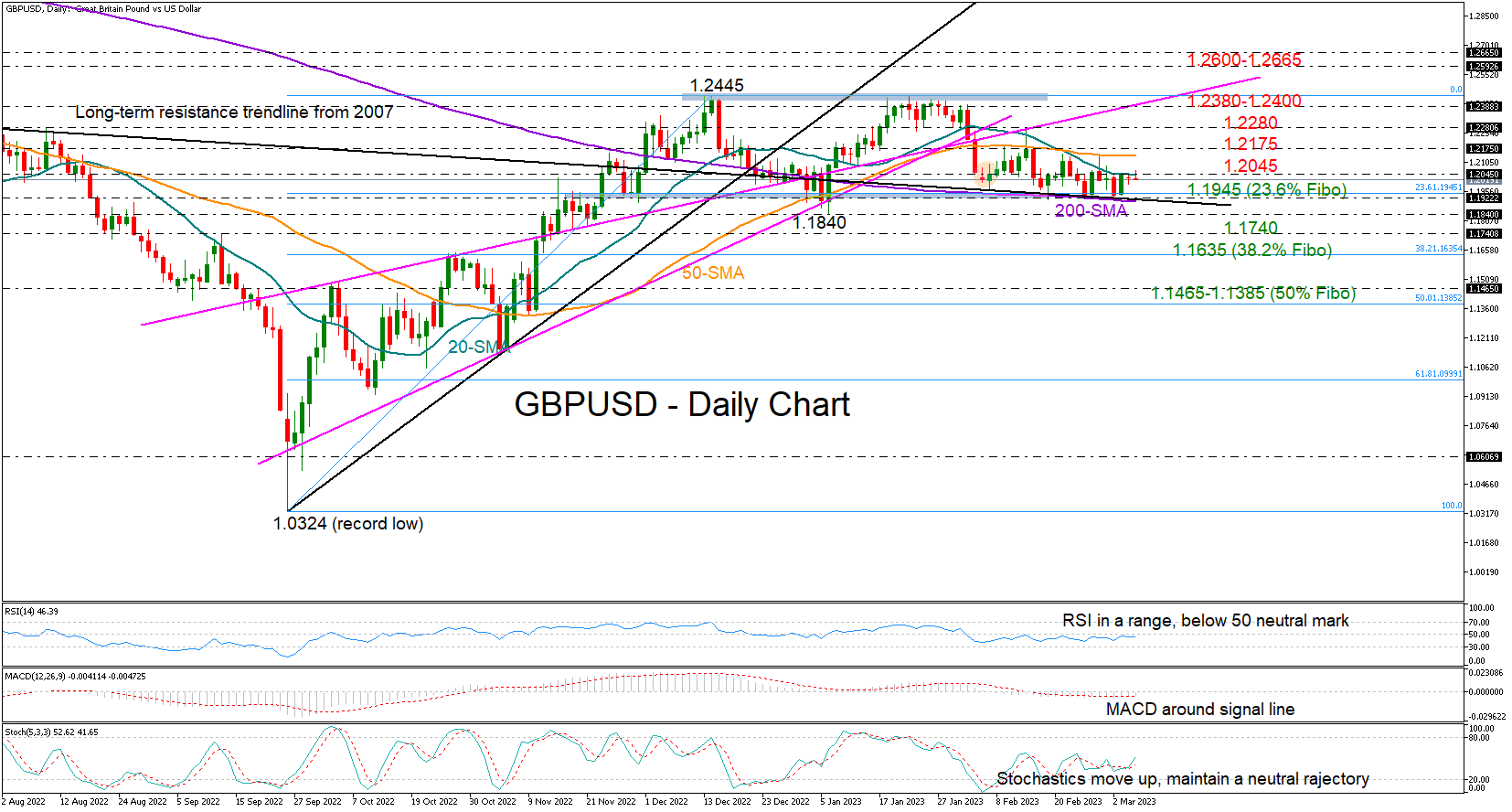
GBPUSD is making another attempt to climb the constraining 20-day simple moving average (SMA) at 1.2045, which has been capping bullish actions over the past week.
Although the pair seems to have secured a strong footing near January’s support area, where the 200-day SMA and the 23.6% Fibonacci retracement of the 1.0324-1.2445 upleg are positioned, the technical indicators have yet to show meaningful improvement. The RSI is sloping upwards, but it has yet to breach its neutral trajectory above its 50 neutral mark, while the MACD keeps fluctuating within the negative area and near its red signal line, both displaying a neutral-to-bearish bias.
Above the 20-day SMA, the 50-day SMA and the nearby 1.2175 resistance region could immediately cool upside pressures. If not, the pair could speed up to test the 1.2280 handle ahead of the key 1.2380-1.2400 barrier. Yet, only a sustainable move above the 1.2445 ceiling would activate new buying orders, likely boosting the price towards the 1.2600-1.2665 zone.
On the downside, a close below the 1.1945 floor may shift the spotlight to January’s trough of 1.1840. A step lower could face some congestion around 1.1740 before the door opens for the 38.2% Fibonacci zone of 1.1635. Should the bears persist, the pair could experience a freefall towards the 1.1465 level and the 50% Fibonacci of 1.1385.
In a nutshell, the technical picture in GBPUSD does not look bright despite the strong support developed around 1.1945. A close above 1.2045 could strengthen market sentiment, though only a rally above 1.2445 would violate the three-month-old range area.
All Eyes on Powell
It's shaping up to be another relatively flat day in the markets as investors turn their attention to Capitol Hill ahead of Jerome Powell's first testimony.
The Fed Chair will appear before the Senate Banking Committee later today to testify on the semi-annual monetary policy report. These events naturally attract a lot of attention but the reality is the Chair's performance is usually quite polished and uncontroversial, and the occasion itself can drag on and frequently venture away from topic. In other words, we shouldn't assume we're about to get fireworks from Powell.
What may make this occasion different is the fact that there's so much uncertainty around the outlook for interest rates and inflation. While the Fed has maintained that rate hikes must continue, the economic data from January has forced markets to adjust to that reality too so there's every chance we get a hawkish offensive from Powell.
Considering the likelihood of the January data being a blip rather than a trend, I think it would probably be wiser for Powell to maintain his previous tone as he may risk spooking the markets but if the FOMC truly is weighing up a 50 basis point hike this month, this would be a good opportunity to lay the groundwork for it.
Nearing the end
The RBA appeared to soften its tone once more after hiking rates by another 25 basis points today. The central bank is now of the opinion that inflation has peaked and so multiple rate hikes may no longer be the base case. That said, the RBA will decide meeting by meeting and a lot can change in between. Markets are now pricing in at least one more hike in the cycle and maybe two. The Australian dollar is a little lower on the day as the decision was perceived to be a dovish hike.
Some promising signs
Chinese trade data highlighted some modest improvements but remain quite weak overall. The drop in imports can possibly be attributed to some one-off factors including Covid exit waves and the Lunar New Year and the data will surely improve over the coming months as the economy returns to normal. Exports remained under pressure, although the number was better than expected, indicating still soft global demand which aligns with what we've seen recently elsewhere.
Pushing the highs
Oil prices rebounded again on Monday, the second day in a row that they've reversed sizeable early losses to end the day in positive territory. They're now on a good run and traders were clearly not deterred by China's modest growth target for long. Against that backdrop, it may well be the case that Brent and WTI are about to test the upper end of their trading ranges that they've remained within since early December.
A break above $89 would be a very bullish signal for Brent while the same would be true of $83 in WTI. Whether they have the momentum to pull that off may well depend on Powell's dual testimonies and/or Friday's jobs data.
Tentatively higher
Gold is edging tentatively higher ahead of Powell's testimony, during which conditions could become much more volatile. The yellow metal has run into resistance around $1,860 this week which was always likely to be the first test to the upside. Above here, $1,890-$1,900 will be a big test, should it get that far.
Of course, all of this may simply depend on what Powell has to say. A hawkish testimony could wipe out any bullish momentum built up over the last week, at which point attention will shift back to the lows around $1,780-$1,800.
Hanging on in there
Bitcoin has been in consolidation since Friday's sell-off with traders seemingly fearful of further ripple effects but still willing to hang on for now just in case. It's been a fantastic year for crypto so far but events late last week were a quick reminder of the challenges facing the industry in the short term and the consequences of that. There'll also be an eye on Powell's testimony today as it may influence overall risk appetite in the markets.
Volatile Week Ahead as Risk Events Eyed
The next few days could be wild and incredibly volatile for financial markets thanks to key central banks meetings, a semi-annual Congress appearance from Jerome Powell, and the latest US jobs data.
Asian shares edged higher on Tuesday morning following the mixed cues from Wall Street overnight as investors geared up for this week’s key risk events and economic releases. US and European futures seem to be pointing to a mixed open, with all attention directed towards commentary from Fed Chair Jerome Powell later today. In the FX space, the dollar remained subdued offering more space for G10 currencies to retaliate. Gold remains shaky this morning, and could be exposed to more pain if Powell strikes a hawkish tone later today.
In other news, the Reserve Bank of Australia hiked interest rates to the highest level in over 10 years. As expected, the central bank announced a 25-basis point hike, taking the cash rate to 3.6%. However, the RBA signaled a pause in its tightening cycle which triggered a selloff in the aussie. Taking a quick look at the technical picture, the AUDUSD remains under pressure on the daily charts with prices pressing against the 0.6700 support level. A solid bearish breakout beyond this level may open a path toward 0.6600.
Big week for USD as Powell and NFP eyed
It has been a choppy affair for the dollar over the past few days due to the absence of a fresh fundamental spark. But upcoming events could inject fresh life into the currency and set the tone for March.
Later today, Fed Chair Powell provides his semi-annual report to the Senate Banking Committee. Any hints around the Fed veering away from 25bp hikes in future meetings have the potential to move markets. The central bank head will address the House Financial Services Committee on Wednesday and is expected to reiterate a similar message. If Powell sounds hawkish, this could essentially revive dollar strength and rate hike bets. Alternatively, a dovish-sounding Powell may temper expectations around rates staying higher for longer, resulting in dollar weakness.
Before the main course and potential market shaker on Friday in the form of the NFP jobs data, investors will be served appetisers in the form of the ADP’s monthly report and the weekly initial jobless claims. Market sentiment could receive a slight boost if these reports exceed forecasts.
All eyes will be on the US jobs report at the end of the week, which is expected to show that the US added 215,00 jobs in February compared to the blowout 517,000 seen in January. Ultimately, another robust jobs report may reinforce expectations around the Fed holding rates higher for longer, in turn supporting dollar bulls. If the NFP report disappoints, this may raise questions about the dollar’s renewed strength, especially if rate hike bets cool.
Commodity spotlight - Gold
After bagging its best week since mid-January, gold has kicked off the new week on a shaky note.
The next few days promise to be eventful for the precious metal as investors brace for Powell’s Testimony and US economic data including the highly anticipated NFP. Price action suggests that gold bulls could be back in town. However, the risk events over the next few days may determine whether the current momentum results in a more pronounced bullish reversal or simply a dead cat bounce. A hawkish-sounding Powell coupled with another strong jobs report could spell nothing but trouble for gold. Alternatively, a cautious Powell and disappointing jobs report could keep the party going for gold bugs.
Taking a quick look at the technical picture, a strong daily close above the 50-day SMA around $1870 could encourage a move toward $1880 and $1900, respectively. Sustained weakness could open a path back towards $1845, $1825, and $1800.
EUR/USD: A Bearish Impulse Needed to Complete Primary Wave Ⓧ
The EURUSD currency pair seems to be forming a large corrective wave within the global impulse trend. Cycle correction IV, most likely, takes the form of a primary double zigzag Ⓦ-Ⓧ-Ⓨ.
The first actionary leg Ⓦ is completed in the form of a simple zigzag (A)-(B)-(C). A bearish intervening wave Ⓧ may be in the development stage now. It is also similar to the standard zigzag (A)-(B)-(C), which requires the last impulse sub-wave (C) to complete.
It is assumed that the price, along with impulse (C) going down, may fall to the 1.007 mark. At that level, impulse (C) will be at 123.6% of first impulse (A).
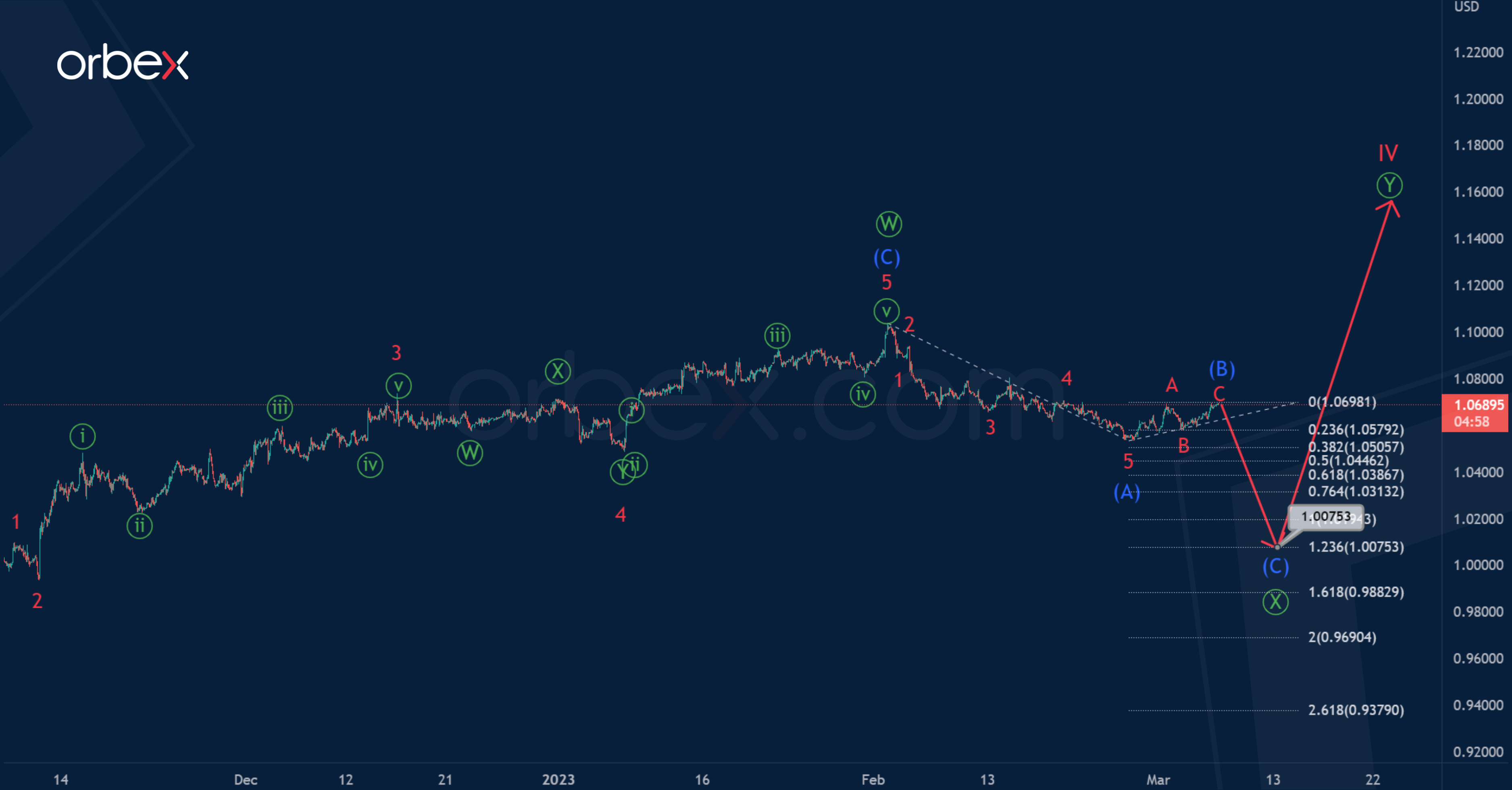
An alternative scenario suggests that the primary intervening wave Ⓧ will be short and perhaps it is already fully completed in the form of a zigzag (A)-(B)-(C).
Thus, the last upward movement of the price may indicate that the development of a new actionary wave Ⓨ has begun. Like the primary sub-waves Ⓦ and Ⓧ, the wave Ⓨ can take a zigzag shape (A)-(B)-(C), as shown in the chart.
There is a high probability that the first intermediate wave (A) will end near the February maximum, that is, at 1.149.