

Sample Category Title
Short Term Elliott Wave Outlook in SPX Favors More Upside
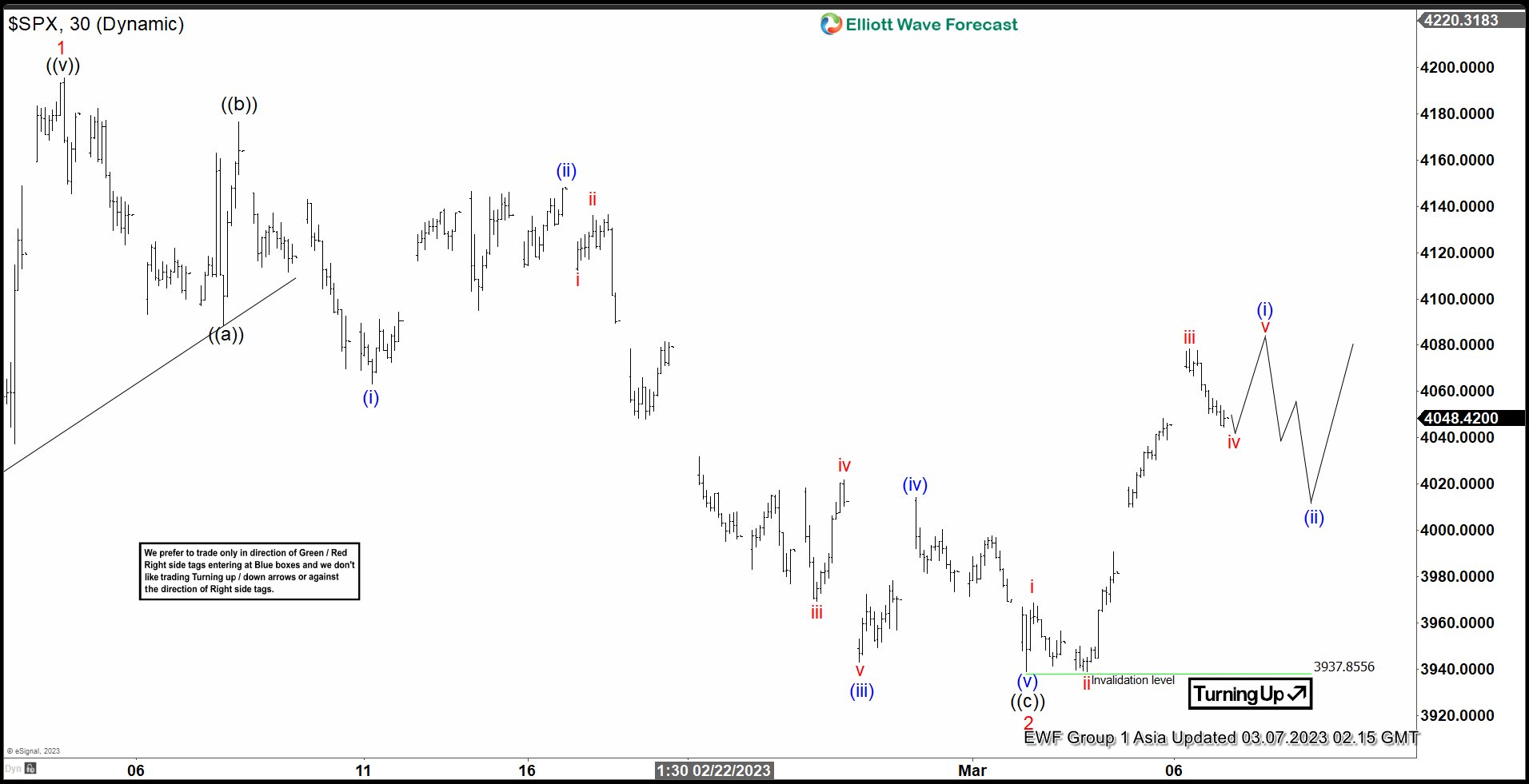
Rally from 10.13.2022 low in SPX is in progress as a nesting impulse. Up from 10.13.2022 low, wave (1) ended at 4100.51 and dips in wave (2) ended at 3764.49. The Index has resumed higher in wave (3) with subdivision as another impulse in lesser degree. Up from wave (2), wave 1 ended at 4195.44 and pullback in wave 2 ended at 3937.85. The 30 minutes chart below shows the pullback in wave 2. Internal subdivision of wave 2 unfolded as a zigzag Elliott Wave structure. Down from wave 1, wave ((a)) ended at where wave ((a)) ended at 4088.39 and wave ((b)) rally ended at 4176.54.
Wave ((c)) lower ended at 3937.85 with internal subdivision as a 5 waves. Down from wave ((b)), wave (i) ended at 4063.18 and rally in wave (ii) ended at 4148.11. Wave (iii) lower ended at 3943.08, rally in wave (iv) ended at 4014.13, and final leg wave (v) ended at 3937.85. This completed wave ((c)) of 2 in higher degree. The Index has turned higher now in wave 3 of (3). Near term, as far as pivot at 3937.85 low stays intact, expect dips to find support in 3, 7, or 11 swing for further upside.
SPX 30 Minutes Hour Elliott Wave Chart
https://www.youtube.com/watch?v=LIwRaYGTksw
AUD/CAD and AUD/NZD near downside breakout after RBA
Australian Dollar weakened broadly despite RBA's rate hike. This is attributed to the less hawkish statement by RBA indicating a "lower risk of a cycle in which prices and wages chase one another".
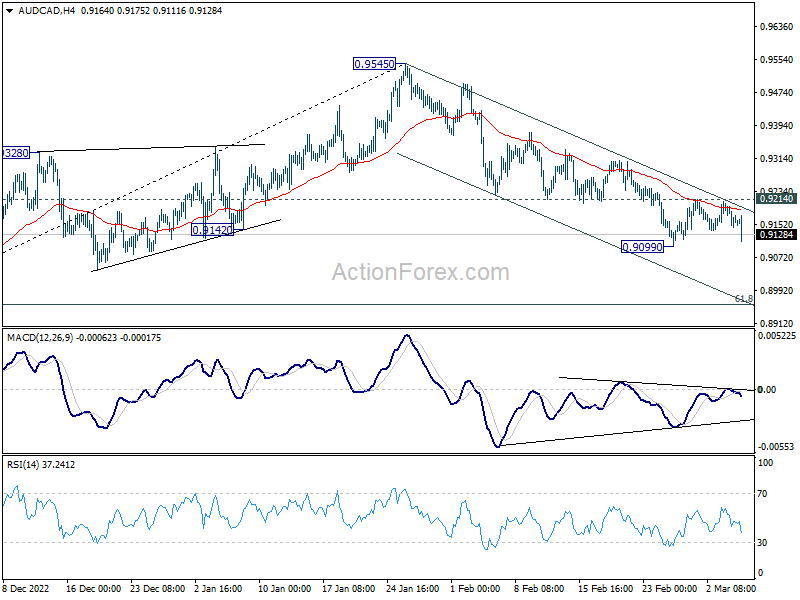
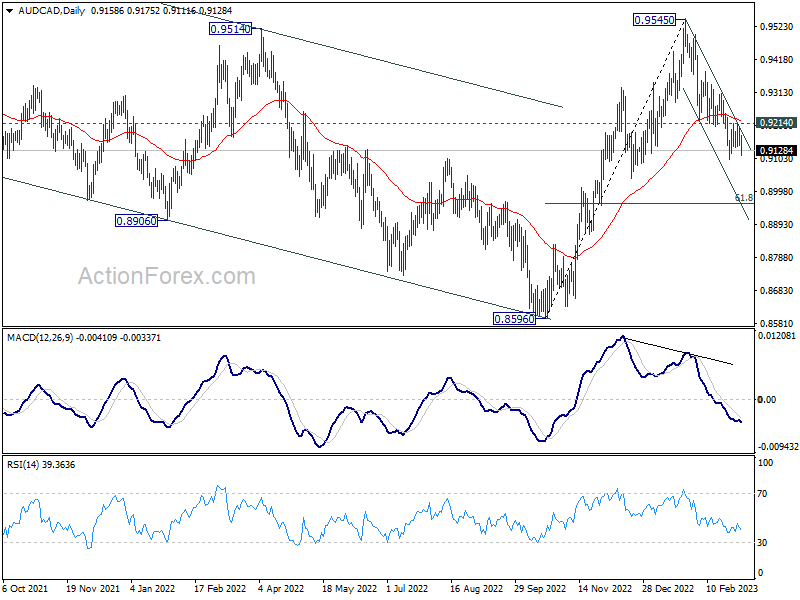
As AUD/CAD nears a breakthrough of 0.9099 temporary low, a deeper decline is expected as long as 0.9214 resistance holds. The next target for the fall from 0.9545 is 61.8% retracement of 0.8596 to 0.9545 at 0.8959. Bullish convergence conditions in 4 hour MACD suggest that stronger support may be seen there to bring a rebound.
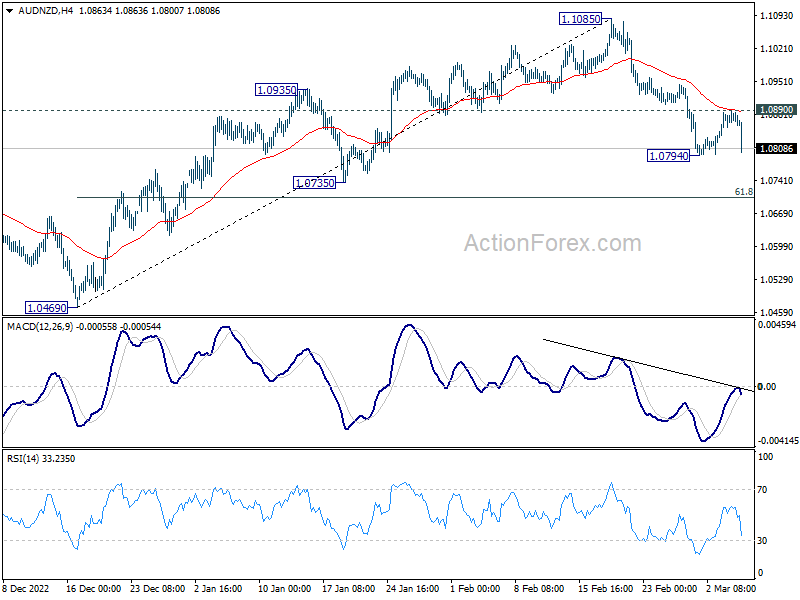
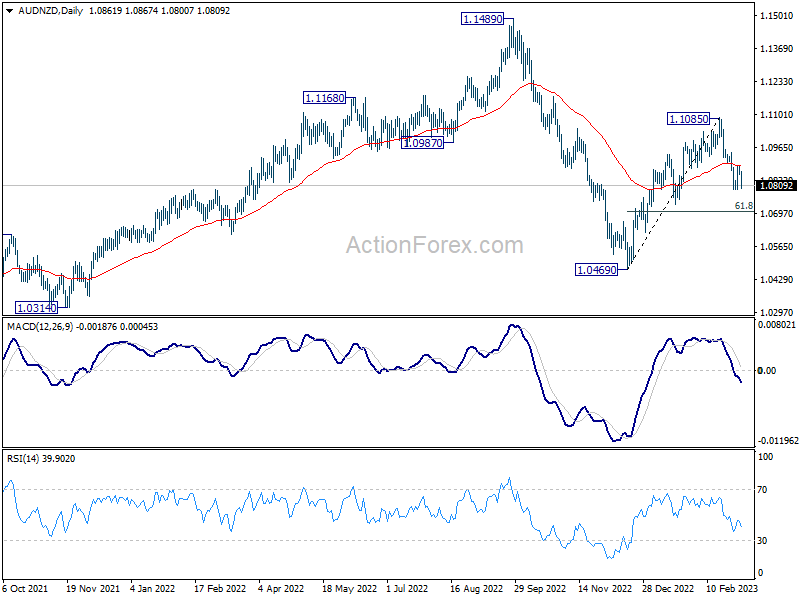
Likewise, AUD/NZD is poised to break through 1.0794, with the decline from 1.1085 targeting the 1.0735 support or further to the 61.8% retracement of 1.0469 to 1.1085 at 1.0704. Sustained break there could pave the way to retest 1.0469 low. The near-term outlook will remain bearish as long as the 1.0890 resistance holds.
RBA hikes 25bps, notes lower risk of prices-wages spiral
RBA raised the cash rate target by 25bps to 3.60%, which was widely anticipated. The bank also signaled the need for further tightening of monetary policy. Nevertheless, there was a notable dovish twist in the the statement about a lower risk of prices-wages spiral.
The central bank said monthly CPI indicator suggested that "inflation has peaked in Australia". The central forecasts is for inflation to decline this year and next to around 3% in mid-2025. Medium-term inflation expectations remain "well anchored".
Growth over the next couple of years is expected to be "below trend". Labor markets remains "very tight, although conditions have eased a little". Wage growth is "still consistent with the inflation target" and "recent data suggest a lower risk of a cycle in which prices and wages chase one another".
It indicated that "further tightening of monetary policy will be needed". The timing and extent of further interest rate hikes will depend on "developments in the global economy, trends in household spending and the outlook for inflation and the labour market".
(RBA) Statement by Philip Lowe, Governor: Monetary Policy Decision
At its meeting today, the Board decided to increase the cash rate target by 25 basis points to 3.60 per cent. It also increased the interest rate on Exchange Settlement balances by 25 basis points to 3.50 per cent.
Global inflation remains very high. In headline terms it is moderating, although services price inflation remains elevated in many economies. It will be some time before inflation is back to target rates. The outlook for the global economy remains subdued, with below average growth expected this year and next.
The monthly CPI indicator suggests that inflation has peaked in Australia. Goods price inflation is expected to moderate over the months ahead due to both global developments and softer demand in Australia. Services price inflation remains high, with strong demand for some services over the summer. Rents are increasing at the fastest rate in some years, with vacancy rates low in many parts of the country. The central forecast is for inflation to decline this year and next, to be around 3 per cent in mid-2025. Medium-term inflation expectations remain well anchored, and it is important that this remains the case.
Growth in the Australian economy has slowed, with GDP increasing by 0.5 per cent in the December quarter and 2.7 per cent over the year. Growth over the next couple of years is expected to be below trend. Household consumption growth has slowed due to the tighter financial conditions and the outlook for housing construction has softened. In contrast, the outlook for business investment remains positive, with many businesses operating at a very high level of capacity utilisation.
The labour market remains very tight, although conditions have eased a little. The unemployment rate remains at close to a 50-year low. Employment fell in January, but this partly reflects changing seasonal patterns in labour hiring. Many firms continue to experience difficulty hiring workers, although some report a recent easing in labour shortages. As economic growth slows, unemployment is expected to increase.
Wages growth is continuing to pick up in response to the tight labour market and higher inflation. At the aggregate level, wages growth is still consistent with the inflation target and recent data suggest a lower risk of a cycle in which prices and wages chase one another. The Board, however, remains alert to the risk of a prices-wages spiral, given the limited spare capacity in the economy and the historically low rate of unemployment. Accordingly, it will continue to pay close attention to both the evolution of labour costs and the price-setting behaviour of firms.
The Board recognises that monetary policy operates with a lag and that the full effect of the cumulative increase in interest rates is yet to be felt in mortgage payments. There is uncertainty around the timing and extent of the slowdown in household spending. Some households have substantial savings buffers, but others are experiencing a painful squeeze on their budgets due to higher interest rates and the increase in the cost of living. Household balance sheets are also being affected by the decline in housing prices. Another source of uncertainty is how the global economy responds to the large and rapid increase in interest rates around the world. These uncertainties mean that there are a range of potential scenarios for the Australian economy.
The Board's priority is to return inflation to target. High inflation makes life difficult for people and damages the functioning of the economy. And if high inflation were to become entrenched in people's expectations, it would be very costly to reduce later, involving even higher interest rates and a larger rise in unemployment. The Board is seeking to return inflation to the 2–3 per cent target range while keeping the economy on an even keel, but the path to achieving a soft landing remains a narrow one.
The Board expects that further tightening of monetary policy will be needed to ensure that inflation returns to target and that this period of high inflation is only temporary. In assessing when and how much further interest rates need to increase, the Board will be paying close attention to developments in the global economy, trends in household spending and the outlook for inflation and the labour market. The Board remains resolute in its determination to return inflation to target and will do what is necessary to achieve that.
GBP/USD Aims Recovery Above 1.2100, Oil Price Rallies
Key Highlights
- GBP/USD is attempting a recovery wave above the 1.2000 resistance zone.
- A major bearish trend line is forming with resistance near 1.2060 on the 4-hours chart.
- EUR/USD recovered above the 1.0680 resistance zone.
- Crude oil price rallied above the $80.00 resistance zone.
GBP/USD Technical Analysis
The British Pound remained well bid above the 1.1920 zone against the US Dollar. GBP/USD formed a base and recently started an upside correction above 1.1980.
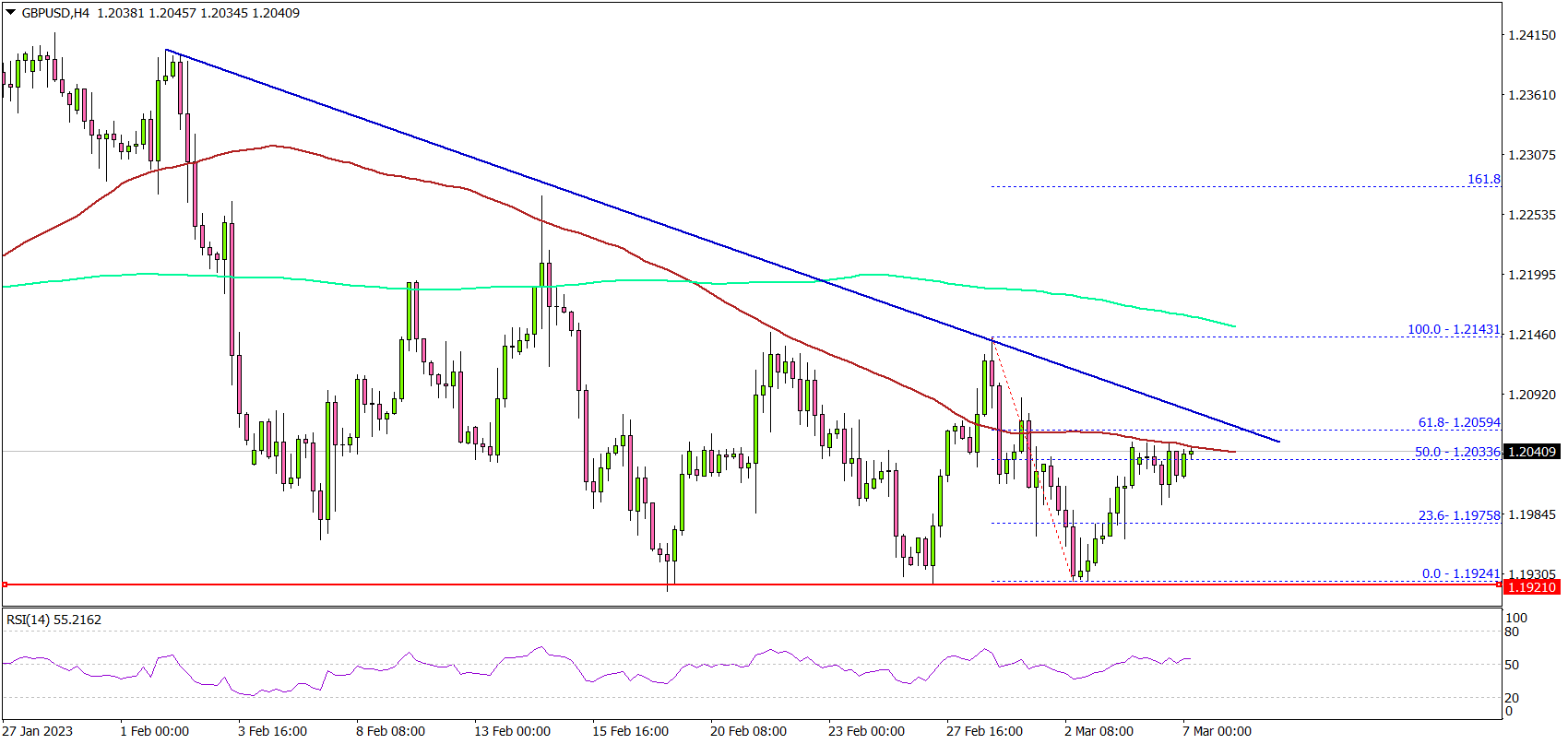
Looking at the 4-hours chart, the pair was able to clear the 1.2000 resistance zone. The pair is now testing the 50% Fib retracement level of the downward move from the 1.2143 swing high to 1.1924 low.
The 100 simple moving average (red, 4-hours) is also acting as a resistance near 1.2040. The next major resistance is near the 1.2060 level. There is also a major bearish trend line forming with resistance near 1.2060 on the same chart.
A clear move above the 1.2060 resistance might start a steady increase towards the 1.2120 zone. Any more gains might send the pair towards 1.2180.
On the downside, an immediate support is near the 1.2000 level. The next major support is near the 1.1975 level, below which there is a risk of a move towards the 1.1925 level. Any more losses could open the doors for a drop towards 1.1840.
Looking at crude oil price, there was a strong upward move and the price was able to clear the $80.00 resistance zone.
Economic Releases
- UK Halifax House Price Index for Feb 2023 (MoM) - Forecast +0.4%, versus 0% previous.
- UK Halifax House Price Index for Feb 2023 (3m/YoY) - Forecast +2%, versus +1.9% previous.
Japan’s Wage Growth Disappoints in January, Real Earnings Fall the Most Since 2014
Japan's nominal labor cash earnings rose by 0.8% yoy in January, below expectations of 1.9% yoy. The strong growth rate of 4.1% yoy in December was an anomaly due to lump-sum payments, rather than regular wage rises. The level of wage growth is far below the required level needed to maintain a 2% inflation rate, as indicated by outgoing BoJ Governor Haruhiko Kuroda.
Moreover, real cash earnings of workers have declined by -4.1% yoy, indicating that their real wages have fallen the most since 2014. The continuous decline in real wages for ten consecutive months shows that inflation has surpassed earnings.
Later in the week, BoJ is expected to keep its ultra-loose monetary policy unchanged, including the negative short-term interest rate of -0.10% and the 10-year yield cap at 0.50% at Kuroda's final meeting before handing over the reins to Kazuo Ueda. The declining real wages poses a challenge for the incoming governor to achieve the inflation target set by the central bank.
Natural Gas Wave Analysis
- Natural Gas reversed from round resistance level 3.0000
- Likely to fall to support level 2.224
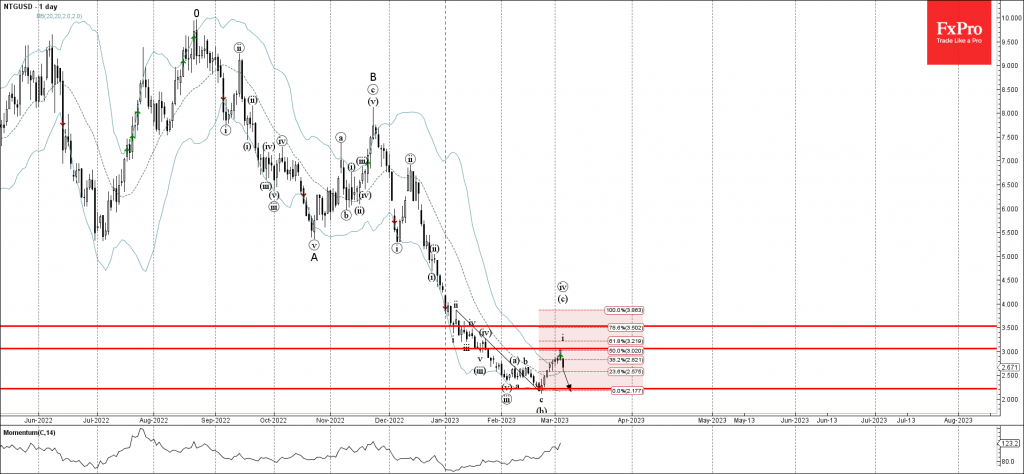
Natural Gas recently reversed down from the round resistance level 3.0000 (former support from the start of January).
The resistance level 3.0000 was further strengthened by the upper daily Bollinger Band and by the 50% Fibonacci correction of the previous downward impulse from January.
Given the strong multi-month downtrend, Natural Gas can be expected to fall further to the next support level 2.224 (previous monthly low).
EURUSD Wave Analysis
- EURUSD reversed from round support level 1.0500
- Likely to rise to resistance level 1.0775
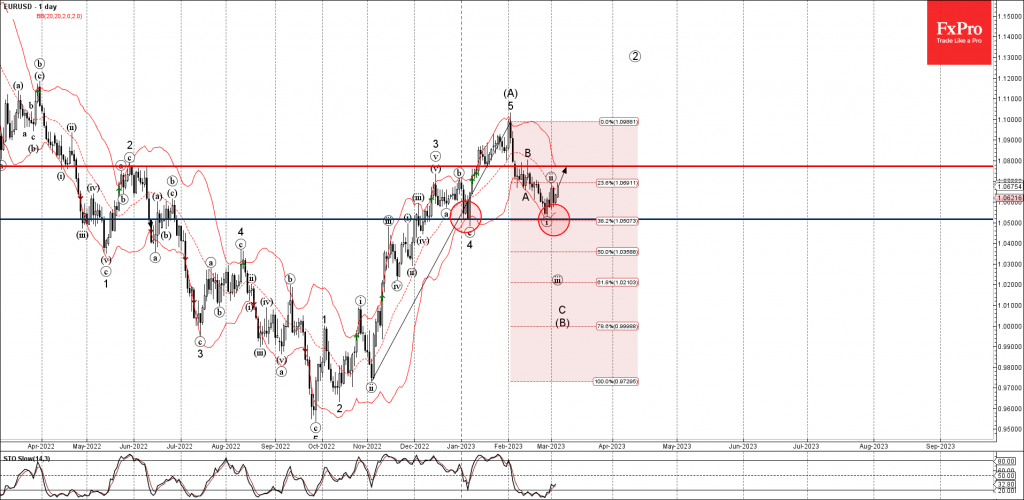
EURUSD currency pair recently reversed up from the round support level 1.05000 (which has been reversing the price from the start of December) coinciding with the lower daily Bollinger Band and the 38.2.% Fibonacci correction of the upward impulse from November.
The upward reversal from the support level 1.05000 stopped the previous minor impulse wave C.
EURUSD currency pair can be expected to rise to the next resistance level 1.0775 (which stopped wave B earlier this month).
Smart Crypto Trades in March
This year started with a beautiful bullish price action from the crypto markets. However, the current bearish movement is already causing many investors and traders to panic is interesting. This piece reviews a few trading opportunities I have spotted today in the crypto market. Let's go!
BTCUSD
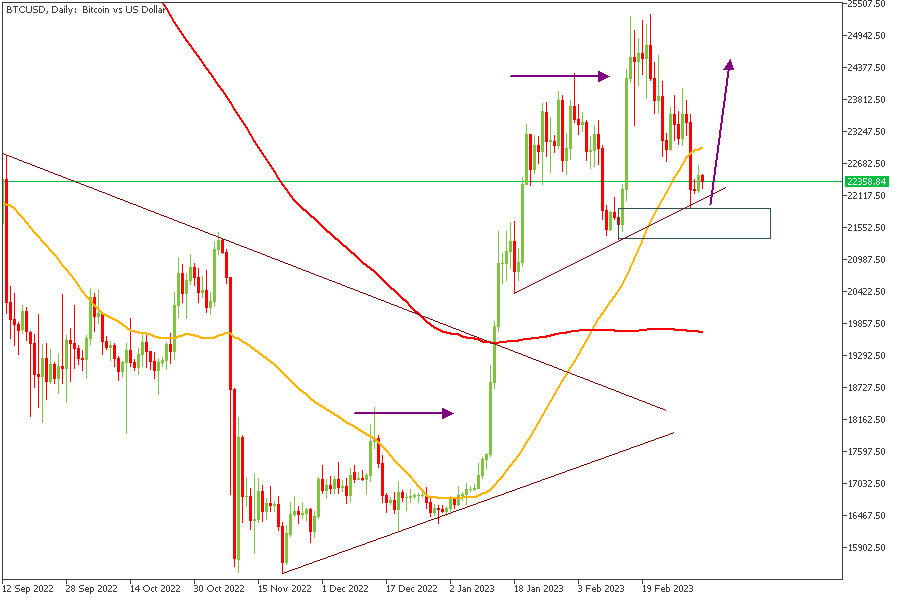
Here is the daily timeframe chart of Bitcoin. We can see that price has recently broken above the previous high marked by the horizontal arrow. As a result, BTCUSD created a demand area highlighted by the rectangle. This demand zone falls within 88% of the Fibonacci retracement, increasing my bullish sentiment on BTCUSD. The 50-Day moving average trading above the 200-Day MA is also a considerable confluence.
Analysts’ Expectations:
- Direction: Bullish
- Target: $24400
- Invalidation: $21277
ETHUSD
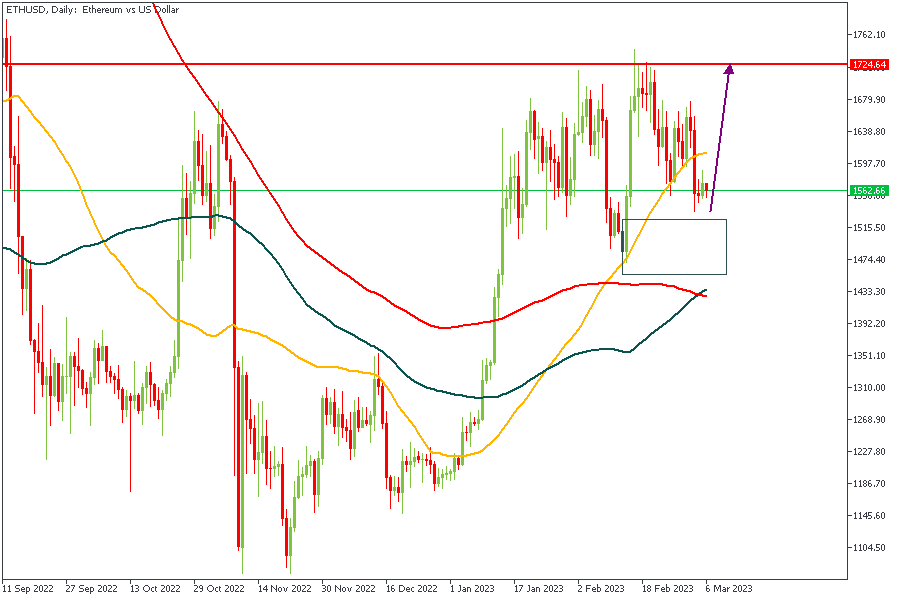
Similar to the arrangement on BTCUSD, the price action on ETHUSD is also setting up a bullish continuation. ETHUSD's bullish sentiment is based on the confluence of the demand zone, the 50 and 100-period moving averages crossing above the 200-MA, and the 88% of the Fibonacci retracement overlapping the demand zone.
- Analysts’ Expectations:
- Direction: Bullish
- Target: $1683
- Invalidation: $1450
LTCUSD
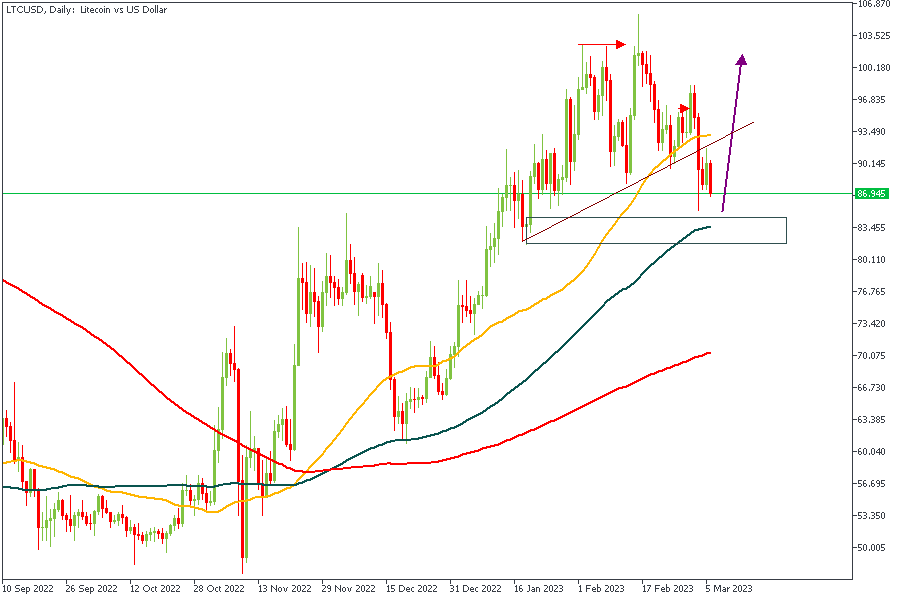
Litecoin is setting up to resume its bullish momentum. The current price action indicates a break of a structure with the demand zone has not yet been mitigated. As a result of the confluence of the demand zone, the 100-Day moving average support, and the 88% Fibonacci retracement are my confluences for this position.
Analysts’ Expectations:
- Direction: Bullish
- Target: $99
- Invalidation: $81.3
XRPUSD
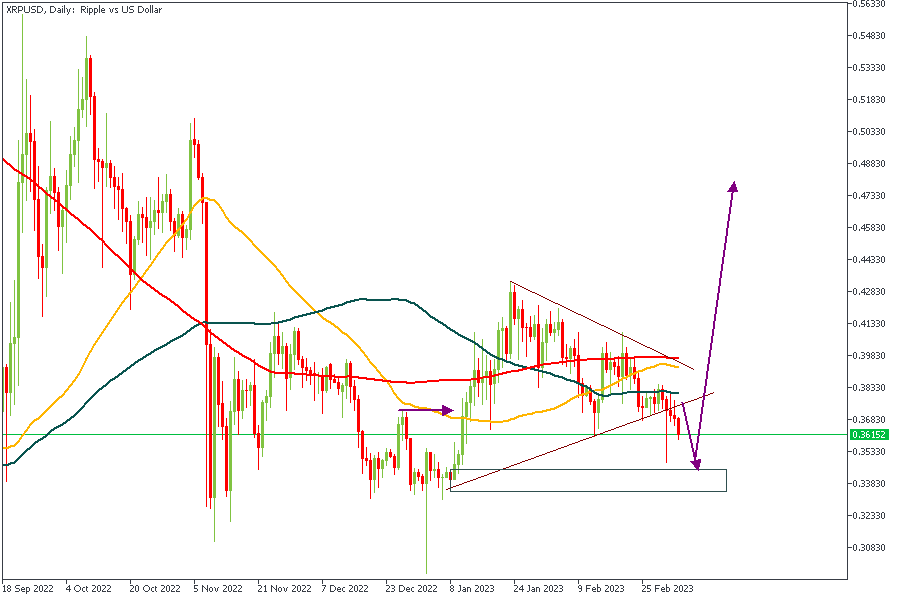
XRPUSD (Ripple) on the Daily timeframe has recently broken out of a wedge pattern. Right below the trendline support of the wedge is a convenient demand zone from the break of structure marked by the horizontal arrow and is yet to be mitigated. As a result, I expect the price to make a run for the demand zone before returning to resume the trend. My confluences are the demand zone and 76% of the Fibonacci retracement zone.
Analysts’ Expectations:
- Direction: Bullish
- Target: 0.44491
- Invalidation: 0.33110
CONCLUSION
The trading of CFDs comes at a risk. Thus, to succeed, you have to manage risks properly. To avoid costly mistakes while you look to trade these opportunities, be sure to do your due diligence and manage your risk appropriately.