Sample Category Title
Brent Keeps Trying to Grow
The crude oil sector fights with the news flow, trying to climb higher. A Brent barrel now costs 85.25 USD.
China has changed its forecast for economic growth in the country to 5.0% from 5.5% earlier. This made capital market really unhappy because it had really counted on the demand on energy carriers from China. Last year, the Chinese GDP grew by just 3%. Hence, the decrease in the target for 2023 might be an attempt to place more realistic goals and reach them efficiently. However, at the moment things look bad.
For now, the market has few fundamental reasons for optimism, yet local waves of purchases happen.
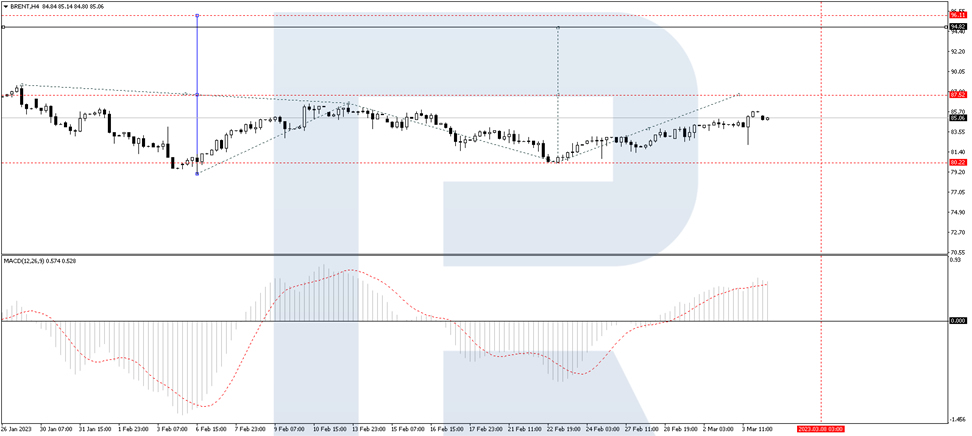
On H4, Brent has formed a consolidation range around 83.83. With an escape upwards, a pathway to 87.52 will practically open. After this level is reached, a link of correction to 83.83 might happen, followed by further growth to 87.52. And this is just a half of the wave. After the goal of growth is reached, a decline to 83.83 might follow, and then — growth to 94.80. Technically, this scenario is confirmed by the MACD: its signal line is above zero in the histogram area suggesting growth to new highs.
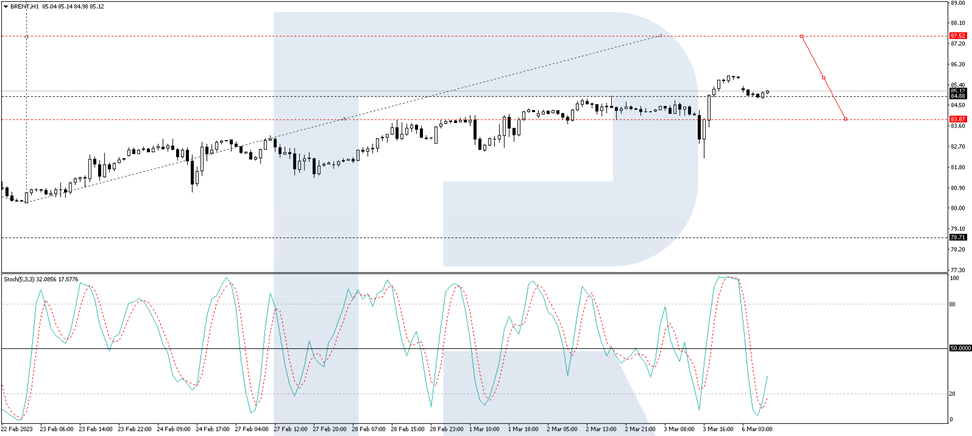
On H1, the structure of the fifth wave of growth to 85.80 has been completed. Today a consolidation range is forming below it. An escape downwards and a link of correction to 83.83 are not excluded. With an escape upwards, the wave might continue to 87.50. The target is local. After it is reached, a link of decline to 83.83 and growth to 90.00 might follow. Technically, this scenario is confirmed by Stochastic. Its signal line is above 20, aimed strictly upwards.
Canadian jobs report, Bank of Canada decision back in the spotlight
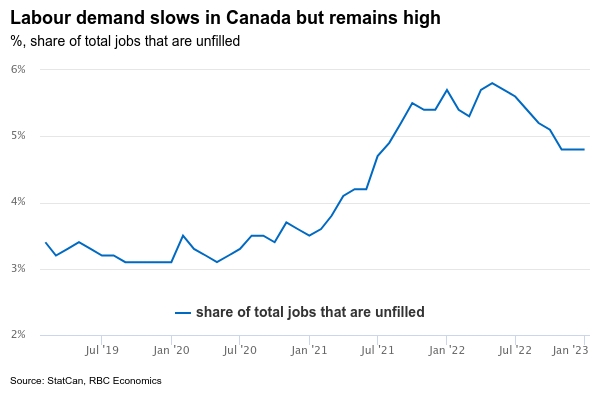
All eyes will be on Canada’s labour market numbers next Friday after a shockingly strong 150,000 employment gain in January. The Canadian employment count is notoriously volatile. Two years of stop-and-start pandemic lockdowns have probably added to those challenges by making the data more difficult to seasonally adjust. And other labour market data hasn’t been quite as robust. The number of job vacancies (while still very high) has declined and the Bank of Canada’s Q4 2022 Business Outlook Survey hinted at slower hiring plans. Still, January’s employment gains were too large and broadly-based to discount entirely. A 0.3% increase in the preliminary estimate for GDP in the month also pointed to a relatively resilient economic backdrop at the start of 2023 given aggressive earlier BoC interest rate hikes. We look for employment to edge slightly higher in February and for the unemployment rate to tick up to a still very low 5.1%. And we continue to expect unemployment to drift higher over the rest of 2023 as the lagged impact of interest rate hikes flow through to household debt payments and weigh on spending and GDP growth.
The BoC will also be looking closely at signs of resilience in labour markets. It’s expected to leave the overnight rate unchanged at its next policy decision on Wednesday—for the first time since the start of this hiking cycle in March of last year. The BoC committed to a “conditional pause” at its January meeting and data released since then (outside of those surprise January labour market numbers) has not met the relatively high bar needed to suggest a change in course. GDP data has been mixed, with a downside surprise on fourth quarter GDP growth offsetting the surprisingly firm 0.3% tick higher in the advance estimate for January. That left growth in the economy tracking slightly below the BoC’s January forecast.
More important, inflation has shown further signs of moderating. Core inflation as measured by the Bank’s preferred indices (CPI trim and CPI median) continue to show improvement. The breadth of inflation pressure has continued to narrow after peaking last summer. We still think the most likely scenario is that the BoC will not need to hike interest rates further this year. But that call hinges on whether the previous hikes are enough to slow consumer spending and labour market momentum in the months ahead.
Week ahead data watch
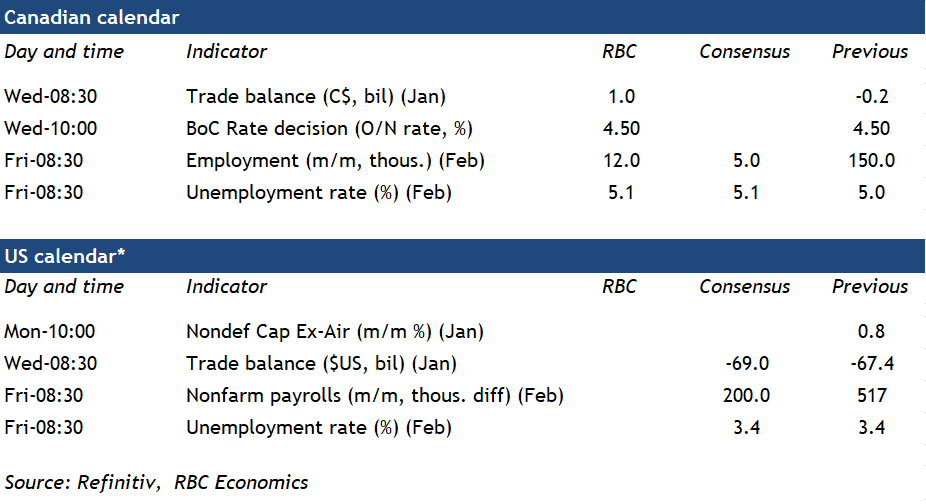
Canadian trade balance likely edged back to a surplus in January from a small $0.2 billion deficit in December, largely due to an uptick in the oil prices during that month. Advance estimates indicate motor vehicle production jumped higher in January, which likely buoyed both imports and exports.
U.S. payroll employment is expected to rise 200,000 in February, still strong but down from an upside surprise of 517,000 jobs in January. The unemployment rate is expected to edge up to 3.5%. Job postings have been edging lower but weekly jobless claims are still low, and labour markets remained tight.
Sunset Market Commentary
Markets
Austrian ECB Governor Holzmann, never shy to drop a juicy quote, solidified his reputation as biggest hawk. He said the central bank should hike rates by 50 bps in March, May, June and July while it should also consider adding PEPP to QT in the fall. That would bring the deposit rate from 2.5% to as high as 4.5%. Holzmann said rates need to be much higher to constrain economic growth and dampen inflationary pressures. Only at 4% “would we roughly get into the restrictive area”. Having this view, it tells us something about his expectations for (structurally higher) inflation. Holzmann assumes that core inflation won’t weaken significantly in the first half of the year, hence the need for drastic central bank action. Chief economist Lane stuck to the data-dependent approach and said that economic data will guide policy after the March meeting. He did add that current information suggests more is needed. Euro area money markets inch a little closer to a 4% peak policy rate. It also helps explain the relative underperformance of the front-end of the European/German yield curve. Germany’s 2y yield rose several bps on Holzmann’s Handelsblatt interview with momentum gaining as US dealings get going (now +7.5 bps). Current changes on the remainder of the curve vary between +3.5 bps (5y) and -3 bps (30y). US Treasuries ease a few bps ahead of Fed Powell’s appearance before the Senate tomorrow, the House on Wednesday and the payrolls report on Friday. Yields lose up to 2 bps across the curve. Treasuries are well off their intraday highs though. The Euro Stoxx 50 advances 0.4%, testing the previous recovery high at 4316.17. Wall Street opens with modest gains after Friday’s sharp run higher.
In FX space, the three biggest currencies - dollar, euro, yen - prove worthy to each other. Bund underperformance allows the common currency to eke out a gain vs the others though, making it the top performer of the day. EUR/USD moves towards interim resistance at 1.068. The Swiss franc is also doing well today, gaining against every G10 peer but the euro following faster than expected inflation (see headline below). Lagging the pack are the AUD and NZD. Both are probably a bit disappointed by the relatively muted growth target put forward by China. In Central-Europe, the Hungarian forint continues to outperform. EUR/HUF advanced to 380 on Friday but having avoided the (HUF) break lower, the forint is already staging a comeback today (EUR/HUF 377).
News & Views
Inflation in Switzerland in February accelerated by 0.7% M/M to 3.4% Y/Y (0.6% M/M and 3.3% Y/Y in January). Core inflation ticked up from 2.2% Y/Y to 2.4 %. According to the Federal Statistical office, the monthly increase ‘is due to several factors including rising prices for air transport, package holidays and supplementary accommodation. Housing rentals also recorded a price increase, as did petrol. In contrast, prices for heating oil decreased as well as those for new cars and berries’. In this respect, inflation is holding well above the 0%-2.0% target range from the Swiss national Bank (SNB). The January and February inflation readings will also likely cause Q1 inflation to stay above the 3% December SNB forecast. The SNB holds its next policy meeting on March 23. Today’s data suggest another rate hike of at least 50 bps is warranted with the potential for a further step in June. The Swiss franc initially gained from about EUR/CHF 0.996 to test the 0.9925 area, but couldn’t hold on to it (now 0.995).
The Hungarian statistic office reported that the volume of sales in retail in January decreased by 4.5% Y/Y (data adjusted for calendar effects). Sales volumes decreased by 4.8% in specialised and non-specialised food shops, by 1.5% in non-food retailing and by 9.7% in automotive fuel retailing. The volume of mail order and internet retailing accounting for 8.6% of all retail sales fell by 7.6%. The January figure compared to a-4.1% decline in December. The data indicate that persistent elevated inflation (25.7% in January) and a tightening of monetary conditions by the MNB are slowing consumer demand. Still the forint remained well bid today, with EUR/HUF easing from a close near 379 on Friday to currently trade in the 377.25 area. Forint resilience today was probably partly due to Moody’s on Friday giving no review of the Hungarian Credit rating (Baa2). Some market participants feared a rating downgrade or a change in the stable outlook assessment.
A Blessing in Disguise
It's been a calm start to the week as investors weigh up what China's modest growth target means for the global economy and look ahead to a busy few days.
Safe to say markets were surprised by the decision to target only 5% growth this year while signaling no significant stimulus to turbo-charge the economic recovery. It may well prove to be a wise decision when you consider how well the country has transitioned from zero-Covid to living with it, while policymakers around the world may also be breathing a sigh of relief.
One of the upside risks to inflation this year was a turbo-charged Chinese recovery which would drive up demand for a host of commodities from oil to iron ore and as a result prices. So while we may not get the growth boost, we're probably getting something far more valuable.
It will be interesting to see if this is something that is referenced by central banks over the coming months as they near the end of their tightening cycles and battle what may be proving to be quite stubborn inflation. We may even get a reference to it from Jerome Powell during his testimonies in Congress over the next couple of days.
In reality, these are not the thrilling affairs they are often played up to be. But this time may be different as the Fed is not exactly in anyone's good books after delaying the start of tightening and as a result having to go further in order to get a grip on it. And with the cycle now in such an unclear phase, I'm sure the grilling will be extra intense this time around.
There's no doubt what the main event will likely be this week though. The jobs report on Friday will tell us whether the January data was a blip or something to be more concerned about. No one is expecting a repeat of last month but any indication that the labour market is still red-hot could see a fourth 25 basis point hike be more priced in.
Oil slips on modest Chinese growth target
It's not been a great day for commodities as a whole and that includes oil, which is down a little over 1% on the day. One big upside risk for oil prices this year was a strong, stimulus-driven, rebound in China and it would appear that isn't going to happen. That said, the growth target is probably a minimum aim and one that could easily be surpassed but it does make stimulus less likely.
Oil prices are a little lower on the day but those losses pale in comparison to the rally last week. They're still not too far from the upper end of their range of the last few months, although the news does make a breakout to the upside that much more challenging.
Stalling ahead of Powell's testimony
Gold is edging lower today after a strong rebound last week. The yellow metal is struggling around $1,860 which was always likely to be the first big test above. A move above here could see $1,900 back in focus, although that may well depend on how the two-day testimony in Congress unfolds and, of course, Friday's jobs report. Another red-hot report could see gold quickly lose any bullish momentum and potentially $1,780-$1,800 come under real strain.
Stabilized for now
Bitcoin has managed to stabilize quite quickly after Friday's plunge as traders take stock of the situation at Silvergate Capital. Fears naturally resurfaced following reports late last week and just as it seemed cryptos were moving past the FTX debacle. The question now is how widespread the ripple effects will be and how much it will undermine confidence in the space. Bitcoin had already been struggling to break above $24,500-$25,500 resistance and this has just made it that much harder.
EUR/AUD Mid-Day Outlook
Daily Pivots: (S1) 1.5682; (P) 1.5721; (R1) 1.5748; More...
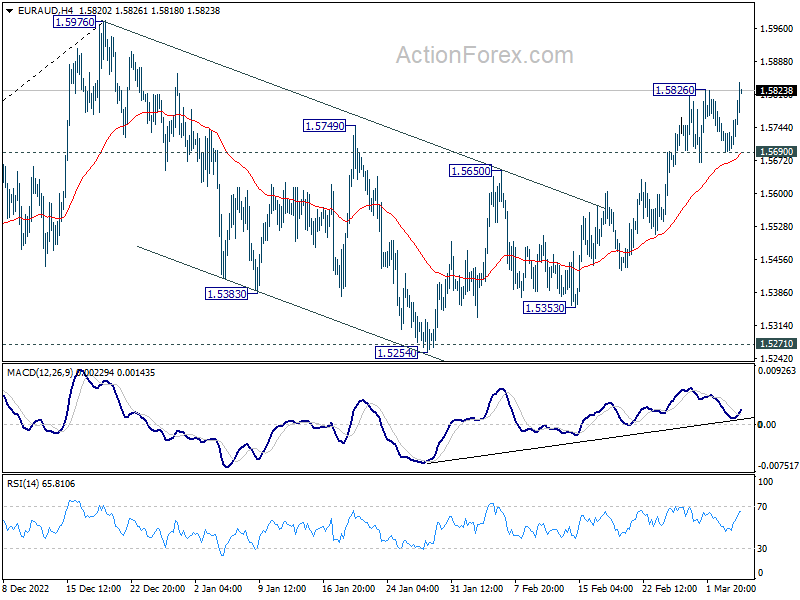
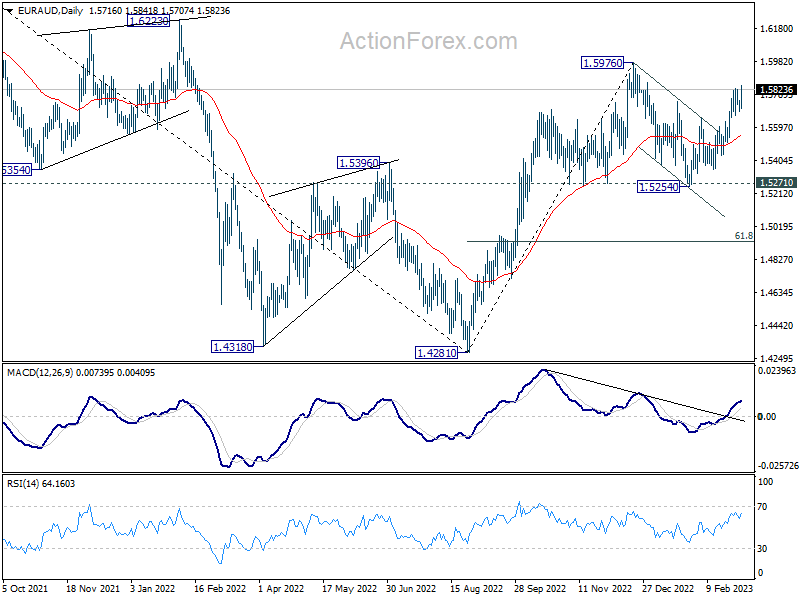
EUR/AUD's rise from 1.5254 resumed after brief consolidations. Intraday bias is back on the upside. Outlook is unchanged that corrective fall from 1.5976 has completed at 1.5254. Further rally is expected to retest 1.5976 high. On the downside, however, break of1.5690 support will delay the bullish case and extend the corrective pattern from 1.5976 with another falling leg.
In the bigger picture, it's still early to confirm if rise from 1.4281 represents bullish trend reversal. But as long as 1.5271 support holds, such rally is in favor to continue. Break of 1.5976 will target 1.6434 key resistance next. On the other hand, firm break of 1.5271 will retain medium term bearishness instead.
EUR/CHF Mid-Day Outlook
Daily Pivots: (S1) 0.9938; (P) 0.9963; (R1) 0.9979; More....
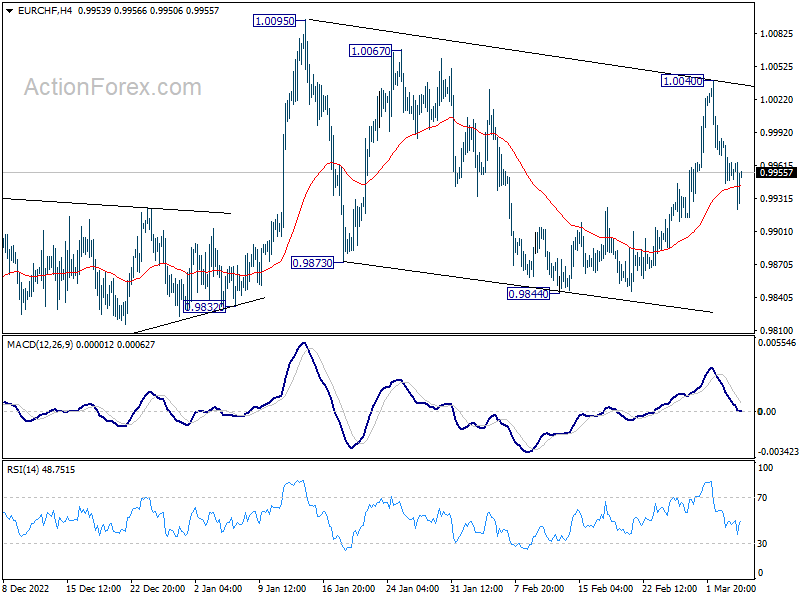
EUR/CHF's break of 4 hour 55 EMA suggests that rebound from 0.9844 has completed at 1.0040. Corrective pattern from 1.0095 is extending with another falling leg. Intraday bias is back on the downside for 0.9844 support. But downside should be contained by 0.9832 to bring rebound. On the upside, above 1.0040 will bring retest of 1.0095 high.
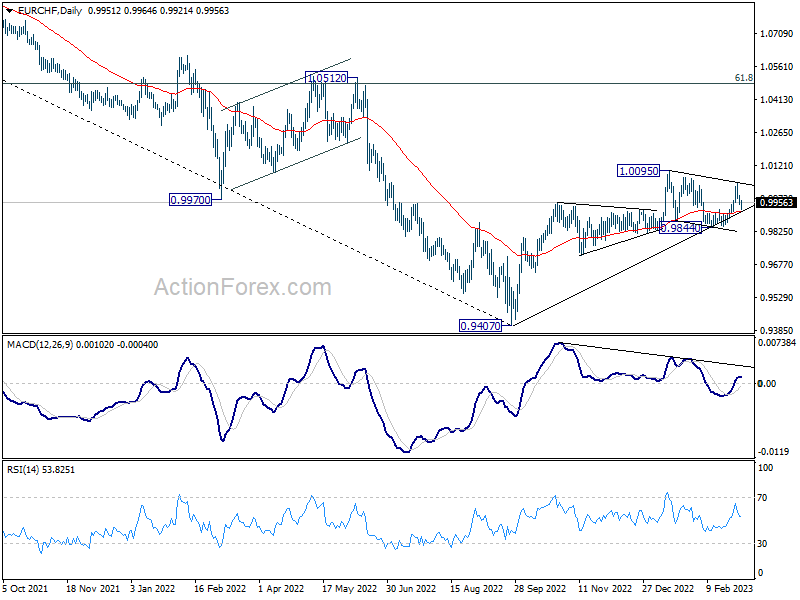
In the bigger picture, with 0.9832 support intact, rise from 0.9407 (2022 low) is still expected to continue. Break of 1.0095 and sustained trading above 55 week EMA (now at 1.0021) will be a medium term bullish signal, and bring further rally to 1.0505 cluster resistance (2020 low at 1.0505, 61.8% retracement of 1.1149 to 0.9407 at 1.1484). However, firm break of 0.9832 support will revive medium term bearishness and bring retest of 0.9407 low instead.
EUR/USD Mid-Day Outlook
Daily Pivots: (S1) 1.0602; (P) 1.0621; (R1) 1.0652; More...
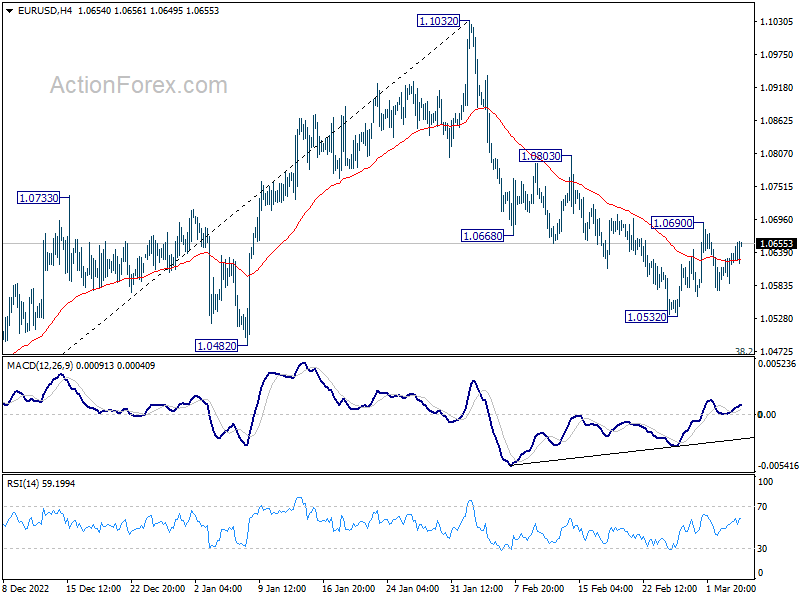
Intraday bias in EUR/USD stays neutral at this point. Fall from 1.1032 could still extend lower. But strong support is expected from 38.2% retracement of 0.9534 to 1.1032 at 1.0463 to bring rebound. Break of 1.0690 will turn bias back to the upside for 1.0803 resistance first. However, sustained break of 1.0463 will carry larger bearish implication and bring deeper decline.
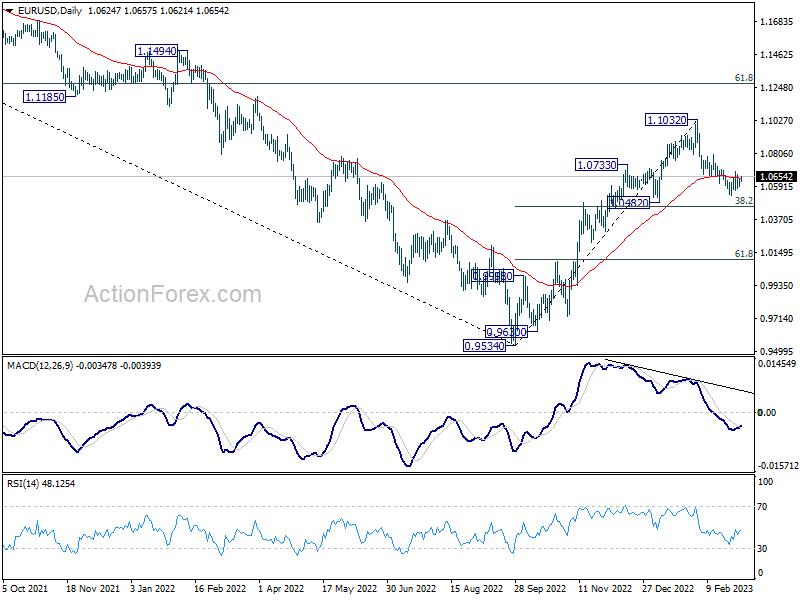
In the bigger picture, as long as 1.0482 support holds, rise from 0.9534 (2022 low) should continue to 61.8% retracement of 1.2348 (2021 high) to 0.9534 at 1.1273. However, sustained break of 1.0482 will bring deeper fall to 61.8% retracement of 0.9534 to 1.1032 at 1.0106, even as a corrective pull back.
GBP/USD Mid-Day Outlook
Daily Pivots: (S1) 1.1975; (P) 1.2012; (R1) 1.2082; More...
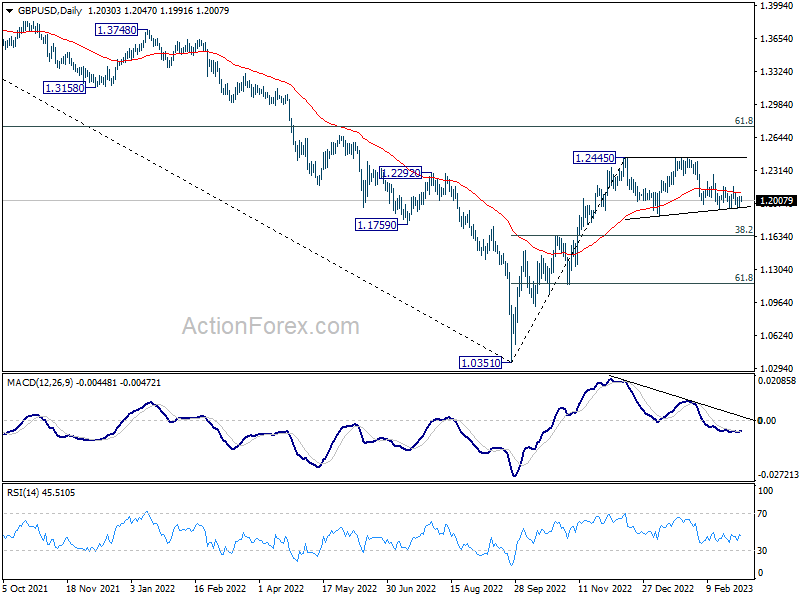
Intraday bias in GBP/USD stays neutral at this point. On the downside, break of 1.1914 will resume the decline from 1.2446, as the third leg of the corrective pattern from 1.2445, for 1.1840 support and possibly below. On the upside, break of 1.2142 resistance will turn bias back to the upside for further rebound to 1.2269 and above.
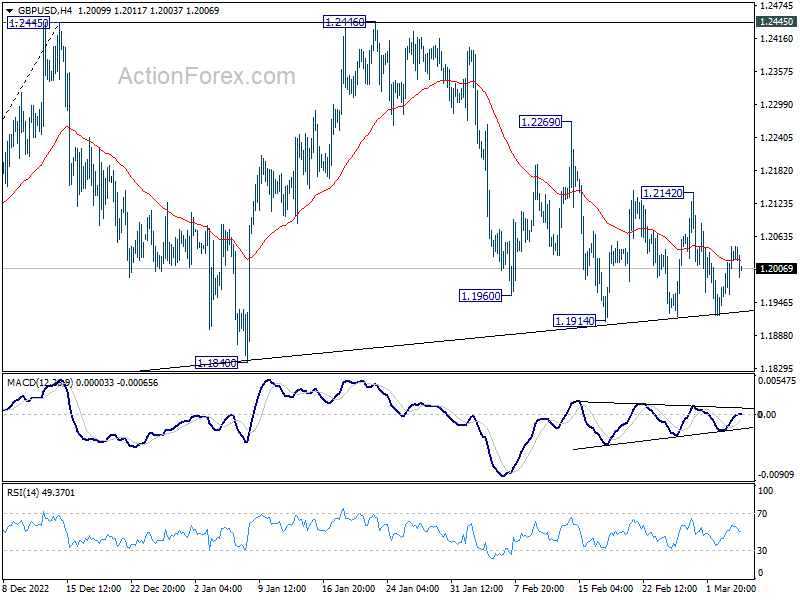
In the bigger picture, as long as 1.1840 support holds, rise from 1.0351 medium term bottom (2022 low) should still continue to 61.8% retracement of 1.4248 (2021 high) to 1.0351 at 1.2759. However, decisive break of 1.1840 will complete a double top pattern (1.2445, 1.2446) after rejection by 55 week EMA (now at 1.2243). Deeper decline should be seen back to 38.2% retracement of 1.0351 to 1.2445 at 1.1645.
USD/JPY Daily Outlook
Daily Pivots: (S1) 135.45; (P) 136.12; (R1) 136.50; More...
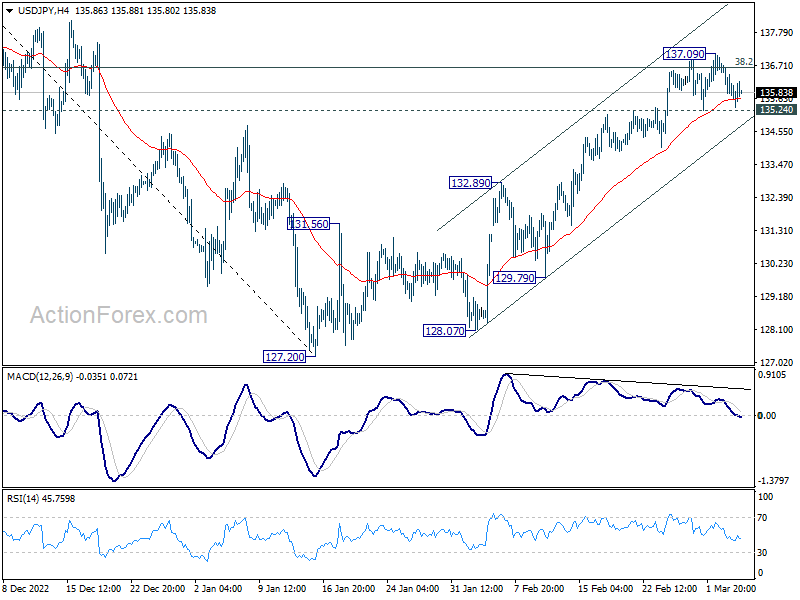
Intraday bias in USD/JPY remains neutral at this point. On the downside, break of 135.24 support will indicate short term topping, after rejection by 38.2% retracement of 151.93 to 127.20 at 136.64. Intraday bias will be turned back to the downside for 55 day EMA (now at 133.96) first. Sustained break of 55 day EMA will indicate that whole rebound from 127.20 has completed. On the upside, however, sustained break of 136.64 will indicate that fall from 151.93 has completed, and bring further rally to 61.8% retracement at 142.48.
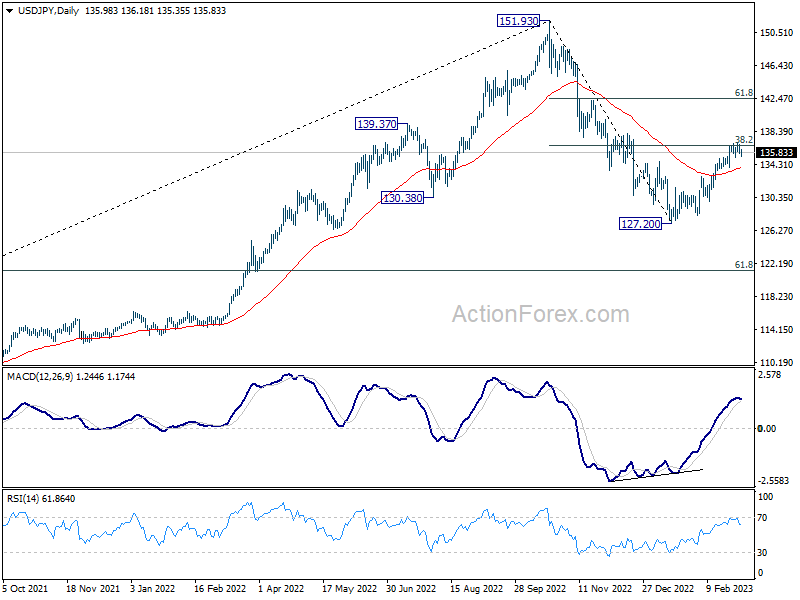
In the bigger picture, focus remains on 38.2% retracement of 151.93 to 127.20 at 136.64. Sustained break there will indicate that price actions from 151.93 medium term are merely a corrective pattern. Such development will maintain long term bullishness. Rejection by 136.64 will, on the other hand, extend the fall from 151.93 to 61.8% retracement of 102.58 to 151.93 at 121.43 at a later stage.
USD/CHF Mid-Day Outlook
Daily Pivots: (S1) 0.9336; (P) 0.9384; (R1) 0.9408; More...
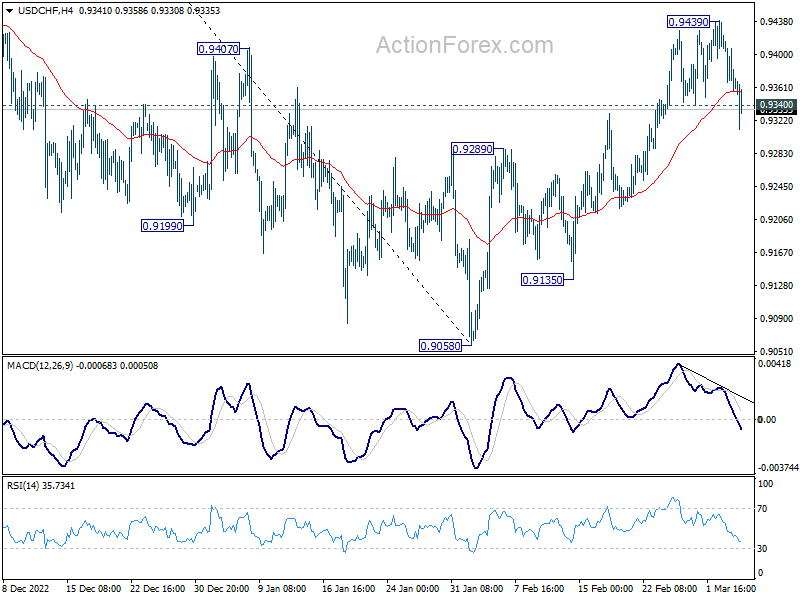
USD/CHF's break of 0.9340 support indicate short term topping at 0.9439, on bearish divergence condition in 4 hour MACD. More importantly, the corrective rebound from 0.9058 could have completed ahead of 38.2% retracement of 1.0146 to 0.9058 at 0.9474. Intraday bias is back on the downside for 0.9289 resistance turned support first. Decisive break there will bring retest of 0.9058 low. For now, risk will stay on the downside as long as 0.9439 resistance holds, in case of recovery.
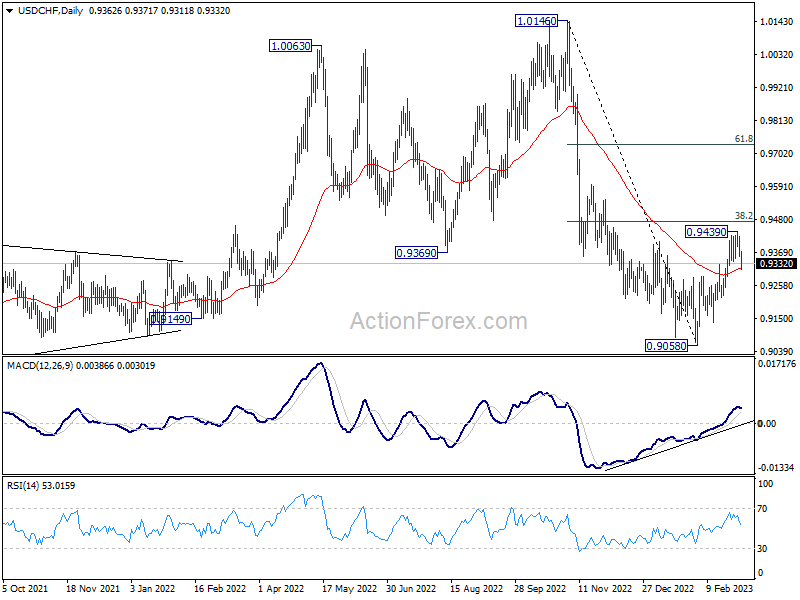
In the bigger picture, decline from 1.0146 is seen as part of a long term sideway pattern. As long as 38.2% retracement of 1.0146 to 0.9058 at 0.9474 holds, another fall is in favor through 0.9058. However, sustained trading above 0.9474 will indicate that the medium term trend has reversed, and open up further rally to 61.8% retracement at 0.9730 and above.