Sample Category Title
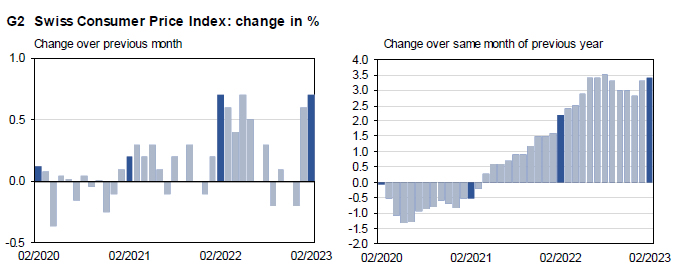
Swiss CPI accelerated to 3.4% yoy in Feb, core rose to 2.4% yoy
Swiss CPI rose 0.7% mom in February, above expectation of 0.4% mom. Core CPI (excluding fresh and seasonal products, energy and fuel), rose 0.8% mom. Prices of domestic products rose 0.6% mom. Imported products rose 1.1% mom.
Compared with the same month a year ago, CPI accelerated to 3.4% yoy, up from January's 3.3% yoy, well above expectation of slowing to 2.9% yoy. Core CPI accelerated to 2.4% yoy, up from 2.2% yoy. Domestic prices accelerated to 2.9% yoy, up from 2.6% yoy. Imported prices slowed to 4.9% yoy, down from 5.2% yoy.
Is It Time for Fed Chair Powell to Appear in a Hawkish Suit?
Market pricing about the Fed’s future course of action has dramatically changed lately, following a streak of upbeat US economic data and hotter-than-expected inflation numbers for January. Several Fed officials have become more vocal about the need for more aggressive action hereafter, but a big question is whether Fed Chair Powell has ditched his disinflationary view following the data. With that in mind, investors will closely watch his testimony before Congress on Tuesday and Wednesday.
Streak of January data boosts Fed hike bets
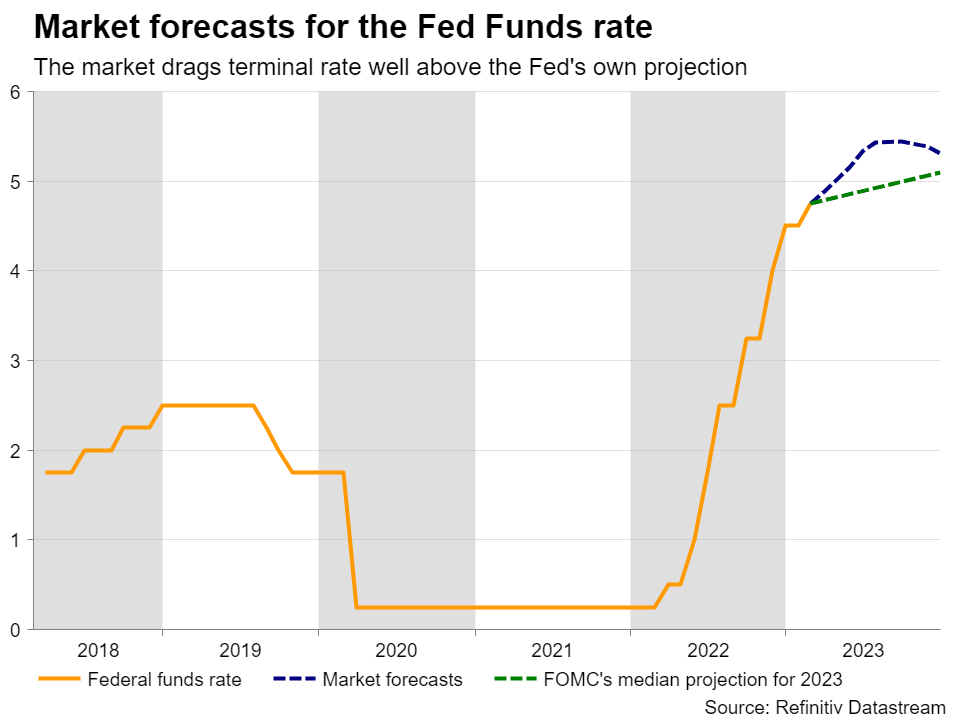
At the press conference following the last FOMC gathering, Fed Chair Powell appeared less hawkish than expected, saying that the disinflationary process has started and although he noted that it will not be appropriate to cut rates this year, he added that if inflation comes down faster, that will be incorporated into their policy.
Back then, his remarks added credence to investors’ view that the terminal rate could not reach the Fed’s median projection of 5.1%, and that a couple of rate cuts could be warranted by the end of the year. Nonetheless, a run of upside surprises in economic and inflation data made investors radically change their mind. They raised the level of where they expect interest rates to reach at 5.4%, while scaling back their bets for rate cuts.
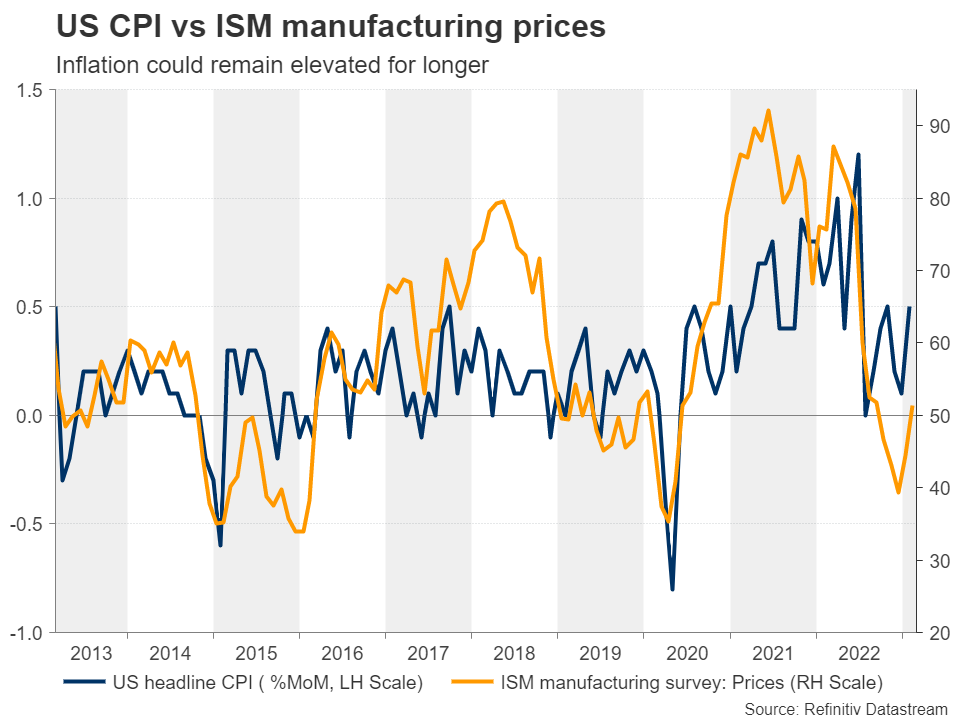
The stellar gains in nonfarm payrolls for January marked the beginning of the shift, with the acceleration in the monthly CPI rate for the month cementing this change of heart. Although those releases were the game changers, early February numbers also corroborated the new narrative. The preliminary S&P Global PMIs surprised to the upside, and although the ISM manufacturing PMI stayed in contractionary territory, its prices subindex jumped above 50, heightening fears that inflation may remain elevated for longer.
Will Powell abandon his disinflationary view?
With all that in mind, investors may be sitting on the edge of their seats in anticipation of what Fed Chair Powell has to say in his semi-annual testimony before Congress. Will he reiterate his disinflationary remarks, or will he appear in a hawkish suit and fuel expectations that interest rate projections will be revised higher at the upcoming meeting?
Several of his colleagues seem to have adopted the latter stance. Minneapolis Fed President Neel Kashkari, who has long been an advocate of a terminal rate above 5.4%, said that he is “open minded” on either a 25 or 50bps hike at the upcoming meeting, while Cleveland Fed President Mester and Atlanta Fed President Bostic argued that rates should exceed 5% and stay there for a prolonged period, with Bostic specifically saying that they should keep them at the peak well into 2024.
How can the dollar respond?
Therefore, a hawkish message by Fed Chair Powell could further endorse investors’ view and thereby push Treasury yields and the dollar higher. At the same time, stock indices could extend their slide as higher interest rates mean higher borrowing costs and lower present values for firms. However, calling for a long-lasting recovery in the US dollar seems premature and impulsive. Ahead of the upcoming FOMC meeting, investors will have to take in the employment report for February, coming out on Friday, and the CPI numbers for the month, due to be released on March 14, both of which have the capacity to give market pricing a 180-degree spin again.
Considering that investors have drastically increased their ECB hike bets as well, euro/dollar may not be the best pair for exploiting any further dollar gains. With the slowdown in Canada’s inflation for January and the nation’s disappointing GDP data for Q4 congealing expectations that the BoC may refrain from hiking at Wednesday’s meeting, the loonie may be a better choice.
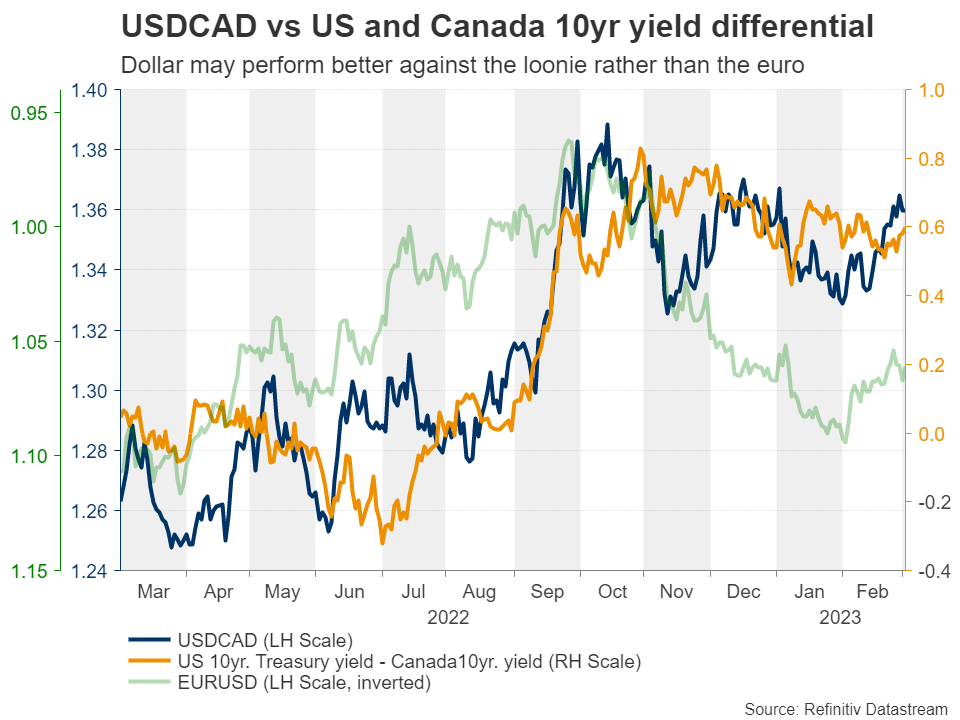
Will dollar/loonie break above 1.3700 soon?
Dollar/loonie seems to be in a recovery mode since February 14, while in the bigger picture, it is trading well above the key support zone of 1.3230 and well above the uptrend line drawn from the low of June 2021. So, should the bulls recharge soon, they could challenge the 1.3700 territory, which acted as a ceiling between December 7 and January 3. If there are no sellers to be found there, they may climb towards the 13810 zone, where another breach could set the stage for extensions towards the peak of October 13 at 1.3980.
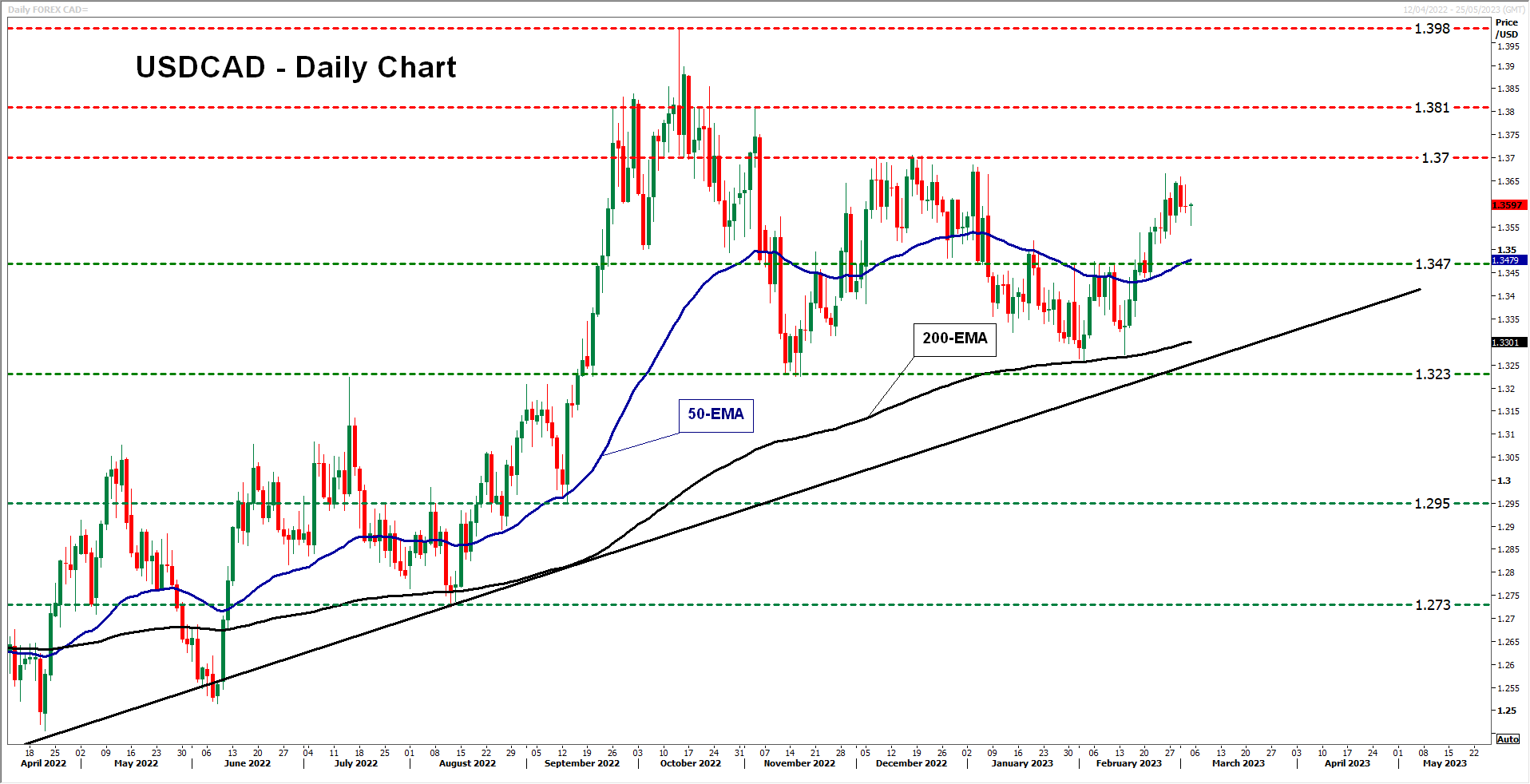
Now, if Powell reiterates his disinflationary view, which seems an unlikely scenario following the latest bunch of US data, traders may abandon the US dollar and allow dollar/loonie to fall below 1.3470, a move that might trigger declines towards the key support territory of 1.3230. That said, the pair would still be trading above the aforementioned uptrend line and thus, the slide will be far from signaling a full-scale bearish reversal.
ECB and Fed Speakers Maintained ‘Higher for Longer Mantra’
Markets
On Friday, US and European yields envisaged an end of week countermove. The correction occurred as even ECB and Fed speakers maintained the ‘higher for longer mantra’. ECB’s Wunch indicated that a 4% policy rate isn’t excluded if (core) inflation doesn’t cool. Other ECB members (Vasle, de Guindos, Muller) were less specific but also committed to bring (core) inflation back under control. However, the comments didn’t prevent an end-of-week correction with German yields easing between 0.1 bps (2-y) and 3.9 bps (30-y). Still, technically, the yield-uptrend remains firmly intact with the German 10-y yield closing the week well above the previous 2.57% resistance. The correction in US yields was even more outspoken even as the intraday downtrend was temporarily interrupted after the release of the services ISM. The headline index stabilized firmly in expansion territory (55.1), with strong orders (62.6), further employment growth (54.0) and persistent prices rises (65.6). Fed’s Barkin and Collins also indicated the Fed has more work to do. Even so, after a brief post-ISM uptick in yields, US Treasuries rebounded further with yields easing from 2.9 bps (2-y) up to 11.8 bps (30-y). The correction was solely due to a decline in real yields. Inflation expectations again even rose a few bps. The decline in (real) yields supported further equities gains (Dow +1.17%; Nasdaq +1.97%). The Euro Stoxx 50 rose 1.28% to close less than 3.0% from the 2021 peak. Risk-on sentiment caused a modest setback of the dollar (DXY close at 104.52, EUR/USD close at 1.0635), but the US currency didn’t give up any important support. EUR/GBP dropped from the 0.887 to 0.883, but firmly held within tight 0.88/0.89 week ‘extremes’.
This morning, Asian equities modestly join Friday’s risk rally on WS. China underperforms. Markets apparently expected a more growth supportive approach from the Chinese government (cf infra). US yields and the dollar are easing marginally further (EUR/USD 1.0645). Later today, the eco calendar mostly contains second tier data. Later this week, the focus will be on Fed Powell’s testimony before Congress (Tuesday before Senate/Wednesday before the House) and Friday’s US payrolls. Powell will confirm that the Fed’s job on inflation isn’t finished. Question is whether he will already indicate that the Fed will have to go beyond the December dots (5.5%+). If not, some more consolidation in US yields might continue going into the payrolls. The decline in EUR/USD also takes a breather, with the correction low at 1.0533. In case of a further USD correction, the EUR/USD 1.0803 mid-February top serves as a first resistance. Also keep an eye at the policy meetings of the Reserve Bank of Australia (Tuesday), The Bank of Canada (Wednesday) and the Bank of Japan (Friday). US Treasury auctions (3-y, 10-y, 30-y) also will provide an indication on investors’ appetite for (US) bonds after recent repositioning.
News and Views
China has set a growth target of 5% this year. The rather modest goal is seen as restoring Beijing’s credibility after missing last year’s target (around 5.5%) by a wide margin for the first time ever. It also suggests that there won’t be any large stimulus measures. Premier Li said that boosting demand (consumer spending and investment) will be the top priority. They planned for an urban job creation of around 12 million vs the 11 million last year. The fiscal deficit was raised from 2.8% to 3% of GDP. Yet, local governments are given smaller quota for special bonds used mainly to finance infrastructure. It indicates the government is seeking to strike a balance between supporting the economy and strained finances as well as prevent spiraling commodity inflation. Headline price increases are expected to stick around 3%. China’s yuan is trading a tad weaker this morning with USD/CNY eking out a gain to 6.915.
South Korean inflation eased in February. The headline figure came in at 4.8% y/y (0.3% m/m), down from 5.2% and less than the 5% expected. A core gauge retreated from 5% to 4.8%. All categories but transport (-0.7% m/m) rose, suggesting still-widespread pressures, despite the deceleration. The central bank of South Korea (BoK) has lifted policy rates by 300 bps since August 2021 to 3.5%. It stood pat last month but the governor said it shouldn’t be seen as the end of the tightening cycle. Indeed, most board members wanted to keep the door open to lift the key rate to 3.75%. While the domestic economy is slowing down, the BoK is wary for the Fed’s aggressive tightening cycle and its effect on the won. At USD/KRW 1296.8 (unchanged vs. Friday) the SK won is trading at a relatively weak level.
Commodities Trading on Back-foot Following New China Growth Target
Market movers today
We start the week in a quiet fashion on the data front amid markets digesting the take-aways from China's National People's Congress over the weekend.
In the euro area, retail sales for January and Sentix investor confidence for March are on the agenda. After the sharp decline in retail spending in December, it will be interesting to see if the downtrend trend has continued at the start of 2023 as real income losses are taking their toll.
In Sweden, Statistics Sweden said on Friday that GDP Q4 declined 0.5% y/y seasonally adjusted, a smaller drop than the 0.9% y/y initially reported and more in line with expectations. The correction is due to late incoming reports affecting net exports. A new set of national account data will be published today at 08:00 CET.
Later this week, the primary highlight will be the US jobs report and Bank of Japan meeting on Friday (more below), with markets still caught between the overheating vs. soft-landing narrative (see Research US - Fed finds comfort in retightening financial conditions, 3 March). We also have rate decisions in Australia (Tuesday) and Canada (Wednesday) where we look for a 25bp hike and an unchanged decision, respectively.
The 60 second overview
Markets: sentiment this morning is dominated by the modest, revised growth target in China highlighting a diminished likelihood of more stimulus. Not least commodity prices are trading to the heavy side with industrial metals and oil prices reacting to the slightly weaker demand outlook. US Treasury yields have come a few bp lower overnight while the CNY, AUD and NZD are among the natural underperformers in FX space.
Modest Chinese growth target: At the opening of China's National People's Congress yesterday, China announced a new growth target at 5.0%. It was in the low end of expectations, which ranged from 5-6% (we looked for a 5.5% target). The modest growth target is probably a reflection that: a) after a year of substantial undershooting of the target in 2022 (3.0% vs a target of 5.5%), China has decided on a target that it feels confident it can deliver, b) China wants to leave room for new headwinds such as a possible global recession, and c) we are not likely to see a lot of stimulus. The latter is probably the most important signal from the announcement. The signal does not change our expectation of China reaching 5.5% growth this year as we already have indications that growth came off to a strong start in Q1. The announcement may disappoint some investors but on the other hand, it could ease some fears of a strong inflationary impact from China. Markets have reacted moderately with Chinese offshore stocks down 0.3% and the USD/CNH broadly unchanged from Friday's levels.
US data: Friday's ISM services report showed a slight decline in the main index from 55.2 to 55.1. That said, at these levels the service consumption engine of the US economy continues to do far better than what we believe the Federal Reserve can feel comfortable with amid above target inflation. In addition, the details revealed a further rise in the new orders sub index to a very elevated 62.6. Also, the employment index continued to move higher hitting the highest level since December 2021 (54.0). The prices paid eased slightly but remains far too high for policy makers' liking at 65.6. All in all a data release supporting the notion that Fed has more work to do in the fight against elevated inflation.
Bank of Japan (BoJ): this week, outgoing Governor Kuroda has his last chance to surprise markets, and perhaps make life easier for his successor Ueda, when the BoJ has a monetary policy meeting on Friday. Changes to monetary policy by rate hikes or tweaks to the YCC seem less likely for this meeting, as Kuroda clearly has communicated that he believes the current inflationary pressures are temporary and the BoJ needs firmer evidence of persistent price pressures before tightening policy. However, we still find it likely that the BoJ has to at least tweak the YCC at some point during Q2.
FI: Last week was once again dramatic in the global fixed income markets with a solid rise in bond yields during the first four days of the week. On Friday, yields declined and the week ended only modestly higher. 10Y US Treasuries were testing 4%, but fell back below 4% on Friday. 10Y German government bond yields ended 12bp higher at 2.70%.
FX: SEK and NOK had a bad last week but both edged higher after the European session closed on Friday. EUR/SEK starts the week in the lower end of the 11.10-20 range and EUR/NOK have moved closer to the 11.00 mark. The dollar ended last week on a weaker note vs both EUR and JPY. USD/JPY is back below 136.
Credit: Very strong sentiment on Friday where iTraxx Xover tightened 19bp, closing in 397bp, and Main tightened almost 4bp to 76bp. In primary, Pandora priced its inaugural sustainability-linked bond where terms are linked to using 100% recycled gold and silver within two years.
China’s 5% Growth Target Weigh on Energy and Commodity
There are plenty of reasons that should push equities lower, but equities continue trending higher.
Both European and American stocks closed last week with gains, and futures hint at a positive start to the week despite China’s announcement of a modest 5% growth target.
But the 5% growth target raises concerns about the amount of stimulus that the Chinese will put on the table, and the possible continuation of the government crackdown. The Chinese officials said that they don’t want a disorderly growth in real estate – which is a major ingredient for the Chinese growth. Plus, the local governments could borrow and spend less, even though the Chinese as a whole increased their fiscal deficit projection.
This means that China is on its way for more centralization of the power around Xi Jinping and less freedom for local entities. Combined with Xi’s fight against euphoric growth and the West’s limitation on investment and technology exports to China, we shall see investors reluctant to return to Chinese equities.
China’s modest 5% growth target weigh on energy and commodity prices. Iron ore and copper futures are down, and US crude’s 100-DMA resistance, around the $80pb level, will likely remain strong.
On this week’s agenda
Fed talk
Federal Reserve (Fed) Chair Jerome Powell will deliver his semi-annual testimony before the Senate this week, and he will certainly reiterate that the Fed is not yet done with its fight against inflation, that the labour market remains particularly strong, that a soft landing is possible, yet the Fed won’t hesitate to sacrifice growth to abate inflation as soon as possible.
Looking at the latest set of data, the U-turn of easing inflation and last month’s blowout jobs figures, we don’t expect to hear anything less than hawkish from Mr. Powell. But it’s always possible that a word like ‘disinflation’ slips out of his mouth, and that we get a boost on risk.
US jobs
The US economy is expected to have added around 200’000 jobs, with the possibility of a negative surprise after last month’s above half a million read. Unemployment is seen steady around 3.4% - a more than 50-year low, while average earnings are seen going up from 3.4% to 3.7% over the year. Nothing encouraging for the Fed doves. But who cares?
RBA, BoC, BoJ
The Reserve Bank of Australia (RBA), the Bank of Canada (BoC) and the Bank of Japan (BoJ) will be announcing their latest policy verdicts this week and among them, only the RBA is expected to hike the rates by another 25bp despite last week’s surprise softening in latest inflation and growth numbers.
More than 40% of the companies in the ASX 200 posted negative earnings surprise last quarter, up from 28% a year ago. The latest figures from macro and micro fronts raise questions about how far the RBA could go in terms of rate hikes.
On the currency front, since the end of February, the AUDUSD slipped into the bearish consolidation zone, but the pair has been following the 100-DMA slightly to the upside, as the Chinese reopening sustains iron ore prices – except for today, of course, as China’s 5% growth target hasn’t been a boon for energy and commodity stocks.
China could still rescue the Aussie from falling further, but the Chinese winds could hardly reverse the negative trend in AUDUSD as the Fed-supported US dollar is certainly not done its positive push yet.
Technical Outlook and Review
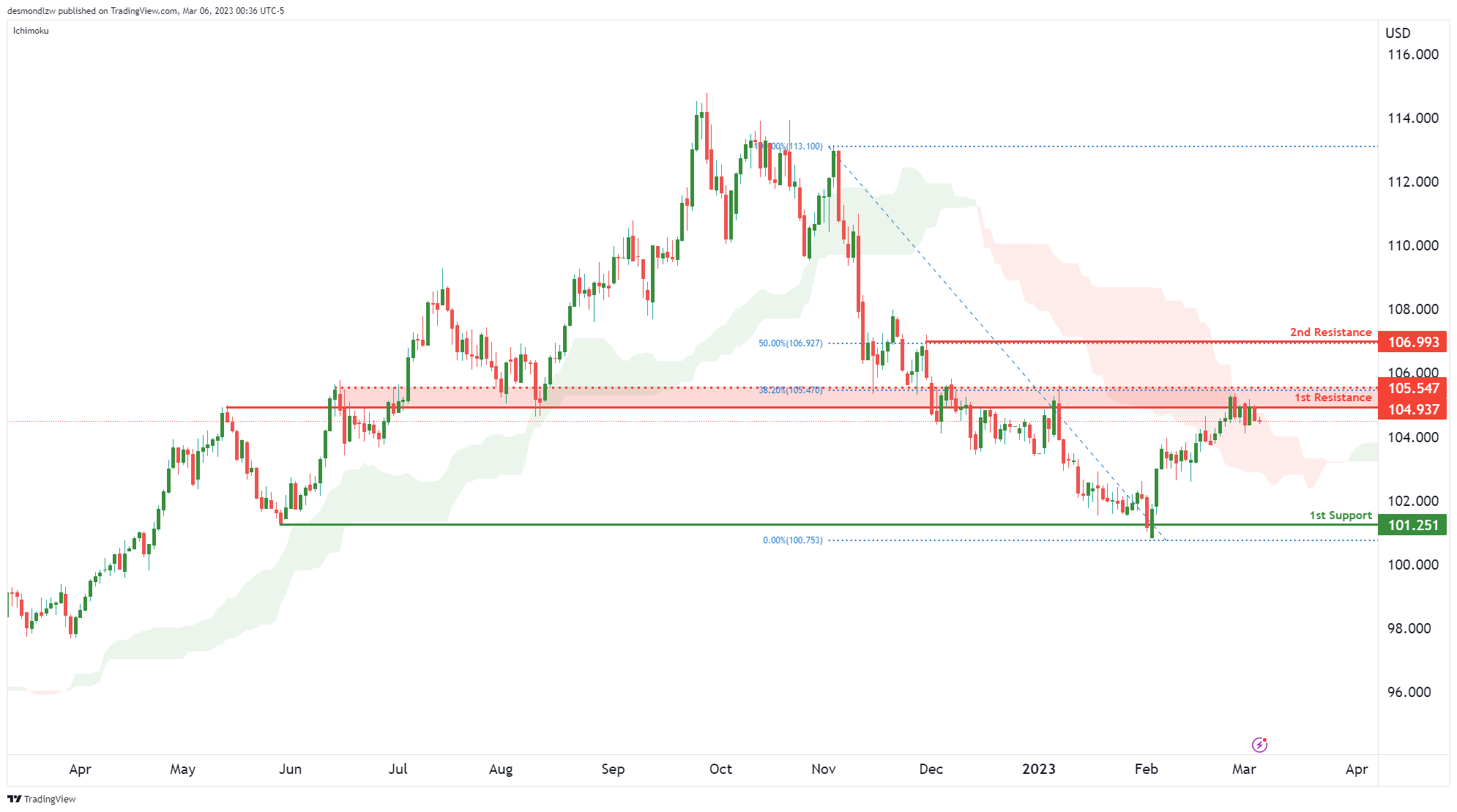
DXY:
Price has reached our 1st resistance area at 104.93, which is also a 38.2% Fibonacci retracement and a swing high resistance. If the price cannot break this level, we could see prices drop all the way down to 1st support at 101.25, which is an overlap support.
However, if the price were to break our first resistance, we could potentially see the price push up to our 2nd resistance.
EUR/USD:
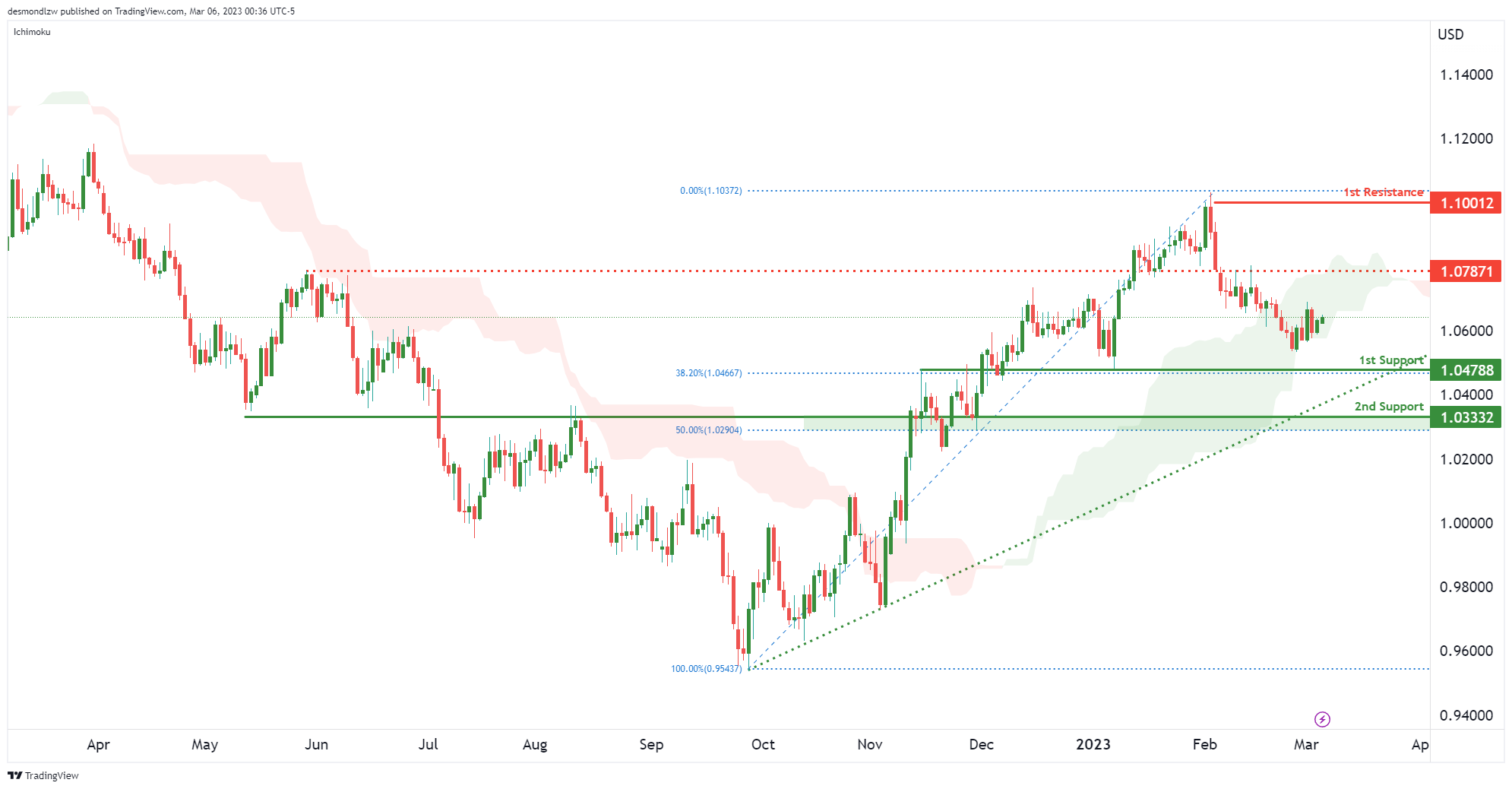
Price has reversed from our first resistance at 1.10012 and reached our first support at 1.0478, which also lines up with the 38.2% Fibonacci retracement. If the price were to break our first support at 1.04788, it could potentially drop further to our second support at 1.03332, where the overlap support is.
GBP/USD:
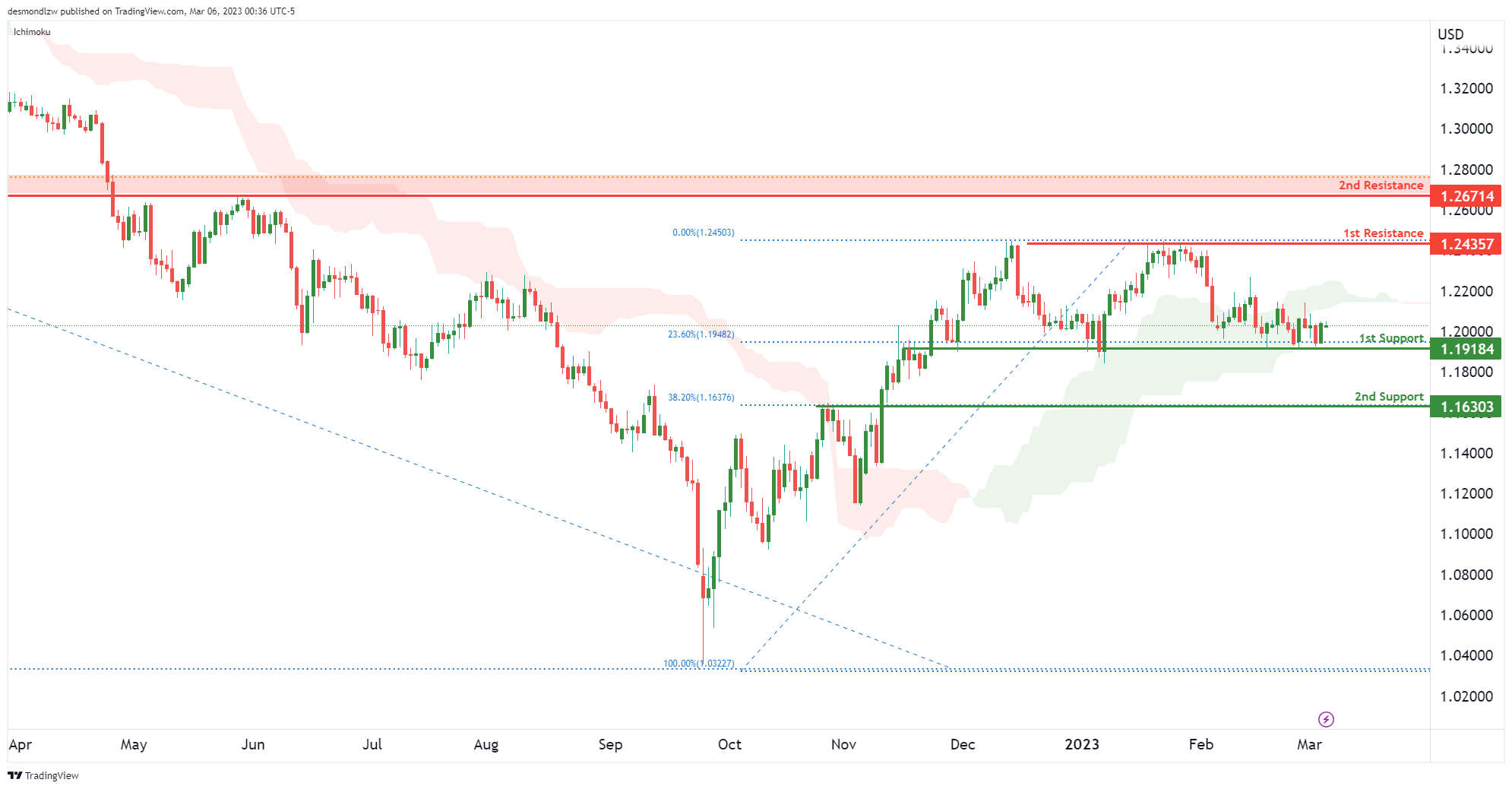
Price has bounced from our first support at 1.1918 with the 23.6% Fibonacci retracement. Our first support is a very strong overlap support because the price has reacted and bounced off it multiple times in the past. If prices were to break this first support, the next key support to watch out for is 1.1630, which lines up with the 38.2% Fibonacci retracement.
In terms of resistance, our first resistance is 1.2435, which is also a very strong resistance because the price has reacted and bounced off it multiple times. If the price were to break it, it could potentially push up to our second resistance at 1.2671.
USD/CHF:
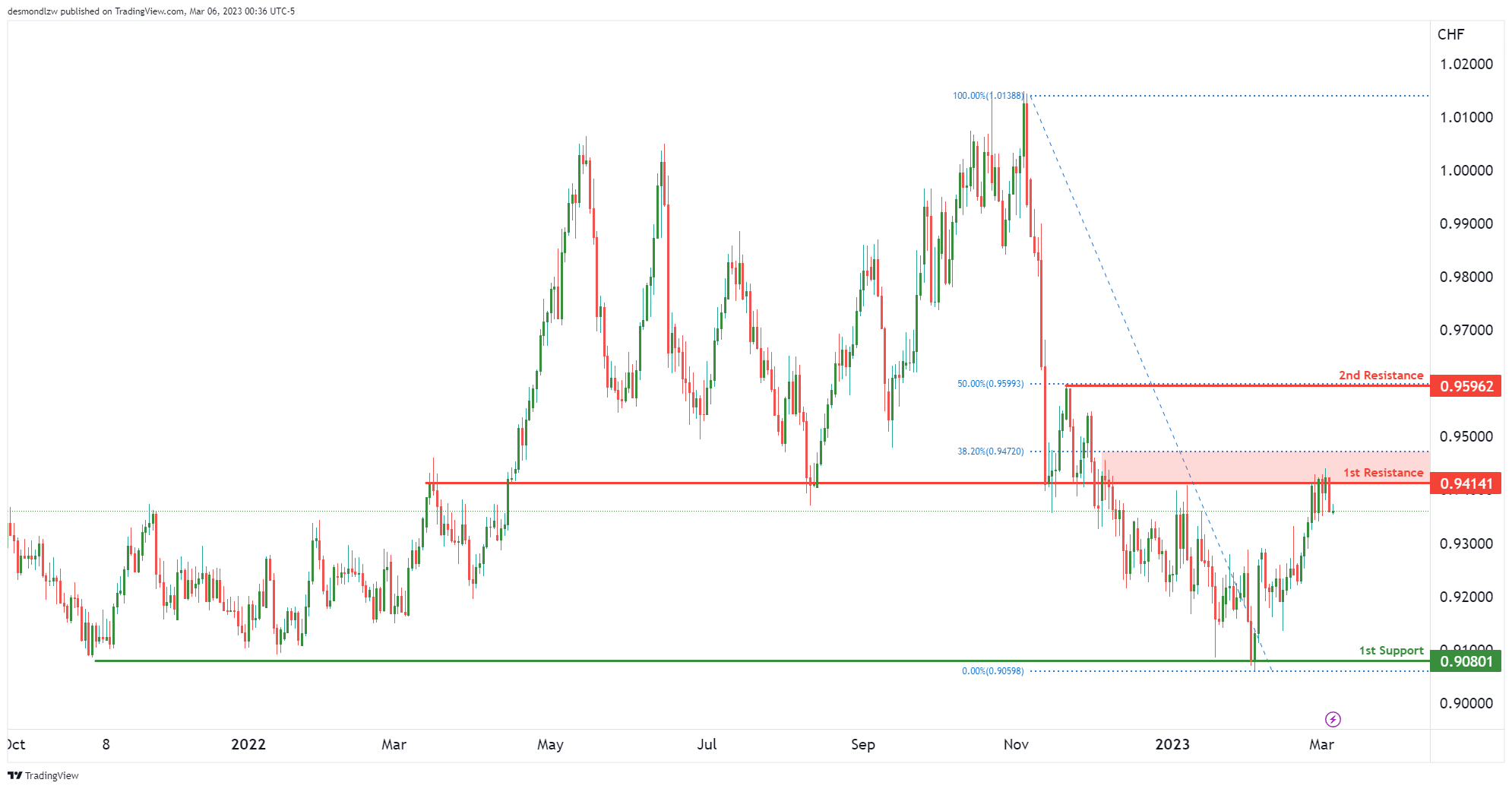
Price has reached our 1st resistance at 0.9414, which is a very strong resistance. If the price were to break this level, we could see a further push-up to our 2nd resistance at 0.9596. However, if prices fail to break the 1st resistance and instead reverse, we could see it drop to 1st support at 0.9080, which is a strong overlap support.
USD/JPY:
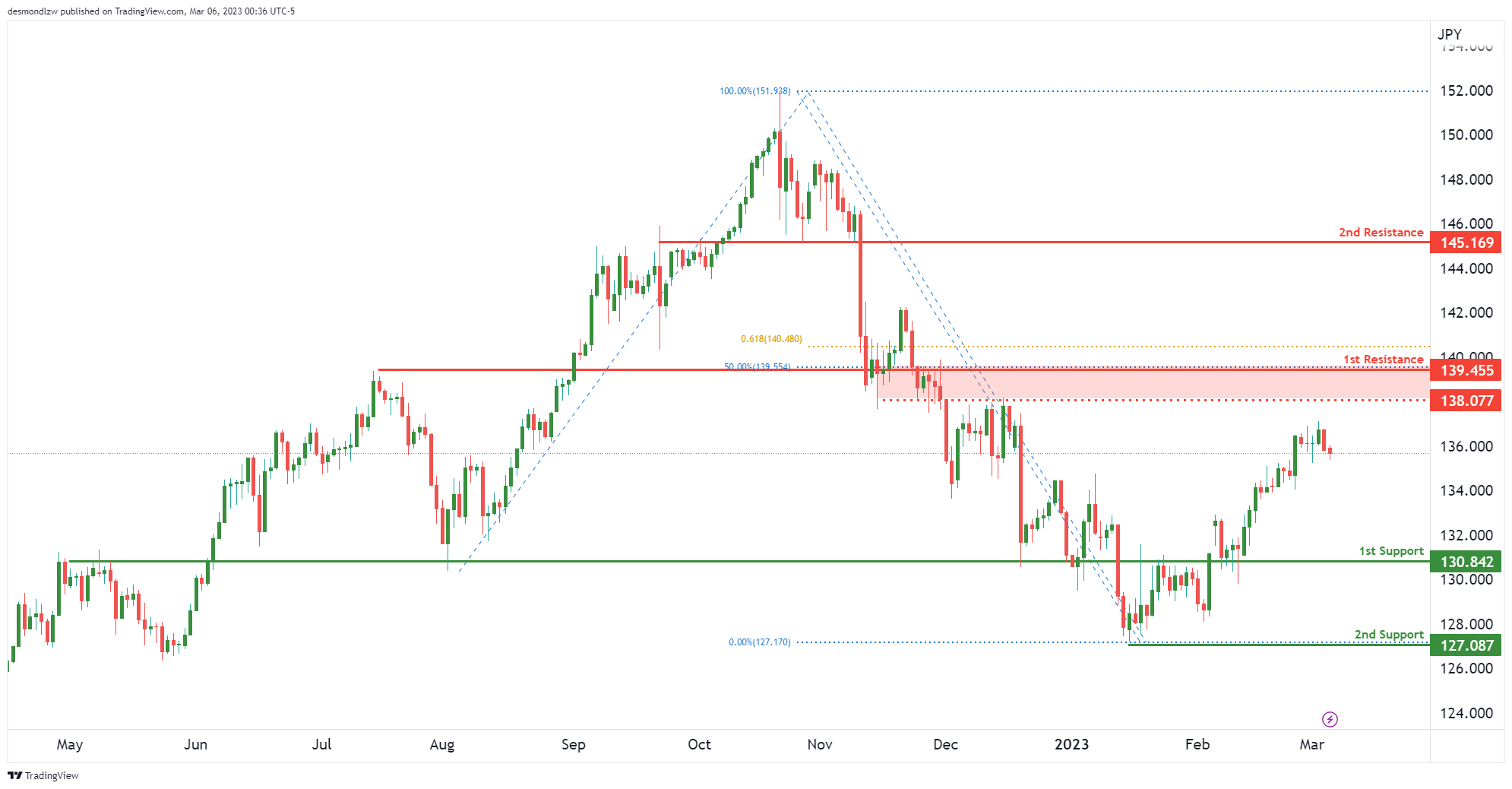
We are seeing that the price could potentially reach our first resistance at 138.077 with the 50% Fibonacci retracement, which is a strong overlap resistance.
In terms of support, we can see an overlap support at 130.84, which is our first support. If the price were to break this level, the price could drop to the second support at 127.08.
AUD/USD:
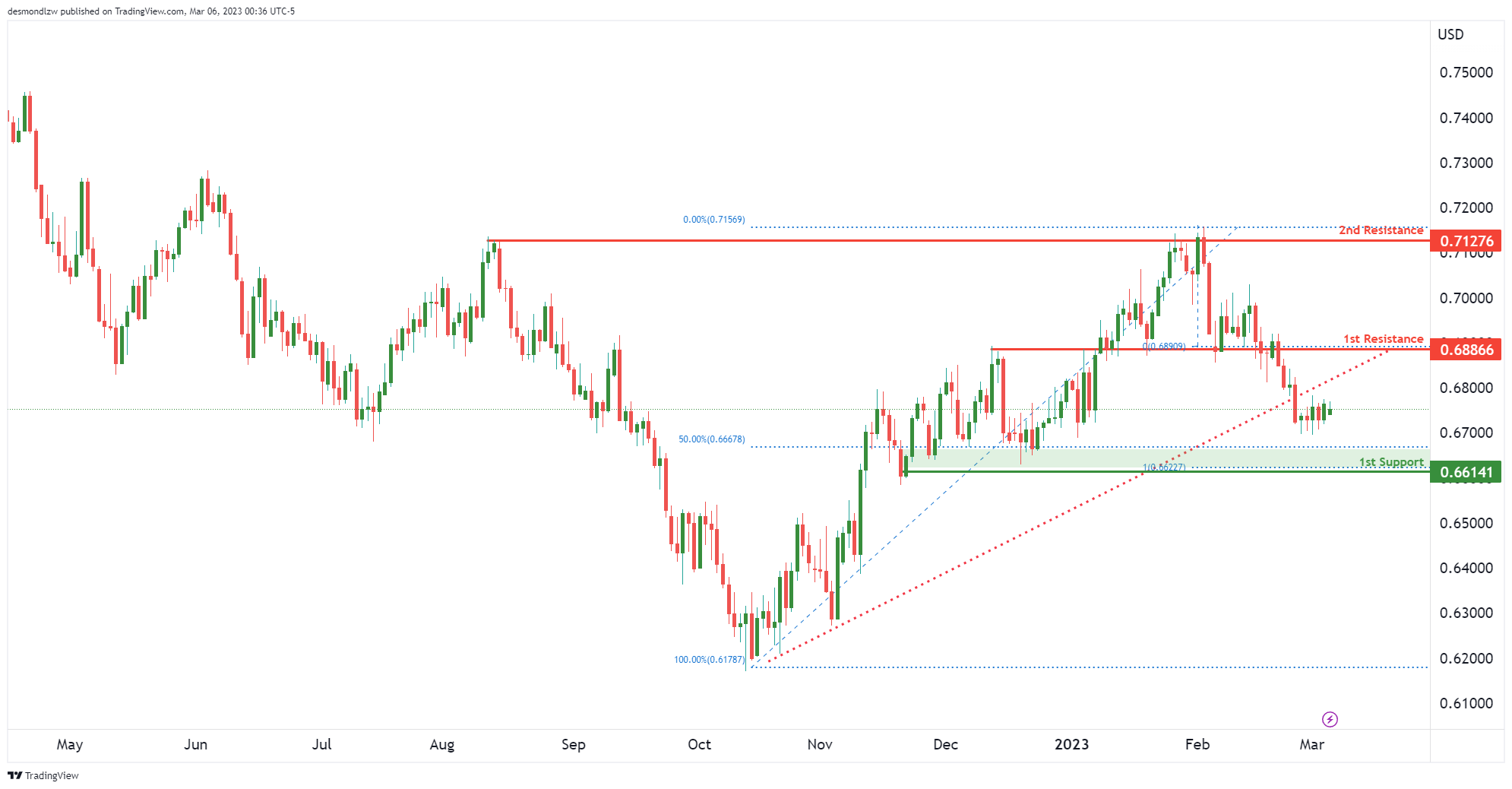
Price has broken from our ascending trendline, and it could come down to our first support area at 0.6614, along with the 50% Fibonacci retracement.
In terms of resistance, we can see overlap resistance at 0.6886. If the price were to break this level, it could potentially push up to our second resistance at 0.7127.
NZD/USD:
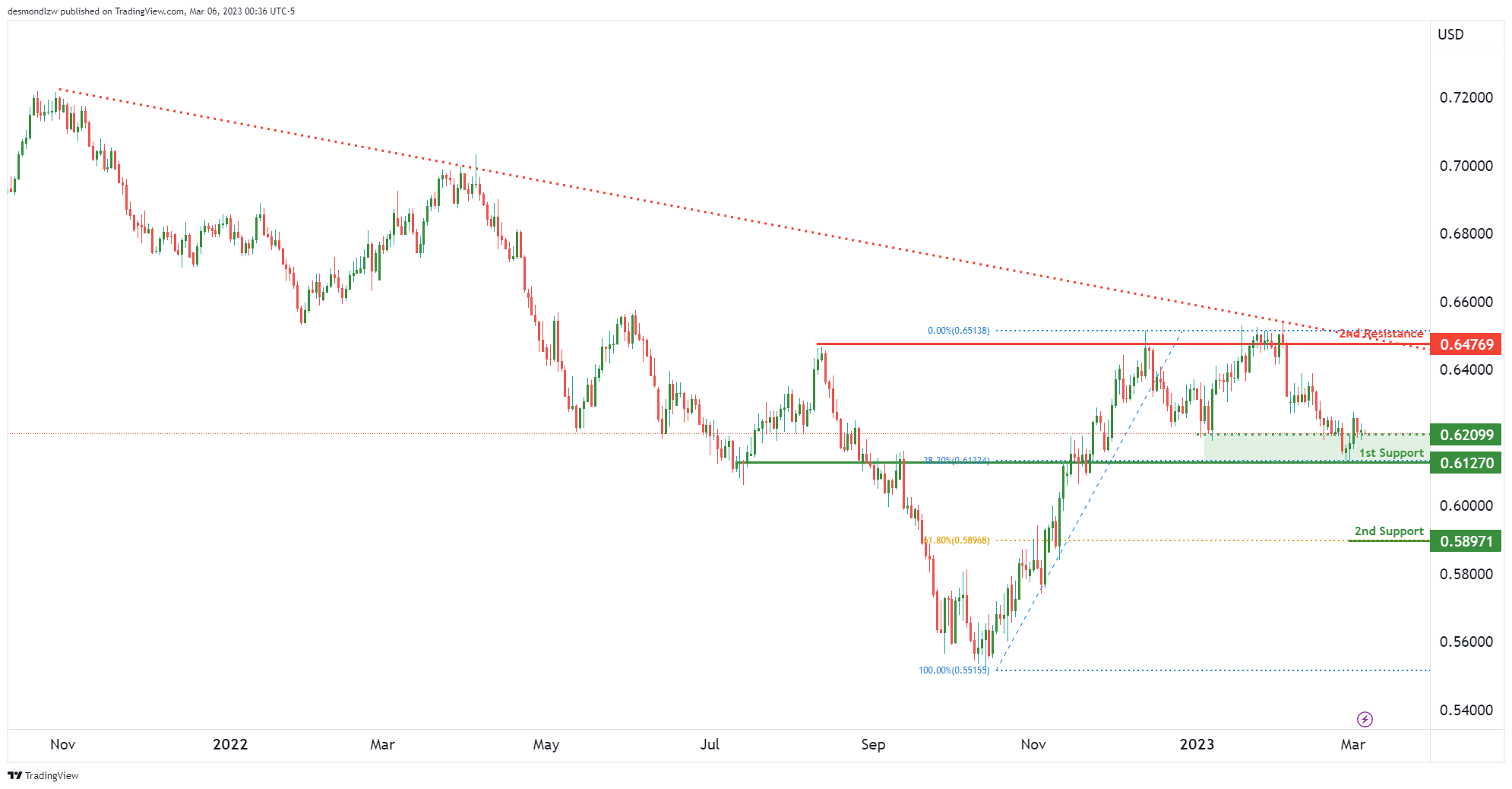
Price bounced off from our first support area at 0.6127, along with the 38.2% Fibonacci retracement. If the price were to break this level, it could potentially come down to our second support at 0.5897, along with the 61.8% Fibonacci retracement, which is strong overlap support.
In terms of resistance, the next swing high is 0.6476, which is a very strong overlap resistance along with the descending trendline.
USD/CAD:
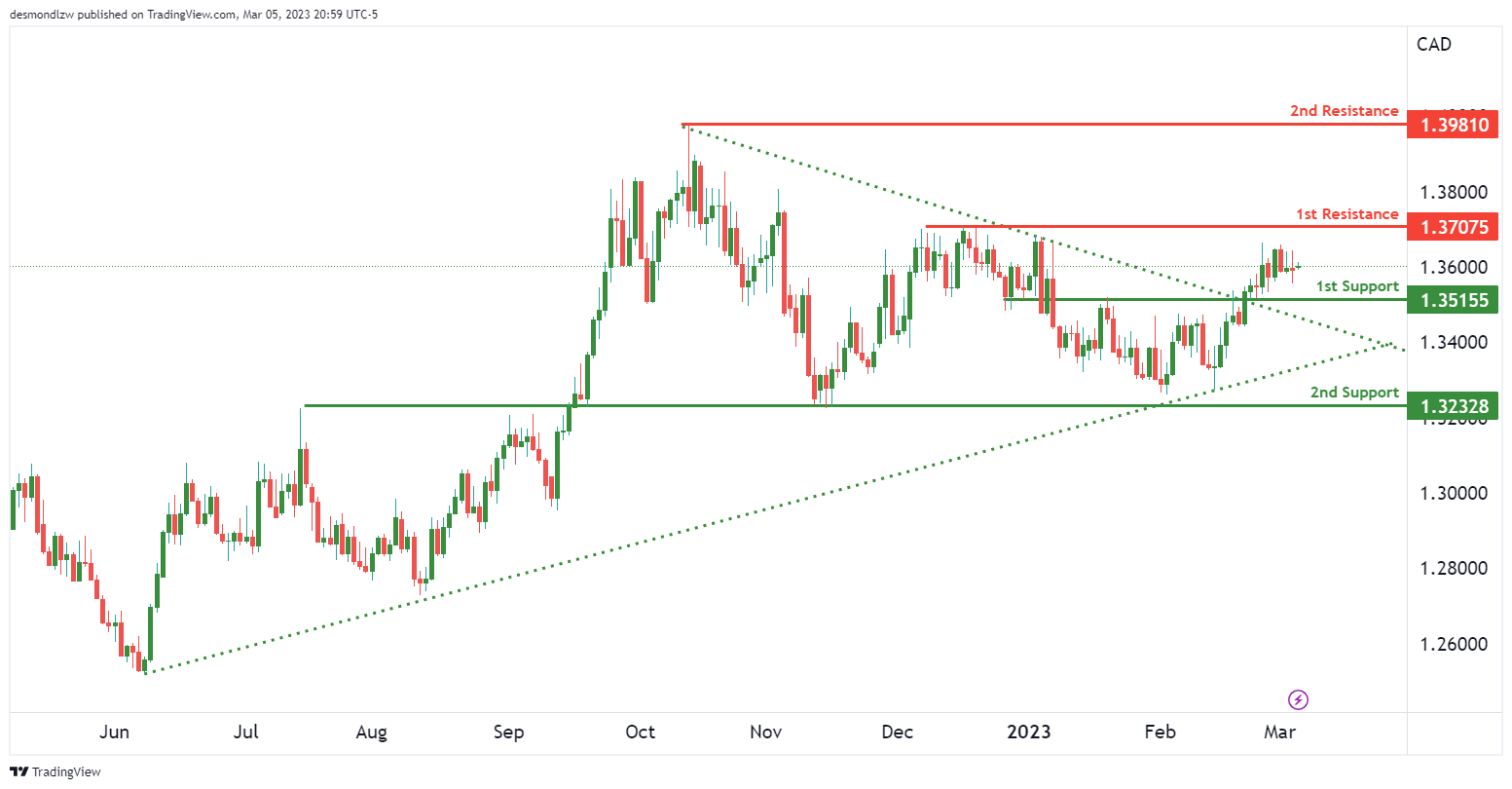
We are seeing that the price has broken from the descending trendline and could potentially push up to our 1st resistance at 1.3707. If the price were to break this level, the next swing high is at 1.3981.
In terms of support, the first support of 1.3515 is a strong overlap support level. Breaking this level, the price could come down to our second support at 1.3232, which is another overlap support.
DJ30:
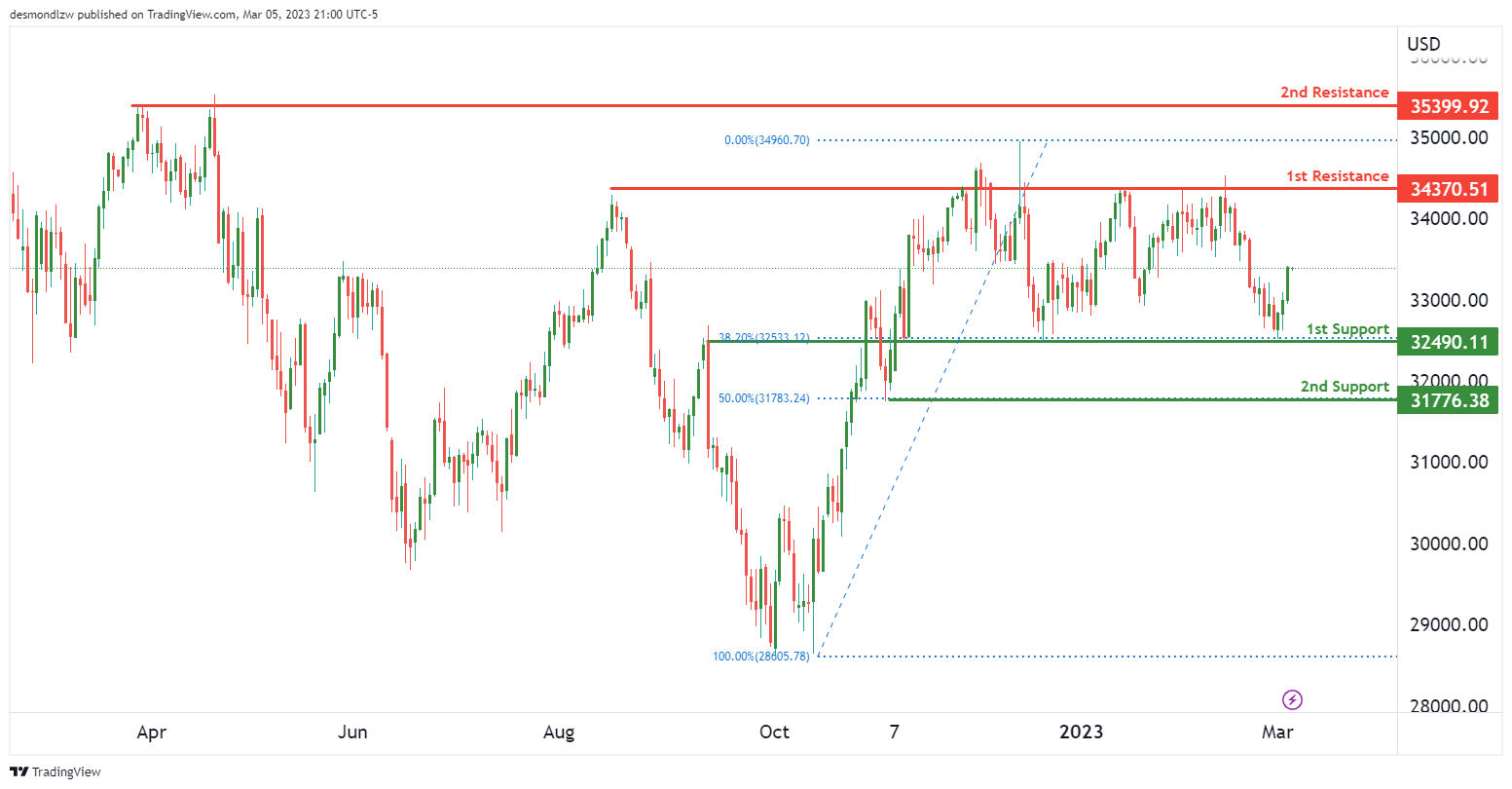
Price has bounced off from our first support at 32490, along with the 38.2% Fibonacci retracement. The price could potentially push up to the first resistance at 34370, which is overlap resistance where there are multiple touches in the past. If the price were to break this level, it could make its way up to the second resistance at 35399, which is the swing high.
In terms of support, if the price were to break from our first support, it could potentially come down to the second support at 31776, with the Fibonacci retracement.
GER30:
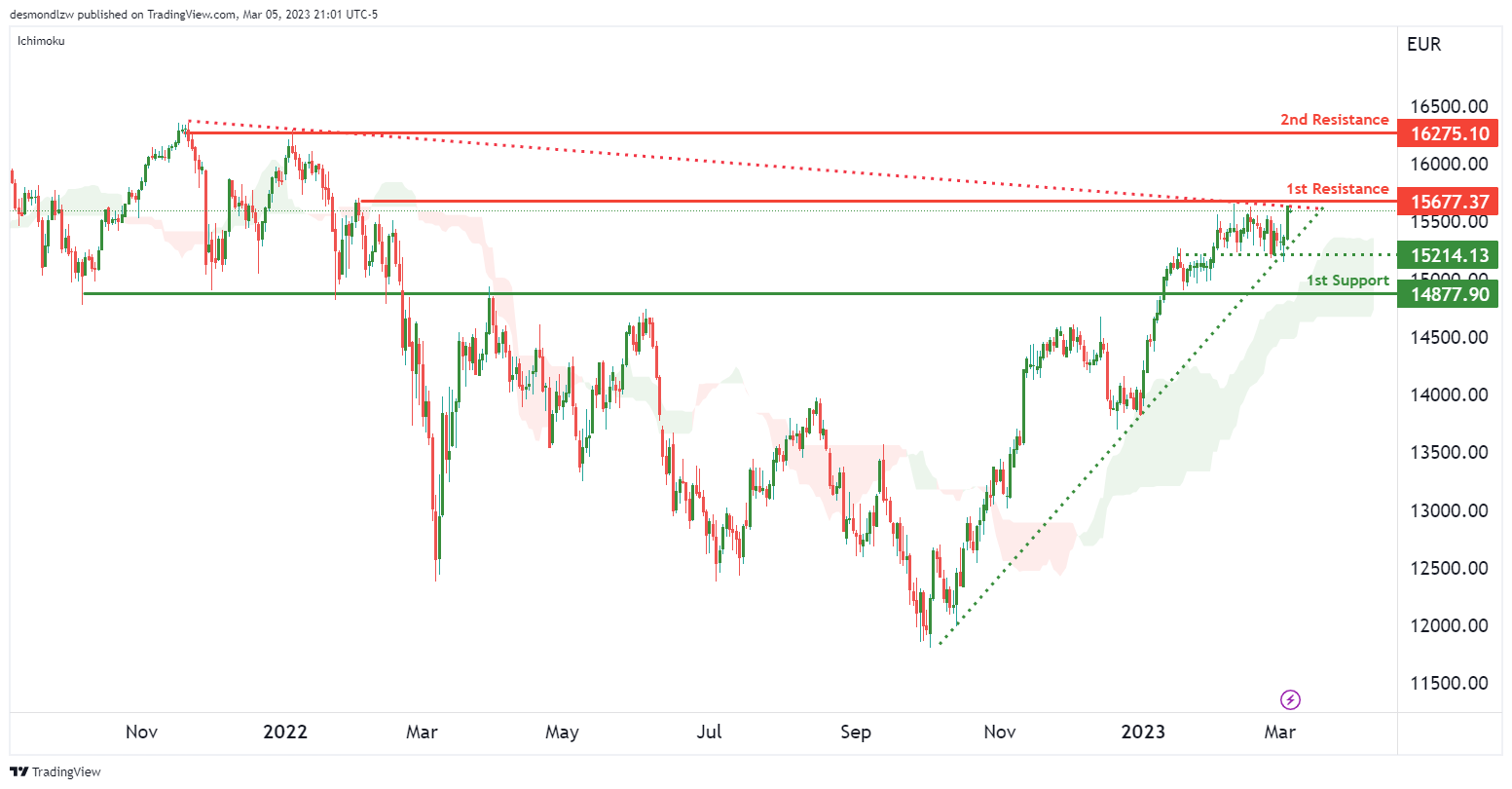
Price has reached our 1st resistance at 15677, and it has potentially come down to our 1st support at 14877
However, if the price were to break from the 1st resistance, the next swing high is 16275.
BTC/USD:
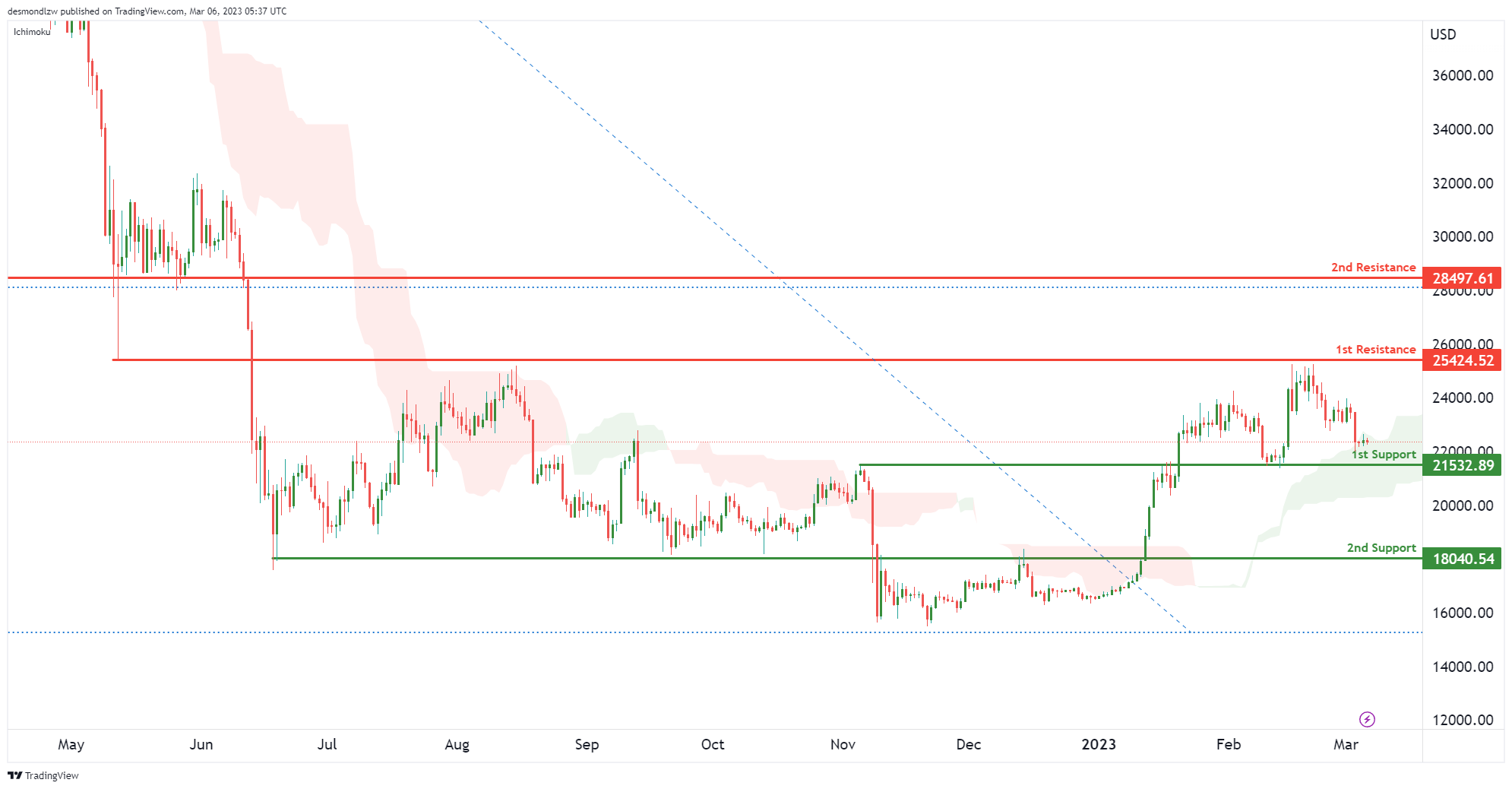
Our 1st resistance is at 25424, which is a very strong overlap resistance, and prices have reacted multiple times. If the price were to break, it could push up to our 2nd resistance at 28497.
In terms of support, the 1st support level is at 21532, and if it breaks, the next support is 18040, which is a very strong overlap support at this level.
US500:
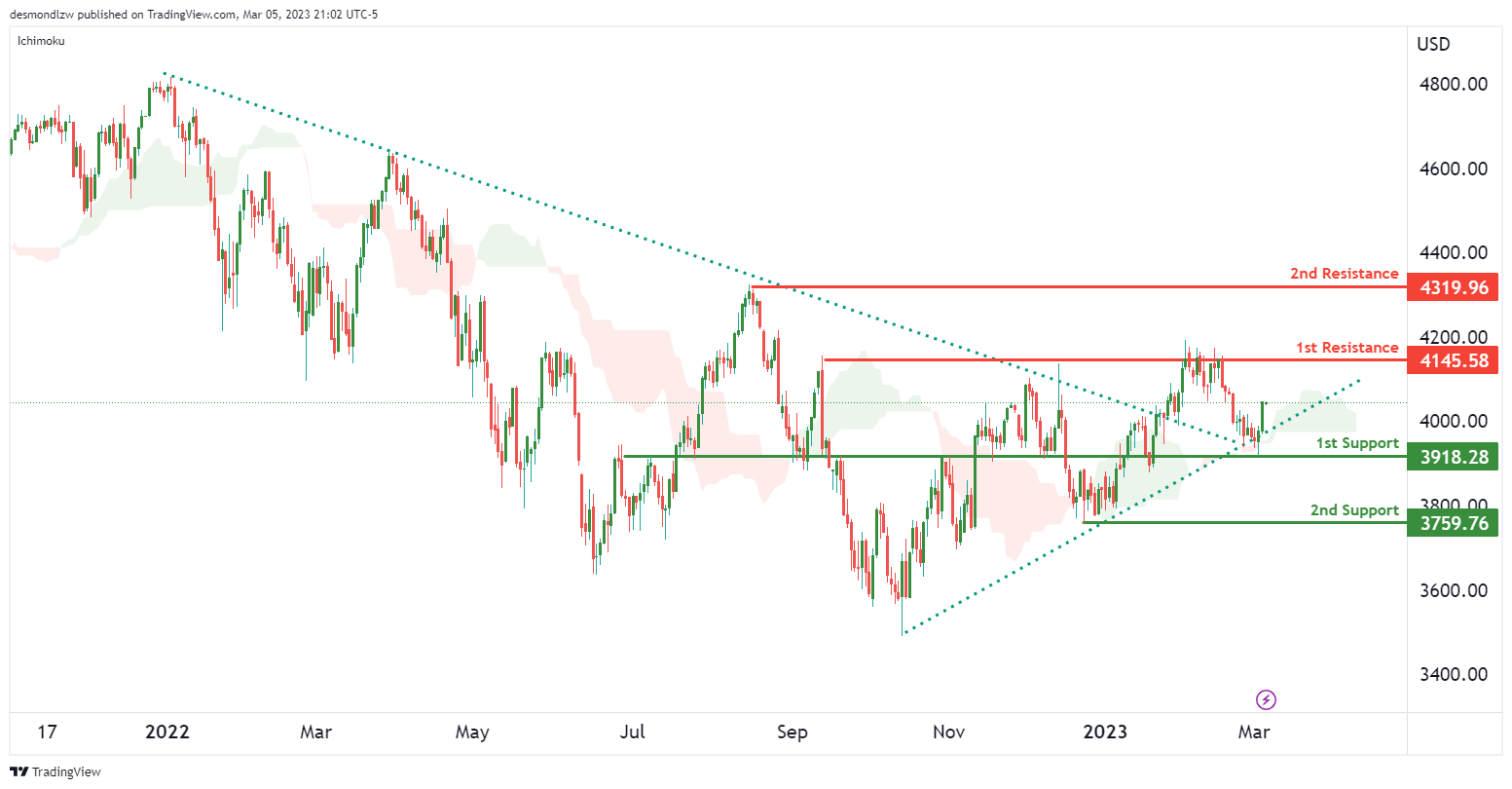
We are seeing price testing our first support at 3918 and bouncing off from this level, pushing it up to our first resistance at 4145, which is overlap resistance. If the price were to break this level, we could potentially see the price push up to our second resistance at 4319, which is another overlap resistance.
However, if the price could not break through our first resistance, we could potentially see the price drop to our first support at 3918, and the second support is at 3759.
ETH/USD:
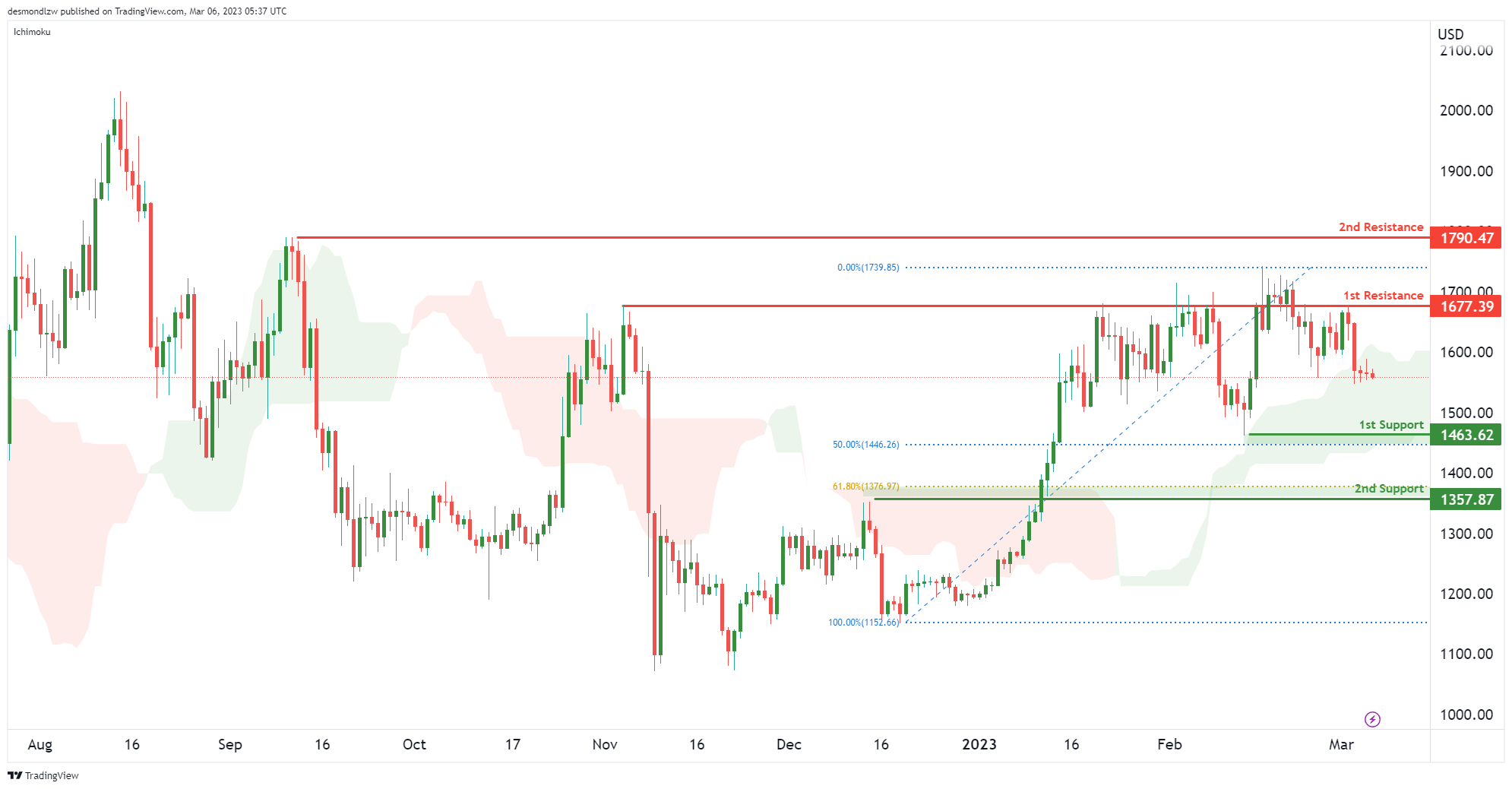
Price is testing our 1st resistance at 1677 where the overlap resistance is. The price is coming down to find the 1st support at 1463 with the 50% Fibonacci retracement. If the price were to break at this level, the next support is at 1357 with the 61.8% Fibonacci retracement.
In terms of resistance, if the price were to break the 1st resistance, the next swing high is at 1790.
BCO/USD:
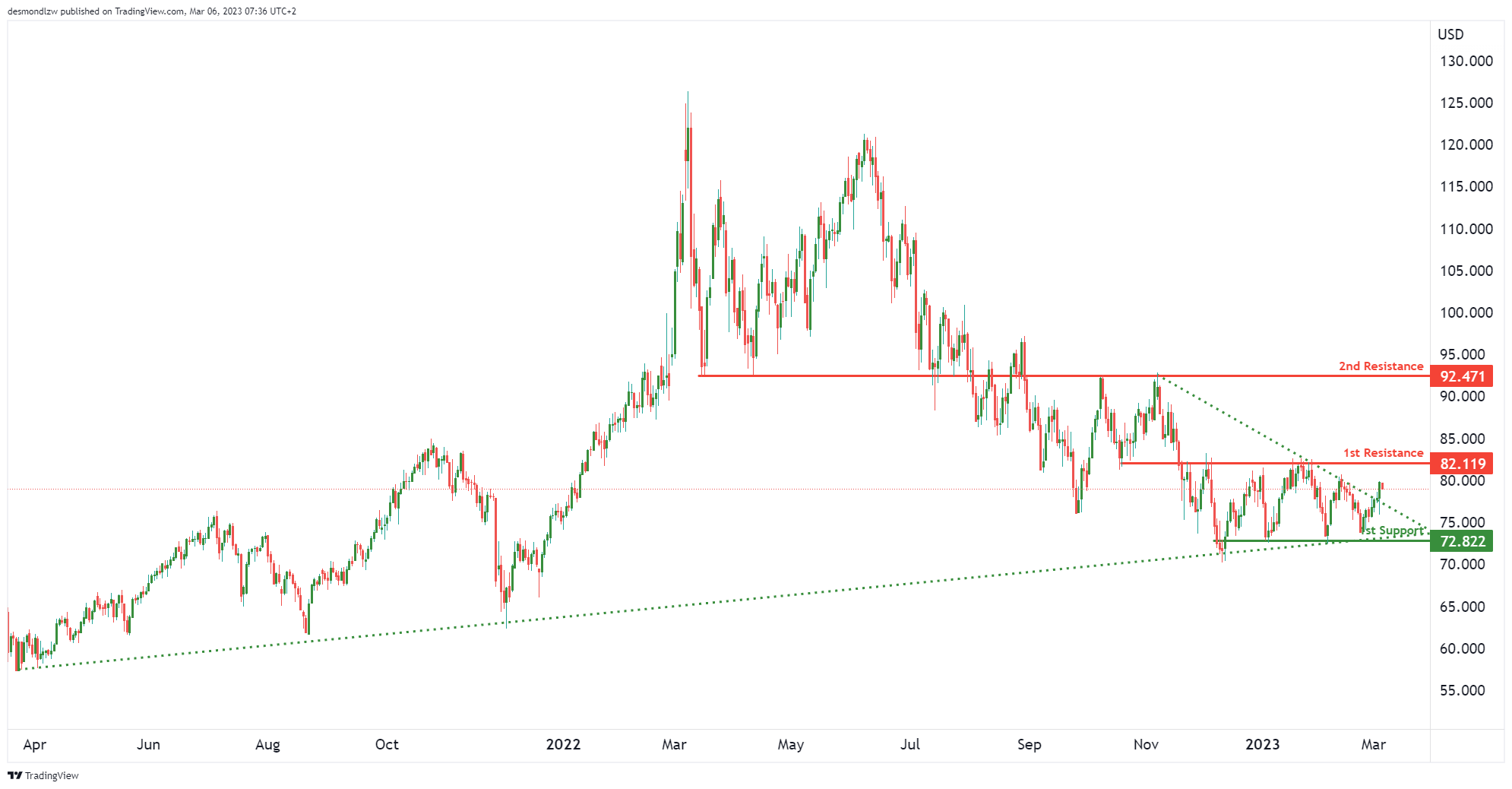
We are seeing that the price has broken off from the descending resistance, and it has the potential to push up to our first resistance at 82.119, which is overlap resistance. If the price were to break from this level, it could push up to our second resistance at 92.47, which is a strong overlap at this level.
However, the first support is at 72.82, which is a recent swing low support along with the ascending support line.
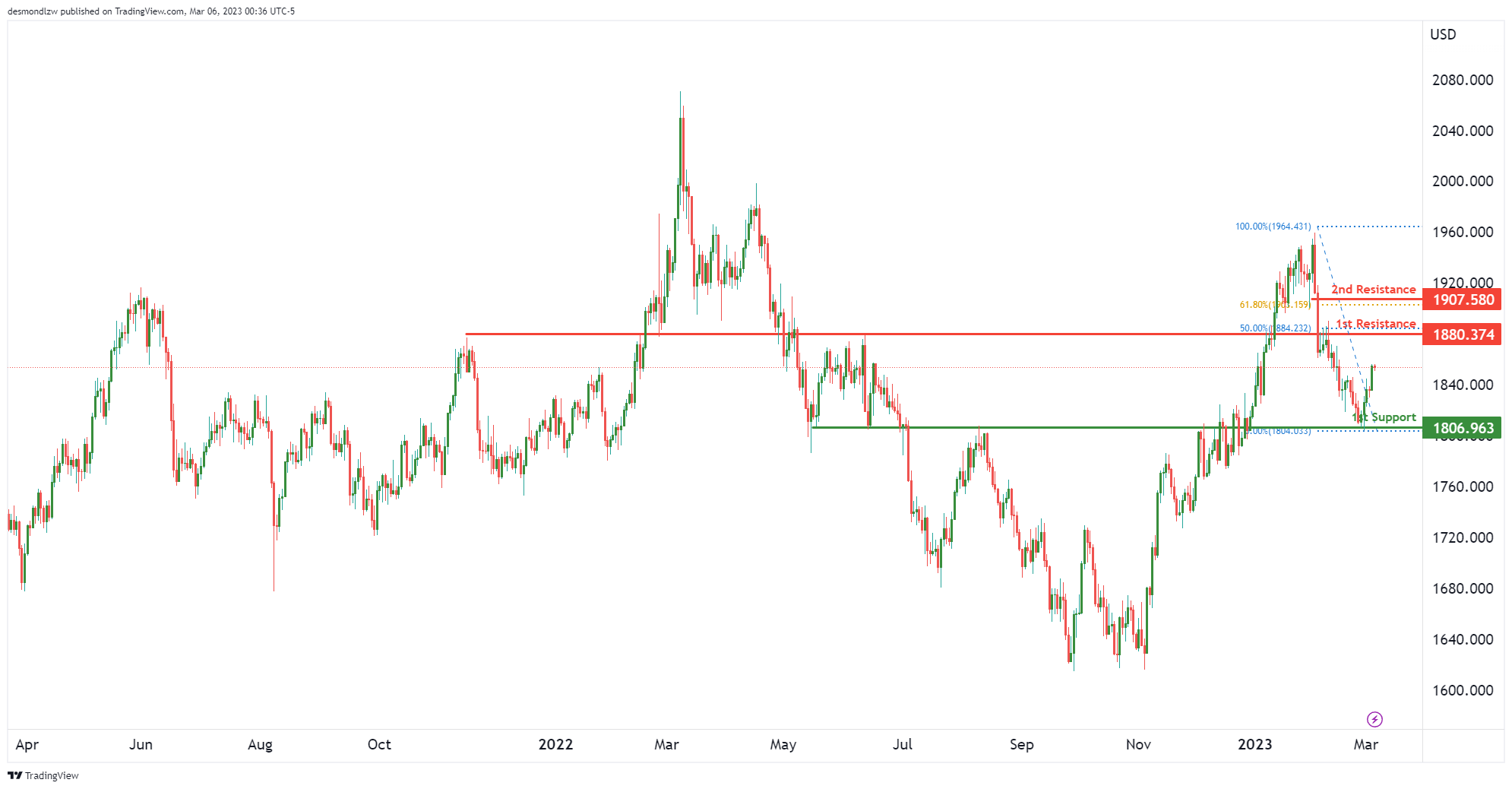
XAU/USD (GOLD):
Price has bounced off from our first support and it could potentially push up to our first resistance level at 1880 with the 50% Fibonacci retracement. However, if the price were to break, it could push up to our second resistance level at 1907 with the 61.8% Fibonacci retracement.
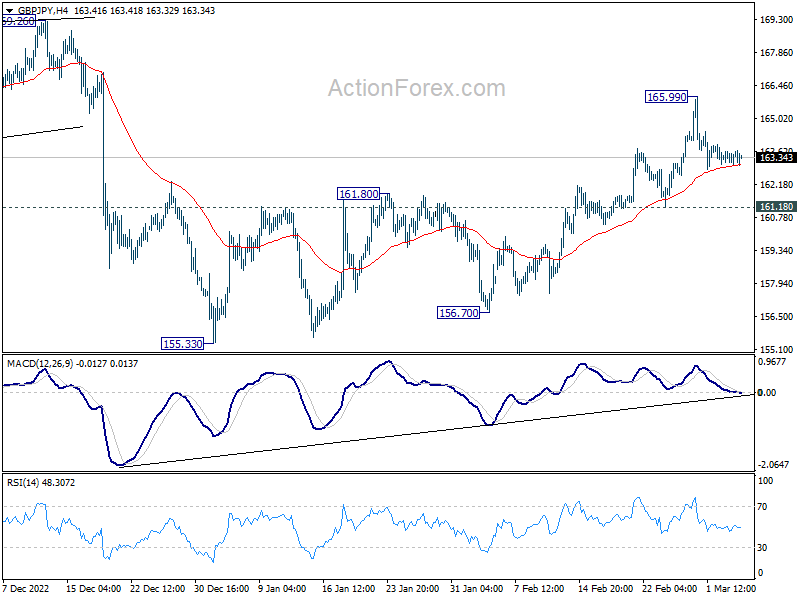
GBP/JPY Daily Outlook
Daily Pivots: (S1) 163.26; (P) 163.46; (R1) 163.81; More...
Intraday bias in GBP/JPY remains neutral for the moment. Further rally is still expected as long as 161.18 support holds. As noted before, corrective fall from 172.11 should have completed at 155.33 already. Break of 165.99 will target 169.26 resistance first, and then 172.11 high.
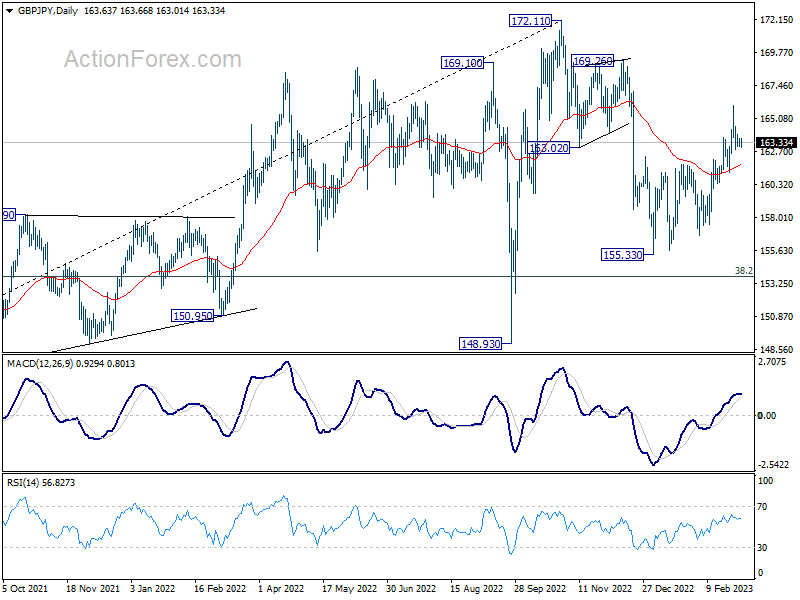
In the bigger picture, corrective decline from 172.11 medium term should have completed at 155.33. With 38.2% retracement of 123.94 (2020 low) to 172.11 (2022 high) at 153.70 intact, medium term bullishness is retained. That is, larger up trend from 123.94 (2020 low) is still in progress. Break of 172.11 high to resume such up trend is expected at a later stage.
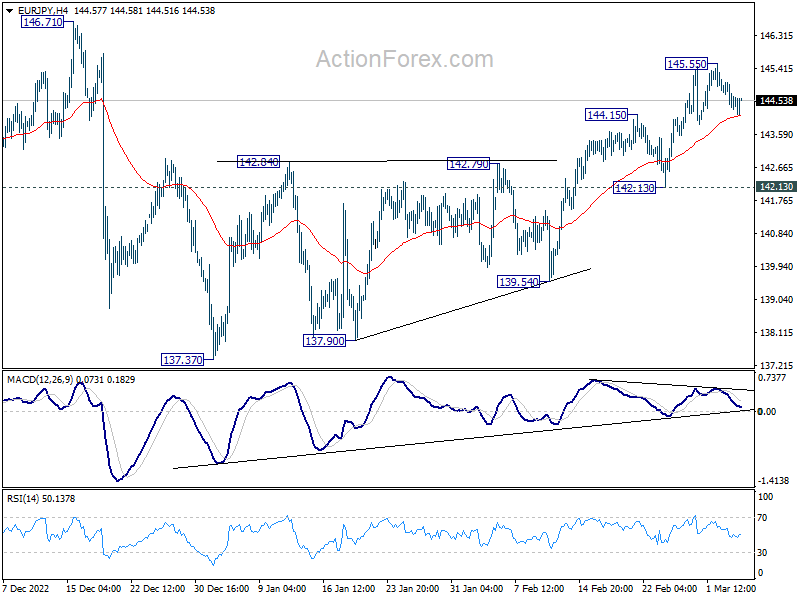
EUR/JPY Daily Outlook
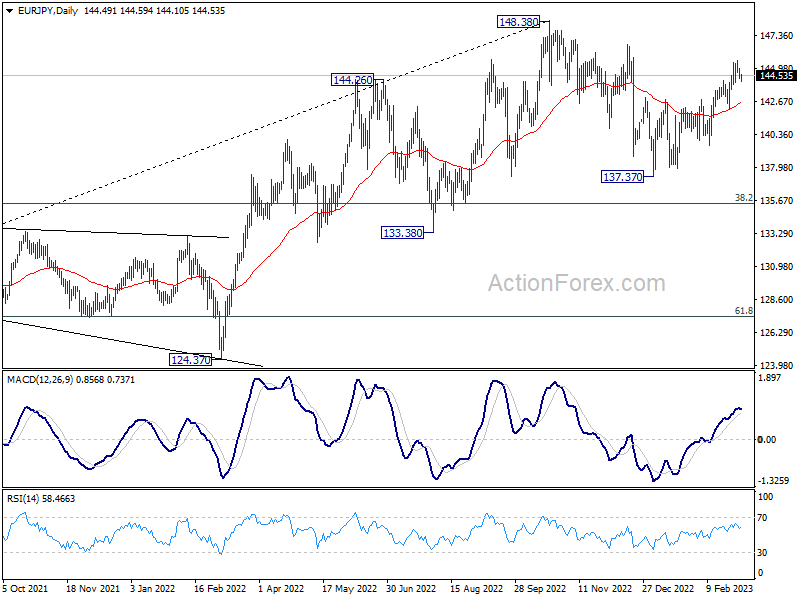
Daily Pivots: (S1) 144.14; (P) 144.59; (R1) 144.88; More....
Intraday bias in EUR/JPY remains neutral for the moment. Further rally is expected as long as 142.13 support holds. Corrective fall from 148.38 has completed at 137.37 already. Break of 145.55 will resume the rise from 137.37 to 146.71 resistance and then 148.38 high.
In the bigger picture, as long as 55 week EMA (now at 139.42) holds, larger up trend from 114.42 (2020 low) is still in progress for 149.76 long term resistance. However, firm break of 55 week EMA will bring deeper fall to 38.2% retracement of 114.42 to 148.38 at 135.40. Sustained break there will raise the chance of trend reversal, and target 61.8% retracement at 127.39.
EUR/GBP Daily Outlook
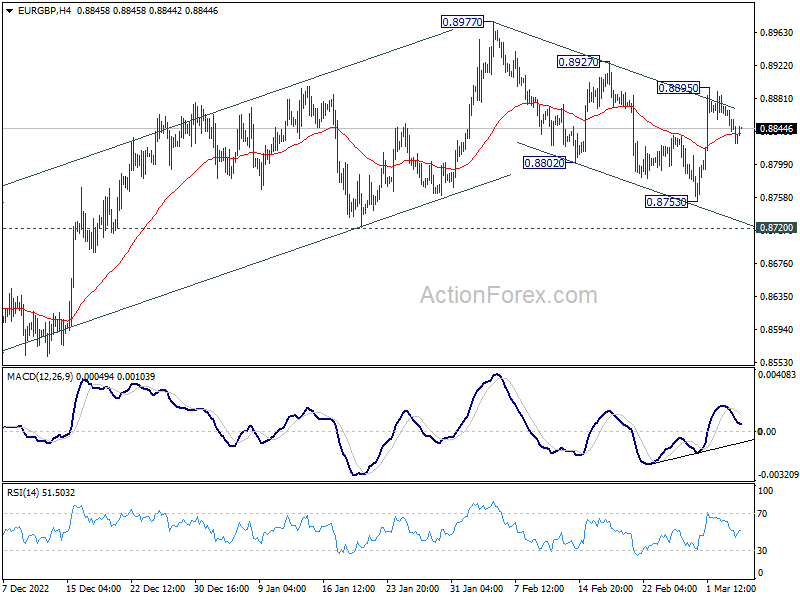
Daily Pivots: (S1) 0.8813; (P) 0.8842; (R1) 0.8858; More...
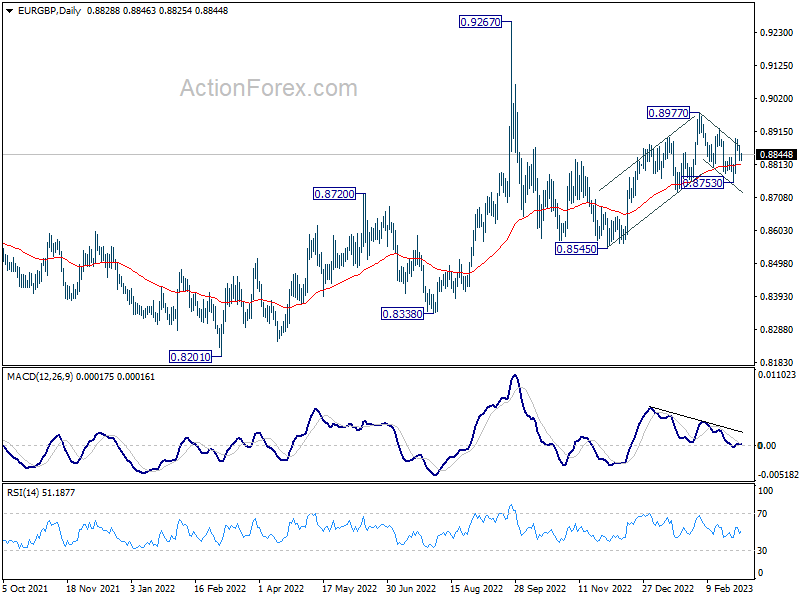
Intraday bias in EUR/GBP stays neutral at this point. On the upside, break of 0.8895 will affirm the case that correction from 0.8977 has completed at 0.8753. Further rally should be seen to retest 0.8977.
In the bigger picture, outlook is rather mixed for now, except that price actions from 0.9267 (2022 high) are part of the long term range pattern from 0.9499 (2020 high). With 0.8720 support intact, rise from 0.8545 is in favor to continue through 0.8977. However, firm break of 0.8720 will argue that such rebound has completed, and open up deeper fall through this support level.
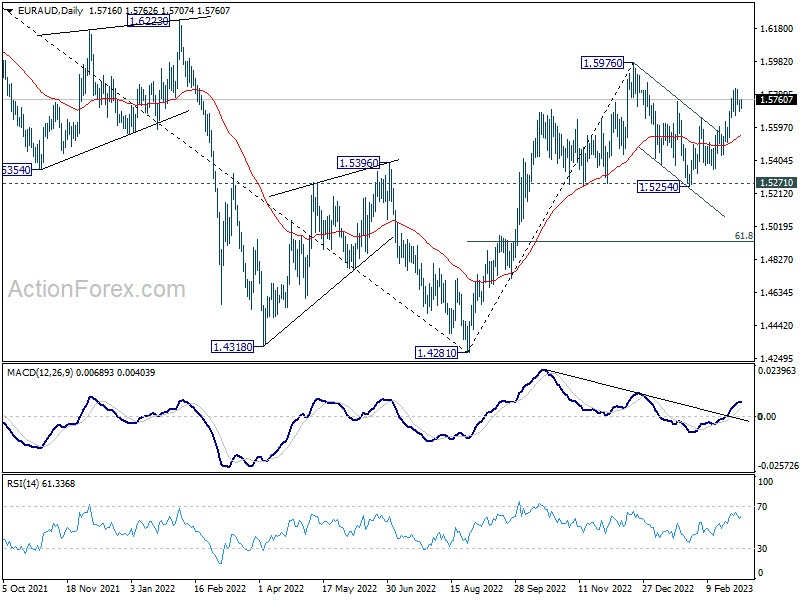
EUR/AUD Daily Outlook
Daily Pivots: (S1) 1.5682; (P) 1.5721; (R1) 1.5748; More...
Intraday bias in EUR/AUD remains neutral for the moment. Outlook is unchanged that corrective fall from 1.5976 has completed at 1.5254. Further rally is expected as long as 1.5650 resistance turned support holds. Break of 1.5826 will target a test on 1.5976 high. However, firm break of 1.5650 will delay the bullish case and extend the corrective pattern from 1.5976 with another falling leg.
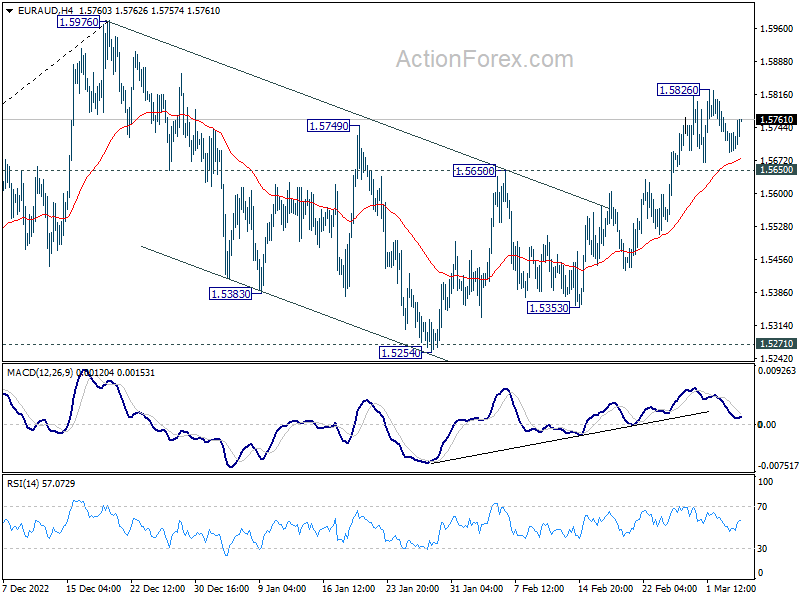
In the bigger picture, it's still early to confirm if rise from 1.4281 represents bullish trend reversal. But as long as 1.5271 support holds, such rally is in favor to continue. Break of 1.5976 will target 1.6434 key resistance next. On the other hand, firm break of 1.5271 will retain medium term bearishness instead.