Sample Category Title
How Will BOJ Statement Affect the Yen?
The Bank of Japan is expected to release a statement regarding its monetary policy for the second time this year. This statement, due on the 10th of March, usually has a very high impact on the outlook of the Japanese Yen as it ties in closely with the short-term interest rates and overall strength of the currency.
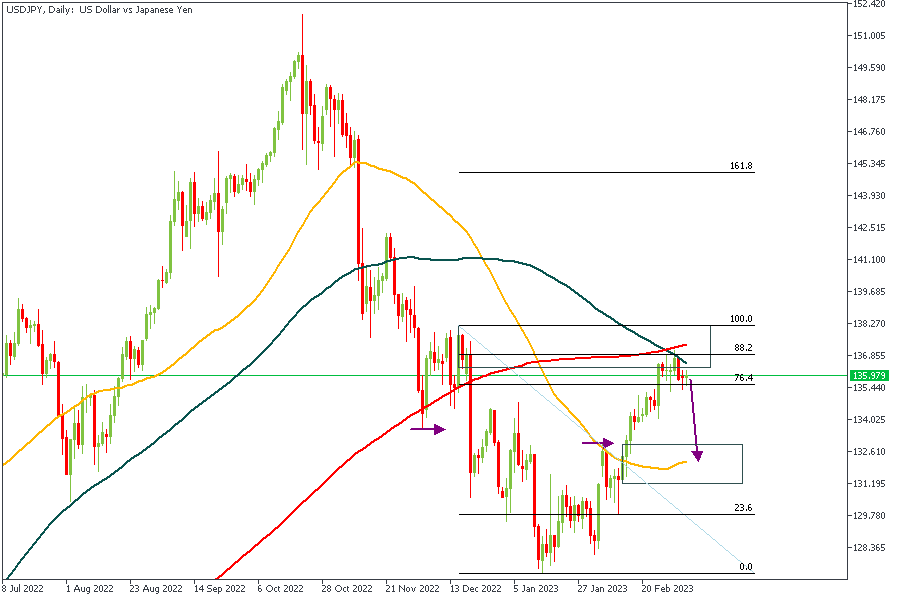
USDJPY
The Daily timeframe chart of the USDJPY already looks like the onset of a downward move. We can see the 100- and 200-period moving averages have successfully rejected prices from going higher. Also, looking at the fact that the rejection occurred from the supply zone overlapping with the 88% Fibonacci retracement level, it is quite safe to sustain a bearish sentiment.
Analysts’ Expectations:
- Direction: Bearish
- Target: 131.7
- Invalidation: 138.3
GBPJPY
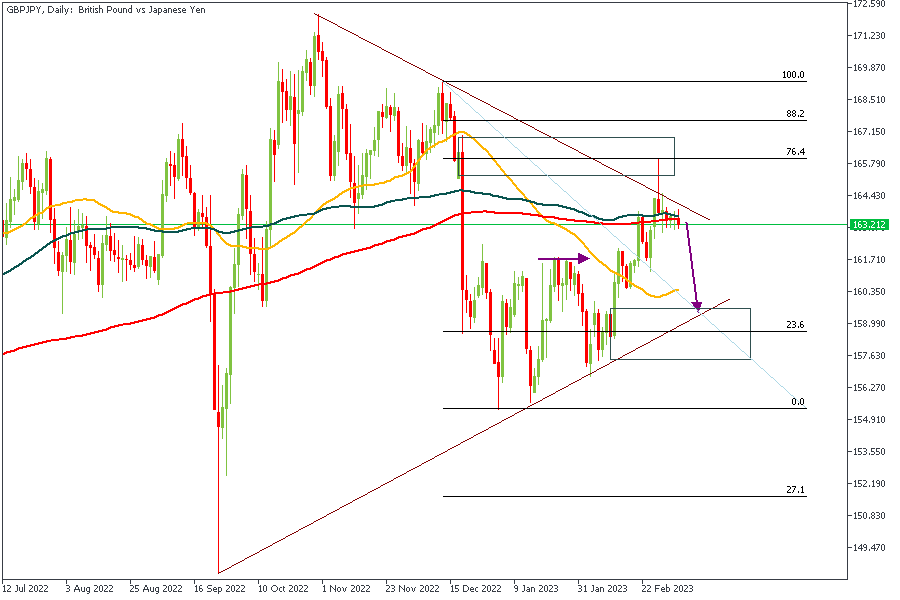
Here we have a large wedge constricting price movement on the daily timeframe of GBPJPY. Price has also recently bounced off the supply zone above the trendline resistance of the wedge. Based on this, the position of the moving averages, and the 76% of the Fibonacci retracement zone, it is safe to expect a further price decline.
Analysts’ Expectations:
- Direction: Bearish
- Target: 158.9
- Invalidation: 168.9
CADJPY
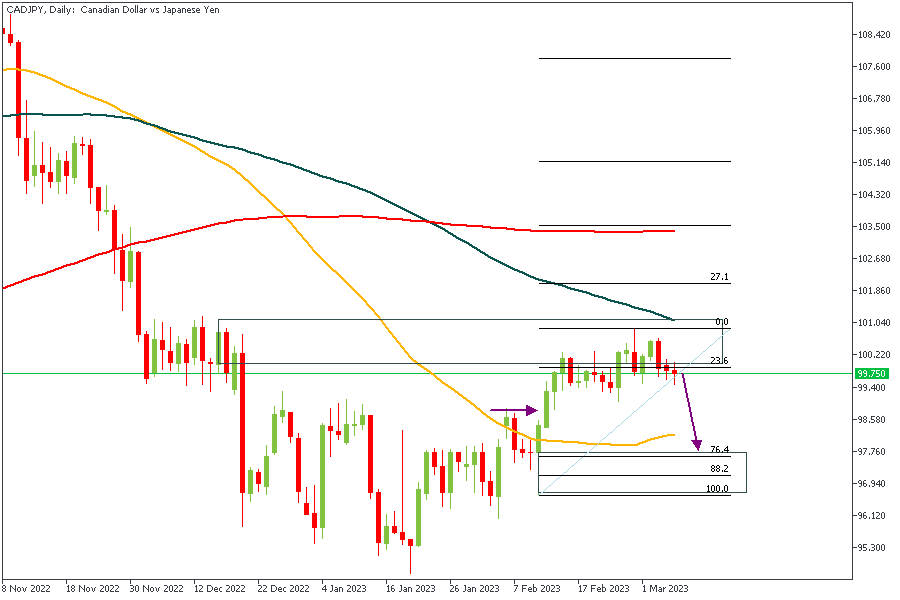
CADJPY is reacting within the highlighted supply zone, and we also have a bearish alignment from the moving averages. As a result of these confluences, I have a bearish sentiment. However, it is less confident than I would like.
Analysts’ Expectations:
- Direction: Bearish
- Target: 97.9
- Invalidation: 101.8
CHFJPY
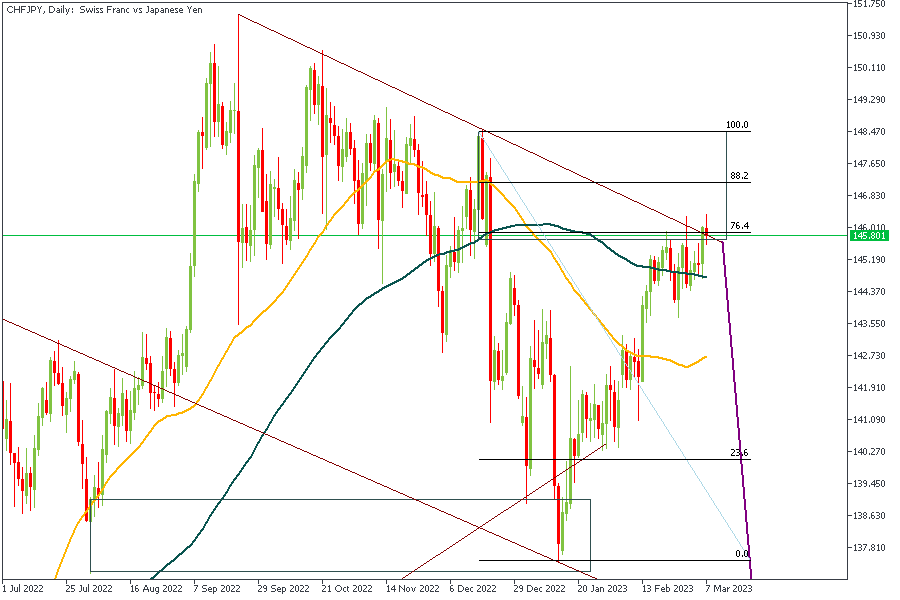
We've been pursuing this particular setup for a few days. It is noticeable that the price here is still trading under the supply zone, with slight rejections already taking place. The resistance trendline and the 76% Fibonacci retracement level add additional confluences. The 50-period moving average trading below the 100-period moving average also confirms a bearish sentiment.
Analysts’ Expectations:
- Direction: Bearish
- Target: 142.7; and 141
- Invalidation: 148.5
CONCLUSION
The trading of CFDs comes at a risk. Thus, to succeed, you have to manage risks properly. To avoid costly mistakes while you look to trade these opportunities, be sure to do your due diligence and manage your risk appropriately.
AUDUSD Wave Analysis
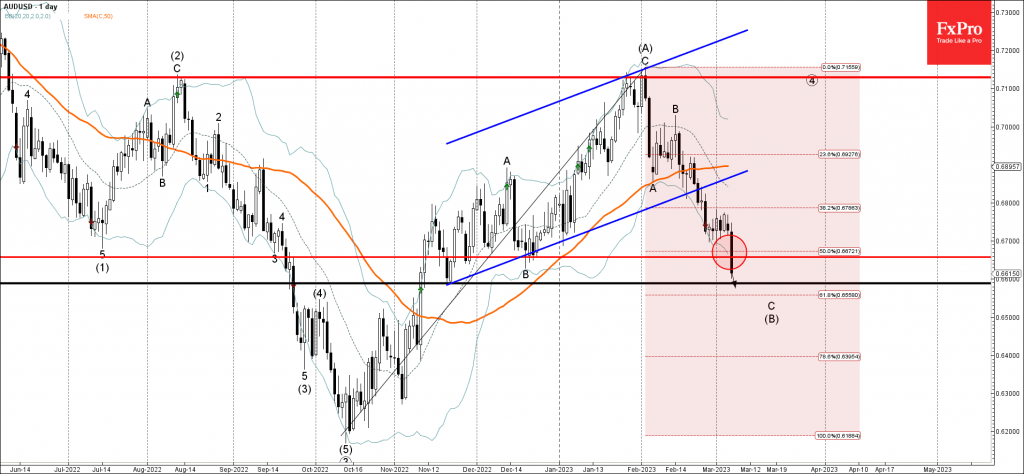
- AUDUSD broke support level 0.6660
- Likely to fall to support level 0.6600
AUDUSD recently broke the key support level 0.6660 (which stopped the earlier B-wave in December) intersecting with the 50% Fibonacci correction of the upward impulse from October.
The breakout of the support level 0.6660 accelerated the active C-wave of the intermediate ABC correction (B) from the start of February.
AUDUSD can be expected to fall further to the next support level 0.6600 (which reversed the pair in the middle of November).
CADCHF Wave Analysis
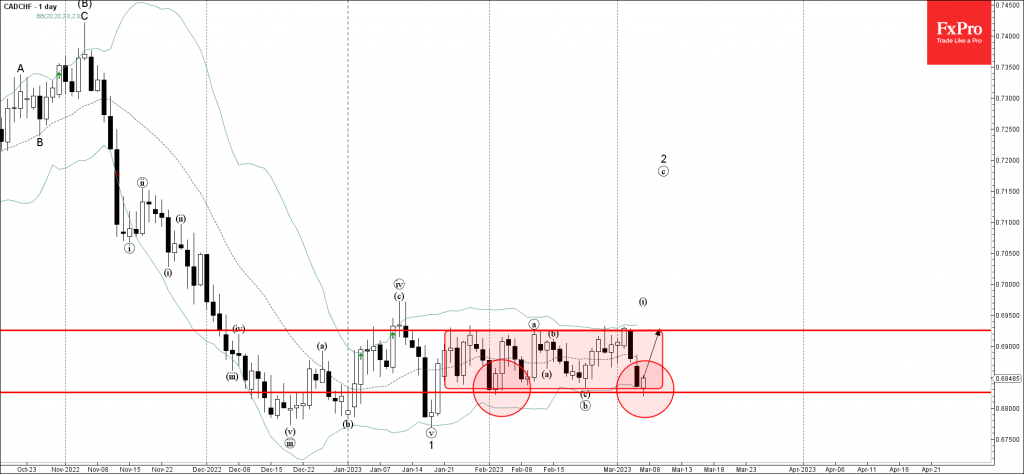
- CADCHF reversed from strong support level 0.6825
- Likely to rise to resistance level 0.6925
CADCHF currency pair recently reversed up from the strong support level 0.6825 (which is the lower boundary of the narrow sideways price range inside which the pair has been trading from January).
The support level 0.6825 was further strengthened by the lower daily Bollinger Band.
CADCHF can be expected to rise further to the next resistance level 0.6925 (upper border of the active sideways price range).
Fed Chair Powell Said Ultimate Peak Interest Rate Level Would be Higher
Markets
Fed Chair Powell in front of the US Senate as expected said that the ultimate peak interest rate level would be higher than expected in December (5-5.25% median projection in the dot plot). Less expected was the other bomb he dropped: showing readiness to speed up rate hikes again if warranted by the data. Stronger January data and the bumpy inflation data ahead could be the key. We warned for quite some time that the Fed in March would have to revert to a 50 bps rate hike, a scenario US money markets are now attaching a 1/3 possibility to. The US yield curve turns more inverse with yields rising by 2.7 bps (30-yr) to 7.4 bps (2-yr). The dollar profits with EUR/USD losing 1.06 again. US stock markets lose around 1% in a first move.
Ahead of Fed Chair Powell’s testimony before US Senate, another central banker grabbed headlines with some interesting comments on Bloomberg. The lady in question was not ECB President Lagarde, but Bank of England policy maker Catherine Mann, amongst the more hawkish members on the BoE-board. She argued that the UK central bank needs to push hard on rates as the traditional transmission mechanism is hampered by the volume of long-term, fixed loans by companies and households during (and ahead) of the Covid-period. As a result, interest rate increases we are seeing today are not really hitting the economy, she says. Another argument is concern about the extent to which there is strong pricing power among firms and acceptance of those price rises by a lot of consumers. Worries about diminishing labour supply in the wake of Covid and brexit (end UK-EU freedom of movement) add to her personal inflation outlook. The return to a small and open economy following brexit implies as well that it will be tough to grow without creating inflation. Mann still thinks that there’s more to go for the UK central bank with the terminal rate still “beyond the forecast horizon”. It’s unclear whether the latter means a preference to hold rates until 2025. Her reference to sterling suggests that she’ll lose out against the more dovish majority under BoE-governor Bailey’s wings. Mann fears that sterling could fall further given the hawkish tone coming from the Fed and the ECB, especially if it turns out that this hawkishness isn’t completely discounted yet. Sterling is a tad softer today, but testing the psychologic EUR/GBP 0.89-mark again. UK Gilt yields follow the global move today, sliding 2.4 bps (2-yr) to 8 bps (30-yr). UK money markets currently discount three additional 25 bps rate hikes at the March, May and June or August policy meetings with the terminal rate then being 4.75%.
News Headlines
South-African GDP contracted by 1.3% Q/Q in the fourth quarter of last year, resulting in activity only being 0.9% higher compared to the same period in 2021. The decline follows 1.8% Q/Q and 4.2% Y/Y growth in Q3. The decline was much more pronounced than analysts expected. Economic growth for the whole of 2022 slowed to 2% compared to 4.9% in 2021. Electricity blackouts probably were an important factor behind the poor economic performance. According to Statistics South Africa, seven of the ten industries contracted in Q4. The finance, real estate & business services industry shrank by 2,3%. As this sector is the largest in the economy, the decrease was the biggest factor behind the decline in GDP, subtracting 0,6 ppt from GDP growth. Trade, catering and accommodation subtracted 0.3 ppt. Transport and communication, construction and personal services where the only sectors to make a (marginal) positive contribution. The 2-y swap rated declined 6 bps after the release. The rand loses about 0.75% with USD/ZAR trading at 18.41, near recent YTD peak levels in the 18.51/58 area.
Perceived inflation over the previous 12 months eased in the ECB’s monthly consumer expectations survey to 9.5% in January from 9.9%. Median expectations for inflation in the year ahead slowed slightly from 5.0% to 4.9% but expectations for three years ahead declined sharply from 3.0% to 2.5%. Consumers expect nominal income to grow by 1.3% over the next year, but expectations on spending moderated from 4.2% to 3.8%. Expectations on economic growth turned less negative (-1.2% from -1.5%) and this also caused expectations for the unemployment rate to ease from 11.9 to 11.6%. Current unemployment rate is perceived at 11.3%. Consumers expect growth in the price of their home to slow to 2.5% down from 3.0%.
German Industrial Orders Support Hawkish ECB Stance
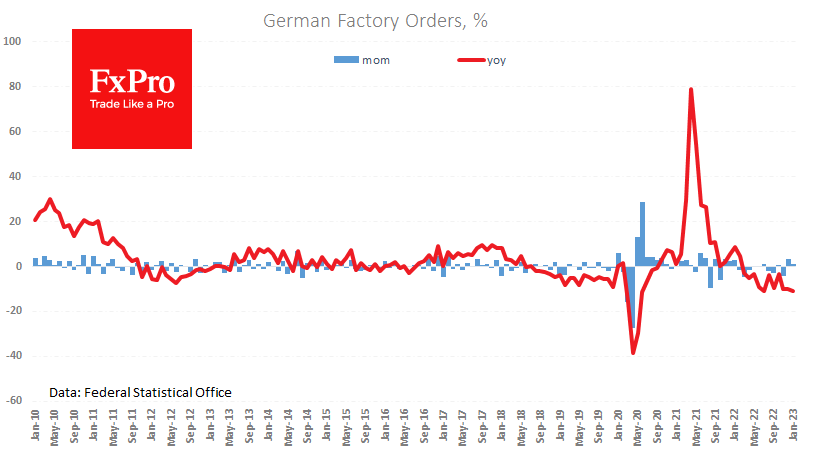
Europe continues to surprise with statistics, suggesting more room for a hawkish tone from the ECB next week. In addition to hawkish inflation readings, data from Germany today highlighted a continued recovery in industrial orders.
Destatis reported a 1% rise in manufacturing orders in January, after +3.4% in the previous month. This sharply contrasts the expected 0.6% m/m correction and adds to market optimism. The new orders index has returned to the level of August last year, although it is still down 10.9% year-on-year. However, the worrying pattern of year-on-year declines is primarily a high base effect. The post-squeeze recovery coincides with a rush to place orders on fears that the military conflict in Ukraine could soon disrupt supplies.
Strong Eurozone data strengthens the hawkish case for the ECB Governing Council, which meets next week for another policy decision. Options for a 50 or 25-basis-point rate hike will likely be on the table for the ECB. On Monday, Holzmann said four more 50-point hikes and an accelerated sell-off of assets from the balance sheet would be needed. Such a scenario is hardly a base case, but the general tone of commentary continues to shift in favour of further tightening.
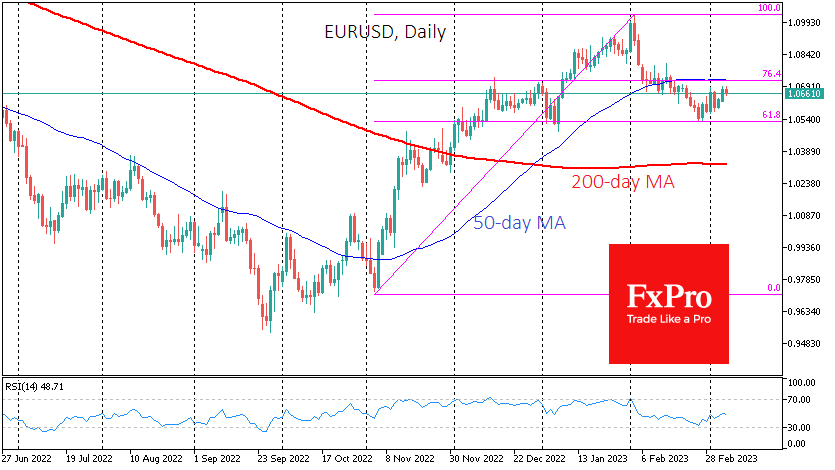
This is probably the most critical driver for the FX market. Throughout 2021 and 2022, the dollar has rallied as the Fed’s tone has become more hawkish round after round. Now it is the ECB’s turn, and the fundamentals are in place for EURUSD to rise.
USD/CAD Mid-Day Outlook
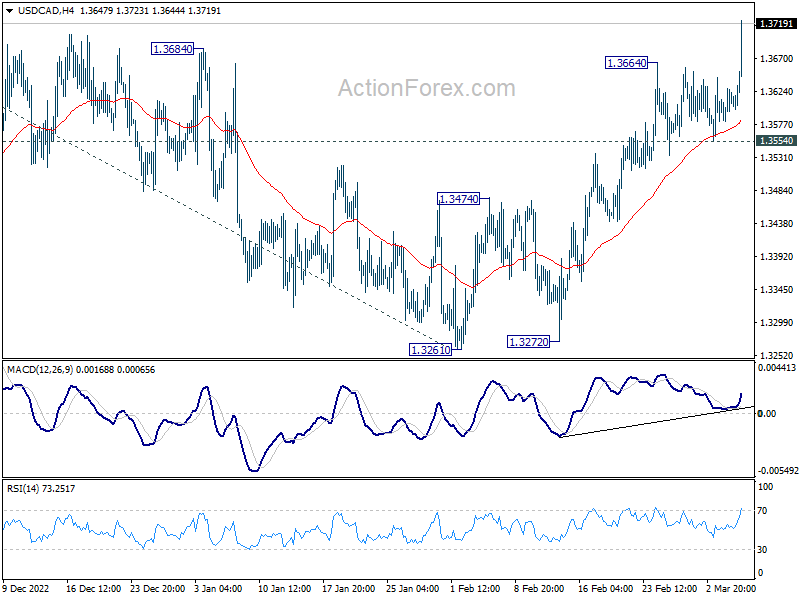
Daily Pivots: (S1) 1.3587; (P) 1.3608; (R1) 1.3634; More....
USD/CAD's rally resumed by breaking through 1.3664 and intraday bias is back on the upside. Further rise should be seen to retest 1.3976 high next. Decisive break there will resume larger up trend. For now, outlook will remain bullish as long as 1.3554 support holds, in case of retreat.
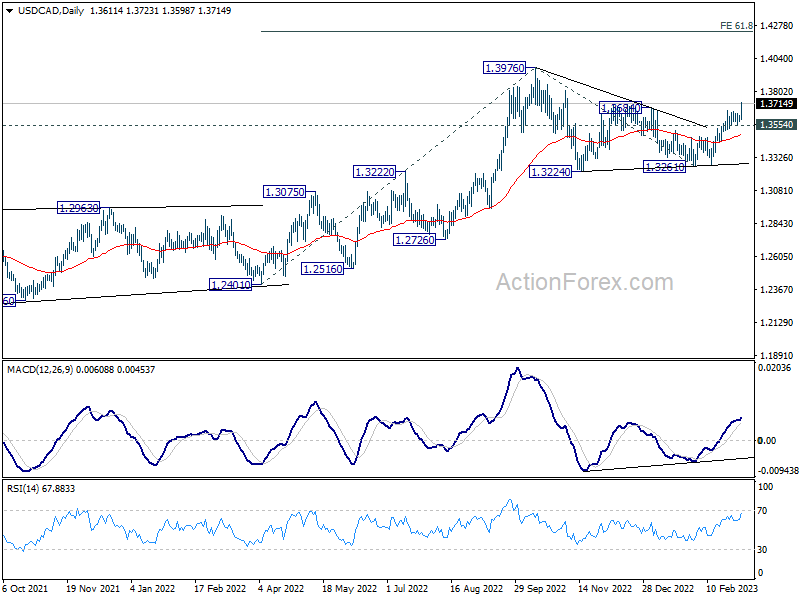
In the bigger picture, outlook stays bullish with 1.3222 cluster support (38.2% retracement of 1.2005 to 1.3976 at 1.3223) intact. Break of 1.3976 resistance will resume larger up trend from 1.2005 (2021 low) to 61.8% projection of 1.2401 to 1.3976 from 1.3261 at 1.4234.
Fed Powell: Higher ultimate rate, ready to hike faster, no premature loosening
Dollar soars on hawkish comments from Fed Chair Jerome Powell. He indicated that ultimate level of interests is "likely to be higher than previously anticipated". Fed is also "prepared to increase the pace of rate hikes". He also warned against "prematurely loosening policy.
"The latest economic data have come in stronger than expected, which suggests that the ultimate level of interest rates is likely to be higher than previously anticipated," Powell said in the prepared remarks for the semi-annual testimony to Congress.
Additionally, "if the totality of the data were to indicate that faster tightening is warranted, we would be prepared to increase the pace of rate hikes," he added.
"Our overarching focus is using our tools to bring inflation back down to our 2 percent goal and to keep longer-term inflation expectations well anchored," Powell emphasized. "Restoring price stability is essential to set the stage for achieving maximum employment and stable prices over the longer run."
"The historical record cautions strongly against prematurely loosening policy. We will stay the course until the job is done," he said.
AUDUSD Extends its Downtrend
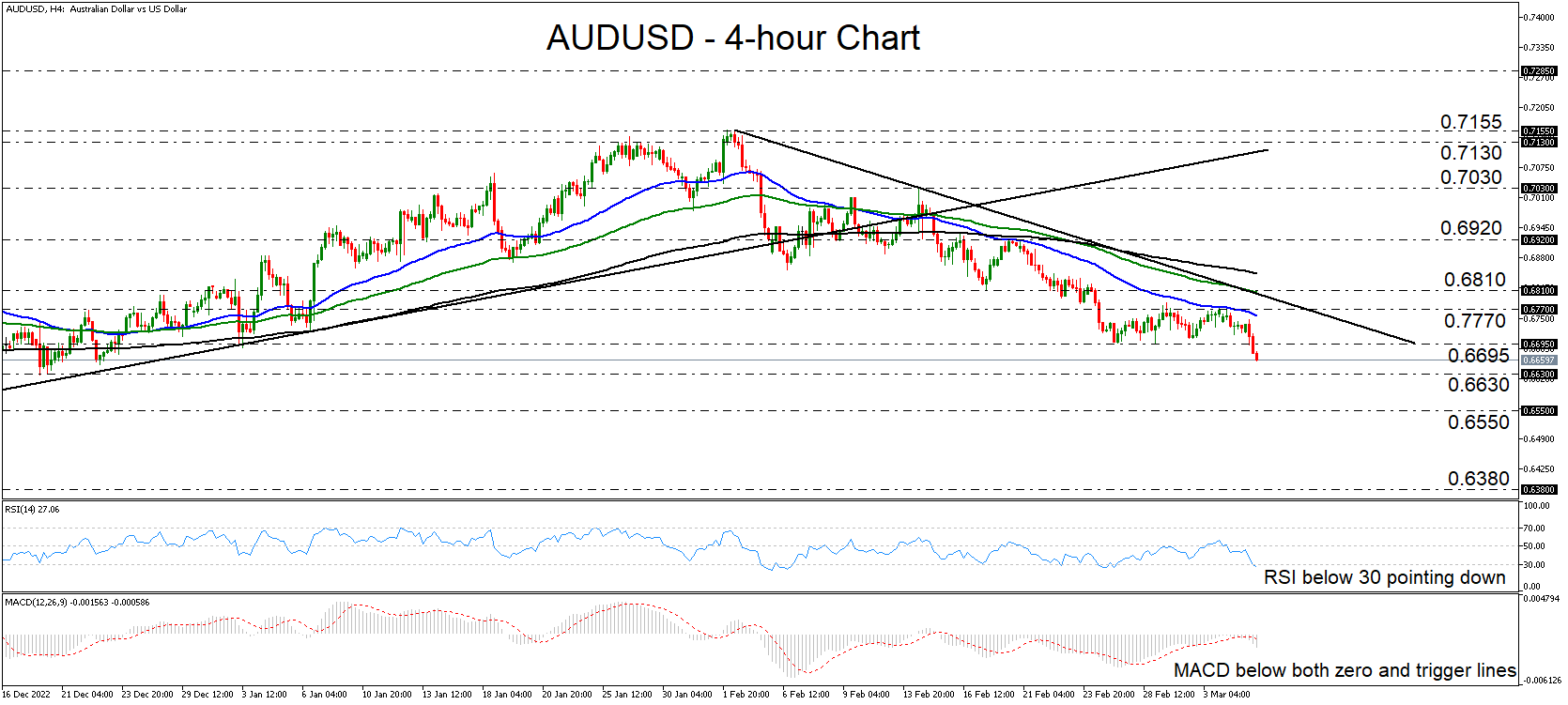
AUDUSD slipped today, breaking below the 0.6695 support (now turned into resistance) barrier, and confirming a lower low on the 4-hour chart. In the bigger picture, the pair is printing lower peaks and lower troughs below the downtrend line drawn from the high of February 2, as well as below all three of the plotted moving averages. This paints a negative short-term outlook for now.
The case for further declines is also supported by the short-term momentum indicators. The RSI fell below 30 and is pointing down, while the MACD is running below both its zero and trigger lines, pointing south as well.
If the bears are willing to stay in the driver’s seat, they could challenge the 0.6630 territory soon, the break of which might pave the way towards the 0.6550 barrier, marked as support by the inside swing high of November 8. If there are no buyers to be found there, another break could see scope for larger bearish extensions, perhaps all the way down to the low of November 10 at 0.6380.
For a bullish reversal scenario to start being examined, a move above 0.6810 may be needed. Such a move could confirm the break above the aforementioned trendline and may set the stage for advances towards the peak of February 21 at 0.6920. If that zone gets violated as well, the bulls may then extend their march towards the 0.7030 area, defined as resistance by the high of February 14.
Wrapping things up, AUDUSD traded lower today, confirming a lower low and thereby signaling the continuation of the prevailing short-term downtrend that’s been in place since February 2. For the outlook to change, a clear break above 0.6810 may be needed.
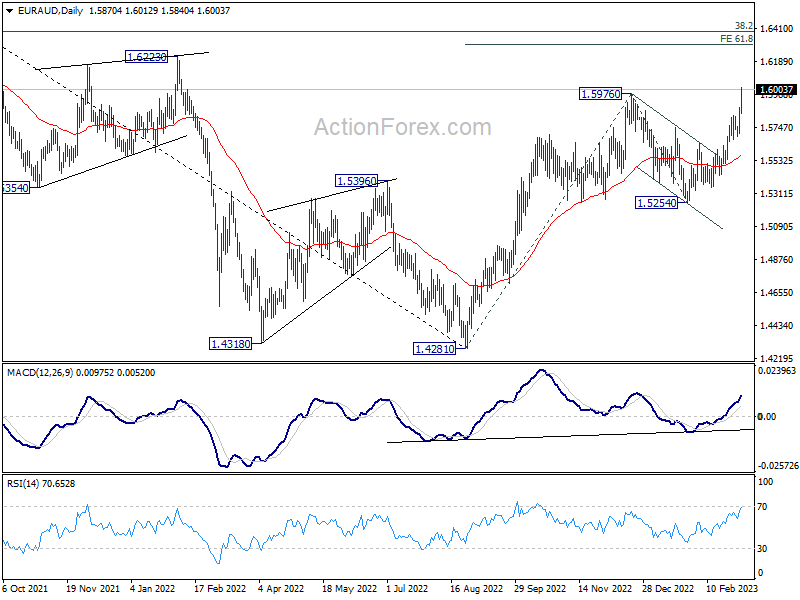
EUR/AUD Mid-Day Outlook
Daily Pivots: (S1) 1.5763; (P) 1.5824; (R1) 1.5932; More...
EUR/AUD's break of 1.5976 resistance confirms resumption of rise from 1.4281. Intraday bias remains on the upside. Current rally should target 61.8% projection of 1.4281 to 1.5976 from 1.5254 at 1.6302. On the downside, below 1.5840 minor support will turn intraday bias neutral and bring consolidations first, before staging another rise.
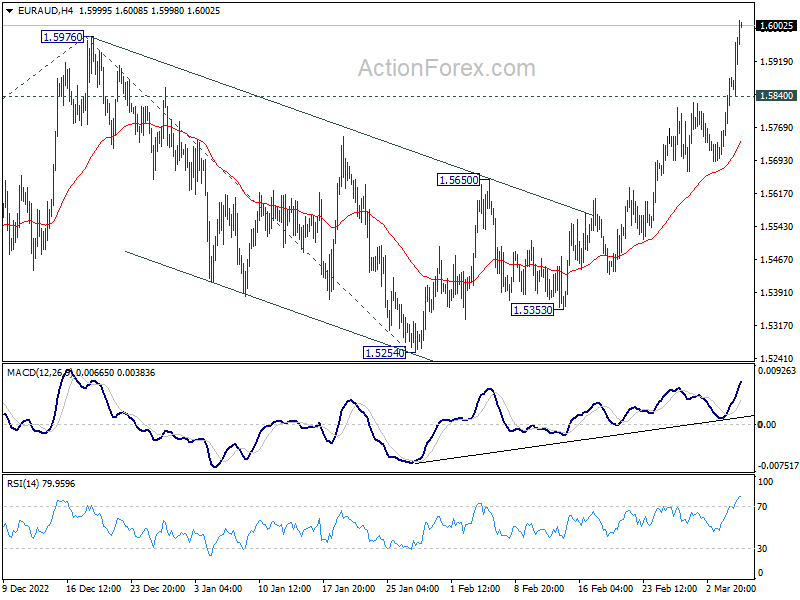
In the bigger picture, the strong support from 55 week EMA (now at 1.5396) is raising the chance of bullish trend reversal. On break of 1.5976, focus will be on 1.6434 cluster resistance (38.2% retracement of 1.9799 to 1.4281 at 1.6389). Sustained break there should confirm that whole down trend form 1.9799 (2020 high) has completed. However, rejection by this cluster resistance will make medium term outlook neutral at best.