

Sample Category Title
AUD/USD Breaks Critical Floor
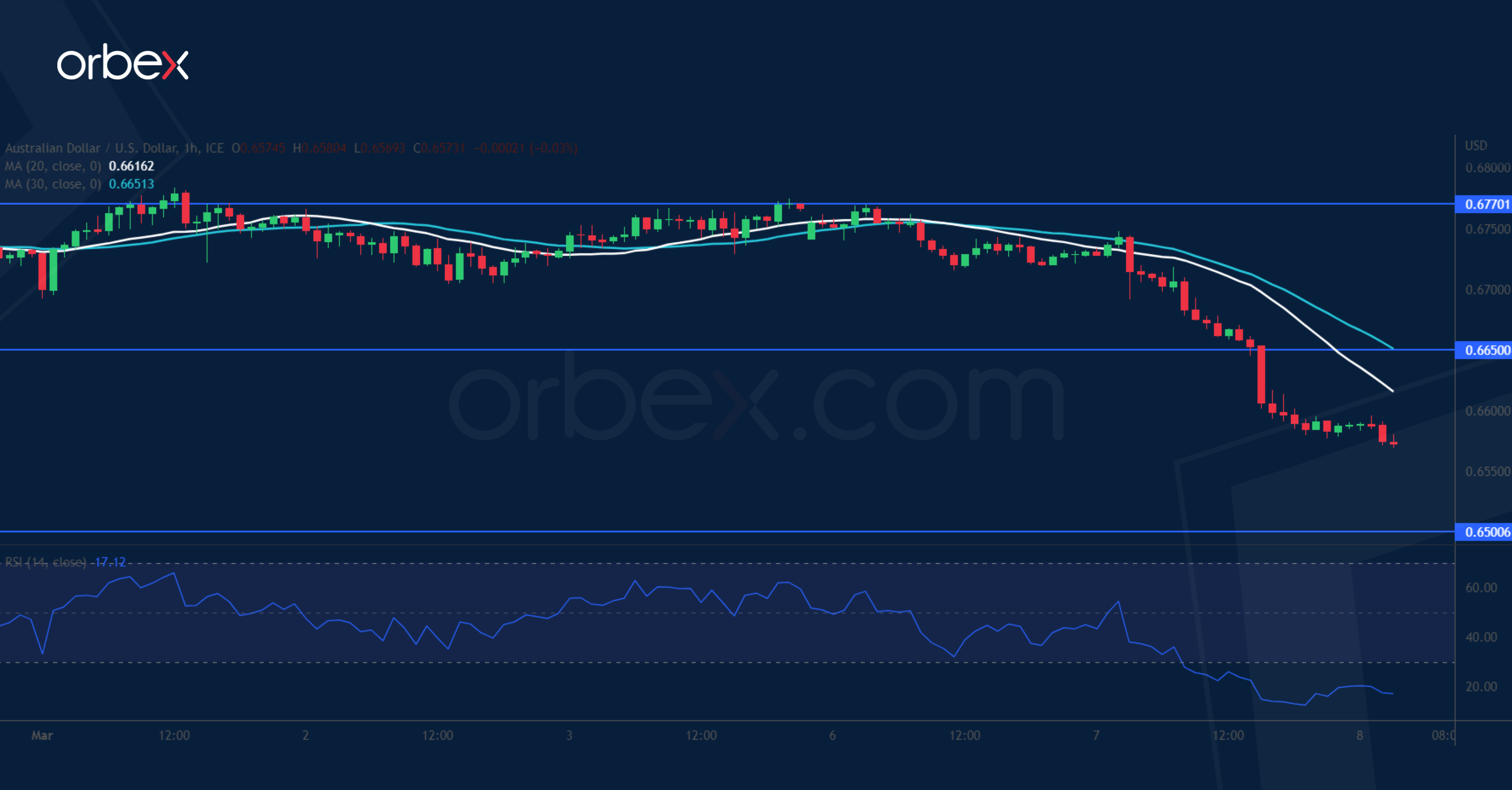
The Australian dollar slid after the RBA signalled it was near the conclusion of its tightening cycle. The pair pierced December’s lows around 0.6650 and opened the door for a liquidation towards 0.6500. In the medium-term, the correction could threaten the rebound from last October and turn it into a reversal. As the RSI dipped into oversold territory, profit-taking may trigger a limited bounce. 0.6650 has become a resistance and 0.6770 at the top of the recent consolidation may see more bears selling into strength.
USD/CHF Bounces Back
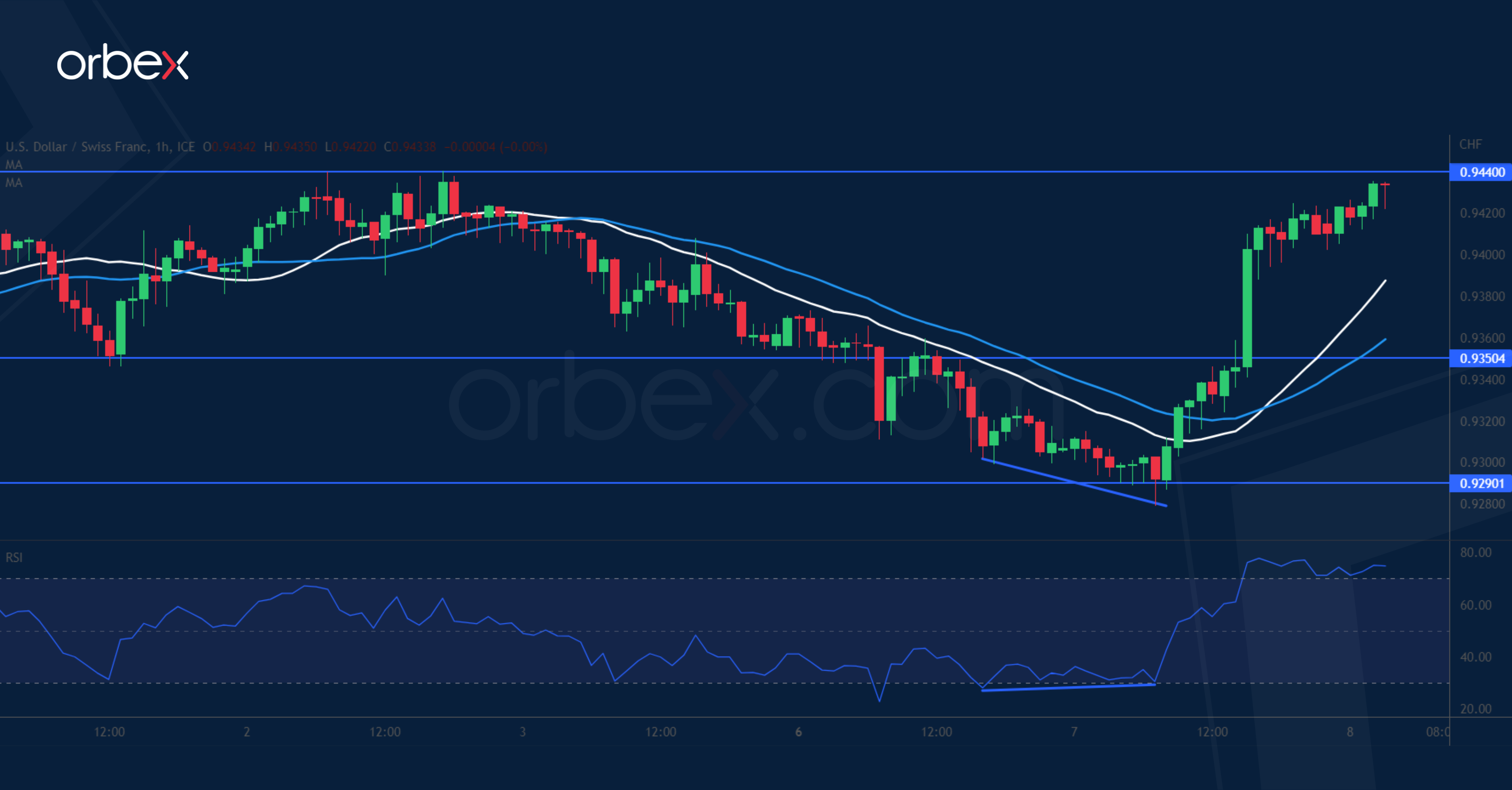
The US dollar popped after Fed Chair Jerome Powell hinted at a return to larger rate increases. On the daily chart, after pulling back from its three-month high at 0.9440, the greenback found support over the 20-day SMA (0.9290), which coincides with the base of a previous bullish breakout. A bullish RSI divergence in this demand zone carries weight and the surge confirms the recovery. A break above 0.9400 puts the peak of 0.9440 under pressure and may resume the rally from early February. 0.9350 is now a fresh support.
Fed Likely to Revert to 50 bps Hike in March
Markets
At the hearing before the Senate Banking Committee, Fed Chair Powell repeated that inflation in the core goods sector has fallen while housing services prices are also decelerating. Still, there is little sign of disinflation in core services excluding housing. Wages also remain above what is consistent with 2% inflation. As recent data were stronger than expected, the Fed Chair now guides that the ultimate level of interest rates is likely to be higher than previously anticipated. In addition, if data were to indicate that faster tightening is warranted, the Fed is prepared to increase the pace of rate hikes. Translating this into a concrete policy strategy/outlook: the March Fed dots probably will show that an important part of the FOMC advocates a final policy rate in the 5.5%/6% corridor and the Fed is likely to revert to a 50 bps hike in March, unless Friday’s payrolls and next week’s February CPI inflation would show an outsized downside surprise. The market reaction was a textbook one. The US yield curve inverted further with the 2-y jumping 12.8 bps, settling north of 5%. The 30-y declined 2.1 bps. Markets now see a 2 in 3 chance of a 50 bps step this month. Contrary to what was the sometimes the case of late, the real yield (10-y) this time jumped more than 10 bps while inflation expectations declined almost equally. This also didn’t pass unnoticed in other markets. US equities lost up to 1.72% (Dow). Cyclical commodities (oil, copper) also nosedived (Brent $83.3/b). The dollar profited from generous additional (real) interest rate support. DXY left the low 104 area, surpassed first resistance at 105.35 to close almost exactly at the 105.63 YTD top. EUR/USD (close 1.0546) finished only a whisker away from the 1.0533 February low. Smaller currencies (AUD, NZD, SEK, NOK) suffered substantial losses. CE currencies (HUF, CZK, PLN) again showed quite resilient. Sterling underperformed the euro as BoE’s Mann ‘warned’ on the risk of a further sterling depreciation. EUR/GBP regained the 0.89 handle. German yields lost between 0.4 bps (2-y) and 5.7 bps (10-y) but still have some catching up to do this morning.
Asian markets (ex-Japan) join yesterday’s risk-off positioning on WS. US (ST) yields are continuing their march higher (2-y + 5 bps) and so does the dollar (DXY 105.75; EUR/USD 1.0535; USD/JPY 137.67). Later today, the calendar is modestly interesting. A solid US ADP labour market report and persistently high JOLTS job openings already might further cement the case for a 50 bps Fed hike in March with further upside pressure at the short end of the curve. From a credibility point of view, it also raises the odds to continue hiking by 50 bps in May. The US Treasury today sells $42 bn of 10-y bonds. Even as the curve inverts further, the US 10-y yield tries to regain the 4% handle with the ST top at 4.09% the last barrier before a return to the 4.33% cycle top. Also keep an eye at the Fed Beige Book preparing the March 22 meeting. The dollar now is again in the driver’s seat. EUR/USD breaking below 1.0533, opens the way to the 1.0484/1.0461 area (YTD low/38 retracement Sept/Febr. rally).
News and views
The European Commission will publish its fiscal guidance for 2024 today. The plan is to return to the one-size-fitsall debt reduction rules that were suspended following the pandemic and the Russian invasion, an official familiar with the matter said. However, EU member states want the rules changed to better reflect the challenges of high public debt and the need for investment. Until a negotiated solution is reached later this year, the Commission is likely to propose that, for now, governments set their own targets for the next three years. The key premise is ensuring that the public debt ratio is on a downward path or that it remains at a prudent level and that the deficit is below 3% of GDP over the medium term.
One of the two MPC members that joined the Czech National Bank in mid-February, Kubicek, in his first interview said having rates at 7% should be enough to bring down inflation. He did say it was conditional on the absence of new shocks, including fundamental wage acceleration or crown weakening. Kubicek also favours keeping the rates at 7% for longer rather than follow the CNB’s model which proposes to lift rates to 8% and then reduce them towards 5%. Inflation hit 17.5% y/y in January, around a three-decade high. Helping the fight against inflation is the strong CZK. Although having retreated a little bit over the past few days, it is still trading at the strongest levels in 15 years (EUR/CZK 23.56 currently).
AUD/USD Daily Report
Daily Pivots: (S1) 0.6527; (P) 0.6637; (R1) 0.6694; More...
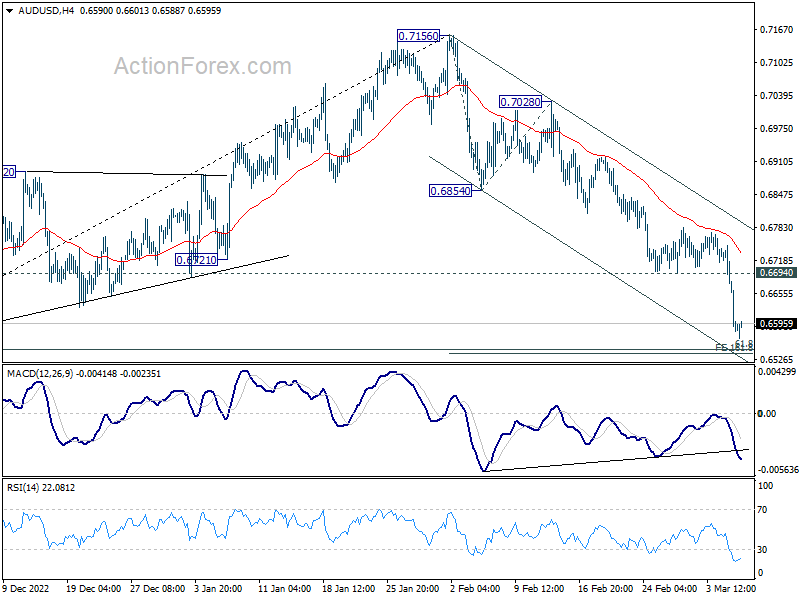
Intraday bias in AUD/USD remains on the downside at this point. Fall from 0.7159 should target 161.8% projection of of 0.6854 to 0.7028 from 0.6854 at 0.6539. Some support could be seen there to bring recovery. Above 0.6694 resistance will turn bias back to the upside for recovery. However, sustained break of 0.6539 will pave the way back towards 0.6169 low.
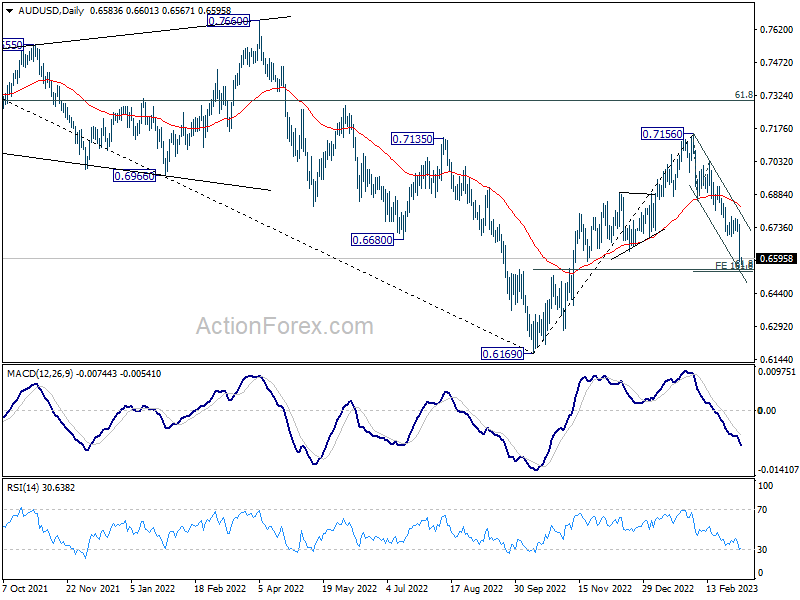
In the bigger picture, rise from 0.6169 (2022 low) has completed at 0.7156, after rejection by 55 month EMA (now at 0.7164). Deeper decline would then be see back to 61.8% retracement of 0.6169 to 0.7156 at 0.6546, even as a corrective fall. Sustained break there will raise the chance of long term down trend resumption through 0.6169 low.
USD/CAD Daily Outlook
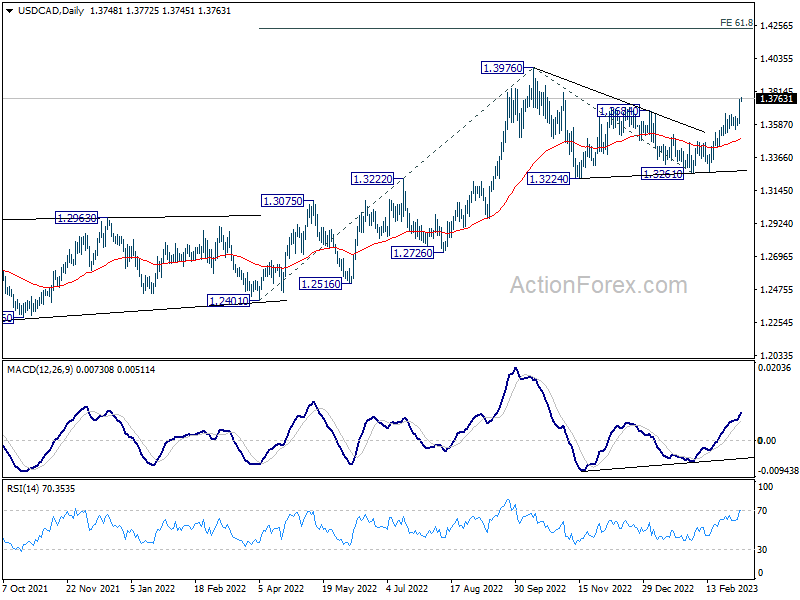
Daily Pivots: (S1) 1.3649; (P) 1.3705; (R1) 1.3810; More....
intraday bias in USD/CAD remains on the upside for retesting 1.3976 high. Firm break there will resume larger up trend and target 1.4234 projection level. On the downside, break of 1.3664 minor support will turn intraday bias neutral first. But retreat should be contained above 1.3554 support to bring another rally.
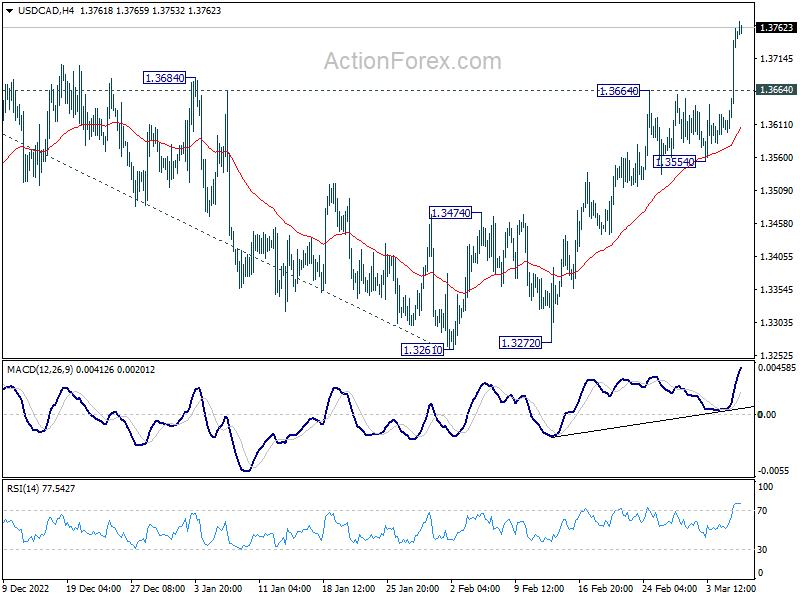
In the bigger picture, outlook stays bullish with 1.3222 cluster support (38.2% retracement of 1.2005 to 1.3976 at 1.3223) intact. Break of 1.3976 resistance will resume larger up trend from 1.2005 (2021 low) to 61.8% projection of 1.2401 to 1.3976 from 1.3261 at 1.4234.
EUR/USD Daily Outlook
Daily Pivots: (S1) 1.0498; (P) 1.0597; (R1) 1.0647; More...
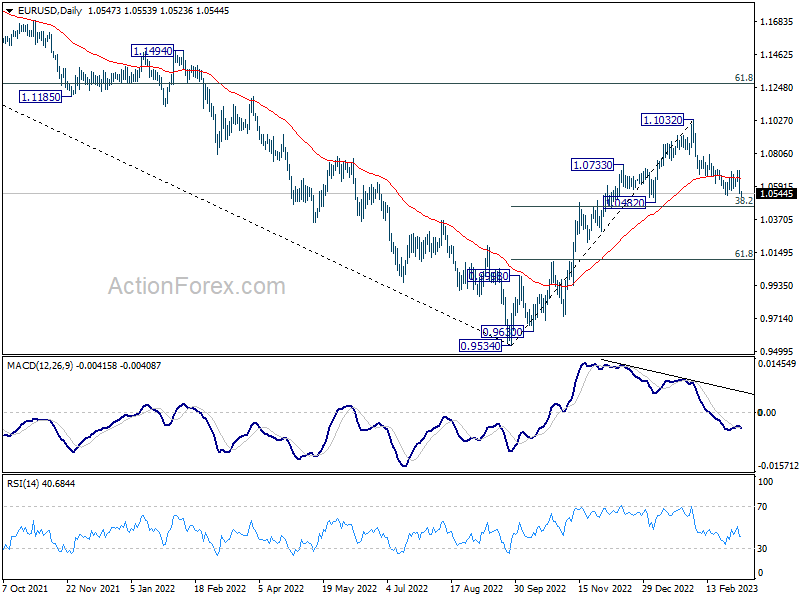
EUR/USD's decline from 1.1032 resumed by breaking 1.0532 support. Intraday bias is back on the downside for 38.2% retracement of 0.9534 to 1.1032 at 1.0463. Strong support could be seen there to bring reversal. But break of 1.0693 resistance is needed to indicate short term bottoming first. Meanwhile, sustained break of 1.0463 will carry larger bearish implications.
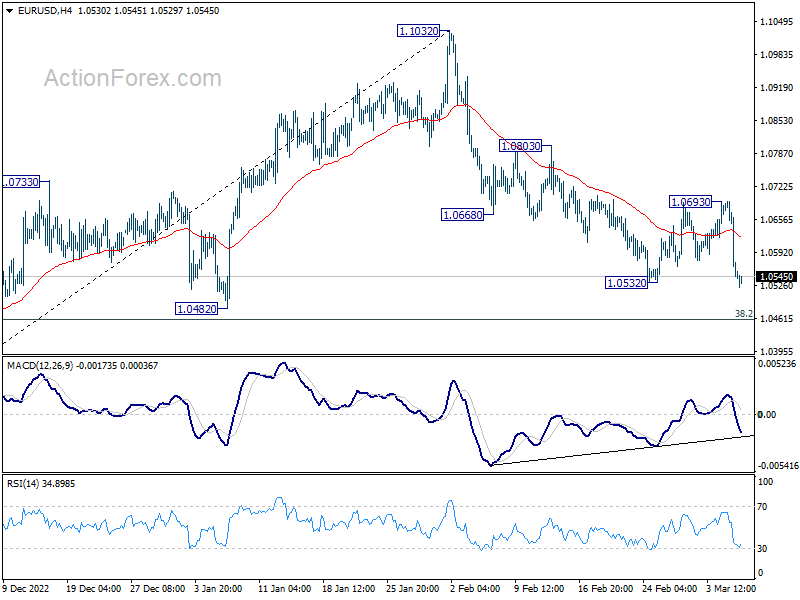
In the bigger picture, as long as 1.0482 support holds, rise from 0.9534 (2022 low) should continue to 61.8% retracement of 1.2348 (2021 high) to 0.9534 at 1.1273. However, sustained break of 1.0482 will bring deeper fall to 61.8% retracement of 0.9534 to 1.1032 at 1.0106, even as a corrective pull back.
GBP/USD Daily Outlook
Daily Pivots: (S1) 1.1744; (P) 1.1905; (R1) 1.1987; More...
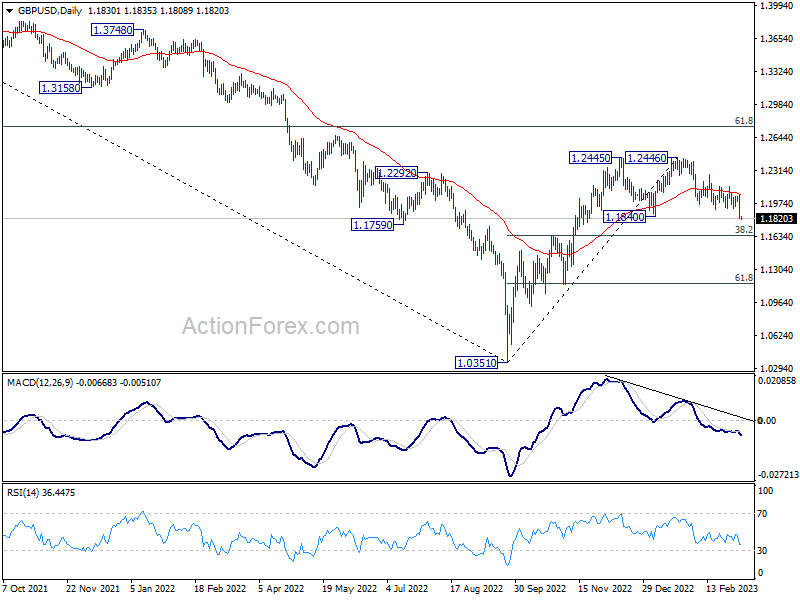
GBP/USD's fall from 1.3446 resumed by break through 1.1914 support and intraday bias is back on the downside. Deeper decline would be seen to 38.2% retracement of 1.0351 to 1.2446 at 1.1646. Strong support might be seen there to rebound. But break of 1.1914 support turned resistance is needed to sign temporary bottoming first. Meanwhile, firm break of 1.1645 would carry larger bearish implications.
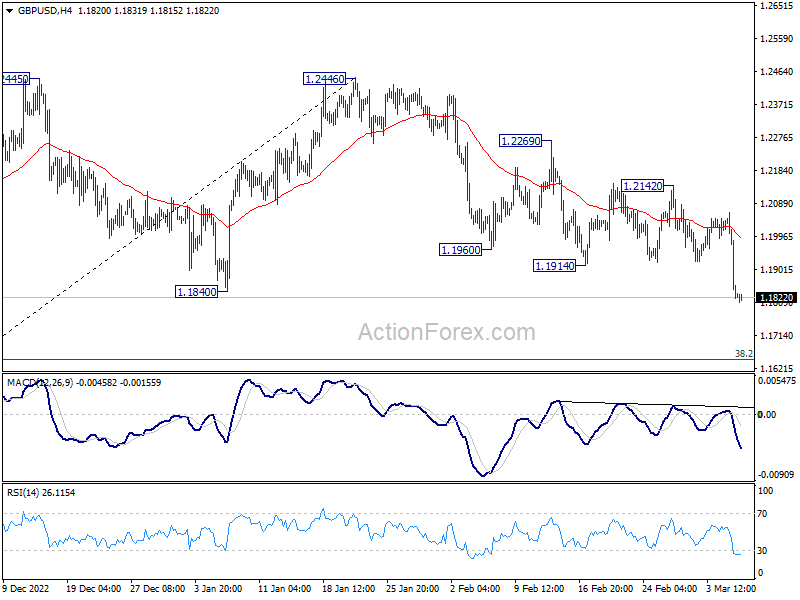
In the bigger picture, break of 1.1840 support argues that a double top pattern (1.2445, 1.2446) was formed after rejection by 55 week EMA (now at 1.2228). Deeper decline should be seen back to 38.2% retracement of 1.0351 to 1.2446 at 1.1646. Sustained break there will raise the chance of trend reversal and target 61.8% retracement at 1.1151.
USD/CHF Daily Outlook
Daily Pivots: (S1) 0.9329; (P) 0.9378; (R1) 0.9469; More...
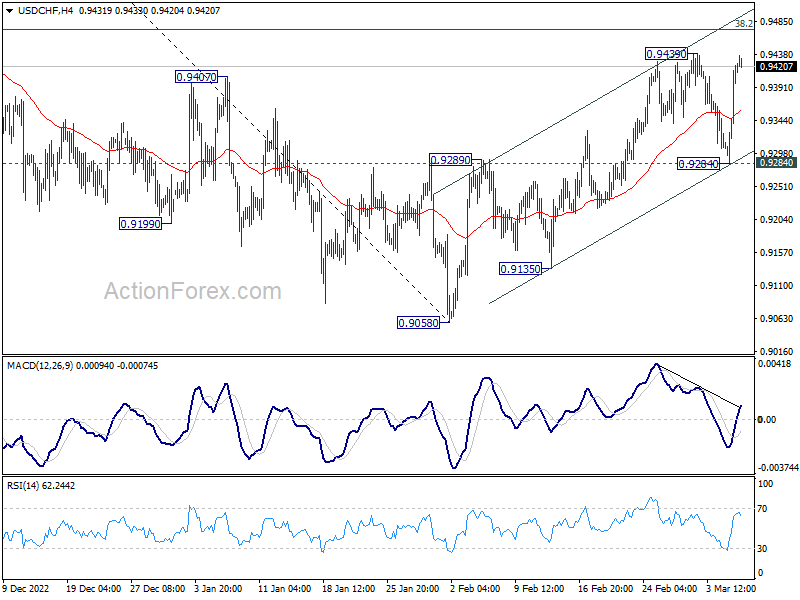
Intraday bias in USD/CHF is back on the upside with current strong rebound. Break of 0.9439 will resume the rise from 0.9058 for 38.2% retracement of 1.0146 to 0.9058 at 0.9474. Decisive break there will carry larger bullish implications. On the downside, break of 0.9284 will turn bias back to the downside for retesting 0.9058 low instead.
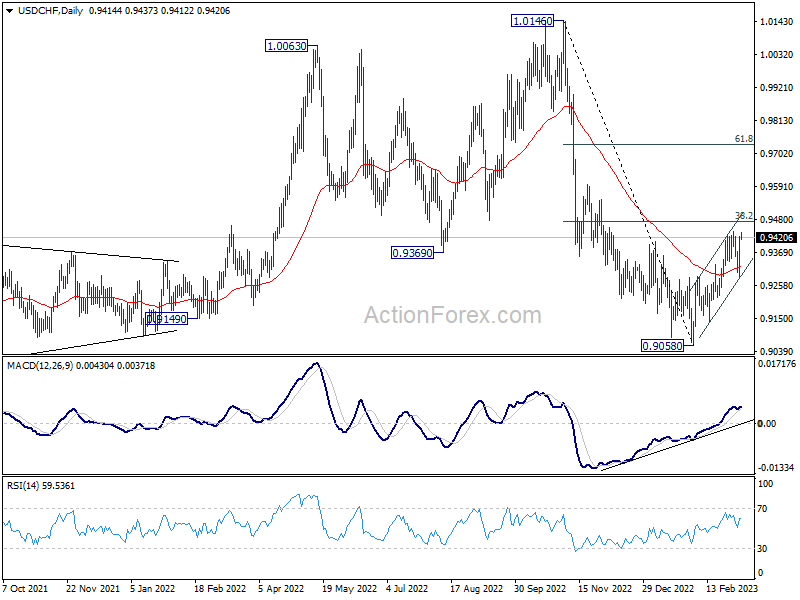
In the bigger picture, decline from 1.0146 is seen as part of a long term sideway pattern. As long as 38.2% retracement of 1.0146 to 0.9058 at 0.9474 holds, another fall is in favor through 0.9058. However, sustained trading above 0.9474 will indicate that the medium term trend has reversed, and open up further rally to 61.8% retracement at 0.9730 and above.
Powell Brings 50bp Hikes Back on the Table
Market movers today
In the US, markets will pay close attention to the JOLTs job openings, which have been a good leading indicator for wage growth.
German industrial production figures for January are on the agenda. Factory orders showed a small rebound at the start of the year, but truck toll mileage and electricity consumption point to downside risks.
The final euro area Q4 22 GDP figures could see a small downward revision from the earlier estimate of 0.1% q/q, due to a deeper contraction in Germany.
ECB's Lagarde and Riksbank Deputy Governor Breman will be on the wires.
Bank of Canada is widely expected to leave policy rates unchanged at today's monetary policy meeting leaving the key policy rate at 4.5%. Bank of Canada was one of the first central banks to initiate the post pandemic hiking cycle and has also been among the very first to signal a pause. Markets will not least look for signs that Bank of Canada could reinitiate hikes amid a continued strong labour market and other central banks sending hawkish signals as of late.
The 60 second overview
Powell shakes up markets: Fed chair Powell managed to shake up markets at yesterday's Senate testimony. Powell not only indicated a higher eventual peak in policy rates amid the economy faring better-than-expected but he also signalled a willingness to re-accelerate the hiking pace back to 50bp increments should data warrant this.
Notably, Powell highlighted that there is "little sign of disinflation thus far in the category of core services excluding houses" which illustrates that the Fed is concerned with respect to underlying inflationary pressures. Powell also indicated the need for a softer labour market and that although wage growth has eased slightly in recent months it remains uncomfortably high relative to productivity trend growth and the 2% inflation target.
Markets reacted strongly with US FI selling off aggressively. Markets are now leaning more towards a 50bp March hike than the 25bp hike deemed a done deal not many weeks back. With the Fed's silent period beginning on Saturday the next couple of sessions' US releases will be unusually important for the short-end of the USD curve as this could pivot Fed one way or the other. While Friday's nonfarm payrolls naturally marks the highlight we stress the JOLTS job openings data later today and tomorrow's initial jobless claims could also prove unusually important. During the Fed's silent period we get US CPI (14 March) which naturally also holds the importance to shift market pricing in either way.
Markets now price a policy rate peak around 5.60% in September later this year. The slope between the 10Y and 2Y US Treasury yield has now inverted beyond -100bp which is the most since 1981 highlighting the sharp recession signal that bond markets continue to send.
Markets. Price action from yesterday has generally extended into the overnight Asia session with most notably US yields continuing to move higher. Most major equity indices and G10 equity futures are trading in red territory this morning while the USD has gained further. Amid the rise in global yields USD/JPY has moved sharply higher and is now trading at the highest levels since December just two days ahead of the eagerly awaited Bank of Japan meeting.
FI: It was a volatile day in rates markets amid inflation expectations collapse in the Eurozone and a hawkish Powell.
FX: The USD strengthened sharply and across the board on the back of the hawkish Powell testimony with EUR/USD moving closer to 1.05 and USD/JPY toward 138. SEK and NOK continue to underperform and USD/SEK soared all the way back to year highs at 10.75.
Credit: Tuesday saw some profit taking in the overall corporate bond market after solid performance in recent days. iTraxx Main widened 1bp to 75bp while iTraxx X-over widened 8bp to 393bp. The primary market remains busy with several companies looking to issue new bonds amid high investor demand.
Nordic macro
Riksbank's Breman speaks about the economy and monetary policy at 08.45 CET. Given the recent high core inflation in the Euro zone, hawkish ECB comments and signals about accelerating Swedish food inflation we expect her to emphasize the need for additional forceful hikes at the upcoming meetings (i.e. 50 bps and 25 bps) in April and June to combat rising Swedish core inflation.
Maklarstatistik releases country-wide residential property price data for February. It should show a modest stabilization as seen in other data.
Hawks are in the Air
Investors got a double shot of hawkishness from Federal Reserve (Fed) Chair Jerome Powell’s semi-annual testimony before the US Senate yesterday.
This time, Powell left no place for doubt. He clearly said that nothing about the data suggests to him that they have tightened too much, and that ‘if the totality of the data were to indicate that faster tightening is warranted, we would be prepared to increase the pace of rate hikes’.
I repeat, ‘increase the PACE of rate hikes’.
That means that if the US jobs data remains strong, and inflation won’t cool down, the Fed will throw the slower-but-higher-rate-hikes strategy out of the window, and they will just hike by decent chunks.
And the level of rates will ‘likely be higher than previously anticipated’; it will be higher than 5.1%.
The message went through
Activity on Fed funds futures now assesses 73% chance for a 50bp hike for the March FOMC meeting, up from around 30% before the speech. Pricing also suggests 100bp hike in the next four meetings. And swap markets price in a peak Fed rate of 5.6%. That was around 4.90% at the start of the year.
Chaos
Powell’s comments wreaked havoc across the US treasury and equity markets and the US dollar. The US 2-year yield spiked past the 5% mark. The 10-year yield spiked to 4%. The gap between the 2 and 10-year yield hit a full percentage point for the first time since 1981.
The widening yield gap means that the pricing of further rate hikes is well in play, yet the rate hike expectations increase the odds that the US economy could come down sharply. That’s why the 4% mark on the 10-year is less enthusiastic about further upside.
In equities, the S&P500 had to give to the bears and fell 1.53% to below the 4000 mark and the 50-DMA.
To be true, the reaction could’ve been worse, but the selloff may not stop here.
Data, data, data
The next few data points will be very important in cementing the expectation of a 50bp hike at the March 21-22 FOMC meeting.
Today, the ADP report and job openings data. JOLTS data would better soften this month, after last month’s booming figure of 11 mio.
On Friday, February jobs report will be released. We’d better see an easing here as well after last month’s blowout half-a-million NFP read.
Finally, the latest CPI update is due next Tuesday. And again, it’d better head sufficiently lower after last month’s disinflation disillusion.
If the fresh data doesn’t go where the Fed wants to see them, bigger rate hikes will be on the menu, and hope of soft-landing and easy disinflation could fade away.
And with all the hawks in the air, the US dollar went straight up yesterday and there is no reason to bet on a softer US dollar for the next couple of days. The dollar will likely consolidate and extend gains against most majors.
The EURUSD tanked to the 100-DMA, which stands a few pips above the 1.05 mark, and the major 38.2% Fibonacci retracement on September to February rally, around the 1.0473 level, is just about to get tested, and could be broken depending on the strength of the USD bullishness. It’s true that we were expecting the rate hikes in the US to gently end in Q1 and the rate hikes in the Eurozone to continue. But the new turn of things suggests that the Fed is not done hiking yet, so the euro can barely strengthen its back if the USD bulls remain in charge of the market.
The Reserve Bank of Australia (RBA) head Philip Lowe said, just a day after the 25bp hike, that they are approaching a point where a pause in tightening is needed. The combination of a hawkish shift in Fed’s language and the dovish hike from the RBA cost dearly to the Aussie. The AUDUSD dropped two figures yesterday and is now around the 65 cents mark. At this point, even the Chinese reopening will hardly make up for the negative pressure.
In Canada, the Bank of Canada is preparing to do nothing at today’s monetary policy meeting. But Canadian policymakers could make some careful tweaks to the statement to leave the door open for further action, if needed. The cup and handle formation on the dollar-CAD hints that the move could extend to 1.40 mark, if the BoC fails to show a bit of teeth.