Sample Category Title
GBP/USD Mid-Day Outlook
Daily Pivots: (S1) 1.1744; (P) 1.1905; (R1) 1.1987; More...
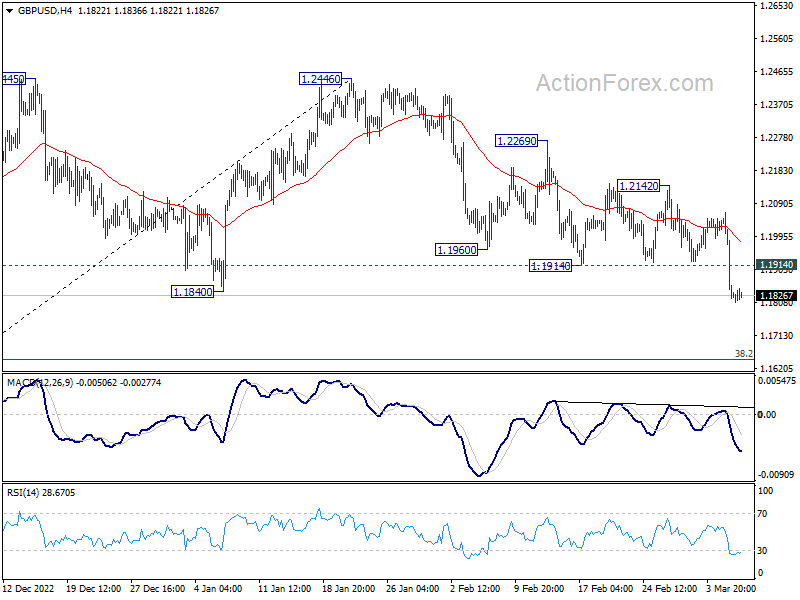
Intraday bias in GBP/USD remains on the downside for the moment. Current decline from 1.2446 is in progress for 38.2% retracement of 1.0351 to 1.2446 at 1.1646. Strong support might be seen there to rebound. But break of 1.1914 support turned resistance is needed to sign temporary bottoming first. Meanwhile, firm break of 1.1645 would carry larger bearish implications.
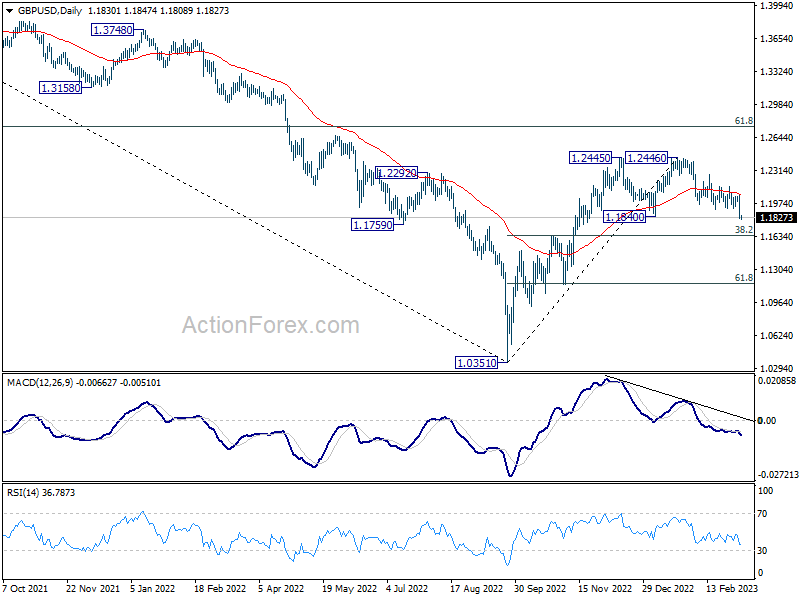
In the bigger picture, break of 1.1840 support argues that a double top pattern (1.2445, 1.2446) was formed after rejection by 55 week EMA (now at 1.2228). Deeper decline should be seen back to 38.2% retracement of 1.0351 to 1.2446 at 1.1646. Sustained break there will raise the chance of trend reversal and target 61.8% retracement at 1.1151.
USD/JPY Mid-Day Outlook
Daily Pivots: (S1) 136.07; (P) 136.63; (R1) 137.72; More...
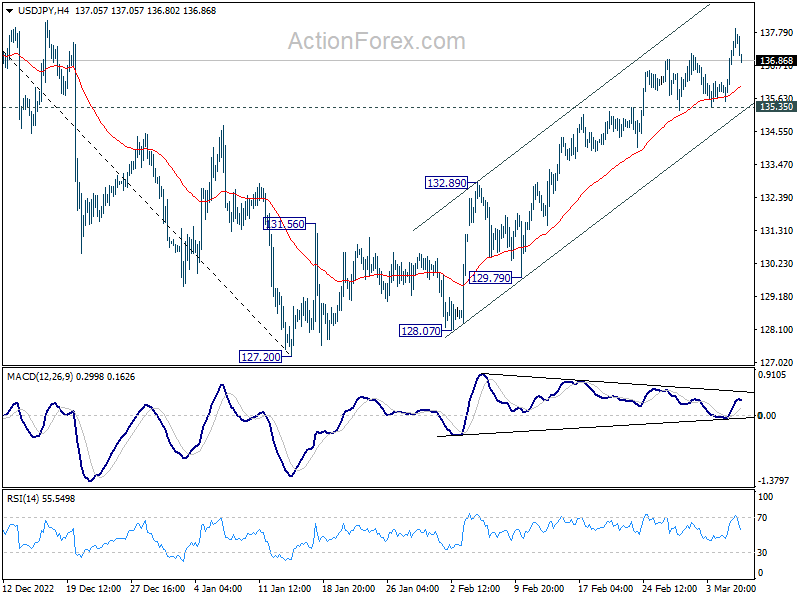
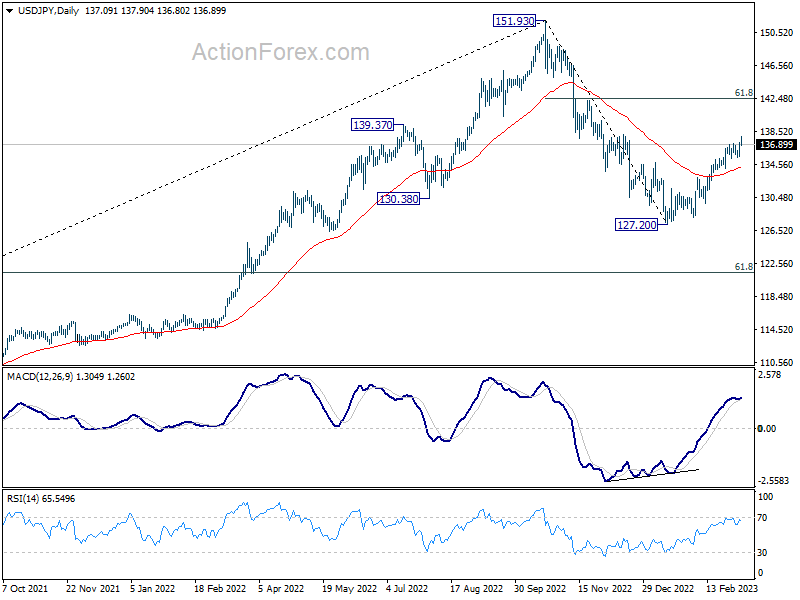
Intraday bias in USD/JPY stays on the upside at this point. Current rally from 127.20 would target next fibonacci level at 142.48. On the downside, break of 135.35 support is needed to indicate short term topping. Otherwise, outlook will remain bullish in case of retreat.
In the bigger picture, the break of 38.2% retracement of 151.93 to 127.20 at 136.64 suggests that whole down trend from 151.93 has completed at 127.20 already. Tentatively, rise from 127.20 is seen as the second leg the medium term pattern from 151.93. Further rally is expected to 61.8% retracement at 142.48. This will now remain the favored case as long as 55 day EMA (now at 134.10) holds.
USD/CHF Mid-Day Outlook
Daily Pivots: (S1) 0.9329; (P) 0.9378; (R1) 0.9469; More...
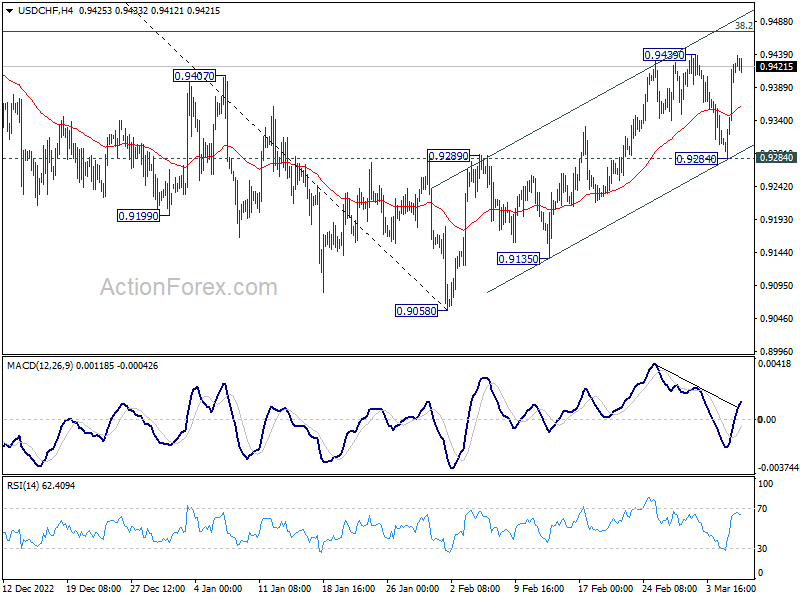
Intraday bias in USD/CHF stays on the upside with focus on 0.9439 resistance. Break there will resume the rise from 0.9058 for 38.2% retracement of 1.0146 to 0.9058 at 0.9474. Decisive break there will carry larger bullish implications. On the downside, break of 0.9284 will turn bias back to the downside for retesting 0.9058 low instead.
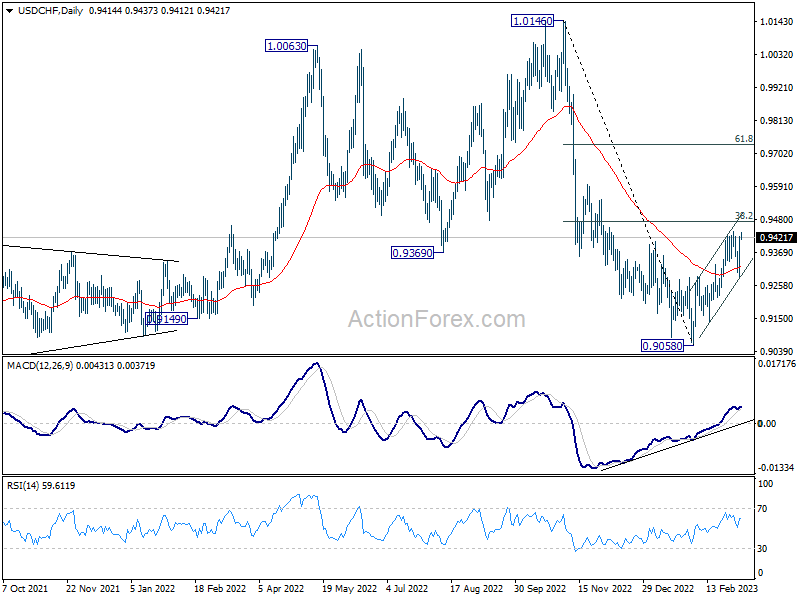
In the bigger picture, decline from 1.0146 is seen as part of a long term sideway pattern. As long as 38.2% retracement of 1.0146 to 0.9058 at 0.9474 holds, another fall is in favor through 0.9058. However, sustained trading above 0.9474 will indicate that the medium term trend has reversed, and open up further rally to 61.8% retracement at 0.9730 and above.
Dollar Takes a Breather and Shrugs Strong ADP Job Numbers
Dollar is currently taking a pause from its recent gains, with traders digesting the impact of Fed Chair Jerome Powell's previous testimony. While Powell will appear again in front of Congress today, there shouldn't be any more surprises. The market has also remained relatively unmoved by a stronger-than-expected ADP private job report, with many traders waiting for Friday's non-farm payroll report before making any significant moves.
Swiss Franc and Euro are currently among the strongest currencies this week, trailing Dollar. Meanwhile, Australian dollar is still struggling, despite a slight recovery today, and Sterling and New Zealand dollar are also underperforming. Yen is mixed, with its fortunes largely dependent on the development of treasury yields and the upcoming BoJ meeting on Friday. Finally, the Canadian Dollar is also mixed, with traders awaiting the BoC's decision later in the session.
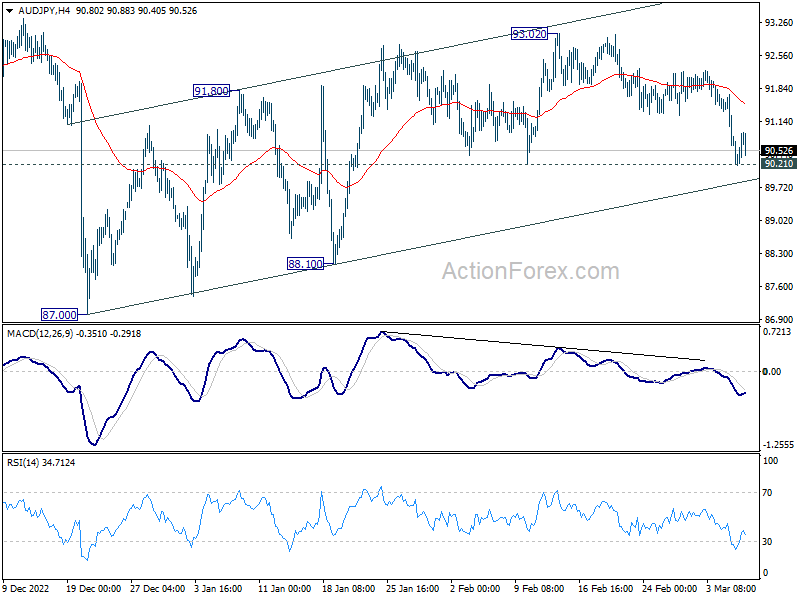
Technically, AUD/JPY is under pressure once again after a weak recovery earlier in the day If the cross breaks below the support level of 90.21 decisively, it would indicate that the corrective recovery from 87.00 to 93.02 has ended. In this case, a deeper fall could be expected towards the support zone of 87.00/88.10. Such a drop is likely to be accompanied by a deeper selloff in the Aussie in other trading pairs as well.
In Europe, at the time of writing, FTSE is up 0.08%. DAX is up 0.42%. CAC is up 0.04%. Germany 10-year yield is down -0.0378 at 2.651. Earlier in Asia, Nikkei rose 0.48%. Hong Kong HSI dropped -2.35%. China Shanghai SSE dropped -0.06%. Singapore Strait Times dropped -0.57%. Japan 10-year JGB yield rose 0.0012 to 0.507.
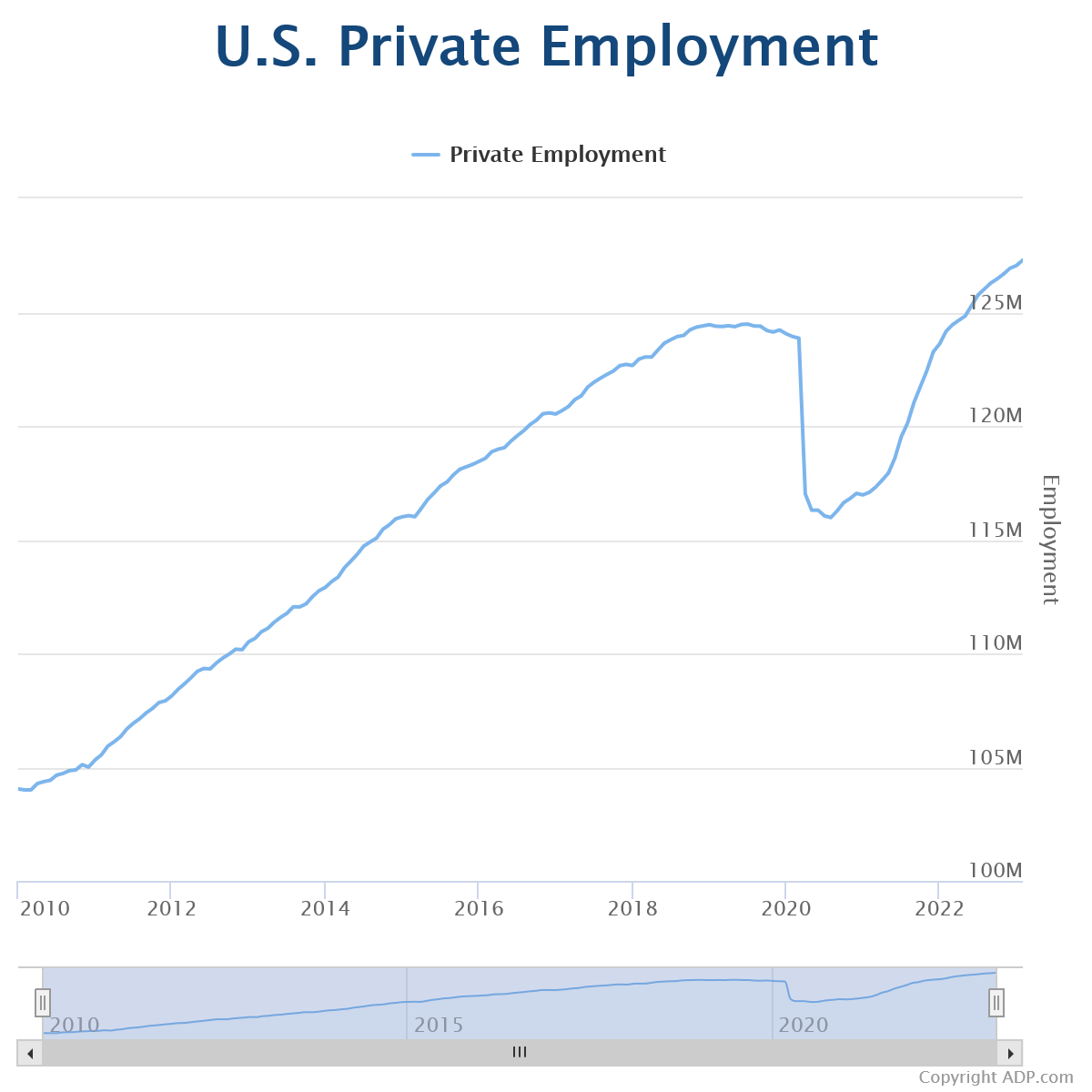
US ADP jobs grew 242k in Feb, pay growth still quite elevated
US ADP private sector employment grew 242k in February, above expectation of 200k. By sector, goods-producing jobs rose 52k and service-providing jobs rose 190k. By size, small companies lost -61k jobs, but medium companies added 148k and large companies added 160k. Pay growth for job stays slowed to 7.2% yoy, slowest in 12 months.
"There is a tradeoff in the labor market right now," said Nela Richardson, chief economist, ADP. "We're seeing robust hiring, which is good for the economy and workers, but pay growth is still quite elevated. The modest slowdown in pay increases, on its own, is unlikely to drive down inflation rapidly in the near-term."
BoE Dhingra: Prudent to hold rates steady because of material overtightening risk
BoE dove Swati Dhingra warned in a speech that overtightening posses a more material risk now. She called for holding interest rate unchanged.
"Overtightening poses a more material risk at this point, through potential negative impacts from increased borrowing costs and reduced supply capacity going forwards," she explained. "It risks unnecessarily denting output at a time when the economy is weak and deepening the pain for households when budgets are already squeezed through energy and housing costs."
"In my view, a prudent strategy would hold policy steady amidst growing signs external price pressures are easing, and be prepared to respond to developments in price evolution. This would avoid overtightening and return the economy sustainably to our 2% inflation target in the medium-term."
"Overall, the evidence does not point to persistent cost-push inflation becoming embedded in wages and margins," she said. "Even after a year and a half of above-target inflation, there is little evidence for such cost-push inflation beyond what might be expected following an unprecedented terms of trade shock."
"Consumption remains weak and many of the tightening effects of monetary policy are yet to fully take hold," she added.
RBA Lowe: Further tightening required, but closer to a pause
RBA Governor Philip Lowe said in a speech that further rate hike is still necessary. But the central bank is now closer to the point of a pause.
The board's judgment remained that "further tightening of monetary policy is likely to be required to bring inflation back to target within a reasonable timeframe", Lowe said.
"Inflation is still too high and while it looks to be on a declining path it is likely to remain higher than target for a few years," he added. "If we don't get inflation down fairly soon, the end result will be even higher interest rates and more unemployment.
Meanwhile, " with monetary policy now in restrictive territory, we are closer to the point where it will be appropriate to pause interest rate increases to allow more time to assess the state of the economy," he noted.
"At what point it will be appropriate to pause will be determined by the data and our assessment of the outlook".
USD/CHF Mid-Day Outlook
Daily Pivots: (S1) 0.9329; (P) 0.9378; (R1) 0.9469; More...
Intraday bias in USD/CHF stays on the upside with focus on 0.9439 resistance. Break there will resume the rise from 0.9058 for 38.2% retracement of 1.0146 to 0.9058 at 0.9474. Decisive break there will carry larger bullish implications. On the downside, break of 0.9284 will turn bias back to the downside for retesting 0.9058 low instead.
In the bigger picture, decline from 1.0146 is seen as part of a long term sideway pattern. As long as 38.2% retracement of 1.0146 to 0.9058 at 0.9474 holds, another fall is in favor through 0.9058. However, sustained trading above 0.9474 will indicate that the medium term trend has reversed, and open up further rally to 61.8% retracement at 0.9730 and above.
Economic Indicators Update
| GMT | Ccy | Events | Actual | Forecast | Previous | Revised |
|---|---|---|---|---|---|---|
| 23:50 | JPY | Bank Lending Y/Y Feb | 3.30% | 3.20% | 3.10% | |
| 23:50 | JPY | Current Account (JPY) Jan | 0.22T | 0.85T | 1.18T | |
| 05:00 | JPY | Leading Economic Index Jan P | 96.5 | 97.1 | 97.2 | |
| 05:00 | JPY | Eco Watchers Survey: Current Feb | 52 | 48.3 | 48.5 | |
| 07:00 | EUR | Germany Industrial Production M/M Jan | 3.50% | 1.50% | -3.10% | -2.40% |
| 07:00 | EUR | Germany Retail Sales M/M Jan | -0.30% | 2.00% | -5.30% | -4.90% |
| 09:00 | EUR | Italy Retail Sales M/M Jan | 1.70% | 0.20% | -0.20% | |
| 10:00 | EUR | Eurozone GDP Q/Q Q4 F | 0.00% | 0.10% | 0.10% | |
| 10:00 | EUR | Eurozone Employment Change Q/Q Q4 F | 0.30% | 0.40% | 0.40% | |
| 13:15 | USD | ADP Employment Change Feb | 242K | 200K | 106K | 119K |
| 13:30 | USD | Trade Balance (USD) Jan | -68.3B | -69.0B | -67.4B | -67.2B |
| 13:30 | CAD | Trade Balance (CAD) Jan | 1.9B | -0.2B | -0.2B | 1.2B |
| 15:00 | USD | Fed's Chair Powell testifies | ||||
| 15:00 | CAD | BoC Interest Rate Decision | 4.50% | 4.50% | ||
| 15:30 | USD | Crude Oil Inventories | 1.3M | 1.2M | ||
| 18:00 | USD | Fed's Beige Book |
US ADP jobs grew 242k in Feb, pay growth still quite elevated
US ADP private sector employment grew 242k in February, above expectation of 200k. By sector, goods-producing jobs rose 52k and service-providing jobs rose 190k. By size, small companies lost -61k jobs, but medium companies added 148k and large companies added 160k. Pay growth for job stays slowed to 7.2% yoy, slowest in 12 months.
"There is a tradeoff in the labor market right now," said Nela Richardson, chief economist, ADP. "We're seeing robust hiring, which is good for the economy and workers, but pay growth is still quite elevated. The modest slowdown in pay increases, on its own, is unlikely to drive down inflation rapidly in the near-term."
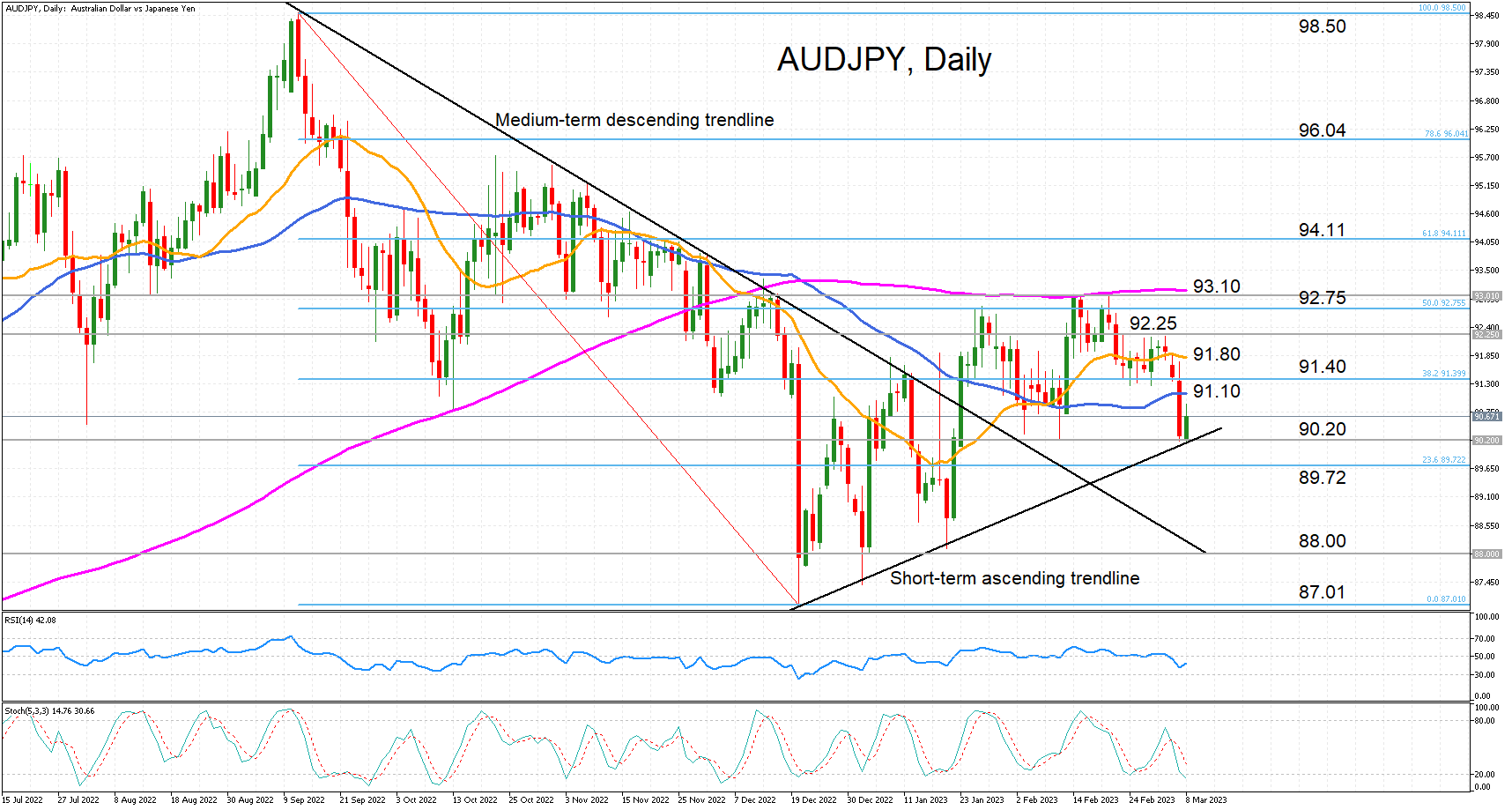
AUDJPY Slips Below 50-day SMA But Finds Support at Ascending Trendline
AUDJPY has been under selling pressure this week, crashing below its 50-day simple moving average (SMA) on Tuesday. However, the price appears to be bouncing off the medium-term ascending trendline today, and the momentum indicators suggest that a rebound could be underway.
The RSI has already started to turn upwards, having dipped below 50 on Friday, but has yet to reach its zero neutral line. The stochastics are rebounding in the 4-hour but will need more time in the daily timeframe to begin a convincing reversal. Hence, the current upswing is far from being on a solid footing and the short-term bias remains tilted to the downside.
If the positive momentum gathers strength, the pair could meet immediate resistance at the 50-day SMA, which stands at 91.10. There are further obstacles at the 20-day SMA near 91.80 and the recent peaks around 92.25. If overcome, the bulls could then challenge the 200-day SMA at 93.10.
However, if today’s bounce loses steam and the price falls below the ascending trendline in the 90.20 region, there could be support at the 23.6% Fibonacci retracement of the September-December 2022 downtrend at 89.72. A steeper slide would bring into focus the previous downtrend line and specifically, the 88.00 level.
To conclude, it is too early to assume that the short-term selling pressure is easing. Meanwhile in the medium-term, AUDJPY would need to cross above the 200-day SMA to achieve a higher-high and extend the rebound from the December low, whereas a drop below the uptrend line would nullify this bullish formation.
USD/CAD Climbs after Hawkish Powell, Bank of Canada Set to Pause
The Canadian dollar has steadied on Wednesday, after sliding 1% a day earlier. Later today, the Bank of Canada meets for its monthly meeting.
BoC likely to pause
The Bank of Canada is widely expected to take a pause at today’s meeting and maintain the cash rate at 4.50%. This would mark the first pause in rate hikes since the current tightening cycle began in January 2022. The BoC has raised rates by 425 basis points during this time and the tightening has had a dampening effect on the economy – GDP in Q4 flattened out and inflation has fallen under 6%.
There is a possibility that the BoC will continue to hold rates, but that will depend on the data, particularly inflation and employment. The shift in policy is bearish for the Canadian dollar, especially with the Federal Reserve expected to continue raising rates. Currently, there is only a 25-bp differential in rates between the US and Canada, but if the Fed keeps raising and the BoC stays on the sidelines, the divergence in rates will weigh on the Canadian dollar, which has plunged some 3% since its February high.
It’s a very different story south of the border, where the US economy is churning out strong numbers and the disinflation process appears to be on hold. In his testimony on Capitol Hill, Fed Chair Powell noted that the latest (January) data was stronger than expected and signalled that the Fed would respond with higher rates than it had previously anticipated. Although the January numbers may have been a blip, the markets are marching to the Fed’s tune and have now priced in a 50-bp hike at the March 22 meeting at 75%, up from 25% prior to Powell’s testimony, according to the CME Group.
USD/CAD Technical
- 1.3701 and 1.3784 are the next resistance lines
- 1.3571 is a weak support line, followed by 1.3478
Gold Gives up March’s Gains, Looks Oversold
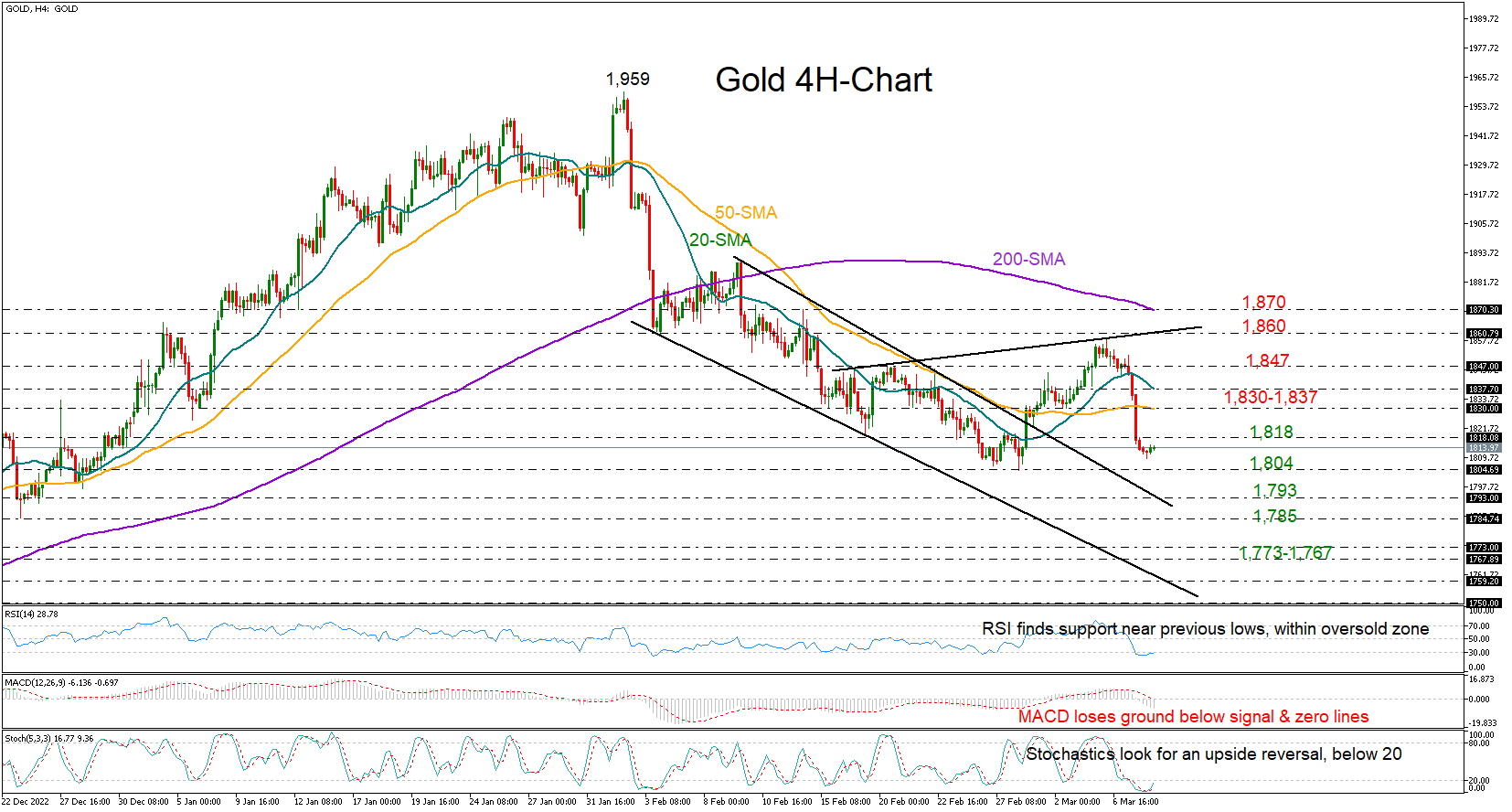
Gold plummeted in the face of Powell’s hawkish interest rate rhetoric on Tuesday, reversing March’s gains from 1,858 to pause at 1,809 earlier today.
Encouragingly, the precious metal seems to have formed a doji morning star candlestick near its recent lows in the four-hour chart, with traders waiting to see whether the market can confirm the bullish pattern with another strong green candlestick. The oversold signals from the RSI and the Stochastics are also raising hopes for an upside reversal, though with the MACD having dived into the negative area, downside pressures could limit potential gains.
The 1,818 number resumed its resistance role yesterday. Therefore, a decisive close above that bar might be required for an advance to 1,830, where the 50-period simple moving average (SMA) is flattening. Moving higher, the price may encounter the 20-day SMA at 1,837 and the 1,847 constraining zone before speeding up to 1,860.
If the bears retake control, the price may seek shelter near February’s low of 1,804. A continuation lower could strengthen towards the upper surface of the broken channel seen around 1,793, a break of which could find immediate support near 1,785 and then somewhere between 1,773-1,767.
Summing up, gold’s latest sharp decline seems to be overdone, making an upside reversal likely. For that to happen though, the yellow metal will need a bullish extension above 1,818.
Powell’s Speech Deepens Bitcoin Correction
Market picture
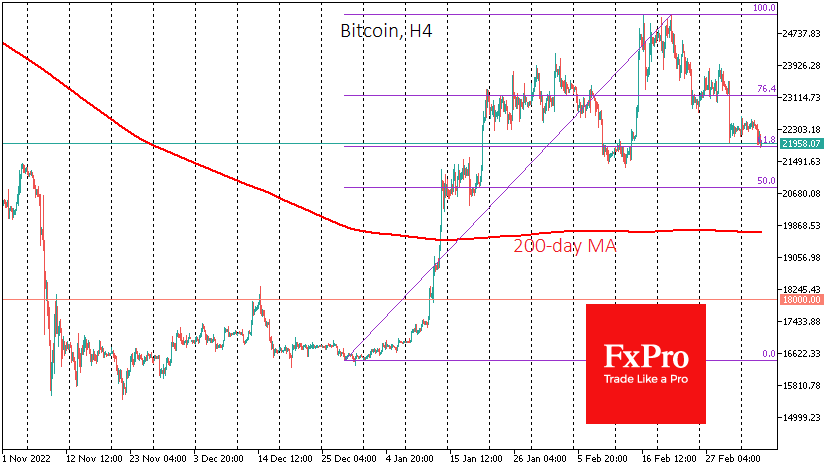
Bitcoin fell on Tuesday amid falling equity indices and a rising US dollar. BTC updated three-week lows below $22K, losing 2% in the past 24 hours. Risky assets fell sharply amid a hawkish speech from Fed chief Jerome Powell, after which markets began to price in the chances of a 50-basis point rate hike later this month.
BTCUSD re-entered the area of the February lows. However, the dynamics in the FX market were much more capitulatory than in cryptocurrencies, where intraday moves continue to mark buying on dips. Touching levels just below $22K took the price back to the 61.8% Fibonacci retracement of the December-February rally. Consolidation below $21.5K would be a strong signal to move lower.
However, more buying is likely at the end of the medium-term correction in such situations, and the bulls will only celebrate victory once the price returns above $22.5K.
News Background
According to CoinGecko, Tether’s (USDT) share of the stackable coin market has surpassed 54% for the first time since November 2021, when the cryptocurrency market hit all-time highs.
El Salvador’s president, Nayib Buquele, said the legalisation of bitcoin had boosted the country’s tourism sector by 95%, improving the economy as a whole.
Ethereum co-founder Vitalik Buterin began selling his meme crypto assets MOPS, CULT and SHIK. The sale of tokens severely affected their value, and investors suffered losses.
WeChat, China’s largest social network, integrated digital yuan into its payment platform WeChat Pay.
Aussie Takes a Tumble after Powell
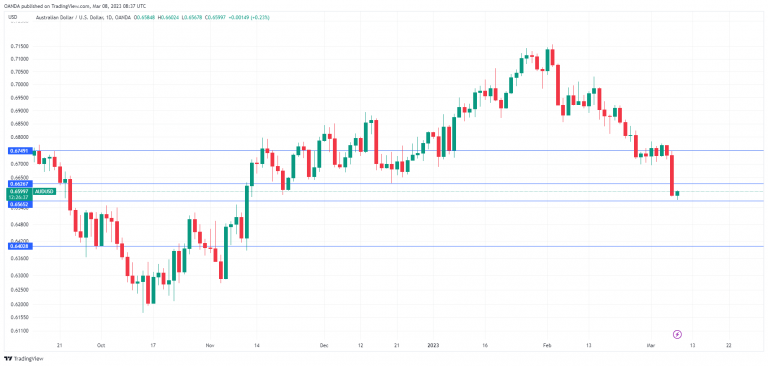
The Australian dollar has stabilized on Wednesday after a dreadful outing a day earlier. In the European session, AUD/USD is trading just below the 0.66 line.
AUD/USD sustained its second most bearish day this year on Wednesday, with a staggering decline of 2.1%. Earlier today, the Australian dollar touched a low of 0.6567, its lowest level in four months. A combination of a dovish rate hike by the Reserve Bank of Australia and hawkish comments from Fed Chair Powell sent the Australian dollar reeling.
The RBA hike of 25 basis points was practically business as usual, but investors picked up on the removal of a reference to raising rates “over the months ahead”, a possible signal that the RBA could be near the end of the current rate-tightening cycle. The rate statement explicitly said that inflation had peaked, clearly a dovish signal from policy makers.
Earlier today, Governor Lowe used a second “p” word which weighed on the Australian dollar, saying that a pause in rate increases was closer. Does that mean that the April meeting will be a “one and done”? Perhaps, but Lowe has said previously that the Bank will make its rate decisions on a meeting-by-meeting basis, after evaluating the data. This means that the next inflation and employment reports will have a critical impact on what the RBA does at next month’s meeting.
In the US, Fed Chair Powell remained in hawkish mode in his testimony on Capitol Hill. Powell pointed to the recent string of strong releases and said the Fed would likely need to raise rates more than it had anticipated. Powell said that the Fed would evaluate the need to increase the pace of rate hikes based on the “totality of the data”. The remarks caused a huge shift in market pricing, with the likelihood of a 50-bp at the March 22 meeting rising to 70%, up from 25% prior to Powell’s testimony, according to the CME Group.
AUD/USD Technical
- 0.6565 is a weak support line. Below, there is support at 0.6402
- There is resistance at 0.6626 and 0.6749