Sample Category Title
Crude Oil Price Could Recover If It Clears This Hurdle
Key Highlights
- Crude oil price is facing resistance near the $76.50 zone.
- A connecting bearish trend line is forming with resistance near $76.10 on the 4-hours chart.
- Gold price is consolidating losses above the $1,850 support zone.
- EUR/USD extended its decline below the 1.0750 support.
Crude Oil Price Technical Analysis
Crude oil price started a strong decline from the $82.40 resistance against the US Dollar. The price declined below the $78.00 support to move into a bearish zone.
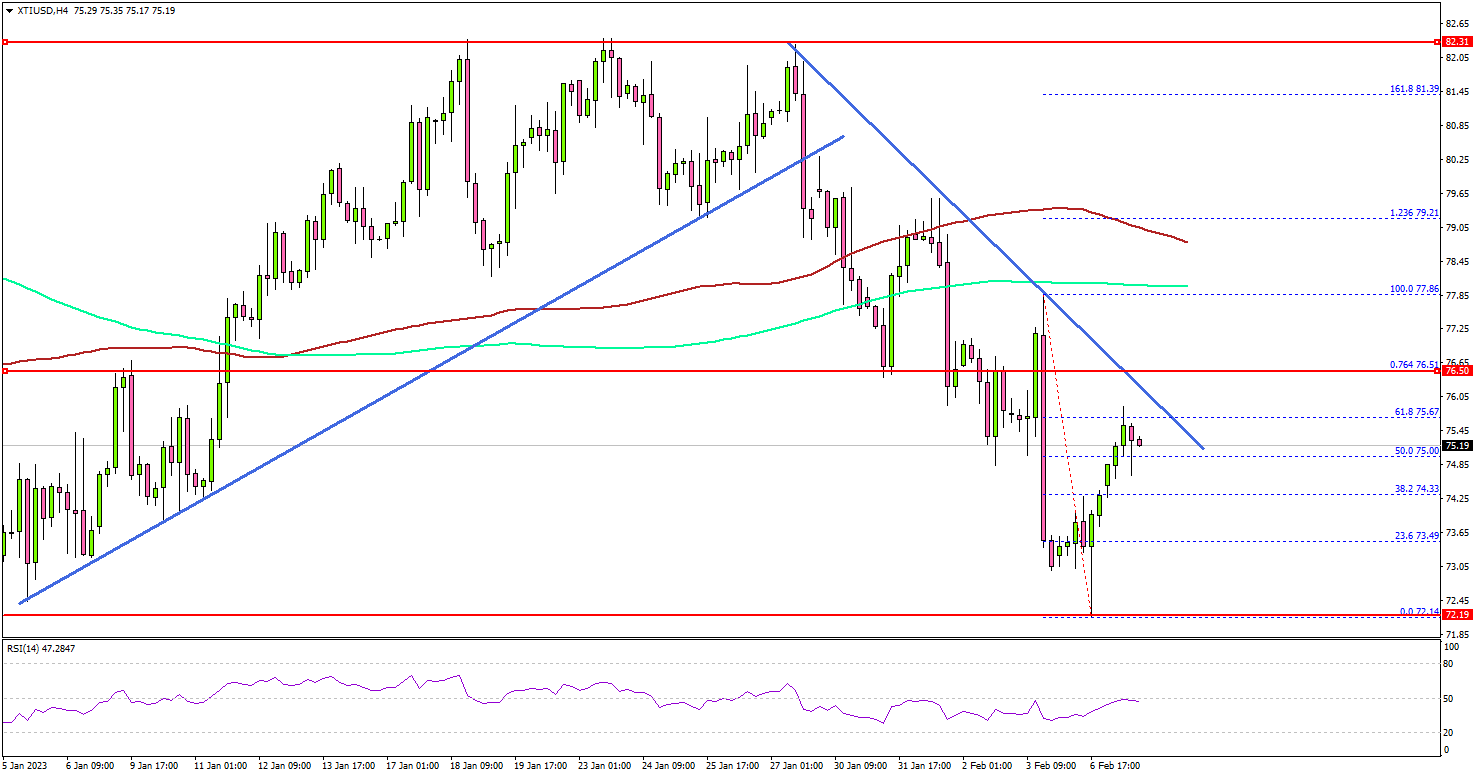
Looking at the 4-hours chart of XTI/USD, the price traded below a major bullish trend line. It even settled below the $76.50 support, the 100 simple moving average (red, 4-hours) and the 200 simple moving average (green, 4-hours).
Finally, the bulls appeared near the $72.00 support. A low was formed near $72.14 before the price started an upside correction.
On the upside, the price is facing resistance near the $76.00 zone. The next major resistance is near the $76.50 zone. A clear move above the $76.50 resistance could open the doors for another steady increase towards $78 or even $80.
If not, the price might drop again from $76. An immediate support is now forming near the $74 zone. The next major support sits near the $73.50 level. Any more losses might call for a test of the $72.40 support zone in the coming days.
Looking at gold price, the bulls are trying to protect the $1,850 support zone and they might aim a recovery wave in the coming days.
Economic Releases to Watch Today
- Fed's Williams speech.
- Fed's Waller speech.
BTC/USD: Forecasting Elliott Wave ((iv)) Correction In Bitcoin
Hello Traders, in this article we will have a look on BTC/USD. You will see how we were able to forecast in advance the upcoming wave ((iv)) correction. Bitcoin is trading within a larger degree cycle that started from 11.21.2022. Current cycle appears to be within extended wave 3. Inside our members area we cover also 4 hour, Daily & Weekly charts. That will give you also a bigger context as where we stand in the cycle. Moreover, as day trading or position trading can be applied when trading our charts it is important for a trader to know and understand when the market is approaching a reaction point within a cycle. This can help with making better decisions as whether is good to take profits, move stop loss, enter trades etc.
Firstly, let’s have a look on BTC/USD from 01.24.2023
BTC/USD 2H Chart 01.24.2023
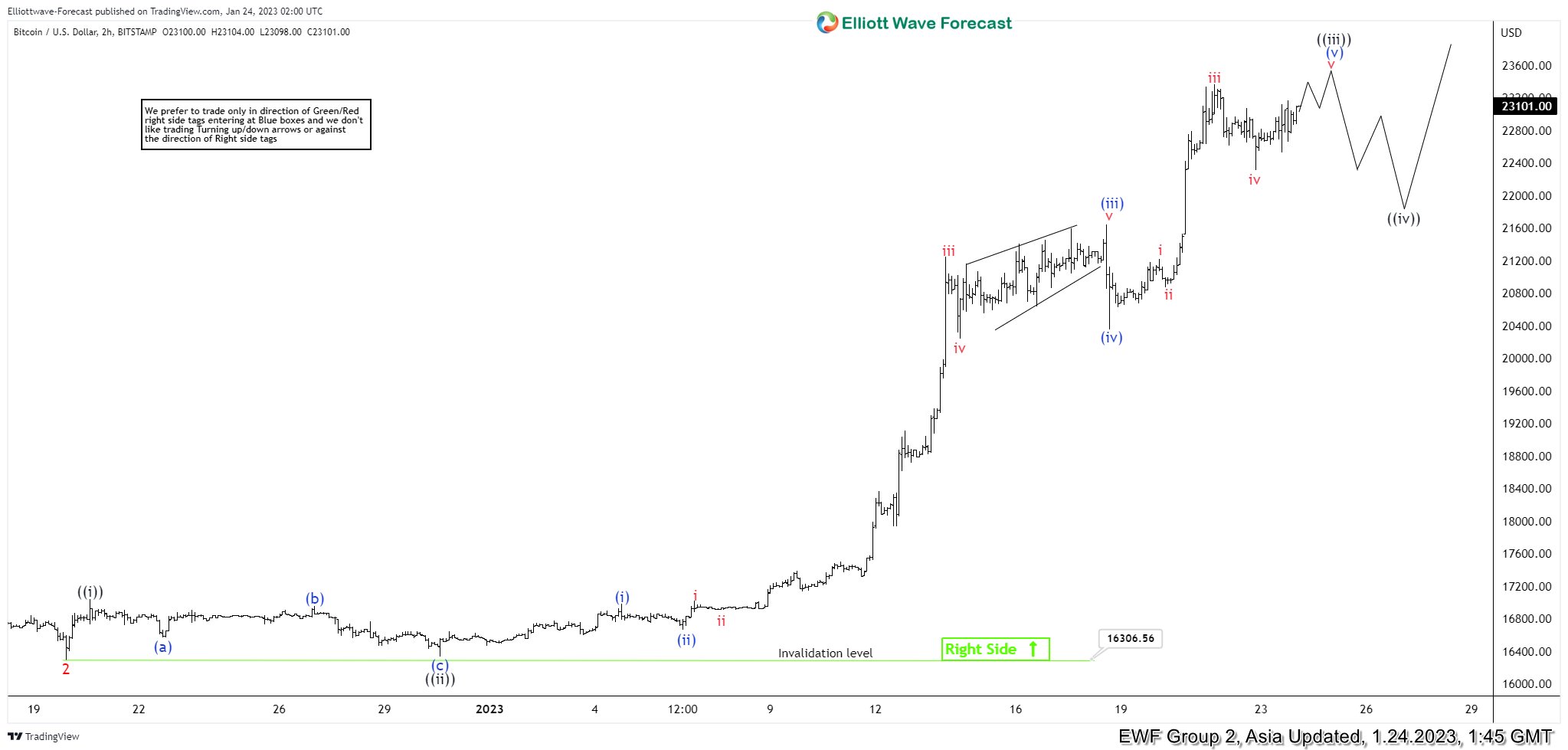
Bitcoin has been trading higher in a wave ((iii)). However, It had created a nest and was trading higher within v of (v) of ((iii)). At that point the market was getting closer to the end of wave ((iii)) and soon was expected to pullback in ((iv)).
Fast forward, a couple of days later here is what happened.
BTC/USD 2H Chart 02.06.2023
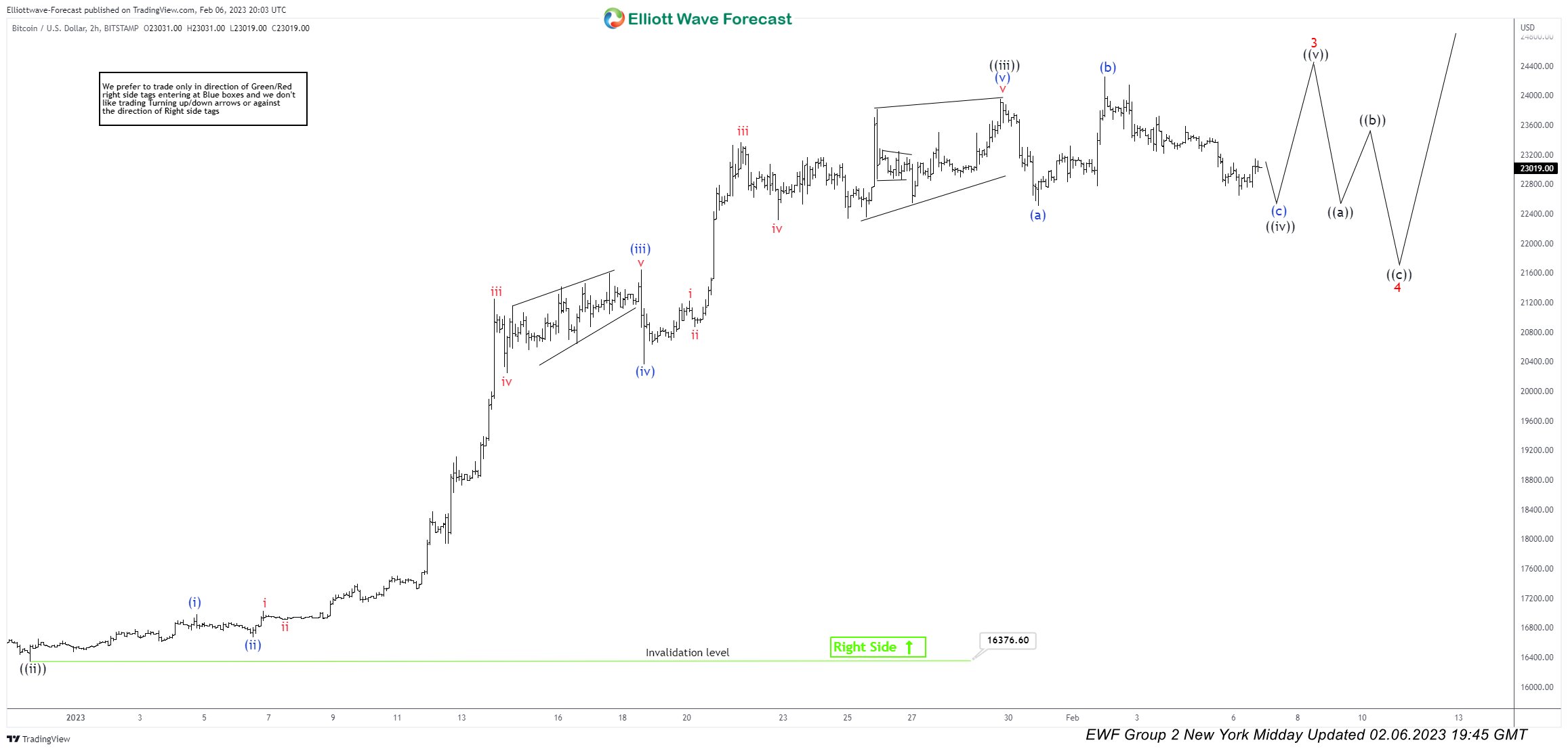
Bitcoin has ended as expected wave ((iii)) and pullback in ((iv)) played out as a flat correction within wave ((iv)). Soon it expected to make the next and final move higher in ((v)) to end wave 3 in red. By having the information and expected path beforehand in mind traders can make better decisions with their trades. This is one of the many advantages and benefits members get at Elliott Wave Forecast. Apart from the charts you can see Daily technical videos, Live Analysis sessions in which you can ask questions in real time. Live trading room is also available in which we discuss trading ideas using our system. Learn to trade the right side and anticipate the next move in the market today.
Hawkish RBA Still Heading Higher
Summary
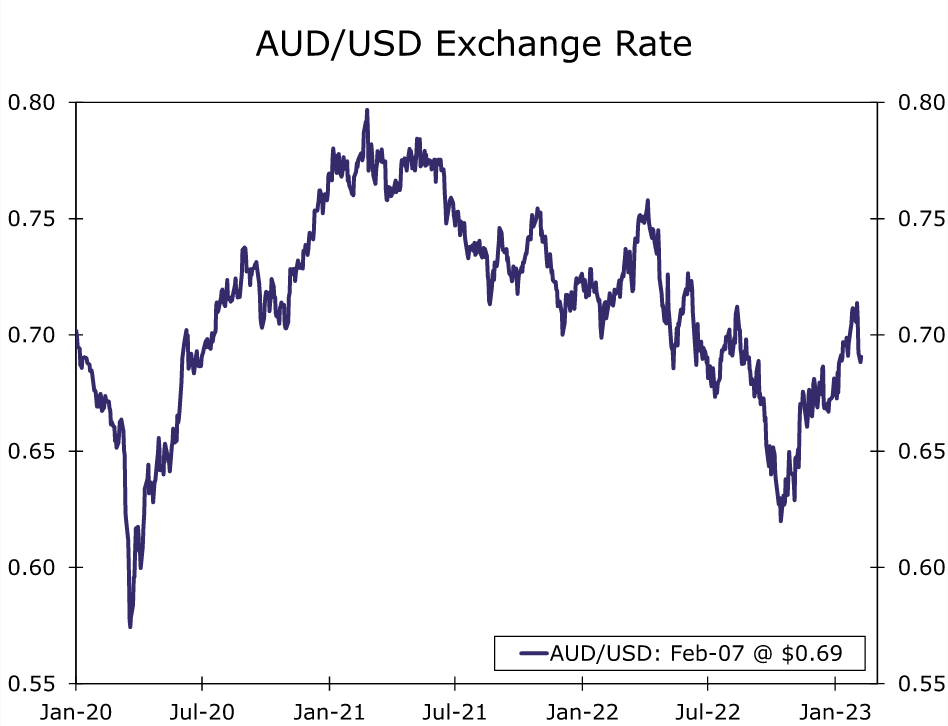
- The Australian dollar has been a solid performer in recent months and is up 11% from its October 2022 low. Given recent developments, we believe this positive trend can continue and have adopted a more constructive medium-term outlook for AUD/USD, targeting an exchange rate of $0.7800 by mid-2024.
- In our view, growth in Australia should be sturdy enough to avoid recession, and with inflation still elevated at the highest rate in over 30 years, we do not expect the Reserve Bank of Australia (RBA) to cut rates from now through mid-2024. This is in contrast to our expectation for a U.S. recession in H2-2023 and eventual Federal Reserve easing at the beginning of 2024. Resilient Australian growth and favorable RBA monetary policy dynamics versus the Fed are the main factors that should be supportive of the Australian dollar over time.
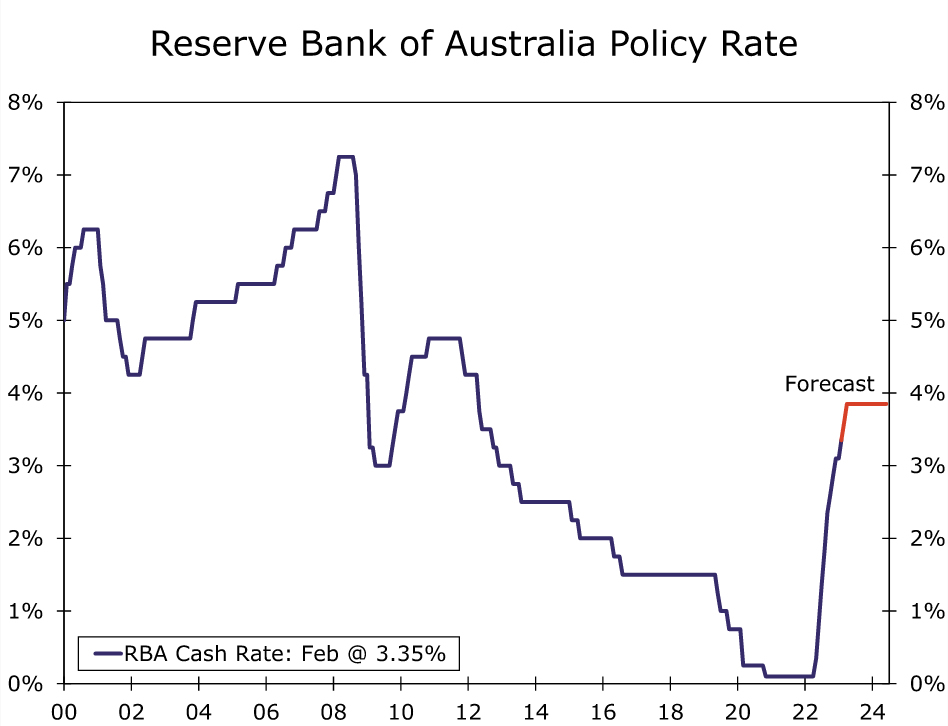
- Notably, the RBA raised its Cash Rate by 25 bps to 3.35% at its February monetary policy meeting and signaled additional rate hikes to come. Given some hawkish comments and guidance, we now expect the RBA to deliver two more 25 bps rate hikes in March and April to a terminal rate of 3.85%.
Emerging Divergence Between U.S. and Australia
The Australian dollar has been a solid performer in recent months, and is up 11% from its October 2022 low (Figure 1). Given recent developments, we believe this positive trend can continue and have adopted a more constructive outlook for AUD/USD, targeting an exchange rate of $0.7800 by mid-2024. A key driver of this improving outlook has been some important swings in growth and monetary policy trends. More specifically, our outlook for continued expansion in Australia's economy is in contrast to our expectation for a U.S. recession in H2-2023. In addition, we expect eventual Federal Reserve easing in early 2024, whereas we do not forecast Reserve Bank of Australia rate cuts at this time.
In terms of U.S. monetary policy, the Fed is becoming less hawkish, having shifted from 50 and 75 bps rate hikes during much of 2022 to just 25 bps in February. In addition, price pressures in the U.S. have subsided somewhat—inflation receded to 6.5% year-over-year in December, down from a peak of 9.1% in June last year. For now, U.S. activity indicators are mixed, though they are perhaps consistent with some overall slowing. Nonfarm payrolls jumped in January and the ISM services index rebounded to growth territory. However, the January ISM manufacturing index fell for a fifth straight month, while real consumer spending and consumer confidence fell late last year. Overall, we forecast a U.S. recession in the second half of 2023, which should place broad depreciation pressure on the dollar.
Inflation Still Elevated in Australia
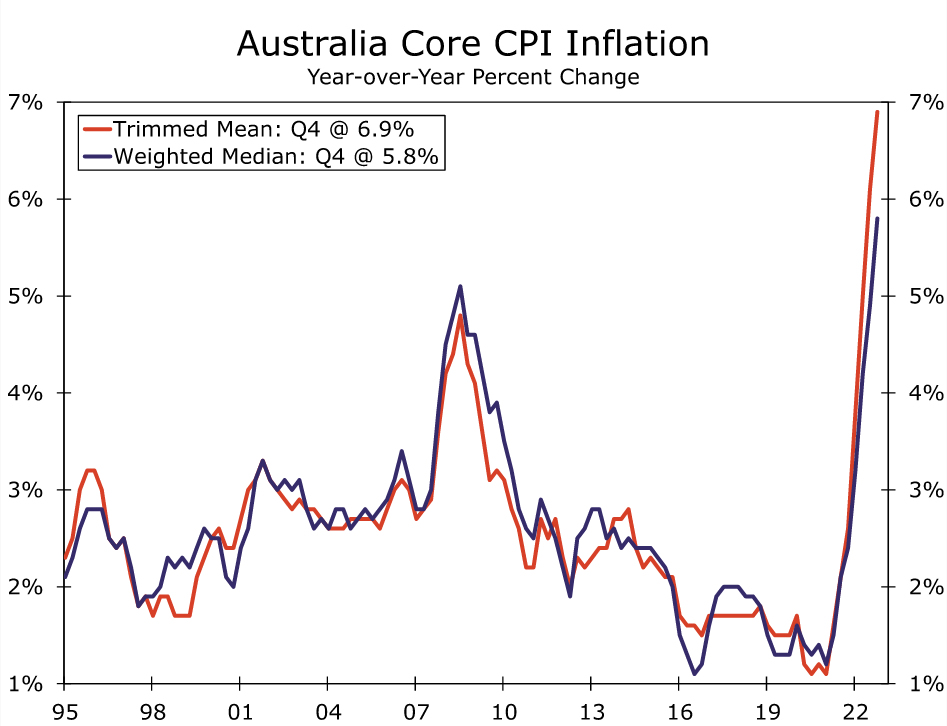
In contrast to the downshift from the Federal Reserve, the Reserve Bank of Australia has been hiking rates at a steady 25 bps pace and does not appear to have a dovish pivot on the immediate horizon. Australian inflation has remained elevated, demonstrating no clear signs of slowing yet from the highest rate in over 30 years. While prices within many peer developed economies have already begun to recede from their respective peaks, inflation in Australia appears to have remained persistently high to end 2022. Indeed, the headline CPI quickened to an above-consensus 7.8% year-over-year in Q4. Perhaps even more importantly, underlying measures of inflation accelerated more than expected in the fourth quarter. Trimmed mean and weighted median inflation rose to 6.9% and 5.8%, respectively (Figure 2). These two measures of core inflation remaining significantly above the RBA's medium-term 2-3% inflation target band and lead us to believe more rate hikes are on the way. Additionally, while both measures quickened in Q4, tradables inflation, which is influenced by currency movements (stronger AUD) and international conditions (softer commodity prices), was higher at 8.7%, compared to domestically-oriented non-tradables inflation, up 7.4% over the year.
RBA Monetary Tightening Not Done Yet
With inflation still elevated, the RBA raised its Cash Rate by 25 bps to 3.35% at its February meeting and signaled additional rate hikes to come. The announcement contained some hawkish-leaning commentary and conveyed a sense of steadfastness in bringing inflation back to target.
The announcement reiterated that inflation is too high, but is expected to recede this year due to both global factors and slower domestic demand. The RBA's central forecast is for CPI inflation to decline to 4.75% this year and reach around 3% by mid-2025. It acknowledged that monetary policy operates with a lag and the cumulative effect of rate hikes is yet to be fully felt by households, but it also recognized that if high inflation were to become entrenched in expectations, it would be very costly to reduce later on. Thus, lower inflation remains the main priority for the central bank. With respect to economic growth, the RBA expects GDP growth to slow to around 1.5% over both 2023 and 2024.
Lastly, the Board explicitly signaled "further increases in interest rates will be needed over the months ahead." Given the hawkish comments and guidance, we now expect the RBA to deliver two more 25 bps rate hikes in March and April to a terminal rate of 3.85% (Figure 3). Just as importantly, with inflation elevated, we do not expect the RBA to ease monetary policy from now through mid-2024.
Slower Australian Growth Prospects, But Recession Unlikely
While Australia's recent sentiment, PMI, and employment data showed some softness to end 2022 and suggest some areas of the economy have begun to slow, we believe growth will be sturdy enough to avoid recession.
With respect to activity data, labor market trends turned less positive in December, as the employment report showed an unexpected 14,600-job decline following four months of solid gains. That said, the decline was entirely due to a drop in part-time employment, while full-time employment increased. In our view, the miss in the December jobs report shouldn't be enough to prevent further tightening, as the RBA still views the labor market as being very tight. In addition to the unexpected jobs decline, consumers and households have started to feel the sting from elevated inflation and higher interest rates. After eleven consecutive months of gains, December retail sales dropped more than expected by 3.9% month-over-month. Meanwhile, after adjusting for inflation, Q4 real retail sales fell by 0.2% quarter-over-quarter, pointing to higher prices weighing on the retail sector.
China's Reopening Provides a Tailwind
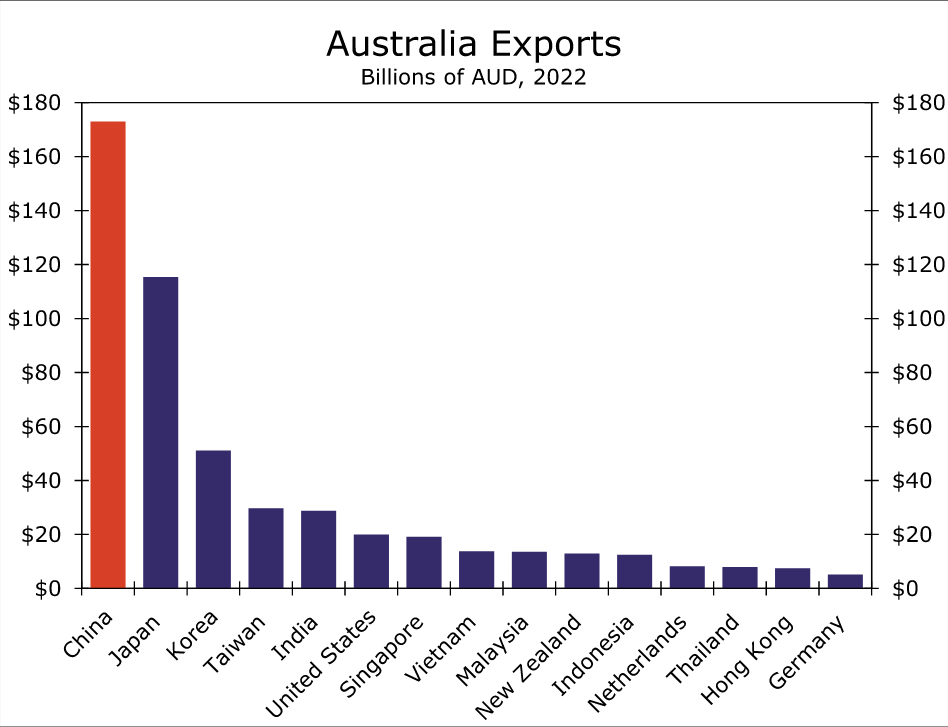
Importantly, we believe this soft patch for Australian economic growth will be temporary. After two years of Zero-COVID, China's reopening led us to upgrade our Chinese GDP growth outlook for 2023 to 5.2%. The improved outlook for China should also improve Australia's growth prospects and sentiment towards the Australian dollar, given strong trade linkages between the two countries (Figure 4). Given that 28% of Australia's GDP consists of exports and around 45% of those exports go to China, we believe positive growth trends in China will provide a boost Australia's economy.
In another encouraging development, government officials from China and Australia met this week to discuss trade relations after the Chinese government placed restrictions on a variety of exports from Australia in 2020. According to a statement from the Chinese Commerce Ministry, both parties agreed to “enhance dialogue”, with a goal of “timely and full resumption of trade." In addition, trade officials from both countries agreed to further future discussions in Beijing, as the meeting “represents another important step in the stabilization of Australia’s relations with China.”
This in combination with recent announcements that China would resume purchases of Australian coal after a two-year pause should be a boost for AUD, and could open the door for further easing of trade restrictions. In any case, considering the resilient medium-term outlook for economic growth, we do not believe the recent soft patch will prevent additional RBA rate hikes or currency gains.
Australian Dollar's Path Looks Brighter Ahead
To sum up, given our outlook for Australia to enjoy a reasonably steady expansion over time and avoid recession, our base case remains for some further monetary policy tightening before a pause in rate hikes. Even if the RBA were to eventually cut rates (which is not our base case though mid-2024), we anticipate that any RBA easing would be noticeably later than the Federal Reserve's and smaller in magnitude. And as we highlighted above, continued Australian growth also contrasts with an expected recession in the United States. Against this backdrop, we believe resilient Australian growth and favorable RBA monetary policy dynamics versus the Fed are the main factors that should be supportive of the Australian dollar over the medium term. Those factors underpin our forecast for the AUD/USD exchange rate to appreciate to $0.7800 by mid-2024. We expect the Australian dollar to be an outperformer among G10 currencies during this period.
Central Banks Actions – What is the Market Pricing In for the Remainder of 2023?
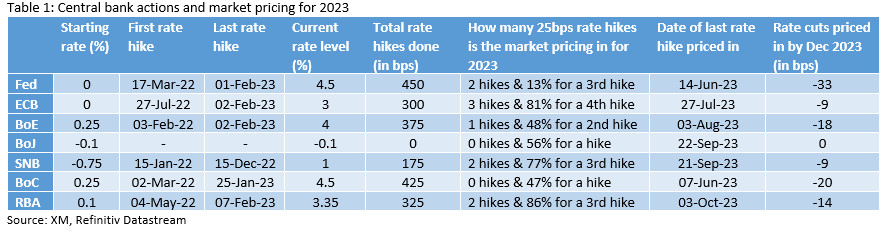
The first round of central bank meetings for 2023 has been completed. The RBA was the latest one to meet and, as widely expected, it announced a 25bps rate hike, carrying the torch from the ECB. A total of 175 bps of rate hikes have been announced since the start of 2023 by the seven central banks we have analyzed in this report, and the plan for most central banks is to continue tightening their monetary policy. Now that the dust has settled from last week’s key rate decisions and the recent surprisingly strong US data releases, we have had a look at what the market is pricing in for the remainder of 2023. Is the market expecting the key central banks to remain at full throttle for 2023 or are we getting close to the peak of central bank rates?
We have separated the seven central banks examined in three groups based on the market pricing for 2023. The exact categorization has been made on the number of rate hikes expected by the market.
Maybe one rate hike in remainder of 2023 – BoC, BoJ
Both the BoC and BoJ belong to this group. The former has been aggressively hiking since March 2022 and it has delivered 425 bps of monetary policy tightening. The market thinks that BoC is close to its peak, and it is currently pricing in a 47% probability for a 25 bps move at the June 7 meeting. However, a total of 20 bps of easing is then seen by year-end, which means that the BoC could opt for a rate cut at the December 2023 meeting. On the other hand, the BoJ is a completely different “animal”. Apart from the small change in its yield curve framework at the December meeting, it has not managed to hike rates in the current global tightening cycle. We are certain that Governor Kuroda would have liked to finally utter the rate hike phrase, but the Japanese economy has not been plagued by the skyrocketing inflation rates seen elsewhere. However, the recent improvement in the economic data has allowed the market to cautiously price in 14 bps of rate hikes by year-end.
Most likely two rate hikes left and then possibly a rate cut – Fed, BoE
The Fed and the BoE feature in this category. Following last week’s rate hike and the moderately hawkish tone by Chairman Powell, the market is currently expecting two additional 25 bps rate hikes by the June 14 meeting. This means that the Fed Fund rate target range could rise to the 5-5.25% range, close to the median rate forecast seen at the December dot plot. However, until the end of 2023 a total of 33 bps of rate cuts are penciled in by the market, partly reflecting market fears for a possible recession ahead. Similarly, Governor Bailey et al announced another 50bps rate hike at last Thursday's gathering. The UK is facing the strongest and most stubborn inflation, but the market is only pricing in 38 bps of rate hikes during 2023. The current state of the economy, especially the housing sector, and the overall BoE rhetoric appear to hold back the hawkish expectations. On top of that, the market is already pricing in a 72% probability for a rate cut by year-end, revealing the market angst about the UK economy.
Tightening to continue with around 3 or more rate hikes – ECB, SNB, RBA
The third group includes the ECB, the SNB and the RBA. Last week President Lagarde appeared adamant about the ECB’s strategy, repeating their intention to hike by 50 bps at the next meeting. Based on the current economic state of the euro area countries, the ECB seems determined to continue its tightening campaign post-March and the market appears to be convinced. Almost 96 bps of rate hikes are priced in by the July 27 meeting with just 9 bps of easing expected in the latter part of 2023. Similarly, both the SNB and the RBA are expected by the market to deliver around three rate hikes by their September and October meetings respectively. Thereafter, there is a 30-55% probability of a 25bps rate cut to take place by year-end for both central banks.
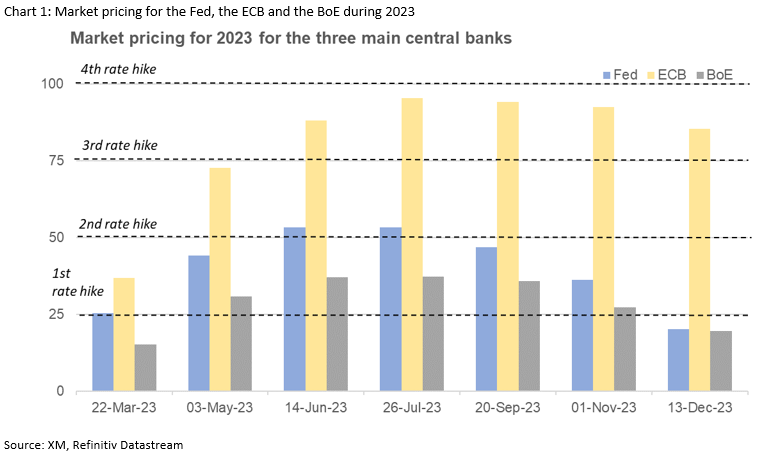
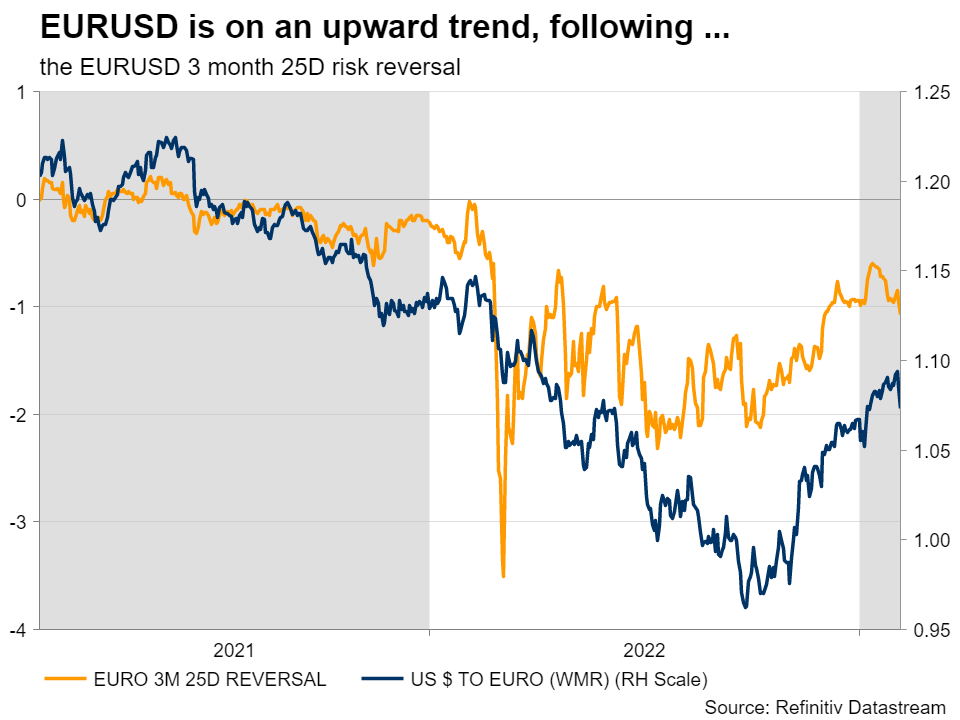
To sum up, the market has been busy plotting different paths for the main central banks. The Fed is expected to hike twice before unwinding at least 33 bps of tightening by year-end. On the other side, the ECB has convinced the market for a more aggressive action plan in 2023. Almost four rate hikes are currently priced in, with just 38% probability of a 25 bps rate cut in December 2023. EURUSD has been moving aggressively higher since October 2022, but following last week’s rate announcements, it has been experiencing a sharp correction. Using the 3-month 25 delta Risk Reversal - an option structure measuring volatility but also used as a sentiment metric for a specific currency pair – we can see that the market appetite for the euro has turned more bearish since January 13. This could potentially reflect waning confidence on the euro’s future performance, despite the market anticipating a more aggressive ECB path.
What Will the Canadian Jobs Report Mean for the Loonie?
The first Canadian employment report for 2023 will be published on Friday at 13:30 GMT and may not receive as much attention as usual. The Canadian dollar has been losing ground versus the US dollar recently, as the Bank of Canada (BoC) recently signaled that it may have lifted interest rates for the final time during the current tightening cycle, whilst the Federal Reserve has a couple more planned.
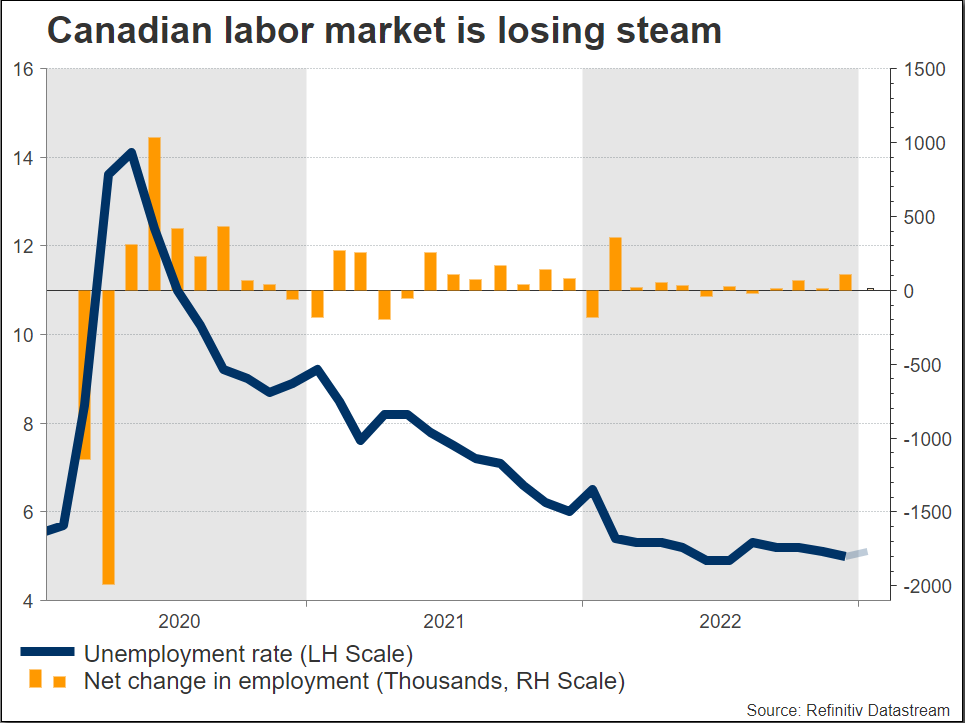
Canada’s labor market expected to lose steam
However, the jobs data will still be closely monitored by policymakers, since Canada's labor market could potentially haunt those who wager that the inflation problem has been resolved. In December 2022, the economy of Canada added 104k jobs, easily surpassing market expectations, which had called for a growth of only 8k positions, with the unemployment rate inching down to 5.0%, the lowest figure since the record low of 4.9% in June and July.
Still, economists expect the labor market top have lost steam in January, and Friday's employment report could provide evidence. The employment change is expected to mark a soft increase of 15k, lifting the unemployment rate slightly higher to 5.1%.
Will BoC continue the rate hikes?
The Bank of Canada has not totally closed the door on future rate hikes, so a significant beat in the headline employment or wage growth might propel the Canadian dollar to new highs.
Following an aggressive hike in interest rates to 4.5% in the first meeting in 2023, the highest level seen in the preceding 15 years, Governor Tiff Macklem clearly suspended the policy of tightening monetary policy. The nation's central bank is of the opinion that they have achieved a great deal in terms of the interest rate, and that the process of disinflation has already begun. As a result, a temporary halt to the ongoing process of tightening policies appears to be appropriate now.
Investors are becoming increasingly confident that the current monetary policy being implemented by the bank is sufficiently restrictive to keep inflation under control. In addition, the median prediction for real GDP indicates a decline of 0.4% in 2023 followed by an expansion of 2% in 2024.
Even still, expectations regarding short-term inflation remain high, despite the fact that it is anticipated that they would drop dramatically later on in the year. In the meantime, the bank predicts that the economy of Canada expanded by 3.6%, but that expansion is likely to come to a standstill during the middle of the present year before picking up speed once more in the second half.
Technical outlook: USD/CAD
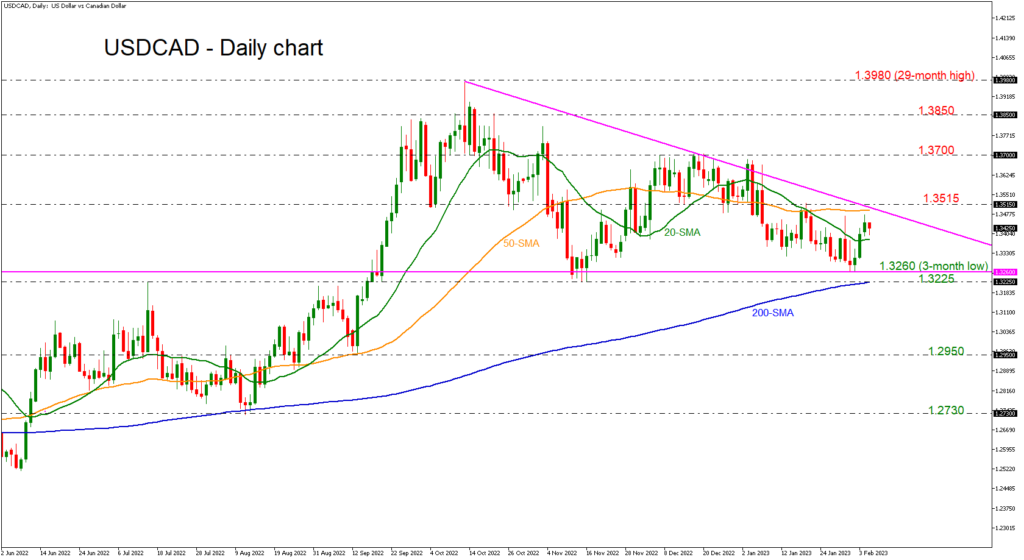
As regards the loonie, if the Canadian employment sounds more positive than expected on Friday, it may move dollar/loonie through the significant $1.3260 support level, which is acting as a strong obstacle of a descending triangle. A stronger-than-expected report may send the market further down to $1.3225, which overlaps with the 200-day simple moving average (SMA) at $1.3225 ahead of $1.2950.
Alternatively, dollar/loonie could revisit the $1.3515 resistance level ahead of the $1.3700 psychological mark, penetrating the pattern to the upside. The $1.3850 barrier will also be in focus before the spotlight shifts to the 29-month peak of $1.3980.
Elsewhere, the price of WTI crude oil is rising after the strong rebound off the $72.45 level as a result of the slightly weakening US dollar and hopes around China’s economic reopening.
Bundesbank Nagel: Further significant interest rate increases are needed
Bundesbank President Joachim Nagel told Boersen-Zeitung, "it would be dangerous to think that we are already through and that the inflation problem is over." In particular, core CPI at 5.2% shows that "inflation is eating its way through the economy and is becoming more widespread."
On interest rate, Nagel said, "From my current perspective, further significant interest rate increases are needed... In my opinion, we must also raise interest rates in order to achieve the necessary braking effect, with which we can bring inflation back to 2% quickly and sustainably."
Regarding German economy, Nagel said, "this year, the economy could roughly stagnate instead of falling into recession," while "inflation could now "possibly land somewhere between 6% and 7%".
Sunset Market Commentary
Markets
This morning, the Reserve Bank of Australia’s post-meeting statement was a clear sign of the times. It’s too early to frontrun on an easy fix to (persistent) high inflation. Even Governor Lowe and Co, with a DNA that usually tries to avoid an unnecessary negative impact on growth, unequivocally admitted that ‘if high inflation were to become entrenched in people’s expectations, it would be very costly to reduce later’. No wait-and-see approach anymore that potentially translates into a pause. Further interest rate increases are likely. Despite this highly symbolic U-turn, the RBA decision/guidance only triggered a repositioning on domestic (interest rate) markets. Especially US yield markets already experienced an impressive run post-payrolls, more than reversing the dovish run earlier. The US 2-y and 10-y yield currently trade well above the levels after Powell’s FOMC press conference (2-y 4.45% vs 4.21%; 10-y 3.65 vs 3.50%). US yields for now take a breather (2-y -2.0 bps, 30-y +2.75 bps). Even so, Fed’s Kashkari today also erred to the hawkish side. Surprised by the strong payrolls, he sees a case for rates to be raised to 5.25/5.50%. Later today, Fed chair Powell in an interview at the Economic Club of Washington has the opportunity to make a more decisive impression compared to its ‘on the hand, on the other hand’ narrative last Wednesday. German yields also reversed the post-ECB setback. Yields are gaining across the curve today, albeit more modestly than over the previous sessions (2-y + 1 bp, 10-y +3.5 bps). According to the ECB’s consumer expectations survey, EMU consumers see inflation unchanged at 5.0% this year. Inflation expectations for the 3 years ahead were reported marginally higher at 3.0% (cf infra). No de-anchoring of expectations, but too high for the ECB to feel really comfortable, we think. For now, recent volatility in core bond markets has only limited impact on intra-EMU spreads versus German (10y Italian +1 bp, Greece +3 bps). Higher (real) yields are a potential negative for risk assets. But for now the damage for European equity markets remains limited (Euro Stoxx 50 -0.25%). US indices after yesterday’s setback open little changed. Oil stabilizes near $82 p/b.
On FX markets, the dollar easily maintains its post-payrolls’ gains. The DXY index gains a few more ticks (103.75). EUR/USD (1.0695) slipped below the 1.0735 support (Dec top), nearing next intermediate support at 1.0680 (23% retracement (Sept/Febr. rebound). USD/JPY is the exception to the rule. A big beat in Japanese wage data apparently revived speculation that the BOJ will have to amend its ultra-easy policy. The yen gains against a broadly stronger dollar (USD/JPY 131.9). Sterling failed to build on yesterday’s outperformance. EUR/GBP trades near 0.8935 (from 0.8910). Among the smaller currencies, the Norwegian krone remains a distinct underperformer with EUR/NOK (11.14) reaching the highest level since November 2020.
News & Views
In the ECB’s December survey, median consumer inflation expectations for the 12 months ahead were at an unchanged 5% but edged higher for the three year horizon, from 2.9% to 3%. Euro area consumers expect their nominal incomes to grow by only 1% over the next 12 months, slightly more than the 0.9% in November, while nominal spending is seen at 4.2% (down from 4.3%). Their economic assessment improved noticeably with growth the year ahead anticipated at -1.5% instead of -2% the month before. This made them more optimistic about the labour market as well, with the unemployment rate seen over the same period easing from 12.4% to 11.9%. After loosening in November, respondents’ expectations for access to credit remained unchanged overall.
Czech (real) retail sales ex motor vehicles dropped 0.7% m/m and 7.3% y/y in December, data from the Czech Statistical Office showed. For the whole year 2022, retail sales decreased 3.6%. The eighth year-over-year decline in a row was also bigger than the 5.5% expected. The decline was broad-based with food sales (-10.2% y/y) even recording the lowest value since the beginning of the survey. Non-food sales fell by 7.5% y/y with cultural & recreation goods (-4.8%), online shopping (-10.6%) and “other household equipment” (-11.4%) acting as the biggest drag. Sales in the automotive sector (including repairs) on the other rose 0.7% m/m (0.3% y/y). The Czech koruna strengthens slightly today, but that’s mainly due to the sell-off in core bonds (pushing yields higher) easing a bit today. EUR/CZK changes hands around 23.83.
UK 100 Hangs Near All-time High
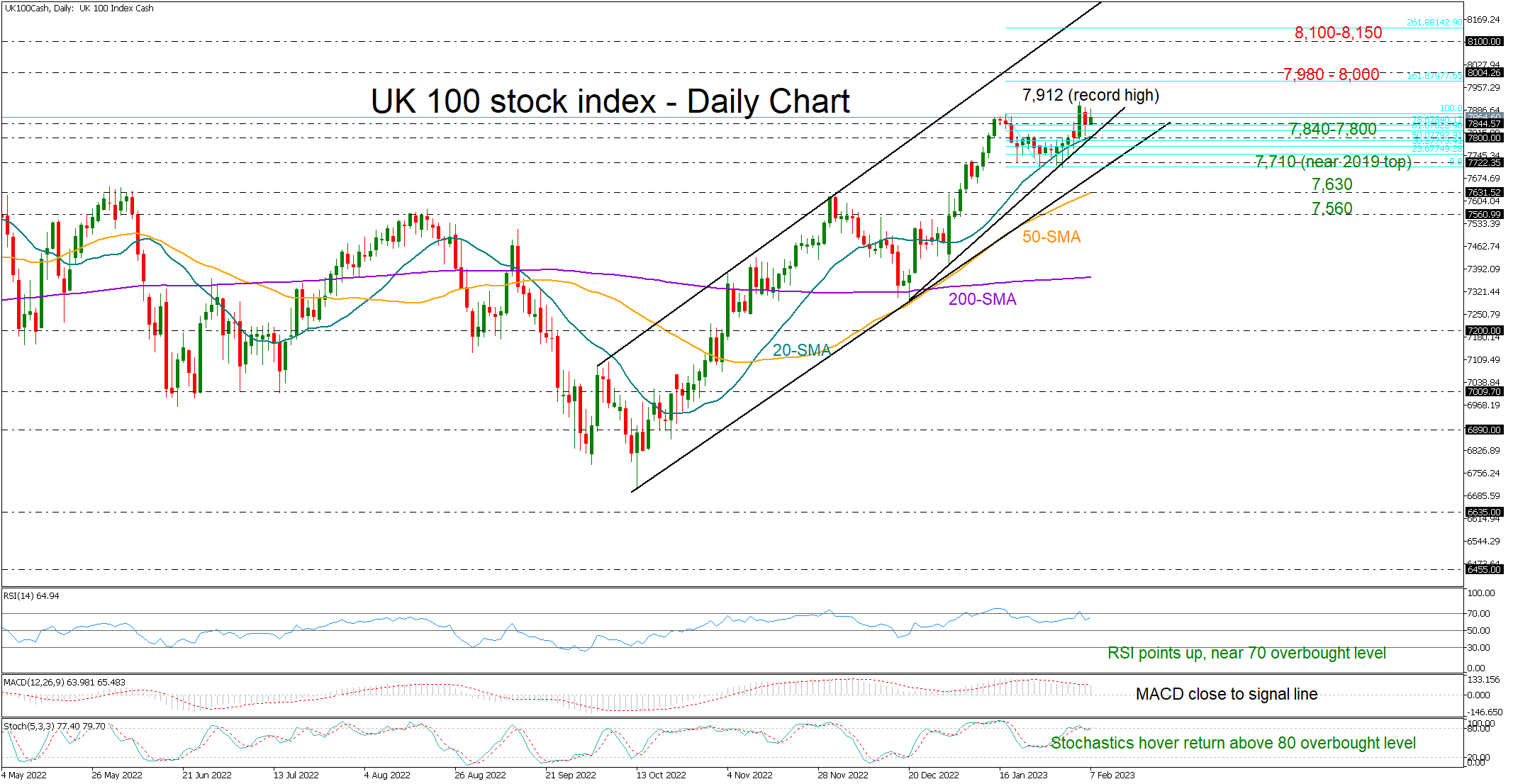
The UK 100 stock index (cash) has fully recovered the pandemic’s loss but with a long delay compared to other major European and US indices, peaking at a new record high of 7,912 last Friday despite the UK’s fragile economic outlook.
The index has been struggling to gain fresh momentum so far this week, but its resilience above its 20-day simple moving average (SMA), which has been supporting the market since the end of January, is strengthening the case for another bull run. The RSI and the stochastic oscillators, although close to their overbought levels, are showing intention to move higher, backing this narrative as well. Yet, with the MACD remaining below its red signal line despite its latest soft upturn, some caution is required.
If the price keeps its foothold around the nearby support area of 7,840, the uptrend may advance into uncharted territory, likely marking a new all-time high around 7,980 – being the 161.8% Fibonacci extension of the latest bearish wave. The 8,000 psychological mark could be the next target, while higher, the door may open for the 8,100-8.150 region.
In the event the bears press the index beneath the 20-day SMA at 7,800, selling forces may intensify towards the 7,710 support zone. This is approximately where the price peaked in 2019, while the ascending trendline from October’s low of 6,704 is also in the neighborhood, adding more credence to the area. A cross below that threshold and an extension beneath the 50-day SMA at 7,630 would downgrade the broad outlook to neutral, sending the price to 7,560.
Summing up, the UK 100 index could build its uptrend in the coming sessions, though with the price trading near overbought levels, the room for additional gains could be limited.
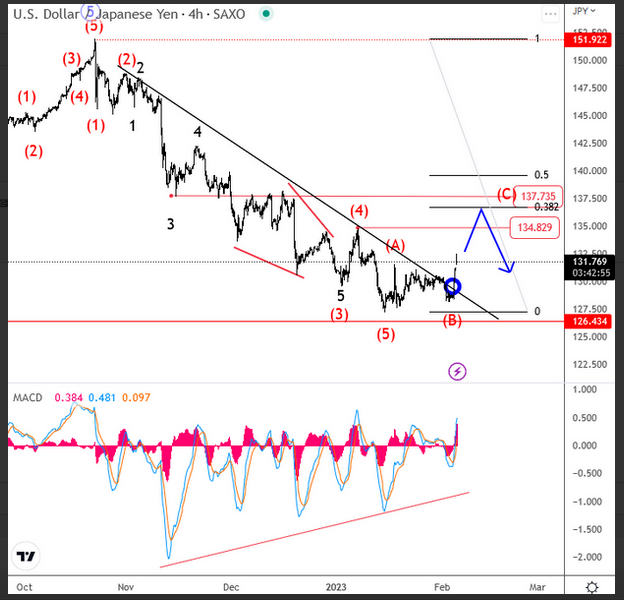
Technical Resistance for USD/JPY is at 135-138
USDJPY has a gap near 131.20 after the reports that the BoJ can be looking for a new candidate with a dovish outlook. But it appears this was just speculation with no real evidence, so USDJPY bulls quickly slowed down, and now trying to fill the Sunday gap. However, these gaps can act as support once they are filled so there can be another jump to 134.00 or 135 first resistance area before recovery is finished.