

Sample Category Title
EURJPY Wave Analysis
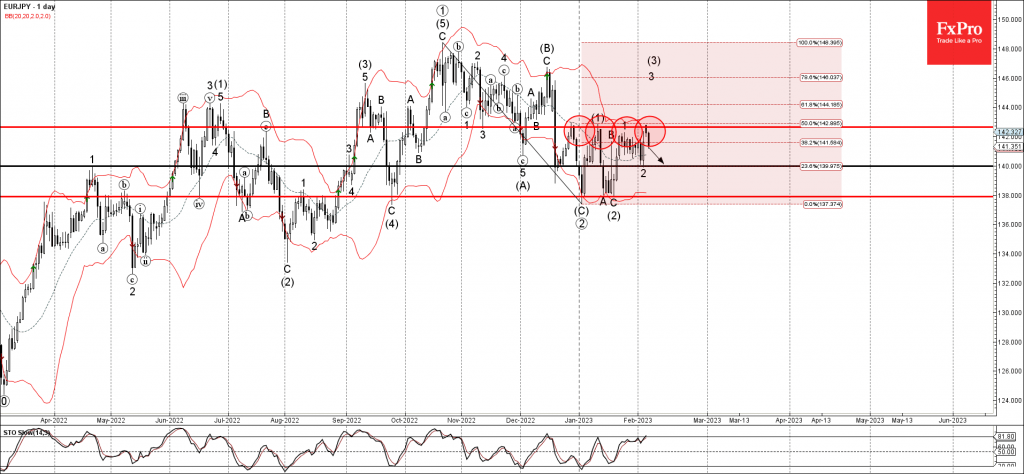
- EURJPY reversed from resistance level 142.65
- Likely to fall to support level 140.00
EURJPY recently reversed down from the key resistance level 142.65, which has been reversing the price from the end of December.
The resistance level 142.65 was further strengthened by the upper daily Bollinger Band and by the 50% Fibonacci correction of the downward impulse from October.
Given the overbought daily Stochastic, EURJPY can be expected to fall further toward the next support level 140.00 (low of the previous correction 2).
Aussie Jumps after RBA Hike
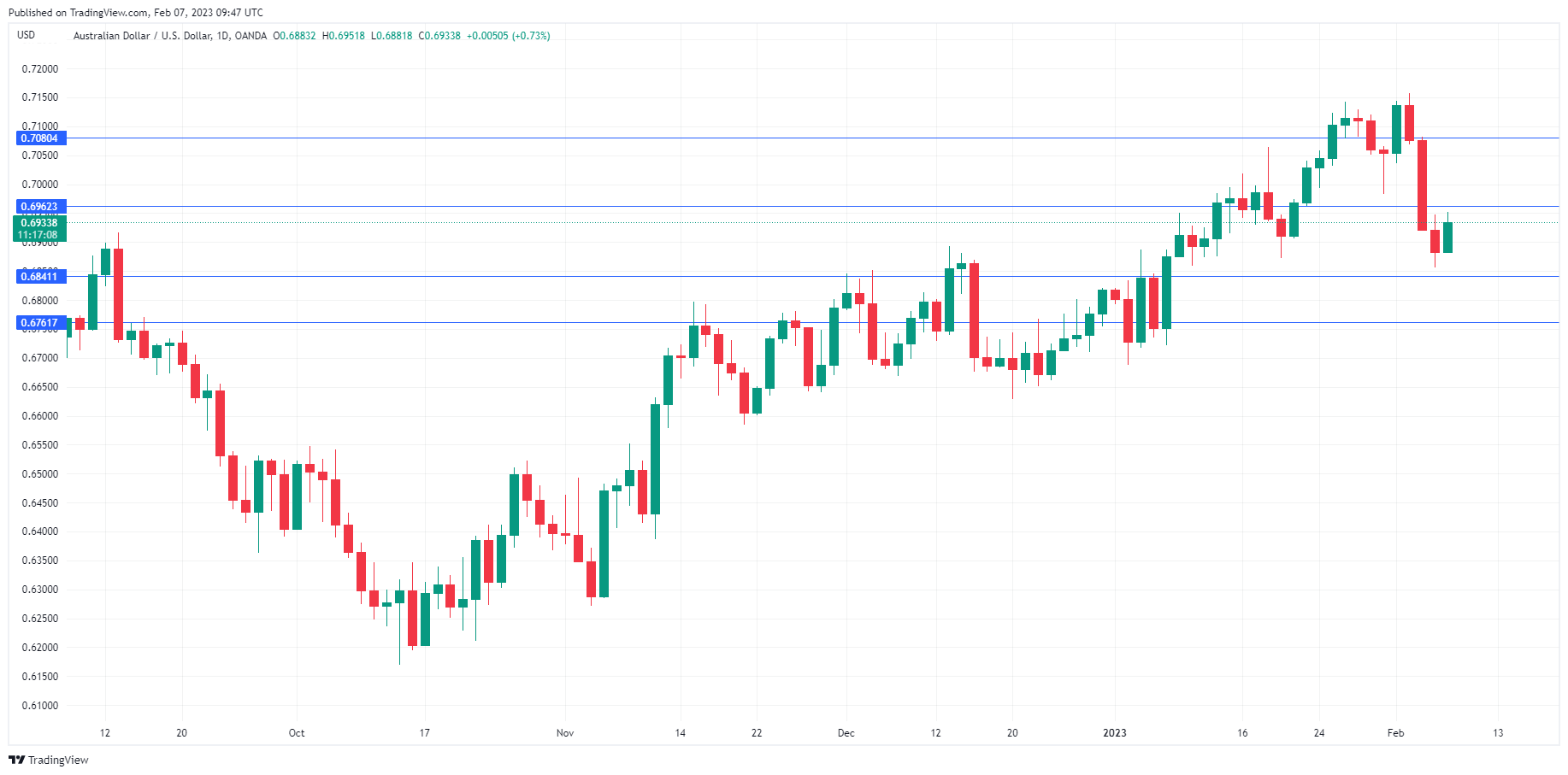
The Australian dollar has posted strong gains on Tuesday. In the European session, AUD/USD is trading at 0.6934, up 0.75%.
RBA expected to raise rates
There were no surprises from the RBA, which raised rates by 25 basis points, for a record ninth straight hike. This brings the cash rate to 3.35%, its highest level since 2012. The RBA has settled into a tightening policy of small but steady increments and has raised rates by 25 bp four consecutive times. RBA Governor Lowe’s rate statement after today’s meeting was more hawkish than expected, surprising the markets and giving a big boost to the Australian dollar.
Lowe said that “further increases in interest rates will be needed over the months ahead”, a signal that he was prepared to tighten by 50 bp and perhaps even more in order to tame inflation. Lowe added that this period of high inflation was only temporary, but with inflation hitting 7.8% in Q4, its highest since 1990, I wonder just how many investors would agree that high inflation is temporary.
The RBA’s steep rate-hike cycle is yet to tame inflation but it is taking a bite out of economic activity. Earlier in the week, retail sales slumped by 3.9% and January’s Manufacturing and Services PMIs both indicated contraction. Fortunately for the RBA, the employment market remains robust, allowing the central bank to continue raising rates.
The US dollar received a much-needed boost from the US employment report on Friday, and a host of Fed speakers this week could extend the dollar’s rally. The Fed members are expected to reiterate the “higher for longer” stance that the Fed has been pushing, and the markets will be listening closely as Fed Chair Powell delivers remarks in Washington later today.
AUD/USD Technical
- 0.6962 is a weak resistance line, followed by 0.7080
- 0.6841 and 0.6761 are providing support
EUR/USD: Completion of Bearish Pattern on Daily Chart Adds to Downside Risk
The Euro is holding in a narrow consolidation near one-month low in European session on Tuesday. Near-term focus is shifting to the downside, as strengthening dollar on fresh hopes of Fed’s further rate hikes weighs and additional pressure came from disappointing German data which showed a significant drop in country’s industrial production.
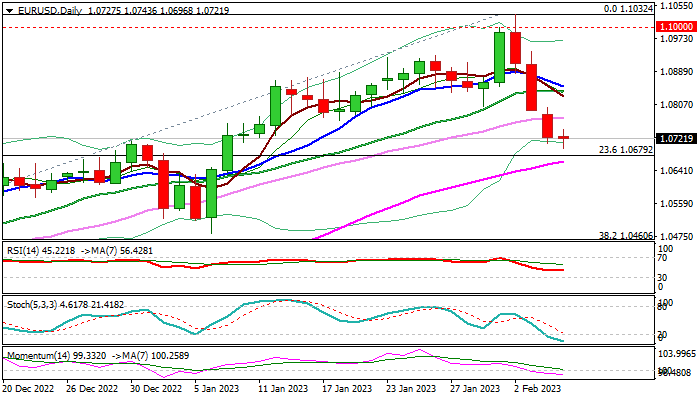
Daily studies show rising negative momentum and moving averages (10/20/30) in bearish configuration, with completion of three black crows bearish pattern contributing to negative signals.
Bears pressure initial Fibo support at 1.0679 (23.6% of 0.9535/1.1032) reinforced by rising 55DMA (1.0663), break of which would generate fresh bearish signal and expose strong support at 1.0564 (top of rising thick daily cloud), followed by targets at 1.0483/60 (Jan 6 higher low / Fibo 38.2%).
Caution on strongly oversold stochastic which warns that bears may pause for consolidation in coming sessions.
Broken daily Kijun-sen (1.0757) reverted to solid resistance which should ideally cap, though extended upticks under south-turning daily Tenkan-sen (1.0864) would keep near-term bearish bias in play.
Res: 1.0757; 1.0798; 1.0864; 1.0940.
Sup: 1.0679; 1.0663; 1.0564; 1.0483.
GBPUSD Forms Bearish Double Top; Confirmation Required
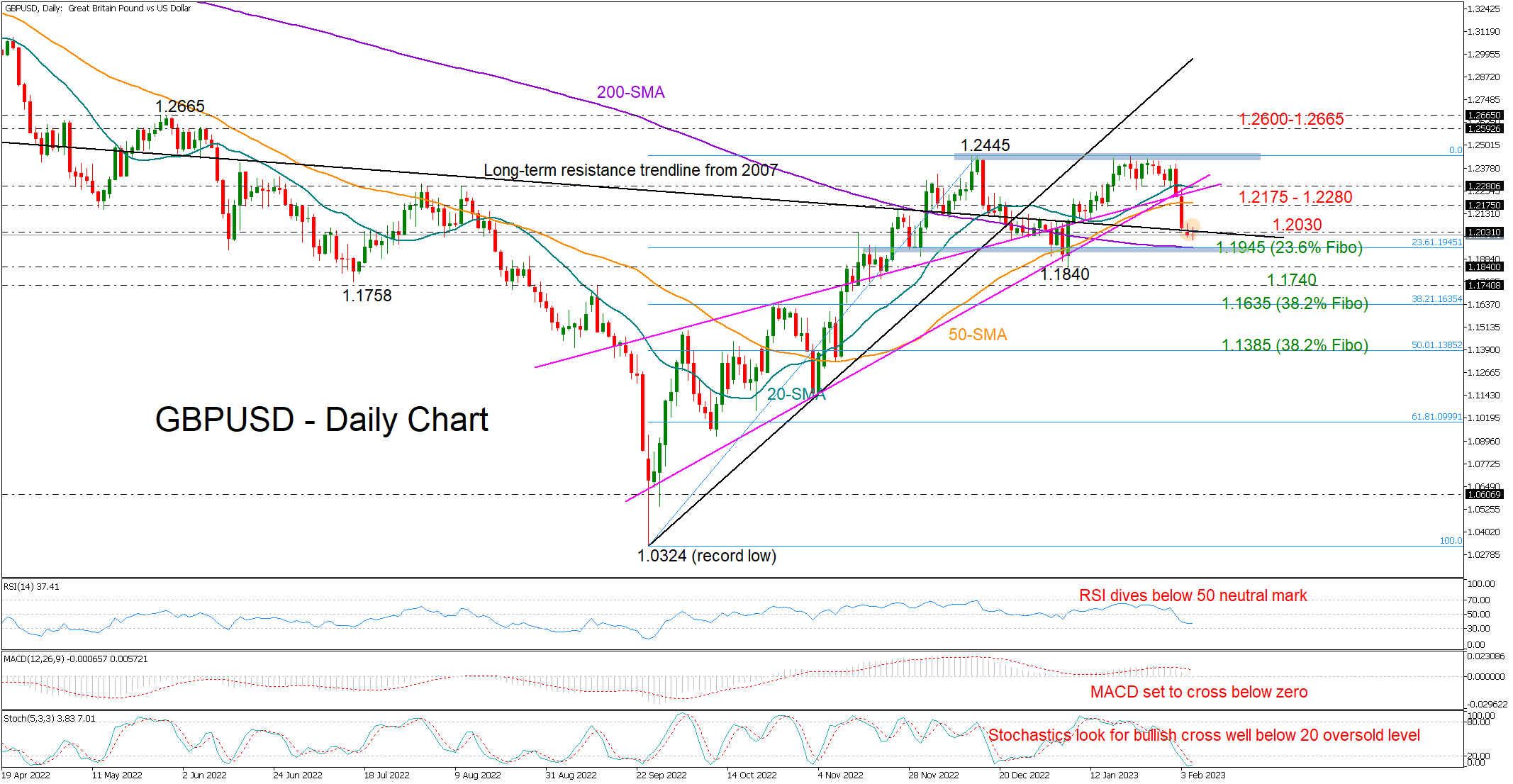
GBPUSD raised questions over its four-month-old positive trend after failing to print a new higher high above December's peak of 1.2445, subsequently crashing below two support trendlines.
Despite the latest rapid downfall, the bullish pattern remains intact as the bears have not charted a new lower low below January’s trough of 1.1840. The flattening 200-day simple moving average (SMA) and the 23.6% Fibonacci retracement of the 1.0324-1.2445 upleg are also on guard slightly higher at 1.1945 as the falling technical indicators are flagging more losses ahead. Yet, with the stochastic oscillator having dipped well in the oversold zone, there is a potential for an upside correction.
If the bears snap the 1.1945 floor, the pair may tumble towards the 1.1740 constraining zone, confirming a bearish double top pattern. Slightly lower, the 38.2% Fibonacci level of 1.1635 may attempt to protect the market from another aggressive downfall that may stall near the 50% Fibonacci mark of 1.1385.
On the upside, the pair is facing strong resistance from the long-term descending trendline that was indestructible during the 2007-2020 period at 1.2030. A close back above that line could be the key for a bounce back into the 1.2175-1.2280 zone formed by the 20- and 50-day SMAs and the broken support trendlines. If buyers pierce through that wall too, the focus will shift again to the 1.2445 bar. A sustainable close higher could then prompt a rally towards May’s barrier of 1.2600-1.2665.
All in all, GBPUSD sellers seem to be holding the upper hand at the moment, waiting for a clear extension below 1.1945 to gain fresh impetus. Alternatively, a move above 1.2030 is expected to motivate some buying.
EURJPY Lacks Direction as Near-Term Outlook Turns Neutral Again
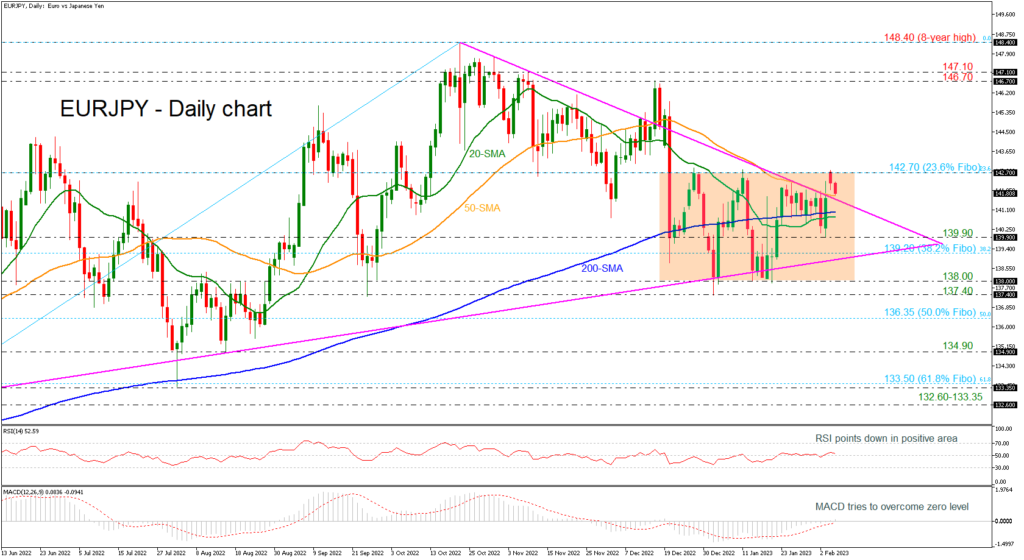
EURJPY has found a strong resistance level near the 23.6% Fibonacci retracement level of the up leg from 124.40 to 148.40 at 142.70 once again, which is also acting as an upper boundary of the short-term consolidation area. The pair penetrated the long-term symmetrical triangle to the upside in the previous couple of sessions, but it seems to be a false bullish sign for traders.
According to the technical oscillators, the RSI is sloping down in the positive region and is standing near the neutral threshold of 50, while the MACD ticked above the zero level with weak momentum.
If sellers manage to close decisively below the downtrend line and the 200-day simple moving average (SMA) at 141.00, the 139.90 support could deter the price from encountering the 38.2% Fibonacci of 139.20. Falling below this, the lower boundary of the channel at 138.00 could attract more attention before shifting the outlook to strongly bearish towards 137.40 and the 50.0% Fibonacci of 136.35.
To the upside, an initial important resistance region near the 142.70 mark could prove difficult to overrun. Conquering this, the 146.70-147.10 zone could halt the climb towards the eight-year peak of 148.40.
All in all, EURJPY looks neutral in the short-term timeframe and still bearish in the medium-term. Any successful jump above the 23.6% Fibonacci of 142.70 may switch the broader outlook to slightly bullish.
DXY: Are Bears Strong Enough to Lower Price to 97.307?
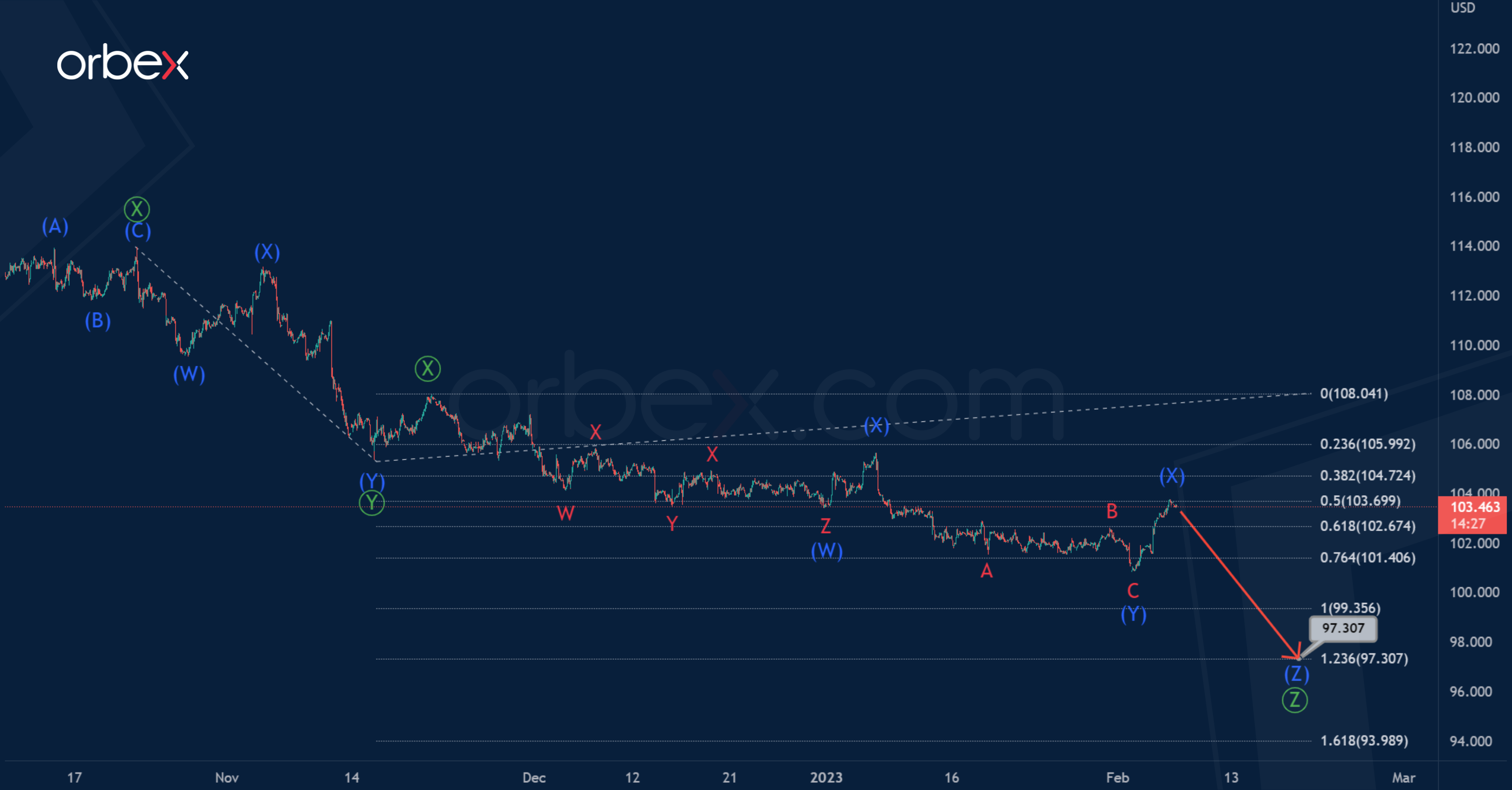
The current DXY structure suggests that we are at the end of a global corrective trend.
It is assumed that the bears form a triple zigzag pattern Ⓦ-Ⓧ-Ⓨ-Ⓧ-Ⓩ. It seems that the sub-waves Ⓦ-Ⓧ-Ⓨ-Ⓧ have already been completed.
In the near future, the price depreciation is expected to continue in the primary wave Ⓩ, it is also similar to the intermediate triple zigzag (W)-(X)-(Y)-(X)-(Z). The market is now in its sub-wave (Z).
The price may fall to 97.307. At that level, wave Ⓩ will be at 123.6 % of wave Ⓨ.
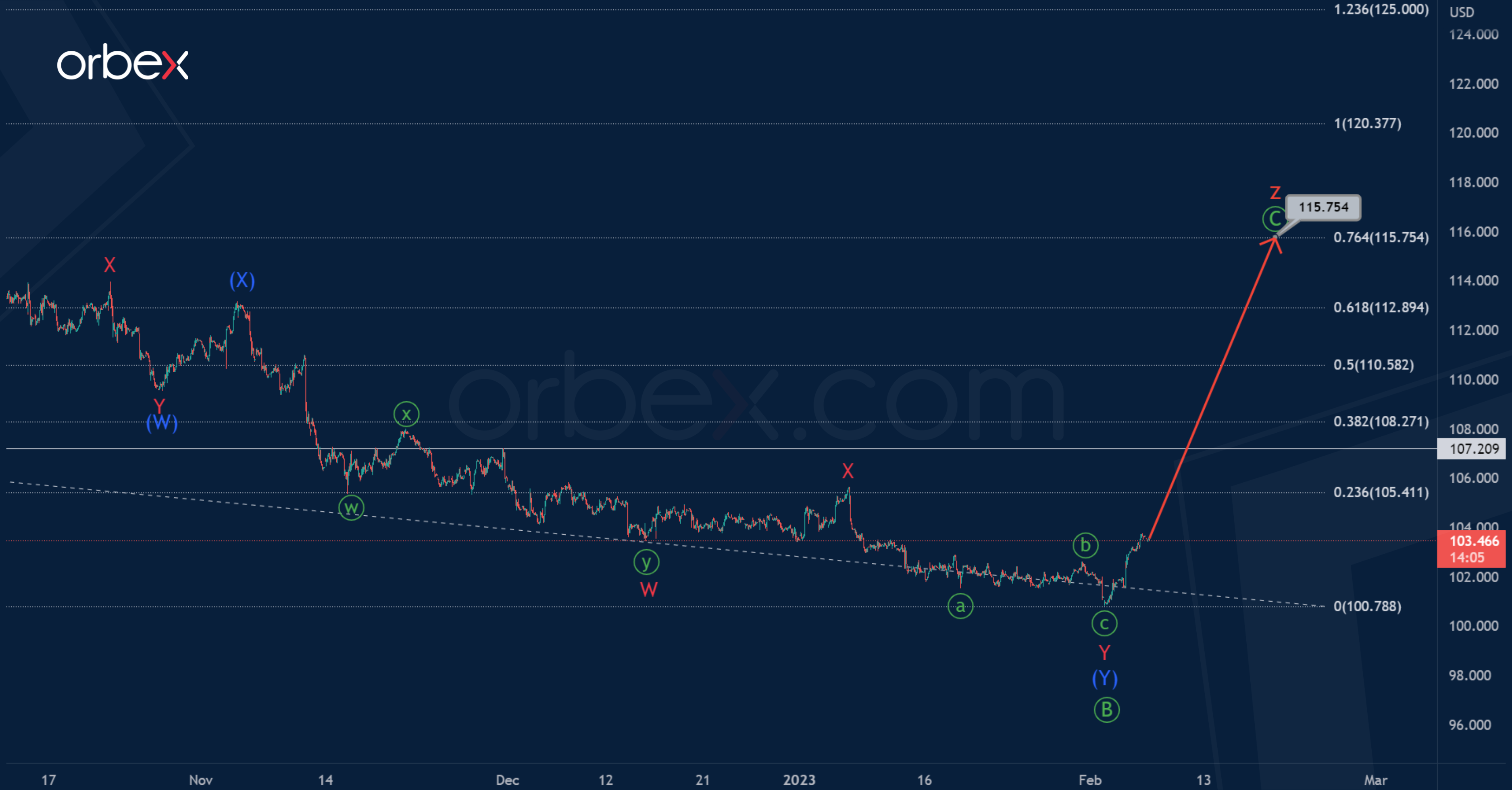
Let's consider an alternative scenario in which the last part of the bullish correction trend is being built – a triple zigzag w-x-y-x-z, in other words, wave z is being formed.
Wave z can take the form of a zigzag Ⓐ-Ⓑ-Ⓒ. The first impulse Ⓐ and the correction Ⓑ in the form of an intermediate double zigzag are already completed.
The entire wave z may end near 115.75. At that level, it will be at the 76.4% Fibonacci extension of wave y.
Dow Jones 30 Seeks Support
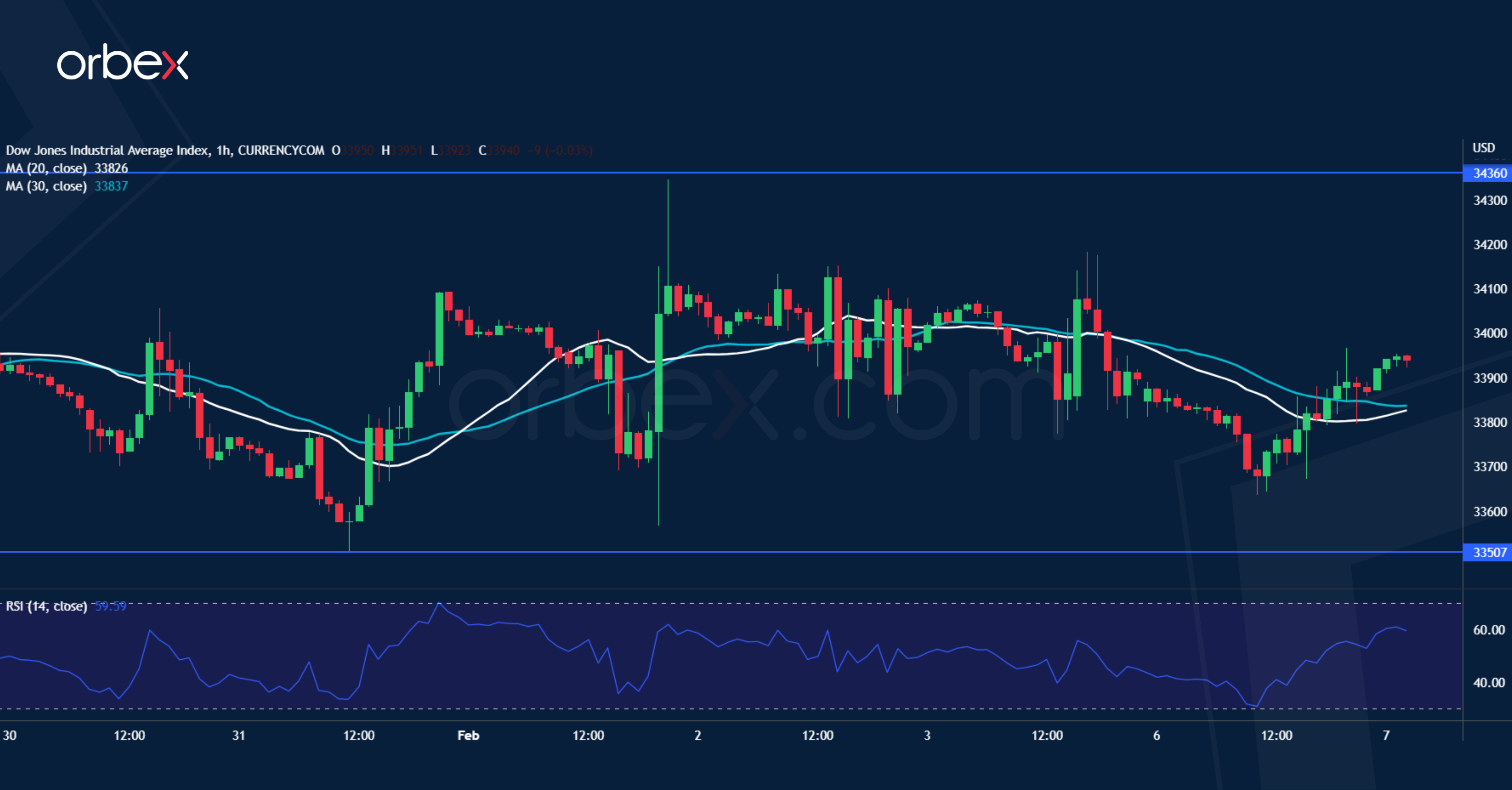
The Dow Jones 30 struggles as strong US job growth cast doubt on a rate cut later this year. The laborious grind around 34000 has met stiff selling pressure under the daily resistance of 34360. A shooting star candle showed a strong rejection of the upside and a subsequent drop below the base of a previous engulfing candle at 33700 means a lack of follow-through. 33500 is a key support at the lower end of the recent consolidation range. Its breach would send the index to the critical floor at 33000.
EUR/GBP Pulls Back
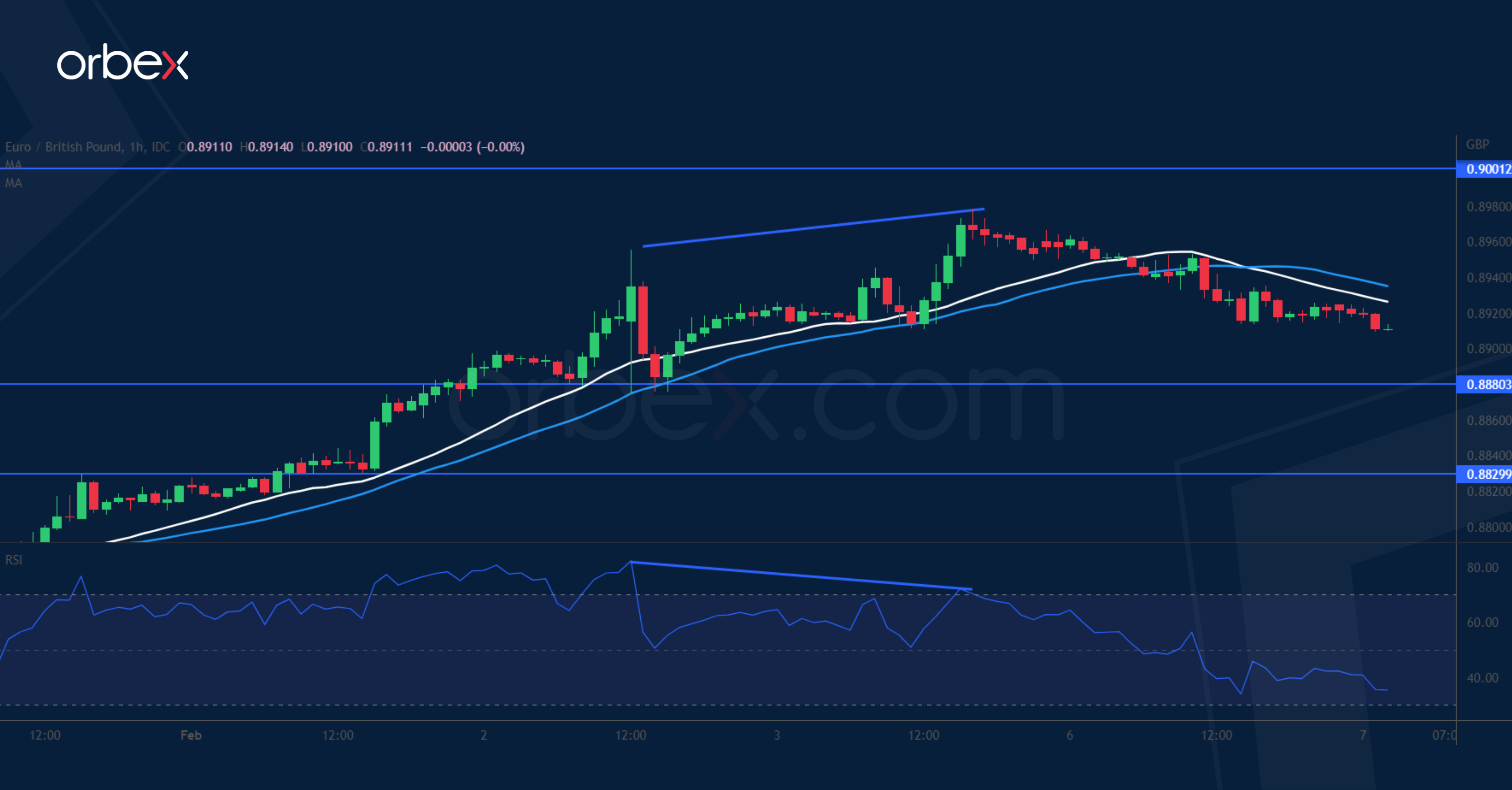
The euro stalled after the bloc’s retail sales fell short of expectations in January. On the daily chart, the pair is making another attempt above the psychological level of 0.9000 where a near 300-pip upper wick showed a rejection last September. A break above last month’s high of 0.8895 combined with a bullish MA cross reinforced the upward bias. Though a correction cannot be ruled out as a bearish RSI divergence shows a deceleration in the momentum. 0.8880 is the first demand zone should this happen.
USD/JPY Grinds Supply Zone
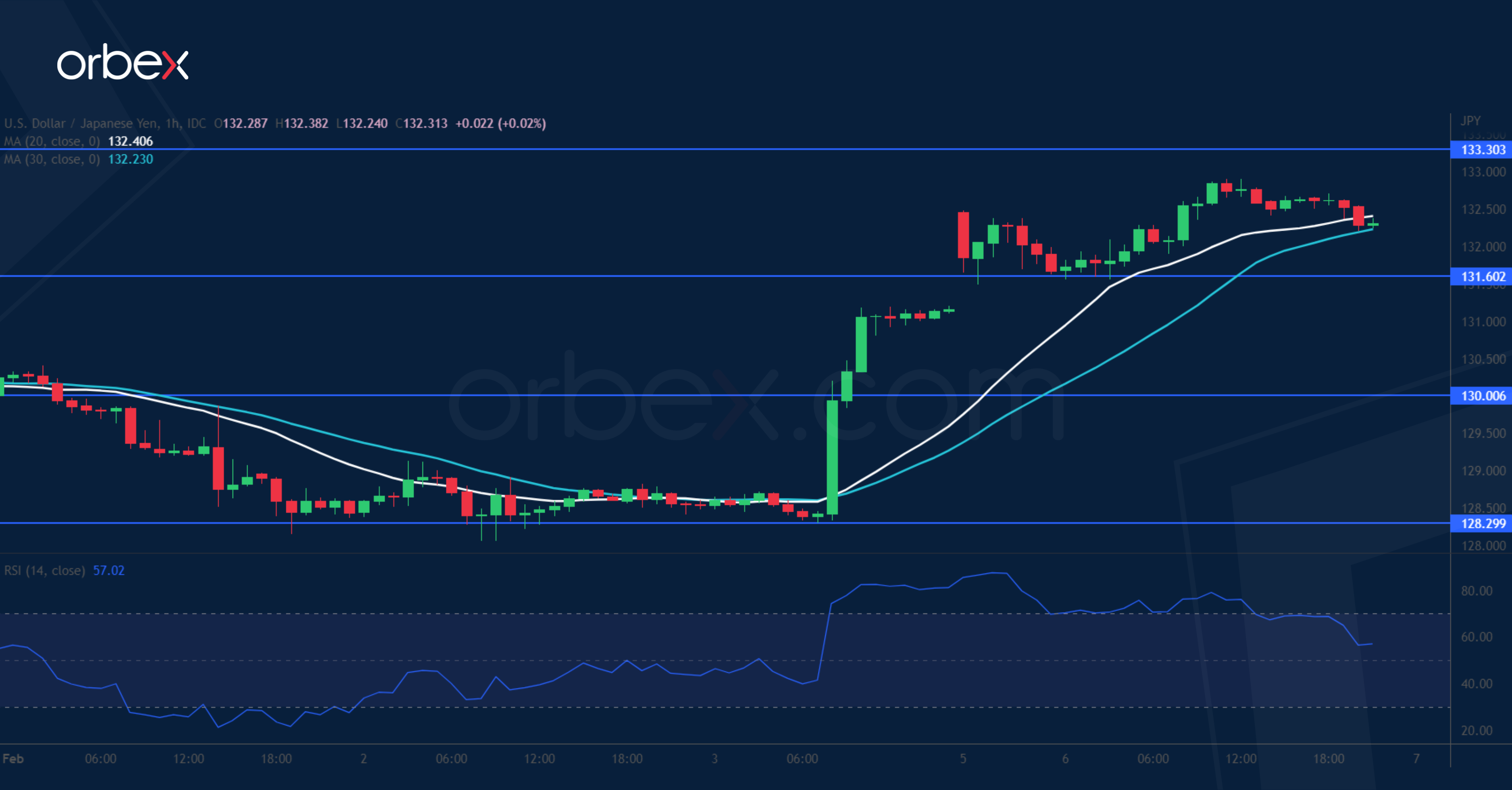
The US dollar extended gains on the NFP momentum. On the daily chart, the 30-day SMA (131.10) has been acting as a tough resistance and its latest breach suggests that bearish sentiment has waned. A tentative break above 132.80 exposes the support-turned-resistance of 133.30 and potentially the daily resistance of 134.70. An overbought RSI may limit the range of the initial surge for now. 131.60 is a fresh support in case a consolidation takes place, and the psychological level of 130.00 a second layer of defence.
Market Mood Stabilises ahead of Powell
Asian markets stabilised somewhat on Tuesday morning following the broadly negative cues from Wall Street overnight as concerns over higher US interest rates left investors on edge. US and European futures seem to be pointing to a positive open despite the overall caution, with all attention directed towards commentary from Fed Chair Jerome Powell later today. In the currency space, the dollar pulled back slightly along with Treasury yields, allowing other G10 currencies room to fight back. Although gold has taken the opportunity to shine this morning, last Friday’s blockbuster jobs data may set the tone for direction in February.
In other news, the Reserve Bank of Australia hiked interest rates to the highest level in over 10 years. As expected, the central bank announced a 25-basis point hike, taking the cash rate to 3.35%. Buying sentiment towards the Aussie received a boost as markets saw the statement as hawkish with more tightening signaled down the road. AUDUSD is up over 0.7% this morning, trading back within a narrow range with resistance found at 0.7000. A softer dollar could support upside gains in the short term.
All eyes on Jerome Powell
After last week’s freakishly strong US jobs data, market expectations around the Fed switching to rates cuts later in 2023 have taken a massive hit. The robust strength of the US labour force is expected to fuel fears over inflation remaining stubbornly high, ultimately empowering the Fed hawks. Given the latest developments, much attention will be directed on Powell’s tone, messaging and whether fresh insight is offered over monetary policy for 2023, especially after the market’s dovish reaction to his recent FOMC press conference. Should the central bank head signal that rate cut bets were misplaced, this could boost dollar bulls along with Treasury yields. It will also be wise to keep a close eye on US President Joe Biden’s second State of Union address later this afternoon. Biden is expected to use this event to address key topical matters revolving around geopolitical developments and other important themes.
Talking technicals, the DXY still remains in a downtrend on the daily charts despite the recent breakout above 103.00. Prices need to push prices back above 105.00 for the outlook to swing in favour of the bulls. A move back below 103.00 could trigger a selloff towards 101.20 – 101.00.
Currency spotlight – EUR/USD
A broadly stronger dollar may ensure EURUSD remains under pressure in the short to medium term. Since failing to secure a solid weekly close above the 1.0900 resistance level, prices have been under noticeable pressure despite the ECB recently raising interest rates to combat inflation. The main risk event for the euro this morning will be Germany’s industrial production figures for December. A figure that exceeds market expectations could provide some support to the euro.
Looking at EURUSD, prices are wobbling above 1.0700 as of writing. Should this level prove to be reliable support, a move back towards 1.0900 could be on the cards. Weakness below 1.0700 may open a path towards 1.0550.
Commodity spotlight – Gold
Gold drew strength from a slightly weaker dollar and small drop in Treasury yields on Tuesday as investors braced themselves for Jerome Powell’s speech.
If Powell strikes a hawkish note and signals that the Fed will still be hiking rates down the road, gold prices are likely to suffer as the dollar jumps. Alternatively, a cautious sounding Powell could offer the precious metal a lifeline which could limit downside losses. Looking at technical levels, a breakdown below $1860 may open the door towards $1825 and $1800, respectively. If prices can push back above $1900, gold could challenge $1950 and $2000.