

Sample Category Title
Today’s Economic Calendar is Loaded with Central Bank Speeches
Markets
Core bonds suffered a massive hangover on Monday. Ridiculously strong US data last Friday caused a further repricing in favour of central bank guidance, particularly in the US where money markets now discount a 5-5.25% terminal rate. The move ran its course uninterrupted by other data releases and with the backing from the likes of Fed’s Bostic. His base case was for rates to reach 5-5.25% but he added that January’s strong jobs report raised the possibility of even higher rates if the stronger-than-expected economy persists. US yield changes varied between 6 bps (30y) to 18+ bps (2y, 5y). The 2y yield tested 4.50% and the 10y yield (close at 3.64%) extended gains well beyond the 3.50% resistance-now-turned-support. European yields were pulled higher in the slipstream with swap yields adding 8.2 bps to 11.7 bps, the belly of the curve underperforming. UK gilts underperformed. Yields in the area shot up 18.9-20.7 bps in the 2y-10y bucket. Bank of England’s Mann adopted ECB language and vowed to stay the (tightening) course. She said that consequences of doing too little still far outweigh the alternative. Both the dollar and sterling outperformed in FX space with the former enjoying an additional boost from a grim risk/equity sentiment affected by geopolitics too. The trade-weighted DXY jumped beyond the March 2020 pandemic high to close at 103.46. EUR/USD retreated from 1.0805 to the low 1.07 area. EUR/GBP eased from an intraday high around 0.896 to 0.892 while sterling did lose out against the USD (GBP/USD grinding towards the 1.20 support zone).
The Reserve Bank of Australia added to the hawkish central bank atmosphere by raising rates to the highest in 10 years and flagging more to come (see below). And in Japan nominal wages jumped by the most since 1997 (4.8%). While partially supported by bonus increases, it may reignite speculation that the Bank of Japan could further plan its exit from ultra-easy monetary policy. After a sharp two-day decline, core bonds are nonetheless given a breather in Asian dealings. US cash yields lose up to 5 bps at the front. The Australian dollar outperforms G10 peers. The US counterpart loses a few ticks. Japan’s yen appreciates a tad. Stocks in the Asian region trade mixed.
Today’s economic calendar is loaded with central bank speeches from the ECB over the BoE to the Fed. We doubt any of them liked the easing in financial conditions after all of them met last week. This is an opportunity for policymakers to formally push back. Among them: Fed chair Powell. His dovish accents and overly balanced tone during last week’s FOMC meeting triggered an outsized market reaction. That likely unnerved some within the committee (eg. Bostic’s speech). In combination with the strong batch of US eco data last week, we expect Powell to bring a much more unequivocal message this time around. Core bonds and equities could remain under selling pressure. The US dollar stands to benefit from this.
News Headlines
The Reserve Bank of Australia (RBA) raised its policy rate as expected this morning by 25 bps to 3.35%. It’s the ninth consecutive rate hike since the normalisation/tightening cycle started in May last year. The RBA sounded more hawkish than in December in its closing paragraph: it now expects that further increases in interest rates will be needed over the months ahead to ensure that inflation returns to target and that this period of high inflation is only temporary. In December, the RBA said that it was not on a pre-set course when it comes to additional tightening. Another addition was a reference that if high inflation were to become entrenched in people’s expectations, it would be very costly to reduce later. This is something commonly flagged by central bankers: it’s better to take the risk of over- than underdoing. Finally, the RBA mentioned stronger than expected core Australian inflation numbers in an otherwise more “balanced” economic assessment (high inflation vs weak growth). The hawkish plots in the statement help the Aussie dollar against a strong greenback this morning with AUD/USD rising from 0.6880 to 0.6940. Last week’s USD surge pulled the pair away from 0.7137 resistance. AUD swap yields add up to 13 bps for the 2-yr with money markets lifting their peak policy rate expectations close to 4%.
Total UK retail sales rose by 4.2% Y/Y in January, around half the pace in December. High inflation hides an underlying drop in retail volumes. British Retail Consortium (responsible for the data) CEO Dickinson said “as Christmas cheer subsided, retailers felt the January blues. With ongoing cost pressures and labor shortages, increases in sales don’t convert into profits or cash”.
Rising Geopolitical Tensions, Fed Hawks Take a Toll on Sentiment
Rising geopolitical tensions between the US versus China and Russia, and the hawkish Federal Reserve (Fed) expectations weighed on market sentiment at the start of the week. The US yields, the US dollar and gold gained, stock indices kicked off the week under selling pressure.
Fed President Jay Powell wills speak following a blowout jobs report, and US President Joe Biden will deliver his State of the Union speech following the Chinese spy balloon incident.
Hence, there is little to cheer.
A sour cocktail of tensions and Fed expectations
Tensions around the Chinese spy balloon that was discovered last week and shut down, didn’t do good to the Chinese stocks trading on American exchanges on risk of escalation. Risk of escalation may include higher tariffs, shortly after news of tariff relief on Chinese goods, and it could lead to a potential revival of the US – China trade war.
The Chinese Golden Dragon index fell more than 1.80%, but that was also partly due to the overall stock selloff that was triggered by an excessively strong jobs report released on Friday, and that – by its monumental strength – sent the Fed doves flying away, increased the expectation of further rate hikes, dashed the odds of immediate recession, and lowered the probability of seeing a rate cut by the end of this year from the Fed.
Atlanta Fed President Raphael Bostic even said that the strong jobs report may encourage the Fed to raise the interest rates further above the 5% mark, which would require one more 25bp rate hike, on top of two more already expected. There could even be a 50bp hike on the pipeline, he said. Could there be? It will depend on how the strong jobs impact inflation, and we won’t have an answer before next week.
What we know this week, is that the Fed hawks are returning to the playground, and the Fed expectations, mixed with escalating geopolitical tensions with China, and also with Russia.
On the Russian front, the US announced yesterday that it is preparing to tax the Russian aluminum by 200% as soon as this week. I am not sure that extra measures will convince Putin to back off, but it could help further squeeze Russia’s finances. Russia announced its biggest slump in oil and gas revenue in January, since at least 1998, as the revenue plunged by 46% in January. Bloomberg writes that spending due to war increased 59%.
The aluminum futures traded sharply lower on COMEX yesterday – although some doubt that the announcement may be delayed as a 200% on Russian aluminum would be a big hit to US domestic businesses as Russian is the world’s second biggest aluminum producer.
Market reaction
Rising geopolitical tensions, and the Fed hawks feed into higher US yields. The US 2-year yield is above the levels it kicked off the year, the US 10-year yield is following suit, and the dollar is sharply bid this week, the dollar index gained nearly 3% in three sessions, and is now testing the 50-DMA to the upside, and there is little reason to stop the dollar from a further recovery this week.
Gold is slightly better bid on the mounting geopolitical tensions, but the rising US dollar and the rising yields will likely cap gains into the $1900 per ounce.
In the currencies markets, the EURUSD tanked to 1.0710 yesterday, and rebounded from the lower band of the latest bullish trend, which is just a couple of pips above the 50-DMA.
The USDJPY jumped to 132, and challenged its own 50-DMA resistance. The Bank of Japan (BoJ) doves joined the move next to the Fed hawks as the news that Amamiya, a dovish banker, will lead the BoJ after Kuroda’s departure.
Cable consolidates a touch above the 1.20 mark.
The Aussie-dollar is better bid today as the Reserve Bank of Australia (RBA) hiked the rates by 25bp points as expected, and said that more rate hikes could be down the road, as inflation remains high and sticky.
In indices, the S&P500 retreated by 0.60% yesterday, Nasdaq 100 lost 0.87%. Losses could extend toward 4030 for the S&P500 this week, the minor 23.6% retracement on October to last week rally, and toward 12040 for Nasdaq, the major 38.2% retracement on the latest rally, as rate-sensitive tech stocks are expected to be more severely hit than non-tech companies.
But if we leave the macro news aside for a moment, Google announced its own conversational AI called Bard AI in response to the Microsoft-supported ChatGPT. Microsoft scheduled a mystery event for today, and many people think that we will be hearing more about ChatGPT in that event. Will it help lift the otherwise morose market mood? We will see. Baidu which announced that it will roll out its own AI in March jumped more than 15% in Hong Kong.
In energy
In energy and commodity space, the Indian Tata steel announced an unexpected loss last quarter and the shares slipped more than 4%. BP is to announce its earnings shortly.
Crude oil rebounded past the $75pb, but solid offers are yet to be cleared into the 50-DMA, which stands a touch above the $77pb level.
The European nat gas futures are slightly higher this week, after falling to pre-war levels.
A nat gas export terminal in Turkey was hit by a strong earthquake in Turkey on Monday, it should recover in the coming days it is said.
The Turkish construction stocks rose before the horrified eyes of those who were watching the earthquake news along with the market news, as more than 6000 buildings collapsed, killing thousands.
Powell Interview Tonight is Today’s Highlight
Market movers today
Fed Chairman Powell will be interviewed at a live transmitted event at the Economic Club of Washington, D.C., beginning at 18.00 CET. This could give Powell an opportunity to mitigate the markets' very dovish reaction to his press conference last week if he wants to, especially in light of the strong jobs report and ISM data we have seen since then.
In terms of data releases, today is on the light side.
The 60 second overview
Fed: Fed's Bostic said that the Fed may have to do a little more work following the strong US labour market report on Friday. Bostic repeated his view of peak policy rate of 5.1%, but added the risk of more, and staying at the level through 2024.
Euro area: Weak euro area retail sales in December, after the temporary rebound in November. Decline of -2.7% m/m was quite broad-based across categories. A sharp slowdown in private consumption was a common feature visible across euro area countries during Q4, in a sign that real income losses are finally taking their toll on consumers and we expect this trend to linger into 2023.
RBA: The RBA hiked its cash rate by 25bp to 3.35% in line with consensus expectations. RBA said that Australia's economy grew strongly over 2022 and that further rate hikes will be needed in the months ahead.
BoE: Yesterday, the BoE's most hawkish member, Mann highlighted that inflation expectations are still above target and that she sees upside to the inflation outlook. She emphasised that a pause in the hiking cycle would be both hard to communicate but also to transmit through markets to the real economy. Likewise, she thought that the next step in Bank Rate was still more likely to be another hike than a cut or hold. With market pricing relatively close to our call of a final 25bp hike in March, we increasingly see relative rates being more neutral for the cross going forward as opposed to positive.
Japan: The nominal labour cash earnings estimate for December rose to 4.8% yoy, the highest since the early 1990's. The unusually high print comes after significant bonuses, and adds pressure on the BoJ as wage growth is closely linked to inflation developments in Japan.
FI: It was higher rates across the euro curves yesterday from the start across all euro curves, in particular in the sub 10y area (2s10s ended 5bp steeper). Spreads to core/semi-core were mostly unchanged, with widening recorded to periphery. ECB pricing for the peak policy rates followed the general sell-off, adding 5bp to peak policy rate now pointing almost 3.5% again. We had a number of hawkish views yesterday as well with ECB's Vasle, Kazaks and Holzmann but also Fed's Bostic saying that the Fed may have to do more work after the strong labour market report on Friday. RBA hiked its policy rates by 25bp to 3.35% in line with expectations.
FX: NOK and SEK weakness continues to stand out in the G10 currency sphere. Both set new cycle highs - EUR/SEK rose above 11.40 and EUR/NOK above 11.10. EUR/USD continued to slide and dropped closer to 1.07 level.
Credit: Credit markets followed equities into risk-off mode on Monday. iTtraxx Main widened 3bp to close at 75.2bp, while iTraxx Xover widened 15.9bp to close at 395.1bp. Moreover, the primary market activity remains busy with more than 20 mandates announced with sizeable issuance from RWE AG, Ford Motor Co., British Telecommunications Plc, Danske Bank A/S, Husqvarna AB and Becton Dickinson & Co.
Nordic macro
The Swedish National Debt Office (SNDO) is to publish the January budget balance (8:00 CET). After three months of stronger than anticipated budget outcomes, we expect the numbers to weaken going forward, eventually leading to an upward revision in borrowing requirements by the SNDO.
RBA Board Increases the Cash Rate by 0.25% to 3.35%
Governor’s statement slightly more hawkish than in December. We confirm our forecast for the cash rate to peak at 3.85% in May.
The Reserve Bank Board decided to increase the cash rate from 3.10% to 3.35% at its February meeting. That decision was in line with market expectations and the Westpac view.
The major area of uncertainty around the decision was in the wording of forward guidance. Westpac expected that this would be in line with the wording in the December Statement: “The Board expects to increase interest rates further over the period ahead, but is not on a pre-set course”.
There was considerable speculation that this wording would be ‘diluted’, perhaps shifting to something along the lines of: “The Board is prepared to increase interest rates further …”. Such a change would have implied a possible pause at the March meeting.
In the event the wording was arguably, slightly more hawkish than even Westpac expected, namely: "The Board expects that further increases in interest rates will be needed over the months ahead …”. The qualification used in December “not on a pre-set course” was excluded. While not definitive, the use of “not on a pre-set course” could be interpreted as indicating the possibility of a pause being considered in the next month.
By excluding that qualification it seems to be very clear that the Board anticipates increasing the cash rate by a further 0.25% in March.
That profile is consistent with the Westpac view that the cash rate will be increased on two further occasions in March and May, the last move coming in response to the March quarter inflation report.
Other aspects of the statement that can be interpreted as more hawkish than the December Statement.
Despite recognition that global inflation was moderating, reflecting supply-side adjustments, there was no downward adjustment in the Board’s forecast for inflation since the November Statement on Monetary Policy (SoMP). These remain unchanged at 4.75% for 2023 and 3% for mid-2025 (the latter compares to a 3.2% forecast by end-2024 back in November).
The growth and unemployment forecasts are also unchanged from the November SoMP. Growth is forecast to be around 1.5% in both 2023 and 2024 and the unemployment rate is still forecast to lift to 3.75% by end-2023 and 4.5% by mid-2025 (compared to 4.3% by end-2024 in the November SoMP).
One surprise on the real economy outlook was that the Governor states that: “The recovery in spending on services following the lifting of COVID restrictions has largely run its course”. This conclusion is not apparent in the data so far with the surprise collapse in retail spending in December relating to household goods; clothing; and department stores rather than any cooling in in services spend.
We also saw a surprise downgrading of the sentiment in previous statements around the lags in the system. Whereas a full paragraph was allocated to discussing these lags in December, only one sentence focussed on the lag issue in February, albeit still referring to “a painful squeeze” on households’ budgets.
The most likely explanation for the more hawkish statement is around inflation developments. Underlying inflation was noted at 6.9%, running “higher than expected.” But the concerns around high inflation becoming entrenched in “people’s expectations”; the damage from high inflation; and the clear priority “to return inflation to target” all signal that inflation is front and centre of the Board’s thinking.
Conclusion
Westpac remains comfortable with the view we expressed in October that the cash rate is likely to peak at 3.85%. That will entail a further 0.25% increase in March and a final 0.25% increase at the May Board meeting as the Board is able to respond to the March quarter inflation report.
AUD/USD Daily Report
Daily Pivots: (S1) 0.6844; (P) 0.6896; (R1) 0.6937; More...
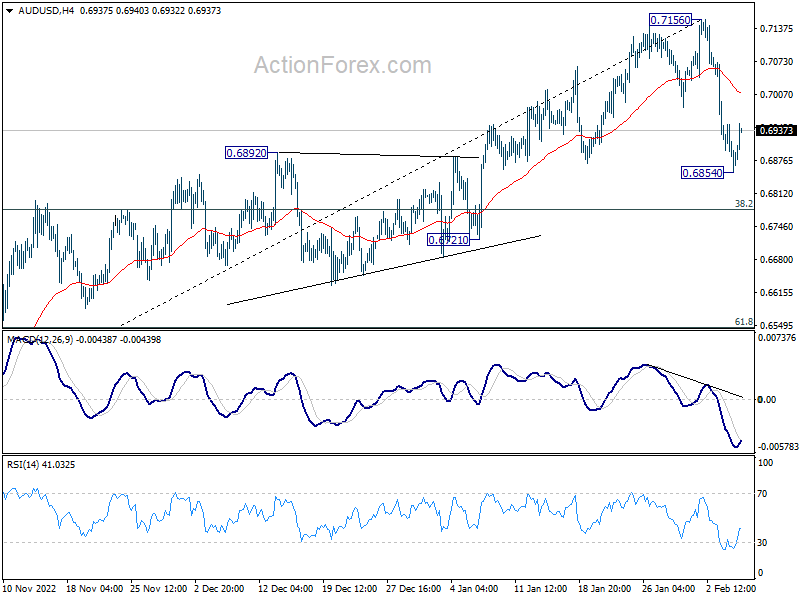
Intraday bias in AUD/USD is turned neutral first with current recovery. Correction from 0.7156 could still extend lower. But downside should be contained by 38.2% retracement of 0.6169 to 0.7156 at 0.6779 to bring rebound. For now, break of 0.7156 is not expected soon, as correction from there should extend for a while.
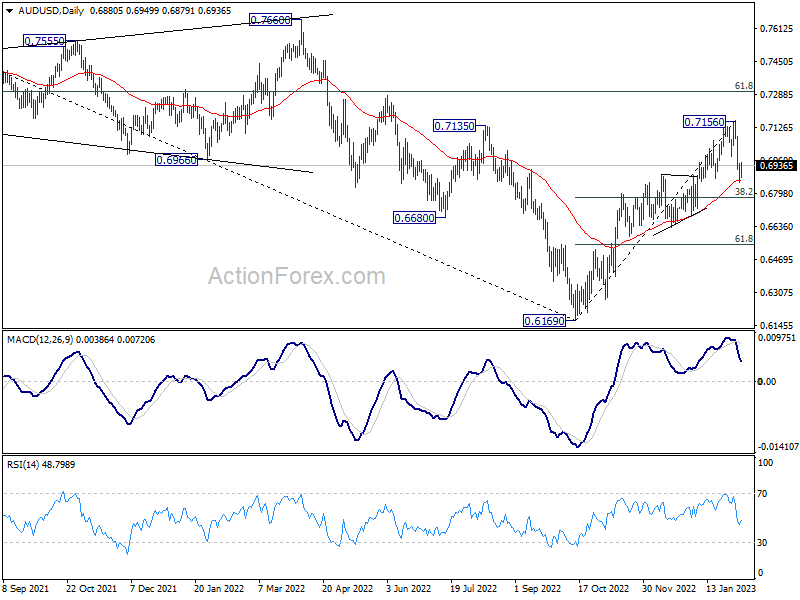
In the bigger picture, corrective decline from 0.8006 (2021 high) should have completed with three waves down to 0.6169 (2022 low). Further rally should be seen to 61.8% retracement of 0.8006 to 0.6169 at 0.7304. Sustained break there will pave the way to retest 0.8006. This will now remain the favored case as long as 0.6721 support holds.
Aussie Bounces after Hawkish RBA Hike, Dollar Hesitates ahead of Fed Powell
Australian Dollar recovered broadly today following hawkish RBA rate hike, which signals more tightening ahead. The rebound in Aussie also takes New Zealand Dollar higher. On the other hand, Dollar is once again consolidating overnight gains. The rally in the greenback is not too committed this week so far. But Fed Chair Jerome Powell's speech later today has the potential to trigger some fireworks. European majors are on the softer side, with Sterling having a slight upper hand. But Yen is the worst performer for the week.
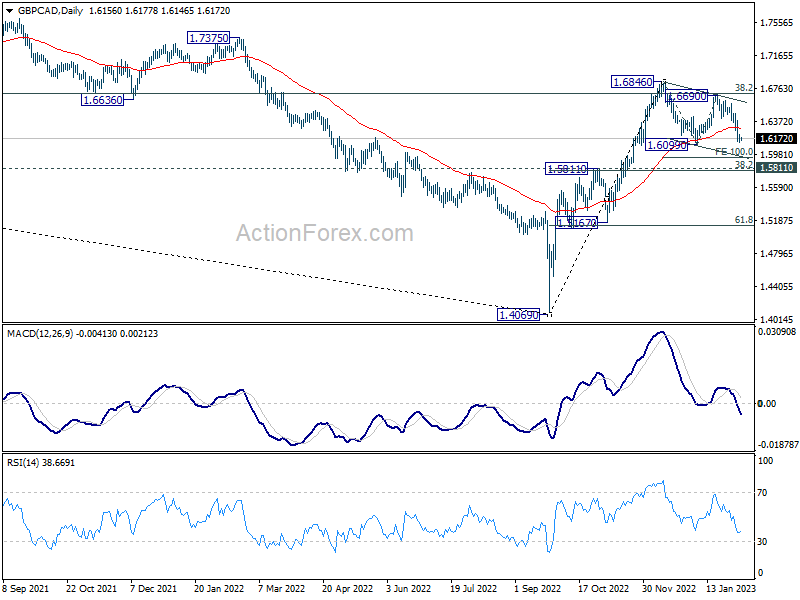
Technically, GBP/CAD is on the verge of breaking through 1.6099 to resume the whole correction from 1.6846. 100% projection of 1.6846 to 1.6099 from 1.6690 at 1.5934 is the target. However, a strong cluster support level lies ahead at 1.5811, 38.2% retracement of 1.4069 to 1.6846 at 1.5785. So, the dip below 1.5934 could be seen as a buying opportunity with stop below 1.5785. Let's see how it goes.
In Asia, Nikkei is down -0.04%. Hong Kong HSI is up 0.30%. China Shanghai SSE is down -0.08%. Singapore Strait Times is down -0.22%. Japan 10-year JGB yield is down -0.0003 at 0.500. Overnight, DOW dropped -0.10%. S&P 500 dropped -0.61%. NASDAQ dropped -1.00%. 10-year yield rose 0.102 to 3.634.
RBA hikes 25bps, further increases needed over the months ahead
RBA raises the cash rate target by 25bps to 3.35% as widely expected. The Board also expects that "further increases in interest rates will be needed over the months ahead". To assess "how much" further hike is needed, close attention will be paid to "developments in the global economy, trends in household spending and the outlook for inflation and the labour market."
The central noted that underlying inflation at 6.9% in December was "high than expected" with "strong domestic demand "adding to the inflationary pressures in a number of areas of the economy." Inflation is expected to decline to 4.75% this year, then to around 3% by mid-2025. Medium-term inflation expectation remain" well anchored".
GDP growth is expected to slow to 1.50% in 2023 and 2024. Unemployment rate is projected to rise form current 3.50% to 3.75% by the end of 2023, and then 4.50% by mid-2025.
BoE Pill more concerned about the potential persistence of inflation
BoE Chief Economist Huw Pill said yesterday, "I do have high degree of confidence (about getting inflation to target) because we know what we're going to do. We've done a lot to achieve it, we're prepared to do more as necessary to ensure that we achieve it sustainably."
He also said the BoE had to "guard against doing too much" given the typical 18-month lag for rate hikes to impact the economy. "We are reaching the point where those types of concerns are in the forefront of our minds," he said. "But if you ask me where we are at the moment, I think we are still more concerned about the potential persistence of inflation."
Inflation pressure in the labor market "probably tilts us to saying we haven't quite got to the point where we're confident to engage in a discussion of a turning point in rates."
Fed Bostic: Strong job data probably translate into more rate hikes than projected
Atlanta Fed President Raphael Bostic told Bloomberg News yesterday, last week's strong non-farm payroll report will probably mean we have to do a little more work... And I would expect that that would translate into us raising interest rates more than I have projected right now."
Bostic previously indicated that he expects interest rate to peak at 5.00-5.25% to get policy sufficiently restrictive. Rate would then stay there throughout 2024. To him, a hike peak could come through an additional quarter-point hike after the two currently envisaged, without ruling out a half-point hike.
He expects inflation to be in the "low 3s" this year, still well above Fed's 2% target. "Those last few tenths of a point can take a long time to be realized," he said. "And so I want to make sure that we are in the right place before we start easing off our policy because the most important thing at this stage is to get our price stability measure as close to target as possible."
Looking ahead
Swiss unemployment rate and foreign currency reserve, Germany industrial production, France trade balance will be released in European session. Later in the day, both Canada and US will publish trade balance.
AUD/USD Daily Report
Daily Pivots: (S1) 0.6844; (P) 0.6896; (R1) 0.6937; More...
Intraday bias in AUD/USD is turned neutral first with current recovery. Correction from 0.7156 could still extend lower. But downside should be contained by 38.2% retracement of 0.6169 to 0.7156 at 0.6779 to bring rebound. For now, break of 0.7156 is not expected soon, as correction from there should extend for a while.
In the bigger picture, corrective decline from 0.8006 (2021 high) should have completed with three waves down to 0.6169 (2022 low). Further rally should be seen to 61.8% retracement of 0.8006 to 0.6169 at 0.7304. Sustained break there will pave the way to retest 0.8006. This will now remain the favored case as long as 0.6721 support holds.
Economic Indicators Update
| GMT | Ccy | Events | Actual | Forecast | Previous | Revised |
|---|---|---|---|---|---|---|
| 23:30 | JPY | Labor Cash Earnings Y/Y Dec | 4.80% | 2.50% | 0.50% | 1.90% |
| 23:30 | JPY | Household Spending Y/Y Dec | -1.30% | -0.20% | -1.20% | |
| 03:30 | AUD | RBA Rate Decision | 3.35% | 3.35% | 3.10% | |
| 00:30 | AUD | Trade Balance (AUD) Dec | 12.24B | 12.2B | 13.20B | 13.48B |
| 05:00 | JPY | Leading Economic Index Dec P | 97.2 | 97.2 | 97.4 | |
| 06:45 | CHF | Unemployment Rate Jan | 1.90% | 1.90% | ||
| 07:00 | EUR | Germany Industrial Production M/M Dec | -0.60% | 0.20% | ||
| 07:45 | EUR | France Trade Balance (EUR) Dec | -12.2B | -13.8B | ||
| 08:00 | CHF | Foreign Currency Reserves (CHF) Jan | 784B | |||
| 13:30 | CAD | International Merchandise Trade (CAD) Dec | -0.6B | 0.0B | ||
| 13:30 | USD | Trade Balance (USD) Dec | -68.5B | -61.5B |
RBA hikes 25bps, further increases needed over the months ahead
RBA raises the cash rate target by 25bps to 3.35% as widely expected. The Board also expects that "further increases in interest rates will be needed over the months ahead". To assess "how much" further hike is needed, close attention will be paid to "developments in the global economy, trends in household spending and the outlook for inflation and the labour market."
The central noted that underlying inflation at 6.9% in December was "high than expected" with "strong domestic demand "adding to the inflationary pressures in a number of areas of the economy." Inflation is expected to decline to 4.75% this year, then to around 3% by mid-2025. Medium-term inflation expectation remain" well anchored".
GDP growth is expected to slow to 1.50% in 2023 and 2024. Unemployment rate is projected to rise form current 3.50% to 3.75% by the end of 2023, and then 4.50% by mid-2025.
(RBA) Statement by Philip Lowe, Governor: Monetary Policy Decision
At its meeting today, the Board decided to increase the cash rate target by 25 basis points to 3.35 per cent. It also increased the interest rate on Exchange Settlement balances by 25 basis points to 3.25 per cent.
Global inflation remains very high. It is, however, moderating in response to lower energy prices, the resolution of supply-chain problems and the tightening of monetary policy. It will be some time, though, before inflation is back to target rates. The outlook for the global economy remains subdued, with below average growth expected this year and next.
In Australia, CPI inflation over the year to the December quarter was 7.8 per cent, the highest since 1990. In underlying terms, inflation was 6.9 per cent, which was higher than expected. Global factors explain much of this high inflation, but strong domestic demand is adding to the inflationary pressures in a number of areas of the economy.
Inflation is expected to decline this year due to both global factors and slower growth in domestic demand. The central forecast is for CPI inflation to decline to 4¾ per cent this year and to around 3 per cent by mid-2025. Medium-term inflation expectations remain well anchored, and it is important that this remains the case.
The Australian economy grew strongly over 2022. The central forecast is little changed from three months ago, with GDP growth expected to slow to around 1½ per cent over 2023 and 2024. The recovery in spending on services following the lifting of COVID restrictions has largely run its course and the tighter financial conditions will constrain spending more broadly.
The labour market remains very tight. The unemployment rate has been steady at around 3½ per cent over recent months, the lowest rate since 1974. Job vacancies and job ads are both at very high levels, but have declined a little recently. Many firms continue to experience difficulty hiring workers, although some report a recent easing in labour shortages. As economic growth slows, unemployment is expected to increase. The central forecast is for the unemployment rate to increase to 3¾ per cent by the end of this year and 4½ per cent by mid-2025.
Wages growth is continuing to pick up from the low rates of recent years and a further pick-up is expected due to the tight labour market and higher inflation. Given the importance of avoiding a prices-wages spiral, the Board will continue to pay close attention to both the evolution of labour costs and the price-setting behaviour of firms in the period ahead.
The Board recognises that monetary policy operates with a lag and that the full effect of the cumulative increase in interest rates is yet to be felt in mortgage payments. There is uncertainty around the timing and extent of the expected slowdown in household spending. Some households have substantial savings buffers, but others are experiencing a painful squeeze on their budgets due to higher interest rates and the increase in the cost of living. Household balance sheets are also being affected by the decline in housing prices. Another source of uncertainty is how the global economy responds to the large and rapid increase in interest rates around the world. These uncertainties mean that there are a range of potential scenarios for the Australian economy.
The Board's priority is to return inflation to target. High inflation makes life difficult for people and damages the functioning of the economy. And if high inflation were to become entrenched in people's expectations, it would be very costly to reduce later. The Board is seeking to return inflation to the 2–3 per cent range while keeping the economy on an even keel, but the path to achieving a soft landing remains a narrow one.
The Board expects that further increases in interest rates will be needed over the months ahead to ensure that inflation returns to target and that this period of high inflation is only temporary. In assessing how much further interest rates need to increase, the Board will be paying close attention to developments in the global economy, trends in household spending and the outlook for inflation and the labour market. The Board remains resolute in its determination to return inflation to target and will do what is necessary to achieve that.
Fed Bostic: Strong job data probably translate into more rate hikes than projected
Atlanta Fed President Raphael Bostic told Bloomberg News yesterday, last week's strong non-farm payroll report will probably mean we have to do a little more work... And I would expect that that would translate into us raising interest rates more than I have projected right now."
Bostic previously indicated that he expects interest rate to peak at 5.00-5.25% to get policy sufficiently restrictive. Rate would then stay there throughout 2024. To him, a hike peak could come through an additional quarter-point hike after the two currently envisaged, without ruling out a half-point hike.
He expects inflation to be in the "low 3s" this year, still well above Fed's 2% target. "Those last few tenths of a point can take a long time to be realized," he said. "And so I want to make sure that we are in the right place before we start easing off our policy because the most important thing at this stage is to get our price stability measure as close to target as possible."
BoE Pill more concerned about the potential persistence of inflation
BoE Chief Economist Huw Pill said yesterday, "I do have high degree of confidence (about getting inflation to target) because we know what we're going to do. We've done a lot to achieve it, we're prepared to do more as necessary to ensure that we achieve it sustainably."
He also said the BoE had to "guard against doing too much" given the typical 18-month lag for rate hikes to impact the economy. "We are reaching the point where those types of concerns are in the forefront of our minds," he said. "But if you ask me where we are at the moment, I think we are still more concerned about the potential persistence of inflation."
Inflation pressure in the labor market "probably tilts us to saying we haven't quite got to the point where we're confident to engage in a discussion of a turning point in rates."