Sample Category Title
EUR/USD Extends Losses
The euro continues to lose ground and has started the week in negative territory. In the European session, EUR/USD is trading at 1.0783, down 0.19%. Earlier in the day, the euro has now fallen to its lowest level since Jan. 23.
Euro takes a spill
The euro sent market participants on a roller-coaster ride last week. The Fed’s rate increase pushed the euro higher by 1.16%, but the ECB rate hike and the blowout US nonfarm payroll report sent the euro tumbling close to 2%.
The January US nonfarm payrolls was an absolute blowout that surprised everybody. The economy created 517,000 new jobs, crushing the estimate of 185,000 and well above the December gain of 260,000. The unemployment rate fell from 3.5% to 3.4%, its lowest rate since 1969.
The US dollar surged against most of the major currencies after the employment report and the euro fell by 1%. There has been talk that the Fed might deliver a “one and done” rate hike in March which would end the current rate-hike cycle, even though Jerome Powell said at last week’s FOMC meeting that two more rate hikes were likely. After the massive gain in nonfarm payrolls, the “one and done” proponents will be lying low.
How will the Fed react to the job data? The labour market, which has shown remarkable resilience to the Fed’s steep rate-tightening cycle, is much too strong for the Fed’s liking, as a weaker labour market is needed for inflation to continue falling. Fed member Mary Daly called the employment release a “wow number” and said that the Fed’s December forecast of a peak rate of 5.1% was a “good indicator” of Fed policy. With the benchmark rate currently at 4.5%-4.75%, we’re likely looking at two more rate hikes, exactly what Jerome Powell said at the FOMC meeting last week. Since the employment report, the markets have become less dovish and have priced in an increase in May.
Eurozone data was a mixed bag today. German factory orders bounced back in December with a gain of 3.2% m/m, after a 4.4% decline in November. The estimate stood at 2.0%. Eurozone Sentix Investor Confidence improved to -8.0, up from -17.5 points. However, eurozone retail sales slid 2.7% m/m in January, down from a 1.2% gain in December and worse than the consensus of -2.5%.
EUR/USD Technical
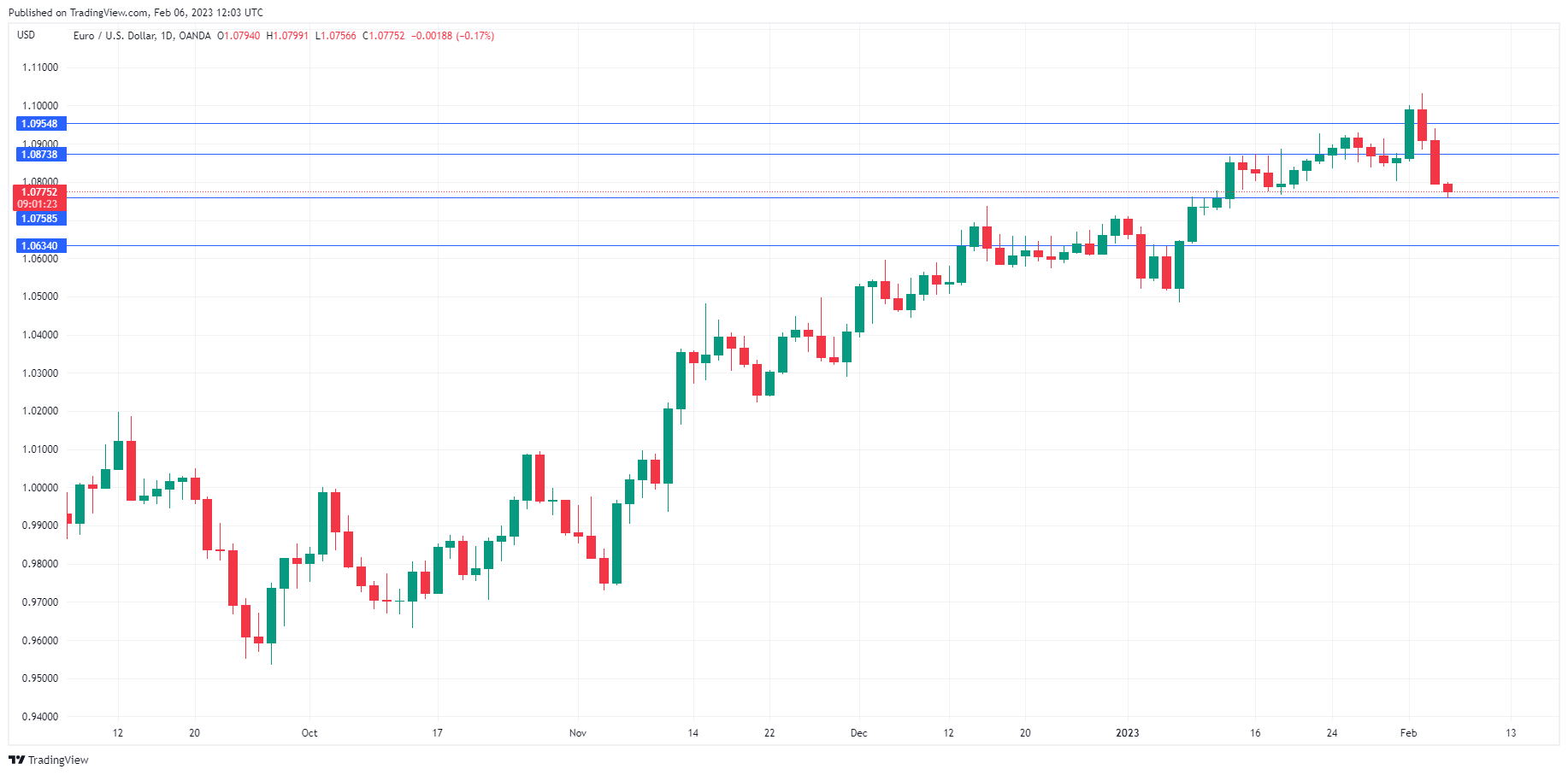
- 1.0758 is a weak support line, followed by 1.0633
- There is resistance at 1.0873 and 1.0954
EUR/USD Mid-Day Outlook
Daily Pivots: (S1) 1.0745; (P) 1.0842; (R1) 1.0892; More...
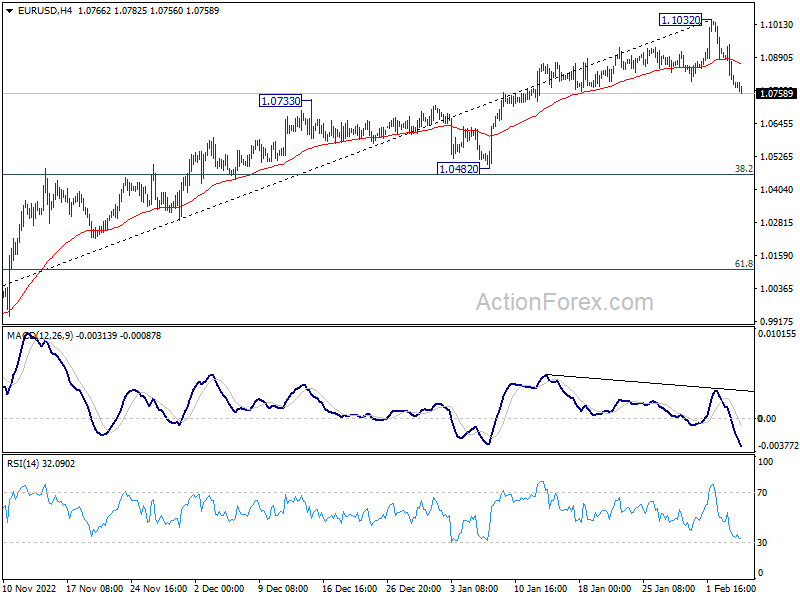
Intraday bias in EUR/USD is still on the downside for the moment. Fall from 1.1032 short term top is correcting whole rise from 0.9534, and should target 1.0482 support, which is close to 38.2% retracement of 0.9534 to 1.1032 at 1.0463. For now, risk will stay on the downside as long as 1.1032 resistance holds, in case of recovery.
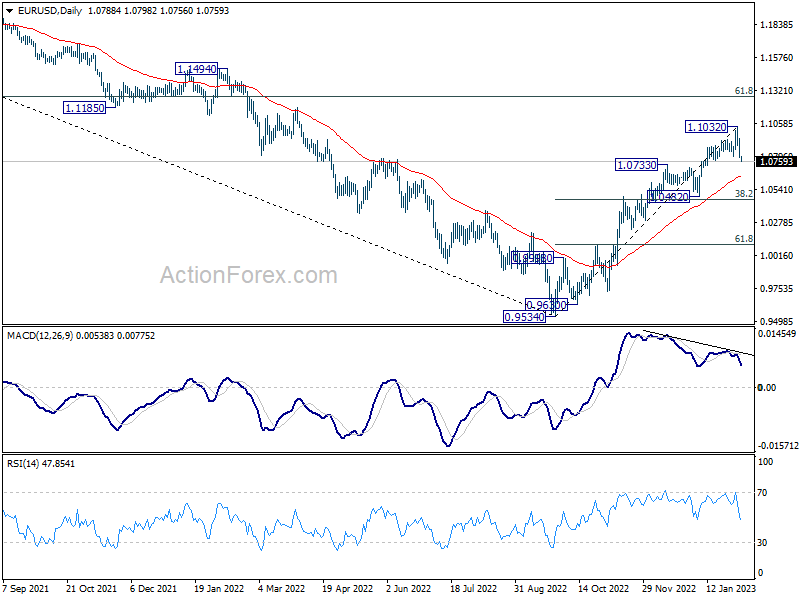
In the bigger picture, current development suggests that the rally from 0.9534 low (2022 low) is a medium term up trend rather than a correction. Further rise is in favor to 61.8% retracement of 1.2348 (2021 high) to 0.9534 at 1.1273 next. This will remain the favored case as long as 1.0482 support holds.
GBP/USD Mid-Day Outlook
Daily Pivots: (S1) 1.1979; (P) 1.2122; (R1) 1.2197; More...
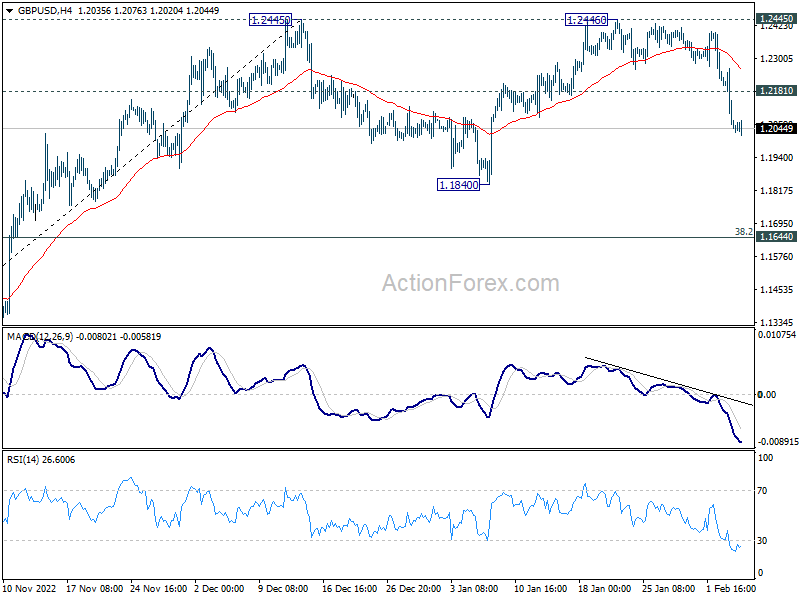
Intraday bias in GBP/USD remains on the downside at this point. Fall from 1.2446 is seen as the third leg of the corrective pattern from 1.2445. Deeper decline would be seen to 1.1840 support and possibly below. But downside should be contained by 38.2% retracement of 1.0351 to 1.2445 at 1.1645 to bring rebound. On the upside, above 1.2181 minor resistance will turn intraday bias neutral first. But risk will stay mildly on the downside as long as 1.2445/6 holds, in case of recovery.
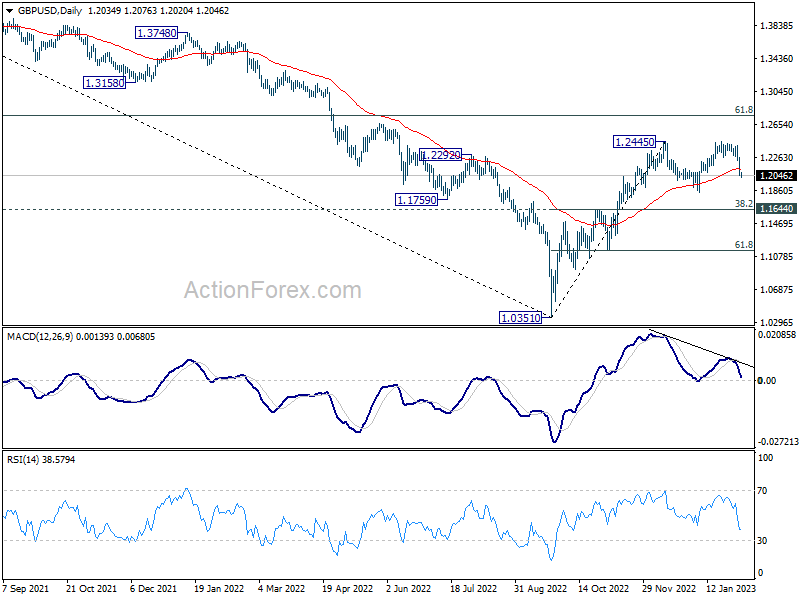
In the bigger picture, rise from 1.0351 medium term bottom is at least correcting whole down trend from 1.4248 (2021 high). Further rise is expected as long as 1.1644 resistance turned support holds. Next target is 61.8% retracement of 1.4248 to 1.0351 at 1.2759. Sustained break there will pave the way back to 1.4248.
USD/JPY Mid-Day Outlook
Daily Pivots: (S1) 129.28; (P) 130.24; (R1) 132.15; More...
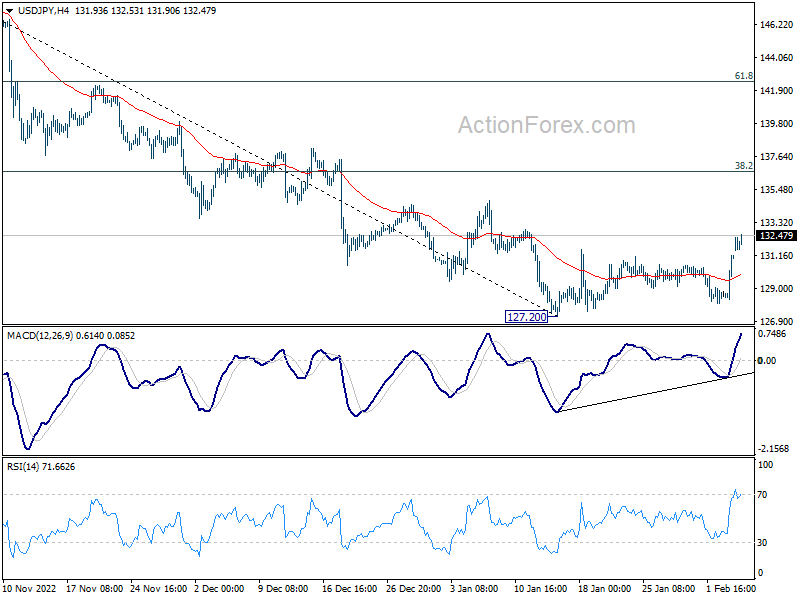
Intraday bias in USD/JPY remains on the upside. Rise from 127.20 short term bottom should target 55 day EMA (now at 133.28) first. Firm break there will target 38.2% retracement of 151.93 to 127.20 at 136.64, even just as a correction to the decline from 151.93. For now, risk will stay mildly on the upside as long as 127.20 support holds, in case of retreat.
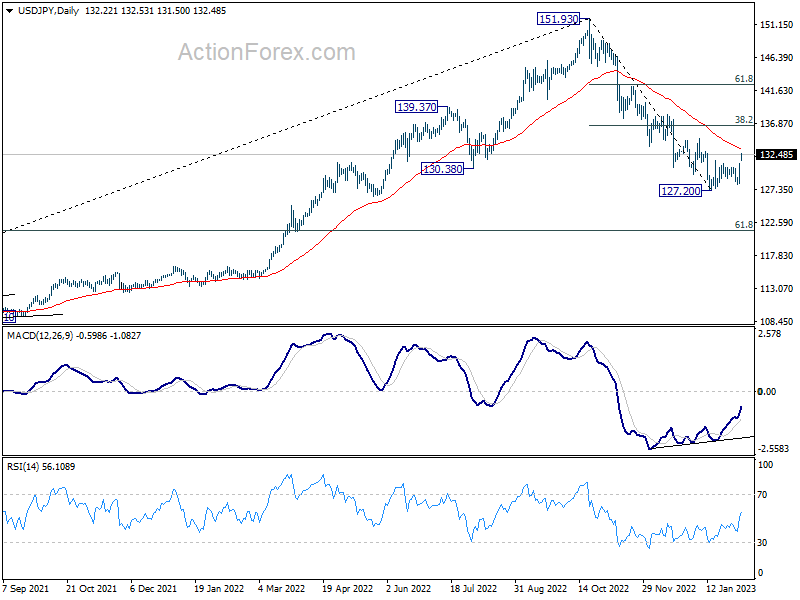
In the bigger picture, prior of 55 week EMA (now at 131.39) raises the chance of medium term bearish reversal, but that's not confirmed yet. Strong rebound from current level, followed by sustained break of 38.2% retracement of 151.93 to 127.20 at 136.64 will argue that price actions from 151.93 is merely a corrective pattern. However, rejection by 136.64 will solidify medium term bearishness for 61.8% retracement of 102.58 to 151.93 at 121.43 and 38.2% retracement of 75.56 to 151.93 at 122.75.
USD/CHF Mid-Day Outlook
Daily Pivots: (S1) 0.9154; (P) 0.9211; (R1) 0.9317; More...
No change in USD/CHF's outlook as intraday bias remains neutral, with focus on 0.9285 resistance. Firm break there will confirm short term bottoming at 0.9058, and bring stronger rise to 0.9407 resistance. On the downside, however, sustained break of 0.9058 will resume larger decline from 1.0146 instead.
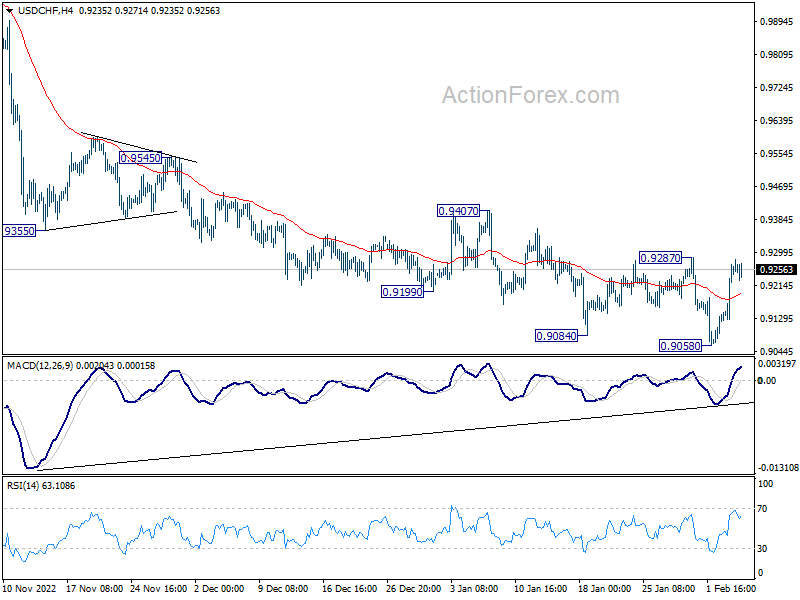
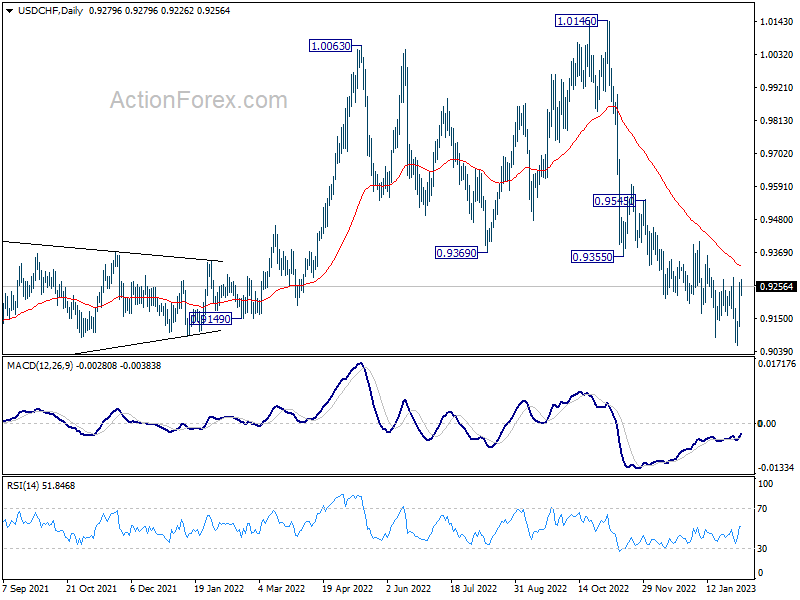
In the bigger picture, rise from 0.8756 (2021 low) has completed at 1.0146, well ahead of 1.0342 long term resistance (2016 high). Based on current downside momentum, fall from 1.0146 should be a medium term down trend itself. Next target is a test on 0.8756 low. Strong support should be seen there to bring rebound. Still, further decline will now be expected as long as 0.9407 resistance holds, in any case.
Dollar Staying Firm But Lacks Follow-Through Momentum
Dollar is staying generally firm today but lacks clear-cut momentum to extend last week's rally. Overall sentiment is mildly on the risk-off side, with major European indexes and US futures in red while benchmark treasury yields jump. For now, Yen remains the worst performer for the day, followed by Kiwi and then Aussie. Swiss Franc and Sterling are the stronger ones, followed by the greenback. The question is on whether Dollar could pick up momentum again, probably with help from hawkish Fedspeaks.
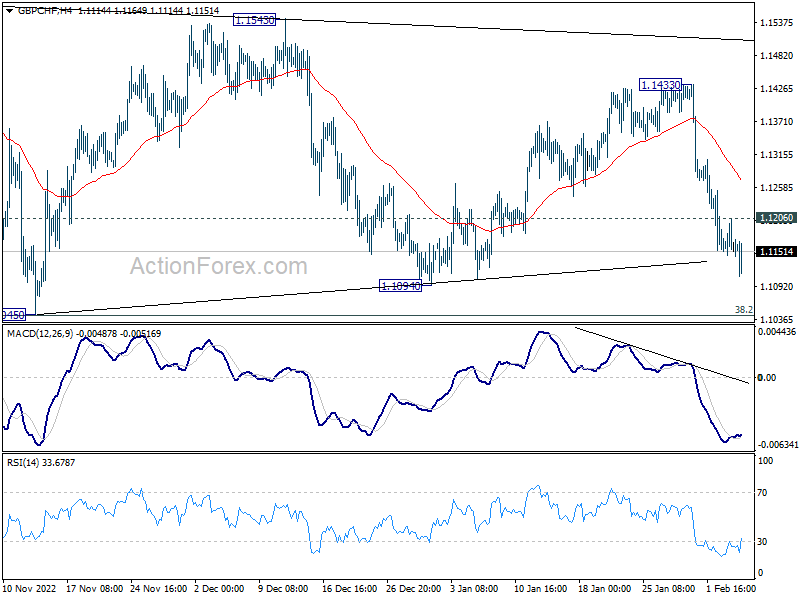
Technically, to solidify more upside momentum in Dollar, USD/CHF will need to break through 0.9287 resistance in USD/CHF to confirm short term bottom. The pair might look into GBP/CHF for some help. A rebound could be due as GBP/CHF is already close to support zone of 1.1045/1094. Break of 1.1206 minor resistance with be a sign of bottoming and turn bias back to the upside for 1.1433 resistance. That might give USD/CHF an extra lift.
In Europe, at the time of writing, FTSE is down -0.69%. DAX is down -0.86%. CAC is down -1.31%. Germany 10-year yield is up 0.1007 at 2.291. Earlier in Asia, Nikkei rose 0.67%. Hong Kong HSI dropped -2.02%. China Shanghai SSE dropped -0.76%. Singapore Strait Times rose 0.05%. Japan 10-year JGB yield rose 0.0094 to 0.500.
BoE hawk Mann: Next step more likely another hike than a cut or hold
BoE MPC member Catherine Mann, a known hawk, said in a speech that "we need to stay the course, and in my view the next step in Bank Rate is still more likely to be another hike than a cut or hold."
She noted that "some (global) central bankers are seeing a turning point in data to which they are responding with an inflection in their respective policy paths".
Also, "recent market chatter has focused on when central banks will stop hiking and if they will reverse, with fears torn between the risks of overtightening and stopping too soon.
But for assessment on the turning point, she is looking for "significant and sustained deceleration in higher frequency price increases and in the underlying inflation measures and expectations towards inflation rates that are consistent with achieving the 2% target".
She emphasized, "uncertainty around turning points should not motivate a wait-and-see approach, as the consequences of under tightening far outweigh, in my opinion, the alternative."
UK PMI construction dropped to 48.4, weakest in 2 1/2 years
UK PMI Construction dropped slightly from 48.8 to 48.4 in January, below expectation of 49.5. S&P Global noted that residential work had the steepest drop for 32 months. New orders and employment continued to decrease. But business activity expectations rebounded.
Tim Moore, Economics Director at S&P Global Market Intelligence, said: "A sharp and accelerated decline in house building activity led to the weakest UK construction sector performance for just over two-and-a-half years in January.... However, there were positive signals for longer-term prospects across the construction sector, with business activity expectations staging a swift rebound from the low point seen last December."
Eurozone Sentix rose to -8 in Feb, stagnation with mini-growth the consequence
Eurozone Sentix Investor Confidence rose from -17.5 to -8.0 in February, above expectation of -11.8. That;s also the highest since March 2022. Current Situation Index rose from -19.3 to -10.0, highest since June 2022. Expectations Index rose from -15.8 to -6.0, highest since February 2022. All three indexes had the fourth increase in a row.
Sentix said: "Up to now, investors have been assuming a recession, the course of which was initially expected to be severe but has now eased considerably. With the recent improvement, the scenario of stagnation is gaining in contour. The absence of an energy crisis and the rosy corporate news are contributing to the turnaround from the original recessionary path."
"However, the following must be critically observed: So far, the improvement in all subcomponents is running at a negative level. In addition, it is noticeable that the expectations component is hardly running ahead of the current situation. Normally, at economic turning points, the expectations values turn positive much faster, while the current situation is still deep in the red. In these cases, a new, positive perspective emerges. However, this has not been the case so far! Investors expect the status quo of the economy to be maintained to some extent. Stagnation with mini-growth would be the consequence."
Eurozone retail sales dropped -2.7% mom in Dec, EU down -2.6% mom
Eurozone retail sales volume dropped -2.7% mom in December, worse than expectation of -2.5% mom. The volume of retail trade decreased by -2.9% for food, drinks and tobacco and by -2.6% for non-food products, while it grew by 2.3% for automotive fuels.
EU retail sales contracted -2.6% mom. Among Member States for which data are available, the largest monthly decreases in the total retail trade volume were registered in the Netherlands (-6.3%), Germany (-5.3%) and Luxembourg (-3.8%). The highest increases were observed in Slovakia (+2.3%), Austria (+1.6%) and Romania (+1.3%).
ECB Holzmann: Monetary policy must continue to show its teeth
ECB Governing Council member Robert Holzmann said in a conference, "the risk of over-tightening seems dwarfed by the risk of doing too little."
"Monetary policy must continue to show its teeth until we see a credible convergence to our inflation target," he added.
Holzmann also hailed that the central bank's timely tightening helped keep inflation expectation anchored, but people were still feeling the impact. "Ultimately, the losses we as euro-area policymakers incur by consistently missing our inflation target come at our own peril."
BoJ Kuroda: Monetary easing steps a necessary approach shared by others
BoJ Governor Haruhiko Kuroda told the parliament today, "with our monetary easing steps, we sought to stimulate economic activity and tighten the labour market so that prices and wages would rise more."
"This was a necessary approach and one that is shared by other central banks," he said. There was "no better way" to aim at sustainably achieving its 2% inflation target.
USD/CHF Mid-Day Outlook
Daily Pivots: (S1) 0.9154; (P) 0.9211; (R1) 0.9317; More...
No change in USD/CHF's outlook as intraday bias remains neutral, with focus on 0.9285 resistance. Firm break there will confirm short term bottoming at 0.9058, and bring stronger rise to 0.9407 resistance. On the downside, however, sustained break of 0.9058 will resume larger decline from 1.0146 instead.
In the bigger picture, rise from 0.8756 (2021 low) has completed at 1.0146, well ahead of 1.0342 long term resistance (2016 high). Based on current downside momentum, fall from 1.0146 should be a medium term down trend itself. Next target is a test on 0.8756 low. Strong support should be seen there to bring rebound. Still, further decline will now be expected as long as 0.9407 resistance holds, in any case.
Economic Indicators Update
| GMT | Ccy | Events | Actual | Forecast | Previous | Revised |
|---|---|---|---|---|---|---|
| 00:00 | AUD | TD Securities Inflation M/M Jan | 0.90% | 0.20% | ||
| 07:00 | EUR | Germany Factory Orders M/M Dec | 3.20% | 2.00% | -5.30% | -4.40% |
| 09:30 | EUR | Eurozone Sentix Investor Confidence Feb | -8 | -11.8 | -17.5 | |
| 09:30 | GBP | Construction PMI Jan | 48.4 | 49.5 | 48.8 | |
| 10:00 | EUR | Eurozone Retail Sales M/M Jan | -2.70% | -2.50% | 0.80% | 1.20% |
| 15:00 | CAD | Ivey PMI Jan | 42.3 | 33.4 |
WTI Oil: Limited Upticks to Keep Bears in Play for Fresh Attempts Lower
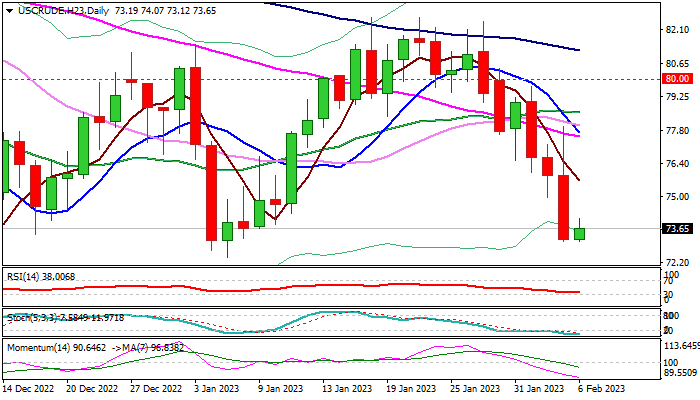
The WTI oil is consolidating above one-month low after falling by 8.5% last week, deflated by by fresh signals about further rate hikes and growing concerns that slower growth in major economies would hurt global demand.
Markets reacted on prevailing story about recession, but focus turns towards China, world’s second largest economy and the biggest oil importer, which is expected to be key driver of demand.
Oversold daily studies suggest that bears may stay on hold above key near-term support at $72.44 (Jan 5 low), with corrective upticks to stall under Fibo barrier at $76.73 (38.2% of $82.64/$73.08) to keep intact key barrier at $76.99 (base of thick daily cloud).
Res: 74.07; 74.95; 75.34; 76.73.
Sup: 73.08; 72.44; 70.23; 70.00.
US Dollar Index: Dollar Advances on Fresh Expectations for Prolonged Tightening Cycle
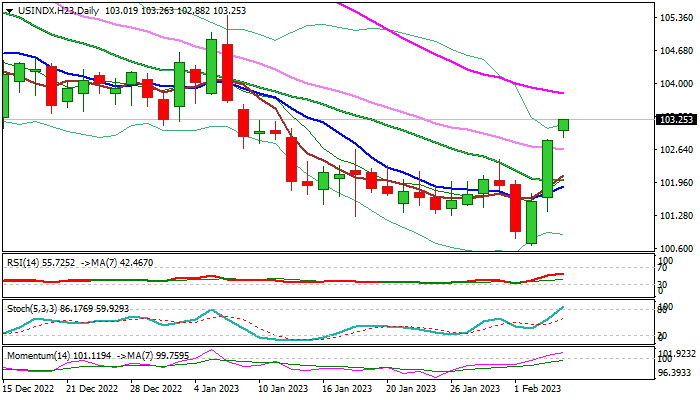
The US dollar index keeps firm tone on Monday and extends strong rally from past two days, after upbeat US labor and services sector data fueled expectations for a hawkish shift in Fed rate outlook.
Markets speculate that the US central bank would go for another two 0.25% hikes in current circumstances, which also reduce the possibility of cutting rates before the end of the year.
Fresh advance on Monday hit the highest in almost one month and generated bullish signal on break above daily Kijun-sen (103.03), which looks for verification on daily close above this level.
Bulls eye falling 55DMA (103.80) violation of which would open way for test of the base of thick daily cloud (104.46). Bullish daily techs support the action, but overbought conditions warn that bulls may pause for consolidation/correction in coming sessions.
Res: 102.73; 103.04; 103.80; 104.46.
Sup: 103.03; 102.64; 102.47; 101.96.
US-China Relations Turn Sour Again
After a period of some improvement in US-China relations since the Xi-Biden meeting in November, the relationship took yet another turn for the worse following the shoot-down of a Chinese 'spy balloon' over the Atlantic. Below is a short Q&A on what happened and how we see the implications.
What actually happened?
On Friday last week a large balloon flying over the US started to get media attention. It was suspected to be a Chinese 'spy balloon' as it was detected over Montana, a state where the US has nuclear missile sites. US defence officials highlighted though, that it did not present an added intelligence gathering risk relative to what China would be able to gather with low-orbit satellites. According to the US Department of Defence, the balloon had been monitored for some time as it entered over Alaska and Canada before reaching Montana at the border to Canada.
On Friday, China's Foreign Ministry said the balloon was a Chinese civilian airship used for research, mainly meteorological purposes and that it had deviated from its planned course due to the Westerlies and limited self-steering capability. It stated that "The Chinese side regrets the unintended entry of the airship into US airspace due to force majeure".
On Sunday, when the balloon had moved over the Atlantic, the US shot it down and divers are currently gathering its debris for further investigation. US Secretary of Defence Lloyd Austin stated that the balloon was being used by China to surveil strategic sites and was brought down above US territorial waters. The shoot-down triggered a sharper response from China, saying it was a "clear overreaction" and that "China will resolutely safeguard the legitimate rights and interests of the company concerned, and reserves to make further responses if necessary"
Is China spying?
Whether the balloon was indeed intentionally flying over the US is hard to tell and experts differ in their views on the matter. On the one hand, it seems like a strange gamble at a time when China seems to have moved to a softer foreign policy stance and is trying to get the US-China relationship on a more calm footing. One expert believes technical problems may have caused the termination mechanism to fail, while one meteorologist claimed the wind explanation was plausible and that since it is hard to aim at targets with a balloon, it is less efficient than low-orbit satellites for gathering intelligence. On the other hand, balloons only used for meteorological purposes tend to be smaller suggesting that it had a broader scope for intelligence gathering.
Regardless of the above, the balloon was in US airspace without permission and it would have been easy for China to notify the US that a balloon had gone astray. The fact that they did not do so undermines their credibility. It is also no secret that both the US and China spy on each other using other means such as satellites. The US is also flying lots of spy planes in the South China Sea and has moved closer to the Chinese shore in recent years, something that has increasingly angered China. They have also been accused of tampering with air codesthat are used to identify individual aircrafts.
What are the implications for US-China relations?
In the short term, there is no doubt that tensions will run high again between the US and China. The visit in Beijing by Secretary of State Anthony Blinken scheduled for yesterday and today has been postponed, a meeting where he was also set to meet Xi Jinping in a sign of some thawing in diplomatic relations. However, the State Department stated that Blinken "would plan to travel to the PRC at the earliest opportunity when conditions allow", indicating that the trip had not been cancelled completely and that the US administration will aim to get diplomatic relations back on track when the time allows. However, in the short-term, domestic politics will not allow Blinken to go. Republicans have used the incident to attack Bidenfor being too soft in his response. Depending on what the investigations of the balloon debris show, the White House will come with a response against China and China will likely retaliate in some way. But after a while things should calm down again.
In the long term, we think this is part of a new normal with a very strained relationship and rivalry between the US and China, that will last for years, if not decades. Over the next year, more incidents are likely to happen. First and foremost, it seems very likely that the new US speaker of the House, Kevin McCarthy, will follow in the footsteps of Nancy Pelosi and visit Taiwan later this year. China's response will likely be similar to last time, with extensive military exercises around the island and heightened tensions. Early next year (before 20 April), Taiwan goes to the polls and frictions could flare up again around this time. The ruling DPP elected a new leader in January, William Lai, who is a self-described "political worker for Taiwanese independence". He is DPP's candidate for President .
What are the market implications?
Chinese offshore stocks declined 2.7% overnight and the CNH weakened somewhat with USD/CNH rising to 6.79 from 6.74. Most likely the market reaction will calm down again from here, though. The incident should not have an impact on the Chinese recovery and as such the underpinning for Chinese stocks, where we still see upside potential.
However, the incident is yet another issue that has damaged China's image in the West and illustrates the hesitancy by foreign investors to move money into China. Hence, we think risk premia in the offshore markets are likely to stay higher than before China's image in the West started to deteriorate starting with Covid in 2020 and since then increased with Russian aggression against Ukraine and ongoing human rights issues in Xinjiang. The higher long-term risk premium implies that we do not see Chinese stocks rallying back to previous highs. But given the low levels, Chinese stocks are still cheap in a historical perspective, and we still see room for higher stock prices from here.
EUR/USD: Fresh Bears Look for More Signals of Deeper Pullback
The Euro is consolidating in early Monday after suffering heavy losses last Thu/Fri (down 1.8%) but remains at the back foot and warning of further weakness.
Stronger than expected January US labor data on Friday signal that the Fed may stay in prolonged tightening cycle that inflated dollar and pressure the single currency.
Traders started to collect profits from larger rally after last week’s action failed to sustain break above the top of falling weekly cloud (1.0930) and psychological 1.10 barrier, leaving a bull trap, with additional negative signal seen from bearish weekly candle with long upper shadow, which suggests that bulls are running out of steam.
Although the sentiment has weakened significantly, technical studies on daily chart are still constructive, as momentum is moving at the centreline and stochastic broke into oversold territory.
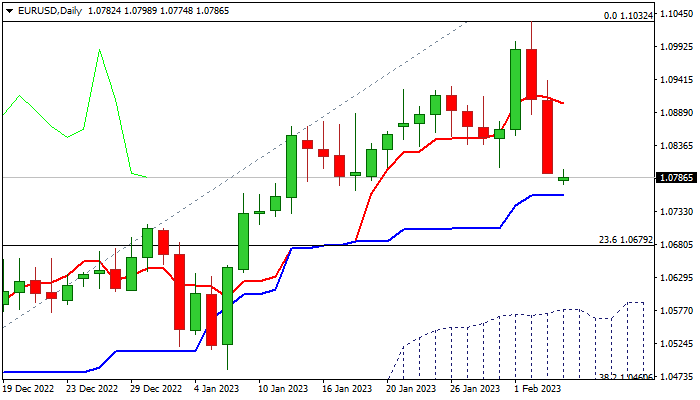
The price is so far holding above the first trigger at 1.0757 (daily Kijun-sen) that keeps in play the scenario of a healthy correction, though potential bounce to return above daily Tenkan-sen (1.0903) to neutralize immediate downside risk and signal a higher low.
On the other hand, weekly studies are weakening and support scenario of deeper pullback, which sees an initial requirement of close below daily Kijun-sen that would expose open way for test of initial Fibo support at 1.0679 (23.6% of 0.9535/1.1032) and unmask more significant support at 1.0578 (top of thick rising daily cloud).
Res: 1.0844; 1.0903; 1.0930; 1.1000.
Sup: 1.0757; 1.0679; 1.0657; 1.0578.