Sample Category Title
Crude Oil Started with Crash
Crude oil market started the new week with sales. A Brent barrel is falling to 81.40 USD.
The worst of the news comes from China. The Chinese are rebelling against tough anti-coronavirus measures and lockdowns imposed by the government due to many new cases of COVID-19. The situation generates points of uncertainty because it is yet unclear how the Chinese authorities will react and how it all ends.
The issue with the maximum price level for Russian oil also keeps the market nervous.
According to Baker Hughes, the number of active oil rigs in the US increased last week by 4, reaching 627.
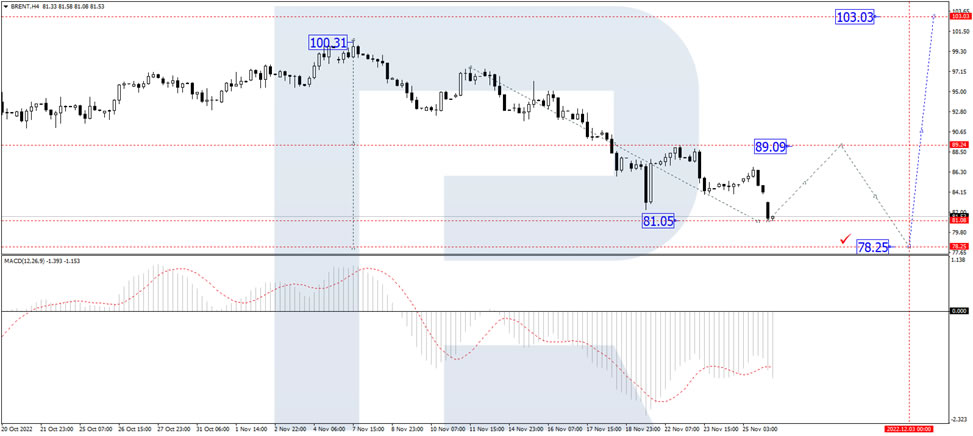
On H4, Brent has completed a wave of decline to 81.05. Today a consolidation range may form around it. With an escape upwards, a correction link to 89.09 might form. Then a link of decline to 78.78 and even 78.25 becomes possible. Technically, this scenario is confirmed by the MACD. Its signal line is at the lows, preparing to grow to zero.
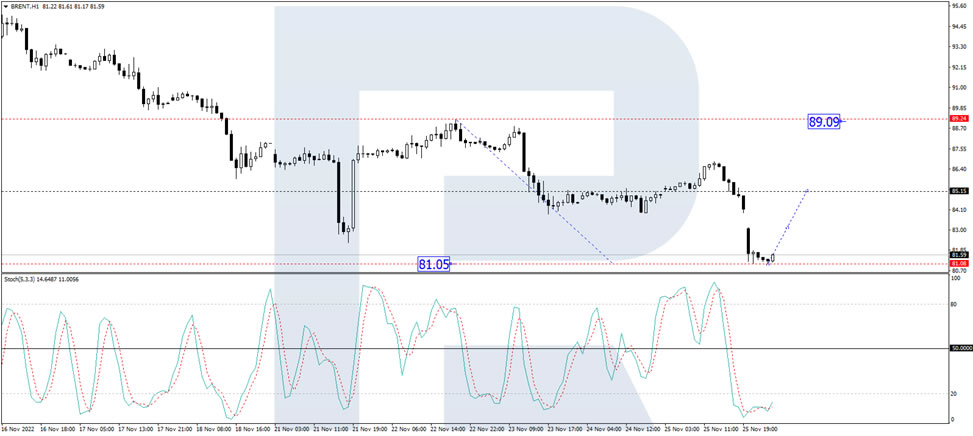
On H1, Brent has formed a consolidation range around 85.00. Today with an escape downwards, a local goal of the declining wave has been reached at 81.05. With an escape upwards, a pathway up to 85.00 will open (a test from below). Technically, this scenario is confirmed by the Stochastic oscillator. Its signal line is under 20, headed straight upwards. The indicator is expected to grow to 50.
USDJPY Oversold Near November’s Lows; Risks Remain
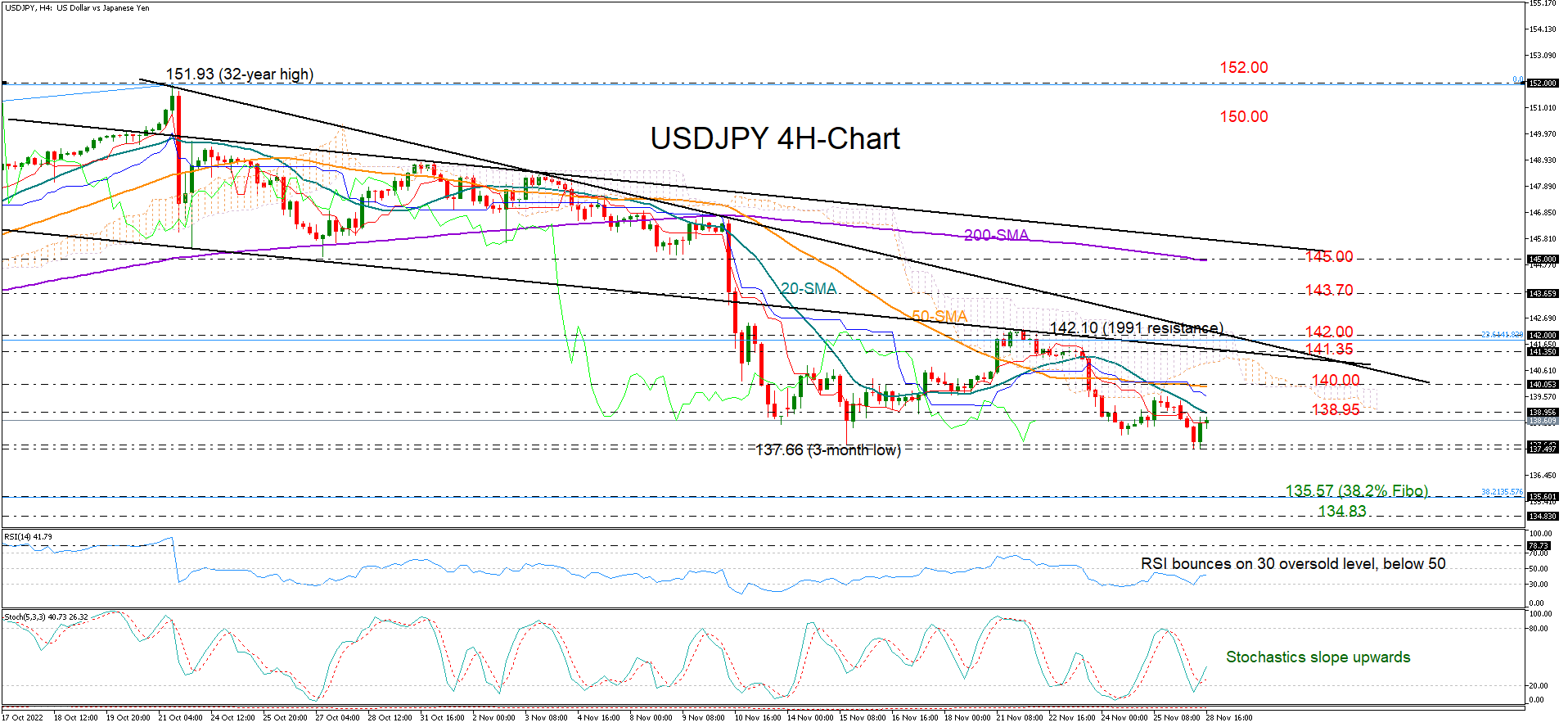
USDJPY paused its latest decline near November’s low of 137.66 before climbing back into the 138.00 territory on Monday.
The RSI and the stochastics on the four-hour chart are flagging oversold conditions, justifying the latest bullish correction in the price. However, the way higher could be rocky, as several obstacles remain intact.
The 20-period simple moving average (SMA) could postpone an extension to the 50-period SMA at 140.00. Above the latter, the pair may get congested within the 141.35–142.00 territory formed by two key constraining lines. If the bulls dominate, the next challenge could commence around 143.70, a break of which is required to drive the price up to the 200-period SMA at 145.00.
On the downside, a decisive close below the 137.66 trough may intensify selling pressures towards the 38.2% Fibonacci retracement of the September 2021– October 2022 uptrend at 135.57. Crossing below that base, the bears may take some rest around the 161.8% Fibonacci extension of the latest upleg at 134.83 before heading for the 134.00 number.
In brief, although downside pressures in USDJPY seem to be fading, the pair may remain vulnerable to bearish corrections unless it successfully crawls above 142.00.
Sunset Market Commentary
Markets
Chinese mass protests over President Xi Jingping’s zero Covid-policy dominate today’s headlines. The rare civil unrest was triggered by a deadly apartment fire where pandemic control barriers etc hampered civil services to extinguish the fire while residents in the region were already for three months in isolation. Another issue is related to unpaid workers at the biggest iPhone assembly plant. The unrest and protests are feared to add to China’s economic woes. Regional bourses lost up to 1.5% this morning with European stock markets ceding up to 1%. USD/CNY significantly weakened from last week’s close at 7.165 to 7.2050. This year’s CNY low stands at 7.3275 (weakest since 2007). The Chinese growth fears pulled oil prices significantly lower today, with Brent crude sliding from around $84/b to currently $81.5/b, breaking below the September low. US bond yields (Asian dealings ) and German yields (at the open) lost quite some bps initially, but managed to overturn that move. US yield changes currently range between -3 bps (30-yr) and +1 bps (5-yr). German yield differences compared with Friday’s close vary between - 0.5 bps (2-yr) and +2.0 bps (10-yr). The German 10-yr yield again attempts to reconquer the 2% mark. The dollar initially followed the textbook reaction, profiting somewhat from the risk-off context, but that move didn’t last long. From the start of the European bell it went from below 1.04 just below 1.05. Resistance stands at 1.0479/1.0516 (recent high/50% retracement on Feb/Sep EUR/USD decline). The trade-weighted dollar in a similar move fell below 106 with DXY testing the mid-November low at 105.34.Even USD/JPY tested 137.68 support. Sterling finally threw the towel following an intense test of EUR/GBP 0.8559/67 support. The pair followed EUR/USD’s leap higher and is currently changing hands near 0.8660.
Today’s eco calendar only contained second tier eco data. We retain hawkish comments from ECB Knot who finds the underlying inflation trends worrisome while adding that inflation forecasts are entirely tilted to the upside. ECB President Lagarde wouldn’t go as far as saying inflation has peaked, stressing the central bank will hike rates as long and much as needed. From tomorrow on it’s all hands on deck with US consumers confidence, ADP employment change, manufacturing ISM, US payrolls and a speech by Fed chair Powell. In Europe, we’ll get national EMU inflation numbers from tomorrow on, which will evolve to the overall EMU figure on Wednesday.
News Headlines
The monthly UK retail sales as measured by the CBI index deteriorated sharply in November. The headline balance for the retail sector dropped from 18 in October to -19 this month. The orders placed subindex dropped from -1 to -32, the lowest level since March of last year. Sales for the time of the year also eased from 20 to 3. At the same time, the level of stocks compared to expected sales continue to rise. British retailers also don’t expect an improvement in the near future as the expectations balance also nosedived from -9 to -21, as did orders (-38).
IFO export expectations improved in November to plus 0.4 points, up from minus 4.6 points in October, the German IFO institute reported today. The rise was mainly driven by the automotive industry again expecting exports to grow. Manufacturers of machinery and equipment and companies in the electrical industry expect hardly any further improvement from international business. On the negative side, beverage producers, the furniture industry, and the chemical industry are expecting declining sales. Ifo added that the export environment remains especially difficult for energy-intensive industries.
According to Reuters reporting based on a document seen by the press agency, the EU commission is preparing a draft proposal that requires market participants in the European Union to have an active account with a minimum of activity at a clearing house in the EU. According to the draft the measures are aimed at safeguarding financial stability by ending "excessive exposures" to "a few" non-EU clearers. The draft with other detailed measure, for example on commodity derivatives markets, is said to be published on December 7. At the end of the procedure final approval is needed from the European Parliament and EU members states.
Will Eurozone Inflation alter ECB Policy Expectations?
With Eurozone inflation surging to 10.6% year-on-year in October, investors have shifted their bets to another 75bps hike when the ECB meets on December 15, and last week’s meeting minutes added credence to that view. This week, traders will probably turn their gaze to the preliminary inflation data for November, due out on Wednesday at 10:00 GMT. Will the numbers prompt them to change their minds and what impact could they have on the euro?
Market wants another 75bps hike
Last month, the ECB delivered its second straight 75bps hike, but President Lagarde’s remarks at the press conference thereafter had a dovish flavor, with market participants interpreting them as a warning for a slowdown in the pace of future rate increments. What verified further this market hypothesis were post-meeting reports that some officials dissented in favor of a smaller move.
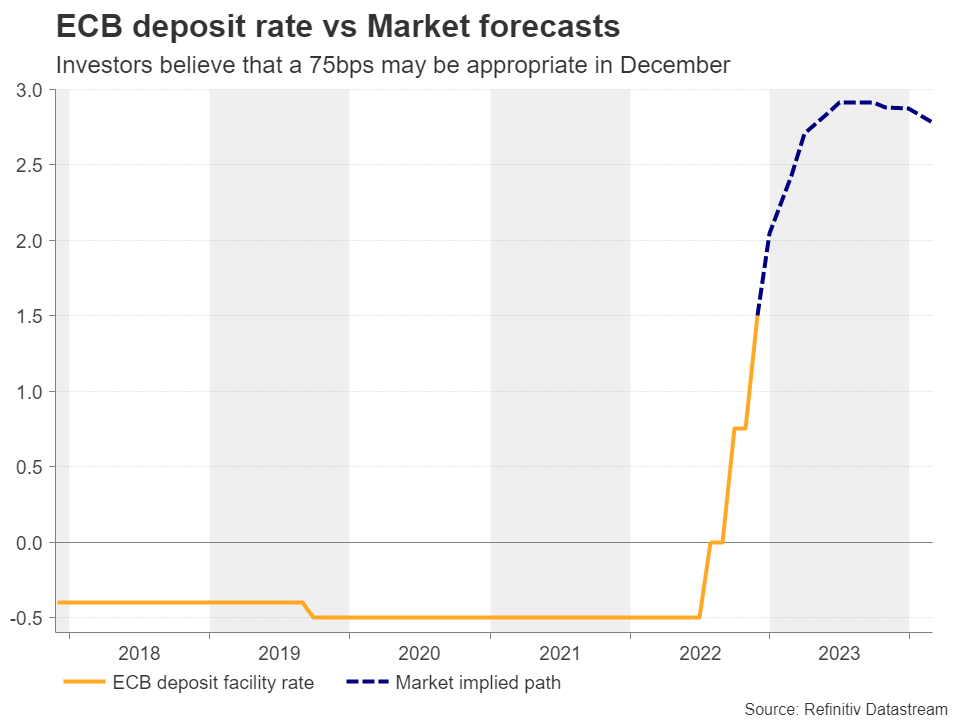
However, that narrative changed after the October inflation data revealed a strong acceleration into double digits, convincing market participants that another triple hike may be warranted, with the new assessment being supported by the minutes of the October meeting, which revealed that Euro-area policymakers were anxious about inflation becoming entrenched; and that was even before inflation data for October.
A small slowdown unlikely to prove a game changer
Now, the flash estimate of the headline harmonized index of consumer prices is expected to show a slowdown to 10.4% y/y from 10.6%, while the core rate is anticipated to have ticked down to 6.3% y/y from 6.4%. However, with the headline rate still in double digits, the core number well above the ECB’s objective, and the headline producer price index at unprecedented levels (above 40%), market participants are unlikely to alter their bets with regards to a 75bps hike at the ECB’s upcoming gathering.
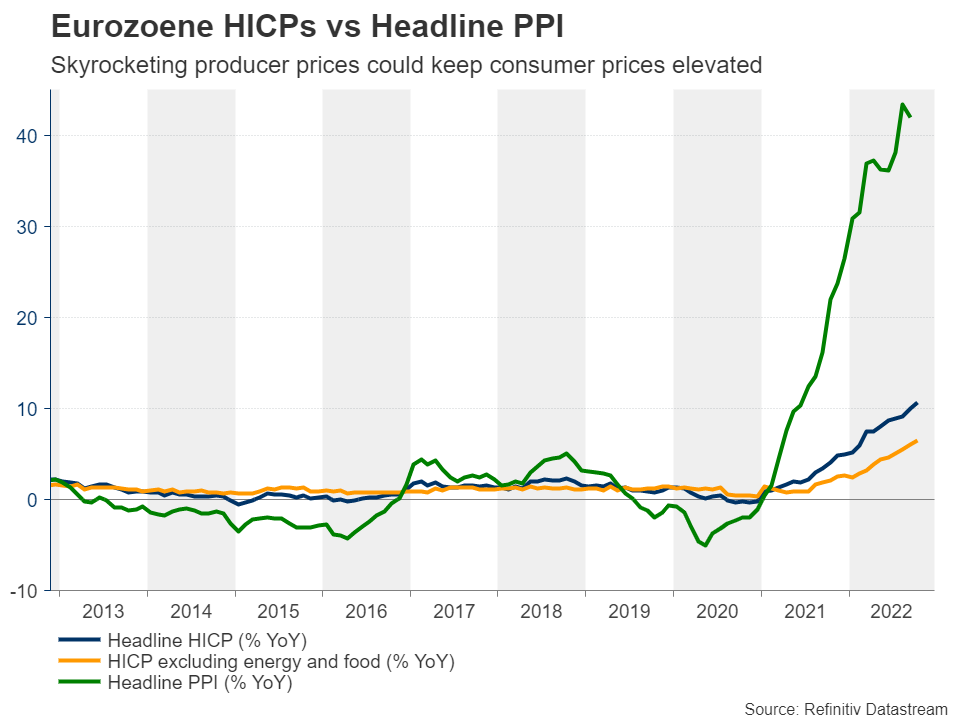
The PPI data for October are coming out on Friday, but even if they point to a second consecutive slowdown, a headline rate near 40% leaves no room for the ECB to let loose on its fight against inflation, as skyrocketing producer prices could be channeled into next months’ consumer prices and result in another acceleration.
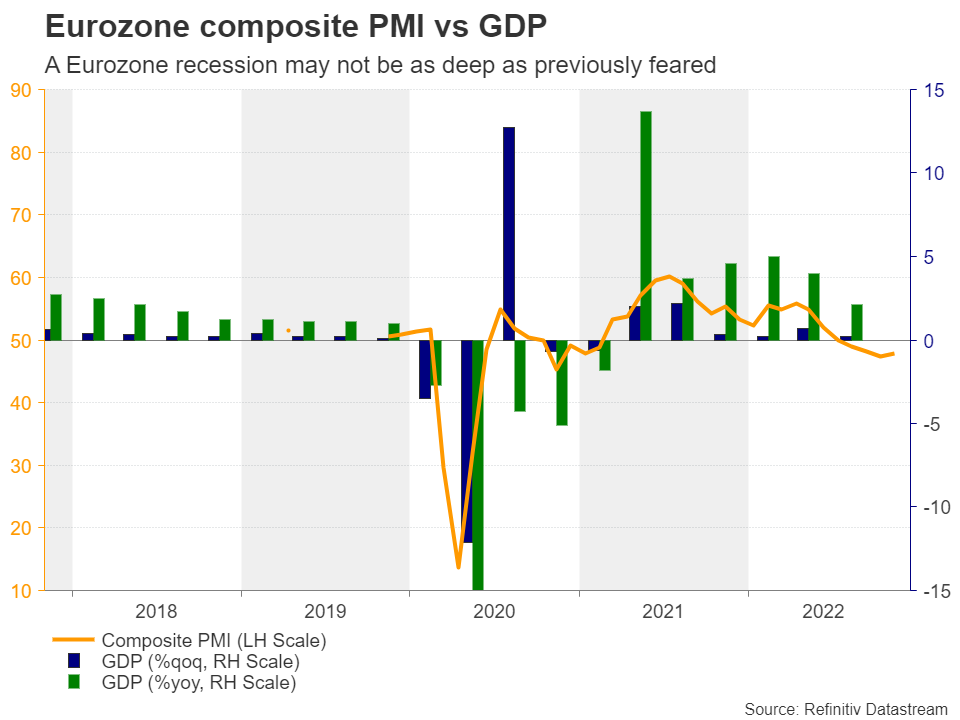
Last week, the preliminary S&P Global PMIs pointed to another month of contraction in November, but all the indices rose instead of sliding like the forecasts suggested. Yes, a recession in the euro area seems inevitable, but the PMIs may have added to hopes that the wounds may not be as deep as were feared a couple of months ago, thereby giving another reason to investors for anticipating another triple hike.
Euro may extend its recent recovery
An ECB expected to act more aggressively than the Fed in December could keep the euro supported against the US dollar for a while longer. Nonetheless, the recession in the Eurozone is still estimated to be deeper and more prolonged than in the US, which means that the ECB may not have the comfort to continue acting aggressively for longer and may not go as far as the Fed in terms of a terminal rate level. In other words, due to the prospect of a full-scale bullish reversal appearing premature, the latest recovery in euro/dollar – and any extensions of it – may be more wisely treated as a strong upside correction.
From a technical standpoint, euro/dollar has enjoyed some gains last week, after hitting support slightly above the psychological round number of 1.0200. Although the recovery was paused on Friday, it resumed on Monday, with the pair now headed towards the high of November 15 at 1.0480.
Overall, euro/dollar is trading well above the prior downtrend line drawn from the high of February 2, while last week, it managed to close clearly above the 200-day exponential moving average for the first time since June 2021. All these technical signs add to the notion of further advances.
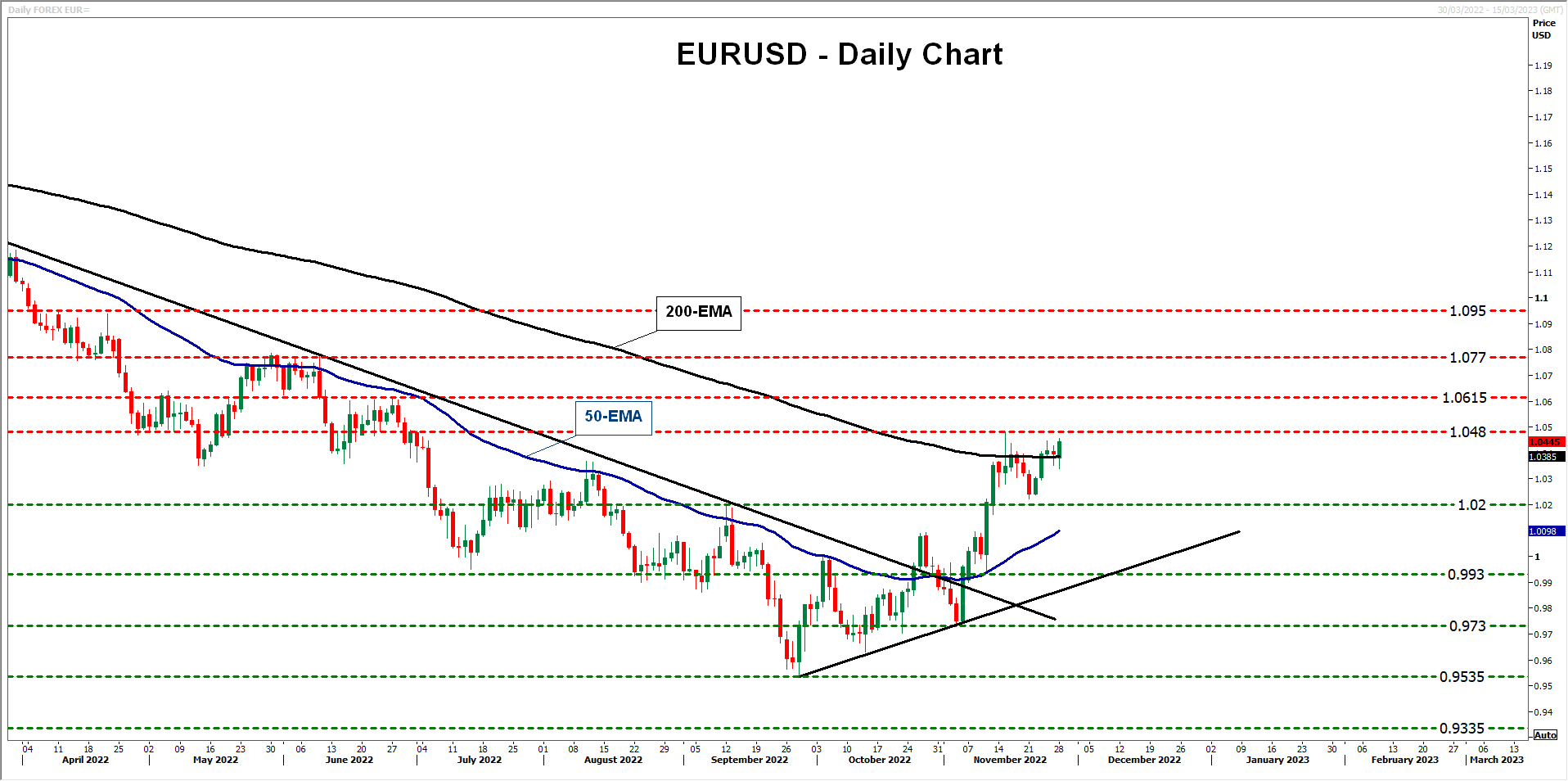
A clear break above 1.0480 would confirm a higher high and may initially pave the way towards the peak of June 27 at 1.0615, where another break could extend the advance towards the key area of 1.0770, which acted as a temporary ceiling between May 24 and June 9. Should the bulls manage to climb above that zone as well, they may put the 1.0950 zone on their radar.
On the downside, a break below the low of November 10 at 0.9930 could signal the break below the short-term upward-sloping support line drawn from the low of September 28. In such a case, the next level to consider as support may be the low of November 4 at 0.9730, the break of which may see scope for declines towards the low of September 28 at 0.9535.
Stock Slide Amid China Unrest
It's been a pretty quiet start to the trading week, with the negative session in Asia continuing into Europe and the US ahead of the open on Wall Street.
Chinese stocks have been hit particularly hard amid unrest over Covid restrictions. The protests really do highlight how increasingly frustrated the public is becoming with the leadership's zero-Covid policy, even if it has been modestly relaxed recently.
Record cases across multiple cities are putting the policy to the test and the unrest highlights the enormity of the challenge facing President Xi Jinping and his commitment to zero-Covid. The combination of these creates huge uncertainty, both in terms of how the protests are handled and what the whole experience means for the future of the policy and the economy.
It comes at a time when Chinese stocks had been boosted by the prospect of the policy being relaxed, with more easing expected in the spring. So much now is uncertain which may continue to weigh on sentiment until we get a better idea of the direction of travel. Despite how much time has passed and what other countries have achieved, it would appear China is not prepared for a significant loosening of restrictions which could mean that frustration we're seeing continues to bubble over.
The rest of the week promises to be extremely lively with the US returning from the Thanksgiving holiday and the calendar being packed with big-hitting economic data from around the globe. That includes what is normally considered the biggest of the lot - maybe now second behind inflation - the US jobs report to wrap up the week.
Buckle up, it could be a bumpy ride.
China and the Russian price cap weigh on crude
Events in China aren't just hitting local equity markets, oil prices are also crumbling under the pressure of record Covid cases and huge economic uncertainty. The country's commitment to zero-Covid has seriously damaged growth in the world's second-largest economy and by extension, crude demand. This has helped to soften the impact of the Ukraine war on energy markets to some extent and we could be seeing it weigh on oil prices once more.
Discussions are also continuing on the details of the Russian oil price cap. Most notably, where it should be set. It's looking increasingly likely to be done at a level that doesn't particularly hinder Russia's ability to sell crude - which is contributing to the drop in oil prices - or put its buyers in an uncomfortable position. The outcome will likely factor in how OPEC+ responds this weekend and I expect the rumour mill will therefore be busy as the week progresses, which in turn could trigger a lot of oil price volatility over the course of the week.
A volatile period ahead for gold?
Gold has performed well again over the last week but now appears to be settling ahead of a busy week of economic data. It's now sitting in the middle of a potential new range between $1,780 resistance - a major level of support in the first half of the year - and $1,730 support - a big resistance level in September and October turned support last week.
With so much data coming from the US this week including inflation, GDP, and the jobs report, we could see one of these give way in the coming days, setting us up nicely for the Fed meeting in two weeks. The latest inflation data will also be released a little over 24 hours before that interest rate decision so it could be a volatile couple of weeks for the yellow metal.
Cryptos on the ropes
Bitcoin remains under pressure despite recovering slightly last week. Cryptos are still suffering the fallout from the FTX collapse and the still unknown full extent of the contagion. Not to mention the fact that traders will now be hyper-alert to similar vulnerabilities elsewhere in the crypto world. The fact that risk appetite is weak today also won't be helping and bitcoin is off around 2% as a result and not far from $16,000. While it's seemingly trying to form a base around $15,500-17,000, it may be easier said than done in this environment.
ECB Lagarde: Interest rates remain the main tool for fighting inflation
ECB President Christine Lagarde told a parliamentary committee, interest rates will remain the "main tool for fighting inflation". Meanwhile, in December, ECB will "lay out the key principles for reducing the bond holdings". The balance sheet will be "normalized over time in a measured and predictable way."
"While monetary policy is geared towards bringing inflation back to our medium-term target, the economic outlook will also depend on the actions taken by other stakeholders," she said. "In the current environment of high inflation, fiscal policy needs to be considerate to not add to inflationary pressures. Fiscal support should therefore be targeted, tailored and temporary.
Lagarde also reiterated that "meeting-by meeting approach" and data dependence of upcoming policy decisions. "How much further we need to go, and how fast we need to get there, will be based on our updated outlook, the persistence of the shocks, the reaction of wages and inflation expectations, and on our assessment of the transmission of our policy stance," she added.
USD/JPY – China Jitters Propel Yen Higher
After strong gains last week, the Japanese yen has extended its gains on Monday. USD/JPY is trading at 138.23 in the European session, down 0.67%.
Yen jumps on China unrest
China has applied its Covid-zero policy with a heavy hand, but Covid cases continue to rise nonetheless. The mass lockdowns have triggered widespread protests, which some injuries reported. The unrest is likely to exacerbate supply-chain disruptions and dampen domestic demand, which has hurt risk appetite. This has resulted in flows to haven assets, such as the Japanese yen. USD/JPY dropped as much as 1% earlier today, but the dollar has managed to recover some of these losses.
The yen also received a boost after Bank of Japan Governor Kuroda said that the tightening labour market will push wages higher. Kuroda has long insisted that rising inflation has driven by import costs and the weak yen and is transient. Higher wages would indicate that inflation is sustained, which could result in the BoJ making some changes in its ultra-loose policy.
After a short trading week in the US due to the Thanksgiving holiday, the markets will have plenty of US events to digest this week. CB Consumer Confidence will be released on Tuesday, with the November report expected to dip to 100.0, down from 102.5. The key release of the week is nonfarm payrolls on Friday, which could have a major impact on the Fed’s decision to raise rates by 50 or 75 basis points at the December 14th meeting. Currently, the likelihood of a 50-bp hike is about 75%, versus 25% for a larger 75-bp increase. Investors are viewing a 50-point move as a dovish pivot, which has been putting pressure on the US dollar. Still, even a 50-bp hike would set a record for yearly rate hikes of 4.25%.
USD/JPY Technical
- There is resistance at 139.82 and 141.58
- There is support at 137.39 and 135.63
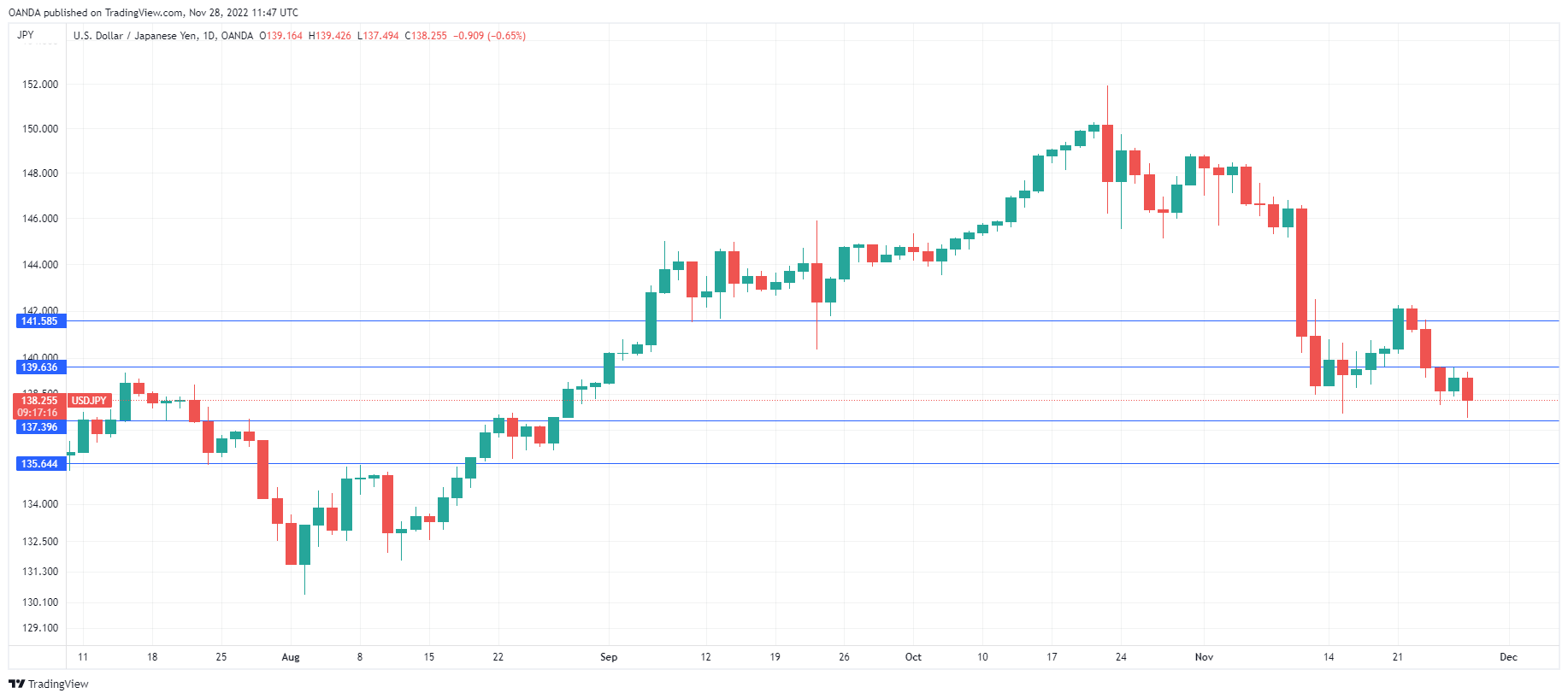
USD/JPY Mid-Day Outlook
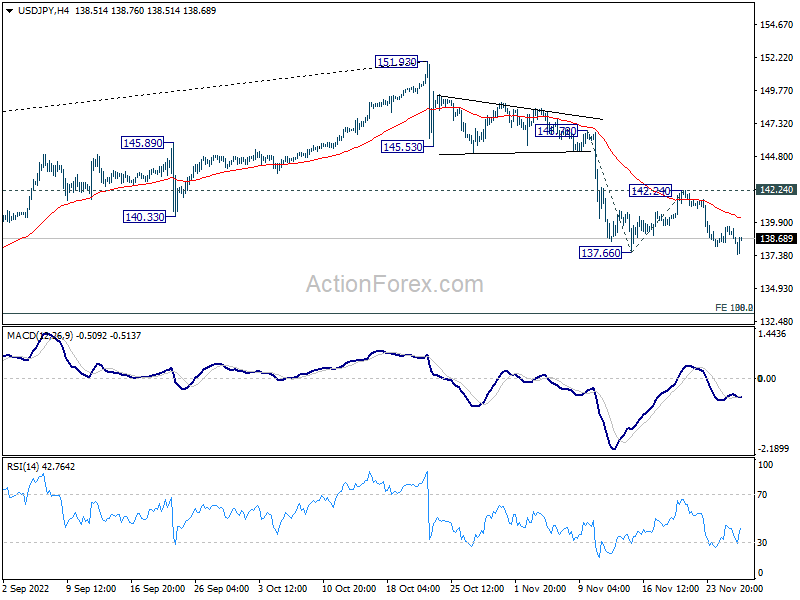
Daily Pivots: (S1) 138.49; (P) 139.04; (R1) 139.71; More...
Breach of 137.66 support suggests that fall from 151.93 is resuming. Intraday bias in now on the downside for 100% projection of 146.78 to 137.66 from 142.24 at 133.12, which is close to 133.07 medium term fibonacci level. For now, near term outlook will remain bearish as long as 142.24 resistance holds, in case of recovery.
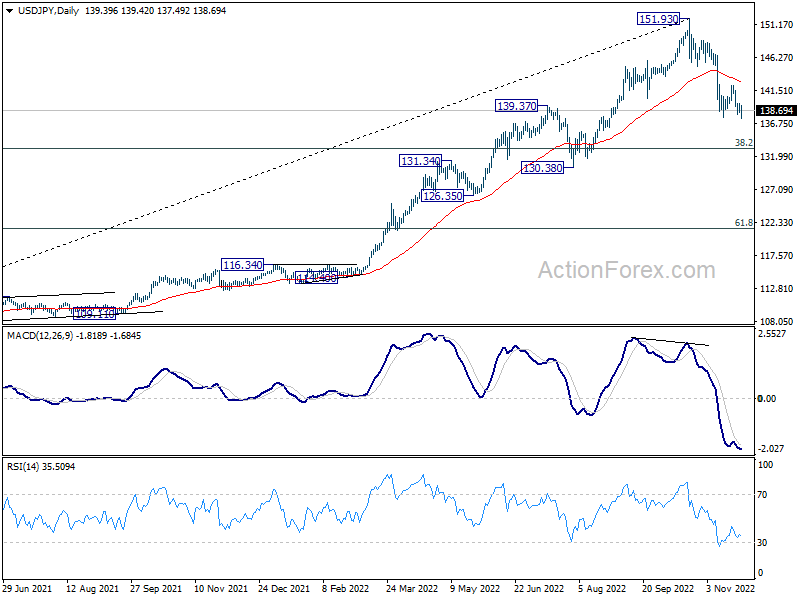
In the bigger picture, a medium term top should be formed at 151.93. Fall from there is correcting larger up trend from 102.58. It's too early to call for bearish trend reversal. But even as a corrective move, such decline should target 38.2% retracement of 102.58 to 151.93 at 133.07, or further to 55 week EMA (now at 131.22).
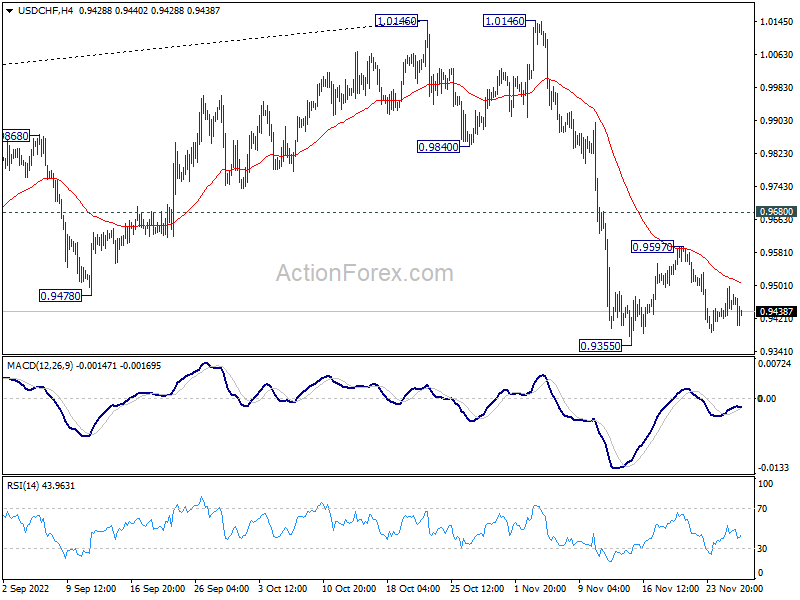
USD/CHF Mid-Day Outlook
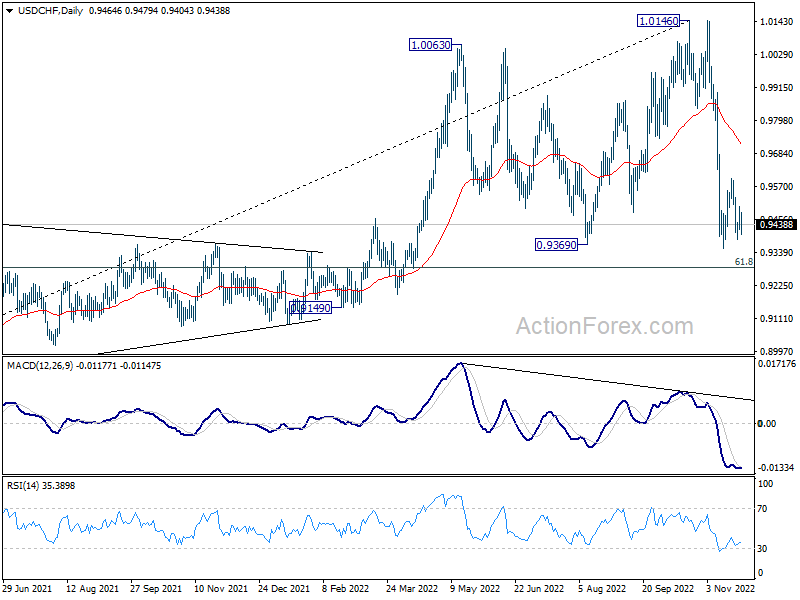
Daily Pivots: (S1) 0.9422; (P) 0.9461; (R1) 0.9499; More...
Intraday bias in USD/CHF remains neutral as consolidation from 0.9355 is still extending. On the downside, firm break of 0.9355 will resume the decline from 1.0146 to 0.9287 fibonacci level. Near term outlook will remain bearish as long as 0.9680 minor resistance holds, in case of another recovery.
In the bigger picture, rise from 0.8756 (2021 low) has completed at 1.0146, well ahead of 1.0342 long term resistance (2016 high). Based on current downside momentum, fall from 1.0146 might be a medium term down trend itself. Break of 61.8% retracement of 0.8756 to 1.0146 at 0.9287 will pave the way to 0.8756. In any case, risk will stay on the downside as long as 55 day EMA (now at 0.9726) holds.
GBP/USD Mid-Day Outlook
Daily Pivots: (S1) 1.2060; (P) 1.2094; (R1) 1.2129; More...
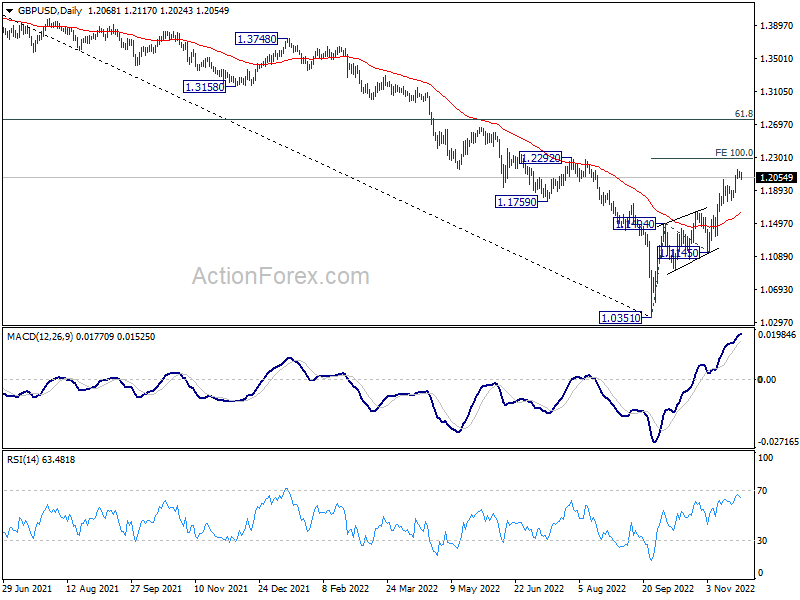
Intraday bias in GBP/USD is turned neutral first as it continued to lose upside momentum with current retreat. Further rally is expected as long as 1.1777 support holds. Next target is 100% projection of 1.0351 to 1.1494 from 1.1145 at 1.2288 first. Sustained break there will pave the way to 1.2759 medium term fibonacci level.
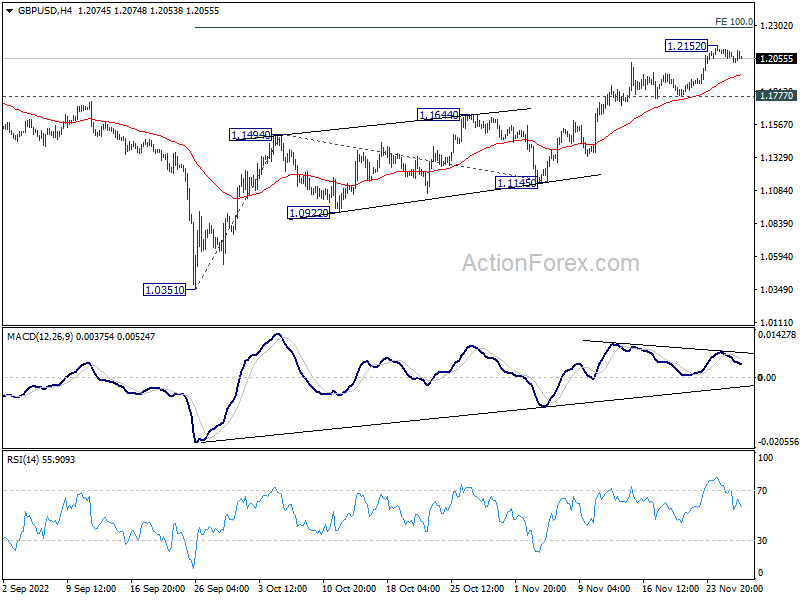
In the bigger picture, rise from 1.0351 medium term bottom is at least correcting whole down trend from 1.4248 (2021 high). Further rise is expected as long as 1.1145 support holds. Next target is 61.8% retracement of 1.4248 to 1.0351 at 1.2759. Sustained break there will pave the way back to 1.4248.