Sample Category Title
EURJPY Retreats Below 50-day SMA
EURJPY has been in a prolonged uptrend since early March, generating consecutive multi-year peaks. However, the pair has been losing ground in the short term after its rally paused at the eight-year high of 148.39.
The momentum indicators currently suggest that bearish forces are strengthening. Specifically, the RSI has crossed below its 50-neutral mark, while the MACD histogram is retreating further below both zero and its red signal line.
If sellers push the price lower, initial support could be met at the recent low of 142.54. Diving beneath that region, the bears could aim for 141.00 before the spotlight turns to the September low of 137.30. Even lower, the 135.50 hurdle could provide downside protection.
On the flipside, bullish actions could boost the price towards the 50-day simple average (SMA), currently at 144.28. Piercing through that zone, the pair could ascend towards 146.12 or higher to test the 147.75 barrier. A break above the latter might then set the stage for the eight-year high of 148.39.
In brief, EURJPY appears ready to extend its pullback as negative momentum is intensifying. Therefore, a break below the recent low of 142.54 might open the door for further downside.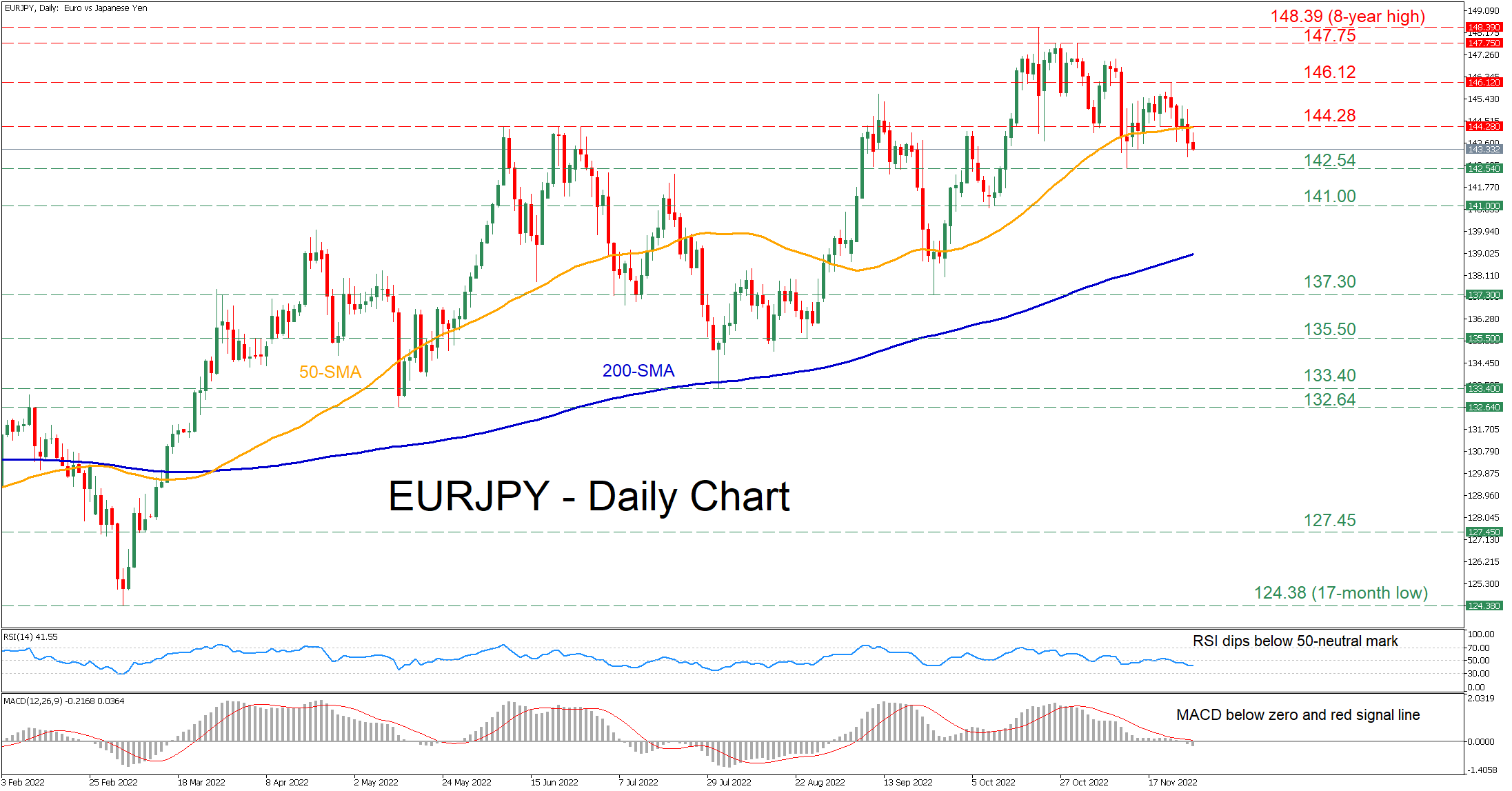
Risk Sentiment Improves as China Rebounds
Volatility could be the name of the game over the next few days due to the protests in China, speeches from Fed officials including Jerome Powell, and top-tier economic data.
Investors received a taster early this morning with Asian stocks rallying as Chinese shares rebounded from the heavy selloff triggered by unrest over Covid restrictions. Shares in the region were also supported by a rally in the property sector after China removed restrictions on developers selling stock to raise funds. European futures are pointing to a positive open amid the improving market mood in Asia. This renewed appetite for risk could find its way back to Wall Street as market jitters over the developments in China ease. In the currency space, the dollar fell along with Treasury yields while the euro hovered around the 200-day SMA at 1.0380. Gold prices rebounded during early trading helped by a weaker dollar, while oil prices jumped as speculation around more supply cuts by OPEC+ intensifies.
In Europe, the pending economic sentiment and consumer confidence figures for November could provide insight into the health of the European economy. The euro may find itself under renewed pressure if these reports fail to meet expectations. However, the key focus falls on the German inflation figures scheduled to be released today and then for the wider region on Wednesday. Inflation in Europe is expected to remain at elevated levels, with the CPI projected to ease slightly from a record high of 10.6% in October.
All eyes on Fed Chair Powell
Dollar bulls were injected with renewed inspiration on Monday thanks to hawkish comments from Federal Reserve officials. Perennial hawk Bullard said he believed “markets are underpricing a little bit the risk that the FOMC will have to be more aggressive rather than less”. New York Fed President Williams struck a softer tone but also said he saw the rate path higher.
Regardless of recent gains, the greenback could find itself under fresh selling pressure not only due to the improving market mood, but if Powell reinforces expectations over the central bank slowing its pace of interest rate increases in a speech scheduled for Wednesday. Much attention will also be directed toward the PCE Core Deflator on Thursday which is the Fed’s preferred measure of inflation. Any signs of cooling inflation will most likely fortify expectations around the Fed adopting a less aggressive approach toward rates.
Friday could be the main market shaker as all eyes turn to the monthly US non-farm payrolls report. The US economy is expected to have created 200,000 jobs in October with the unemployment rate unchanged at 3.7%. A report that meets or prints below expectations may justify a change in the pace of the Fed’s policy tightening, ultimately weakening the dollar further.
Talking technicals, the DXY remains under pressure on the daily charts. A move back below 106.00 could encourage a decline toward the 200-day SMA around 105.30. Below this point, the next level of interest can be found at 104.50.
Currency spotlight – EUR/USD
This is bound to be a volatile trading week for the EURUSD thanks to the numerous key risk events in Europe and the United States.
With the Eurozone inflation figures and Powell’s speech on Wednesday, the US PCE deflator and US ISM on Thursday, topped off with the US jobs report on Friday, this could be a rollercoaster week for the EURUSD. Looking at the technical picture, the currency pair is bullish on the daily charts but remains capped around the 200-day SMA. A solid daily close above 1.0450, followed by a move towards 1.0500 could signal that bulls remain in control. Alternatively, a selloff towards 1.0300 could result in a move to 1.0190 and 1.0100.
Commodity spotlight - Gold
Gold is waiting for a fresh fundamental spark to get its gears moving and this could come in the form of speeches from Fed officials, geopolitical risks, or key US economic data such as the NFP.
The precious metal remains in a wide range on the daily charts with support at $1735 and resistance at $1785. However, with the fundamentals slowly tilting in favour of gold bulls, a solid breakout could be around the corner. In the meantime, prices are trading above the 50-day and 100-day SMA but below the 200-day SMA. A solid breakout above $1785 could open the doors toward $1800 and $1840. Should prices slip back below $1735, this may result in a selloff towards $1700.
Dow Jones Shows Over-extension
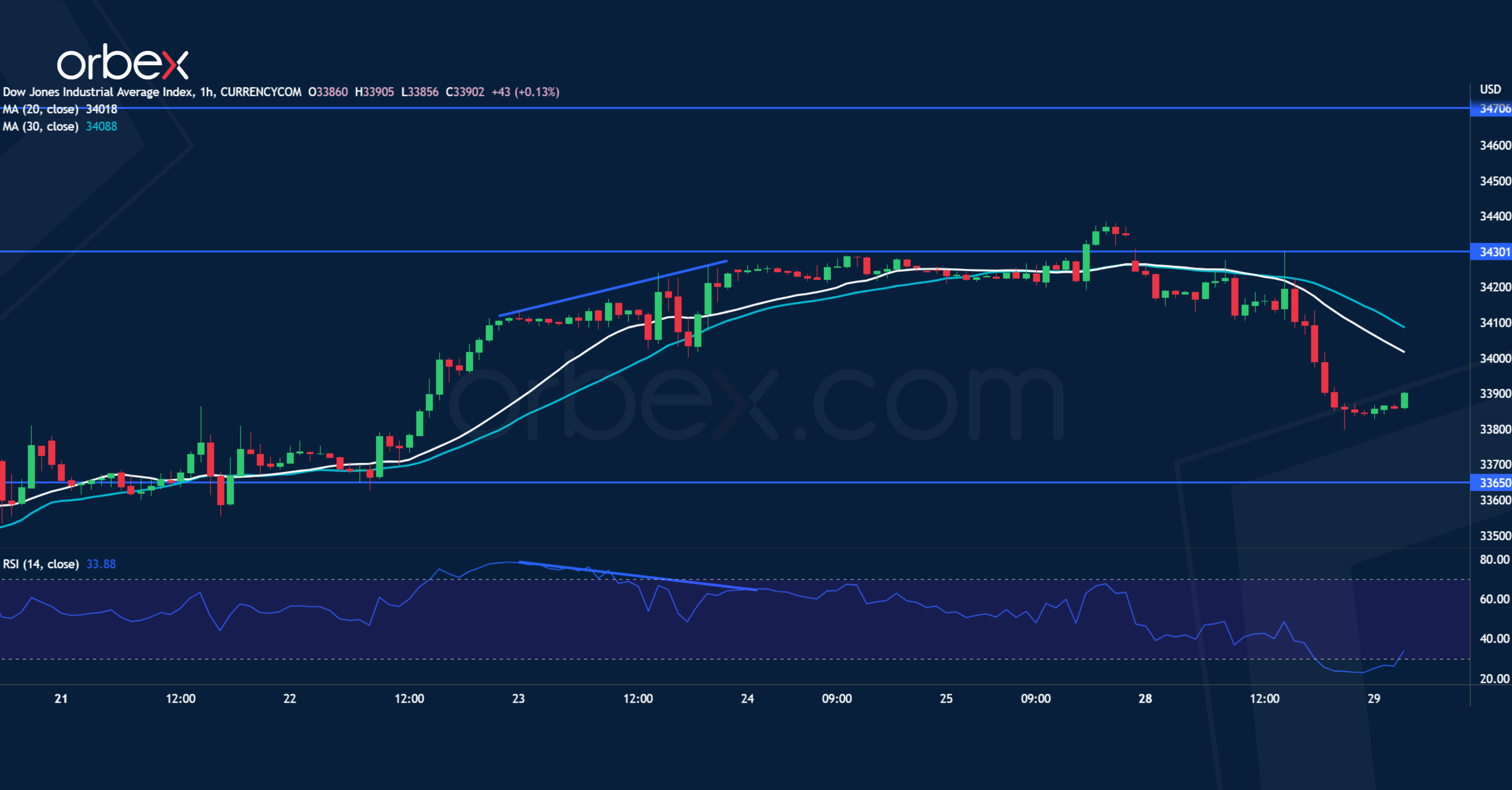
The Dow Jones 30 slips as protests in China against Covid curbs raise concerns about growth. While a rally above August’s high of 34200 is an encouraging sign, the bulls would need to secure their foothold before pushing towards 34700. A bearish RSI divergence indicates a deceleration in the upward momentum and the index could use some breathing room. A slide below 34000 has led some buyers to take profit and 33650 is the next level to gauge their interest. Only a bounce above 34300 would resume the uptrend.
AUD/USD Seeks Support
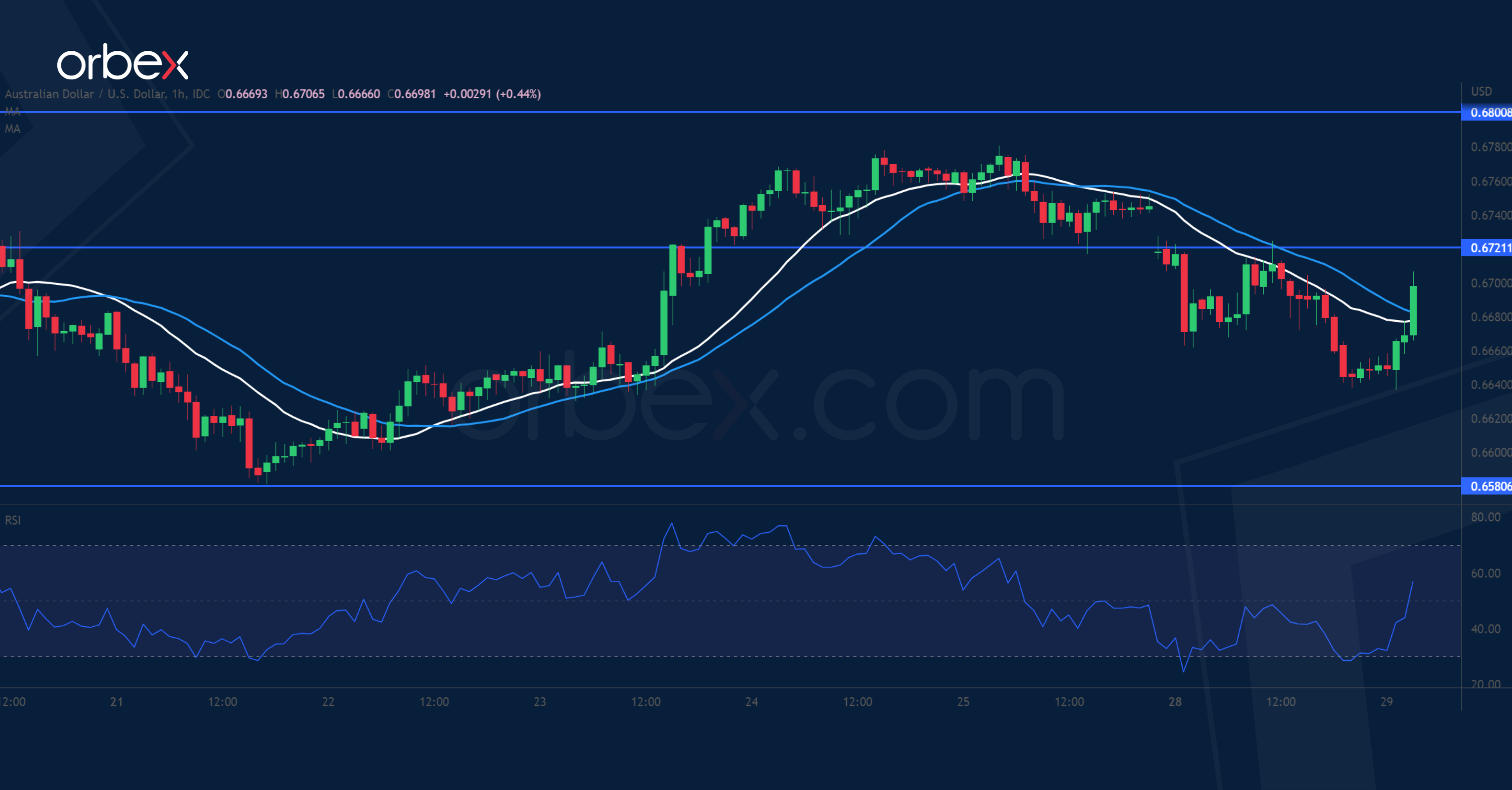
The Australian dollar retreats after a lacklustre retail sales reading in October. The pair is looking to hold onto its gains above 0.6700 following a rally earlier this month. A bounce off 0.6580 next to the 20-day moving average indicates interest in safeguarding the aussie’s recovery. 0.6720 is a fresh resistance and a close above 0.6800 would open the door for an extension to September’s peak of 0.6910. On the downside, a dip below said support would put the bulls on the defensive with 0.6400 as a second line of defence.
USD/JPY Remains Under Pressure
The Japanese yen fell after an uptick in October’s jobless rate. The rebound has met stiff selling pressure in the former demand zone around 142.40. A break below the recent low of 138.00 suggests that the path of least resistance remains down. As more buyers switch sides, increased volatility may drive the pair even lower. 135.90 is the next level to see if buyers would make their way back. Otherwise, the greenback could drift towards 132.00. The psychological level of 140.00 is the first hurdle in case of a bounce.
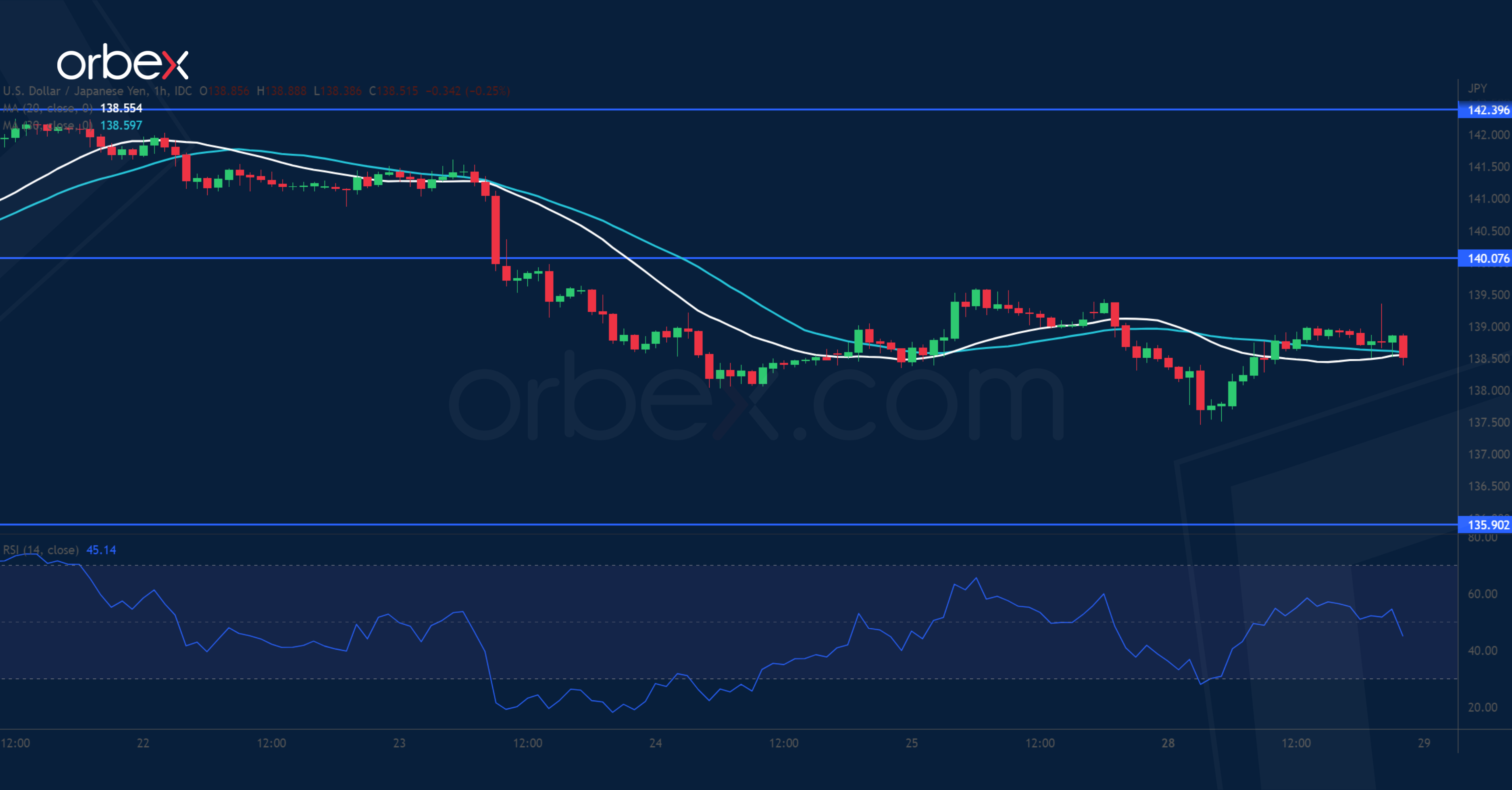
Dollar Recently Traded in Defensive and Still Looks Vulnerable to Bad Eco News
Markets
In the absence of important eco data, the new China Corona outbreaks and central bank speak were the main drivers for trading yesterday. In the end, it turned out to be a risk-off session with US indices losing about 1.50%. Fed and ECB Governors sounded rather hawkish. Even ECB’s Lagarde admitted that the it’s too early to already conclude that inflation actually reached its peak. Fed members (Bullard: markets are underpricing the risk the Fed will have to be more aggressive rather than less aggressive; Williams: a somewhat higher underlying inflation suggests a modestly higher interest rate path relative to September; Barkin: rates to be higher and for longer) also kept a hawkish tone. CB speak and technical considerations caused US and European yields to reverse earlier declines, but a substantial slide in US equities prevented yields to close really higher. US yields closed mixed with the 2-y and 30-y yield ceding 1.5/1.1 bps. The 5-y rose 1.7 bps. German yields also reversed the early decline to close less than 2 bps different from Friday. The German 10-y yield (1.99%) finished just below the 2.0% barrier. The dollar initially didn’t profit from the (mainly China driven) risk-off. EUR/USD even came within reach of 1.05, but returned intraday gains in US dealings to close at 1.0345. USD/JPY showed a similar pattern reversing an intra-day dip near 137.5, to close the day at 138.95. Sterling traders threw the towel, with EUR/GBP rebounding off the key 0.856 area to close at 0.865.
This morning, Chinese equities show a remarkable comeback (Hang Seng + 4.0%, CSI 300 +2.8%). Investors apparently hope for an easing of the strict Covid policy. The yuan rebounds (USD/CNY 7.1575). The dollar trades in the defensive (USD/JPY 138,6; DXY 106.20; EUR/USD 1.0385). Oil (Brent $84,75/b) is looking for a bottom after its recent sharp decline.
Later today, the calendar is becoming interesting. US consumer confidence (conf. board) is expected to ease from 102.5 to 100. US housing price data also are expected to ease further. In EMU CPI data from Spain, Belgian and Germany will give a preview for tomorrow’s Flash EMU CPI. The monthly dynamics are expected to slow sharply (0.1% expected for Spain and Germany), but y/y readings will stay high (German expected at 11.3% from 11.6%). The North Rhine Westphalia release this morning (-0.8%M/M and 10.4% Y/Y) suggests downside risks to the consensus. Whatever the outcome, the market reaction will be interesting, with EMU/German yields showing tentative signs of bottoming after a decline of more than a month. Will the German 10-y yield sustainably regain the 2.0% barrier? On FX markets, the dollar recently traded in the defensive and still looks vulnerable to bad eco news. At the same time, key technical levels (DXY 105.3, EUR/USD 1.0479/1.05) might hold if global risk sentiment were to deteriorate further with US equity indices showing tentative signs of a topping out process. A return of EUR/USD to/below 1.0223 would call of the EUR/USD recovery/USD correction.
News Headlines
In comments published yesterday, Polish central banker Dabrowski said that she aligns with markets to assume that already next year we may see the first policy rates cuts. She puts forward a policy rate closer to 6% compared with the current 6.75%. Falling money supply, rising consumer deposits and weakening demand all point to abating price pressure even as Polish inflation currently stands at 18% Y/Y. Dabrowski adds that Poland isn’t experiencing a wage-price spiral as “workers feel we have a slowdown and they are not escalating their pay demands”. The Polish MPC remains a dovish stronghold around strongman Glapinski whose term expires early next year. The zloty didn’t react to the comments. Instead, EUR/PLN tested the November low at 4.67 despite a risk-off market climate.
The Japanese labour market remains tight. The job-to-applicants ratio climbed from 1.34 to 1.35 last month with the unemployment rate stable at 2.6%. A separate report showed retail sales growth decelerating to 0.2% M/M in October (4.3% Y/Y). Consumption is expected to slow further as wages can’t keep up with Japanese inflation.
EUR/USD Daily Outlook
Daily Pivots: (S1) 1.0281; (P) 1.0389; (R1) 1.0448; More...
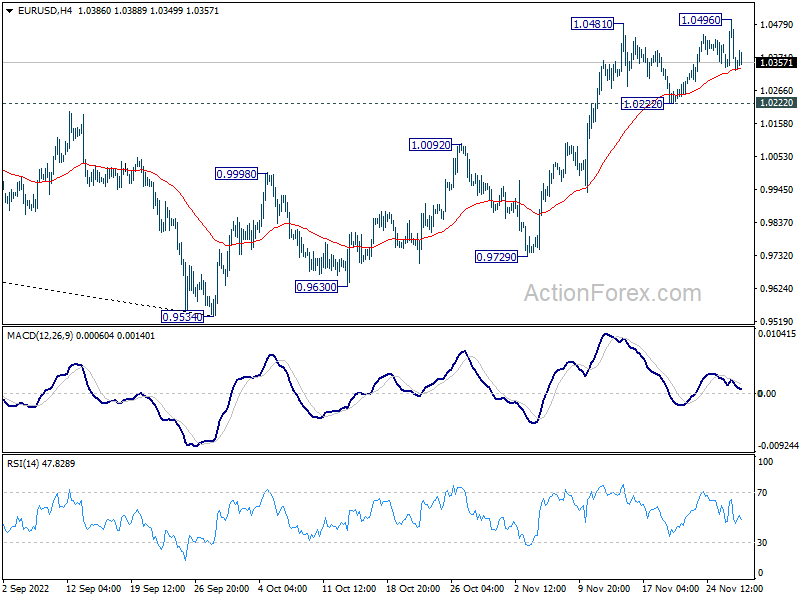
EUR/USD quickly retreated after breaching 1.4810 resistance and intraday bias is turned neutral first. Still, further rally is expected as long as 1.0222 support holds. Break of 1.0496 will resume the rise from 0.9534 to 1.0609 fibonacci level. However, firm break of 1.0222 will turn bias back to the downside for 1.0092 resistance turned support.
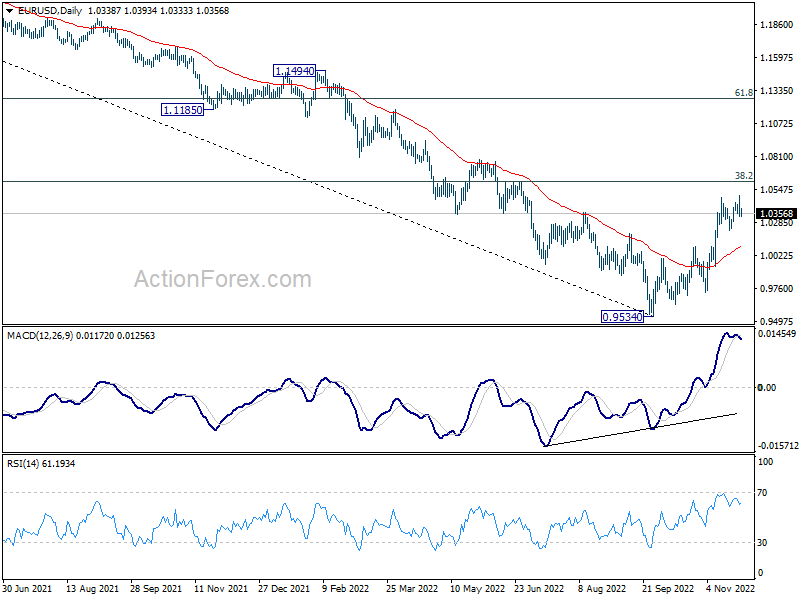
In the bigger picture, a medium term bottom was in place at 0.9534, on bullish convergence condition in daily MACD. Even as a corrective rise, rally from 0.9534 should target 38.2% retracement of 1.2348 (2021 high) to 0.9534 at 1.0609. Sustained trading above 55 week EMA (now at 1.0566) will raise the chance of trend reversal and target 61.8% retracement at 1.1273. This will now remain the favored case as long as 1.0092 resistance turned support holds.
GBP/USD Daily Outlook
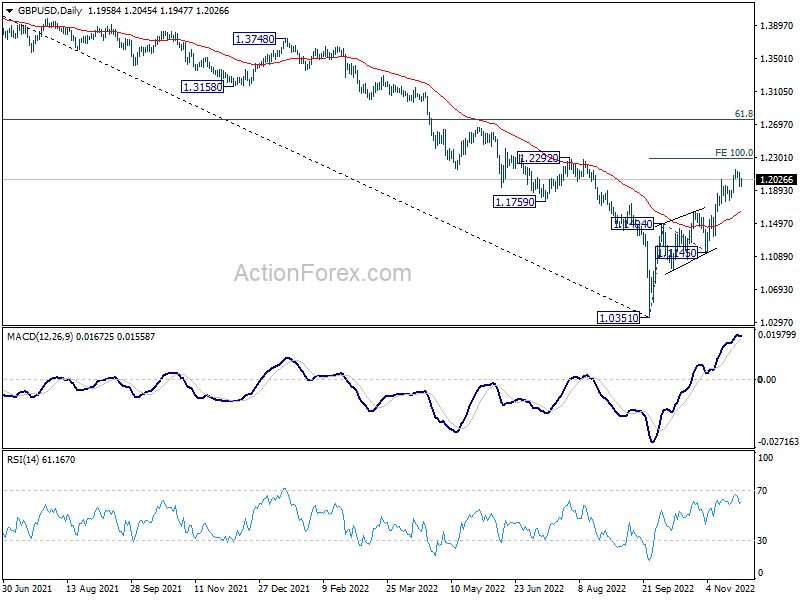
Daily Pivots: (S1) 1.1893; (P) 1.2006; (R1) 1.2070; More...
Intraday bias in GBP/USD remains neutral and further rally is expected with 1.1777 support intact. Break of 1.2152will target 100% projection of 1.0351 to 1.1494 from 1.1145 at 1.2288 first. Sustained break there will pave the way to 1.2759 medium term fibonacci level.
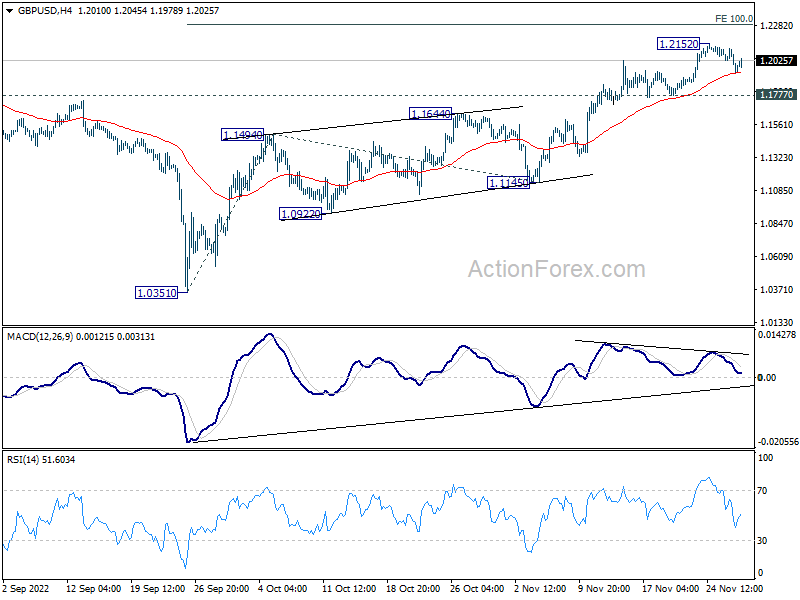
In the bigger picture, rise from 1.0351 medium term bottom is at least correcting whole down trend from 1.4248 (2021 high). Further rise is expected as long as 1.1145 support holds. Next target is 61.8% retracement of 1.4248 to 1.0351 at 1.2759. Sustained break there will pave the way back to 1.4248.
USD/CHF Daily Outlook
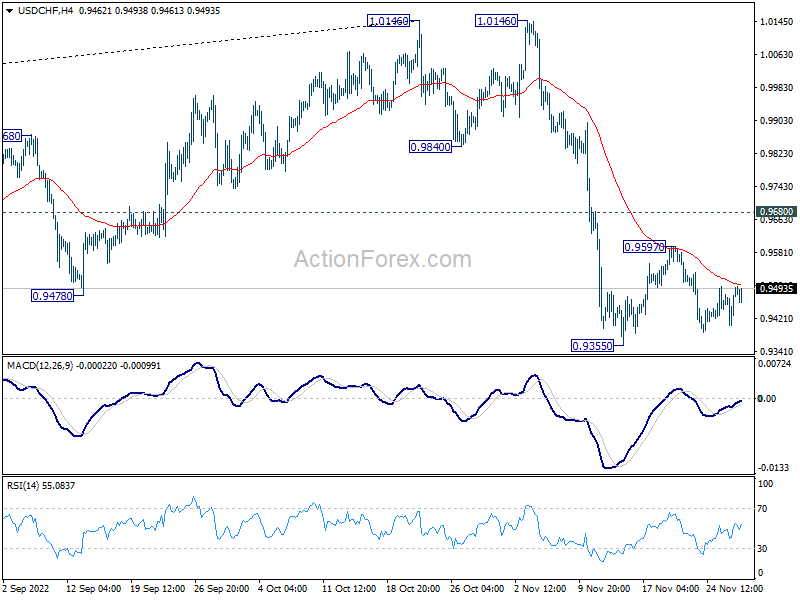
Daily Pivots: (S1) 0.9431; (P) 0.9465; (R1) 0.9523; More...
Range trading continues in USD/CHF and intraday bias remains neutral. On the downside, firm break of 0.9355 will resume the decline from 1.0146 to 0.9287 fibonacci level. Near term outlook will remain bearish as long as 0.9680 minor resistance holds, in case of another recovery.
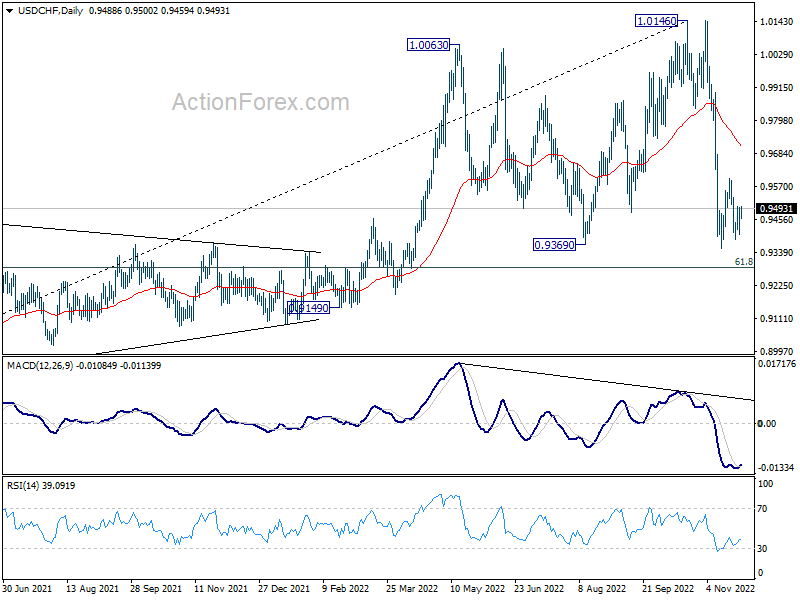
In the bigger picture, rise from 0.8756 (2021 low) has completed at 1.0146, well ahead of 1.0342 long term resistance (2016 high). Based on current downside momentum, fall from 1.0146 might be a medium term down trend itself. Break of 61.8% retracement of 0.8756 to 1.0146 at 0.9287 will pave the way to 0.8756. In any case, risk will stay on the downside as long as 55 day EMA (now at 0.9726) holds.
USD/JPY Daily Outlook
Daily Pivots: (S1) 137.79; (P) 138.62; (R1) 139.74; More...
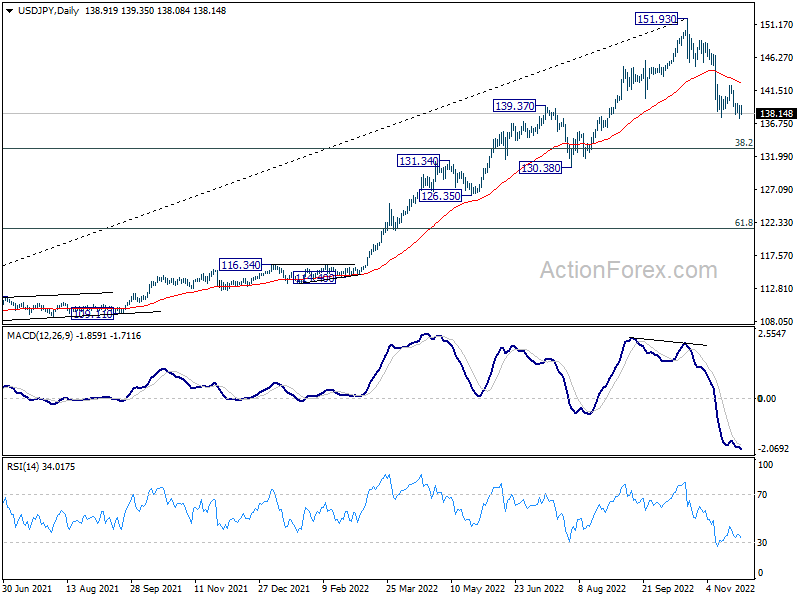
Intraady bias in USD/JPY remains mildly on the downside as fallf rom 151.93 is resuming. Next target is 100% projection of 146.78 to 137.66 from 142.24 at 133.12, which is close to 133.07 medium term fibonacci level. For now, near term outlook will remain bearish as long as 142.24 resistance holds, in case of recovery.
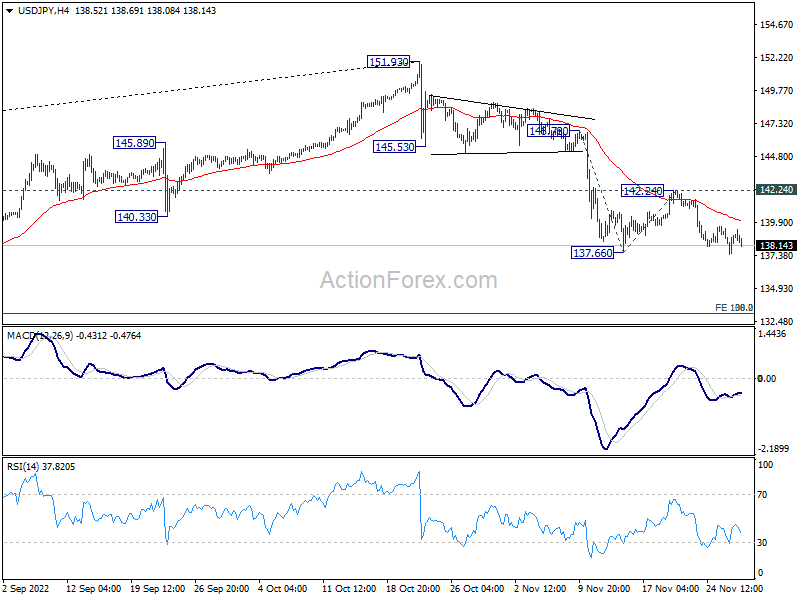
In the bigger picture, a medium term top should be formed at 151.93. Fall from there is correcting larger up trend from 102.58. It's too early to call for bearish trend reversal. But even as a corrective move, such decline should target 38.2% retracement of 102.58 to 151.93 at 133.07, or further to 55 week EMA (now at 131.22).