Sample Category Title
Sunset Market Commentary
Markets
All eyes were on Europe this morning with the publication of PMI business confidence for November. It topped the bar on all accounts. Both manufacturing and services defied expectations for a further decline: the former rising from 46.4 to 47.3 and the latter stabilizing at 48.6. The composite PMI rose as a consequence from 47.3 to 47.8. That said, this is still below the neutral 50 level. S&P Global currently expects the EU economy to contract by 0.2% q/q in the running quarter. Demand is clearly weakening following the cost-of-living crisis with depleting order books, causing companies to eliminate backlogs at the fastest pace in two years and to be cautious in their hiring intentions. Yet, the November report offers a glimpse of hope. While both input and output prices continue to advance to very elevated levels, they do so at a (significantly) slower pace. Companies note the weakened demand has alleviated pressures on supply chains. And business optimism in the services sector - though still low - further improved while pessimism in the manufacturing sector greatly fell back due to concerns on supply chains and energy rationing having eased. The decelerating inflation trend is what defined the initial market response, mainly in European yields. They fell from intraday highs to lows before recovering later on, especially at the front of the curve with high inflationary pressures leaving the ECB no choice but to tighten further, whatever the economic cost. Daily changes in Germany range between -2.9 (10-y) to +5 bps (2y). Peripheral yield spreads vs Germany’s 10y narrow with Italy (-6 bps) outperforming peers. The Italian/German spread is moving towards levels last seen in May/June this year. US yields rose a few bps too initially but momentum snapped in early US dealings with the curve now showing declines between 2.5 and 6.3 bps. Markets await the publication of the November FOMC meeting minutes in which they will look for clues whether the 5% terminal rate that’s currently priced in is what Powell had in mind when he said the “ultimate level of interest rates will be higher than previously expected” at the Nov 2 meeting.
In other markets, oil takes a serious beating after the Russian oil price cap under discussion is seen high enough to keep flows running to the bloc (see below). The Canadian dollar, sensitive to oil, loses out today. Trading in the Norwegian krone is often oil-driven too but not today. Scandinavian currencies, the SEK included, are catching a nice, broad bid. Stocks show little direction. The EuroStoxx50 gains modestly and so does WS at the open. The dollar is trading in the defense on the currency market. The greenback loses about half a big figure on a trade-weighted basis. DXY is currently changing hands around 106.81. EUR/USD is testing the May interim low around 1.035, up from 1.03. Sterling is better bid today, with better-than-expected though still-gloomy UK PMIs delivering a small push in the back. Technical factors helped too with EUR/GBP bouncing off the 0.87 big figure resistance level. The pair currently trades around 0.862 and is testing the upward sloping trendline connecting the August and October lows.
News Headlines
G7-nations are expected to propose a price cap on Russian oil between $65 and $70 a barrel, according to sources. This range is in line with the historical average from before the invasion and is on the higher end of what was expected given that it’s way above Russia’s oil production cost. The price cap would ban companies from providing shipping and services, such as insurance, brokering and financial assistance, needed to transport Russian oil anywhere in the world unless the oil is sold below the agreed threshold. Industry experts say that Russian oil is currently trading around $65/b. That’s a significant discount compared to eg Brent prices, but in line with the proposed cap. Therefore, its impact should be limited. Brent crude fell from $89/b to $86/b.
The UK Supreme Court ruled that the Scottish government needs agreement from Westminster to have legal authority to hold an independence referendum. Under current devolution law, legislation relating to the union between Scotland and the UK is reserved for Westminster. Scottish PM Sturgeon hoped to hold a referendum in October next year. The previous one dates back to 2014 when 55% of the voters wanted to maintain in the UK. Sturgeon told a press conference that she would seek to make the next UK general election in 2024 a de facto referendum on independence.
USD/JPY Mid-Day Outlook
Daily Pivots: (S1) 140.79; (P) 141.52; (R1) 141.94; More...
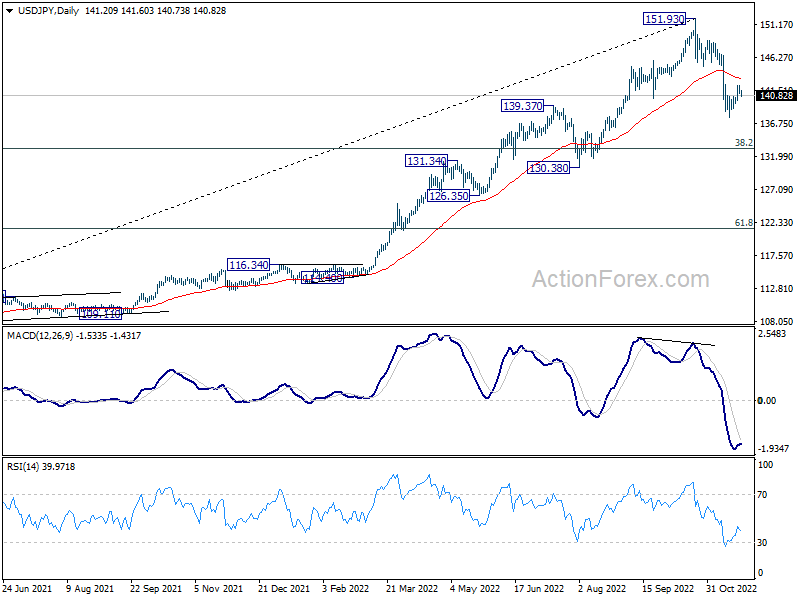
Intraday bias in USD/JPY stays neutral at this point. With 142.45 minor resistance intact, further decline is in favor. Break of 139.63 minor support will bring retest of 137.66 low first. Break there will resume the decline from 151.93, to 133.07 fibonacci level, as a correction to the larger up trend. Nevertheless, firm break of 142.45 will turn bias back to the upside for stronger rebound to 55 day EMA (now at 143.32) and above.
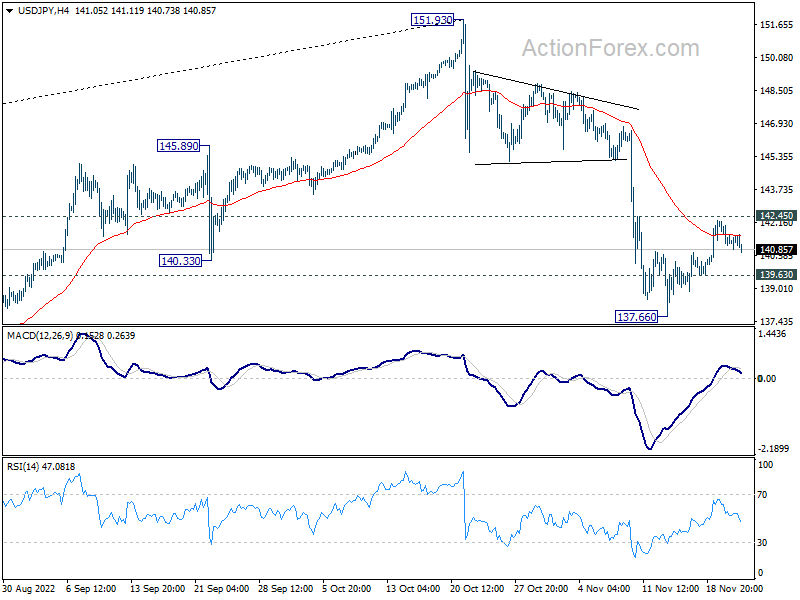
In the bigger picture, a medium term top should be formed at 151.93. Fall from there is correcting larger up trend from 102.58. It's too early to call for bearish trend reversal. But even as a corrective move, such decline should target 38.2% retracement of 102.58 to 151.93 at 133.07, or further to 55 week EMA (now at 130.28).
USD/CHF Mid-Day Outlook
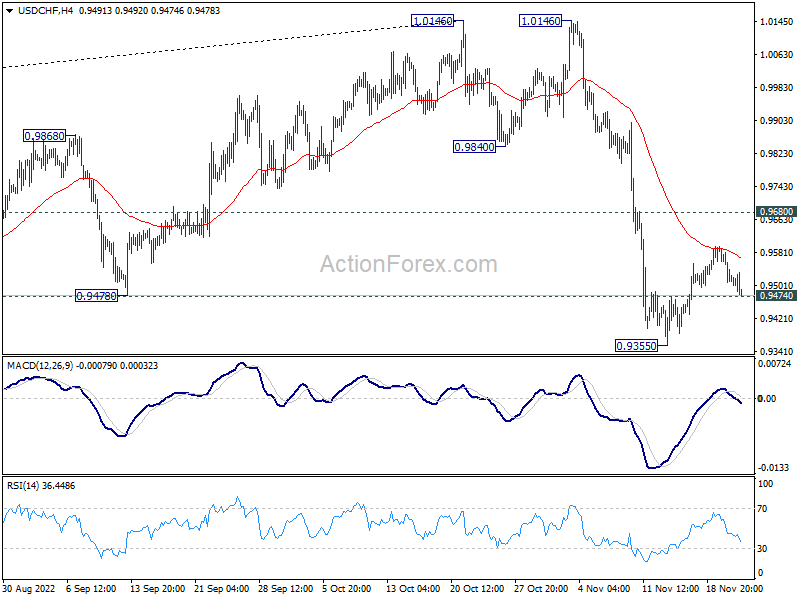
Daily Pivots: (S1) 0.9489; (P) 0.9541; (R1) 0.9572; More...
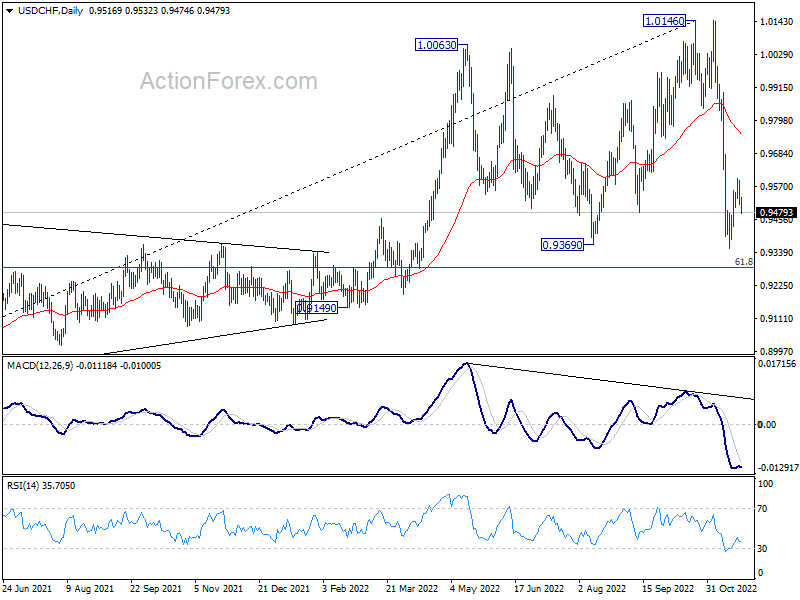
Intraday bias in USD/CHF remains neutral for the moment. Near term outlook stays bearish with 0.9680 minor resistance intact. On the downside, break of 0.9474 minor support will bring retest of 0.9355 low first. Break there will resume the fall from 1.0146 to 0.9287 fibonacci level.
In the bigger picture, rise from 0.8756 (2021 low) has completed at 1.0146, well ahead of 1.0342 long term resistance (2016 high). Based on current downside momentum, fall from 1.0146 might be a medium term down trend itself. Break of 61.8% retracement of 0.8756 to 1.0146 at 0.9287 will pave the way to 0.8756. In any case, risk will stay on the downside as long as 55 day EMA (now at 0.9767) holds.
EUR/USD Mid-Day Outlook
Daily Pivots: (S1) 1.0259; (P) 1.0283; (R1) 1.0328; More...
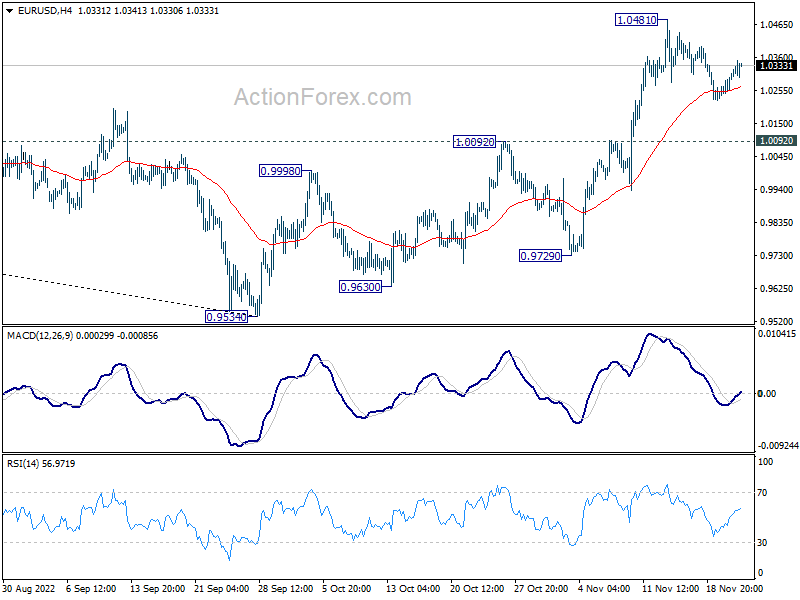
Intraday bias in EUR/USD stays neutral for the moment, and more consolidations could be seen. After all, as long as 1.0092 resistance turned support holds, further rally is still expected. On the upside, break of 1.0481 will resume the rise from 0.9534 and target 1.0609 fibonacci level. However, sustained break of 1.0092 will turn bias to the downside for 55 day EMA (now at 1.0052) and below.
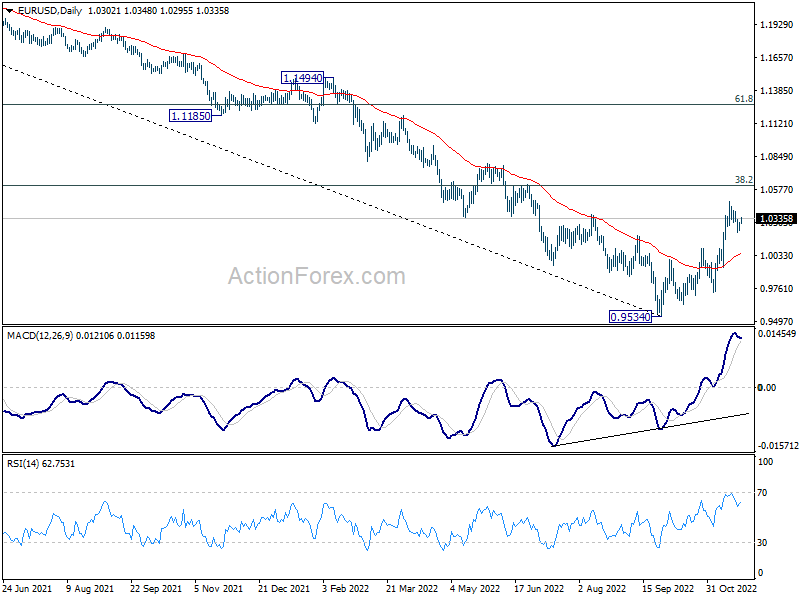
In the bigger picture, a medium term bottom was in place at 0.9534, on bullish convergence condition in daily MACD. Even as a corrective rise, rally from 0.9534 should target 38.2% retracement of 1.2348 (2021 high) to 0.9534 at 1.0609. Sustained trading above 55 week EMA (now at 1.0566) will raise the chance of trend reversal and target 61.8% retracement at 1.1273. This will now remain the favored case as long as 1.0092 resistance turned support holds.
GBP/USD Mid-Day Outlook
Daily Pivots: (S1) 1.1834; (P) 1.1869; (R1) 1.1919; More...
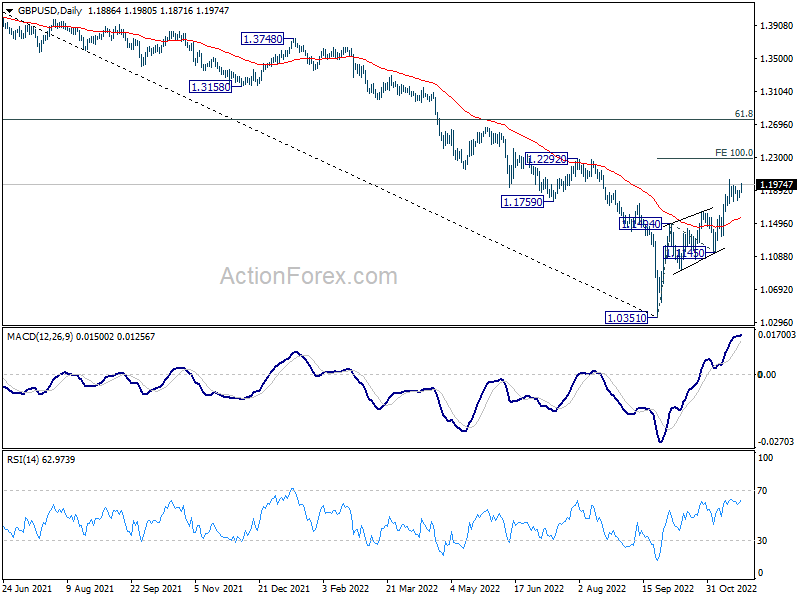
GBP/USD rises notably today but stays below 1.2028 resistance. Intraday bias remains neutral first. But overall, further rally is expected as long as 1.1644 resistance turned support holds. On the upside, break of 1.2028 will resume whole rise from 1.0351 to 100% projection of 1.0351 to 1.1494 from 1.1145 at 1.2288. However, sustained break of 1.1644 will bring deeper fall to 1.1145 support instead.
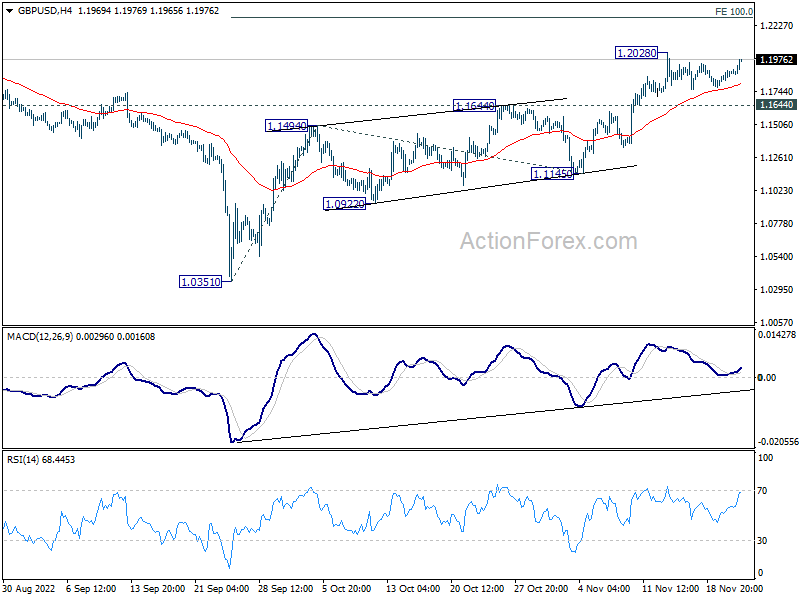
In the bigger picture, rise from 1.0351 medium term bottom is at least correcting whole down trend from 1.4248 (2021 high). Further rise is expected as long as 1.1145 support holds. Next target is 61.8% retracement of 1.4248 to 1.0351 at 1.2759.
Sterling Rises Broadly, Shrugging Weak PMI Data
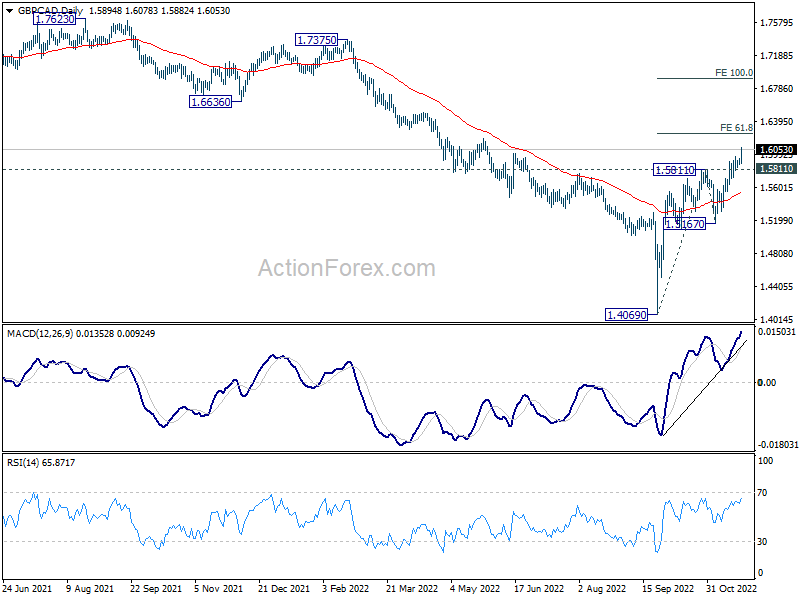
Sterling surges broadly today, shrugging off PMI data which indicates extended weakness in the economy. It's even over-powering New Zealand Dollar, which was lifted by RBNZ's jumbo rate hike. On the other hand, selling is focusing on Dollar, Canadian and Australia, while Yen is also on the weak side. Euro is mixed, and it's clearly lagging behind both the Pound and Swiss Franc.
Technically, GBP/CAD is extending the rise from 1.4069 low, and further rally is expected as long as 1.5811 resistance turned support holds. Next target is 61.8% projection of 1.4069 to 1.5811 from 1.5167 at 1.6244. Decisive break there could prompt upside acceleration to 100% projection at 1.6909, and solidify the momentum for a medium term up trend, rather than a corrective rebound.
In Europe, at the time of writing, FTSE is up 0.06%. DAX is down -0.31%. CAC is down -0.12%. Germany 10-year yield is down -0.003 at 1.982. Earlier in Asia, Japan was on holiday, Hong Kong HSI rose 0.57%. China Shanghai SSE rose 0.26% Singapore Strait Times dropped -0.11%.
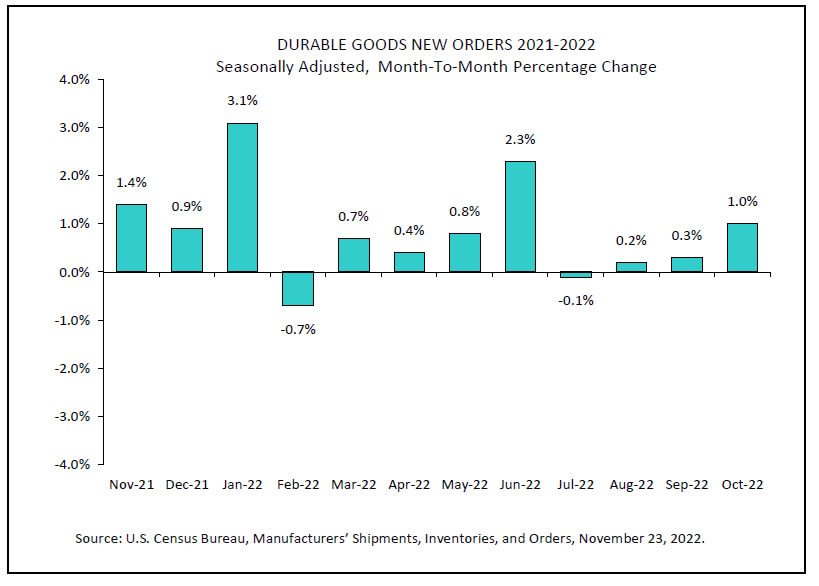
US durable goods orders rose 1.0% mom in Oct, ex-transport orders up 0.5% mom
US durable goods orders rose 1.0% mom to USD 277.4B in October, above expectation of 0.4% mom. New orders were up seven of the last eight months. Ex-transport orders rose 0.5% mom to USD 179.6B, above expectation of 0.1% mom. Ex-defense orders rose 0.8 mom to USD 260.8B. Transportation equipment, up six of the last seven months, rose 2.1% mom to USD 97.8B.
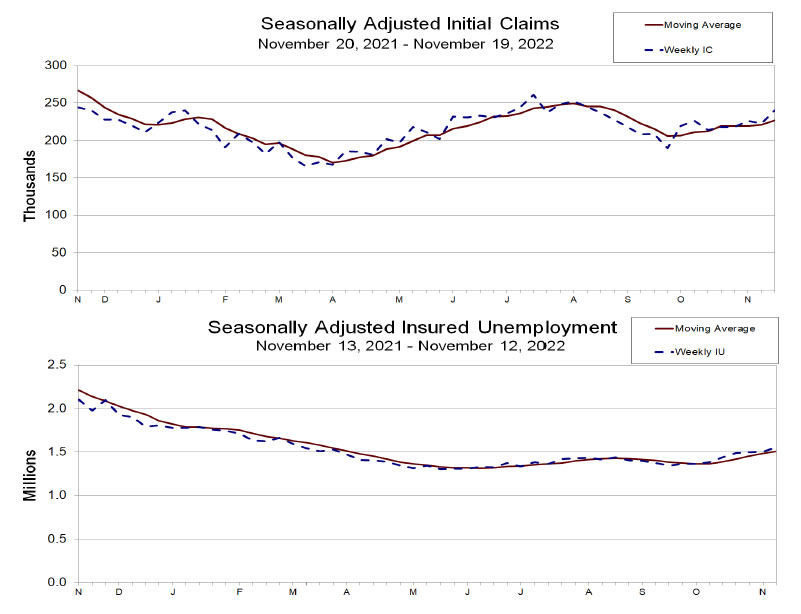
US initial jobless claims rose to 240k, above expectation
US initial jobless claims rose 17k to 240k in the week ending November 19, above expectation of 224k. Four-week moving average of initial claims rose 4.4k to 227k.
Continuing claims rose 48k to 1551k in the week ending November 12. Four-week moving average of continuing claims rose 28k to 1510k.
Bundesbank: Inflation rate in double digits beyond turn of the year
In the monthly report, Bundesbank said "all in all, despite the higher than expected economic activity in the summer quarter, a recession in the German economy is to be expected in the winter half-year." Downward forces should "clearly predominate in the coming months". Weaker global economy will weigh on exports while high inflation is dampening private consumption.
"The inflation rate could remain in the double digits beyond the turn of the year," it noted. There is still strong cost pressure, especially for industrial products on the upstream stages. Energy prices have recently been declining but are still at a very high level. Passing of raw material prices is not yet complete.
ECB de Guindos: We will continue to raise interest rates
ECB Vice-President Luis de Guindos said at a finance event, "we will continue to raise interest rates to a level that allows us to ensure that inflation converges towards our definition of price stability."
"It is very important to look at the evolution of underlying inflation and possible second round effects because they will determine the response of monetary policy," De Guindos said.
While he expect inflation to slow in Q1 or H1 of next year, "we also believe core inflation will be high in coming months." Also, he noted, "it is very possible that in the fourth quarter and the first quarter of next year we will have negative growth rates."
Eurozone PMI composite ticked up to 47.8, consistent with -0.2% GDP contraction in Q4
Eurozone PMI Manufacturing rose from 46.4 to 47.3 in November. PMI Services was unchanged at 48.6. PMI Composite rose from 47.3 to 47.8.
Chris Williamson, Chief Business Economist at S&P Global Market Intelligence said:
"A further fall in business activity in November adds to the chances of the eurozone economy slipping into recession. So far, the data for the fourth quarter are consistent with GDP contracting at a quarterly rate of just over 0.2%.
"However, the November PMI data also bring some tentative good news. In particular, the overall rate of decline has eased compared to October. Most encouragingly, supply constraints are showing signs of easing, with supplier performance even improving in the region's manufacturing heartland of Germany. Warm weather has also allayed some of the fears over energy shortages in the winter months.
"Price pressures, the recent surge of which has prompted further policy tightening from the ECB, are also now showing signs of cooling, most noticeably in the manufacturing sector. Not only should this help contain the cost of living crisis to some extent, but the brighter inflation outlook should take some pressure off the need for further aggressive policy tightening.
"However, it's clear that manufacturing remains in a worryingly severe downturn, and service sector activity is also still under intense pressure, both largely as a result of the cost of living crisis and recent tightening of financial conditions. A recession therefore looks likely, though the latest data provide hope that the scale of the downturn may not be as severe as previously feared."
Germany PMI Manufacturing improved from 45.1 o 46.7 in November. PMI Services dropped from 46.5 to 46.4. PMI Composite also recovered slightly from 45.1 to 46.4.
France PMI Manufacturing improved from 47.2 to 49.1 in November. But PMI Services dropped from 51.7 to 49.4, a 20-month low. PMI Composite dropped from 50.2 to 48.8, a 21-month low.
UK PMI composite ticked up to 48.3, downturn will deepen into new year
UK PMI Manufacturing was unchanged at 46.2 in November. PMI services was also unchanged at 48.8. PMI Composite ticked up from 48.2 to 48.3.
Chris Williamson, Chief Business Economist at S&P Global Market Intelligence said:
"A further steep fall in business activity in November adds to growing signs that the UK is in recession, with GDP likely to fall for a second consecutive quarter in the closing months of 2022.
"If pandemic lockdown months are excluded, the PMI for the fourth quarter so far is signalling the steepest economic contraction since the height of the global financial crisis in the first quarter of 2009, consistent with the economy contracting at a quarterly rate of 0.4%. "
Forward-looking indicators, notably an increasingly steep drop in demand for goods and services, suggest the downturn will deepen as we head into the new year."
RBNZ hikes 75bps to 4.25%, tightening not finished
RBNZ raises the Official Cash Rate by a record 75bps to 4.25% as widely expected. The central bank maintained that "monetary conditions needed to continue to tighten further, so as to be confident there is sufficient restraint on spending to bring inflation back within its 1-3 percent per annum target range."
During the meeting, increases of 50, 75 and 100bps were considered. But members agreed that "a larger increase in the OCR was appropriate, given the resilience of domestic spending, and the higher and more persistent actual and expected inflation outcomes."
But on the "balances of risks", a 75bps hike was "appropriate at this meeting". Members highlights that "the cumulative tightening of monetary conditions delivered to date continues to pass through to the economy via the lagged transmission to effective retail interest rates."
In the new forecasts, annual inflation is projected to rise further to 7.5% in Q4 and Q1, then stay above 5% throughout 2023. Inflation would then slowly drop back to 2.9% in Q3, 2024. Quarterly GDP is projected to contract from Q2 2023 to Q1 2024, turn flat in Q2 and Q3 2024, before returning to slight growth. OCR will continue to rise and peak at 5.5% in Q3 2023, before turning down in second half of 2024.
Australia PMI composite dropped to 47.7, deteriorating demand and worsening price pressures
Australia PMI Manufacturing dropped from 52.7 to 51.5 in November, a 29-month low. PMI Services dropped from 49.3 to 47.2, a 10-month low. PMI Composite also dropped from 49.8 to 47.7, a 10-month low.
Jingyi Pan, Economics Associate Director at S&P Global Market Intelligence said:
"The latest S&P Global Flash Australia Composite PMI data revealed that the private sector economy further contracted midway into the fourth quarter, faced with deteriorating demand conditions. In particular, the service sector continued to be affected by higher interest rates and capacity constraints, leading to a sharper fall in business activity.
"That said, with price inflation further climbing in November, the pressure remains on the central bank to keep tightening monetary policy to rein in prices. This is also amid indications of solid employment growth from the PMI data.
"The mix of deteriorating demand and worsening price pressures does not bode well for the near-term outlook, and this has also been reinforced by the decline in private sector confidence in November."
GBP/USD Mid-Day Outlook
Daily Pivots: (S1) 1.1834; (P) 1.1869; (R1) 1.1919; More...
GBP/USD rises notably today but stays below 1.2028 resistance. Intraday bias remains neutral first. But overall, further rally is expected as long as 1.1644 resistance turned support holds. On the upside, break of 1.2028 will resume whole rise from 1.0351 to 100% projection of 1.0351 to 1.1494 from 1.1145 at 1.2288. However, sustained break of 1.1644 will bring deeper fall to 1.1145 support instead.
In the bigger picture, rise from 1.0351 medium term bottom is at least correcting whole down trend from 1.4248 (2021 high). Further rise is expected as long as 1.1145 support holds. Next target is 61.8% retracement of 1.4248 to 1.0351 at 1.2759.
Economic Indicators Update
| GMT | Ccy | Events | Actual | Forecast | Previous | Revised |
|---|---|---|---|---|---|---|
| 22:00 | AUD | Manufacturing PMI Nov P | 51.5 | 52.7 | ||
| 22:00 | AUD | Services PMI Nov P | 47.2 | 49.3 | ||
| 01:00 | NZD | RBNZ Rate Decision | 4.25% | 4.25% | 3.50% | |
| 08:15 | EUR | France Manufacturing PMI Nov P | 49.1 | 47 | 47.2 | |
| 08:15 | EUR | France Services PMI Nov P | 49.4 | 50.6 | 51.7 | |
| 08:30 | EUR | Germany Manufacturing PMI Nov P | 46.7 | 45.2 | 45.1 | |
| 08:30 | EUR | Germany Services PMI Nov P | 46.4 | 46.4 | 46.5 | |
| 09:00 | EUR | Eurozone Manufacturing PMI Nov P | 47.3 | 46.5 | 46.4 | |
| 09:00 | EUR | Eurozone Services PMI Nov P | 48.6 | 48.4 | 48.6 | |
| 09:30 | GBP | Manufacturing PMI Nov P | 46.2 | 45.6 | 46.2 | |
| 09:30 | GBP | Services PMI Nov P | 48.8 | 48 | 48.8 | |
| 13:30 | USD | Initial Jobless Claims (Nov 18) | 240K | 224K | 222K | 223K |
| 13:30 | USD | Durable Goods Orders Oct | 1.00% | 0.40% | 0.40% | 0.30% |
| 13:30 | USD | Durable Goods Orders ex Transportation Oct | 0.50% | 0.10% | -0.50% | -0.90% |
| 14:45 | USD | Manufacturing PMI Nov P | 49.8 | 50.4 | ||
| 14:45 | USD | Services PMI Nov P | 47.7 | 47.8 | ||
| 15:00 | USD | Michigan Consumer Sentiment Nov F | 54.7 | 54.7 | ||
| 15:00 | USD | New Home Sales Oct | 575K | 603K | ||
| 15:30 | USD | Crude Oil Inventories | -2.6M | -5.4M | ||
| 17:00 | USD | Natural Gas Storage | 86B | 64B | ||
| 19:00 | USD | FOMC Meeting Minutes |
USD/CAD Eyes Macklem, FOMC
The Canadian dollar has edged lower on Wednesday. In the North American session, USD/CAD is trading at 1.3428, up 0.42%.
Is Canada heading towards a recession?
The Canadian consumer is in a sour mood. I don’t blame her, given the cost-of-living crisis and higher mortgage payments due to rising interest rates. Retail sales for September slipped 0.5% MoM as expected, but lower than the August gain of 0.4%. More worrying, retail sales fell by 1.0% QoQ, the first quarterly decline since Q2 2020.
The decline in consumer spending could well be a result of the Bank of Canada’s concerted effort to beat inflation with a steep rate-hike cycle, which has raised the cash rate to 3.75%. Despite this, inflation has been stickier than expected, currently at 6.9%.
The drop in retail sales will put a damper on expectations of a 50-basis point hike at the December meeting, as the Bank of Canada will likely deliver a modest 25-bp hike. Inflation, the bank’s number one priority, remains very high at 6.9%, as the BoC’s aggressive rate-hike cycle is yet to show results. The benchmark rate is currently at 3.75%, and like the Federal Reserve, there’s more life remaining in the current rate-tightening cycle.
The BoC is closely monitoring employment and retail sales data, as strong numbers will make it easier for the bank to continue hiking as policy makers look for that elusive peak in inflation. The bank will have little choice but to continue raising rates until it sees indications that inflation is peaking, and is expected to continue raising rates into next year. Higher and higher rates make it ever more difficult for the BoC to guide the economy to a soft landing without tipping into a recession.
The Canadian dollar could show stronger movement later in the day, with two key events on the calendar. BoC Governor Macklem will testify before a parliamentary committee in Ottawa, while the FOMC releases the minutes of its meeting earlier this month, where it raised rates by 75 basis points.
USD/CAD Technical
- USD/CAD is putting pressure on resistance at 1.3455. Next, there is resistance at 1.3523
- There is support at 1.3341 and 1.3218
US durable goods orders rose 1.0% mom in Oct, ex-transport orders up 0.5% mom
US durable goods orders rose 1.0% mom to USD 277.4B in October, above expectation of 0.4% mom. New orders were up seven of the last eight months. Ex-transport orders rose 0.5% mom to USD 179.6B, above expectation of 0.1% mom. Ex-defense orders rose 0.8 mom to USD 260.8B. Transportation equipment, up six of the last seven months, rose 2.1% mom to USD 97.8B.
US initial jobless claims rose to 240k, above expectation
US initial jobless claims rose 17k to 240k in the week ending November 19, above expectation of 224k. Four-week moving average of initial claims rose 4.4k to 227k.
Continuing claims rose 48k to 1551k in the week ending November 12. Four-week moving average of continuing claims rose 28k to 1510k.
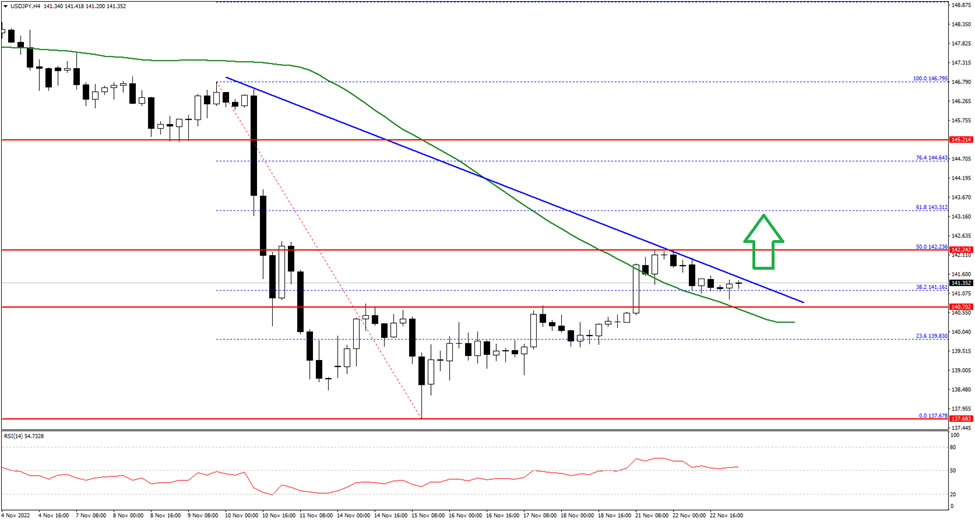
USD/JPY Pair Moved into a Short-term Bearish Zone Below 142.00
The US Dollar started a fresh decline from well above the 145.00 zone against the Japanese Yen. The USD/JPY pair traded below the 142.00 level to move into a short-term bearish zone.
The pair traded as low as 137.67 and is currently correcting losses above the 50 hourly simple moving average. An immediate resistance on the upside is near the 141.60 level and a connecting bearish trend line on the hourly chart.
The next major resistance is near 142.25 on FXOpen. A clear break above the 142.25 resistance could push the price towards 143.20. The next major resistance is near the 144.00 level.
On the downside, an initial support is near the 140.70 zone. The next major support sits near the 139.00 level, below which there is a risk of more downsides towards the 138.00 level.