Sample Category Title
Pound Steadies after Sterling Performance
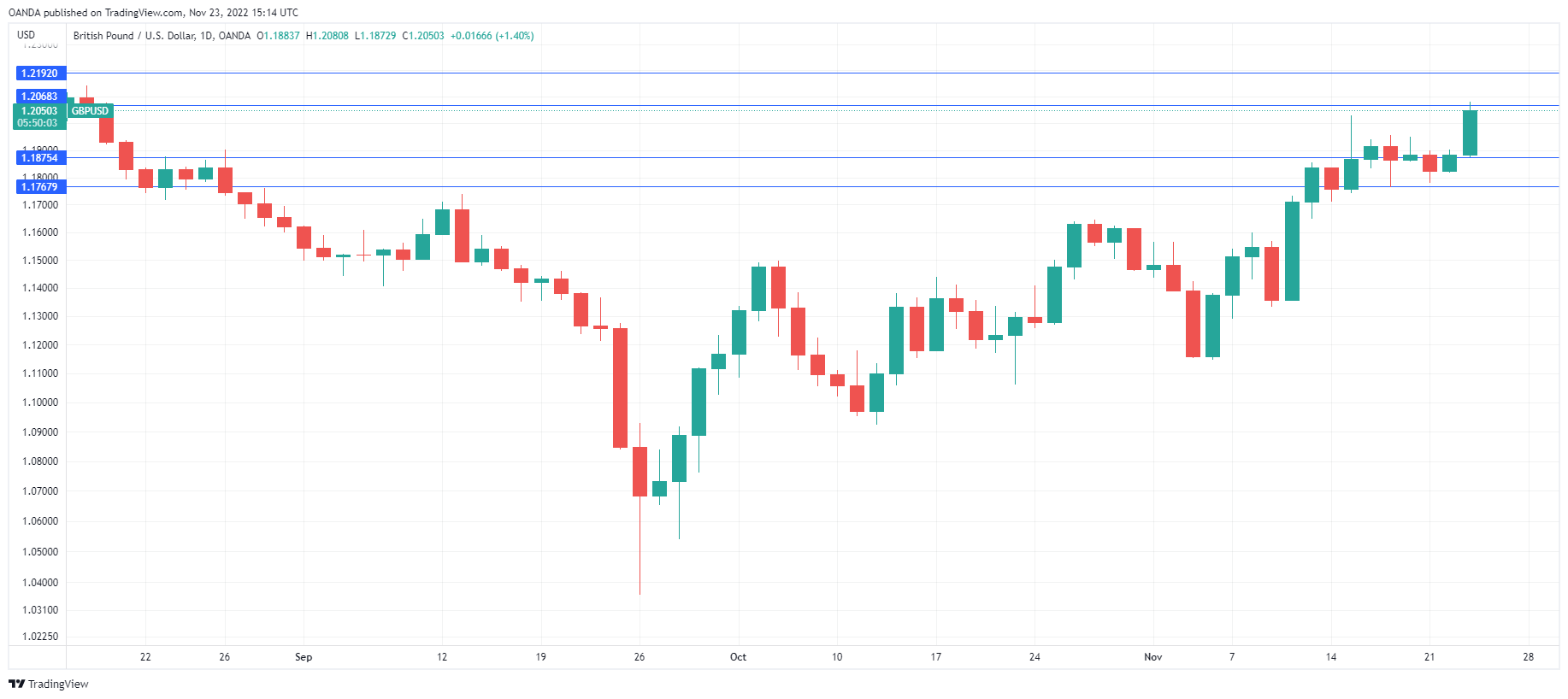
The British pound has steadied on Thursday, after soaring 1.4% a day earlier. In the European session, GBP/USD is trading at 1.2074, up 0.17%.
The pound has enjoyed a splendid November, gaining 5.3%. The upswing has been impressive but is more a case of a broad pullback in the US dollar rather than newfound strength in the pound. The UK economy is likely in a recession, and the outlook is as gloomy as a rainy November day in London. The October Manufacturing and Services PMIs remained mired in negative territory, pointing to contraction. The labour market has been a bright spot but that could soon change, with the Bank of England projecting that unemployment will double to 6.5%. The UK economy declined by 0.2% in Q3, and the BoE has warned that negative growth will extend all the way to the first half of 2024. With these formidable economic headwinds, it’s difficult to make a case for the pound continuing its upswing.
Inflation has hit a staggering 11.1%, despite the BoE raising the cash rate to 3.0%. The bank pressed harder on the rate pedal at the last meeting, raising rates by 75 basis points. The BoE expects rates to peak at 5%, which means there’s a lot more tightening on the way. The bank will have to tread carefully in order not to choke off economic growth as it continues to tighten in order to curb red-hot inflation.
Fed says pace of hikes will ease
The Fed minutes reiterated what the Fed has been telegraphing for weeks; namely, smaller rates are on the way. Fed members agreed that smaller rate increases would happen “soon”, as they continue to evaluate the impact of the current policy on the economy. Members also noted that inflation was yet to show any signs of a peak. The markets aren’t completely convinced that we’ll see lower rates at the December meeting – the odds of a 75 basis point move are at 65%, with a 35% chance of a 50 bp increase.
GBP/USD Technical
- 1.2040 and 1.1875 are the next support levels
- There is resistance at 1.2192 and 1.2357
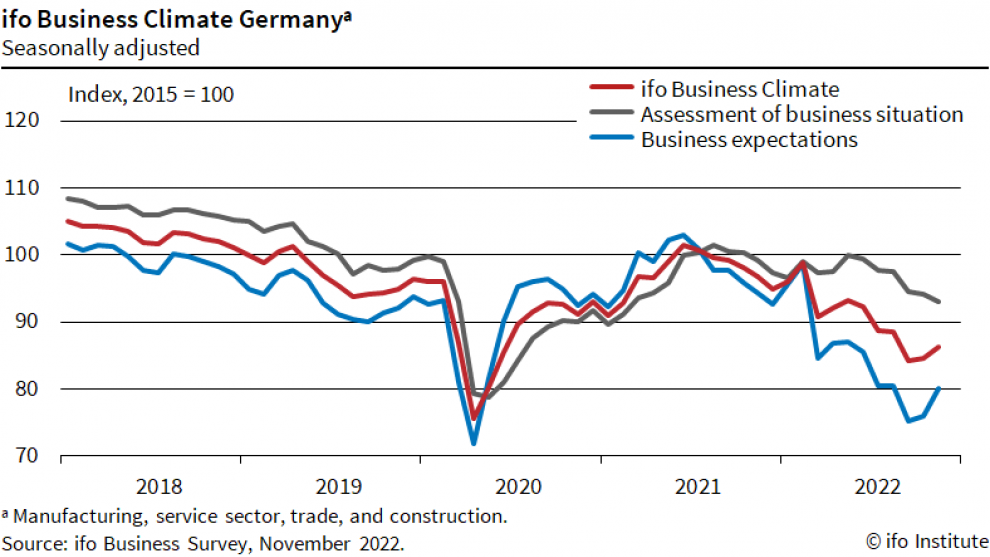
Germany Ifo rose to 86.3, recession could prove less severe than expected
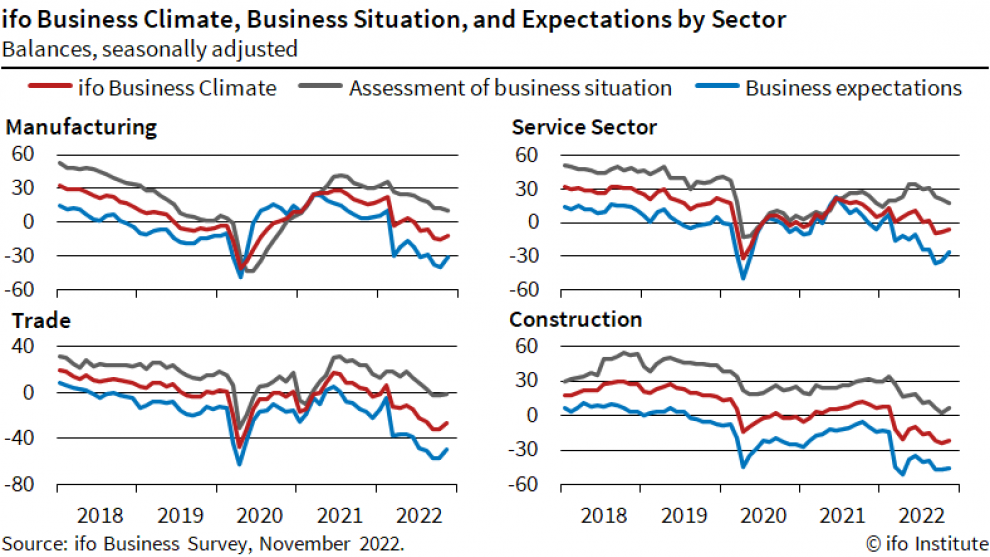
Germany Ifo Business Climate rose from 84.5 to 86.3 in November, above expectation of 85.0. Current Assessment Index rose from 84.2 to 93.1, below expectation of 93.6. Expectations Index rose from 75.9 to 80.0, above expectation of 77.0.
By sector, manufacturing rose from -15.4 to -11.7. Service rose from -8.5 to -5.4. Trade rose from -31.9 to -26.9. Construction rose from -24.0 to -21.6.
Ifo said, "While companies were somewhat less satisfied with their current business, pessimism regarding the coming months reduced sharply. The recession could prove less severe than many had expected."
AUDUSD Erases Pullback, Eyes Recent Rejection Region
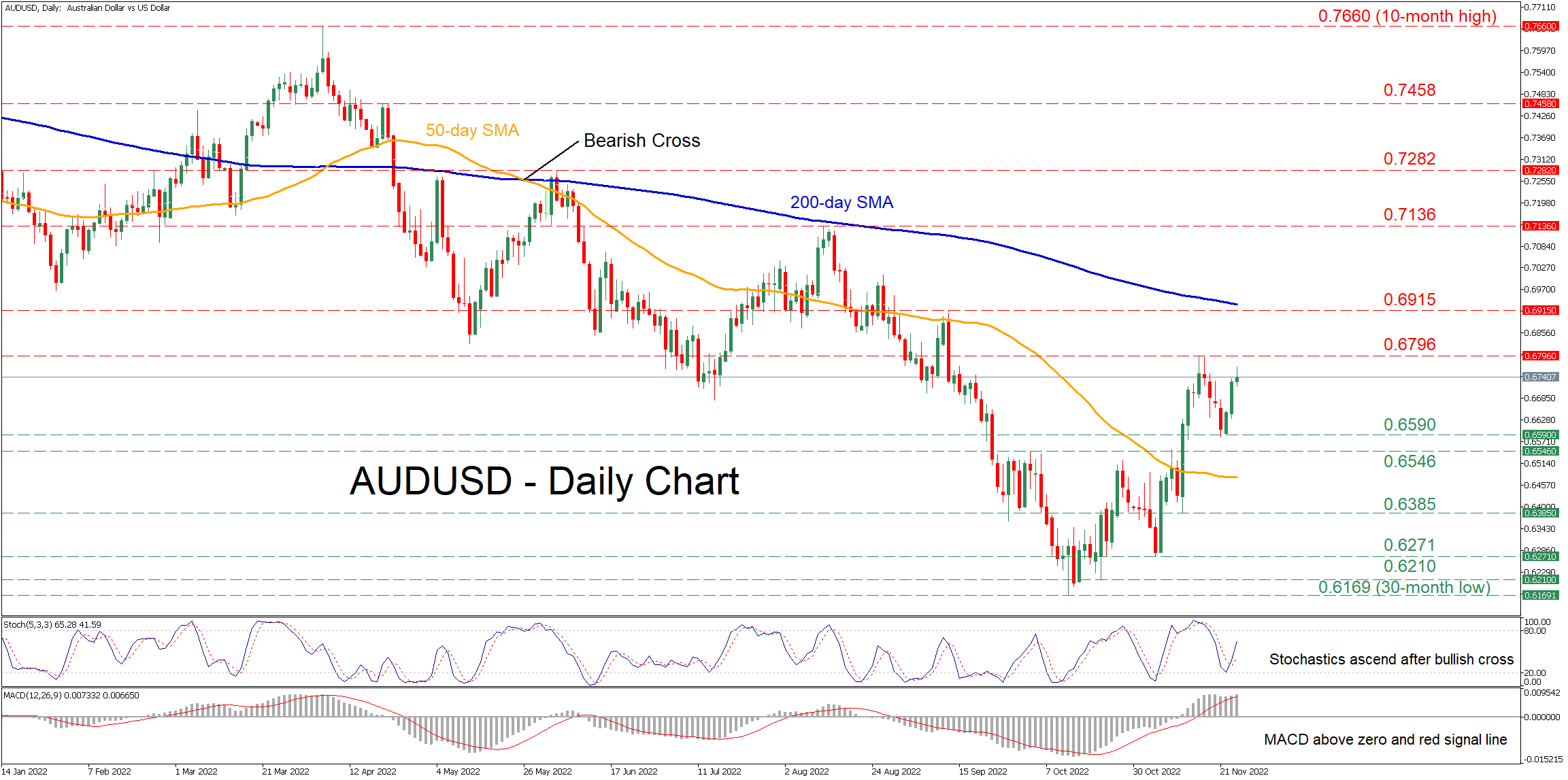
AUDUSD has been stuck in a steep downtrend since early March, but it managed to recoup some losses after bouncing at the 30-month low of 0.6169. Even though the recent rebound paused temporarily and the pair exhibited a minor correction in the short term, it has been regaining lost ground in the last few daily sessions.
The momentum indicators are endorsing this bullish near-term bias. Specifically, the stochastic oscillator is ascending after posting a bullish cross, while the MACD histogram is strengthening above both zero and its red signal line.
Should buying pressures persist, the pair could challenge its recent rejection region of 0.6796. Conquering this barricade, further advances could cease at 0.6915 before the August high of 0.7136 comes under examination. Even higher, the June peak of 0.7282 may prove a tough obstacle for the price to overcome.
On the flipside, bearish actions could send the price to test the recent support of 0.6590. Sliding beneath that floor, the bears may aim at 0.6546 before the 0.6385 support appears on the radar. Failing to halt there, the November low of 0.6271 might provide downside protection.
Overall, AUDUSD appears ready to retest its recent rejection point as the positive momentum is intensifying. Therefore, should the pair manage to profoundly cross above that ceiling, the short-term rebound is likely to resume.
WTI Crude Oil Slips Towards 10-Month Low
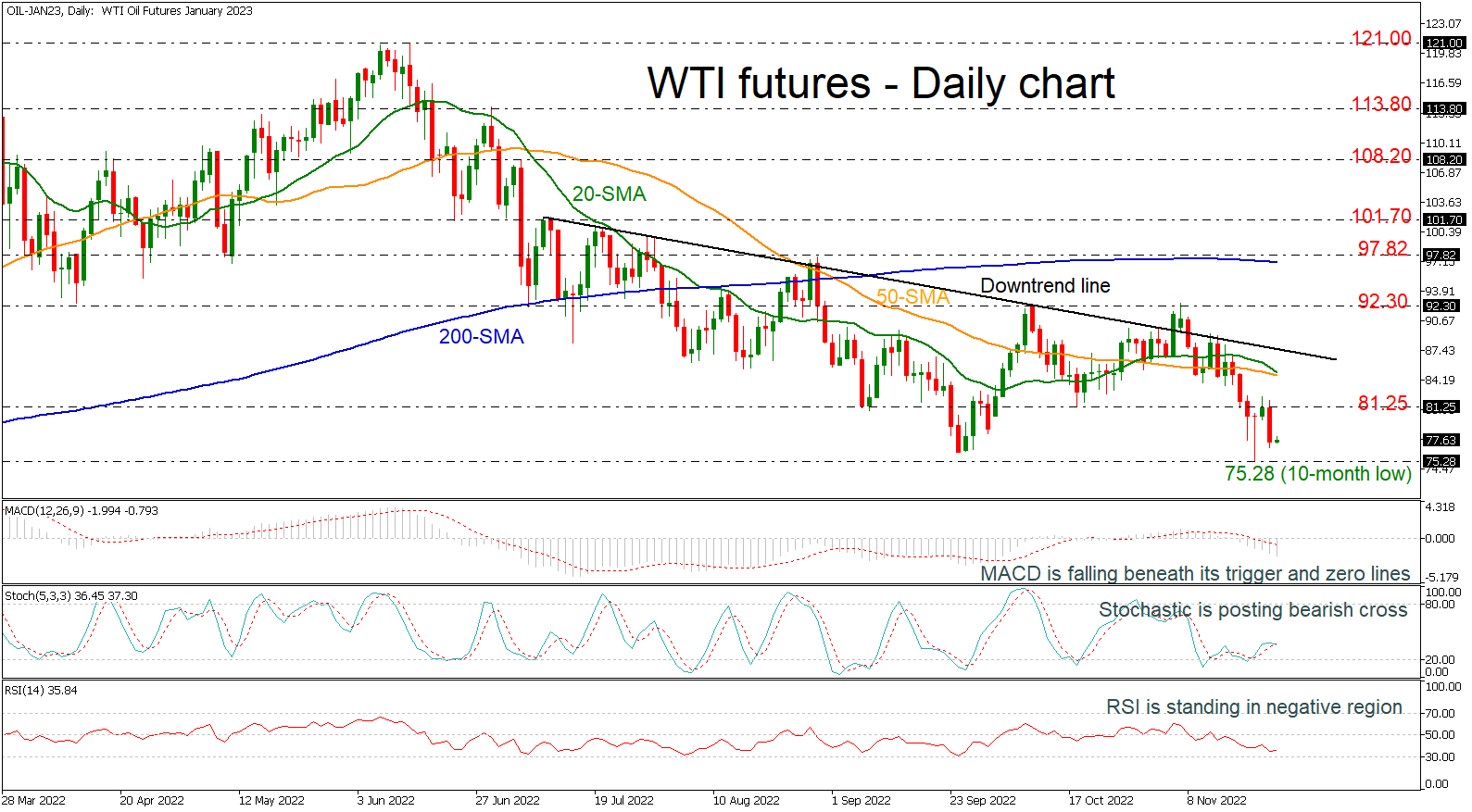
WTI crude oil futures are heading south with the next major support coming from the ten-month low of 75.28. The 20- and 50-day simple moving averages (SMAs) are ready for a bearish crossover, indicating more losses, while the price is still developing well below the downtrend line.
The descending move in the RSI and the slowdown in the stochastic justify the selling pressure, as both remain near their negative thresholds, keeping the short-term risk skewed to the downside. The MACD is also comfortably within the negative territory and below its red signal line, losing some further steam.
Should selling forces strengthen, the ten-month trough of 75.28 will come under the spotlight. The 200-weekly SMA could also turn as support near the 65.87 barrier, while moving lower the long-term picture could be strongly bearish, testing the 57.25 mark, registered in April 2021.
Alternatively, a close above the 81.25 resistance will take the market towards the short-term SMAs near 84.80 ahead of the downtrend line at 87.10. Beyond that, the rally may gear up to 92.30, brightening the outlook.
In brief, oil prices are facing a strongly bearish picture, where a drop below the ten-month bottom is expected to enhance selling interest.
Fed Minutes Quantified Probability of Recession, Giving Almost 50-50 Chance
Markets
Core bonds rallied yesterday. US Treasuries vastly outperformed Bunds, catching a bid from economic data and the FOMC minutes. US PMIs all fell more than expected and (deeper) into contraction territory. The final reading of the U. of Michigan consumer confidence was slightly better but details are worrying with more than half of the people surveyed expecting inflation next year to surpass income gains. The Fed meeting minutes later revealed that a “substantial majority” of officials support slowing down the tightening pace soon. Fed chair Powell at the November meeting said the terminal rate would likely be higher than previously expected but the minutes were a bit more vague, referring to “various” members coming to this conclusion. Finally, the minutes for the first time since tightening started in March quantified the probability of a recession, giving it an almost 50-50 chance. Together with “some” governors warning for the risk of doing too much, markets saw it as the central bank becoming more sensitive to growth. Daily US yield changes ranged between -3.5 bps (2y) to -9.5 bps (30y) in a thin liquidity environment ahead of the Thanksgiving holiday today. German yields eked out a gain at the front but lost 4.8 bps (10y) further out. European PMIs, while still below 50, unexpectedly rose while price pressures decelerated (materially). The US dollar slipped. EUR/USD advanced from 1.03 towards 1.04. GBP/USD surpassed 1.20 for the first time since August. In a sign of broader sterling strength, EUR/GBP eased to 0.862. The pair briefly lost the upward sloping trendline but then bounced off support around 0.86. BoE chief economist in a late-evening speech said rates need to be increased further as inflation is becoming increasingly domestic. He did repeat that raising above 5% was not likely. Brent oil lost almost 4% after the G7 Russian price cap under discussion is seen as high enough to keep the country’s supplies flowing into the global market.
Asian stock markets take heart from yesterday’s price action on US markets. Japan and South Korea outperform. The central bank in the latter raised rates further (see below). News otherwise is scarce. Today’s eco calendar, containing the German IFO business indicator and ECB meeting minutes, is of little importance for trading and there won’t be any guidance from the US. This could set the stage for the ongoing yield correction to continue on European markets. Germany’s 10y yield is at a crucial technical point, risking to snap below the June interim high. The European 10y swap yield already lost that support earlier this week. Dollar weakness lifts EUR/USD beyond the 200MdA and recent highs with next resistance located around 1.05.
News Headlines
The Bank of Korea switched back to a 25 bps rate hike this morning, lifting the policy rate to 3.25%, matching the cycle peak from 2011-2012. The central bank mentioned a recent contraction in the short-term credit market (default of local government-backed developer) and an easing of pressure on the won as some of the reasons to slow it down. The US Federal Reserve hinting at a downshift comes in handy as well. The tightening cycle isn’t done yet though with two BoK members advocating a peak rate north of 3.5%. Governor Rhee Chang-yong is aware that the cumulative tightening effect starts weighing on growth. Next year’s growth forecast was downgraded from 2.1% in August to 1.7% while the 2023 inflation prognosis remained broadly unchanged at 3.6%. CPI currently stands at 5.7% Y/Y is expected to remain above 5% for some time. The Korean won outperforms this morning against a generally weak US dollar. USD/KRW drops from 1350 to 1330, more and more leaving behind the multiyear lows for the won just below USD/KRW 1450.
The Bank of England announced that it will unwind its financial stability Gilt purchases (£19bn) made between September 28 and October 14 to stop huge sell-off in the wake of lavish fiscal spending plans by the Truss-Kwarteng government. The strategy fits within the BoE framework to winddown its QE bond portfolio, naturally and via active Gilt sales. The BoE intends to operate a demand-led approach sales via a series of reverse enquiry window three times a week starting November 29. To ensure unwind does not trigger renewed dysfunction, the Bank will typically not sell individual gilts which have experienced a significant fall in price ahead of a window.
Stocks Up, USD Down after Fed Minutes
US stocks spent most of yesterday’s session hesitating between slight gains and slight losses, then the release of the latest Federal Reserve (Fed) minutes helped the bulls take the upper hand, as the minutes confirmed that a ‘substantial majority’ of Fed members thought it was a good idea to slow down the pace of the rate hikes.
That’s nothing new, Fed Chair Jerome Powell has been very clear at his latest press conference that the Fed would deliver smaller rate hikes, but the terminal rate would be higher.
We also read in the minutes that the Fed officials think that there is now a 50-50 chance for US to step into recession next year.
And happily, yesterday’s PMI data, and the jobless claims were bad enough to cheer investors up. Manufacturing PMI fell unexpectedly below 50, the contraction zone, and services PMI fell deeper within the contraction zone. Jobless claims on the other hand rose more than expected, though the durable goods orders printed a better-than-expected number in October.
But hey, let’s focus on good ‘bad’ news.
The S&P500 gained around 0.60% and advanced to the lowest level since September, extending the latest rally, while Nasdaq jumped around 1%.
The US 10-year yield eased, as the US dollar sold off quite aggressively across the board.
Cable rallied past the 1.20, and is eyeing the 1.21 mark this morning. The EURUSD extended above its own 200-DMA, which stands around 1.0391, and could stretch toward the 1.05 psychological target. Today, the minutes from the European Central Bank (ECB) will likely not see the same reaction as the Fed’s, but because the trading volumes are expected to be thin – due to the Thanksgiving holiday, we could see important up and downs to the end of the week.
Crude oil: One bullish pillar down, but two remain
We saw a decent price action yesterday was oil, and that was well before the Fed minutes. The barrel of American crude dropped up to 5% yesterday on news that the Europeans would set the price cap for Russian oil to around $65 to $70 per barrel.
But because the Russian oil is already trading with a certain discount, the price cap proposed by the European leaders yesterday match the price that the Russian oil is already exchanged between Russia, and whoever is willing to buy the cheaper Russian oil. Therefore, it’s obvious that a price cap of around $65/70 won’t damage the Russian output.
As a result, one of the major pillars for the bullish oil view would no longer be. This is why we saw the price of US crude fall below $77 yesterday despite the 3.7-million-barrel fall in US crude inventories last week.
Yet, keep in mind that two other factors that could give support to oil prices are still in play. One: Americans will stop selling their strategic reserves, and eventually start refilling them. Two: OPEC countries will continue restricting output to keep prices high.
Therefore, the $75 bottom could hold, however the upside potential is unclear, as the global recession worries, and the Chinese re-closing due to surging Covid cases could take a further toll.
Global Slowdown Confirmed by November PMIs
Market movers today
The main event today will be the Riksbank meeting, where we expect a 75bp hike in line with consensus and market pricing. Focus will be on forward-looking communication, we expect Riksbank to deliver one more 25bp hike in February 2023 after today, which would end the hiking cycle at 2.75%, below the current market pricing.
ECB's de Guindos and Schnabel will give speeches today.
The central bank of Turkey is expected to continue its unorthodox monetary policies with a 150bp cut despite the soaring inflation. On the data front, German November Ifo is expected to remain at subdued levels following yesterday's PMIs.
The 60 second overview
European slowdown: Euro area PMIs surprised to the upside with composite PMI increasing to 47.8 in November from 47.3. That said, the figures strengthen the message that the economy is likely headed for a contraction in Q4. Compared to previous months, sectoral dynamics seem to have shifted somewhat, with the downturn increasingly driven by weaker services activity, while manufacturing is experiencing a temporary production boost thanks to easing supply bottlenecks. Also the UK figures ticked in better than expected, with both manufacturing and service unchanged. It still points towards recession in Q4, though.
US: Yesterday, the combination of soft US flash PMIs (composite below consensus at 46.3) and modestly dovish FOMC minutes supported market sentiment and weighed on broad USD. In line with the recent Fed commentary, the minutes suggested that the majority of FOMC members could favour a smaller 50bp hike at the December meeting. While we have been calling for more aggressive tightening, the low October CPI print combined with PMIs now signalling clearly moderating growth and commodity prices declining do suggest that the need for rapid rate hikes is easing. The key upside risk for inflation is still related to the tight labour markets, as wage growth remains too fast to be consistent with Fed's inflation target, and even the PMI employment indices showed no clear signs of cooling. As such, we think Fed will have to keep hiking and maintain financial conditions restrictive well into 2023 even if the pace of hikes would be more moderate going forward.
Japan: Also Japanese PMIs were weak, as manufacturing is weighed down by the global slowdown and inflation has slowed the service sector rebound. Composite PMI declined to 48.9 from 51.8.
Equities: Equities higher yesterday with bond yields lower, somewhat bad data out of US and not to forget sharply lower oil price. We have seen this before, it is the post summer narrative of "bad data being good data" because it means less inflations and less fear of central bank tightening. Hence, equities are not lifted because of economic growth outlook but simply just less fear of the biggest tail risk fear - inflation staying too high for longer. There this is more of an unloved rally where VIX is softening but remains elevated and cyclicals are not able to outperform. One sector stuck out yesterday in what was a broad based rally - not surprisingly the energy sector. If the low growth and less inflation fear scenarios continue, it should soon mean a goodbye to the inflation semi-hedge story of overweighting the energy sector and hence the massive YTD outperformance is coming to an end. In the US yesterday, Dow +0.3%, S&P 500 +0.6%, Nasdaq +1.0% and Russell 2000 +0.2%. The equity rally continues in Asia this morning with homeland China being the exemption. Both European and US futures are slightly higher as well.
FI: The flattening of the yield curves continues as US PMI data fell more than expected and the minutes from the latest FOMC meeting showed that most officials were backing a more moderate pace of interest-rate hikes. This is also in line with a string of recent comments from various Fed members. A similar picture is seen in the Euro curves.
FX: USD was the big underperformer in yesterday's session - both during European hours and also in the immediate aftermath of the Fed minutes. That has returned EUR/USD to the 1.04 mark. The Scandies were the top performers with EUR/SEK moving back below 10.90 while EUR/NOK has settled in the mid-10.30s.
Credit: Yesterday the credit market was nourished by renewed hopes of a dovish change of path from central banks amid bad macro numbers. Itraxx Main tightened 2.6bp to 89.8bp while Xover tightened 9.4bp to 451.8bp.
Nordic macro
We expect the Riksbank to pull off a 75bp hike this morning, which is 25bp more than what the central bank suggested in the September repo rate path. This, however, is already priced by the money market and should not cause any volatility. The reason behind our call is that October core inflation again overshot Riksbank's forecast by a significant margin of 0.5 percentage points, printing 7.9 % yoy. Looking forward, it seems reasonable to expect Riksbank to raise its inflation forecast and on the back of that also raise the "peak rate" of the repo rate path to the 2.75-3.00 % range in the first half of 2023. Such a revision should neither cause any major market reaction as this too is expected by market players.
The Norwegian labour market is still tight, with low unemployment and numerous vacancies, but there are now signs of the tide turning: the number of new job openings is falling, employment seems to have levelled off, and unemployment has bottomed out. We therefore expect the jobless rate to edge up from 3.2% to 3.3% in September (August-October), but with employment more or less unchanged.
GBP/JPY Daily Outlook
Daily Pivots: (S1) 167.67; (P) 168.34; (R1) 168.93; More...
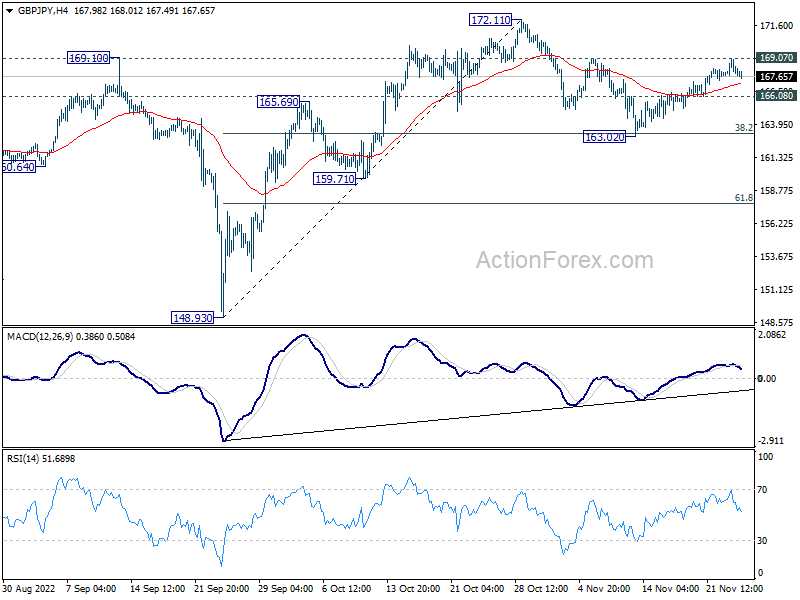
GBP/JPY lose some upside momentum ahead 169.07 resistance and intraday bias is turned neutral first. In the upside, break of 169.07 resistance will argue that larger up trend is ready to resume through 172.11 high. however, break of 166.08 minor support will turn bias back to the downside to extend the corrective pattern from 172.11 with another fall.
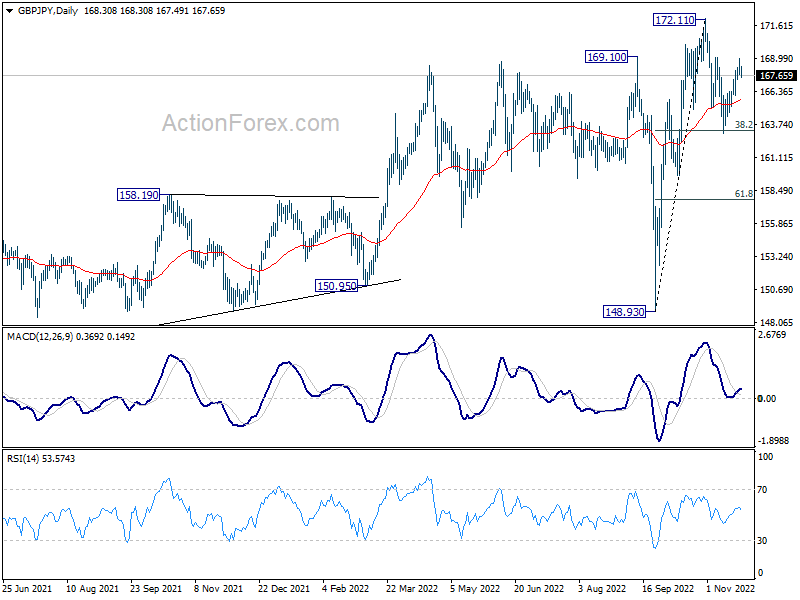
In the bigger picture, there is no clear sign of medium term topping yet. Up trend from 123.94 (2020 low) could still resume through 172.11 high at a later stage. However, firm break of 159.71 support will argue that it's already in correction to the up trend from 123.94, and deeper decline would be seen back towards 148.93 support.
EUR/JPY Daily Outlook
Daily Pivots: (S1) 144.45; (P) 145.30; (R1) 145.95; More....
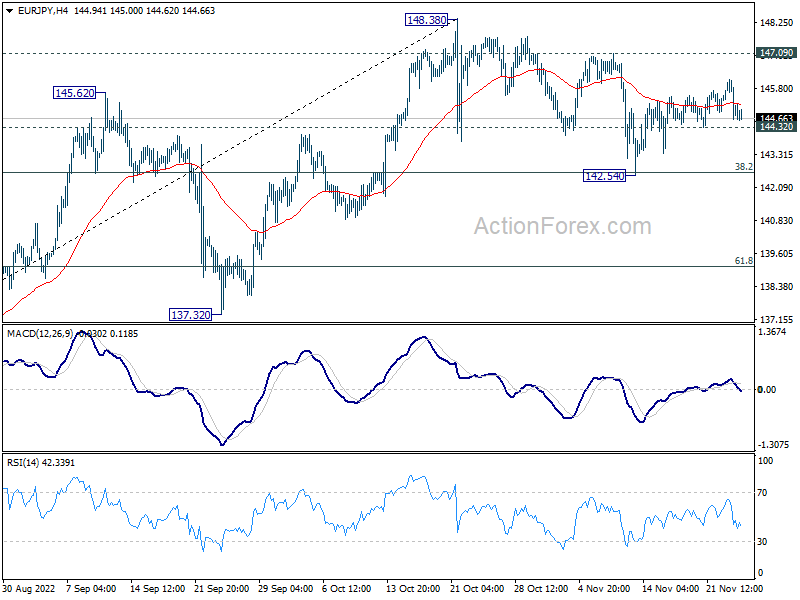
Intraday bias in EUR/JPY stays neutral for the moment. On the downside, break of 144.32 minor support will extend the corrective pattern from 148.38 with another fall. Intraday bias will be back on the downside for 142.54 support first. On the upside, break of 147.09 will indicate that larger up trend is ready to resume through 148.38 high.
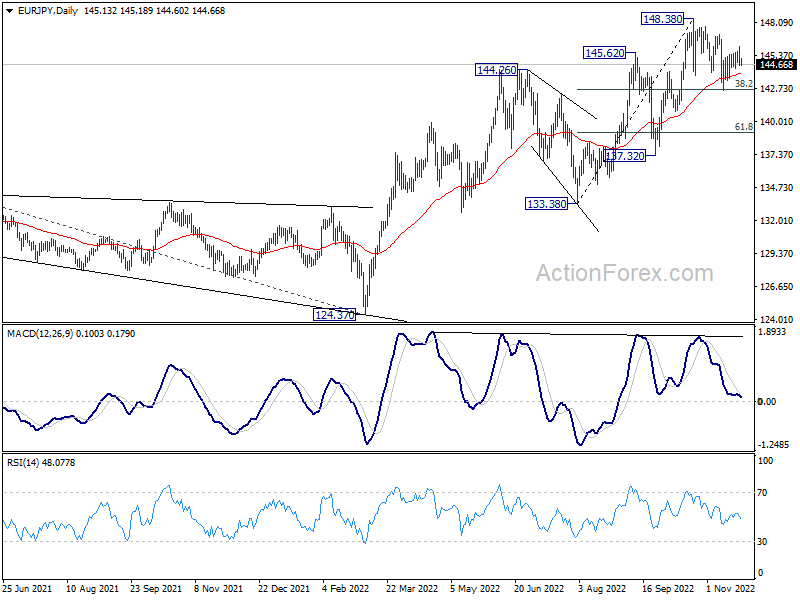
In the bigger picture, there is no clear sign of medium term topping yet. Up trend from 114.42 (2020 low) could still resume through 148.38 to 149.76 (2014 high). However, break of 137.32 support argue that a medium term correction has already started to correct the whole up trend from 114.42.
EUR/GBP Daily Outlook
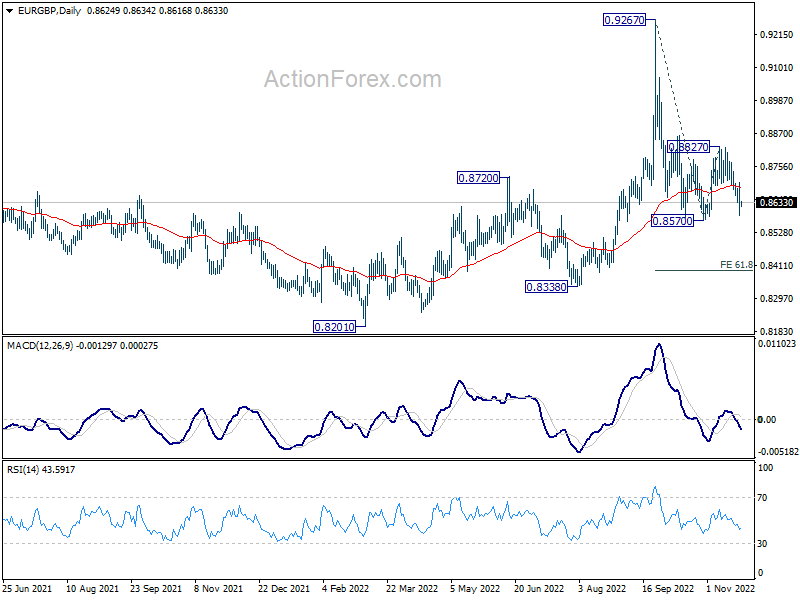
Daily Pivots: (S1) 0.8574; (P) 0.8637; (R1) 0.8688; More...
Intraday bias in EUR/GBP stays neutral first. Break of 0.8570 will resume the decline from 0.9267. Next target is 61.8% projection of 0.9267 to 0.8570 from 0.8827 at 0.8369. For now risk will stay on the downside as long as 0.8827 resistance holds, in case of recovery.
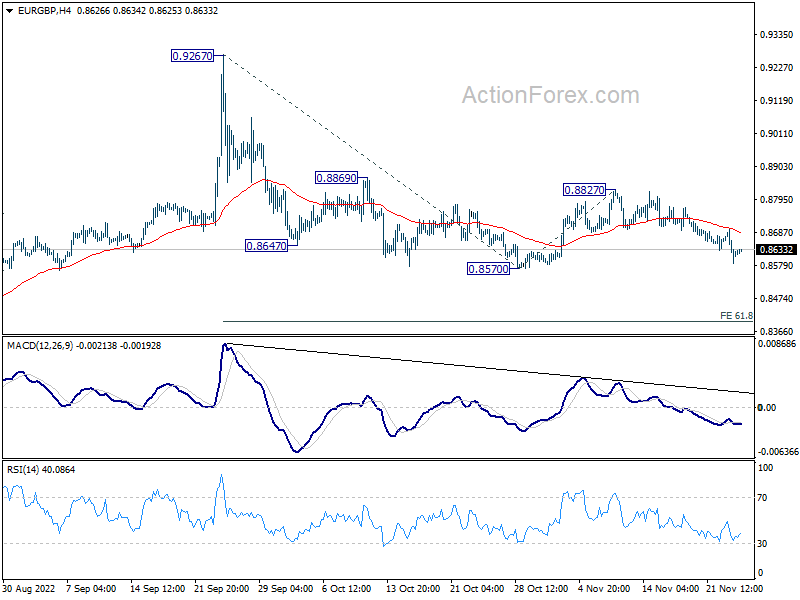
In the bigger picture, current development suggests that fall from 0.9267 is a down leg inside long term range pattern. Deeper fall could be seen towards 0.8201/8338 support zone. But strong support should be seen there to bring reversal. Nevertheless, firm break of 0.8869 resistance will turn favor to the case that such decline is merely a correction in the up trend from 0.8201. That is, further rally would be seen at a later stage through 0.9267.