Sample Category Title
Gold Wave Analysis
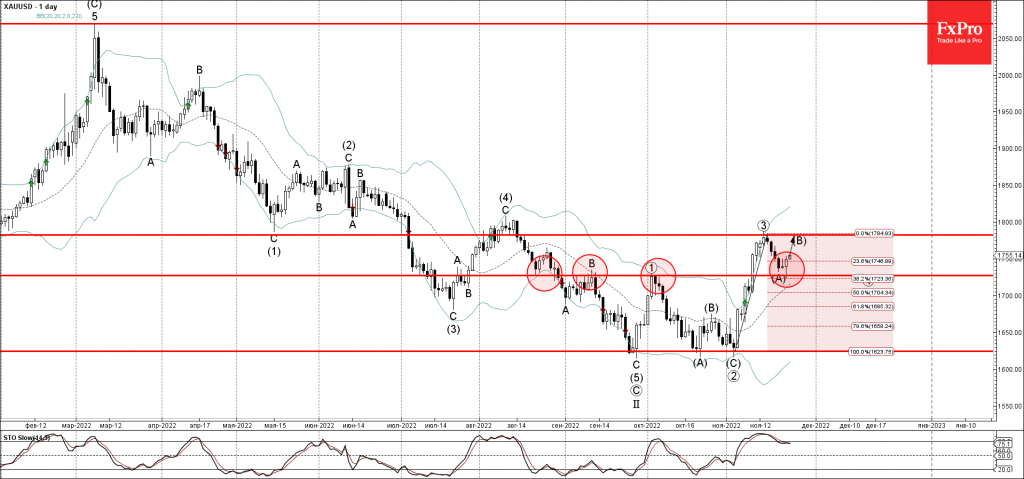
- Gold reversed from the support level 1727.00
- Likely to rise to resistance level 1782.80
Gold recently reversed up with the daily Morning Star from the pivotal support level 1727.00 (former monthly high from September and October, as can be seen below) – standing near the 38.2% Fibonacci correction of the upward impulse from the start of November.
The upward reversal from the support level 1727.00 started the active intermediate corrective wave (B).
Gold can be expected to rise further toward the next resistance level 1782.80 (which reversed the price earlier this month).
CADJPY Wave Analysis
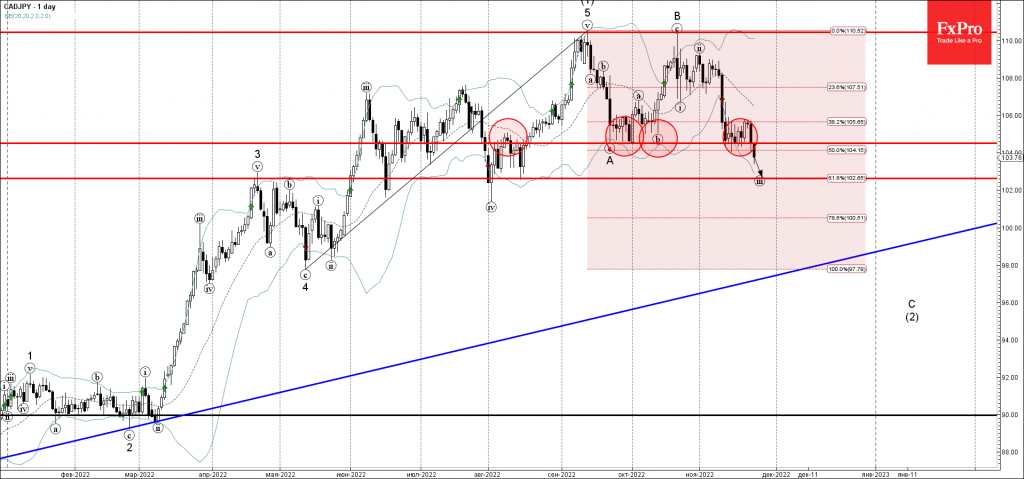
- CADJPY under bearish pressure
- Likely to fall to support level 102.65
CADJPY under the bearish pressure after recently breaking the key support level 104.50 (which has been reversing the price from September), intersecting with the 50% Fibonacci correction of the upward impulse from May.
The breakout support level 104.50 accelerated the active impulse wave (iii), which belongs to wave C from last month.
CADJPY can be expected to fall further toward the next support level 102.65 (target for the completion of the active impulse wave (iii)).
NZDJPY Wave Analysis
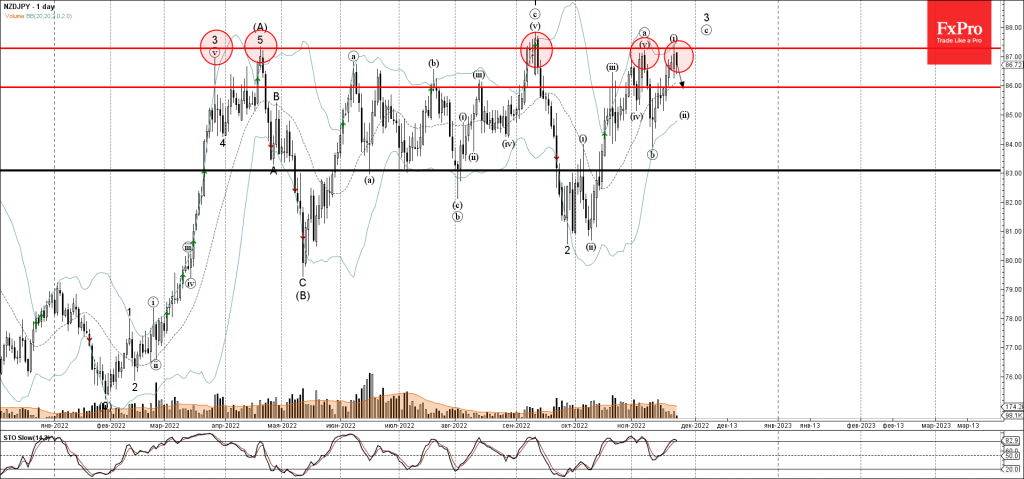
- NZDJPY reversed from resistance level 87.28
- Likely to fall to support level 86.00
NZDJPY recently reversed down from the long-term resistance level 87.28 (which has been reversing the pair from the end of March, as can be seen below).
The downward reversal from the resistance level 87.28 is likely to form the daily reversal pattern Bearish Engulfing.
Given the proximity of the resistance level 87.28 and the overbought daily Stochastic, NZDJPY can be expected to fall further toward the next support level 86.00.
EURUSD Bulls Look Exhausted Near 1.0400
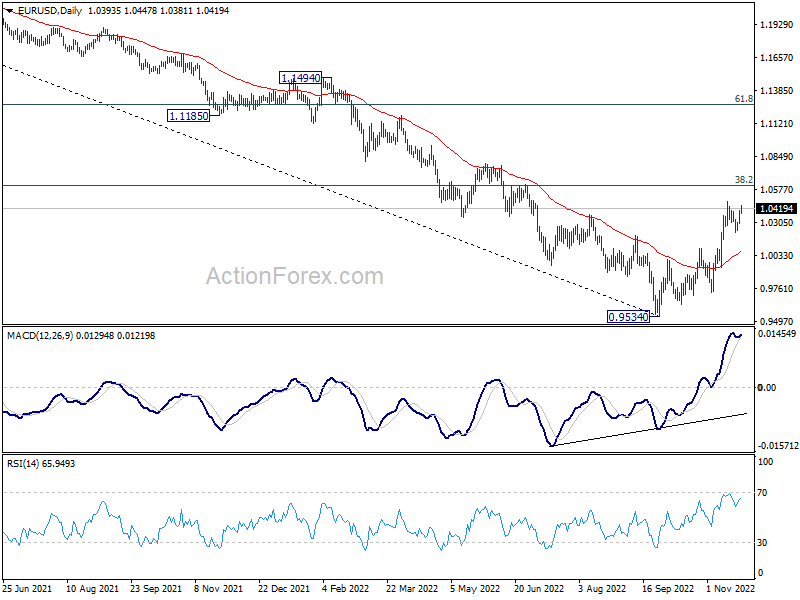
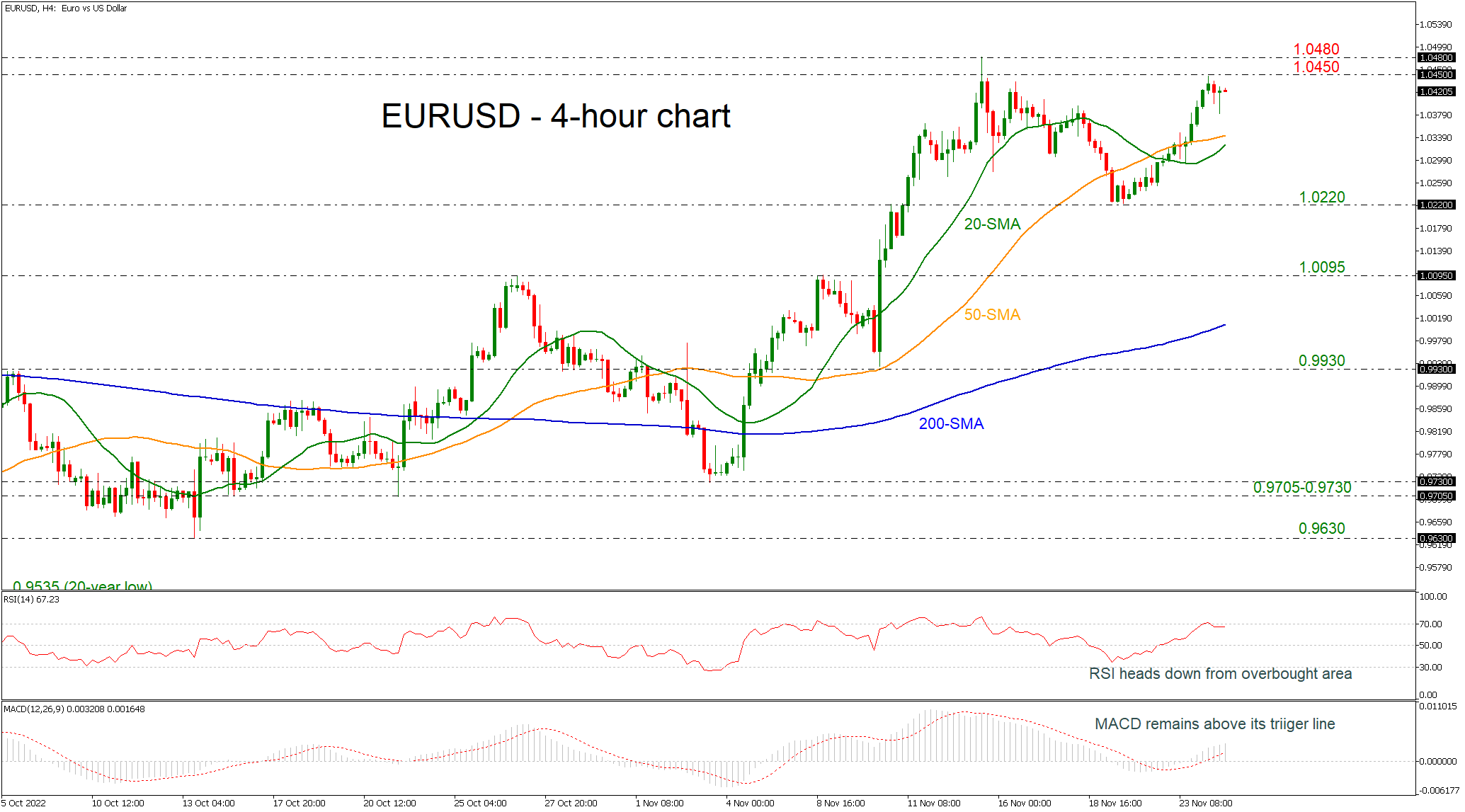
EURUSD is weakening somewhat after the climb towards the 1.0450 barrier, which is a level slightly above the 200-period simple moving average (SMA) in the daily chart. Currently, the market is retreating near the 1.0400 psychological mark with the technical oscillators losing steam. The RSI has pulled back from the overbought region, while the MACD is continuing to move in the positive area with weak momentum.
Still, the market seems to be well supported by the short-term SMAs around 1.0315-1.0340 and therefore only a decisive close below them would put the pair on the backfoot. Moving lower, the price should first breach the 1.0220 support and the 1.0095 inside swing high from November 8. Clearing that obstacle too, all attention would turn to the 200-period SMA at 1.0000.
Alternatively, if the bulls dominate above 1.0400, the spotlight will shift back to the 1.0450-1.0480 resistance zone, a break of which could extend the short-term uptrend towards the 1.0600 mark, taken from the peaks on June 27.
In brief, EURUSD is expected to hold an upward direction unless the price closes significantly below the 200-period SMA near the parity level.
Sunset Market Commentary
Markets
“The votes are in. They’ve been counted and verified. There’s no ballot stuffing, there’s no fowl play”. In absence of other meaningful news, we open with Monday’s traditional pre-Thanksgiving turkey pardon at the White House where US President Biden spared the lives of “Chocolate” and “Chip”. Other holiday season puns included that the only red wave this season would be the one stemming from his German shepherd (“Commander”) knocking over the cranberry sauce. In any case, the absence of US investors today set the stage for rangebound action in FX (EUR/USD 1.0420) while German/European bonds had some catching up to do with US Treasuries’ gains after the European closing bell yesterday. This results in daily German yield declines between 4.7 bps (2-yr) and 8.2 bps (10-yr). From a technical point of view, the German 10-yr yield lost support at 1.95% with the October low of 1.77% approaching very rapidly. The eco calendar was empty apart from November German Ifo business sentiment which improved more than forecast from 84.5 to 86.3, but remains low from an absolute point of view. Details were more hopeful though as pessimism regarding the coming months reduced somewhat (80 from 75.9), suggesting that the recession could prove less severe than many had expected. Contrary to Belgian consumer confidence on Monday (-22 from -27), business confidence deteriorated in November (-16.6 from -15.5; lowest since June 2020).
Sterling remains better bid with EUR/GBP moving south of 0.86 and ready to test key support at 0.8559/67. BoE Ramsden joined chief economist Pill in backing additional BoE rate hikes. Governor Bailey doubted the need of such moves given updated forecasts at the November policy meeting, but nevertheless suggested that more of them would come, though smaller. Ramsden cites the tight labor market and risk of inflation expectations becoming unanchored. He added that the long term Budget plans of Sunak-Hunt will have little impact on the central bank’s forecasts.
News Headlines
The Turkish central bank (CBRT) as expected lowered policy rates by 150 bps to 9%. With the final rate cut this cycle, the CBRT seeks to sustain growth momentum in industrial production and the positive trend in employment. Inflation hitting more than 85% y/y in October (x17 the 5% target) with more in the pipeline (PPI 151% y/y) is set aside as the result of rising energy costs, not supported by fundamentals and supply shocks. The MPC expect a disinflationary process to start soon and inflation should “cool” to 65% by the end of the year. Since August the CBRT has reduced rates by a cumulative 500 bps under the watchful eye of president Erdogan who called for single digit rates by the end of the year. USD/TRY as usual is an ocean of calm with the lira stabilizing around historic lows of 18.63 despite carrying an ever deeper (and world’s largest) negative real interest rate. It is believed that the central bank is defending the currency by draining its scarce and artificially boosted FX reserves. The FT just yesterday reported that Turkey and Saudi Arabia are discussing a deal to inject $5bn into the CBRT in a move that would shore up reserves.
Sweden’s Riksbank jacked up rates by 75 bps to 2.5% at today’s (and governor Ingves’ last) meeting. It also pulled the expected policy rate path higher to 3% in early 2023 vs 2.5% seen in September. It’s expected to stay there at least through 2025. Inflation remains far too high (CPIF 9.3%). Although headline price growth was a tad below the September forecast, inflation ex energy was unexpectedly high. CPI was revised upwards to 9.3% next year and will remain above target until the end of the policy horizon (2.2% in 2025). This poses substantial risks for entrenchment and demands further tightening, the central bank concluded, even as it comes with a cost for growth. The expected contraction for next year is now seen at 1.2% instead of 0.7% earlier. The Swedish krone lost ground following the decision as the expected terminal rate fell short of market expectations (3.25%) but recovered soon thereafter. Ingves said that the interest rate shouldn’t be lower than elsewhere in the world as this may lead to a weaker currency and a more difficult inflation battle. EUR/SEK is currently down for the day, trading around 10.83.
GBP/USD: Cable Hits New Multi-month High as Larger Bulls Resume
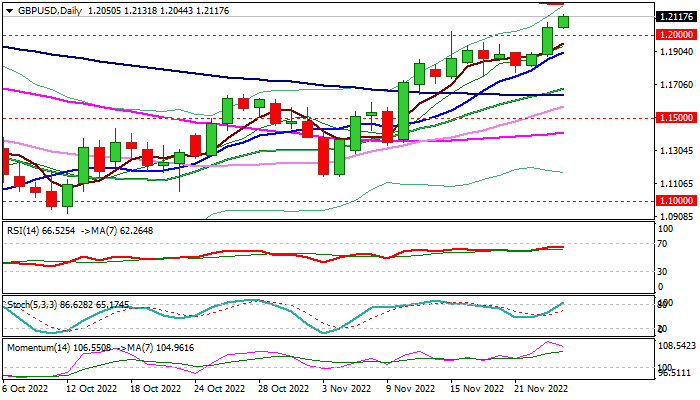
Cable extends advance above 1.21 mark on Thursday, hitting the highest since mid-August, following Wednesday’s 1.4% rally, which resulted in close above pivotal barriers at 1.2000/28 (psychological/former high of Nov 15.
Fresh advance signals bullish continuation after larger uptrend was paused for consolidation.
Bulls focus initial target at 1.2190 (falling 200DMA), which guards 1.2299 (50% retracement of 1.4249/1.0348 fall/Aug 1 lower top).
Daily studies are in bullish setup but fading bullish momentum and overbought stochastic warn that bulls may face headwinds on approach to 200DMA barrier.
Broken 1.20 level reverted to support which should ideally contain dips, though dip-buying to remain favored while the action stays above rising daily Tenkan-sen (1.1921).
Sterling continues to benefit from weaker dollar, additionally pressured by dovish Fed minutes and overall soft US data, released on Wednesday.
Res: 1.2190; 1.2299; 1.2332; 1.2406.
Sup: 1.2081; 1.2000; 1.1921; 1.1778.
Brighter Business Sentiment in Germany
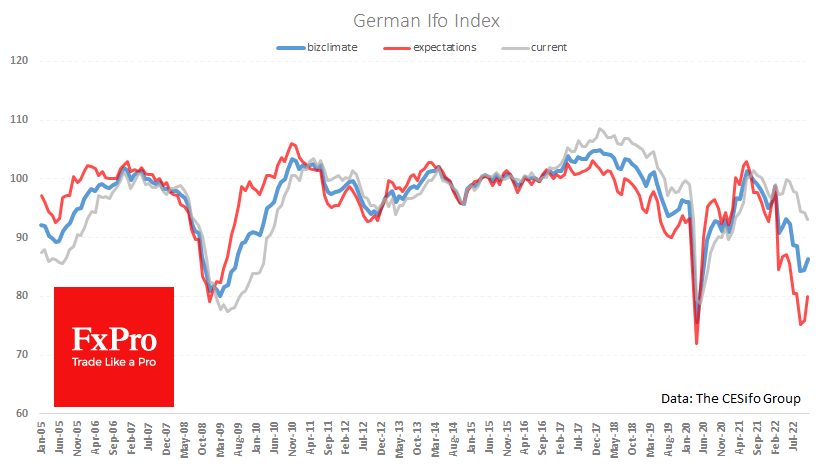
Germany’s Ifo Business Climate Index improved in November, strengthening from 84.5 to 86.3 (85.0 was expected). The overall index rose following an improvement in expectations over the last two months.
Signals that the sharpest downturn may be over and that the situation will stabilise further we also previously noted in Markit PMIs and the ZEW Indicator of Economic Sentiment.
The outcome of the Ifo index is encouraging for both economists and market participants. The same kind of reversal signalled the start of a period of economic stabilisation after almost free-falling in both 2009 and 2020. These hopes for changes are also bolded by lowering energy prices, improved consumer expectations, and rising export volumes.
Global reversals in the Ifo sentiment index coincided with EURUSD and many European stock indices hitting their cyclical lows. Improving business sentiment may provide additional reasons to remain confident in the single currency and to buy back at historically low levels.
A “Dovish” Boost
Equity markets are making steady gains in Europe and Asia on Thursday, while Wall Street is closed for the Thanksgiving bank holiday.
The day got off to a decent start as investors on this side of the pond played catch-up following the late rally in the US. All considered it hasn't been the most lively of weeks but the FOMC minutes did ensure investors went into the Thanksgiving break on a bit of a high.
A dovish boost before Thanksgiving
The most notable takeaway from the minutes - which were never going to be game-changing - were the discrete references to the difference in support for slowing the pace of tightening now and those raising their estimates of the terminal rate. Clearly, the latter has much less support which means a lower rate hike is on the cards in December - probably 50 basis points - while a higher terminal rate is only a possibility and will depend on the data. While not ideal for investors, the net effect is undoubtedly less hawkish and that's at least partly what drove that late rally.
Destructive lockdowns again for China?
Record Covid cases in China, more testing and restrictions, and even possible lockdowns went some way towards undermining that positivity coming from the US in Asia on Thursday. Stocks in China slipped while Hong Kong underperformed its regional peers as investors weighed up the prospect of more growth-destructive lockdowns and uncertainty for the world's second-largest economy. This comes as authorities sought to slightly ease the burden of Covid restrictions and support the property market, both of which are difficult if record case numbers force people indoors.
Another disappointing manufacturing survey
The plunge in Japan's manufacturing PMI to a two-year low below 50 - which separates growth from contraction - perfectly highlights how challenging the current environment is around the world. Higher input costs combined with lower domestic and external demand is hammering the manufacturing sector and is likely to continue until inflation abates and growth bounces back.
Navigating blind
The Bank of Korea has become the latest central bank to jump aboard the "slower for longer" train, raising rates by 25 basis points while leaving the door wide open to further rates hikes. The decision to join the RBA and BoC, with the Fed likely not far behind, comes as the economic headwinds mount. The problem many now face is a result of acting late and aggressively. As rate moves come with a lag, policymakers are being forced to make decisions without full visibility of the impact recent moves have had. They must therefore decide when to slow the pace of tightening in order to avoid unnecessary economic hardship and deflation while inflation is still very high. It may work out in the end but there's a big risk on both sides that it won't.
CBRT brings an end to its easing cycle
I'm not sure that particular analogy works when describing the Turkish central bank. In this case, it's more like driving a car in reverse while looking forwards in the hope you somehow make it home ok. The CBRT cut interest rates by another 150 basis points today, taking it back to 9% while declaring the end of its easing cycle. That comes as official inflation sits at 85.5% in October, despite various efforts to control the currency movements.
Oil tumbles amid price cap talks and stricter Chinese restrictions
Oil prices are a little lower again on Thursday as the G7 continues to work towards a price cap on Russian oil. Brent crude fell heavily on Wednesday amid reports that the group could settle on a level around $65 which is roughly where they currently sell it at, and with a sizeable profit. That would blunt the effectiveness of the cap and ensure we don't see any shortages in supply. But it may be what is necessary to keep all stakeholders on board, with some countries concerned about the domestic implications of a stricter cap.
The discussions will continue but these reports have weighed on the price of oil at a time when restrictions, maybe even lockdowns, in China threaten demand in the world's second-largest economy. And amid a report - since denied - that OPEC+ could boost output next week. I'm not sure what the motive would be at this point but perhaps it's heavily conditional on the outcome of the G7 talks.
Gold buoyed by "dovish pivot"
Gold bulls very much welcomed the FOMC minutes on Wednesday and we're continuing to see the price benefit today. The yellow metal has massively benefited from the "dovish pivot" last month if we can even call it that, as policymakers appeared to support a slower pace of tightening from next month, which was then backed up by the minutes.
It remains within a range though, with $1,730 providing support below - around the September and October highs - and $1,780 resistance above - a key area of support in the first half of the year.
A dead cat bounce?
Bitcoin is in the green for a third day, albeit only just, as it continues to try and stabilize in the aftermath of the FTX collapse. The event was unsurprisingly a huge setback for the whole industry, both from a contagion perspective but also a reputational one. Traders are correctly now asking themselves who else is exposed, how big will the ripple effects be, and where else this kind of activity is taking place. In such an unregulated world, these fears are very real and could undermine faith in the crypto space for some time, further weighing on prices in the process.
EUR/USD Mid-Day Outlook
Daily Pivots: (S1) 1.0326; (P) 1.0366; (R1) 1.0434; More...
Intraday bias in EUR/USD stays neutral for the moment. As long as 1.0092 resistance turned support holds, further rally is expected. On the upside, break of 1.0481 will resume the rise from 0.9534 and target 1.0609 fibonacci level. However, sustained break of 1.0092 will turn bias to the downside for 55 day EMA (now at 1.0055) and below.
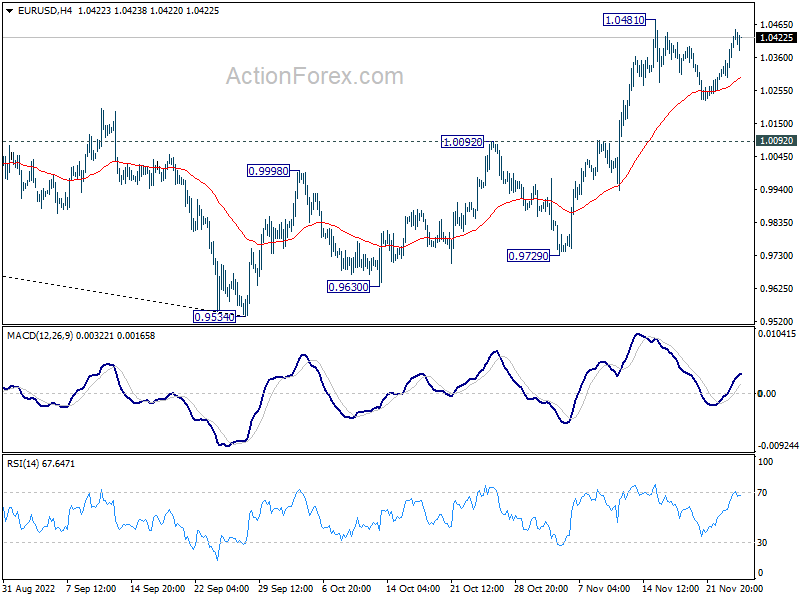
In the bigger picture, a medium term bottom was in place at 0.9534, on bullish convergence condition in daily MACD. Even as a corrective rise, rally from 0.9534 should target 38.2% retracement of 1.2348 (2021 high) to 0.9534 at 1.0609. Sustained trading above 55 week EMA (now at 1.0566) will raise the chance of trend reversal and target 61.8% retracement at 1.1273. This will now remain the favored case as long as 1.0092 resistance turned support holds.