Sample Category Title
USDCAD Retreats as Latest Recovery Fades
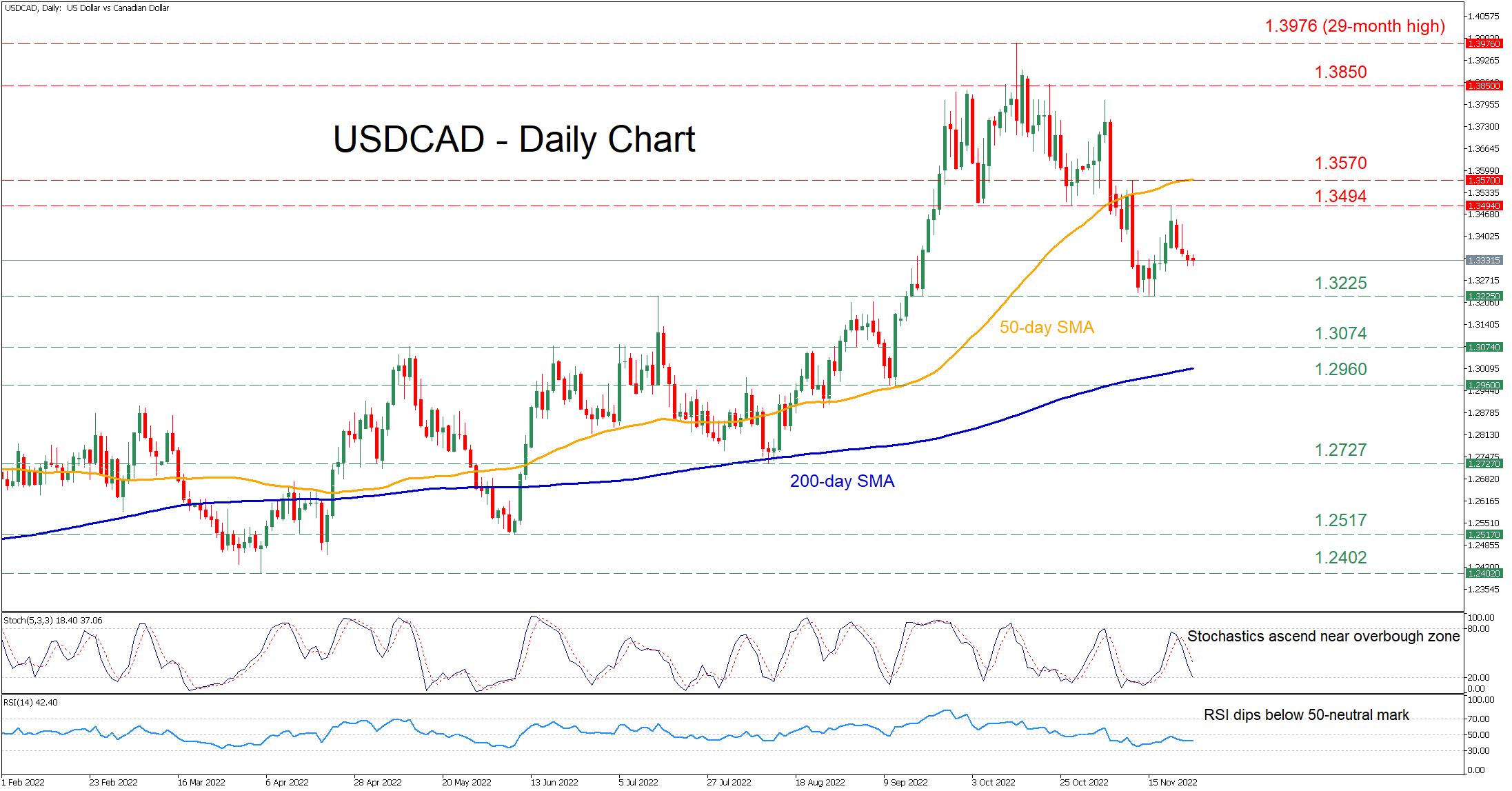
USDCAD has been in an uptrend since March, storming to a fresh 29-month high of 1.3976 before experiencing a significant downside correction. Even though the pair managed to erase part of the recent pullback, it has been on the retreat again as its latest rebound failed to strengthen.
The momentum indicators currently suggest that bearish forces are gaining control. Specifically, the RSI is retreating below its 50-neutral mark, while the stochastic oscillator is descending near the 20-oversold zone.
To the downside, bearish forces could send the price to test the November low of 1.3225, which coincides with the pair’s high in July. Sliding beneath that floor, the crucial 1.3074 resistance region could appear on the radar. Failing to halt there, the bears may then aim at the 1.2960 support before the attention shifts to the August low of 1.2727.
On the flipside, should buyers regain control and push the price higher, initial resistance could be met at the recent resistance of 1.3494. Piercing through this region, the pair might challenge 1.3570, which overlaps with the 50-day simple moving average (SMA). A break above the latter could trigger an advance towards 1.3850.
Overall, USDCAD appears ready to resume its recent decline as its latest rebound has run out of steam. Therefore, a break below the 1.3225 floor could validate this negative tendency.
US Financial Markets Reopen Today But Only for a Short Session
Markets
Yesterday’s session was a short one with the US absent for Thanksgiving. European stock markets closed with gains between 0.4-0.8%. European/German bonds advanced in a catch-up move with a late-session UST rally the day before. ECB’s Schnabel cut the run short though. The influential German board member said European fiscal policies and incoming data so far suggest that the room for slowing down the tightening pace remains limited. Dutch ECB governor Knot earlier also warned that large-scale fiscal policy can lead to inflation. German yields at the short end pared losses to 2.8 bps. Longer tenors eased 8-8.3 bps still with the 10y yield losing June interim high support at 1.927%. EUR/USD held a tight sideways pattern. The pair finished slightly higher at 1.041. Sterling had a good run. Bank of England MPC member Ramsden sided with chief economist Pill, saying additional rate hikes are necessary to keep inflation expectations anchored. He downplayed central bank scenario’s projecting inflation below target in two years even with the policy rate held stable at the current 3%. Gilts underperformed with gains up to 7.9 bps in the 2y. The very long end (30y) rose to the same extend after the BoE formally announced it will wind down its financial stability gilt purchases made between Sep 28 and Oct 14. EUR/GBP lost the upward sloping trendline (Aug-Oct) and came close to an (inevitable) test of 0.8567 neckline support. Cable (GBP/USD) extended gains to 1.211. The Japanese yen closed at the strongest level since early September (USD/JPY 138.54) while the Swedish krone (EUR/SEK 10.83) profited from the Riksbank’s 75 bps rate hike to 2.5% and higher expected terminal rate.
FX markets in Asian-Pacific dealings trade quietly this morning. Stocks trade mixed with the Antipodeans outperforming. In China/Hong Kong markets are weighing record Covid cases (and expanding community lockdowns) vs upcoming monetary stimulus. The State Council issued a statement earlier this week that tools “such as a RRR cut” will be used “in a timely and appropriate manner". This is usually followed by an actual cut by the PBOC some days after. US cash bond markets reopen with yields declining between 1.7 bps (30y) to 4.9 bps (2y).
US financial markets reopen today but only for a short session, reducing liquidity for a second day straight. Unlike yesterday, there are no smaller central bank meetings nor high-profile central bank speakers scheduled that could spice up the session. Forget about today’s lackluster trading session and let’s focus on next week instead. ECB President Lagarde appears before the Committee on Economic and Monetary Affairs for a hearing on Monday while Fed chair Powell speaks on November 30. European CPI’s are due that same day, serving as key input for the ECB December meeting and the US releases the monthly labour market report next Friday.
News Headlines
Japanese inflation, as measured by Tokyo CPI (one month ahead of national CPI), accelerated more than expected in November from 3.5% Y/Y to 3.8% Y/Y for the headline reading and from 3.4% Y/Y to 3.6% Y/Y for the ex-fresh food gauge (eyed by the BoJ). Stripping out energy as well came in at 2.5% Y/Y. Tokyo inflation this way hit the fastest pace since April 1982. Processed food prices (6.7% Y/Y) and the weaker yen added to price pressure. The numbers add pressure to BoJ governor Kuroda’s view that cost-push inflation is only temporary and make it tougher to defend the Japanese central bank’s ultra-easy monetary policy. Japanese government bond yield rise by 3-4 bps this morning at the 5yr+ part of the curve. The yen fails to build on his recent momentum after bouncing off the mid-November low yesterday (137.68).
Spanish parliament approved next year’s budget, with a record spending cap op €198.2bn, in a win for the minority coalition of PM Sanchez. Next year’s budget will increase social spending by 11% to a record €266.7bn, bolster pensions by around 8.5%, and increase civil servant wages by 3.5%. Government spending should deliver 2.1% growth next year with the budget deficit shrinking from 5% of GDP this year to 3.9% next. Spain’s lower house also approved a plan to impose windfall taxed on banks and energy companies. Both bills will now be sent to Spanish Senate for final approval.
European Stocks Surf on Softer USD
Markets were quiet yesterday, as the US was closed for Thanksgiving.
European markets mostly surfed on the positive reaction from the US equities to the Federal Reserve (Fed) minutes released a day earlier. The latest minutes from the Fed were heard as dovish, as the Fed is willing to reduce the size of its interest rate hikes.
But, keep in mind that the fact that they will go higher has been broadly ignored.
The DAX advanced to a fresh 5-month high, and is now preparing to test the major 61.8% retracement on the year-to-date selloff, which stands around 14590 mark, and if cleared, will hint at a stronger recovery in German stocks despite looming recession worries.
The French CAC40 on the other hand advanced to a fresh 7-month high, and is now up by almost 20% since the dip that we saw end of September.
And the recent rally in the European stocks is mostly due to the euro’s appreciation against the greenback, which also started around end of September, and which somehow eased the inflationary pressures for the European companies, along with the falling energy prices.
The same is true for sterling and FTSE. A stronger pound feeds into a better appetite for FTSE these days, even though most FTSE companies’ revenues are US dollar-denominated. The correlation between Cable and the FTSE has been relatively strong this year.
And whether sterling or the euro will recover more against the US dollar, depends heavily on the US dollar, as the greenback has been the major driver of the FX markets over the past year-and-a-half, and the dollar tends to say the last word as long as the Fed remains on its aggressive monetary tightening path.
The latest minutes from the European Central Bank (ECB) released yesterday revealed that ‘a few’ officials favored a smaller rate increase, than the 75bp that the bank delivered last month, citing the other monetary tightening measures that would help restricting the monetary conditions. But ECB’s Isabel Schnabel was there to dissipate speculation that the ECB would opt for a softer rate hike in December, warning that the biggest risk would be ‘underestimating inflation’s persistence’. We will see how much the rest of the committee agrees with that.
Elsewhere, rate hikes continue at a certain speed. The Swedish Riksbank raised its interest rates by 75bp yesterday and said that the monetary tightening will continue to tame inflation in Sweden. The Korean Central Bank raised its interest rates by another 25bp to the highest levels since 2012 and the won gained, whereas the Turkish Central Bank CUT its policy rate by another 150bp points, but said that the easing is perhaps enough at 9%, and that risks on inflation – which stands around 85% officially, and 185% unofficially – increase from here
In China, the central bank signals lower reserve ratios for banks, and conducts reverse repo operations to boost liquidity in the system, as news of fresh Covid restriction measures creep in. The Chinese news certainly prevent oil bulls from jumping in the market right now, and the American crude consolidates below $80pb this morning, with solid offers seen at $82/85 range.
Yields Lower Despite Hawkish ECB Comments
Market movers today
No major data releases are scheduled for today, but Swedish October PPI and German consumer confidence are due for release.
It is a quiet day on the central bank front as well, Riksbank's Floden will be on the wires today.
The 60 second overview
Yields lower, equities up, USD flat: Despite hawkish ECB comments (see below) European bond yields moved lower yesterday and US bond markets (closed yesterday) picked up the baton in Asian trading with the US 10-year yield dropping to 3.65%, the lowest in nearly two months. Equities found support in the narrative and moved higher again yesterday. Asian stocks are slightly lower on China's Covid spread that looks increasingly chaotic. The USD is broadly flat from yesterday.
Hawkish ECB comments: ECB's Executive Board member Isabel Schnabel delivered hawkish comments yesterday saying that "incoming data so far suggest that the room for slowing down the pace of rate adjustments remains limited". She added that the ECB will probably have to raise rates into restrictive territory. She is generally a hawk and the comments indicate she is likely to vote for another 75bp hike at the 15 December meeting rather than 50bp. Next week's inflation print for November will also be key for the decision. ECB minutes yesterday also struck a hawkish tone indicating that the ECB would continue to hike also in case of a shallow recession. Markets price 150bp of hikes by summer next year.
China's Covid challenges continue: China's most widespread Covid outbreak to date continues with a new record in reported cases today. More than half of China's provinces now face rising cases and restrictions. China's restrictions are less harsh than previously in line with the 20-point plan recently announced but it is unclear if they can get the outbreaks under control without resorting to tougher restrictions and whether they would do that if necessary. The development could turn more chaotic in the coming weeks if it turns out that the spread cannot be contained without stronger lockdown measures, which could hit large parts of China. Disruptions to supply chains could return as witnessed with the Foxconn challenges causing problems for iPhone production. We doubt China will allow major Covid waves over the winter before a vaccination campaign has been rolled out. Hence, China could be facing a chaotic winter with widespread restrictions. But the jury is still out on the path for the coming months and China's response.
FI: The spill-over from the FOMC minutes on Wednesday night and continued concern about the European growth outlook sent European rates lower from the morning, amid US being out for Thanksgiving. Bunds ended 6bp lower on the day at 1.85%, after some of the rally was retraced on hawkish comments from ECB's Schnabel. 2s5s continued to flatten.
FX: It was very limited with spot moves in FX markets yesterday although USD on a broad basis traded on the back-foot. EUR/USD remains close to the 1.04 level. JPY has been the primary winner amid lower global yields and oil prices with USD/JPY now trading just north of 138 - the lowest level since late August/early September. In the Scandies, both SEK and NOK have gained modestly in recent sessions.
Credit: The positive sentiment, that has prevailed most of the week in the credit markets, continued yesterday. The Investment Grade index, iTraxx Main tightened 2.2bp to 87.6bp while the High Yield index iTraxx Xover tightened 10.3bp to 441.5bp. We see similar strong tightening in the cash indices.
Nordic macro
Statistics Sweden (SCB) is publishing its financial market statistics report (CET 8:00) which includes, among many other numbers, the household mortgage growth rate that has taken a serious turn lower as of late. We assume this trend to continue. Also, the (already high) share of variable mortgage loan contracts is expected to continue to increase, at the same time as average mortgage interest rates are rising, consistent with a lagging adaption to the increased repo rate from the Riksbank.
Today's PPI numbers - (also at 8) - are likely to fall on a monthly basis, as electricity prices made a significant downward contribution in line with what we have seen for the October CPIF print.
USD/JPY Daily Outlook
Daily Pivots: (S1) 137.92; (P) 138.78; (R1) 139.51; More...
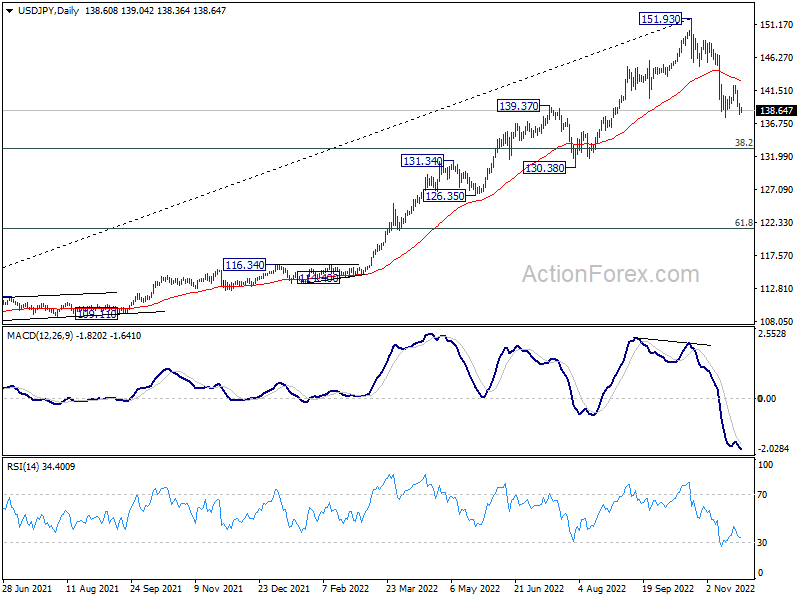
Focus stays on 137.66 support in USD/JPY. Firm break there will resume the whole fall from 151.93, as a correction to the larger up trend. Next target is 100% projection of 146.78 to 137.66 from 142.24 at 133.12, which is close to 133.07 medium term fibonacci level. Meanwhile, outlook will stay bearish as long as 142.45 resistance holds, in case of another recovery.
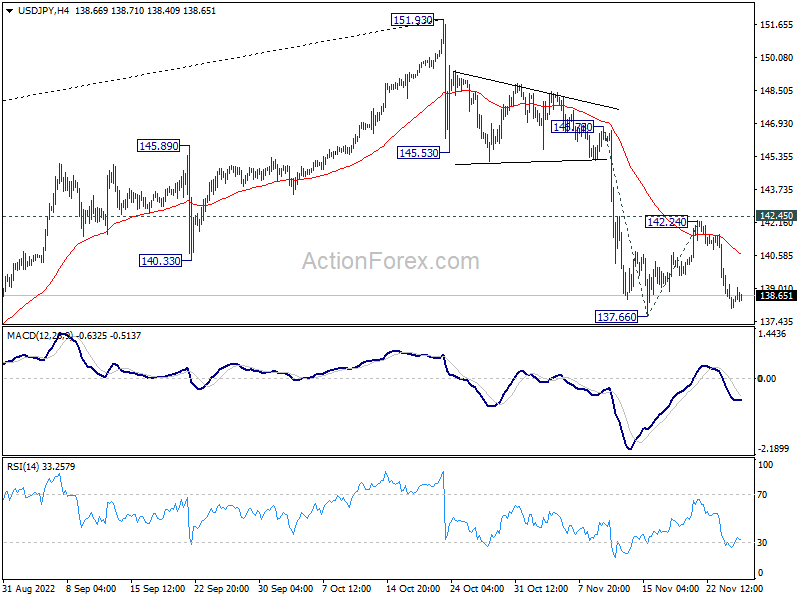
In the bigger picture, a medium term top should be formed at 151.93. Fall from there is correcting larger up trend from 102.58. It's too early to call for bearish trend reversal. But even as a corrective move, such decline should target 38.2% retracement of 102.58 to 151.93 at 133.07, or further to 55 week EMA (now at 130.28).
USD/CHF Daily Outlook
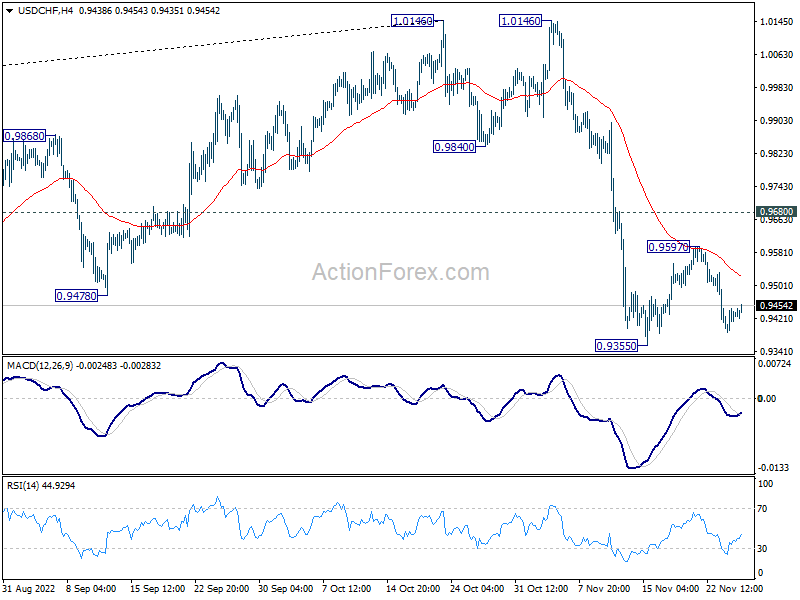
Daily Pivots: (S1) 0.9398; (P) 0.9422; (R1) 0.9456; More...
Intraday bias in USD/CHF is turned neutral first as it lost downside momentum ahead of 0.9355 support. On the downside, firm break of 0.9355 will resume the decline from 1.0146 to 0.9287 fibonacci level. Near term outlook stays bearish with 0.9680 minor resistance intact, in case of another recovery.
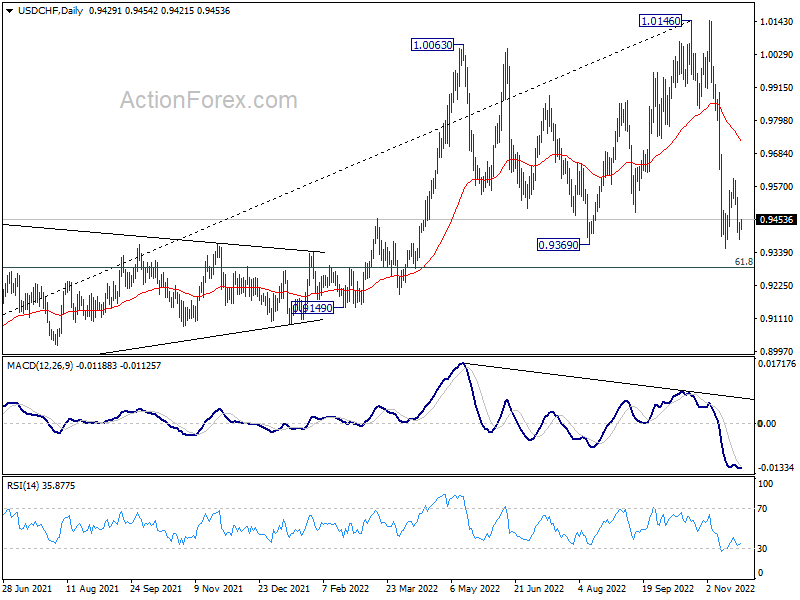
In the bigger picture, rise from 0.8756 (2021 low) has completed at 1.0146, well ahead of 1.0342 long term resistance (2016 high). Based on current downside momentum, fall from 1.0146 might be a medium term down trend itself. Break of 61.8% retracement of 0.8756 to 1.0146 at 0.9287 will pave the way to 0.8756. In any case, risk will stay on the downside as long as 55 day EMA (now at 0.9767) holds.
GBP/USD Daily Outlook
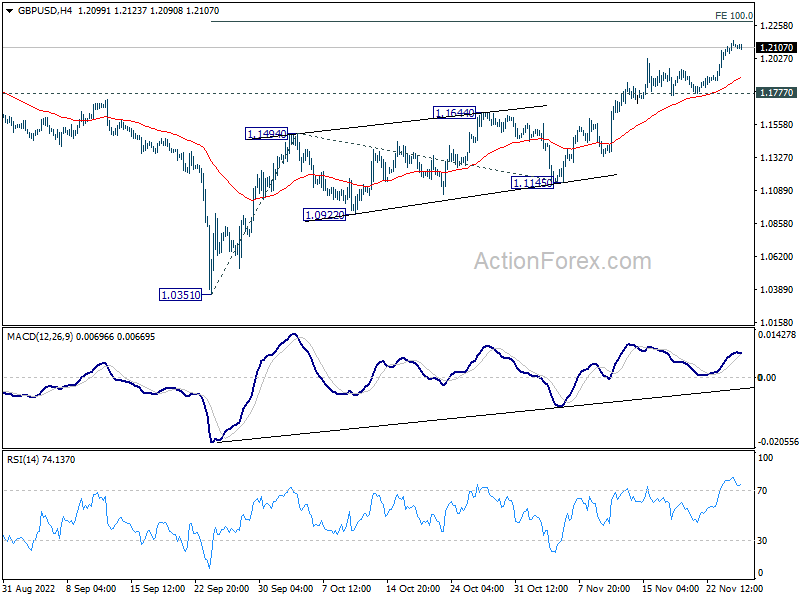
Daily Pivots: (S1) 1.2057; (P) 1.2105; (R1) 1.2164; More...
GBP/USD's rise from 1.0351 is in progress and intraday bias remains on the upside. Next target is 100% projection of 1.0351 to 1.1494 from 1.1145 at 1.2288 first. Sustained break there will pave the way to 1.2759 medium term fibonacci level. For now, break of 1.1777 support is needed to indicate short term topping. Otherwise, outlook will remain bullish in case of retreat.
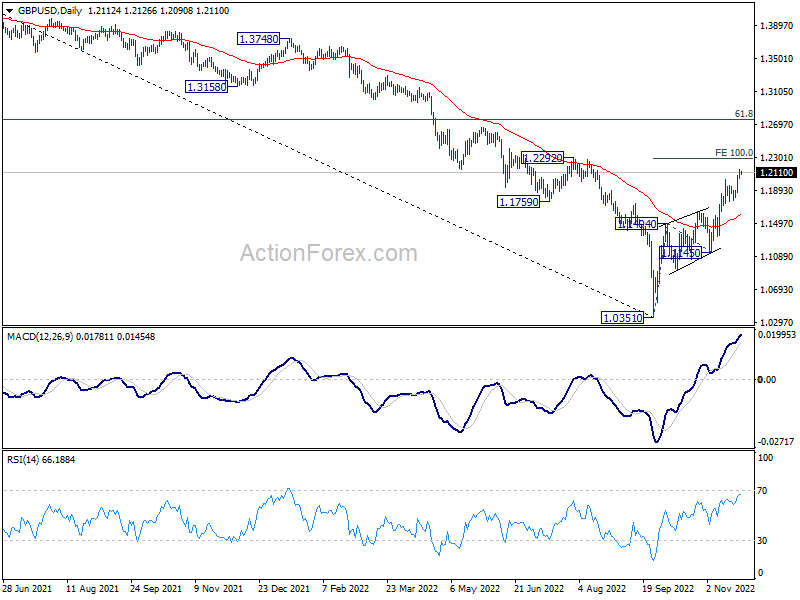
In the bigger picture, rise from 1.0351 medium term bottom is at least correcting whole down trend from 1.4248 (2021 high). Further rise is expected as long as 1.1145 support holds. Next target is 61.8% retracement of 1.4248 to 1.0351 at 1.2759. Sustained break there will pave the way back to 1.4248.
EUR/USD Daily Outlook
Daily Pivots: (S1) 1.0380; (P) 1.0414; (R1) 1.0447; More...
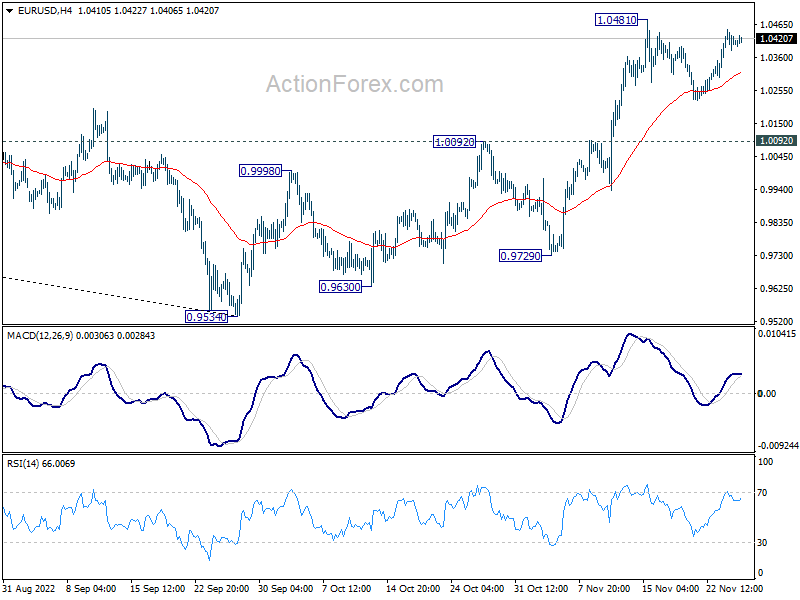
EUR/USD is still bounded in range below 1.0481 and intraday bias stays neutral. As long as 1.0092 resistance turned support holds, further rally is expected. On the upside, break of 1.0481 will resume the rise from 0.9534 and target 1.0609 fibonacci level. However, sustained break of 1.0092 will turn bias to the downside for 55 day EMA (now at 1.0055) and below.
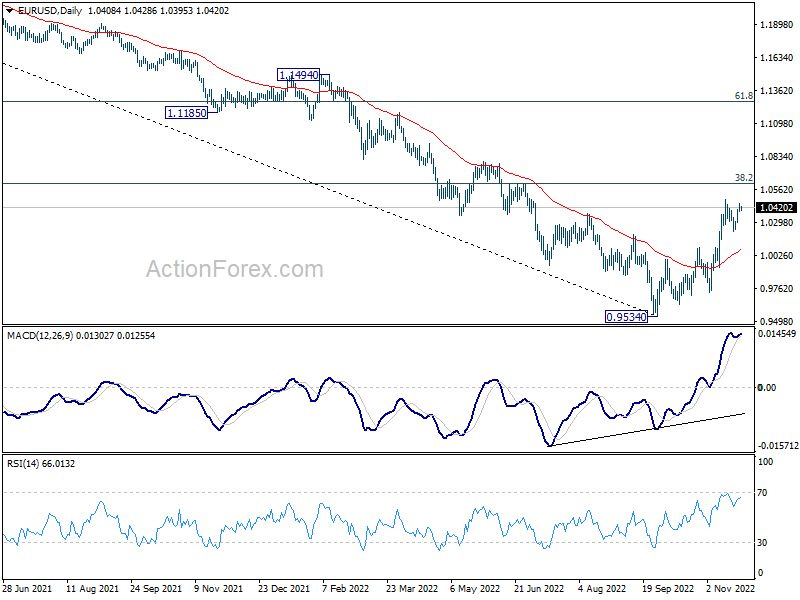
In the bigger picture, a medium term bottom was in place at 0.9534, on bullish convergence condition in daily MACD. Even as a corrective rise, rally from 0.9534 should target 38.2% retracement of 1.2348 (2021 high) to 0.9534 at 1.0609. Sustained trading above 55 week EMA (now at 1.0566) will raise the chance of trend reversal and target 61.8% retracement at 1.1273. This will now remain the favored case as long as 1.0092 resistance turned support holds.
Euro Ignores Improvement in German Consumer Sentiment, Kiwi Firm after Retail Sales
Overall, the markets are quiet in holiday mood today. Dollar remains the worst performer for the week, followed by Canadian. Next is Euro, which is receiving no support from the slight improvement in Germany consumer sentiment. Sterling is currently the strongest one for the week. New Zealand Dollar follows as second as supported by retail sales data. Yen attempted a rally overnight but there is no clear follow through buying so far.
Technically, a focus before the weekly close is whether Dollar will finally break through recent support against others. The levels include 1.0481 resistance in EUR/USD, 0.9355 support in USD/CHF and 137.66 support in USD/JPY. At the same time, if USD/JPY resumes recent decline, a focus will be on whether other Yen crosses will follow, say, with EUR/JPY breaking through 142.54 support.
In Asia, Nikkei closed down -0.35%. Hong Kong HSI is down -0.48%. China Shanghai SSE in up 0.40%. Singapore Strait Times is down -0.28%. Japan 10-year JGB yield is up 0.0063 at 0.255.
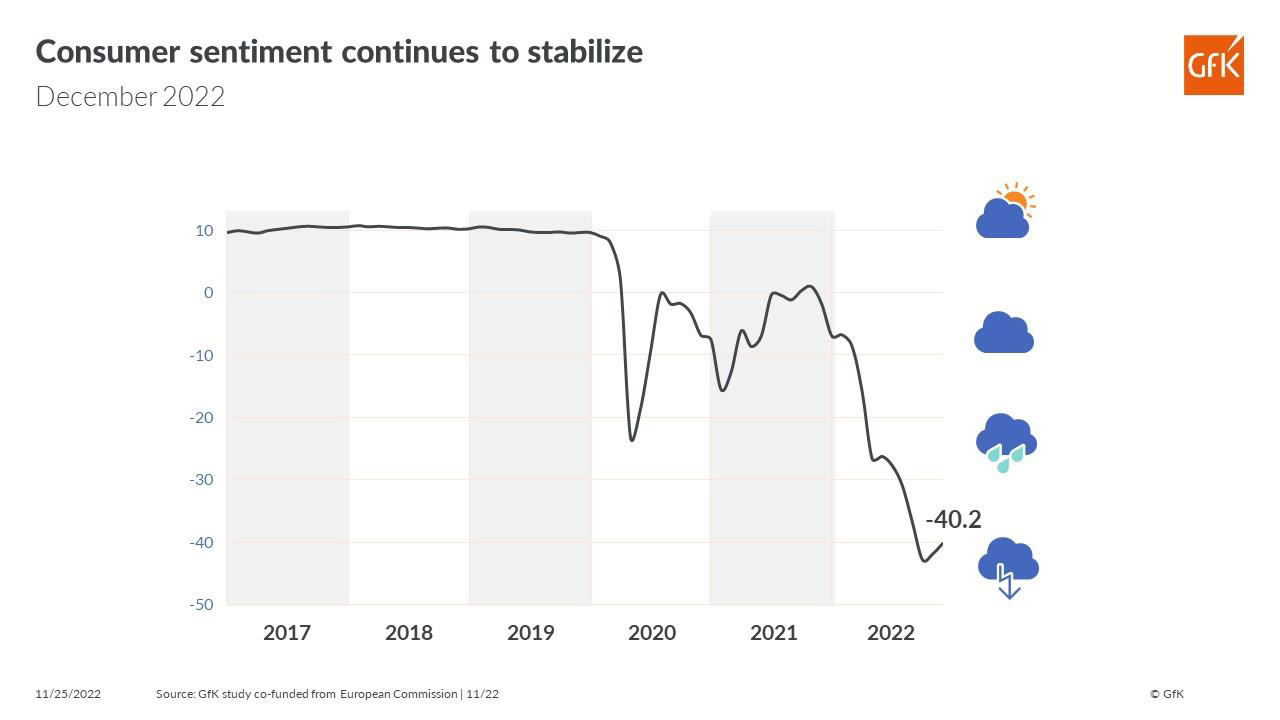
Germany Gfk consumer sentiment rose slightly to -40.2, but situation remains tense
Germany Gfk Consumer Sentiment for December rose slightly from -41.9 to -40.2, better than expectation of -45.3. In November, economic expectations rose from -22.2 to -17.9. Income expectations rose from -60.5 to -54.3. Propensity to buy dropped from -17.5 to -18.6.
"Consumers' long-standing fear of skyrocketing energy prices has currently eased somewhat, which is having a slightly positive impact on consumer sentiment. On the one hand, some energy prices have recently recovered a bit, and on the other hand, consumers apparently assume that the measures adopted to cap energy prices can help curb inflation, even if this may turn out to be rather modest," explains Rolf Bürkl, GfK consumer expert. "Despite the slight improvements, however, the situation remains tense."
Also released, Germany Q3 GDP growth was finalized at 0.4% qoq.
NZ retail sales volume rose 0.4% qoq in Q3, value rose 2.5% qoq
New Zealand retail sales volume rose 0.4% qoq to NZD 26B in Q3, slightly below expectation of 0.5% qoq. Sale value rose 2.5% qoq to NZD 30B. Comparing with Q3 2021, sales volume rose 4.9% yoy and sales value rose 15% yoy.
StatsNZ said, "The volume of sales in the food and beverage services industry (which includes cafes, restaurants, bars, and takeaways), increased 30 percent in the September 2022 quarter compared with the September 2021 quarter, helping to drive the rise in total retail sales."
EUR/USD Daily Outlook
Daily Pivots: (S1) 1.0380; (P) 1.0414; (R1) 1.0447; More...
EUR/USD is still bounded in range below 1.0481 and intraday bias stays neutral. As long as 1.0092 resistance turned support holds, further rally is expected. On the upside, break of 1.0481 will resume the rise from 0.9534 and target 1.0609 fibonacci level. However, sustained break of 1.0092 will turn bias to the downside for 55 day EMA (now at 1.0055) and below.
In the bigger picture, a medium term bottom was in place at 0.9534, on bullish convergence condition in daily MACD. Even as a corrective rise, rally from 0.9534 should target 38.2% retracement of 1.2348 (2021 high) to 0.9534 at 1.0609. Sustained trading above 55 week EMA (now at 1.0566) will raise the chance of trend reversal and target 61.8% retracement at 1.1273. This will now remain the favored case as long as 1.0092 resistance turned support holds.
Economic Indicators Update
| GMT | Ccy | Events | Actual | Forecast | Previous | Revised |
|---|---|---|---|---|---|---|
| 21:45 | NZD | Retail Sales Q/Q Q3 | 0.40% | 0.50% | -2.30% | -2.20% |
| 21:45 | NZD | Retail Sales ex Autos Q/Q Q3 | 0.40% | 0.70% | -1.60% | -1.50% |
| 23:30 | JPY | Tokyo CPI Core Y/Y Nov | 3.60% | 2.10% | 2.20% | |
| 07:00 | EUR | Germany Gfk Consumer Confidence Dec | -40.2 | -45.3 | -41.9 | |
| 07:00 | EUR | Germany GDP Q/Q Q3 F | 0.40% | 0.30% | 0.30% |
Germany Gfk consumer sentiment rose slightly to -40.2, but situation remains tense
Germany Gfk Consumer Sentiment for December rose slightly from -41.9 to -40.2, better than expectation of -45.3. In November, economic expectations rose from -22.2 to -17.9. Income expectations rose from -60.5 to -54.3. Propensity to buy dropped from -17.5 to -18.6.
"Consumers' long-standing fear of skyrocketing energy prices has currently eased somewhat, which is having a slightly positive impact on consumer sentiment. On the one hand, some energy prices have recently recovered a bit, and on the other hand, consumers apparently assume that the measures adopted to cap energy prices can help curb inflation, even if this may turn out to be rather modest," explains Rolf Bürkl, GfK consumer expert. "Despite the slight improvements, however, the situation remains tense."