Sample Category Title
Bundesbank: Inflation rate in double digits beyond turn of the year
In the monthly report, Bundesbank said "all in all, despite the higher than expected economic activity in the summer quarter, a recession in the German economy is to be expected in the winter half-year." Downward forces should "clearly predominate in the coming months". Weaker global economy will weigh on exports while high inflation is dampening private consumption.
"The inflation rate could remain in the double digits beyond the turn of the year," it noted. There is still strong cost pressure, especially for industrial products on the upstream stages. Energy prices have recently been declining but are still at a very high level. Passing of raw material prices is not yet complete.
RBNZ Accelerates Rate Hike, Encouraging NZD Rise
The Reserve Bank of New Zealand raised the rate by 75 points to 4.25% after five consecutive 50-point hikes. Analysts polled had anticipated such a result based on the signals sent by the central bank. RBNZ also began to reduce the balance sheet through managed sales, while before, it had stopped reinvesting coupons and matured obligations. Commenting on the decision, it states the need “to reach a higher level, and sooner than previously indicated”.
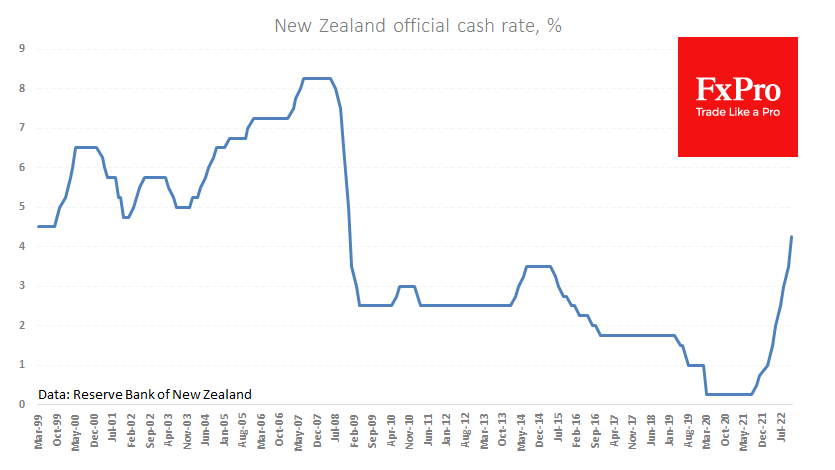
In the November monetary policy update, the RBNZ said it intends to raise the rate to 5.5% by September 2023.
Contrary to the trend set by the US and shared by Australia, the RBNZ is accelerating rate hikes and tightening other policy tools. This has been made possible by excessively high inflation (7.2% y/y), rising short-term inflation expectations (5% in one year and 3.6% in two years) and employment above sustainable levels (unemployment rate of 3.3% – near the cyclical lows of the last 40 years).
Although a key rate hike of 400 points in 14 months looks impressive, current rates are low by historical standards. Until May 2008 – before the global zero-rate policy and QE started – the RBNZ held the rate at 8.25%, and the 4.5% level was the cyclical low from 1999 to 2009. So, in this case, the anticipated 5.5% is just a return to normal and not overtightened conditions here.
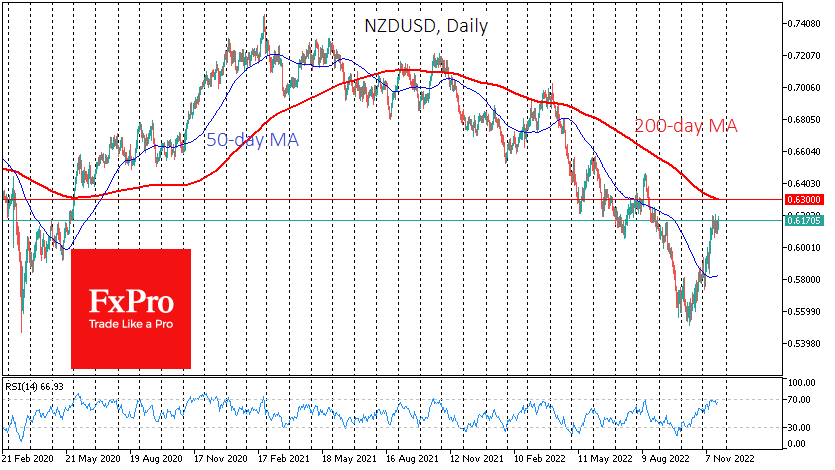
Either way, a higher rate hike is a bullish signal for the Kiwi. The NZDUSD pushed back from the bottom near 0.5500 6 weeks ago, adding 12% to 0.6170 during quite an even rally. Over the last week, we have seen some position shake-ups, after which the pair looks ready to resurface again.
A significant milestone on the way up will be the area of 0.6300, the 200-day MA and the essential support of the last seven years. A consolidation above that would firmly establish a reversal. At the same time, fundamentals such as a strong labour market and central bank resolve to fight inflation would increase interest in the Kiwi from speculators and carry traders.
Natural Gas Wave Analysis
- Natural gas broke resistance level 7.230
- Likely to rise to resistance level 8.160
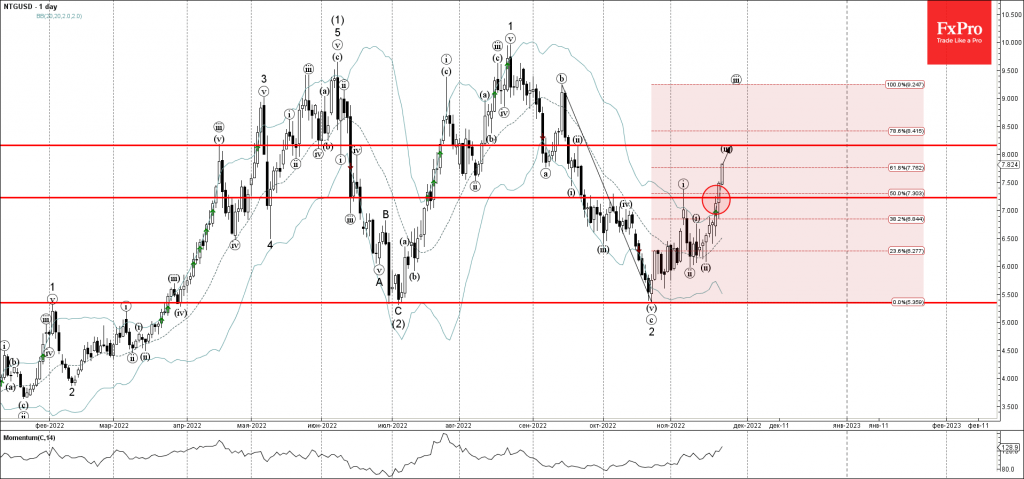
Natural gas recently broke above the resistance level 7.230 (which has been reversing the price from the start of October), intersecting with the 50% Fibonacci correction of the downward impulse from September.
The breakout of the resistance level 7.230 accelerated the active short-term impulse wave (iii).
Natural gas can be expected to rise further toward the next resistance level 8.160 (top of wave (ii) from the end of September and the target for the completion of the active impulse wave (iii)).
Platinum Wave Analysis
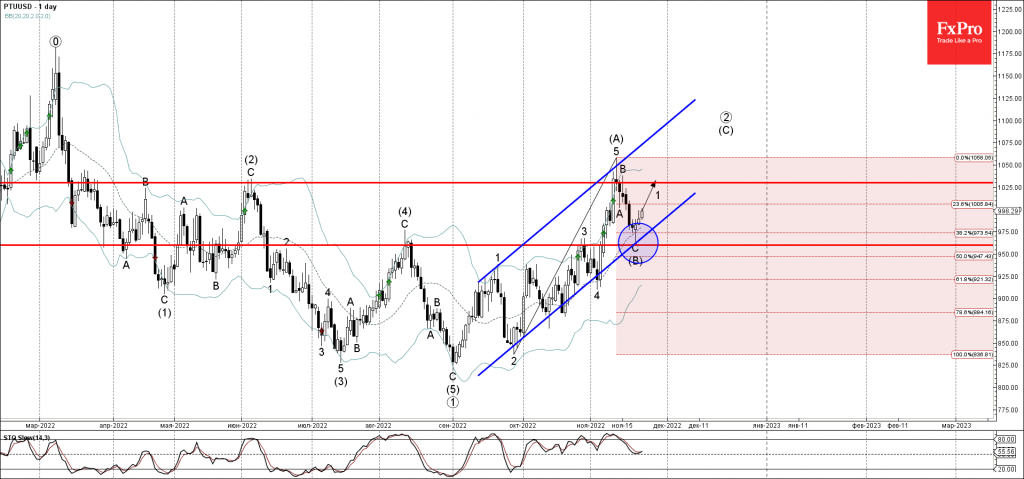
- Platinum reversed from support level 960.00
- Likely to rise to resistance level 1025.00
Platinum recently reversed up from the pivotal support level 960.00 (former resistance from October), support trendline of the daily up channel from September and the 50% Fibonacci correction of the upward impulse from September.
The upward reversal from the support level 960.00 started the active medium-term impulse wave (C).
Platinum can be expected to rise further toward the next resistance level 1025.00 (which has been reversing the price from March, the target for the completion of the active impulse wave 1).
NZD/USD Rises after RBNZ’s Jumbo Hike
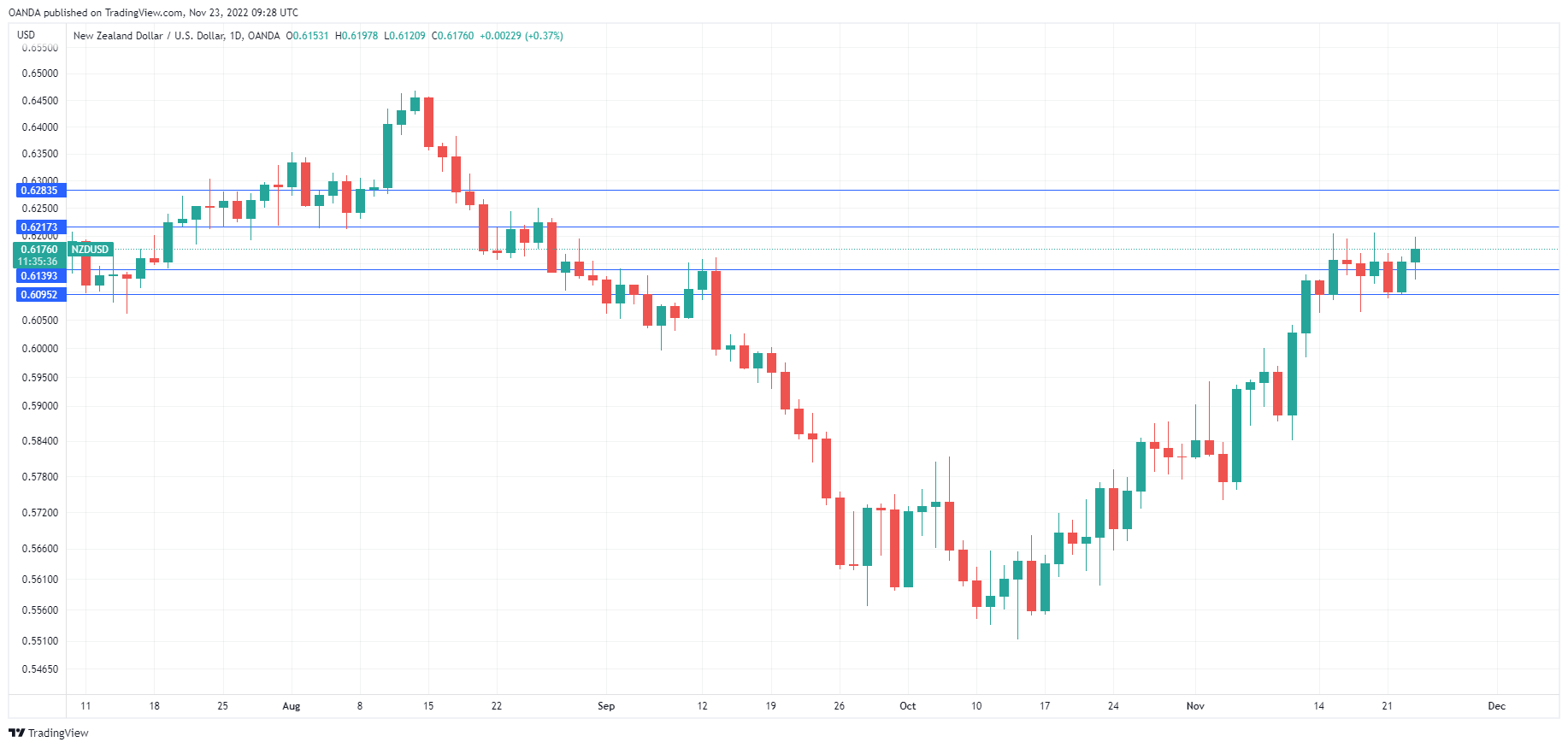
The New Zealand dollar has extended its rally on Wednesday. In the European session, NZD/USD is trading at 0.6181, up 0.47%.
RBNZ delivers record hike
The Reserve Bank of New Zealand pushed the rate pedal to the floor today, with a supersize rate hike of 75 basis points, a record high. This raised the cash rate to 4.25%, up from 3.5% and the highest level since 2008. The move was widely expected, but nonetheless, it sent bond yields and the New Zealand dollar higher.
The RBNZ is forecasting that the cash rate will peak at 5.5% in 2023, which means there’s plenty of life left in the current rate-tightening cycle, with the RBNZ currently boasting the highest cash rates among the major central banks. The bank has designated inflation as public enemy number one, but despite a series of oversize hikes, there are no signs that inflation has peaked. In the third quarter, CPI was almost unchanged in Q3, nudging lower to 7.2%, following a 7.3% gain in Q2. This figure caught the RBNZ off guard, as the bank projected that CPI in Q3 would slow to 6.4%. The Monetary Policy Statement was decidedly hawkish, noting that “core consumer price inflation is too high” and “near-term inflation expectations have risen.”
How will New Zealand’s economy fare after the latest rate hike? The labour market remains tight, with unemployment at a near-record low of 3.3%, and the economy has recovered impressively from the Covid pandemic. Still, the RBNZ statement forecasted that the economy will tip into recession in June 2023 and that inflation would accelerate to 7.5% in the fourth quarter and would not fall back to the midpoint of the 1%-3% target until 2025. The RBNZ has taken off the gloves, but the prolonged battle against inflation will not end anytime soon.
The US will release the FOMC minutes later today, which could impact on the movement of NZD/USD. Investors will be looking for hints about what the Fed has planned at the December 12th meeting. The markets have priced in a 50-basis point hike, although there is an outside chance of a 75 bp increase.
NZD/USD Technical
- There is resistance at 0.6217 and 06283
- 0.6139 is providing support, followed by 0.6095, a monthly support line
ECB de Guindos: We will continue to raise interest rates
ECB Vice-President Luis de Guindos said at a finance event, "we will continue to raise interest rates to a level that allows us to ensure that inflation converges towards our definition of price stability."
"It is very important to look at the evolution of underlying inflation and possible second round effects because they will determine the response of monetary policy," De Guindos said.
While he expect inflation to slow in Q1 or H1 of next year, "we also believe core inflation will be high in coming months." Also, he noted, "it is very possible that in the fourth quarter and the first quarter of next year we will have negative growth rates."
Trade Idea: Breakdown of Major Pairs
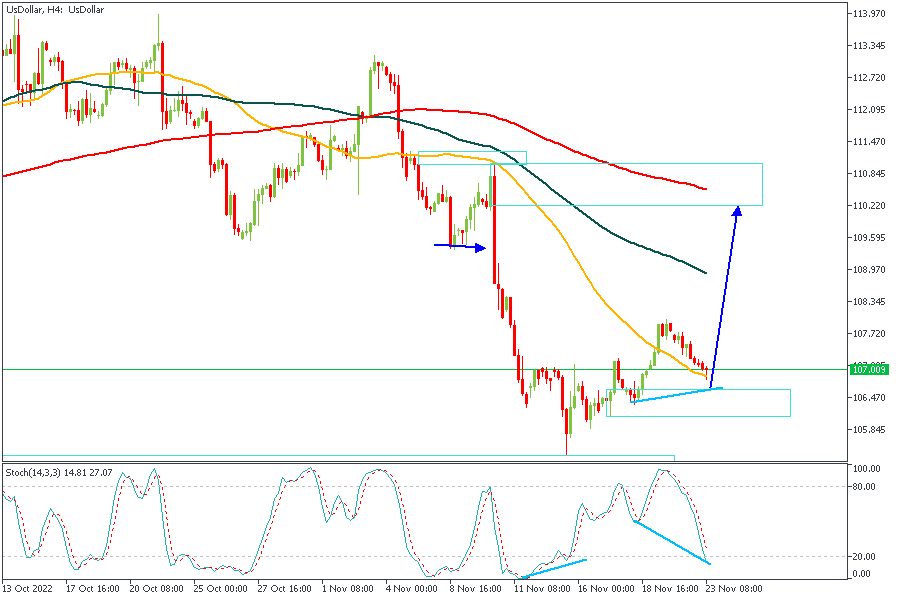
Even though we've only witnessed sluggish movements from the Dollar over the past few weeks, the general idea and bias still seem intact and untampered. The bullish impulse however can be seen as "searching for support". This simply means that price is strategically searching for an area with sufficient demand to push prices higher.
The setup above shows a break out of the small range between the 107 and 104 price area with a possible retest of the drop-base-rally demand zone. There is also a divergence from the stochastics as well as the 50-Moving Average contributing to the trade idea.
EURUSD
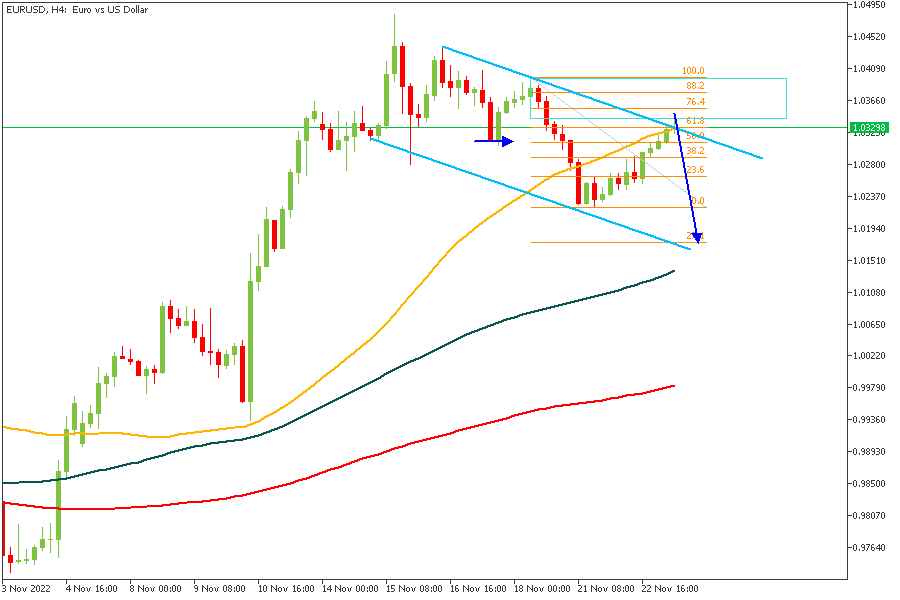
The 4-Hour timeframe of EURUSD presents us with an interesting opportunity. Here, we see the trendline resistance fitting into the rally-base-drop supply zone and the "golden zone" of the Fibonacci retracement (61.8%). All these present us reasons to expect a decline in prices possibly to the 1.018 area.
GBPUSD
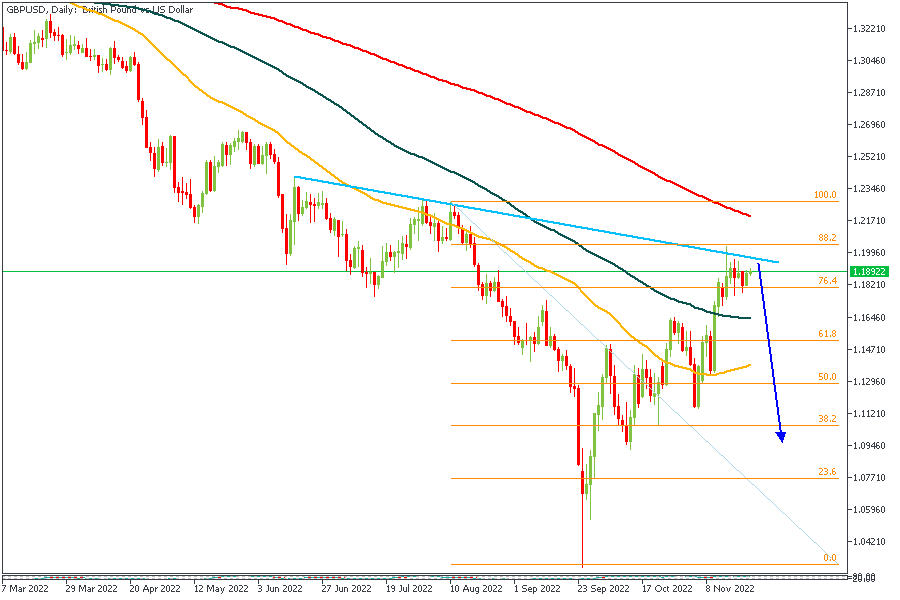
GBPUSD presents a case similar to what we've seen from EURUSD, however, from the Daily Timeframe. We see price filling up the Fair Value Gap (FVG) between 1.997 and 1.892 area with a touch of the 88.2% Fibonacci retracement. The trendline resistance is also a contributory factor to consider in favour of a bearish impulse.
AUDUSD
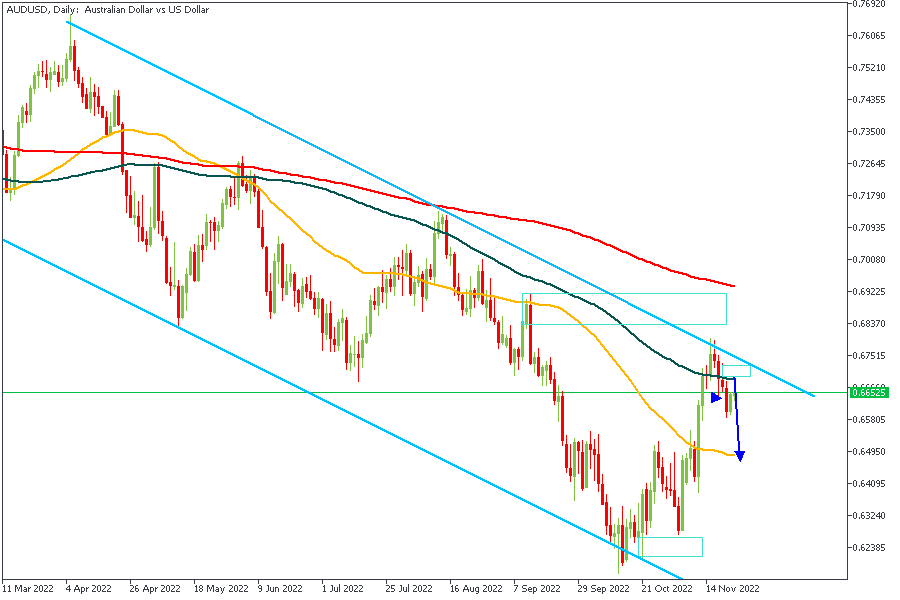
AUDUSD is trading inside the descending channel on the Daily timeframe and has just recently given an initial reaction to the trendline resistance and the FVG (Fair Value Gap). Price is however retracing slightly towards the 100-Day moving average which should serve as sufficient resistance to push prices lower. A long-term selling opportunity could be brewing here!
NZDUSD
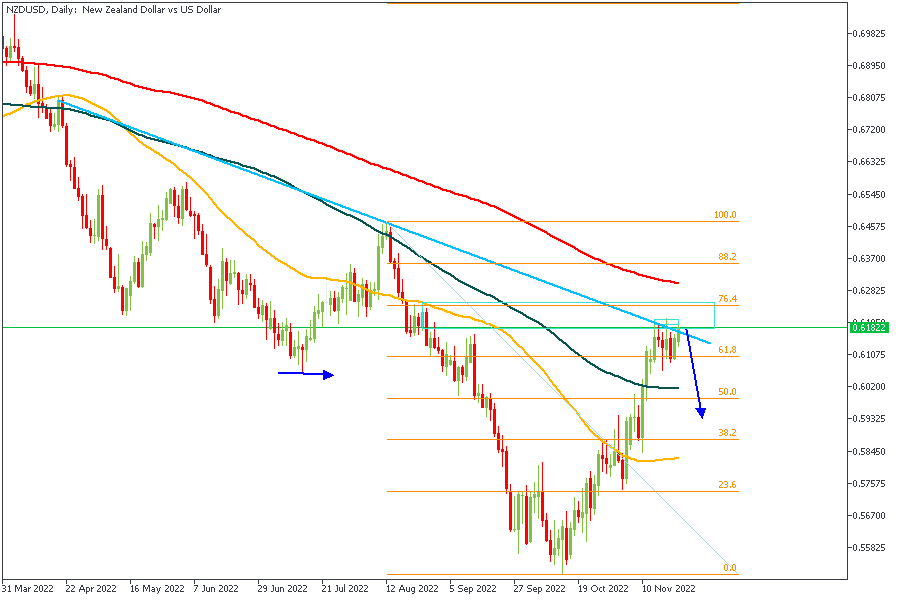
NZDUSD is at the moment 'dancing' around the trendline resistance from April. To the left, we can see the drop-base-drop supply zone aligning with the 76.4% Fibonacci level. Considering the possibility of a stronger Dollar, this looks like a textbook setup for a bearish impulse.
Traders Await FOMC Minutes to Learn About Fed’s Outlook on Monetary Policy
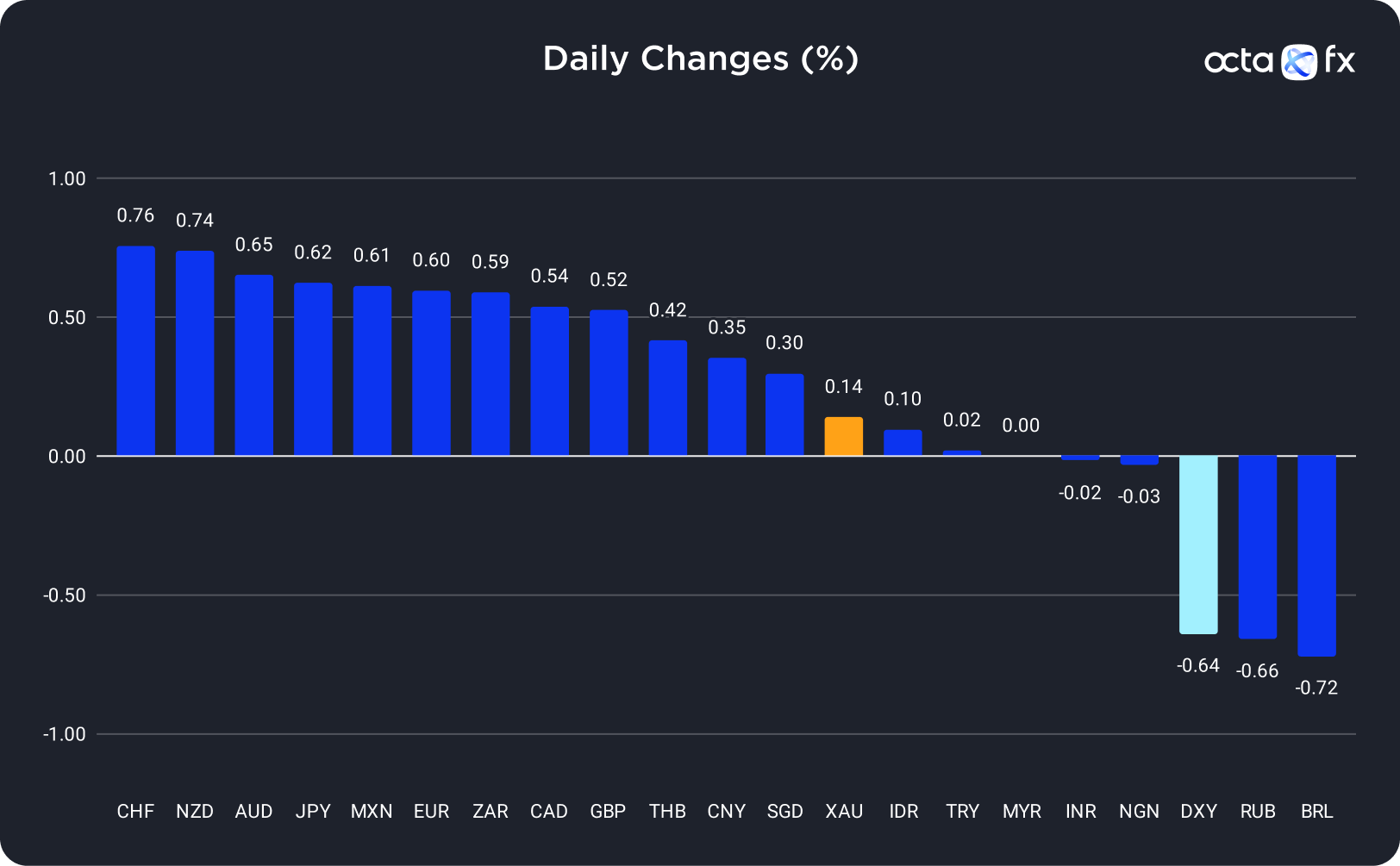
On Tuesday, the Swiss franc was the best-performing currency among the 20 global currencies we track, while the Brazilian real showed the weakest results. The Mexican peso was the leader among emerging markets, while the U.S. dollar underperformed among majors.
In focus today
U.S. Dollar Index
The U.S. Dollar Index (DXY) fell by 0.64% as U.S. Treasury yields continued to invert, fueling fears of a possible recession.
Possible effects for traders
Treasury yields are inverted since the difference between the yield on ten-year government bonds and two-year bonds turned negative. Such a situation signals that an economic recession is likely, and further monetary tightening is risky. According to Reuters, the market expects the U.S. interest rate to peak at 5% by mid-2023, and it starts to price in rate cuts after that. DXY has been stable during the Asian session as traders await the release of the Federal Reserve's (Fed) policy meeting minutes. The report could offer clues to the outlook for inflation and interest rates. Fed minutes are due at 7:00 p.m. GMT today. Investors should look for any signs of discussions around moderating the pace of rate hikes.
XAUUSD
The gold price increased by 0.14% but closed below the important 1,750 level.
Possible effects for traders
XAUUSD received some support from the weakening U.S. dollar, but it is unclear if a rebound from 1,730 can be sustained. 'I think the metals will eventually move higher. But right now it is a direct correlation with interest rates,' said Daniel Pavilonis, senior market strategist at RJO Futures. XAUUSD has been trading in a narrow range during the Asian session as investors await the release of the Fed meeting protocols. Many analysts expect the Fed to remain hawkish, which is potentially bearish for gold. Kansas City Fed President Esther George said that the Fed might need to raise rates to a higher level and hold them longer to moderate consumer demand and successfully bring down high inflation. According to Reuters, the market is pricing in a 79% chance of a 50-basis point hike in December.
EURUSD
EURUSD traded in the positive territory, closing above 1.0300.
Possible effects for traders
The pair gained 0.60% intraday as the eurozone Consumer Confidence Index (CPI) came out better than expected, and the U.S. dollar retreated. EURUSD continued to increase during the Asian session and will likely retest 1.03600. The upcoming German and the eurozone PMI data due at 9:00 am GMT today may send the pair towards 1.03400 in case of good results. Alternatively, a disappointing figure will likely pause the rally and reverse the pair towards 1.02800.
Other events
GBPUSD
The British pound rose by 0.5% yesterday due to the better-than-expected UK government borrowing numbers. The general weakness of the U.S. dollar also provided some support.
Possible effects for traders
The data published on Tuesday showed that Britain's government borrowed less funds than expected in October. However, the budget deficit is likely to increase in the months ahead due to energy bill support measures and slowing economy. Samuel Tombs, chief UK economist at consultancy Pantheon Macroeconomics, said that 'the downturn in GDP will start to slow the growth rate of tax receipts, and put some upward pressure on benefits spending towards the very end of this fiscal year.' According to Reuters, the UK economy is already in a recession and will shrink by 1.4% in 2023. Thus, the fundamental pressure on GBPUSD is rather bearish. Today, the UK will release its Manufacturing PMI data at 09:30 a.m. GMT. Higher-than-expected results may drive GBPUSD towards 1.19450, while the weaker numbers may push the pair towards 1.18000.
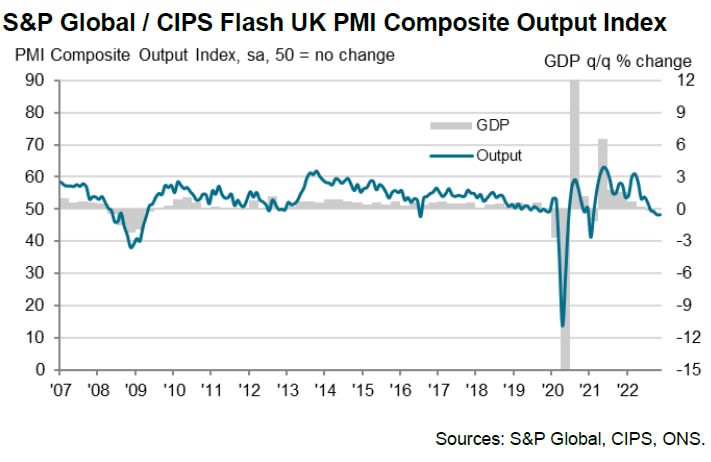
UK PMI composite ticked up to 48.3, downturn will deepen into new year
UK PMI Manufacturing was unchanged at 46.2 in November. PMI services was also unchanged at 48.8. PMI Composite ticked up from 48.2 to 48.3.
Chris Williamson, Chief Business Economist at S&P Global Market Intelligence said:
"A further steep fall in business activity in November adds to growing signs that the UK is in recession, with GDP likely to fall for a second consecutive quarter in the closing months of 2022.
"If pandemic lockdown months are excluded, the PMI for the fourth quarter so far is signalling the steepest economic contraction since the height of the global financial crisis in the first quarter of 2009, consistent with the economy contracting at a quarterly rate of 0.4%. "
Forward-looking indicators, notably an increasingly steep drop in demand for goods and services, suggest the downturn will deepen as we head into the new year."
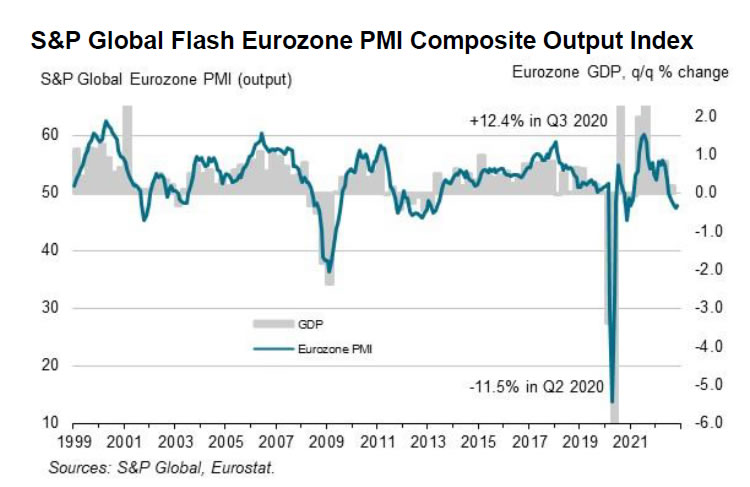
Eurozone PMI composite ticked up to 47.8, consistent with -0.2% GDP contraction in Q4
Eurozone PMI Manufacturing rose from 46.4 to 47.3 in November. PMI Services was unchanged at 48.6. PMI Composite rose from 47.3 to 47.8.
Chris Williamson, Chief Business Economist at S&P Global Market Intelligence said:
"A further fall in business activity in November adds to the chances of the eurozone economy slipping into recession. So far, the data for the fourth quarter are consistent with GDP contracting at a quarterly rate of just over 0.2%.
"However, the November PMI data also bring some tentative good news. In particular, the overall rate of decline has eased compared to October. Most encouragingly, supply constraints are showing signs of easing, with supplier performance even improving in the region's manufacturing heartland of Germany. Warm weather has also allayed some of the fears over energy shortages in the winter months.
"Price pressures, the recent surge of which has prompted further policy tightening from the ECB, are also now showing signs of cooling, most noticeably in the manufacturing sector. Not only should this help contain the cost of living crisis to some extent, but the brighter inflation outlook should take some pressure off the need for further aggressive policy tightening.
"However, it's clear that manufacturing remains in a worryingly severe downturn, and service sector activity is also still under intense pressure, both largely as a result of the cost of living crisis and recent tightening of financial conditions. A recession therefore looks likely, though the latest data provide hope that the scale of the downturn may not be as severe as previously feared."