

Sample Category Title
Markets Steady as Investors Eye Earnings and ECB
European markets edged cautiously higher on Tuesday as investors digested upbeat corporate earnings and news that Rishi Sunak would replace Liz Truss as U.K. prime minister.
The latest German IFO Business Climate Index supported sentiment by showing some signs of stabilisation, albeit at low levels. Most Asian shares staged a sharp rebound during early trade, tracking the recovery from Wall Street as soft economic data fueled bets around the Fed softening its hawkish stance. Interestingly, some stability returned to Chinese markets following Monday’s historic selloff as traders weighed bargain prices against China’s uncertain political landscape and economic outlook.
In the currency space, the offshore Yuan has weakened past the psychological 7.30 level following the party congress, while dollar bulls are taking a pause amid expectations around a potential Fed pivot. Sterling has appreciated against every G10 currency this morning ahead of Rishi Sunak’s meeting with King Charles and his first public address later this morning. The euro seems to be on standby and is likely to remain trapped within a range until the European Central Bank (ECB) meeting on Thursday.
Will the ECB come to the euro’s rescue?
Markets widely expect the central bank to raise interest rates by another 75 basis points on Thursday, in a move to contain inflation which is well above the 2% target. Given how this has already been priced in, this may offer little support to euro bulls that have been beaten black and blue by a stronger dollar over the past few months. Much attention will be directed towards President Christine Lagarde’s press conference which will be closely scrutinised by investors for clues on the central bank’s next policy move. If policymakers move ahead with a 75bp hike and open the door for more jumbo hikes in the future, this could provide some support to the euro. A shock 100bp rate hike would inject euro bulls with fresh inspiration to break decisively out of the current range. Should the central bank surprise markets with a smaller than expected 50bp hike, the EURUSD could tumble back to 0.9700 and lower. Whatever the outcome of the ECB meeting, it is likely to set the tone for the euro over the next few weeks.
Currency spotlight – Time for king dollar to rest?
The dollar has weakened against most G10 currencies since the start of the fourth quarter thanks to the improving market mood and expectations around the Fed dialing back on its hawkish stance. As economic data in the United States continues to illustrate a gloomy picture, this could fuel speculation around the jumbo-sized rate hikes coming to an end. Throughout 2022, dollar bulls have derived strength from safe-haven flows, optimism over the US economy, and Fed rate hike expectations. As some positivity returns to global markets amid robust earnings, and shaky US data prompts the Fed to drop its aggressive approach towards rates, this could hit dollar bulls hard.
Looking at the technical picture, DXY bulls look exhausted on the daily charts with prices back within a range. A breakdown below the 111.50 support level could trigger a decline toward 110.00 and 109.00, respectively. If prices can break out above 113.50, the DXY could retest its 20-year high at 114.78.
Oil prices wait for fresh catalyst
Oil prices are likely to swing between losses and gains as fears over a global economic slowdown collide with caution over tightening supply. Brent remains under pressure this morning, trading around $90.25 as of writing. As investors juggle with slowdown concerns, sharp changes in risk sentiment, dollar volatility, and other themes impacting the supply/demand dynamics, this could result in more choppy price action into year end.
Looking at the technical picture, Brent remains under pressure on the daily charts. Prices are trading below the 50-, 100- and 200-day Simple Moving Average. A breakdown below $90.00 could open a path toward $87.00 and $82.50. Should prices push back above $92.00, the next key level of interest can be found at $95.00.
Commodity spotlight - Gold
After staging a stunning rebound last Friday, gold has found itself under pressure thanks to the improving market mood and rising Treasury yields. Appetite towards the precious metal is likely to remain shaky as investors evaluate whether the Fed will indicate next week if it will remain hawkish after raising interest rates by another 75 basis points in November. In the meantime, gold could trend lower until a fresh directional catalyst is brought into the picture. Talking technicals, sustained weakness below $1655 could open the doors towards $1615 and $1600 respectively. A breakout above $1655 may trigger an incline towards $1670 and $1680.
Japanese Yen Settles Down
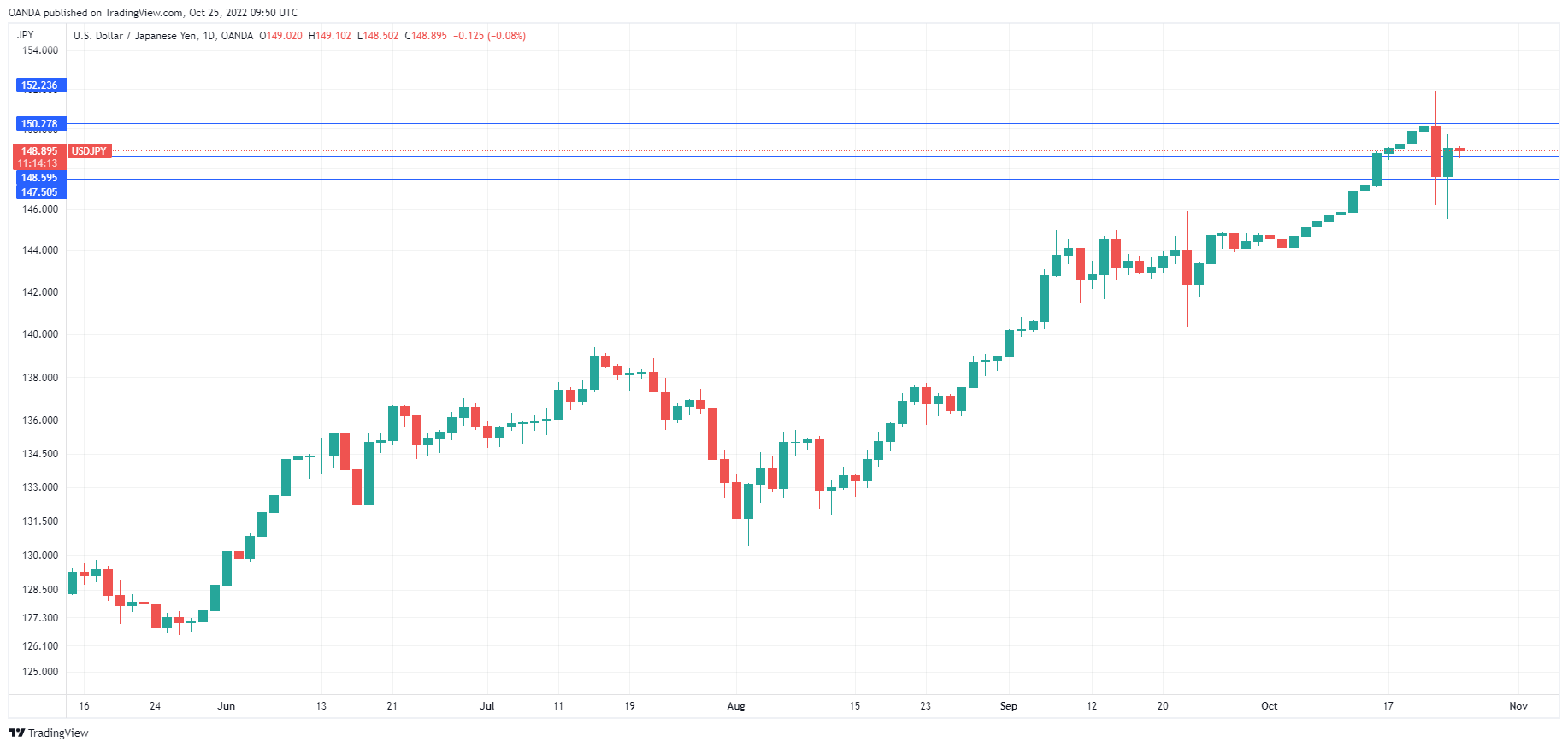
The Japanese yen is almost unchanged today, after being whipsawed over the past two sessions. In the European session, USD/JPY is trading at 1.48.93, down 0.06%.
It’s been a roller-coaster ride for the yen, as USD/JPY rose 1.7% on Friday and declined by 0.9% on Monday. It’s clear that the driver behind this volatility has been intervention by Japan’s Ministry of Finance (MOF), although officials in Tokyo are keeping mum.
The MOF intervened in late September, at a cost of around 2.8 trillion yen ($19.8 billion). Friday’s intervention was about double the size, and Monday was likely about the same. This means that the MOF is delivering a more powerful punch to deter speculators from betting against the yen. The interventions may have slowed the yen’s descent but it’s doubtful the moves will reverse the downward trend. Japan’s current policy mix is contradictory and likely unsustainable – the MOF is intervening in the currency markets while the Bank of Japan has intervened in the fixed-income markets and capped yields on Japanese government bonds.
Markets eye BoJ meeting
With the Federal Reserve widely expected to deliver another 0.75% rate next week, the US/Japan rate differential continues to widen, which will weigh on the yen. The MOF’s intervention and the subsequent volatility have heightened the interest in the BoJ’s meeting on Wednesday and Thursday, which some are calling a ‘do or die’ moment for the Japanese yen. If the BoJ continues its dovish policy and doesn’t provide the yen a lifeline, the yen is likely to fall even further.
Japan’s core inflation rose to 3.0% in September, its highest level in eight years. This follows the 2.8% gain in August and matched the consensus, and the yen’s reaction has been muted today.
USD/JPY Technical
- USD/JPY faces resistance at 147.50 and 148.59
- There is support at 145.23 and 143.14
German Business Climate: Steadily Grim
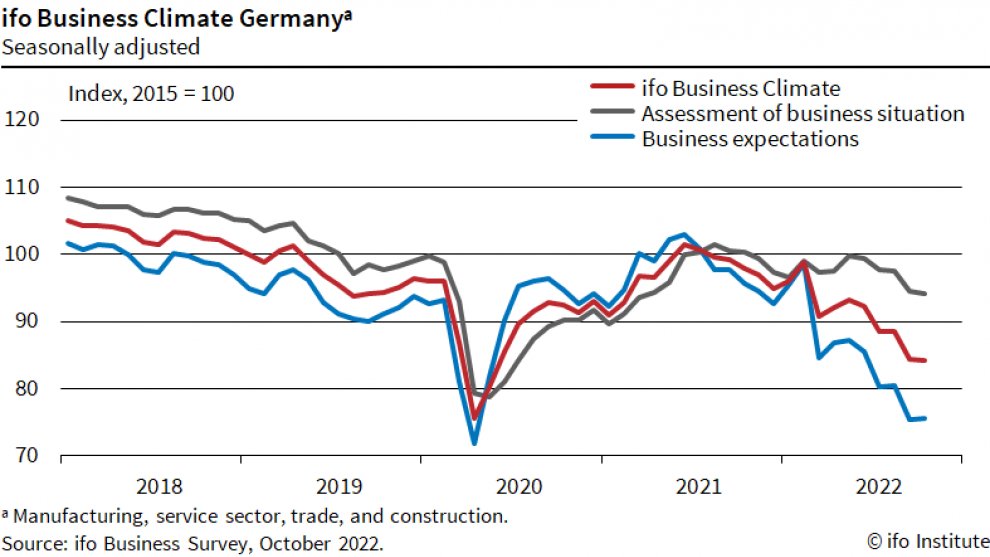
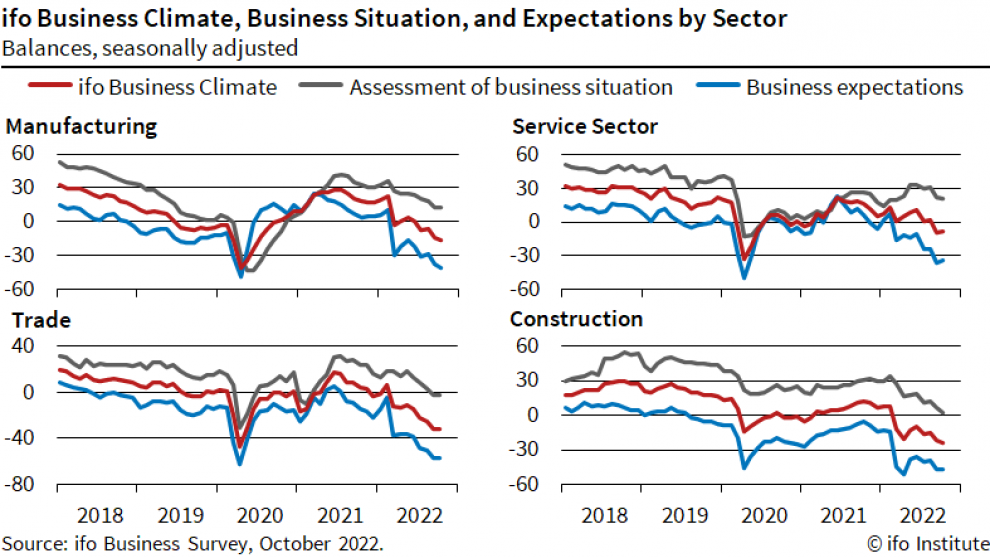
The Ifo Business Climate Index from Germany was above expectations in October – slightly down from 84.4 a month earlier to 84.3. The index components’ current situation and business expectations also marginally changed. But the overall level shows that the climate remains gloomy.
The expectations index rose from 75.3 to 75.6 for the month, while the assessment of current conditions fell 0.4 points to 94.1.
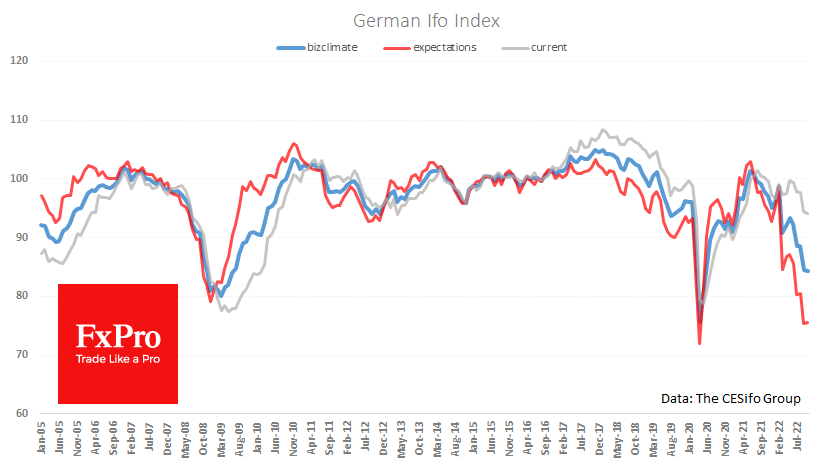
Economists are watching the business expectations component most closely as its sharp rise from the lows of the previous crises (2009 and 2020) signalled the start of a recovery in the German economy.
For traders on the foreign exchange and stock markets, the substantial rise of this index signalled the start of a rally in EURUSD and euro-region equities. Thus, supported by a strongly rising index in May 2020, EURUSD began its 10% rally in the following two months, pushing sentiment sideways. The index had previously reached its low point in December 2008, but only a powerful jump in March 2009 coincided with a general reversal of the markets and a subsequent 8-month rise in the pair of around 20%.
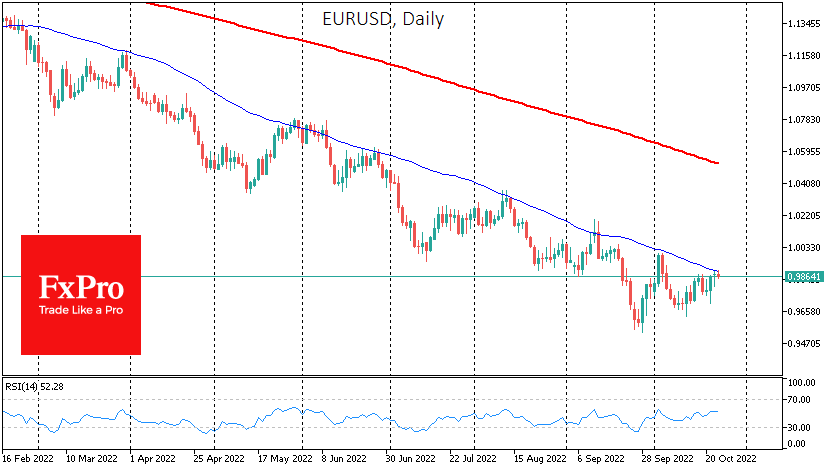
Today’s publication did not provide a meaningful signal of improvement in the German economy, so it is unlikely that the release is slightly better than expected. Traders will take the stoppage of the decline as a signal that the German economy has passed its low point.
Germany Ifo business climate fell slightly to 84.3, facing a difficult winter
Germany Ifo Business Climate ticked down from 84.4 to 84.3 in October, above expectation of 84.0. Current Assessment index dropped from 94.5 to 94.1, above expectation of 92.5. Expectations index rose from 75.3 to 75.6, above expectation of 74.9.
By sector, manufacturing fell from -14.3 to -15.9. Services rose slightly from -8.9 to -8.6. Trade rose from -32.3 to -31.9. Construction dropped from -21.9 to -24.9.
Ifo said: "Companies were less satisfied with their current business. Their expectations improved, but they are still worried about the coming months. The German economy is facing a difficult winter."
GBPUSD Struggles Withing Short-term SMAs; Neutral Bias
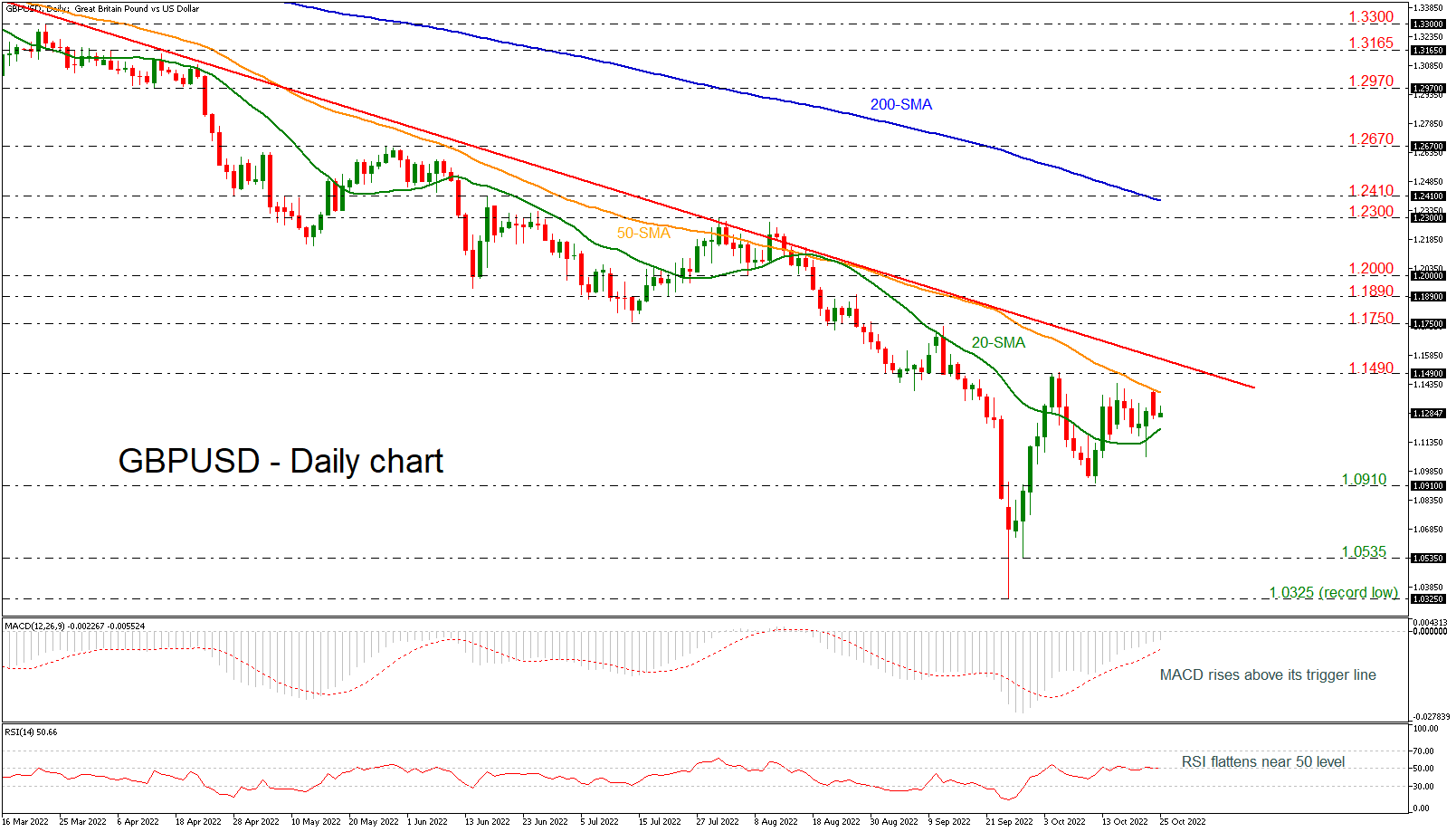
GBPUSD is hovering within the 20- and 50-day simple moving averages (SMAs) after the bearish movement from the 1.1400 mark on Monday. In the short-term, the price is failing to endorse a bullish correction and is shifting the bias to neutral.
Technically, the MACD oscillator is still strengthening its positive momentum, while the RSI is moving sideways near the neutral threshold of 50.
Should prices reverse lower, immediate support could come from the 20-day SMA at 1.1205. Below that, the 1.0910 barrier is another major support ahead of the 1.0535 level. Further losses would open the way towards the record low of 1.0325.
In the event of an upside reversal, the 50-day SMA at 1.1400 could act as a barrier before being able to re-challenge the 1.1490 resistance level. A break above this line would test the long-term downtrend line around 1.1550. Further gains would lead the way to a more bullish outlook in the near-term meeting the next resistance levels such as 1.1750 and 1.1890.
In the bigger picture, the pair is bearish as long as it holds below the 200-day SMA and the falling trend line. In case it violates these lines, bulls could take the upper hand.
US Oil: Bulls Continue to Strengthen Their Positions
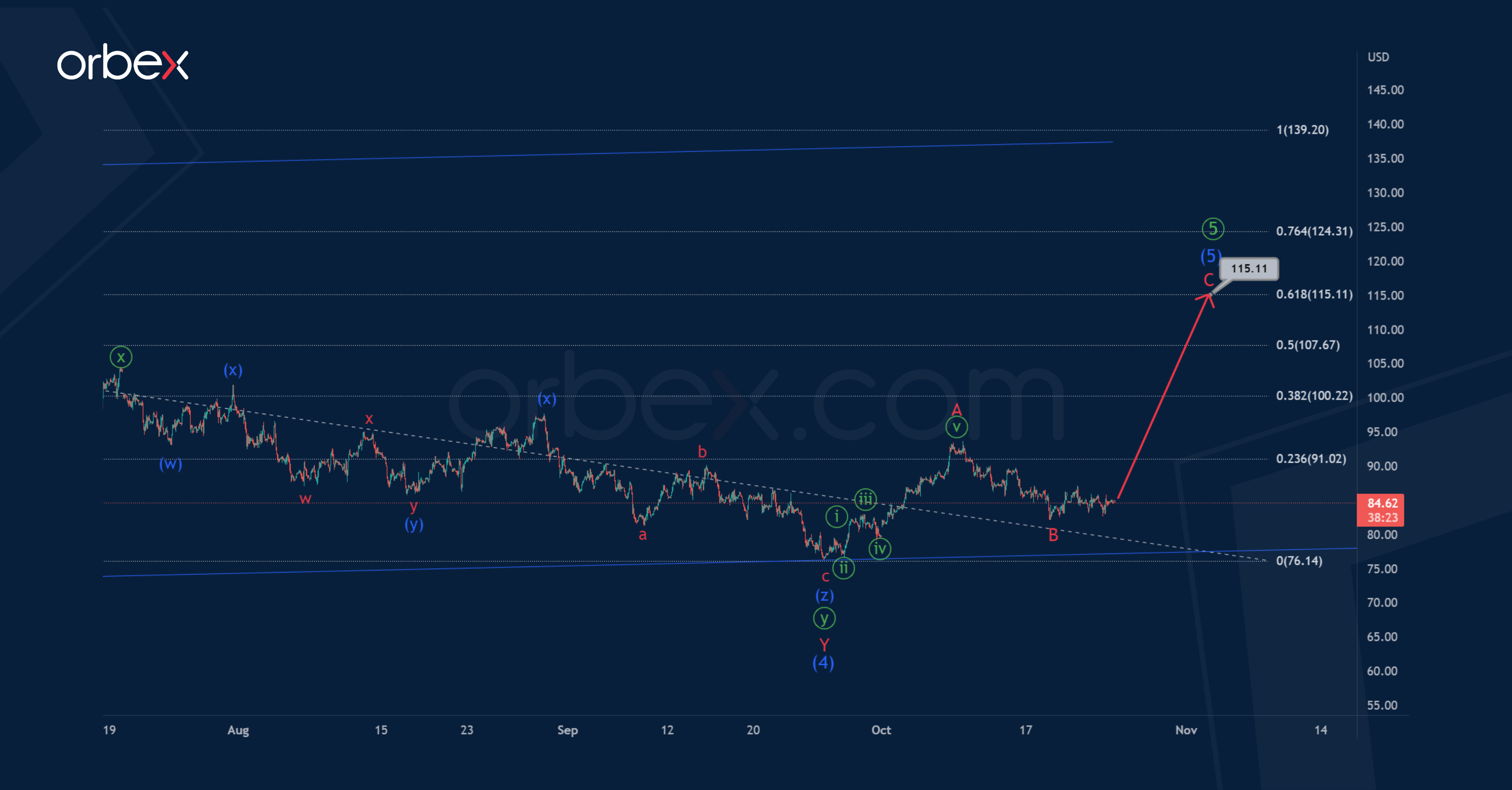
In the long term, USOIL seems to be forming a primary wave ⑤, which takes the form of an intermediate ending diagonal. On the 1H timeframe, we see its second half.
An intermediate correction (4) in the form of a minor double zigzag may have been completed recently.
Thus, at the moment the price may move within the intermediate wave (5). It is assumed that the intermediate wave (5) will take the form of a standard 3-wave zigzag A-B-C
The end of this construction is possible near 115.11. At that level, wave (5) will be at the 61.8% Fibonacci extension of impulse (3).
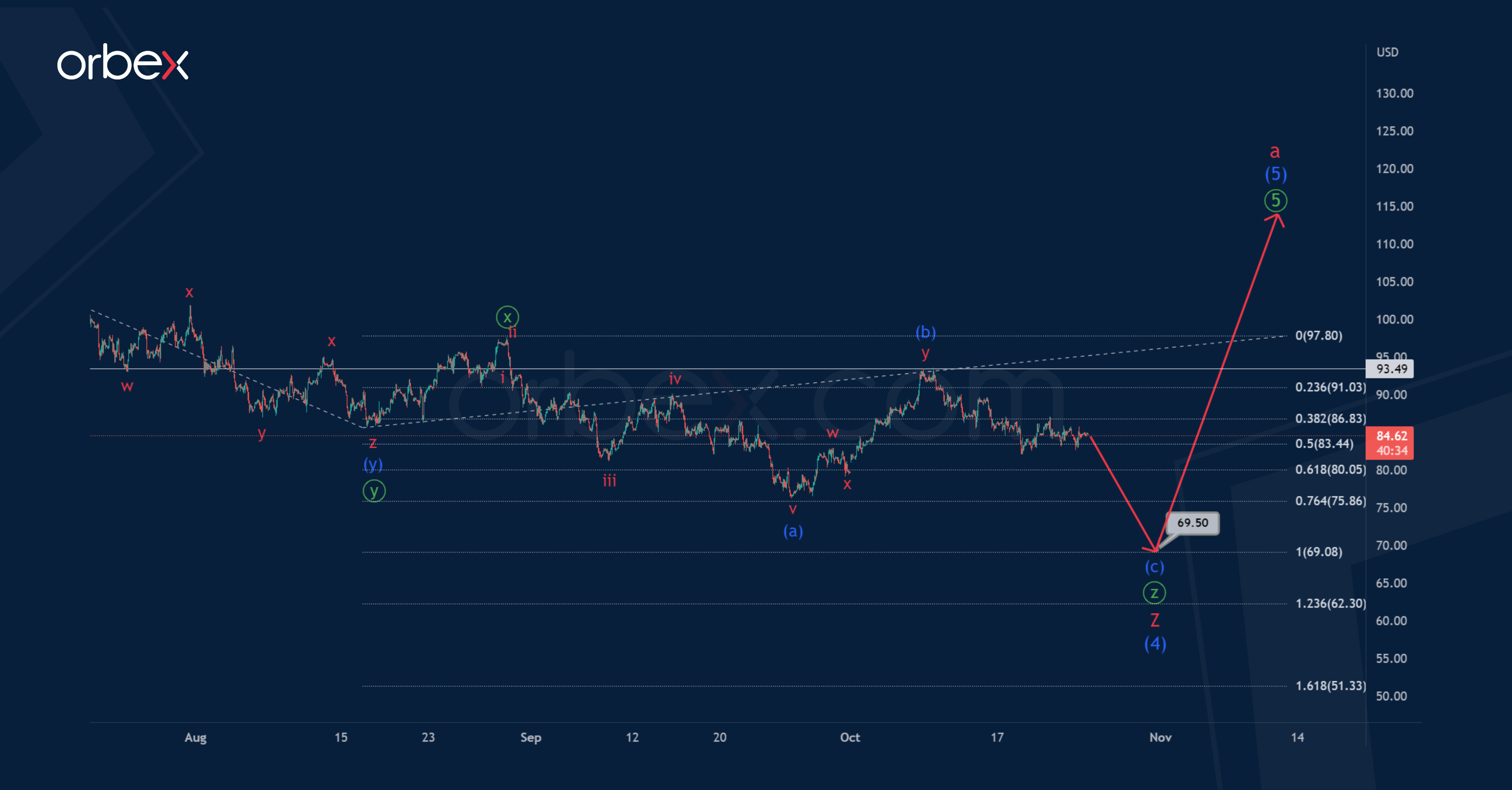
Alternatively, the construction of the intermediate correction (4) can be continued. Perhaps it will have the form of a triple zigzag W-X-Y-X-Z, where the minor sub-waves W-X-Y-X can be completed.
Thus, in the near future, the downward movement is expected to continue in the final actionary sub-wave Z, which can be completed in the form of a minute triple zigzag ⓦ-ⓧ-ⓨ-ⓧ-ⓩ.
The oil price may fall to 69.50, at which the minute waves ⓨ and ⓩ will be equal.
After reaching this level, the market is expected to grow above the maximum – 123.72.
Dow Jones 30 Gains Momentum
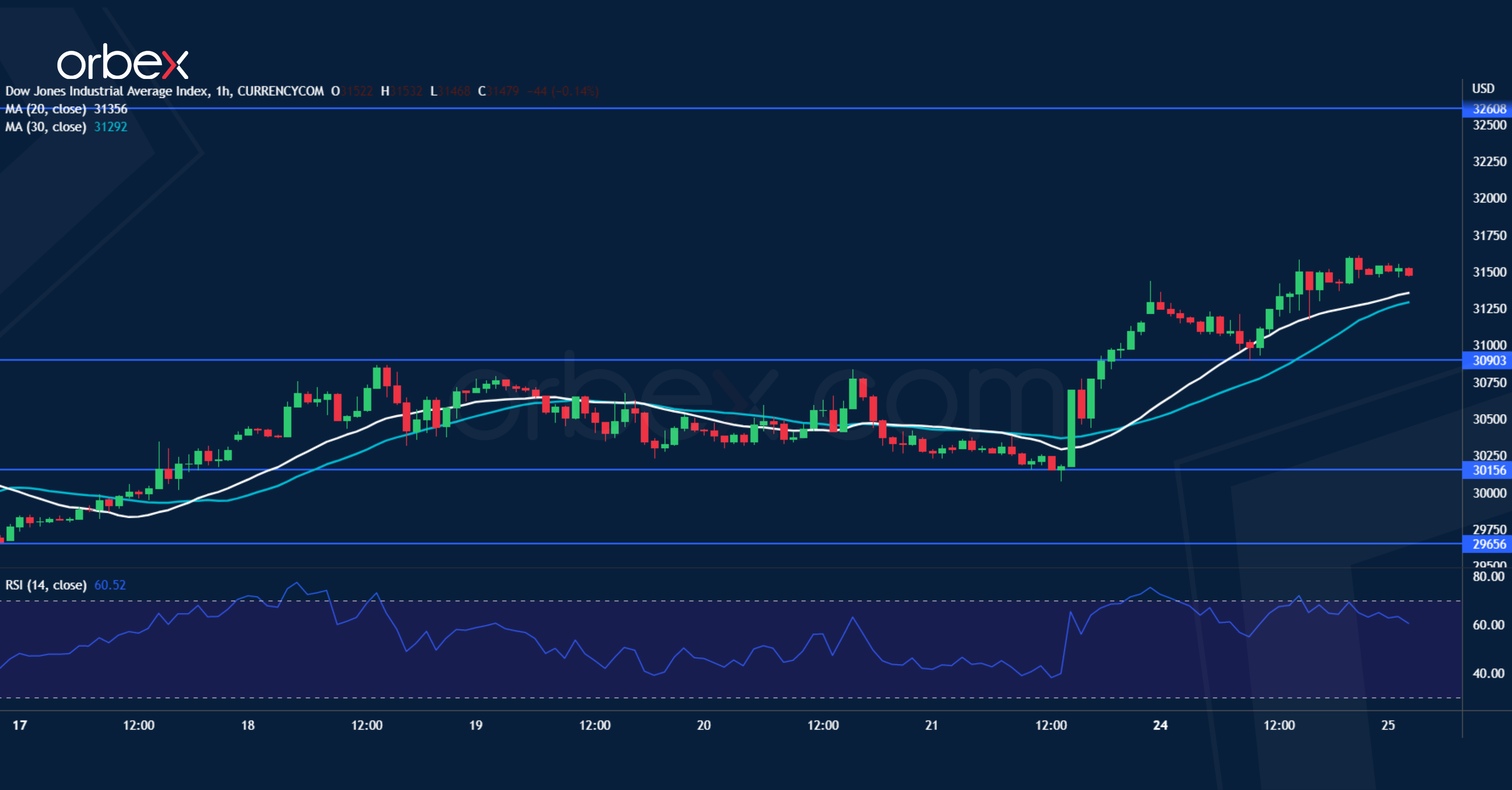
The Dow Jones 30 rallies as weaker US business activity in October rekindles hopes of a dovish Fed. From the daily chart’s perspective, a pop above the support-turned-resistance at 31000 is a sign of strong buying interest in the short-term. A series of higher lows may encourage the bulls to extend upwards, further squeezing the short side. After clearing 31300, the index is heading to September’s high at 32600. The RSI’s overbought condition may cause a limited retracement with 30900 as the first support.
EUR/GBP Heads Lower
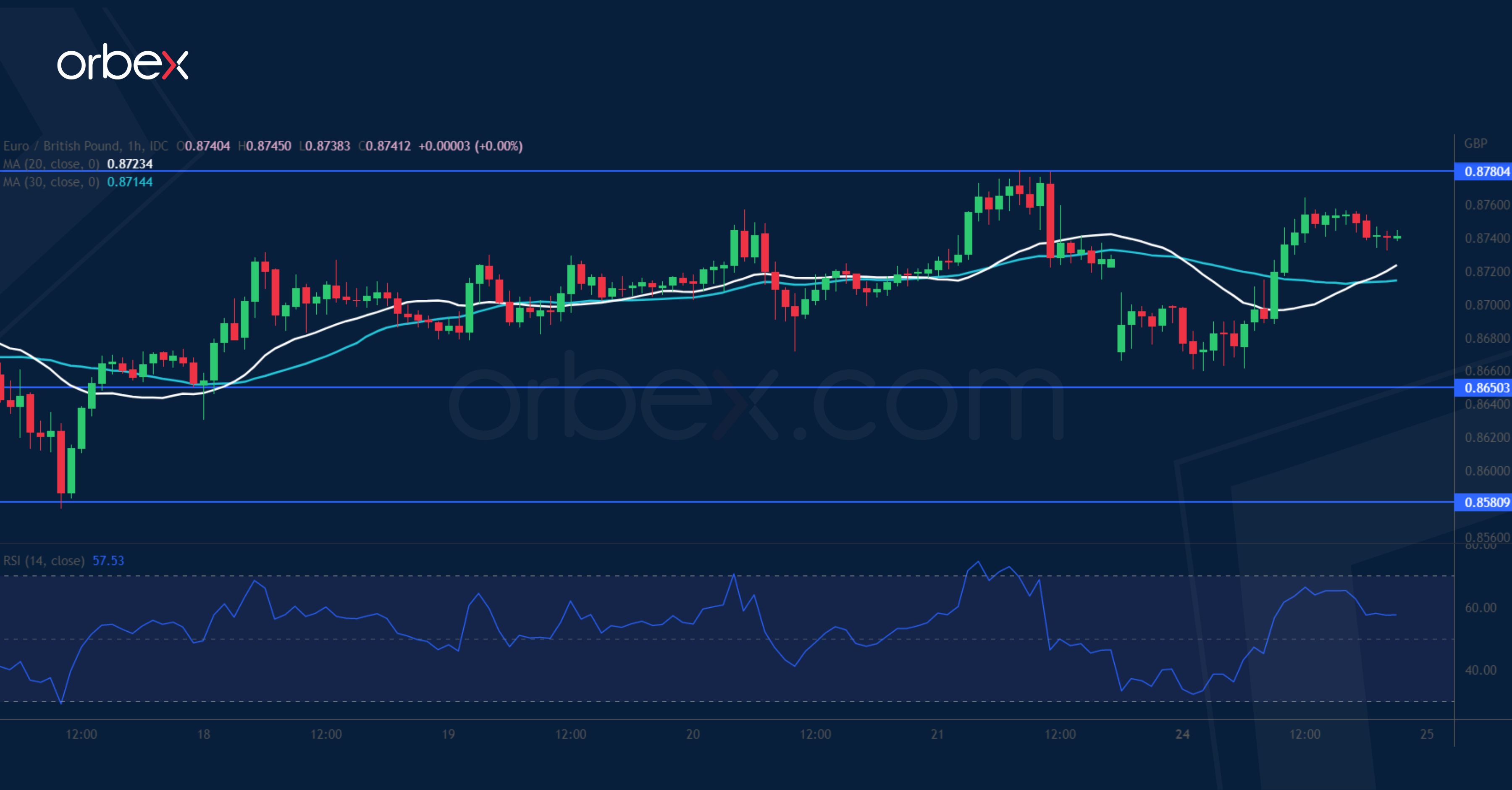
The pound weakens as traders stay wary of political and economic uncertainties in Britain. The rebound came under pressure at 0.8780 at the origin of a mid-August sell-off. A bearish MA cross on the daily chart suggests a shift in sentiment, and the euro could be vulnerable unless it clears the said resistance. A bullish breakout may trigger an extended rally above 0.8850. The demand zone between 0.8580 and 0.8650 is a major level to keep the single currency afloat, or a deeper correction might send it below 0.8450.
USD/CHF in Consolidation
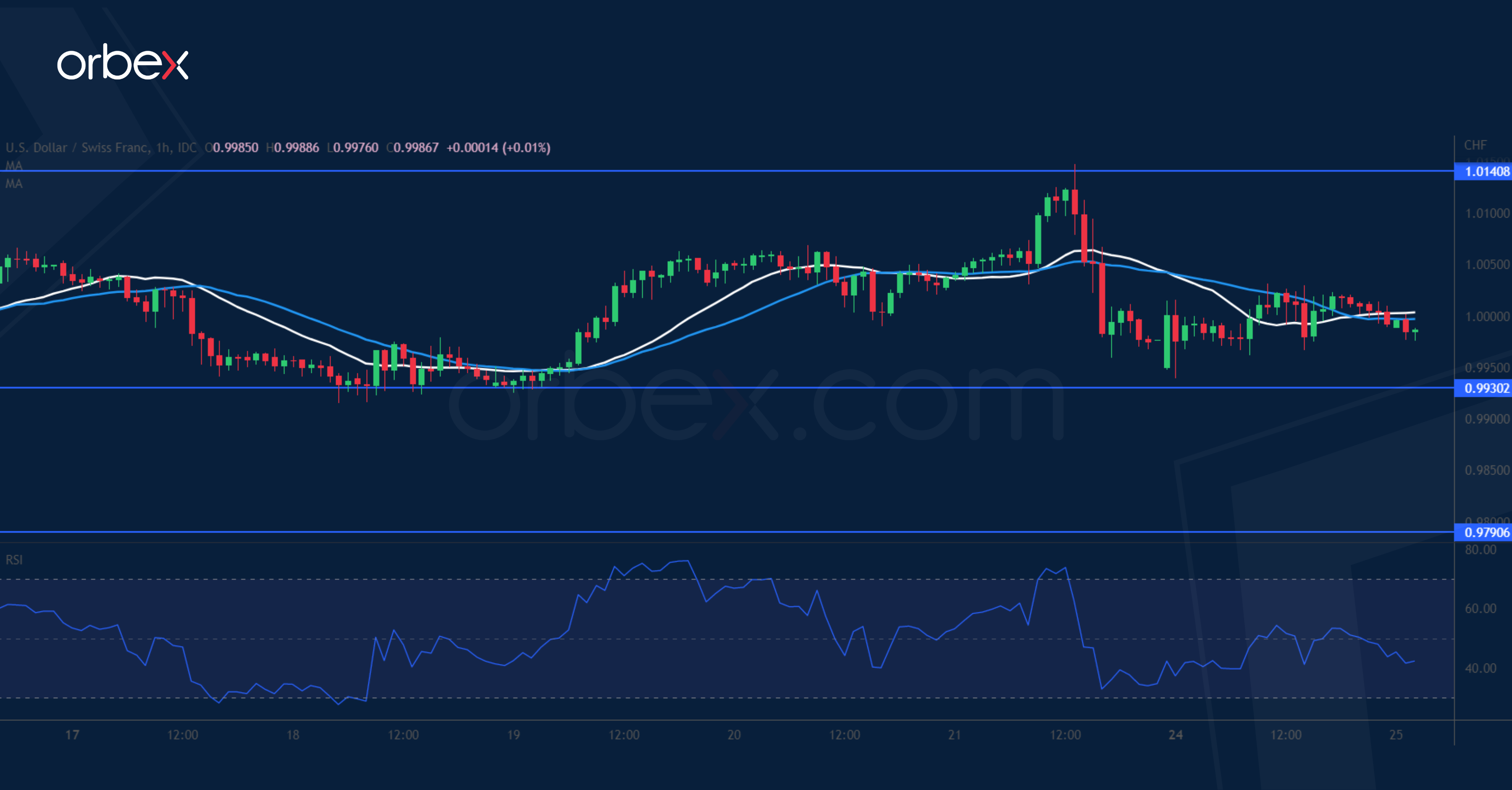
The US dollar stays muted over lacklustre manufacturing and services PMI. The bullish bias remains intact as the greenback consolidates its gains around parity. Buyers may see the sideways action as an opportunity to accumulate at a better price. 0.9930 at the base of the previous breakout coincides with the 20-day moving average, making it a congestion area. Further down, the daily support at 0.9790 would be the bulls’ second level of defence. A close above 1.0140 may attract momentum buying and send the pair towards 1.0300.
UK Money Markets Discount consecutive 75 bps Rate Hikes in Nov, Dec, Feb
Markets
UK Gilts hugely outperformed German Bunds and US Treasuries as it became clear that Rishi Sunak would become the next Prime Minister. The main move occurred at the start of trading after ex-PM Johnson dropped out of the race over the weekend before even getting in. UK yields fell around 30 bps across the curve. Sunak is rumoured to stick to the previous government’s October 31 deadline to present the long term fiscal outlook, allowing the Bank of England to take this into account when setting policy on November 3rd. Today’s speech by Bank of England chief economist could perhaps already give some insight in the central bank’s thinking. UK money markets currently discount consecutive 75 bps rate hikes at the November, December and February policy meetings. Sterling’s “relief rally” rapidly fainted with EUR/GBP closing at 0.8754.
US Treasuries ended 1.3 bps (3-yr) to 4.2 bps (30-yr) higher. We stick to our view that Treasuries’ are up for a correction higher on market talk (WSJ, Fed Daly) about the Fed slowing down it’s tightening pace from December onwards. Yesterday’s US PMI’s added a bit to this feeling with the composite dropping from 49.5 to 47.6 (vs 49.2 expected). On a sectoral level, the manufacturing PMI now fell below the 50 boom/bust mark (first time since June 2020) with the services PMI sinking deeper (46.6 from 49.3 vs 49.5 expected). The downward lurch in services activity was fuelled by the rising cost of living and tightening financial conditions. October saw a steep drop in demand for manufactured goods, meaning current output is only being maintained by firms eating into backlogs of previously placed orders. Chief business economist at S&P Global Market Intelligence Williamson, responsible for the surveys, says that there is an increased risk of economic contraction in Q4 while at the same time inflationary pressures remain stubbornly high. However, there are clearly signs that weakening demand is helping to moderate the overall rate of inflation, which should continue to fall in the coming months, especially if interest rates continue to rise.
The disappointing US PMI’s followed on the heels of weak numbers in EMU and the UK earlier on the day. They didn’t left instant traces on markets though. The German yield curve bull flattened with yields ending 3.8 bps (2-yr) to 10.4 bps (30-yr) lower. The same doji-like patterns that appeared on US charts on Friday, are now there for Germany as well. With Thursday’s ECB meeting approaching soon, the case for a short term correction is less strong than in the US though. EUR/USD closed a tad higher at 0.9874. Stocks gained up to 2% in Europe and 1.5% in the US. Bad economic news is good news… Today’s eco calendar probably won’t impact trading with German Ifo Business Climate, US consumer confidence and Richmond Fed Manufacturing.
News Headlines
Polish president Duda signed the extension of the anti-inflation shield to end 2022 into law yesterday. The measures include a reduced 8% VAT on fuels, an exemption for select fuels from a retail sales tax, keep a 0% VAT on fertilizers and food that was previously subject to a 5% VAT rate and hold excise taxes on electricity, some fuels and light heating oil at the minimum EU level. The decision was widely expected. Some policy members of the National Bank of Poland have already said it will be critical what will happen with the shield next year as it currently curbs some of the inflationary pressures. Inflation stood at 17.2% y/y in September – already the highest since 1996. Core measures came in at 10.7% y/y.
China’s central bank raised the so-called macro-prudential parameter for companies and bank’s cross-border financing from 1 to 1.25. Doing so allows them to borrow more from overseas and may enable more foreign capital to flow in. It is doing so at a time the (onshore) Chinese yuan tumbled to the lowest level since 2008 against the USD. The announcement also came shortly before the PBOC set the daily reference rate for the yuan at the weakest level since 2008. USD/CNY gaps higher at the Asian open, to 7.30.